 Neotropical invaders: a review of the most impactful non-native aquatic macrophytes
Abstract:
Aim Many macrophyte species have become invasive and cause severe ecological and economic impacts on aquatic ecosystems. In this review, we synthesize the main determinants of invasion by the principal macrophyte species in the Neotropics that originated from other continents, as well as their ecological impacts on these ecosystems.
Methods We conducted a systematic review using the Web of Science and Scopus databases.
Results The three most frequently studied non-native species introduced from other continents in Neotropical ecosystems were Hydrilla verticillata (hydrilla), Urochloa arrecta (African signalgrass), and Hedychium coronarium (white ginger). The success of these species is explained by a combination of traits that facilitate dispersal and colonization, together with rapid growth rates and tolerance to a wide range of abiotic conditions. Environmental factors such as drought, nutrient availability, and shading are important determinants of their success, although their influence varies among species. Biotic resistance provided by native species was identified as an important factor that reduces the ecosystem invasibility by all three species. We found evidence of impacts on native macrophyte populations and communities, as well as on invertebrates, fish, and birds. All three species caused changes in community composition, while reductions in native species diversity were most pronounced for African signalgrass and white ginger. African signalgrass accumulates extremely high biomass, eliminating native macrophytes and fish and altering ecosystem properties. For these reasons, it can be considered the most impactful of the three species.
Conclusions All three species cause significant impacts on Neotropical ecosystems, and efforts to prevent their spread and establishment should be prioritized. Management practices that include preventing dispersal, maintaining ecosystem integrity and native biodiversity, and implementing direct control at small spatial scales may help achieve effective control of these invasive species.
Keywords:
invasive species; non-native species; aquatic plants; invasive species impacts; biotic resistance; invasiveness; invasibility
Resumo:
Objetivo Muitas espécies de macrófitas tornaram-se invasoras e causam severos impactos ecológicos e econômicos nos ecossistemas aquáticos. Nesta revisão, sintetizamos os principais determinantes da invasão pelas principais espécies de macrófitas na região Neotropical que se originaram de outros continentes, bem como seus impactos ecológicos.
Métodos Conduzimos uma revisão sistemática utilizando as bases de dados Web of Science e Scopus.
Resultados As três espécies não nativas mais frequentemente estudadas, originárias de outros continentes e presentes em ecossistemas neotropicais, foram Hydrilla verticillata (hidrila), Urochloa arrecta (braquiária aquática) e Hedychium coronarium (lírio do brejo). O sucesso dessas espécies é explicado por uma combinação de características que facilitam a dispersão e a colonização, juntamente com altas taxas de crescimento e tolerância a uma ampla gama de condições abióticas. Fatores ambientais, como seca, disponibilidade de nutrientes e sombreamento, são determinantes importantes de seu sucesso, embora sua influência varie entre as espécies. A resistência biótica proporcionada pelas espécies nativas foi identificada como um fator importante que reduz a invasibilidade do ecossistema pelas três espécies. Encontramos evidências de impactos sobre populações e comunidades de macrófitas nativas, bem como sobre invertebrados, peixes e aves. As três espécies causaram alterações na composição das comunidades, enquanto as reduções na diversidade de espécies nativas foram mais pronunciadas para a braquiária e o lírio do brejo. A braquiária acumula uma biomassa extremamente alta, eliminando em algumas situações, macrófitas e peixes nativos e alterando as propriedades do ecossistema. Por essas razões, pode ser considerada a mais impactante das três espécies.
Conclusões As três espécies causam impactos significativos nos ecossistemas neotropicais, e esforços para prevenir sua disseminação e estabelecimento devem ser priorizados. Práticas de manejo que incluam a prevenção da dispersão, a manutenção da integridade do ecossistema e da biodiversidade nativa, bem como a implementação de controle direto em pequenas escalas espaciais, podem contribuir para o controle eficaz dessas espécies invasoras.
Palavras-chave:
espécies invasoras; espécies não nativas; plantas aquáticas; impactos de espécies invasoras; resistência biótica; aptidão invasora; suscetibilidade à invasão
1. Introduction
Aquatic ecosystems worldwide are increasingly threatened by biological invasions, which alter ecological processes, affect biodiversity, and generate substantial economic costs (Dudgeon et al., 2006; Cuthbert et al., 2021). The spread of non-native organisms has intensified in recent decades, primarily driven by human-mediated dispersal, habitat modification, and climate change, all of which increase ecosystem invasibility (Mormul et al., 2022). As a consequence, biological invasions are now recognized as one of the major drivers of ecological change in freshwater ecosystems (Gallardo et al., 2016).
Among invasive organisms, aquatic macrophytes are particularly impactful due to their ability to rapidly colonize large areas, modify habitat structure, and interfere with ecosystem functioning. By altering light availability, nutrient cycling, and hydrodynamics, they often act as ecosystem engineers, reshaping both abiotic conditions and biological communities (Yarrow et al., 2009; Villamagna & Murphy, 2010). Several traits may underlie invasion success, highlighting the ability of aquatic plants to thrive across a wide range of environmental conditions and to utilize effective dispersal strategies (Hussner et al., 2021; Bora & Padial, 2023a; Thomaz, 2025).
The Neotropical region harbors high diversity of native aquatic plants (Murphy et al., 2019), but also provides highly favorable conditions for the establishment and proliferation of invasive species introduced from other continents. Some of these species have become widespread and dominant, altering nutrient cycling, water quality, native biodiversity and food-web dynamics (Carniatto et al., 2013; Bradshaw et al., 2015; Bottino et al., 2021), as well as impacting navigation, and hydropower generation (Ferreira et al., 2016; Duque et al., 2025). Their ecological and socioeconomic impacts have prompted growing scientific attention, as well as management and policy responses across multiple countries.
Despite this increasing recognition, knowledge about invasive aquatic macrophytes in the Neotropics remains scattered across case studies and specific ecological contexts. While some reviews have synthesized information on aquatic plant invasions at global or regional scales (e.g., Mormul et al., 2022), relatively few have focused on specific regions of the Neotropics (e.g., Schmitz et al., 1991; Sousa, 2011), highlighting the most impactful species. Moreover, the accumulation of ecological studies over the last decades makes it timely to provide an updated synthesis of current knowledge on these plants.
In this study, we summarize current knowledge on the ecological aspects of the most prominent non-native invasive aquatic macrophyte species introduced from other continents into the Neotropical region. We defined the most relevant non-native invasive macrophytes as those attaining high population densities, displaying broad geographic distributions or exhibiting great ecological or economic impacts. Such species are likely to receive the most scientific and management attention. Based on this rationale, we focused on the species most extensively studied, i.e., those featured in the highest number of publications, in a systematic literature review. Specifically, we reviewed studies addressing: (i) the factors influencing their performance and success across different ecosystems, comprehending species invasiveness (the species potential to reproduce, spread, and establish in new locations; Rejmánek, 2011) and ecosystem invasibility (the ecosystem susceptibility to colonization and dominance by introduced species; Fridley, 2011); (ii) the impacts of invasive macrophytes on the environment and native biota; and (iii) molecular research that has contributed to identifying their origins or provided insights into their distribution and ecological dynamics.
We emphasize that this survey serves as an update to previous reviews on particular species of aquatic plant invasions in the Neotropics (e.g., Schmitz et al., 1991, 1993; Langeland, 1996; Sousa, 2011). Our aim is not to replace these foundational works, but to complement them. Furthermore, we highlight that our synthesis is based exclusively on studies conducted within the Neotropics and is not intended to substitute the knowledge derived from research in the species’ native ranges.
2. Methods
To find the most studied non-native invasive aquatic macrophyte species in Neotropical regions, we conducted a survey in the Web of Science (WoS, all databases) and Scopus on 10 April 2025. There were no time limits. We utilized this initial systematic survey to select the species that would be the focus of our review. After that, we added papers found through hand-searching and cross-referencing to the systematic survey (see Supplementary Material 1 in the Data Availability).
To align with the objectives of this review, we retained only studies investigating the ecology of non-native invasive macrophytes introduced into the Neotropical region from other continents. We excluded studies focused solely on species inventories, surveys, first occurrence records, and review articles. We also excluded studies addressing only control and management strategies or other applied aspects, such as the use of invasive macrophytes for chemical extraction, bioremediation, or biogas production.
The conclusions of investigations addressing the factors influencing invasive macrophyte success (objective i) and their impacts (objective ii) are sometimes difficult to disentangle in field-based studies. For this reason, we adhered as closely as possible to the authors’ stated goals and hypotheses, and we interpreted their conclusions within the framework of either one of these two perspectives (see Supplementary Material 2 in the Data Availability).
Finally, because management was not the primary focus of this review, we drew on insights from some studies identified through the systematic review, supplemented by additional relevant literature, to inform and enrich the discussion of this topic.
3. The Most Studied Species
Using only the papers retrieved systematically in the review (i.e., excluding additional sources), to avoid biased tendencies, we recorded seven non-native invasive macrophyte species native to other continents in our systematic survey. The three most frequently studied species, which form the core focus of this review, were: Hydrilla verticillata (Lf) Royle (hydrilla; 89 studies), Urochloa arrecta (Hack.) Morrone & Zuloaga (African signalgrass, hereafter ‘signalgrass’; 30) and Hedychium coronarium J. König (white butterfly ginger lily, hereafter ‘white ginger’; 13) (Figure 1). Other species were Hygrophila polysperma Anderson, Myriophyllum spicatum L., Iris pseudacorus L. and Nymphoides cristata (Roxb.) Kuntze, but each was investigated in fewer than five studies. Of the species retained for this review, hydrilla and white ginger are native to Asia, while signalgrass originates from Africa.

The three non-native invasive species of macrophytes, native to other continents, with the greatest number of publications in Neotropical countries: The stoloniferous macrophyte Urochloa arrecta, which roots along the shoreline and produces floating stems that extend into open waters (left in Fig. A and Fig. B), the rooted-submerged Hydrilla verticillata (center in Fig. A and Fig. C) and the emergent rhizomatous Hedychium coronarium (right in Fig. A and Fig. D). Photos by S. M. Thomaz (U. arrecta and H. coronarium) and R. P. Mormul (H. verticillata).
Using also only the papers retrieved systematically, ecological studies on non-native invasive macrophytes were conducted in four countries across the Neotropics. Studies occurred in Brazil (41 studies on hydrilla, 30 on signalgrass and 13 on white ginger), the U.S./Florida (44 studies on hydrilla), Guatemala (three studies on hydrilla) and Panama (one study on hydrilla).
In the next sections, we discuss ecological aspects of these three species using all papers we retrieved, i.e., those from the systematic survey and those obtained by handling-search and cross referencing (see Supplementary Material 1 in the Data Availability).
4. Hydrilla
Hydrilla is a rooted-submerged macrophyte that forms a canopy and is considered the “perfect aquatic weed” (Langeland, 1996). The species has been reported in 18 Neotropical countries, with the first record in Panama in 1935 (Velez-Gavilan, 2024 and references therein). In Florida, Hydrilla was introduced near Tampa Airport by a farmer around 1951-1952 (Schmitz et al., 1991, 1993). In Brazil, the first records date from 2005–2006 in the Upper Paraná River (Sousa et al., 2009; Pitelli et al., 2014). In both regions, populations consist exclusively of dioecious plants (Madeira et al., 2000; Lucio et al., 2019), and only female flowers have been recorded (Schmitz et al., 1993; Sousa, 2011).
Hydrilla reaches high frequencies of occurrence or abundance in a variety of aquatic habitats in the Neotropics, including lakes (Sutton & Portier, 1995; Langeland, 1996; Barrientos & Allen, 2008), reservoirs (Thomaz et al., 2009; Pitelli et al., 2014; Pulzatto et al., 2019; Salgado et al., 2023), rivers and channels (Sousa et al., 2010), and tidally influenced environments (Mataraza et al., 1999). Genetic studies suggest that Florida populations likely originated from Sri Lanka (Schmitz et al., 1991; Madeira et al., 1999). Determining the origin of Brazilian populations is more complex, as their haplotypes show similarity to both Asian and Floridian populations (Lucio et al., 2019). Considering the geographic proximity and history of human-mediated exchanges, it is hypothesized that the Brazilian populations most likely stem from introductions via Florida.
4.1. Hydrilla invasiveness
Studies in the Neotropics indicate that several traits contribute to hydrilla’s invasiveness and competitive advantage over other aquatic macrophytes. It exhibits high growth rates, outperforming both native and other invasive species under experimental conditions (Mony et al., 2007; Fasoli et al., 2018), with rapid biomass accumulation and doubling times from both fragments and tubers (Bianchini Junior et al., 2010). It also recovers rapidly from disturbances (Sousa et al., 2010). Physiologically, hydrilla benefits from being a C4-like species, which gives it a competitive edge under warmer conditions (Holaday & Bowes, 1980; Rao et al., 2006). It has a low light compensation point and is capable of utilizing bicarbonate (Van et al., 1976), responding more strongly and flexibly to increased carbon availability than native species (Fasoli et al., 2018). Niche dynamics analyses suggest that founder effects and invasion bottlenecks initially caused niche reduction in the Neotropics (Ribas et al., 2018). Nevertheless, evidence points to a subsequent niche expansion following its invasion of the Americas, with high invasion potential across the region (Zhu et al., 2017).
Hydrilla reproduces asexually through various vegetative propagules, which facilitates its spread and colonization. The production of tubers and turions, which occurs year-round (Sutton & Portier, 1985), enhances its regenerative capacity. Turion production increases under short day lengths and low plant density (Miller et al., 1993), while tuber production is triggered by short photoperiods (Sutton et al., 1980), independently of sediment fertility, indicating its adaptability across trophic conditions (Sutton, 1986a). The species also produces numerous branches that function as asexual propagules after fragmentation (Umetsu et al., 2012a, b; Fasoli et al., 2018; Mormul et al., 2020). Fragments derived from stems or branches remain buoyant for 2–6 days before sinking and rooting (Wood & Netherland, 2017), forming axillary buds with high regeneration capacity, even after desiccation (Silveira et al., 2009). The high dispersal potential of these fragments is further amplified by e-commerce (Peres et al., 2018). Field studies corroborate the importance of asexual reproduction, showing positive correlations between current and past abundances in female-only populations (Florêncio et al., 2021a). The rapid downstream spread of such populations (Thomaz et al., 2009), together with low genetic variability (Lucio et al., 2019), further confirms the dominance of clonal propagation.
In summary, hydrilla’s invasiveness in the Neotropics results from a combination of aggressive growth, physiological adaptations, and prolific asexual reproduction. In addition, its ability to grow rapidly and accumulate biomass, combined with a low light compensation point and efficient bicarbonate usage, allows it to thrive in warm, nutrient-rich environments. Despite initial founder effects, the species has expanded its niche significantly. Its spread is primarily driven by vegetative reproduction through fragments, tubers, and turions, which are produced continuously throughout the year. Dispersal is further facilitated by both natural processes, such as downstream drift, and human-mediated activities, including commercial trade.
4.2. Invasibility of aquatic ecosystems by hydrilla
4.2.1. Environmental factors
The successful invasion of hydrilla across diverse Neotropical ecosystems is shaped by a complex interplay of abiotic environmental factors, which determines the susceptibility of local communities and ecosystems to be invaded. Light availability is one of the primary drivers of its distribution and growth (Blackburn et al., 1968; Hopson & Zimba, 1993; Sousa et al., 2009; Silveira, 2015; Pulzatto et al., 2019). Indeed, hydrilla colonizes under a broad range of irradiance conditions (White et al., 1996) and light penetration, often measured by Secchi depth, is a significant predictor of hydrilla occurrence (Sousa et al., 2009; Thomaz et al., 2009; Florêncio et al., 2021a, b). Interaction between light and other factors such as flooding (Sousa et al., 2010) and littoral slope (Florêncio et al., 2021a) explains temporal and spatial variation in biomass. Hydrilla also appears to be less affected by siltation than some native species, suggesting a possible advantage under future climate scenarios (Silveira & Harthman, 2024).
Carbon availability also influences hydrilla growth (Fasoli et al., 2018), with its effects mediated by the trophic status of the ecosystem. Although eutrophication can negatively affect growth and branching, elevated CO2 levels may counteract these effects (Mormul et al., 2020). This indicates that rising atmospheric and aquatic carbon could benefit hydrilla in eutrophic ecosystems, raising concerns about its future expansion under global change scenarios.
Responses of hydrilla growth to nutrient availability have been extensively investigated in the Neotropics. The species absorbs nitrogen directly from the water column (Kennedy et al., 2009; Grosselin et al., 2018), and its growth is positively correlated with concentrations of total phosphorus and nitrogen (Gu, 2006). It often achieves higher growth rates than native macrophytes across a wide range of nitrogen concentrations, enabling invasion of both oligotrophic and eutrophic systems (Kennedy et al., 2009). Additionally, nutrient release from decomposing organic matter can stimulate growth, particularly after water drawdown events (Dainez-Filho et al., 2019).
Increased sediment fertility generally promotes hydrilla growth (Sutton, 1986a; Mony et al., 2007; Hasandras et al., 2015), and is often associated with reduced root-to-shoot ratios (Sutton & Portier, 1995). Experimental evidence shows that hydrilla grows more vigorously than both exotic and native macrophytes in nutrient-enriched sediments (Mony et al., 2007; Hasandras et al., 2015), which may explain its success in eutrophic habitats. However, excessively high sediment nitrogen and phosphorus levels can inhibit its growth (Grosselin et al., 2018), suggesting that hydrilla may be less competitive in hyper-eutrophic systems relative to some native species.
Beyond nitrogen and phosphorus, elements such as potassium and iron have been shown to promote hydrilla growth (Basiouny & Garrard, 1984; Reid Junior & Martin, 1975; Basiouny et al., 1977a, b). Magnesium can have stimulatory or inhibitory effects depending on concentration (Martin & Reid Junior, 1976), while zinc can be toxic, although nitrate may mitigate this toxicity (Zhang et al., 2014). These findings suggest that under specific conditions, elements other than nitrogen and phosphorus may play important roles in hydrilla performance in Neotropical ecosystems.
Sediment organic matter (OM) is often identified as another limiting factor. Across several Neotropical studies, a negative correlation was found between OM content and hydrilla presence and biomass (Sousa et al., 2009; Pulzatto et al., 2019). This is supported by experimental data (Silveira & Thomaz, 2015; 2023). Extracts from peat-like sediments have inhibited hydrilla growth, likely due to humic substances (Dooris & Martin, 1980). In controlled settings, hydrilla biomass initially increases with OM enrichment but declines beyond a certain threshold, whereas native species may continue to increase in biomass (Silveira & Thomaz, 2015). Differences have been attributed to plant morphological traits associated with intercellular spaces that transport gases (Silveira et al., 2016), suggesting that hydrilla is less tolerant to the oxygen-depleting and potentially toxic conditions (e.g., H2S) common in high-OM sediments.
Although hydrilla can colonize brackish environments, its salt tolerance is limited. While growth is not significantly affected at low salinity levels, short-term saline pulses can drastically reduce biomass (Tootoonchi et al., 2023; Frazer et al., 2006), possibly conferring a competitive advantage to salt-tolerant native species following such events (Mataraza et al., 1999).
Desiccation is another factor that limits hydrilla’s performance. Tubers generally survive desiccation longer than turions (Basiouny et al., 1978), and desiccated plant fragments show lower colonization success when dried in sand compared to mud (Silveira et al., 2009). Nevertheless, regrowth from propagules has been observed after sediment exposure to drought (Harwell & Havens, 2003), suggesting that terrestrial dispersal by animals or boats may contribute to spread across watersheds.
In short, hydrilla’s invasibility in Neotropical ecosystems results from its adaptive responses to a variety of abiotic factors. While light availability is a key determinant, nutrient enrichment, particularly under moderate conditions, enhances its growth. However, extreme nutrient levels, high sediment organic matter, salinity fluctuations, and desiccation impose limitations. These complex environmental interactions ultimately shape the species' performance and distribution across invaded ecosystems.
4.2.2. Biotic resistance and interactions affecting hydrilla performance
While previous examples emphasized abiotic influences on hydrilla, biotic factors, such as competition (a key component of biotic resistance; Gurevich, 2011) and herbivory, as well as their interactions with environmental conditions, play a crucial role in hydrilla’s performance in Neotropical ecosystems. Such biotic influences have been investigated through both field observations and experimental studies, often yielding contrasting conclusions.
Evidence for biotic resistance by native macrophyte communities has emerged from several independent studies. For example, lower cover of hydrilla was observed along more protected shorelines, suggesting that intact native macrophyte assemblages can provide resistance to invasion (Salgado et al., 2023). This effect may be linked to lower nutrient concentrations, stable water chemistry, and increased habitat heterogeneity (Salgado et al., 2023). In contrast, a large-scale field study found that hydrilla biomass was more strongly influenced by physical and chemical drivers, such as wind disturbance, sediment characteristics, and water quality, than by native plant competition (Pulzatto et al., 2019). However, competition was more influential at finer spatial scales, where direct species interactions are stronger. Another study revealed a density dependence: competition dominated at high plant densities, but facilitation occurred at low densities (Florêncio et al., 2021a).
Experimental evidence further supports the idea that native plant biomass, rather than species richness, plays a central role in limiting hydrilla growth (Petruzzella et al., 2020). Certain native macrophytes have been shown to reduce hydrilla shoot biomass and tuber production, potentially through the release of allelopathic compounds (Sutton, 1986b, 1990; Sutton & Portier, 1991), thereby hindering early establishment.
Nonetheless, the role of competition in constraining hydrilla is not universally supported. Some studies have found comparable inter versus intraspecific competition between hydrilla and a native species regardless of nutrient status (Dainez-Filho et al., 2019), or reported non-significant effects of native plant presence on hydrilla biomass (Da Costa et al., 2024). Additionally, the effectiveness of biotic resistance appears to depend on the native macrophytes life form. For instance, isoetid-like species may be ineffective at limiting hydrilla colonization, even under low hydrilla propagule pressure (Louback-Franco et al., 2020).
Herbivory also emerges as a potentially important biotic resistance mechanism. While rising temperatures may enhance hydrilla invasiveness, herbivorous snails have been shown to reduce its growth, indicating that herbivory could mitigate temperature-driven advantages to invasion (Calvo et al., 2019). A broader range of herbivores, including gastropods and fish, can also substantially decrease hydrilla biomass (Ribas et al., 2017). Importantly, herbivory can interact synergistically with native plant competition and sediment-related stress associated with high OM content to strengthen resistance to hydrilla (Silveira & Thomaz, 2023).
Taken together, these findings indicate that native competition alone may not consistently suppress hydrilla invasion. Instead, factors such as priority effects (e.g., order and timing of colonization), spatial scale, abiotic context, and the identity and biomass of native species all modulate biotic resistance. Additionally, maintaining or restoring riparian vegetation may play a role in supporting diverse native macrophyte communities and associated fauna, thereby enhancing resistance. Despite some inconsistencies, it is evident that hydrilla performance is shaped by the combined influence of abiotic stressors (e.g., turbidity, sediment organic matter), competition with native plants, and pressure from a variety of herbivores. This complex interplay of factors may explain why hydrilla successfully invades some habitats but remains nearly absent from others within the same region, despite decades of invasion history (Figure 2).

Potential interactive mechanisms and agents identified in the field and in the laboratory that offer resistance to hydrilla (green plants) invasion, as indicated in lakes of the Upper Paraná River floodplain in Brazil where this plant is nearly absent. (a) Competition with native submerged species (e.g., Egeria najas Planch.); (b) herbivory by macroinvertebrates (e.g., Pomaceae sp.); (c) fish bioturbation [(e.g., Astronotus ocellatus (Agassiz, 1831)]; (d) high turbidity and (e) high organic matter content in sediment. Based on Sousa et al. (2009), Silveira & Thomaz (2015, 2023) and Ribas et al. (2017).
4.3. Hydrilla’s impact on the environment and biota
Studies conducted in both natural and experimental settings across the Neotropics have examined hydrilla's effects on environmental conditions and diverse aquatic organisms, including microorganisms, macrophytes, invertebrates, fish, and other vertebrates. In line with the context-dependent nature of hydrilla’s establishment success, its impacts are also variable and sometimes contradictory. Nonetheless, the widespread invasion of Neotropical ecosystems by hydrilla has the potential to affect multiple ecosystem services (e.g., Monterroso et al., 2011), prompting substantial investment in management strategies, which have yielded positive outcomes (Hiatt et al., 2019). Below, we summarize the principal effects of hydrilla on abiotic conditions and on the population and community attributes of various aquatic groups.
4.3.1. Abiotic features and ecosystem processes
Hydrilla’s influence on abiotic conditions has been reported in several studies. It can induce significant diel and vertical fluctuations in dissolved oxygen (DO), sometimes leading to hypoxia and impacting fish (Bradshaw et al., 2015), or causing midday surface supersaturation (Rejmánková et al., 2018). Hydrilla stands also promote phosphorus settling, significantly reducing water phosphorus concentrations (Gu, 2006). Additionally, its proliferation has been associated with decreases in alkalinity, conductivity, turbidity, orthophosphate, and chlorophyll-a (Schmitz & Osborne, 1984), while increasing sediment organic matter (Joyce et al., 1992). Overall, these findings suggest that hydrilla can substantially alter several abiotic parameters. However, another study reports that hydrilla maintains thermal and oxygen conditions similar to those of native plants (Cunha et al., 2011). Although its structural complexity can provide suitable habitat for aquatic fauna (see below), the decomposition of hydrilla biomass may deplete DO, creating physiological stress for animals.
Some studies have examined the decomposition dynamics of hydrilla detritus in Neotropical environments. Comparisons with native submerged species show that hydrilla exhibits similar decay rates to some macrophytes (Chiba de Castro et al., 2013a), but significantly faster rates than other submerged species (Yang et al., 2020), as well as emergent and free-floating macrophytes (Zhou et al., 2018). These differences are explained by variations in detritus chemical composition, including distinct concentrations of nutrients, lignin, cellulose, and hemicellulose among species. Hydrilla’s rapid decomposition may result in the swift release of nutrients and contaminants, such as heavy metals, into the water column, with potential adverse consequences for water quality (Zhou et al., 2018). These differences in decomposition also extend to microbial processes: for example, bacterial colony counts in decay solutions varied between hydrilla and native species (Yang et al., 2020).
Moreover, hydrilla decomposition consumes more DO than the native Egeria densa Planchon, likely due to its higher lignin content (Chiba de Castro et al., 2015). As a result, invaded habitats may undergo more pronounced reductions in DO compared to non-invaded areas. Additionally, E. densa exhibits greater enzymatic efficiency and faster degradation of cellulose and hemicellulose than hydrilla, which may influence microbial mineralization pathways and increase the accumulation of particulate organic matter in invaded systems (Chiba de Castro et al., 2021a).
Together, these findings suggest that hydrilla invasions can significantly alter detritus decomposition dynamics, potentially leading to enhanced DO depletion, shifts in microbial activity, and rapid nutrient and contaminant release. These changes may disrupt nutrient cycling and contribute to environmental issues such as eutrophication and water contamination, warranting greater attention and further research.
4.3.2. Microorganisms (bacteria, algae and rotifers)
Hydrilla exerts great effects on microbial communities in Neotropical ecosystems. Studies have documented a diverse microbial assemblage associated with hydrilla, including bacteria, fungi, actinomycetes, and cyanobacteria (Shabana & Charudattan, 1996). Still, microbial composition and activity can differ significantly between systems with and without hydrilla, likely due to shifts in substrate availability and utilization (Gordon-Bradley & Williams, 2015). Comparisons with native macrophytes have also revealed distinct epiphytic bacterial communities, attributed to differences in plant exudates and leaf morphology (Gordon-Bradley et al., 2014).
Hydrilla-related dynamics have been linked to broader microbial and planktonic shifts. Seasonal increases in hydrilla coverage have been associated with transitions in zooplankton assemblages toward nearshore rotifer-dominated communities (Schmitz & Osborne, 1984). Conversely, declines in hydrilla have preceded cyanobacterial blooms and increases in heterotrophic protists, possibly due to changes in food resources, epiphytic surface availability, or selective pressures on microbial niches (Barbosa et al., 2024). Microcosm and whole-system studies corroborate these patterns, with periphytic algae and phytoplankton increases commonly following hydrilla control or removal, likely in response to enhanced nitrogen availability (Hodgson & Linda, 1984; Hodgson & Carter, 1982). Periphytic algal composition also differs between hydrilla and native plants (Mormul et al., 2010a).
Together, these studies indicate that hydrilla significantly influences microbial communities and may thereby affect critical ecosystem processes such as nutrient cycling. However, hydrilla may also confer benefits by suppressing toxic cyanobacteria, an ecosystem service often provided by submerged macrophytes.
4.3.3. Macrophytes
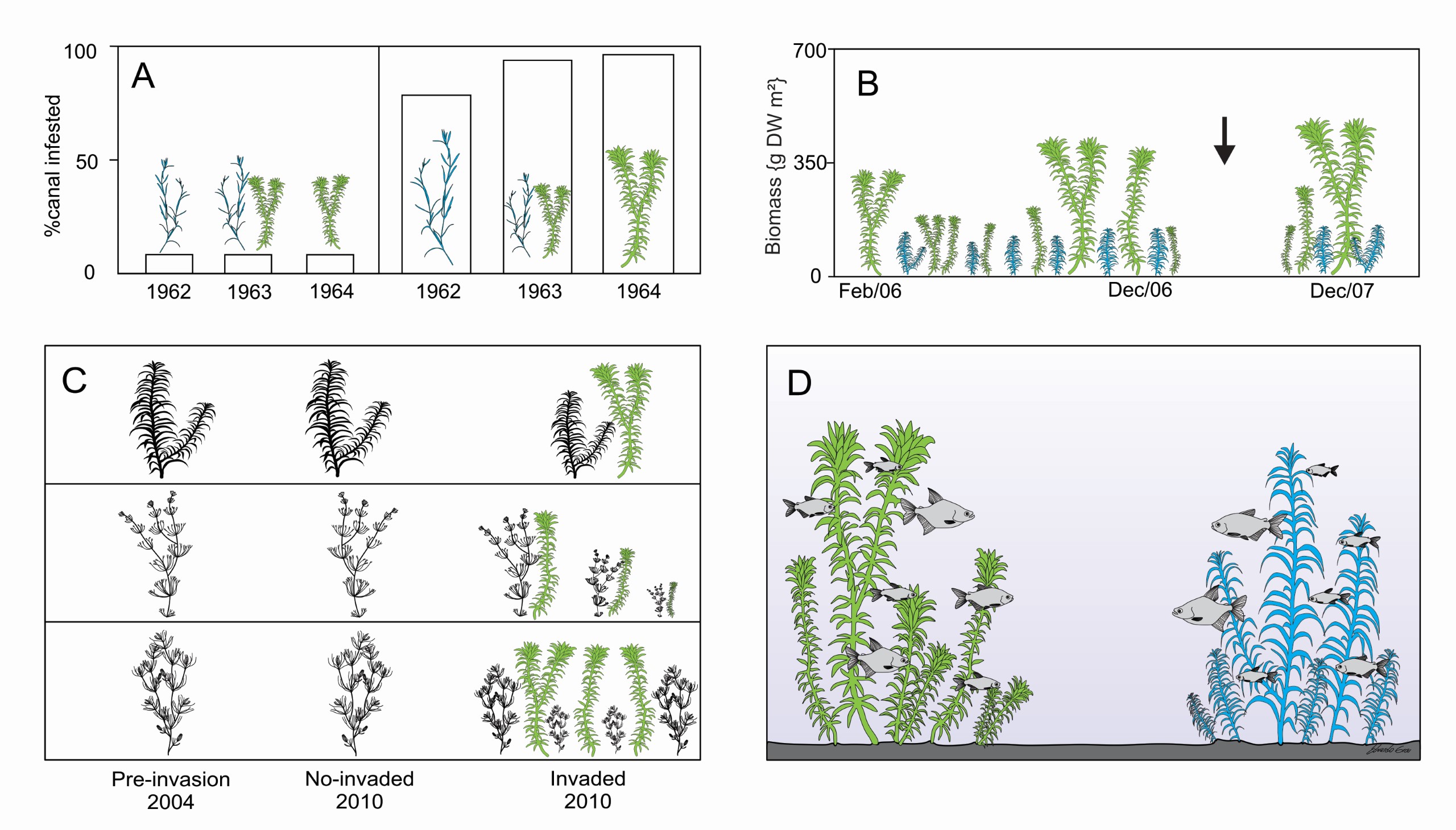
Observational evidence indicates that hydrilla can negatively affect other macrophyte species. It has been observed to displace native macrophytes over short periods (Blackburn et al., 1968; Figure 3A) and has been linked to declines in other non-native species (Mataraza et al., 1999). Hydrilla also demonstrates rapid post-disturbance recovery and higher biomass accumulation relative to native competitors, suggesting high competitive potential under certain conditions (Sousa et al., 2010; Figure 3B). In situ studies have shown that mitigating hydrilla's competitive dominance (e.g., via herbivorous fish) can facilitate native macrophyte establishment (Johnston et al., 1983). Notably, hydrilla may also interfere with the regeneration of emergent species (Rejmánková et al., 2018).

Some impacts of hydrilla (green plants) are context dependent. In two canals in Florida (A), Najas guadalupensis (Spreng.) Magnus was replaced by hydrilla within two years (based on Table 1 of Blackburn et al., 1968), indicating that competition eliminated the native species. Bars indicate the percentage of ecosystem colonized by macrophytes. In a backwater of the Upper Paraná River floodplain (B), hydrilla attained a biomass (represented by plant lenghts) approximately three times higher than that of the native Egeria najas, and the invasive species recovered much faster from a flood (arrow) than the native one (based on Sousa et al., 2010). In a Brazilian reservoir (C), incidence data obtained before and after invasion showed that the probability of occurrence of Egeria spp. (upper panel) did not change over time in either invaded or non-invaded sites, indicating no effect of hydrilla on its occurrence. However, the probability of occurrence of Nitella sp. (middle pannel) and Chara cf. guairensis (lower pannel) increased by approximately three- and fivefold, respectively, but only in invaded sites, indicating facilitation (based on Silveira & Thomaz, 2019). In a backwater of the Upper Paraná River floodplain (D), fish total total abundance and species richness did not differ between monospecific patches of hydrilla or the native Egeria najas, but assemblage composition differed (based on Cunha et al., 2011).
In contrast, some studies report minimal or no effects of hydrilla on macrophyte richness, abundance, or diversity (Hoyer et al., 2008). Species co-occurrence analyses reveal more nuanced outcomes, with some native taxa not being affected, while others, especially those morphologically dissimilar, such as Characeae, may co-occur more than expected by chance with hydrilla, indicating facilitation (Silveira & Thomaz, 2019; Silveira et al., 2025; Figure 3C). In some cases, hydrilla invasion has even coincided with increased native richness, potentially due to factors such as improved light availability, reduced physical disturbance, or enhanced substrate stabilization (Thomaz et al., 2012a; Silveira & Thomaz, 2019).
Experimental evidence also points to variable outcomes, influenced by abiotic context. For example, salinity stress can eliminate hydrilla's competitive advantage (McDonald et al., 2022), and nutrient availability can determine the outcome of interactions, with hydrilla sometimes showing greater plasticity under fertilized conditions (Mony et al., 2007). Root–shoot contact has also been shown to modulate competition, indicating that belowground and aboveground resources are both critical in mediating competitive outcomes (Silveira et al., 2018). Biotic interactions further shape these dynamics. For instance, the presence of certain herbivores can reverse competitive hierarchies, allowing native species to outperform hydrilla (Van et al., 1998), emphasizing the complexity and contingency of these relationships.
Several mechanisms may explain these varying outcomes. Functional or ecological differences between hydrilla and native species (e.g., light use efficiency, canopy formation) may give hydrilla a competitive advantage in some cases (Van et al., 1976 in Van et al., 1998). Conversely, niche differentiation or dissimilar growth forms may facilitate coexistence or reduce competitive pressure (Silveira & Thomaz, 2019). Even morphologically similar species may differ in ecophysiological traits such as light requirements, depth tolerance, slope preferences, and adaptive strategies (Florêncio et al., 2021a, b, 2025), allowing coexistence. As with invasion success, the outcomes of hydrilla’s interactions with macrophytes can be shaped by arrival order (priority effects), hydrological regimes, and other environmental filters. Lastly, methodological aspects, such as whether studies use presence/absence or biomass metrics, can influence the detected strength and direction of the perceived hydrilla’s impact.
4.3.4. Macroinvertebrates
Various aspects of hydrilla’s association with macroinvertebrates have been explored, revealing its role as both a resource and a habitat. Studies on individual invertebrate species indicate that hydrilla can serve as a suitable substrate and feeding resource for native invertebrates. For instance, a native weevil has been shown to complete its development and feed on hydrilla stems at a rate comparable to a species specifically used for hydrilla biocontrol (Wheeler & Center, 2007).
The potential of hydrilla as a food source for native snails has also been investigated experimentally. Some native snail species exhibit a preference for hydrilla over other submerged native macrophytes (Cruz et al., 2015; Oliveira et al., 2019). Similarly, a non-native snail species has been observed to readily consume hydrilla, although its preference relative to other macrophytes can vary (Baker et al., 2010; Gettys et al., 2008). These differences in consumption appear to be linked to plant traits such as nutritional quality (e.g., caloric content) and physical structure (e.g., morphology) (Oliveira et al., 2019; Baker et al., 2010).
At the population level, field studies have indicated that hydrilla can facilitate the establishment of other invasive invertebrate species (Michelan et al., 2014). This positive interaction raises concerns about “invasional meltdown,” where one invasive species facilitates another, potentially leading to enhanced negative effects on native communities (Simberloff & von Holle, 1999).
Studies focusing on macroinvertebrate community attributes have generally shown that hydrilla supports diverse groups (e.g., Schramm Junior et al., 1987). Numerous chironomid species with varying feeding strategies have been reared from hydrilla samples, underscoring its suitability as habitat (Stratman et al., 2013). Although some studies have found no significant differences in invertebrate diversity between hydrilla and native macrophytes, they have detected differences in community composition (Mormul et al., 2010b; Behrend et al., 2013; Carniatto et al., 2020a). In some cases, hydrilla even harbors higher invertebrate richness and abundance than native species (Rejmánková et al., 2018). Conversely, other research has found similar community composition and richness, but reduced functional and beta diversity of chironomids in hydrilla stands, indicating potential negative effects on certain diversity components (Gentilin-Avanci et al., 2019). Given the morphological similarities between hydrilla and some native macrophytes, these differences may stem from associated microbiota, which constitute an important food source for many invertebrates (Mormul et al., 2010b).
In sum, despite its relatively recent introduction in many regions, hydrilla can offer food and habitat for native invertebrates. However, it may also lead to shifts in community structure and facilitate other invasive species, raising ecological concerns.
4.3.5. Fish and other vertebrates
The interactions between hydrilla and aquatic vertebrates, particularly fish, have been widely studied. While hydrilla may be directly consumed by some vertebrates, including manatees (Etheridge et al., 1985), turtles (Adler et al., 2018), and fish, fish herbivory on hydrilla is uncommon in the Neotropics, where herbivorous fish are relatively rare. For example, in the Paraná River in Brazil, hydrilla was detected in the stomach contents of only a few species (e.g., Schizodon nasutus Kner, 1858) (Isaac et al., 2008).
More commonly, hydrilla influences fish diets indirectly by providing habitat for invertebrate preys. Field studies show no significant differences in fish feeding activity between hydrilla and native macrophytes, although diet composition can vary (Carniatto et al., 2014). In microcosms, fish foraging efficiency and trophic parameters (e.g., invertebrate composition, abundance, richness, and niche breadth) were similar between hydrilla and native macrophytes (Carniatto et al., 2020a). Differences between field and laboratory results may be explained by macrophyte biomass, which was controlled in the experiment but not in the field.
Fish responses to hydrilla at the population level are variable. Some native species use hydrilla as habitat (Wilson et al., 2014), while studies on Micropterus salmoides (Lacépède, 1802) (largemouth bass) have found both positive associations (Tate et al., 2003; Johnson et al., 2014) and no significant correlations (Allen et al., 2003). However, dense hydrilla stands can negatively affect fish growth (Bonvechio & Bonvechio, 2006), and water levels can modulate these relationships (Nagid et al., 2015). For Lepomis spp., abundances are negatively correlated with plant biomass and positively with dissolved oxygen, suggesting that preference depends on a balance between plant structural complexity and DO availability (Wilson et al., 2015).
Experimental studies on habitat preference indicate that some native fish do not discriminate between native macrophytes and hydrilla (Looby et al., 2021; Figueiredo et al., 2015). However, hydrilla may be selected for specific functions, such as nesting by certain non-native fish species (Nico & Muench, 2004), and as refuge from predators for others (Chick & McIvor, 1997).
At the community level, hydrilla stands can support similar fish abundance and richness to native macrophyte stands, though species composition may differ (Barrientos & Allen, 2008; Chick & McIvor, 1994; Cunha et al., 2011; Figure 3D). Hydrilla can also act as an important nursery habitat (Conrow et al., 1990), reinforcing its role in supporting fish communities. Beyond fish, hydrilla has not been shown to significantly affect aquatic bird abundance, richness, or diversity in multi-lake studies (Hoyer et al., 2008).
In summary, hydrilla can provide feeding and breeding habitats for fish, sometimes with economic benefits (Furse & Fox, 1994). Habitat preference does not appear to rely heavily on evolutionary history, and beneficial associations can arise rapidly. Moderate hydrilla abundance may support fish communities, though negative effects may emerge at very high biomass levels, a pattern that may be masked by the challenges of sampling fish in dense vegetation (Thomaz et al., 2025).
5. The Tropical Signalgrass
The signalgrass is an emergent, stoloniferous macrophyte that roots along the shores of aquatic ecosystems. It produces long, floating stolons that extend into open waters, where it accumulates massive quantities of biomass (Carniatto et al., 2013; Ferreira et al., 2016). In Brazil, the species was initially misidentified as Urochloa subquadripara (Trin.) R.D.Webster in some publications (e.g., Michelan et al., 2010a, b; see Michelan et al., 2013 for more details). However, records of U. subquadripara are scarce, and the species typically occurs in well-drained sites (Ferreira et al., 2016; Tropical Forages, 2025). Therefore, it is highly probable that investigations conducted on U. subquadripara in aquatic or semi-aquatic ecosystems were, in fact, dealing with U. arrecta. For this reason, all such studies (seven in total) are here considered as focusing on U. arrecta.
Signalgrass is documented in Florida and across ten countries in Central and South America (Kew Gardens, 2025). It was likely introduced for use as pasture (Seiffert, 1980; Rojas-Sandoval, 2023 and references therein), with its introduction history suggesting an origin in Zimbabwe (Seiffert, 1980). Although several Brazilian samples have been genetically analyzed, the scarcity of African sequences still hampers efforts to pinpoint the exact origin of the studied populations (Scorsim et al., 2023).
Signalgrass has invaded a wide range of ecosystems, including rivers, streams, ponds, irrigation channels, wetlands, reservoirs, and lakes, as well as disturbed areas, roadsides, and natural grasslands (Rojas-Sandoval, 2023).
5.1. Signalgrass invasiveness
Signalgrass's remarkable success likely stems from its high potential for nutrient uptake and rapid biomass accumulation. For example, experimental studies show that signalgrass exhibits a superior competitive ability to absorb macronutrients and accumulates significantly more dry matter (between 1.4 and 8.4 times more) than four other grass species (Bianco et al., 2015).
Its reproductive strategy further contributes to its success. Efficient asexual propagation likely drives its rapid spread and quick recovery from disturbances. Indeed, signalgrass rapidly spreads from the edges of its stands (Tomazi & Castellani, 2016). Stolons, rhizomes, and stem fragments are highly effective propagules, enabling strong colonization and regeneration (Lorenzi, 2000; Michelan et al., 2010a; Pott et al., 2011; Bando et al., 2016). Stem fragments, produced abundantly by physical disturbances, are particularly important propagules; fragments of various sizes and from different stem portions (apical, intermediate, or basal) successfully sprout (Michelan et al., 2010a; Bando et al., 2016). The importance of asexual reproduction is highlighted by the low genetic diversity observed across both small (Diamente et al., 2020) and large (Scorsim et al., 2023) spatial scales. Seed production is likely limited and exhibits low viability (Ferreira et al., 2016).
Propagules spread via several mechanisms, including direct anthropogenic means, water flow (Pott et al., 2011; Ferreira et al., 2016), or within floating mats (Michelan et al., 2018a). These vectors enhance dispersal and colonization of new habitats. In coastal environments, tidal flows further promote the dispersal of propagules, facilitating colonization of new habitats (Schneider et al., 2024). The ability of signalgrass fragments to endure stressful, drought-prone environments further contributes to its high invasiveness across tropical ecosystems (Michelan et al., 2010a; Bora & Padial, 2023b).
Finally, its success in diverse Neotropical habitats may be further boosted by rapid evolutionary changes. This was suggested by a common-garden experiment revealing differences in growth parameters (Bora et al., 2020) and anatomical traits (Silveira & Harthman, 2024) between freshwater and brackish water populations.
In summary, signalgrass's invasive success largely reflects efficient nutrient uptake, rapid growth, and effective assexual reproduction and dispersal. Moreover, rapid evolutionary adaptation to novel conditions enables it to thrive across diverse Neotropical ecosystems.
5.2. Invasibility of aquatic ecosystems by the signalgrass
5.2.1. Environmental factors
Various physical and chemical variables influence signalgrass's success. Temperature appears crucial. Originating from tropical Africa, signalgrass's ability to thrive is limited under colder conditions (Duque et al., 2023). Other physical factors, such as littoral slope, shading from riparian vegetation, fetch (a measure of wave disturbance), and high water flows negatively affect signalgrass presence and abundance (Thomaz et al., 2009, 2012b; Alves et al., 2017; Schneider et al., 2024).
Human disturbances facilitate signalgrass invasion. It particularly thrives in habitats impacted by human activities such as pasture, agriculture, irrigation, mining, urban development, and riparian vegetation removal (Alves et al., 2017; Evangelista et al., 2017; Fares et al., 2020).
Among chemical factors, nutrient availability plays a pivotal role in signalgrass's success. Experiments show that signalgrass growth increases markedly with sediment nutrient amendments (Teixeira et al., 2017) and in muddy compared to sandy sediments (Fasoli et al., 2015). Although adapted to hypereutrophic environments, excessively nitrogen and phosphorus concentrations (above 168.0 mg N L-1 and 24.8 mg P L-1) are toxic to signalgrass (Domingos et al., 2015).
Signalgrass can tolerate sediment water having conductivity as high as 5,000 µS.cm-1 (approximately 6.7 g NaCl.L-1) (Bora et al., 2020; Silveira et al., 2024), and salinities up to 30 ppt (Santini et al., 2022). However, its growth is limited by extreme salinities, where oxidative stress rises (Santini et al., 2022). This tolerance to moderate salinity enables the species to colonize coastal rivers, estuaries, and mangroves, where salinity likely limits other macrophytes (Reinert et al., 2007; Santini et al., 2022) and it represents an evolutionary opportunity for the future colonization of even more saline environments (Bora et al., 2020).
Signalgrass stem fragment sprouting decreases with exposure to drought, but a small percentage of these propagules can still sprout even after six days of air exposure without sediment contact (Bora & Padial, 2023b), or 17 days when left on sediment (Michelan et al., 2010a). These findings indicate that fragments can be dispersed by animals or human activities, successfully colonizing new sites.
Despite desiccation's negative impacts, signalgrass is more drought-resistant than some native aquatic grasses (Leal et al., 2022). Moreover, field studies also show that while droughts reduce occurrences, populations recover rapidly (Thomaz et al., 2009). This rapid recovery likely results from efficient propagules regeneration (including seeds), and surviving shore plants.
Overall, environmental factors such as temperature, shading, disturbances, nutrients (Figure 4), and salinity influence signalgrass's distribution and abundance. There is a preference for eutrophic conditions and tolerance to brackish habitats. It is very likely that a combination of factors may explain context-dependency of invasion success. For instance, it has been suggested that the combination of high nutrient input and relatively slow flows explain its invasion success in coastal tidal Brazilian rivers (Schneider et al., 2024). Furthermore, while desiccation may limit spread, stem fragment resistance facilitates dispersal via multiple vectors.

Selected potential interactive mechanisms and agents identified in the field and in the laboratory associated with signalgrass (green plants) success. The species thrive in eutrophic environments, less disturbed by waves (A), while its presence and biomass are negatively affected by riparian vegetation shading (a), competition with native macrophytes (b) and waves (c)(B). Based on Thomaz et al. (2009, 2012b), Michelan et al. (2013), Teixeira et al. (2017), Alves et al. (2017) and Schneider et al. (2024).
5.2.2. Biotic resistance and interactions affecting signalgrass performance
Experiments demonstrate that signalgrass growth declines with higher native species richness and density (Michelan et al., 2013; Teixeira et al., 2017) (Figure 4). According to these authors, competition for space, light, and nutrients likely explains these patterns.
Although native macrophyte communities play a key role in resisting signalgrass invasion, its response to competition with individual native species is variable. For example, the aquatic grass Hymenachne pernambucensis (Spreng.) Zuloaga reduces signalgrass growth (Leal et al., 2022), while in the Brazilian Pantanal, the native macrophyte Panicum elephantipes Nees ex Trin. is one of the few species capable of matching signalgrass in competitive ability (Pott et al., 2011).
These insights come mainly from small-scale experimental plots (less than 1m-2), where interaction with real environmental variation is limited. Indeed, large-scale observations reveal a different picture. For instance, field data from extensive areas (~1000m-2 macrophyte patches) show that signalgrass co-occurs with many native species more frequently than expected by chance (Thomaz & Michelan, 2011). Furthermore, large-scale data suggest that signalgrass is more likely to occur in habitats favorable to native macrophytes (Thomaz et al., 2009, 2012b; Alves et al., 2017). Taken together, these findings support the biotic acceptance hypothesis, which proposes that habitats favorable to native species at large scales are also favorable to invasive species, whereas biotic resistance mainly operates at small scales (Fridley et al., 2007; Figure 4B). Given these variable responses, it seems unlikely that biotic resistance alone can eliminate signalgrass from large areas.
5.3. Impacts of signalgrass on the environment and biota
Signalgrass exerts pervasive effects mainly due to its remarkably high biomass accumulation, reaching up to 7000 g DW m-3 (Carniatto et al., 2013). Such growth results in dense mats that both float in the water column and settle on sediment (Carniatto et al., 2013; Bornschein et al., 2022). These accumulations stem from signalgrass's high C:N:P ratios and lignin content, which reduces decomposition rates and strongly affects aquatic carbon cycling (Bottino et al., 2021).
Signalgrass affects various ecological communities. For example, field data from small plots (0.25 m-2) reveal that the co-occurrence patterns between signalgrass and some individual native macrophyte species are predominantly lower than expected by chance (Thomaz & Michelan, 2011). This indicates that signalgrass markedly reduces the presence of most native macrophytes. Consistently, native macrophytes composition shifts, and alpha, beta, and gamma diversity decline in invaded areas or as signalgrass abundance rises. Such effects occur across diverse habitats, such as streams, rivers, lakes, floodplains, and reservoirs (Michelan et al., 2010b; Carniatto et al., 2013; Fernandes et al., 2013; De Amorim et al., 2015; Sato et al., 2021).
Time-sequence studies further reveal that signalgrass drives seasonal homogenization of taxonomic and functional diversity (Galvanese et al., 2022) and the long-term loss of native macrophyte species (Bando et al., 2023). Mesocosms experiments confirm these detrimental effects, showing that signalgrass significantly suppresses macrophyte growth (Michelan et al., 2018b). Together, these studies suggest that competition for space and nutrients, combined with shading, underlies signalgrass impacts (Figure 5).

Some impacts of signalgrass (green plants) on other organisms. Increases of signalgrass biomass reduces macrophyte abundance, richness and change macrophyte assemblage composition (from A to C) (Michelan et al., 2010b; Carniatto et al., 2013; Fernandes et al., 2013; De Amorim et al., 2015; Sato et al., 2021). Where signalrass accumulates extremely high biomasses not attained by native macrophytes, it eliminates macrophyte and fish communities (C; based on Carniatto et al., 2013). At least two threatened bird species that depend on native macrophytes for feeding and nesting (A) have their habitats eliminated by signagrass, compromising their conservation (Reinert et al., 2007; Bornschein et al., 2024).
Signalgrass impacts also extend beyond macrophytes. For example, invertebrate composition differs between signalgrass and native macrophyte habitats, with abundances significantly lower in signalgrass. Consequently, fish diet composition differs among plant types, though feeding activity remained similar (Carniatto et al., 2020b). Another study comparing these two plant types revealed that fish communities exhibited lower diversity in signalgrass patches than in native macrophyte patches and this community was absent from sites where signalgrass biomass exceeded 2000 g DW m-3 (Carniatto et al., 2013; Figure 5).
Birds are also impacted by signalgrass. Formicivora acutirostris (Bornschein, Reinert & Teixeira, 1995), a threatened bird found in few coastal ecosystems in Southern Brazil, is heavily impacted (Figure 5). Signalgrass eliminates the habitat stratification necessary for movement and foraging, removes the plants needed for nest construction and support, and reduces the macrophyte cover where the bird finds its food (Reinert et al., 2007; Bornschein et al., 2024), although signalgrass may benefit the population of the non-threatened bird Rallus longirostris (Bornschein et al., 2022). Since other bird species depend on these habitats (Bornschein et al., 2017), impacts caused by signalgrass likely affect whole bird communities.
Risk analyses indicate that large Neotropical rivers and reservoirs face moderate to high invasion risk from signalgrass (Duque et al., 2023, 2025). In the case of reservoirs, this is particularly concerning, as these ecosystems are economically important for water supply and hydroelectric power generation. Considering all severe impacts cited here, occasionally eradicating native communities, and the potential for spread in the near future, signalgrass ranks among the most pervasive non-native invasive aquatic macrophytes in the Neotropics; and its control and management is highly recommended.
6. White Ginger
White ginger is an emergent rhizomatous macrophyte native to the Eastern Himalayas that thrives in the shallow areas of aquatic ecosystems and waterlogged habitats, typically growing to 1-2 meters tall. Its primary mode of propagation is through rhizomes (Lorenzi, 2000). It was widely introduced across the globe as an ornamental species, including in the Neotropics (Instituto Horus, 2025). White ginger is now documented in 30 Neotropical countries (Rojas-Sandoval & Acevedo-Rodríguez, 2013). Despite its prevalence, there are relatively few studies addressing the mechanisms underlying its success and its impacts, compared to research on hydrilla and signalgrass.
6.1. White ginger invasiveness
White ginger's success in the Neotropics may be attributed to a combination of reproductive and ecological traits. For example, its seeds germinate regardless of light levels, allowing the species to thrive in a wide range of light conditions (Brígitte, 2008). Furthermore, seeds remain viable for extended periods and can germinate in low oxygen environments. These traits provide a competitive advantage in habitats subjected to permanent or seasonal flooding (Brígitte, 2008).
Beyond seed propagation, white ginger successfully reproduces via rhizome fragments (Chiba de Castro et al., 2021b). While rhizome survival decreases with desiccation, they can resist drying for approximately 30 days (Pinheiro et al., 2021). Their ability to sprout is also highly resilient under a wide range of drought, temperature, and light conditions, which further promotes its establishment and spread (Pinheiro et al., 2021). Finally, these rhizome fragments are easily spread by hydrochory and anthropochory, further enhancing their role as efficient propagules and contributing to the species’ invasive success (Bellini & Becker, 2021).
The development of aerenchyma in its rhizomes is also considered a trait that contributes to white ginger's high performance in Neotropical riparian habitats (Chiba de Castro et al., 2021b). Furthermore, white ginger alters its growth strategy based on the presence of other macrophytes. It invests more in ramet production when competition is low but prioritizes plant height when native macrophytes are present (Chiba de Castro et al., 2016). The authors emphasize that this significant phenotypic plasticity enchances its competitive ability against co-occurring species, representing another key driver of its invasive potential.
To summarize, research conducted in Neotropical regions consistently indicates that several key traits enhance white ginger's performance and competitive ability, thereby facilitating its widespread success in diverse ecosystems. These factors include advantageous germination characteristics, high phenotypic plasticity, specialized anatomical adaptations for wet environments, and effective dispersal pathways.
6.2. Invasibility of aquatic ecosystems by the white ginger
Light levels and biotic resistance are potentially important factors to explain white ginger success, but responses to these factors are not always consistent in part because they are obtained in observational studies. For instance, there are studies showing that white ginger develops well under shading (Santos et al., 2005; Bellini & Becker, 2021; Figure 6A) or a combination of shading and low native diversity (Martins & Marchello, 2023). Moreover, white ginger tends to be more abundant in areas where riparian vegetation is degraded and dominated by altered non-native forests, despite the fact that shading levels in these habitats are presumably high (Bellini & Becker, 2021; Figure 6B). Thus, the increase of ecosystems dominated by non-native forest in Neotropical regions poses concerns from a conservation perspective. In contrast, other studies have found that white ginger growth is enhanced in high-light environments (Costa et al., 2019; Figure 6C).

Selected potential environmental factors determining water ginger success (green plants) in Neotropics. The species can thrive under shading caused by riparian vegetation (A; Santos et al., 2005; Bellini & Becker, 2021; Martins & Marchello, 2023), in sites degraded and dominated by invasive trees, like Pinus sp (B; Bellini & Becker, 2021) and under full sunlight (C; Costa et al., 2019). The species is negatively affected by droughts (D), presence of herbaceous plants (E; Chiba de Castro et al., 2016; Martins & Marchello, 2023), but seedlings of some native species (e.g., Anadenanthera macrocarpa (Benth) Brenan) may facilitate it (F; Costa et al., 2019).
By growing in the shallow shores of aquatic ecosystems, white ginger is highly exposed to water-level fluctuations, seasonal drought and variable temperatures. Plant growth decreases (Santos et al., 2005) and ramet mortality increases (Chiba de Castro et al., 2020) in dry seasons (Figure 6D). Rhizome survival is reduced under high temperature and drought but increases under darkness, albeit with lower sprout biomass (Pinheiro et al., 2021).
Regarding plant interactions, herbaceous plants compete efficiently with white ginger (Chiba de Castro et al., 2016; Martins & Marchello, 2023), indicating that they can provide biotic resistance (Figure 6E). However, white ginger growth can be facilitated by native tree seedlings (Costa et al., 2019; Figure 6F).
These contrasting findings regarding the environmental and biotic factors constraining white ginger’s success indicate that the species can thrive in various environmental conditions.
6.3. Impacts of white ginger on the environment and biota
White ginger's impacts extend beyond aquatic organisms because it also grows in the wet soil habitats typical of riparian corridors (Figure 7). For example, belowground competition between white ginger and native riparian tree seedlings reduced the latter's growth, regardless of shading levels (Costa et al., 2019). Studies on white ginger's impacts on terrestrial animals are scarce in Neotropical regions. Nevertheless, similar to signalgrass, white ginger eliminates the habitat of the bird Formicivora acutirostris provided by native macrophytes and shrubs, leading to its disappearance in invaded areas (Reinert et al., 2007; Figure 7).
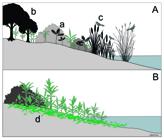
Examples of impacts caused by white ginger (green plants). Non-invaded or lightly invaded sites (A) are more conducive to the growth of the native tree Anadenanthera macrocarpa seedlings (a), other shrubs and trees (b), and to the occurrence of the bird Formicivora acutirostris (c). In invaded sites dominated by white ginger (B), these plants are negatively affected, the birds are eliminated, and large amounts of detritus accumulate (d), potentially causing impacts at the ecosystem level. Based on Reinert et al. (2007); Chiba de Castro et al. (2020); Costa et al. (2019); Martins & Marchello (2023); Pereira et al. (2024).
Impacts propagate to population and community levels. Invaded areas experience significant decreases in the abundance, height, and diversity of native riparian shrubs and trees, whose regeneration is also diminished (Martins & Marchello, 2023; Pereira et al., 2024; Figure 7). These studies highlight that the impacts on plants result from a combination of mechanisms, such as the release of allelopathic compounds, the concentration of rhizomes near the soil surface, shading, and the accumulation of detritus over the soil and sediment (Figure 7). Allelochemicals synthesized by white ginger are of particular ecological relevance, as they have been shown to be toxic to algae, macrophytes, Cladocera, and Chironomidae (Costa et al., 2021). This toxicity suggests that white ginger can significantly affect local biota and alter the trophic interactions within invaded habitats (Costa et al., 2021).
Some studies have explored how native animals use white ginger as both a habitat and a food source. For example, juvenile freshwater crabs, Trichodactylus petropolitanus (Goeldi, 1886) utilizes white ginger as a microhabitat (Venâncio & Leme 2010). Live white ginger tissues serve as a food source for various macroinvertebrates (Saulino & Trivinho-Strixino, 2018; Saulino et al., 2018) and capybaras (Chiba de Castro et al., 2013b), while chironomids feed on its detritus (Leite-Rossi et al., 2019). However, in some cases, the toxic compounds produced by white ginger appear to reduce herbivory by insects (Costa et al., 2021).
White ginger significantly alters macroinvertebrate communities. For example, the composition of chironomid assemblages differs between invasive white ginger and native macrophyte species (Leite-Rossi et al., 2016). Similarly, insect assemblage composition varied as well although without significant differences in taxonomic diversity (Saulino & Trivinho-Strixino, 2017a). Furthermore, white ginger simplifies the trait composition of insect assemblages, as demonstrated by several functional diversity metrics (Saulino & Trivinho-Strixino, 2017b). It also makes shredder assemblage communities less dissimilar than those inhabiting native macrophytes (Saulino & Trivinho-Strixino, 2018). These authors attribute white ginger's influence on invertebrate assemblages to factors such as reduced habitat heterogeneity and fewer feeding resources, the plant's chemical composition, high detritus accumulation, and pH changes in invaded sites. However, impacts are context-dependent. Comparisons between white ginger and the native macrophyte Pontederia cordata L. revealed higher functional diversity in the macroinvertebrate herbivore community associated with white ginger, while no difference in food web structure was observed (Saulino et al., 2018).
White ginger also alters ecosystem processes. For example, the species produces massive amounts of high-fiber litter that, in some cases, decomposes more slowly than native macrophytes (Chiba de Castro et al., 2020), though other studies show higher decomposition rates (Paccagnella et al., 2020). These authors point to potential changes in the carbon cycle within invaded areas. Furthermore, evapotranspiration rates differ in sites dominated by white ginger compared to those colonized by native vegetation, indicating an impact on the water cycle (Vergne et al., 2023). Given these impacts, white ginger leads to significant losses in ecosystem services. In Argentina, the primary losses are related to water flow regulation, amounting to between USD 44-215 million annually (Zílio et al., 2025).
7. Management
Invasive aquatic macrophytes pose significant ecological and economic challenges in freshwater ecosystems and thus, their management is sometimes necessary. Although our survey focused on the ecology of the main macrophyte non-native invasive species rather than their control and management, insights from these studies can provide guidance for developing site-specific management strategies aimed at limiting their spread and mitigating impacts of the invasive macrophytes in Neotropics.
Effective management is complicated by the high resilience, rapid growth, and diverse reproductive strategies of these species, and decisions should be taken with care (Schneider et al., 2024). Moreover, complete removal without careful planning can even worsen environmental conditions, for example by triggering nutrient release and cyanobacterial blooms following the removal of invasive floating plants (Schneider et al., 2024).
As one of the most aggressive macrophyte species, hydrilla demands significant attention for its control. Our survey suggests that its success is driven by a combination of abiotic features including water turbidity and nutrients along with biotic resistance (Sutton, 1990; Sousa et al., 2009; Silveira & Thomaz, 2023; Ribas et al., 2017; Salgado et al., 2023;). Thus, managing this species requires maintaining native macrophytes and herbivores and controlling eutrophication.
In addition to these possibilities for hydrilla management, direct management involves a range of strategies, whose effectiveness depends on the spatial scale and environmental characteristics of the invaded waterbody. Among the most commonly applied methods are chemical controls, particularly through selective aquatic herbicides such as fluridone and endothall, which can significantly reduce hydrilla biomass when properly applied, although they do not prevent long-term tuber survival (Langeland, 1996; Netherland, 1997). Mechanical removal, including cutting and harvesting, has been widely used but is often constrained by high costs and the risk of fragment dispersal, which may further contribute to spread (Langeland, 1996; Sousa, 2011). Biological control has also been implemented, most notably through the introduction of the Asian leaf-mining fly (Hydrellia pakistanae Deonier, 1978), which has shown variable success in reducing population densities, depending on regional and environmental conditions (Wheeler & Center, 2001). Because no single method is universally effective, integrated approaches combining chemical, mechanical, and biological strategies are increasingly recommended to achieve long-term control of hydrilla populations (Netherland, 1997; Sousa, 2011).
Although studies on signalgrass control are limited, experimental evidence indicates that native macrophytes can reduce its invasive success via biotic resistance at local scales, even in eutrophic habitats (Michelan et al., 2013; Teixeira et al., 2017). Maintaining or restoring riparian vegetation, along with proactively promoting native macrophyte stands, also appears to decrease invasion risk (Evangelista et al., 2017). At smaller scales, such as beaches, cattle water troughs, or anchorages, management may include substrate manipulation, for example, adding coarse or nutrient-poor sediments, which can limit signalgrass growth (Fasoli et al., 2015).
Mechanical removal is among the direct control methods that have been successfully applied to signalgrass at small spatial scales (Bornschein et al., 2022). Nevertheless, some machines achieve only limited success due to the clogging of their chopper inlets (Bravin et al., 2005). Shading and covering strategies, such as temporary black polyethylene sheets, can suppress growth; however, rapid regrowth after cover removal highlights the limitations of this method (Tomazi & Castellani, 2016). Chemical control through herbicides has also been explored (Cruz et al., 2015; Rojas-Sandoval, 2023), though costs, benefits, and potential environmental risks require careful evaluation. Collectively, these results emphasize that integrated strategies, combining prevention, habitat restoration, and site-specific interventions, are more promising than single-method approaches.
Management of white ginger has primarily relied on mechanical and chemical approaches, often combined with habitat restoration. Mechanical control, including manual or mechanized removal of rhizomes, is crucial because the species resprouts vigorously from remaining rhizome fragments (Machado et al., 2020). Repeated efforts are usually necessary, particularly in riparian areas where soil disturbance facilitates recolonization. Chemical control using systemic herbicides has demonstrated effectiveness in the short term (Dechoum & Ziller, 2013) but is limited if not combined with soil clearing (Machado et al., 2020). Integrated management that combines mechanical removal, chemical treatment, and subsequent restoration of native vegetation appears to yield the most effective outcomes for preventing reinvasion (Machado et al., 2020).
The management of the most relevant invasive aquatic macrophytes in the Neotropics requires a nuanced, site-specific approach. No single method is universally effective, and long-term success depends on combining mechanical, chemical, and biological tools with habitat restoration and the promotion of native species. Continuous monitoring and adaptive management are essential to respond to rapid regrowth and environmental variability, ultimately helping to mitigate the ecological and economic impacts of these invasive plants.
8. Conclusions
Our survey supports the broad notion that invasion success of the three most important non-native invasive species, originated from other continents, in Neotropics is modulated by the interaction between species traits allowing easy spread and fast growth rates, along with favourable conditions in several types of ecosystems. Considering the impacts reported, signalgrass is the most pervasie aquatic invader in Neotropical ecosystems, invading shallow waters in lakes, rivers, streams, reservoirs and wetlands. Along with water ginger, signalgrass changes the habitats and affects multiple trophic levels, including detritivorous organisms. The accumulation of living biomass and of detritus may cause changes at ecosystem level, like for example, in C cycling. Moreover, signalgrass simplifies the habitats, contributing to reducing biodiversity of aquatic and terrestrial organisms that use riparian habitats. Hydrilla also changes the physical and chemical habitats, influence microorganisms and invertebrates, and change aquatic community composition. Its impacts on diversity are less clear, decreasing it in some instances, but showing no effects in others. In any instance, efforts to avoid spread and growth of these three species should be implemented. Managing these species is challenging, but a combination of practices that include preventing dispersal, maintaining ecosystem integrity and native biodiversity, along with direct control at small scales may help to achieve this target.
Acknowledgements
The authors thank the Conselho Nacional de Desenvolvimento Científico e Tecnológico (CNPq) for continuous support through ongoing Research Productivity grants. Eduardo Grou (Universidade Estadual de Maringá) drew the figures.
Data availability
The entire dataset supporting the results of this study has been published in the article itself. Supplementary Material with additional information is freely available in SciELO Data, at https://doi.org/10.48331/SCIELODATA.QGCMLC.
-
Cite as:
Thomaz, S.M., and Padial, A.A. Neotropical invaders: a review of the most impactful non-native aquatic macrophytes. Acta Limnologica Brasiliensia, 2026, vol. 38, e20. https://doi.org/10.1590/S2179-975X8425
References
-
Adler, J.M., Barry, S.C., Johnston, G.R., Jacoby, C.A., & Frazer, T.K., 2018. An aggregation of turtles in a Florida spring yields insights into effects of grazing on vegetation. Freshw. Sci., 37(2), 397-403. https://doi.org/10.1086/697541
» https://doi.org/10.1086/697541 -
Allen, M.S., Tugend, K.I., & Mann, M.J., 2003. Largemouth bass abundance and angler catch rates following a habitat enhancement project at Lake Kissimmee, Florida. N. Am. J. Fish. Manage., 23(3), 845-855. https://doi.org/10.1577/M02-148
» https://doi.org/10.1577/M02-148 -
Alves, R.M.A., Albuquerque, M.B., & Barbosa, L.G., 2017. Status of the invasion of a Poaceae species in tropical semi-arid reservoirs. Planta Daninha 35(0), e017153224. https://doi.org/10.1590/s0100-83582017350100041
» https://doi.org/10.1590/s0100-83582017350100041 -
Baker, P., Zimmanck, F., & Baker, S.M., 2010. Feeding rates of an introduced freshwater gastropod Pomacea insularum on native and nonindigenous aquatic plants in Florida. J. Molluscan Stud., 76(2), 138-143. https://doi.org/10.1093/mollus/eyp050
» https://doi.org/10.1093/mollus/eyp050 -
Bando, F., Michelan, T.S., & Thomaz, S.M., 2016. Propagule success of an invasive Poaceae depends on size of parental plants. Acta Limnol. Bras., 28(0), e23. https://doi.org/10.1590/s2179-975x2216
» https://doi.org/10.1590/s2179-975x2216 -
Bando, F.M., Figueiredo, B.R.S., Moi, D.A., Thomaz, S.M., Michelan, T.S., García-Girón, J., Heino, J., Alahuhta, J., Romero, G.Q., & Mormul, R.P., 2023. Invasion by an exotic grass species homogenizes native freshwater plant communities. J. Ecol., 111(4), 799-813. https://doi.org/10.1111/1365-2745.14061
» https://doi.org/10.1111/1365-2745.14061 -
Barbosa, M., Lefler, F.W., Berthold, D.E., Gettys, L.A., Leary, J.K., & Laughinghouse 4th, H.D., 2024. Macrophyte coverage drives microbial community structure and interactions in a shallow sub-tropical lake. Sci. Total Environ., 923, 171414. PMid:38442760. https://doi.org/10.1016/j.scitotenv.2024.171414
» https://doi.org/10.1016/j.scitotenv.2024.171414 -
Barrientos, C.A., & Allen, M.S., 2008. Fish abundance and community composition in native and non-native plants following hydrilla colonisation at Lake Izabal, Guatemala. Fish. Manag. Ecol., 15(2), 99-106. https://doi.org/10.1111/j.1365-2400.2007.00588.x
» https://doi.org/10.1111/j.1365-2400.2007.00588.x -
Basiouny, F.M., & Garrard, L.A., 1984. Studies on mineral nutrition of Hydrilla verticillata. Weed Sci., 32(5), 681-685. https://doi.org/10.1017/S0043174500059786
» https://doi.org/10.1017/S0043174500059786 -
Basiouny, F.M., Garrard, L.A., & Haller, W.T., 1977a. Absorption of iron and growth of Hydrilla verticillata (L.F.). Aquat. Bot., 3, 349-356. https://doi.org/10.1016/0304-3770(77)90039-0
» https://doi.org/10.1016/0304-3770(77)90039-0 -
Basiouny, F.M., Haller, W.T., & Garrard, L.A., 1977b. Evidence for root Fe nutrition in Hydrilla verticillata Royle. Plant Soil 48(3), 621-627. https://doi.org/10.1007/BF00145772
» https://doi.org/10.1007/BF00145772 -
Basiouny, F.M., Haller, W.T., & Garrard, L.A., 1978. Survival of hydrilla (Hydrilla verticillata) plants and propagules after removal from the aquatic habitat. Weed Sci., 26(5), 502-504. https://doi.org/10.1017/S0043174500050414
» https://doi.org/10.1017/S0043174500050414 -
Behrend, R.D.K., Teixeira, M.C., Fernandes, S.E.P., Camargo, J.C., Rosin, G.C., & Takeda, A.M., 2013. Effects of a native and a non-native macrophyte species of Hydrocharitaceae on Chironomidae and Oligochaeta assemblages structure. Acta Sci. Biol. Sci., 35(3), 351-358. https://doi.org/10.4025/actascibiolsci.v35i3.10855
» https://doi.org/10.4025/actascibiolsci.v35i3.10855 -
Bellini, G., & Becker, F.G., 2021. Riparian degradation, stream position in watershed, and proximity to towns facilitate invasion. Aquat. Invasions 16(1), 11-27. https://doi.org/10.3391/ai.2021.16.1.02
» https://doi.org/10.3391/ai.2021.16.1.02 -
Bianchini Junior, I., Cunha-Santino, M.B., Milan, J.A.M., Rodrigues, C.J., & Dias, J.H.P., 2010. Growth of Hydrilla verticillata (L.f.) Royle under controlled conditions. Hydrobiologia 644(1), 301-312. https://doi.org/10.1007/s10750-010-0191-1
» https://doi.org/10.1007/s10750-010-0191-1 -
Bianco, S., Carvalho, L.B., Bianco, M.S., & Yamauchi, A.K.F., 2015. Crescimento e nutrição mineral de Urochloa arrecta. Planta Daninha 33(1), 33-40. https://doi.org/10.1590/S0100-83582015000100004
» https://doi.org/10.1590/S0100-83582015000100004 -
Blackburn, R.D., White, P.F., & Weldon, L.W., 1968. Ecology of submersed aquatic weeds in South Florida canals. Weed Sci., 16(2), 261-266. https://doi.org/10.1017/S0043174500047068
» https://doi.org/10.1017/S0043174500047068 -
Bonvechio, K.I., & Bonvechio, T.F., 2006. Relationship between habitat and sport fish populations over a 20-year period at West Lake Tohopekaliga, Florida. N. Am. J. Fish. Manage., 26(1), 124-133. https://doi.org/10.1577/M04-191.1
» https://doi.org/10.1577/M04-191.1 -
Bora, L.S., & Padial, A.A., 2023a. A global review on invasive traits of macrophytes and their link to invasion success. Acta Limnol. Bras., 35, e20. https://doi.org/10.1590/s2179-975x4222
» https://doi.org/10.1590/s2179-975x4222 -
Bora, L.S., & Padial, A.A., 2023b. Propagule resistance of an invasive Poaceae as a trait of its invasiveness. Rev. Bras. Bot., 46(4), 1089-1093. https://doi.org/10.1007/s40415-023-00952-2
» https://doi.org/10.1007/s40415-023-00952-2 -
Bora, L.S., Thomaz, S.M., & Padial, A.A., 2020. Evidence of rapid evolution of an invasive poaceae in response to salinity. Aquat. Sci., 82(4), e76. https://doi.org/10.1007/s00027-020-00750-y
» https://doi.org/10.1007/s00027-020-00750-y -
Bornschein, M.R., Reinert, B.L., Machado-de-Souza, T., Golec, C., Whitney, B.M., & Favretto, M.A., 2017. Abundance, occurrence, and seasonality of the Subtropical Doradito (Pseudocolopteryx acutipennis) on the coast of Brazil. Wilson J. Ornithol., 129(1), 199-206. https://doi.org/10.1676/1559-4491-129.1.199
» https://doi.org/10.1676/1559-4491-129.1.199 -
Bornschein, M.R., Teixeira, L., Guerra, B.M., Melchiori, B., Reinert, B.L., & Sandretti-Silva, G., 2022. Appearance of a population of the mangrove rail Rallus longirostris (Rallidae) in salt marshes invaded by the exotic tanner grass Urochloa arrecta (Poaceae) and its disappearance after plant management. Wetlands 42(8), 124. PMid:36530518. https://doi.org/10.1007/s13157-022-01642-7
» https://doi.org/10.1007/s13157-022-01642-7 -
Bornschein, M.R., Sandretti-Silva, G., Sobotka, D.D., Corrêa, L., Reinert, B.L., Vannucchi, F.S., & Pie, M.R., 2024. Revision of the conservation status and assessment of the Green Status of the Parana Antwren Formicivora acutirostris with management proposals. Bird Conserv. Int., 34, e21. https://doi.org/10.1017/S095927092400008X
» https://doi.org/10.1017/S095927092400008X -
Bottino, F., Souza, B.P., Rocha, R.J.S., Cunha-Santino, M.B., & Bianchini Junior, I., 2021. Characterization of humic substances from five macrophyte species decomposed under different nutrient conditions. Limnetica 40(2), 267-278. https://doi.org/10.23818/limn.40.18
» https://doi.org/10.23818/limn.40.18 -
Bradshaw, E.L., Allen, M.S., & Netherland, M., 2015. Spatial and temporal occurrence of hypoxia influences fish habitat quality in dense Hydrilla verticillata. J. Freshwat. Ecol., 30(4), 491-502. https://doi.org/10.1080/02705060.2014.982726
» https://doi.org/10.1080/02705060.2014.982726 -
Bravin, L.F.N., Velini, E.D., Reigotta, C., Negrisoli, E., Corrêa, M.R., & Carbonari, C.A., 2005. Desenvolvimento de equipamento para controle mecânico de plantas aquáticas da UHE de Americana-SP. Planta Daninha 23(2), 263-267. https://doi.org/10.1590/S0100-83582005000200013
» https://doi.org/10.1590/S0100-83582005000200013 - Brígitte, P.A., 2008. Ecofisiologia da germinação de Hedychium coronarium J. König (Zingiberaceae), submetida à hipóxia e anoxia [Master’s thesis]. Campinas: Universidade Estadual de Campinas.
-
Calvo, C.C., Mormul, R.P., Figueiredo, B.R.S., Cunha, E.R., Thomaz, S.M., & Meerhoff, M., 2019. Herbivory can mitigate, but not counteract, the positive effects of warming on the establishment of the invasive macrophyte Hydrilla verticillata. Biol. Invasions 21(1), 59-66. https://doi.org/10.1007/s10530-018-1803-3
» https://doi.org/10.1007/s10530-018-1803-3 -
Carniatto, N., Thomaz, S.M., Cunha, E.R., Fugi, R., & Ota, R.R., 2013. Effects of an invasive alien Poaceae on aquatic macrophytes and fish communities in a Neotropical reservoir. Biotropica 45(6), 747-754. https://doi.org/10.1111/btp.12062
» https://doi.org/10.1111/btp.12062 -
Carniatto, N., Fugi, R., Thomaz, S.M., & Cunha, E.R., 2014. The invasive submerged macrophyte Hydrilla verticillata as a foraging habitat for small-sized fish. Nat. Conserv., 12(1), 30-35. https://doi.org/10.4322/natcon.2014.006
» https://doi.org/10.4322/natcon.2014.006 -
Carniatto, N., Fugi, R., Quirino, B.A., Cunha, E.R., & Thomaz, S.M., 2020a. An invasive and a native macrophyte species provide similar feeding habitat for fish. Ecol. Freshwat. Fish 29(1), 112-120. https://doi.org/10.1111/eff.12499
» https://doi.org/10.1111/eff.12499 -
Carniatto, N., Cunha, E.R., Thomaz, S.M., Quirino, B.A., & Fugi, R., 2020b. Feeding of fish inhabiting native and non-native macrophyte stands in a Neotropical reservoir. Hydrobiologia 847(6), 1553-1563. https://doi.org/10.1007/s10750-020-04212-2
» https://doi.org/10.1007/s10750-020-04212-2 -
Chiba de Castro, W.A., Cunha-Santino, M.B., & Bianchini Junior, I., 2013a. Anaerobic decomposition of a native and an exotic submersed macrophyte in two tropical reservoirs. Braz. J. Biol., 73(2), 299-307. PMid:23917557. https://doi.org/10.1590/S1519-69842013000200010
» https://doi.org/10.1590/S1519-69842013000200010 -
Chiba de Castro, W.A., Moitas, M.L., Lobato, G.M., Cunha-Santino, M.B., & Matos, D.M.S., 2013b. First record of herbivory of the invasive macrophyte Hedychium coronarium J. König (Zingiberaceae). Biota Neotrop., 13(4), 368-370. https://doi.org/10.1590/S1676-06032013000400030
» https://doi.org/10.1590/S1676-06032013000400030 -
Chiba de Castro, W.A., Cunha-Santino, M.B., & Bianchini Junior, I., 2015. Differential aerobic decomposition between a native and exotic macrophytes of tropical reservoirs. Braz. J. Biol., 75(2), 501-502. PMid:26132040. https://doi.org/10.1590/1519-6984.14914
» https://doi.org/10.1590/1519-6984.14914 -
Chiba de Castro, W.A., Almeida, R.V., Leite, M.B., Marrs, R.H., & Silva Matos, D.M., 2016. Invasion strategies of the white ginger lily Hedychium coronarium J. König (Zingiberaceae) under different competitive and environmental conditions. Environ. Exp. Bot., 127, 55-62. https://doi.org/10.1016/j.envexpbot.2016.03.010
» https://doi.org/10.1016/j.envexpbot.2016.03.010 -
Chiba de Castro, W.A., Almeira, R.V., Xavier, R.O., Bianchini Junior, I., Moya, H.M., & Matos, D.M.S., 2020. Litter accumulation and biomass dynamics in riparian zones in tropical South America of the Asian invasive plant Hedychium coronarium J. König (Zingiberaceae). Plant Ecol. Divers., 13(1), 47-59. https://doi.org/10.1080/17550874.2019.1673496
» https://doi.org/10.1080/17550874.2019.1673496 -
Chiba de Castro, W.A., Bonugli-Santos, R.C., Sibim, A.C., Cunha-Santino, M.B., & Bianchini Junior, I., 2021a. Enzymatic efficiency of the decomposing microbiota: what does really matter for aquatic macrophytes invasions? Acta Bot. Bras., 35(1), 104-110. https://doi.org/10.1590/0102-33062020abb0351
» https://doi.org/10.1590/0102-33062020abb0351 -
Chiba de Castro, W.A., Almeira, R.V., Xavier, R.O., Arduin, M., Moya, H.M., & Matos, D.M.S., 2021b. Response of rhizomes of the invasive Hedychium coronarium J. König (Zingiberaceae) to different soil moisture conditions. Acta Bot. Bras., 35(1), 122-125. https://doi.org/10.1590/0102-33062020abb0343
» https://doi.org/10.1590/0102-33062020abb0343 -
Chick, J.H., & McIvor, C.C., 1994. Patterns in the abundance and composition of fishes among beds of different macrophytes: viewing a littoral zone as a landscape. Can. J. Fish. Aquat. Sci., 51(12), 2873-2882. https://doi.org/10.1139/f94-286
» https://doi.org/10.1139/f94-286 -
Chick, J.H., & McIvor, C.C., 1997. Habitat selection by three littoral zone fishes: effects of predation pressure, plant density and macrophyte type. Ecol. Freshwat. Fish 6(1), 27-35. https://doi.org/10.1111/j.1600-0633.1997.tb00139.x
» https://doi.org/10.1111/j.1600-0633.1997.tb00139.x -
Conrow, R., Zale, A.V., & Gregory, R.W., 1990. Distributions and abundances of early life stages of fishes in a Florida lake dominated by aquatic macrophytes. Trans. Am. Fish. Soc. 119(3), 521-528. https://doi.org/10.1577/1548-8659(1990)119<0521:DAAOEL>2.3.CO;2
» https://doi.org/10.1577/1548-8659(1990)119<0521:DAAOEL>2.3.CO;2 -
Costa, R.O., Batisteli, A.F., Espindola, E.L.G., & Matos, D.M.S., 2019. Invasive Hedychium coronarium inhibits native seedling growth through belowground competition. Flora 261, 151479. https://doi.org/10.1016/j.flora.2019.151479
» https://doi.org/10.1016/j.flora.2019.151479 -
Costa, R.O., Vieira, B.H., Espindola, E.L.G., Ribeiro, A.I., Ferro, J.L.R., Fernandes, J.B., & Matos, D.M., 2021. Toxicity of rhizomes of the invasive Hedychium coronarium (Zingiberaceae) on aquatic species. Biol. Invasions 23(7), 2221-2231. https://doi.org/10.1007/s10530-021-02501-y
» https://doi.org/10.1007/s10530-021-02501-y -
Cruz, C., Souza, R.A., Ferreira, E.A., Aspiazú, I., Galon, L., & Bianco, S., 2015. Glyphosate effectiveness in the control of macrophytes under a greenhouse condition. Planta Daninha 33(2), 241-247. https://doi.org/10.1590/0100-83582015000200009
» https://doi.org/10.1590/0100-83582015000200009 -
Cunha, E.R., Thomaz, S.M., Evangelista, H.B.A., Carniato, N., Souza, C.F., & Fugi, R., 2011. Small-sized fish assemblages do not differ between a native and a recently established non-indigenous macrophyte in a Neotropical ecosystem. Nat. Conserv., 9(1), 61-66. https://doi.org/10.4322/natcon.2011.007
» https://doi.org/10.4322/natcon.2011.007 -
Cuthbert, R.N., Pattison, Z., Taylor, N.G., Verbrugge, L., Diagne, C., Ahmed, D.A., Leroy, B., Angulo, E., Briski, E., Capinha, C., Catford, J.A., Dalu, T., Essl, F., Gozlan, R.E., Haubrock, P.J., Kourantidou, M., Kramer, A.M., Renault, D., Wasserman, R.J., & Courchamp, F., 2021. Global economic costs of aquatic invasive alien species. Sci. Total Environ., 775, 145238. PMid:33715860. https://doi.org/10.1016/j.scitotenv.2021.145238
» https://doi.org/10.1016/j.scitotenv.2021.145238 -
Da Costa, L., Vieira, L.A., Michelan, T.S., Vale, A.H., & Chiba de Castro, W.A., 2024. Growth allocation shifts in the invasive Hydrilla verticillata under interspecific competition with native submerged macrophytes. Plants 13(24), 3500. PMid:39771197. https://doi.org/10.3390/plants13243500
» https://doi.org/10.3390/plants13243500 -
Dainez-Filho, M.S., Michelan, T.S., Louback-Franco, N., Souza, D.C., Cafofo, E.G., & Thomaz, S.M., 2019. Role of sediment structuring by detritus on colonization and interspecific competition of one native and one invasive submerged macrophyte. Hydrobiologia 834(1), 63-74. https://doi.org/10.1007/s10750-019-3909-8
» https://doi.org/10.1007/s10750-019-3909-8 - De Amorim, S.R., Umetsu, C.A., Toledo, D., & Camargo, A.F.M.C., 2015. Effects of a nonnative species of Poaceae on aquatic macrophyte community composition: A comparison with a native species. J. Aquat. Plant Manage., 53, 191-196.
-
Dechoum, M.S., & Ziller, S.R., 2013. Métodos para controle de plantas exóticas invasoras. Biotemas 26(1), 69-77. https://doi.org/10.5007/2175-7925.2013v26n1p69
» https://doi.org/10.5007/2175-7925.2013v26n1p69 -
Diamente, N.A., Fabrin, T.M., Silveira, M.J., Oliveira, A.V., Thomaz, S.M., Prioli, S.M.A.P., & Prioli, A.J., 2020. Molecular analysis of the invasive populations of Urochloa (Poaceae) in a large Neotropical reservoir. Aquat. Bot., 161, 103183. https://doi.org/10.1016/j.aquabot.2019.103183
» https://doi.org/10.1016/j.aquabot.2019.103183 -
Domingos, V.D., Martins, D., Costa, N.V., da Costa, A.C.P.R., & Marchi, S.R., 2015. Initial growth of Brachiaria subquadripara (Trin.) Hitchc. plants under different nutritional conditions. Rev. Bras. Eng. Agric. Ambient., 19(6), 560-566. https://doi.org/10.1590/1807-1929/agriambi.v19n6p560-566
» https://doi.org/10.1590/1807-1929/agriambi.v19n6p560-566 -
Dooris, P.M., & Martin, D.F., 1980. Growth inhibition of Hydrilla verticillata by selected lake sediment extracts. J. Am. Water Resour. Assoc., 16(1), 112-117. https://doi.org/10.1111/j.1752-1688.1980.tb02340.x
» https://doi.org/10.1111/j.1752-1688.1980.tb02340.x -
Dudgeon, D., Arthington, A.H., Gessner, M.O., Kawabata, Z.I., Knowler, D.J., Lévéque, C., Naiman, R.J., Prieur-Richard, A.H., Soto, D., Stiassny, M.L.J., & Sullivan, C.A., 2006. Freshwater biodiversity: importance, threats, status and conservation challenges. Biol. Rev. Camb. Philos. Soc., 81(2), 163-182. PMid:16336747. https://doi.org/10.1017/S1464793105006950
» https://doi.org/10.1017/S1464793105006950 -
Duque, T.S., Souza, I.M., Mendes, D.S., da Silva, R.S., Mucida, D.P., da Silva, F.D., Silva, D.V., & dos Santos, J.B., 2023. Ecological niche modeling of invasive macrophyte (Urochloa subquadripara) and co-occurrence with South American natives. Sustainability 15(17), 12722. https://doi.org/10.3390/su151712722
» https://doi.org/10.3390/su151712722 -
Duque, T.S., da Silva, R.S., Souza, I.M., Oliveira, F.S., Mucida, D.P., & dos Santos, J.B., 2025. Impact of Urochloa subquadripara invasion on hydroelectricity generation: a risk analysis. Biol. Invasions 27(2), 70. https://doi.org/10.1007/s10530-025-03529-0
» https://doi.org/10.1007/s10530-025-03529-0 - Etheridge, K., Rathbun, G.B., Powell, J.A., & Kochman, H.I., 1985. Consumption of aquatic plants by the West Indian manatee. J. Aquat. Plant Manage., 23, 21-25.
-
Evangelista, H.B., Michelan, T.S., Gomes, L.C., & Thomaz, S.M., 2017. Shade provided by riparian plants and biotic resistance by macrophytes reduce the establishment of an invasive Poaceae. J. Appl. Ecol., 54(2), 648-656. https://doi.org/10.1111/1365-2664.12791
» https://doi.org/10.1111/1365-2664.12791 -
Fares, A.L.B., Nonato, F.A.D.S., & Michelan, T.S., 2020. New records of the invasive macrophyte, Urochloa arrecta extend its range to eastern Brazilian Amazon altered freshwater ecosystems. Acta Amazon., 50(2), 133-137. https://doi.org/10.1590/1809-4392201903831
» https://doi.org/10.1590/1809-4392201903831 -
Fasoli, J.V.B., Michelan, T.S., & Thomaz, S.M., 2015. Sediment composition mediates the invasibility of aquatic ecosystems by a non-native Poaceae species. Acta Limnol. Bras., 27(2), 165-170. https://doi.org/10.1590/S2179-975X5214
» https://doi.org/10.1590/S2179-975X5214 -
Fasoli, J.V.B., Mormul, R.P., Cunha, E.R., & Thomaz, S.M., 2018. Plasticity responses of an invasive macrophyte species to inorganic carbon availability and to the interaction with a native species. Hydrobiologia 817(1), 227-237. https://doi.org/10.1007/s10750-018-3543-x
» https://doi.org/10.1007/s10750-018-3543-x -
Fernandes, L.F.G., Teixeira, M.C., & Thomaz, S.M., 2013. Diversity and biomass of native macrophytes are negatively related to dominance of an invasive Poaceae in Brazilian sub-tropical streams. Acta Limnol. Bras., 25(2), 202-209. https://doi.org/10.1590/S2179-975X2013000200011
» https://doi.org/10.1590/S2179-975X2013000200011 - Ferreira, F.A., Pott, A., Pott, V.J., Latini, R.O., & Resende, D.C., 2016. Capítulo 11 - Macrófitas aquáticas. In: Latini, A.O. & Resende, D.C., eds. Espécies exóticas invasoras de águas continentais no Brasil. Brasília: MMA, 657-726.
-
Figueiredo, B.R.S., Mormul, R.P., & Thomaz, S.M., 2015. Swimming and hiding regardless of the habitat: prey fish do not choose between a native and a non-native macrophyte species as a refuge. Hydrobiologia 746(1), 285-290. https://doi.org/10.1007/s10750-014-2096-x
» https://doi.org/10.1007/s10750-014-2096-x -
Florêncio, F.M., Alves, D.C., Lansac-Tôha, F.M., Silveira, M.J., & Thomaz, S.M., 2021a. The success of the invasive macrophyte Hydrilla verticillata and its interactions with the native Egeria najas in response to environmental factors and plant abundance in a subtropical reservoir. Aquat. Bot., 175, 103432. https://doi.org/10.1016/j.aquabot.2021.103432
» https://doi.org/10.1016/j.aquabot.2021.103432 -
Florêncio, F.M., Silveira, M.J., & Thomaz, S.M., 2021b. Niche differentiation between a native and an invasive species of submersed macrophyte in a subtropical reservoir. Acta Bot. Bras., 35(1), 132-139. https://doi.org/10.1590/0102-33062020abb0330
» https://doi.org/10.1590/0102-33062020abb0330 -
Florêncio, F.M., Rosado, A., Leal, R.P., & Vecchia, A.D., 2025. Unexpected coexistence of a native and an invasive macrophyte: a functional versus environmental niche perspective. Hydrobiologia 852(8-9), 2293-2311. https://doi.org/10.1007/s10750-024-05606-2
» https://doi.org/10.1007/s10750-024-05606-2 -
Frazer, T.K., Notestein, S.K., Jacoby, C.A., Littles, C.J., Keller, S.R., & Swett, R.A., 2006. Effects of storm-induced salinity changes on submersed aquatic vegetation in Kings Bay, Florida. Estuaries Coasts 29(6), 943-953. https://doi.org/10.1007/BF02798655
» https://doi.org/10.1007/BF02798655 -
Fridley, J.D., Stachowicz, J.J., Naeem, S., Sax, D.F., Seabloom, E.W., Smith, M.D., Stohlgren, T.J., Tilman, D., & Von Holle, B., 2007. The invasion paradox: reconciling pattern and process in species invasions. Ecology 88(1), 3-17. PMid:17489447. https://doi.org/10.1890/0012-9658(2007)88[3:TIPRPA]2.0.CO;2
» https://doi.org/10.1890/0012-9658(2007)88[3:TIPRPA]2.0.CO;2 - Fridley, J.D., 2011. Invasibility, of communities and ecosys tems. In: Simberloff, D. & Rejmánek, M., eds. Encyclopedia of Biological Invasions. Berkeley: University of California Press, 356-360.
- Furse, J.B., & Fox, D.D., 1994. Economic fishery valuation of five vegetation communities in Lake Okeechobee, Florida. Proc. Annu. Conf. Southeast. Assoc. Fish and Wild Agencies 48, 575-591.
-
Gallardo, B., Clavero, M., Sánchez, M.I., & Vilà, M., 2016. Global ecological impacts of invasive species in aquatic ecosystems. Glob. Change Biol., 22(1), 151-163. PMid:26212892. https://doi.org/10.1111/gcb.13004
» https://doi.org/10.1111/gcb.13004 -
Galvanese, E.F., Costa, A.P.L., Araújo, E.S., Falkievicz, B.C., Melo, G.G.V., Vitule, J.R.S., & Padial, A.A., 2022. Community stability and seasonal biotic homogenisation emphasize the effect of the invasive tropical tanner grass on macrophytes from a highly dynamic neotropical tidal river. Aquat. Sci., 84(2), 30. PMid:35400976. https://doi.org/10.1007/s00027-022-00858-3
» https://doi.org/10.1007/s00027-022-00858-3 -
Gentilin-Avanci, C., Pinha, G.D., Petsch, D.K., Mormul, R.P., & Thomaz, S.M., 2019. The invasive macrophyte Hydrilla verticillata causes taxonomic and functional homogenization of associated Chironomidae community. Limnology 22(1), 129-138. https://doi.org/10.1007/s10201-020-00641-z
» https://doi.org/10.1007/s10201-020-00641-z - Gettys, L.A., Haller, W.T., Mudge, C.R., & Koschnick, T.J., 2008. Effect of temperature and feeding preference on submerged plants by the island. apple snail, Pomacea insularum (d’Orbigny 1839) (Ampullariidae). Veliger 50, 248-254.
-
Gordon-Bradley, N., Lymperopoulou, D.S., & Williams, H.N., 2014. Differences in bacterial community structure on Hydrilla verticillata and Vallisneria americana in a freshwater spring. Microbes Environ., 29(1), 67-73. PMid:24553106. https://doi.org/10.1264/jsme2.ME13064
» https://doi.org/10.1264/jsme2.ME13064 -
Gordon-Bradley, N., & Williams, H.N., 2015. Bacterial community structure in freshwater springs infested with the invasive plant species Hydrilla verticillata. Hydrobiologia 742(1), 221-232. PMid:26207069. https://doi.org/10.1007/s10750-014-1988-0
» https://doi.org/10.1007/s10750-014-1988-0 - Grosselin, J.R., Haller, W.T., Gettys, L.A., Griffin, T., & Crawford, E.S., 2018. Effects of substrate nutrients on growth of three submersed aquatic plants. J. Aquat. Plant Manage., 56, 39-46.
-
Gu, B., 2006. Environmental conditions and phosphorus removal in Florida lakes and wetlands inhabited by Hydrilla verticillata (Royle): implications for invasive species managemen. Biol. Invasions 8(7), 1569-1578. https://doi.org/10.1007/s10530-005-5851-0
» https://doi.org/10.1007/s10530-005-5851-0 - Gurevich, J., 2011. Competition, plant. In: Simberloff, D., & Rejmanek, M., eds. Encyclopedia of biological invasions. Berkeley, CA, USA: University of California Press, 122-125.
-
Harwell, M.C., & Havens, K.E., 2003. Experimental studies on the recovery potential of submerged aquatic vegetation after flooding and desiccation in a large subtropical lake. Aquat. Bot., 77(2), 135-151. https://doi.org/10.1016/S0304-3770(03)00101-3
» https://doi.org/10.1016/S0304-3770(03)00101-3 - Hasandras, H., Moore, K.K., Gettys, L.A., & Vendrame, W.A., 2015. Growth of Southern Naiad (Najas guadalupensis) and Hydrilla (Hydrilla verticillata) using controlled-release fertilizer. Proc. Annu. Meet. Fla. State Hort. Soc., 128, 268-270.
-
Hiatt, D., Serbesoff-King, K., Lieurance, D., Gordon, D.R., & Flory, S.L., 2019. Allocation of invasive plant management expenditures for conservation: lessons from Florida, USA. Conserv. Sci. Pract., 1(7), e51. https://doi.org/10.1111/csp2.51
» https://doi.org/10.1111/csp2.51 - Hodgson, L.M., & Carter, C.C., 1982. Effect of hydrilla management by herbicides on a periphyton community. J. Aquat. Plant Manage., 20, 17-19.
- Hodgson, L.M., & Linda, S.B., 1984. Response of periphyton and phytoplankton to chemical control of hydrilla in artificial pools. J. Aquat. Plant Manage., 22, 48-52.
-
Holaday, A.S., & Bowes, G., 1980. C4 metabolism and dark CO2 fixation in a submersed aquatic macrophyte (Hydrilla verticillata). Plant Physiol., 65(2), 331-335. PMid:16661184. https://doi.org/10.1104/pp.65.2.331
» https://doi.org/10.1104/pp.65.2.331 - Hopson, M.S., & Zimba, P.V., 1993. Temporal variation in the biomass of submersed macrophytes in Lake Okeechobee, Florida. J. Aquat. Plant Manage., 31, 76-81.
-
Hoyer, M.V., Jackson, M.W., Allen, M.S., & Canfield Junior, D.E., 2008. Lack of exotic hydrilla infestation effects on plant, fish and aquatic bird community measures. Lake Reserv. Manage., 24(4), 331-338. https://doi.org/10.1080/07438140809354843
» https://doi.org/10.1080/07438140809354843 -
Hussner, A., Heidbüchel, O., Coetzee, J., & Gross, E.M., 2021. From introduction to nuisance growth: a review of traits of alien aquatic plants which contribute to their invasiveness. Hydrobiologia 848(9), 2119-2151. https://doi.org/10.1007/s10750-020-04463-z
» https://doi.org/10.1007/s10750-020-04463-z -
Instituto Horus de Desenvolvimento e Conservação Ambiental – Instituto Horus, 2025. Base de dados nacionais. Retrived in 2025, May 18, from https://bd.institutohorus.org.br/especies
» https://bd.institutohorus.org.br/especies -
Isaac, A., Fernandes, A., Ganassin, M.J.M., & Hahn, N.S., 2008. Three invasive species occurring in the diets of fishes in a Neotropical floodplain. Braz. J. Biol., 74(3, Suppl.1), S16-S22. PMid:25627362. https://doi.org/10.1590/1519-6984.18312
» https://doi.org/10.1590/1519-6984.18312 - Johnston, D.L., Sutton, D.L., Vandiver Junior, V.V., & Langeland, K.A., 1983. Replacement of hydrilla by other aquatic plants in a pond with emphasis on growth of American lotus. J. Aquat. Plant Manage., 21, 41-43.
-
Johnson, K.G., Dotson, J.R., Pouder, W.F., Trippel, N.A., & Eisenhauer, R.L., 2014. Effects of hurricane-induced hydrilla reduction on the largemouth bass fishery at two central Florida lakes. Lake Reserv. Manage., 30(3), 217-225. https://doi.org/10.1080/10402381.2014.908254
» https://doi.org/10.1080/10402381.2014.908254 - Joyce, J.C., Langeland, K.A., Van, T.K., & Vandiver Junior, V.V., 1992. Organic sedimentation associated with hydrilla management. J. Aquat. Plant Manage., 30, 20-23.
-
Kennedy, T.L., Horth, L.A., & Carr, D.E., 2009. The effects of nitrate loading on the invasive macrophyte Hydrilla verticillata and two common, native macrophytes in Florida. Aquat. Bot., 91(3), 253-256. https://doi.org/10.1016/j.aquabot.2009.06.008
» https://doi.org/10.1016/j.aquabot.2009.06.008 -
Kew Gardens, 2025. Royal Botanic Gardens Kew. Retrieved in 2025, July 22, from https://powo.science.kew.org/taxon/urn:lsid:ipni.org:names:972082-1
» https://powo.science.kew.org/taxon/urn:lsid:ipni.org:names:972082-1 - Langeland, K.A., 1996. Hydrilla verticillata (L.f.) Royle (Hydrocharitaceae), “The perfect aquatic weed. Castanea 61, 293-304.
-
Leal, R.P., Silveira, M.J., Petsch, D.K., Mormul, R.P., & Thomaz, S.M., 2022. The success of an invasive Poaceae explained by drought resilience but not by higher competitive ability. Environ. Exp. Bot., 194, 104717. https://doi.org/10.1016/j.envexpbot.2021.104717
» https://doi.org/10.1016/j.envexpbot.2021.104717 -
Leite-Rossi, L.A., Saito, V.S., Cunha-Santino, M.B., & Trivinho-Strixino, S., 2016. How does leaf litter chemistry influence its decomposition and colonization by shredder Chironomidae (Diptera) larvae in a tropical stream? Hydrobiologia 771(1), 119-130. https://doi.org/10.1007/s10750-015-2626-1
» https://doi.org/10.1007/s10750-015-2626-1 -
Leite-Rossi, L.A., Saulino, H.H.L., Shimabukuro, E.M., Cunha-Santino, M.B., & Trivinho-Strixino, S., 2019. Shredder chironomid diets are influenced by decomposition rates of different leaf litter species. Neotrop. Entomol., 48(1), 38-49. PMid:29651693. https://doi.org/10.1007/s13744-018-0608-5
» https://doi.org/10.1007/s13744-018-0608-5 -
Looby, A., Reynolds, L.K., Adams, C.R., Walsh, S.J., & Martin, C.W., 2021. Submerged aquatic vegetation habitat use of age-0 Florida bass Micropterus floridanus. Environ. Biol. Fishes 104(8), 947-958. https://doi.org/10.1007/s10641-021-01126-3
» https://doi.org/10.1007/s10641-021-01126-3 - Lorenzi, H., 2000. Plantas daninhas do Brasil: terrestres, aquáticas, parasitas e tóxicas. Nova Odessa, Brazil: Instututo Plantarum de Estudos da Flora, 3 ed., 608 p.
-
Louback-Franco, N., Dainez-Filho, M.S., Souza, D.C., & Thomaz, S.M., 2020. A native species does not prevent the colonization success of an introduced submerged macrophyte, even at low propagule pressure. Hydrobiologia 847(7), 1619-1629. https://doi.org/10.1007/s10750-019-04116-w
» https://doi.org/10.1007/s10750-019-04116-w -
Lucio, L.C., Thomaz, S.M., Prioli, S.M., Boni, T.A., de Oliveira, A.V., & Prioli, A.J., 2019. Molecular characterization of the invasive aquatic macrophyte Hydrilla verticillata (Hydrocharitaceae) in Brazil. An. Acad. Bras. Cienc., 91(3), e20180494. PMid:31618409. https://doi.org/10.1590/0001-3765201920180494
» https://doi.org/10.1590/0001-3765201920180494 -
Machado, M.X., Casstellani, T.T., & Dechoum, M.S., 2020. Integrating management techniques to restore subtropical forests invaded by Hedychium coronarium J. Köenig (Zingiberaceae) in a biodiversity hotspot. Restor. Ecol., 28(5), 1273-1282. https://doi.org/10.1111/rec.13213
» https://doi.org/10.1111/rec.13213 -
Madeira, P.T., Van, T.K., & Center, T.D., 1999. Integration of five Southeast Asian accessions into the world-wide phenetic relationships of Hydrilla verticillata as elucidated by random amplified polymorphic DNA analysis. Aquat. Bot., 63(2), 161-167. https://doi.org/10.1016/S0304-3770(98)00114-4
» https://doi.org/10.1016/S0304-3770(98)00114-4 - Madeira, P.T., Jacono, C.C., & Van, T.K., 2000. Monitoring hydrilla using two RAPD procedures and the nonindigenous aquatic species satabase. J. Aquat. Plant Manage., 38, 33-40.
-
Martin, D.F., & Reid Junior, G.A., 1976. Uptake of manganese in Hydrilla verticillata Royle. J. Agric. Food Chem., 24(6), 1161-1165. https://doi.org/10.1021/jf60208a042
» https://doi.org/10.1021/jf60208a042 - Martins, E.M.C., & Marchello, A.E., 2023. Density of Hedychium coronarium in 1st order river riparian Forest in an environmental protection area. Rev. Bio Cienc., 29, 28-42.
- Mataraza, L.K., Terrell, J.B., Munson, A.B., & Canfield Junior, D.E., 1999. Changes in submersed macrophytes in relation to tidal storm surges. J. Aquat. Plant Manage., 37, 3-12.
-
McDonald, A.M., Martin, C.W., Adams, C.R., & Reynolds, L.K., 2022. Competition in a changing world: invasive aquatic plant is limited by saltwater encroachment. Ecosphere 14(3), e4394. https://doi.org/10.1002/ecs2.4394
» https://doi.org/10.1002/ecs2.4394 -
Michelan, T.S., Thomaz, S.M., Carvalho, P., Rodrigues, R.B., & Silveira, M.J., 2010a. Regeneration and colonization of an invasive macrophyte grass in response to desiccation. Nat. Nat. Conserv., 8(2), 133-139. https://doi.org/10.4322/natcon.00802005
» https://doi.org/10.4322/natcon.00802005 -
Michelan, T.S., Thomaz, S.M., Mormul, R.P., & Carvalho, P., 2010b. Effects of an exotic invasive macrophyte (tropical signalgrass) on native plant community composition, species richness and functional diversity. Freshw. Biol., 55(6), 1315-1326. https://doi.org/10.1111/j.1365-2427.2009.02355.x
» https://doi.org/10.1111/j.1365-2427.2009.02355.x -
Michelan, T.S., Thomaz, S.M., & Bini, L.M., 2013. Native macrophyte density and richness affect the invasiveness of a tropical Poaceae species. PLoS One 8(3), e60004. PMid:23536902. https://doi.org/10.1371/journal.pone.0060004
» https://doi.org/10.1371/journal.pone.0060004 -
Michelan, T.S., Silveira, M.J., Petsch, D.K., Pinha, G.D., & Thomaz, S.M., 2014. The invasive aquatic macrophyte Hydrilla verticillata facilitates the establishment of the invasive mussel Limnoperna fortunei in Neotropical reservoirs. J. Limnol., 73(3), 598-602. https://doi.org/10.4081/jlimnol.2014.909
» https://doi.org/10.4081/jlimnol.2014.909 -
Michelan, T.S., Dainez Filho, M.S., & Thomaz, S.M., 2018a. Aquatic macrophyte mats as dispersers of one invasive plant species. Braz. J. Biol., 78(1), 169-171. PMid:28658388. https://doi.org/10.1590/1519-6984.06216
» https://doi.org/10.1590/1519-6984.06216 -
Michelan, T.S., Thomaz, S.M., Bando, F.M., & Bini, L.M., 2018b. Competitive effects hinder the recolonization of native species in environments densely occupied by one invasive exotic species. Front. Plant Sci., 9, 1261. PMid:30233613. https://doi.org/10.3389/fpls.2018.01261
» https://doi.org/10.3389/fpls.2018.01261 - Miller, J.D., Haller, W.T., & Glenn, M.S., 1993. Turion production by dioecious hydrilla in North Florida. J. Aquat. Plant Manage., 31, 101-105.
-
Monterroso, I., Binimelis, R., & Rodríguez-Labajos, B., 2011. New methods for the analysis of invasion processes: multi-criteria evaluation of the invasion of Hydrilla verticillata in Guatemala. J. Environ. Manage., 92(3), 494-507. PMid:20947243. https://doi.org/10.1016/j.jenvman.2010.09.017
» https://doi.org/10.1016/j.jenvman.2010.09.017 -
Mony, C., Koschnick, T.J., Haller, W.T., & Muller, S., 2007. Competition between two invasive Hydrocharitaceae (Hydrilla verticillata (L.f.) (Royle) and Egeria densa (Planch)) as influenced by sediment fertility and season. Aquat. Bot., 86(3), 236-242. https://doi.org/10.1016/j.aquabot.2006.11.007
» https://doi.org/10.1016/j.aquabot.2006.11.007 -
Mormul, R.P., Thomaz, S.M., Silveira, M.J., & Rodrigues, L., 2010a. Epiphyton or macrophyte: which primary producer attracts the snail Hebetancylus moricandi? Am. Malacol. Bull., 28(1-2), 127-133. https://doi.org/10.4003/006.028.0205
» https://doi.org/10.4003/006.028.0205 -
Mormul, R.P., Thomaz, S.M., Higuti, J., & Martens, K., 2010b. Ostracod (Crustacea) colonization of a native and a non-native macrophyte species of Hydrocharitaceae in the Upper Parana´ floodplain (Brazil): an experimental evaluation. Hydrobiologia 644(1), 185-193. https://doi.org/10.1007/s10750-010-0112-3
» https://doi.org/10.1007/s10750-010-0112-3 -
Mormul, R.P., Thomaz, S.M., & Jeppesen, E., 2020. Do interaction between eutrophication and CO2 enrichment increase the potential of eloideid invasion in tropical lakes? Biol. Invasions 22(9), 2787-2795. https://doi.org/10.1007/s10530-020-02284-8
» https://doi.org/10.1007/s10530-020-02284-8 -
Mormul, R.P., Vieira, D.S., Bailly, D., Fidanza, K., Batista da Silva, V.F., da Graça, W.J., Pontara, V., Bueno, M.L., Thomaz, S.M., & Mendes, R.S., 2022. Invasive alien species records are exponentially rising across the Earth. Biol. Invasions 24(10), 3249-3261. https://doi.org/10.1007/s10530-022-02843-1
» https://doi.org/10.1007/s10530-022-02843-1 -
Murphy, K., Efremov, A., Davidson, T.A., Molina-Navarro, E., Fidanza, K., Betiol, T.C.C., Chambers, P., Tapia Grimaldo, J., Martins, S.V., Springuel, I., Kennedy, M., Mormul, R.P., Dibble, E., Hofstra, D., Lukács, B.A., Gebler, D., Baastrup-Spohr, L., & Urrutia-Estrada, J., 2019. World distribution, diversity and endemism of aquatic macrophytes. Aquat. Bot., 158, 103127. https://doi.org/10.1016/j.aquabot.2019.06.006
» https://doi.org/10.1016/j.aquabot.2019.06.006 -
Nagid, E.J., Tuten, T., & Johnson, K.G., 2015. Effects of reservoir drawdowns and the expansion of hydrilla coverage on year-class strength of largemouth bass. N. Am. J. Fish. Manage., 35(1), 54-61. https://doi.org/10.1080/02755947.2014.963750
» https://doi.org/10.1080/02755947.2014.963750 - Netherland, M.D., 1997. Turion ecology of hydrilla. J. Aquat. Plant Manage., 35, 1-10.
-
Nico, L.G., & Muench, A.M., 2004. Nests and nest habitats of the invasive catfish Hoplosternum littorale in Lake Tohopekaliga, Florida: A novel association with non-native Hydrilla verticillata. Southeast. Nat., 3(3), 451-466. https://doi.org/10.1656/1528-7092(2004)003[0451:NANHOT]2.0.CO;2
» https://doi.org/10.1656/1528-7092(2004)003[0451:NANHOT]2.0.CO;2 -
Oliveira, M.V.C., Dainez-Filho, M.S., Bertoncin, A.P.S., Muniz, C.M., Meurer, T., Figueiredo, B.R.S., Thomaz, S.M., Fávaro, S.L., & Mormul, R.P., 2019. Native snails choose an invasive macrophyte over a native macrophyte as a food resource. Can. J. Zool., 97(4), 362-367. https://doi.org/10.1139/cjz-2018-0116
» https://doi.org/10.1139/cjz-2018-0116 -
Paccagnella, Y.C., Bianchini Junior, I., & Cunha-Santino, M.B., 2020. Decomposition dynamics of two aquatic macrophytes: response of litter interaction with temperature and dissolved oxygen availability. Rev. Bras. Bot., 43(4), 1047-1059. https://doi.org/10.1007/s40415-020-00643-2
» https://doi.org/10.1007/s40415-020-00643-2 -
Pereira, L.S., Barbosa, F.M., Chagas, K.P.T., Velazco, S.J.E., Montagna, T., Carlucci, I.M.B., & Blum, C.T., 2024. Influência de Hedychium coronarium J. Koenig na sucessão secundária de um remanescente de Floresta Ombrófila Mista Aluvial. Cienc. Florest., 34(1), e74054. https://doi.org/10.5902/1980509874054
» https://doi.org/10.5902/1980509874054 -
Peres, C.K., Lambrecht, R.W., Tavares, D.A., & Chiba de Castro, W.A., 2018. Alien Express: the threat of aquarium e-commerce introducing invasive aquatic plants in Brazil. Perspect. Ecol. Conserv., 16(4), 221-227. https://doi.org/10.1016/j.pecon.2018.10.001
» https://doi.org/10.1016/j.pecon.2018.10.001 -
Petruzzella, A., Rodrigues, T.A.S.S.R., van Leeuwen, C.H.A., Esteves, F.A., Figueiredo-Barros, M.P., & Bakker, E.S., 2020. Species identity and diversity effects on invasion resistance of tropical freshwater plant communities. Sci. Rep., 10(1), 5626. PMid:32221401. https://doi.org/10.1038/s41598-020-62660-1
» https://doi.org/10.1038/s41598-020-62660-1 -
Pinheiro, A.M., Matos, D.M.S., Dawson, W., & Xavier, R.O., 2021. Effect of rhizome exposure to contrasting abiotic conditions on the performance of the invasive macrophyte Hedychium coronarium J. Koenig (Zingiberaceae). Plant Ecol., 222(3), 375-385. https://doi.org/10.1007/s11258-020-01112-2
» https://doi.org/10.1007/s11258-020-01112-2 -
Pitelli, R.L., Pitelli, R.A., Rodrigues, C.J., & Dias, J.H.P., 2014. Aquatic plant communities in Porto Primavera Reservoir. Planta Daninha 32(3), 467-473. https://doi.org/10.1590/S0100-83582014000300001
» https://doi.org/10.1590/S0100-83582014000300001 -
Pott, V.J., Pott, A., Lima, L.C.P., Moreira, S.N., & Oliveira, A.K.M., 2011. Aquatic macrophyte diversity of the Pantanal wetland and upper basin. Braz. J. Biol., 71(1, Suppl.1), 255-263. PMid:21537598. https://doi.org/10.1590/S1519-69842011000200004
» https://doi.org/10.1590/S1519-69842011000200004 -
Pulzatto, M.M., Cunha, E.R., Dainez-Filho, M.S., & Thomaz, S.M., 2019. Association between the success of an ivasive macrophyte, environmental variables and abundance of a competing native macrophyte. Front. Plant Sci., 10, 514. PMid:31134104. https://doi.org/10.3389/fpls.2019.00514
» https://doi.org/10.3389/fpls.2019.00514 -
Rao, S., Reiskind, J., & Bowes, G., 2006. Light regulation of the photosynthetic phospho enol pyruvate carboxylase (PEPC) in Hydrilla verticillata. Plant Cell Physiol., 47(9), 1206-1216. PMid:16936335. https://doi.org/10.1093/pcp/pcj091
» https://doi.org/10.1093/pcp/pcj091 -
Reid Junior, G.A., & Martin, D.F., 1975. Radio-iron and phosphorus uptake by hydrilla. J. Inorg. Nucl. Chem., 37(11), 2359-2362. https://doi.org/10.1016/0022-1902(75)80755-X
» https://doi.org/10.1016/0022-1902(75)80755-X - Reinert, B.L., Bornschein, M.R., & Firkowski, C., 2007. Distribuição, tamanho populacional, hábitat e conservação do bicudinho-do-brejo Stymphalornis acutirostris Bornschein, Reinert e Teixeira, 1995 (Thamnophilidae). Rev. Bras. Ornitol., 15, 493-519.
- Rejmánek, M., 2011. Invasiveness. In: Simberloff, D. & Rejmánek, M., eds. Encyclopedia of biological invasions. Berkeley: University of California Press, 379-385.
-
Rejmánková, E., Sullivan, B.W., Aldana, J.R.O., Snyder, J.M., Castle, S.T., & Morales, F.R., 2018. Regime shift in the littoral ecosystem of volcanic Lake Atitlán in Central America: combined role of stochastic event and invasive plant species. Freshw. Biol., 63(9), 1088-1106. https://doi.org/10.1111/fwb.13119
» https://doi.org/10.1111/fwb.13119 -
Ribas, L.G.S., Cunha, E.R., Vitule, J.R.S., Mormul, R.P., Thomaz, S.M., & Padial, A.A., 2017. Biotic resistance by snails and fish to an exotic invasive aquatic plant. Freshw. Biol., 62(7), 1266-1275. https://doi.org/10.1111/fwb.12943
» https://doi.org/10.1111/fwb.12943 -
Ribas, L.G.S., Cássia-Silva, C., Petsch, D.K., Silveira, M.J., & Lima-Ribeiro, M.S., 2018. The potential invasiveness of an aquatic macrophyte reflects founder effects from native niche. Biol. Invasions 20(11), 3347-3355. https://doi.org/10.1007/s10530-018-1780-6
» https://doi.org/10.1007/s10530-018-1780-6 -
Rojas-Sandoval, J., & Acevedo-Rodríguez, P., 2013. Hedychium coronarium (white butterfly ginger lily). Wallingford, UK: CABI Compendium. https://doi.org/10.1079/cabicompendium.26678
» https://doi.org/10.1079/cabicompendium.26678 -
Rojas-Sandoval, J., 2023. Urochloa arrecta (African signalgrass). Wallingford, UK: CABI Compendium. https://doi.org/10.1079/cabicompendium.120141
» https://doi.org/10.1079/cabicompendium.120141 -
Salgado, J., Vélez, M.I., González-Arango, C., & O’Dea, A., 2023. Protected land enhances the survival of native aquatic macrophytes and limits invasive species spread in the Panama Canal. Aquat. Conserv., 33(7), 737-750. https://doi.org/10.1002/aqc.3970
» https://doi.org/10.1002/aqc.3970 -
Santini, R., de Lima, J.P., Gratão, P.L., & Camargo, A.F.M., 2022. Evaluation of growth and oxidative stress as indicative of salinity tolerance by the invasive tropical aquatic macrophyte tanner grass. Hydrobiologia 849(5), 1261-1271. https://doi.org/10.1007/s10750-021-04787-4
» https://doi.org/10.1007/s10750-021-04787-4 -
Santos, S.B., Pedralli, G., & Meyer, S.T., 2005. Aspectos da fenologia e ecologia de Hedychium coronarium (Zingiberaceae) na estação ecológica do Tripuí, Ouro Preto – MG. Planta Daninha 23(2), 175-180. https://doi.org/10.1590/S0100-83582005000200002
» https://doi.org/10.1590/S0100-83582005000200002 -
Sato, R.Y., Costa, A.P.L., & Padial, A.A., 2021. The invasive tropical tanner grass decreases diversity of the native aquatic macrophyte community at two scales in a subtropical tidal river. Acta Bot. Bras., 35(1), 140-150. https://doi.org/10.1590/0102-33062020abb0360
» https://doi.org/10.1590/0102-33062020abb0360 -
Saulino, H.H.L., & Trivinho-Strixino, T., 2017a. Forecasting the impact of an invasive macrophyte species in the littoral zone through aquatic insect species composition. Iheringia Ser. Zool., 107(0), e2017043. https://doi.org/10.1590/1678-4766e2017043
» https://doi.org/10.1590/1678-4766e2017043 -
Saulino, H.H.L., & Trivinho-Strixino, S., 2017b. The invasive white ginger lily (Hedychium coronarium) simplifies the trait composition of an insect assemblage in the littoral zone of a Savanna reservoir. Rev. Bras. Entomol., 61(1), 60-68. https://doi.org/10.1016/j.rbe.2016.12.003
» https://doi.org/10.1016/j.rbe.2016.12.003 -
Saulino, H.H.L., & Trivinho-Strixino, S., 2018. Native macrophyte leaves influence more specialisation of Neotropical shredder chironomids than invasive macrophyte leaves. Hydrobiologia 813(1), 189-198. https://doi.org/10.1007/s10750-018-3525-z
» https://doi.org/10.1007/s10750-018-3525-z -
Saulino, H.H.L., Thompson, R.M., & Trivinho-Strixino, S., 2018. Herbivore functional traits and macroinvertebrate food webs have different responses to leaf chemical compounds of two macrophyte species in a tropical lake’s littoral zone. Aquat. Ecol., 52(2-3), 165-176. https://doi.org/10.1007/s10452-018-9652-9
» https://doi.org/10.1007/s10452-018-9652-9 - Schmitz, D.C., Nelson, B.V., Nall, L.E., & Schardt, J.D., 1991. Exotic aquatic plantas in Florida: A historical perspective and review of the presente aquatic plant regularion program. In: Proceedings of the Symposium on Exotic Pest Plants. Washington: United States Department of the Interior, 303-326.
- Schmitz, D.C., Schardt, J.D., Leslie, A.J., Dray Junior, F.A., Osborne, J.A., & Nelson, B.V., 1993. The ecological impact and management history of three invasive alien aquatic planta species in Florida. In: McKnight, B.N., ed. Biological pollution: The control and impacto f invasive exotic species. Indianapolis: Indiana Academy of Sciences, 173-194.
-
Schmitz, D.C., & Osborne, J.A., 1984. Zooplankton densities in a Hydrilla infested lake. Hydrobiologia 111(2), 127-132. https://doi.org/10.1007/BF00008625
» https://doi.org/10.1007/BF00008625 -
Schneider, S.C., Coetzee, J.A., Galvanese, E.F., Harpenslager, S.F., Hilt, S., Immerzeel, B., Köhler, J., Misteli, B., Motitsoe, S.N., Padial, A.A., Petruzzella, A., Schchner, A., Thiébaut, G., Thiemer, K., & Vermaat, J.E., 2024. Causes of macrophyte mass development and management recommendations. Sci. Total Environ., 931, 172960. PMid:38710393. https://doi.org/10.1016/j.scitotenv.2024.172960
» https://doi.org/10.1016/j.scitotenv.2024.172960 -
Schramm Junior, H.L., Jirka, K.J., & Hoyer, M.V., 1987. Epiphytic macroinvertebrates on dominant macrophytes in two central Floria lakes. J. Freshwat. Ecol., 4(2), 151-161. https://doi.org/10.1080/02705060.1987.9664649
» https://doi.org/10.1080/02705060.1987.9664649 -
Scorsim, B., Diamante, N.A., Fabrin, T.M.C., Silveira, M.J., Thomaz, S.M., & de Oliveira, A.V., 2023. Urochloa arrecta: an African invasive Poaceae in Brazil with low genetic diversity. Biol. Invasions 25(3), 863-872. https://doi.org/10.1007/s10530-022-02952-x
» https://doi.org/10.1007/s10530-022-02952-x - Seiffert, N.F. 1980. Gramíneas forrageiras do gênero Brachiaria. Campo Grande: Embrapa Gado de Corte, 83 p.
- Shabana, Y.M., & Charudattan, R., 1996. Microorganisms associated with hydrilla in ponds and lakes in North Florida. J. Aquat. Plant Manage., 34, 60-68.
-
Silveira, M.J., Thomaz, S.M., Mormul, R.P., & Camacho, F.P., 2009. Effects of desiccation and sediment type on early regeneration of plant fragments of three species of aquatic macrophytes. Int. Rev. Hydrobiol., 94(2), 169-178. https://doi.org/10.1002/iroh.200811086
» https://doi.org/10.1002/iroh.200811086 -
Silveira, M.J., 2015. The effect of habitat and sediment type on the occurrence of non-native and native species of aquatic macrophytes in subtropical regions. Biosci. J., 31(1), 268-274. https://doi.org/10.14393/BJ-v31n1a2015-22305
» https://doi.org/10.14393/BJ-v31n1a2015-22305 -
Silveira, M.J., & Thomaz, S.M., 2015. Growth of a native versus an invasive submerged aquatic macrophyte differs in relation to mud and organic matter concentrations in sediment. Aquat. Bot., 124, 85-91. https://doi.org/10.1016/j.aquabot.2015.03.004
» https://doi.org/10.1016/j.aquabot.2015.03.004 -
Silveira, M.J., & Harthman, V.C., 2024. Evidence that siltation aggravated by climate change can shift the dominance of two globally invasive freshwater macrophytes. Limnologica 108, 126198. https://doi.org/10.1016/j.limno.2024.126198
» https://doi.org/10.1016/j.limno.2024.126198 -
Silveira, M.J., Harthman, V.C., Michelan, T.S., & Souza, L.A., 2016. Anatomical development of roots of native and non-native submerged aquatic macrophytes in different sediment types. Aquat. Bot., 133, 24-27. https://doi.org/10.1016/j.aquabot.2016.05.006
» https://doi.org/10.1016/j.aquabot.2016.05.006 -
Silveira, M.J., Alves, D.C., & Thomaz, S.M., 2018. Effects of the density of the invasive macrophyte Hydrilla verticillata and root competition on growth of one native macrophyte in different sediment fertilities. Ecol. Res., 33(5), 927-934. https://doi.org/10.1007/s11284-018-1602-4
» https://doi.org/10.1007/s11284-018-1602-4 -
Silveira, M.J., & Thomaz, S.M., 2019. Interspecific associations between Hydrilla verticillata and three dominant native genera of submerged macrophytes are taxa dependent. Aquat. Sci., 81(1), 21. https://doi.org/10.1007/s00027-018-0614-z
» https://doi.org/10.1007/s00027-018-0614-z -
Silveira, M.J., & Thomaz, S.M., 2023. Effects of interactions between abiotic and biotic factors on growth of a non‑native macrophyte. Biol. Invasions 25(2), 431-440. https://doi.org/10.1007/s10530-022-02924-1
» https://doi.org/10.1007/s10530-022-02924-1 -
Silveira, M.J., Sbais, P.G., Bora, L.S., Mourão, K.S.M., & Harthman, V.C., 2024. Indicators of rapid adaptation of an exotic aquatic Poaceae to increased salinity. Austral Ecol., 49(6), e13552. https://doi.org/10.1111/aec.13552
» https://doi.org/10.1111/aec.13552 -
Silveira, M.J., Michelan, T.S., & Harthman, V.C., 2025. Invasive Hydrilla verticillata impacts native aquatic plants at family and species levels. Aquat. Ecol., 59(2), 657-669. https://doi.org/10.1007/s10452-025-10186-x
» https://doi.org/10.1007/s10452-025-10186-x -
Simberloff, D., & von Holle, B., 1999. Positive interactions of nonindigenous species. Biol. Invasions 1(1), 21-32. https://doi.org/10.1023/A:1010086329619
» https://doi.org/10.1023/A:1010086329619 -
Sousa, W.T.Z., Thomaz, S.M., Murphy, K.J., Silveira, M.J., & Mormul, R.P., 2009. Environmental predictors of the occurrence of exotic Hydrilla verticillata (L.f.) Royle and native Egeria najas Planch. in a sub-tropical river floodplain: the Upper River Paraná, Brazil. Hydrobiologia 632(1), 65-78. https://doi.org/10.1007/s10750-009-9828-3
» https://doi.org/10.1007/s10750-009-9828-3 -
Sousa, W.T.Z., Thomaz, S.M., & Murphy, K.J., 2010. Response of native Egeria najas Planch. and invasive Hydrilla verticillata (L.f.) Royle to altered hydroecological regime in a subtropical river. Aquat. Bot., 92(1), 40-48. https://doi.org/10.1016/j.aquabot.2009.10.002
» https://doi.org/10.1016/j.aquabot.2009.10.002 -
Sousa, W.T.Z., 2011. Hydrilla verticillata (Hydrocharitaceae), a recent invader threatening Brazil’s freshwater environments: a review of the extent of the problem. Hydrobiologia 669(1), 1-20. https://doi.org/10.1007/s10750-011-0696-2
» https://doi.org/10.1007/s10750-011-0696-2 -
Stratman, K., Overholt, W.A., Cuda, J.P., Netherland, M.D., & Wilson, P.C., 2013. The diversity of chironomidae associated with hydrilla in Florida, with special reference to Cricotopus lebetis (Diptera: chironomidae). Fla. Entomol., 96(2), 654-657. https://doi.org/10.1653/024.096.0239
» https://doi.org/10.1653/024.096.0239 -
Sutton, D.L., Littell, R.C., & Langeland, K.A., 1980. Intraspecific Competition of Hydrilla verticillata. Weed Sci., 28(4), 425-428. https://doi.org/10.1017/S0043174500055594
» https://doi.org/10.1017/S0043174500055594 -
Sutton, D.L., 1986a. Culture of hydrilla (Hydrilla verticillata) in sand root media amended with three fertilizers. Weed Sci., 34(1), 34-49. https://doi.org/10.1017/S0043174500026400
» https://doi.org/10.1017/S0043174500026400 - Sutton, D.L., 1986b. Growth of hydrilla in established stands of spikerush and slender arrowhead. J. Aquat. Plant Manage., 24, 3-7.
- Sutton, D.L., & Portier, K.M., 1995. Growth of dioecious hydrilla in sediments from six Florida lakes. J. Aquat. Plant Manage., 33, 3-7.
- Sutton, D.L., & Portier, K.M., 1991. Influence of spikerush plantas on growth and nutrient content of hydrilla. J. Aquat. Plant Manage., 29, 6-11.
- Sutton, D.L., & Portier, K.M., 1985. Density of tubers and turions of hydrilla in South Florida. J. Aquat. Plant Manage., 23, 64-67.
- Sutton, D.L., 1990. Growth of Sagittaria subulata and interaction with hydrilla. J. Aquat. Plant Manage., 28, 20-22.
-
Tate, W., Allen, M., Myers, R.A., Nagid, E.J., & Estes, J.R., 2003. Relation of age-0 largemouth bass abundance to hydrilla coverage and water level at Lochloosa and Orange Lakes, Florida. N. Am. J. Fish. Manage., 23(1), 251-257. https://doi.org/10.1577/1548-8675(2003)023<0251:ROALBA>2.0.CO;2
» https://doi.org/10.1577/1548-8675(2003)023<0251:ROALBA>2.0.CO;2 -
Teixeira, M.C., Bini, L.M., & Thomaz, S.M., 2017. Biotic resistance buffers the effects of nutrient enrichment on the success of a highly invasive aquatic plant. Freshw. Biol., 62(1), 65-71. https://doi.org/10.1111/fwb.12849
» https://doi.org/10.1111/fwb.12849 -
Thomaz, S.M., Carvalho, P., Mormul, R.P., Ferreira, F.A., Silveira, M.J., & Michelan, T.S., 2009. Temporal trends and effects of diversity on occurrence of exotic macrophytes in a large reservoir. Acta Oecol., 35(5), 614-620. https://doi.org/10.1016/j.actao.2009.05.008
» https://doi.org/10.1016/j.actao.2009.05.008 -
Thomaz, S.M., & Michelan, T.S., 2011. Associations between a highly invasive species and native macrophytes differ across spatial scales. Biol. Invasions 13(8), 1881-1891. https://doi.org/10.1007/s10530-011-0008-9
» https://doi.org/10.1007/s10530-011-0008-9 -
Thomaz, S.M., Agostinho, A.A., Gomes, L.C., Silveira, M.J., Rejmánek, M., Aslan, C.E., & Chow, E., 2012a. Using space-for-time substitution and time sequence approaches in invasion ecology. Freshw. Biol., 57(11), 2401-2410. https://doi.org/10.1111/fwb.12005
» https://doi.org/10.1111/fwb.12005 -
Thomaz, M.J., Silveira, M.J., & Michelan, T.S., 2012b. The colonization success of an exotic Poaceae is related to native macrophyte richness, wind disturbance and riparian vegetation. Aquat. Sci., 74(4), 809-815. https://doi.org/10.1007/s00027-012-0264-5
» https://doi.org/10.1007/s00027-012-0264-5 -
Thomaz, S.M., 2025. Asexual reproduction of aquatic macrophytes via stem fragments: A review on determinants of plant fragmentation and propagule dispersal. Hydrobiologia https://doi.org/10.1007/s10750-025-05942-x
» https://doi.org/10.1007/s10750-025-05942-x -
Thomaz, S.M., Cardozo, A.L.P., Quirino, B.A., Yofukuji, K.Y., Aleixo, M.H.F., & Fugi, R., 2025. A review of the ecological role of aquatic macrophytes on freshwater fish. Hydrobiologia 852(13), 3257-3290. https://doi.org/10.1007/s10750-025-05819-z
» https://doi.org/10.1007/s10750-025-05819-z -
Tomazi, A.L., & Castellani, T.T., 2016. Artificial perches and solarization for forest restoration: assessment of their value. Trop. Conserv. Sci., 9(2), 809-831. https://doi.org/10.1177/194008291600900215
» https://doi.org/10.1177/194008291600900215 -
Tootoonchi, M., Gettys, L.A., Ferrell, J.A., Erickson, J.E., & Bhadha, J.H., 2023. Salt tolerance assessment of aquatic and wetland plants: increased salinity can reshape aquatic vegetation communities. Hydrobiologia 850(20), 4575-4587. https://doi.org/10.1007/s10750-022-04934-5
» https://doi.org/10.1007/s10750-022-04934-5 -
Tropical Forages, 2025. Urochloa subquadripara Retrieved in 2025, October 4, from https://tropicalforages.info/text/entities/urochloa_subquadripara.htm
» https://tropicalforages.info/text/entities/urochloa_subquadripara.htm -
Umetsu, C.A., Evangelista, H.B.A., & Thomaz, S.M., 2012a. Colonization, regeneration potential and growth rates of fragments of the exotic aquatic macrophyte Hydrilla verticillata. Aquat. Biol., 16(2), 197-202. https://doi.org/10.3354/ab00450
» https://doi.org/10.3354/ab00450 -
Umetsu, C.A., Evangelista, H.B.A., & Thomaz, S.M., 2012b. The colonization, regeneration, and growth rates of macrophytes from fragments: a comparison between exotic and native submerged aquatic species. Aquat. Ecol., 46(4), 443-449. https://doi.org/10.1007/s10452-012-9413-0
» https://doi.org/10.1007/s10452-012-9413-0 -
Van, T.K., Haller, W.T., & Bowes, G., 1976. Comparison of the photosynthetic characteristics of three submersed aquatic plants. Plant Physiol., 58(6), 761-768. PMid:16659762. https://doi.org/10.1104/pp.58.6.761
» https://doi.org/10.1104/pp.58.6.761 -
Van, T.K., Wheeler, G.S., & Center, T.D., 1998. Competitive interactions between hydrilla (Hydrilla verticillata) and vallisneria (Vallisneria americana) as influenced by insect herbivory. Biol. Control 11(3), 185-192. https://doi.org/10.1006/bcon.1997.0594
» https://doi.org/10.1006/bcon.1997.0594 -
Velez-Gavilan, J., 2024. Hydrilla verticillata (hydrilla). Wallingford: CABI Compendium. https://doi.org/10.1079/cabicompendium.28170
» https://doi.org/10.1079/cabicompendium.28170 - Venâncio, F.A., & Leme, M.H.A., 2010. The freshwater crab Trichodactylus petropolitanus (Goeldi, 1886) (Decapoda, Trichodactylidae) associated with roots of Hedychium coronarium Koenig (Zingiberacea). Pan-American. J. Aquat. Sci., 5, 501.
-
Vergne, D.C., Rosalem, L.M.P., Wendland, E.C., Anache, J.A.A., Martins da Silva, M.C., Boschi, R.S., & Silva Matos, D.M., 2023. Experimental study on potential influence of the invasive Hedychium coronarium J. König on the evapotranspiration of riparian plant community. Plants 12(9), 1746. PMid:37176804. https://doi.org/10.3390/plants12091746
» https://doi.org/10.3390/plants12091746 -
Villamagna, A.M., & Murphy, B.R., 2010. Ecological and socioeconomic impacts of invasive water hyacinth (Eichhornia crassipes): a review. Freshw. Biol., 55(2), 282-298. https://doi.org/10.1111/j.1365-2427.2009.02294.x
» https://doi.org/10.1111/j.1365-2427.2009.02294.x -
Wheeler, G.S., & Center, T.D., 2001. Impact of the biological vontrol agent Hydrellia pakistanae (Diptera: Ephydridae) on the submersed aquatic weed Hydrilla verticillata (Hydrocharitaceae). Biol. Control 21(2), 168-181. https://doi.org/10.1006/bcon.2001.0927
» https://doi.org/10.1006/bcon.2001.0927 -
Wheeler, G.S., & Center, T.D., 2007. Hydrilla stems and tubers as hosts for three bagous species: two introduced biological control agents (Bagous hydrillae and B. affinis) and one native species (B. restrictus). Environ. Entomol., 36(2), 409-415. PMid:17445376. https://doi.org/10.1603/0046-225X(2007)36[409:HSATAH]2.0.CO;2
» https://doi.org/10.1603/0046-225X(2007)36[409:HSATAH]2.0.CO;2 -
White, A., Reiskind, J.B., & Bowes, G., 1996. Dissolved inorganic carbon influences the photosynthetic responses of Hydrilla to photoinhibitory conditions. Aquat. Bot., 53(1-2), 3-13. https://doi.org/10.1016/0304-3770(95)01008-4
» https://doi.org/10.1016/0304-3770(95)01008-4 -
Wilson, K.L., Allen, M.S., Ahrens, R.N.M., & Netherland, M.D., 2014. Use of underwater video to assess freshwater fish populations in dense submersed aquatic vegetation. Mar. Freshw. Res., 66(1), 10-22. https://doi.org/10.1071/MF13230
» https://doi.org/10.1071/MF13230 -
Wilson, K.L., Allen, M.S., Ahrens, R.N.M., & Netherland, M.D., 2015. Nonlinear and density-dependent fish habitat selection across physiochemical gradients in an invasive macrophyte habitat. Environ. Biol. Fishes 98(6), 1525-1539. https://doi.org/10.1007/s10641-015-0379-3
» https://doi.org/10.1007/s10641-015-0379-3 - Wood, J.D., & Netherland, M.D., 2017. How long do shoot fragments of hydrilla (Hydrilla verticillata) and Eurasian watermilfoil (Myriophyllum spicatum) remain buoyant? J. Aquat. Plant Manage., 55, 76-82.
-
Yang, Y., Wang, J., Wang, Y., & He, Z., 2020. Biomass decay rate and influencing factors of four submerged aquatic vegetation in Everglades wetland. Int. J. Phytoremediation 22(9), 963-971. PMid:32543912. https://doi.org/10.1080/15226514.2020.1774500
» https://doi.org/10.1080/15226514.2020.1774500 -
Yarrow, M., Marín, V.H., Finlayson, M., Tironi, A., Delgado, L.E., & Fischer, F., 2009. The ecology of Egeria densa Planchon (Liliopsida: Alismatales): A wetland ecosystem engineer? Rev. Chil. Hist. Nat., 82(2), 299-313. https://doi.org/10.4067/S0716-078X2009000200010
» https://doi.org/10.4067/S0716-078X2009000200010 -
Zhang, S., Liu, K., Lv, X., Wang, P.-F., Wang, C., Zhang, W., & He, Z.-L., 2014. Effects of nitric oxide on zinc tolerance of the submerged macrophyte Hydrilla verticillata. Aquat. Biol., 23(1), 61-69. https://doi.org/10.3354/ab00608
» https://doi.org/10.3354/ab00608 -
Zhou, X., He, Z., Ding, F., Li, L., & Stoffella, P.J., 2018. Biomass decaying and elemental release of aquatic macrophyte detritus in waterways of the Indian River Lagoon basin, South Florida, USA. Sci. Total Environ., 635, 878-891. PMid:29710610. https://doi.org/10.1016/j.scitotenv.2018.04.047
» https://doi.org/10.1016/j.scitotenv.2018.04.047 -
Zhu, J., Xu, X., Tao, Q., Yi, P., Yu, D., & Xu, X., 2017. High invasion potential of Hydrilla verticillata in the Americas predicted using ecological niche modeling combined with genetic data. Ecol. Evol., 7(13), 4982-4990. PMid:28690824. https://doi.org/10.1002/ece3.3072
» https://doi.org/10.1002/ece3.3072 -
Zílio, M.I., Restrepo, A.F.S., Gervazoni, P., Minuti, G., Muzón, J., Djeddour, D., Mc Kay, F., & Sosa, A., 2025. Economic loss of ecosystem services caused by yellow flag iris and white ginger lily, two invasive alien plants in natural ecosystems of Argentina. J. Nat. Conserv., 84, 126789. https://doi.org/10.1016/j.jnc.2024.126789
» https://doi.org/10.1016/j.jnc.2024.126789
Edited by
-
Associate Editor:
Irineu Bianchini Júnior