 Distinct hydrological scenarios influence phytoplankton community in urban lakes
Abstract:
Aim The objective of this study was to investigate the distribution of phytoplankton and the presence of indicative species of different hydrological scenarios, such as drought and rainfall, in a set of tropical urban lakes.
Methods Samples were collected from 14 urban lakes distributed across different regions of Goiânia, Goiás, Brazil. Two samples were taken: one during the rainy season and one during the dry season. For each lake, we collected phytoplankton data, as well as data on water temperature, pH, electrical conductivity, dissolved oxygen, turbidity, and the concentrations of total phosphorus, orthophosphate, nitrate, ammoniacal nitrogen, and chlorophyll-a. These variables were used as indicators of environmental variability.
Results A total of 173 taxa were recorded during the rainy season, compared to 165 during the dry season. We evaluated the constancy of each taxa in the sampled lakes during both hydrological periods, identifying similarities between the seasons and notable contributions from rare species. Additionally, Principal Coordinate Analysis (PCoA) revealed greater variability in taxonomic composition between lakes during the dry season. For density, however, variability remained consistent throughout both seasons. The Permdisp indicated that these differences in variability within each season were not significant. However, Permanova identified differences in environmental and community structure between seasons. Finally, an indicator species analysis (IndVal) identified eight indicator taxa: five for the rainy season and three for the dry season.
Conclusions The composition and density of the phytoplankton community in tropical urban lakes varies between the dry and rainy seasons, with distinct indicator species characterizing each season. During the dry season, greater variability in environmental conditions was observed between lakes, particularly with regard to higher concentrations of nutrients, electrical conductivity and turbidity. Thus, this heterogeneity was important for the selection of species with different adaptive strategies.
Keywords:
environmental variability; planktonic algae; seasonality; shallow lakes; urban ecosystems
Resumo:
Objetivo O objetivo deste estudo foi investigar a distribuição do fitoplâncton e a presença de espécies indicadoras de diferentes cenários hidrológicos, como seca e chuva, em um conjunto de lagos urbanos tropicais.
Métodos As amostras foram coletadas em 14 lagos urbanos distribuídos por diferentes regiões de Goiânia, Goiás, Brasil. Foram realizadas duas amostragens: uma durante a estação chuvosa e outra durante a estação seca. Para cada lago, coletamos dados sobre o fitoplâncton, bem como dados sobre a temperatura da água, pH, condutividade elétrica, oxigênio dissolvido, turbidez e as concentrações de fósforo total, ortofosfato, nitrato, nitrogênio amoniacal e clorofila-a. Essas variáveis foram utilizadas como indicadores da variabilidade ambiental.
Resultados Um total de 173 taxas foram registradas durante a estação chuvosa, em comparação com 165 durante a estação seca. Avaliamos a constância de cada táxon durante ambos os períodos hidrológicos, identificando semelhanças entre as estações e contribuições notáveis de espécies raras. Além disso, a Análise de Coordenadas Principais (PCoA) revelou maior variabilidade na composição taxonômica entre os lagos durante a estação seca. No entanto, em termos de densidade, a variabilidade permaneceu consistente ao longo das duas estações. O Permdisp indicou que estas diferenças na variabilidade dentro de cada estação não foram significativas. No entanto, a Permanova identificou diferenças na estrutura ambiental e comunitária entre as estações. Por fim, uma análise de espécies indicadoras (IndVal) identificou oito táxons indicadores: cinco para a estação chuvosa e três para a estação seca.
Conclusões A composição e densidade da comunidade fitoplanctônica em lagos urbanos tropicais variam entre as estações, com táxons indicadores distintos caracterizando cada estação. Durante a estação seca, observou-se maior variabilidade nas condições ambientais, particularmente no que diz respeito a concentrações mais elevadas de nutrientes, condutividade elétrica e turbidez. Assim, essa heterogeneidade foi importante para a seleção de espécies com diferentes estratégias adaptativas.
Palavras-chave:
variabilidade ambiental; algas planctônicas; sazonalidade; lagos rasos; ecossistemas urbanos
1. Introduction
Understanding the dynamics of biological communities is essential for sustaining ecosystem services, which benefit humans directly and indirectly through provisioning, regulating, supporting, and cultural services (De Groot et al., 2002; Rudman et al., 2017; Hasan et al., 2020). Therefore, investigating the variability of microorganism communities can serve as an important model for understanding how these organisms respond to environmental conditions, providing indicators of environmental variability, which is crucial for maintaining ecosystem functions and services, particularly in aquatic ecosystems.
For example, the phytoplankton community consists of an extremely diverse group of microorganisms that differ in phylogeny, size, shape, and adaptive strategies related to their ability to cope with environmental variations (Litchman & Klausmeier, 2008; Brasil & Huszar, 2011; Guiry, 2012; Hu et al., 2013). As such, they can clearly and efficiently indicate environmental variability in ecosystems, enabling us to monitor their functioning. Furthermore, phytoplankton constitutes an important component of primary production in aquatic systems, providing essential ecosystem services such as oxygen production and carbon fixation, which are vital for sustaining the biosphere (Naselli-Flores & Padisák, 2023). Another key characteristic of this community is the short generation time of its populations, which allows for a rapid response to environmental changes (Weithoff, 2003; Reynolds, 2006).
Therefore, many species can serve as valuable tools for assessing ecological integrity (Marques & Américo-Pinheiro, 2017). Phytoplankton, for instance, are valuable indicators of extreme climatic events, which is a particularly relevant approach in the Anthropocene (Cardoso et al., 2013; Bortolini et al., 2016). They can also be used to evaluate the quality of aquatic ecosystems because they can thrive under a wide range of conditions, including variations in nutrients, alkalinity, acidity, dissolved organic carbon (DOC), salinity, temperature, light, and mixing regimes (Padisák & Naselli-Flores, 2021). This makes phytoplankton a powerful tool for developing more effective monitoring programs amid the high environmental variability found in aquatic ecosystems.
Urban lakes are among the most susceptible continental aquatic ecosystems to the impacts of urbanization due to their spatial isolation, small size, and limited inclusion in monitoring programs (Thornhill et al., 2017). Due to population growth and intense anthropogenic influence, these systems may degrade environmentally (Nabout & Nogueira, 2011; Frau et al., 2018), which affects the delivery of ecosystem services, such as recreation (a cultural service) and carbon fixation by resident organisms (a regulating service). Furthermore, deforestation driven by urban expansion increases the input of allochthonous organic matter into lentic systems, and this often results in eutrophication, sedimentation, and temperature rise—factors that negatively affect chemical, physical, and biological interactions (Félix et al., 2020). Finally, urban lakes in tropical climates are subject to temporal environmental changes associated with hydrological periods of drought and rainfall, which alter, for example, water transparency, dissolved oxygen and nutrient concentrations (Jia et al., 2021), which makes the study particularly relevant for this region.
Scientific evidence from tropical urban lakes suggests that nutrient concentrations tend to be higher during dry periods, which often results in increased phytoplankton densities (Nabout & Nogueira, 2011). Additionally, higher rainfall can dilute chlorophyll-a, an important parameter for assessing water quality and determining the trophic state (Hamdhani et al., 2024). However, other studies suggest that increased rainfall can enhance the availability of certain nutrients, increase biomass, and cause variability in phytoplankton during the rainy season (Silva & Jati, 2024). Therefore, phytoplankton environmental responses may be seasonally dependent (Oliveira & Bortolini, 2025). Understanding how phytoplankton respond to varying environmental conditions in these ecosystems is essential for grasping their ecological responses to environmental variability.
Thus, based on the above questions, this study investigated how phytoplankton and indicator species are influenced by environmental variability under distinct dry and rainy season hydrological scenarios in a set of tropical urban lakes. Therefore, we expect greater variability in composition and density among lakes due to greater environmental variability during the dry season. Additionally, we expect phytoplankton density to be higher during the dry season than during the rainy season due to reduced water volume, which leads to greater turbidity and higher nutrient concentrations that directly favor phytoplankton development. Finally, the composition and selection of phytoplankton species in urban lakes is influenced by environmental variability between hydrological periods, with different taxa being favored depending on the prevailing conditions in each period.
2. Material and Methods
2.1. Study area
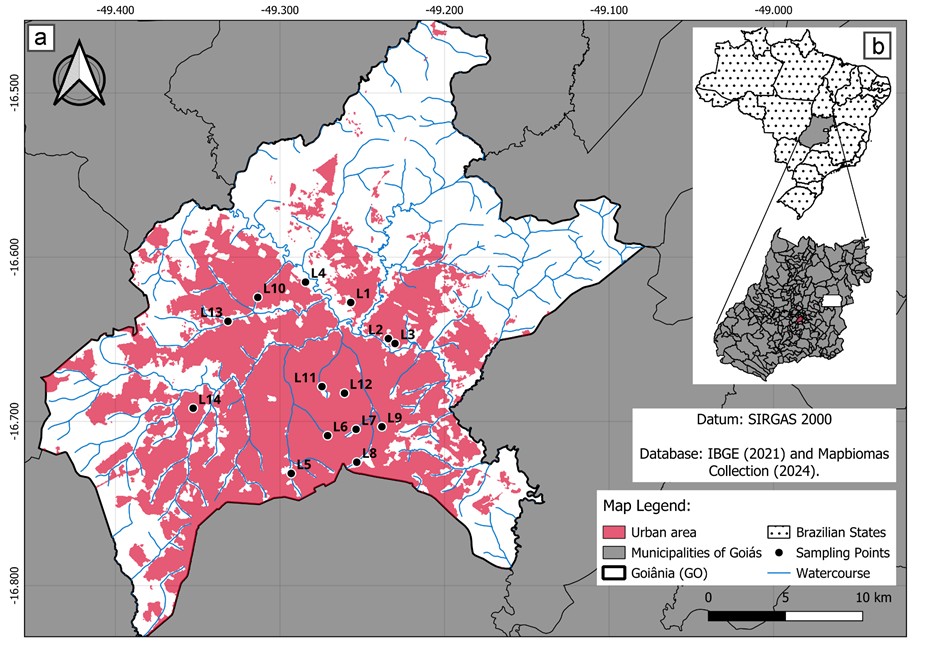
This study was conducted in 14 urban lakes located in different geographical regions of the municipality of Goiânia, Goiás, Brazil (Figure 1). The lakes sampled in the study were: L1 (Leolídio di Ramos Caiado Park), L2 (Liberdade Park), L3 (Beija Flor Park), L4 (Balneário Park), L5 (Cascavel Park), L6 (Vaca Brava Park), L7 (Areião Park), L8 (Jardim Botânico Park), L9 (Flamboyant Park), L10 (Fonte Nova Park), L11 (Lago das Rosas Park), L12 (Bosque dos Buritis Park), L13 (Nova Esperança Park), and L14 (João Carlos Fernandes de Oliveira Park). The selected lakes are distributed across different regions of the city, capturing the environmental heterogeneity inherent to urban lacustrine systems. The park areas vary in size, as do the lake areas, which range from 850 to over 14,000 square meters. Additionally, the parks have diverse vegetation, including dry forest remnants, flooded areas, and reforested sections with preservation areas, as well as different land uses (Martins et al., 2024; Oliveira & Bortolini, 2025).
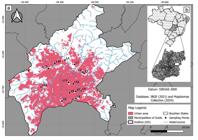
Location of the study area showing the sampling stations in the municipality of Goiânia, Goiás, Brazil. (a) Urban lakes and sampling stations; (b) Location of Goiás state and the municipality of Goiânia in Brazil.
2.2. Sampling of phytoplankton and local environmental conditions
Water samples for the analysis of local environmental conditions and the phytoplankton community in the lakes were collected during the rainy season (March 2022) and the dry season (September 2022). The rainy season in this region typically occurs during spring and summer, from October to April, with an annual average precipitation ranging from 1200 mm to 1800 mm. In contrast, the dry season spans from May to September, with average precipitation values ranging from 100 mm to 400 mm during this period (Costa et al., 2012).
For each lake, we measured water temperature (°C), pH, electrical conductivity (µS cm-1), dissolved oxygen (mg L−1), and turbidity (NTU), using a portable digital potentiometer. In addition, we collected 1000 mL of water for laboratory analysis of total phosphorus (μg L−1), orthophosphate (μg L−1), nitrate (mg L−1), ammoniacal nitrogen (mg L−1), and chlorophyll-a concentrations (μg L−1). These variables were used as indicators of environmental variability.
On the same day, part of the water samples was filtered using Whatman GF/C membranes. Chlorophyll-a concentrations were quantified by macerating glass fiber filters containing the retained phytoplankton biomass with 90% acetone, followed by spectrophotometric readings (Golterman et al., 1978). The water filtrate was used for the determination of dissolved nutrients, including orthophosphate, nitrate, and ammoniacal nitrogen. Unfiltered water samples were used to analyze total phosphorus. Total phosphorus and orthophosphate were determined using the ascorbic acid method, with readings performed in a spectrophotometer (Golterman et al., 1978), where nitrate and ammoniacal nitrogen concentrations were obtained through cadmium and salicylate reduction methods, respectively, followed by spectrophotometric analysis (APHA, 2012).
We collected quantitative samples of phytoplankton directly with 100 mL bottles at the subsurface of the limnetic region and fixed them with Lugol’s acetic solution. Qualitative samples were also taken with a plankton net (20 μm) and fixed with Transeau’s solution, only for the taxonomic identification of the phytoplankton (Bicudo & Menezes, 2017).
2.3. Identification and quantification of phytoplankton
The phytoplankton material was identified based on morphological, morphometric, and meristic characteristics. Whenever possible, variability in these characteristics was observed in populations and the taxa were classified according to the classification systems presented in Bicudo & Menezes (2017) and Guiry & Guiry (2022), which follow strong phylogenetic propositions.
Phytoplankton density was estimated from quantitative samples using an inverted microscope (Olympus CKX41 model at 400×magnification), following the Utermöhl (1958) method. The sedimented volume was determined based on the concentration of algae and/or debris present in the sample, and the sedimentation time was adjusted according to the height of the sedimentation chamber, with at least three hours for each centimeter of chamber height (Margalef, 1983).
The counting was performed randomly by field, considering the stabilization curve of the species. The density values were calculated according to APHA (2012), and the results were expressed as individuals (cells, coenobia, colonies, or filaments) per milliliter, based on the forms in which the algae occur in nature. Phytoplankton richness was considered as the number of total taxa present in each quantitative sample.
To infer the constancy of each species in the lakes sampled during the two hydrological periods, we applied the method proposed by Dajoz (2005), where C = (p/P) * 100, with C >70% representing constant species; 30% < C < 70% representing frequent species; 10%< C < 30% representing sporadic species; and C < 10% representing rare species. In this equation, p is the number of samples containing the species, and P is the total number of samples tested.
2.4. Data analysis
To assess the environmental conditions of the lakes, we initially conducted descriptive statistics, including mean, minimum, maximum, and coefficient of variation, to compare the dry and rainy season and to reveal how environmental variables were structured according to the hydrological regime. Based on this, we characterized the different environmental scenarios in which phytoplankton communities occurred.
Subsequently, to test the variability in environmental conditions, as well as phytoplankton composition and density, we performed a permutation test for the homogeneity of multivariate dispersions among the sampling units for environmental data, presence/absence, and density of taxa collected in each lake across the two hydrological periods. The test was based on distances calculated via Principal Coordinates Analysis (PCoA), using the position of individual sampling units relative to the centroid of their respective groups in full-dimensional space (Anderson, 2006). The analysis employed a dissimilarity matrix constructed with Euclidean distance for environmental variables, Jaccard distance for presence/absence data, and Bray-Curtis distance for phytoplankton density data. Additionally, we assessed the homogeneity of multivariate dispersion (average distance to the group centroid) using PERMDISP with betadisper and permutest (with 9,999 permutations) from the vegan package (Oksanen et al., 2018). To test differences in environmental conditions and phytoplankton community structure between hydrological periods, we performed a Permutational Multivariate Analysis of Variance (PERMANOVA) using the adonis2 function from the vegan package, based on the same dissimilarity matrices described above, with 999 permutations (Anderson, 2001).
Finally, to identify indicator species for the dry and rainy seasons, we performed an indicator value analysis (IndVal; Dufrêne & Legendre, 1997) using the labdsv package (Roberts, 2019), and the density of organisms recorded in each lake during the two hydrological periods. The analyses were performed using the free software R (R Development Core Team, 2017).
3. Results
3.1. Environmental scenarios
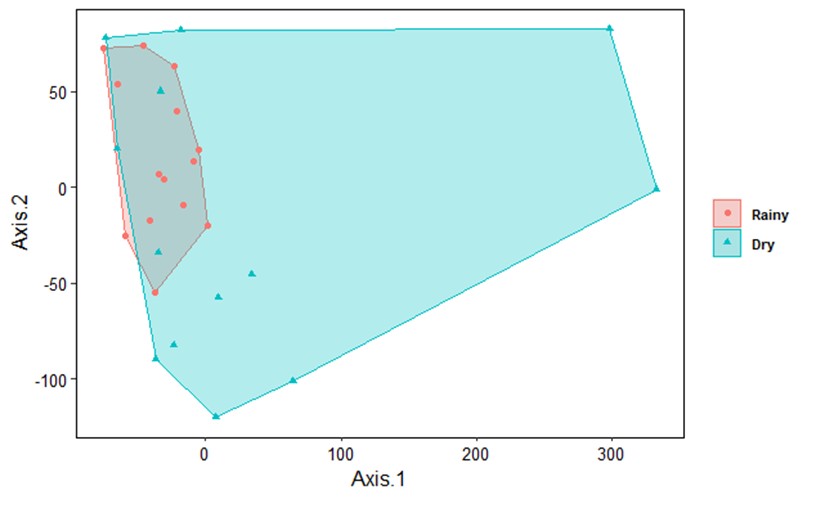
Regarding rainfall, total precipitation in March was 101 mm, whereas only 30 mm was recorded in September 2022 (INMET, 2025). These values reflect the variability in hydrological regime between the two periods analyzed. Orthophosphate, nitrate, and ammoniacal nitrogen were the variables that exhibited the greatest variation during the rainy season, according to the coefficient of variation. In contrast, dissolved oxygen, electrical conductivity, turbidity, total phosphorus, and chlorophyll-a showed greater variation during the dry season. Although temperature varied less during the dry season, the highest values were recorded in the rainy season (Table 1). According to the PCoA (Axis 1 = 70.46%; Axis 2 = 27.01%; F = 12.919; p = 0.001), greater variability in environmental conditions among the lakes was observed during the dry season (Figure 2). PERMANOVA for environmental variables indicated significant differences between periods (F = 6.58; R2 = 0.21; p = 0.001; 999 permutations).
Summary of local environmental variables measured during the rainy and dry seasons in urban lakes located in Goiânia, Goiás, Brazil.
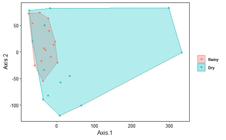
Principal Coordinates Analysis (PCoA) of the sampling units based on environmental variables obtained from urban lakes of Goiânia, Goiás, Brazil. The polygons indicate the maximum dispersion of the sampling units for each hydrological period.
3.2. Phytoplankton community structure
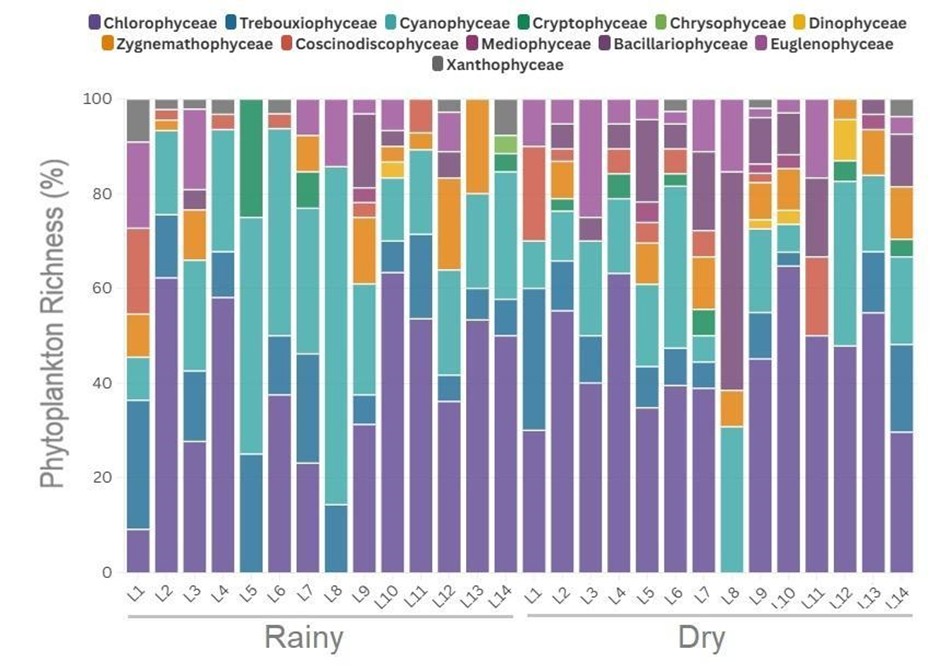
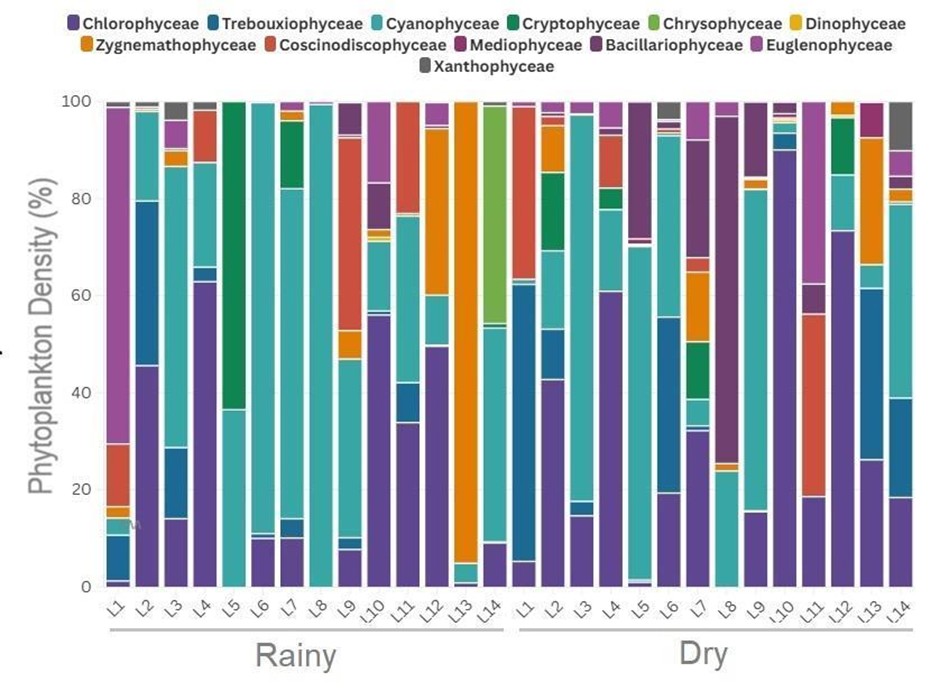
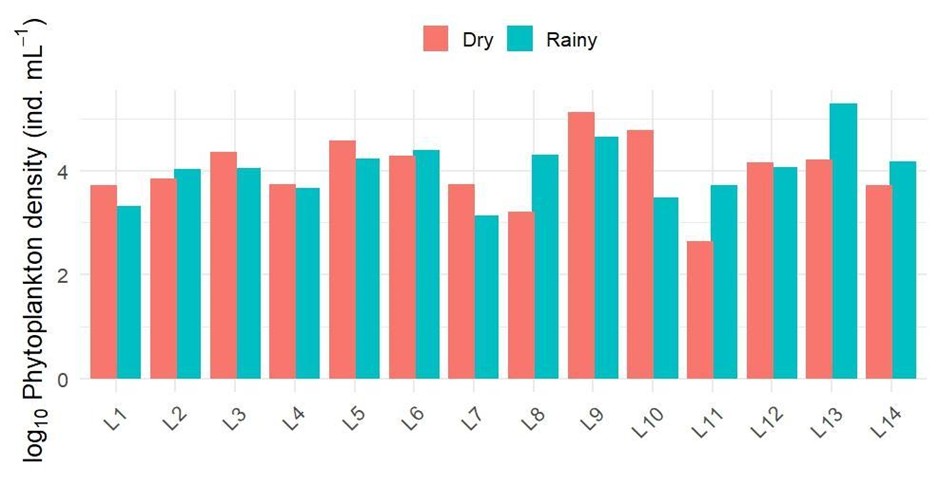
A total of 241 phytoplankton taxa were recorded in urban lakes during the study period. During the rainy season, taxa mainly belonged to the classes Chlorophyceae, Cyanophyceae, and Zygnematophyceae, whereas in the dry season, taxa mainly belonged to the classes Chlorophyceae, Cyanophyceae, and Bacillariophyceae (Figure 3). Regarding density, the rainy season showed notable contributions from Chlorophyceae, Cyanophyceae, Cryptophyceae, Chrysophyceae, and Zygnematophyceae. In contrast, during the dry season, major contributions were observed from Chlorophyceae, Cyanophyceae, Trebouxiophyceae, Coscinodiscophyceae, and Mediophyceae (Figure 4). Most lakes (L1, L3, L4, L5, L7, L9, L10, and L12) exhibited higher phytoplankton densities during the dry season than the rainy season. During the rainy season, lakes L2, L6, L8, L11, L13, and L14 had higher densities (Figure 5).
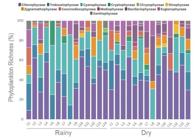
Relative contribution (%) of taxonomic groups to phytoplankton richness in urban lakes, Goiânia, Goiás, Brazil, during the rainy and dry seasons.
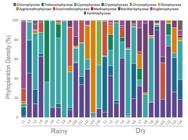
Relative contribution (%) of taxonomic groups to phytoplankton density in urban lakes, Goiânia, Goiás, Brazil, during the rainy and dry seasons.
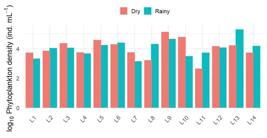
Total phytoplankton density in urban lakes, Goiânia, Goiás, Brazil, during the rainy and dry seasons. Data were log-transformed for better visualization.
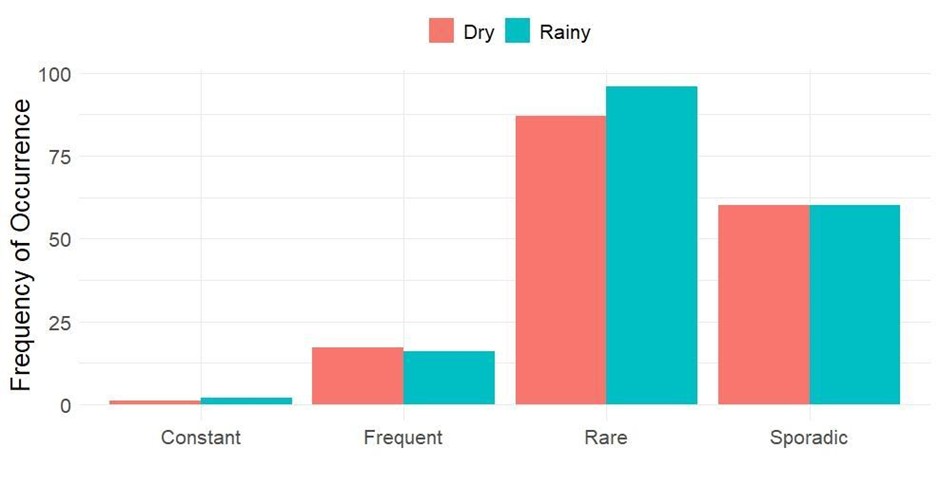
Regarding the occurrence frequency of the species, we observed a similar distribution for both hydrological periods, where it was possible to observe a higher number of sporadic and rare species (Figure 6).
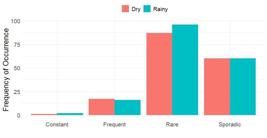
Constancy of phytoplankton taxa for the rainy and dry seasons sampled in urban lakes of Goiânia, Goiás, Brazil. Species were classified according to their frequency of occurrence in the samples as: constant (>70%), frequent (30–69%), sporadic (10–29%), and rare (<10%) (Dajoz, 2005).
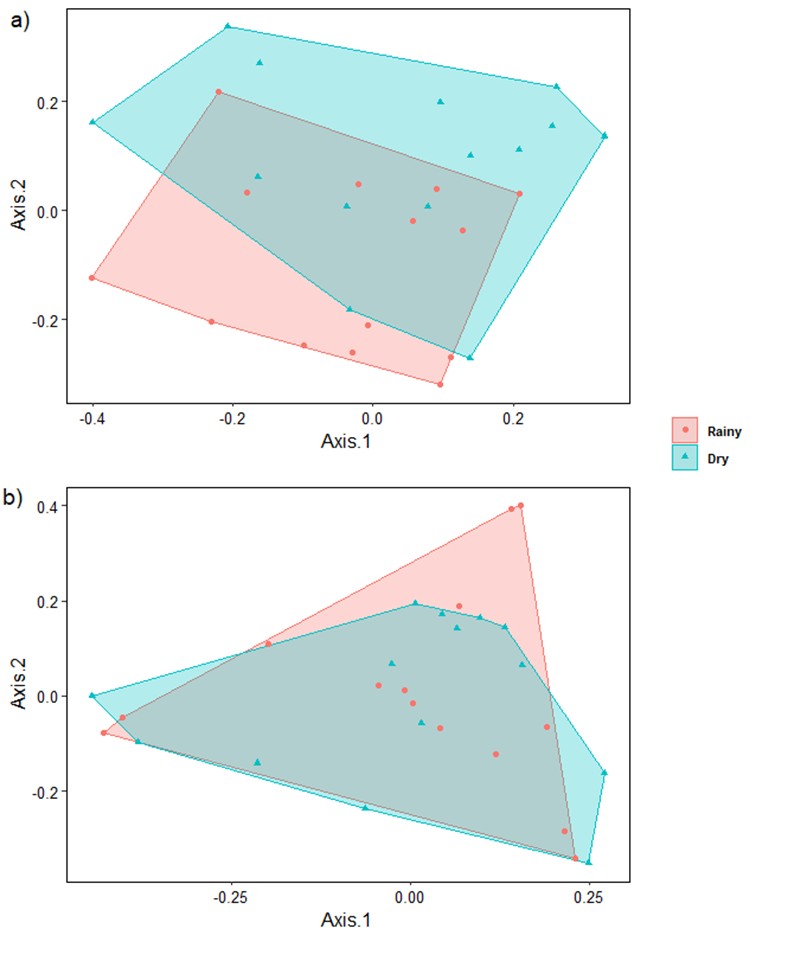
According to the PCoA, greater variability in taxa composition between lakes was observed during the dry season, whereas phytoplankton density showed similar variability between lakes in both the rainy and dry seasons (Figure 7). However, there were no differences in variability of composition (Axis 1 = 9.26%; Axis 2 = 8.71%; F = 0.9498; p = 0.316) or density (Axis 1 = 9.59%; Axis 2 = 7.96%; F = 0.154; p = 0.687) between lakes in the rainy season or dry season. Thus, the data allowed for a comparison of the similarity in composition and density of the lakes within each hydrological period. However, the phytoplankton community structure differed significantly between the dry and rainy seasons. PERMANOVA based on Bray-Curtis dissimilarity (densities transformed by Hellinger) revealed significant differences in community (F = 1.69; R2 = 0.06; p = 0.001), although the proportion of variance explained was comparatively low. Similarly, species composition based on Jaccard dissimilarity showed significant differences between seasons (F = 1.68; R2 = 0.06; p = 0.002).
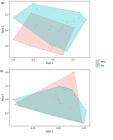
Principal Coordinate Analysis (PCoA) of the sampling units of the composition (a) and phytoplankton density (b) obtained in the urban lakes of Goiânia, Goiás, Brazil. The polygons indicate the maximum dispersion of the sampling units for each of the hydrological periods.
According to IndVal, eight phytoplankton indicator taxa were recorded, five taxa indicating the rainy season and three taxa indicating the dry season. Taxa associated with the rainy season were Eucapsis densa Azevedo, Sant'Anna, Senna, Komárek & Komárková, Synechocystis aquatilis f. salina (Wisłouch) Komárek, Aphanocapsa elachista West & G.S.West, Acanthosphaera zachariasii Lemmermann and Oocystis lacustris Chodat, whereas taxa associated with the dry season were Tetraëdron minimum (A.Braun) Hansgirg, Euglena Ehrenberg and Cryptomonas Ehrenberg (Table 2).
Results of the indicator species analysis (IndVal) based on phytoplankton density in the urban lakes of Goiânia, Goiás, Brazil.
4. Discussion
Our research revealed environmental variability between the dry and rainy seasons. The greatest environmental dissimilarity was observed in lakes during the dry season. However, contrasting patterns emerged in community variability and phytoplankton density. Although species composition was more variable among lakes during the dry season, phytoplankton density exhibited similar levels of variability in both seasons. Additionally, no significant differences in structural dissimilarity were detected among lakes within each season, despite clear differences in composition and density being observed between the dry and rainy periods. These findings suggest that different components of the phytoplankton community respond differently to hydrological variability, challenging the initial hypothesis. As expected, the highest levels of nutrients, electrical conductivity, turbidity and chlorophyll-a were recorded in the dry season, directly influencing the higher phytoplankton density values in most lakes. We identified eight indicator taxa in total: five were associated with the rainy season, and three with the dry season. This supports our third hypothesis, which states that environmental variability between hydrological periods influences phytoplankton species composition and selection. Additionally, a predominance of cyanobacteria, green algae, desmids, and diatoms was observed across both sampling periods, together with a high occurrence of sporadic and rare species.
In terms of environmental conditions, we observed greater variability among the lakes during the dry season. This may be due to the influence of local conditions specific to each lake; several studies have examined how local environmental processes affect the structure of biological communities (Beisner et al., 2006; Nabout & Nogueira, 2011). During the dry season, higher concentrations of phosphorus and nitrogen were the main factors promoting primary productivity and leading to increased concentrations of chlorophyll-a. This is because phosphorus plays an important role in the metabolism of photosynthetic organisms, particularly in the form of orthophosphate, which is more readily assimilated by the phytoplankton community. Meanwhile, nitrogen is directly involved in biomass formation, with ammoniacal nitrogen being the main nitrogen source for these organisms (Reynolds, 2006; Esteves, 2011).
During the dry season, the high electrical conductivity values may be associated with increased decomposition of organic matter, which releases ions into the water column (Carmo, 2000). The reduced water volume may also exert a dilution effect on ion concentrations. Regarding phytoplankton density, our findings are consistent with those of Nabout & Nogueira (2011), who also found higher densities during the dry season, when higher nutrient concentrations were recorded. Our results demonstrate the importance of local environmental conditions in determining the intensity of phytoplankton development (Cai et al., 2012). Another important observation is the coexistence of Cyanophyceae and Chlorophyceae within the context of phytoplankton functional groups (Reynolds et al., 2002; Padisák et al., 2009). Although these two groups of algae are taxonomically distinct, species from both can be classified into functional groups that share similar ecological strategies, particularly with regard to nutrient acquisition and tolerance of higher temperatures. This functional similarity, driven by environmental filtering, likely explains their coexistence under comparable environmental conditions, a phenomenon that has also been observed in other aquatic ecosystems (Almanza et al., 2016).
The presence of Zygnematophyceae was recorded at higher densities during the rainy season, indicating that water characteristics strongly influence their occurrence. This group is generally associated with dystrophic lakes with a pH lower than 7, or oligotrophic lakes, which favour their populations (Brook, 1981). During this period, the most frequent genus in this group was Cosmarium Corda ex Ralfs, of which 650 species have already been recorded in Brazil (Biolo & Bicudo, 2018). Furthermore, the presence of these organisms in lakes may be linked to the release of inocula during rainfall, which favours these microalgae as many are common components of periphyton (Cavati & Fernandes, 2008).
The frequency of occurrence results reveals the well-documented pattern observed in several studies where the number of rare species is higher, particularly in larger datasets (Magurran & Henderson, 2003). In the context of our study, this high proportion of rare taxa possibly reflects elevated beta diversity among lakes, particularly during the dry season. This would reinforce the trend of greater dissimilarity observed in the PCoA. Meanwhile, ecosystem functioning is expected to be strongly influenced by dominant and frequent taxa as they represent the largest proportion of total abundance and biomass (Grime, 1998). Among the indicator species recorded during the rainy season, Eucapsis densa Azevedo, Sant'Anna, Senna, Komárek & Komárková, Aphanocapsa elachista West & G.S. West, and Oocystis lacustris Chodat are characterized by forming large mucilaginous colonies. Additionally, their low surface-to-volume ratio (S/V) makes them more susceptible to environments with limited resources (Kruk & Segura, 2012). The presence of mucilage may also confer important ecological advantages, particularly during the rainy season when the water column is more intensely mixed and diluted. Under these conditions, colonial forms surrounded by mucilage may be favoured as this trait increases resistance to turbulence and provides protection against strong mechanical stress (Liu et al., 2019).
In contrast, Synechocystis aquatilis Sauvageau, also recorded during this period, is described as having a smaller size and belonging to the group of R-strategist organisms, which are efficient in resource acquisition and exhibit high growth rates even in environments with lower nutrient concentrations (Kruk & Segura, 2012). Medium-sized species without specialized traits were also recorded, with Acanthosphaera zachariasii Lemmermann indicating the rainy season and Tetraëdron minimum f. trigonum W. Krieger indicating the dry season. These organisms are better adapted to survive in environments with better water quality or during transitional stages of the ecosystem (Kruk & Segura, 2012).
We recorded Euglena Ehrenberg and Cryptomonas Ehrenberg as indicators of the dry season. These organisms are typically found in small bodies of water and are known for their ability to tolerate low light conditions (Reynolds et al., 2002; Kruk & Segura, 2012). This is consistent with the higher turbidity values recorded during this period. Both species are considered opportunistic because they have heterotrophic potential and are characterized by high resilience and tolerance to a wide range of environmental conditions (Burkholder et al., 2008). This strategy may therefore be important in aquatic ecosystems with low light levels due to low water levels and high inorganic turbidity, even if nutrient concentrations are high. This trait provides an adaptive advantage in environments with limiting conditions, especially during dry periods (Costa et al., 2019).
Finally, this study demonstrated that environmental variability associated with hydrological periods of drought and rainfall influences the structure of phytoplankton communities in tropical urban lakes. During the dry season, greater variability in environmental conditions was observed between the lakes, particularly with regard to higher concentrations of nutrients, electrical conductivity, and turbidity. This heterogeneity favored different phytoplankton species, as well as species with different adaptive strategies, in the lakes. The high proportion of rare species, variation in density, and presence of distinct taxonomic groups across time periods underscore the importance of continuous monitoring of these ecosystems. Our results suggest that hydrological variability plays a structuring role in urban lakes and phytoplankton communities. Monitoring local environmental variables in conjunction with phytoplankton species can effectively evaluate the ecological integrity of these systems and inform management and conservation strategies in urban areas.
Acknowledgements
We would like to thank the Conselho Nacional de Desenvolvimento Científico e Tecnológico (CNPq – National Council for Scientific and Technological Development) for granting a scientific scholarship (PIBIC) to UBS. We also thank the Fundação de Amparo à Pesquisa do Estado de Goiás (FAPEG – Goiás State Research Support Foundation) for funding the Project “ENVIRONMENTAL INTEGRITY IN URBAN LAKES AND ADJACENT AREAS: BIODIVERSITY AS AN ASSESSMENT TOOL” (Process No. 202310267000229), and the Institutos Nacionais de Ciência e Tecnologia (INCT – National Institutes for Science and Technology) in Ecology, Evolution and Biodiversity Conservation, supported by MCTIC/CNPq (Process No. 465610/2014-5).
-
Cite as:
Barbosa, U. et al. Distinct hydrological scenarios influence phytoplankton community in urban lakes. Acta Limnologica Brasiliensia, 2026, vol. 38, e16. https://doi.org/10.1590/S2179-975X6925.
Data availability
The dataset analyzed/produced in this study can be requested from the corresponding author.
References
-
Almanza, V., Parra, O., De, M., Bicudo, C.E., González, M.A., Lopez, M., & Urrutia, R., 2016. Floraciones de fitoplancton y variación de la estructura comunitaria fitoplanctónica en tres lagos someros eutróficos de Chile Central. Gayana Bot., 73(2), 191-205. https://doi.org/10.4067/S0717-66432016000200191
» https://doi.org/10.4067/S0717-66432016000200191 - American Public Health Association – APHA. American Water Works Association – AWWA. Water Environment Federation – WEF, 2012. Standard methods for the examination of water and wastewater. Washington, D.C.: APHA, 22 ed.
-
Anderson, M.J., 2001. A new method for non-parametric multivariate analysis of variance. Austral Ecol., 26(1), 32-46. https://doi.org/10.1111/j.1442-9993.2001.01070.pp.x
» https://doi.org/10.1111/j.1442-9993.2001.01070.pp.x -
Anderson, M.J., 2006. Distance-based tests for homogeneity of multivariate dispersions. Biometrics, 62(1), 245-253. PMid:16542252. https://doi.org/10.1111/j.1541-0420.2005.00440.x
» https://doi.org/10.1111/j.1541-0420.2005.00440.x -
Beisner, B.E., Peres-Neto, P.R., Lindström, E.S., Barnett, A., & Longhi, M.L., 2006. The role of environmental and spatial processes in structuring lake communities from bacteria to fish. Ecology, 87(12), 2985-2991. PMid:17249222. https://doi.org/10.1890/0012-9658(2006)87[2985:TROEAS]2.0.CO;2
» https://doi.org/10.1890/0012-9658(2006)87[2985:TROEAS]2.0.CO;2 - Bicudo, C.E.M., & Menezes, M., 2017. Gêneros de algas de águas continentais do Brasil: chave para identificação de gêneros. São Carlos: RiMa.
-
Biolo, S., & Bicudo, C.E.M., 2018. Checklist of the genus Cosmarium (Zygnematophyceae, Streptophyta) from Brazil. Biodivers. Int. J., 2(5), 452-454. https://doi.org/10.15406/bij.2018.02.00099
» https://doi.org/10.15406/bij.2018.02.00099 -
Bortolini, J.C., Train, S., & Rodrigues, L.C., 2016. Extreme hydrological periods: effects on phytoplankton variability and persistence in a subtropical floodplain. Hydrobiologia, 763(1), 223-236. https://doi.org/10.1007/s10750-015-2378-y
» https://doi.org/10.1007/s10750-015-2378-y -
Brasil, J., & Huszar, V.L.M., 2011. O papel dos traços funcionais na ecologia do fitoplâncton continental. Oecol. Aust., 15(4), 799-834. https://doi.org/10.4257/oeco.2011.1504.04
» https://doi.org/10.4257/oeco.2011.1504.04 - Brook, A.J., 1981. The biology of desmids. Oxford: Blackwell Scientific Publications.
-
Burkholder, J.M., Glibert, P.M., & Skelton, H.M., 2008. Mixotrophy, a major mode of nutrition for harmful algal species in eutrophic waters. Harmful Algae, 8(1), 77-93. https://doi.org/10.1016/j.hal.2008.08.010
» https://doi.org/10.1016/j.hal.2008.08.010 -
Cai, L.L., Zhu, G.W., Zhu, M.Y., Xu, H., & Qin, B.Q., 2012. Effects of temperature and nutrients on phytoplankton biomass during bloom seasons in Taihu Lake. Water Sci. Eng., 5(4), 361-374. https://doi.org/10.3882/j.issn.1674-2370.2012.04.001
» https://doi.org/10.3882/j.issn.1674-2370.2012.04.001 -
Cardoso, A.S., Silva Filho, S.M.P., Alves, A.E., Rocha, C.M.C., & Cunha, M.C.C., 2013. Fitoplâncton como bioindicador de eventos extremos na bacia do rio Una, Pernambuco, Brasil. Rev. Bras. Geogr. Fis., 6(4), 697-710. https://doi.org/10.26848/rbgf.v6i4.233063
» https://doi.org/10.26848/rbgf.v6i4.233063 - Carmo, C.F., 2000. Aporte de nutrientes, nitrogênio e fósforo, e sua relação com os impactos antropogênicos em um lago urbano [Dissertação de mestrado em Engenharia Ambiental]. São Paulo: Universidade de São Paulo.
-
Cavati, B., & Fernandes, V.O., 2008. Algas perifíticas em dois ambientes do baixo rio Doce (lagoa Juparanã e rio Pequeno-Linhares, Estado do Espírito Santo, Brasil): variação espacial e temporal. Acta Sci. Biol. Sci., 30(4), 439-448. https://doi.org/10.4025/actascibiolsci.v30i4.535
» https://doi.org/10.4025/actascibiolsci.v30i4.535 -
Costa, H.C., Marcuzzo, F.F.N., Ferreira, O.M., & Andrade, L.R., 2012. Espacialização e sazonalidade da precipitação pluviométrica do Estado de Goiás e Distrito Federal. Rev. Bras. Geogr. Fis., 5(1), 87-100. https://doi.org/10.26848/rbgf.v5i1.232785
» https://doi.org/10.26848/rbgf.v5i1.232785 -
Costa, M.R.A., Menezes, R.F., Sarmento, H., Attayde, J.L., Sternberg, L.S.L., & Becker, V., 2019. Extreme drought favors potential mixotrophic organisms in tropical semi-arid reservoirs. Hydrobiologia, 831(1), 43-54. https://doi.org/10.1007/s10750-018-3583-2
» https://doi.org/10.1007/s10750-018-3583-2 - Dajoz, R., 2005. As populações, as comunidades e os fatores ecológicos. In: Dajoz, R., ed. Princípios de ecologia. Porto Alegre: Artmed, 113-132, 7 ed.
-
De Groot, R.S., Wilson, M.A., & Boumans, R.M.J., 2002. A typology for the classification, description and valuation of ecosystem function, goods and services. Ecol. Econ., 41(3), 393-408. https://doi.org/10.1016/S0921-8009(02)00089-7
» https://doi.org/10.1016/S0921-8009(02)00089-7 -
Dufrêne, M., & Legendre, P., 1997. Species assemblages and indicator species: the need for a flexible asymmetrical approach. Ecol. Monogr., 67(3), 345-366. https://doi.org/10.2307/2963459
» https://doi.org/10.2307/2963459 - Esteves, F.A., 2011 Fundamentos de limnologia. Rio de Janeiro: Interciência, 3 ed.
-
Félix, I.B., Farias, T.L., Barroso, L.L., de Souza, L.L.R., & Junior, A.P., 2020. Urbanização, desmatamento marginal e a matéria orgânica alóctone em ecossistemas lênticos. Rev Bras. Gest. Ambient. (Online), 14(1), 132-138. Retrieved in 2025, March 5, from https://www.gvaa.com.br/revista/index.php/RBGA/article/view/7367
» https://www.gvaa.com.br/revista/index.php/RBGA/article/view/7367 -
Frau, D., Mayora, G., & Devercelli, M., 2018. Phytoplankton-based water quality metrics: feasibility of their use in a Neotropical shallow lake. Mar. Freshw. Res., 69(11), 1746-1754. https://doi.org/10.1071/MF18101
» https://doi.org/10.1071/MF18101 - Golterman, H.L., Clymo, R.S., & Ohstad, M., 1978. Methods for physical and chemical analysis of fresh water. IBP Handb., 8, 213.
-
Grime, J.P., 1998. Benefits of plant diversity to ecosystems: immediate, filter and founder effects. J. Ecol., 86(6), 902-910. https://doi.org/10.1046/j.1365-2745.1998.00306.x
» https://doi.org/10.1046/j.1365-2745.1998.00306.x -
Guiry, M.D., & Guiry, G.M., 2022 AlgaeBase (Online). Galway: National University of Ireland. Retrieved in 2025, March 5, from http://www.algaebase.org
» http://www.algaebase.org -
Guiry, M.D., 2012. How many species of algae are there? J. Phycol., 48(5), 1057-1063. PMid:27011267. https://doi.org/10.1111/j.1529-8817.2012.01222.x
» https://doi.org/10.1111/j.1529-8817.2012.01222.x -
Hamdhani, H., Sharaha, M., Eppehimer, D.E., & Rizal, S., 2024. Chlorophyll-a variation in response to precipitation in a tropical urban lake. Lakes Reserv., 29(1), e12447. https://doi.org/10.1111/lre.12447
» https://doi.org/10.1111/lre.12447 -
Hasan, S.S., Zhen, L., Miah, M.G., Ahamed, T., & Samie, A., 2020. Impact of land use change on ecosystem services: a review. Environ. Dev., 34, 100527. https://doi.org/10.1016/j.envdev.2020.100527
» https://doi.org/10.1016/j.envdev.2020.100527 -
Hu, R., Han, B., & Naselli-Flores, L., 2013. Comparing biological classifications of freshwater phytoplankton: a case study from South China. Hydrobiologia, 701(1), 219-233. https://doi.org/10.1007/s10750-012-1277-8
» https://doi.org/10.1007/s10750-012-1277-8 -
Instituto Nacional de Meteorologia – INMET, 2025. Gráficos meteorológicos – Estação A002 (Online). Brasília: INMET. Retrieved in 2025, March 5, from https://tempo.inmet.gov.br/Graficos/A002
» https://tempo.inmet.gov.br/Graficos/A002 -
Jia, Z., Chang, X., Duan, T., Wang, X., Wei, T., & Li, Y., 2021. Water quality responses to rainfall and surrounding land uses in urban lakes. J. Environ. Manage., 298, 113514. PMid:34391108. https://doi.org/10.1016/j.jenvman.2021.113514
» https://doi.org/10.1016/j.jenvman.2021.113514 -
Kruk, C., & Segura, A.M., 2012. The habitat template of phytoplankton morphology-based functional groups. Hydrobiologia, 698(1), 191-202. https://doi.org/10.1007/s10750-012-1072-6
» https://doi.org/10.1007/s10750-012-1072-6 -
Litchman, E., & Klausmeier, C.A., 2008. Trait-based community ecology of phytoplankton. Annu. Rev. Ecol. Evol. Syst., 39(1), 615-639. https://doi.org/10.1146/annurev.ecolsys.39.110707.173549
» https://doi.org/10.1146/annurev.ecolsys.39.110707.173549 -
Liu, M., Ma, J., Kang, L., Wei, Y., He, Q., Hu, X., & Li, H., 2019. Strong turbulence benefits toxic and colonial cyanobacteria in water: a potential way of climate change impact on the expansion of harmful algal blooms. Sci. Total Environ., 670, 613-622. PMid:30909039. https://doi.org/10.1016/j.scitotenv.2019.03.253
» https://doi.org/10.1016/j.scitotenv.2019.03.253 -
Magurran, A.E., & Henderson, P.A., 2003. Explaining the excess of rare species in natural species abundance distributions. Nature, 422(6933), 714-716. PMid:12700760. https://doi.org/10.1038/nature01547
» https://doi.org/10.1038/nature01547 - Margalef, R., 1983. Limnología. Barcelona: Omega.
-
Marques, S.M., & Américo-Pinheiro, J.H.P., 2017. Algas como bioindicadores da qualidade da água. Rev. Cient. ANAP Bras., 10(19), 1. https://doi.org/10.17271/19843240101920171651
» https://doi.org/10.17271/19843240101920171651 -
Martins, M.P.M., Soares, K.W.D.S., Carvalho, P.D., & Bortolini, J.C., 2024. Phytoplankton community diversity, dominance, and rarity: a case study of tropical urban lakes. Acta Limnol. Bras., 36, e1. https://doi.org/10.1590/s2179-975x6123
» https://doi.org/10.1590/s2179-975x6123 -
Nabout, J.C., & Nogueira, I.S., 2011. Variação temporal da comunidade fitoplanctônica em lagos urbanos eutróficos. Acta Sci. Biol. Sci., 33(4), 383-391. https://doi.org/10.4025/actascibiolsci.v33i4.5955
» https://doi.org/10.4025/actascibiolsci.v33i4.5955 -
Naselli-Flores, L., & Padisák, J., 2023. Ecosystem services provided by marine and freshwater phytoplankton. Hydrobiologia, 850(12-13), 2691-2706. PMid:35106010. https://doi.org/10.1007/s10750-022-04795-y
» https://doi.org/10.1007/s10750-022-04795-y -
Oksanen, J., Blanchet, F.G., Friendly, M., Kindt, R., Legendre, P., McGlinn, D., Minchin, P., O’Hara, R.B., Simpson, G.L., Solymos, P., Stevens, M.H.H., Szoecs, E., & Wagner, E., 2018. vegan: Community Ecology Package. R package version 2.5-3 (Online). Vienna: R Foundation for Statistical Computing. Retrieved in 2025, March 5, from https://CRAN.R-project.org/package=vegan
» https://CRAN.R-project.org/package=vegan -
Oliveira, A.K.N., & Bortolini, J.C., 2025. Environmental, spatial, and land-use determinants as key drivers of phytoplankton in urban lakes. Urban Ecosyst., 28(5), 178. https://doi.org/10.1007/s11252-025-01789-1
» https://doi.org/10.1007/s11252-025-01789-1 -
Padisák, J., Crossetti, L.O., & Naselli-Flores, L., 2009. Use and misuse in the application of the phytoplankton functional classification: a critical review with updates. Hydrobiologia, 621(1), 1-19. https://doi.org/10.1007/s10750-008-9645-0
» https://doi.org/10.1007/s10750-008-9645-0 -
Padisák, J., & Naselli-Flores, L., 2021. Phytoplankton in extreme environments: importance and consequences of habitat permanency. Hydrobiologia, 848(1), 157-176. https://doi.org/10.1007/s10750-020-04353-4
» https://doi.org/10.1007/s10750-020-04353-4 -
R Development Core Team, 2017. R: a language and environment for statistical computing (Online). Vienna: R Foundation for Statistical Computing. Retrieved in 2025, March 5, from http://www.R-project.org
» http://www.R-project.org -
Reynolds, C., Huszar, V., Kruk, C., Naselli-Flores, L., & Melo, S., 2002. Towards a functional classification of the freshwater phytoplankton. J. Plankton Res., 24(5), 417-428. https://doi.org/10.1093/plankt/24.5.417
» https://doi.org/10.1093/plankt/24.5.417 -
Reynolds, C.S., 2006. Ecology of phytoplankton. New York: Cambridge University Press. https://doi.org/10.1017/CBO9780511542145
» https://doi.org/10.1017/CBO9780511542145 -
Roberts, D.W., 2019. Labdsv: ordination and multivariate analysis for ecology (Online). Vienna: R Foundation for Statistical Computing. Retrieved in 2025, March 5, from https://CRAN.R-project.org/package=labdsv
» https://CRAN.R-project.org/package=labdsv -
Rudman, S.M., Kreitzman, M., Chan, K.M.A., & Schluter, D., 2017. Evosystem Services: rapid evolution and the provision of ecosystem services. Trends Ecol. Evol., 32(6), 403-415. PMid:28336183. https://doi.org/10.1016/j.tree.2017.02.019
» https://doi.org/10.1016/j.tree.2017.02.019 -
Silva, M.V., & Jati, S., 2024. Rainfall increases the biomass and drives the taxonomic and morpho-functional groups variability of phytoplankton in a subtropical urban lake. Acta Limnol. Bras., 36, e27. https://doi.org/10.1590/s2179-975x7823
» https://doi.org/10.1590/s2179-975x7823 -
Thornhill, I., Batty, L., Death, R.G., Friberg, N.R., & Ledger, M.E., 2017. Local and landscape scale determinants of macroinvertebrate assemblages and their conservation value in ponds across an urban land-use gradient. Biodivers. Conserv., 26(5), 1065-1086. PMid:32103868. https://doi.org/10.1007/s10531-016-1286-4
» https://doi.org/10.1007/s10531-016-1286-4 -
Utermöhl, H., 1958. Zur vervollkommnung der quantitativen phytoplankton-methodik: Mit 1 Tabelle und 15 abbildungen im Text und auf 1 Tafel. Internationale Vereinigung für theoretische und angewandte Limnologie. Mitteilungen, 9(1), 1-38. https://doi.org/10.1080/05384680.1958.11904091
» https://doi.org/10.1080/05384680.1958.11904091 -
Weithoff, G., 2003. The concepts of ‘plant functional types’ and ‘functional diversity’ in lake phytoplankton: a new understanding of phytoplankton ecology? Freshw. Biol., 48(9), 1669-1675. https://doi.org/10.1046/j.1365-2427.2003.01116.x
» https://doi.org/10.1046/j.1365-2427.2003.01116.x
Edited by
-
Associate Editor:
Bárbara Dunck