 Seasonal variation of the zooplankton communities’ diversity in ponds of the Atlantic Forest
Abstract:
Aim This study analyzed the structure and seasonal variation of the zooplankton community in five ponds in a preserved Atlantic Forest environment in Brazil, the Betary Reserve.
Methods Sampling took place in March and September 2022, January and July 2023, covering the summer (rainy) and winter (dry) seasons. Vertical trawls were carried out with a 45μm plankton net and, at the same points, physical-chemical parameters of the water were measured with a multi-parameter probe.
Results Fifty-nine taxa were recorded, distributed between Copepoda (1), Cladocera (5) and Rotifera (53). Among them, the families Lecanidae, Brachionidae and Trichocercidae were the most representative in number of species. Mesocyclops longisetus longisetus, Ceriodaphnia cornuta and Brachionus quadridentatus were present in all samples. The highest richness was observed in January/23. There was a difference in the composition of the assemblage between the seasons. Conductivity and temperature were structuring factors for some populations.
Conclusions The study pointed to a high diversity of the zooplankton in ponds within the Atlantic Forest, demonstrating the importance of preserved sites for the conservation of the biodiversity of this threatening biome. Further studies are needed to understand the distribution pattern of zooplankton species, the seasonal variation and their relationship with the physical-chemical parameters of the water.
Keywords:
cladocera; copepoda; rotifera; Betary Reserve; biodiversity
Resumo:
Objetivo Este estudo analisou a estrutura e variação sazonal da comunidade do zooplâncton de cinco poças inseridas em ambiente preservado da Mata Atlântica no Brasil, a Reserva Betary.
Métodos As amostragens ocorreram em março e setembro de 2022 e janeiro e julho de 2023, abrangendo as estações verão (chuvoso) e inverno (seco). Foram realizados arrastos verticais com rede de plâncton de 45μm e, nos mesmos pontos, foram aferidos os parâmetros físico-químicos da água com sonda multiparâmetro.
Resultados Foram registrados 59 taxóns, distribuídos por Copepoda (1), Cladocera (5) e Rotifera (53). Entre eles, as famílias Lecanidae, Brachionidae e Trichocercidae foram as mais representativas em termos de número de espécies. Mesocyclops longisetus, Ceriodaphnia cornuta, Brachionus quadridentatus estiveram presentes em todas as amostragens. A maior riqueza foi observada em janeiro/23. Houve uma diferença na composição da assembléia. A condutividade e a temperatura foram variáveis estruturantes para algumas populações nos períodos estudados.
Conclusões O estudo mostrou a biodiversidade do zooplâncton encontrado nas lagoas inseridas na Mata Atlântica, demonstrando a importância de locais preservados para a conservação da biodiversidade deste bioma, que se encontra ameaçado. Mais estudos são necessários para entender o padrão de distribuição das espécies zooplanctônicas, a variação sazonal de suas comunidades e sua relação com os parâmetros físico-químicos da água.
Palavras-chave:
cladocera; copepoda; rotifera; Reserva Betary; biodiversidade
1. Introduction
Global biodiversity has declined in recent centuries due to various anthropogenic impacts. Obtaining information on the diversity in different global biomes allows us to understand the dynamics and effects of this damage on the functioning of ecosystems (Reid et al., 2019). Despite this, knowledge of the biodiversity of aquatic communities is still not fully recognized, especially that of zooplankton (Elmoor-Loureiro et al., 2022). Therefore, work that explores areas that have not yet been studied is necessary to increase the biodiversity knowledge of organisms, especially in biomes with a high degree of impact.
The Atlantic Forest is one of the most diverse and impacted biomes in the world, covering almost the entire Brazilian coast (Vancine et al., 2024). In just over 3 decades, this biome has shown a decline in the size of its remnants, both for reforested vegetation and natural vegetation (Vancine et al., 2024). Protected areas cover only a small percentage of the biome, which is highly fragmented. This tropical forest is home to several aquatic systems, ranging from small freshwater bodies to large reservoirs, which are essential components for the balance and functioning of the ecosystem. Lentic freshwater environments, such as ponds, puddles and lakes, can harbor different groups of organisms, such as zooplankton. Furthermore, macrophytes can grow on those and form microhabitats for different trophic levels (Esteves, 2011; Van Leeuwen et al., 2023), animals can use these sites for reproduction, egg deposition, feeding or hiding from predators (Burks et al., 2002; Gonzalez Sagrario & Balseiro, 2010).
In addition to the effects of biotic factors, abiotic factors can be also important. Water parameters such as temperature, pH, conductivity, dissolved oxygen, and nutrients have shown to strongly influence community structure (Liu et al., 2023; Dos Santos et al., 2023). In shallow tropical lakes, nitrogen and phosphorus are structuring variables in phytoplankton and zooplankton community composition (Kondowe et al., 2022). In another study with mesocosms simulating shallow lakes, it was shown that the influence of nutrients on the composition of the zooplankton community was greater than the influence of temperature (Işkin et al., 2020). In addition, seasonality is a factor that influences environmental variables and can cause effects and changes in the structure of aquatic communities (Kondowe et al., 2022; Liu et al., 2023).
During the dry season (winter), the water temperature is lower than in the rainy season (summer), where aquatic environments receive high solar intensity, which increases water temperature. The greater rainfall during the rainy season contributes to the increase in the depth of aquatic environments, in addition to modifying the turbidity of the water. These variables, or a set of them, are structuring factors for the zooplankton community. Negreiros et al. (2010) recorded high densities of rotifers in the rainy season, as well as the exclusive occurrence of some species during this period. In contrast, Takahashi et al. (2009) found higher values for richness and abundance of zooplankton species in the dry season, where rotifers exhibited greater species richness, however for cladocerans and copepods, this attribute was greater in the rainy season. Therefore, more studies are needed to understand the distribution patterns of species under the effect of seasonality.
Zooplankton are primary consumers relevant for the transfer of energy to higher trophic levels, acting as herbivores and as a food source for fish larvae and juveniles (Rocha & Güntzel, 1999; Dos Santos et al., 2020). In addition, this group is composed of organisms sensitive to environmental changes and used as bioindicators of the trophic state and quality of aquatic systems (Gazonato Neto et al., 2014). The biodiversity of the Brazilian zooplankton community is still poorly understood. Elmoor-Loureiro et al. (2022) showed that for all zooplankton groups, the species accumulation curves have not yet reached their level, and more studies are needed to increase the knowledge of zooplankton biodiversity.
Freshwater environments have been severely affected by human activities, such as the effects of pollution and land use, contamination by agrochemicals, eutrophication and habitat destruction, which have negatively affected the zooplankton community (Portinho et al., 2018; Gutierrez et al., 2020; Dos Santos et al., 2025). However, many studies have been carried out on the survey and distribution of species in Brazil, contributing to the knowledge of biodiversity over the years (Matsumura-Tundisi & Tundisi, 2003; Castilho-Noll et al., 2012; Elmoor-Loureiro et al., 2022). However, it is necessary to carry out taxonomic and ecological studies of the species that are still in protected areas and do not suffer from anthropogenic impacts. Given the environmental heterogeneity of aquatic environments in Brazil, there are still gaps in the understanding of biodiversity in the Atlantic Forest, mainly considering the ecological characteristics of zooplankton and the factors that influence the community structure. Research on the distribution and seasonal variation of zooplankton is necessary to provide information that helps to understand the complexity of ecosystems and how biodiversity can be influenced. The objective of this study was to describe the zooplankton community and its diversity in different seasonal periods (summer and winter) from ponds located under the domain of dense ombrophilous Atlantic Forest.
2. Material and Methods
2.1. Study area
This study was conducted in five ponds located in the Betary Reserve (24º35'16"S; 48º37'44"W) (Figure 1), in the municipality of Iporanga, State of São Paulo - Brazil. The reserve covers an area of 60 hectares and is located in the Ribeira de Iguape and South Coast Basin, the largest contiguous area of preserved Atlantic Forest in Brazil, of the dense ombrophilous forest type, dominated by submontane dense ombrophilous forest. It is also located within the protection zone of the Alto Rio Ribeira Tourist State Park (PETAR). According to the Köppen classification, this region has a humid subtropical climate (Cfa) (Alvares et al., 2013), with rainfall distributed throughout the year and with an annual total sum of 1768 mm. Its geographical location acts as a link between the Serra do Mar Environmental Protection Area (buffer zone) and other conservation units in the region. It also acts as a corridor of relevant environmental heterogeneity, providing a habitat and transit area for the fauna of the remnants, through its connection with Permanent Protection Areas (APPs) (IPBIO, 2023).

A - The map of South America illustrates the geographical distribution of the Atlantic Forest area in green and the Betary Reserve area in red. B - Location of the municipality of Iporanga and the Betary Reserve, in the State of São Paulo; C - Boundary of the Betary Reserve and sampling points.
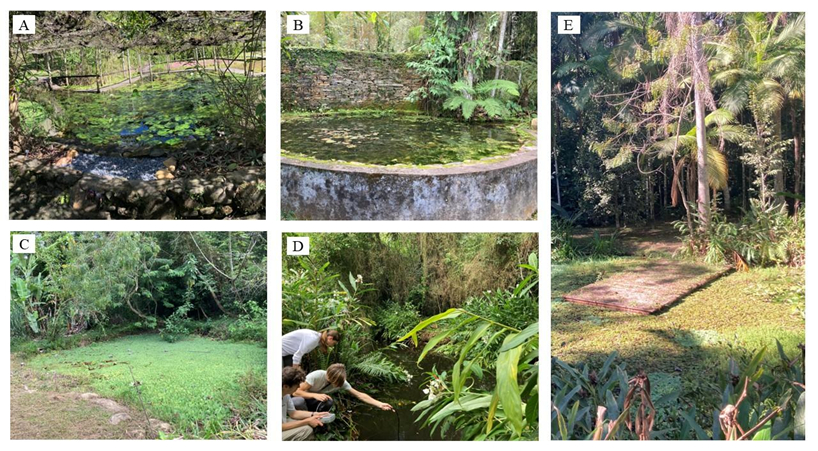
All ponds are inserted in forest landscape (Figure 1). The Aquarium Pond (Table 1 and Figure 2A) was built under an artificial lake and some studies with native fish are conducted there. There are also several species of rooted, submerged and floating aquatic plants. During the collections, the genus Azolla Lam., Egeria Michx., Salvinia Ség. and the species Nymphaea amazonum Mart. & Zucc., Nymphaea nouchali var. caerulea (Sav.) Verdc. and Nymphaea pubescens Willd. were identified.

Images of the ponds, Aquarium Pond (A) and Artificial Pond (B), Celpond 1 (C), Celpond 2 (D), Ornpond (E).
The Artificial Pond (Table 1 and Figure 2B) is in the artificial greenhouse (600m2) of the Betary Reserve and receives water from a natural spring. This artificial greenhouse is attractive for biodiversity such as amphibians, reptiles, arthropods and other groups, and is home to several endemic species of fauna from the Atlantic Rainforest. In addition, the pond is dominated by filamentous green algae, and most pond is covered by macrophytes such as Azolla sp., Egeria sp., Salvinia sp., Lemna minor L. and Nymphaea nouchali var. caerulea Small fish species are also found in this pond.
Celpond 1 was created for the colonization of aquatic species and is located in the middle of Atlantic Forest (Table 1 and Figure 2C). The pond is completely covered by the macrophyte Pistia stratiotes L. Celpond 2 is an artificial pond and located next to Celpond 1 and has a high density of vegetation around it (Table 1 and Figure 2D). This is the only pond that is not colonized by macrophytes. Finally, the Ornpond, also an artificial pond, receives natural flow and water from the Aquarium Pond, which contributes to an environment rich in organic matter (Table 1 and Figure 2E). Its cover is taken over by macrophytes, Myriophyllum aquaticum (Vell.) Verdc. and Heteranthera reniformis Ruiz & Pav.
2.2. Zooplankton community and water parameters
Sampling was conducted in March (summer) and September (winter) 2022; and January (summer) and July (winter) 2023. Zooplankton were collected in triplicate in the 5 ponds by vertical trawls in the water column using a 45 µm mesh plankton net. The average volume filtered was 50 liters per sampling pond. The filtered water was then transferred to 200 mL bottles. Carbonated water was added to anesthetize the organisms and preserve relevant taxonomic structures for identification. The organisms were fixed by formaldehyde solution until a concentration of 4% in the sample.
At the same zooplankton sampling sites, water depth (m) and transparency (m) were verified using a Secchi disk near the margin of the ponds. Water physical and chemical variables (dissolved oxygen (mg. L-1), temperature (°C), pH and electrical conductivity (μS. cm-1) were measured with the YSI 556 multi-parameter probe.
2.3. Identification and counting of zooplankton organisms
Zooplankton species were identified to the lowest possible taxonomic level using specialized identification keys (Segers, 1995; Elmoor-Loureiro, 1997; Silva, 2003; Joko, 2011; Sousa & Elmoor-Loureiro, 2019). The count was done by the total number of individuals when the density was low. For samples with abundant species, the count was done with 3 subsamples of 1 mL each. For counting, a checkered petri dish was used and analyzed under a stereoscopic microscope. Rotifers were counted using a Sedgewick-Rafter chamber and observed under a light microscope. Species densities and averages were calculated per month for each pond.
2.4. Data analysis
The relative contribution to abundance of Cladocera, Copepoda and Rotifera groups by sampling month was calculated. Species richness (S), Shannon-Wiener (H'), Simpson (D) and Pielou (J) diversity indices and relative abundance of species for the sampling periods were also calculated. The species richness was calculated using the function “specnumber”, Shannon-Wiener and Simpson with “diversity”, both from package “vegan” (Oksanen et al., 2022). For Pielou, the Shannon-Wiener diversity values and the logarithm of species richness were used as there is no function for their calculation.
To compare the relative abundance and diversity indices between the sampled months and seasons (winter and summer), was used the Kruskal-Wallis test using the "kruskal.test" function and the Wilcoxon-Man-Whitney test using the "wilcox.test" function, respectively. Both functions are from the "stats" package (R Core Team, 2022). The same approach was used to compare the physical-chemical parameters of the sampled seasons.
To describe the relationship between zooplankton species densities and physico-chemical parameters, a redundancy analysis (RDA) was performed using the function “rda” from “vegan” package (Oksanen et al., 2022) and the graph was made using the "ggord" function of the "ggord" package (Beck, 2024). Before the RDA, the “forward.sel” function in the “adespatial” package (Dray et al., 2022) was applied and only the variables responsible for the data variation were applied in RDA and plot. PERMANOVA was used to test differences in species composition between the sampled seasons, this was done through the "adonis2" function from the "vegan" package (Oksanen et al., 2022). To verify which species differed between the seasons, a SIMPER analysis was applied through the "simper" function from the "vegan" package (Oksanen et al., 2022). All statistical analyses were performed using R software (v4.2.0, R Core Team, 2022).
3. Results
3.1. Physical and chemical variables
The water temperature did not differ by seasons (W = 4; p = 0.221) but during the summer (March and January) the water temperature averaged 24.50°C, while in winter (September and July) the values ranged from 18.28°C to 18.55°C. There was a difference in conductivity between seasons (W = 4; p < 0.0001), with the highest average value recorded being in summer (85.75 μS. cm-1) and the lowest in winter (53.80 μS. cm-1). Dissolved oxygen did not differ between seasons (W = 2; p = 1), with little variation in values between months of sampling. The pH did not vary between seasons (W = 1; p = 0.667) and values collected in January were not included due to problems with the multiparameter probe. All collected ponds are shallow with depths ranging from 0.81 m to 1.4 m and this did not change according to the seasons (W = 2; p = 1). The transparency did not differ by seasons (W = 3; p = 0.667) and ranged from 0.47 m to 0.87 m (Table 2).
Means and standard deviations of water physical and chemical variables in the ponds of the Betary reserve during the collection seasons (March and September 2022; January and July 2023; March and January is summer; September and July is winter).
3.2. Zooplankton community structure
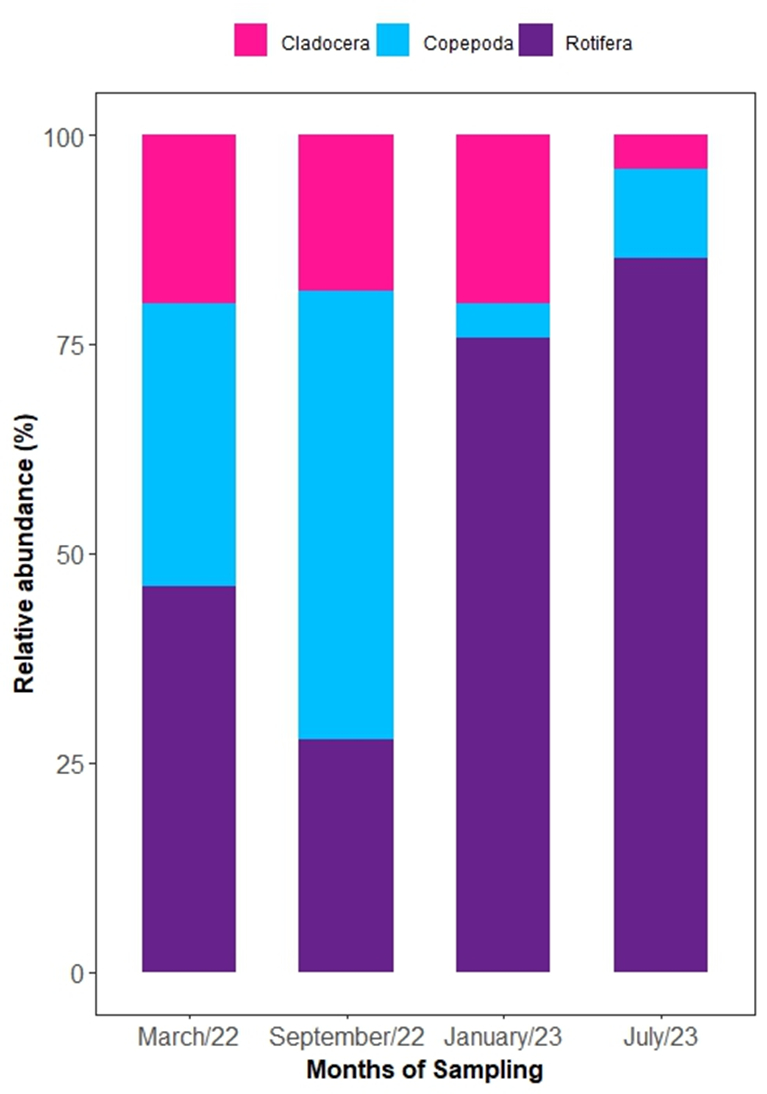
Rotifers had the highest relative abundance in March, January and July (46.05%, 75.67% and 85.33%, respectively). However, copepods were the most abundant in September (53.49%) (Figure 3). Cladocerans had values of 20% in March, September and January, and in July they were not very abundant (4.09%). The relative abundance of the groups (Cladocera, Copepoda and Rotifera) did not vary between months (X2 = 0.744; df = 3; p = 0.863). There was no difference in the relative abundance of groups between seasons (W = 20; p = 0.818)

Relative abundance of Copepoda, Cladocera and Rotifera species in the ponds of the Betary Reserve during the months sampled.
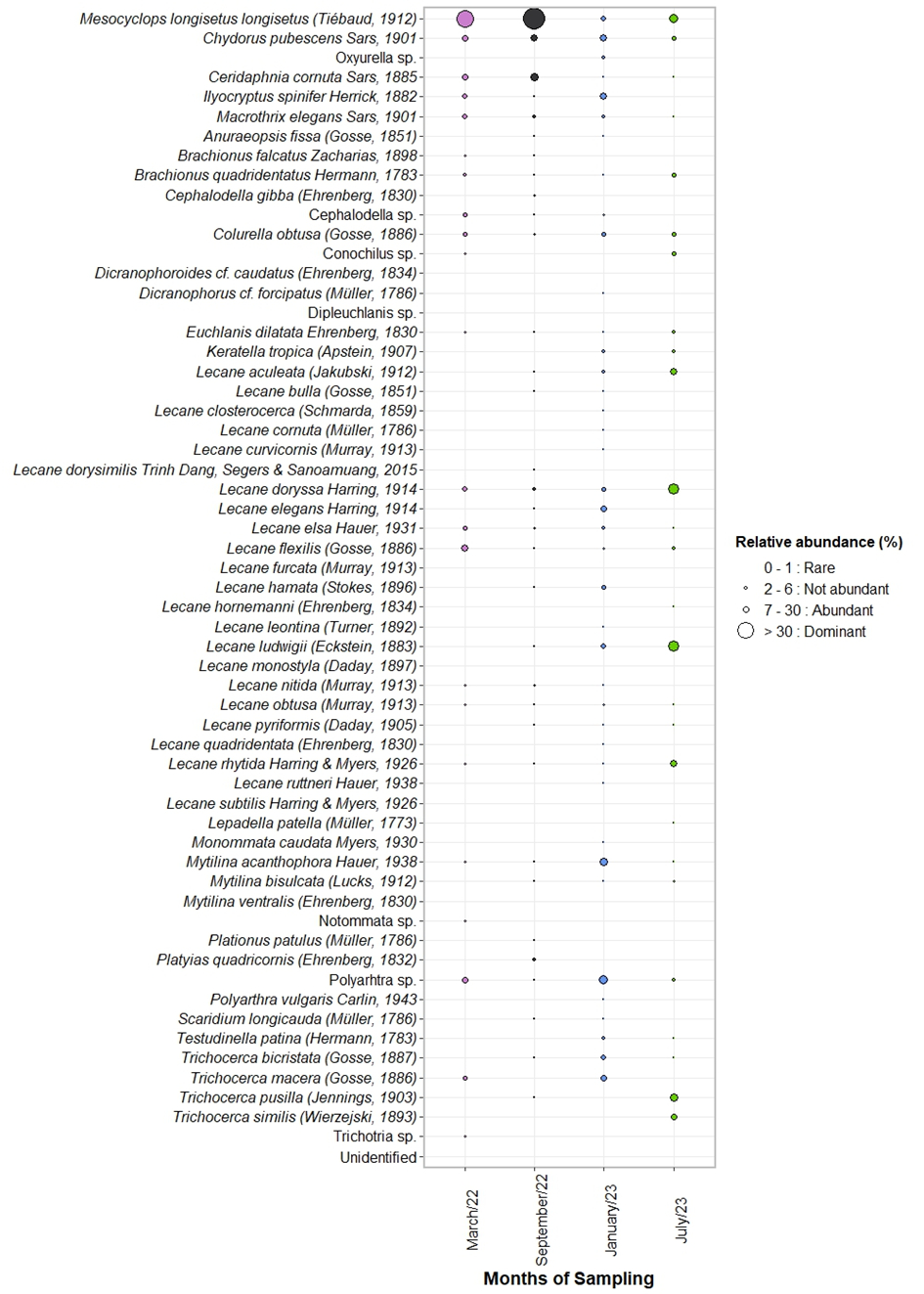
A total of 59 taxa were recorded, including 1 Copepoda, 5 Cladocera and 53 Rotifera. The rotifer genus Lecane (family Lecanidae) had twenty-three species distributed among the seasons, followed by the family Brachionidae with 6 species and Trichocercidae with 4 species (Figura 4). Among the cladocerans, the families Chydoridae, Daphniidae, Ilyocryptidae and Macrothricidae were found. Finally, Mesocyclops longisetus longisetus was the only Copepoda specie found.

The relative abundance of Copepoda, Cladocera and Rotifera species in the ponds of the Betary Reserve during the months sampled.
Species showed a variation in relative abundance between sampling periods (Figure 4). In March, Mesocyclops longisetus longisetus was characterized as the dominant species (33.83%). L. curvicornis and Polyarthra vulgaris were the only organisms classified as abundant. Cladocerans were not very abundant as well as some rotifer species (B. quadridentatus, L. bulla, L. cornuta, P. patulus, P. quadricornis and T. pusilla) (Figure 4).
In September, M. longisetus longisetus was the dominant species with the highest relative abundance among the species (Figure 4). As for the cladocerans, Ceriodaphnia cornuta and Chydorus pubescens were abundant in this period. However, M. elegans and I. spinifer showed a decrease in abundance and were classified as low abundant and rare, respectively. Lecane bulla was characterized as not very abundant and all of the species left occurring this season were rare, with abundances ranging from 0.40% to 1.99%. The rotifers species A. fissa, K. tropica, Lecane obtuse, L. closterocerca, and L. elsa were also considered not very abundant. Finally, L. curvicornis showed a decrease in abundance and was classified as rare during this period (0.48%) (Figure 4).
In January, no species were dominant. Ilyocryptus spinifer, M. bisulcata and P. vulgaris were abundant and had the highest abundance values in this collection (Figure 4). Most of the taxa recorded were classified as rare, and of these, the majority occurred exclusively in January. P. quadricornis and T. pusilla, as in March, were characterized as not very abundant, although they were more abundant than other species. Ceriodaphnia cornuta was not very abundant in March and September and was rare in the other collections. In addition, I. spinifer was most abundant in January, followed by March, but was rare in September and was not recorded in July (Figure 4).
The indices of diversity did not show any variability between the sampled months (X2 = 3; df = 3; p = 0.392). There was also no statistical difference between seasons (winter and summer) (Richness: W = 2; p = 1; Shannon: W = 4; p = 0.333, Simpson: W = 3.5; p = 0.414 and Pielou: W = 4; p = 0.333). However, the highest species richness was recorded in the January collection (50), followed by the two winter collections (33 and 28, respectively). March had the lowest number (22) but showed the highest equitability (0.94). The highest species diversity (3.25) and dominance (0.95) were found in January. The lowest values for diversity (2.63), dominance (0.81) and evenness (0.75) were recorded in September (Table 3).
Species richness (S), Shannon-Wiener diversity index (H'), Simpson's diversity index (D) and Pielou's Evenness (J) found at the sampling stations for the zooplankton community in the ponds of the Betary Reserve.
Redundancy analysis (RDA) showed the relationship between zooplankton species composition and limnological parameters through two ordination axes representing the variation observed in the community (Figure 5). Temperature (F= 1.68; p= 0.033) and conductivity (F= 1.78; p= 0.023) were the water parameters that structured the zooplankton species composition. The community sampled in summer (mainly represented by Macrothrix elegans, Trichocerca pusilla, Ilyocryptus spinifer) was positively associated with high water temperature. On the other hand, the community found in winter (Trichocerca similis, Trichocerca macera, Mytilina ventralis and Mesocyclops longisetus longisetus) was negatively associated with temperature. In summer, the species Ceriodaphnia cornuta was positively associated with high conductivity. PERMANOVA showed a difference in community composition between the sampling seasons (F= 2.00; p= 0.045), and Simper's analysis pointed to Notommata sp. (p= 0.008), which had a higher density in january.

Redundancy analysis (RDA) for zooplankton species and limnological parameters between winter and summer seasons. Abbreviation defined as follows: temp, temperature; cond, electrical conductivity; mes.lon, Mesocyclops longisetus longisetus; chy.pub, Chydorus pubescens; oxy.sp, Oxyurella sp.; cer.cor, Ceriodaphnia cornuta; ily.spi, Ilyocryptus spinifer; mac.ele, Macrothrix elegans; anu.fis, Anuraeopsis fissa; bra.fal, Brachionus falcatus; bra.qua, Brachionus quadridentatus; cep.gib, Cephalodella gibba; cep.sp, Cephalodella sp.; col.obt, Colurella obtusa; con.sp, Conochilus sp.; dic.cau, Dicranophoroides cf. caudatus; dic.for, Dicranophorus cf. forcipatus; dip.sp, Dipleuchlanis sp.; euc.dil, Euchlanis dilatata; ker.tro, Keratella tropica; lec.acu, Lecane aculeata; lec.bul, Lecane bulla; lec.clo, Lecane closterocerca; lec.cor, Lecane cornuta; lec.cur, Lecane curvicornis; lec.dor, Lecane dorysimilis; lec.dory, Lecane doryssa; lec.ele, Lecane elegans; lec.els, Lecane elsa; lec.fle, Lecane flexilis; lec.fur, Lecane furcata; lec.ham, Lecane hamata; lec.hor, Lecane hornemanni; lec.leo, Lecane leontina; lec.lud, Lecane ludwigii; lec.mon, Lecane monostyla; lec.nit, Lecane nitida; lec.obt, Lecane obtusa; lec.pyr, Lecane pyriformis; lec.qua, Lecane quadridentata; lec.rhy, Lecane rhytida; lec.rut, Lecane ruttneri; lec.sub, Lecane subtilis; lep.pat, Lepadella patella; mon.cau, Monommata caudata; myt.aca, Mytilina acanthophora; myt.bis, Mytilina bisulcata; myt.ven, Mytilina ventralis; not.sp, Notommata sp.; pla.pat, Plationus patulus; pla.qua, Platyias quadricornis; pol.sp, Polyarthra sp.; pol.vul, Polyarthra vulgaris; sca.lon, Scaridium longicauda; tes.pat, Testudinella patina; tri.bic, Trichocerca bicristata; tri.mac, Trichocerca macera; tri.pus, Trichocerca pusilla; tri.sim, Trichocerca similis; tri.sp, Trichotria sp.; uni, Unidentified.
4. Discussion
The ponds studied are characterized as shallow and with a small surface area. The physical and chemical water variables varied during the collection seasons, reflecting the characteristics of summer and winter. The solubility of oxygen in the aquatic system depends on the temperature, with warmer temperatures leading to lower gas solubility and accelerated organic matter decomposition, which may have resulted in the low concentration of dissolved oxygen in summer (Esteves, 2011). In addition, the high density of macrophytes prevents light penetration, thus affecting phytoplankton production and the availability of food for zooplankton. The large amount of biomass produced by aquatic plants promotes an increase in the concentration of dissolved organic matter, increasing the availability of resources for detritivorous species such as Macrothrix elegans and Chydorus spp., which live in association with macrophytes (Debastiani-Júnior et al., 2016). Also, some studies have shown that a high abundance of free-floating macrophytes can cause changes in limnological parameters such as lower pH values and dissolved oxygen, and higher water transparency, contributing to the increase in the diversity and richness of zooplankton species (Dos Santos et al., 2020).
There is a paucity of data on the dynamics of limnological parameters in shallow, forested environments, as most of the research involves large reservoirs that are not located in preserved environments. However, Gomes et al. (2020) reported that the degree of forest cover affected physicochemical characteristics such as conductivity, dissolved oxygen, and temperature in streams in the southeastern Amazon. Temperature and electrical conductivity were higher during the dry and wet seasons in areas with low forest cover, while water temperatures were higher during the wet season in areas with high forest cover (Gomes et al., 2020). Our results show that temperature and conductivity are structural factors of zooplankton communities in lakes located in ecological reserves with a high percentage of forest cover.
Considering the small size of the sampled ponds, the 59 taxa recorded represent a considerable species richness of the studied area. There are studies with relatively lower and others with higher numbers of species than those reported in our study. And this may reflect differences in sampling effort, size and depth of the sampled environment, filtering volume, and other factors that make comparison difficult. Our study showed a predominance of rotifer species, followed by cladocerans and copepods, whose pattern was also reported by several authors (Neves et al., 2003, Serafim-Júnior et al., 2010; Castilho-Noll et al., 2012). These studies found between 50 and 93 species of rotifers. This variation can be related to the variability in the types of environments, ranging from shallow reservoirs to eutrophic reservoirs and marginal lakes. On the other hand, lower diversity than those found in our study was also found by De-Carli et al. (2017) that observed 35 taxa in samples from 5 reservoirs in the Cantareira-SP system during the winter and summer seasons.
In most Brazilian small reservoirs, whether eutrophic or not, Rotifera is the dominant group, with greater species richness (Sampaio et al., 2002; De-Carli et al., 2017). Among them, the predominance of organisms from the family Lecanidae, Brachionidae and Trichocercidae is also widely reported in rivers and resevoirs in the State of São Paulo and others (Takahashi et al., 2009; Serafim-Júnior et al., 2010; Soares et al., 2011), as also found in our study. The success of the group is due to some specific characteristics, such as being generalists with a varied diet, having a high reproductive rate, in addition to being typical strategists and having a great dispersal capacity (de Paggi et al., 2020).
A checklist study of Rotifera in the State of São Paulo in five water management units (UGHRIs) showed 277 species which was considered a high diversity of rotifer species (Soares et al., 2011). However, there are 22 unsampled UGRHIs in the State of São Paulo and the Iguape/Litoral Sul basin, which includes our study area. Therefore, our study contributes to filling these gaps in the understanding of zooplankton biodiversity.
A study with a list of Cladocera species from the state of São Paulo (Rocha et al., 2011) showed that Ceriodaphnia cornuta and Ilyocryptus spinifer were widely recorded, including in the reservoirs of the Iguape Basin/South Coast, which corresponds to the basin that encompasses our study sites. However, Macrothrix elegans and Chydorus pubescens were conspicuous in our samples despite not being reported in the Iguape Basin/South Coast. Organisms from the families Chydoridae and Macrothricidae are typical of coastal regions, have appendages specialized for scraping substrates for food and can live associated with macrophyte banks (Fryer, 1968 and 1974; Elmoor-Loureiro, 1997; Santos-Wisniewski et al., 2002). Individuals of the family Ilyocryptidae have benthic habits, being able to collect particles from the bottom and aquatic plants, where they also live (Fryer, 1968 and 1974; Elmoor-Loureiro, 1997). Thus, the species Chydorus pubescens, Macrothrix elegans and Ilyocryptus spinifer found in our study belong to these families and may occur due to the characteristics of the ponds, being low depth and high abundance of macrophytes.
For cladocerans, Ceriodaphnia cornuta and Chydorus pubescens stand out and are characterized as species with high occurrence rates in other Brazilian environments (Matsumura-Tundisi & Tundisi, 2005; Rocha et al., 2011). For rotifers, the predominance of very common species is found in the genus Lecane and associated with macrophytes. The families Brachionidae, Synchaetidae and Trichocercidae also had constant representatives, reinforcing their characteristic of presenting common genera, which may be typical of the rainy season in different Neotropical regions (Abra et al., 2014).
The genus Ceriodaphnia is able to maintain its continuous reproductive rate and abundance at high conductivity values, such as those found in summer in our study (Armstead et al., 2016). At higher temperatures, such as in summer, there is a greater development of macrophytes and consequently an increase in the abundance and occurrence of species of the genera Macrothrix and Ilyocryptus (Dai et al., 2020; Fryer, 1974). On the other hand, in winter and at lower temperatures, species of the genus Trichocerca tend to be more abundant due to the presence of diatoms, which are used as food by these species (May et al., 2001). In addition, some studies have shown that some species, such as Mesocyclops longisetus longisetus and Mytlina ventralis, develop and grow more at low temperatures than at high temperatures (Jamieson, 1980, González-Gutiérrez et al., 2023).
Considering the results found for the community sampled in the shallow pond, habitat size, presence of macrophytes and riparian vegetation are positively related to zooplankton species richness (Dodson, 1991; Perbiche-Neves et al., 2014). Cortez-Silva et al. (2020) showed that the presence of riparian forest positively influenced the richness, abundance and diversity of cladoceran communities in tropical reservoirs. These results highlight the importance of vegetation in ensuring and maintaining biodiversity, in contrast to sites without forest. This is a relevant factor in assemblage structure because small aquatic environments provide less heterogeneity and microhabitats, which affects biotic interactions (Hobæk et al., 2002). Depth also influences species richness, as shallow lakes have limited space for vertical niche segregation (Strom, 1946). In this study, despite the small area of the ponds, macrophyte colonization contributed to species richness by providing different microhabitats and supporting different niches.
Water temperature was also a structuring factor in the community during this study, as evidenced by the RDA result (Figure 5). The data found is similar to those reported by Serafim-Júnior et al. (2010), where there was a greater richness of rotifer taxa in the winter, that was associated with higher water temperature and rainfall. Similarly, in the dry season (winter), characterized by a decrease in water temperature, lower richness was recorded. Finally, Cortez-Silva et al. (2020) showed that the presence of riparian forest positively influences the richness, abundance and diversity of cladoceran communities in tropical reservoirs. The results found in the present study corroborate with those of the authors and highlight the high diversity of zooplankton community in aquatic environments inserted in forest landscapes.
5. Conclusion
The zooplankton community of the ponds included in the Betary Reserve showed variations in the relative abundance of organisms and also in the distribution of species among the sampled stations. The community was characterized by species inhabiting shallow environments with the presence of macrophytes. Rotifers were predominant in all water bodies, followed by cladocerans and copepods. The different physical and chemical characteristics of the environments promoted differences in zooplankton species richness indices between periods. In addition to temperature, conductivity was also a key community structuring variable. Therefore, it can be concluded that the composition of zooplankton shifts between seasons and that temperature would be a key structuring variable for the community.
Knowing the biodiversity present in aquatic systems such as those studied in this study, it is possible to highlight the relevance of areas such as Natural Reserves and Environmental Protection Areas for the conservation of species and reinforce the preservation of environmental protection areas. Furthermore, information on biodiversity and geographical distribution of species is needed to fill gaps in this knowledge and to promote conservation actions. Therefore, the results of this study are subsidies for the monitoring of local fauna, in addition to providing data that can be incorporated into environmental education activities conducted in the Betary Reserve.
Data availability
The entire dataset supporting the results of this study has been published in the article itself.
Acknowledgements
We sincerely thank the anonymous reviewers for their insightful comments and suggestions, which significantly improved our manuscript. We gratefully acknowledge the Coordenação de Aperfeiçoamento de Pessoal de Nível Superior (CAPES) for the scholarship that supported the first author during his master's degree. We are deeply grateful to the staff and volunteers at Betary Reserve for their hospitality and invaluable assistance during fieldwork. Special thanks go to our colleagues at the Zooplankton Ecology Laboratory (IBILCE/UNESP) for their support and expertise in species identification throughout the master's program.
-
Cite as:
Souza, M.E.T. et al. Seasonal variation of the zooplankton communities’ diversity in ponds of the Atlantic Forest. Acta Limnologica Brasiliensia, 2025, vol. 37, e105. https://doi.org/10.1590/S2179-975X6524
References
- Abra, J., Castilho-Noll, M.S.M., Stephan, L.R., & Henry, R., 2014. Estudo de longo prazo do zooplâncton em lagoas marginais ao rio Paranapanema. In Henry, R. Represa de Jurumirim: ecologia, modelagem e aspectos sociais. Ribeirão Preto: Holos, 205-226, 1 ed.
-
Alvares, C.A., Stape, J.L., Sentelhas, P.C., Gonçalves, J.D.M., & Sparovek, G., 2013. Köppen’s climate classification map for Brazil. Meteorol. Z. (Berl.) 22(6), 711-728. http://doi.org/10.1127/0941-2948/2013/0507
» http://doi.org/10.1127/0941-2948/2013/0507 -
Armstead, M.Y., Bitzer-Creathers, L., & Wilson, M., 2016. The effects of elevated specific conductivity on the chronic toxicity of mining influenced streams using Ceriodaphnia dubia. PLoS One 11(11), e0165683. PMid:27814378. http://doi.org/10.1371/journal.pone.0165683
» http://doi.org/10.1371/journal.pone.0165683 -
Beck, M.W., 2024. ggord: Ordination Plots with ggplot2. R package version 1.1.8. Retrieved in 2024, November 11, from https://zenodo.org/badge/latestdoi/35334615
» https://zenodo.org/badge/latestdoi/35334615 -
Burks, R.L., Alojamento, D.M., Jeppesen, E., & Lauridsen, T.L., 2002. Diel horizontal migration of zooplankton: costs and benefits of inhabiting the littoral. Freshw. Biol. 47(3), 343-365. http://doi.org/10.1046/j.1365-2427.2002.00824.x
» http://doi.org/10.1046/j.1365-2427.2002.00824.x - Castilho-Noll, M.S.M., Camara, C.F., Abra, J., & Stephan, L.R., 2012. Fauna de invertebrados planctônicos e fitófilos em ambientes lênticos associados a fragmentos florestais remanescentes da região noroeste do estado de São Paulo. In: Necchi Junior, O., ed. Fauna e flora de fragmentos florestais remanescentes da região noroeste do estado de São Paulo. Ribeirão Preto: Holos, 137-153, 1 ed.
-
Cortez-Silva, E.E., Santos, G.S., Leite, M.G.P., & Eskinazi-Sant’anna, E.M., 2020. Response of cladoceran assemblages to restoration of riparian vegetation: a case study in a tropical reservoir of Brazil. Limnologica 85, 125-822. http://doi.org/10.1016/j.limno.2020.125822
» http://doi.org/10.1016/j.limno.2020.125822 -
Dai, Y., Hein, T., Preiner, S., Reitsema, R.E., & Schoelynck, J., 2020. Influence of water temperature and water depth on macrophyte–bacterioplankton interaction in a groundwater-fed river. Environ. Sci. Pollut. Res. Int. 27(12), 13166-13179. PMid:32016867. http://doi.org/10.1007/s11356-020-07921-2
» http://doi.org/10.1007/s11356-020-07921-2 -
de Paggi, S.B.J., Wallace, R., Fontaneto, D., & Marinone, M.C., 2020. Phylum rotifera. In: Rogers, D.C., Damborenea, C., & Thorp, J., eds. Thorp and Covich’s freshwater invertebrates. Cambridge: Academic Press, 145-200. http://doi.org/10.1016/B978-0-12-804225-0.00008-3
» http://doi.org/10.1016/B978-0-12-804225-0.00008-3 -
Debastiani-Júnior, J.R., Elmoor-Loureiro, L.M.A., & Nogueira, M.G., 2016. Habitat architecture influencing microcrustaceans composition: a case study on freshwater Cladocera (Crustacea Branchiopoda). Braz. J. Biol. 76(1), 93-100. PMid:26909628. http://doi.org/10.1590/1519-6984.13514
» http://doi.org/10.1590/1519-6984.13514 -
De-Carli, B.P., Doval, J.C.L., Rodrigues, E.H.C., & Pompêo, M.L.M., 2017. Variação espacial e sazonal do zooplâncton nos reservatórios do Sistema Cantareira, Brasil. Rev. Amb. Água, 12(4), 666-679. http://doi.org/10.4136/ambi-agua.1935
» http://doi.org/10.4136/ambi-agua.1935 -
Dodson, S., 1991. Species richness of crustacean zooplankton in European lakes of different sizes. SIL Proc. 1922-2010. 24(2), 1223-1229. http://doi.org/10.1080/03680770.1989.11898949
» http://doi.org/10.1080/03680770.1989.11898949 -
Dos Santos, N.G., Chiarelli, L.J., Morari, P.H.R., de Souza, M.E.T., Calixto, G., Kato, B.E.D., Del Pino Rodrigues, G.L., Figueira, L.C., & Castilho-Noll, M.S.M., 2025. How land use affects freshwater zooplankton communities: a global overview. Hydrob. 852, 2555-2580. http://doi.org/10.1007/s10750-024-05562-x
» http://doi.org/10.1007/s10750-024-05562-x -
Dos Santos, N.G., Dos Santos, E.F., Morari, P.H.R., Chiarelli, L.J., & Castilho-Noll, M.S.M., 2023. Total nitrogen and pH are key variables for functional structure of zooplanktonic communities in an agropastoral landscape. Sci. Total Environ. 891, 164031. PMid:37172842. http://doi.org/10.1016/j.scitotenv.2023.164031
» http://doi.org/10.1016/j.scitotenv.2023.164031 -
Dos Santos, N.G., Stephan, L.R., Otero, A., Iglesias, C., & Castilho-Noll, M.S.M., 2020. How free-floating macrophytes influence interactions between planktivorous fish and zooplankton in tropical environments? An in-lake mesocosm approach. Hydrobiologia 847(5), 1357-1370. http://doi.org/10.1007/s10750-020-04194-1
» http://doi.org/10.1007/s10750-020-04194-1 -
Dray, S., Bauman, D., Blanchet, G., Borcard, D., Clappe, S., Guenard, G., Jombart, T., Larocque, G., Legendre, P., Madi, N., & Wagner, H.H., 2022. adespatial: Multivariate Multiscale Spatial Analysis. R package version 0.3-16. Retrieved in 2024, November 11, from https://CRAN.R-project.org/package=adespatial
» https://CRAN.R-project.org/package=adespatial - Elmoor-Loureiro, L.M.A. 1997. Manual de identificação de cladóceros límnicos do Brasil. Brasília: Universa.
-
Elmoor-Loureiro, L.M.A., Souza, F.D.R., Oliveira, F.R., Joko, C.Y., Perbiche-Neves, G., Da Silva, A.C.S., Silva, A.J., Ghidini, A.R., Meira, B.R., Aggio, C.E.G., Morais-Junior, C.S., Eskinazi-Sant’anna, E.M., Lansac-Tôha, F.M., Cabral, G.S., Portinho, J.L., Nascimento, J.R., Silva, J.V.F., Veado, L., Chiarelli, L.J., Santana, L.O., Diniz, L.P., Braghin, L.S.M., Schwind, L.T.F., Melo Júnior, M., Progênio, M., Rocha, M.A., Silva, M.L.C., Castilho-Noll, M.S.M., Silva, N.J., Dos Santos, N.G., Morari, P.H.R., Maia-Barbosa, P.M., Oliveira, P.M., Arrieira, R.L., Macêdo, R.L., Deosti, S., Mantovano, T., Gazulha, V., Bonecker, C.C., Lansac-Tôha, F.A., Corgosinho, P.H.C., Velho, L.M.F., & Simões, N.R., 2022. Towards a synthesis of the biodiversity of freshwater Protozoa, Rotifera, Cladocera, and Copepoda in Brazil. Limnologica 100, 126008. http://doi.org/10.1016/j.limno.2022.126008
» http://doi.org/10.1016/j.limno.2022.126008 - Esteves, F.D.A., 2011. Fundamentos de Limnologia. Rio de Janeiro: Interciência, 3 ed.
-
Fryer, G., 1968. Evolution and adaptive radiation in the Chydoridae (Crustacea: Cladocera): a study in comparative functional morphology and ecology. Philos.Trans. Royal Soc. Lond., Ser. B, Bio. Sci. (Online), 254(795), 221-385. Retrieved in 2024, November 11, from https://www.jstor.org/stable/2416820
» https://www.jstor.org/stable/2416820 -
Fryer, G., 1974. Evolution and adaptive radiation in the Macrothricidae (Crustacea: Cladocera): a study in comparative functional morphology and ecology. Philos.Trans. Royal Soc. Lond. Ser. B. Biomed. Sci. 269(898), 137-274. http://doi.org/10.1098/rstb.1974.0044
» http://doi.org/10.1098/rstb.1974.0044 -
Gazonato Neto, A.J., Silva, L.C., Saggio, A.A., & Rocha, O., 2014. Zooplankton communities as eutrophication bioindicators in tropical reservoirs. Biota Neotrop. 14(4), e20140018. http://doi.org/10.1590/1676-06032014001814
» http://doi.org/10.1590/1676-06032014001814 -
Gomes, A.C.A.M., Gomes, L.F., Roitman, I., Pereira, H.R., Junior, A.F.C., da Costa, E.M.M., da Silva, M.L.C., Jacobson, T.K.B., da Costa Ribeiro, R.J., de Miranda Filho, R.J., de Avila, M.L., & Vieira, L.C.G., 2020. Forest cover influences zooplanktonic communities in Amazonian streams. Aquat. Ecol. 54(4), 1067-1078. http://doi.org/10.1007/s10452-020-09794-6
» http://doi.org/10.1007/s10452-020-09794-6 -
Gonzalez Sagrario, M.A., & Balseiro, E., 2010. The role of macroinvertebrates and fish in regulating the provision by macrophytes of refugia for zooplankton in a warm temperate shallow lake. Freshw. Biol. 55(10), 2153-2166. http://doi.org/10.1111/j.1365-2427.2010.02475.x
» http://doi.org/10.1111/j.1365-2427.2010.02475.x -
González-Gutiérrez, S., Sarma, S.S.S., & Nandini, S., 2023. Seasonal Diversity and Morphometric Variations of Rotifers in Relation to Selected Environmental Variables from a Tropical High-Altitude Lake in Mexico. Diversity (Basel) 15(8), 942. http://doi.org/10.3390/d15080942
» http://doi.org/10.3390/d15080942 -
Gutierrez, M.F., Simões, N.R., Frau, D., Saigo, M., & Licursi, M., 2020. Responses of stream zooplankton diversity metrics to eutrophication and temporal environmental variability in agricultural catchments. Environ. Monit. Assess. 192(12), 792. PMid:33242179. http://doi.org/10.1007/s10661-020-08766-5
» http://doi.org/10.1007/s10661-020-08766-5 -
Hobæk, A., Manca, M., & Andersen, T., 2002. Factors influencing species richness in lacustrine zooplankton. Acta Oecol. 23(3), 155-163. http://doi.org/10.1016/S1146-609X(02)01147-5
» http://doi.org/10.1016/S1146-609X(02)01147-5 -
Instituto de Pesquisas da Biodiversidade – IPBIO, 2023. Reserva Betary [online]. Iporanga: IPBio. Retrieved in December 15, 2023, from https://www.ipbio.org.br/o-que-%C3%A9-ipbio
» https://www.ipbio.org.br/o-que-%C3%A9-ipbio -
Işkin, U., Filiz, N., Cao, Y., Neif, E.M., Öğlü, B., Lauridsen, T.L., Davidson, T.A., Søndergaard, M., Tavşanoğlu, Ü.N., Beklioğlu, M., & Jeppesen, E., 2020. Impact of nutrients, temperatures, and a heat wave on zooplankton community structure: an experimental approach. Water 12(12), 3416. http://doi.org/10.3390/w12123416
» http://doi.org/10.3390/w12123416 -
Jamieson, C.D., 1980. Observations on the effect of diet and temperature on rate of development of Mesocyclops leuckarti (Claus) (Copepoda, Cyclopoida). Crustaceana 38(2), 145-154. http://doi.org/10.1163/156854080X00580
» http://doi.org/10.1163/156854080X00580 - Joko, C.Y., 2011. Taxonomia de rotíferos monogonontas da planície de inundação do alto rio Paraná (MS/PR) [Tese de doutorado em Ecologia de Ambientes Aquáticos Continentais]. Maringá: Programa de Pós-graduação em Ecologia de Ambientes Aquáticos Continentais, Departamento de Biologia, Universidade Estadual de Maringá.
-
Kondowe, B.N., Masese, F.O., Raburu, P.O., Singini, W., Sitati, A., & Walumona, R.J., 2022. Seasonality in environmental conditions drive variation in plankton communities in a shallow tropical lake. Front. Water 4, 883767. http://doi.org/10.3389/frwa.2022.883767
» http://doi.org/10.3389/frwa.2022.883767 -
Liu, H., Cheng, W., Xiong, P., Li, H., Liu, Z., Ai, J., Yuan, D., Wan, F., Wan, Y., Zou, H., & Shu, P., 2023. Temporal variation of plankton and zoobenthos communities in a freshwater reservoir: structure feature, construction mechanism, associated symbiosis and environmental response. Ecol. Indic. 154, 110774. http://doi.org/10.1016/j.ecolind.2023.110774
» http://doi.org/10.1016/j.ecolind.2023.110774 -
Matsumura-Tundisi, T., & Tundisi, J.G., 2003. Calanoida (Copepoda) species composition changes in the reservoirs of São Paulo State (Brazil) in the last twenty years. Hydrobiologia 504(1), 215-222. http://doi.org/10.1023/B:HYDR.0000008521.43711.35
» http://doi.org/10.1023/B:HYDR.0000008521.43711.35 -
Matsumura-Tundisi, T., & Tundisi, J.G., 2005. Plankton richness in a eutrophic reservoir (Barra Bonita Reservoir, SP, Brazil). In: Segers, H., & Martens, K., eds. Aquatic Biodiversity II. Developments in Hydrobiology. Dordrecht: Springer, 367-378. http://doi.org/10.1007/1-4020-4111-X_31
» http://doi.org/10.1007/1-4020-4111-X_31 - May, L., Bailey-Watts, A.E., & Kirika, A., 2001. The relationship between Trichocerca pusilla (Jennings), Aulacoseira spp. and water temperature in Loch Leven, Scotland, UK. In: Rotifera IX: Proceedings of the IXth International Rotifer Symposium, held in Khon Kaen. Netherlands: Springer, 29-34.
-
Negreiros, N.F., Santos-Wisniewski, M.J.D., Santos, R.M.D., & Rocha, O., 2010. The influence of environmental factors on the seasonal dynamics and composition of Rotifera in the Sapucaí River arm of Furnas Reservoir, MG, Brazil. Biota Neotrop. 10(4), 173-182. http://doi.org/10.1590/S1676-06032010000400023
» http://doi.org/10.1590/S1676-06032010000400023 -
Neves, I.F., Rocha, O., Roche, K.F., & Pinto, A.A., 2003. Zooplankton community structure of two marginal lakes of the river Cuiabá (Mato Grosso, Brazil) with analysis of Rotifera and Cladocera diversity. Braz. J. Biol. 63(2), 329-343. PMid:14509855. http://doi.org/10.1590/S1519-69842003000200018
» http://doi.org/10.1590/S1519-69842003000200018 -
Oksanen, J., Simpson, G., Blanchet, F., Kindt, R., Legendre, P., Minchin, P., O’Hara, R., Solymos, P., Stevens, M., Szoecs, E., Wagner, H., Barbour, M., Bedward, M., Bolker, B., Borcard, D., Carvalho, G., Chirico, M., De Caceres, M., Durand, S., Evangelista, H., FitzJohn, R., Friendly, M., Furneaux, B., Hannigan, G., Hill, M., Lahti, L., McGlinn, D., Ouellette, M., Ribeiro Cunha, E., Smith, T., Stier, A., Ter Braak, C., & Weedon, J., 2022. vegan: Community Ecology Package. Retrieved in 2024, November 11, from https://CRAN.R-project.org/package=vegan
» https://CRAN.R-project.org/package=vegan -
Perbiche-Neves, G., Previattelli, D., Pie, M.R., Duran, A., Suárez-Morales, E., Boxshall, G.A., Nogueira, M.G., & da Rocha, C.E., 2014. Historical biogeography of the neotropical Diaptomidae (Crustacea: copepoda). Front. Zool. 11, 36. PMid:25057279. http://doi.org/10.1186/1742-9994-11-36
» http://doi.org/10.1186/1742-9994-11-36 -
Portinho, J.L., Nielsen, D.L., Daré, L., Henry, R., Oliveira, R.C., & Branco, C.C., 2018. Mixture of commercial herbicides based on 2, 4-D and glyphosate mixture can suppress the emergence of zooplankton from sediments. Chemosphere 203, 151-159. PMid:29614408. http://doi.org/10.1016/j.chemosphere.2018.03.156
» http://doi.org/10.1016/j.chemosphere.2018.03.156 -
R Core Team, 2022. R: A language and environment for statistical computing. Vienna, Austria: R Foundation for Statistical Computing. Retrieved in 2024, November 11, from https://www.R-project.org/
» https://www.R-project.org/ -
Reid, A.J., Carlson, A.K., Creed, I.F., Eliason, E.J., Gell, P.A., Johnson, P.T.J., Kidd, K.A., MacCormack, T.J., Olden, J.D., Ormerod, S.J., Smol, J.P., Taylor, W.W., Tockner, K., Vermaire, J.C., Dudgeon, D., & Cooke, S.J., 2019. Emerging threats and persistent conservation challenges for freshwater biodiversity. Biol. Rev. Camb. Philos. Soc. 94(3), 849-873. PMid:30467930. http://doi.org/10.1111/brv.12480
» http://doi.org/10.1111/brv.12480 - Rocha, O., & Güntzel, A.M., 1999. Crustacea Branchiopoda. In D. Ismael, W.C. Valenti, T. Matsumura-Tundisi & O. Rocha, ed. Invertebrados de Água Doce. São Paulo: Programa BIOTA/FAPESP, 109-120.
-
Rocha, O., Santos-Wisniewski, M.J., & Matsumura-Tundisi, T., 2011. Checklist de Cladocera de água doce do Estado de São Paulo. Biota Neotrop. 11(Suppl. 1), 571-592. http://doi.org/10.1590/S1676-06032011000500024
» http://doi.org/10.1590/S1676-06032011000500024 -
Sampaio, E.V., Rocha, O., Matsumura-Tundisi, T., & Tundisi, J.G., 2002. Composition and abundance of zooplankton in the limnetic zone of seven reservoirs of the Paranapanema River, Brazil. Braz. J. Biol. 62(3), 525-545. PMid:12530191. http://doi.org/10.1590/S1519-69842002000300018
» http://doi.org/10.1590/S1519-69842002000300018 -
Santos-Wisniewski, M.J., Rocha, O., Güntzel, A.M., & Matsumura-Tundisi, T., 2002. Cladocera Chydoridae of high-altitude water bodies (Serra da Mantiqueira), in Brazil. Braz. J. Biol. 62(4A), 681-687. PMid:12659018. http://doi.org/10.1590/S1519-69842002000400016
» http://doi.org/10.1590/S1519-69842002000400016 -
Segers, H., 1995. Rotifera 2. The Lecanidae (Monogononta). Guides to the Identification of the Microinvertebrates of the Continental Waters of the World 6. Amsterdam: SPB Academic Publishing BV., 226 p. Retrieved in 2024, November 11, from http://hdl.handle.net/1854/LU-251052
» http://hdl.handle.net/1854/LU-251052 -
Serafim-Júnior, M., Perbiche-Neves, G., Brito, L.D., Ghidini, A.R., & Casanova, S., 2010. Variação espaço-temporal de Rotifera em um reservatório eutrofizado no sul do Brasil. Iheringia Ser. Zool. 100(3), 233-241. http://doi.org/10.1590/S0073-47212010000300008
» http://doi.org/10.1590/S0073-47212010000300008 - Silva, W.M.D., 2003. Diversidade dos Cyclopoida (Copepoda, Crustácea) de água doce do estado de São Paulo: taxonomia, ecologia e genética [Tese de doutorado em Ciências (Ciências Biológicas]. São Carlos: Universidade Federal de São Carlos.
-
Soares, F.S., Tundisi, J.G., & Matsumura-Tundisi, T., 2011. Checklist de Rotifera de água doce do Estado de São Paulo, Brasil. Biota Neotrop. 11(Suppl. 1), 515-539. http://doi.org/10.1590/S1676-06032011000500020
» http://doi.org/10.1590/S1676-06032011000500020 -
Sousa, F.D.R., & Elmoor-Loureiro, L.M.A., 2019. Identification key for the Brazilian genera and species of Aloninae (Crustacea, Branchiopoda, Anomopoda, Chydoridae). Pap. Avulsos Zool. 59, e20195924. http://doi.org/10.11606/1807-0205/2019.59.24
» http://doi.org/10.11606/1807-0205/2019.59.24 -
Strom, K.M., 1946. The ecological niche. Nature 157(3986), 375-375. http://doi.org/10.1038/157375b0
» http://doi.org/10.1038/157375b0 -
Takahashi, E.M., Lansac-Tôha, F.A., Dias, J.D., Bonecker, C.C., & Velho, L.F.M., 2009. Spatial variations in the zooplankton community from the Corumbá Reservoir, Goiás State, in distinct hydrological periods. Acta Sci. Biol. Sci. 31(3), 227-234. http://doi.org/10.4025/actascibiolsci.v31i3.4132
» http://doi.org/10.4025/actascibiolsci.v31i3.4132 -
Van Leeuwen, C.H., de Leeuw, J.J., Volwater, J.J.J., van Keeken, O.A., Jin, H., Drost, A.M., Waasdorp, D., Reichman, E., Ursem, L., & Bakker, E.S., 2023. Creating new littoral zones in a shallow lake to forward-restore an aquatic food web. Sci. Total Environ. 904, 166768. PMid:37683872. http://doi.org/10.1016/j.scitotenv.2023.166768
» http://doi.org/10.1016/j.scitotenv.2023.166768 -
Vancine, M.H., Muylaert, R.L., Niebuhr, B.B., Oshima, J.E.D.F., Tonetti, V., Bernardo, R., & Ribeiro, M.C., 2024. The Atlantic Forest of South America: spatiotemporal dynamics of remaining vegetation and implications for conservation. Biol. Conserv. 291, 110499. https://doi.org/10.1016/j.biocon.2024.110499
» https://doi.org/10.1016/j.biocon.2024.110499
Edited by
-
Associate Editors:
Cláudia Bonecker, Gilmar Perbiche Neves, Maria Stela Maioli Castilho Noll.