Data-driven prediction of chemical oxygen demand in dairy wastewater coagulation using a magnetic Moringa Oleifera-derived coagulant
Abstract
The increasing environmental impacts of industrial effluents have intensified the search for alternative wastewater treatment technologies. In this study, a magnetized natural coagulant based on Moringa oleifera-CoFe₂O₄ composite was synthesized and evaluated for the treatment of dairy wastewater. A Box-Behnken experimental design comprising 27 runs was employed to investigate the effects of coagulant dosage (9-16 g), pH (4-12), settling time (15-30 min), and mixing rate (50-150 rpm) on chemical oxygen demand (COD) removal efficiency. Experimental results showed COD removal ranging from 70.13% to 89.45%. To model the nonlinear relationships between operational parameters and COD removal, a multilayer perceptron artificial neural network (ANN) was developed using 27 experimental observations, divided into training (77.8%) and testing (22.2%) datasets. The optimized ANN architecture (4-2-1 topology) demonstrated high predictive accuracy, achieving relative errors of 6.6% and 6.3% for training and testing phases, respectively. The model exhibited excellent agreement between predicted and experimental values, with a coefficient of determination (R²) of 0.9946. Variable importance analysis revealed that pH was the dominant factor controlling coagulation performance, followed by settling time, while coagulant dosage and mixing rate showed comparatively lower influence. The results confirm that magnetized M. oleifera represents a promising eco-friendly alternative to conventional chemical coagulants and that ANN-based modeling provides a robust and reliable tool for process predictive and potential scale-up of natural coagulant-based wastewater treatment systems.
Keywords:
artificial neural network (ann); chemical oxygen demand (cod); dairy wastewater treatment; magnetized Moringa oleifera; multilayer perceptron; natural coagulant
Resumo
Os crescentes impactos ambientais dos efluentes industriais têm intensificado a busca por tecnologias alternativas de tratamento de águas residuais. Neste estudo, um coagulante natural magnetizado baseado em um compósito de Moringa oleifera-CoFe₂O₄ foi sintetizado e avaliado para o tratamento de efluente lácteo. Um delineamento experimental Box-Behnken, composto por 27 ensaios, foi empregado para investigar os efeitos da dosagem do coagulante (9-16 g), pH (4-12), tempo de sedimentação (15-30 min) e taxa de mistura (50-150 rpm) na eficiência de remoção da Demanda Química de Oxigênio (DQO). Os resultados experimentais mostraram remoção de DQO variando de 70,13% a 89.45%. Para modelar as relações não lineares entre os parâmetros operacionais e a remoção de DQO, foi desenvolvida uma rede neural artificial do tipo perceptron multicamadas (ANN), utilizando 27 observações experimentais, divididas em conjuntos de treinamento (77.8%) e teste (22.2%). A arquitetura otimizada da ANN (topologia 4-2-1) demonstrou alta precisão preditiva, alcançando erros relativos de 6.6% e 6.3% nas fases de treinamento e teste, respectivamente. O modelo apresentou excelente concordância entre os valores previstos e experimentais, com coeficiente de determinação (R²) de 0.9946. A análise de importância das variáveis revelou que o pH foi o fator dominante no controle do desempenho da coagulação, seguido pelo tempo de sedimentação, enquanto a dosagem do coagulante e a taxa de mistura exerceram influência comparativamente menor. Os resultados confirmam que a M. oleifera magnetizada representa uma alternativa ecológica promissora aos coagulantes químicos convencionais e que a modelagem baseada em ANN fornece uma ferramenta robusta e confiável para a processo preditivo e o potencial escalonamento de sistemas de tratamento de águas residuais baseados em coagulantes naturais.
Palavras-chave:
coagulante natural; demanda química de oxigênio (dqo); moringa oleifera magnetizada; perceptron multicamadas; rede neural artificial (ANN); tratamento de efluente lácteo
1. INTRODUCTION
Due to the accelerated growth of industrial activities, together with the continuous discharge of untreated agro-industrial wastewater into natural water bodies, the contamination of aqueous effluents has become one of the major environmental challenges worldwide. Agro-industrial wastewaters pose a significant threat to human health because of their adverse effects on both public health and aquatic ecosystems (Tetteh et al., 2021; Sahani et al., 2022). Among industrial sectors, the dairy industry has been identified as one of the major contributors to wastewater generation, as it produces large volumes of effluents containing high concentrations of organic matter, including carbohydrates, proteins, and lipids (Wang and Serventi, 2019). This type of pollution is commonly assessed using physicochemical parameters such as pH, temperature, color, and particularly chemical oxygen demand (COD), among others (Mosaddeghi et al., 2020; Ifeanyi et al., 2012; Zahrim et al., 2017). Szabo-Corbacho et al. (2021) reported that the processing of one liter of milk generates between 2.5 and 10 liters of wastewater. The treatment of dairy effluents is particularly challenging due to their high protein and fat content, which contribute to pH fluctuations and elevated levels of COD and biochemical oxygen demand (BOD). Among the primary treatment processes most commonly applied to reduce pollutant loads prior to discharge into natural water bodies are coagulation, flocculation, and sedimentation (Parihar et al., 2024).
In coagulation-flocculation processes, chemical coagulants such as aluminum- and iron-based metal salts are traditionally used to achieve charge neutralization and promote the aggregation of dispersed particles into settleable flocs (Gautam and Saini, 2020; Nimesha et al., 2022). However, these chemical treatments generate large volumes of sludge and may introduce residual soluble metal ions or synthetic polymers into the treated water. Such residues have been associated with potential environmental risks and adverse health effects, including possible links to carcinogenicity and toxicity toward aquatic organisms (Al-Mutairi, 2006). Although coagulation has traditionally been considered an effective technique for reducing contamination in various types of wastewater (Shak and Wu, 2015), its efficiency primarily depends on the physicochemical properties of the coagulant, which may either enhance or limit treatment performance (Sun et al., 2017; Verma and Kumar, 2016).
In this context, natural coagulants offer several advantages over chemical alternatives, including low toxicity, reduced sludge production, cost-effectiveness, and environmental sustainability, making them particularly attractive for developing regions (Yin, 2010; Awang and Aziz, 2012). Moringa oleifera, commonly known as the drumstick tree, is widely distributed across India, Asia, and parts of Africa and the Americas. Different parts of the tree, including bark, roots, leaves, flowers, and seeds, have traditionally been used for medicinal purposes. Notably, its seeds contain water-soluble cationic proteins that function effectively as natural coagulants and flocculants in water and wastewater treatment applications (El-Taweel et al., 2023). Several studies have demonstrated the effectiveness of M. oleifera seed extracts in pollutant removal. For instance, Tanko et al. (2020) reported that M. oleifera seed extract efficiently removed heavy metals from tannery wastewater, highlighting its economic feasibility, operational simplicity, and environmental compatibility. Similarly, Ravikumar and Udayakumar (2020) evaluated a combined treatment process involving M. oleifera seed coagulation followed by bentonite clay adsorption for heavy metal removal from drinking water. Additionally, several operational parameters significantly influence coagulation efficiency, including coagulant dosage, pH, mixing intensity and duration, as well as settling time (Rui et al., 2012; Tang et al., 2020).
As previously mentioned, M. oleifera has been widely used in coagulation-flocculation and sedimentation processes. However, it has been reported that the flocs produced by this natural coagulant are often light and difficult to settle, requiring up to 90 min for complete sedimentation (Cardoso et al., 2008). Therefore, there is growing scientific interest in developing coagulants capable of forming flocs that settle more rapidly. The development of coagulants associated with nanomaterials represents an innovative strategy to improve coagulation performance. These kinds of coagulants offer several advantages, including shorter coagulation/sedimentation times, reduced sludge production, and the possibility of nanomaterial reuse (Okoli et al., 2012). Furthermore, nanomaterials have been recognized as environmentally sustainable, efficient, and cost-effective alternatives for water treatment (Bottero et al., 2006; Theron et al., 2008). Among them, nano-structured iron oxides have attracted considerable attention because of their low cost, easy separation under an external magnetic field, and high adsorption capacity, particularly for metallic contaminants. These characteristics highlight the great potential of nano-structured iron oxides for wastewater decontamination (Silva et al., 2015).
Modeling of such processes is a key factor for optimization and scale-up. Numerous mathematical models have been proposed to describe coagulation mechanisms; however, these approaches often involve complex formulations without necessarily achieving high predictive accuracy (Sadri Moghaddam et al., 2011; Khayet et al., 2011). Therefore, there is growing interest in developing rapid, reliable, and data-driven modeling approaches capable of capturing nonlinear relationships among process variables. Artificial neural networks (ANNs) represent a powerful tool for modeling complex water treatment systems (Lamrini et al., 2005). An ANN is a computational model inspired by the functioning of the human brain and is widely applied in machine learning applications (Guo et al., 2021). Due to its data-driven nature, ANN is often referred to as a “black-box” model, as it does not require explicit knowledge of the underlying physical mechanisms (Al-Abri and Hilal, 2008). Among various ANN architectures, the feedforward backpropagation neural network-commonly known as the multilayer perceptron (MLP)-is the most frequently employed (Jawad et al., 2021). An MLP typically consists of an input layer, one or more hidden layers, and an output layer. The number of neurons in the input and output layers corresponds to the number of independent and dependent variables, respectively, whereas the hidden layer neurons are determined during model training. Each neuron processes weighted inputs, adds a bias (threshold), and applies an activation function to generate the output signal (Sharifi et al., 2021). In the present study, magnetized M. oleifera-CoFe₂O₄ was employed as a coagulant for the treatment of dairy wastewater. The effects of operational parameters-namely coagulant dosage, mixing rate, and settling time-were modeled as a function of chemical oxygen demand (COD) removal. An ANN-based approach was implemented to model the experimental data, and the predictive performance of the model was evaluated using the coefficient of determination (R²).
2. MATERIALS AND METHODS
2.1. Wastewater sample
Dairy wastewater was obtained from a privately operated dairy processing facility located close to Cartagena City, Colombia. Sampling was carried out during the early morning hours (06:00-07:00 h) using sterile polyethylene containers. The samples were immediately placed in a refrigerated icebox and transported to the laboratory for further analysis. To prevent microbial growth, the wastewater was sterilized by autoclaving at 121°C under 15 psi for 15 min prior to experimental use.
2.2. Preparation of the magnetic coagulant
Moringa oleifera seeds were manually collected, and those exhibiting signs of insect damage were discarded. The selected seeds were air-dried under direct sunlight for approximately eight days. Once dried, the seeds were mechanically milled, and the resulting powder was passed through a 40-mesh sieve to ensure particle size uniformity. The synthesis of CoFe₂O₄ was performed following the methodology reported by Nguyen et al. (2024). Subsequently, M. oleifera seed powder (1.0 g) and CoFe₂O₄ (0.5 g) were dispersed in 125 mL of distilled water and subjected to thermal treatment at 50°C for 2 h under continuous stirring. After the reaction, the resulting precipitate was recovered by filtration and sequentially washed with ethanol and distilled water. The obtained solid was dried under ambient conditions to produce the final magnetic composite material. The magnetic properties of the synthesized composite were verified according to the procedure described by González Cuello et al. (2025). Structural characterization by X-ray diffraction (XRD) revealed characteristic diffraction peaks at 2θ values of 30.3°, 35.6°, 43.2°, 57.0°, and 62.5°, corresponding to the cubic spinel structure of CoFe₂O₄, thereby confirming the successful incorporation of the magnetic phase.
2.3. Physicochemical analyses
Physicochemical characterization of the effluent was performed in accordance with the Standard Methods for the Examination of Water and Wastewater (Table 1). The concentrations of fats and oils were determined using the Soxhlet extraction method, following the procedures established by APHA et al. (2012). Chemical oxygen demand (COD) was measured employing the dichromate titration method (APHA et al. (2012). COD removal efficiency was calculated based on the percentage reduction relative to the initial COD concentration. Total phosphorus content was determined after acid digestion using the ascorbic acid method and expressed as mg P L⁻¹. The pH of the samples was measured potentiometrically using a digital benchtop pH/conductivity meter (PC 510). All analyses were conducted in triplicate, and the results are reported as mean values ± standard deviation (SD).
2.4. Jar test for coagulation experiments
Jar test experiments for wastewater treatment using the magnetic M. oleifera-CoFe₂O₄ composite were carried out employing a standard jar test apparatus. In each experimental run, 500 mL of wastewater was transferred into individual beakers and dosed with the predetermined amount of magnetized M. oleifera, as defined by the experimental design matrix (Table 2). Supernatant samples were carefully withdrawn from the clarified zone at approximately 2 cm below the liquid surface using a pipette for further analysis.
2.5. Design of Experiment
The design of the experiment was based on the Box-Behnken design (BBD) using the Minitab software (version: 17.0). Levels of the input variables defined in Table 2. The percentage of COD removal efficiency (%) was analyzed to assess the impact of the interactions of the factors on the overall performance of the system.
2.6. Artificial neural network (ANN)
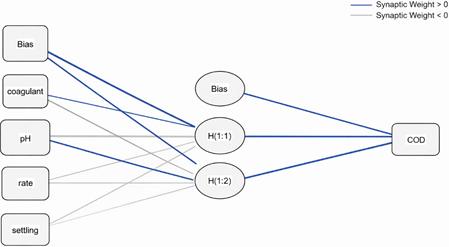
ANNs are typically organized in layers, consisting of an input layer, one or more hidden layers, and an output layer. Each neuron in the hidden layer receives a weighted sum of the outputs from the previous layer, and these weights are iteratively adjusted during training to minimize the error between predicted and target outputs. The number of neurons in the hidden layer is optimized based on the complexity of the problem. Once computed, the output is processed through an activation function to generate the network’s final prediction. The typical workflow of an ANN includes the following: data collection, identification of input and output parameters, training the network, testing its performance, and using the trained model for prediction. In this study, an ANN model was developed to predict COD removal efficiency as a function of operational coagulation-flocculation parameters. The experimental dataset consisted of 27 observations obtained from a structured experimental design including coagulant dosage, pH, mixing rate, and settling time as continuous input variables, while COD removal (%) was defined as the output variable. A schematic diagram of ANN architecture representing the inputs and outputs of the model is shown in Figure 1. To determine the performance of the ANN model, the coefficient of determination (R2) was used. R2 represents the degree of correlation between the measured and predicted values and can be computed as Equation 1:
Where N is the number of input samples; yi and di are the observed (actual) value and the desired value obtained from the ANN model correspondent with the ith input, respectively; and ȳ and d are their averages, respectively.

Schematic view of a feedforward neural network with an input layer, a hidden layer and an output layer.
3. RESULTS AND DISCUSSION.
3.1. Experimental data on chemical oxygen demand (COD) reduction
The evaluation of COD in wastewater treatment processes is of critical importance, as it quantifies the amount of oxidizable chemical substances and organic matter present in water that require oxygen for decomposition through chemical and biological pathways. Therefore, COD reduction constitutes a primary objective in wastewater treatment and water purification systems, since elevated COD levels could indicate the presence of contaminants that may cause risks to both environmental integrity and public health. Table 3 summarizes the experimental results for COD removal during the treatment of dairy wastewater, with removal efficiencies ranging from 70.13% to 89.45%. The highest COD removal (89.45%) was achieved under the following operational conditions: a coagulant dosage of 12.5 g/L, pH 8.0, a settling time of 15 minutes, and a mixing rate of 150 rpm. Under such conditions, a relatively higher mixing rate facilitates effective particle collision and aggregation, while a shorter settling time may be sufficient to promote floc sedimentation. The COD removal efficiencies reported herein are slightly lower than those documented by David et al. (2016). However, it is important to highlight that those authors employed M. oleifera seed extract in combination with conventional chemical coagulants such as aluminum sulfate and ferric sulfate for the treatment of distillery effluents. The use of metal-based salts (aluminum and iron) is known to enhance coagulation performance but also results in the generation of large volumes of complex sludge, which entails high handling and disposal costs and is frequently landfilled without adequate treatment (Prosper et al., 2021). Furthermore, Taiwo et al. (2020) reported a 78.6% reduction in COD in water from the Opa Reservoir at Obafemi Awolowo University (Ile-Ife) using purified M. oleifera coagulant protein obtained through ion-exchange and gel filtration chromatography. The purification of the active coagulant protein significantly improves process efficiency, thereby increasing COD removal performance.
The Box-Behnken design employed to produce the dataset for ANN modeling values COD removal.
3.2. Artificial neural network modelling study
The multilayer perceptron (MLP) developed in the present study was designed to model the nonlinear relationships between process variables and COD removal efficiency. The dataset consisted of 27 experimental runs generated according to the combinations defined by the Box-Behnken design. The data were partitioned into two subsets: 77.8% (n = 21) were used for training and 22.2% (n = 6) for testing. No experimental cases were excluded, ensuring complete utilization of the available data. The final neural network architecture followed a 4-2-1 topology. The input layer consisted of four neurons corresponding to coagulant dosage, pH, mixing rate, and settling time. The hidden layer comprised two neurons (denoted H(1:1) and H(1:2)) employing the hyperbolic tangent activation function. The output layer contained a single neuron with an identity activation function to perform continuous regression of COD removal. This relatively simple architecture was selected to prevent overfitting, considering the limited size of the experimental dataset.
Figure 1 also presents the synaptic weights of the optimized MLP network. In the graphical representation, blue lines indicate negative weights, whereas gray lines represent positive weights. The thickness of each line denotes the relative magnitude of the corresponding connection, with thicker lines indicating greater influence. Based on this representation, stronger connections can be observed between coagulant dosage and pH and the hidden layer, suggesting that these variables exert the greatest influence on COD removal. In contrast, mixing rate and settling time exhibited comparatively weaker contributions. This behavior is consistent with the fundamental physicochemical mechanisms governing coagulation-flocculation processes, in which solution pH plays a critical role in particle destabilization, charge neutralization, and aggregation efficiency (Bui et al., 2016). Analyzing the synaptic weights of the ANN is therefore particularly relevant, as it provides valuable insight into the relative importance of each input variable (coagulant dosage, pH, mixing rate, and settling time) with respect to the output variable (COD removal efficiency).
The quantitative values presented in Table 4 further confirm the dominant effect of pH, which exhibited larger connection weights between the input and hidden layers, indicating a strong contribution to the nonlinear transformations learned by the network. Coagulant dosage and mixing rate showed moderate weight magnitudes, while settling time presented comparatively smaller values, suggesting a reduced influence on COD prediction. Moreover, the weights connecting the hidden neurons to the output layer confirm that the model integrates multiple nonlinear sub-functions to accurately represent the treatment process. It is important to emphasize that individual synaptic weights cannot be interpreted as linear regression coefficients, since the ANN captures complex nonlinear interactions among variables rather than direct linear relationships.
3.3. Variable importance analysis
The relative importance of the input variables (coagulant dosage, pH, mixing rate, and settling time) was quantified using the connection-weight approach implemented within the MLP model. This analysis (Table 5) further confirmed that pH was the dominant variable, exhibiting the highest normalized importance (100%), followed by coagulant dosage (22.0%), settling time (15.4%), and mixing rate (14.5%). These findings differ from those reported by Sibiya et al. (2022), who identified coagulant dosage as the most influential parameter governing contaminant removal efficiency. However, it is important to emphasize that in their study, pH was maintained constant at 7.5 throughout the experimental runs, and magnetized rice starch was employed as the coagulant. Such experimental constraints, together with the distinct physicochemical properties of the coagulant used, may account for the observed discrepancies between the two studies.
The pronounced influence of pH suggests that the coagulation-flocculation process is predominantly governed by electrostatic interactions. According to the coagulation mechanism proposed by Nguyen et al. (2024), the functional groups present in the polymeric chains of M. oleifera undergo partial deprotonation under specific pH conditions, leading to the generation of negatively charged sites. Simultaneously, CoFe₂O₄ particles are likely to exhibit a positively charged surface under the synthesis conditions. This charge difference promotes electrostatic attraction, enabling the spherical CoFe₂O₄ particles to be effectively coated with M. oleifera. In the resulting composite structure, CoFe₂O₄ acts as the magnetic core, facilitating post-treatment magnetic recovery, while M. oleifera constitutes the active coagulating layer responsible for pollutant destabilization and subsequent aggregation.
In contrast, coagulant dosage exhibited a lower relative influence (22%) compared to pH. It was observed that both insufficient and excessive dosages led to reduced COD removal efficiencies, which may be attributed to the saturation of available active binding sites or to charge reversal phenomena (González Cuello et al., 2025). Meanwhile, settling time and mixing rate presented normalized importance values of 15.4% and 14.5%, respectively, indicating a comparatively lower contribution to the coagulation-flocculation performance. This behavior suggests that the process is more sensitive to chemical interactions than to hydrodynamic conditions within the evaluated experimental range. Overall, the variable importance analysis highlights that chemical control-particularly pH adjustment-plays a more critical role than purely mechanical parameters in optimizing coagulation efficiency and COD removal performance.
3.4. Model validation and predictive performance
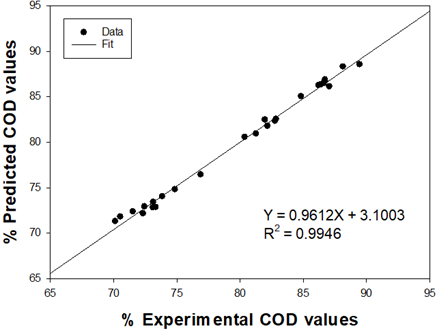
The developed ANN exhibited relative errors of 0.066 and 0.063 during the training and testing phases, respectively, indicating that more than 93% of the variability in COD removal efficiency was explained by the neural network model. The close agreement between training and testing errors confirms the absence of overfitting and demonstrates the strong generalization capability of the proposed architecture. Regarding the sum of squared errors (SSE), values of 0.681 and 0.310 were obtained for the training and testing phases, respectively. These low error magnitudes further indicate that the ANN effectively captured the nonlinear relationships between the operational parameters and COD removal efficiency.
This predictive performance is more clearly illustrated in Figure 2, which correlates the experimental values with those predicted by the model. The data points are tightly clustered around the 1:1 reference line, indicating strong agreement between measured and predicted values. The best-fit regression line is described by the linear equation: Y=0.9612X+3.1003 with a coefficient of determination (R²) of 0.994. This high R² value reflects an excellent correlation between experimental and predicted outputs, confirming the high predictive accuracy of the ANN model. Similar results were reported by Bui et al. (2016), who achieved a correlation coefficient of 0.986 when applying an artificial neural network to predict the coagulation performance of reactive dyeing wastewater treated with chitosan. Overall, the combination of a high R² value, low relative error, reduced SSE, and consistent performance across both training and testing datasets demonstrates that the proposed ANN model constitutes a reliable and robust predictive tool for modeling COD removal in dairy wastewater treated with magnetized M. oleifera-CoFe₂O₄ composite coagulant.

4. CONCLUSIONS
This study demonstrated the effectiveness of magnetized Moringa oleifera seeds as a natural coagulant for wastewater treatment, achieving COD removal efficiencies ranging from 70.13% to 89.45%. A Box-Behnken experimental design comprising 27 runs was employed to systematically evaluate the influence of four operational parameters: coagulant dosage (9-16 g), pH (4-12), settling time (15-30 min), and mixing rate (50-150 rpm), each assessed at three levels. The complex nonlinear interactions between process variables and COD removal were successfully modeled and optimized using an artificial neural network (ANN). The multilayer perceptron architecture exhibited strong predictive capability, yielding low relative errors for both the training (6.6%) and testing (6.3%) datasets, thereby confirming the robustness and generalization capacity of the model. Sensitivity analysis revealed that pH was the dominant factor governing the coagulation performance, followed by settling time, while coagulant dosage and mixing rate showed comparatively lower contributions. The high coefficient of determination (R² > 0.95) obtained between experimental and predicted values further demonstrated the accuracy of the developed ANN model. Overall, the results emphasize the critical role of pH control in maximizing pollutant removal efficiency. The proposed ANN-based modeling framework constitutes a reliable and efficient predictive tool for the design, optimization, and potential scale-up of wastewater treatment systems employing natural coagulants.
5. DATA AVAILABILITY STATEMENT
Data availability not informed.
6. REFERENCES
- APHA; AWWA; WEF Standard Methods for the examination of water and wastewater. 22nd ed. Washington, 2012. 1496 p.
-
AL-ABRI, M.; HILAL, N. Artificial neural network simulation of combined humic substance coagulation and membrane filtration. Chemical Engineering Journal, v. 141, n. 1, p. 27-34, 2008. https://doi.org/10.1016/j.cej.2007.10.005
» https://doi.org/10.1016/j.cej.2007.10.005 -
AL-MUTAIRI, N. Z. Coagulant toxicity and effectiveness in a slaughterhouse wastewater treatment plant. Ecotoxicology and Environmental Safety, v. 65, n. 1, p. 74-83, 2006. https://doi.org/10.1016/j.ecoenv.2005.05.013
» https://doi.org/10.1016/j.ecoenv.2005.05.013 -
AWANG, N. A.; AZIZ, H. A. Hibiscus rosa-sinensis leaf extract as coagulant aid in leachate treatment. Applied Water Science, v. 2, n. 4, p. 293-298, 2012. https://doi.org/10.1007/s13201-012-0041-3
» https://doi.org/10.1007/s13201-012-0041-3 -
BOTTERO, J. Y.; ROSE, J.; WIESNER, M. R. Nanotechnologies: Tools for sustainability in a new wave of water treatment processes. Integrated Environmental Assessment and Management, v. 2, n. 4, p. 391-395, 2006. https://doi.org/10.1002/ieam.5630020411
» https://doi.org/10.1002/ieam.5630020411 -
BUI, H. M.; DUONG, H. T. G.; NGUYEN, C. D. Applying an artificial neural network to predict coagulation capacity of reactive dyeing wastewater by chitosan. Polish Journal of Environmental Studies, v. 25, n. 2, p. 545-555, 2016. https://doi.org/10.15244/pjoes/61114
» https://doi.org/10.15244/pjoes/61114 -
CARDOSO, K. C.; BERGAMASCO, R.; COSSICH, E. S.; MORAES, L. C. K. Optimizing mixture and decantation times in the process of coagulation/flocculation of raw water using Moringa oleifera Lam. Acta Scientiarum. Technology, v. 30, n. 2, p. 193-198, 2008. https://dx.doi.org/10.4025/actascitechnol.v30i2.5493
» https://dx.doi.org/10.4025/actascitechnol.v30i2.5493 -
DAVID, C.; NARLAWAR, R.; ARIVAZHAGAN, M. Performance evaluation of Moringa oleifera seed extract (MOSE) in conjunction with chemical coagulants for treating distillery spent wash. Indian Chemical Engineer, v. 58, n. 3, p. 189-200, 2016. https://doi.org/10.1080/00194506.2015.1006147
» https://doi.org/10.1080/00194506.2015.1006147 -
EL-TAWEEL, M.; MOHAMED, N.; ALREFAEY, K. A.; HUSIEN, S.; ABDEL-AZIZ, A. B.; SALIM, A. I. et al A review of coagulation explaining its definition, mechanism, coagulant types, and optimization models (RSM and ANN). Current Research in Green and Sustainable Chemistry, v. 6, 2023. https://doi.org/10.1016/j.crgsc.2023.100358
» https://doi.org/10.1016/j.crgsc.2023.100358 -
GAUTAM, S.; SAINI, G. Use of natural coagulants for industrial wastewater treatment. Global Journal of Environmental Science and Management, v. 6, n. 4, p. 553-578, 2020. https://doi.org/10.22034/gjesm.2020.04.10
» https://doi.org/10.22034/gjesm.2020.04.10 -
GONZÁLEZ CUELLO, R. E.; ORTEGA TORO, R.; CASTELLANOS, H. M. Optimizing COD reduction in dairy wastewater treatment using magnetic coagulant derived from Moringa oleifera. Revista Ambiente & Água, v. 20, 2025. https://doi.org/10.4136/ambi-agua.3021
» https://doi.org/10.4136/ambi-agua.3021 -
GUO, C.; ZHANG, M.; CHEN, H. Suitability of low-field nuclear magnetic resonance (LF-NMR) combined with back propagation artificial neural network (BP-ANN) to predict printability of polysaccharide hydrogels for 3D printing. International Journal of Food Science and Technology, v. 56, n. 5, p. 2264-2272, 2021. https://doi.org/10.1111/ijfs.14885
» https://doi.org/10.1111/ijfs.14885 - IFEANYI, U.; CHUKWUDI, M. M.; OKECHUKWU, O. D. Effect of coag-flocculation kinetics on Telfairia occidentalis seed coagulant in pharmaceutical wastewater. International Journal of Multidisciplinary Science and Engineering, v. 3, n. 9, p. 22-33, 2012.
-
JAWAD, J.; HAWARI, A. H.; ZAIDI, S. J. Artificial neural network modeling of wastewater treatment and desalination using membrane processes: a review. Chemical Engineering Journal, 2021. https://doi.org/10.1016/j.cej.2021.129540
» https://doi.org/10.1016/j.cej.2021.129540 -
KHAYET, M.; ZAHRIM, A. Y.; HILAL, N. Modelling and optimization of coagulation of highly concentrated industrial grade leather dye by response surface methodology. Chemical Engineering Journal, v. 167, n. 1, p. 77-87, 2011. https://doi.org/10.1016/j.cej.2010.11.108
» https://doi.org/10.1016/j.cej.2010.11.108 -
LAMRINI, B.; BENHAMMOU, A.; KARAMA, A.; LE LANN, M. V. A neural network system for modelling of coagulant dosage used in drinking water treatment. In: RIBEIRO, B. et al Adaptive and Natural Computing Algorithms. Vienna: Springer, 2005. p. 96. https://doi.org/10.1007/3-211-27389-1_23
» https://doi.org/10.1007/3-211-27389-1_23 -
MOSADDEGHI, M. R.; PAJOUM SHARIATI, F.; VAZIRI YAZDI, S. A.; NABI BIDHENDI, G. Application of response surface methodology (RSM) for optimizing coagulation process of paper recycling wastewater using Ocimum basilicum. Environmental Technology, v. 41, n. 1, p. 100-108, 2020. https://doi.org/10.1080/09593330.2018.1491637
» https://doi.org/10.1080/09593330.2018.1491637 -
NGUYEN, T.; VO, D.; TRAN, T.; DAO, M. Magnetic coagulant derived from Cassia fistula seed for real textile wastewater treatment: A pilot-scale study. Desalination and Water Treatment, v. 319, 2024. https://doi.org/10.1016/j.dwt.2024.100426
» https://doi.org/10.1016/j.dwt.2024.100426 -
NIMESHA, S.; HEWAWASAM, C.; JAYASANKA, D.; MURAKAMI, Y.; ARAKI, N.; MAHARJAN, N. Effectiveness of natural coagulants in water and wastewater treatment. Global Journal of Environmental Science and Management, v. 8, n. 1, p. 1-16, 2022. https://doi.org/10.22034/GJESM.2022.01.08
» https://doi.org/10.22034/GJESM.2022.01.08 -
OKOLI, C.; BOUTONNET, M.; JÄRÅS, S.; RAJARAO-KUTTUVA, G. Protein-functionalized magnetic iron oxide nanoparticles: Time-efficient potential for water treatment. Journal of Nanoparticle Research, v. 14, n. 11, p. 1194, 2012. https://doi.org/10.1007/s11051-012-1194-9
» https://doi.org/10.1007/s11051-012-1194-9 -
PARIHAR, R. K.; BHANDARI, K.; BURNWAL, P.; GHOSH, S.; CHAURASIA, P.; MIDDA, O. Advancing dairy wastewater treatment: exploring two-stage fluidized bed anaerobic membrane bioreactor for enhanced performance, fouling, and microbial community analysis. Journal of Water Process Engineering, v. 58, 2024. https://doi.org/10.1016/j.jwpe.2024.104917
» https://doi.org/10.1016/j.jwpe.2024.104917 -
PROSPER, O. E.; UGONABO, V. I.; OKPALA, L. C.; NWOKOCHA, G. F. Clarification efficacy of eggshell and aluminum base coagulant for the removal of total suspended solids (TSS) from cosmetics wastewater by coag-flocculation. Chemical Papers, v. 75, p. 4759-4777, 2021. https://doi.org/10.1007/s11696-021-01703-x
» https://doi.org/10.1007/s11696-021-01703-x -
RAVIKUMAR, K.; UDAYAKUMAR, J. Moringa oleifera biopolymer coagulation and bentonite clay adsorption for hazardous heavy metals removal from aqueous systems. Geosystem Engineering, v. 23, p. 265-275, 2020. https://doi.org/10.1080/12269328.2020.1778544
» https://doi.org/10.1080/12269328.2020.1778544 - RUI, L. M.; DAUD, Z.; LATIF, A. A. A. Treatment of leachate by coagulation-flocculation using different coagulants and polymer: a review. International Journal of Advanced Science Engineering and Information Technology, v. 2, n. 2, p. 1-4, 2012.
-
SADRI MOGHADDAM, S.; ALAVI MOGHADDAM, M. R.; ARAMI, M. Response surface optimization of acid red 119 dye from simulated wastewater using Al-based waterworks sludge and polyaluminium chloride as coagulant. Journal of Environmental Management, v. 92, n. 4, p. 1284-1291, 2011. https://doi.org/10.1016/j.jenvman.2010.12.015
» https://doi.org/10.1016/j.jenvman.2010.12.015 - SAHANI, S.; SHARMA, Y. C.; KIM, T. Y. Emerging contaminants in wastewater and surface water. In: SINGH, S. P. et al New Trends in Emerging Environmental Contaminants. Springer, 2022. p. 9-30.
-
SHAK, K. P. Y.; WU, T. Y. Optimized use of alum together with unmodified Cassia obtusifolia seed gum as coagulant aid in treatment of palm oil mill effluent under natural pH of wastewater. Industrial Crops and Products, v. 76, p. 1169-1178, 2015. https://doi.org/10.1016/j.indcrop.2015.07.072
» https://doi.org/10.1016/j.indcrop.2015.07.072 -
SHARIFI, A.; SHARAFIAN, A.; AI, Q. Adaptive MLP neural network controller for consensus tracking of multi-agent systems with application to synchronous generators. Expert Systems with Applications, v. 184, 2021. https://doi.org/10.1016/j.eswa.2021.115460
» https://doi.org/10.1016/j.eswa.2021.115460 -
SIBIYA, N. P.; AMO-DUODU, G.; TETTEH, E. K.; RATHILAL, S. Model prediction of coagulation by magnetised rice starch for wastewater treatment using response surface methodology (RSM) with artificial neural network (ANN). Scientific African, v. 17, 2022. https://doi.org/10.1016/j.sciaf.2022.e01282
» https://doi.org/10.1016/j.sciaf.2022.e01282 -
SILVA, M. F.; PINEDA, E. A. G.; BERGAMASCO, R. Aplicação de óxidos de ferro nanoestruturados como adsorventes e fotocatalisadores na remoção de poluentes de águas residuais. Química Nova, v. 38, n. 3, p. 393-398, 2015. https://doi.org/10.5935/0100-4042.20140311
» https://doi.org/10.5935/0100-4042.20140311 -
SUN, Y.; ZHU, C.; ZHENG, H.; SUN, W.; XU, Y.; XIAO, X. et al Characterization and coagulation behavior of polymeric aluminum ferric silicate for high-concentration oily wastewater treatment. Chemical Engineering Research and Design, v. 119, p. 23-32, 2017. https://doi.org/10.1016/j.cherd.2017.01.009
» https://doi.org/10.1016/j.cherd.2017.01.009 -
SZABO-CORBACHO, M. A.; PACHECO-RUIZ, S.; MÍGUEZ, D.; HOOIJMANS, C. M.; GARCÍA, H. A.; BRDJANOVIC, D. et al Impact of solids retention time on the biological performance of an AnMBR treating lipid-rich synthetic dairy wastewater. Environmental Technology, v. 42, p. 597-608, 2021. https://doi.org/10.1080/09593330.2019.1639829
» https://doi.org/10.1080/09593330.2019.1639829 -
TAIWO, A. S.; ADENIKE, K.; ADERONKE, O. Efficacy of a natural coagulant protein from Moringa oleifera (Lam) seeds in treatment of Opa reservoir water, Ile-Ife, Nigeria. Heliyon, v. 6, n. 1, 2020. https://doi.org/10.1016/j.heliyon.2020.e03335
» https://doi.org/10.1016/j.heliyon.2020.e03335 - TANG, Y.; HU, X.; CAI, J.; XI, Z.; YANG, H. Enhanced coagulation using a starch-based coagulant assisted by polysilicic acid in treating simulated and real surface water. Chemosphere, v. 259, 2020.
-
TANKO, M. A.; SANDA, B. Y.; BICHI, M. H. Application of Moringa oleifera seed extract in the removal of heavy metals from tannery wastewater. Nigerian Journal of Technology Development, v. 17, p. 70-78, 2020. https://doi.org/10.4314/njtd.v17i2.1
» https://doi.org/10.4314/njtd.v17i2.1 - TETTEH, E. K.; ASANTE-SACKEY, D.; ARMAH, E. K.; RATHILAL, S. Tapping wastewater resource: why and how?. In: SAHAY, S. . Handbook of Biofuels. Academic Press, 2021. p. 125-146.
-
THERON, J.; WALKER, J. A.; CLOETE, T. E. Nanotechnology and water treatment: Applications and emerging opportunities. Critical Reviews in Microbiology, v. 34, n. 1, p. 43-69, 2008. https://doi.org/10.1080/10408410701710442
» https://doi.org/10.1080/10408410701710442 -
VERMA, M.; KUMAR, R. N. Can coagulation-flocculation be an effective pre-treatment option for landfill leachate and municipal wastewater co-treatment?. Perspectives in Science, v. 8, p. 492-494, 2016. https://doi.org/10.1016/j.pisc.2016.05.005
» https://doi.org/10.1016/j.pisc.2016.05.005 -
WANG, Y.; SERVENTI, L. Sustainability of dairy and soy processing: a review on wastewater recycling. Journal of Cleaner Production, v. 237, 2019. https://doi.org/10.1016/j.jclepro.2019.117821
» https://doi.org/10.1016/j.jclepro.2019.117821 -
YIN, C. Y. Emerging usage of plant-based coagulants for water and wastewater treatment. Process Biochemistry, v. 45, n. 9, p. 1437-1444, 2010. https://doi.org/10.1016/j.procbio.2010.05.030
» https://doi.org/10.1016/j.procbio.2010.05.030 -
ZAHRIM, A. Y.; DEXTER, Z. D.; JOSEPH, C. G.; HILAL, N. Effective coagulation-flocculation treatment of highly polluted palm oil mill biogas plant wastewater using dual coagulants: decolourisation, kinetics and phytotoxicity studies. Journal of Water Process Engineering, v. 16, p. 258-269, 2017. https://doi.org/10.1016/j.jwpe.2017.02.005
» https://doi.org/10.1016/j.jwpe.2017.02.005
Edited by
-
Editor-in-Chief:
Nelson Wellausen Dias https://orcid.org/0000-0002-9507-9211