
 Water quality in the Rio de Janeiro section of the Paraíba do Sul River Basin (2012-2023)
Abstract
This study presents an analysis of water quality in the Rio de Janeiro section of the Paraíba do Sul River Basin for the period 2012-2023. The results showed that the parameters with the highest frequency of non-compliance were thermotolerant coliforms (66.5%) and total phosphorus (56.0%), indicating that the pollution pressure was predominantly domestic in origin. BOD and DO showed non-compliance in 39.3% and 38.2% of the samples, respectively, confirming a high organic load in the studied section. Turbidity (3.6%), pH (1.4%), and Nitrate (0.4%) remained within limits in the vast majority of samples. Turbidity was the only parameter with a statistically significant temporal trend (τ = 0.491; p = 0.043), with a Sen slope of 0.56 UNT/year, suggesting a progressive increase in sediment load during the evaluated period. The other parameters did not show a significant trend (p > 0.05), indicating stable concentrations throughout the analyzed time series. The findings indicate significant impairment of water quality in the Rio de Janeiro section of the Paraíba do Sul River basin, particularly regarding microbiological parameters and nutrients. Non-compliance rates of 66.5% for thermotolerant coliforms and 56.0% for total phosphorus highlight the inadequacy of wastewater treatment as the primary driver of water degradation-a pattern consistent with observations in other urban watersheds in southeastern Brazil.
Keywords:
CONAMA 357/2005; Mann-Kendall; Paraíba do Sul River; principal component analysis; sanitation; water quality monitoring
Resumo
Este trabalho apresenta a análise da qualidade da água do trecho fluminense da Bacia do rio Paraíba do Sul no trecho (2012 - 2023). Os resultados evidenciaram que os parâmetros com maior frequência de não conformidade foram Coliformes Termotolerantes (66,5%) e Fósforo Total (56,0%), indicando pressão de origem predominantemente doméstica. DBO e OD apresentaram não conformidade em 39,3% e 38,2% das amostras, respectivamente, confirmando carga orgânica elevada no trecho estudado. Turbidez (3,6%), pH (1,4%) e Nitrato (0,4%) mantiveram-se dentro dos limites na grande maioria das coletas. A Turbidez foi o único parâmetro com tendência temporal estatisticamente significativa (τ = 0,491; p = 0,043), com inclinação de Sen de 0,56 UNT/ano, sugerindo aumento progressivo da carga de sedimentos no período avaliado. Os demais parâmetros não apresentaram tendência significativa (p > 0,05), indicando estabilidade das concentrações ao longo da série histórica analisada. Os achados indicam comprometimento significativo da qualidade da água no trecho fluminense da bacia do Rio Paraíba do Sul, com destaque para parâmetros microbiológicos e nutrientes. A não conformidade de 66,5% para Coliformes Termotolerantes e 56,0% para Fósforo Total evidencia a insuficiência do tratamento de esgoto como principal vetor de degradação hídrica, padrão consistente com observações em outras bacias urbanas do Sudeste brasileiro.
Palavras-chave:
parâmetros microbiológicos; qualidade da água; Rio Paraíba do Sul
1. INTRODUCTION
The Paraíba do Sul River is one of the most strategically important watercourses in southeastern Brazil, draining approximately 57,000 km² across the states of São Paulo, Minas Gerais, and Rio de Janeiro and supplying water, directly or indirectly, to more than 15 million people. The Rio de Janeiro section of the basin is particularly critical: it hosts the headworks of the Guandu water supply system, which serves the metropolitan region of Rio de Janeiro through the transposition of roughly one-third of the river’s flow (Ovalle et al., 2013). The Rio de Janeiro section combines high population density, agro-industrial activity, and ongoing urbanization, all of which exert constant pressure on water quality (Costa et al., 2023).
The waters of the Paraíba do Sul River supply approximately 15 million people, mostly in metropolitan areas of the state of Rio de Janeiro, which essentially depend on this river basin. The Paraíba do Sul basin encompasses one of the most industrially developed regions in Brazil, accounting for about 10% of the national Gross Domestic Product, in addition to having a total hydroelectric potential of 3,800 MW, corresponding to 1.5% of Brazil’s total. Located along the riverbed are major reservoirs for hydroelectric power plants, including Paraibuna, Santa Branca, Santana, Vigário, and Funil (Frota et al., 2023).
The study period (2012-2023) encompasses some of the most severe hydrological stress events recorded in southeastern Brazil. Anomalously dry seasons in 2011-2013 preceded the most intense drought in 55 years, which peaked in 2014-2015 and critically affected water supply to São Paulo and Rio de Janeiro. The Paraibuna Reservoir, the largest storage unit in the Paraíba do Sul watershed (area: 224 km²; volume: 4.74 × 10⁹ m³), reached its historical minimum in 2015, recording only 1.09% of its effective volume (Cunha et al., 2019). The Paraíba do Sul River feeds an intricate water supply system for agriculture, industry, hydroelectricity generation, and urban consumption in cities both within and beyond its watershed boundaries. The total volume removed for domestic use alone is estimated at approximately 60 m³ s⁻¹, serving more than 20 million people (Pacheco et al., 2017).
However, increasing urbanization, agricultural expansion, and climate change have exerted significant pressures on this vital resource, resulting in growing concern about water quality and its availability for human and environmental use. The transposition of around a third of the volume of water from the Paraiba do Sul River into the Guandu system, which supplies the world’s largest water treatment plant, makes the Middle Paraiba do Sul hydrographic region strategic for the water security of the state of Rio de Janeiro
Several environmental accidents have occurred in the region, including an Endosulfan spill in 2008 (Azevedo et al., 2004). Continuous monitoring of the basin waters is therefore essential to detect contamination events, characterize long-term quality trends, and underpin management interventions consistent with national and international water quality objectives (Azevedo et al., 2004).
Statistical methods have been developed as a rigorous framework for hypothesis testing, pattern recognition, and evidence-based decision making across environmental and applied sciences (Leoni et al., 2017; Sampaio et al., 2024; Tavares and Sampaio, 2026).
Long-term, large-scale monitoring datasets are indispensable for evaluating water quality dynamics under multiple stressors. Statistical techniques have become central to this enterprise, with tools such as Mann-Kendall trend analysis, Kruskal-Wallis tests, Principal Component Analysis (PCA), Cluster Analysis, Generalized Linear Mixed-Effect Models (GLMMs), and machine learning approaches increasingly applied to river water quality data worldwide. In Brazilian river basins subject to CONAMA 357/2005 regulation, systematic application of these methods to official monitoring records remains limited, particularly for multi-decadal, multi-parameter assessments at the reach scale (Schreiber et al., 2022).
Against this backdrop, this study provides a systematic spatiotemporal assessment of water quality in the Rio de Janeiro section of the Paraíba do Sul River basin for the period 2012-2023, using the official monitoring dataset of the Rio de Janeiro State Environmental Institute (INEA) - comprising up to 450 sampling stations and over 202,000 records. The analysis applies compliance evaluation against CONAMA Resolution No. 357/2005 (Class 2 water bodies), nonparametric trend detection (Mann-Kendall/Sen’s slope), spatial comparison across longitudinal reach segments (Kruskal-Wallis/Dunn), and multivariate structure identification (PCA). The novel contribution lies in the longitudinal segmentation framework and the use of twelve continuous years of institutional data to disentangle spatial from temporal drivers of quality impairment - an approach rarely applied at this scale in Brazilian regulatory monitoring contexts (da Costa et al., 2025; Bostanmaneshrad et al., 2018).
2. MATERIAL AND METHODS
The methodology was structured into three main stages: (i) Study area and data; (ii) Spatial segmentation; and (iii) Statistical analysis.
2.1. Study area and data
The data used come from the INEA monitoring network, made available through the integrated water quality system for the Paraíba do Sul basin. Compliance assessment follows CONAMA Resolution 357/2005 Class 2 thresholds, consistent with established practice in surface water quality studies. The dataset covers the period from 2012 to 2023, with observations from up to 450 sampling stations distributed along the Rio de Janeiro section of the basin. Eight parameters with adequate spatial and temporal coverage were selected for statistical analysis: Dissolved Oxygen (DO), Biochemical Oxygen Demand (BOD), pH, Turbidity, Total Phosphorus (TP), Nitrate (NO₃), Thermotolerant Coliforms (TC), and Electrical Conductivity (Cond).
2.2. Spatial segmentation
Monitoring stations were partitioned into three longitudinal reaches based on geographic coordinates, following the natural hydraulic gradient of the river from headwaters to its confluence with the Atlantic Ocean. This segmentation strategy is consistent with approaches used in large-basin assessments in Brazil and elsewhere (Pacheco et al., 2017; Schreiber et al., 2022) and allows the identification of pollution gradients associated with urban concentration, agricultural land use, and sewage infrastructure deficits at the sub-basin scale. The reach boundaries were defined by longitude thresholds as follows:
-
• Upper course: longitude ≤ −43.5°
-
• Middle course: −43.5° < longitude ≤ −42.0°
-
• Lower course: longitude > −42.0°
2.3. Statistical analysis
Compliance with CONAMA 357/2005 (Class 2) was assessed for each parameter. The temporal trend analysis employed the Mann-Kendall (MK) test and Sen’s slope estimator, applied to the annual medians of each parameter. Comparisons between sections used the Kruskal-Wallis test followed by Dunn’s post-hoc test with Bonferroni correction. Multivariate analysis was conducted using Principal Component Analysis (PCA), based on seasonal medians. All analyses were performed in the R environment (v4.x), using the trend, dunn.test, and FactoMineR packages.
3. RESULTS AND DISCUSSION
3.1. Compliance with CONAMA Resolution 357/2005
Table 1 presents the descriptive statistics and the percentage of samples that do not comply (NC) with CONAMA 357/2005 (Class 2) by parameter.
Figure 1 shows the percentage of samples that do not comply with CONAMA 357/2005 (Class 2) by parameter. The red dashed line is at 30%.

Percentage of samples that do not comply with CONAMA 357/2005 (Class 2) by parameter. Red dashed line at 30%.
The parameters with the highest frequency of non-compliance were thermotolerant coliforms (66.5%) and total phosphorus (56.0%), indicating that domestic point-source discharge is the primary driver of water quality impairment in this section. BOD and DO showed non-compliance rates of 39.3% and 38.2%, respectively, confirming elevated organic loading throughout the study reach. Turbidity (3.6%), pH (1.4%), and Nitrate (0.4%) remained within limits in the vast majority of samples.
3.2. Time-series analysis
Table 2 presents the Results of the Mann-Kendall test and Sen’s estimator for the annual time series of each parameter (2012-2023).
Results of the Mann-Kendall test and Sen’s estimator for the annual time series of each parameter (2012-2023).
Figure 2 shows the annual medians by parameter (2012-2023). The gray line represents the trend (LOESS), and the red dashed line represents the CONAMA 357/2005 limit where applicable.
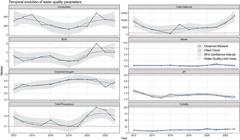
Annual medians by parameter (2012-2023). Grey line: LOESS trend. Red dashed line: CONAMA 357/2005 Class 2 limit (where applicable).
Turbidity was the only parameter with a statistically significant temporal trend (τ = 0.491; p = 0.043), with a Sen slope of 0.56 UNT/year, suggesting a progressive increase in sediment load during the period evaluated. The other parameters did not show a significant trend (p > 0.05), indicating stability in concentrations throughout the analyzed time series.
The Geological Survey of Brazil (CPRM/SGB) reported that, between January and March 2021, much of the Southeast experienced rainfall below the historical average, increasing the risk of low river flows and water shortages during the dry season. In addition, the National Institute of Meteorology (INMET) noted that the Paraná River basin-which is essential for the Southeast’s water and energy supply-had experienced successive precipitation deficits, leading to the issuance of a water emergency alert in 2021. The drought monitoring reports prepared by CPRM indicate that several river basins in Minas Gerais and the Southeast experienced below-average precipitation during the 2020/2021 hydrological year, resulting in a regional water shortage (Boyd, 2020; SGB, 2021).
In 2018, the Paraíba Valley and North Coast Metropolitan Region had a population of approximately 2.53 million, representing a 1.22% increase from 2017, according to estimates based on data from the IBGE. This led to: increased surface runoff; greater transport of organic matter; sediment transport; increased nutrient levels (phosphorus and nitrogen); and increased coliform levels from urban and rural areas. As a result, several parameters tend to increase simultaneously. Similarly, there was a resumption of activities following the pandemic. Between 2020 and 2021, there was a gradual resumption of industrial, commercial, and urban activities. This led to: sewage generation; organic load; effluent discharge; and pressure on water bodies (Cuelbas and Carvalho, 2009; Meon, 2018).
3.3. Spatial variation between sections
Table 3 presents the results of the Kruskal-Wallis test for comparing river sections (upper, middle, and lower reaches).
Results of the Kruskal-Wallis test for comparing river sections (upper, middle, and lower reaches).
Figure 3 shows the distribution of parameters by river basin section. Red line = CONAMA 357/2005 limit where applicable.
Table 4 complements Figure 3 by listing the pairwise comparisons with statistically significant differences in the Dunn post-hoc test (Bonferroni correction, α = 0.05).

Distribution of parameter values across the three longitudinal reaches. Red line: CONAMA 357/2005 Class 2 limit (where applicable).
All parameters showed significant differences between river sections (p < 0.05 in the Kruskal-Wallis test). The middle reach exhibited the greatest exceedance rates for BOD, total phosphorus, and thermotolerant coliforms, consistent with the highest urban population density and the largest sewage treatment deficit in the basin. The lower course showed elevated nitrate concentrations, pointing to diffuse agricultural influence in the lowland areas.
Table 5 presents the variance explained by each principal component, and Figure 4 displays the resulting biplot, together revealing the main axes of physicochemical variation in the dataset.

Principal Component Analysis (PCA) biplot showing parameter loadings and reach centroids for PC1 (organic pollution gradient) and PC2 (mineralisation/agricultural influence gradient).
The first two principal components explained 73.6% of the total variance. PC1 (49.7%) was positively associated with BOD, total phosphorus, and thermotolerant coliforms, and negatively associated with DO, representing a gradient of domestic organic pollution. PC2 (23.9%) was dominated by Conductivity and Nitrate, reflecting variations in mineralization and agricultural land use. The biplot revealed partial overlap between the middle and lower reaches, with the upper reach consistently associated with better water quality.
The results indicate significant impairment of water quality in the Rio de Janeiro section of the Paraíba do Sul River basin, particularly with regard to microbiological parameters and nutrients. Non-compliance rates of 66.5% for thermotolerant coliforms and 56.0% for total phosphorus highlight the inadequacy of sewage treatment as the primary driver of water degradation, a pattern consistent with observations in other urbanized basins in southeastern Brazil (Ovalle et al., 2013; da Costa et al., 2025) and with international findings from rivers subjected to comparable sanitation deficits. High coliform loads have been documented as the dominant non-compliance driver in peri-urban tropical rivers across Latin America, Sub-Saharan Africa, and South- and Southeast Asia, where sanitation coverage rates lag behind population growth (Schreiber et al., 2022). Similarly, the elevated phosphorus non-compliance (56.0%) is consistent with the nutrient enrichment trajectories reported for rivers draining mixed urban-agricultural landscapes throughout the developing world, where point-source sewage and diffuse agricultural runoff co-occur without adequate buffer infrastructure.
The absence of a statistically significant temporal trend in most parameters (p > 0.05) suggests relative stability in the anthropogenic loading structure during 2012-2023 - a period in which neither major infrastructure investments nor significant land-use changes were documented at the basin scale. This pattern resembles findings from long-term monitoring programs in other South American rivers, where organic and microbiological indicators remain persistently elevated without a clear directional trend in the absence of targeted policy intervention (Pacheco et al., 2017; Ovalle et al., 2013). The sole exception was Turbidity, which exhibited a statistically significant upward trend (τ = 0.491; p = 0.043; Sen’s slope = 0.56 NTU/yr). This trajectory is consistent with intensification of soil erosion processes associated with deforestation in riparian zones and with the increasing frequency of high-intensity precipitation events reported for the region, which are projected to worsen under climate change scenarios (Cunha et al., 2019; Da Costa et al., 2025). The Turbidity trend warrants particular attention given the Guandu transposition: elevated suspended solids can increase coagulant demand and treatment costs at the downstream water treatment plant.
The spatial structure revealed by PCA and the Kruskal-Wallis test reinforces the role of the middle course as the primary intervention zone, where BOD, total phosphorus, and thermotolerant coliforms simultaneously exceed CONAMA 357/2005 thresholds at the highest rates. This reach concentrates the largest urban agglomerations in the basin without proportional sewage treatment infrastructure, producing a cumulative organic load that depresses dissolved oxygen to levels incompatible with Class 2 designation in nearly 40% of samples. The longitudinal gradient identified by PCA - PC1 capturing organic/microbiological pollution and PC2 capturing mineralization/agricultural influence - is structurally analogous to gradients documented in long-term monitoring programs of other large rivers under mixed urban-agricultural pressure, reinforcing the diagnostic utility of this biplot representation for management prioritization (Pessoa et al., 2020). The findings collectively underline that water quality degradation in this section of the Paraíba do Sul River is primarily driven by point-source domestic sewage rather than diffuse agricultural inputs, and that no measurable improvement occurred over the twelve-year period. The stability of non-compliance rates, combined with the significant upward turbidity trend, suggests that ongoing pressures will intensify without targeted interventions in both sanitation infrastructure and land management.
This study relies exclusively on secondary data from the INEA monitoring network. Although this dataset provides unparalleled spatial (up to 450 stations) and temporal (12-year) coverage for the Rio de Janeiro section of the Paraíba do Sul basin, several limitations must be acknowledged. First, sampling frequency was irregular across stations and years, which may introduce temporal bias in annual median calculations, particularly for parameters with episodic dynamics such as thermotolerant coliforms. Second, the longitudinal segmentation based on longitude thresholds is an operational simplification that does not account for sub-basin contributions from major tributaries (e.g., Rio Pirapetinga, Rio Pomba) or reservoir effects (e.g., Funil reservoir). Third, the absence of concurrent physical habitat or land-use data precludes a formal attribution of the observed quality gradients to specific anthropogenic sources. Fourth, the exclusion of emerging contaminants, pesticide residues, and pharmaceutical compounds from the analysis - driven by data availability constraints - means that risks associated with these parameters remain unquantified. Future work should complement regulatory monitoring data with targeted field campaigns and more granular spatial variables to overcome these limitations.
4. CONCLUSION
This study assessed the spatiotemporal variability of water quality in the Rio de Janeiro section of the Paraíba do Sul River basin over twelve years (2012-2023) using a large-scale institutional dataset from INEA. Four principal conclusions emerge. First, thermotolerant coliforms (66.5% non-compliance) and total phosphorus (56.0%) were the parameters most frequently in violation of CONAMA Resolution 357/2005 (Class 2), identifying domestic sewage as the dominant driver of water quality degradation in the basin. Second, turbidity was the sole parameter with a statistically significant upward temporal trend (τ = 0.491; p = 0.043; Sen’s slope = 0.56 NTU/yr), likely associated with intensified erosion and more frequent extreme precipitation events, and representing an increasing operational risk for downstream water treatment. Third, the middle reach exhibited the poorest water quality for BOD, total phosphorus, and thermotolerant coliforms, reflecting concentrated urban organic loading without adequate sewage treatment infrastructure. Fourth, PCA identified two independent axes of quality variation - an organic pollution gradient (PC1: 49.7%) and a mineralization/agricultural influence gradient (PC2: 23.9%) - together explaining 73.6% of total variance and providing a clear diagnostic framework for spatial intervention prioritization.
The results indicate a clear policy priority: expanding basic sanitation coverage in the middle reaches of the Paraíba do Sul basin is the single intervention with the greatest potential to restore water quality to Class 2 standards across the largest number of parameters. Complementary strategies should address erosion control in riparian zones to reverse the turbidity trend, and future monitoring programs should incorporate emerging contaminants and higher-frequency sampling at critical nodes to improve early-warning capacity.
5. DATA AVAILABILITY STATEMENT
The data supporting the results of this study were obtained from the Rio de Janeiro State Environmental Institute (INEA) through the integrated water quality monitoring system of the Paraíba do Sul basin. Access to the dataset is subject to institutional procedures via the INEA environmental information portal (https://www.inea.rj.gov.br). Data are available upon reasonable request to the corresponding author.
6. REFERENCES
-
AZEVEDO, D. D. A.; GERCHON, E.; DOS REIS, E. O. Monitoring of pesticides and polycyclic aromatic hydrocarbons in water from Paraíba do Sul River, Brazil. Journal of the Brazilian Chemical Society, v. 15, n. 2, p. 292-299, 2004. https://dx.doi/10.1590/S0103-50532004000200021
» https://dx.doi/10.1590/S0103-50532004000200021 -
BOSTANMANESHRAD, F.; PARTANI, S.; NOORI, R.; NACHTNEBEL, H.-P. P.; BERNDTSSON, R.; ADAMOWSKI, J. F. Relationship between water quality and macro-scale parameters (land use, erosion, geology, and population density) in the Siminehrood River Basin. Science of The Total Environment, v. 639, p. 1588-1600, 2018. https://doi.org/10.1016/j.scitotenv.2018.05.244
» https://doi.org/10.1016/j.scitotenv.2018.05.244 - BOYD, C. E. Water Quality: An Introduction. New York: Springer Nature, 2020.
-
COSTA, I. D. DA; COSTA, L. L.; ZALMON, I. R. Microplastics in water from the confluence of tropical rivers: Overall review and a case study in Paraiba do Sul River basin. Chemosphere, v. 338, 2023. https://dx.doi/10.1016/j.chemosphere.2023.139493
» https://dx.doi/10.1016/j.chemosphere.2023.139493 -
CUELBAS, L. P.; CARVALHO, S. L. DE. Avaliaçäo da qualidade da água na microbacia do córrego Campestre no municipio de Lins (Sp). Holos Environment, v. 9, n. 1, p. 14, 2009. https://dx.doi/10.14295/holos.v9i1.3473
» https://dx.doi/10.14295/holos.v9i1.3473 -
CUNHA, A. P. M. A. et al. Extreme drought events over Brazil from 2011 to 2019. Atmosphere, v. 10, n. 11, 2019. https://dx.doi/10.3390/atmos10110642
» https://dx.doi/10.3390/atmos10110642 -
DA COSTA, J. M. F.; SILVEIRA, C. DA S.; COSTA, A. C.; DUARTE JUNIOR, A.; GOLÇALVES, S. T. N. Analysis of precipitation extremes in Brazil: the role of atmospheric temperature. Revista Brasileira de Ciências Ambientais, v. 60, 2025. https://doi.org/10.5327/z2176-94782123
» https://doi.org/10.5327/z2176-94782123 - FROTA, M. N. et al. O ciclo das águas da bacia hidrográfica do Paraíba do Sul. Rio de Janeiro: PUC RIO, 2023.
-
LEONI, R. C.; DE SOUZA SAMPAIO, N. A.; CORRÊA, S. M. Estatística multivariada aplicada ao estudo da qualidade do ar. Revista Brasileira de Meteorologia, v. 32, n. 2, p. 235-241, 2017. https://dx.doi/10.1590/0102-77863220005
» https://dx.doi/10.1590/0102-77863220005 -
MEON População da RMVale cresce 1,22%, mas 13 cidades da região “encolhem”: 3 cidades abrigam metade dos habitantes da região; dados são do IBGE. 2018 Aug. 30. Available: https://www.meon.com.br/noticias/vale-do-paraiba-regiao/populacao-da-rmvale-cresce-1-22-mas-13-cidades-da-regiao-encolhem-2018-1
» https://www.meon.com.br/noticias/vale-do-paraiba-regiao/populacao-da-rmvale-cresce-1-22-mas-13-cidades-da-regiao-encolhem-2018-1 -
OVALLE, A. R. C. et al. Long-term trends in hydrochemistry in the Paraíba do Sul River, southeastern Brazil. Journal of Hydrology, v. 481, p. 191-203, 2013. https://dx.doi/10.1016/j.jhydrol.2012.12.036
» https://dx.doi/10.1016/j.jhydrol.2012.12.036 -
PACHECO, F. S. et al. Water quality longitudinal profile of the Paraíba do Sul River, Brazil during an extreme drought event. Limnology and Oceanography, v. 62, p. S131-S146, 2017. https://dx.doi/10.1002/lno.10586
» https://dx.doi/10.1002/lno.10586 -
PESSOA, M. A. R. et al. IQAFAL - Fuzzy water quality index for lotic environments. Engenharia Sanitaria e Ambiental, v. 25, n. 1, p. 21-30, 2020. https://dx.doi/10.1590/s1413-41522020147587
» https://dx.doi/10.1590/s1413-41522020147587 -
SAMPAIO, N. A. S. et al. Applications of Correlation Analysis in Environmental Problems. Revista de Gestão Social e Ambiental, v. 18, n. 3, p. e04925, 2024. https://dx.doi/10.24857/rgsa.v18n3-085
» https://dx.doi/10.24857/rgsa.v18n3-085 -
SCHREIBER, S. G. et al. Statistical tools for water quality assessment and monitoring in river ecosystems - a scoping review and recommendations for data analysis. Water Quality Research Journal, v. 57, n. 1, p. 40-57, 2022. https://dx.doi/10.2166/wqrj.2022.028
» https://dx.doi/10.2166/wqrj.2022.028 - SERVIÇO GEOLÓGICO DO BRASIL - CPRM Acompanhamento da estiagem nas regiões sudeste e centro-oeste do Brasil: Monitoramento hidrológico da bacia do rio Doce. Belo Horizonte, 2021.
-
TAVARES, H. P.; SAMPAIO, N. A. DE S. Multi-criteria decision analysis and linear programming for optimal resource allocation in water quality monitoring networks: a case study of California’s EPA monitoring stations. Environmental Science and Pollution Research, p. 9652-9669, 2026. https://dx.doi/10.1007/s11356-026-37899-2
» https://dx.doi/10.1007/s11356-026-37899-2
Edited by
-
Editor-in-Chief:
Nelson Wellausen Dias https://orcid.org/0000-0002-9507-9211


