Modeling and analysis of sediment discharge in three tributaries of the Mourão River basin, Brazil
Abstract
The transport of sediments in river systems has significant environmental and economic implications, affecting water quality, aquatic ecosystems, and the operational lifespan of hydraulic structures such as reservoirs. This study quantified and analyzed sediment discharge in three distinct river sections within the Mourão River basin in Paraná, Brazil, by applying and comparing various mathematical models. The three sampling sections were established on the Campo River (Section 1), the Mourão River (Section 2), and the Sem Passo River (Section 3). Bedload sediment discharge was calculated using the methods of Einstein (1942) with a Peter-Meyer modification, and Duboys (1879) and Zeller (1963). Suspended sediment discharge was estimated using the models of Yang (1973) and Righetto (1998) and compared with experimental results from total suspended solids analysis. Hydraulic characterization, including the development of rating curves and the calculation of the Froude number, was performed to understand the flow regime. The results indicated a subcritical flow regime (Fr < 1) in all three sections, characteristic of relatively slow-moving water. The Duboys (1879) and Zeller (1963) model was only applicable to Section 1, a smaller channel, as it yielded non-representative results for the larger perimeters of Sections 2 and 3 under the observed low-flow conditions. In contrast, the Einstein (1942) approach with the Peter-Meyer modification proved more robust, providing viable estimates for all sections. A strong correlation was found between the Froude number and the sediment discharge predicted by the theoretical models. This study highlights the critical importance of selecting appropriate models based on the specific hydraulic and geomorphological characteristics of the river channel and underscores the complexity of accurately predicting sediment transport.
Keywords:
Froude number; mathematical modeling; Mourão River; rating curve; sediment transport
Resumo
O transporte de sedimentos em sistemas fluviais tem implicações ambientais e econômicas significativas, afetando a qualidade da água, os ecossistemas aquáticos e a vida útil de estruturas hidráulicas, como reservatórios. Este estudo teve como objetivo quantificar e analisar a descarga de sedimentos em três trechos distintos do rio Mourão, no Paraná, Brasil, aplicando e comparando diversos modelos matemáticos. Os três trechos amostrais foram estabelecidos no rio Campo (Trecho 1), no rio Mourão (Trecho 2) e no rio Sem Passo (Trecho 3). A descarga de sedimentos de fundo foi calculada utilizando os métodos de Einstein (1942) com modificação de Peter-Meyer e de Duboys (1879) e Zeller (1963). A descarga de sedimentos em suspensão foi estimada utilizando os modelos de Yang (1973) e Righetto (1998) e comparada com resultados experimentais de análise de sólidos totais em suspensão. A caracterização hidráulica, incluindo o desenvolvimento de curvas de descarga e o cálculo do número de Froude, foi realizada para compreender o regime de escoamento. Os resultados indicaram um regime de escoamento subcrítico (Fr < 1) em todas as três seções, característico de águas com movimento relativamente lento. O modelo de Duboys (1879) e Zeller (1963) foi aplicável apenas à Seção 1, um canal menor, pois apresentou resultados não representativos para os perímetros maiores das Seções 2 e 3 sob as condições de baixa vazão observadas. Em contraste, a abordagem de Einstein (1942) com a modificação de Peter-Meyer mostrou-se mais robusta, fornecendo estimativas viáveis para todas as seções. Uma forte correlação foi encontrada entre o número de Froude e a descarga de sedimentos prevista pelos modelos teóricos. Este estudo destaca a importância crítica da seleção de modelos apropriados com base nas características hidráulicas e geomorfológicas específicas do canal do rio e ressalta a complexidade de prever com precisão o transporte de sedimentos.
Palavras-chave:
curva de descarga; modelagem matemática; número de Froude; Rio Mourão; transporte de sedimentos
1. INTRODUCTION
Water is a fundamental resource for sustaining life and driving socioeconomic development. Within the hydrological cycle, the movement of water is a primary agent of environmental degradation processes such as erosion, siltation, and nutrient loss. Water flows in river systems are the most significant transporters of weathered materials from higher to lower elevations. These hydro-sedimentological processes involve the detachment, erosion, transport, and deposition of solid particles from the watershed surface. The transported sediments, varying in size, shape, and weight, behave differently according to local flow conditions, either remaining in suspension or moving along the riverbed.
The study of solid discharge in water bodies is a crucial tool for environmental characterization. Sediments directly interfere with water quality and quantity, acting as vectors for microorganisms and toxic particles, and intensifying the siltation of rivers, which signals significant environmental degradation. Anthropogenic pressures, particularly land-use changes for agriculture, coupled with natural phenomena like intense precipitation in tropical regions, can lead to sediment production rates far exceeding those under natural equilibrium conditions.
Evaluating sediment discharge can be approached in two main ways: using empirical transport formulas that correlate solid load with flow and sediment parameters, or through direct measurements of water flow and sediment concentration. Direct measurements require regular and long-term monitoring campaigns, which can be time-consuming and technically demanding. An alternative is to establish a rating curve that relates instantaneous flow to sediment concentration. However, this relationship is highly sensitive to seasonality, as 70% to 90% of total sediment transport often occurs during rainy periods.
Given the challenges in direct quantification, mathematical models are essential tools for estimating sediment discharge. The accuracy of these models relies heavily on the granulometric distribution of bed sediments. Various models exist for estimating both bedload and suspended load. For example, studies have compared the performance of methods such as Schoklitsch (1962), Duboys (1879) and Zeller (1963), Meyer-Peter and Müller (1948), Einstein (1950), and Yang (1973), with findings often indicating that model suitability is site-specific. The suitability of the model is intrinsically linked to the conditions under which it was developed (e.g., particle size distribution, bed roughness, and flow regime) (Dey et al., 2021, Shen, 2025). The differences in sediment capture results can be attributed to the stochastic nature of the process (Fei et al., 2024).
This study quantifies and monitors sediment discharge by correlating hydrometric characteristics with the physical properties of sediment in three sub-basins of the Mourão River, Paraná, Brazil. The specific objectives were to: (1) perform a granulometric analysis of the riverbed sediment; (2) apply mathematical 'models to estimate suspended and bedload sediment discharge; (3) establish rating curves for the study sections; and (4) determine the physical characteristics of the flow and correlate them with sediment discharge and concentration (Graf, 1971; Carvalho, 2008; Scapin et al., 2007).
2. MATERIAL AND METHODS
2.1. Study Area
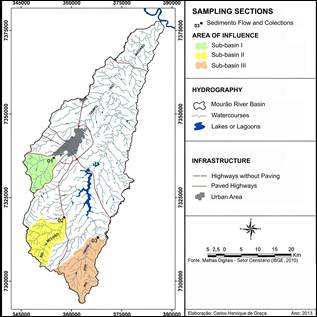
The study was conducted in three rivers within the Mourão River hydrographic basin: the Sem Passo River in the municipality of Luiziana, the Campo River in Campo Mourão, and the Mourão River itself, upstream reservoir of the Mourão Hydroelectric Power Plant. The region is in the Center-West of Paraná state, on the Plateau of Campo Mourão, with altitudes around 630 meters. The predominant soil type is dystroferric red latosol.
Three sampling sections were established (Figure 1):
-
Section 1: Located on the Campo River in Campo Mourão, upstream of the municipal water abstraction point. The contributing drainage area is approximately 76.16 km². The Campo River is a key tributary of the Mourão River and a vital water source for the city.
-
Section 2: Located on the Mourão River at the boundary between Campo Mourão and Luiziana, upstream of the Mourão reservoir. The contributing drainage area is approximately 106.06 km².
-
Section 3: Located on the Sem Passo River in Luiziana. The contributing drainage area is approximately 140.63 km². This river is a major tributary to the Mourão reservoir.
2.2. Field Data Collection and Laboratory Analysis
Field campaigns were conducted, including four sediment collection campaigns and ten flow measurement campaigns, during both dry and rainy periods, over a period of one and a half years of testing.
Bed sediments were collected from the riverbed in each section using a Petersen Dredge, stored in identified plastic bags, and transported to the laboratory. Granulometric analyses were performed according to Brazilian standards NBR 7181, NBR 6502, and NBR 6508 (ABNT, 2014; 2016; 2022). The specific mass of the sediment grains was also determined.
River discharge was measured using a HIDROMEC Newton-type fluviometric current meter and a SONTEK FlowTracker acoustic doppler velocimeter. Water samples were collected concurrently with flow measurements for the analysis of total suspended solids in the laboratory using an integrating sediment sampler, DH48, following the methods described by APHA et al. (2012). Using the models presented in this work, estimates of suspended sediment discharges were calculated based on granulometry, flow rate and velocity data at the time of sediment sample collection.
2.3. Hydraulic Characterization and Rating Curve
A rating curve (Flow quota) was developed for each section to establish a relationship between the maximum water depth (h) and the discharge (Q). This relationship is typically represented by an exponential function (Equation 1):
Where h0 is the water level at zero discharge, and a and b are regression coefficients.
The flow regime was classified using the dimensionless Froude number (Fr), which is the square root of the ratio of inertial to gravitational forces (Equation 2):
Where V is the mean flow velocity, g is the acceleration due to gravity, and Hm is the characteristic length, taken as the hydraulic depth (Area/Top Width). The flow is classified as subcritical (Fr < 1), supercritical (Fr > 1), or critical (Fr = 1).
2.4. Estimation of Sediment Discharge
2.4.1. Bedload Transport
Two models were used to estimate the bedload discharge (qs).
Duboys (1879) and Zeller (1963): This model relates sediment discharge to the shear stress of the flow (Equation 3):
Where q s is the sediment discharge per unit width of the channel. It measures the volume of sediment passing through a cross-section of the channel per unit time and width, c is a sediment characteristic coefficient, to is the flow shear stress on the bed, and to,crit is the critical shear stress for the initiation of motion. These parameters were determined using the graphical method proposed by Zeller (1963).
Einstein (1942) with Peter-Meyer Formulation: This method is based on a relationship between two dimensionless parameters, the intensity of transport (f) and the intensity of shear (y):
The equations presented are fundamental in the field of fluvial geomorphology and sediment transport, describing the relationship between fluid flow and the movement of sediment particles. These dimensionless parameters are crucial for predicting how much sediment a river or channel will carry.
Consider Equation 4:
This equation defines the dimensionless sediment transport rate, often denoted as ϕ. It represents the efficiency of the flow in transporting sediment, where, ρs is the density of the sediment particles, ρw is the density of the water (or the fluid), g is the acceleration due to gravity, d is the characteristic diameter of the sediment particles, often the median diameter (d50).
Essentially, ϕ relates the actual sediment transport rate to a reference transport rate, making it a normalized, dimensionless quantity.
Equation 5 is a form of the Shields stress, a critical parameter that determines the initiation of sediment motion. However, the equation provided for ψ is actually the inverse of the Shields stress. The standard Shields stress (τ∗ or θ) is defined as:
Therefore, the parameter ψ in the Equation 6 is:
This parameter ψ is sometimes referred to as the mobility parameter or a form of dimensionless shear stress, where (ρs −ρw ) is the difference in density between the sediment and the fluid, which accounts for the buoyant weight of the sediment, d is the characteristic diameter of the sediment particles, ρw is the density of the water, Rh is the hydraulic radius of the flow, which is the cross-sectional area of the flow divided by the wetted perimeter. It is a measure of the flow's efficiency, where S is the slope of the energy grade line. For uniform flow, this is often approximated by the channel bed slope.
The Shields stress (τ∗) represents the ratio of the fluid forces acting to move a sediment particle (bed shear stress) to the gravitational forces acting to keep it in place. The parameter ψ represents the inverse of this ratio.
These two parameters are famously related in what is known as the Shields-Brown curve or more generally through sediment transport functions. These functions empirically relate the dimensionless sediment transport rate (ϕ) to the dimensionless shear stress (or its inverse, ψ). This relationship typically shows that as the Shields stress increases (and therefore ψ decreases), the sediment transport rate increases significantly.
In summary, the two equations cited are used together to predict the rate of sediment transport in a channel based on the properties of the fluid, the sediment, and the flow conditions.
An empirical function, was used to relate the parameters (Equation 7).
2.4.2. Suspended Sediment Transport
The suspended sediment concentration (Cs) was estimated using the method of Yang (1973), which is recommended for sand-bed rivers. The governing Equation 8 is:
Where U is the mean flow velocity, S is the energy slope, w s is the sedimentation velocity of the particle calculated based on the average sediment diameter (Stoke's Law), U c is the critical mean velocity for incipient motion, and a 1 and a 2 are empirical variables.
Additionally, suspended sediment discharge was estimated based on the bedload calculations using the approach from Righetto (1998), considering sediment mass flow, with bedload discharge as a boundary condition for sediment production.
3. RESULTS
3.1. Sediment Characteristics
Granulometric analysis of the bed sediment revealed distinct characteristics for each section. In Section 1 (Campo River), the sediment was predominantly sand, averaging 88.8% across the four collection campaigns, with minor variations in clay (avg. 4.25%), silt (avg. 7.0%) and sand (avg. 88.75%) content (Table 1). The average diameters d10, d50, and d90 measured for Section 1 were, respectively, 0.039 mm, 0.27 mm and 0.60 mm (Table 1).
Section 2 (Mourão River) showed a significant change in composition between the first and subsequent collections. The sample contained 14.50% clay and 72.50% sand, suggesting that a high-flow event between campaigns may have washed away finer sediments. The average diameters for Section 2 specifically diameters d10, d50, and d90 values were 0.019 mm, 0.245 mm, and 0.62 mm, respectively (Table 1).
Section 3 (Sem Passo River) also displayed a higher fine-sediment content, with average values (11.25% clay, 25.75% silt), though sand remained the predominant fraction overall. This section was also noted for having a bed composed of stones and gravel, which was reflected in a higher average specific grain mass (3.128 g/cm³) compared to Section 1 (2.795 g/cm³) and Section 2 (2.710 g/cm³). The average diameters measured for Section 3 were 0.178 mm (d50), and 0.89 mm (d90) (Table 1). It was not possible to determine d10 for Section 3, given that more than 10% of the samples contained clay.
3.2. Flow and Rating Curves
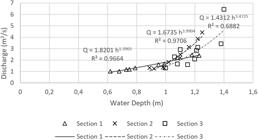
Ten flow measurement campaigns provided the data for developing the rating curves (Figure 2). During the study period, flow rates from 1.017 m3/s to 2.443 m3/s were observed in Section 1, from 1.23 m3/s to 4.422 m3/s in Section 2 and from 1.305 m3/s to 6.433 m3/s in Section 3, corresponding to rainy periods and the greatest measured depths.
The rating curve for Section 1 showed a very strong relationship between depth and discharge, with a coefficient of determination (R²) of 0.9664 (Figure 2). Section 2 also yielded a good rating curve, with an R² of 0.9706. However, Section 3 produced a much weaker correlation (R² = 0.6882), which was attributed to the complex hydraulics caused by the stony, irregular riverbed, leading to backwaters and rapids that disrupt the simple depth-discharge relationship.
3.3. Sediment Discharge Estimation
The calculated sediment discharges are summarized in Tables 2, 3, and 4.
For Section 1, the bedload discharge estimates from the Duboys-Zeller and Einstein-Peter-Meyer methods were reasonably close. The suspended discharge models also produced results in the same order of magnitude. However, a notable discrepancy was observed: the highest modeled suspended sediment discharge did not occur on the same date as the highest experimentally measured concentration. This may be explained by the wash load effect, where fine particles eroded from the watershed surface are transported through the section without significant interaction with the bed material.
For Sections 2 and 3, the Duboys (1879) and Zeller (1963) model could not be applied (N.O.), as the erosive process was not characterized for the flow conditions. The combination of a large wetted perimeter (average of 9.57 m for Section 2 and 12.33 m for Section 3) and relatively low measured flows resulted in negative values during calculation, indicating no sediment transport according to this model. This finding demonstrates a key limitation of the method (Hager and Weitbrecht, 2010). Consequently, only the Einstein-Peter-Meyer method provided bedload estimates for these two sections. As shown in Tables 3 and 4, transport was only predicted for the highest flow data.
3.4. Flow Regime and its Relation to Sediment Discharge
The Froude number (Table 5) was calculated for all measurements to classify the flow regime. In all cases, the Froude number was less than 1 (Fr < 1), ranging from 0.07 to 0.20. This confirms that the flow in all three river sections was subcritical, characterized by low velocities and low turbulence. This finding helps explain the ineffectiveness of the Duboys-Zeller method in the wider sections, as the flow energy was insufficient to meet the model's criteria for initiating transport across the large channel perimeter.
A strong correlation was found between the Froude number and the sediment concentration calculated by the theoretical models. For Section 1, the Einstein-Peter-Meyer method showed an excellent relationship (R² = 0.9408), indicating that as the Froude number (and thus flow energy) increases, so does the predicted sediment discharge. A similar strong correlation was observed for Section 2 (R² = 0.9944) and Section 3 (R² = 0.9943) using the Einstein-Peter-Meyer method. In contrast, the relationship between the Froude number and the experimentally measured concentrations was weak and incoherent, possibly due to experimental errors or the dominance of wash load, which is less dependent on local hydraulics (Table 5).
4. DISCUSSION
The results of this study underscore the challenges of modeling sediment transport in natural rivers, where hydraulic and sedimentological characteristics can vary significantly even within the same basin. The contrasting performance of the applied models across the three study sections provides valuable insight into their respective domains of applicability. The results obtained, which demonstrate a contrasting performance of the models applied in different study sections, corroborate the modern literature that emphasizes the sensitivity of the models to the domains of hydraulic applicability (Van Rijn, 1993; Liu et al., 2018).
The most significant finding was the limited applicability of the Duboys (1879) and Zeller (1963) method. It provided reasonable estimates only for Section 1 (Campo River), which had the smallest wetted perimeter (average 5.76 m). For Sections 2 and 3, with larger perimeters (9.57 m and 12.33 m, respectively) and a subcritical flow regime, the model failed to predict sediment transport for most flow conditions. This confirms that the method is more suitable for smaller streams or rivers with higher flow energy, where the shear stress can overcome the critical threshold for transport across the entire channel width.
For Sections 2 and 3, the Duboys (1879) and Zeller (1963) model could not be applied, a finding attributed to the uncharacterized erosive process under the observed flow conditions (N.O.). The combination of an exceptionally large wetted perimeter (averaging 9.57 m for Section 2 and 12.33 m for Section 3) and relatively low measured flows resulted in negative calculated values, which, within the model's empirical framework, indicate a cessation of sediment transport. This failure demonstrates a key limitation of the Duboys-type shear stress model in wide channels with low relative depths, where the calculated mean boundary shear stress falls below the critical threshold for particle motion (Chang, 1992; Julien, 2010).
Consequently, only the Einstein-Peter-Meyer method provided bedload estimates for these two sections. As shown in Tables 3 and 4, transport was consistently predicted only for the highest recorded flow data, further underscoring the marginal hydraulic conditions.
In contrast, the Einstein (1942) method, using the Peter-Meyer formulation, proved to be more versatile and robust, yielding plausible results for all three sections under varying flow conditions. The strong correlation observed between the Froude number and the sediment discharge predicted by the Einstein-Peter-Meyer model (R² > 0.93 for all sections) further validates its utility. This relationship demonstrates that the model effectively captures the fundamental principle that sediment transport is driven by the energy of the flow (Gomez and Church, 1989).
The discrepancy between modeled and experimentally measured suspended sediment concentrations highlights another layer of complexity. The lack of correlation between experimental concentrations and flow hydraulics (Froude number) points towards the influence of wash load. The wash load consists of very fine particles (clay and silt) that originate from erosion on the watershed slopes rather than from the riverbed itself. These particles are easily kept in suspension by even low turbulence and their concentration in the river is often more dependent on their supply from the catchment (e.g., following a rainstorm) than on the immediate hydraulic conditions of the channel. This phenomenon explains why the highest measured concentrations did not necessarily coincide with the highest flows or Froude numbers (Asselman et al., 2003; Gessner et al., 2014).
The distinct physical characteristics of each river also played a crucial role. The sandy bed of Section 1 was well-suited for the application of standard transport models. The heterogeneous, stony bed of Section 3, however, not only complicated the establishment of a reliable rating curve but also created complex local hydraulics that are not fully captured by one-dimensional models. This emphasizes that, in such environments, model results should be interpreted with caution.
5. CONCLUSIONS
This study successfully evaluated the sediment discharge in three distinct rivers of the Mourão River basin using a combination of field measurements and mathematical modeling. The research leads to the following conclusions:
-
The applicability of sediment transport models is highly contingent on the specific hydraulic and geomorphological characteristics of the river. The Duboys (1879) and Zeller (1963) method was found to be effective for the smaller channel (Section 1) but was unsuitable for the wider channels of Sections 2 and 3 under the observed flow conditions.
-
The Einstein (1942) method with the Peter-Meyer formulation demonstrated greater robustness, providing consistent estimates across all three studied sections, and its predictions correlated strongly with the Froude number.
-
The flow regime in all three rivers was consistently subcritical (Fr < 1), which is a key factor controlling sediment transport dynamics and helps explain the limitations of certain models.
-
Discrepancies between modeled and experimental suspended sediment concentrations likely stem from the influence of wash load, which is governed by watershed-scale erosion processes rather than just local channel hydraulics.
Ultimately, this work confirms the complexity of sediment transport phenomena and reinforces the principle that there is no universal model. Accurate estimation requires a careful selection of methods tailored to the local river conditions. Further research, including more frequent monitoring during high-flow events and the exploration of two-dimensional hydraulic models, is recommended to deepen the understanding of sediment dynamics in this and other similar basins.
6. DATA AVAILABILITY STATEMENT
Data availability not informed.
7. ACKNOWLEDGMENTS
The authors wish to thank the Professional Master's Program in the National Network in Water Resources Management and Regulation ProfÁgua, CAPES/ANA Project CAPES/UNESP Nº. 951420/2023, and the Federal Technological University of Paraná-UTFPR for the support received. Finally, to all who in some way contributed to the realization of this research, my enormous gratitude.
8. REFERENCES
-
ASSELMAN, N. E. M.; MIDDELKOOP, H.; VAN DIJK, P. M. The impact of changes in climate and land use on soil erosion, transport and deposition of suspended sediment in the River Rhine. Hydrological Processes, v. 17, n. 16, p. 3225-3244, 2003. https://doi.org/10.1002/hyp.1384
» https://doi.org/10.1002/hyp.1384 - ABNT. NBR 6502: Solos e rochas - Terminologia. Rio de Janeiro, 2022.
- ABNT. NBR 6508: Grãos de solos que passam na peneira de 4,8 mm - Determinação da massa específica. Rio de Janeiro, 2014.
- ABNT. NBR 7181: Solo - Análise Granulométrica. Rio de Janeiro, 2016.
- APHA; AWWA; WEF. Standard Methods for the examination of water and wastewater. 22nd ed. Washington, 2012. 1496 p.
- CARVALHO, N. de O. Hidrossedimentologia Prática. 2. ed. Rio de Janeiro: Interciência, 2008.
- CHANG, H. H. Fluvial processes in river engineering. [S. l.]: John Wiley & Sons, 1992.
-
DEY, A. et al State of the art and prospects for halide perovskite nanocrystals. ACS Nano, v. 15, n. 7, p. 10775-10981, 2021. https://doi.org/10.1021/acsnano.0c08903
» https://doi.org/10.1021/acsnano.0c08903 - DUBOYS, M. P. Le Rhone et les rivières à lit affouillable. Paris: Dunod, 1879.
-
EINSTEIN, H. A. Formulas for the transportation of bed load. Transactions of the American Society of Civil Engineers, v. 107, n. 1, p. 561-577, 1942. https://doi.org/10.1061/TACEAT.0005468
» https://doi.org/10.1061/TACEAT.0005468 - EINSTEIN, H. A. The bed-load function for sediment transportation in open channel flows. Washington, DC: US Government Printing Office, 1950.
-
FEI, G.; WANG, X.; LAN, L. A review of flash flood hazards influenced by various solid material sources in mountain environment. Progress in Physical Geography: Earth and Environment, v. 48, n. 5-6, p. 781-800, 2024. https://doi.org/10.1177/03091333241280626
» https://doi.org/10.1177/03091333241280626 -
GESSNER, M. O. et al Urban water interfaces. Journal of Hydrology, v. 514, p. 226-232, 2014. https://doi.org/10.1016/j.jhydrol.2014.04.021
» https://doi.org/10.1016/j.jhydrol.2014.04.021 -
GOMEZ, B.; CHURCH, M. An assessment of bed load sediment transport formulae for gravel bed rivers. Water Resources Research, v. 25, n. 6, p. 1161-1186, 1989. https://doi.org/10.1029/WR025i006p01161
» https://doi.org/10.1029/WR025i006p01161 -
GRAÇA, C. H. et al Multitemporal analysis of estimated soil loss for the river Mourão watershed, Paraná-Brazil. Brazilian Journal of Biology, v. 75, n. 4, suppl 2, p. 120-130, 2015. https://doi.org/10.1590/1519-6984.00613suppl
» https://doi.org/10.1590/1519-6984.00613suppl - GRAF, W. H. Hydraulics of sediment transport. New York: McGraw-Hill, 1971.
- HAGER, W. H.; WEITBRECHT, V. Erosion and sedimentation. [S. l.]: CRC Press, 2010.
- JULIEN, P. Y. Erosion and Sedimentation. 2. ed. Cambridge: Cambridge University Press, 2010.
-
LIU, C.; WALLING, D. E.; HE, Y. The International Sediment Initiative case studies of sediment problems in river basins and their management. International Journal of Sediment Research, v. 33, n. 2, p. 216-219, 2018. https://doi.org/10.1016/j.ijsrc.2017.05.005
» https://doi.org/10.1016/j.ijsrc.2017.05.005 - MEYER-PETER, E.; MULLER, R. Formulas for bed-load transport. In: MEETING OF IAHR, 2., 1948, Stockholm . Proceedings [...]. Stockholm: IAHR, 1948. p. 39-64.
- RIGHETTO, A. M. Hidrologia e Recursos Hídricos. São Carlos: EESC/USP, 1998.
- SCAPIN, J.; PAIVA, J. B. D. de; BELING, F. A. Avaliação de Métodos de Cálculo do Transporte de Sedimentos em um Pequeno Rio Urbano. Revista Brasileira de Recursos Hídricos, v. 12, n. 4, p. 5-21, 2007.
- SCHOKLITSCH, A. Die Wasserstraßen. In: BAND, Z. Handbuch des Wasserbaues. Vienna: Springer-Verlag, 1962. p. 1011-1021.
-
SHEN, H. T. River Ice Effects on Sediment Transport and Channel Morphology: Progress and Research Needs. Glacies, v. 2, n. 1, p. 2, 2025. https://doi.org/10.3390/glacies2010002
» https://doi.org/10.3390/glacies2010002 - VAN RIJN, L. C. Principles of sediment transport in rivers, estuaries and coastal seas. Amsterdam: Aqua Publications, 1993.
-
YANG, C. T. Incipient motion and sediment transport. Journal of the Hydraulics Division, v. 99, n. 10, p. 1679-1704, 1973. https://doi.org/10.1061/JYCEAJ.0003766
» https://doi.org/10.1061/JYCEAJ.0003766 -
ZELLER, J. Einführung in den Sedimenttransport offeener Gerinne. Schweizerische Bauzeitung, v. 81, n. 34, 1963. https://doi.org/10.5169/seals-66860
» https://doi.org/10.5169/seals-66860
Edited by
-
Editor-in-Chief:
Nelson Wellausen Dias https://orcid.org/0000-0002-9507-9211

 Source: