Fertigation with sorption-treated vinasse in sandy and clay soils
Abstract
The sugar-energy industry generates large volumes of waste, among which vinasse stands out for its potential in agricultural use. However, its use in fertigation requires careful management to prevent soil salinization and soil quality degradation. This study evaluated whether sorption treatment of vinasse with sugarcane bagasse ash (SBA) can simultaneously neutralize its acidity and improve its nutrient composition, thereby mitigating its adverse effects on soil. To this end, 100 mL of raw vinasse was treated with 5.0 g of SBA through three consecutive 24-h sorption cycles. Treated vinasse was applied to PVC columns filled with sandy and clay soils, and was compared with untreated vinasse. Soil physicochemical properties, including electrical conductivity, volumetric moisture, nutrient composition, and sodicity indices, were evaluated. Results indicated that 5.0 g of SBA with a 72-h contact time optimized sorption, increasing the vinasse pH and nutrient availability. Treated vinasse enhanced chemical stability in clay soils, whereas sandy soils showed higher leaching susceptibility. In both soil types, the exchangeable sodium percentage (ESP) remained below 15%, indicating no risk of soil sodification. The results suggest that sorption-treated vinasse is a sustainable fertigation alternative, particularly for clay soils, while sandy soils require stricter application management to prevent nutrient leaching.
Keywords:
adsorption; agricultural sustainability; soil fertility; waste
Resumo
A indústria sucroenergética gera grandes volumes de resíduos, entre os quais a vinhaça se destaca pelo seu potencial uso agrícola. No entanto, seu uso na fertirrigação requer manejo cuidadoso para evitar a salinização do solo e a degradação da qualidade do solo. Este estudo avaliou se o tratamento por sorção da vinhaça com cinza de bagaço de cana-de-açúcar (SBA) pode, simultaneamente, neutralizar sua acidez e melhorar sua composição nutricional, mitigando assim seus efeitos adversos sobre o solo. Para isso, 100 mL de vinhaça in natura foram tratadas com 5,0 g de SBA, submetidas a três ciclos de sorção de 24 horas. A vinhaça tratada foi então aplicada em colunas de PVC preenchidas com solos de textura arenosa e argilosa, sendo comparada à vinhaça in natura. Avaliaram-se atributos físico-químicos do solo, incluindo condutividade elétrica, umidade volumétrica, composição química e índices de sodicidade. Os resultados mostraram que a dose de 5,0 g de SBA associada a um tempo de contato de 72 horas foi eficiente no processo de sorção, elevando o pH da vinhaça e aumentando a disponibilidade de nutrientes. A aplicação da vinhaça tratada promoveu maior estabilidade química no solo argiloso, enquanto o solo arenoso apresentou maior suscetibilidade à lixiviação. Em ambos os tipos de solo, a porcentagem de sódio trocável (ESP) permaneceu abaixo de 15%, não indicando risco de sodificação. Os resultados sugerem que a vinhaça tratada por sorção é uma alternativa sustentável para fertirrigação, especialmente para solos argilosos, enquanto solos arenosos requerem um manejo de aplicação mais rigoroso para evitar a lixiviação de nutrientes.
Palavras-chave:
adsorção; fertilidade do solo; resíduos; sustentabilidade agrícola
1. INTRODUCTION
Brazil is the world’s largest producer of sugarcane (Saccharum spp.), with the state of São Paulo standing out due to its extensive cultivation areas and its crucial role in the national agribusiness. Since the 1970s, the implementation of the National Alcohol Program (Proálcool) has promoted the use of ethanol as fuel, driving the significant expansion of sugarcane cultivation areas (Araújo and Araújo Sobrinho, 2024).
The intensification of sugar-energy production has led to increased generation of residues, mainly vinasse, a byproduct of the ethanol distillation process. For every liter of ethanol produced, approximately 12 to 18 liters of vinasse are generated. When improperly managed, this residue can cause eutrophication and contamination of water resources (Carrilho et al., 2016). Ethanol plants face significant challenges related to the proper disposal of vinasse, especially in the context of increased production and inappropriate land application practices.
Fertigation with vinasse has become a widely adopted alternative, particularly in sugarcane cultivation, with Brazil leading in fertigation area, covering 2.9 million hectares (ANA, 2021). It is estimated that the application of 150 m³ of vinasse per hectare supplies the soil with approximately 61 kg ha-1 of nitrogen, 343 kg ha-1 of potassium, and 108 kg ha-1 of calcium, thereby reducing fertilizer costs and supporting plant development (Parsaee et al., 2019). However, its high salt load and biodegradable compounds may alter soil salinity and nutritional balance, necessitating careful management.
Vinasse contains high concentrations of potassium, nitrogen, phosphorus, and micronutrients, along with organic compounds that stimulate microbial activity (Christofoletti et al., 2013). In this context, sugarcane bagasse ash (SBA) emerges as a promising biosorbent due to its physicochemical characteristics that are directly related to soil improvement and vinasse conditioning. SBA commonly contains alkaline oxides and carbonates, such as CaO, MgO, K₂O, and CaCO₃, which confer a high neutralizing capacity through the consumption of hydrogen ions, leading to an increase in pH and base saturation, thereby improving soil chemical attributes (Rubio et al., 2023; Antonio and Faez, 2024). Additionally, its porous mineral structure and negatively charged surfaces favor cation exchange and the sorption of organic compounds and soluble salts, contributing to the reduction of vinasse acidity and salinity prior to soil application. These properties are particularly relevant in acidic tropical soils, where pH correction and improved nutrient retention are essential to mitigate salinization risks and enhance soil chemical stability during fertigation.
Although other lignocellulosic materials, such as peanut husks and raw sugarcane bagasse, have shown effectiveness in reducing vinasse organic matter and turbidity and in promoting partial pH adjustment (Lima et al., 2024), SBA stands out due to the combined presence of alkaline oxides and carbonates and its origin within the sugar-energy sector itself. This combination enhances treatment efficiency while enabling the valorization of an abundant industrial residue, potentially promoting both vinasse conditioning and partial soil chemical improvement upon application.
Despite the recognized potential of sugarcane bagasse ash for vinasse conditioning, there is still limited understanding of whether sorption treatment with SBA can simultaneously neutralize vinasse acidity, modify its nutrient composition, and mitigate its adverse effects when applied through fertigation. Moreover, the behavior of sorption-treated vinasse in soils with contrasting textures remains poorly understood, particularly regarding salinity dynamics, nutrient leaching, and sodicity risks. These knowledge gaps limit the definition of soil-specific management strategies for the sustainable use of treated vinasse.
Thus, the objective of this study was to evaluate whether vinasse treated by sorption with sugarcane bagasse ash alters its acidity and nutrient composition and to assess its effects on the physicochemical properties of sandy and clay soils.
2. MATERIAL AND METHODS
This experiment was conducted at the Soil Physics Laboratory of the Center for Agricultural Sciences at the Federal University of São Carlos (UFSCar), Araras campus, SP, between August 2024 and January 2025. Four distinct experimental stages were developed to consolidate the project.
2.1. Characterization of ideal variables in the sorption assay
The sorption tests were carried out using agro-industrial byproducts from sugar-energy facilities in the region, with vinasse used as the adsorbate and sugarcane bagasse ash (SBA) as the adsorbent material. The chemical characterization of vinasse was performed before and after the sorption process to assess its composition and the changes resulting from the treatment.
The experimental procedure followed the methodology proposed by Antonio and Faez (2024), with fixed parameters for SBA mass and a pre-established contact time. For each trial, 5.0 g of untreated SBA were added to 100 mL of raw vinasse. The mixtures were agitated on an orbital shaker (Nova Técnica) at 150 rpm for three consecutive 24-hour cycles, totaling 72 hours of contact, to ensure efficient homogenization and to simulate sequential batch conditions.
The laboratory environmental conditions during the assays were controlled, maintaining a temperature of 20°C and a relative humidity of 65%, to ensure the reproducibility of the results.
At the end of each cycle, the solid material was separated by centrifugation and filtration. The same vinasse sample was reused in subsequent cycles, with a new aliquot of SBA added at each stage. The optimal process conditions were determined by comparing contact times, with the primary criterion being a significant increase in vinasse pH compared to its initial acidity.
2.2. Experimental design
The experimental setup was designed to simulate the soil system using soil columns, allowing for a realistic evaluation of soil behavior. Two soil types were used:
(i) Quartzarenic Neosol (sandy-textured), collected in Leme, SP, and
(ii) Dystrophic Red Latosol (clay-textured), collected from the experimental area of the Department of Natural Resources and Environmental Protection at UFSCar.
Physical and chemical analyses of the soils were conducted by the Agrotechnical Laboratory Piracicaba Ltda. (Pirasolo), as shown in Table 1.
The soil columns were limited to 20 cm in height to ensure uniform soil packing and control over soil moisture and vinasse distribution during fertigation. Although this depth is shallower than the typical rooting depth of sugarcane (>1 m), it allows for a controlled evaluation of short-term chemical changes and nutrient dynamics in the soil surface layer, which is most susceptible to vinasse-induced salinization and acidity effects. It should be noted that while the results provide insight into the initial interactions between sorption-treated vinasse and soil chemical properties, they do not fully capture deeper soil profile dynamics. Therefore, field-scale studies are recommended to validate these findings over the entire rooting zone of sugarcane.
After fertigation, soil moisture and electrical conductivity (EC) were measured using a TDR 100 reflectometer (Campbell Scientific) installed at a depth of 20 cm in each column.
The experimental design consisted of two soil types: clayey and sandy, each receiving two treatments: (i) untreated raw vinasse (control), and (ii) vinasse treated through sorption. This configuration resulted in four experimental groups: sandy soil with raw vinasse (RS-S), sandy soil with treated vinasse (TS-S), clayey soil with raw vinasse (RS-C), and clayey soil with treated vinasse (TS-C). Each group had three independent replicates, totaling 12 soil columns, allowing for a comparative evaluation of soil textures and treatments.
2.3. Determination of fertigation volume under simulated conditions
The amount of vinasse applied per column was based on the annual potassium application recommendation, using a uniform application rate of 3 L m-2, equivalent to 30 m³ ha⁻¹. This volume complies with CETESB guidelines for areas with potassium-saturated cation exchange capacity (CEC), thus avoiding risks of salinization and excessive leaching (CETESB, 2015; Lance et al., 2023).
The fertigation setup took into account the PVC column specifications and the water retention capacity of each soil type. A consistent vinasse dose across treatments ensured comparability of results.
Vinasse application was performed using a modified and sterilized PET bottle, fitted with perforated caps to simulate sprinkler irrigation. This method allowed for uniform distribution and flow control, improving application homogeneity across the soil surface and replicating field conditions. The goal was to evaluate the infiltration and redistribution dynamics of vinasse in the different substrates.
Soil moisture was determined using undisturbed samples collected with volumetric rings, which were later analyzed at the Soil Physics Laboratory of UFSCar (Table 2).
The total application depth was calculated using Equation 1:
Where:
V is the irrigation volume (L)
Cad is the water storage capacity of the soil (L m-2)
A is the base area of the column (m²)
These values were essential for evaluating soil water behavior during fertigation and the efficiency of the system.
2.4. Data analysis
Statistical analysis included comparisons between treatments and evaluation periods for each studied variable, focusing on physicochemical parameters. All measurements were performed in three independent replicates per treatment (n = 3). TDR probe readings were taken at 30 minutes, 1 hour, 1 day, and 2 days after application to monitor vinasse dynamics in the soil, especially ion availability and the evolution of salinity over time.
At the end of the experiment, samples were collected from the soil and substrate columns for chemical analysis. The determinations included: organic matter, phosphorus (P), potassium (K⁺), calcium (Ca²⁺), magnesium (Mg²⁺), sodium (Na⁺), and cation exchange capacity (CEC), following standard laboratory protocols (Teixeira et al., 2017).
At the end of the experiment, samples were collected from the soil and substrate columns for chemical analysis. The determinations included: organic matter, phosphorus (P), potassium (K⁺), calcium (Ca²⁺), magnesium (Mg²⁺), sodium (Na⁺), and cation exchange capacity (CEC), following standard laboratory protocols (Teixeira et al., 2017).
Based on the results, the following indicators were calculated:
Equation 2 - Sodium Adsorption Ratio (SAR):
Concentrations expressed in mmolc L⁻¹.
Equation 3 - Exchangeable Sodium Percentage (ESP):
[Na⁺] and CEC in mmolc kg⁻¹.
These analyses enabled the assessment of changes in soil fertility and the effects of sorption-treated vinasse compared to untreated vinasse, particularly regarding sodium accumulation and overall soil chemical quality, which are critical for optimizing agricultural practices.
Data were subjected to analysis of variance (ANOVA), and means were compared using Tukey’s test at a 5% significance level, with analyses performed in R statistical software (Version 4.0.0, 2023).
3. RESULTS AND DISCUSSION
3.1. Chemical composition of vinasse after sorption
Table 3 displays the nutrient concentrations in both untreated vinasse and vinasse treated via sorption with sugarcane bagasse ash (SBA). The sorption-treated vinasse exhibited a reduction in total nitrogen content, accompanied by significant increases in phosphorus, potassium, calcium, magnesium, sodium, and sulfur.
Comparative macro‑ and micronutrient concentrations in untreated and sorption-treated vinasse (mg L-1).
The observed reduction in nitrogen is attributed to SBA’s ability to retain soluble nitrogenous compounds within its solid matrix, aligning with findings from Antonio and Faez (2024), who highlighted the sorbent’s selectivity toward soluble nitrogen forms.
Conversely, the marked increase in other nutrients, such as phosphorus (P increased from 32.6 to 56.9 mg L⁻¹), may result from desorption of phosphorus previously bound to the ash, combined with the removal of organic complexes. Antonio and Faez (2024) note that oxides and silicates in such materials can induce competitive ionic desorption processes under variable pH conditions.
Similar upward trends in K, Ca, and Mg concentrations suggest partial solubilization of basic mineral components in the ash, underscoring the potential of sugarcane bagasse ash as a secondary nutrient source, improving fertility and contributing to chemical correction in soils (Chacha et al., 2019). However, the doubling of sodium concentration (from 24.1 to 48.6 mg L⁻¹) signals a potential salinization risk in poorly drained soils, due to sodium’s competitive behavior with K⁺ and Ca²⁺ (Meurer, 2017). The increase in sulfur is arguably advantageous, given its vital role in the synthesis of amino acids, enzymes, and vitamins (Taiz et al., 2017).
3.2. Electrical conductivity and volumetric moisture
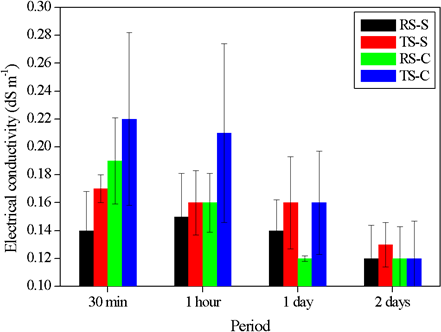
Figure 1 illustrates the temporal trends in electrical conductivity (EC) across treatments. In sandy soil, the treated vinasse (TS-S) exhibited a higher initial EC (at 30 minutes) than the untreated counterpart (RS-S), followed by a gradual decline over time. This pattern highlights the enhanced ionic mobility in soils with low water retention, which facilitates salt dissolution and transport (Silva et al., 2007).
In clayey soil, both treatments (RS-C and TS-C) started with elevated EC values, followed by similar decreasing trends. The reduced ionic mobility in this soil type is linked to its higher water retention capacity and ionic buffering ability (Francisco et al., 2015).
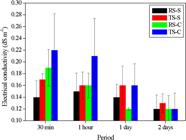
Temporal variation in electrical conductivity (EC) across treatments, presented as mean ± standard deviation (n = 3).
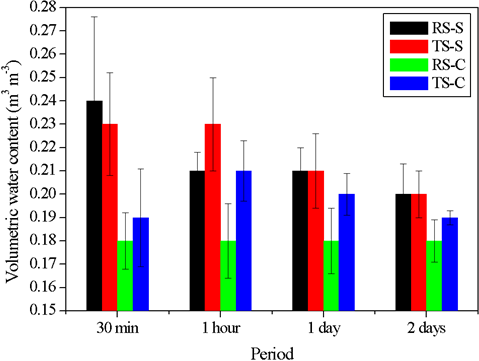
Figure 2 depicts volumetric moisture dynamics over time. In sandy soil, moisture in the untreated treatment (RS-S) decreased from 0.24 to 0.20 m³ m⁻³ and then stabilized. The treated treatment (TS-S) exhibited a similar decline (0.23 to 0.20 m³ m⁻³) over two days, indicating losses through evaporation and percolation.
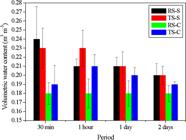
Temporal variation in volumetric moisture across treatments, presented as mean ± standard deviation (n = 3).
In clayey soil, both untreated (RS-C) and treated (TS-C) treatments maintained relatively stable moisture levels, attributable to the predominance of microporosity and a greater specific surface area, which favor moisture retention (Francisco et al., 2015; Ferreira et al., 2018).
Overall, EC and moisture exhibited a positive correlation: as moisture decreased, EC also declined, particularly in sandy soil due to higher percolation rates. In contrast, clayey soil maintained more stable moisture and ion fluxes, reflecting its enhanced retention capacity.
In addition to physical processes such as ionic leaching and water percolation, the observed reduction in electrical conductivity over time, particularly in sandy soils, may also be influenced by microbial activity. Soil microorganisms can alter salt dynamics by assimilating ions and transforming soluble salts, thereby contributing to a decrease in the ionic concentration in the soil solution (Rietz and Haynes, 2003; Marschner, 2012). Studies have shown that in saline soils the composition and activity of microbial communities are affected by salt levels and that the addition of organic amendments can alleviate the negative effects of salinity on microbial activity, potentially influencing salt dynamics in the soil (Dong et al., 2022). This interaction between microbial processes and applied vinasse may thus complement the physical dilution and adsorption mechanisms observed in both sandy and clayey soils. However, further studies including direct measurements of microbial biomass or enzymatic activity are required to better quantify the contribution of biological processes to the temporal reduction in EC.
The variability observed among replicates, expressed by the standard deviation, is associated with intrinsic soil heterogeneity and the transient behavior of water and solute fluxes in soil columns after vinasse application.
3.3. Effects of fertigation on soil chemical properties
Table 4 summarizes post-fertigation soil chemical attributes for both soil textures under untreated and sorption-treated vinasse.
Chemical properties of sandy and clayey soils after application of untreated and sorption-treated vinasse.
In sandy soil, treated vinasse (TS-S) increased pH from 5.4 to 5.8, indicating reduced acidity and enhanced cation availability. Available phosphorus rose notably from 7 to 13 mg dm⁻³, suggesting that residual or transformed compounds post-filtration still influenced soil chemistry (Antonio and Faez, 2024). Cation concentrations also increased, with K rising from 2.3 to 4.9 mmolc dm⁻³, Ca from 4 to 5 mmolc dm⁻³, and Mg from 2 to 3 mmolc dm⁻³, boosting both base saturation and CEC, though absolute values remained modest due to sandy soil’s low organic matter and clay content (Costa et al., 2020). Sodium increased from 0.30 to 0.55 mmolc dm⁻³, raising the Exchangeable Sodium Percentage (ESP) from 1.76% to 2.62%, well below the critical threshold of 15% (Teixeira et al., 2017). Still, cumulative sodium build-up under repeated applications warrants caution in sandy soils.
In clayey soil, pH similarly increased from 5.6 to 5.8, and available phosphorus rose from 7 to 10 mg dm⁻³. Cations K, Ca, and Mg showed marked increases, with K rising from 7.2 to 8.6 mmolc dm⁻³, Ca from 30 to 39 mmolc dm⁻³, and Mg from 16 to 21 mmolc dm⁻³, resulting in elevated base saturation and CEC from 53 to 69 and 71 to 84 mmolc dm⁻³, respectively. Sodium increased minimally from 0.69 to 0.76 mmolc dm⁻³, slightly reducing ESP from 0.97% to 0.90%, remaining well within safe limits. These outcomes underscore the greater nutrient retention capabilities of clayey soils due to their higher CEC and colloidal content.These findings confirm that sorption-treated vinasse can substantially enhance nutrient availability and soil chemical properties, especially in clayey soils. While sandy soils benefit as well, their limited retention capacity suggests a greater risk of nutrient leaching.
3.4. Chemistry of saturated paste extracts
Table 5 presents the chemical composition of saturated paste extracts post-fertigation, highlighting macronutrients, pH, and Sodium Adsorption Ratio (SAR).
In sandy soil, treated vinasse (TS-S) significantly increased K from 36.4 to 50.6 mg L⁻¹, Ca from 17.8 to 26.9 mg L⁻¹, Mg from 17.7 to 25 mg L⁻¹, and total nitrogen from 12 to 20.4 mg L⁻¹, indicating enhanced nutrient availability. The Sodium Adsorption Ratio (SAR) increased moderately from 0.49 to 0.55, remaining well below the critical sodicity threshold (SAR > 6).
In clayey soil, nutrient enrichment was even more pronounced, with K increasing from 69.3 to 116.5 mg L⁻¹, Ca from 20.9 to 24.7 mg L⁻¹, Mg from 10.7 to 13.7 mg L⁻¹, and total N from 23.3 to 45.3 mg L⁻¹. The Sodium Adsorption Ratio (SAR) rose from 0.62 to 1.56, remaining well below harmful levels. The modest pH increase from 6.5 to 6.8 further supports improved nutrient availability, particularly phosphorus, in acidic tropical soils (Fukushima et al., 2019).
Although the sorption-treated vinasse presented a lower total nitrogen content than the untreated vinasse, higher nitrogen concentrations were observed in the saturated paste extracts of soils receiving the treated effluent. This apparent discrepancy can be explained by soil-mediated processes rather than by the vinasse composition alone. The application of treated vinasse may have stimulated microbial activity due to the presence of residual labile organic compounds, potentially promoting the mineralization of native soil organic nitrogen and increasing the concentration of mineral N in the soil solution (Paul and Clark, 1996; Brady and Weil, 2017). Organic amendments and carbon-rich residues, such as biochars and ashes, have been shown to influence soil nutrient dynamics by enhancing microbial biomass and nutrient availability, including nitrogen, through both direct release and increased retention (Lehmann and Joseph, 2015; Piash et al., 2021). In this context, part of the nitrogen retained by sugarcane bagasse ash during the sorption process may have been gradually released after soil application as a result of changes in pH, moisture, and ionic strength, thereby contributing to higher N levels in the saturated paste extracts. Overall, these mechanisms suggest that treated vinasse favored nitrogen availability in the soil system, even with a lower initial nitrogen concentration in the applied effluent.
3.5. Synthesis of findings
Collectively, these results highlight the efficacy of sorption-treated vinasse as a sustainable fertigation alternative: it mitigates harmful compounds while enriching soil nutrition. Enhanced responses in clayey soils are attributed to their higher colloidal content and CEC, which favor cation retention, whereas sandy soils, though benefiting, are more vulnerable to nutrient losses via leaching.
For optimal application, soil-specific management strategies such as dose splitting or combining with soil amendments are essential, especially for sandy-textured fields (Eykelbosh et al., 2015).
4. CONCLUSIONS
The application of SBA-sorption-treated vinasse consistently improved soil fertility, as evidenced by higher pH, increased essential macronutrients, and elevated CEC. These effects were more pronounced in clayey soil due to its higher charge retention capacity, while sandy soil showed more modest improvements as a result of lower CEC and greater susceptibility to nutrient leaching.
Although treated vinasse initially contained lower nitrogen than the untreated effluent, higher mineral N concentrations were observed in soil extracts, likely resulting from soil-mediated processes, including microbial mineralization and gradual release from sugarcane bagasse ash. This highlights the role of biological activity in enhancing nutrient availability.
In addition to nutritional enrichment, the treatment reduced the potential environmental impact of vinasse by maintaining sodicity and salinity indices below critical thresholds, supporting more sustainable soil management practices.
It should be noted that this study was conducted in soil columns under controlled conditions, with a relatively short experimental period and low vinasse application rates, which limits direct extrapolation to field conditions. Therefore, further research is recommended, including long-term trials, assessments of crop growth and productivity responses, and scaling experiments under field conditions to validate the efficacy and safety of sorption-treated vinasse applications across different soil types and management systems.
5. DATA AVAILABILITY STATEMENT
Data availability not informed.
6. REFERENCES
- ANA (Brasil). Atlas Irrigação 2021: uso da água na agricultura irrigada. 2. ed. Brasília, 2021.
-
ANTONIO, M. M.; FAEZ, R. Unlocking agronutrient resources: sorption strategies for sugar-energy industry waste. Journal of Environmental Management, v. 356, p. 120634, 2024. https://doi.org/10.1016/j.jenvman.2024.120634
» https://doi.org/10.1016/j.jenvman.2024.120634 -
ARAÚJO, D. F. C. de; ARAÚJO SOBRINHO, F. L. O setor sucroenergético brasileiro: a intervenção estatal como motor do desenvolvimento. Revista Tocantinense de Geografia, v. 13, n. 30, p. 173-200, 2024. https://doi.org/10.70860/rtg.v13i30.18482
» https://doi.org/10.70860/rtg.v13i30.18482 - BRADY, N. C.; WEIL, R. R. The nature and properties of soils. 15th ed. New Jersey: Pearson, 2017. 1064 p.
- CARRILHO, E. N. V. M.; LABUTO, G.; KAMOGAWA, M. Y. Destination of vinasse, a residue from alcohol industry: and prevention of pollution. In: PRASAD, M. N. V.; SHIH, K. (eds.). Environmental materials and waste. Amsterdam: Elsevier, 2016. cap. 2, p. 21-43.
- CETESB. Norma P.4231: vinhaça - critérios e procedimentos para aplicação no solo agrícola. São Paulo, 2015.
-
CHACHA, M. S.; ANDREW, B.; VEGI, M. R. Amendment of soil water retention and nutrients holding capacity by using sugar cane bagasse. Current Agriculture Research Journal, v. 7, n. 2, 2019. http://dx.doi.org/10.12944/CARJ.7.2.10
» http://dx.doi.org/10.12944/CARJ.7.2.10 -
CHRISTOFOLETTI, C. A.; ESCHER, J. P.; CORREIA, J. E.; MARINHO, J. F. U.; FONTANETTI, C. S. Sugarcane vinasse: Environmental implications of its use. Waste Management, v. 33, n. 12, p. 2752-2761, 2013. https://doi.org/10.1016/j.wasman.2013.09.005
» https://doi.org/10.1016/j.wasman.2013.09.005 -
COSTA, A. C. S.; SOUZA JÚNIOR, I. G.; CANTON, L. C.; GIL, L. G.; FIGUEIREDO, R. Contribution of the chemical and mineralogical properties of sandy-loam tropical soils to the cation exchange capacity. Revista Brasileira de Ciência do Solo, v. 44, 2020. https://doi.org/10.36783/18069657rbcs20200019
» https://doi.org/10.36783/18069657rbcs20200019 -
DONG, Y.; ZHANG, J.; CHEN, R.; ZHONG, L.; LIN, X.; FENG, Y. Microbial Community Composition and Activity in Saline Soils of Coastal Agro-Ecosystems. Microorganisms, v. 10, n. 4, 835, 2022. https://doi.org/10.3390/microorganisms10040835
» https://doi.org/10.3390/microorganisms10040835 -
EYKELBOSH, A. J.; JOHNSON, M. S.; COUTO, E. G. Biochar decreases dissolved organic carbon but not nitrate leaching in relation to vinasse application in a Brazilian sugarcane soil. Journal of Environmental Management, v. 149, p. 9-16, 2015. https://doi.org/10.1016/j.jenvman.2014.09.033
» https://doi.org/10.1016/j.jenvman.2014.09.033 -
FERREIRA, T. M.; CHANG, H. K.; SOTO, M. A. Avaliação da aplicação de vinhaça em solo arenoso da Formação Rio Claro. Águas Subterrâneas, v. 32, n. 3, p. 354-363, 2018. https://doi.org/10.14295/ras.v32i3.29208
» https://doi.org/10.14295/ras.v32i3.29208 -
FRANCISCO, J. P.; FOLEGATTI, M. V.; SILVA, L. B. D.; SILVA, J. G. B. Monitoramento da condutividade elétrica e PH da solução do solo sob diferentes doses de aplicação de vinhaça. Engenharia na Agricultura, v. 23, n. 6, p. 552-561, 2015. https://doi.org/10.13083/reveng.v23i6.590
» https://doi.org/10.13083/reveng.v23i6.590 -
FUKUSHIMA, N. A.; PALACIOS-BERECHE, M. C.; PALACIOS-BERECHE, R.; NEBRA, S. A. Energy analysis of the ethanol industry considering vinasse concentration and incineration. Renewable Energy, v. 142, p. 96-109, 2019. https://doi.org/10.1016/j.renene.2019.04.085
» https://doi.org/10.1016/j.renene.2019.04.085 -
LANCE, L. R. G.; STOLF, R.; BOSCHI, R. S.; SOUZA, C. F. Fertirrigação com vinhaça na cana-de-açúcar: Avaliação do desenvolvimento inicial, condutividade elétrica e teor de potássio no solo. Irriga, v. 28, n. 4, p. 805-820, 2023. https://doi.org/10.15809/irriga.2023v28n4p805-820
» https://doi.org/10.15809/irriga.2023v28n4p805-820 - LEHMANN, J.; JOSEPH, S. Biochar for Environmental Management: Science, Technology and Implementation. 2. ed. London: Routledge, 2015. 661 p.
-
LIMA, F. A.; SANTOS JÚNIOR, A. C.; SARROUH, B.; LOFRANO, R. C. Application of sugarcane bagasse and peanut shell in natura as bioadsorbents for vinasse treatment. Clean Technologies and Environmental Policy, v. 26, p. 785-802, 2024. https://doi.org/10.1007/s10098-023-02650-9
» https://doi.org/10.1007/s10098-023-02650-9 - MARSCHNER, P. Mineral nutrition of higher plants. 3. ed. London: Academic Press, 2012.
- MEURER, E. J. Fundamentos de química do solo. 6. ed. Porto Alegre: Evangraf, 2017.
- PAUL, E. A.; CLARK, F. E. Soil microbiology and biochemistry. 2nd ed. San Diego: Academic Press, 1996. 340 p.
-
PARSAEE, M.; KIANI, M. K. D.; KARIMI, K. A review of biogas production from sugarcane vinasse. Biomass and Bioenergy, v. 122, p. 117-125, 2019. https://doi.org/10.1016/j.biombioe.2019.01.034
» https://doi.org/10.1016/j.biombioe.2019.01.034 -
PIASH, M. I.; IWABUCHI, K.; ITOH, T.; UEMURA, K. Release of essential plant nutrients from manure- and wood-based biochars. Geoderma, v. 397, p. 115100, 2021. https://doi.org/10.1016/j.geoderma.2021.115100
» https://doi.org/10.1016/j.geoderma.2021.115100 -
RIETZ, D. N.; HAYNES, R. J. Effects of irrigation-induced salinity and sodicity on soil microbial activity. Soil Biology and Biochemistry, v. 35, n. 6, p. 845-854, 2003. https://doi.org/10.1016/S0038-0717(03)00125-1
» https://doi.org/10.1016/S0038-0717(03)00125-1 -
RUBIO, G. O.; RIBEIRO, D. O.; SOUZA, Z. H.; PEREIRA, R. M.; SILVA, J. G.; DALMOLIN, B. Sugarcane bagasse ash doses affect soil chemical attributes and pigeon pea initial performance. Revista de Agricultura Neotropical, v. 10, n. 1, e7150, 2023. https://doi.org/10.32404/rean.v10i2.7150
» https://doi.org/10.32404/rean.v10i2.7150 -
SILVA, M. A. S.; GRIEBELER, N. P.; BORGES, L. C. Uso de vinhaça e impactos nas propriedades do solo e lençol freático. Revista Brasileira de Engenharia Agrícola e Ambiental, v. 11, n. 1, p. 108-114, 2007. https://doi.org/10.1590/S1415-43662007000100014
» https://doi.org/10.1590/S1415-43662007000100014 - TAIZ, L.; ZEIGER, E.; MOLLER, I. M.; MURPHY, A. Fisiologia e desenvolvimento vegetal. 6. ed. Porto Alegre: Artmed, 2017.
- TEIXEIRA, P. C.; DONAGEMMA, G. K.; FONTANA, A.; TEIXEIRA, W. G. Manual de métodos de análise de solo. 3. ed. Brasília, DF: Embrapa, 2017.
Edited by
-
Editor-in-Chief:
Nelson Wellausen Dias https://orcid.org/0000-0002-9507-9211