Mineral nitrogen dynamics, mineralization and nitrification in soybean fields under No-Tillage and conventional tillage in Amazonian tropical soils
Abstract
This study evaluated mineral nitrogen (NH₄⁺ and NO₃⁻) concentrations and potential mineralization and nitrification rates in soils under No-Tillage (NT) and Conventional Tillage (CT) in soybean fields in the Santarém Plateau, Pará, Brazil. Soil samples were collected at three phenological stages (R1: flowering; R5: grain filling; R8: physiological maturity) and four depths (0 - 10, 10 - 20, 20 - 30, 30 - 40 cm). No significant differences were observed between NT and CT for mineral N concentrations or transformation rates, suggesting that after two years of NT adoption, short-term effects on N dynamics are minimal. Mineral N concentrations decreased significantly (p< 0.05) from R1 to R8, mainly in deeper layers (10 - 40 cm), likely due to intense N uptake by soybean during early reproductive stages. The highest daily mineralization and nitrification rates occurred in the 0 - 10 cm layer, associated with greater organic matter and microbial activity. Positive transformation rates at all depths indicate continuous conversion of organic N into plant-available forms throughout the crop cycle. Results suggest that NT benefits on soil N cycling in Amazonian agricultural systems may become more evident over longer adoption periods, particularly when integrated with crop rotation and permanent soil cover.
Keywords:
agricultural management systems; ammonium and nitrate; nitrogen transformation rates; soil nitrogen cycling; tropical agriculture
Resumo
Este estudo avaliou as concentrações de nitrogênio mineral (NH₄⁺ e NO₃⁻) e as taxas potenciais de mineralização e nitrificação em solos sob Plantio Direto (PD) e Plantio Convencional (PC) em campos de soja no Planalto de Santarém, Pará, Brasil. Amostras de solo foram coletadas em três estádios fenológicos (R1: floração; R5: enchimento de grãos; R8: maturidade fisiológica) e quatro profundidades (0 - 10, 10 - 20, 20 - 30, 30 - 40 cm). Não foram observadas diferenças significativas entre o PD e o PC para as concentrações de N mineral ou taxas de transformação, sugerindo que, após dois anos de adoção do PD, os efeitos de curto prazo na dinâmica do N são mínimos. As concentrações de N mineral diminuíram significativamente (p< 0,05) de R1 a R8, principalmente em camadas mais profundas (10 - 40 cm), provavelmente devido à intensa absorção de N pela soja durante os estágios reprodutivos iniciais. As maiores taxas diárias de mineralização e nitrificação ocorreram na camada de 0 a 10 cm, associadas a maior matéria orgânica e atividade microbiana. Taxas de transformação positivas em todas as profundidades indicam conversão contínua de N orgânico em formas disponíveis para as plantas ao longo do ciclo da cultura. Os resultados sugerem que os benefícios do PD na ciclagem de N do solo em sistemas agrícolas amazônicos podem se tornar mais evidentes com períodos de adoção mais longos, particularmente quando integrados à rotação de culturas e à cobertura permanente do solo.
Palavras-chave:
agricultura tropical; amônio e nitrato; ciclagem de nitrogênio do solo; sistemas de manejo agrícola; taxas de transformação de nitrogênio
1. INTRODUCTION
Since the early 1990s, the expansion of the agricultural frontier in the Amazon Basin-particularly across the Santarém Plateau, encompassing the municipalities of Santarém, Mojuí dos Campos, and Belterra-has been driven by the intensification of grain cultivation, notably soybean, maize, and rice. Recent data indicate a substantial increase in production, reaching 383,773 t of soybean, 134,455 t of maize (2nd crop), and 15,780 t of paddy rice in 2023 (IBGE, 2024). Such expansion and intensification into landscapes with inherently nutrient-poor soils heighten the need for soil management strategies that sustain fertility, enhance nutrient cycling, and reduce environmental externalities at multiple scales.
The No-Tillage System (NTS) is widely recognized as a key conservation agriculture practice with the potential to improve soil physical, chemical, and biological attributes. Long-term studies in the Brazilian Cerrado have demonstrated that NTS combined with crop rotation can sequester approximately 0.41 Mg C ha⁻¹ year⁻¹ (Amado et al., 2001). In cotton systems, NTS has increased carbon stocks by 20% to 40 cm depth and boosted nitrogen content in surface layers by up to 50% relative to conventional tillage (EMBRAPA, 2019). Continuous residue cover under NTS promotes aggregate stability, enhances macroporosity, and improves water-holding capacity - traits that contribute to both productivity and resilience.
Nitrogen (N) dynamics, particularly the cycling of mineral forms (NH₄⁺ and NO₃⁻), are central to the sustainability of agroecosystems. Mineralization and nitrification govern the temporal and spatial availability of plant-available N and are strongly modulated by management practices. Compared with conventional tillage, NTS typically moderates decomposition rates, resulting in a more gradual nutrient release and reducing losses via leaching or volatilization (Cerri, 2024).
Empirical evidence from subtropical Brazil supports these benefits: reduced soil disturbance in Rio Grande do Sul minimized organic carbon and total nitrogen losses, maintaining levels comparable to those under native vegetation. In Santa Catarina, Guadagnin et al. (2005) demonstrated that conservation tillage reduced soil and water erosion more effectively than conventional systems. Blainski and Tormena (2011) reported that crop residue retention increased soil organic matter, thereby improving aggregation, permeability, and porosity (Gonçalves et al., 2010).
Nitrogen is the most limiting macronutrient for most crops. While abundant in the biosphere, it is virtually absent in the mineral fraction of soils and occurs predominantly as atmospheric N₂ - a chemically inert form unavailable to most higher plants (Raij, 1991).
Despite extensive evidence from the Cerrado and Atlantic Forest, research on mineral N dynamics under NTS in Amazonian soils remains scarce, especially in the grain-production zones of the Santarém Plateau. The edaphic characteristics of Amazonian Oxisols and Ultisols - low cation exchange capacity, high acidity, and strong weathering - demand site-specific investigations to determine whether findings from other biomes are transferable to these environments.
This study addresses this knowledge gap by testing two hypotheses: (i) NTS increases mineral N pools and accelerates mineralization and nitrification relative to Conventional Tillage, due to residue-mediated protection and greater organic matter accumulation; and (ii) continuous residue cover under NTS sustains higher organic matter content and microbial activity, resulting in more stable mineral N availability across the cropping cycle.
The specific objective is to quantify mineral N concentrations and estimate mineralization and nitrification rates in soils under NTS and conventional Tillage in grain-producing areas of the Santarém Plateau, thereby informing management strategies for improved nitrogen-use efficiency and long-term agroecosystem sustainability in Amazonian landscapes.
2. MATERIAL AND METHODS
2.1. Study area
The experiment was conducted on two commercial soybean farms in Mojuí dos Campos, Pará State, Brazil. The first site was managed under a no-tillage system (NTS; 2°40′09.75″ S, 54°39′21.17″ W), and the second under conventional tillage (CTS; 2°44′19.38″ S, 54°37′00.60″ W). All experiments were conducted from January to June.
The regional climate is classified as Ami (humid tropical with a short dry season) according to Köppen-Geiger (Oliveira Junior and Corrêa, 2001; IDESP, 2011). Mean annual air temperature is 25.6°C, with monthly maxima averaging 31°C and minima averaging 22.5°C. Relative humidity exceeds 80% throughout most of the year. Mean annual precipitation is approximately 2,000 mm, concentrated from December to June (wet season).
Soils in both sites are classified as Dystrophic Yellow Latosols (Oxisols), with clayey to very clayey texture, containing 490 - 930 g kg⁻¹ of clay (Oliveira Junior and Corrêa, 2001).
2.2. Soil sampling
Three sampling campaigns were conducted during the soybean cycle, corresponding to the following phenological stages on the Fehr & Caviness scale: R1 - beginning of flowering; R5 - beginning of grain filling and; R8 - physiological maturity.
Stages R1, R5, and R8 were selected because they represent critical transitions in the soybean reproductive cycle, in which soil nitrogen dynamics are strongly modulated by plant metabolism:
R1 - beginning of flowering: At this stage, the maximum initial demand for N occurs, as the plant intensifies reproductive growth and biological nitrogen fixation (BNF) increases rapidly. Thus, changes in soil mineral N levels begin to reflect the crop's nutritional needs.
R5 - grain filling: The grain filling period is marked by high N absorption, when soybeans mobilize nutrients both via soil absorption and internal remobilization. It is a sensitive point in mineral N dynamics, and it is common to observe sharp reductions in NH₄⁺ and NO₃⁻ at this stage.
R8 - physiological maturity: At maturity, N absorption practically ceases, and the soil-plant system enters a phase of stabilization of N flows, allowing for the evaluation of residual N availability in the soil and the balance of mineralization/nitrification processes at the end of the cycle.
Together, these three stages provide a representative overview of the temporal dynamics of mineral N in the soil, capturing the phase of greatest demand (R1), the peak of nutrient use and transformation (R5), and the final condition of the system (R8). This allows for a robust interpretation of absorption, mineralization, and nitrification patterns throughout the crop cycle. Within each management system, five georeferenced sampling points were randomly selected. At each point, composite soil samples were collected at four depths: 0 - 10, 10 - 20, 20 - 30, and 30 - 40 cm. Sampling was performed with a Dutch auger, thoroughly cleaned between points to avoid cross-contamination.
2.3. Mineral nitrogen, nitrification, and mineralization analyses
Determinations of mineral nitrogen (NH₄⁺ and NO₃⁻) and estimates of potential nitrification and mineralization rates followed protocols adapted from Sfredo (2008), Siqueira Neto et al. (2010), and Figueira (2013).
Fresh soil samples were extracted with 1 mol L⁻¹ KCl at a 1:5 (w/v) ratio, shaken for 1 h, and filtered. NH₄⁺ was quantified by the indophenol blue colorimetric method, and NO₃⁻ by spectrophotometry following cadmium reduction.
Potential nitrification rate (PNR) was determined by incubating soil with (NH₄)₂SO₄ solution and quantifying NO₃⁻ accumulation after 7 days at 25°C and 60% field capacity. Potential mineralization rate (PMR) was calculated from the change in total mineral nitrogen (NH₄⁺ + NO₃⁻) over the same incubation period.
2.4. Statistical analysis
Data were analyzed using a completely randomized design with split plots, where soil depth was treated as the subplot factor and sampling date as the repeated measure.
3. RESULTS AND DISCUSSION
3.1. Mineral Nitrogen Concentrations (NH4 + + NO3 -)
Mineral nitrogen (N-mineral) concentrations did not differ significantly between the two management systems (CT vs. NT) (Figure 1). However, a consistent temporal decline was observed across sampling phenological periods (R1 → R8), particularly in the 10-20, 20-30, and 30-40 cm layers, with significant reductions (p < 0.05) between phenological periods 1 and 3. This vertical and temporal pattern is aligned with results reported by Siqueira Neto et al. (2010), who found that the highest levels of inorganic N occurred during early vegetative and reproductive stages, declining progressively toward maturity as plant demand peaks.
The replicated decline in the Santarém Plateau reinforces that soybean rapidly depletes the soil N-mineral pool during reproductive stages, especially after flowering (R1), when N uptake intensifies and continues until physiological maturity (Sfredo, 2008; Siqueira Neto et al., 2010). The greater depletion in deeper layers suggests mobilization of nitrate (NO₃⁻), which is more mobile in the soil profile and preferentially absorbed by the crop during high-demand growth phases.
3.2. Mineralization and Nitrification Rates
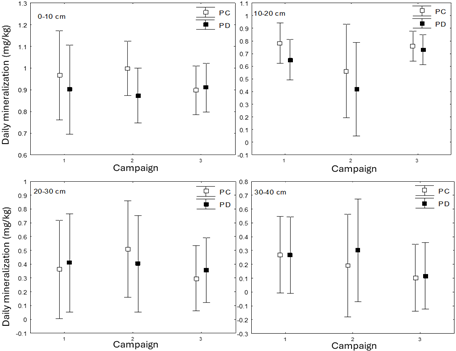
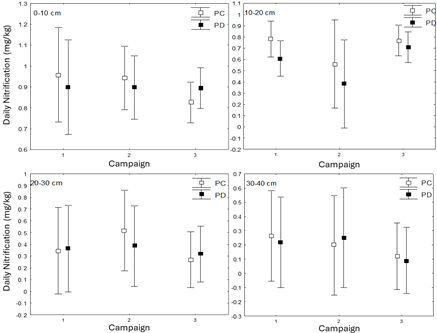
Daily mineralization and nitrification rates were positive across all depths and sampling periods (Figure 2), indicating continuous conversion of organic N into plant-available forms (Raij, 1991). As expected, rates were markedly higher in the 0-10 cm layer, where greater organic matter content, enhanced aeration, and the residual effects of liming promote microbial activity (Siqueira Neto et al., 2010). The vertical decrease in transformation rates mirrors trends reported in other agroecosystems, where topsoil layers sustain the highest mineralization potential due to their enriched biological and chemical attributes (Cardoso et al., 2011; Kuusemets et al., 2025).
Means and confidence intervals of daily nitrogen mineralization rates at four sampling depths (0-10, 10-20, 20-30 and 30-40 cm) and at three soybean development stages, in conventional (PC) and no-till (PD) planting systems, in mg Kg-1 dia-1. Campaigns 1, 2 and 3 correspond to stages R1 (beginning of flowering), R5 (beginning of grain formation) and R8 (harvest maturity), respectively.
Averages and confidence intervals of daily nitrification rates at four sampling depths (0-10, 10-20, 20-30 and 30-40 cm) and at three soybean development stages, in conventional (PC) and no-till (PD) planting systems, in mg Kg-1 dia-1. Campaigns 1, 2 and 3 correspond to stages R1 (beginning of flowering), R5 (beginning of grain formation) and R8 (harvest maturity), respectively.
Comparisons with long-term studies help contextualize the magnitude of these rates. Siqueira Neto et al. (2010) found mineralization rates ranging from 0.74 to 1.75 mg kg⁻¹ day⁻¹ in NT systems after more than a decade of adoption, while Figueira (2013) observed comparable values under CT and NT. The rates observed in the present study fall within a similar amplitude, but the absence of significant differences between systems likely reflects the short duration of NT adoption (only two years). This is consistent with Franchini et al. (2009), who highlight that NT systems generally require at least five years to reach functional maturity and manifest measurable improvements in N cycling.
Recent studies further reinforce that long-term NT fosters increased mineralization and higher soil N pools (Pecci Canisares et al., 2021), while integration with cover crops enhances N availability and fertilizer use efficiency in tropical regions (Carvalho et al., 2024). Thus, although the present study did not detect significant differences between CT and NT, evidence from mature systems suggests that such benefits are likely to emerge over longer adoption periods.
3.3. Integrated Interpretation of N Dynamics
The combined analysis of N-mineral pools and transformation rates indicates that plant uptake was the primary driver of temporal declines in soil inorganic N, particularly between R1 and R8. This pattern is coherent with the physiological trajectory of soybean, which increases N uptake markedly during flowering and early grain filling. Such dynamics explain the significant reductions in N-mineral observed in deeper layers, where nitrate is readily available and mobile.
The absence of significant differences between NT and CT for mineral N concentrations, mineralization rates, and nitrification rates leads to the rejection of Hypothesis 1, which predicted higher N availability under no-tillage. Likewise, the results do not support Hypothesis 2, when interpreted as an expected improvement in N transformation processes specifically attributable to permanent soil cover. Instead, the data reveal a strong effect of soil depth, with markedly higher mineralization and nitrification rates in the 0-10 cm layer, regardless of the management system. This pattern reflects the natural vertical stratification of organic matter and microbial activity commonly observed in tropical agricultural soils and is not associated with differences between CT and NT within the two-year adoption window evaluated. Therefore, the observed behavior should be interpreted as a depth-driven response, rather than a management-driven effect.
Furthermore, similarities between CT and NT in crop residue production and nutrient concentrations reinforce the interpretation that the short duration of NT adoption limited detectable effects. Studies in analogous tropical systems (Franchini et al., 2009; Vázquez et al., 2020; Canisares et al., 2021) indicate that adaptive responses in soil N dynamics generally emerge only after medium-to-long-term accumulation of residues and improvements in soil structure.
Overall, the evidence suggests that the benefits of NT on soil N cycling in Amazonian agricultural systems may become more evident over longer adoption periods, especially when combined with diversified rotations and permanent soil cover.
4. CONCLUSIONS
The results for the studied variables showed no statistically significant differences between soil management systems (NT and CT), suggesting that, in the short term, the adopted system did not significantly influence mineral N availability or mineralization and nitrification rates. This outcome may be related to the relatively recent adoption of NT in the studied area, as consistent benefits of this practice typically manifest in medium- to long-term scenarios.
Significant differences in mineral N concentrations were observed between the phenological stages R1 (flowering) and R8 (maturity). The highest concentrations were recorded at R1, particularly at depths of 10 - 20 cm, 20 - 30 cm, and 30 - 40 cm. This pattern can be attributed to higher N demand and uptake by plants during early grain-filling stages, followed by reduced uptake in later growth phases.
Daily mineralization and nitrification rates showed significant differences between soil depths, with notably higher values in the surface layer (0 - 10 cm) compared to deeper layers (30 - 40 cm). This behavior may be linked to greater microbial activity, higher organic matter availability near the surface, and improved aeration and liming effects, which promote the conversion of organic N into inorganic forms.
Mineralization and nitrification rates were positive at all depths, demonstrating that-regardless of soil layer - organic N is converted into inorganic forms, ensuring continuous availability of plant-available N throughout the crop cycle. This process is essential for maintaining soil nitrogen fertility and supporting plant development, particularly in tropical agricultural systems with high residue decomposition rates.
5. DATA AVAILABILITY STATEMENT
Data availability not informed.
6. ACKNOWLEDGEMENTS
Ao Projeto Fluxus, Embrapa Amazônia Oriental.
7. REFERENCES
- AMADO, T. J. C.; BAYER, C.; ELTZ, F. L.; BRUM, A. C. R. Potencial de culturas de cobertura em acumular carbono e nitrogênio no solo no plantio direto e a melhoria da qualidade ambiental. Revista Brasileira de Ciência do Solo, v. 25, n. 1, p. 189-197, 2001. https://doi.org/10.1590/S0100-06832001000100020
- BLAINSKI, É.; TORMENA, C. A. Influência dos restos culturais no teor de água e na qualidade física de um latossolo. In: CONGRESSO BRASILEIRO DE CIÊNCIA DO SOLO, 33., 2010, Uberlândia. Anais… Uberlândia: SBCS, 2011.
-
CANISARES, L. P.; POFFENBARGER, H.; BRODIE, E. L.; SORENSEN, P. O.; KARAOZ, U.; VILLEGAS, D. M. et al Legacy effects of intercropping and nitrogen fertilization on soil N cycling, nitrous oxide emissions, and the soil microbial community in tropical maize production. Frontiers in Soil Science, v. 1, 2021. https://doi.org/10.3389/fsoil.2021.746433
» https://doi.org/10.3389/fsoil.2021.746433 -
CARDOSO, E. G.; SÁ, J. C. M.; BIEDIS, C.; FERREIRA, A. O.; BORSZOWSKI, P. R.; SANTOS, J. B. et al Dinâmica do nitrogênio em sistemas de manejo do solo: II - taxas de mineralização e nitrificação. Revista Brasileira de Ciência do Solo, v. 35, n. 5, p. 1651-1660, 2011. https://doi.org/10.1590/S0100-06832011000500019
» https://doi.org/10.1590/S0100-06832011000500019 -
CARVALHO, A. M. D.; RAMOS, M. L. G.; SILVA, V. G. da; SOUSA, T. R. de; MALAQUIAS, J. V.; RIBEIRO, F. P. et al Cover crops affect soil mineral nitrogen and N fertilizer use efficiency of maize no-tillage system in the Brazilian Cerrado. Land, v. 13, p. 693, 2024. https://doi.org/10.3390/land13050693
» https://doi.org/10.3390/land13050693 -
CERRI, C. E. P. Sequestro de carbono no solo: práticas agrícolas modernas e serviços ecossistêmicos. Novo Solo, 7 out. 2024. Available: Available: https://revistanovosolo.org.br/2024/10/07/semana-do-manejo-do-solo-e-agua-debate-plantas-de-servico-3/ Access: 8 ago. 2025.
» https://revistanovosolo.org.br/2024/10/07/semana-do-manejo-do-solo-e-agua-debate-plantas-de-servico-3/ -
EMBRAPA. Plantio direto do algodoeiro aumenta estoque de carbono no solo em 20%. 2019. Available: Available: https://www.embrapa.br/en/busca-de-noticias/-/noticia/45923956/plantio-direto-do-algodoeiro-aumenta-estoque-de-carbono-no-solo-em-20. Access: 8 ago. 2025.
» https://www.embrapa.br/en/busca-de-noticias/-/noticia/45923956/plantio-direto-do-algodoeiro-aumenta-estoque-de-carbono-no-solo-em-20. - FIGUEIRA, A. M. S. O cultivo da soja na região sudeste da Amazônia e suas implicações na dinâmica do nitrogênio. 2013. 92 f. Tese (Doutorado em Ciências) - Programa de Pós-Graduação em Ciências, Centro de Energia Nuclear na Agricultura, Universidade de São Paulo, Piracicaba, 2013.
- FRANCHINI, J. C.; DEBIASI, H.; BALBINOT JUNIOR, A. A.; TONON, B. C.; FARIAS, J. R. B.; OLIVEIRA, M. C. N. de et al Sistemas de cultivo do solo no Brasil: desafios e oportunidades para a sustentabilidade. Revista Brasileira de Ciência do Solo, v. 33, n. especial, p. 1-16, 2009. https://doi.org/10.1590/S0100-06832009000500002
- GONÇALVES, S. L. et al Decomposição de resíduos de milho e soja em função do tempo e do manejo do solo. Londrina: Embrapa Soja, 2010. 19 p. (Boletim de Pesquisa e Desenvolvimento/Embrapa Soja, n. 3).
-
GUADAGNIN, J. C. et al Perdas de solo, água e nitrogênio por erosão hídrica em diferentes sistemas de manejo. Revista Brasileira de Ciência do Solo, v. 29, p. 277-286, 2005. https://doi.org/10.1590/S0100-06832005000200013
» https://doi.org/10.1590/S0100-06832005000200013 -
IBGE. Pesquisa Agrícola Municipal: Culturas temporárias e permanentes - 2023. Rio de Janeiro, 2024. Available: Available: https://sidra.ibge.gov.br/pesquisa/pam/tabelas Access: 15 dez. 2025.
» https://sidra.ibge.gov.br/pesquisa/pam/tabelas - INSTITUTO DE DESENVOLVIMENTO ECONÔMICO, SOCIAL E AMBIENTAL DO PARÁ. Estatística municipal: Santarém. Belém: SEPOF/IDESP, 2011.
-
KUUSEMETS, L.; MANDER, Ü.; ESCUER-GATIUS, J.; ASTOVER, A.; KAUER, K.; SOOSAAR, K.; ESPENBERG, M. Interações entre fertilização e produtividade de culturas no microbioma do ciclo do nitrogênio do solo e emissões de gases. SOIL, v. 11, p. 1-15, 2025. https://doi.org/10.5194/soil-11-1-2025
» https://doi.org/10.5194/soil-11-1-2025 - OLIVEIRA JÚNIOR, R. C. de; CORRÊA, J. R. V. Caracterização dos solos do município de Belterra, Estado do Pará. Belém: Embrapa Amazônia Oriental, 2001. 39 p. (Documentos/Embrapa Amazônia Oriental, n. 88).
-
PECCI CANISARES, L.; GROVE, J.; MIGUEZ, F.; POFFENBARGER, H. Long-term no-till increases soil nitrogen mineralization but does not affect optimal corn nitrogen fertilization practices relative to inversion tillage. Soil and Tillage Research, v. 213, p. 105080, 2021. https://doi.org/10.1016/j.still.2021.105080
» https://doi.org/10.1016/j.still.2021.105080 - RAIJ, B. Van. Fertilidade do solo e manejo de nutrientes: fundamentos e aplicações. Viçosa: UFV, 1991.
- SFREDO, G. J. Soja no Brasil: calagem, adubação e nutrição mineral. Londrina: Embrapa Soja, 2008. 148 p. (Documentos/Embrapa Soja, n. 305).
-
SIQUEIRA NETO, M.; PICCOLO, M. C.; VENZKE FILHO, S. P.; FEIGL, B. J.; CERRI, C. C. Mineralização e desnitrificação do nitrogênio no solo sob sistema plantio direto. Bragantia, v. 69, n. 4, p. 923-936, 2010. https://doi.org/10.1590/S0006-87052010000400019
» https://doi.org/10.1590/S0006-87052010000400019 -
VÁZQUEZ, E.; TEUTSCHEROVÁ, N.; DANNENMANN, M.; TÖCHTERLE, P.; BUTTERBACH-BAHL, K.; PULLEMAN, M. et al Gross nitrogen transformations in tropical pasture soils as affected by Urochloa genotypes differing in biological nitrification inhibition (BNI) capacity. Soil Biology & Biochemistry, v. 151, p. 108058, 2020. https://doi.org/10.1016/j.soilbio.2020.108058
» https://doi.org/10.1016/j.soilbio.2020.108058
Edited by
-
Editor-in-Chief:
Nelson Wellausen Dias https://orcid.org/0000-0002-9507-9211