 Biochar reduces the mobility of Pb and Cd while decreasing micronutrient availability in soil impacted by metallurgical waste
ABSTRACT.
Cadmium (Cd) and lead (Pb) contamination in agricultural and urban soils poses significant environmental and human health risks, especially in areas impacted by metallurgical waste. In this study, the efficacy of four biochars produced from rice straw (RSB), sugarcane bagasse (SBB), sewage sludge (SSB), and filter cake (FCB), in immobilizing Cd and Pb and improving soil chemical properties, was assessed. An incubation experiment was conducted using contaminated soil from Santo Amaro, Brazil, a site historically affected by lead smelting. Biochars were applied at 10% (w/w), and their effects on soil pH, nutrient availability, organic matter (SOM), and metal fractionation were evaluated. Compared with the control treatment, the SBB and FCB treatments significantly reduced the availability of Cd (~30%) and Pb (~20%). These biochars also increased phosphorus (P) availability and increased the SOM content. Sequential extraction indicated a shift of Cd and Pb from labile to more stable forms, particularly the reducible and residual fractions, suggesting improved long-term immobilization. The superior performance of SBB and FCB was attributed to their higher SOM and P contents, as well as functional groups that promote metal complexation. Overall, the findings demonstrate the potential of nutrient-rich, waste-derived biochars as a sustainable and cost-effective solution for the remediation of heavy metal-contaminated soils. The results highlight the importance of selecting biochars based on feedstock characteristics and underscore the need for field-based studies to evaluate their long-term stability and the effects on metal uptake by plants.
Keywords:
soil remediation; heavy metals; sequential extraction; trace elements; soil pollution
Introduction
Biochars are carbon-rich, stable, and porous materials produced through the pyrolysis of biomass under low or limited oxygen conditions, and at relatively low temperatures (Beesley & Marmiroli, 2011; Cao et al., 2009). In recent years, these materials have gained prominence as soil amendments due to their potential to enhance fertility, increase crop productivity, mitigate climate change, and remediate environmental contamination, particularly by heavy metals. Studies have shown that biochar can immobilize toxic metals such as lead (Pb) and cadmium (Cd), but may also reduce the availability of micronutrients like zinc (Zn) and copper (Cu), due to their high surface area, alkaline pH, and the presence of abundant functional groups (Beesley & Marmiroli, 2011; Jiang et al., 2012; Li & Ji, 2017). Thus, biochar application has emerged as a sustainable and cost-effective alternative for remediating heavy metal-contaminated soils, although its effects on nutrient availability warrant further investigation (Premalatha et al., 2023).
Mining activities and the improper disposal of industrial wastes are among the main sources of heavy metal contamination in terrestrial environments, directly affecting urban, industrial, and agricultural soils (Chirakkara & Reddy, 2015; Haghighizadeh et al., 2024; Jacob et al., 2022; Wang et al., 2017; Zdravković et al., 2020). In Brazil, the case of Santo Amaro, in Bahia state, is a notable example. Lead smelting slag, which is rich in lead oxide (PbO) and cadmium oxide (CdO), was used for paving, landfilling, and even in residential backyards. This practice resulted in widespread contamination of urban soils, exposing the population to elevated levels of heavy metals. The largest known case of human Pb contamination in the country affected more than 18,000 residents, with epidemiological studies reporting blood lead levels in children three times above reference values (Silva et al., 2024; Veloso et al., 2022; Santos et al., 2017; Niemeyer et al., 2012; 2015).
In this context, emerging technologies, such as biochar application, have drawn attention as promising alternatives for mitigating the effects of heavy metals in contaminated soils (Veloso et al., 2022; Meng et al., 2018; Rodríguez-Vila et al., 2015; Su et al., 2023). The pyrolysis process converts biomass into a highly stable and porous material capable of retaining contaminants, thereby endowing biochar with favorable properties for remediation and for improving the chemical and physical attributes of soils (Chen et al., 2021; Chew et al., 2022; Chormare et al., 2023; Gusiatin & Rouhani, 2023; Leng et al., 2021; Lu et al., 2014). Biochar application has therefore been shown as an effective means of reducing the concentrations of soluble metals in contaminated soils, with adsorption being among the main mechanisms involved in contaminant retention (Beesley & Marmiroli, 2011).
Despite its potential, biochar application can reduce micronutrient availability, thus compromising crop productivity and the efficiency of combined remediation techniques like phytoextraction and phytostabilization (Veloso et al., 2022; Zhang et al., 2021). For example, the application of rice straw biochar at a 5% rate reduced iron (Fe) availability in soil by 73% (Xu et al., 2022). Hence, there is a need to develop strategies that maximize the benefits of biochar while minimizing its negative effects on soil quality, including assessing how different types of biochar influence the dynamics of potentially toxic metals and micronutrients.
Given this context, the objectives of this study were i) to evaluate the effectiveness of four types of biochar in immobilizing Pb and Cd, as well as in modulating the availability of micronutrients (Fe, Mn, Zn, and Cu) in soil contaminated by metallurgical slag and ii) to investigate the dynamics of toxic metals and micronutrients through sequential chemical extraction. Additionally, the effects of biochar application on soil pH, phosphorus content, the sum of exchangeable bases (Ca, Mg, K, and Na), and soil organic matter content, were assessed.
Material and methods
Soil sampling and analyses
The soil used in this experiment was collected in the municipality of Santo Amaro, Bahia State, Brazil, near an abandoned lead smelting facility (Silva et al., 2017). The sample was sieved through a 2 mm mesh and subsequently subjected to chemical and physical characterization (Table 1). Chemical analyses were conducted according to the protocols described by Teixeira et al. (2017) and included the following procedures: soil pH was determined in water using a 1:2.5 soil-to-solution ratio; sodium (Na⁺) and potassium (K⁺) concentrations were measured by flame photometry; calcium (Ca²⁺) and magnesium (Mg²⁺) were extracted using 1.0 mol L-1 potassium chloride (KCl) and determined by complexometric titration with 0.0125 mol L-1 EDTA; aluminum (Al³⁺) was extracted with 1.0 mol L-1 KCl and quantified by titration with sodium hydroxide; potential acidity (H⁺+Al³⁺) was extracted using 0.5 mol L-1 calcium acetate and determined by alkalimetric titration; and available phosphorus (P) was extracted with Mehlich-1 solution and quantified by colorimetry.
Biochar production and preparation
The biochars were produced via slow pyrolysis, during which the temperature was gradually increased to approximately 400°C to optimize the charcoal yield (Sharma et al., 2024). The process was carried out using a custom-built fixed-bed furnace consisting of two concentric metal cylinders. The inner chamber (15 L) was sealed to restrict oxygen exposure, thereby facilitating pyrolysis. This chamber was housed within a larger 50 L metal cylinder, using burning firewood in the interstitial space to maintain the target temperature. The outer cylinder was covered and fitted with a chimney to allow for the controlled release of combustion gases.
Four types of biochar were used in the experiments, each produced from different organic feedstocks. Rice straw biochar (RSB) was obtained from a commercial product, resulting from the pyrolysis of rice straw at 400°C. Sugarcane bagasse biochar (SBB) and filter cake biochar (FCB) were produced from byproducts of sugar and ethanol production, the bagasse derived from sugarcane milling, and the filter cake from the sugarcane juice clarification process. These materials were collected from a sugar and ethanol processing plant. Finally, sewage sludge biochar (SSB) was produced from residues collected in a wastewater treatment plant located in Recife, Pernambuco State, Brazil.
Prior to pyrolysis, the raw materials were air-dried to reduce the moisture content and subsequently placed into a custom-designed fixed-bed furnace specifically constructed for biochar production. The pyrolysis process was carried out at a constant temperature of 400°C, maintained for 6 hours, and monitored using an industrial thermometer to ensure efficiency and consistency in the conversion of feedstock into biochar.
Chemical characterization of the biochars
The biochars were chemically characterized (Table 2) according to the procedures described by Singh et al. (2017). The pH was measured using a 1:10 (v/v) ratio of biochar to deionized water. The determination of the SiO₂ content followed the method described by Korndörfer et al. (2004), whereby silicon is extracted using a solution containing 10 g L⁻¹ of sodium carbonate (Na₂CO₃) and 16 g L⁻¹ of ammonium nitrate (NH₄NO₃), followed by quantification via colorimetry.
The concentrations of Ca, Mg, K, P, Fe, Mn, Cu, Zn, As, Cd, Cr, and Pb in the environmentally available biochar sample fraction were determined using acid extraction via Method 3051A (United States Environmental Protection Agency [USEPA], 2007). The digested samples were analyzed using inductively coupled plasma‒optical emission spectrometry (ICP‒OES; Optima 7000, PerkinElmer, USA), ensuring accurate quantification of the elemental contents.
Soil incubation
A total of 700 g of soil was weighed and placed into labeled pots. In the treatments, the 10% (w/w) biochars produced from different feedstocks were applied to the soil. The experimental design included the following treatments: control (no biochar addition), rice straw biochar (RSB), sugarcane bagasse biochar (SBB), sewage sludge biochar (SSB), and filter cake biochar (FCB). Each treatment was replicated four times. During the incubation period, soil moisture was maintained at 60% of the pot water-holding capacity, and the treatments were incubated for 64 days.
Soil pH and concentrations of P, Ca, Mg, K, Na, and organic matter after incubation
Soil samples were air-dried and sieved through a 2.0 mm mesh prior to chemical analysis. Soil pH was determined in water using a 1:2.5 (v/v) soil-to-solution ratio. Exchangeable K⁺ and Na⁺ were extracted with Mehlich-1 solution and quantified by flame photometry. Exchangeable Ca²⁺ and Mg²⁺ were extracted using 1 mol L-1 KCl and quantified by volumetric titration with 0.025 mol L-1 EDTA. Available P was determined by colorimetry following extraction with Mehlich-1 solution. Soil organic carbon (SOC) was quantified using the Walkley-Black wet oxidation method, as described by Teixeira et al. (2017).
Cadmium, Pb, Fe, Mn, Zn, and Cu analyses
After incubation, soil samples were collected from each experimental unit. The soil was air-dried, gently crushed, and sieved through a 2 mm mesh. Available concentrations of Pb, Cd, and micronutrients were extracted using a solution of 0.005 mol L-1 DTPA, 0.1 mol L-1 triethanolamine, and 0.01 mol L-1 CaCl₂ (pH 7.3), as described by Lindsay and Norvell (1978). Extraction was performed by shaking 10.0 g of fine, air-dried, soil with 20 mL of the extractant solution for 2 hours, followed by centrifugation. The supernatant was filtered through blue-band filter paper. The concentrations of Pb, Cd, Fe, Mn, Zn, and Cu in the extracts were determined by inductively coupled plasma‒optical emission spectrometry (ICP‒OES; Optima 7000, PerkinElmer, USA) (Yin et al., 2016).
Sequential extraction
Metal fractionation was determined using the Bureau Communautaire de Référence (BCR) sequential extraction method, adapted to identify different chemical forms of metals (Tytła et al., 2016). First, 1 g of air-dried soil was transferred to centrifuge tubes containing 20 mL of 0.11 mol L-1 acetic acid in order to extract the exchangeable and carbonate-bound fraction (F1). The mixture was shaken for 16 hours at room temperature (30 rpm) and centrifuged at 5000 rpm for 10 minutes, after which the supernatant was filtered and reserved for analysis. The remaining solid was washed with 5 mL of deionized water and centrifuged, after which the supernatant was discarded.
For the reducible fraction (F2), 20 mL of 0.5 mol L-1 hydroxylamine hydrochloride (pH adjusted to 2.0 with nitric acid) was added to the residue from the previous step, followed by the same agitation, centrifugation, and washing procedures. To extract the oxidizable fraction (F3), the residue from step II was treated with 5 mL of 30% hydrogen peroxide, incubated for 1 hour at room temperature, and then heated to 85°C for 1 hour. This step was repeated using an additional 5 mL of 8.8 mol L-1 hydrogen peroxide. Afterwards, 25 mL of 1 mol L-1 ammonium acetate (pH 2.0) was added, and the same centrifugation and washing procedures were performed. The residual fraction was obtained by subtracting the sum of the previous fractions from the total metal concentration.
Statistics and quality control analyses
As a quality control measure for the chemical analyses, blanks and certified reference soil samples (SRM 2711a - Montana Soil) were used, with reference values provided by the National Institute of Standards and Technology (NIST). Element recoveries in the certified reference material ranged from 85% to 105%, ensuring the reliability of the results. All analyses were performed in duplicate to ensure data reproducibility.
The mean values and standard deviations were calculated for all of the measured variables. Data normality was assessed using the Shapiro-Wilk test. When necessary, logarithmic or square root transformations were applied to meet the assumptions of a normal distribution. Variables were subjected to analysis of variance (ANOVA), and Tukey’s test was used for post hoc comparisons at a significance level of p < 0.05. All of the statistical analyses were performed using STATISTICA software (v. 10.0) and OriginPro.
Results and discussion
Post-incubation chemical analysis of the soil samples
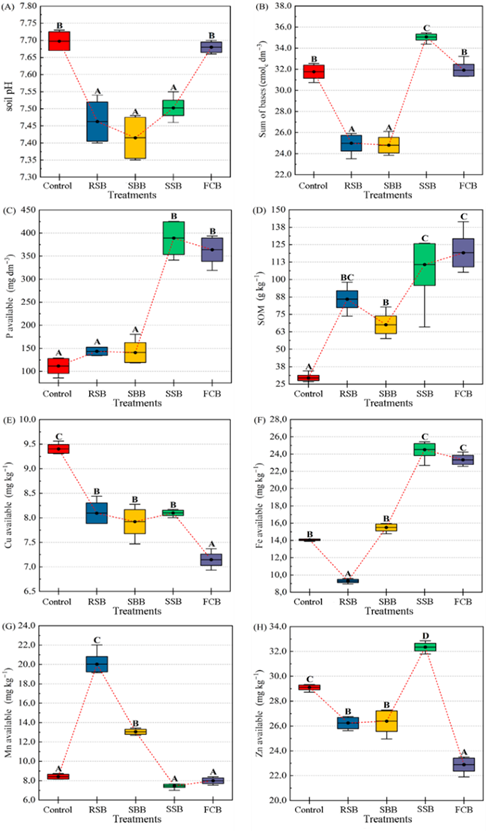
Compared with the control treatment, the application of RSB, SBB, and SSB slightly reduced the soil pH, whereas no significant difference was observed for the FCB treatment (Figure 1A). These results are directly related to the buffering pH of each biochar, as the pH of the FCB was near to that of the native soil, whereas the pH values of the RSB, SBB, and SSB were 6.3, 5.6, and 6.8, respectively. A similar trend was observed for the sum of exchangeable bases, except for SSB, which had the highest value, likely due to its higher calcium content (Figure 1B). The higher base sum in the control treatment may be attributed to the initial presence of exchangeable cations in the soil that could have been adsorbed or retained by the added biochars (Bousdra et al., 2023; Li et al., 2016).
An increase in available P concentrations was observed in soils treated with SSB and FCB, whereas lower values were obtained for RSB and SCB (Figure 1C). As FCB and SSB originate from feedstocks naturally richer in P, they contribute bioavailable P to the soil, highlighting their potential to supply this nutrient to plants. Increased P concentrations in contaminated soils are particularly relevant, not only for promoting plant growth and biomass accumulation, but also because of the ability of phosphorus to precipitate heavy metals (Adejumo et al., 2018; Chirakkara & Reddy, 2015; Veloso et al., 2022).
Compared with the control, the addition of the biochars significantly increased the soil organic matter (SOM) content (Figure 1D), with the highest values observed in the SSB treatment. This outcome reflects the intrinsic composition of biochars, which are rich in organic material and contribute to improved soil quality and the enhancement of water and nutrient retention. The increase in SOM has a direct effect on the retention of heavy metals and micronutrients (Veloso et al., 2022), indicating that biochars with higher organic matter content tend to be more efficient at immobilizing these elements.
Biochar application directly affected soil Cu concentrations, with Cu being the only micronutrient consistently reduced by all biochar types, particularly FCB (Figure 1E). Copper is known for its strong affinity to organic matter (Cao et al., 2019; Gao et al., 2020), which may partially explain the reductions observed. Moreover, SSB and FCB increased the soil organic matter content, whereas SSB also increased base saturation, suggesting that competition between basic cations and Cu²⁺ for adsorption sites could play a role. Nevertheless, a significant decrease in Cu availability was detected only in soils amended with FCB. These findings indicate that the higher soil pH induced by FCB was the dominant mechanism, likely promoting Cu precipitation or complexation, and thereby reducing its availability. In agricultural soils, the selection of biochar type and application rate should therefore be made with caution to prevent any Cu deficiencies that could impair plant growth (Ning et al., 2019; Silva et al., 2021).
Iron availability significantly varied among the treatments, highlighting the influence of biochar composition on its dynamics (Figure 1F). The application of SSB and FCB resulted in the highest available Fe levels, likely due to the naturally higher Fe content in these biochars. Conversely, the addition of RSB and SBB resulted in Fe levels that were equal to or lower than those of the control. Given the low solubility of Fe compounds in soils, Fe availability is largely dependent on the presence of soluble organic matter, particularly through the formation of organic chelates that prevent Fe precipitation (Li et al., 2023). While this increase can be beneficial in Fe-deficient soils, excess Fe may interfere with the uptake of other cationic micronutrients due to competitive interactions. The lower Fe levels observed in the RSB and SCB treatments suggest that these biochars either have a reduced capacity to release Fe into the soil, may have adsorbed Fe into unavailable forms, or may contain lower levels of soluble organic matter.
Manganese concentrations also varied substantially among the treatments (Figure 1G). Owing to its high Mn content, RSB significantly increased Mn availability in the soil. Interestingly, however, this direct relationship between the Mn content in the biochar and Mn availability in the soil was not observed for SSB and FCB, whose Mn levels were similar to those of the control. These findings indicate that other characteristics of the organic matter in each biochar type affect Mn availability. Manganese is involved in various plant metabolic processes, but excessive availability can be toxic, especially in acidic soils. This highlights the importance of the pH adjustment promoted by biochar. Conversely, the sharp reduction in Mn availability observed in the SSB and FCB treatments may indicate a risk of Mn deficiency at the doses applied in this study.
Mean values (± standard deviation) of chemical properties of soils contaminated with lead smelting slag treated with 10% of different biochar types after a 64-day incubation period. Mean values followed by the same letter do not differ significantly according to Tukey’s test at the 5% probability level. SOM= soil organic matter; RSB = rice straw biochar; SBB = sugarcane bagasse biochar; SSB = sewage sludge biochar; FCB = filter cake biochar.
Zinc availability was also strongly influenced by the type of biochar used (Figure 1H). SSB had the highest Zn concentrations, likely due to the inherently high Zn content of sewage sludge (Table 2). Conversely, FCB reduced Zn availability to levels below that of the control, indicating that this biochar may be the most suitable for remediating Zn-contaminated soils. While Zn is essential for the metabolic functions of various plants, excessive levels of Zn can be toxic, particularly in soils polluted with smelting slag. The RSB and SBB treatments resulted in Zn levels that differed only slightly from those of the control, suggesting a limited effect on Zn immobilization.
Bioavailability and sequential extraction analyses of Cd and Pb
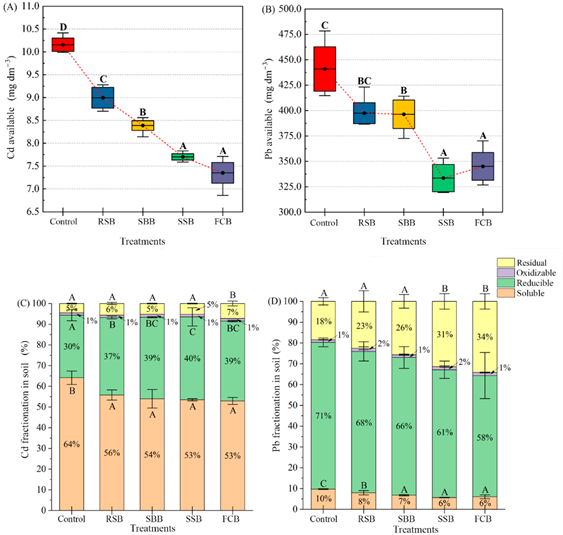
The application of different types of biochar significantly affected the availability of Cd and Pb in the contaminated soil (Figure 2A and B). SSB and FCB did not significantly differ from each other but were notable as the most effective at reducing the availability of these metals. These biochars reduced the available Cd by approximately 30% and the available Pb by about 20%. Their greater efficiency may be attributed to their higher organic matter and P contents, which increase metal retention through the precipitation of less soluble P compounds, and the formation of stable organometallic complexes (Silva et al., 2017; Veloso et al., 2022; Lahori et al., 2017; Khan et al., 2020).
The functional groups on the biochar surface play a key role in metal interactions. Hydroxyl (-OH), carboxyl (-COOH), and amino (-NH₂) groups exhibit high affinity for metals and directly influence their availability. The composition and abundance of these groups vary according to the feedstock used to produce the biochar (Chormare et al., 2023; Hu et al., 2024; Nguyen et al., 2023), and future studies should explore how these differences contribute to the behavior of the biochars tested in the present study.
The metal distribution among soil fractions indicates that biochar application significantly influenced the redistribution of Cd and Pb across different chemical fractions (Figure 2C and D). In general, biochar reduced the proportion of metals in the most labile fractions, like the soluble fraction, which represents the most bioavailable and environmentally risky form. Conversely, there was an increase in the residual fraction, which is more stable and less mobile, indicating a positive effect of biochar on the immobilization of cadmium and lead.
With respect to Cd (Figure 2C), the control soil predominantly contained Cd in the soluble fraction, highlighting its high bioavailability. In the RSB, SBB, SSB, and FCB treatments, there was a significant reduction in the soluble Cd fraction, with a predominant shift toward the reducible fraction. SSB resulted in the greatest accumulation of Cd in the reducible fraction, reaching 40% of the total Cd in the soil. FCB was also notable, as it not only promoted a similar redistribution of Cd to the reducible fraction, but also transferred a considerable portion of the metal to the residual fraction, ensuring more effective and long-lasting immobilization.
These findings reinforce the potential of biochars for mitigating the environmental risks associated with heavy metal contamination. SSB and FCB demonstrated the highest efficiency in immobilizing Cd and Pb, likely due to mechanisms such as surface adsorption, complexation with organic matter, and changes in soil physicochemical properties, including increased pH and enhanced retention by iron and manganese oxides. Moreover, the results emphasize the importance of selecting the appropriate type of biochar for the remediation of contaminated soils, as different feedstocks and pyrolysis conditions impart specific characteristics that directly influence the effectiveness of heavy metal stabilization.
The soluble fraction of Cd poses the greatest environmental risk, as in this form, the metal is readily taken up by plants, potentially entering the food chain and causing adverse effects on human health. Therefore, reducing Cd in this fraction is critical for the remediation of contaminated soils. The reducible fraction, associated with iron and manganese oxides, is less bioavailable, and the migration of Cd to this fraction suggests the formation of stable complexes that limit its mobility. The residual fraction, which is the most stable and least bioavailable, represents the ideal form for long-term immobilization, significantly reducing environmental risks (Du et al., 2019; Li et al., 2016; Qiu et al., 2022; Zhang et al., 2020).
In contrast to Cd, only 10% of the total Pb in the control (Figure 2D) was found in the available form, with most of it distributed among the reducible (71%), residual (18%), and oxidizable (10%) fractions. This distribution was generally maintained by biochar application, but reduced the Pb content in the soluble and reducible fractions while significantly increasing the proportion in the residual fraction. In the control treatment, the residual fraction accounted for 18% of the total Pb, which increased to 31 and 34% in the SSB and FCB treatments, respectively. Although these two treatments did not differ statistically from one another, they were notable in comparison to the other tested biochars.
Mean values (± standard deviation) of Cd and Pb availability (A, B) and chemical fractionation (C, D) in soil contaminated with lead smelting slag treated with 10% of different biochar types after a 64-day incubation period. Mean values followed by the same letter do not differ significantly according to Tukey’s test at the 5% probability level. RSB = rice straw biochar; SBB = sugarcane bagasse biochar; SSB = sewage sludge biochar; FCB = filter cake biochar.
These findings highlight the potential of biochars, particularly SSB and FCB, for immobilizing Pb in contaminated soils. The migration of Pb to the residual fraction indicates more effective and long-lasting stabilization, reducing its availability to plants and minimizing environmental contamination risks (Gascó et al., 2019; Li et al., 2016; Rodríguez-Vila et al., 2015; Wang et al., 2017). Previous studies support this efficacy, showing, for example, that oak wood biochar immobilizes Pb through increased pH and surface absorption (Khan et al., 2020) and that rice straw biochar reduces Pb mobility in contaminated soils (Li et al., 2016).
The redistribution of Cd and Pb into more stable fractions reinforces the potential of biochar to mitigate the environmental risks associated with heavy metal contamination. These effects may be attributed to several mechanisms, including surface adsorption by biochar, complexation with organic matter, and changes in soil characteristics, such as increased pH and enhanced metal retention by iron and manganese oxides. Moreover, these results underscore the importance of selecting the appropriate type of biochar for soil remediation, as different feedstocks and pyrolysis conditions result in specific characteristics that directly influence the effectiveness of heavy metal immobilization.
Metal fractionation in soils is not static. Over time, processes such as organic matter mineralization and geochemical transformations may redistribute Cd and Pb among soil fractions, influencing their availability and mobility, particularly under the influence of plants and soil microorganisms (Xu et al., 2018; Ye et al., 2025). Therefore, while the present results demonstrate short-term immobilization, the long-term stability of these effects depends on the persistence of organic matter and the ongoing interactions between biochar and the soil matrix.
Conclusion
Biochar application significantly altered the chemical properties of slag-contaminated soil, particularly by increasing nutrient availability, SOM, and reducing the mobility of toxic metals. Sewage sludge (SSB) and filter cake (FCB) biochars were the most effective, lowering Cd and Pb availability by up to 30 and 20%, respectively. Sequential extraction revealed a shift in Cd and Pb from the labile fractions to more stable fractions, which were mainly reducible and residual, reducing their mobility along with their associated risks. The effectiveness of SSB and FCB was attributed to their higher organic matter and P contents and the presence of functional groups capable of metal complexation. Improvements in soil pH and increased retention by Fe and Mn oxides also contributed to metal stabilization. These results highlight the potential of waste-derived biochars as low-cost, sustainable tools for remediating metal-contaminated soils. However, the findings also stress the importance of selecting biochars based on their composition and feedstock. Long-term field studies are needed to assess the persistence of metal immobilization and its effects on soil-plant-microbe interactions.
Data availability
The dataset generated and analyzed during this study is not publicly available due to internal restrictions, but it is available from the authors upon reasonable request.
References
-
Adejumo, S. A., Ogundiran, M. B. & Togun, A. O.. (2018). Soil amendment with compost and crop growth stages influenced heavy metal uptake and distribution in maize crop grown on lead-acid battery waste contaminated soil. Journal of Environmental Chemical Engineering, 6(4), 4809-4819. https://doi.org/10.1016/j.jece.2018.07.027
» https://doi.org/https://doi.org/10.1016/j.jece.2018.07.027 -
Beesley, L. & Marmiroli, M.. (2011). The immobilisation and retention of soluble arsenic, cadmium and zinc by biochar. Environmental Pollution, 159(2), 474-480. https://doi.org/10.1016/j.envpol.2010.10.016
» https://doi.org/https://doi.org/10.1016/j.envpol.2010.10.016 -
Bousdra, T., Papadimou, S. G. & Golia, E. E.. (2023). The Use of biochar in the remediation of Pb, Cd, and Cu-contaminated soils. The impact of biochar feedstock and preparation conditions on its remediation capacity. Land, 12(2), 1-20. https://doi.org/10.3390/land12020383
» https://doi.org/https://doi.org/10.3390/land12020383 -
Cao, Q., Huang, Z., Liu, S. & Wu, Y.. (2019). Potential of Punica granatum biochar to adsorb Cu (II) in soil. Scientific Reports, 9(1), 1-13. https://doi.org/10.1038/s41598-019-46983-2
» https://doi.org/https://doi.org/10.1038/s41598-019-46983-2 -
Cao, X., Ma, L., Gao, B. & Harris, W.. (2009). Dairy-manure derived biochar effectively sorbs lead and atrazine. Environmental Science & Technology, 43(9), 3285-3291. https://doi.org/10.1021/es803092k
» https://doi.org/https://doi.org/10.1021/es803092k -
Chen, Y., Liu, D., Ma, J., Jin, B., Peng, J. & He, X.. (2021). Assessing the influence of immobilization remediation of heavy metal contaminated farmland on the physical properties of soil. Science of the Total Environment, 781, 146773. https://doi.org/10.1016/j.scitotenv.2021.146773
» https://doi.org/https://doi.org/10.1016/j.scitotenv.2021.146773 -
Chew, J., Joseph, S., Chen, G., Zhang, Y., Zhu, L., Liu, M., Taherymoosavi, S., Munroe, P., Mitchell, D. R. G., Pan, G., Li, L., Bian, R. & Fan, X.. (2022). Biochar-based fertiliser enhances nutrient uptake and transport in rice seedlings. Science of the Total Environment, 826, 1-14. https://doi.org/10.1016/j.scitotenv.2022.154174
» https://doi.org/https://doi.org/10.1016/j.scitotenv.2022.154174 -
Chirakkara, R. A. & Reddy, K. R.. (2015). Biomass and chemical amendments for enhanced phytoremediation of mixed contaminated soils. Ecological Engineering, 85, 265-274. https://doi.org/10.1016/j.ecoleng.2015.09.029
» https://doi.org/https://doi.org/10.1016/j.ecoleng.2015.09.029 -
Chormare, R., Moradeeya, P. G., Sahoo, T. P., Seenuvasan, M., Baskar, G., Saravaia, H. T. & Kumar, M. A.. (2023). Conversion of solid wastes and natural biomass for deciphering the valorization of biochar in pollution abatement: A review on the thermo-chemical processes. Chemosphere, 339, 139760. https://doi.org/10.1016/j.chemosphere.2023.139760
» https://doi.org/https://doi.org/10.1016/j.chemosphere.2023.139760 -
Conselho Nacional do Meio Ambiente. (2009). Resolução No. 420, de 28 de dezembro de 2009. Dispõe sobre critérios e valores orientadores de qualidade do solo quanto à presença de substâncias químicas e estabelece diretrizes para o gerenciamento ambiental de áreas contaminadas por essas substâncias em decorrência de atividades antrópicas. Ministério do Meio Ambiente e Mudança do Clima. http://www.mma.gov.br/port/conama/legiabre.cfm?codlegi=620
» http://www.mma.gov.br/port/conama/legiabre.cfm?codlegi=620 -
Du, J., Zhang, L., Ali, A., Li, R., Xiao, R., Guo, D., Liu, X., Zhang, Z., Ren, C. & Zhang, Z.. (2019). Research on thermal disposal of phytoremediation plant waste: Stability of potentially toxic metals (PTMs) and oxidation resistance of biochars. Process Safety and Environmental Protection, 125, 260-268. https://doi.org/10.1016/j.psep.2019.03.035
» https://doi.org/https://doi.org/10.1016/j.psep.2019.03.035 -
Gao, R., Hu, H., Fu, Q., Li, Z., Xing, Z., Ali, U., Zhu, J. & Liu, Y.. (2020). Remediation of Pb, Cd, and Cu contaminated soil by co-pyrolysis biochar derived from rape straw and orthophosphate: Speciation transformation, risk evaluation and mechanism inquiry. Science of the Total Environment, 730, 139119. https://doi.org/10.1016/j.scitotenv.2020.139119
» https://doi.org/https://doi.org/10.1016/j.scitotenv.2020.139119 -
Gascó, G., Paz-Ferreiro, J. & Méndez, A.. (2019). Combining phytoextraction by Brassica napus and biochar amendment for the remediation of a mining soil in Riotinto (Spain). Chemosphere, 231, 562-570. https://doi.org/10.1016/j.chemosphere.2019.05.168
» https://doi.org/https://doi.org/10.1016/j.chemosphere.2019.05.168 -
Gusiatin, M. Z. & Rouhani, A.. (2023). Application of selected methods to modify pyrolyzed biochar for the immobilization of metals in soil: A review. Materials, 16(23), 1-29. https://doi.org/10.3390/ma16237342
» https://doi.org/https://doi.org/10.3390/ma16237342 -
Haghighizadeh, A., Rajabi, O., Nezarat, A., Hajyani, Z., Haghmohammadi, M., Hedayatikhah, S., Asl, S. D. & Beni, A. A.. (2024). Comprehensive analysis of heavy metal soil contamination in mining environments: impacts, monitoring techniques, and remediation strategies. Arabian Journal of Chemistry, 17(6), 1-26. https://doi.org/10.1016/j.arabjc.2024.105777
» https://doi.org/https://doi.org/10.1016/j.arabjc.2024.105777 -
Hu, Y., Wang, J., Yang, Y., Li, S., Wu, Q., Nepovimova, E., Zhang, X. & Kuca, K.. (2024). Revolutionizing soil heavy metal remediation: Cutting-edge innovations in plant disposal technology. Science of the Total Environment, 918, 170577. https://doi.org/10.1016/j.scitotenv.2024.170577
» https://doi.org/https://doi.org/10.1016/j.scitotenv.2024.170577 -
Jacob, J. N., Okuo, J. M., Archibong, U. D., Imafidon, M. I., Emeribe, O. F. & Anegbe, B.. (2022). Comparative studies on the effects of biochar and cow dung amendments on the mobility, bioavailability and toxicity of heavy metals in lead-acid contaminated soil. Dutse Journal of Pure and Applied Sciences, 8(2a), 171-186. https://doi.org/10.4314/dujopas.v8i2a.17
» https://doi.org/https://doi.org/10.4314/dujopas.v8i2a.17 -
Jiang, J., Xu, R., Jiang, T. & Li, Z. (2012). Immobilization of Cu(II), Pb(II) and Cd(II) by the addition of rice straw derived biochar to a simulated polluted Ultisol. Journal of Hazardous Materials, 229-230, 145-150. https://doi.org/10.1016/j.jhazmat.2012.05.086
» https://doi.org/https://doi.org/10.1016/j.jhazmat.2012.05.086 -
Khan, A. Z., Khan, S., Ayaz, T., Brusseau, M. L., Khan, M. A., Nawab, J. & Muhammad, S.. (2020). Popular wood and sugarcane bagasse biochars reduced uptake of chromium and lead by lettuce from mine-contaminated soil. Environmental Pollution, 263(Part A), 114446. https://doi.org/10.1016/j.envpol.2020.114446
» https://doi.org/https://doi.org/10.1016/j.envpol.2020.114446 - Korndörfer, G. H., Pereira, H. S. & Nolla, A. (2004). Análise de silício: solo, planta e fertilizante. ICIAG/UFU.
-
Lahori, A. H., Zhang, Z., Guo, Z., Mahar, A., Li, R., Awasthi, M. K., Sial, T. A., Kumbhar, F., Wang, P., Shen, F., Zhao, J. & Huang, H.. (2017). Potential use of lime combined with additives on (im)mobilization and phytoavailability of heavy metals from Pb/Zn smelter contaminated soils. Ecotoxicology and Environmental Safety, 145, 313-323. https://doi.org/10.1016/j.ecoenv.2017.07.049
» https://doi.org/https://doi.org/10.1016/j.ecoenv.2017.07.049 -
Leng, L., Xiong, Q., Yang, L., Li, H., Zhou, Y., Zhang, W., Jiang, S., Li, H. & Huang, H.. (2021). An overview on engineering the surface area and porosity of biochar. Science of the Total Environment, 763, 144204. https://doi.org/10.1016/j.scitotenv.2020.144204
» https://doi.org/https://doi.org/10.1016/j.scitotenv.2020.144204 -
Li, H., Liu, Y., Chen, Y., Wang, S., Wang, M., Xie, T. & Wang, G.. (2016). Biochar amendment immobilizes lead in rice paddy soils and reduces its phytoavailability. Scientific Reports, 6, 1-8. https://doi.org/10.1038/srep31616
» https://doi.org/https://doi.org/10.1038/srep31616 -
Li, H. & Ji, H.. (2017). Chemical speciation, vertical profile and human health risk assessment of heavy metals in soils from coal-mine brownfield, Beijing, China. Journal of Geochemical Exploration, 183(Part A), 22-32. https://doi.org/10.1016/j.gexplo.2017.09.012
» https://doi.org/https://doi.org/10.1016/j.gexplo.2017.09.012 -
Li, Q., Hu, W., Li, L. & Li, Y.. (2023). Interactions between organic matter and Fe oxides at soil micro-interfaces: Quantification, associations, and influencing factors. Science of the Total Environment, 855, 158710. https://doi.org/10.1016/j.scitotenv.2022.158710
» https://doi.org/https://doi.org/10.1016/j.scitotenv.2022.158710 -
Lindsay, W. L. & Norvell, W. A.. (1978). Development of a DTPA soil test for zinc, iron, manganese, and copper. Soil Science Society of America Journal, 42(3), 421-428. https://doi.org/10.2136/sssaj1978.03615995004200030009x
» https://doi.org/https://doi.org/10.2136/sssaj1978.03615995004200030009x -
Lu, K., Yang, X., Shen, J., Robinson, B., Huang, H., Liu, D., Bolan, N., Pei, J. & Wang, H.. (2014). Effect of bamboo and rice straw biochars on the bioavailability of Cd, Cu, Pb and Zn to Sedum plumbizincicola. Agriculture, Ecosystems & Environment, 191, 124-132. https://doi.org/10.1016/j.agee.2014.04.010
» https://doi.org/https://doi.org/10.1016/j.agee.2014.04.010 -
Meng, J., Tao, M., Wang, L., Liu, X. & Xu, J.. (2018). Changes in heavy metal bioavailability and speciation from a Pb-Zn mining soil amended with biochars from co-pyrolysis of rice straw and swine manure. Science of The Total Environment, 633, 300-307. https://doi.org/10.1016/j.scitotenv.2018.03.199
» https://doi.org/https://doi.org/10.1016/j.scitotenv.2018.03.199 -
Nguyen, T., Sherpa, K., Bui, X., Nguyen, V., Vo, T., Ho, H., Chen, C. & Dong, C.. (2023). Biochar for soil remediation: A comprehensive review of current research on pollutant removal. Environmental Pollution, 337, 122571. https://doi.org/10.1016/j.envpol.2023.122571
» https://doi.org/https://doi.org/10.1016/j.envpol.2023.122571 -
Niemeyer, J. C., Lolata, G. B., Carvalho, G. M., Silva, E. M., Sousa, J. P. & Nogueira, M. A.. (2012). Microbial indicators of soil health as tools for ecological risk assessment of a metal contaminated site in Brazil. Applied Soil Ecology, 59, 96-105. https://doi.org/10.1016/j.apsoil.2012.03.019
» https://doi.org/https://doi.org/10.1016/j.apsoil.2012.03.019 -
Niemeyer, J. C., Moreira-Santos, M., Ribeiro, R., Rutgers, M., Nogueira, M. A., Silva, E. M. & Sousa, J. P.. (2015). Ecological risk assessment of a metal-contaminated area in the tropics. Tier II: Detailed assessment. PLoS ONE, 10(11), 1-25. https://doi.org/10.1371/journal.pone.0141772
» https://doi.org/https://doi.org/10.1371/journal.pone.0141772 -
Ning, Y., Zhang, X., Li, B., Wang, Y. & Guo, J.. (2019). Distribution of Cd and Cu fractions in chinese soils and their relationships with soil pH: A meta-analysis. Sustainability, 11(2), 1-11. https://doi.org/10.3390/su11020337
» https://doi.org/https://doi.org/10.3390/su11020337 -
Premalatha, R. P., Poorna Bindu, J., Nivetha, E., Malarvizhi, P., Manorama, K., Parameswari, E. & Davamani, V.. (2023). A review on biochar’s effect on soil properties and crop growth. Frontiers in Energy Research, 11, 1-19. https://doi.org/10.3389/fenrg.2023.1092637
» https://doi.org/https://doi.org/10.3389/fenrg.2023.1092637 -
Qiu, M., Liu, L., Ling, Q., Cai, Y., Yu, S., Wang, S., Fu, D., Hu, B. & Wang, X.. (2022). Biochar for the removal of contaminants from soil and water: A review. Biochar, 4(19), 1-25. https://doi.org/10.1007/s42773-022-00146-1
» https://doi.org/https://doi.org/10.1007/s42773-022-00146-1 -
Rodríguez-Vila, A., Asensio, V., Forján, R. & Covelo, E. F.. (2015). Chemical fractionation of Cu, Ni, Pb and Zn in a mine soil amended with compost and biochar and vegetated with Brassica juncea L. Journal of Geochemical Exploration, 158, 74-81. https://doi.org/10.1016/j.gexplo.2015.07.005
» https://doi.org/https://doi.org/10.1016/j.gexplo.2015.07.005 -
Santos, N. M., Nascimento, C. W. A. & Accioly, A. M. A.. (2017). Guideline values and metal contamination in soils of an environmentally impacted bay. Water, Air, and Soil Pollution, 228(88), 1-12. https://doi.org/10.1007/s11270-017-3279-7
» https://doi.org/https://doi.org/10.1007/s11270-017-3279-7 -
Sharma, T., Hakeem, I. G., Gupta, A. B., Joshi, J., Shah, K., Vuppaladadiyam, A. K. & Sharma, A.. (2024). Parametric influence of process conditions on thermochemical techniques for biochar production: A state-of-the-art review. Journal of the Energy Institute, 113, 1-16. https://doi.org/10.1016/j.joei.2024.101559
» https://doi.org/https://doi.org/10.1016/j.joei.2024.101559 -
Silva, J. A. G. F., Freitas, A. D. S., Silva, V. S. G., Santos, C. E. R. S., Fernandes Júnior, P. I., Melo, A. F., Souza, P. A. S., Oliveira, A. S., Santos, N. M. & Nascimento, C. W. A.. (2024). Assessing the phytoextraction of Cd, Pb, and Zn from a slag-contaminated soil by legume species inoculated with rhizobial strains. Environmental Processes, 11(55). https://doi.org/10.1007/s40710-024-00732-4
» https://doi.org/https://doi.org/10.1007/s40710-024-00732-4 -
Silva, J. R., Veloso, V. L., Silva, F. B. V. & Nascimento, C. W. A.. (2021). Cadmium, silicon and nutrient accumulation by maize plants grown on a contaminated soil amended with a diatomaceous Earth fertilizer. Ciência Rural, 51(2), 1-8. https://doi.org/10.1590/0103-8478cr20190804
» https://doi.org/https://doi.org/10.1590/0103-8478cr20190804 -
Silva, W. R., Silva, F. B. V., Araújo, P. R. M. & Nascimento, C. W. A.. (2017). Assessing human health risks and strategies for phytoremediation in soils contaminated with As, Cd, Pb, and Zn by slag disposal. Ecotoxicology and Environmental Safety, 144, 522-530. https://doi.org/10.1016/j.ecoenv.2017.06.068
» https://doi.org/https://doi.org/10.1016/j.ecoenv.2017.06.068 - Singh, B., Camps-Arbestain, M. & Lehmann, J. (2017). Biochar: A guide to analytical methods. Csiro Publishing.
-
Su, Y., Peng, S., Xu, G., Gao, Q., Chen, J., Lu, X. & Duan, B.. (2023). Effect of cornstalk biochar on phytoremediation of Pb-contaminated soil by females and males of Populus deltoides (Salicaceae). Physiologia Plantarum, 175(4), 13986. https://doi.org/10.1111/ppl.13986
» https://doi.org/https://doi.org/10.1111/ppl.13986 -
Teixeira, P. C., Donagemma, G. K., Fontana, A. & Teixeira, W. G. (2017). Manual de métodos de análise de solo (v. 3). Embrapa. https://ainfo.cnptia.embrapa.br/digital/bitstream/item/181717/1/Manual-de-Metodos-de-Analise-de-Solo-2017.pdf
» https://ainfo.cnptia.embrapa.br/digital/bitstream/item/181717/1/Manual-de-Metodos-de-Analise-de-Solo-2017.pdf -
Tytła, M., Widziewicz, K. & Zielewicz, E.. (2016). Heavy metals and its chemical speciation in sewage sludge at different stages of processing. Environmental Technology, 37(7), 899-908. https://doi.org/10.1080/09593330.2015.1090482
» https://doi.org/https://doi.org/10.1080/09593330.2015.1090482 -
United States Environmental Protection Agency. (2007). Method 3051A: Microwave assisted acid digestion of sediments, sludges, soils, and oils. USEPA. http://www.epa.gov/osw/hazard/testmethods/sw846/pdfs/3051a.pdf
» http://www.epa.gov/osw/hazard/testmethods/sw846/pdfs/3051a.pdf -
Veloso, V. L., Silva, F. B. V., Santos, N. M. & Nascimento, C. W. A.. (2022). Phytoattenuation of Cd, Pb, and Zn in a slag-contaminated soil amended with rice straw biochar and grown with energy maize. Environmental Management, 69(1), 196-212. https://doi.org/10.1007/s00267-021-01530-6
» https://doi.org/https://doi.org/10.1007/s00267-021-01530-6 -
Wang, S., Gao, B., Li, Y., Ok, Y. S., Shen, C. & Xue, S. (2017). Biochar provides a safe and value-added solution for hyperaccumulating plant disposal: A case study of Phytolacca acinosa Roxb. (Phytolaccaceae). Chemosphere, 178, 59-64. https://doi.org/10.1016/j.chemosphere.2017.02.121
» https://doi.org/https://doi.org/10.1016/j.chemosphere.2017.02.121 -
Xu, D., Shen, Z., Dou, C., Dou, Z., Li, Y., Gao, Y. & Sun, Q.. (2022). Effects of soil properties on heavy metal bioavailability and accumulation in crop grains under different farmland use patterns. Scientific Reports, 12(1), 1-15. https://doi.org/10.1038/s41598-022-13140-1
» https://doi.org/https://doi.org/10.1038/s41598-022-13140-1 -
Xu, Y., Seshadri, B., Sarkar, B., Wang, H., Rumpel, C., Sparks, D., Farrell, M., Hall, T., Yang, X. & Bolan, N.. (2018). Biochar modulates heavy metal toxicity and improves microbial carbon use efficiency in soil. Science of the Total Environment, 621, 148-159. https://doi.org/10.1016/j.scitotenv.2017.11.214
» https://doi.org/https://doi.org/10.1016/j.scitotenv.2017.11.214 -
Ye, Z., Wang, X., Yang, L., Zhang, W., Zhou, J., Qu, Y. & Chang, V. W.. (2025). Direct observation of biochar aging: Influence of environmental coverage on surface cracks in long-term aged wildfire charcoal. Environmental Technology & Innovation, 40, 1-11. https://doi.org/10.1016/j.eti.2025.104464
» https://doi.org/https://doi.org/10.1016/j.eti.2025.104464 -
Yin, D., Wang, X., Chen, C., Peng, B., Tan, C. & Li, H.. (2016). Varying effect of biochar on Cd, Pb and As mobility in a multi-metal contaminated paddy soil. Chemosphere, 152, 196-206. https://doi.org/10.1016/j.chemosphere.2016.01.044
» https://doi.org/https://doi.org/10.1016/j.chemosphere.2016.01.044 -
Zdravković, A., Cvetković, V., Pačevski, A., Rosić, A. & Erić, S.. (2020). Waste rocks and medieval slag as sources of environmental pollution in the area of the Pb-Zn Mine Rudnik (Serbia). Journal of Geochemical Exploration, 218, 106629. https://doi.org/10.1016/j.gexplo.2020.106629
» https://doi.org/https://doi.org/10.1016/j.gexplo.2020.106629 -
Zhang, Y., Chen, Z., Xu, W., Liao, Q., Zhang, H., Hao, S. & Chen, S.. (2020). Pyrolysis of various phytoremediation residues for biochars: Chemical forms and environmental risk of Cd in biochar. Bioresource Technology, 299, 122581. https://doi.org/10.1016/j.biortech.2019.122581
» https://doi.org/https://doi.org/10.1016/j.biortech.2019.122581 -
Zhang, Y., Hou, Y., Fan, J., Lin, S., Reid, B. J., Coulon, F., & Cai, C. (2021). Field verification of low-level biochar applications as effective ameliorants to mitigate cadmium accumulation into Brassica campestris L from polluted farmland soil. Frontiers in Environmental Science. [ PREPRINT ]> https://doi.org/10.21203/rs.3.rs-487733/v1
» https://doi.org/https://doi.org/10.21203/rs.3.rs-487733/v1
Edited by
-
Associate Editor in charge:
Alessandro Lucca BracciniCarlos Alberto Scapim