 Genetic approaches to develop bacterial wilt resistant tobacco cultivars
ABSTRACT.
One of the most notorious pathogens affecting tobacco production is tobacco bacterial wilt (TBW), caused by Ralstonia solanacearum. Controlling TBW is a global issue, and developing more resistant cultivars is one of the solutions. Therefore, this study investigated the effectiveness of recurrent selection (RS) as a breeding strategy to enhance resistance to R. solanacearum in tobacco. We also aimed to identify the appropriate progeny type for RS. The trials were carried out in an area where the pathogen is known to occur, with seedlings inoculated with R. solanacearum to assure the presence of the pathogen. The incidence of the pathogen was evaluated over two seasons. In the first year, we utilized 100 S1:2 progeny from the original population (cycle 0) and 108 half-sib progeny of cycle I. In the subsequent year, we evaluated 196 S0:1 progeny of CI and 176 half-sib progeny of cycle II. Additionally, to ensure the presence of the pathogen, we inoculated R. solanacearum 40-45 days after transplanting the seedlings. The incidence of the pathogen was assessed based on the number of plants showing symptoms (%). Although the difference between cycle 0 and cycle II was relatively small, the results suggest that recurrent selection was successful in accumulating resistance alleles, as reflected in the positive association between disease resistance and agronomic traits.
Keywords:
plant disease resistance; Ralstonia solanacearum; recurrent selection
Introduction
Tobacco is an extremely important crop in the context of Brazilian agribusiness. Brazil is the world’s largest exporter and produced approximately 720,000 tons worth 10.9 billion dollars in the 2024/25 crop year. In addition, tobacco provides direct and indirect employment for 2.1 million people within its production chain. An estimated 160,000 families produce tobacco, mainly in Brazil’s South region (Associação dos Fumicultores do Brasil, 2025).
Pathogens have become a growing concern, especially with intensification of cultivation in Brazil’s Southern Region. Among them, Ralstonia solanacearum Smith (Yabuuchi et al., 1995), the causal agent of tobacco bacterial wilt (TBW), is particularly damaging. The bacterial agent causes loss of turgidity and atrophy and turns the leaf tissue and most of the succulent parts of branches yellow. The TBW damage to tobacco production has not yet been measured in Brazil. However, in North Carolina, United States, the estimated losses are several million dollars (Thiessen, 2020). In other crops, there are also very high losses due to this bacterial agent (Kannan et al., 2015).
Bacterial wilt, caused by isolates belonging to the R. solanacearum species complex, is one of the most destructive plant diseases in tropical and subtropical regions, affecting a wide range of economically important crops. Moreover, it is estimated that the bacterium is associated with over 200 plant species, both cultivated and wild, belonging to at least 50 different botanical families (Miranda et al., 2004; Wicker et al., 2007), highlighting its broad adaptive potential. The pathogen exhibits high genetic and phenotypic diversity, which is reflected in significant differences in geographic distribution, physiological properties, pathogenicity, and host range (Hayward, 1994; Genin & Denny, 2012; Santiago et al., 2016).
Under field conditions, bacterial wilt shows marked spatial and temporal variability. The disease rarely occurs in a uniform pattern, typically appearing in clusters, which reflects the complex interaction between the pathogen, the environment, and the host plant. These characteristics pose challenges to the execution of experiments under natural conditions. As a result, studies aiming to evaluate genotype resistance, the effectiveness of control strategies, or the epidemiology of the disease face considerable methodological challenges, often requiring artificial inoculation.
Ralstonia solanacearum is a soil pathogen that survives in association with different host plants and adapts to diverse climate conditions, thereby hindering the development of effective control methods. Chemical control has limited effectiveness, so alternatives are needed. One of the most effective strategies is the use of resistant varieties (Liu et al., 2016). Researchers have reported genetic resistance to R. solanacearum in some potato (Chen et al., 2013), tomato (Wang et al., 2013; Kim et al., 2016; Costa et al., 2019), and eggplant (Lebeau et al., 2013) genotypes. Several articles on this topic have already been published for tobacco (Nishi et al., 2003; Lan et al., 2014; Drake-Stowe et al., 2017). The authors of these publications have described genetic control as polygenic and probably additive, and the trait is highly affected by the environment.
As genetic control is probably polygenic, accumulation of favorable alleles from different genes responsible for resistance must be carried out in steps. Under these conditions, recurrent selection (RS) is the most appropriate procedure. RS is a cyclical process in plant breeding that aims to gradually accumulate favorable alleles over successive generations (Hallauer, 1992; Ramalho et al., 2024). This method was initially recommended for allogamous plants; however, in recent decades, its use has expanded to autogamous plants to improve traits such as pathogen resistance (Amaro et al., 2007; Rezende et al., 2014; Morais Junior, 2015; Lopes et al., 2019). Additionally, RS has been used in tobacco breeding, with positive results (Marques et al., 2022). Until now, no report of the use of RS as a strategy to obtain tobacco genotypes with resistance to R. solanacearum. Thus, we aimed (i) to evaluate the viability of employing RS in tobacco to enhance resistance to R. solanacearum, (ii) to determine of the most viable progeny type for conducting RS, and (iii) to estimate the most appropriate time to evaluate for TBW.
Material and methods
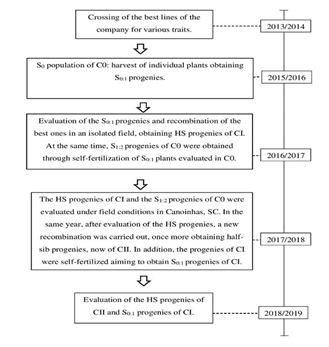
The base population for RS of the Virginia varietal group used in this study was obtained from crosses among 26 lines of tobacco (Nicotiana tabacum L.) in a half-sib (HS) scheme, where the pollen of each line was weighted and mixed before the pollination of the same lines (Figure 1). These lines were chosen in accordance with agronomic performance and resistance to R. solanacearum. Crosses were performed in the experimental area at the Tobacco Breeding Unit located in Canoinhas, Santa Catarina State, Brazil. The trials were conducted in two years.
Structure of the recurrent selection program for resistance to Ralstonia solanacearum in tobacco.
In the first year, the best S0:1 progenies were selected and recombined to create the cycle I (CI) population. A bulk of pollen from the best progeny was used for recombination, resulting in the generation of HS progenies. In the same field, the plants of each S0:1 progeny of cycle 0 (C0) were self-fertilized to obtain the S1:2 progenies of C0.
In the second year, the HS progenies of CI and the S1:2 progenies of C0 and two check cultivars common to the two experiments were evaluated. A randomized complete block design was used for the experiment with HS progenies, consisting of 108 treatments, 3 replications, and the plots of one 5-m row. The spacing between the rows was 1.3 m, with 0.5 m between plants within the row, resulting in 10 plants per plot.
The S1:2 progenies from C0 were evaluated by using a 10 × 10 triple lattice design, which included 100 treatments. The details of the plot were the same as those used with the HS progenies. Border areas with a moderately resistant commercial cultivar were created to prevent environmental effects on adjacent plots and to set yield performance standards. Based on the disease incidence, the best progenies were identified for recombination.
A similar procedure was adopted in the second crop year. In that case, 174 HS progenies of cycle II (CII) and 194 S0:1 progenies of CI were evaluated. Both experiments included a moderately susceptible check cultivar (SC) and a resistant check cultivar (RC). Thus, for the evaluation of the HS progenies, an 11 × 16 alpha lattice design was adopted, with three replications, and in the experiment with the S0:1 progenies, the experimental design was a 14 × 14 triple lattice. The plots with HS and S0:1 progenies had 10 plants. The crop treatments were the same as those recommended by the company to its partners growing the crop in the region.
To guarantee the incidence of TBW, the plants were inoculated with R. solanacearum based on a method adapted from previous studies (Viana et al., 2012; Gonçalves et al., 2014). The bacterial isolate, collected in Tubarão, Santa Catarina State, Brazil, was characterized as biovar 1 and phylotype II (Viana et al., 2012). Approximately 40-50 days post-sowing, the plants were incised in the lower third of the roots using scissors. Following this procedure, the trays were promptly placed in aluminum trays containing a suspension of distilled water saturated with R. solanacearum (800 mL of suspension per tray). A second inoculation was performed 40-45 days after transplanting the seedlings. A suspension of R. solanacearum was prepared at an appropriate concentration. The plants were inoculated by spraying 15 mL of the bacterial suspension through drenching the root collar. The inoculum was prepared from R. solanacearum cells stored in a 0.85% salt solution, using Petri dishes containing SPA media (sucrose 20 g L-1, peptone 10 g L-1, and agar 20 g L-1), incubated at 28°C in BOD incubator for 3 days. The colonies were collected and diluted in autoclaved distilled water until the optical density at 600 nm (OD600) was 0.025, which corresponds to 1 × 10⁶ colony-forming units (CFU) mL-1.
The main goal was to select for TBW resistance, so the following traits were evaluated: (i) the incidence of TBW, determined as the percentage of plants with symptoms at 90 and 120 days after transplanting; and (ii) in the first crop year, agronomic performance was visually evaluated based on a scoring scale from 1 to 15, with 1 being the worst evaluation and 15 being the best, at 120 days. This evaluation considered standard phenotype (ideotype) within the varietal group and was used to correlate with the incidence of TBW.
Because the TBW incidence data were not normally distributed, they were square-root transformed. Individual analyses of variance were performed using R (R Core Team, 2024) and all effects were treated as random, except for the mean. The genetic variance among the progeny ( ) and the phenotypic variance among the means of the progenies () were estimated from the expected mean squares. Heritability (h 2 ) was obtained for selection based on the means of progenies. In addition, the confidence interval of each h2 estimate, including the lower limit (LL) and upper limit (UL), was determined.
The Pearson correlations were estimated among the means for each progeny at different evaluation times. In the first year, the correlations among the evaluation times and the mean agronomic performance of the progenies were also estimated.
As the number and type of progenies varied each crop year, check cultivars were used as a reference point to compare the performance of the progeny within different generations. This comparison consisted of an average percentage of progeny with disease symptoms relative to the check cultivars (d 1 and d 2 estimates). d 1 estimate refers to the SC and was estimated by the formula: (Mean of the SC - Mean of the progenies)/(Mean of the SC) x 100. d2 refers to the RC and was estimated by the formula: (Mean of the RC - Mean of the progenies)/(Mean of the RC) x 100.
Results and discussion
The accuracy of the evaluation was moderate for both inbred progenies (S1:2 of C0 and S0:1 of CI) and non-inbred progenies (HS of CI and HS of CII) (Table 1). Phenotyping plants in response to bacterial wilt disease is challenging. Several studies evaluating R. solanacearum resistance in tobacco or other species have reported similar experimental accuracy (Nishi et al., 2003; Qian et al., 2016; Costa et al., 2019).
We used inbred (S0:1 and S1:2) and HS progenies to estimate genetic variation in the RS population. This is a favorable condition because the literature suggests that additive allelic interactions mainly control resistance to R. solanacearum in tobacco (i.e., TBW) and other species (Nishi et al., 2003; Maimbo et al., 2010; Lan et al., 2014; Qian et al., 2016; Drake-Stowe et al., 2017; Costa et al., 2019). The estimates of the confidence interval of heritability exhibited a negative lower limit.
In the assessments of the HS progenies of CII and S0:1 progenies of CI, the accuracy estimates were significantly higher compared with those observed in the previous year (Table 1). The h2 estimates, as expected, were higher compared with those obtained in the previous year, except for the S0:1 progenies of CI. The h2 estimates might not differ from zero.
Estimates for the number of plants with symptoms (NPWS), obtained based on evaluation of the resistance to Ralstonia solanacearum of the S1:2 progenies of cycle 0 (C0) and the half-sib (HS) progenies of cycle I (CI) (for the 2016/2017 crop year) and the S0:1 progenies of CI and the HS progenies of cycle II (CII) (for the 2018/2019 crop year).
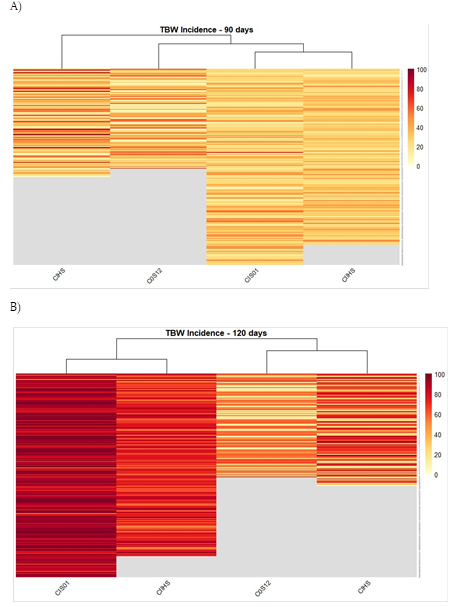
The number of symptomatic plants was low, particularly at 90 days after inoculation (Figure 2). However, as expected, the incidence of TBW increased at 120 days, and in some progenies, all plants within a plot exhibited symptoms. When considering both types of progeny, none showed complete resistance at 90 days after inoculation. It is important to highlight that symptom progression was more pronounced in the experiments conducted during the 2018/2019 season (HS of CII and S0:1 of CI). Based on the results, it is not possible to confirm whether the inbred or HS progenies performed better. As previously mentioned, because resistance to TBW is primarily controlled by additive allelic interactions, the inbred progenies would be expected to exhibit superior performance.
We used common check cultivars to compare the performance of the progenies in different cycles. This procedure has constantly been used in other species, such as the common bean crop (Amaro et al., 2007; Rezende et al., 2014). The d 1 and d 2 estimates-calculated to compare the number of plants with disease symptoms in each progeny relative to the check cultivars (the SC and RC, respectively)-were not consistent (Table 2). The S1:2 progenies of C0 consistently showed negative estimates of the percentage compared to the SC (d 1 estimates), regardless of the evaluation time. Thus, for this generation, the progenies exhibited a greater number of plants with symptoms than the SC. For the RC (d 2 estimates), we observed the opposite only for the 90-day assessment. At 120 days, the RC had a smaller number of plants with symptoms than the progenies, indicating a negative response. The percentage, however, was considerably lower than observed in relation to the SC (Table 2). The percentage of CI progenies with symptoms, compared with the SC and RC, showed that the opposite occurred, except at the 90-day evaluation relative to the RC. All values were positive, indicating that the disease incidence of the check cultivars was greater than the means of the progenies. Overall, RS was effective in reducing the disease incidence from CI to C0. We did not find a published report where researchers used RS to promote resistance to R. solanacearum.
When we assessed the mean relative performance of the CI and CII progenies with symptoms compared with the RC, the d 1 estimates were not consistent with what we expected. The percentage was negative at the 90-day assessment and positive at the 120-day assessment for the two cycles. Therefore, RS was effective, mainly if the selection was done at 120 days, but the magnitude of the difference of the result from CI to CII was very small (CI = 8.17 and CII = 10.54). Given that the estimates are related to the same check cultivar, we infer that the means for CI and CII are higher than the mean for C0. In other words, the means of the CI and CII progenies with symptoms were lower than the mean of the C0 progeny, confirming the effectiveness of RS (Table 2).
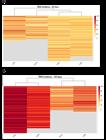
Heat map of the tobacco bacterial wilt disease (TWD) incidence (%) at 90 (A) and 120 (B) days after transplanting. Evaluation of the S1:2 progenies of cycle 0 (C0) and the half-sib (HS) progenies of cycle I (CI) (for the 2016/2017 crop year), and the HS progenies of cycle II (CII) and the S0:1 progenies of CI (for the 2018/2019 crop year).
Percentage estimate of the mean number of plants with symptoms in relation to the check cultivars: d 1 in relation to the susceptible check cultivar (SC) and d 2 in relation to the resistant check cultivar (RC).
In this situation, we would expect there to be greater genetic variation among the inbred progenies because among the S0:1 progenies, 1 additive variance (VA) + 0.25 dominance variance (VD) occurs. For the S1:2 progenies, genetic variance exploits 1.5 VA + 0.125 VD. In contrast, between the HS progenies, only 0.25 VA is exploited (Bernardo, 2020; Ramalho et al., 2024). However, the estimates we obtained did not reflect what we expected. The values were always low and without any tendency to be higher for the inbred progenies.
The correlation (r) estimates between the dependent variable “x,” the incidence of TBW at 90 days, and the independent variable “y,” the incidence of TBW at 120 days, were positive (Table 3). There were significant and strong correlations for the first crop year, but not for the second crop year. Moreover, the correlations between the incidence of TBW and agronomic performance were always negative.
Estimates of the phenotypic correlations between agronomic performance and the number of plants with symptoms for the S1:2 progenies of cycle 0 (C0) and the half-sib (HS) progeny of cycle I (CI) (for the 2016/2017 crop year) and the S0:1 progenies of CI and the HS progenies of cycle II (CII) (for the 2017/2018 crop year).
In general, the screening techniques for plant diseases primarily include field testing (exposure to natural disease pressure) (Kakar et al., 2020) and greenhouse trials. However, researchers have found no correlation between the two assessment methods for most plant diseases. Successful screening hinges on conducting the disease assessment at the appropriate time, particularly when there are significant genetic variations in the plant response. We did not find reports of the best time for evaluating the incidence of TBW under field conditions. In a study conducted in a greenhouse, the authors assessed the incidence of TBW 15 days after inoculation under controlled conditions, temperature, and humidity (Tang et al., 2023). So, the question is when is the best time to evaluate the incidence of R. solanacearum? We found that the classification of the progenies regarding incidence remained consistent over time. Therefore, for field trials, we recommend starting evaluations 90 days after transplanting.
It is worth mentioning that we aimed to determine the effectiveness of RS in selecting for resistance to R. solanacearum. Evidently, the success of RS depends on the existence of variation within the base population for the trait under selection. Our evaluations of different types of progenies, under the natural occurrence of the pathogen in the field and with artificial inoculation, indicate the presence of genetic variation, even though it is of a small magnitude.
Conclusion
Recurrent selection (RS) proved effective in reducing the incidence of R. solanacearum in tobacco, despite the low magnitude of genetic variation. There is no clear evidence suggesting that one type of progeny, be it inbreed or HS, is the most viable progeny type for conducting RS. Field evaluations should begin at 90 days post-transplanting, as progeny classification remained consistent over time.
Data availability
The data that support the findings of this study are not publicly available but are available from the authors upon reasonable request.
Acknowledgements
This study was supported by British American Tobacco Brazil. It was funded by the Coordination for the Improvement of Higher Education Personnel (CAPES) and by the National Council for Scientific and Technological Development (CNPq) , through grant of productivity.
References
-
Associação dos Fumicultores do Brasil. (2025). Safra de tabaco 2024/2025 fecha em 719. 891 toneladas.https://afubra.com.br/safra-de-tabaco-2024-2025-fecha-em-719-891-toneladas/
» https://afubra.com.br/safra-de-tabaco-2024-2025-fecha-em-719-891-toneladas/ -
Amaro, G. B., Ramalho, M. A. P. & Silva, F. B.. (2007). Phenotypic recurrent selection in the common bean (Phaseolus vulgaris L.) with carioca-type grains for the resistance to the fungi Phaeoisariopsis griseola. Genetics and Molecular Biology, 30(3), 584-588. https://doi.org/10.1590/S1415-47572007000400014
» https://doi.org/https://doi.org/10.1590/S1415-47572007000400014 - Bernardo, R. (2020). Breeding for quantitative traits in plants. Stemma Press.
-
Chen, L., Guo, X., Xie, C., He, L., Cai, X., Tian, L., Song, B. & Liu, J.. (2013). Nuclear and cytoplasmic genome components of Solanum tuberosum + S. chacoense somatic hybrids and three SSR alleles related to bacterial wilt resistance. Theoretical and Applied Genetics, 126(7), 1861-1872. https://doi.org/10.1007/s00122-013-2098-5.
» https://doi.org/https://doi.org/10.1007/s00122-013-2098-5. -
Costa, K. D. S., Santos, P. R., Santos, A. M. M., Silva, A. M. F., Chagas, J. T. B., Carvalho Filho, J. L. S., Pereira, J. W. L., Silva, M. O., Silva, J. R. & Menezes, D.. (2019). Genetic control of tomato resistance to Ralstonia solanacearum. Euphytica, 215(7), 1-11. https://doi.org/10.1007/s10681-019-2458-6
» https://doi.org/https://doi.org/10.1007/s10681-019-2458-6 -
Drake-Stowe, K., Bakaher, N., Goepfert, S., Philippon, B., Mark, R., Peterson, P. & Lewis, R. S.. (2017). Multiple disease resistance loci affect soilborne disease resistance in tobacco (Nicotiana tabacum). Phytopathology, 107(9), 1055-1061. https://doi.org/10.1094/PHYTO-03-17-0118-R
» https://doi.org/https://doi.org/10.1094/PHYTO-03-17-0118-R -
Genin, S. & Denny, T. P.. (2012). Pathogenomics of the Ralstonia solanacearum species complex. Annual Review of Phytopathology, 50, 67-89. https://doi.org/10.1146/annurev-phyto-081211-173000
» https://doi.org/https://doi.org/10.1146/annurev-phyto-081211-173000 - Gonçalves, R. C., Vallim, J. H., Macedo, P. B. F. & Bastos, R. M. (2014). Método de inoculação de Ralstonia solanacearum para a seleção de plantas de Piper hispidinervum resistentes à murcha bacteriana. Embrapa. (Comunicado Técnico, 185).
- Hallauer, A. R.. (1992). Recurrent selection in maize. Plant Breeding Reviews, 9, 115-179.
- Hayward, A. C. (1994). Systematic and phylogeny of Pseudomonas solanacearum and related bacteria. In A. C. Hayward, & G. L. Hartman (Eds.), Bacterial wilt: The disease and its causative agent, Pseudomonas solanacearum (pp. 123-155). CAB International.
-
Kakar, K. U., Nawaz, Z., Cui, Z., Ahemd, N. & Ren, X.. (2020). Molecular breeding approaches for production of disease-resilient commercially important tobacco. Briefings in Functional Genomics, 19(1), 10-25. https://doi.org/10.1093/bfgp/elz038
» https://doi.org/https://doi.org/10.1093/bfgp/elz038 -
Kannan, V. R., Bastas, K. K., & Devi, R. S. (2015). Sustainable approaches to controlling plant pathogenic bacteria. In V. R. Kannan, & K. K. Bastas (Eds.), Scientific and economic impact of plant pathogenic bacteria (pp. 369-392). CRC Press. https://doi.org/10.1201/b18892
» https://doi.org/https://doi.org/10.1201/b18892 -
Kim, B., French, E., Caldwell, D., Harrington, E. J. & Iyer-Pascuzzi, A. S.. (2016). Bacterial wilt disease: host resistance and pathogen virulence mechanisms. Physiological and Molecular Plant Pathology, 95, 37-43. https://doi.org/10.1016/j.pmpp.2016.02.007
» https://doi.org/https://doi.org/10.1016/j.pmpp.2016.02.007 -
Lan, T., Zhen, S., Yang, L., Wu, S., Wang, B., Zhang, S., Tong, Z., Chen, Y., Chen, S., Duan, Y. & Wu, W.. (2014). Mapping of quantitative trait loci conferring resistance to bacterial wilt in tobacco (Nicotiana tabacum L.). Plant Breeding, 133(5), 672-677. https://doi.org/10.1111/pbr.12202
» https://doi.org/https://doi.org/10.1111/pbr.12202 -
Lebeau, A., Gouy, M., Daunay, M. C., Wicker, E., Chiroleu, F., Prior, P., Frary, A. & Distinger, J.. (2013). Genetic mapping of a major dominant gene for resistance to Ralstonia solanacearum in eggplant. Theoretical and Applied Genetics, 126(1), 143-158. https://doi.org/10.1007/s00122-012-1969-5
» https://doi.org/https://doi.org/10.1007/s00122-012-1969-5 -
Liu, X., Zhang, S., Jiang, Q., Bai, Y., Shen, G., Li, S. & Ding, W.. (2016). Using community analysis to explore bacterial indicators for disease suppression of tobacco bacterial wilt. Scientific Reports, 6, 1-11. https://doi.org/10.1038/srep36773
» https://doi.org/https://doi.org/10.1038/srep36773 -
Lopes, F. S., Leite, M. E., Porto, A. C. M., Miguel, L. A., Reis, V. O. L. & Santos, J. B.. (2019). Recurrent selection in common bean aiming at resistance to white mold in a greenhouse. Crop Breeding and Applied Biotechnology, 19(1), 95-101. https://doi.org/10.1590/1984-70332019v19n1a13
» https://doi.org/https://doi.org/10.1590/1984-70332019v19n1a13 -
Maimbo, M., Ohnishi, K., Hikichi, Y., Yoshioka, H. & Kiba, A.. (2010). S-glycoprotein-like protein regulates defense responses in Nicotiana plants against Ralstonia solanacearum. Plant Physiology, 152(4), 2023-2035. https://doi.org/10.1104/pp.109.148189
» https://doi.org/https://doi.org/10.1104/pp.109.148189 -
Marques, T. L., Padua, J. M. V., Berger, I. J. & Ramalho, M. A. P.. (2022). Strategies for the recurrent selection program in tobacco breeding for green leaf yield. Crop Science, 62(6), 2212-2221. https://doi.org/10.1002/csc2.20813
» https://doi.org/https://doi.org/10.1002/csc2.20813 -
Miranda, E. F. O., Takatsu, A. & Uesugi, C. H.. (2004). Colonização de raízes de plantas daninhas cultivadas in vitro e em vasos por Ralstonia solanacearum, biovares 1, 2 e 3. Fitopatologia Brasileira, 29(2), 121-127. https://doi.org/10.1590/S0100-41582004000200001
» https://doi.org/https://doi.org/10.1590/S0100-41582004000200001 -
Morais Junior, O. P., Melo, P. G. S., Morais, O. P., Castro, A. P., Breseghello, F., Utumi, M. M., Pereira, J. A., Wruck, F. J. & Colombari Filho, J. M.. (2015). Genetic progress after cycles of upland rice recurrent selection. Scientia Agricola, 72(4), 297-305. https://doi.org/10.1590/0103-9016-2014-0137
» https://doi.org/https://doi.org/10.1590/0103-9016-2014-0137 -
Nishi, T., Tajima, T., Noguchi, S., Ajisaka, H. & Negishi, H.. (2003). Identification of DNA markers of tobacco linked to bacterial wilt resistance. Theoretical and Applied Genetics, 106, 765-770. https://doi.org/10.1007/s00122-002-1096-9
» https://doi.org/https://doi.org/10.1007/s00122-002-1096-9 -
Qian, Y. L., Chen, J., Dong, J. J., Wu, Z. C., Liu, Y. H., Xue, B. Y., Shao, F. W. & Sun, X. Y.. (2016). Genetic analyses of the major and minor locus groups of bacterial wilt resistance in tobacco using a diallel cross design. Genetics and Molecular Research, 15(1), 1-13. https://doi.org/10.4238/gmr.15017223
» https://doi.org/https://doi.org/10.4238/gmr.15017223 -
R Core Team. (2024). R: A language and environment for statistical computing. R Foundation for Statistical Computing. https://www.r-project.org/
» https://www.r-project.org/ -
Rezende, B. A., Abreu, A. F. B., Ramalho, M. A. P. & Souza, E. A.. (2014). Severity evaluation methods in common bean recurrent selection programme for resistance to angular leaf spot. Journal of Phytopathology, 162(10), 643-649. https://doi.org/10.1111/jph.12238
» https://doi.org/https://doi.org/10.1111/jph.12238 -
Santiago, T. R., Lopes, C. A., Anollés, G. & Mizubuti, E. S. G.. (2016). Phylotype and sequevar variability of Ralstonia solanacearum in Brazil, an ancient centre of diversity of the pathogen. Plant Pathology, 66(3), 383-392. https://doi.org/10.1111/ppa.12586
» https://doi.org/https://doi.org/10.1111/ppa.12586 -
Tang, Q., Liu, T., Teng, K., Xiao, Z., Cai, H., Wang, Y., Xiao, Y. & Chen, W.. (2023). Microbial interactions and metabolisms in response to bacterial wilt and black shank pathogens in the tobacco rhizosphere. Frontiers in Plant Science, 14, 1-13. https://doi.org/10.3389/fpls.2023.1200136
» https://doi.org/https://doi.org/10.3389/fpls.2023.1200136 - Thiessen, L. (2020). Managing diseases. In L. R. Fisher (Ed.), Flue-cured tobacco guide. (pp. 127-150). NC State Extension.
-
Viana, F. C., Berger, I. J. & Duarte, V.. (2012). Caracterização de populações de Ralstonia solanacearum Smith em tabaco (Nicotiana tabacum L.) no Brasil. Tropical Plant Pathology, 37(2), 123-129. https://doi.org/10.1590/S1982-56762012000200004
» https://doi.org/https://doi.org/10.1590/S1982-56762012000200004 -
Wang, J., Ho, F., Truong, H. T. H., Huang, S., Balatero, C. H., Dittapongpitch, V. & Hidayati, N.. (2013). Identification of major QTLs associated with stable resistance of tomato cultivar ‘Hawaii 7996’ to Ralstonia solanacearum. Euphytica, 190, 241-252. http://dx.doi.org/10.1007/s10681-012-0830-x
» https://doi.org/http://dx.doi.org/10.1007/s10681-012-0830-x -
Wicker, E., Grassart, L., Coranson-Beaudu, R., Mian, D., Guibaud, C., Fegan, M. & Prior, P.. (2007). Ralstonia solanacearum strains from Martinique (French West Indies) exhibiting a new pathogenic potential. Applied and Environmental Microbiology, 73(21), 6790-6801. https://doi.org/10.1128/AEM.00841-07
» https://doi.org/https://doi.org/10.1128/AEM.00841-07 -
Yabuuchi, E., Kosako, Y., Yano, I., Hotta, H. & Nishiuchi, Y.. (1995). Transfer of two Burkholderia and an Alcaligenes species to Ralstonia gen. Nov. proposal of Ralstonia pickettii (Ralston, Palleroni and Doudoroff 1973) comb. Nov., Ralstonia solanacearum (Smith 1896) comb. Nov. and Ralstonia eutropha (Davis 1969) comb. Nov. Microbiology and Immunology, 39(11), 897-904. https://doi.org/10.1111/j.1348-0421.1995.tb03275.x
» https://doi.org/https://doi.org/10.1111/j.1348-0421.1995.tb03275.x
Edited by
-
Associate Editor in charge:
Alessandro Lucca BracciniCarlos Alberto Scapim