 Non-destructive method for predicting the area and weight of red pitaya cladodes using linear dimensions
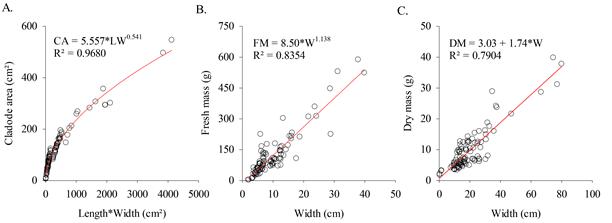
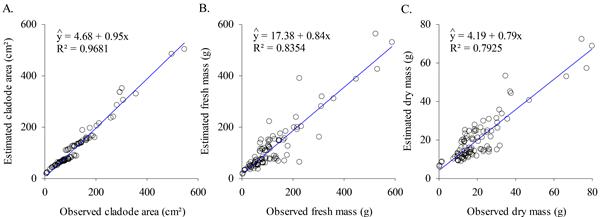
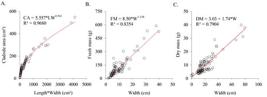
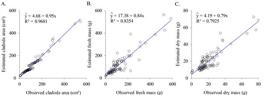
The leaf area estimation of crops is a critical analysis because it indicates the photosynthetically active area of the plant. However, some methods are more expensive and difficult to apply to crops, such as pitaya. Thus, the objective of the present work was to determine a non-destructive method of estimating the area and weight of pitaya cladodes using linear dimensions. In an experimental orchard, 101 pitaya cladodes of the species Selenicereus undatus were collected, and the length (L), width (W), cladode area (CA), fresh mass (FM) and dry mass (DM) of the cladodes were measured. The product between the cladodes’ length and width (LW) was then calculated. Linear, non-intercept linear and power models were used to predict the area and weight of cladodes using allometric equations. The criteria for choosing the best equations were based on Pearson’s coefficients of determination and correlation, Willmott’s agreement index, Akaike’s information criterion, root mean squared error and mean absolute error. The equations constructed with the power and linear model were the most suitable for predicting cladode area (CA = 5.577 * LW0.541), cladode fresh mass (FM = 8.50 * W1.138) and cladode dry mass (MD = 3.03 + 1.74 * W). Thus, it was possible to construct a non-destructive and reliable method for predicting the area and weight of pitaya cladodes using the linear dimensions of the cladodes (length and width).
Keywords:
Selenicereus undatus; Cactaceae; allometric equations; biometrics; width of cladode
 Thumbnail
 Thumbnail
 Thumbnail
 Thumbnail
 Thumbnail