 Aspects related to floral morphology and pollen viability for the pollination of self-compatible and self-incompatible pitaya species
ABSTRACT.
Pitaya species can be self-compatible, partially self-compatible, or self-incompatible. Information related to floral biology and pollination is important for identifying the causes of self-incompatibility and the factors that limit self-pollination among pitaya species. This research was carried out to evaluate floral morphology, pollen viability, stigma receptivity, and different pollination methods in genotypes of Selenicereus undatus and S. monacanthus. During the flowering period, the flower buds were selected, identified, and protected in the pre-anthesis stage to evaluate floral morphology, pollen viability, and pollen transfer methods at the time of anthesis. The genotypes had complete flowers and showed differences in floral morphology related to the quantity and coloration of the protective tissues of the flower buds. Herkogamy was more pronounced in S. monacanthus. Anthesis in both species was coincident, with a longer duration in S. undatus. During anthesis, both species presented receptive stigmas and viable pollen grains, with dehiscent anthers before the flowers opened. The S. monacanthus genotype was self-incompatible. Seeds from self-pollination showed lower germination. Manual cross-pollination between the genotypes promoted a high fruit set and the formation of fruit of a high commercial standard.
Keywords:
Selenicereus; flowering; pollination deficit; self-compatibility
Introduction
Pitaya producers prefer to cultivate species that are self-compatible because species that present self-incompatibility depend on cross-pollination, which can lead to pollination deficits and small fruit production. In most genotypes, this does not ensure the production of commercial fruit in terms of productivity or quality. Thus, understanding the factors that limit the pollination of pitaya species is essential for establishing complementary management practices in orchards aiming to increase production and improve fruit quality.
The absence of fruiting in pitaya orchards occurs due to various factors that result in flower abortion, such as climatic variations, lack of pollinators, and the unavailability of pollen from compatible genotypes (Menezes et al., 2015a; Muniz et al., 2019; Silva et al., 2011; Tran & Yen, 2014). Regarding pollen availability, strategies must be established to ensure pollination and increase fruiting, such as introducing compatible species genotypes to ensure pollen availability and adopting manual cross-pollination management (Moreira et al., 2022) to increase yield and improve fruit quality.
The deficiency of self-pollination or pollination carried out by floral visitors occurs even in self-compatible species genotypes. Self-pollination is limited due to floral morphology, such as the difference in height between the stigma and anthers, which is considered an ecological strategy of the species to favor cross-pollination (Guimarães et al., 2022).
Given the complexity of factors related to the reproductive phenology of pitaya species, research on this subject is essential for expanding cultivation areas and improving orchard productivity. In this context, this study evaluated floral morphology, pollen viability, stigma receptivity, and different pollination methods in genotypes of Selenicereus undatus and S. monacanthus.
Material and methods
Genotypes and cultivation region
Five-year-old genotypes of S. undatus (Haw.) D.R. Hunt = Hylocereus undatus (Haw.) Britton & Rose and S. monacanthus (Haw.) D.R. Hunt = H. polyrhizus (F.A.C. Weber) Britton & Rose, obtained through asexual propagation (cuttings), were studied. The main morphological differences between these species are floral tissue and fruit pulp coloration. These characteristics can be easily observed by producers in the field, as S. monacanthus plants issue flower buds with sepals that have purple tips and fruit with reddish pulp.
In the orchard, yellow pitaya (S. megalanthus) plants were arranged in equal proportions to S. undatus and S. monacanthus, alternating between planting rows, with a spacing of 2 m between plants and 3 m between rows. However, S. megalanthus exhibits a different phenology from the other species (Rabelo et al., 2020a).
This research was carried out in an orchard located in Minas Gerais State, Brazil, located at 18°04'15" S latitude and 43°28'15" W longitude at an altitude of 726 m. The region has an Aw climate type, classified as high-altitude tropical, with an average annual rainfall of 1,246 mm from October to April, which coincides with the flowering period of the species studied in the spring until autumn.
During the flowering season in summer, from December to March, 20 plants of each species were randomly selected in the orchard to evaluate anthesis, stigma receptivity, anther dehiscence, and pollen viability as well as to carry out pollination management. Summer is the hottest season in the region, with average maximum and minimum temperatures of 35.1 and 21.5°C, respectively, and accumulated precipitation of 505.6 mm. During this season, the plants issued up to three flowering period.
Floral morphology and anthesis
In each plant, five flower buds were randomly selected and identified. The evaluations were conducted through visual observation to determine the start of flower opening and the duration during which they remained open. Monitoring began at 4:00 p.m. (pre-anthesis stage), with 60-min. intervals between observations to record the start of flower opening, full flower opening/diameter of the open flower, flower closing, and duration of anthesis (time between the start of opening and closing of the flowers).
Stigma receptivity, anther dehiscence, and pollen viability
Evaluations were made every 2h, from the start of anthesis until flower closure the next morning (7:00 p.m. to 7:00 a.m.). The flower buds were protected with bags made of non-woven fabric from pre-anthesis until the evaluations.
For each evaluation, three randomly selected flower buds from each species were used for stigma removal, utilizing a stylus to assess stigma receptivity with a 3% hydrogen peroxide (H₂O₂) solution, following the methodology proposed by Dafni et al. (2005).
Anther dehiscence and pollen grain viability were assessed at the same time using three flower buds. After the start of anthesis, samples of 10 anthers were taken from each flower bud and stored for 24h in tubes with a 1% tetrazolium solution. From the samples, slides were prepared with 0.5 mL of the solution containing the pollen grains and glycerinated water, following the methodology proposed by Kearns and Inouye (1993). Pollen grain counting was performed using the scanning method under an optical microscope with 10X magnification until 300 pollen grains were counted. The viability of pollen grains was assessed based on coloration, with those stained red considered viable and the unstained ones considered unviable.
Pollination, fruit set, and physicochemical characterization of fruit
The pollen requirement was evaluated in both species using five pollen transfer methods: self-pollination, manual self-pollination, manual cross-pollination between different species, manual cross-pollination with pollen from the same species, and natural pollination (open). For each pollination type, 40 flower buds were randomly selected, totaling 200 flowers per species. During the pre-anthesis stage, the buds were protected to prevent pollen mixing, except for those selected for natural pollination, which were pollinated by natural pollinators present in the area with pollen from nearby donor plants. In the controlled pollinations, the flower buds were emasculated during pre-anthesis and protected; at anthesis, after the flowers fully opened, pollen grains from the plant donors were collected in a Petri dish and transferred to the stigma of the recipient plant flowers using a brush.
Fruit set was assessed 15 days after pollination by counting the number of developed fruits. The fruiting rate (%) was calculated as the number of fruits formed using each pollination method divided by the number of pollinated flowers, multiplied by 100.
The physicochemical characteristics of the fruit obtained from different pollination methods were evaluated after harvest. All harvested fruit was identified according to the pollination method for the evaluation of mass, transverse diameter, longitudinal diameter, pulp yield, peel thickness, soluble solids (SS) (°Brix) following the standards of the Association of Official Analytical Chemists (AOAC, 2007), titratable acidity (TA) (% malic acid), SS/TA ratio, and pH, according to the standards of the Adolfo Lutz Institute (Zenebon et al., 2008).
The number of seeds was determined by the total seed count extracted from each fruit, and the mass was measured by weighing 8 samples of 100 seeds using an analytical balance with 0.0001 g precision for each treatment according to the methodology of Brasil (2009).
The seed viability was assessed through a germination test in a completely randomized design, with four replicates of 50 seeds from the fruit obtained via each pollination method. The seeds were placed in “gerbox” boxes on paper towels, moistened with distilled water using 2.5 times the dry paper mass soaked in water. The evaluations were performed according to the criteria established in the seed analysis rules (Brasil, 2009).
Statistical analysis
Stigma receptivity and pollen viability were assessed through descriptive analysis for each species using the Genes statistical program (Cruz, 2016). Data on pollination response variables (fruit set, seed quality, and viability) were subjected to analysis of variance and comparison of means using the Tukey test at 5% probability.
Results
Floral morphology and anthesis
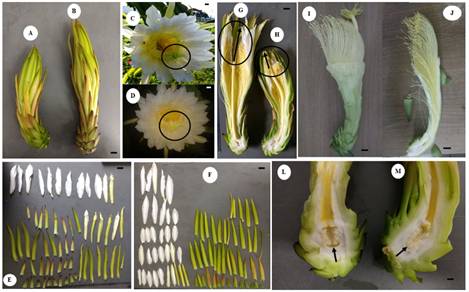
The floral morphology of the species S. undatus and S. monacanthus presented some characteristics that differentiated them. In both species, the perianth of the flowers was formed by sepaloids (sepals) that covered the floral tube, which had an ensiform (larger) to narrow triangular (smaller) shape (Figure 1A and B) and lanceolate petaloids (petals) attached around the edge of the calyx (Figure 1C and D). The difference between the two species was noted in the colors of the external sepals, which were green with purple edges and stripes in S. monacanthus, but only the smaller sepals were green with a slightly purple tip in S. undatus (Figure 1E and F).
Morphological characteristics of Selenicereus undatus and S. monacanthus flowers: flower bud in the pre-anthesis phase - (A) S. undatus and (B) S. monacanthus; open flower - (C) S. monacanthus and (D) S. undatus; petals and sepals with purple streaks in the sepaloids - (E) S. monacanthus; petals and sepals without purple streaks in the sepaloids (F) S. undatus; difference in height between the anthers and the stigma (black arrows) - (G) S. monacanthus and (H) S. undatus; abundance of stamens - (I) S. monacanthus and (J) S. undatus; flower bud highlighting the inferior ovary with numerous ovules in the placental wall (black arrows) - (L) S. monacanthus and (M) S. undatus.
Regarding the number of protective structures, the S. undatus genotype had a greater number of sepals (68.5 ± 3.37), with the largest ones being light yellow and the smallest ones light green, and a greater number of petals (26.7 ± 2.36), with the inner ones being white and the outer ones (the last layer between the sepals) light yellow (Figure 1F and Table 1).
As for the reproductive organs, both S. undatus and S. monacanthus had hermaphroditic flowers containing both male and female organs (Figure 1G and H). In both species, the gynoecium was composed of several fused carpels (syncarpous pluricarpellary) (Figure 1G and H). This structure was characterized by the presence of a long filament connecting the ovary to the stigma, which had fleshy yellow projections called lobes, varying from 20 to 27 in both species (Figure 1C and D, Table 1). The stamens consisted of light-yellow filaments and yellow anthers (where the pollen grains are produced) and were arranged around the gynoecium (Figure 1I and J).
The differences observed between the species were related to the length of the gynoecium, which was longer in S. monacanthus (28.1 ± 1.64 cm), with a difference of 1-2 cm compared to S. undatus. There was also greater variation in the length of the stamens (androecium = 10.3 ± 0.94 cm), with a variation of approximately 1 cm in a single flower (Figure 1G, Table 1), increasing the distance between the stamens and the stigma (1.86 ± 0.51 cm). In addition, a greater number of stamens was observed in S. monacanthus (980.1 ± 89.5), although S. undatus also presented an abundant quantity (830 ± 47.5) (Table 1).
The position of the ovary was inferior in both species (Figure 1L and M), as the stamens, sepals, and petals were inserted in its upper part. From the observation of the longitudinal section of the flower tissues, it was noted that the ovules (numerous) originated from the ovary wall (indicated by red arrows in Figure 1L and M). Although the gynoecium was composed of several carpels, the parietal placentation did not show a locule subdivision in the ovary, making it unilocular.
In both species, anthesis mainly occurred at night, starting at 6:30 p.m., with the flowers fully opening at midnight. However, a difference was observed between the species regarding the flower closing time. In S. monacanthus, it occurred at 9:20 a.m., while in S. undatus, it occurred at 11:30 a.m., the following day. Under the high-altitude tropical climate conditions of Brazil, the total duration of anthesis was around 2h longer in S. undatus, although the onset of anthesis occurred synchronously in both species.
Stigma receptivity, anther dehiscence, and pollen viability
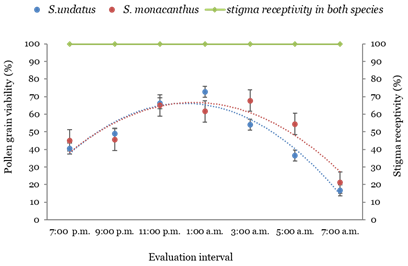
Regarding stigma receptivity, no differences were observed between S. monacanthus and S. undatus or across evaluation times (Figure 2). In both species, the stigma remained receptive throughout the anthesis period, meaning that it was ready for pollination from 7:00 p.m. until 7:00 a.m. the following morning.
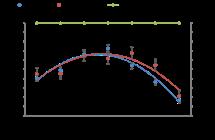
Pollen grain viability and stigma receptivity during anthesis of Selenicereus monacanthus and S. undatus genotypes.
As for anther dehiscence, pollen grains were already present on the internal tissues of the floral bud and released upon manual touch of the anthers during the pre-anthesis phase. Additionally, throughout the evaluation period, between 7:00 p.m. and 7:00 a.m. the next day, the anthers continued releasing pollen grains, primarily onto the petals. However, pollen grain viability varied throughout anthesis. The period of highest pollen viability occurred when the flowers were fully open, between 11:00 p.m. and 5:00 a.m. for S. monacanthus and between 11:00 p.m. and 3:00 a.m. for S. undatus, when the anthers had over 50% viable pollen grains, which decreased by dawn (Figure 2).
Fruit set and physicochemical characterization of fruit
The genotypes showed differences in fruiting rates depending on the pollination method, showing that the requirement for pollen influences production. Fruit set was absent in S. monacanthus when submitted to both self-pollination and manual self-pollination, indicating the self-incompatibility of the studied genotype, which presented the highest fruit set rates obtained with manual interspecific cross-pollination (99%) and natural pollination (87%). In S. undatus, fruit set occurred with all tested pollination methods (Table 2). However, the fruit set percentages from self-pollination (32.2%), manual self-pollination (27.9%), and manual intraspecific cross-pollination (23.7%) were low compared to the fruit set rates observed in plants submitted to manual interspecific cross-pollination with S. monacanthus (98.1%) and natural pollination (88.6%) (Table 2).
The manual interspecific cross-pollination method favored the production of fruit with better physicochemical characteristics (Table 3). The observed differences in fruit size (mass and diameter), pulp yield, seed count, SS, and SS/TA ratio corresponded to increases of over 100% compared to fruit resulting from self-pollination and manual self-pollination in S. undatus. In S. monacanthus, the fruit from this pollination method was also superior to that from natural pollination (Table 3).
Regarding seed viability, the highest germination percentages were observed in seeds from naturally pollinated fruit, with 91.2% in S. monacanthus and 96.5% in S. undatus, as well as from manual interspecific cross-pollination, with 90.5 and 90.0%, respectively (Table 4). The lowest germination percentages occurred in seeds from manually self-pollinated S. undatus fruit, ranging from 75.5 to 79.9%. These seeds had the lowest mass (weight of 1,000 seeds).
Fruit mass (FM), pulp yield (PY), number of seeds (NS), soluble solids content (SS), titratable acidity (TA), pH, SS/AT ratio, longitudinal diameter (LD), transversal diameter (TD), and peel thickness (PT) in fruit of Selenicereus monacanthus and S. undatus genotypes from different pollination methods.
Discussion
Floral morphology and anthesis
The results observed in relation to the floral morphology of S. monacanthus and S. undatus showed that both species produced large flowers and that the protective organs of the flowers, the sepaloids, and petaloids made the perianth of the flowers attractive to pollinators, especially nocturnal ones. The attractiveness of nocturnal and diurnal pollinators was studied under tropical climate conditions, and the authors observed ‘chiropterophily syndrome’ in the genotypes of these species. Thus, during anthesis, in addition to presenting large and colorful flowers, a strong nocturnal aroma and a large amount of pollen nectar were released, attracting pollinators, such as bats and moths (Muniz et al., 2019; 2020). However, according to these authors, under Brazilian climate conditions, the greatest visitation (abundance) is by bees, which are considered potential diurnal pollinators of these species and may play an important role in the quality of fruit produced by pitaya species.
In the two genotypes of the species evaluated in this study, there was spatial separation between the stigma and the anthers, which is referred to as herkogamy. Herkogamy is an ecological strategy that limits self-pollination and occurs in several predominantly allogamous plants (Guimarães et al., 2022). However, even if the genotype of S. undatus showed self-compatibility, this spatial separation of the male and female organs limits self-pollination by reducing the amount of pollen grains deposited on the stigma from the same flower naturally, without the action of pollinators. Thus, the presence of pollinators is essential to achieve high fruit set rates as well as the production of commercial fruit in the extra class (mass > 500 g), considering that the amount of pollen influences the number of fertilized ovules and the fruit size. Other studies point to herkogamy as one of the reasons for pollination deficits in self-compatible genotypes of S. undatus, as it reduces fruit size and productivity (Menezes et al., 2015a; Muniz et al., 2019; Santos et al., 2023).
The differences in sepal color is an interesting characteristic for differentiating S. monacanthus since the purple color on the edges of sepals, observed from the appearance of the flower bud, serves to indicate differences in the fruit based on the color of the skin (scales). This is because the scales of S. monacanthus fruit have purple edges, while S. undatus fruit has green-edged scales.
Regarding the duration of anthesis, the results observed in this study demonstrated longer anthesis in S. undatus, lasting approximately 17h, while it was 15h in S. monacanthus. The results suggest that there is variation according to the temperature conditions of the cultivation site since under high-altitude tropical climate conditions, Marques et al. (2011) reported a duration of 15h in S. undatus, and Muniz et al. (2019) reported a duration of 12h in S. undatus and S. monacanthus genotypes under tropical climate conditions. In other producing countries, due to the different climate from that of Brazil, the events that characterize pre-anthesis and the opening time of flower buds begin later. In S. monacanthus, pre-anthesis occurs at 7:00 p.m., anthesis at 9:30 p.m., and the flowers close completely around midday (12:00 p.m.) (Cho & Ding, 2021).
Variations related to the flower opening times of these species occur due to the climatic conditions of the cultivation site at the time of anthesis. Thus, in cultivation in warmer regions, where anthesis is shorter, the duration of anthesis can be prolonged under cloudy conditions. Muniz et al. (2019) found that S. undatus and S. monacanthus flowers remained open for up to 2h longer.
This information is relevant for hand pollination planning. Furthermore, longer anthesis favors diurnal pollination, which is carried out by bees (Apis mellifera) identified as pollinators of pitaya species (Muniz et al., 2019). According to these authors, bees are the most abundant floral visitors (86.1%) in S. monacanthus cultivation, starting their visitation around 5:00 a.m. and remaining until the flowers close.
Stigma receptivity, anther dehiscence, and pollen viability
The results observed in this study demonstrate the possibility of flower pollination and fertilization throughout the period evaluated, between 7:00 p.m. and 7:00 a.m., considering the quantity of pollen grains in the flowers and stigma receptivity. However, the reduction in pollen grain viability at the end of anthesis shows that orchard productivity may be influenced since pollination with pollen grains with lower viability results in the formation of smaller fruit due to the smaller quantity of fertilized ovules (Cho et al., 2013).
Variation in the percentage of pollen viability evaluated in the present study may be related to the temperature of the cultivation site and the protection of the flower buds. This is because the evaluations were carried out in the middle of summer, when the average maximum temperatures reach 30°C, and heat accumulates with the protection of the flower buds. This is an important aspect that should be observed at the cultivation site since variations in temperature and relative humidity have been related as factors that can compromise the viability of pollen grains. Under controlled conditions, temperatures of 40/30°C have been shown to interfere in the reduction of pollen grain germination and in the formation of small fruit with a low number of seeds compared to the development of fruit obtained from crosses with pollen grains taken from plants grown at temperatures of 35/25°C (Chu & Chang, 2022).
Anther dehiscence in flower buds during pre-anthesis, which was observed from 4:00 p.m. onwards in both species, does not allow self-pollination. In this phase, the released pollen grains only reached the style and petals due to herkogamy, suggesting that in self-compatible species, such as S. undatus, self-pollination tends to occur at the end of anthesis, during the closing movement of the petals, which allows the deposition of pollen grains on the stigma. The anticipation of anther dehiscence appears to be a common event in pitaya species, which has already been reported for genotypes of S. undatus and S. monacanthus under tropical climate conditions in Brazil (Muniz et al., 2019). According to the observations of these authors, the dispersion of pollen grains over floral tissues facilitates capture by pollinators that can carry out pollination and are therefore important for increasing productivity in pitaya orchards.
Based on the results of stigma receptivity, anther dehiscence, and pollen viability, we infer that pollination can occur throughout anthesis. Furthermore, pollinators make an important contribution to pollination, including for genotypes of self-compatible species. In cultivated areas with no pollinators, this information is essential for pollination management, enabling interspecific cross-pollination to increase productivity or for genetic improvement in cultivars of interest.
Fruit set and physicochemical characterization of fruit
The fruit set rates observed in this study indicate that the S. monacanthus genotype was self-incompatible and that the cause of self-incompatibility was not solely related to herkogamy, as even manual self-pollination did not result in fruit production (Table 3). In this case, self-incompatibility is genetically controlled by a gynogenetic S gene, which regulates the self-incompatibility system in some pitaya species (Wang et al., 2023). This mechanism prevents pollen tube formation when pollen grains have the same allele.
The genetic diversity of genotypes within the same species is an important factor to consider when evaluating fruit set rates. Studies have identified S. undatus genotypes that did not produce fruit (Silva et al., 2011) or produced a low percentage (7%) (Menezes et al., 2015a) through self-pollination. This occurs because some genotypes are self-incompatible or partially self-compatible; therefore, self-pollination alone is not sufficient to ensure fruit production. In the present study, neither self-pollination nor intraspecific manual cross-pollination produced fruit in S. monacanthus, confirming the self-incompatibility of this genotype and suggesting that all plants of this species in the orchard are likely clones.
Another important aspect that deserves to be highlighted in our observations is the contribution of pollinators in the fruit set of the self-compatible species genotype (S. undatus) since a 56.4% deficit in fruit set was observed with self-pollination compared to natural pollination (Table 2). Under Brazilian conditions, bees and wasps are diurnal visitors, and the nocturnal ones are beetles, ants, and moths, with moths (Agrius cingulata) and bees (Apis mellifera) being identified as potential pollinators that enable fruit set rates (100%) and fruit mass higher than those of self-pollination (Muniz et al., 2019; 2020). Floral visitors are attracted by the diversity and pollen abundance of the three species cultivated in the orchard, as the variety of colors, odors, and shapes is considered appealing to pollinators.
Pollination efficiency is an important aspect of pitaya species, as it is reflected in the number of pollinated flowers and fertilized ovules (Guimarães et al., 2022). In addition to the number of fruits on the plant, the amount of pollen grains deposited on the stigma influences fruit size (fruit mass) (Cho et al., 2013). This is why the fruit set index and fruit size resulting from natural pollination are generally smaller than those of fruits produced through manual cross-pollination (Menezes et al., 2015a; 2015b; Tran et al., 2015).
Differences in fruit set rates have also been related to climatic variations in the growing locations at the time of anthesis. Precipitation during anthesis increases the humidity, a condition that reduces pollen grain germination at temperatures above 24°C, as observed in pollen from other species (Iovane et al., 2022). Under the climatic conditions of this study, anthesis usually coincides with rainy days, as flowering peaks during summer, which is the rainy season in this region. Furthermore, temperature is one of the factors related to pollen grain viability. In S. monacanthus, S. undatus, and S. setaceus, greater pollen grain germination was observed between 28 and 30°C, and the length of the pollen tube is shorter at temperatures between 30 and 32°C (Li et al., 2020).
Regarding fruit quality, the results observed demonstrate the importance of pollination efficiency to increase fruit size, mass, and diameter for commercialization. This is evident due to the greater seed quantity obtained from interspecific manual cross-pollination, compared to fruit formed from self-pollination. The relationship between the number of seeds and fruit size in pitaya species is due to hormone synthesis by the seeds, which favors the development of the ovary since the pulp develops from the funicles, which connect the ovules to the placenta (Dag & Mizrahi, 2005). In addition, pollen diversity is essential, as intraspecific cross-pollination can also result in the formation of smaller fruit and lower fruit set percentages, depending on genotype compatibility, as observed in the present study.
Another relevant aspect regarding fruit quality is the pollen source, as S. undatus fruit formed from interspecific cross-pollination presented a better SS content and SS/TA ratio, as well as size, than fruit from intraspecific cross-pollination. The results observed in this study are important, mainly from a commercial point of view, for consumer acceptance since, in addition to the visual aspect, flavor is an important characteristic, considering that the SS content is an indication of fruit sweetness. In this regard, the genotypes of S. monacanthus have presented characteristics that stand out in relation to consumer acceptance, such as a high SS content and SS/TA ratio, compared to the genotypes of S. undatus (Alves et al., 2021; Rabelo et al., 2020b; Santos et al., 2023).
Regarding seed germination, the highest percentages of twinning observed in seeds formed from natural (open) and interspecific cross-pollination suggest that the diversity of pollen grains deposited on the stigma at the time of pollination favor genetic variability. This occurs because pollination involves different pollen grains deposited manually or from pollinators visiting several plants. The reduction in seed germination percentage has been cited in other species as a possible consequence of inbreeding depression and may be related to a decrease in seed size. In the present study, the lowest percentage of twinning was observed in seeds obtained from self-pollination and manual self-pollination, which produced light seeds (Table 3). This may have occurred because these seeds contained fewer reserves, which are essential for the germination process. Similar results regarding fruit production with seeds of lower mass have been obtained with intraspecific cross-pollination (S. undatus) compared to interspecific cross-pollinations with pollen grains from S. monacanthus and S. costaricensis (Lone et al., 2017).
Conclusion
The differences in floral morphology between pitaya species S. monacanthus and S. undatus were related to the quantity and color of the protective tissues of the flower buds. These differences distinguished S. monacanthus in the field due to its external sepals, which were green with purple edges and streaks, whereas S. undatus had a denser flower bud due to a greater number of petals and sepals. Both species produced complete flowers with functional reproductive organs, with herkogamy being more pronounced in S. monacanthus. Anthesis occurred simultaneously in both species, ensuring the availability of pollen for cross-pollination. However, S. undatus exhibited a longer anthesis duration, remaining open for up to 2h longer than S. monacanthus under cloudy conditions during the post-anthesis period. During anthesis, both species presented receptive stigmas and viable pollen grains, with dehiscent anthers before flower opening. The S. monacanthus genotype presented self-incompatibility, requiring interspecific cross-pollination or different clones for pollen availability. In contrast, S. undatus exhibited self-compatibility; however, the highest fruit set rates and best fruit quality were achieved through interspecific cross-pollination. Interspecific cross-pollination ensures high fruit set and the production of larger fruit in the cultivation of self-incompatible pitaya species or when there is an absence of pollinators in the cultivation region. Pollen diversity enhances interspecific cross-pollination and promotes the production of fruit with a high number of viable seeds.
Data availability
The data supporting the findings of this study are available in the institutional repository of the Federal University of Jequitinhonha and Mucuri Valleys, Diamantina, Minas Gerais State, Brazil, linked to the Master of the co-author. The material can be accessed at: https://acervo.ufvjm.edu.br//handle/123456789/3391
Acknowledgements
We thank the Coordination for the Improvement of Higher Education Personnel and for providing the scholarship Brasil (CAPES) - Finance Code 001 , the National Council for Scientific and Technological Development (CNPq) - 400904/2019-5, the Federal University of Jequitinhonha and Mucuri Valleys, and the Program in Plant Production for the infrastructure made available to carry out the research project. We also thank Dr. André Rodrigo Rech for his considerations
References
-
Alves, D. A., Cruz, M. C. M., Lima, J. E., Santos, N. C., Rabelo, J. M. & Barroso, F. L.. (2021). Productive potential and quality of pitaya with nitrogen fertilization. Pesquisa Agropecuária Brasileira, 56, 1-10. https://doi.org/10.1590/S1678-3921.pab2021.v56.01882
» https://doi.org/https://doi.org/10.1590/S1678-3921.pab2021.v56.01882 - Brasil (2009). Regras para análise de sementes. Secretaria de Defesa Agropecuária/Ministério da Agricultura, Pecuária e Abastecimento.
-
Cho, J. L. Y., Ding, P., Razak-ABD, A. R. & Wahab, Z.. (2013). Pollen load affects quality of red-fleshed dragon fruit (Hylocereus polyrhizus). Acta Horticulturae, 1012, 253-258. https://doi.org/10.17660/ActaHortic.2013.1012.29
» https://doi.org/https://doi.org/10.17660/ActaHortic.2013.1012.29 -
Cho, J. L. Y. & Ding, P.. (2021). Floral morphology and pollination process of red-fleshed dragon Fruit (Hylocereus polyrhizus) grown in an open field. Horticultural Science and Technology, 39(3), 277-293. https://doi.org/10.7235/HORT.20210025
» https://doi.org/https://doi.org/10.7235/HORT.20210025 -
Chu, Y. & Chang, J.. (2022). Heat stress leads to poor fruiting mainly due to inferior pollen viability and reduces shoot photosystem ii efficiency in “da hong” pitaya. Agronomy, 12(1), 1-14. https://doi.org/10.3390/agronomy12010225
» https://doi.org/https://doi.org/10.3390/agronomy12010225 -
Cruz, C. D.. (2016). Genes Software - extended and integrated with the R, Matlab and Selegen. Acta Scientiarum. Agronomy, 38(4), 547-552. https://doi.org/10.4025/actasciagron.v38i4.32629
» https://doi.org/https://doi.org/10.4025/actasciagron.v38i4.32629 - Dafni, A., Kevan, P. G. & Husband, B. C. (2005). Practical pollination biology. Enviroquest Ltd.
-
Dag, A. & Mizrahi, Y.. (2005). Effect of pollination method on fruit set and fruit characteristics in the vine cactus Selenicereus megalanthus (“yellow pitaya”). The Journal of Horticultural Science and Biotechnology, 80(5), 618-622. https://doi.org/10.1080/14620316.2005.11511987
» https://doi.org/https://doi.org/10.1080/14620316.2005.11511987 - Guimarães, A. G., Giordani, S. C. O., Rech, A. R. & Costa, M. R. (2022). Biologia floral e polinização. In M. C. M Cruz & R. S. Martins (Eds.), Pitaia no Brasil, nova opção de cultivo. (pp. 70-91). Epagri.
-
Iovane, M., Cirillo, A., Izzo, L. G., Di Vaio, C. & Aronne, G.. (2022). High temperature and humidity affect pollen viability and longevity in Olea europaea L. Agronomy, 12(1), 1-13. https://doi.org/10.3390/agronomy12010001
» https://doi.org/https://doi.org/10.3390/agronomy12010001 - Kearns, C. A. & Inouye, D. W. (1993). Techniques for pollination biologists. University Press of Colorado.
-
Li, J., Shi, H., Huang, X., Wang, Y., Junsheng, Z., Dai, H. & Sun, Q. (2020). Pollen germination and hand pollination in pitaya (Hylocereus undatus). PREPRINT (Version 1). Research Square. https://doi.org/10.21203/rs.2.22205/v1
» https://doi.org/https://doi.org/10.21203/rs.2.22205/v1 -
Lone, A. B, Takahashi, L. S. A. & Faria, R. T.. (2017). Influência dos diferentes tipos de pólen sobre a qualidade do fruto de pitaya. Agropecuária Catarinense, 30(2), 51-53. https://doi.org/10.52945/rac.v30i2.200
» https://doi.org/https://doi.org/10.52945/rac.v30i2.200 -
Marques, V. B., Moreira, R. A., Ramos, J. D., Araújo, N. A. & Silva, F. O. R.. (2011). Fenologia reprodutiva de pitaya vermelha no município de Lavras, MG. Ciência. Rural, 41(6), 984-987. https://doi.org/10.1590/S0103-84782011005000071
» https://doi.org/https://doi.org/10.1590/S0103-84782011005000071 - Menezes, T. P., Ramos, J. D., Bruzi, A. T., Costa, A. C. & Ramos, P. S.. (2015a). Autopolinização e qualidade de fruto em pitaia vermelha (Hylocereus undatus). Magistra, 27(3), 376-383.
-
Menezes, T. P., Ramos, J. D., Bruzi, A. T. & Costa, A. C. (2015b). Artificial pollination and fruit quality in red pitaya. BioScience Journal, 31(3):801-807. https://doi.org/10.14393/BJ-v31n3a2015-22424
» https://doi.org/https://doi.org/10.14393/BJ-v31n3a2015-22424 -
Moreira, R. A., Rodrigues, M. A., Souza, R. C., Silva, A. D., Silva, F. O. R., Lima, C. G., Pio, L. A. S. & Pasqual, M. (2022). Natural and artificial pollination of white fleshed pitaya. Anais da Academia Brasileira de Ciências, 94(Suppl. 3), 1-12. https://doi.org/10.1590/0001-3765202220211200
» https://doi.org/https://doi.org/10.1590/0001-3765202220211200 -
Muniz, J. P. O., Bomfim, I. G. A., Corrêa, M. C. M. & Freitas, B. M.. (2019). Floral biology, pollination requirements and behavior of floral visitors in two species of pitaya. Revista Ciência Agronômica, 50(4), 640-649. https://doi.org/10.5935/1806-6690.20190076
» https://doi.org/https://doi.org/10.5935/1806-6690.20190076 -
Muniz, J. P. O., Bomfim, I. G. A., Corrêa, M. C. M. & Freitas, B. M.. (2020). Complementary bee pollination maximizes yield and fruit quality in two species of self-pollinating pitaya. Revista Ciência Agronômica, 51(4), 1-9. https://doi.org/10.5935/1806-6690.20200072
» https://doi.org/https://doi.org/10.5935/1806-6690.20200072 -
Rabelo, J. M., Cruz, M. C. M., Alves, D. A., Lima, J. E., Reis, L. A. C. & Santos, C. N.. (2020a). Reproductive phenology of yellow pitaya in a high-altitude tropical region in Brazil. Acta Scientiarum. Agronomy, 42(1), 1-5. https://doi.org/10.4025/actasciagron.v42i1.43335
» https://doi.org/https://doi.org/10.4025/actasciagron.v42i1.43335 -
Rabelo, J. M., Cruz, M. C. M., Sena, C. G., Pantoja, L. A., Santos, A. S., Reis, L. A. C. & Guimarães, A. G.. (2020b). Potassium fertilization in the quality improvement and centesimal composition of pitaya. Emirates Journal of Food and Agriculture, 32(9), 658-665. https://doi.org/10.9755/ejfa.2020.v32.i9.2146
» https://doi.org/https://doi.org/10.9755/ejfa.2020.v32.i9.2146 -
Santos, N. C., Alves, D. A., Lima, J. E. & Guimarães, A. G.. (2023). Commercial productivity and quality of pitaya as a function of number of fruits per cladode. Revista Ceres, 70(2), 41-48. https://doi.org/10.1590/0034-737X202370020005
» https://doi.org/https://doi.org/10.1590/0034-737X202370020005 -
Silva, A. C. C., Martins, A. B. G. & Cavallari, L. D. L.. (2011). Qualidade de frutos de pitaya em função da época de polinização, da fonte de pólen e da coloração da cobertura. Revista Brasileira de Fruticultura, 33(4), 1162-1168. https://doi.org/10.1590/S0100-29452011000400014
» https://doi.org/https://doi.org/10.1590/S0100-29452011000400014 - Tran, D. & Yen, C.. (2014). Morphological characteristics and pollination requirement in red pitaya (Hylocereus spp. ). World Academy of Science, Engineering and Technology/International Journal of Agricultural and Biosystems Engineering, 8(3), 6-10.
-
Tran, H., Yen, C. & Chen, Y.. (2015). Effect of pollination method and pollen source on fruit set and growth of red-peel pitaya (Hylocereus spp. ) in Taiwan. The Journal of Horticultural Science and Biotechnology, 90(3), 254-258. https://doi.org/10.1080/14620316.2015.11513179
» https://doi.org/https://doi.org/10.1080/14620316.2015.11513179 -
Wang, Z., Wang, M., Ding, Y., Li, T., Jiang, S., Kang, S., Wei, S., Xie, J., Huang, J., Hu, W., Li, H. & Tang, H. (2023). The pitaia flower tissue’s gene differential expression analysis between self-incompatible and self-compatible varieties for the identification of genes involved in self-incompatibility regulation. International Journal of Molecular Sciences, 24(14). https://doi: 10.3390/ijms241411406
» https://doi.org/https://doi: 10.3390/ijms241411406 - Zenebon, O., Pascuet, N. S., & Tiglea, P. (2008.). Métodos físico-químicos para análise de alimentos (4. ed., 1. ed. Digital). Instituto Adolfo Lutz.
Edited by
-
Associate Editor in charge:
Alessandro Lucca BracciniCarlos Alberto Scapim