 Productivity and quality of noble garlic cultivars under different vernalization temperatures
ABSTRACT.
Brazilian producers of noble garlic (Allium sativum L.) have sought to enhance the productivity and quality of garlic by applying a vernalization technique that induces bulb formation. The objective of this study was to evaluate the productivity and quality of garlic bulbs produced from different noble garlic cultivars at varying vernalization temperatures. The experiment was conducted in the experimental area of the Wehrmann Agricultural Group and was replicated three times on April 4th (Experiment I), April 18th (Experiment II), and May 16th, 2019 (Experiment III). The experimental design consisted of a randomized complete block design in a 3 × 3 factorial scheme, with nine treatments and four replicates. The treatments consisted of three garlic cultivars: Quitéria, Ito, and Chonan, and three vernalization temperatures (-1 to -3°C; 1 to 3°C; and 2 to 4°C). After harvesting, the bulbs were counted, weighed, and classified based on sieves ranging from 2 to 8, according to the transverse bulb diameter. Following this classification, the commercial, total, and industrial bulb yields were estimated. Negative vernalization temperatures resulted in slower bulb development in all experiments; however, this was associated with a higher potential for bulb growth. Notably, the Chonan cultivar outperformed the other cultivars. Negative vernalization temperature increased the yield of bulbs in the 5-7 and 8 classes (higher commercial value classes), reduced the bulb yields in the 2-4 and industrial classes (lower commercial value classes), and enhanced the total yield.
Keywords:
Allium sativum L.; bulb induction; thermo-photoperiodic conditions; production in the midwest.
Introduction
Brazil is one of the world's largest garlic producers, currently holding the sixth position with a production of 155 thousand tons (Mazzuco et al., 2023). Goiás is the second-largest garlic producing state in Brazil, with approximately 3.5 thousand hectares under cultivation, second only to Minas Gerais, with approximately 4.8 thousand hectares (Mota et al., 2014). Given its economic significance, scientific studies on garlic cultivation in Goiás have become indispensable for updating and enhancing vernalization management recommendations for garlic, thereby improving production efficiency.
Vernalization is a physiological process that subjects the plants to temperatures ranging from -1 to 10°C for several weeks, with the objective of inducing the emergence of the floral scape (Taiz & Zeiger, 2017). In Brazil, vernalization can also be related to the use of low temperatures for treating bulbils with the aim of inducing bulb formation, as seen in garlic cultivation (Luz et al., 2022). As reported by Siswadi et al. (2019), the vernalization process in garlic cultivation, along with the use of plant growth regulators, can lead to increased production.
Longhi et al. (2019) confirm that the garlic vernalization process occurs in cold chambers at temperatures ranging from 3 to 5°C, over a period of 30 to 40 days, with a relative humidity of 70 to 80%. However, the storage period for bulbils under low temperatures is determined by climatic variations in each region, planting season, and cultivar, and can range from 45 to 60 days. Currently, garlic producers in Brazil are working with data specific to each cultivar and location regarding vernalization duration and temperature, indicating the need for further studies. In addition, temperature variability has increased in recent years, affecting effective cold accumulation in garlic plants. Therefore, the use of appropriate temperatures and vernalization periods at different times may be crucial to ensure high quality and productivity in garlic cultivation.
Luz et al. (2022) demonstrated that the use of subzero vernalization temperatures for bulbils of the Ito garlic cultivar, with a visual dormancy-breaking index of 60%, resulted in increased crop productivity. However, further studies are required on the application of negative vernalization techniques in different regions of the country and with various noble garlic cultivars to solidify their potential for broader economic applications.
Therefore, the objective of this study was to evaluate the productivity and quality of the bulbs of noble garlic cultivars originating from bulbils subjected to varying vernalization temperatures.
Material and methods
The experiment was conducted in the experimental area of the Wehrmann Agricultural Group (Santa Barbara Farm), situated in the municipality of Cristalina, Goiás State, Brazil, (17°02'45" S, 47°45'24" W) and an elevation of 980 m (Luz et al., 2023). The experiment was replicated three times on April 4th (Experiment I), April 18th (Experiment II), and May 16th, 2019 (Experiment III).
The soil in the area is classified as a medium-textured red-yellow oxisol, with undulating to flat terrain. According to the Köppen classification, the region's climate is a humid subtropical climate characterized by hot summers and dry winters, with average annual precipitation and temperature of 1,300 mm and 20.9°C, respectively (Luz et al., 2023).
Meteorological data were collected during the experimental period for each experiment. In Experiment I, the maximum and minimum temperatures ranged from 21 to 26°C and 8 to 20°C, respectively. The accumulated precipitation was 215 mm and the photoperiod ranged from 11h to 17 min. to 12h and 3 min. during plant growth, with an average of 11h and 10 min. during bulb formation. In Experiment II, the maximum minimum temperatures ranged from 19 to 30°C and 8 to 19°C, respectively, and the accumulated precipitation was 79 mm. The photoperiod ranged from 11h and 4 min. to 11h and 28 min. during plant growth, with an average of 11h and 14 min during bulb formation. In Experiment III, the maximum and minimum temperatures ranged from 18 to 29°C and 9 to 18°C, respectively, and the accumulated precipitation was 51 mm. The photoperiod ranged from 11 h and 2 min. to 11h and 36 min. during plant growth, with an average of 11h and 14 min. during bulb formation.
The experimental design was a randomized complete block design in a 3 × 3 factorial scheme, which resulted in nine treatments with four replicates. The treatments consisted of three garlic cultivars: Quitéria (2nd-generation seeds, originating from crops in Padre Bernardo, Goiás State, Brazil), Ito (3rd-generation seeds, originating from Guarda-Mor, Minas Gerais State, Brazil), and Chonan (4th-generation seeds, originating from Cristalina, Goiás State, Brazil); and three vernalization temperature ranges (-1 to -3°C, 1 to 3°C, and 2 to 4°C).
The experimental plots were arranged in beds with a width of 1.2 m, containing six single rows (three double rows). Each experimental plot was 6 m long, with spacing of 0.095 m between plants, 0.4 meters between double rows, and approximately 0.013 m between single rows, totaling 378 plants per plot. The central 4 m of the two central rows were considered as the useful plot area.
The seed bulbs used belonged to the Noble Group and were composed of round, uniform, and vigorous bulbs with a white outer tunic, with each bulb containing seven-ten bulbils covered by a purple membrane. Bulbils had standard weights exceeding 5 g.
The bulbs of the Ito, Quitéria, and Chonan cultivars were stored in cold chambers with relative air humidity of 60-70% for 50, 60, and 62 d, respectively, at various vernalization temperature ranges to achieve a visual dormancy breaking index (VDI) of 70%. VDI was calculated according to Reghin and Kimoto (1998) using the following formula: VDI = [(LBL/LRL) × 100], where VDI = visual dormancy breaking index, LBL = length of the bulb sprout leaf, and LRL = length of the reserve leaf.
The vernalization process of the seed bulbs was carried out in three separate mini-cold chambers, each with dimensions of 2 × 2 × 2 meters, constructed with insulating material on a metal frame, and adjusted to the following temperature ranges: -1 to -3°C, 1 to 3°C, and 2 to 4°C.
In each cold chamber, a refrigeration unit with air condensation, single-phase compressor, fan, electronic temperature and defrost controller, refrigerant gas, high- and low-pressure switches, copper tubing and connections, thermostatic expansion valve, thermal insulation accessories, rotating refrigeration door measuring 1.80 × 0.80 m, polyurethane coated with treated and pre-painted steel plate, flexible curtain for the door with stainless steel support, and mini-exhaust fan for air renewal and control were installed. A portable dehumidifier was placed in each chamber. During the vernalization period, humidity, temperature, and CO2 were recorded four times per week.
Before planting, physical and chemical analyses of the soil were conducted (Table 1). Planting and topdressing fertilization followed the manufacturer's recommendations.
Soil preparation involved heavy harrowing, plowing with a moldboard plow, light harrowing, subsoiling, full-area planting fertilization, and construction of planting beds. For planting fertilization, 2,600 kg ha-1 and 1,300 kg ha-1 of formulated NPK 03-35-06 and single superphosphate, respectively, were used. After the beds were prepared, garlic was planted manually.
Topdressing fertilization was carried out through fertigation with 150 kg ha-1 urea, 360 kg ha-1 potassium chloride (KCl), 730 kg ha-1 NPK 12-00-12, 1,130 kg ha-1 NPK 19-04-19, and 600 kg ha-1 NPK 20-05-20. For supplementary foliar fertilization, 14 L ha-1 Aminoagro MOL, 26 kg ha-1 manganese sulfate, 64 kg ha-1 zinc sulfate, 177 kg ha-1 magnesium sulfate, 50 kg ha-1 boric acid, and 31 kg ha-1 prime balance were used.
Throughout the crop cycle, irrigation was controlled using a drip irrigation system commencing immediately after planting the bulbils. At the time of tissue differentiation (between 60 and 100 days after planting), irrigation was halted to induce the necessary water stress, which was sufficient to prevent excessive sprouting while promoting proper bulb and bulbil formation. Other cultural and phytosanitary practices were carried out following the procedures commonly employed in commercial garlic cultivation (Souza, 2009).
Harvesting occurred during the senescence phase, when the plants had fallen over. In each experiment and each evaluated cultivar, the number of days after planting for bulb harvesting was recorded.
After harvesting, the plants were stored and hung in a protected open structure for a curing process that lasted for 45 days. After this period, the bulbs were trimmed by cutting the pseudostem 2 cm above the bulb and removing dirty external roots and husks.
The bulbs were counted, weighed, and classified using sieves ranging from 2 to 8, which separated the bulbs based on their transverse diameter into the following classes: class 2 (bulbs with a transverse diameter of less than 35 mm); class 3 (bulbs with a transverse diameter of 36-40 mm); class 4 (bulbs with a transverse diameter of 41-45 mm); class 5 (bulbs with a transverse diameter of 46-50 mm); class 6 (bulbs with a transverse diameter of 51-55 mm); class 7 (bulbs with a transverse diameter of 56-60 mm); and class 8 (bulbs with a transverse diameter greater than 60 mm).
After classification, 84 bulbs were randomly selected from each experimental plot, and based on the number and weight of the bulbs, the following parameters were estimated: productivity of commercial bulbs in classes 2-4; productivity of commercial bulbs in classes 5-7; productivity of commercial bulbs in class 8; industrial bulb productivity, and total bulb productivity, all measured in tons per hectare (t ha-1). For the calculation of commercial productivity, only extra bulbs were considered; that is, bulbs that had at least one intact tunic covering the bulb. Total productivity included extra bulbs, industry bulbs (bulbs with minor defects and no intact tunics covering the bulb), and discard bulbs (non-commercial bulbs).
Initially, the data were tested to determine if they met the assumptions for analysis of variance (ANOVA), which included residual normality, variance homogeneity, and block additivity at a 5% probability level using the Shapiro-Wilk, Levene, and Tukey tests, respectively. Once the assumptions were met, the means were subjected to ANOVA and variables that exhibited significant differences, as determined by the F-test (≤ 0.05), were compared using the Tukey test (p ≤ 0.05). The R statistical software (R Core Team, 2023) was used for all experiments.
Results and discussion
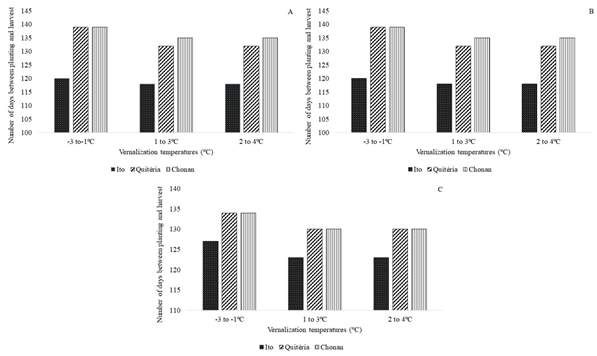
When garlic was subjected to negative vernalization temperatures, compared to the average of the other temperatures, there was an increase in the average number of days between planting and harvest in relation to temperatures of 1 to 3°C and 2 to 4°C. In Experiment I, this increase was 4.56, 2.39, and 3.10% (Figure 1A); in Experiment II, it was 1.70, 5.35, and 3.00% (Figure 1B); and in Experiment III, it was 3.26, 3.10, and 3.10% (Figure 1C) for the cultivars Ito, Quitéria, and Chonan, respectively.

Number of days between planting and harvest of garlic bulbs from three noble garlic cultivars (Ito, Quitéria, and Chonan), under three vernalization temperatures (-1 to -3°C; 1 to 3°C; and 2 to 4°C), in Experiment I (A), Experiment II (B), and Experiment III (C). Cristalina, Goiás State, Brazil, 2019.
A negative vernalization temperature led to slower bulb development in all experiments, but resulted in a greater potential for bulb growth. The extended crop cycle caused by negative vernalization temperatures can be explained by the fact that vernalization affects flowering hormones, especially gibberellins and auxins (Taiz & Zaiger, 2017). However, Wu et al. (2015) observed a reduction in the cycle of the G064 garlic cultivar from 250 to 212 days until harvest and an increase in the flowering rate when comparing the control treatment (without vernalization) to vernalization at 5°C for 60 days.
Under very low temperatures (-1 to -3°C), there is likely a high production of auxin, which leads to a high production of ethylene. High concentrations of auxin, in addition to affecting flowering development, also inhibit flower and fruit drop because this hormone stimulates photosynthetic activity by increasing stomatal opening, phosphorylation, and CO2 fixation (Bangerth, 2000). However, with increased photosynthetic activity, there is a greater supply of assimilates, allowing increased fruit and bulb growth (Bangerth, 2000). As observed in this study, this may require more time, consequently extending the crop cycle.
In all experiments, a significant interaction between factors was observed for all evaluated variables, except for the total productivity of commercial bulbs in Experiment I, the productivity of commercial bulbs in classes 2-4 in Experiment II, and the total productivity in Experiments II and III.
In Experiment I, the highest values of productivity for bulbs in classes 2-4 were observed in the Ito cultivar at the vernalization temperature of 2 to 4°C. However, the lowest productivity of lower-class bulbs was obtained by the Chonan cultivar at the negative vernalization temperature, with a reduction of 5.26 t ha-1 and 2.94 t ha-1 compared to the Ito and Quitéria cultivars, respectively (Figure 2). In Experiment II, regardless of the vernalization temperature, the productivity of commercial bulbs in classes 2-4 was statistically similar (Figure 3A). However, there was a significant difference (p ≤ 0.05) between cultivars, with the Chonan and Quitéria cultivars standing out as they exhibited lower bulb productivity with lower commercial value (Figure 3B). In Experiment III, the highest productivity for bulbs in classes 2-4 was obtained for the Ito cultivar at the negative vernalization temperature (Figure 4), unlike Experiment I, where the highest values of bulb productivity for this classification and cultivar were obtained at the higher vernalization temperature (2 to 4°C).

Interaction breakdown for bulb productivity (t ha-1) of classes 2 to 4 (A) of three noble garlic cultivars (Ito, Quitéria, and Chonan) under three vernalization temperatures (-1 to -3°C; 1 to 3°C; and 2 to 4°C) in Experiment I. Cristalina, Goiás State, Brazil, 2019. Lowercase letters on the bars compare vernalization temperatures within each cultivar, and uppercase letters compare cultivars within each vernalization temperature.

Mean values of commercial bulb productivity for classes 2 to 4 (t ha-1) at three vernalization temperatures (-1 to -3°C; 1 to 3°C; and 2 to 4°C) (A) and for three noble garlic cultivars (Ito, Quitéria, and Chonan) (B) in Experiment II. Cristalina, Goiás State, Brazil, 2019. The same lowercase letters on the bars do not differ significantly from each other by Tukey's test (p ≤ 0.05).

Breakdown of the interaction for bulb productivity (t ha-1) of classes 2 to 4 for three noble garlic cultivars (Ito, Quitéria, and Chonan) at three vernalization temperatures (-1 to -3°C; 1 to 3°C; and 2 to 4°C) in Experiment III. Cristalina, Goiás State, Brazil, 2019. Lowercase letters on the bars compare vernalization temperatures within each cultivar, and uppercase letters compare cultivars within each vernalization temperature.
In all experiments, the highest productivity of higher-class commercial bulbs (classes 5-7 and 8) was obtained by the Chonan cultivar at negative vernalization temperatures (Figures 5 and 6). In Experiment I, comparing the Chonan cultivar with the Ito and Quitéria cultivars, there were increases in productivity of 4.71 and 4.61 t ha-1 for class 5-7 (Figure 5A) and 4.65 and 3.49 t ha-1 for class 8 (Figure 6A), respectively. In Experiment II, comparing the productivity of the Chonan cultivar at the lower and higher temperatures, increases of 2.07 and 5.78 t ha-1, respectively, were observed for classes 5-7 and 8 (Figures 5B and 6B). In Experiment III, the productivity average for classes 5-7 obtained at the negative vernalization temperature in relation to the other temperatures resulted in productivity gains of 1.19 t ha-1, 2.46 t ha-1, and 3.87 t ha-11, for the Ito, Quitéria, and Chonan cultivars, respectively (Figure 5C). Similarly, for the productivity of class 8 bulbs in Experiment III, the Chonan cultivar stood out compared to the other cultivars, but the highest productivity was obtained when bulbs were subjected to the vernalization temperature of 1 to 3°C. However, this did not occur in the other cultivars, which maintained higher productivity of class 8 bulbs when subjected to negative vernalization temperatures (Figure 6C).
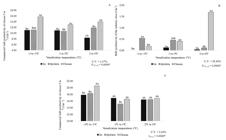
Breakdown of the interaction for bulb productivity (t ha-1) of classes 5 to 7 for three noble garlic cultivars (Ito, Quitéria, and Chonan) at three vernalization temperatures (-1 to -3°C; 1 to 3°C; and 2 to 4°C) in Experiment I (A), Experiment II (B), and Experiment III (C). Cristalina, Goiás State, Brazil, 2019. Lowercase letters on the bars compare vernalization temperatures within each cultivar, and uppercase letters compare cultivars within each vernalization temperature.
In Experiment I, the highest bulb productivity classified as industry bulbs were obtained by the Chonan cultivar at the vernalization temperature range of 1 to 3°C (Figure 7A). Bulbs in this classification had more external tunic cracks, possibly because of the extensive expansion of the bulbils of the Chonan cultivar. Similarly, in Experiment II, the highest yields of industry bulbs were also obtained by the Chonan cultivar, but at higher vernalization temperatures, despite their lower commercial relevance (Figure 7B). In contrast to what happened for the class 8 bulb productivity in the Ito and Quitéria cultivars in Experiment III, the lower vernalization temperature, compared to the average productivity of the other temperatures, resulted in a reduction of industry bulbs by 0.52 t ha-1 (for the Quitéria cultivar) and 1.50 t ha-1 (for the Chonan cultivar). This reduction in industry bulbs is beneficial, as these bulbs have lower commercial value (Figure 7C).
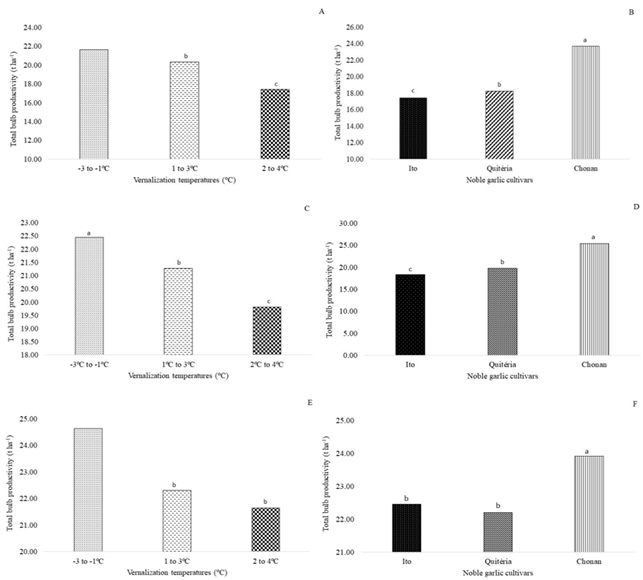
When considering total productivity, it was evident that despite the absence of a significant interaction between factors, there was a statistical difference between cultivars and vernalization temperatures in all experiments (Figure 8).

Breakdown of the interaction for bulb productivity (t ha-1) of class 8 for three noble garlic cultivars (Ito, Quitéria, and Chonan) at three vernalization temperatures (-1 to -3°C; 1 to 3°C; and 2 to 4°C) in Experiment I (A), Experiment II (B), and Experiment III (C). Cristalina, Goiás State, Brazil, 2019. Lowercase letters on the bars compare vernalization temperatures within each cultivar, and uppercase letters compare cultivars within each vernalization temperature.

Breakdown of the interaction for bulb productivity (t ha-1) of the industry class for three noble garlic cultivars (Ito, Quitéria, and Chonan) at three vernalization temperatures (-1 to -3°C; 1 to 3°C; and 2 to 4°C) in Experiment I (A), Experiment II (B), and Experiment III (C). Cristalina, Goiás State, Brazil, 2019. Lowercase letters on the bars compare vernalization temperatures within each cultivar, and uppercase letters compare cultivars within each vernalization temperature.
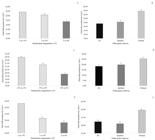
Mean values of total bulb productivity (t ha-1) at three vernalization temperatures (-1 to -3°C; 1 to 3°C; and 2 to 4°C) in Experiment I (A), Experiment II (C), and Experiment III (E), and for three noble garlic cultivars (Ito, Quitéria, and Chonan) (B) in Experiment I (B), Experiment II (D), and Experiment III (F). Cristalina, Goiás State, Brazil, 2019. Lowercase letters on the bars compare vernalization temperatures within each cultivar, and uppercase letters compare cultivars within each vernalization temperature.
In Experiment I, the highest average value was obtained when the bulbs were subjected to negative vernalization temperature, with increases of 1.33 and 2.7 t ha-1 compared to vernalization temperatures of 1 to 3°C and 2 to 4°C, respectively (Figure 8A). When comparing cultivars, the highest average value was obtained for the Chonan cultivar, with a productivity increase of 47 and 38% compared with the Ito and Quitéria cultivars, respectively (Figure 8B). Overall, in Experiment I, negative vernalization provided a greater yield of heavier bulbs and, consequently, better commercial classification, a trend observed in all cultivars, but most prominently in the Chonan cultivar.
In Experiment II, similar to what occurred in Experiment I, the highest average value for total bulb productivity was obtained when the bulbs were subjected to negative vernalization temperature, with weight gains of 1.12 and 2.59 t ha-1 compared to vernalization temperatures of 1 to 3°C and 2 to 4°C, respectively (Figure 8C). When comparing cultivars, the highest average value was obtained for the Chonan cultivar, with a productivity increase of 34 and 28.3 % compared with the Ito and Quitéria cultivars, respectively (Figure 8D).
Similar to the other experiments, in Experiment III, the Chonan cultivar stood out compared to the others when the bulbs were subjected to negative vernalization temperatures (Figure 8E and F).
As per the measurements taken in the cold chambers where the vernalization of garlic seeds from different cultivars was carried out, higher amounts of CO2 were observed in the chambers with higher vernalization temperatures (Table 2). This demonstrates that garlic seeds subjected to higher vernalization temperatures have a higher transpiration rate, which consequently leads to greater consumption of their reserves (Taiz & Zeiger, 2017).
Mean CO2 values in garlic seed storage chambers under different vernalization temperatures. Cristalina, Goiás State, Brazil, 2019.
According to Wu et al. (2015), most species of plants require vernalization temperatures between -1 to 10°C, as the effect of vernalization can increase the activity of the peroxidase (POD) and superoxide dismutase enzymes.
According to Dufoo-Hurtado et al. (2015), conditioning garlic bulbils at low temperatures for five weeks at 5°C affects different metabolic pathways and physiological processes. The affected physiological processes included cell growth, antioxidant/oxidative states, macromolecule transport, protein folding, and transcriptional regulation. These factors trigger fundamental metabolic pathways, including protein biosynthesis, quality control systems, photosynthesis, photorespiration, energy production, and carbohydrate and nucleotide metabolism.
Possible explanations for the favorable effect of negative vernalization temperature on productivity are related to inferences linked to garlic origin and its high demand for low temperatures. Visual observations indicated that garlic seedlings vernalized at negative temperatures exhibited less pronounced root differentiation when removed from the cold chamber than those vernalized at positive temperatures. This resulted in less damage to the root system during manual planting.
Furthermore, garlic vernalized at negative temperatures initially exhibited slower development, possibly due to less-developed roots. However, between 45 and 60 days after planting, the plants had equal or greater aboveground development than plants vernalized at positive temperatures.
In the current experiment, the average bulb productivity in classes 5-7 and the total were positively influenced by negative vernalization temperatures for all cultivars. These averages were significantly higher than the national average productivity of 13 t ha-1. Similarly, Luz et al. (2022) achieved high productivity with the Ito cultivar in 2018 using negative vernalization temperatures.
Additionally, vernalization led to a reduction in the average productivity of industry-grade bulbs by 3.18 t ha-1 from Experiments I to III, along with an increase in the average productivity of bulbs in classes 5-7 by 2.6 t ha-1 from Experiment I to II and by over 6 t ha-1 from Experiment I to III. The increase in the productivity of bulbs in classes 5-7 was also accompanied by a significant rise in the total commercial bulb productivity, increasing by 4 % from Experiment I to II and by 14 % from Experiments I to III.
It can be observed that the productivity of noble garlic cultivars in Brazil are strongly influenced by photoperiod and ambient temperatures (Taiz & Zeiger, 2017). The late-maturing Chonan cultivar responded most positively in terms of increased productivity in the higher commercial value classes with a reduced vernalization temperature. According to Lucidos et al. (2014), low temperatures in garlic bulbil treatment can affect plant growth regulators, which can subsequently lead to early plant emergence and rapid growth, ultimately resulting in optimal development and vigor.
However, cultivars exhibited distinct characteristics with respect to their low-temperature requirements for maximum genetic expression, which aligns with the findings of Azmi et al. (2022). They evaluated the effects of temperature and vernalization duration on garlic clones in Indonesia and reported diverse responses when bulbs were vernalized at temperatures of 0, 5, or 10°C for 20, 40, or 60 days. This indicates that the duration of the storage period and vernalization temperature had different effects on garlic plant responses. Thus, environmental factors have both immediate and long-term effects at each developmental stage (Dufoo-Hurtado et al., 2015).
According to Michael et al. (2018), garlic bulb production has been studied in a wide range of climates, highlighting that production is influenced not only by the genetic composition of the cultivar but also by its phenotypic expression in different storage and cultivation environments. This is evident in the current experiment, where in Experiment I, the Ito garlic cultivar exhibited higher productivity in classes 2-4 when bulbs were vernalized at a temperature of 2 to 4°C, while in Experiment III, it was higher when vernalized at -1 to -3°C. According to Lopes et al. (2016), negative vernalization temperatures also result in larger bulbs that better meet consumer demand. Therefore, both bulb size and number of bulbils are essential considerations in garlic marketing, as larger bulbs command higher prices.
As reported by Luz et al. (2022), Brazil can reduce its garlic imports by increasing production, and the adoption of vernalization using negative temperatures allows producers to expand planting areas and production. Vernalization using negative temperatures is a pioneering technique that provides opportunities for other countries with edaphoclimatic conditions similar to those of the Brazilian Cerrado to become garlic producers.
Conclusion
In conclusion, the Chonan cultivar stands out from the other cultivars. Negative vernalization temperatures increased productivity in higher commercial value classes (classes 5-7 and 8), reduced productivity in lower commercial value classes (classes 2-4), and increased total productivity.
Data availability
Not applicable.
References
-
Azmi, C., Rosliani, R., Handayani, D. P., Jayanti, H., Liferdi, L. & Palupi, E. R.. (2022). Temperature and duration of vernalization effect on the vegetative growth of garlic (Allium sativum L. ) clones in Indonesia. Open Agriculture, 7(1), 520-528. https://doi.org/10.1515/opag-2022-0114
» https://doi.org/https://doi.org/10.1515/opag-2022-0114 -
Bangerth, F.. (2000). Abcission of thinning of young fruit and their regulation by hormones and bioregulators. Plant Growth Regulation, 31, 43-59. https://doi.org/10.1023/A:1006398513703
» https://doi.org/https://doi.org/10.1023/A:1006398513703 -
Dufoo-Hurtado, M. D., Huerta-Ocampo, J. A, Barrera-Pacheco, A., Rosa, A. P. B. & Mercado-Silva, E. M.. (2015). Low temperature conditioning of garlic (Allium sativum L. ) “seed” cloves induces alterations in sprouts proteome. Frontiers in Plant Science, 6(332), 1-15. https://doi.org/10.3389/fpls.2015.00332
» https://doi.org/https://doi.org/10.3389/fpls.2015.00332 -
Longhi, C. N., Wilpert, L. S. & Bosco, L. C.. (2019). Filocrono de alho nobre cultivado sob influência da vernalização. Agrometeoros, 27(1), 209-216. https://doi.org/10.31062/agrom.v27i1.26581
» https://doi.org/https://doi.org/10.31062/agrom.v27i1.26581 -
Lopes, W. A. R., Negreiros, M. Z., Resende, F. V., Lucena, R. R. M., Soares, A. M., Silva, O. M. P. & Medeiros, J. F.. (2016). Garlic production depending on vernalization periods and planting times in semiarid climate region. Horticultura Brasileira, 34(2), 249-256. https://doi.org/10.1590/S0102-053620160000200016
» https://doi.org/https://doi.org/10.1590/S0102-053620160000200016 -
Lucidos, J. G., Younis, A., Hwang, Y. J., Son, B. G. & Lim, K. B.. (2014). Determination of optimum conditions for breaking bulb dormancy in relation to growth and flowering in Lilium hansonii. Horticulture, Environment and Biotechnology, 55, 257-262. https://doi.org/10.1007/s13580-014-0143-1
» https://doi.org/https://doi.org/10.1007/s13580-014-0143-1 -
Luz, J. M. Q., Azevedo, B. N. R., Silva, S. M., Oliveira, C. I. G., Oliveira, T. G., Oliveira, R. C. & Castoldi, R.. (2022). Productivity and quality of garlic produced using below-zero temperatures when treating seed cloves. Horticulturae, 8(2), 1-12. https://doi.org/10.3390/horticulturae8020096
» https://doi.org/https://doi.org/10.3390/horticulturae8020096 -
Luz, J. M. Q., Oliveira, C. I. G., Silva, S. M., Oliveira, T. G. & Castoldi, R.. (2023). Vernalization temperature and maturation point of seed cloves on garlic production and quality. Ciência e Agrotecnologia, 47, 1-13. https://doi.org/10.1590/1413-7054202347015122
» https://doi.org/https://doi.org/10.1590/1413-7054202347015122 -
Mazzuco, V. R., Torres Júnior, C. C. & Botelho, G. R.. (2023). Fluorescent Pseudomonas spp. and Bacillus spp. for phosphate solubilization and growth promotion of garlic. Pesquisa Agropecuária Tropical, 53, 1-8. https://doi.org/10.1590/1983-40632023v5375301
» https://doi.org/https://doi.org/10.1590/1983-40632023v5375301 -
Michael, T. B., Shemesh-Mayer, E., Kimhi, S., Gershberg, C., Forer, I., Rabinowitch, H. D. & Goldstein, R. K.. (2018). Temporal and spatial effect of low pre-planting temperatures on plant architecture and flowering in bolting garlic. Scientia Horticulturae, 242, 69-75. https://doi.org/10.1016/j.scienta.2018.07.025
» https://doi.org/https://doi.org/10.1016/j.scienta.2018.07.025 - Mota, J. H., Yuri, J. E. & Resende, G. M.. (2014). Produção de alho no estado de Goiás. Nosso Alho, 19, 46-48.
-
R Core Team. (2023). R: A language and environment for statistical computing. R Foundation for Statistical Computing. http://www.R-project.org/
» http://www.R-project.org/ - Reghin, M. Y. & Kimoto, T.. (1998). Dormência, vernalização e produção de alho após diferentes tratamentos de frigorificação de bulbilhos sementes. Horticultura Brasileira, 16(1), 73-79.
-
Siswadi, E., Putri, S. U., Firgiyanto, R. & Putri, C. F.. (2019). Peningkatan pertumbuhan dan produksi bawang putih (Allium sativum L. ) melalui aplikasi vernalisasi dan pemberian BAP (benzyl amino purin). Agrovigor: Jurnal Agroekoteknologi, 12(2), 53-58. https://doi.org/10.21107/agrovigor.v12i2.5419
» https://doi.org/https://doi.org/10.21107/agrovigor.v12i2.5419 - Souza, R. J. (2009). Cultura do alho: tecnologias modernas de produção. UFLA.
- Taiz, L. & Zeiger, E. (2017). Fisiologia e desenvolvimento vegetal. ARTMED.
- Teixeira, P. C., Donagemma, G. K., Fontana, A. & Teixeira, W. G. (2017). Manual de métodos de análise de solo (3. ed.). Embrapa.
-
Wu, C., Wang, M., Dong, Y., Cheng, Z. & Meng, H.. (2015). Growth, bolting and yield of garlic (Allium sativum L. ) in response to clove chilling treatment. Scientia Horticulturae, 194, 43-52. https://doi.org/10.1016/j.scienta.2015.07.01
» https://doi.org/https://doi.org/10.1016/j.scienta.2015.07.01