 Sewage sludge in the production of chrysanthemum (Dendranthema grandiflora) and petunia (petunia x hybrida) seedlings
ABSTRACT.
Sewage sludge generated from wastewater treatment plants is an environmental and economic liability that burdens not only waste management companies, but the society at large, because it causes environmental damage. Therefore, this study aimed to seek an alternative to the destination of this sludge, such as using it as a substrate to produce chrysanthemum (Dendranthema grandiflora) and petúnia (petunia x hybrid) seedlings. The sludge was collected at CASAN, Florianópolis (SC-Brazil), and subjected to solar drying for later application in proportions of 0, 5, 10, and 25%, together with soil collected from the Ressacada Farm Experimental Station, and used as inoculum for arbuscular mycorrhizal fungi. The parameters used in the analyses were plant height (cm), root length (cm), production of aerial part dry matter, production of root dry matter (g), nitrogen content in the aerial part (g kg-1), nitrogen accumulation in the aerial part (mg plant-1), phosphorus content in the aerial part (g kg-1), phosphorus accumulation in the aerial part (mg plant -1), soil arbuscular mycorrhizal fungi spore count (in 50 cm of soil), mycorrhizal colonization (%), and pH of the substrate (pre- and post-treatment). The study showed that solar drying is an efficient method of eliminating pathogens, and the sludge was classified as proper for agricultural application. The results showed that the best dosages of sludge for the growth of chrysanthemum and petunia varied from 5 to 13%, and 13 to 18%, respectively. These concentrations provided the best yield for all variables tested, except mycorrhizal colonization and spore counting that decreased as the sludge concentration increased.
Keywords:
biosolids; cultivation; substrate; arbuscular mycorrhizal fungi; innovation
Introduction
Sewage sludge, a residue from treatment plants, is a material rich in organic matter (Abreu, et al., 2019) and its end-use includes sanitary landfill, which burdens sanitation companies. According to the National Solid Waste Management Information System (Brasil, 2020a), 64% of the waste was sent to landfills, 12% to dumps or controlled landfills, and 24% to unspecified treatments.
Since sewage sludge is rich in pathogens capable of disrupting ecosystem balance, the use of this material as an agricultural substrate requires adherence to the criteria defined by the Brasil (2020b) Resolution 498/2020. One of these recommendations is the sanitation process, which aims to make sewage sludge safe both for plants and for those handling it. One method of sanitation is solar drying, a technique that not only utilizes renewable energy (Chen et al., 2014) but also reduces pathogens (An-Nori et al., 2021) and results in a significant decrease in the volume of the treated material (Collard et al., 2017), thereby reducing costs related to transportation, handling, and storage.
Ornamental plants utilize sewage sludge, as the diversity and range of climates and soils in Brazil allow for the cultivation of numerous flower and plant species. The floriculture industry in Brazil has become notably competitive in the market, spreading across the entire country and becoming a significant economic activity (Souza et al., 2020).
The use of sewage sludge as a substrate for cultivating ornamental plants was aimed at reducing production costs for small producers while providing an appropriate waste disposal method. The plants selected for this work were chrysanthemum (Dendranthema grandiflora) and petunia (petunia x hybrida). Consequent upon its various colors and lush inflorescence, chrysanthemum is among the most popular plants in Brazil (Carvalho et al., 2020). Petunia, on the other hand, is an ornamental plant used worldwide in landscaping projects, including ground cover in beds, pots, and planters, hence its importance to the Brazilian ornamental plant market (Stumpf et al., 2016).
Few studies have investigated the use of sewage sludge with these plants, and their behavior in relation to arbuscular mycorrhizal fungi (AMF), which makes this work relevant. AMF occurs widely in soils, promoting plant growth by absorbing nutrients from the soil and increasing their resistance (Trovato et al., 2024). Therefore, this study aimed to find an alternative to the disposal of sewage sludge, such as using it as a substrate in the production of chrysanthemum and petunia seedlings, applying different concentrations of this waste and sanitizing it through the technique of solar drying.
Material and methods
Experimental Setup
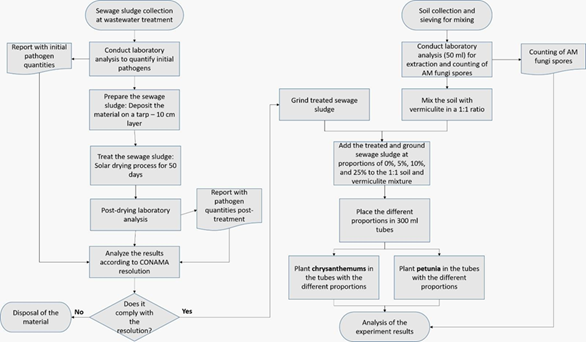
In this study, 500 liters of post-centrifuge sludge, with 80% moisture content, was collected at the anaerobic treatment station of the Companhia Catarinense de Águas e Saneamento (CASAN), located in Canasvieiras, Florianópolis, Santa Catarina State, Brazil, (27º35'48" S and 48º32'57" W). The material was spread in a 10 cm layer, over a dark plastic sheet and left under those conditions of solar drying for 50 consecutive days, exposed to daily sunlight for 8 hours and stirred weekly. Before and after solar drying, sludge samples were analyzed for the quantification of total coliforms, E. coli, non-E. coli coliforms, viruses, Salmonella, and helminths. After the drying process, the sludge had a moisture content of 20% and was then ground using a Tecnal mill, model TE-680, with a 2 mm mesh.
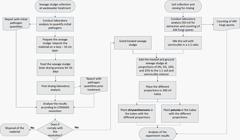
Concurrently, soil from the Fazenda Experimental da Ressacada (UFSC) located in the Tapera neighborhood of Florianópolis, Santa Catarina State, Brazil, was collected and sieved through a 4 mm mesh. According to the methodology described by Gerdemann and Nicholson (1963), a portion of this soil (50 mL) was separated for the extraction and counting of AMF spores. The trials were conducted in a greenhouse using a base substrate composed of a 1:1 (v/v) soil-vermiculite mixture. The sewage sludge treatments evaluated correspond to the proportions added to the base substrate, which were: 25, 10, 5, and 0% (control) of sewage sludge. A randomized block design was used with 30 replications, and the tubes (300 mL) were arranged on a grid stand. Figure 1 presents the logic used in the setup of the experiments.
For the planting of chrysanthemum, conducted in April 2014, apical cuttings with 4 to 5 expanded leaves and approximately 5 cm in length from the Chrystal White variety were used. For petunia, the planting was carried out in May 2014 using seeds from the Isla brand, with 5 seeds per tube.
The chrysanthemum experiment was conducted for over 96 days. During this period, the plants were irrigated daily with deionized water and did not receive any fertilization.
Petunia plant emergence occurred from the 8th day after sowing. On the fifteenth day, thinning was performed, leaving only one plant per tube. The experiment was concluded 115 days after its implementation. Like chrysanthemum, petunia was irrigated daily with deionized water until the substrate reached field capacity.
Evaluation of the experiments
At the end of each experiment, a 30-cm graduated ruler was used to measure the height of the aerial part of the plants. For dry matter determination, the aerial part was then separated from the root system and dried in an air-circulation oven at 55ºC for five days. The soil from each tube was removed simultaneously, and the roots were separated by washing in running water over a sieve with a 0.5 mm mesh. Thereafter, one gram of fine roots was collected, stored in capsules, and immersed in FAA solution (formalin-acetic acid-alcohol) for subsequent clarification and staining with Trypan Blue (Phillips & Hayman, 1970), intended for use in quantifying the mycorrhizal colonization rate (Giovannetti & Mosse, 1980). The remaining roots were dried in the oven under the same conditions as the aerial part. After drying, the material was weighed on an analytical balance to obtain the dry matter data for the aerial part (DMAP) and the root system (DMRS). The aerial part was then ground in a mill with 0.5 mm sieves, and the phosphorus and total nitrogen contents were determined according to the methodology described by Tedesco et al. (1995). From the foliar N and P contents, the accumulated amount of these nutrients in the aerial part was calculated along with its respective dry matter production.
A composite and homogeneous mixture of the substrate from each treatment was prepared for soil pH determination and for the extraction and counting of AMF spores, according to the methodology described by Gerdemann and Nicholson (1963).
All data obtained were subjected to analysis of variance, using a statistical program, to assess the statistical significance of the differences observed in the means. To assist in the interpretation of the data obtained and to evaluate the relationship between them, regression analyses were performed.
Results
The results of the analyses (Table 1) obtained from a composite sample of the collected material showed that the exposure time of the sewage to solar drying (50 days, for 8 hours daily) was effective in eliminating pathogens, thereby bringing the material from ETE Canasvieiras within the limits stipulated in the CONAMA Resolution 498/2020.
The chemical analyses results of the sewage sludge showed nitrogen, phosphorus, and potassium levels of 5.1 g kg-1, 35.7 g kg-1, and 3.33 cmolc dm-3, respectively. For organic carbon and organic matter, the values were 156.4 and 269.0 g kg-1, respectively. Also assessed were sodium (2 cmolc dm-3), sulfur (36.3 g kg-1), calcium (134.50 cmolc dm-3), magnesium (116.66 cmolc dm-3), and the pH of the water (6.1).
The average pH of the composite sample of sewage sludge and soil was 4.58, before the start of the experiments. After conducting the experiments, the average pH values were 4.90 for chrysanthemum and 4.91 for petunia.
Using the SISVAR statistical program, the data obtained were subjected to variance analysis (Ferreira, 2011). The results of this analysis have been presented in graphs, one graph for each parameter.
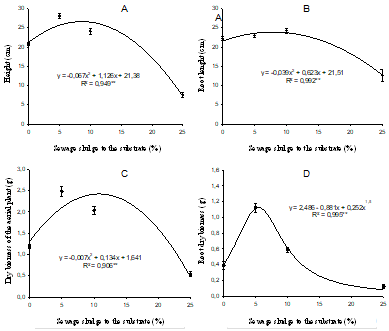
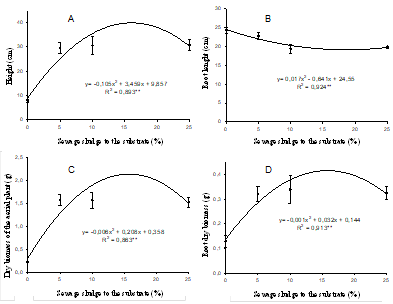
Regarding the chrysanthemum experiment, Figure 2 shows that height, dry matter of the aerial part (DMAP), and root length exhibited statistically significant differences among all treatments due to the increased concentration of sewage sludge in the substrate (Figure 2A, B, and C).
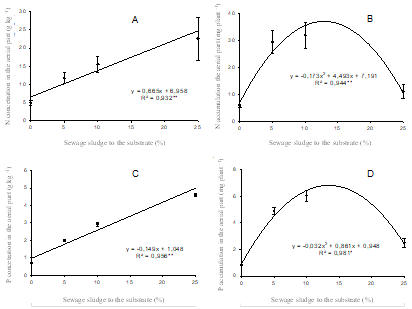
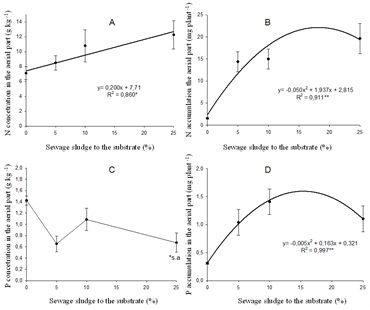
The greatest plant height and dry matter of the aerial part (DMAP) were achieved with 8% and 11% sewage sludge, respectively, while the greatest root length was achieved with 9% sewage sludge in the substrate. Regarding the dry matter of the root system (DMRS), statistical differences were found among all treatments, with higher values obtained at the 5% sewage sludge concentration (Figure 2D). Nitrogen and phosphorus levels exhibited a positive linear effect with increasing sewage sludge concentration in the substrate, with increments of 22.57 g kg-1 for nitrogen and 4.60 g kg-1 for phosphorus at the 25% sewage sludge doses (Figure 3A and C). Compared to the control, nitrogen and phosphorus levels increased by 370% and 570%, respectively. The accumulation of nitrogen and phosphorus exhibited a quadratic behavior with the increasing concentration of sewage sludge in the substrate, with the highest values obtained at the 12% sewage sludge concentration (Figure 3B and D). At the 25% concentration, low accumulation of N and P was observed. This result is due to the low dry matter production of the aerial part at that sewage sludge concentration.
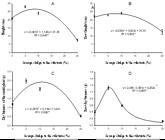
Growth of chrysanthemum (Dendranthema grandiflora) seedlings in substrate with different concentrations of sewage sludge. A) Plant height; B) Root length; C) Dry matter of the aerial part; and D) Dry matter of the root system. Vertical bars represent the standard error of the mean (n = 30). ** Significant at 1% probability.
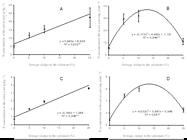
Nitrogen and phosphorus levels in chrysanthemum (Dendranthema grandiflora) seedlings in substrate with different concentrations of sewage sludge. A) Nitrogen content in the aerial part; B) Nitrogen accumulation in the aerial part; C) Phosphorus content in the aerial part; and D) Phosphorus accumulation in the aerial part. Vertical bars represent the standard error of the mean (n = 30). ** Significant at 1% probability. *** Significant at 5% probability.
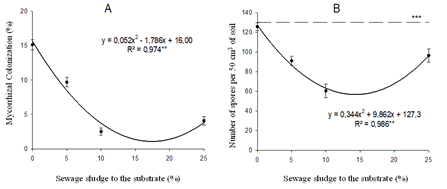
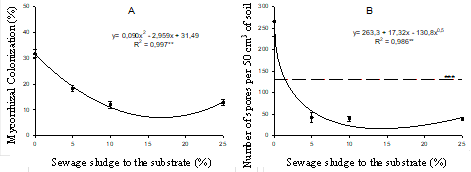
Compared to the control treatment, mycorrhizal colonization showed a 74% decline at the 25% sewage sludge concentration (Figure 4A). Regarding sporulation, there was a 4% reduction compared to the initial sporulation in the control treatment. The treatment with 10% sewage sludge showed the greatest reduction in sporulation compared to the control treatment, with a decrease of 52% (Figure 4B). During the experiment, chrysanthemum completed the cycle indicated by the supplier of the cuttings; however, there was no flowering in the cultivar used.
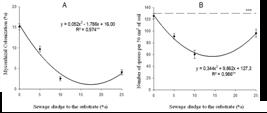
Mycorrhizal colonization (A) and number of spores (B) of arbuscular mycorrhizal fungi (AMF) in chrysanthemum (Dendranthema grandiflora) seedlings in substrate with different concentrations of sewage sludge. Vertical bars represent the standard error of the mean, n=30 for mycorrhizal colonization and n = 3 for the number of spores. *** Number of AMF spores present in the soil before applying the treatments. ** Significant at 1% probability.
Figure 5 shows that with increasing concentrations of sewage sludge in the substrate, factors such as plant height, dry matter of the aerial part (DMAP), root length, and dry matter of the root system (DMRS) for petunia exhibited a quadratic behavior. The greatest plant height and DMAP were achieved with 16 and 15% sewage sludge, respectively (Figure 5A and C). For root length and DMRS, the highest values were obtained with 13 and 15% sewage sludge in the substrate, respectively (Figure 5B and D).
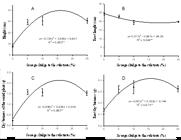
Growth of petunia (petunia x hybrida) seedlings in substrate with different concentrations of sewage sludge. A) Plant height; B) Root length; C) Dry matter of the aerial part; and D) Dry matter of the root system. Vertical bars represent the standard error of the mean (n = 30). ** Significant at 1% probability.
The nitrogen content showed a positive linear effect with increasing sewage sludge concentration in the substrate, an increment of 12.25 g kg-1 was recorded at 25% sewage sludge concentration. Compared to the control, the nitrogen content in the plants increased by 70% (Figure 6A). For phosphorus content, the results showed that the control treatment had the best result, with an average of 1.42 g kg-1 of P (Figure 6C), due to the small biomass production in that treatment.
The accumulation of nitrogen and phosphorus (Figure 6B and D) exhibited a quadratic behavior with increasing sewage sludge concentration in the substrate, and the highest values for nitrogen and phosphorus were recorded at 18 and 16% sewage sludge concentration, respectively. At the 25% concentration, low accumulation of N and P was observed. This result is due to the low dry matter production of the aerial part for that species.
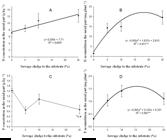
Nitrogen and phosphorus levels in petunia (petunia x hybrida) seedlings in substrate with different concentrations of sewage sludge. A) Nitrogen content in the aerial part; B) Nitrogen accumulation in the aerial part; C) Phosphorus content in the aerial part; and D) Phosphorus accumulation in the aerial part. Vertical bars represent the standard error of the mean (n = 30). ** Significant at 1% probability. *** Significant at 5% probability. *n. a. = not adjusted polynomially.
Regarding mycorrhizal colonization, the control treatment recorded the highest percentages of colonization (Figure 7B). Compared to the control treatment, the addition of 10% sewage sludge resulted in a 64% decrease in mycorrhizal colonization (Figure 7A). When petunia was cultivated without sewage sludge, sporulation increased by 103% compared to the initial values obtained for the soil used in the base substrate preparation (Figure 7B). However, there was an average reduction of 69% in initial sporulation, when sewage sludge was incorporated into the substrate.
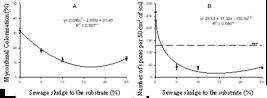
Mycorrhizal colonization (A) and number of spores (B) of arbuscular mycorrhizal fungi (AMF) in petunia (petunia x hybrida) seedlings in substrate with different concentrations of sewage sludge. Vertical bars represent the standard error of the mean, n = 30 for mycorrhizal colonization and n = 3 for the number of spores. *** Number of AMF spores present in the soil before applying the treatments. ** Significant at 1% probability.
Discussion
The disposal of sewage sludge for agricultural use is an efficient alternative for the proper disposal of this material, since chemical analyses results showed that the material contains trace elements below that permitted by the CONAMA Resolution 498/2020. Chemical analysis showed that the nitrogen content was 5.1 g kg-1, a value below the adequate leaf content for the development of chrysanthemum, which according to the Brazilian Society of Soil Science (Sociedade Brasileira de Ciência do Solo [SBCS], 2016) varies from 40 to 60 g kg-1. For petunia, the fertilization manual lacks specific recommendations for nitrogen and phosphorus. Notwithstanding, neither species showed any symptoms of deficiency of that element throughout the experiment.
Regarding phosphorus, the analysis showed a content of 35.7 g kg-1, and according to the Fertilization Manual, for chrysanthemums the recommended value varies between 2.5 and 10.0 g kg-1 (SBCS, 2016). In this study, phosphorus was apparently in excess in the sludge used, and could have interfered with the absorption of other nutritional elements, but no typical deficiencies of these elements were identified in the plants analyzed. In both experiments, a reduction in phosphorus content was observed as the sewage sludge concentrations increased.
According to Figure 2C, treatments with concentrations of 10 and 25% of sewage sludge satisfied the phosphorus needs of chrysanthemum. For petunias, this value is between 2 and 8 g kg-1. The maximum amount of phosphorus absorbed was identified in the control treatment (Figure 5C). Even with the increase in P supply through the addition of sludge, there was a reduction in phosphorus levels in the MSPA in petunia. This result, as with nitrogen, is related to the dilution effect. However, for chrysanthemum, as sludge concentrations increased, there was a decline in growth and MSPA production, i.e., a result influenced by the effect of P concentration in the plant.
The relationships between biomass, nitrogen, and phosphorus accumulation in crops depend on several physiological processes, including the absorption of these elements, crop growth rate, and the allocation of C and N among plant organs (Gastal & Lemaire, 2002). In this study, nitrogen and phosphorus accumulation followed the same trend as dry matter production in the aerial part of chrysanthemum and petunia (Figures 2B and D; 5B and D).
Regarding nitrogen and plant height, Soares et al. (2016), working with sunflowers using different doses of nitrogen and phosphorus, observed that plant height and capitulum diameter were unaffected by N doses, but obtained a linear and positive response for P2O5 doses. Almeida et al. (2014) studied different nitrogen doses in dragon fruit and observed that the application of increasing doses of N affects the root system and aerial part, influencing the initial growth of these plants. In chrysanthemum and petunia, there was an increase in the foliar nitrogen content as the doses of sewage sludge increased (Figures 2A and 5A), with a consequent decrease in plant growth (Figures 1A and 4A). These results represent the direct effect of the concentration of that element in the plants. Nitrogen is an element that influences plant development (Silva et al., 2024) and its deficiency can cause reduced growth and production (Batista et al., 2018). However, despite the low concentration of nitrogen in sewage sludge, there was availability of N for the plants. According to Costa et al. (2015), the rate of organic N mineralization is variable, mainly depending on temperature, soil moisture and microbial activity, and these losses can be minimized by incorporating biosolids into the soil, in which a large part of the ammonia will be retained by soil particles and converted to nitrate, with N remaining available. In addition, sewage sludge has long term benefits in the soil, due to the slow and constant release of nutrients with the decomposition of organic matter, making them available to microbial biomass for a longer time (Sayara et al., 2020).
Growth parameters such as shoot height, shoot dry mass, length and root system dry mass are the most commonly used to determine seedling quality standards. In chrysanthemums, the sewage sludge concentration that provided the best results for height was 8% and for root length, 9% (Figure 1A and B). For petunias, the concentration estimated as most suitable for stimulating plant height was 16% and for root length, 13% (Figure 4A and B). This difference identified for the two evaluated species may be related to the availability of nutrients, such as nitrogen, for example, which directly influences shoot development.
The reduction in mycorrhizal colonization (Figures 3A and 6A) can be attributed to the concentration of phosphorus found in the sewage sludge, since, according to Silva et al. (2018), this nutrient greatly influences mycorrhizal colonization. According to Moreira and Siqueira (2006), soils with high P levels promote sharp declines in colonization.
In turn, sporulation (Figures 3B and 6B) showed a proportional decline in this parameter as the sewage sludge levels in the substrate increased, with the exception of chrysanthemum, which in the treatment with 25% sludge presented a number of spores similar to the 4% concentration, as observed in Figure 3B. This result corroborates Moreira and Siqueira (2006), who emphasized that sporulation does not have a direct influence on the symbiont, but may be related to the degree of colonization and root extension. However, this behavior is not mandatory, as there is no direct relationship between the number of spores and mycorrhizal colonization (Boff et al., 2014).
In this study, the solar drying technique was used to eliminate pathogens, and it is known that disinfection by sunlight depends on light intensity and temperature (Saxena & Den, 2022; Koottatep et al., 2018). During the time in which the sewage sludge was subjected to solar drying, the average maximum temperature was 30.9°C, and the average minimum was 22.7°C. This temperature was effective in eliminating pathogens and is in line with Sweya et al. (2020), who found a 100% reduction in pathogens in Tanzania when the material was subjected to solar drying for 13 days in the dry season, and in the rainy season the exposure time was 42 days. These procedures allowed the sewage sludge used to be classified as class A, according to the CONAMA Resolution 498/2020. Thus, it is possible to conclude that for this work, solar drying is a viable alternative for disinfection of the sludge, enabling its use as a substrate for agronomic purposes.
Conclusion
Solar drying is an effective technique for eliminating pathogens present in domestic sewage sludge, making it suitable for use as a substrate for plant cultivation and it could serve as an alternative disposal method for this material. By reducing the health risks associated with raw sludge, this method enabled its safe application in agriculture, contributing to more sustainable waste management practices. This study successfully identified the potential of solar-dried sewage sludge to serve as a substrate in the production of chrysanthemum and petunia seedlings, using varying waste concentrations. The results indicated that optimal sludge concentrations differ between species, with 5% being ideal for chrysanthemums and 13% to 18% for petunias. These findings demonstrate that solar drying not only ensures the safe reuse of sewage sludge but also offers a sustainable alternative for its disposal, fulfilling the study’s objective of promoting environmentally responsible agricultural practices.
Data availability
The data resulting from this study are fully available in the body of the article.
References
-
Abreu, A. H. M., Alonso, J. M., Melo, L. A., Leles, P. S. & Santos, G. R.. (2019). Caracterização de biossólido e potencial de uso na produção de mudas de Schinus terebinthifolia Raddi. Engenharia Sanitaria e Ambiental, 24(3), 591-599. https://doi.org/10.1590/S1413-41522019108265
» https://doi.org/https://doi.org/10.1590/S1413-41522019108265 -
Almeida, E. I. B., Corrêa, M. C. M., Crisostomo, L. A., Araújo, N. A., & Silva, J. C. V.. (2014). Nitrogênio e potássio no crescimento de mudas de pitaia Revista Brasileira de Fruticultura, 36(4), 1018-1027. https://doi.org/10.1590/0100-2945-296/13
» https://doi.org/https://doi.org/10.1590/0100-2945-296/13 -
An-Nori, A., El Fels, L., Ezzariai, A., El Hayani, B., El Mejahed, K, El Gharous, M. & Hafidi, M.. (2021). Effectiveness of helminth egg reduction by solar drying and liming of sewage sludge. Environmental Science and Pollution Research, 28(11), 14080-14091. https://doi.org/10.1007/s11356-020-11619-w
» https://doi.org/https://doi.org/10.1007/s11356-020-11619-w -
Batista, M. A., Inoue, T. T., Esper Neto, M. & Muniz, A. S. (2018). Princípios de fertilidade do solo, adubação e nutrição mineral. In J. U. T. Brandão Filho, P. S. L. Freitas, L. O. S. Berian & R. Goto (Orgs.), Hortaliças-fruto. (pp. 113-162). Eduem. https://doi.org/10.7476/9786586383010.0006
» https://doi.org/https://doi.org/10.7476/9786586383010.0006 - Boff, V. L., Mello, A. H. & Maneschy, R. Q.. (2014). Fungos micorrízicos arbusculares em mudas de paricá: Colonização, dependência e relações com o desenvolvimento das plantas. Enciclopédia Biosfera, 10(18), 1824-1831.
-
Brasil. Ministério do Meio Ambiente. (2020a). Sistema nacional de informações sobre a gestão dos resíduos sólidos. https://sinir.gov.br/
» https://sinir.gov.br/ - Brasil. Ministério do Meio Ambiente. Conselho Nacional do Meio Ambiente (2020b). Resolução nº 498 de 19 de agosto de 2020. Define critérios e procedimentos, para produção e aplicação de biossólido em solos e dá outras providências. Conselho Nacional do Meio Ambiente.
-
Carvalho, C. R. V., Santos, M. N. S. & Mapeli, A. M.. (2020). Morphophysiological characterization of leaves and inflorescences of commercial mini chrysanthemum varieties. Ornamental Horticulture, 26(2), 277-282. https://doi.org/10.1590/2447-536X.v26i2.2054
» https://doi.org/https://doi.org/10.1590/2447-536X.v26i2.2054 -
Chen, Y., Yu, F., Liang, S., Wang, Z., Liu, Z. & Xiong, Y.. (2014). Utilization of solar energy in sewage sludge composting: fertilizer effect and application. Waste Management, 34(11), 2014-2021. https://doi.org/10.1016/j.wasman.2014.06.029
» https://doi.org/https://doi.org/10.1016/j.wasman.2014.06.029 -
Collard, M., Teychené, B. & Lemée, L. (2017). Comparison of three different wastewater sludge and their respective drying processes: solar, thermal and reed beds - impact on organic matter characteristics. Journal of Environmental Management, 203(Part 2), 760-767. https://doi.org/10.1016/j.jenvman.2016.05.070
» https://doi.org/https://doi.org/10.1016/j.jenvman.2016.05.070 - Costa, A. F. S., Costa, A. N., Caetano, L. C. S. & Maia, F. G. (2015). Disposição do lodo de ETE no solo e seu efeito na produção agrícola. In A. N. Costa & A. F. S. Costa (Orgs.), Manual de uso agrícola e disposição do lodo de esgoto para o estado do Espírito Santo. (pp. 38-44). Incaper.
-
Ferreira, D. F.. (2011). Sisvar: a computer statistical analysis system. Ciência e Agrotecnologia, 35(6), 1039-1042. https://doi.org/10.1590/S1413-70542011000600001
» https://doi.org/https://doi.org/10.1590/S1413-70542011000600001 -
Gastal, F. & Lemaire, G.. (2002). Nitrogen uptake and distribution in crops: an agronomical and ecophysiological perspective. Journal of Experimental Botany, 53(370), 789-799. https://doi.org/10.1093/jexbot/53.370.789
» https://doi.org/https://doi.org/10.1093/jexbot/53.370.789 -
Gerdemann, J. W. & Nicholson, T. H.. (1963). Spores of mycorrhizal Endogone species extracted from soil by wet sieving and decanting. Transactions of the British Mycological Society, 46(2), 235-244. https://doi.org/10.1016/S0007-1536(63)80079-0
» https://doi.org/https://doi.org/10.1016/S0007-1536(63)80079-0 -
Giovannetti, M. & Mosse, B.. (1980). An evaluation of techniques for measuring vesicular arbuscular mycorrhizal infection in roots. The New Phytologist, 84(3), 489-500. http://www.jstor.org/stable/2432123
» https://doi.org/http://www.jstor.org/stable/2432123 -
Koottatep, T., Chapagain, S. K., Polprasert, C., Panuvatvanich, A. & Ahn, K.. (2018). Sanitation Situations in selected Southeast Asian countries and application of innovative technologies. Environment, Development and Sustainability, 20, 495-506. https://doi.org/10.1007/s10668-016-9892-6
» https://doi.org/https://doi.org/10.1007/s10668-016-9892-6 - Moreira, F. M. S. & Siqueira, J. O. (2006). Microbiologia e bioquímica do solo. UFLA.
-
Phillips, J. M. & Hayman, D. S.. (1970). Improved procedures for clearing roots and staining parasitic and vesicular-arbuscular mycorrhizal fungi for rapid assessment of infection. Transactions of the British Mycological Society, 55(1), 158-161. https://doi.org/10.1016/S0007-1536(70)80110-3
» https://doi.org/https://doi.org/10.1016/S0007-1536(70)80110-3 -
Saxena, S. & Den, W.. (2022). In situ treatment technologies for pit latrines to mitigate groundwater contamination by fecal pathogens: a review of recent technical advances. Journal of Water, Sanitation and Hygiene for Development, 12(1), 102-115. https://doi.org/10.2166/washdev.2021.184
» https://doi.org/https://doi.org/10.2166/washdev.2021.184 -
Sayara, T., Basheer-Salimia, R., Hawamde, F. & Sanchez, A.. (2020). Recycling of organic wastes throug composting: process performance and compost application in agriculture. Agronomy, 10(11), 1-23. https://doi.org/10.3390/agronomy10111838
» https://doi.org/https://doi.org/10.3390/agronomy10111838 -
Silva, E. N., Tavares, A. T., Silva, C. P., Ferreira, T. A., Carline, J. V. G. & Nascimento, I. R.. (2018). Fungos micorrízicos arbusculares e doses de fósforo no desenvolvimento de mudas de guanandi. Nativa, 6(3), 246-251. https://doi.org/10.31413/nativa.v6i3.4720
» https://doi.org/https://doi.org/10.31413/nativa.v6i3.4720 -
Silva, M. H., Silva, M. A. A., Duarte, E. R., Bonett, R. A. T., Paludetto, A. & Miyashiro, C. F.. (2024). A relação do nitrogênio com o desenvolvimento das plantas e suas formas de disponibilidade. Revista Cientifica Multidisciplinar, 5(1), 1-9. https://doi.org/10.47820/recima21.v5i1.4762
» https://doi.org/https://doi.org/10.47820/recima21.v5i1.4762 -
Soares, L. E., Emereciano Neto, J. V., Silva, G. G. C., Oliveira, E. M. M., Bezerra, M. G. S., Santos, T. J. A. & Difante, G. S.. (2016). Crescimento e produtividade do girassol sob doses de nitrogênio e fósforo. Revista Brasileira de Agropecuária Sustentável, 6(2), 19-25. https://doi.org/10.21206/rbas.v6i2.326
» https://doi.org/https://doi.org/10.21206/rbas.v6i2.326 - Sociedade Brasileira de Ciência do Solo (2016). Manual de adubação e calagem para os Estados do Rio Grande do Sul e Santa Catarina (11. ed.). SBCS-NRS.
-
Souza, J. N. C., Diniz, J. W. M., Silva, F. A. O. & Almeida, N. D. R.. (2020). Economic overview of ornamental flowers and plants in Brazil. Scientific Eletronic Archives, 13(5), 96-102. https://doi.org/10.36560/1352020943
» https://doi.org/https://doi.org/10.36560/1352020943 - Stumpf, E. R. T., Barbieri, R. L. & Heiden, G. (2016). Cores e formas no Bioma Pampa: plantas ornamentais nativas. Embrapa Clima Temperado.
-
Sweya, L. N., Asce, M. & Mgana, S. M. (2020). Disinfection of fecal sludge using solar thermal water heating: sludge management option for developing countries. Journal of Environmental Engineering, 146(12). https://doi.org/10.1061/(ASCE)EE.1943-7870.0001828
» https://doi.org/https://doi.org/10.1061/(ASCE)EE.1943-7870.0001828 - Tedesco, M. J., Gianello, C., Bissani, C. A., Bohnen, H. & Volkweiss, S. J. (1995). Análise de solo, plantas e outros materiais (Boletim Técnico de Solos, nº 5). Departamento de Solos da Universidade Federal do Rio Grande do Sul.
-
Trovato, V., Souza, G. G., Santos, S. C., Carvalho, L. G. V., Medeiros, E. S., Biazattia, R. M., Santos, C. C., Toralesa, E. P., Carvalho, R. L. & Santos, V. C.. (2024). Arbuscular mycorrhizal fungi, phosphorus and organic residues in Peltophorum dubium (Spreng.) Taub. Seedlings. Brazilian Journal of Biology, 84, 1-10. https://doi.org/10.1590/1519-6984.276160
» https://doi.org/https://doi.org/10.1590/1519-6984.276160
Edited by
-
Associate Editor in charge:
Alessandro Lucca BracciniCarlos Alberto Scapim