 Uniconazole in seed treatment modifies the early growth of maize
ABSTRACT.
In Brazil, corn crops are frequently affected by extreme temperatures and wide variation in water and radiation availability. These factors, coupled with the increasing incidence of pests and diseases and different management practices, limit crop yield. Alternatives that provide increased resilience in plants are of paramount importance, such as the use of growth regulators. This study aimed to investigate the effect of uniconazole (UCZ) applied to corn seeds on the germination, and growth of the shoot and root system at the initial stage of plant development. The experiments consisted of evaluating UCZ doses (0, 50, 100, 150, and 200 mg kg−1 seed) applied to seeds on the viability and vigor of seedlings. Moreover, the effect of UCZ doses on growth and biomass accumulation, root system morphology, contents of chloroplast pigments and nutrients, and leaf reflectance in plants grown up to the V4 stage was also evaluated. UCZ treatment on seeds promoted a delay in the germination process with increasing doses, also leading to a reduction in the shoot size and biomass without an influence on the root system. Vigor assessment showed that increasing UCZ doses applied to the seeds promoted reduction in the shoot size and biomass without changing germination. Plants grown in a greenhouse had inhibition of the initial shoot growth, with the height becoming uniform over time, regardless of the UCZ dose. Root data revealed that increasing the UCZ dose promoted an increase in root length and area with a reduction in diameter. Changes in chlorophyll a and b contents were also detected, in addition to the light absorption capacity depending on the UCZ dose. Seed treatment with UCZ at doses of 100 and 150 mg kg−1 seeds increased Fe, Si, K, Co, Ca, Mg, S, and Na contents in young plants. Lately, UCZ benefited the growth and development of young corn plants.
Keywords:
Zea mays; triazole; chlorophyll; root system; growth regulator
Introduction
Brazil’s corn production represents around 10% of world production (USDA, 2024) and is concentrated in areas of succession with soybean cultivation (Nóia Junior & Sentelhas, 2019). The occurrence of substantial variations in temperature and water and radiation availability are frequent in these corn growing areas, especially in the offseason (second crop corn) in Western Paraná, which, when associated with the occurrence of pests and diseases and different management practices, limit grain production (Andrea et al., 2018). Therefore, alternatives to mitigate adverse effects by modifying the growth and development pattern of plants are of paramount importance.
Seed treatment has been an effective alternative to the application of synthetic or natural compounds, which results in increased seedling uniformity and vigor, leading to greater plant resilience to abiotic stresses (Campobenedetto et al., 2020). Furthermore, the application of these compounds to seeds has relatively low costs, as it requires a single treatment and often leads to prolonged protection (Savvides et al., 2016).
Uniconazole (UCZ), belonging to the triazole group, is a growth regulator that acts to block the gibberellins (GA) biosynthesis route, with changes in the plant’s metabolism, including reduction in branch elongation and reduction in internodes (Saito et al., 2006), increased chlorophyll accumulation (Ahmad et al., 2018; Liu et al., 2015; Dembocurski et al., 2022), and delayed leaf senescence (Ahmad et al., 2018; Wang et al., 2016). In terms of importance for corn cultivation, the use of UCZ in seed treatment has been associated with mitigating the effects caused by water stress (Ahmad et al., 2018), in addition to promoting an increase in starch levels and grain production (Dembocurski et al., 2022).
Considering the increase in productivity of corn hybrid plants observed by Dembocurski et al. (2022) with the application of UCZ doses, studies highlighting probable morphological and/or physiological changes in the early stages of corn development are urgent. Song et al. (2008) found that treating soybean seeds with UCZ promoted a reduction in germination and seedling growth with an increase in the activity of antioxidant enzymes. Recently, Zhou et al. (2022) confirmed an increase in the antioxidant activity of UCZ, with results showing that this substance promotes reduced damage to organelles in soybeans subjected to water stress in the cotyledonary stage.
Jiang et al. (2023) reported that UCZ application in wheat seeds promoted improvement in growth parameters, the maintenance of the integrity of cell membranes, an increase in the activity of antioxidant enzymes, and the production of osmoregulatory compounds under water stress, in addition to beneficial changes in the content of chloroplast pigments and the expression of genes related to photosynthesis. Zhou et al. (2021) applied UCZ via foliar at the V3 stage of Vigna radiata found an increase in the conditions required for photosynthesis, such as stomatal conductance and transpiration, in addition to promoting an increase in water and nutrient absorption with a change in the distribution of roots in different soil layers.
Considering that UCZ promotes an increase in chlorophyll contents (Liu et al., 2015; Ahmad et al., 2018; Dembocurski et al., 2022; Jiang et al., 2023) and adverse climate conditions can lead to destruction of these pigments (Sidhu et al., 2017), the use of spectral signature modification can be an efficient strategy for verifying the physiological response of plants to stress (Estrada et al., 2023). Therefore, the use of spectrum radiometers, equipped with hyperspectral sensors capable of measuring the reflectance of targets in bands of approximately 10 nm, can meet this demand (Martins & Trindade-Galo, 2015).
This study aims to verify the effect of uniconazole on the germination and growth of the shoot and root system of corn plants at the vegetative stage.
Material and methods
This study consisted of carrying out experiments at the Laboratory of Agricultural Products Quality Control (LACON) and a greenhouse, belonging to the Western Paraná State University (UNIOESTE), Campus of Cascavel, Paraná State, Brazil.
The single corn hybrid MSG1001 (MaisGenes Sementes LTDA, Toledo, Paraná State, Brazil) from a commercial lot with high vigor (96%), which was determined by the accelerated aging test (Brasil, 2009) to verify the physiological seed quality, was used in the experiment.
Seeds of the hybrid were treated with the growth regulator uniconazole (New Sunshine (Xiangtan) Agrochemical Co. Ltd.) (5% Uniconazole) at doses ranging from 0 to 200 mg kg−1 seed through application followed by homogenization in plastic bags with a capacity of 3 kg. After treatment, the seeds were maintained at a temperature of 25°C for 12 hours to completely dry the UCZ.
Seed viability
Germination tests on paper rolls were conducted in the first experiment (EXP1) by treating the seeds with UCZ at doses 0 (control), 50, 100, and 150 mg kg−1, and a dose of 200 mg kg−1 was added in the second experiment (EXP2). The experimental design was completely randomized with four replications. The experimental unit consisted of two paper rolls containing 50 seeds each.
After treatment, the seeds were placed between double sheets of previously moistened germitest paper, following the recommendation of the Rules for Seed Testing - RAS (Brasil, 2009). The seeds in the paper rolls were incubated in a BOD chamber set at 25°C under a 24-hour photoperiod for one week.
The first evaluation was conducted 4 days after incubation for the percentage of germinated seeds (%G4). Moreover, the percentage of germination (%G7), seedling size (SS), root length (RL), shoot dry mass (SDM), root dry mass (RDM), and total seedling dry mass (TDM) were determined at the end of a week.
Seed vigor
Seeds were treated with uniconazole (0, 50, 100, 150, and 200 mg kg−1) for 12 hours, followed by an accelerated aging test, according to the methodology described by Bittencourt and Vieira (2006). The germination test (EXP3) was conducted after the aging period, using the methodology described by RAS (Brasil, 2009).
The experimental design was completely randomized, consisting of five treatments and four replications. The experimental unit consisted of two paper rolls containing 50 seeds, totaling one hundred seeds.
The experiment was evaluated by determining the percentage of seed germination at 4 and 7 days after incubation in the BOD and the variables seedling size (SS), root length (RL), shoot dry mass (SDM), root dry mass (RDM), and total seedling dry mass (TDM).
Assessment of growth and development of plants grown
The seeds of the hybrid were subjected to treatment with uniconazole at concentrations of 0 (control), 50, 100, 150, and 200 mg kg−1 for 12 hours, followed by sowing 5 seeds per pot, with subsequent thinning to 2 plants pot-1 at 8 days after sowing (DAS). Nine-liter pots were filled with medium-grained sand and irrigated through a drip system.
The design of this experiment (EXP4) was completely randomized with five treatments and eight replications. The experimental unit consisted of a pot with two plants.
The drip system consisted of 6 lateral lines of Netafim™ microdrip with a nominal flow rate of 2 L h−1 at 100 kPa. Dripping was initially performed with a water depth of 7 mm (7 L m2) until the V1 phenological stage, as seedlings use only the seed reserves for their growth during this period (Fancelli, 2015). Dripping with a nutrient solution (fractional fertigation) started at stage V2, using fertilizers 7-11-27 (Plant-Prod) plus micronutrients and calcium nitrate (Haifa). The 7-11-27 formulation consists of nitrogen as nitrate (6.4%) and ammoniacal (0.6%), available phosphoric acid (11%), soluble phosphorus (4.8%), total potassium (49.4%), magnesium (Mg) (3.8%), chelated iron (Fe) (0.1%), chelated manganese (Mn) (0.085%), chelated zinc (Zn) (0.03%), chelated copper (Cu) (0.004%), boron (B) (0.027%), molybdenum (Mo) (0.009%), and DTPA (chelating agent) (0.700%). The other formulation was calcium nitrate with total nitrogen (N) (15.5%), calcium oxide (CaO) (26.5%), and Ca (19%). Thus, 12.5 g of each formulation was used to prepare the nutrient solution, and the electrical conductivity was determined using a bench conductivity meter (Tecnal), adjusting the solution to 1,500 µS cm−1. Fertigation was performed alternately, that is, one day with the application of nutrient solution and the next day with water until the V4 stage when the plants were harvested.
Assessment of experimental variables
A weekly assessment of plant height was conducted in each of the sampling units. Leaf discs were collected at 20 DAS to determine the chloroplast pigment content and read the leaf tissue spectral information. For this, leaf discs (9.14 mm in diameter per disc and 65.61 mm2 in area per disc) were obtained from leaves representing stages V2, V3, and V4, totaling four leaf discs per experimental unit, with eight replications per treatment. After collection, the discs were immediately inserted into a test tube with 10 mL of ethanol and incubated in a water bath at 25°C for 24 hours. Chlorophyll a and b and carotenoids were quantified using a spectrophotometer (Tecnal Metash Uv-5100 UV/VIS) at absorbances of 664.2, 648.6, and 470 nm, according to Equations 2, 3, and 4, expressions developed by Lichtenthaler (1987).
The spectral information of leaves V2, V3, and V4 from plants belonging to the different treatments was collected using the FieldSpec4 sensor model Standard - Res (Analytical Spectral Devices Inc. [ASD], 2015, Boulder, CO, USA), which operates between wavelengths (λ) from 350 nm to 2500 nm. The equipment has a spectral resolution of 3 nm for readings taken in the visible and near-infrared and 10 nm for readings in the short-wave infrared, with the capacity to take a reading every 0.2 (ASD, 2015). Spectral readings were obtained non-destructively using the ASD Leaf Clip accessory, with eight replications per treatment, with each repetition consisting of the mean of the triplicate. Reflectance curves were generated from the data for each treatment and evaluated corn leaf, and the vegetation indices NDVI (Normalized Difference Vegetation Index - Rouse Jr et al., 1974) and NDRE (Normalized Difference Red Edge - Barnes et al., 2000) were used to assess potential changes in the plants' physiological states.
The experiment was dismantled at 21 DAS, and the plants from six replications were evaluated for the following variables: shoot height (SH), measured from the ground to the plant apex; root length (RL), measured from the bottom of the plant collar to the end of the root system; total plant length (TPL), obtained by the sum of SH and RL; and stem diameter (SD), measured at 1cm relative to the ground level using a digital caliper.
The root (RDM), shoot (SDM), and total (TDM) dry masses were obtained for eight replications per treatment. The samples were dried using a forced-air circulation oven at 65°C, ground using a Willey mill, and subjected to macro-and micronutrient analyses.
The root system morphology was determined using the WinRhizo Pro 2007 image analysis system (Arsenault et al., 1995). The following variables were obtained: root length (RL) (cm), total projected root area (PRA) (cm2), and mean root diameter (MD) (mm).
Statistical analysis
The results were initially analyzed for normality and homogeneity of variances of errors. Subsequently, the variables that met the assumptions of the analysis of variance were subjected to analysis of variance for regression and/or Tukey’s test (p < 0.05). In addition, principal component analysis (PCA) and Pearson correlation coefficients were performed for the macro-and micronutrient contents of the plant tissue samples. All statistical analyses were performed using the computer programs R (R Core Team, 2021) and JAMOVI (The Jamovi Project, 2022).
Results and discussion
Seed viability and vigor
The results of the first experiment (EXP1; Table 1) revealed a statistically significant difference as determined by the F-test (p-value < 0.05) for the percentage of germination at 4 days (%G4), seedling size (SS), and root length (RL). Tukey’s test (p < 0.05) showed a delay in the germination process at 4 days after incubation (DAI) regardless of the tested UCZ concentration (50, 100, or 150 mg kg−1 seeds), which was reversed at 7 DAI. Seed treatment with UCZ resulted in a reduction in the mean length of the shoot and roots of corn seedlings, without changes in biomass accumulation (SDM, RDM, and TDM).
The gradual increase in doses from 0 to 200 mg UCZ kg−1 tested in the second experiment (EXP2) led to a reduction in seed viability at 4 and 7 DAI (Figure 1A and B), in addition to promoting a decrease in height (Figure 1C) and shoot dry mass (Figure 1D).
Seedlings grown from seeds treated with UCZ and subjected to the accelerated aging test (EXP3), which imposes restrictive environmental conditions on the seed, demonstrated a fit to a negative quadratic function (Figure 2A) for the percentage of germination at 4 DAI, with the minimum dose of 50 mg UCZ kg−1 showing a percentage of germination of 89.9%, approximately 4.6% lower than the control. However, no significant difference was observed between treatments at 7 days after incubation for the variable percentage of germination as a function of the UCZ dose (data not presented). These results suggest that UCZ promoted a delay in the germination process, without modifying the final percentage of germination.
Root length (RL) and root dry mass (RDM) were not associated with an increase in the UCZ doses tested in EXP2 and EXP3. However, the evaluation of shoot size (SS) as a function of the UCZ doses applied to the seeds showed a pronounced reduction in seedling height after 7 DAI in EXP2 (Figure 1C) and EXP3 (Figure 2B) from the first dose (50 mg UCZ kg−1 seeds), and regression equations with a negative quadratic behavior were fitted (Y = 6.253 − 0.02788x + 0.00008x2 and Y = 6879 − 0.03451x + 0.000110x2), respectively. Therefore, the application of 50 mg UCZ kg−1 of corn seeds, followed by the germination test in BOD led to a reduction of 1.19 cm (19%) in seedling length relative to the control, and 2.38 cm (38%) using 200 mg UCZ kg−1 of seeds. The accelerated aging test showed that the estimated reduction was 1.45 cm (21%) and 1.05 cm (36%) for doses of 50 and 200 mg UCZ kg−1 corn seeds.

Effect of UCZ doses (0 to 200 mg kg−1) applied to seeds incubated in a BOD (EXP2) for the percentage of germination at 4 (A) and 7 days after incubation (B), seedling size (C), and shoot dry mass (D) of the hybrid.

Effect of UCZ doses (0 to 200 mg kg−1) applied to seeds incubated in a BOD after accelerated aging test (EXP3) for the percentage of germination at 4 days (A), seedling size (B), and shoot dry mass (C) of the hybrid.
A negative quadratic regression equation with germination test data - EXP2 (Figure 1D) (Y = 0.2049 − 0.000418x + 0.000002x2) and a negative linear equation with accelerated aging test data - EXP3 (Figure 2C) (Y = 0.4032 − 0.000258x) were fitted for the variable shoot dry mass as a function of increasing uniconazole doses. The germination test estimated that the application of 50 mg UCZ kg−1 corn seeds led to a loss of 7.7% of biomass relative to the control, and 1.7% with the application of 200 mg UCZ kg−1 seeds (EXP2). The regression equation fitted based on data from the accelerated aging experiment allowed estimating a reduction of 3.2% in biomass for every 50 mg UCZ kg−1 corn seeds applied.
The results of the experiments conducted in the BOD suggest that the use of uniconazole promoted changes in metabolism, resulting in alterations in the germination and growth of seedlings. According to Saito et al. (2006), uniconazole is a growth retardant due to the inhibition of the biosynthesis of gibberellins, leading to an increase in endogenous ABA content. Thus, the data obtained in the present study suggest that the ABA (germination inhibitor) to gibberellin (promoter) ratio may have increased, causing a reduction in the activity of enzymes involved in germination, which prevents the mobilization of reserves and the vegetative growth of the embryo (Kang et al., 2015). It may have resulted in a delay in this process. Furthermore, cytokinins, a class of phytohormone synthesized predominantly in the meristematic tissue of the root system and translocated to the shoot, may be involved in the process of reducing seedling size due to its help in the transport of gibberellins to the endoderm (Singh & Roychoudhury, 2022). According to Rademacher (2000), the reduction in plant size growth is associated with an increase in cytokinin levels relative to gibberellins. A reduction in the shoot size and biomass was detected in the present study, suggesting a possible imbalance of phytohormones, with consequent modification in the initial seedling growth.
Biomass growth and accumulation
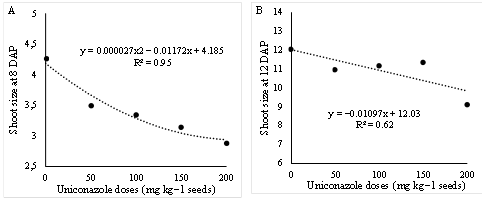
The results from plants grown in sand post-treatment with UCZ doses (EXP4) indicated that uniconazole affected plant development, delaying initial growth at 8 and 12 DAS (Figure 3). The UCZ action on plants presented a short-term effect, with no significant difference detected by the F-test between treatments for variables measured at 20 DAS, which include size and biomass accumulation of the shoot and root system. Dembocurski et al. (2022) also observed a reduction in the initial height of plants of the hybrid MSG1001 under field conditions, justified by the UCZ action as an inhibitor of the biosynthesis of gibberellins, which is the main phytohormone responsible for plant growth (Liu et al., 2015).

Effect of UCZ doses (0 to 200 mg kg−1 seeds) applied to seeds on the shoot size of plants grown in the sand at 8 (A) and 12 DAP (B).
A negative quadratic regression equation (Y = 4.185 − 0.01172x + 0.000027x²; Figure 3A) and a negative linear regression equation (Y=12.03 − 0.01097x; Figure 3B) were fitted for plant height at 8 and 12 DAP, respectively, as a function of increasing uniconazole doses. Plant height showed a mean reduction of 18% from the dose of 50 mg UCZ kg−1 seeds, reaching approximately 32% at the dose of 200 mg UCZ kg−1 seeds, compared to the control. Plants from seeds treated with 200 mg UCZ kg−1 showed a 24% reduction in size at 12 DAP compared to the control. However, the plants showed recovery in size at 20 DAP (25.64 ± 2.84 cm), demonstrating rapid development after 12 DAP, allowing comparison with the control.
Root system morphology
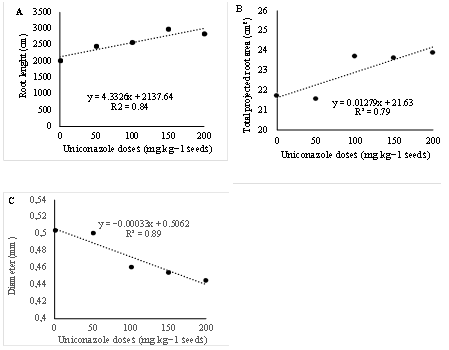
Root analysis conducted using the WinRhizo system has revealed significant correlation for root system in relation to uniconazole doses (Figure 4). Positive linear regression equations were fitted for the root length (RL) (Y = 2137.64 + 4.3326x; Figure 4A) and the total projected root area (PRA) (Y = 21.63 + 0.01279x; Figure 4B), indicating that increasing UCZ doses promotes an increase in these variables. In contrast, the variable mean root diameter (MD) fitted a negative linear regression equation (Y = 0.5082 − 0.000330x; Figure 4C), that is, increasing UCZ doses promotes the formation of thinner roots.

Effect of UCZ doses on total root length (TL) (A), total projected root area (cm²) (PRA) (B), and mean root diameter (MD) (C).
The study of root system, determined by the WinRHIZO system, revealed an increase in length with higher uniconazole doses, as illustrated in Figure 4A. Zhou et al. (2022) found that leaf application of UCZ in Vigna radiata at stage V3 promoted a reduction in root biomass in the superficial layer (0-20 cm), with an increase between 20 and 60 cm. Furthermore, the authors observed thinning of the main root and an increase in lateral roots with increasing soil depth, thus increasing the surface in contact with the soil for the absorption of water and minerals, increasing yield components.
Chloroplast pigment content and reflectance
The results of the regression analysis of variance showed only an association between UCZ doses and the chlorophyll a and b contents extracted from leaf discs of the fourth true leaf (V4), and regression equations with positive linear effect were fitted for chlorophyll a (Y= 10.15 + 0.006353x; Figure 5A) and chlorophyll b (Y = 1.561 + 0.002401; Figure 5B). Dembocurski et al. (2022) found that treating corn seeds with 100 mg UCZ kg−1 seeds promoted an increase in chlorophyll contents, similar to that obtained in the present study. Ahmad et al. (2021) evaluated the effects of UCZ and nitrogen fertilization on corn plants grown under high populations and obtained an increase in chlorophyll content with increasing leaf area and delayed senescence. In addition, they found an increase in stomatal conductance, transpiration, and net photosynthetic rate.

Effect of UCZ doses on chlorophyll a and b contents of the fourth true leaf (V4) of plants grown in the sand.
The increase in leaf chlorophyll contents detected in the present study can be justified by the ability of UCZ to promote cytokinin biosynthesis due to the blockage of the gibberellin biosynthetic pathway (Zhang et al., 2007), which results in chloroplast biogenesis and the synthesis of these photosynthetic pigments (Cortleven & Schmülling, 2015). In this context, UCZ may promote a reduction in the rate of chlorophyll degradation, increase the activity of antioxidant system enzymes (Zhang et al., 2007), and improve photosynthetic parameters (Ahmad et al., 2021), important factors that can help explain the increased productivity of the maize hybrid observed by Dembocurski et al. (2022), which was used in this study.
Photosynthetic pigments have a differential capacity to absorb light at different wavelengths, which allows for inferring the state of the plant through reflectance analysis (Yendrek et al., 2017; Wang et al., 2020). In this context, the spectral signatures of leaf tissues were initially evaluated, and no visual differences were observed. However, significant associations were observed for the NDRE index as a function of UCZ doses, with red-edge band at 740 nm (Figure 6).
The regression analysis using the NDRE index, which represents the inflection point in the transition region from red to near-infrared - redEdge, revealed a linear increase in the index as a function of increasing UCZ doses in leaves V2 (Y = 0.06454 + 0.000071x; Figure 6A), V3 (Y = 0.06856 + 0.000057x; Figure 6B), and V4 (Y = 0.06338 + 0.000033; Figure 6C). These results show that UCZ doses promote changes in the plant to influence the reflectance of light in the leaf tissue. Different indicators of plant health have been documented in the literature. In fact, chlorophyll content (Brewer et al., 2022; Pavlovic et al., 2015) and vegetation indices such as NDRE, which includes red-edge and NIR regions, have been used to predict chlorophyll content and infer plant health (Brewer et al., 2022). Therefore, the increase in NDRE indices estimated for V2, V3, and V4 leaves in the present study enables us to suggest that there is an increase in chlorophyll content, which can increase the plant’s resilience to adverse conditions.

NDRE vegetation indices (740 nm) of the second (A), third (B), and fourth (C) leaves of plants from seeds treated with uniconazole doses.
Mineral composition of leaf tissue
Plant mineral composition, which was determined at 20 DAP (Table 2), revealed small variations between the treatment means, showing no correlation with UCZ doses applied to the seeds. However, the multivariate principal components technique, which has also been used for studies of plant mineral nutrition (Dube et al., 2019), detected modifications between treatments and contributions to the analyzed variables.
The biplot analysis shows that the first two principal components (PC1 and PC2) explain approximately 80% of the total variation available (Figure 7), with a wide distribution from T2 to T5 relative to the control (T1). Regarding the control, plants resulting from the seed treatment with UCZ at doses of 100 and 150 mg kg−1 seeds (T3 to T4) increased Fe, Si, K, Co, Ca, Mg, S, and Na contents. Therefore, plants from different UCZ doses may show differential behavior regarding the accumulation of minerals in tissues.
The data obtained for nutrient content, associated with the verification of changes in the root system morphology, leaf chlorophyll content, and vegetation indices, suggests an effect of UCZ doses on the physiology of young corn plants. Therefore, considering the results found for young plants, a UCZ dose between 100 and 150 mg kg−1 seeds is recommended. Dembocurski et al. (2022) evaluated the application of 50 and 100 UCZ mg kg−1 in seeds of this same hybrid and observed an increase in productivity and starch content. However, Ahmad et al. (2018) found that the use of 75 UCZ mg kg-1 resulted in a decrease in maximum seed weight, as well as in maximum and mean seed filling rates. Therefore, it is suggested to conduct a supplementary experiment using 150 mg UCZ kg−1 in seeds be conducted to verify the influence of this growth retardant on adult plants and its influence on yield components.

Biplot dispersion of treatments based on scores and factor loadings for the studied variables, using principal components analysis.
Macro-and micronutrient contents of corn plants at 20 DAP and Pearson correlation estimates (r).
Conclusion
Uniconazole treatment delays seed germination after 7 days of incubation at 25°C and reduces shoot size and biomass without affecting the root system. Seeds exposed to higher uniconazole doses and accelerated aging tests show reduced shoot size and biomass but maintain germination rates. Increased uniconazole doses initially inhibit shoot growth in sand-grown plants, but plant height normalizes over time, regardless of the dose. Reflectance data indicate that uniconazole treatments alter leaf tissue light absorption, varying with the growth regulator dose. Uniconazole alters the mineral content of leaf tissues in young plants, increasing Fe, Si, K, Co, Ca, Mg, S, and Na levels at 100 and 150 mg kg−1 doses.
References
-
Ahmad, I. Ahmad, S. Kamran, M. Yang, X. N. Hou, F. J. Yang, B. P. DING, R. X. Han, Q. F.(2021). Uniconazole and nitrogen fertilization trigger photosynthesis and chlorophyll fluorescence, and delay leaf senescence in maize at a high population density. Photosynthetica, 59(1), 192-202. https://doi.org/10.32615/ps.2021.011
» https://doi.org/https://doi.org/10.32615/ps.2021.011 -
Ahmad, I. Kamran, M. Ali, S. Cai, T. Bilegjargal, B. Liu, T. Han, Q.(2018). Seed filling in maize and hormones crosstalk regulated by exogenous application of uniconazole in semiarid regions. Environmental Science and Pollution Research, 25, 33225-33239. https://doi.org/10.1007/s11356-018-3235-0
» https://doi.org/https://doi.org/10.1007/s11356-018-3235-0 -
Andrea, M. C. D. S. Boote, K. J. Sentelhas, P. C. Romanelli, T. L.(2018). Variability and limitations of maize production in Brazil: Potential yield, water-limited yield and yield gaps. Agricultural Systems, 165, 264-273. https://doi.org/10.1016/j.agsy.2018.07.004
» https://doi.org/https://doi.org/10.1016/j.agsy.2018.07.004 - Arsenault, J. L. Poulcur, S. Messier, C. Guay, R.(1995). WinRHlZO™, a root-measuring system with a unique overlap correction method. HortScience, 30(4), 906-906
- Analytical Spectral Devices Inc. [ASD]. (2015). FieldSpec4 Boulder. Malvern Panalytical a Spectris Company.
- Barnes, E. M. Clarke, T. R. Richards, S. E. Colaizzi, P. D. Haberland, J. Kostrzewski, M. Waller, P. Choi, C. Riley, E. Thompson, T. Lascano, R. J. Li, H. Moran, M. S.(2000). Coincident detection of crop water stress, nitrogen status and canopy density using ground based multispectral data. In Proceedings of the Fifth International Conference on Precision Agriculture, 1-15. American Society of Agronomy; Crop Science Society of America; Soil Science Society of America
-
Bittencourt, S. R. M. D. Vieira, R. D.(2006). Temperatura e período de exposição de sementes de milho no teste de envelhecimento acelerado. Revista Brasileira de Sementes, 28(3), 161-168. https://doi.org/10.1590/S0101-31222006000300023
» https://doi.org/https://doi.org/10.1590/S0101-31222006000300023 -
Brasil. Secretaria Nacional de Defesa Agropecuária, Ministério da Agricultura e Reforma Agrária. (2009). Regras para análise de sementes https://www.gov.br/agricultura/pt-br/assuntos/insumos-agropecuarios/arquivos-publicacoes-insumos/2946_regras_analise_sementes.pdf
» https://www.gov.br/agricultura/pt-br/assuntos/insumos-agropecuarios/arquivos-publicacoes-insumos/2946_regras_analise_sementes.pdf -
Brewer, K. Clulow, A. Sibanda, M. Gokool, S. Naiken, V. Mabhaudhi, T.(2022). Predicting the chlorophyll content of maize over phenotyping as a proxy for crop health in smallholder farming systems. Remote Sensing, 14(3), 1-20. https://doi.org/10.3390/rs14030518
» https://doi.org/https://doi.org/10.3390/rs14030518 -
Campobenedetto, C. Grange, E. Mannino, G. Van Arkel, J. Beekwilder, J. Karlova, R. Garabello, C. Contartese, V. Bertea, C. M.(2020). A biostimulant seed treatment improved heat stress tolerance during cucumber seed germination by acting on the antioxidant system and glyoxylate cycle. Frontiers in Plant Science, 11(836), 1-12. https://doi.org/10.3389/fpls.2020.00836
» https://doi.org/https://doi.org/10.3389/fpls.2020.00836 -
Cortleven, A. Schmülling, T.(2015). Regulation of chloroplast development and function by cytokinin. Journal of Experimental Botany, 66(16), 4999-5013. https://doi.org/10.1093/jxb/erv132
» https://doi.org/https://doi.org/10.1093/jxb/erv132 -
Dembocurski, D. Disner, E. C. Schuelter, A. R. Souza, I. R. P. Coelho, S. R. M. Christ, D.(2022). Use of uniconazole in growth regulation and biochemical changes in maize. Revista Brasileira de Milho e Sorgo, 21(1246), 1-21. https://doi.org/10.18512/rbms2022v21e1246
» https://doi.org/https://doi.org/10.18512/rbms2022v21e1246 -
Dube, S. P. Marais, D. Mavengahama, S. Van Jaarsveld, C. M. Gerrano, A. S.(2019). Variability in leaf mineral content of Corchorus accessions in South Africa. Research on Crops, 20(1), 121-128. http://doi.org/10.31830/2348-7542.2019.017
» https://doi.org/http://doi.org/10.31830/2348-7542.2019.017 -
Estrada, F. Flexas, J. Araus, J. L. Mora-Poblete, F. Gonzalez-Talice, J. Castillo, D. Matus, I. A. Mendez-Espinoza, A. M. Garriga, M. Araya-Riquelme, C. Douthe, C. Castillo, B. del Pozo, A. Lobos, G. A.(2023). Exploring plant responses to abiotic stress by contrasting spectral signature changes. Frontiers in Plant Science, 13, 1-17. https://doi.org/10.3389/fpls.2022.1026323
» https://doi.org/https://doi.org/10.3389/fpls.2022.1026323 - Fancelli, A. L.(2015). Manejo baseado na fenologia aumenta eficiência de insumos e produtividade. Visão Agrícola, 13(1), 24-29
-
Jiang, Y. Rong, H. Wang, Q. Lu, Y. Li, N. Li, W. Li, M. Xie, T. Wang, S. Zhao, H. Cao, Y. Qian, Y.(2023). Exogenous uniconazole application positively regulates carbon metabolism under drought stress in wheat seedlings. Agronomy, 14(1), 1-21. https://doi.org/10.3390/agronomy14010022
» https://doi.org/https://doi.org/10.3390/agronomy14010022 -
Kang, J. Yim, S. Choi, H. Kim, A. Lee, K. P. Lopez-Molina, L. Martinoia, E. Lee, Y.(2015). Abscisic acid transporters cooperate to control seed germination. Nature Communications, 6(8113), 1-10. https://doi.org/10.1038/ncomms9113
» https://doi.org/https://doi.org/10.1038/ncomms9113 -
Lichtenthaler, H. K.(1987). Chlorophylls and carotenoids: pigments of photosynthetic biomembranes. Methods in Enzymology, 148, 350-382. https://doi.org/10.1016/0076-6879(87)48036-1
» https://doi.org/https://doi.org/10.1016/0076-6879(87)48036-1 -
Liu, Y. Fang, Y. Huang, M. Jin, Y. Sun, J. Tao, X. Zhang, G. He, K. Zhao, Y. Zhao, H.(2015). Uniconazole-induced starch accumulation in the bioenergy crop duckweed (Landoltia punctata) I: transcriptome alterations of pathways involved in carbohydrate metabolism and endogenous hormone crosstalk. Biotechnology for Biofuels, 8(57), 1-12. https://doi.org/10.1186/s13068-015-0246-7
» https://doi.org/https://doi.org/10.1186/s13068-015-0246-7 -
Martins, G. D. Galo, M. L. B. T.(2015). Caracterização espectral da cana-de-açúcar infectada por nematoides e migdolus fryanus por espectrorradiometria de campo. BCG. Boletim de Ciências Geodésicas, 21(4), 783-796. https://doi.org/10.1590/S1982-21702015000400046
» https://doi.org/https://doi.org/10.1590/S1982-21702015000400046 -
Nóia Júnior, R. S. Sentelhas, P. C.(2019). Soybean-maize off-season double crop system in Brazil as affected by El Niño Southern Oscillation phases. Agricultural Systems, 173, 254-267. https://doi.org/10.1016/j.agsy.2019.03.012
» https://doi.org/https://doi.org/10.1016/j.agsy.2019.03.012 -
Pavlovic, D. Nikolic, B. Djurovic, S. Waisi, H. Andjelkovic, A. Marisavljevic, D.(2015). Chlorophyll as a measure of plant health: Agroecological aspects. Pesticidi i Fitomedicina, 29(1), 21-34. https://doi.org/10.2298/PIF1401021P
» https://doi.org/https://doi.org/10.2298/PIF1401021P -
Rademacher, W.(2000). Growth retardants: effects on gibberellin biosynthesis and other metabolic pathways. Annual Review of Plant Biology, 51(1), 501-531. https://doi.org/10.1146/annurev.arplant.51.1.501
» https://doi.org/https://doi.org/10.1146/annurev.arplant.51.1.501 -
R Core Team. (2021). R: A language and environment for statistical computing R Foundation for Statistical Computing. https://www.R-project.org/
» https://www.R-project.org/ -
Rouse Jr, J. W., Haas, R. H., Deering, D. W., Schell, J. A., & Harlan, J. C. (1974). Monitoring the vernal advancement and retrogradation (green wave effect) of natural vegetation. NASA CR. https://ntrs.nasa.gov/citations/19750020419
» https://ntrs.nasa.gov/citations/19750020419 -
Saito, S. Okamoto, M. Shinoda, S. Kushiro, T. Koshiba, T. Kamiya, Y. Hirai, N. Todoroki, Y. Sakata, K. Nambara, E. Mizutani, M.(2006). A plant growth retardant, uniconazole, is a potent inhibitor of ABA catabolism in Arabidopsis. Bioscience, Biotechnology and Biochemistry, 70(7), 1731-1739. https://doi.org/10.1271/bbb.60077
» https://doi.org/https://doi.org/10.1271/bbb.60077 -
Savvides, A. Ali, S. Tester, M. Fotopoulos, V.(2016). Chemical priming of plants against multiple abiotic stresses: mission possible?. Trends in Plant Science, 21(4), 329-340. https://doi.org/10.1016/j.tplants.2015.11.003
» https://doi.org/https://doi.org/10.1016/j.tplants.2015.11.003 -
Sidhu, G. P. S. Singh, H. P. Batish, D. R. Kohli, R. K.(2017). Alterations in photosynthetic pigments, protein, and carbohydrate metabolism in a wild plant Coronopus didymus L. (Brassicaceae) under lead stress. Acta Physiologiae Plantarum, 39(176), 1-9. https://doi.org/10.1007/s11738-017-2476-8
» https://doi.org/https://doi.org/10.1007/s11738-017-2476-8 -
Singh, A., & Roychoudhury, A. (2022). Mechanism of crosstalk between cytokinin and gibberellin. In Auxins, cytokinins and gibberellins signaling in plants (pp. 77-90). Springer International Publishing. https://doi.org/10.1007/978-3-031-05427-3_4
» https://doi.org/https://doi.org/10.1007/978-3-031-05427-3_4 - Song, S. Feng, N. J. Zheng, D. F.(2008). Effect of seed soaking with uniconazole on germination and anti-oxidant enzyme of soybean. Soybean Science, 27, 250-259
-
The Jamovi Project. (2022). Jamovi - version 2.3 [Computer Software]. https://www.jamovi.org
» https://www.jamovi.org -
United States Department of Agriculture [USDA]. (2021). Foreign Agricultural Service. World agricultural production https://ipad.fas.usda.gov/cropexplorer/cropview/commodityView.aspx?cropid=0440000>
» https://ipad.fas.usda.gov/cropexplorer/cropview/commodityView.aspx?cropid=0440000> -
Wang, P. Lombi, E. Zhao, F. J. Kopittke, P. M.(2016). Nanotechnology: a new opportunity in plant sciences. Trends in Plant Science, 21(8), 699-712. https://doi.org/10.1016/j.tplants.2016.04.005
» https://doi.org/https://doi.org/10.1016/j.tplants.2016.04.005 -
Wang, Z. Chen, J. Fan, Y. Cheng, Y. Wu, X. Zhang, J. Wang, B. Wang, X. C. Yong, T. Liu, W. Liu, J. Du, J. Yang, W. Yang, F.(2020). Evaluating photosynthetic pigment contents of maize using UVE-PLS based on continuous wavelet transform. Computers and Electronics in Agriculture, 169, 105160. https://doi.org/10.1016/j.compag.2019.105160
» https://doi.org/https://doi.org/10.1016/j.compag.2019.105160 -
Yendrek, C. R. Tomaz, T. Montes, C. M. Cao, Y. Morse, A. M. Brown, P. J. McIntyre, L. M. Leakey, A. D. B. Ainsworth, E. A.(2017). High-throughput phenotyping of maize leaf physiological and biochemical traits using hyperspectral reflectance. Plant Physiology, 173(1), 614-626. https://doi.org/10.1104/pp.16.01447
» https://doi.org/https://doi.org/10.1104/pp.16.01447 -
Zhang, M. Duan, L. Tian, X. He, Z. Li, J. Wang, B. Li, Z.(2007). Uniconazole-induced tolerance of soybean to water deficit stress in relation to changes in photosynthesis, hormones and antioxidant system. Journal of Plant Physiology, 164(6), 709-717. https://doi.org/10.1016/j.jplph.2006.04.008
» https://doi.org/https://doi.org/10.1016/j.jplph.2006.04.008 -
Zhou, H. Zheng, D. Feng, N. Shen, X.(2022). Effects of uniconazole on leaves photosynthesis, root distribution and yield of mung bean (Vigna radiata). Journal of Plant Growth Regulation, 41(7), 2629-2637. https://doi.org/10.1007/s00344-021-10455-7
» https://doi.org/https://doi.org/10.1007/s00344-021-10455-7 -
Zhou, H. Liang, X. Feng, N. Zheng, D. Qi, D.(2021). Effect of uniconazole to soybean seed priming treatment under drought stress at VC stage. Ecotoxicology and Environmental Safety, 224, 1-13. https://doi.org/10.1016/j.ecoenv.2021.112619
» https://doi.org/https://doi.org/10.1016/j.ecoenv.2021.112619