 Long-term effects of cover crops and nitrogen on soil and grain yield in an Oxisol from southern Brazil
ABSTRACT.
Despite the improvements in soil properties and grain yield obtained by using cover crops, there is little information on their long-term effects and associated nitrogen topdressing fertilization on subsequent crops grown in the same field. Thus, this study aimed to determine the effects of cover crops and nitrogen topdressing fertilization on the soil chemical and physical properties and yield of subsequent grain crops over eight years. The experiment was conducted on soil classified as Oxisol in southern Brazil using a randomized block design in split plots, with five replications. The main plots were divided by winter cover crop (black oat (Avena strigosa Schreb), and pea (Pisum sativum ssp. arvense)), and the subplots had differing nitrogen topdressing application rates (0, 25, 50, 75, and 100 kg N ha−1) and summer grain crops (bean (Phaseolus vulgaris), maize (Zea mays L.), and soybean (Glycine max (L.) Merr.)). In March 2022, after the eighth year of crop rotation, samples were collected in 0-5, 5-10, 10-20, and 20-30 cm soil layers to determine the chemical properties and in 0-5, 5-10, 10-20, and 20-40 cm layers to determine the physical properties. The pH, phosphorus content, and organic matter values were not influenced by the cover crop. A higher soil potassium content was observed at depths of 0-5, 5-10, and 10-20 cm in oat. Oat also showed increased soil macroporosity compared to pea in the 20-30 cm layer. Pea only increased the grain yield in one season with bean and one season with maize. Nitrogen fertilization increased the yield in only some seasons, two seasons with bean and one season with maize. The results of this study can be used to guide cover crop management in no-tillage cropping systems to maximize the positive effects on soil quality.
Keywords:
Oxisol; cover crops; grain crops; soil quality
Introduction
Conservation tillage practices with cover crops and careful fertilizer management have improved the sustainability of farming systems (Tanaka et al., 2019). In these systems, the biomass from cover crops is left to cover and protect the soil and recycle nutrients back into the soil for the next crop (Calegari et al., 2013; Crusciol et al., 2015). Thus, cover crops reduce the need for fertilizers, particularly nitrogen (N). However, proper fertilization management in the subsequent crop requires an understanding of the cover crops involved (Momesso et al., 2022a).
Cover crop selection depends on the environment and subsequent crop demand. Various cover crops can be used as ground cover, with differences in residue quantity, quality, and rooting patterns (Hudek et al., 2022; Jabro et al., 2021; Ren et al., 2019). Residue quantity and quality influence the amount of nutrients released after residue decomposition (Momesso et al., 2019). However, differences in root morphology between cover crops affect nutrient cycling and soil physical properties (Rosolem et al., 2002).
Leguminous species have main roots with larger diameters and better soil penetration (Rosolem et al., 2002), providing larger diameter pores for subsequent root growth (Colombi et al., 2017). They have the advantage of biological N fixation and increase N in the soil (Chen et al., 2017; Colombi et al., 2017). In contrast, grasses have fibrous root systems that grow in deeper soil layers (Hudek et al., 2022; Sarto et al., 2021) and have a high dry mass production capacity, a high carbon (C)/N ratio, and slow decomposition rates. Plant residue with a C/N ratio below 25 likely results in net N mineralization when returned to the soil, increasing N supply, as is the case in pea (Thapa et al., 2022). In contrast, oat residue with a C/N ratio higher than 25 is likely to result in net N immobilization (Radicetti et al., 2016). Slow grass residue decomposition increases the organic C content in the surface layer and protects the soil (Chen et al., 2017). However, grass decomposition can favor microbial N immobilization (Momesso et al., 2022b), affecting the nutritional dynamics of subsequent crops. Although the biomass and N of cover crop residues are returned to the soil, additional N application may be required to increase yield depending on the subsequent crop (Momesso et al., 2019).
The positive effects of cover crops on soil properties and crop yields have been previously reported (Blanco-Canqui & Ruis, 2018; Secco et al., 2023). However, information on the long-term effects of cover crops and N fertilization on subsequent crops remains scarce. In most studies, the effects of cover crops and N application rates have been evaluated for a single crop, such as cotton (Cordeiro et al., 2022; Nouri et al., 2020) or maize (Adeyemi et al., 2020; Perrone et al., 2020). Therefore, this study aimed to fill these research gaps by determining the effects of cover crops and N topdressing on the chemical and physical properties of the soil and yield of bean, maize, and soybean over eight years.
Material and methods
Site description
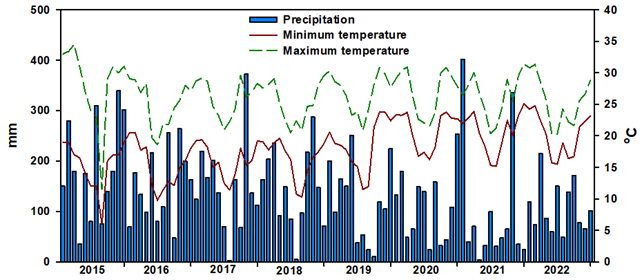
The experiment was conducted at the Rural Development Institute of Paraná, Experimental Station of Santa Tereza do Oeste, Paraná State, Brazil (53°22'25" W, 25°03'17" S, and 899 m a.s.l.). According to the Köppen classification, it has a humid subtropical climate (Cfa) with a monthly average temperature of 22°C in the hottest month and an annual precipitation of 1,800 mm. The mean temperatures and rainfall for the eight years of the study are provided in Figure 1.
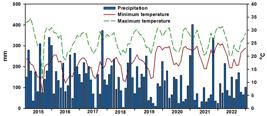
Precipitation and maximum and minimum temperature of the experimental area in 2015-2022. Source: Meteorological Station of Experimental Station of IAPAR, Santa Tereza do Oeste, Paraná State, Brazil.
The soil in the experimental area was classified as Oxisol according to U.S. Soil Taxonomy (Soil Survey Staff, 2014) and Red Latosol according to the Brazilian Soil Classification system (Santos et al., 2018), with 60% clay, 4% sand, and 36% silt in the top 20 cm. A no-tillage cultivation system was used. In 2014, soil samples were collected from the 0-20 cm layer of the experimental area before cover crop implementation. Chemical analysis of the soil (Empresa Brasileira de Pesquisa Agropecuária, 1997) revealed a pH (CaCl2) of 4.9, phosphorus (P) content (Mehlich-1) of 10 mg dm−3, C content of 32.5 g dm−3, calcium (Ca) content of 4.8 cmolc dm−3, magnesium (Mg) content of 2.0 cmolc dm−3, potassium (K) content of 0.50 cmolc dm−3, and 60% base saturation.
Experimental design and treatments
The treatments were organized into split plots in a 2 × 5 scheme. The main plots were split by winter cover crop (black oat (Avena strigosa Schreb), cultivar ‘IPR Cabocla’ and field pea (Pisum sativum ssp. arvense) cultivar ‘IPR 83’), and the subplots had differing N topdressing application rates (0, 25, 50, 75, and 100 kg N ha−1) and summer grain crops (bean (Phaseolus vulgaris), maize (Zea mays L.), and soybean (Glycine max (L.) Merr.)). The experimental design consisted of five randomized blocks.
Experimental units were 6 m long and 5 m wide. The row spacing was 90 cm with maize as the summer crop and 45 cm with bean and soybean. For bean and soybean, the 5 central rows were harvested, discarding 2.5 m from the ends, for a harvested area of 11.5 m2. For maize, the usable harvested area consisted of the 3 central rows of 6 m, excluding 1 m from the ends, totaling 13.5 m2.
Crop management
Winter cover crops were sown in the first half of June in 2015-2021. Desiccation occurred when cover crops were in full bloom. For chemical management, a systemic herbicide with glyphosate as the active ingredient at a dose of 4.0 L ha−1 + 0.3 L ha−1 of mineral oil was used.
Summer grain crops were sown in the first half of October in 2015-2021 (Table 1). Weeds, pests, and diseases were controlled according to the technical recommendations for each crop.
In 2018, before the implementation of the summer crop, lime was applied as 6 Mg ha-1 of dolomitic limestone under the surface, without incorporation. N topdressing fertilization (sub-plots) was applied manually once through broadcast using urea (45% N) without incorporation. For maize, N fertilization was applied when the plants had four completely developed leaves, and for soybean and bean, it was applied when the third trefoil was completely developed.
During cover crop desiccation, the dry matter production of the aerial part and macro- and micronutrient accumulation in the straw were determined. The average data are shown in Table 2.
Dry matter (DM) production of the aerial part and macro- and micronutrient accumulation (averaged by season) according to the cover crop.
Crop grain yield
Harvesting was performed during the physiological maturation stage. Soybean and bean were harvested mechanically using a harvester (Wintersteiger Classic). The ears of maize were manually harvested and subsequently threshed on a stationary threshing machine. The harvested grains were sent to the laboratory for cleaning, weighing, and moisture determination. The yield (kg ha−1) was calculated by correcting for a 13% moisture content.
Soil chemical analysis
In March 2022, soil samples were collected for chemical characterization at depths of 0-5, 5-10, 10-20, and 20-40 cm after maize harvest. Ten samples were collected from the useful area of each plot and combined to form a single sample per experimental plot. The soil samples were placed in paper boxes and dried in an oven at 60°C with forced air circulation for 12h. After drying, the samples were crushed in a hammer mill and passed through a 2-mm mesh sieve. Dried and sieved soil samples were chemically analyzed to determine the pH (CaCl2, 0.01 mol L−1), organic matter cotent (Walkley-Black), Ca and Mg (KCl, 1 mol L−1), and K and P (Mehlich-1), according to the methodology described by Pavan et al. (1992).
Soil physical properties
Soil physical properties (bulk density, macroporosity, microporosity, and total porosity) were measured in March 2022, after maize harvest. During collection, trenches were opened in each experimental plot, and undisturbed samples were collected in stainless steel volumetric rings with a volume of approximately 98 cm³ (5 cm in diameter and 5 cm in height) in 3 soil layers (0-10, 10-20, and 20-30 cm) using a pedological hammer and soil extractor. Undisturbed soil samples were saturated and subjected to a tension of 6 kPa on a sand column (Reinert & Reichert, 2006). The samples were then dried to a constant weight at 105°C to determine the soil bulk density (ρb), according to Blake and Hartge (1986). The total porosity (TP) was calculated from the soil bulk density and particle density (ρp) values (TP = 1−[ρb/ρp]). Microporosity was calculated based on a volumetric tension of 6 kPa, and macroporosity was calculated as the difference between TP and microporosity.
Statistical analyses
Data were subjected to analysis of variance. No interaction (p > 0.05) was observed between the cover crops and N for any of the evaluated variables. Therefore, the effects of cover crops and N were presented separately. The effect of winter cover was compared using the F-test at 5% significance, and the N rate was compared using regression analysis. The model was selected based on the significance of the coefficients of the adjusted regression equation and the values of the coefficient of determination (R²) associated with each regression model. Statistical analyses were performed using the Sisvar 5.6 statistical program (Statistical Analysis Software, UFLA, Lavras, Minas Gerais State, Brazil).
Results and discussion
Effects of cover crops
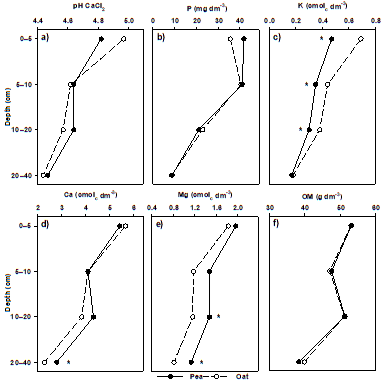
The soil contents of K, Ca, and Mg were significantly affected (p < 0.05) by cover crops. A higher K content was observed in oat plots compared to the pea plots at depths of 0-5, 5-10, and 10-20 cm (Figure 2c). Grasses more efficiently remove monovalent cations from soil by competing for binding sites, which may explain the higher K content in the surface layers of the soil observed with the use of black oat (Woodward et al., 1984). Pea showed higher Ca and Mg contents at a depth of 20-40 cm than oat (Figure 2d and e).
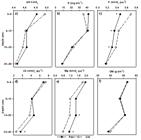
pH, P, K, Ca, Mg, and OM according to cover crop. *: significant difference by F test at p < 0.05.
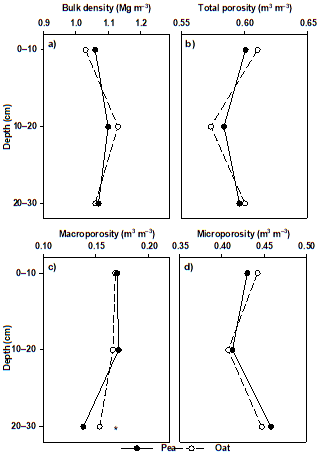
Cover crops did not significantly (p > 0.05) influence the soil bulk density, total porosity, or microporosity. The soil bulk density at all depths was 1.07 Mg m−3, demonstrating good soil management, below the critical level of 1.3 Mg m-3 established by Reichert et al. (2009) for Oxisol. A higher macroporosity was observed at a 20-30 cm soil depth with oat (0.15 m3 m−3) than with pea (0.14 m3 m-3; Figure 3). The improvement in macroporosity in the 20-30 cm layer was presumably due to the greater supply of above- and belowground biomass by oat. Aboveground biomass production protects aggregates from the impact of raindrops and reduces the loading pressure from agricultural machinery (Blanco-Canqui & Ruis, 2018; Keller et al., 2021; Secco et al., 2023), whereas root growth and the addition of organic waste are active sources of organic exudates, which are effective soil aggregation stabilizers (Acuna & Villamil, 2014).
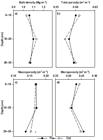
Soil bulk density, total porosity, microporosity, and microporosity according to cover crop. *: significant difference by F test at p < 0.05.
Roots affect the soil structure through several mechanisms, including the direct creation/modification of soil pores, increases in the soil organic C content, and root exudates (Colombi & Keller, 2019; Gregory, 2022). Zheng et al. (2023) found that the fine roots of grasses increased the penetration and entanglement of soil particles, positively affecting the soil structure. Grass roots also promote continuous and connected porosity (Ambus et al., 2023) and decay more quickly than legumes, releasing previously clogged pores (Chen et al., 2021).
The bean grain yield in 2015 and 2022 and maize yield in 2022 were higher (p < 0.05) following pea than oat (Table 3). These results may be explained by the low C/N ratio and faster decomposition of pea and the release of nutrients to bean and maize (Stein et al., 2023). According to Coombs et al. (2017), legume crops generally provide a higher maize yield because they promote a greater short-term N availability.
Effects of nitrogen rates
N application rates caused discrete variations in soil chemical and physical properties (data not shown). The Ca content was significantly influenced (p < 0.05) by the N application rate. Increasing N rates decreased the Ca content in the 0-5 cm layer from 6.5 to 4.8 cmolc dm−3 (Ca content = 6.2407 - 0.0141 × N rate). Increased Ca removal may have been due to increased crop yields during some seasons.
The soybean crop did not respond to N fertilization (Table 4). The absence of positive effects of N topdressing application on the soybean crop may be due to the amount of N available for the soybean crop. Biological N fixation in soybean is responsible for approximately 44-72% of the total N accumulated by plants (Ciampitti & Salvagiotti, 2018). Maize did not respond to N topdressing fertilization during the 2016 and 2019 harvests (Table 4). These results may have occurred because of the contributions of cover crops. N may provide a higher organic matter content to the soil in the experimental area, thus complementing the nutritional needs of maize.
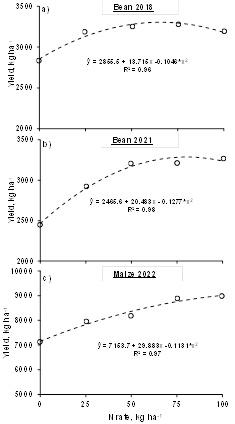
Bean yields in 2018 and 2021 and maize yields in 2022 were significantly influenced by the N application rate (p < 0.05). There was a positive quadratic effect of the N application rate on yield, and the maximum observed yields were 3305, 3287, and 9128 kg ha−1, respectively (Figure 4a-c). Based on the maximum yield, the rates of maximum economic efficiency were calculated, corresponding to the dose that caused 90% of the maximum yield; thus, the N rates of maximum economic efficiency were 9, 29, and 42 kg N ha−1 for bean (2018), bean (2021), and maize (2022), respectively.
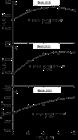
Bean yield in 2018 (a) and 2021 (b) and maize yield in 2022 (c) according to the nitrogen rate. * = significant at 5% probability according to the F test.
Conclusion
This study evaluated soil quality indicators and their effects on different cover crops and N rates on highly weathered clayey Oxisol soil in southern Brazil. The soil pH, P content, and organic matter content were not influenced by the cover crop, regardless of depth. A higher soil K content was observed in the surface layers of soil with oat. In contrast, higher Ca (20-40 cm) and Mg contents (10-20 and 20-40 cm) were observed for field pea. Oat cultivation increased the soil macroporosity in the 20-30 cm layer compared to pea cultivation. The effects of cover crops on crop yield varied by season, and there was a greater effect when pea was the cover crop. In addition, N topdressing application rates did not affects most of the chemical and physical attributes of the soil and increased crop yield in only three of the eight crops evaluated, two of which were bean and one was maize.
Data availability
The data that support the findings of this study are available from the corresponding author upon reasonable request.
Acknowledgements
This work was carried out with the support of the Coordination for the Improvement of Higher Education Personnel - Brazil (CAPES) - Financing Code 001, and for this reason the authors are grateful for the support
References
-
Acuña, J. C. M. & Villamil, M. B.. (2014). Short‐term effects of cover crops and compaction on soil properties and soybean production in Illinois. Agronomy Journal, 106(3), 860-870. https://doi.org/10.2134/agronj13.0370
» https://doi.org/https://doi.org/10.2134/agronj13.0370 -
Adeyemi, O., Keshavarz-Afshar, R., Jahanzad, E., Battaglia, M. L., Luo, Y. & Sadeghpour, A.. (2020). Effect of wheat cover crop and split nitrogen application on corn yield and nitrogen use efficiency. Agronomy, 10(8), 1-10. https://doi.org/10.3390/agronomy10081081
» https://doi.org/https://doi.org/10.3390/agronomy10081081 -
Ambus, J. V., Awe, G. O., Faccio Carvalho, P. C. & Reichert, J. M.. (2023). Integrated crop-livestock systems in lowlands with rice cultivation improve root environment and maintain soil structure and functioning. Soil and Tillage Research, 227, 105592. https://doi.org/10.1016/j.still.2022.105592
» https://doi.org/https://doi.org/10.1016/j.still.2022.105592 -
Blake, G. R. & Hartge, K. H. (1986). Bulk density. In A. Klute (Ed.), Methods of soil analysis: Part 1 Physical and mineralogical methods 5 (2nd ed.). (pp. 363-375). SSSA Book Series. https://doi.org/10.2136/sssabookser5.1.2ed.c13
» https://doi.org/https://doi.org/10.2136/sssabookser5.1.2ed.c13 -
Blanco-Canqui, H. & Ruis, S. J.. (2018). No-tillage and soil physical environment. Geoderma, 326, 164-200. https://doi.org/10.1016/j.geoderma.2018.03.011
» https://doi.org/https://doi.org/10.1016/j.geoderma.2018.03.011 -
Calegari, A., Tiecher, T., Hargrove, W. L., Ralisch, R., Tessier, D., Tourdonnet, S., Guimarães, M. F. & Santos, D. R.. (2013). Long-term effect of different soil management systems and winter crops on soil acidity and vertical distribution of nutrients in a Brazilian Oxisol. Soil and Tillage Research, 133, 32-39. https://doi.org/10.1016/j.still.2013.05.009
» https://doi.org/https://doi.org/10.1016/j.still.2013.05.009 -
Chen, H., Liu, Y., Lü, L., Yuan, L., Jia, J., Chen, X., Ma, J., Zhao, J., Liang, C., Xie, H., He, H., Zhang, X., Lu, C. & Chi, G.. (2021). Effects of no-tillage and stover mulching on the transformation and utilization of chemical fertilizer N in Northeast China. Soil and Tillage Research, 213, 105131. https://doi.org/10.1016/j.still.2021.105131
» https://doi.org/https://doi.org/10.1016/j.still.2021.105131 -
Chen, Z., Wang, H., Liu, X., Zhao, X., Lu, D., Zhou, J. & Li, C.. (2017). Changes in soil microbial community and organic carbon fractions under short-term straw return in a rice-wheat cropping system. Soil and Tillage Research, 165, 121-127. https://doi.org/10.1016/j.still.2016.07.018
» https://doi.org/https://doi.org/10.1016/j.still.2016.07.018 -
Ciampitti, I. A. & Salvagiotti, F.. (2018). New insights into soybean biological nitrogen fixation. Agronomy Journal, 110(4), 1185-1196. https://doi.org/10.2134/agronj2017.06.0348
» https://doi.org/https://doi.org/10.2134/agronj2017.06.0348 -
Colombi, T. & Keller, T.. (2019). Developing strategies to recover crop productivity after soil compaction-A plant eco-physiological perspective. Soil and Tillage Research, 191, 156-161. https://doi.org/10.1016/j.still.2019.04.008
» https://doi.org/https://doi.org/10.1016/j.still.2019.04.008 -
Colombi, T., Braun, S., Keller, T. & Walter, A.. (2017). Artificial macropores attract crop roots and enhance plant productivity on compacted soils. Science of the Total Environment, 574, 1283-1293. https://doi.org/10.1016/j.scitotenv.2016.07.194
» https://doi.org/https://doi.org/10.1016/j.scitotenv.2016.07.194 -
Coombs, C., Lauzon, J. D., Deen, B. & Van Eerd, L. L.. (2017). Legume cover crop management on nitrogen dynamics and yield in grain corn systems. Field Crops Research, 201, 75-85. https://doi.org/10.1016/j.fcr.2016.11.001
» https://doi.org/https://doi.org/10.1016/j.fcr.2016.11.001 -
Cordeiro, C. F. S., Rodrigues, D. R. & Echer, F. R.. (2022). Cover crops and controlled-release urea decrease need for mineral nitrogen fertilizer for cotton in sandy soil. Field Crops Research, 276, 108387. https://doi.org/10.1016/j.fcr.2021.108387
» https://doi.org/https://doi.org/10.1016/j.fcr.2021.108387 -
Crusciol, C. A. C., Nascente, A. S., Borghi, E., Soratto, R. P. & Martins, P. O.. (2015). Improving soil fertility and crop yield in a tropical region with palisadegrass cover crops. Agronomy Journal, 107(6), 2271-2280. https://doi.org/10.2134/agronj14.0603
» https://doi.org/https://doi.org/10.2134/agronj14.0603 - Empresa Brasileira de Pesquisa Agropecuária (1997). Manual of soil analysis methods (2nd ed.). Embrapa.
-
Gregory, P. J.. (2022). Russell Review are plant roots only “in” soil or are they “of” it? roots, soil formation and function. European Journal of Soil Science, 73(1), 1-25. https://doi.org/10.1111/ejss.13219
» https://doi.org/https://doi.org/10.1111/ejss.13219 -
Hudek, C., Putinica, C., Otten, W. & De Baets, S.. (2022). Functional root trait‐based classification of cover crops to improve soil physical properties. European Journal of Soil Science, 73(1), 1-16. https://doi.org/10.1111/ejss.13147
» https://doi.org/https://doi.org/10.1111/ejss.13147 -
Jabro, J. D., Allen, B. L., Rand, T., Dangi, S. R. & Campbell, J. W.. (2021). Effect of previous crop roots on soil compaction in 2 yr rotations under a no-tillage system. Land, 10(2), 202. https://doi.org/10.3390/land10020202
» https://doi.org/https://doi.org/10.3390/land10020202 -
Keller, T., Colombi, T., Ruiz, S., Schymanski, S. J., Weisskopf, P., Koestel, J., Sommer, M., Stadelmann, V., Breitenstein, D., Kirchgessner, N. & Or, D.. (2021). Soil structure recovery following compaction: Short‐term evolution of soil physical properties in a loamy soil. Soil Science Society of America Journal, 85(4), 1002-1020. https://doi.org/10.1002/saj2.20240
» https://doi.org/https://doi.org/10.1002/saj2.20240 -
Momesso, L., Crusciol, C. A. C., Bossolani, J. W., Moretti, L. G., Leite, M. F. A., Kowalchuk, G. A. & Kuramae, E. E.. (2022b). Toward more sustainable tropical agriculture with cover crops: Soil microbiome responses to nitrogen management. Soil and Tillage Research, 224, 1-12. https://doi.org/10.1016/j.still.2022.105507
» https://doi.org/https://doi.org/10.1016/j.still.2022.105507 -
Momesso, L., Crusciol, C. A. C., Cantarella, H., Tanaka, K. S., Kowalchuk, G. A. & Kuramae, E. E.. (2022a). Optimizing cover crop and fertilizer timing for high maize yield and nitrogen cycle control. Geoderma, 405, 1-13. https://doi.org/10.1016/j.geoderma.2021.115423
» https://doi.org/https://doi.org/10.1016/j.geoderma.2021.115423 -
Momesso, L., Crusciol, C. A.C., Soratto, R. P., Vyn, T. J., Tanaka, K. S., Costa, C. H. M., Ferrari Neto, J. & Cantarella, H.. (2019). Impacts of nitrogen management on no‐till maize production following forage cover crops. Agronomy Journal, 111(2), 639-649. https://doi.org/10.2134/agronj2018.03.0201
» https://doi.org/https://doi.org/10.2134/agronj2018.03.0201 -
Nouri, A., Lee, J., Yoder, D. C., Jagadamma, S., Walker, F. R., Yin, X. & Arelli, P.. (2020). Management duration controls the synergistic effect of tillage, cover crop, and nitrogen rate on cotton yield and yield stability. Agriculture, Ecosystems & Environment, 301, 107007. https://doi.org/10.1016/j.agee.2020.107007
» https://doi.org/https://doi.org/10.1016/j.agee.2020.107007 - Pavan, M. A. (1992). Manual de análise química de solo e controle de qualidade. IAPAR.
-
Perrone, S., Grossman, J., Liebman, A., Sooksa-Nguan, T. & Gutknecht, J.. (2020). Nitrogen fixation and productivity of winter annual legume cover crops in Upper Midwest organic cropping systems. Nutrient Cycling in Agroecosystems, 117, 61-76. https://doi.org/10.1007/s10705-020-10055-z
» https://doi.org/https://doi.org/10.1007/s10705-020-10055-z -
Radicetti, E., Mancinelli, R., Moscetti, R. & Campiglia, E.. (2016). Management of winter cover crop residues under different tillage conditions affects nitrogen utilization efficiency and yield of eggplant (Solanum melanogena L.) in Mediterranean environment. Soil and Tillage Research, 155, 329-338. https://doi.org/10.1016/j.still.2015.09.004
» https://doi.org/https://doi.org/10.1016/j.still.2015.09.004 -
Reichert, J. M., Suzuki, L. E. A. S., Reinert, D. J., Horn, R. & Håkansson, I.. (2009). Reference bulk density and critical degree-of-compactness for no-till crop production in subtropical highly weathered soils. Soil and Tillage Research, 102(2), 242-254. https://doi.org/10.1016/j.still.2008.07.002
» https://doi.org/https://doi.org/10.1016/j.still.2008.07.002 -
Reinert, D. J. & Reichert, J. M.. (2006). Coluna de areia para medir a retenção de água no solo: protótipos e teste. Ciência Rural, 36(6), 1931-1935. https://doi.org/10.1590/s0103-84782006000600044
» https://doi.org/https://doi.org/10.1590/s0103-84782006000600044 -
Ren, L., Vanden Nest, T., Ruysschaert, G., Hose, T. & Cornelis, W. M.. (2019). Short-term effects of cover crops and tillage methods on soil physical properties and maize growth in a sandy loam soil. Soil and Tillage Research, 192, 76-86. https://doi.org/10.1016/j.still.2019.04.026
» https://doi.org/https://doi.org/10.1016/j.still.2019.04.026 -
Rosolem, C. A., Foloni, J. S. S. & Tiritan, C. S.. (2002). Root growth and nutrient accumulation in cover crops as affected by soil compaction. Soil and Tillage Research, 65(1), 109-115. https://doi.org/10.1016/S0167-1987(01)00286-0
» https://doi.org/https://doi.org/10.1016/S0167-1987(01)00286-0 - Santos, H. G., Jacomine, P. K. T., Anjos, L. H. C., Oliveira, V. A., Lumbreras, J. F., Coelho, M. R., Almeida, J. A., Araujo Filho, J. C., Oliveira, J. B. & Cunha, T. J. F. (2018). Brazilian soil classification system (5th ed., rev. ed.). Embrapa.
-
Sarto, M. V. M., Borges, W. L. B., Bassegio, D., Rice, C. & Rosolem, C. A.. (2021). Maize and sorghum root growth and yield when intercropped with forage grasses. Agronomy Journal, 113(6), 4900-4915. https://doi.org/10.1002/agj2.20920
» https://doi.org/https://doi.org/10.1002/agj2.20920 -
Secco, D., Bassegio, D., Marins, A. C., Chang, P., Savioli, M. R., Castro, M. B. S., Mesa, V. R., Silva, E. L. & Wendt, E. J.. (2023). Short-term impacts of different intercropping times of maize and ruzigrass on soil physical properties in subtropical Brazil. Soil and Tillage Research, 234. https://doi.org/10.1016/j.still.2023.105838
» https://doi.org/https://doi.org/10.1016/j.still.2023.105838 - Soil Survey Staff (2014). Keys to Soil Taxonomy (12th ed.). United States Department of Agriculture/Natural Resources Conservation Service.
-
Stein, S., Hartung, J., Perkons, U., Möller, K. & Zikeli, S.. (2023). Plant and soil N of different winter cover crops as green manure for subsequent organic white cabbage. Nutrient Cycling in Agroecosystems, 127, 285-298. https://doi.org/10.1007/s10705-023-10306-9
» https://doi.org/https://doi.org/10.1007/s10705-023-10306-9 -
Tanaka, K. S., Crusciol, C. A. C., Soratto, R. P., Momesso, L., Costa, C. H. M., Franzluebbers, A. J., Oliveira Junior, A. & Calonego, J. C. (2019). Nutrients released by Urochloa cover crops prior to soybean. Nutrient Cycling in Agroecosystems, 113, 267-281. https://doi.org/10.1007/s10705-019 09980-5
» https://doi.org/https://doi.org/10.1007/s10705-019 09980-5 -
Thapa, V. R., Ghimire, R., VanLeeuwen, D., Acosta-Martínez, V. & Shukla, M.. (2022). Response of soil organic matter to cover cropping in water-limited environments. Geoderma, 406, 115497. https://doi.org/10.1016/j.geoderma.2021.115497
» https://doi.org/https://doi.org/10.1016/j.geoderma.2021.115497 -
Woodward, R. A., Harper, K. T. & Tiedemann, A. R.. (1984). An ecological consideration of the significance of cation-exchange capacity of roots of some Utah range plants. Plant and Soil, 79(2), 169-180. https://doi.org/10.1007/BF02182339
» https://doi.org/https://doi.org/10.1007/BF02182339 -
Zheng, Y., Chen, N., Yu, K. & Zhao, C.. (2023). The effects of fine roots and arbuscular mycorrhizal fungi on soil macropores. Soil and Tillage Research, 225. https://doi.org/10.1016/j.still.2022.105528
» https://doi.org/https://doi.org/10.1016/j.still.2022.105528
Edited by
-
Associate Editor in charge:
Alessandro Lucca BracciniCarlos Alberto Scapim