 Phenotypic evaluation to define optimal sowing time for upland rice lines in the second crop in Campo das Vertentes region
ABSTRACT.
Rice is a staple food for more than half of the world’s population. In Brazil, upland rice cultivation in the southeastern region faces competition from soybean due to its higher profitability in recent years. In this context, developing more competitive rice lines and expanding the sowing window, such as incorporating rice into the second season, can enhance its integration into cropping systems. This study aimed to evaluate the performance of elite upland rice lines under different sowing dates during the second crop season. Field experiments were conducted in Lavras, Minas Gerais State, Brazil, across 4 sowing dates in 7-day intervals, starting on January 28, 2022. Eight genotypes were evaluated in a randomized block design with a two-way factorial scheme (8 genotypes × 4 sowing dates). The assessed traits included the number of days to flowering (NDFL), plant height (PH), tolerance to Helminthosporium oryzae, and grain yield (GY). The data were analyzed using mixed models based on the restricted maximum likelihood/best linear unbiased predictor. The results revealed significant genetic variability for NDFL and PH as well as significant sowing date effects on NDFL, PH, and GY. A sharp decline in performance was observed across sowing dates, with an increase of 24 days in NDFL, a 14% reduction in PH, and sterility rates reaching 100% at the last sowing. These findings highlight the importance of genotype selection and optimal sowing timing to sustain upland rice production during the second crop season.
Keywords:
Oryza sativa L.; sowing window; cropping system; elite lines
Introduction
Rice (Oryza sativa L.) is considered a staple food for more than half of the world’s population, being an excellent source of carbohydrates (Rubaiyath Bin Rahman & Zhang, 2022). Cultivated and consumed on all continents, rice stands out for its extensive production and cultivation area, playing a strategic role both economically and socially (Li et al., 2024). Outside of Asia, Brazil stands out as a leading producer, representing 1.3% of the total global production (United States Department of Agriculture [USDA], 2023).
In Brazil, rice is cultivated in two systems: dryland environments, known as upland, and under flooded, lowland conditions (Ribas et al., 2021). Upland cultivation faces significant competition from other commodities, particularly soybean, which receives greater financing and has higher liquidity than rice (Ramirez-Villegas et al., 2018). This competition has shifted the rice sowing season out of its optimal cultivation window.
In Minas Gerais, this reduction is evident, with the cultivated area remaining below 2000 ha and production limited to approximately 7.8 thousand tons (Companhia Nacional de Abastecimento [CONAB], 2024). In contrast, soybean cultivation has already surpassed 2 million ha, establishing itself as the state’s main crop. In this context, the inclusion of rice as a second crop emerges as a strategy to optimize land use, diversify production systems, and enhance sustainability (Yu et al., 2024).
The second crop season refers to planting a crop after harvesting the main crop within the same area and agricultural year. This practice is particularly relevant in Brazil’s central west and southeastern regions, where crop succession involving soybean, corn, and bean is well established (Soratto et al., 2022). In the central west, concerns about biotic and abiotic stress are more pronounced, making the introduction of early cycle upland rice genotypes a promising strategy within the cropping system (Carlos et al., 2020). The adoption of early or semi-early cultivars is essential for the successful integration of upland rice into these systems, promoting crop diversification, enhancing food security, and generating economic benefits (Goulart et al., 2020).
To address this challenge, rice breeding efforts must focus on developing cultivars that are better adapted to the second crop season. This will help prevent a reduction in the cultivated area and contribute to the country’s food security (Heinemann et al., 2024). Therefore, this study aimed to evaluate the phenotypic behavior of elite upland rice lines at different sowing times during the second harvest.
Material and methods
Locations
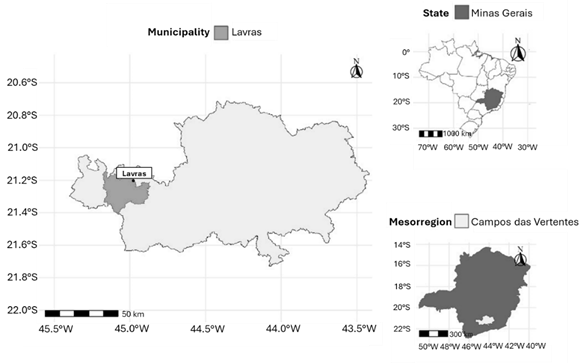
The experiments were conducted in Lavras, Minas Gerais State, Brazil, located at latitude 21°14' S and longitude 44°59' W, with an altitude of 919 m (Figure 1). According to the Köppen classification, this region has a Cwa climate, which is defined as a humid subtropical with a dry winter season (Dantas et al., 2007).
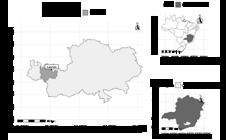
Experimental area for the evaluation of elite upland rice lines during the second growing season in 2022, located in the municipality of Lavras, in the Campo das Vertentes region, Minas Gerais State, Brazil.
Prior to establishing the experiment, soil chemical and physical properties were analyzed by collecting samples at a depth of 20 cm to assess fertility (Table 1).
Genotypes
Eight elite lines from the Upland Rice Breeding Program of the Federal University of Lavras (UFLA) - MelhorArroz, in partnership with Embrapa Rice and Beans and the Agricultural Research Company of Minas Gerais (Epamig), were evaluated: (1) P95-8 CNAx18360-B-3-B-B, (2) CNAx20663-B-14, (3) CNAx20658-B-12, (4) CMG ERF 81-2, (5) P85-15-CNAx18874-B-5-6, (6) OBS1819-126-9, (7) CMG ERF 221-19, and (8) CNAx20665-B-6. The lines were selected for their early flowering, as previously observed in the Value for Cultivation and Use (VCU) trials during the main season, and for their high yield potential.
Experiment conduct
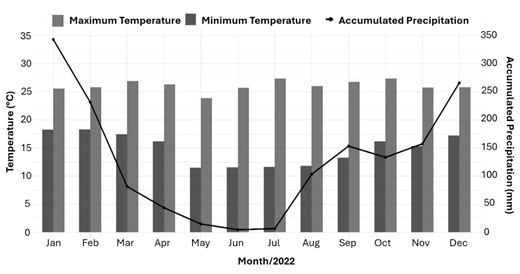
The eight genotypes were sown at 4 sowing times, with a 7-day interval: January 28, 2022 (season 1), February 4, 11, and 18, 2022 (seasons 2, 3, and 4, respectively). The climatic data during the experiment can be seen in Figure 2. The experiments were conducted in a randomized block design with 3 replications in an 8 × 4 factorial scheme. Each plot consisted of 3 rows of 4.0 m length, spaced 0.17 m apart, with a sowing density of 90 seeds per linear meter. Evaluations were performed in the central row of each plot.
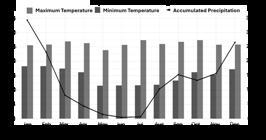
Total accumulated precipitation (mm) and maximum and minimum temperatures (°C) observed throughout the experimental period, with sowing occurring in January and February 2022 (Instituto Nacional de Meteorologia [INMET], 2022).
According to the soil analysis, base fertilization of 300 kg ha−1 of 08-28-16 was applied at sowing, and 100 kg ha−1 of urea was top-dressed at the V3 stage in all experiments. Weed management began immediately after emergence and followed recommendations for upland rice in the region.
Evaluated traits
The phenotypic traits evaluated were the number of days to flowering (NDFL, days), plant height (PH, cm), brown spot tolerance (Helminthosporium oryzae) (BS, score), and grain yield (GY, kg ha−1). The NDFL was obtained by counting the days from sowing until 50% of the plants in the plot reached the R4 developmental stage (Counce et al., 2000). PH was determined as the average height of five plants in the useful area, measured from the ground to the tip of the highest panicle. BS was assessed through visual observations of leaves and panicles from the flowering stage until the grain maturation stage (R4-R8), with ratings assigned according to the following scale based on disease severity: 1, less than 5% of leaves and/or panicles infected; 3, 5-10% of leaves and/or panicles infected; 5, 11-25% of leaves and/or panicles infected; 7, 26-50% of leaves and/or panicles infected; and 9, more than 50% of leaves and/or panicles infected (International Rice Research Institute, 1996). GY was calculated as the productivity of the plot at 13% humidity, extrapolated to 10,000 m².
Statistical analysis
Statistical analyses were performed using the R 4.3.2 computational environment (R Core Team, 2020). The approach used for joint data analysis was a mixed linear model, in which variance components and genetic parameters were estimated using restricted maximum likelihood (REML) and genotypic values of lines were predicted using best linear unbiased prediction (BLUP). The mixed linear model was represented by the following equation:
Y = Xb + Zg + Vd + Wu + e
where y is the data vector; b is the fixed effect vector of the block within the sowing seasons; u is the vector of the fixed effect of sowing seasons; g is the vector of random genotypic effects; g ~ NMV (0, ( g 2 ) and ( g 2 are the genotypic variance; d is the vector of the random genotypes × sowing season interaction effect; d ~ NMV (0, ( d 2 ) and ( d 2 are the variance of the genotype × sowing season interaction; e is the vector of random error; e ~ NMV (0, ( e 2 ) and ( e 2 are the error variance. X, Z, W, and V are the incidence matrices for the effects b, u, g, and d, respectively. The BLUP averages were compared using the Scott-Knott (Scott & Knott, 1974) test at a 95% confidence level.
Selective accuracies ( associated with predicted genetic values were estimated from the following expression: , where PEV is the prediction error variance of the genetic values (Resende & Alves, 2022; Resende & Duarte, 2007). Additionally, the coefficient of error variation (Cve%) was estimated using the following equation: , where ( e 2 is the error variance and x̄ is the overall mean.
Results and discussion
Regarding accuracy, estimates ranged from 0.409 for BS to 0.957 for NDFL (Table 2). Accuracy values above 70% indicate high experimental quality and reliable predictions of genotypic values (Resende & Duarte, 2007). Although an accuracy of 0.409 (BS) was observed, it is a parameter that depends on the genetic variance among the tested lines. For the trait mentioned, since there was no significant difference between the lines (p < 0.05), lower accuracy values were expected. Moreover, the low predictive accuracy for BS ( < 0.50) (Resende et al., 2007) can be attributed to the strong environmental influence on trait expression, which reduces selection efficiency (Liu et al., 2021). To enhance accuracy, complementary strategies, such as multi-environment evaluations and molecular marker-assisted selection, may be required (Anilkumar et al., 2023).
In this experiment, CVe ranged from 7.64 (NDFL) to 52.71% (GY). CVe is a statistical measure that expresses the variability of a dataset in relation to its means. Generally, lower CVe values indicate greater data dispersion relative to the mean, which may reduce experimental precision and compromise the reliability of genetic estimates (Zhao et al., 2023). The BS and GY traits exhibited CVe values above 20%, indicating high and very high experimental variability (Pimentel Gomes, 2000), respectively, and suggesting low precision in the data collection. However, due to the lack of significance for the effect of lines (p > 0.05), these traits were disregarded in the selection of the best genotypes. Additionally, Costa et al. (2002) found that disease-related traits, such as BS, in upland rice typically exhibit higher CVe values due to the assessment method, which is influenced by the evaluators’ visual acuity and the grading scale (0-9) used for evaluation.
The variance among lines was significant (p ≤ 0.05) for NDFL and PH, indicating the presence of genetic variability for these traits. The effect of sowing seasons was significant for NDFL, PH, and GY, meaning that sowing intervals influenced genotype responses for these traits. However, as the genotype × sowing season interaction was not significant (p > 0.05) for any trait, all lines responded similarly to the sowing intervals in the second harvest, with no changes in ranking among environments.
The identification of the ideal plant ideotype for upland rice in the second crop involves selecting genotypes with early flowering, compact plant architecture, high yield potential, and disease resistance. The selection of agronomically superior lines is directly linked to greater cultivar acceptance by farmers, higher profitability, and, consequently, an expansion in the area dedicated to the crop.
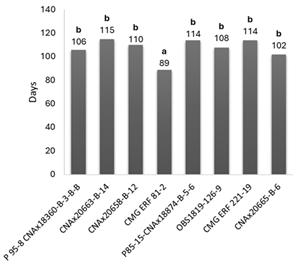
The lines had an average NDFL of 107.25 days, with CMG ERF 81-2 standing out for flowering at 89 days (Figure 3), which classifies it as an early cultivar with a cycle between 106 and 120 days (Colombari Filho & Rangel, 2015). Notably, in rice, the total crop cycle length is positively correlated with the duration of the vegetative phase (Streck et al., 2006).
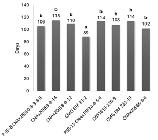
BLUP means for the number of days to flowering of 8 upland rice lines evaluated across 4 sowing seasons during the 2022 off-season in Lavras, Minas Gerais State, Brazil. Different letters indicate significant differences (p ≤ 0.05) by the Scott-Knott test.
Early cycle rice cultivars reach the flowering stage more quickly, allowing for earlier harvesting and better alignment with the agricultural calendar. This trait is particularly relevant for cropping systems that include the second harvest, such as rotations with soybean and corn, in which the timing of cultivation and harvest must be carefully coordinated (Garcia et al., 2024). Early maturing varieties are preferred due to their ability to complete the growth cycle in a shorter period, facilitating integration into the agricultural cropping system (Goulart et al., 2020). Utilizing cultivars that flower quickly not only improves land use efficiency but also reduces exposure to climatic risks and biotic stress. This approach promotes more effective rotation and enables overall productivity and profitability to be maximized, contributing to sustainability and food security (Carlos et al., 2020).
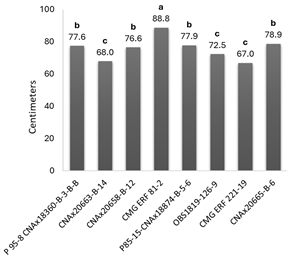
The PH values ranged from 67.0 to 88.8 cm (Figure 4). CMG ERF 81-2 and CNAx20665-B-6 showed the most satisfactory values for the trait under study, measuring 88.81 and 78.85 cm, respectively. The rice plant ideotype represents a combination of traits favorable to photosynthesis, growth, and grain production, primarily based on morphological traits. Regarding PH, the ideotype approach to breeding aims for a height of 90-100 cm, which not only facilitates mechanical harvesting but also enhances lodging resistance (Niu et al., 2021; Peng et al., 2008).
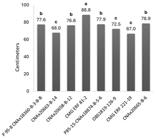
BLUP means for the plant height (cm) of 8 upland rice lines evaluated across 4 sowing seasons during the 2022 off-season in Lavras, Minas Gerais State, Brazil. Different letters indicate significant differences (p ≤ 0.05) by the Scott-Knott test.
Environmental factors affect the growth and grain yield of rice (Abo-Yousef et al., 2024). Selecting an appropriate sowing season avoids environmental extremes (low or high temperatures, drought, heavy rainfall, or water deficits) during critical growth stages and is vital for expressing the genetic yield potential of a line (Abbas et al., 2021). In this study, traits NDFL, PH, and GY were influenced by the sowing season, which can be explained by the variation in genotype means occurring in each season. For the sowing season variation source, different phenotypic expressions were observed for all traits except BS (Table 2).
The sowing windows were chosen based on local farmers’ management practices to simulate the earliest possible rice cultivation after the region’s main crop, soybean, is harvested. Since soybean harvesting in the region of Lavras, Minas Gerais State, Brazil, begins in January, the first sowing date was set within this period to reflect a realistic cultivation scenario. Moreover, a 7-day interval between sowing dates was used to assess its impact on genotype performance, enabling the determination of how a 1-week difference influences plant development.
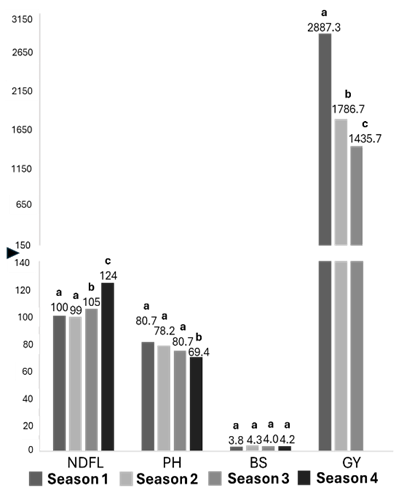
Sowing seasons 1 and 2 presented NDFL averages of 99 and 100 days, respectively, resulting in better genotype performance compared to the other seasons (Figure 5). For PH, the best-performing seasons were 1, 2, and 3, with values of 80.65, 78.22, and 74.36 cm, respectively. For GY, season 1 achieved the best performance at 2887.2 kg ha−1, followed by season 2 at 1786.69 kg ha−1. Data for season 4 could not be obtained due to 100% sterile grains.
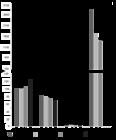
BLUP means for the number of days to flowering (NFDL, days), plant height (PH, cm), brown spot tolerance (BS, score), and grain yield (GY, kg ha−1) for 4 sowing seasons during the 2022 off-season in Lavras, Minas Gerais State, Brazil, based on the evaluation of eight upland rice lines. Different letters within the traits indicate significant differences (p ≤ 0.05) between sowing seasons by the Scott-Knott test.
The worst magnitudes of BLUP estimates for all traits in seasons 3 and 4, where sowing took place after the second 10 days of February, could be attributed to adverse climatic conditions in April during the reproductive stage (R0-R5), which involved low temperatures and limited rainfall. These conditions extended the crop cycle and increased grain sterility. During this critical developmental stage, abiotic stressors, such as low temperatures and water shortages, directly reduce the productive potential of the lines (Zhang et al., 2020). Conversely, in the first sowing season (season 1), which occurred in January, the lines benefited from ideal climatic conditions during the reproductive stages, which require ample water and milder temperatures (Figure 2).
PH is a morphological trait controlled by quantitative trait loci and is highly influenced by environmental conditions (Zheng et al., 2019). Although all lines in this experiment had adequate average heights, up to 100 cm, water scarcity during the vegetative stage resulted in reduced plant growth, with season 4 being the most affected (69.4 cm). According to Cao et al. (2021), reduced plant height under water stress leads to a decrease in photosynthetic areas, reducing light energy efficiency and, consequently, grain yield.
The lower magnitudes of the GY estimate in the third and fourth sowing seasons (Figure 5) are explained by the climatological data shown in Figure 2. During the period when the plants needed humidity and a good temperature for their proper physiological development, there was a water deficit and a low solar radiation and temperature, which reduced grain production. Environmental factors are among the most important factors affecting the grain yield of rice (Wani et al., 2016).
In this study, sowing time significantly influenced the crop’s agronomic potential. Sowing during the third and fourth seasons, on February 11 and 18, respectively, reduced growth, resulted in a longer crop cycle, and increased sterility, despite uniform management practices across all seasons.
The occurrence of low temperatures and water stress during the reproductive phenological development stage (R2 and R3 phases) in growing seasons 3 and 4, were the main environmental stress factors limiting fertilization and grain development, which drastically reduced the crop yield. The crucial phases of the crop, which define grain yield, are between the start of the booting stage (R2) and full flowering (R5). During this interval, abiotic stressors, such as low temperatures and water deficiency, have a direct effect on genotypic expression (Garcia et al., 2024). In this study, at the flowering stage, there was a significant increase in spikelet sterility, which resulted in congenital defects in the panicle that led to yield losses and poor grain quality (Zhang et al., 2020).
Regarding grain yield, in season 4, there was no grain production due to a water deficit and low temperatures at the end of the vegetative phase and throughout the reproductive phase. These factors demonstrated the significant influence of the environment on genotype performance. Thus, sowing upland rice in mid-February in the Campo das Vertentes region is not recommended.
Conclusion
Environmental conditions, including the sowing season for upland rice cultivation in the second crop season, strongly influenced the phenotypic traits of the genotypes, highlighting the importance of selecting appropriate sowing seasons to maximize genotypic performance. Sowing rice in January and the first week of February were most suitable for cultivating upland rice in the second crop season in the Campo das Vertentes region, as they resulted in better performance in the evaluated phenotypic traits. Line CMG ERF 81-2 stood out for its early cycle, with a cycle of less than 120 days, making it a potential option for inclusion in the cropping system.
Data availability
Not applicable.
Acknowledgements
The authors thank the National Council for Scientific and Technological Development (CNPq) for the master’s scholarship. They also express their gratitude to the Coordination for the Improvement of Higher Education Personnel (CAPES), the Research Support Foundation of the State of Minas Gerais (FAPEMIG), and the Upland Rice Breeding Program (Melhorarroz) for their support
References
-
Abbas, A., Yu, P., Sun, L., Yang, Z., Chen, D., Cheng, S. & Cao, L.. (2021). Exploiting genic male sterility in rice: From molecular dissection to breeding applications. Frontiers in Plant Science, 12(629314), 1-27. https://doi.org/10.3389/fpls.2021.629314
» https://doi.org/https://doi.org/10.3389/fpls.2021.629314 -
Abo-Yousef, M. I., Abd Elaty, M. S., Sorour, F. A., Salem, M., Talha, I. A. & Bahgt, M. M.. (2024). Environmental stability and adaptation of several rice (Oryza Sativa L. ) cultivars with different climate change. Egyptian Journal of Agronomy, 46(1), 103-113. https://doi.org/10.21608/agro.2024.268409.1416
» https://doi.org/https://doi.org/10.21608/agro.2024.268409.1416 -
Anilkumar, C., Azharudheen, T. P. M., Sah, R. P., Sunitha, N. C., Devanna, B. N., Marndi, B. C. & Patra, B. C.. (2023). Gene based markers improve precision of genome-wide association studies and accuracy of genomic predictions in rice breeding. Heredity, 130(5), 335-345. http://doi.org/10.1038/s41437-023-00599-5
» https://doi.org/http://doi.org/10.1038/s41437-023-00599-5 -
Cao, Y., Cai, H. & Sun, S.. (2021). Effects of growth‐stage‐based limited irrigation management on the growth, yields, and radiation utilization efficiency of winter wheat in northwest China. Journal of the Science of Food and Agriculture, 101(14), 5819-5826. https://doi.org/10.1002/jsfa.11233
» https://doi.org/https://doi.org/10.1002/jsfa.11233 -
Carlos, F. S., Denardin, L. G. O., Martins, A. P., Anghinoni, I., Carvalho, P. C. F., Rossi, I., Burchain, M. P., Cereza, T., Carmona, F. C. & Camargo, F. A. O.. (2020). Integrated crop-livestock systems in lowlands increase the availability of nutrients to irrigated rice. Land Degradation & Development, 31(18), 2962-2972. https://doi.org/10.1002/ldr.3653
» https://doi.org/https://doi.org/10.1002/ldr.3653 - Colombari Filho, J. M. & Rangel, P. H. N. (2015). Cultivares. In A. Borém & P. H. N. Rangel (Eds.), Arroz: do plantio à colheita. (pp. 84-121). Ed. UFV.
-
Companhia Nacional de Abastecimento. (2024). Séries históricas das safras: grãos. CONAB. https://www.conab.gov.br/info-agro/safras/serie-historica-das-safras#gr%C3%A3os-2
» https://www.conab.gov.br/info-agro/safras/serie-historica-das-safras#gr%C3%A3os-2 -
Costa, N. H. A. D., Seraphin, J. C. & Zimmermann, F. J. P.. (2002). Novo método de classificação de coeficientes de variação para a cultura do arroz de terras altas. Pesquisa Agropecuária Brasileira, 37(3), 243-249. https://doi.org/10.1590/S0100-204X2002000300003
» https://doi.org/https://doi.org/10.1590/S0100-204X2002000300003 -
Counce, P. A., Keisling, T. C. & Mitchell, A. J.. (2000). A uniform, objective, and adaptive system for expressing rice development. Crop Science, 40(2), 436-443. https://doi.org/10.2135/cropsci2000.402436x
» https://doi.org/https://doi.org/10.2135/cropsci2000.402436x -
Dantas, A. A. A., Carvalho, L. G. & Ferreira, E.. (2007). Classificação e tendências climáticas em Lavras, MG. Ciência e Agrotecnologia, 31(6), 1862-1866. https://doi.org/10.1590/s1413-70542007000600039
» https://doi.org/https://doi.org/10.1590/s1413-70542007000600039 -
Garcia, D. A., Mulhanga, A. D. I., Berchembrock, Y. V., Cardoso, F. P., Botelho, F. B. S., Santos, H. O. & Ribeiro, A. O.. (2024). Performance of elite upland rice lines at low temperatures. Pesquisa Agropecuária Brasileira, 59, 1-8. https://doi.org/10.1590/S1678-3921.pab2024.v59.03605
» https://doi.org/https://doi.org/10.1590/S1678-3921.pab2024.v59.03605 -
Goulart, R. Z., Reichert, J. M. & Rodrigues, M. F.. (2020). Cropping poorly-drained lowland soils: Alternatives to rice monoculture, their challenges and management strategies. Agricultural Systems, 177, 102715. https://doi.org/10.1016/j.agsy.2019.102715
» https://doi.org/https://doi.org/10.1016/j.agsy.2019.102715 -
Heinemann, A. B., Stone, L. F., Silva, G. C. C., Matta, D. H., Justino, L. F. & Silva, S. C.. (2024). Climate drivers affecting upland rice yield in the central region of Brazil. Pesquisa Agropecuária Tropical, 54, 1-9. https://doi.org/10.1590/1983-40632024v5477222
» https://doi.org/https://doi.org/10.1590/1983-40632024v5477222 -
Instituto Nacional de Meteorologia. (2022). Todos os dados meteorológicos. INMET. http://portal.inmet.gov.br/
» http://portal.inmet.gov.br/ - International Rice Research Institute (1996). Standard evaluation system for rice (4th ed.). INGER Genetic Resources Center.
-
Li, J., Xiao, Q., Wu, H. & Li, J.. (2024). Unpacking the global rice trade network: Centrality, structural holes, and the nexus of food insecurity. Foods, 13(4), 1-26. https://doi.org/10.3390/foods13040604
» https://doi.org/https://doi.org/10.3390/foods13040604 -
Liu, L., Hsieh, S., Lin, S., Wang, Y. & Lin, W.. (2021). Rice blast (Magnaporthe oryzae) occurrence prediction and the key factor sensitivity analysis by machine learning. Agronomy, 11(4), 1-15. http://doi.org/10.3390/agronomy11040771
» https://doi.org/http://doi.org/10.3390/agronomy11040771 -
Niu, Y., Chen, T., Zhao, C. & Zhou, M.. (2021). Improving crop lodging resistance by adjusting plant height and stem strength. Agronomy, 11(12), 1-14. https://doi.org/10.3390/agronomy11122421
» https://doi.org/https://doi.org/10.3390/agronomy11122421 -
Peng, S., Khush, G. S., Virk, P., Tang, Q. & Zou, Y.. (2008). Progress in ideotype breeding to increase rice yield potential. Field Crops Research, 108(1), 32-38. https://doi.org/10.1016/j.fcr.2008.04.001
» https://doi.org/https://doi.org/10.1016/j.fcr.2008.04.001 - Pimentel Gomes, F. (2000). Curso de estatística experimental (14. ed.). Degaspari.
- R Core Team (2020). R: A language and environment for statistical computing. R Foundation for Statistical Computing.
-
Rubaiyath Bin Rahman, A. N. M. & Zhang, J.. (2022). Trends in rice research: 2030 and beyond. Food and Energy Security, 12(2), 1-17. https://doi.org/10.1002/fes3.390
» https://doi.org/https://doi.org/10.1002/fes3.390 -
Ramirez-Villegas, J., Heinemann, A. B., Castro, A. P., Breseghello, F., Navarro-Racines, C., Li, T., Rebolledo, M. C. & Challinor, A. J.. (2018). Breeding implications of drought stress under future climate for upland rice in Brazil. Global Change Biology, 24(5), 2035-2050. https://doi.org/10.1111/gcb.14071
» https://doi.org/https://doi.org/10.1111/gcb.14071 -
Resende, M. D. V. & Alves, R. S.. (2022). Statistical significance, selection accuracy, and experimental precision in plant breeding. Crop Breeding and Applied Biotechnology, 22(3), 1-19. https://doi.org/10.1590/1984-70332022v22n3a31
» https://doi.org/https://doi.org/10.1590/1984-70332022v22n3a31 -
Resende, M. D. V. & Duarte, J. B.. (2007). Precisão e controle de qualidade em experimentos de avaliação de cultivares precision and quality control in variety trials. Pesquisa Agropecuária Tropical, 37(3), 182-194. https://revistas.ufg.br/pat/article/view/1867
» https://doi.org/https://revistas.ufg.br/pat/article/view/1867 -
Ribas, G. G., Zanon, A. J., Streck, N. A., Pilecco, I. B., Souza, P. M., Heinemann, A. B. & Grassini, P.. (2021). Assessing yield and economic impact of introducing soybean to the lowland rice system in southern Brazil. Agricultural Systems, 188, 103036. https://doi.org/10.1016/j.agsy.2020.103036
» https://doi.org/https://doi.org/10.1016/j.agsy.2020.103036 -
Scott, A. J. & Knott, M.. (1974). A cluster analysis method for grouping means in the analysis of variance. Biometrics, 30(3), 507-512. https://doi.org/10.2307/2529204
» https://doi.org/https://doi.org/10.2307/2529204 -
Soratto, R. P., Guidorizzi, F. V. C., Sousa, W. S., Gilabel, A. P., Job, A. L. G. & Calonego, J. C.. (2022). Effects of previous fall-winter crop on spring-summer soybean nutrition and seed yield under no-till system. Agronomy, 12(12), 1-17. https://doi.org/10.3390/agronomy12122974
» https://doi.org/https://doi.org/10.3390/agronomy12122974 -
Streck, N. A., Bosco, L. C., Michelon, S., Walter, L. C. & Marcolin, E.. (2006). Duração do ciclo de desenvolvimento de cultivares de arroz em função da emissão de folhas no colmo principal. Ciência Rural, 36(4), 1086-1093. https://doi.org/10.1590/S0103-84782006000400007
» https://doi.org/https://doi.org/10.1590/S0103-84782006000400007 -
United States Department of Agriculture. (2023). Agricultural Research Service, Global Production. Data Production. USDA-FAS. https://fas.usda.gov/data/production
» https://fas.usda.gov/data/production -
Wani, S. A., Qayoom, S., Bhat, M. A., Lone, B. A. & Nazir, A.. (2016). Influence of sowing dates and nitrogen levels on growth, yield and quality of scented rice cv. Pusa Sugandh-3 in Kashmir valley. Journal of Applied and Natural Science, 8(3), 1704-1709. https://doi.org/10.31018/jans.v8i3.1026
» https://doi.org/https://doi.org/10.31018/jans.v8i3.1026 -
Yu, K., Zhao, S., Sun, B., Jiang, H., Hu, L., Xu, C., Yang, M., Han, X., Chen, Q. & Qi, Z. (2024). Enhancing food production through modern agricultural technology. Plant, Cell & Environment. http://dx.doi.org/10.1111/pce.15299
» http://dx.doi.org/10.1111/pce.15299 -
Zhang, J., Tong, T., Potcho, P. M., Huang, S., Ma, L. & Tang, X.. (2020). Nitrogen effects on yield, quality and physiological characteristics of giant rice. Agronomy, 10(11), 1-16. https://doi.org/10.3390/agronomy10111816
» https://doi.org/https://doi.org/10.3390/agronomy10111816 -
Zhao, H., Huang, X., Yang, Z., Li, F. & Ge, X.. (2023). Synergistic optimization of crops by combining early maturation with other agronomic traits. Trends in Plant Science, 28(10), 1178-1191. http://doi.org/10.1016/j.tplants.2023.04.011
» https://doi.org/http://doi.org/10.1016/j.tplants.2023.04.011 -
Zheng, Z., Hey, S., Jubery, T., Liu, H., Yang, Y., Coffey, L., Miao, C., Sigmon, B., Schnable, J. C., Hochholdinger, F., Ganapathysubramanian, B. & Schnable, P. S.. (2019). Shared genetic control of root system architecture between Zea mays and Sorghum bicolor. Plant Physiology, 182(2), 977-991. https://doi.org/10.1104/pp.19.00752
» https://doi.org/https://doi.org/10.1104/pp.19.00752
Edited by
-
Associate Editor in charge:
Alessandro Lucca BracciniCarlos Alberto Scapim