 Improving acclimatization and production of micropropagated banana seedlings using mycorrhizal fungi
ABSTRACT.
Banana is an important tropical crop; however, its acclimatization phase still exhibits high mortality rates and limited nutrient uptake. Considering the potential of arbuscular mycorrhizal fungi (AMF) to enhance seedling establishment by increasing nutrient acquisition, biomass accumulation, and stress tolerance, this study evaluated the effects of inoculation with AMF on the growth of micropropagated banana seedlings under greenhouse conditions. Two experiments were conducted: i) micropropagated seedlings were grown in sterilized coconut fibre substrate and inoculated with five AMF isolates (Acaulospora foveata, Gigaspora margarita, Glomus formosanum, Rhizoglomus clarum, and Cetraspora pellucida), a commercial bioinoculant, mineral fertilizer, and a non-inoculated control; and ii) micropropagated seedlings were transplanted into sterile or non-sterile soil and subjected to the same treatments. Growth, nutrient accumulation, root colonization, and spore density were assessed. Inoculation with Cetraspora pellucida and Acaulospora foveata significantly increased the shoot and root dry mass, as well as the concentrations of N, Ca, Mg, S, Fe, and Cu, achieving levels comparable to those obtained with mineral fertilization. Cultivation in non-sterile soil enhanced the performance of micropropagated seedlings, suggesting synergistic interactions with the native microbiota. Regarding colonization and spore production, Acaulospora foveata and Rhizoglomus clarum were the most effective. Overall, these results indicate that AMF inoculation is an effective biotechnological strategy for optimizing the acclimatization and nutrition of micropropagated seedlings, reducing dependence on mineral fertilizers, and promoting sustainable nursery practices. Future studies should validate these findings under field conditions. Moreover, the results reveal the potential of this approach for integration with sustainable banana seedling production programs, demonstrating its operational applicability to tropical fruit cultivation systems.
Keywords:
arbuscular mycorrhiza; biostimulants; nutrient uptake; sustainable agriculture; symbiotic association
Introduction
Banana cultivation (Musa spp.) occupies a prominent position in the global agricultural sector, undertaken in more than 130 tropical and subtropical countries, with relevance for both fresh consumption and the agroindustry (Maseko et al., 2024; Santos, 2025). However, the sector still faces challenges regarding productivity, phytosanitary quality, and production sustainability. Addressing these issues requires the development and adoption of innovative technologies to meet the growing global demand (Janardhan et al., 2024). Micropropagation, a technique that enables the rapid multiplication of uniform plants, is one of the most widely adopted strategies for large-scale production of planting material with high genetic and phytosanitary quality (Yano-Melo et al., 1999).
Despite its advantages, this biotechnology still has important limitations, especially during acclimatization, which is the main bottleneck of the process. In this phase, plantlets must transition from in vitro to ex vitro conditions, where they face variable light, temperature, and humidity, along with exposure to pathogenic microorganisms. This frequently results in high mortality rates, attributed to poor root functionality, reduced photosynthetic capacity, and limited efficiency of water and nutrient uptake (Isah, 2015; Grzelak et al., 2024). Considering these constraints, strategies to improve the acclimatization of micropropagated seedlings are essential for the economic and agronomic viability of the technique.
In this context, the use of arbuscular mycorrhizal fungi (AMF) has emerged as a promising alternative (Rui et al., 2022). These natural symbionts establish mutualistic associations with plant roots, increasing the volume of soil explored through their hyphae and thereby enhancing the uptake of poorly mobile nutrients, such as phosphorus (Chandrasekaran, 2020). AMF can also facilitate water absorption, induce morphological and physiological changes in the root system, stimulate the production of defence compounds, and improve plant tolerance to both biotic and abiotic stresses (Thangavel et al., 2022). AMF inoculation has been shown to contribute toward increased survival and growth of seedlings in fruit species (Rui et al., 2022; Wahone et al., 2023), however, consistent information regarding their application to micropropagated banana plants, particularly during the critical acclimatization stage, ramians lacking (Yano-Melo, 1999).
Considering that integrating this biotechnology into the production process can reduce the costs associated with seedling losses, improve the final quality of the propagative material, and support more sustainable agricultural systems, investigating this association is highly relevant. Moreover, despite extensive literature on the effects of AMF in conventionally propagated banana seedlings, scientific evidence for micropropagated plantlets, which exhibit distinct physiological traits and face critical limitations during acclimatization remains scarce. This gap underscores the need for studies specifically focused on AMF-micropropagated banana interactions, particularly those evaluating plant performance under contrasting soil conditions and explicitly comparing AMF inoculation with mineral fertilization, an aspect seldom addressed in previous research. In this context, the present study aimed to evaluate the effect of inoculating arbuscular mycorrhizal fungi on the acclimatization and production of micropropagated banana seedlings, focusing on the parameters related to growth and plant quality. Accordingly, we tested the hypothesis that AMF inoculation promotes greater seedling development during acclimatization, resulting in more vigorous, well-adapted, and transplant-ready plantlets, thus representing an effective strategy for the sustainable large-scale production of banana seedlings.
Material and methods
Two experiments were conducted in the greenhouse at Embrapa Tropical Agroindustry under controlled temperature, light, and humidity conditions.
Experiment 1: Growth response of micropropagated banana seedlings to AMF inoculation
Micropropagated banana seedlings (cv. Prata Catarina) were transplanted into plastic trays filled with a coconut fibre-based substrate, previously sterilized at 120°C for 1h on two consecutive days. The experiment followed a randomized complete block design with four blocks, and each experimental unit comprised a set of twenty seedlings grown in 288 cm3 tubes. The treatments involved inoculation with five mycorrhizal isolates, A. foveata; G. margarita, G. formosanum, R. clarum, and, C. pellucida; application of a commercial bioinoculant (R. intraradices); a non-inoculated control; and fertilization (10% N, 10% P₂O₅, and 10% K₂O). For treatment with the commercial bioinoculant, a rate of 120 g ha-1 was used, whereas other treatments included 100 fungal spores per experimental unit. All seedlings, regardless of treatment, were supplied with foliar fertilization every 15 days (10% of N, 10% of P2O5, 10% of K2O, 0.1% of B, and 0.01% of Mo at the recommended rate of 4 L ha-1). Mycorrhizal inoculation was performed by incorporating the inoculum into the planting substrate. Irrigation was performed with distilled water, adjusted to meet the plant water demand, and managed to maintain the substrate consistently at field capacity. Sixty days after inoculation, growth parameters, including shoot fresh weight, root fresh weight, total fresh weight, shoot dry weight, root dry weight, total dry weight, and root length, were evaluated. Nutrient concentrations were determined using whole plant material following the procedures described by Miyazawa et al. (2009). Nitrogen was quantified after sulphuric digestion followed by distillation and titration. Phosphorus, potassium, calcium, magnesium, sulphur, copper, iron, manganese, and zinc were measured by ICP-OES following nitric-perchloric digestion. Boron was spectrophotometrically determined using the azomethine-H method. Nutrient accumulation was calculated as the product of nutrient concentration and total plant dry biomass.
Experiment 2: AMF performance under sterile and non-sterile soil conditions
The experimental design was a randomized block arranged in an 8 × 2 factorial scheme (six mycorrhizal isolates, a non-inoculated control, and a fertilized treatment × two soil conditions: sterile and non-sterile). Each experimental unit comprised three banana seedlings grown in a 4 kg plastic bag, which represented the sampling unit for all measurements and statistical analyses. Micropropagated seedlings of banana cv. Prata Catarina were transplanted into bags containing either sterile soil, previously autoclaved at 120°C for 1h on two consecutive days, or non-sterile soil. For mycorrhizal treatment, inoculation was performed by applying the substrate with approximately 100 viable spores per plant for colonization. Fertilized plants received 120 g ha-1 of chemical fertilizer, and all plants, regardless of treatment, were supplemented every 15 days with foliar application (as described previously). At 90 days after transplantation, destructive sampling was performed, and the following variables were evaluated: fresh mass of shoots (FMS) and roots (FMR), total fresh mass (TFM), dry mass of shoots (DMS), roots (DMR), total mass (TM) and root length (RL). The plant material was dried at 65°C to constant weight, ground, and subjected to chemical analyses (Miyazawa et al., 2009). The obtained nutrient concentrations were then used to calculate the nutrient accumulation in shoots and roots, encompassing both macro- and micronutrients. At the end of the experiment, spore numbers were quantified in treatments inoculated with mycorrhizal isolates (Phillips & Hayman, 1970; Giovannetti & Mosse, 1980). Further, both the total spore count and the percentage of root colonization were assessed for all treatments. The experimental design followed a randomized block arrangement. For the spore count of inoculated treatments, a 6 × 2 factorial scheme was adopted (six mycorrhizal isolates and two soil conditions: autoclaved or non-autoclaved), with three replicates, each experimental unit consisting of three plants. For the evaluation of total spore count and mycorrhizal colonization (%), an 8 × 2 factorial scheme was used (six isolates; fertilized and non-inoculated soil: control; and two soil conditions: autoclaved or non-autoclaved), with three replicates. Statistical analysis was performed using analysis of variance, and means were compared using the Scott-Knott test at a 5% probability level, in AgroEstat software version 1.1.0.711 (Barbosa & Maldonado Junior, 2015).
Results and discussion
Experiment 1: Growth response of micropropagated banana seedlings to AMF inoculation
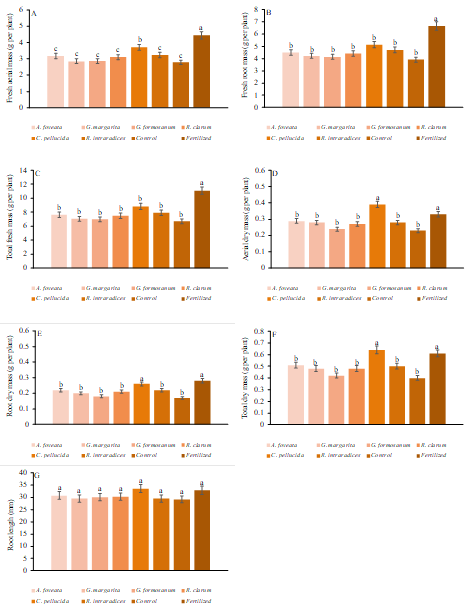
Inoculating banana seedlings with AMF significantly influenced their growth variables. C. pellucida stood out as the most efficient isolate as seedlings inoculated with C. pellucida showed the highest shoot, root, and total dry mass values, which were statistically comparable to those obtained with fertilization. However, fertilized plants achieved the greatest overall performance, particularly in shoot, root, and total fresh mass. Root length did not differ significantly among treatments. In contrast, non-inoculated plants displayed the lowest growth values (Figure 1).
Inoculating banana seedlings with AMF significantly influenced their growth variables, including shoot and root fresh and dry mass, corroborating recent studies highlighting the benefits of this symbiosis for plant development (Lin et al., 2021; Rui et al., 2022; Wahone et al., 2023). C. pellucida stood out as the most efficient isolate as seedlings inoculated with C. pellucida showed the highest shoot, root, and total dry mass, with values statistically comparable to those achieved through mineral fertilization, suggesting that this AMF species effectively enhances the uptake of essential nutrients, such as P and N (Chandrasekaran, 2020; Wu et al., 2024). Although C. pellucida-inoculated seedlings performed well, fertilized plants demonstrated the highest overall growth, particularly in terms of fresh biomass, likely because of the immediate availability of nutrients provided by fertilization; in contrast, AMF colonization requires time to establish a functional network for efficient nutrient acquisition (Ajeesh et al., 2015; Verlinden et al., 2018). Root length did not differ significantly among treatments, indicating that AMF colonization primarily improved nutrient absorption efficiency rather than root system extension, which was consistent with previous findings (Maherali, 2014; Persi & Maherali, 2022). In contrast, non-inoculated plants showed the lowest growth values, both in fresh and dry mass, underscoring the critical role of mycorrhizal symbiosis in supporting the development of banana seedlings (Rui et al., 2022).
As observed in Figure 2, nutrient accumulation followed trends similar to those of biomass production; macronutrient accumulation in banana seedlings was influenced by the different treatments, evidencing the role of mycorrhizal symbiosis in enhancing nutrient uptake.
Inoculation with C. pellucida promoted the highest accumulation of N, K, Ca, Mg, S and Na, highlighting its superior efficiency compared with that of the other AMF species and the non-inoculated control. Accumulation of N and Mg with the inoculation of C. pellucida was even greater than with fertilization. This finding is consistent with reports that certain Glomeromycota species exhibit greater functional compatibility with specific host plants, resulting in improved root colonization and more efficient nutrient acquisition (Rui et al., 2022; Wu et al., 2024). Fertilized plants also showed remarkable improvements, particularly for P, with a higher value to that observed in seedlings inoculated with C. pellucida. This indicates that the combination of high nutrient availability in the substrate and AMF-mediated nutrient transfer can achieve similar physiological outcomes, especially for P, which is highly mobile and essential for growth and energy metabolism (Wu et al., 2024). In contrast, non-inoculated plants consistently showed the lowest macronutrient accumulation, especially for N, and P. These results reinforce the dependence of banana seedlings on symbiotic associations during the acclimatization phase, when the root system is still limited and nutrient demand is high (Pinochet et al., 1997; Yano-Melo et al., 1999; Wahone et al., 2023). This response may be linked with physiological and ecological mechanisms, such as enhanced nutrient transporter activity and improved root-microbe interactions in mycorrhizal seedlings (Xiong & Chen, 2025). Moreover, the improved N and S acquisition under C. pellucida inoculation suggests a broader effect on nutrient cycling beyond P mobilization, possibly linked with enhanced root activity and stimulation of the associated microbial communities (Azcón-Aguilar & Barea, 2015; Hestrin et al., 2019; Koch & Sessitsch, 2024).
Effect of inoculation with mycorrhizal fungi on the growth of micropropagated banana seedlings: fresh aerial mass (A), fresh root mass (B), total fresh mass (C), aerial dry mass (D), root dry mass (E), total dry mass (F), and root length (G). Means followed by the same lowercase letter do not differ from each other by the Scott-Knott test at 5% probability.

Effect of inoculation with mycorrhizal fungi on macronutrient accumulation: nitrogen (A), phosphorus (B), potassium (C), calcium (D), magnesium (E), sulphur (F), and sodium (G) in banana seedlings. Means followed by the same lowercase letter do not differ from each other by the Scott-Knott test at 5% probability.
Notably, the inoculation of banana seedlings with AMF significantly influenced micronutrient accumulation, including B (C. pellucida and R. intraradices), Fe (A. foveata, G. margarita, and C. pellucida), and Mn (C. pellucida), corroborating recent studies highlighting the benefits of this symbiosis for plant mineral nutrition (Oliveira & Oliveira, 2005; Rui et al., 2022). Seedlings mainly inoculated with C. pellucida showed the highest accumulation of these micronutrients, surpassing most other inoculated treatments and the non-inoculated control, indicating that this AMF species enhances the efficiency of essential nutrient uptake (Carrara & Heller, 2022). Fertilized plants also demonstrated superior accumulation, particularly for B and Fe, reaching levels comparable with those observed in C. pellucida -inoculated seedlings, thus highlighting the complementary role of mineral fertilization in plant nutrition (Carrara & Heller, 2022; Rui et al., 2022). The commercial bioinoculant yielded intermediate results, suggesting a moderate efficacy in promoting micronutrient uptake, mainly of B. As shown in Figure 3, the trends in micronutrient accumulation paralleled those observed for overall plant growth, in contrast, non-inoculated plants showed the lowest levels of micronutrient accumulation, reinforcing the critical contribution of AMF symbiosis to the mineral nutrition of banana seedlings, especially under conditions of limited soil nutrient availability (Thangavel et al., 2022).

Effect of inoculation with mycorrhizal fungi on micronutrient accumulation: boron (A), copper (B), iron (C), manganese (D), and zinc (E) in banana seedlings. Means followed by the same lowercase letter do not differ from each other by the Scott-Knott test at 5% probability.
Experiment 2: AMF performance under sterile and non-sterile soil conditions
Fertilized seedlings showed a superior performance compared with those of seedlings inoculated with mycorrhizal fungi, confirming the immediate effect of nutrient supply on early seedling development. However, inoculation with A. foveata, G. margarita, R. clarum, and C. pellucida induced significant increases in shoot fresh mass, total fresh mass, shoot dry mass, root dry mass, and total dry mass relative to those in the uninoculated seedlings. These results indicate that, although the magnitude of the effect was lower than that of fertilization, mycorrhizal inoculation contributed positively to biomass accumulation. This improvement can be explained by the ability of arbuscular mycorrhizal fungi to enhance the uptake of nutrients, particularly phosphorus, and to modulate plant hormonal balance, thus favouring shoot and root development as previously reported in different forest and agricultural species (Chandrasekaran, 2020; Chandrasekaran, 2022; Wu et al., 2024). This significant effect of non-sterile soil on shoot fresh and dry mass, as well as on total fresh and dry masses (Table 1), suggests that native microbial communities also play an important role in seedling performance.
The presence of an active soil microbiota may stimulate nutrient cycling and promote synergistic interactions with the introduced mycorrhizal isolates, thereby enhancing plant growth. Similar findings have been described in studies in which combining native microbiota and inoculated fungi resulted in better seedling establishment and performance under nursery conditions (Volpiano et al., 2022; Ding et al., 2024). Fertilized seedlings exhibited the highest macronutrient accumulation in the shoot, particularly for N, P, Ca, Mg and S, and Na, reinforcing the strong and immediate effect of nutrient supplementation on early seedling nutrition. However, inoculation with mycorrhizal isolates also promoted significant increases in specific nutrients. A. foveata and C. pellucida enhanced N accumulation, whereas A. foveata, G. margarita, R. clarum, and C. pellucida contributed to higher Ca and Mg contents compared with those of non-sterile uninoculated seedlings. Notably, A. foveata was the only isolate that could promote S accumulation to levels comparable with those obtained by fertilization. These results indicate that different mycorrhizal taxa may vary in their efficiency of nutrient mobilization and transfer to the host plant, a phenomenon previously reported for forest and agricultural species (Franco-Ramírez et al., 2021; Vilcatoma-Medina et al., 2024). The influence of non-sterile soil was also evident, as seedlings grown under this condition showed greater accumulation of most macronutrients (P, K, Ca, Mg and S) and Na in the shoot (Table 2).
This finding highlights the importance of native microbial communities, which likely improve nutrient cycling and synergize with the inoculated fungi, thereby enhancing nutrient availability and uptake. Similar interactions between native microbiota and arbuscular mycorrhizal fungi have been described as key drivers of improved nutrient acquisition in plants (Masrahi et al., 2020; Ding et al., 2024). Fertilized seedlings showed the highest accumulation of micronutrients in the shoot, confirming the effectiveness of nutrient supplementation at promoting rapid uptake and assimilation. Nevertheless, inoculation with mycorrhizal isolates (A. foveata, G. margarita, R. clarum, and C. pellucida) also enhanced the acquisition of micronutrients, particularly Fe, for which inoculated seedlings performed similarly to fertilized seedlings. This result is consistent with previous reports showing that arbuscular mycorrhizal fungi can increase Fe availability and transport to plants by improving rhizosphere processes and root absorption capacity (Clark & Zeto, 2000; Gao & Zhang, 2024). Further, the use of non-sterile soil significantly favoured B accumulation in the shoot (Table 3).
The greater availability of B may be associated with the activity of native microbial communities, known to influence micronutrient solubilization and plant uptake through organic acid production and enzymatic processes (Li et al., 2019; Vera et al., 2019). The combined effect of native microbiota and inoculated mycorrhizal fungi may thus represent an important ecological mechanism for improving micronutrient nutrition under natural or minimally disturbed soil conditions. Taken together, these findings indicate that while fertilization provides broad and immediate improvements in micronutrient accumulation, mycorrhizal inoculation plays a selective but significant role in enhancing the uptake of specific elements, such as Fe, highlighting its potential contribution to the nutritional balance and sustainable production of banana seedlings. In the roots of fertilized seedlings, the greatest accumulation was observed for Ca, S, and Na, reflecting the rapid nutrient availability provided by fertilization. As described in (Table 4), mycorrhizal inoculation resulted in nutrient accumulation patterns similar to those of fertilized seedlings; however, seedlings inoculated with mycorrhizal isolates also showed a comparable performance for specific nutrients. A. foveata, R. clarum, and C. pellucida matched the fertilized seedlings in terms of S accumulation, while A. foveata was particularly effective at promoting Na accumulation (Table 4).
These results suggest that certain mycorrhizal fungi can partially compensate for fertilization by enhancing nutrient uptake and storage in root tissues, consistent with their well-established role in expanding the absorptive surface area of roots and facilitating nutrient transfer through extraradical hyphae (Clark & Zeto, 2000; George et al., 1995; Sardans et al., 2023). The influence of non-sterile soil was evident, with significant increases in the root accumulation of most macronutrients (P, K, Ca, Mg and S) and sodium (Table 4). This highlights the contribution of native microbial communities to nutrient mobilization and availability, possibly through mechanisms such as organic matter decomposition, nutrient mineralization, and synergistic interactions with inoculated fungi (Bolan et al., 1984, Sardans et al., 2023). The mycorrhizal isolate A. foveata was particularly effective at promoting micronutrient uptake in roots, standing out with the highest Cu accumulation. This isolate also showed the greatest Fe accumulation, performing similarly to G. margarita and fertilized seedlings (Table 5).
These results highlight the ability of specific arbuscular mycorrhizal fungi to enhance the acquisition of less mobile micronutrients, such as Cu and Fe, likely by modifying root surface properties and releasing fungal siderophores that improve metal solubility and transport (Farzaneh et al., 2011; Rajapitamahuni et al., 2023). Interestingly, sterilization of the soil did not significantly influence the micronutrient accumulation in seedling roots (Table 5). This suggests that, for Cu and Fe, the contribution of inoculated isolates may override the role of the native microbial community, emphasizing the functional specificity of some AMF taxa in regulating the uptake of key micronutrients. Similar findings have been reported in other plant species, where particular mycorrhizal isolates were identified as more efficient at mobilizing micronutrients, thereby contributing to the nutritional balance of seedlings under nutrient-limited conditions (Clark & Zeto, 2000; Janoušková et al., 2017).
The spore production and seedling growth responses to AMF inoculation were strongly influenced by both the fungal isolate and soil microbial context. In sterile soil, A. foveata and C. pellucida produced the highest spore densities, indicating efficient colonization and reproduction in the absence of native microbiota (Table 6) (Birhane et al., 2017). These isolates also promoted significant increases in the shoot and root dry mass and enhanced N, Ca, Mg, S, Fe, and Cu accumulation, demonstrating their potential to improve nutrient acquisition under controlled conditions (Tables 2 to 5).
In non-sterile soil, R. clarum emerged as the dominant spore producer, performing comparably to soils with native microbiota. This suggests greater competitiveness under complex microbial communities, possibly because of adaptation to biotic interactions or efficient resource exploitation (Barroso et al., 2022). Moreover, the synergistic effect of non-sterile soil enhanced seedling growth and nutrient accumulation, highlighting the role of native microorganisms in supporting AMF function (Ding et al., 2024). These findings indicate that A. foveata and C. pellucida are promising for nursery applications where microbial competition is low, whereas R. clarum may be more suitable for field conditions. Overall, these results emphasize the importance of selecting AMF isolates according to soil context for optimizing inoculation strategies, enhancing seedling nutrition, and supporting sustainable nursery production.
The higher colonization observed in sterile soil suggests that the absence of native microorganisms favoured the establishment of the inoculated arbuscular mycorrhizal fungi, thur reducing the competition for root infection sites. Among the isolates, A. foveata, G. margarita, and R. clarum showed the highest colonization rates, indicating their greater efficiency at forming symbiotic associations under controlled conditions (Figure 4).

Colonization (%) of banana seedlings by different mycorrhizal isolates in sterile and non-sterile soils. Distinct uppercase letters denote significant differences between soils (sterile and non-sterile), whereas distinct lowercase letters denote significant differences among treatments within each method, according to the Scott-Knott test (p < 0.05).
These results highlight the potential of these isolates as promising inoculants for seedling establishment, as effective colonization is directly associated with improved nutrient acquisition and plant resilience. However, reduced colonization in non-sterile soil also emphasizes the importance of biotic interactions and microbial competition in shaping the success of inoculation strategies under field conditions (Barroso et al., 2022; Ding et al., 2024).
Conclusion
Inoculation with arbuscular mycorrhizal fungi significantly improved the acclimatization and nutritional status of micropropagated banana seedlings, though the magnitude of the response varied among fungal isolates. Among the most effective isolates, C. pellucida, A. foveata, and R. clarum showed the strongest overall performance, enhancing biomass accumulation and the uptake of both macro- and micronutrients. Although mineral fertilization ensured the highest total growth and nutrient accumulation, AMF inoculation provided consistent selective advantages, especially for nitrogen, calcium, magnesium, sulphur, iron, and copper acquisition. For spore production and root colonization, the isolates A. foveata and R. clarum remained the most efficient, confirming their superior symbiotic capacity. The positive influence of non-sterile soil underscores the importance of native microbial communities for synergizing with inoculated isolates, further promoting nutrient availability and seedling performance. Overall, these results confirm that mycorrhizal symbiosis is a valuable biotechnological strategy to improve the survival, growth, and quality of micropropagated banana seedlings during acclimatization, with direct applicability to commercial nursery systems and semicontrolled production environments. Importantly, adoption of the selected AMF inoculants in tropical nurseries has the potential to substantially support acclimatization, offering practical and environmental benefits for sustainable seedling production. Future efforts should thus prioritize the technological transfer of these inoculants to commercial nurseries and evaluate their performance under operational field conditions.
Data availability
All data generated or analyzed during this study are included in this published article.
Acknowledgements
The authors thank also the Embrapa Tropical Agroindustry (SEG: 20.20.03.041.00.00), National Council for Scientific and Technological Development (CNPq) for funding this research (C.F.B.S. thanks proc. 444339/2014-0, 405401/2021-3, and 304901/2022-9). João Marcos Rodrigues dos Santos to thank the Ceará Foundation for Support to Scientific and Technological Development (FUNCAP) for granting a scholarship under the process BMD-0008-01029.01.08/23.
References
- Ajeesh, R., Vikas, K., Santoshkumar, A. V. & Surenda, G. K.. (2015). Harnessing arbuscular mycorrhizal fungi (Amf) for quality seedling production. Research Journal of Agriculture and Forestry Sciences, 3(6), 22-40.
-
Azcón-Aguilar, C. & Barea, J. M.. (2015). Nutrient cycling in the mycorrhizosphere. Journal of Soil Science and Plant Nutrition, 15(2), 372-396. https://doi.org/10.4067/S0718-95162015005000035
» https://doi.org/https://doi.org/10.4067/S0718-95162015005000035 - Barbosa, J. C. & Maldonado Júnior, W. (2015). AgroEstat: sistema para análises estatísticas de ensaios agronômicos. Versão 1.1 FCAV, Universidade Estadual Paulista.
-
Barroso, L. M., Lisboa, R. D. S., Silveira, S. F., Samarão, S. S. & Rodrigues, L. A.. (2022). Selecting alternative sterile and non-sterile substrates for mycorrhizal inoculant production. Revista Ceres, 69(5), 603-612. https://doi.org/10.1590/0034-737X202269050014
» https://doi.org/https://doi.org/10.1590/0034-737X202269050014 -
Birhane, E., Aregawi, K. & Giday, K.. (2017). Changes in arbuscular mycorrhiza fungi spore density and root colonization of woody plants in response to exclosure age and slope position in the highlands of Tigray, Northern Ethiopia. Journal of Arid Environments, 142, 1-10. https://doi.org/10.1016/j.jaridenv.2017.03.002
» https://doi.org/https://doi.org/10.1016/j.jaridenv.2017.03.002 -
Bolan, N. S., Robson, A. D. & Barrow, N. J.. (1984). Increasing phosphorus supply can increase the infection of plant roots by vesicular-arbuscular mycorrhizal fungi. Soil Biology and Biochemistry, 16, 419-420. https://doi.org/10.1016/0038-0717(84)90043-9
» https://doi.org/https://doi.org/10.1016/0038-0717(84)90043-9 -
Carrara, J. E. & Heller, W. P.. (2022). Arbuscular mycorrhizal species vary in their impact on nutrient uptake in sweet corn (Zea mays) and butternut squash (Cucurbita moschata). Frontiers in Agronomy, 25(4), 1-11. https://doi.org/10.3389/fagro.2022.1040054
» https://doi.org/https://doi.org/10.3389/fagro.2022.1040054 -
Chandrasekaran, M.. (2020). Meta-Analytical approach on arbuscular mycorrhizal fungi inoculation efficiency on plant growth and nutrient uptake. Agriculture, 10(9), 1-12. https://doi.org/10.3390/agriculture10090370
» https://doi.org/https://doi.org/10.3390/agriculture10090370 -
Chandrasekaran, M.. (2022). Arbuscular mycorrhizal fungi mediated enhanced biomass, root morphological traits and nutrient uptake under drought stress: a meta-analysis. Journal of Fungi, 8(7), 1-12. https://doi.org/10.3390/jof8070660
» https://doi.org/https://doi.org/10.3390/jof8070660 -
Clark, R. B. & Zeto, S. K.. (2000). Mineral acquisition by arbuscular mycorrhizal plants. Journal of Plant Nutrition, 23(7), 867-902. https://doi.org/10.1080/01904160009382068
» https://doi.org/https://doi.org/10.1080/01904160009382068 -
Ding, Y., Gao, X., Shu, D., Siddique, K. H. M., Song, X., Wu, P., Li, C. & Zhao, X.. (2024). Enhancing soil health and nutrient cycling through soil amendments: Improving the synergy of bacteria and fungi. Science of the Total Environment, 923, 171332. https://doi.org/10.1016/j.scitotenv.2024.171332
» https://doi.org/https://doi.org/10.1016/j.scitotenv.2024.171332 -
Farzaneh, M., Vierheilig, H., Lossl, A. & Kaul, H. P.. (2011). Arbuscular mycorrhiza enhances nutrient uptake in chickpea. Plant, Soil and Environment, 57(10), 465-470. https://doi.org/10.17221/133/2011-PSE
» https://doi.org/https://doi.org/10.17221/133/2011-PSE -
Franco-Ramírez, A., Pérez-Moreno, J., Sánchez-Viveros, G., Cerdán-Cabrera, C. R., Almaraz-Suárez, J. J., Cetina-Alcalá, V. M. & Alarcón, A.. (2021). Mobilization and transfer of nine macro-and micronutrients to Pinus greggii seedlings via arbuscular mycorrhizal fungi. Revista Mexicana de Biodiversidad, 92, 1-13. https://doi.org/10.22201/ib.20078706e.2021.92.3238
» https://doi.org/https://doi.org/10.22201/ib.20078706e.2021.92.3238 -
Gao, X. & Zhang, K.. (2024). Enhancing iron and zinc uptake in spring wheat through commercial arbuscular mycorrhizal fungi inoculation under different soil phosphorus addition levels. Canadian Journal of Soil Science, 105, 1-10. https://doi.org/10.1139/cjss-2024-0049
» https://doi.org/https://doi.org/10.1139/cjss-2024-0049 -
George, E., Marschner, H. & Jakobsen, I.. (1995). Role of arbuscular mycorrhizal fungi in uptake of phosphorus and nitrogen from soil. Critical Reviews in Biotechnology, 15(3-4), 257-270. https://doi.org/10.3109/07388559509147412
» https://doi.org/https://doi.org/10.3109/07388559509147412 -
Giovannetti, M. & Mosse, B.. (1980). An evaluation of techniques for measuring vesicular arbuscular mycorrhizal infection in roots. New Phytologist, 84(3), 489-500. https://doi.org/10.1111/j.1469-8137.1980.tb04556.x
» https://doi.org/https://doi.org/10.1111/j.1469-8137.1980.tb04556.x -
Grzelak, M., Pacholczak, A. & Nowakowska, K.. (2024). Challenges and insights in the acclimatization step of micropropagated woody plants. Plant Cell, Tissue and Organ Culture, 159(72), 1-20. https://doi.org/10.1007/s11240-024-02923-1
» https://doi.org/https://doi.org/10.1007/s11240-024-02923-1 -
Hestrin, R., Hammer, E. C., Mueller, C. W. & Lehmann, J.. (2019). Synergies between mycorrhizal fungi and soil microbial communities increase plant nitrogen acquisition. Communications Biology, 2(233), 1-9. https://doi.org/10.1038/s42003-019-0481-8
» https://doi.org/https://doi.org/10.1038/s42003-019-0481-8 -
Isah, T.. (2015). Adjustments to in vitro culture conditions and associated anomalies in plants. Acta Biologica Cracoviensia, 57(2), 9-28. https://doi.org/10.1515/abcsb-2015-0026
» https://doi.org/https://doi.org/10.1515/abcsb-2015-0026 -
Janardhan, E., Jatarma, N., Yadav, S., Mishra, S., Ekka, S. K. & Kushwaha, A.. (2024). Review on improvement of banana quality and yield. Asian Journal of Biology, 20(2), 1-6. https://doi.org/10.9734/ajob/2024/v20i2385
» https://doi.org/https://doi.org/10.9734/ajob/2024/v20i2385 -
Janoušková, M., Krak, K., Vosátka, M. & Püschel, D.. (2017). Inoculation effects on root-colonizing arbuscular mycorrhizal fungal communities spread beyond directly inoculated plants. PLoS ONE, 12(7), 1-21. https://doi.org/10.1371/journal.pone.0181525
» https://doi.org/https://doi.org/10.1371/journal.pone.0181525 -
Koch, H. & Sessitsch, A.. (2024). The microbial-driven nitrogen cycle and its relevance for plant nutrition. Journal of Experimental Botany, 75(18), 5547-5556. https://doi.org/10.1093/jxb/erae274
» https://doi.org/https://doi.org/10.1093/jxb/erae274 -
Li, K., DiLegge, M. J., Minas, I. S., Hamm, A., Manter, D. & Vivanco, J. M.. (2019). Soil sterilization leads to re-colonization of a healthier rhizosphere microbiome. Rhizosphere, 12, 100176. https://doi.org/10.1016/j.rhisph.2019.100176
» https://doi.org/https://doi.org/10.1016/j.rhisph.2019.100176 -
Lin, P., Zhang, M., Wang, M., Li, Y., Liu, J. & Chen, Y.. (2021). Inoculation with arbuscular mycorrhizal fungus modulates defense-related genes expression in banana seedlings susceptible to wilt disease. Plant Signaling & Behavior, 16(5), 1-10. https://doi.org/10.1080/15592324.2021.1884782
» https://doi.org/https://doi.org/10.1080/15592324.2021.1884782 -
Maherali, H.. (2014). Is there an association between root architecture and mycorrhizal growth response? New Phytologist, 204(1), 192-200. https://doi.org/10.1111/nph.12927
» https://doi.org/https://doi.org/10.1111/nph.12927 -
Maseko, K. H., Regnier, T., Meiring, B., Wokadala, O. C. & Anyasi, T. A.. (2024). Musa species variation, production, and the application of its processed flour: A review. Scientia Horticulturae, 325, 1-16. https://doi.org/10.1016/j.scienta.2023.112688
» https://doi.org/https://doi.org/10.1016/j.scienta.2023.112688 -
Masrahi, A., Somenahally, A. & Gentry, T.. (2020). Interactions of arbuscular mycorrhizal fungi with hyphosphere microbial communities in a saline soil: impacts on phosphorus availability and alkaline phosphatase gene abundance. Soil Systems, 4(4), 1-12. https://doi.org/10.3390/soilsystems4040063
» https://doi.org/https://doi.org/10.3390/soilsystems4040063 - Miyazawa, M., Pavan, M. A., Muraoka, T., Carmo, C. A. F. S. & Melo, W. J. (2009). Análise química de tecido vegetal. In Manual de análises químicas de solos, plantas e fertilizantes. Embrapa Informação Tecnológica.
-
Oliveira, A. N. & Oliveira, L. A.. (2005). Arbuscular mycorrhizae fungi and nutrient contents in five banana cultivars on an Amazonian Oxisol. Revista Brasileira de Ciência do Solo, 29(3), 481-488. https://doi.org/10.1590/S0100-06832005000300019
» https://doi.org/https://doi.org/10.1590/S0100-06832005000300019 -
Persi, J. & Maherali, H.. (2022). Influence of arbuscular mycorrhizal fungi on root allocation and morphology in two medicago species. International Journal of Plant Sciences, 183(1), 1-9. https://doi.org/10.1086/716783
» https://doi.org/https://doi.org/10.1086/716783 -
Phillips, J. M. & Hayman, D. S.. (1970). Improved procedures for clearing roots and staining parasitic and vesicular-arbuscular mycorrhizal fungi for rapid assessment of infection. Transactions of the British Mycological Society, 55(1), 158-161. https://doi.org/10.1016/S0007-1536(70)80110-3
» https://doi.org/https://doi.org/10.1016/S0007-1536(70)80110-3 -
Pinochet, J., Fernandes, C., Jaizme, M. C. & Tenoury, P.. (1997). Micropropagated banana infected with Meloidogyne javanica responds to Glomus intraradices and phosphorus. HortScience, 32(1), 101-103. https://doi.org/10.21273/HORTSCI.32.1.101
» https://doi.org/https://doi.org/10.21273/HORTSCI.32.1.101 -
Rajapitamahuni, S., Kang, B. R. & Lee, T. K.. (2023). Exploring the roles of arbuscular mycorrhizal fungi in plant-iron homeostasis. Agriculture, 13(10), 1-13. https://doi.org/10.3390/agriculture13101918
» https://doi.org/https://doi.org/10.3390/agriculture13101918 -
Rui, R. F., Schiavo, J. A., Santos, S. C., Lourente, E. R. P., Kusano, D. M. & Ferreira, K. R.. (2022). Growth and mineral nutrition of banana seedlings cv. Grand Naine inoculated with arbuscular mycorrhizal fungi. Comunicata Scientiae, 13, 1-12. https://doi.org/10.14295/CS.v13.3661
» https://doi.org/https://doi.org/10.14295/CS.v13.3661 -
Santos, J. M. R.. (2025). Underground warfare: mechanisms of Trichoderma in the suppression of the march of Fusarium in banana plants - advances, limitations and perspectives. Journal of Phytopathology, 173(6), 1-13. https://doi.org/10.1111/jph.70205
» https://doi.org/https://doi.org/10.1111/jph.70205 -
Sardans, J., Lambers, H., Preece, C., Alrefaei, A. F. & Penuelas, J.. (2023). Role of mycorrhizas and root exudates in plant uptake of soil nutrients (calcium, iron, magnesium, and potassium): has the puzzle been completely solved? The Plant Journal, 114(6), 1227-1242. https://doi.org/10.1111/tpj.16184
» https://doi.org/https://doi.org/10.1111/tpj.16184 -
Thangavel, P., Anjum, N. A., Muthukumar, T., Sridevi, G., Vasudhevan, P. & Maruthupandian, A.. (2022). Arbuscular mycorrhizae: natural modulators of plant-nutrient relation and growth in stressful environments. Archives of Microbiology, 204(264). https://doi.org/10.1007/s00203-022-02882-1
» https://doi.org/https://doi.org/10.1007/s00203-022-02882-1 -
Vera, A., Moreno, J. L., García, C., Morais, D. & Bastida, F.. (2019). Boron in soil: The impacts on the biomass, composition and activity of the soil microbial community. Science of The Total Environment, 685, 564-573. https://doi.org/10.1016/j.scitotenv.2019.05.375
» https://doi.org/https://doi.org/10.1016/j.scitotenv.2019.05.375 -
Verlinden, M. S., Vem, A., Verbruggen, E., Janssens, I. A., Wallander, H. & Vicca, S.. (2018). Favorable effect of mycorrhizae on biomass production efficiency exceeds their carbon cost in a fertilization experiment. Ecology, 99(11), 2525-2534. https://doi.org/10.1002/ecy.2502
» https://doi.org/https://doi.org/10.1002/ecy.2502 -
Vilcatoma-Medina, C., Dolinski, M. A., Mendoza-Cortez, J. W., Azeredo, A. A. C. & Zanette, F.. (2024). Arbuscular mycorrhizal fungi and phosphorus affect Araucaria angustifolia seedling growth. International Journal of Agriculture and Natural Research, 51(1), 44-56. https://doi.org/10.7764/ijanr.v51i1.2438
» https://doi.org/https://doi.org/10.7764/ijanr.v51i1.2438 -
Volpiano, C. G., Lisboa, B. B., São José, J. F. B., Beneduzi, A., Granada, C. E. & Vargas, L. K.. (2022). Soil-plant-microbiota interactions to enhance plant growth. Revista Brasileira de Ciência do Solo, 46, 1-20. https://doi.org/10.36783/18069657rbcs20210098
» https://doi.org/https://doi.org/10.36783/18069657rbcs20210098 -
Wahone, C. N., Ombori, O., Maingi, J., Njeru, E. M., Nchone, S. B., Kimiti, J. M. & Muthini, M.. (2023). Response of micropropagated tissue culture banana (Musa spp.) to acclimatization using arbuscular mycorrhiza fungi. African Journal of Pure and Applied Sciences, 4(2), 50-58. https://doi.org/10.33886/ajpas.v4i2.410
» https://doi.org/https://doi.org/10.33886/ajpas.v4i2.410 -
Wu, Y., Chen, C. & Wang, G.. (2024). Inoculation with arbuscular mycorrhizal fungi improves plant biomass and nitrogen and phosphorus nutrients: a meta-analysis. BMC Plant Biology, 24(960). https://doi.org/10.1186/s12870-024-05638-9
» https://doi.org/https://doi.org/10.1186/s12870-024-05638-9 -
Xiong, R. & Chen, Y. (2025). Molecular mechanisms and nutrient regulation of crop root responses to drought stress: interactions with rhizosphere microorganisms. In H. Etesami & Y. Chen (Eds.), Sustainable agriculture under drought stress. (pp. 499-509). Academic Press. https://doi.org/10.1016/B978-0-443-23956-4.00030-2
» https://doi.org/https://doi.org/10.1016/B978-0-443-23956-4.00030-2 -
Yano-Melo, A. M., Maia, L. C., Lima-Filho, J. M. & Melo, N. F.. (1999). Effect of arbuscular mycorrhizal fungi on the acclimatization of micropropagated banana plantlets. Mycorrhiza, 9, 119-123. https://doi.org/10.1007/s005720050009
» https://doi.org/https://doi.org/10.1007/s005720050009