 Performance, intestinal morphometry, and welfare parameters of broiler quail (Coturnix coturnix) housed on cardboard as an alternative bedding material
ABSTRACT.
This study evaluated the impacts of using recycled cardboard as a total or partial replacement for conventional rice straw bedding in the rearing of broiler quail. A total of 750 male and female quail (14 days of age) were used, distributed into three bedding treatments: (i) chopped cardboard, (ii) a mixture of cardboard and rice straw, and (iii) rice straw. Each experimental unit consisted of a pen containing 50 birds, with 5 replicates per treatment. The results showed that bedding material had no significant effect on feed intake or feed conversion ratio. However, cardboard bedding resulted in a lower incidence of footpad lesions and higher intestinal villus height, suggesting potential health benefits for birds. Infestation by lesser mealworm (Alphitobius diaperinus) was significantly lower in the cardboard group, likely due to its non-compact structure. Economic analysis revealed that the cost of cardboard was considerably lower than that of rice straw, making it a cost-effective alternative for rearing broiler quail. Overall, the use of recycled cardboard as bedding for broiler quail is a viable and sustainable option, offering comparable performance to traditional materials while improving bird health, reducing parasite infestation, and lowering production costs.
Keywords:
cost reduction; poultry; recycling; sustainability
Introduction
Wood shavings and rice straw are conventionally used as bedding in quail production. However, these substrates may not provide optimal moisture absorption or odor control, which are critical for bird health. For instance, wood shavings may be thin and loose, posing a risk of respiratory problems if inhaled. Rice straw, on the other hand, may be less effective in controlling parasites and may not offer the same level of comfort as alternative materials such as hay or recycled cardboard. In 2023, Brazil exported 4,043,813 t of corrugated cardboard and positioned itself as the world's sixth-largest producer of this material (Santos et al., 2024). Of this total, approximately 91.4% was recycled, reflecting the country's commitment to sustainability and the circular economy (Chaudhary et al., 2025). Nevertheless, these Figures also indicate that a portion of cardboard is still not collected or recycled, pointing to opportunities to enhance collection and recycling systems in the country.
Using cardboard as bedding for broiler quail represents an innovative and sustainable alternative with numerous favorable characteristics. Cardboard bedding is characterized by high moisture absorption and thermal insulation, both of which are essential for bird welfare and health. Moreover, its use can help reduce the amount of solid waste in the environment (Soni et al., 2022), aligning with circular economy principles by promoting material reuse and reducing the environmental impact of poultry production (Avila et al., 2007a).
The cost of acquiring and maintaining recycled cardboard without compromising litter quality or bird performance is considerably lower than that of traditional bedding materials (Neto, 2008). Low operational costs can contribute to the economic sustainability and competitiveness of poultry farms, thereby improving economic returns (Grunow et al., 2009). Integrating sustainable and cost-effective practices in quail production is essential for promoting responsible and efficient farming. Cardboard reuse not only meets environmental objectives but also provides a practical and economical solution to the challenges faced in modern poultry farming.
In light of the foregoing, this study aimed to assess the effectiveness of using recycled cardboard as bedding material for broiler quail and determine its impact on bird health, welfare, performance, and economic viability. For this, aspects such as bedding quality, quail weight gain, feed conversion, and operating costs were investigated.
Material and methods
This experiment was approved by the Animal Research Ethics Committee at the State University of Maringá, Paraná, Brazil (Protocol No. 3839100724).
Preparation of bedding materials
The cardboard used in this experiment was of the corrugated type, consisting of a structure formed by the union of flat and corrugated layers, known respectively as liners and flutes. These elements are alternately bonded with adhesive applied to the crest of the flutes, as described by the Brazilian Association of Corrugated Cardboard.
The material was collected in discarded condition from various locations in Maringá, Paraná, Brazil. Only clean, recycled cardboard free from contaminants, such as adhesives, staples, or dirt, was selected. Subsequently, the material was shredded using a silage mill commonly used for grinding forage. The resulting particle size was approximately 2 cm. A total of 36.5 kg of processed cardboard was used in the experiment.
Animals and experimental design
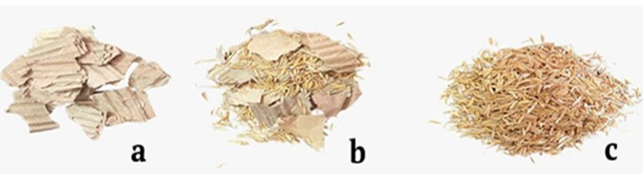
The experiment was conducted at the Iguatemi Experimental Farm of the State University of Maringá. A total of 750 mixed-sex broiler quail (14 days old) were used. The birds were individually weighed and randomly distributed into treatments. A completely randomized design was used, with 3 treatments: cardboard bedding (100% shredded cardboard), mixed bedding (50% shredded cardboard and 50% rice straw), and rice straw bedding (100% rice straw). Each treatment consisted of 5 replicates, with 50 birds per replicate (Figure 1).

Bedding materials for broiler quail: (a) shredded cardboard, (b) cardboard and rice straw mixture, and (c) rice straw.
Quail were maintained under controlled temperature and lighting conditions throughout the experimental period. They were housed in concrete pens covered with mesh within a shed with side curtains. Each pen measured 1.2 × 1.2 × 2.0 m. A 12h light /12h dark photoperiod was adopted. The shed temperature was maintained according to the species' requirements in each production phase. Water was provided ad libitum. The birds were fed diets formulated according to the recommendations of Rostagno & Albino (2024) (Table 1).
Animal performance
For this analysis, each pen containing 50 mixed-sex broiler quail was considered an experimental unit (n = 5). Feed intake, weight gain, and feed conversion were evaluated over the experimental period (14 to 35 days of age). Birds and feed in each pen were weighed at the beginning and end of the experiment to calculate feed intake and conversion. At 35 days of age, batch uniformity was determined as the proportion of birds within ± 10% of the mean final body weight.
Feed intake was calculated as the difference between total feed offered and leftovers in each experimental unit. Weight gain (g day-1) was calculated as final weight minus initial weight. Feed conversion was calculated as the ratio of feed intake to weight gain. Mortality was accounted for in the calculation of performance parameters.
Ingredient and nutrient composition of the experimental diet supplied to quail from 14 to 35 days of age under different bedding treatments.
Carcass yield
At the end of the experiment, two quail from each experimental unit (10 birds per treatment) were selected based on the mean weight of the pen. The birds were weighed (initial weight) and euthanized by manual exsanguination to evaluate carcass yield. Then, the gutted carcass was weighed without feet or head (final weight). Absolute weights were determined, and carcass yields were calculated.
Presence of pododermatitis
The presence of pododermatitis was visually assessed in the two birds slaughtered from each pen. The severity of footpad lesions was scored as follows: score 0: no signs of pododermatitis; score 1, lesions affecting up to 25% of the footpad surface; score 2, lesions affecting 25 to 50% of the footpad surface; and score 3, lesions affecting more than 75% of the footpad surface.
Relative organ weights and intestinal length
At 35 days of age, two quail per treatment (n = 2) were selected based on the mean weight of each replicate and euthanized by cervical dislocation. The heart, gizzard, proventriculus, thymus, liver, intestine, and testicles were weighed to determine relative organ weights, calculated as Relative organ weight = Organ weight ÷ Bird weight × 100. Additionally, the length of the intestine was determined.
Intestinal morphometry
At 35 days of age, five quail per treatment (n = 5) were selected based on the mean weight of each replicate for intestinal morphometry analysis. Jejunal fragments were collected immediately after slaughter and organ weighing. Samples were then fixed in 10% formalin for 24h at room temperature and stored in 70% ethanol until processing. Fragments were dehydrated through a graded alcohol series and embedded in paraffin. Sections (5 µm thick) were obtained using a rotary microtome (RM 2255, Leica Biosystems, Nussloch, Germany) and stained with hematoxylin and eosin. As a strategy to prevent repeated analysis of the same histological areas, sections were collected in a semi-serial manner (1 in every 10). For each animal, 20 histological sections were randomly prepared and imaged using a 10× objective. Images were captured using an optical microscope (Olympus BX-53, Tokyo, Japan) equipped with a digital camera (Olympus DP73, Tokyo, Japan). Villus height, villus width, and crypt depth were measured using Image-Pro® Plus software - version 4.5.0.29 (Media Cybernetics, 2001).
Intestinal pH
At 35 days of age, five quail per treatment (n = 5) were selected based on the mean weight of each replicate for luminal pH analysis. Jejunal contents were diluted in 10 mL of distilled water, and the pH was measured using a pH meter.
Rectal temperature
At 35 days of age, two birds were randomly selected from each experimental unit for analysis of rectal temperature. A flexible digital thermometer (Relax Medic) was inserted 1 cm into the cloaca of each bird and left in place for 10s or until the reading stabilized.
Bedding temperature
At the end of the 35-day experimental period, bedding temperature was measured in the morning and afternoon using a Fluke Ti300+ thermal imager. Images were captured to determine the maximum, minimum, and average temperatures for each treatment. Measurements were taken without birds in the pens.
Presence of lesser mealworms
The occurrence of lesser mealworms (Alphitobius diaperinus) in the bedding was evaluated by collecting samples from six points in each pen. This procedure ensured a homogeneous and representative selection across all pens. The insects present in each sample were then counted.
Bedding nitrogen and dry matter contents
Samples of the three bedding materials were collected at the beginning of the experiment. At the end of the experiment, a sample was collected from each experimental unit (n = 5) and taken to the laboratory. Nitrogen content was determined using the Kjeldahl method, and dry matter was quantified by oven drying.
Economic viability
Forage density and the shredding capacity of a silage mill were used to calculate the cardboard shredding capacity, defined as the ratio of forage density to shredding capacity multiplied by cardboard density. Energy expenditure was calculated by multiplying engine power (kW) by operating time and the cost per kW.
The volume required to cover an area of 1 m2 with a bedding depth of 7 cm, and the corresponding weight of each material, was determined using their respective densities. Material costs were calculated based on the required weight of bedding materials (kg) and their price per tonne. Labor costs were estimated using the Brazilian minimum wage, converted from a monthly to an hourly rate and then to a per-minute rate, and multiplied by the time required to process the material required to cover 1 m2.
Annual costs were calculated based on the frequency of bedding replacement reported in the literature: six times per year for cardboard, three times per year for mixed bedding, and twice per year for rice straw (Gonçalves et al., 2019). Final costs were estimated as the amount of material purchased minus the amount sold, according to their respective prices per tonne.
Statistical analysis
The ‘Univariate’ procedure was used to assess the normality of the data. Data were analyzed using one-way analysis of variance to evaluate the effects of different bedding types. Means were compared using Tukey's test (p < 0.05) (SAS Institute Inc., 2002).
The maximum likelihood method was used to analyze data on the presence of lesser mealworms (A. diaperinus), with a Poisson regression model. Model adequacy was assessed using the overdispersion test, and, if necessary, adjustments were applied, such as the quasi-Poisson distribution or the zero-inflated Poisson model. Treatment comparisons were performed using the likelihood ratio test. Model fit and predictive quality were evaluated using Akaike and Bayesian information criteria.
Results
Animal performance and carcass yield
Bird performance and carcass yield parameters are presented in Table 2. No significant differences in body weight, feed intake, or feed conversion ratio were observed among treatments (cardboard, mixed, and rice straw bedding).
Carcass yield was 74.04% in birds housed on cardboard bedding, 73.82% in birds housed on mixed bedding, and 72.07% in birds housed on rice straw bedding, but differences between treatments were not significant (p = 0.0726).
Presence of pododermatitis
Footpad lesions with scores of 0, 1, and 2 were observed among treatments. No bird exhibited score 3 lesions (Figure 2).

The frequency of footpad lesions by score and bedding treatment is presented in Figure 3. Birds housed on cardboard bedding showed the lowest incidence of footpad lesions, standing out from the other treatments. By contrast, the rice straw treatment differed significantly from the mixed bedding treatment, which had fewer birds with score 0 lesions.

Birds in the mixed and rice straw treatments showed the highest frequency of score 1 lesions, with 50% of birds exhibiting this level of severity. The cardboard treatment had the lowest occurrence of score 1 lesions. For score 2 lesions, the cardboard treatment showed the highest incidence, followed by the mixed bedding treatment, with rice straw resulting in the lowest frequency. No score 3 lesions were observed in any bird during the experiment.
Relative organ weights and intestinal length
No significant differences in relative organ weights were observed among treatments (Table 3).
Bedding material exerted significant effects on quail intestinal parameters (Table 4, Figure 4). Birds housed on recycled cardboard exhibited higher villus height and crypt depth. Mixed bedding resulted in the highest values of villus width and villus/crypt ratio, not differing from recycled cardboard.
Regarding intestinal length, no significant differences were observed between treatments (p = 0.1438). Bedding material also did not influence intestinal pH (p = 0.6580) or rectal temperature (p = 0.2718) (Table 4).

Histological sections of the intestine of broiler quail housed on (a) cardboard bedding, (b) mixed bedding, or (c) rice straw bedding. Hematoxylin and eosin staining, 10× magnification.
Bedding temperature
The minimum, maximum, and average temperatures were recorded for each treatment. The results revealed that, regardless of bedding material, temperatures were consistently higher in the afternoon than in the morning (Table 5).
In the morning, the lowest average temperature was recorded in rice straw bedding (22.29°C). This bedding also exhibited the highest maximum temperature in the afternoon (33.32°C), but the average temperature of rice straw in the afternoon was similar to that of mixed bedding (Figure 5).

Thermal images of (a) cardboard bedding, (b) mixed bedding, and (c) rice straw bedding in quail sheds.
Presence of lesser mealworm
Cardboard bedding had the lowest number of lesser mealworms (23.00 ± 2.14), being significantly lower than that of mixed bedding (54.25 ± 3.68). Rice straw had the highest mean number of lesser mealworms (92.00 ± 4.80), differing significantly from the other bedding materials (Table 6).
Nitrogen and dry matter contents
Preliminary analysis of bedding materials showed that recycled cardboard had the lowest nitrogen content, followed by mixed bedding and rice straw. Dry matter contents did not differ between materials (Table 7).
Nitrogen and dry matter contents of different types of bedding before and after 21 days of use in quail sheds.
Bedding materials were analyzed again after 21 days of use. Cardboard bedding presented the highest nitrogen content (3.253%), which was significantly higher than that of rice straw (2.221%) and slightly higher than that of mixed bedding (2.368%) (p = 0.0017). Regarding dry matter, cardboard and mixed beddings had similar values (91.70%), both significantly higher than that of rice straw (90.88%) (p = 0.0126).
Economic viability
Economic viability was assessed based on area (m2), material acquisition, processing, and labor costs (Table 8). Cardboard bedding had the highest cost-efficiency, representing only 8% of the cost of rice straw and yielding substantial savings in broiler quail production. Mixed bedding also showed low costs, corresponding to 59.48% of the price of rice straw.
Discussion
The search for alternative resources in animal production has become a contemporary necessity. Poultry litter plays a crucial role in absorbing moisture, ensuring thermal comfort, and minimizing bird contact with the ground; thus, the use of alternative bedding materials represents a promising strategy to enhance production efficiency. The selection of bedding material should consider not only direct costs but also factors such as local availability, ease of handling, and potential environmental impacts. In this context, the use of recycled cardboard contributes to the principles of a circular economy, promoting a more sustainable production system (Vilarinho et al., 2015).
The use of alternative bedding materials (cardboard, cardboard and rice straw mixture, and rice straw) as litter for broiler quail did not significantly influence poultry performance or carcass yield. Feed intake and feed conversion were similar between groups, suggesting that bedding material did not influence the feeding behavior of quail. Lot uniformity was also not affected by bedding material, with groups exhibiting values within the expected range for broiler quail. These findings suggest that the evaluated substrates are suitable for quail rearing (Avila et al., 2007b; Avila et al., 2008; Mahrose et al., 2021). Cardboard, in particular, shows good sanitary characteristics, providing a less favorable environment for the development of undesirable microorganisms in quail sheds.
Carcass yield varied slightly between treatments, being higher among quail housed on cardboard and lower among birds housed on rice straw. However, the difference was not statistically significant. Similarly, Brito et al. (2016) analyzed the impact of alternative bedding materials and found small, non-significant variations in yield. Previous studies have shown that bedding material may not be an important factor under adequate environmental and nutritional conditions (Brito et al., 2016). The slight difference in carcass yield is noteworthy, as birds with similar body weights but higher carcass yields demonstrate more efficient nutrient utilization during the productive phase. Consequently, these birds are considered more profitable within the production system (Ferreira & Bertolosi, 2024; Monteiro et al., 2026).
Pododermatitis, also known as footpad dermatitis, is a lesion directly associated with bedding quality, and its occurrence is generally linked to poor litter conditions (Kochish et al., 2023). A higher incidence of these lesions results in both economic losses and reduced bird welfare. Cardboard bedding resulted in the lowest frequency of mild lesions (scores 0 and 1) on plantar pads, whereas mixed and rice straw beddings afforded higher incidences of mild lesions. This outcome may be related to cardboard providing a softer, more uniform surface with lower compaction than the other bedding materials. The results corroborate those of Alabi et al. (2024) and Boussaada et al. (2022), who underscored the importance of physical characteristics (e.g., density and humidity) in the prevention of pododermatitis. Furthermore, mixed bedding produced intermediate results, indicating that combining materials with different structural properties can create a more stable surface, thereby improving balance and overall comfort in birds (Ferreira & Bertolosi, 2024).
Bedding material did not influence the relative weight of organs, intestinal length, or luminal intestinal pH, indicating no effect on quail health or performance. Other factors, such as feeding and handling, likely have a greater influence on these physiological parameters (Costa et al., 2026). Interestingly, birds housed on cardboard bedding had higher intestinal villus height. Furthermore, this bedding material had a lower incidence of lesser mealworms. This beetle is one of the main challenges in poultry farming, as it is a vector of pathogens and parasites (Abreu et al., 2011). Such insects may contribute to the spread of fungi such as Aspergillus flavus, a producer of mycotoxins (Tufan-Cetin & Cetin, 2025). Additionally, birds can contract salmonellosis when ingesting these insects in their larval and adult forms (Leffer et al., 2010).
In the intestine, pathogens such as the causative agent of coccidiosis can induce the death of epithelial cells lining the intestinal lumen (Hamad et al., 2024). Quail housed on cardboard bedding exhibited the highest crypt depth and second-highest villus/crypt ratio, suggesting an enhanced rate of cellular renewal. Conversely, the higher incidence of lesser mealworms in rice straw bedding might have contributed to the poorer intestinal morphometry of quail, as evidenced by the reduction in villus height.
The difference in lesser mealworm infestation between treatments may be related to the beddings' amount of organic matter and capacity to retain food residues and excreta. Shredded recycled cardboard contains less free organic matter and has a more compact structure, which likely limits the access of insects to food sources, resulting in a significantly lower infestation. The mixed bedding, composed of both recycled cardboard and rice straw, may have slightly increased nutrient availability to beetles, leading to intermediate infestation levels. By contrast, rice straw, characterized by a looser structure and greater retention of organic residues, provided a more favorable environment for lesser mealworm proliferation, explaining the higher infestation observed in this bedding.
Ammonia and nitrates are the most common chemical forms of nitrogen found in poultry waste (Abreu et al., 2011). Materials with high absorption capacity, such as cardboard, tend to retain a greater amount of nitrogen, which can result in nutrient accumulation. As such, high-nitrogen materials are interesting for litter management in poultry systems. Given their greater absorptive capacity, they help reduce moisture and, consequently, minimize the proliferation of pathogenic microorganisms in the rearing environment (Gonçalves et al., 2019). The use of cardboard in animal production systems has been seen as a sustainable alternative for waste management and soil enrichment in subsequent agricultural uses (Ribeiro et al., 2019).
Before use, recycled cardboard bedding had the lowest nitrogen content, rice straw the highest, and mixed bedding intermediate values. A similar pattern was observed for dry matter content. After 21 days of use, cardboard absorbed a greater amount of nitrogen, minimizing its volatilization. This result was expected, given the higher absorptive capacity of cardboard. Rice straw, by contrast, owing to its higher organic matter content, exhibited a lower nitrogen content after use compared with its initial values. From a sustainability standpoint, cardboard bedding can be advantageous for animal production systems, as it aligns with the growing demand for environmentally friendly and less polluting resources. Furthermore, spent cardboard bedding, enriched with nitrogen, can acquire added value as an organic fertilizer, contributing to a more circular and sustainable production cycle (Sperandio et al., 2021).
Economic analysis showed that cardboard bedding contributes to cost reduction. With a final cost of R$ 0.65 m-2, cardboard represents only 8% of the cost of rice straw (R$ 8.07 m-2), even when considering the additional processing costs (R$ 0.18 m-2). These results are similar to those of Caldas et al. (2020), who demonstrated the importance of evaluating not only the initial price of inputs but also the indirect costs associated with the production and maintenance of conventional and alternative forms of bedding materials in livestock production.
Conclusion
The results of this study indicate that shredded recycled cardboard is a viable alternative bedding material for quail production, as it maintains productive performance standards while enhancing animal welfare and reducing the incidence of sanitary issues. This finding has important implications for sustainable poultry production, as it promotes the reuse of waste and by-products, contributing to both economic efficiency and environmental sustainability within the production system.
Data availability
He data used in this research are presented in Tables and Figures of this article.
References
-
Abreu, V. M. N., Paiva, D. P. D., Abreu, P. G. D. & Coldebella, A.. (2011). Evaluation of litter material and ventilation systems in poultry production: III. Litter reuse, darkling beetle populations and intestinal parasites. Revista Brasileira de Zootecnia, 40(6), 1372-1380. https://doi.org/10.1590/S1516-35982011000600028
» https://doi.org/https://doi.org/10.1590/S1516-35982011000600028 -
Alabi, O. M., Olagunju, S., Aderemi, F., Lawal, T. E., Oguntunji, A., Ayoola, M. O., Oladejo, O., Adeleye, B., Adewumi, A. A., Alabi, B. & Tarța, A.. (2024). Effect of litter management systems on incidence and severity of footpad dermatitis among broilers at finisher stage. Translational Animal Science, 8, txad145. https://doi.org/10.1093/tas/txad145
» https://doi.org/https://doi.org/10.1093/tas/txad145 - Avila, V. S., Abreu, V. M. N., Figueiredo, E. A. P., Brum, P. A. R. & Oliveira, U. D. (2007a). Valor agronômico da cama de frangos após reutilização por vários lotes consecutivos (Comunicado Técnico, 466) Embrapa Suínos e Aves.
- Avila, V. S., Costa, C. A. F., Figueiredo, E. A. P., Rosa, P. S., Oliveira, U. & Abreu, V. M. N. (2007b). Materiais alternativos, em substituição à maravalha como cama de frangos (Comunicado Técnico, 465) Embrapa Suínos e Aves.
-
Avila, V. S., Oliveira, U., Figueiredo, E. A. P., Costa, C. A. F., Abreu, V. M. N. & Rosa, P. S.. (2008). Avaliação de materiais alternativos em substituição à maravalha como cama de aviário. Revista Brasileira de Zootecnia, 37(2), 273-277. https://doi.org/10.1590/S1516-35982008000200013
» https://doi.org/https://doi.org/10.1590/S1516-35982008000200013 -
Boussaada, T., Lakhdari, K., Benatallah, S. A. & Meradi, S.. (2022). Effects of common litter types and their physicochemical properties on the welfare of broilers. Veterinary World, 15, 1523-1529. https://doi.org/10.14202/vetworld.2022.1523-1529
» https://doi.org/https://doi.org/10.14202/vetworld.2022.1523-1529 -
Brito, D. A. P., Brito, D. R. B., Gomes, A. M. N., Cunha, A. S., Silva Filho, U. A. & Pinheiro, A. A.. (2016). Desempenho produtivo e rendimento de carcaça de frangos criados em diferentes materiais de cama aviária. Ciência Animal Brasileira, 17(2), 192-197. https://doi.org/10.1590/1089-6891v17i220736
» https://doi.org/https://doi.org/10.1590/1089-6891v17i220736 - Caldas, E. O. L., Lima, A. L. R. & Lara, L. J. C.. (2020). Análise econômica da produção avícola de corte por gênero em diferentes estruturas de governança. Organizações Rurais & Agroindustriais, 22(1), e1641.
-
Chaudhary, S., Saha, A. K. & Sharma, M. K.. (2025). A circular economy based nonlinear corrugated waste management system using Fermatean bipolar hesitant fuzzy logic. Scientific Reports, 15. https://doi.org/10.1038/s41598-025-90948-7
» https://doi.org/https://doi.org/10.1038/s41598-025-90948-7 -
Costa, D. R., Monteiro, F. A., Cangianelli, G. H., Almeida, A. A., Valentim, J. K., Souza Khatlab, A., Rezende, R. R., Polonio, J. C., Mokwa, F. C., Calderano, A. A., Guimarães, S. E. F., Castro Burbarelli, M. F., Sena Gandra, E. R., Garcia, R. G. & Gasparino, E. (2026). Effects of Amazonian oils on the jejunal microbiota and performance of Japanese quail (Coturnix coturnix japonica) Scientific Reports. https://doi.org/10.1038/s41598-026-61813-y
» https://doi.org/https://doi.org/10.1038/s41598-026-61813-y -
Ferreira, A. C. D. & Bertolosi, G. M.. (2024). Avaliação da cama nova e reutilizada na produção de frangos de corte: qualidade do material e impactos produtivos. Arquivos de Ciências Veterinárias e Zoologia da UNIPAR, 27(2), 242-251. https://doi.org/10.25110/arqvet.v27i2.2024-11646
» https://doi.org/https://doi.org/10.25110/arqvet.v27i2.2024-11646 -
Gonçalves, N. S., Komiyama, C. M., Rosa, C. C. B., Lima, J. D. F. P., Morais, M. D. G., Savegnago, F. B., Mezzalira Júnior, C. & Staub, L.. (2019). Qualidade da cama de frango de corte e a alternativa da acidificação como tratamento. Nativa, 7(6), 828-834. https://doi.org/10.31413/nativa.v7i6.7041
» https://doi.org/https://doi.org/10.31413/nativa.v7i6.7041 - Grunow, A., Gallon, A. V. & Beuren, I. M.. (2009). Análise da cadeia de valor e dos custos das rações de uma agroindústria processadora de aves. Organizações Rurais & Agroindustriais, 11(2), 205-221.
-
Hamad, S., Bielke, L., Shah, B., Nazmi, A. & Majeed, S.. (2024). Natural intraepithelial lymphocyte populations rise during necrotic enteritis in chickens. Frontiers in Immunology, 15(1), 1-11. https://doi.org/10.3389/fimmu.2024.1354701
» https://doi.org/https://doi.org/10.3389/fimmu.2024.1354701 -
Kochish, I., Krykanov, A. & Krykanov, A.. (2023). The effect of various types of bedding material on productive qualities and occurrence of pododermatitis of paw pads in broiler chickens. Veterinariya, Zootekhniya i Biotekhnologiya, 4(113), 127-131. https://doi.org/10.36871/vet.zoo.bio.202304013
» https://doi.org/https://doi.org/10.36871/vet.zoo.bio.202304013 -
Leffer, A. M., Kuttel, J., Martins, L. M., Pedroso, A. C., Astolfi-Ferreira, C. S., Ferreira, F. & Ferreira, A. J. P.. (2010). Vectorial competence of larvae and adults of Alphitobius diaperinus in the transmission of Salmonella Enteritidis in poultry. Vector-Borne and Zoonotic Diseases, 10(5), 481-487. https://doi.org/10.1089/vbz.2008.0089
» https://doi.org/https://doi.org/10.1089/vbz.2008.0089 -
Mahrose, K., Metwally, K., Abougabal, M., Cooper, R., Farghly, M. & El-Ratel, I.. (2021). Use of available crop by-products as alternative bedding materials to wheat straw for rearing broilers. Animal, 15(7), 100260. https://doi.org/10.1016/j.animal.2021.100260
» https://doi.org/https://doi.org/10.1016/j.animal.2021.100260 - Media Cybernetics (2001). Image-Pro Plus (Version 4.5.0.29) . Media Cybernetics.
-
Monteiro, F. A., Oliveira, C. H., Farias, M. R. S., Fonseca, L., Ramos, B. T., Braga, G. R., Andrade, S. M., Calderano, A. A., Rostagno, H. S. & Hannas, M. I.. (2026). Updated nutritional program improves performance, carcass yield, and profitability in male and female broilers. Poultry Science, 105(2), 106283. https://doi.org/10.1016/j.psj.2025.106283
» https://doi.org/https://doi.org/10.1016/j.psj.2025.106283 -
Neto, O. G. (2008). Análise de custos. IESDE Brasil SA. https://pt.slideshare.net/slideshow/analise-de-custos/4874109
» https://pt.slideshare.net/slideshow/analise-de-custos/4874109 - Ribeiro, D. O., Castoldi, G., Silva, H. D., Cavalcante, T. J., Almeida Júnior, J. J., Lima, L. I. O. & Carballal, M. R.. (2019). Atributos físicos de um latossolo após o uso de doses de cama de frango acrescidas à adubação mineral. Colloquium Agrariae, 15(2), 9-17.
- Rostagno, H. S. & Albino, L. F. T. (2024). Tabelas brasileiras para aves e suínos: composição de alimentos e exigências nutricionais Universidade Federal de Viçosa.
-
Santos, A. R., Silva, R. N., Santos, N. M., Vieira, M. F. C., Patrício, P. S. & Fontes, W. C.. (2024). Production of a Wood-Plastic Composite with wastes from disposable masks and corrugated cardboard: A sustainable post-pandemic approach. Sustainability, 16(22), 9726. https://doi.org/10.3390/su16229726
» https://doi.org/https://doi.org/10.3390/su16229726 - SAS Institute Inc (2002). Statistical Analysis System: Version 9.0. SAS Institute Inc.
-
Soni, A., Chelliapan, S., Hashmi, A., Yusuf, M., Das, P. & Kamyab, H.. (2022). Challenges and opportunities of utilizing municipal solid waste as alternative building materials for sustainable development goals: A review. Sustainable Chemistry and Pharmacy, 27, 100706. https://doi.org/10.1016/j.scp.2022.100706
» https://doi.org/https://doi.org/10.1016/j.scp.2022.100706 -
Sperandio, I. F., Buttgen Junior, J. E., Gasparotto, F., Schmidt Filho, E. & Paccola, E. A. S.. (2021). Aplicação da cama de curral e cama de frango no cultivo da alface. Revista Ibero-Americana de Ciências Ambientais, 12(11), 1-10. https://doi.org/10.6008/CBPC2179-6858.2021.011.0001
» https://doi.org/https://doi.org/10.6008/CBPC2179-6858.2021.011.0001 -
Tufan-Cetin, O. & Cetin, H.. (2025). A review of biological and sustainable management approaches for Alphitobius diaperinus, a major pest in poultry facilities. Veterinary Sciences, 12(2), 158. https://doi.org/10.3390/vetsci12020158
» https://doi.org/https://doi.org/10.3390/vetsci12020158 - Vilarinho, C., Castro, F. & Russo, M. (2015). Wastes: Solutions, treatments and opportunities CRC Press.