 Tactile stimulation reduces reactivity but does not improve the performance of Brahman’s calves
ABSTRACT.
This study aimed to evaluate the effects of tactile stimulation on the reactivity and performance of Brahman calves. One hundred and nine calves were randomly assigned to two treatments: calves that received tactile stimulation (TS, n = 57) and those that did not (NTS, n = 52). Tactile stimulation was performed for eight minutes, 12 hours after birth. The behavioral variables were collected at weaning (209.50 ± 55.83 days) by assigning reactivity scores in the squeeze chute, which ranged from one to five (one was assigned to a calm calf and five to the most reactive). A flight speed score was assigned when each calf exited the squeeze chute. Performance was assessed using the adjusted weaning weight (WW) and daily weight gain (ADG). TS female calves showed lower reactivity scores in the squeeze chute (p < 0.05) and when leaving it (p < 0.05) than NTS calves, but no significant differences were observed in male calves between the treatments (p > 0.05). WW and GMD did not differ between the treatments (p > 0.05). In conclusion, tactile stimulation performed in Brahman’s calves at birth resulted in less reactivity in female calves without affecting their performance.
Keywords:
Animal welfare; behavior; beef cattle; temperament; human-animal interaction
Introduction
Beef cattle production is the most frequent livestock activity in Panama, in which cow-calf operations represent around 68% of the total Panamanian herd (Instituto Nacional de Estadística y Censo [INEC], 2021), with calves being the leading source of income for farmers. Due to the pasture raising system in Panama, animals experience few interactions with humans or, when they occur, they are often negative, resulting from aversive handling such as hot-iron branding, castration and dehorning, among other practices (Acharya et al., 2022; Hemsworth & Coleman, 2011), which affect animal welfare and can result in accidents, illnesses, or even animals’ death (Paranhos da Costa et al., 2014).
A positive relationship between humans and animals has been described by livestock farmers as relevant for positive welfare (Vigors & Lawrence, 2019). In this sense, studies carried out on dairy cattle indicate that tactile stimulation induces positive emotions during interactions with humans (Lange et al., 2020, 2021), and when carried out at an early age (regardless of its frequency and time), can reduce fear and facilitates handling procedures in several species, as reported by sheep (Boivin et al., 2000), goats (Boivin & Braastad, 1996), horses (Ligout et al., 2008) and rabbits (Verwer et al., 2009). Furthermore, previous studies have demonstrated that positive relationships between humans and animals have the potential to improve immunity in sheep (Caroprese et al., 2006) and performance in piglets (Oliveira et al., 2015) and Holstein calves (Lürzel et al., 2015).
A study carried out with crossed Limousin calves demonstrated that tactile stimulation in early life had long-term effects by reducing the fear of humans and the stress response at slaughter (Probst et al., 2012). Therefore, we hypothesized that tactile stimulation during the sensitive period of beef calves' lives (Bateson, 1979; Boivin et al., 1992) is an efficient strategy to promote positive interactions with humans, creating good memories that can reduce calf reactivity and facilitate handling (Paranhos da Costa, 2022), thereby positively affecting animal and human welfare. Thus, this study aimed to evaluate the effects of tactile stimulation on the reactivity and performance of Brahman's calves.
Material and methods
All animals were treated following the practices and experimental protocols reviewed and approved by the Institutional Bioethics Committee of the University of Panama (CEIBA-UP-021-2021).
The study was carried out in a commercial cow-calf operation farm located in Divalá, Alanje, Panama (8°30'40” N and 82°36'43” W, 216 m high from the sea level), where the averages of air temperature and relative humidity were 27°C (ranging from 26.4 to 28.1 °C) and 83.4% (ranging from 75.5 to 87.9%), and the average annual precipitation was 2374.4. mm (Instituto de Meteorología e Hidrología de Panamá [IMHPA], 2020).
One hundred and nine Brahman calves (52 male and 57 female calves) born between March and August 2020, with an average birth weight of 32.31 ± 4.03 kg, all descendants of cows with 3.02 ± 2.39 parities, were randomly distributed in two treatments: those that received tactile stimulation (TS; n = 57, 26 male and 31 female calves) and those that did not (NTS; n = 52, 26 male and 26 female calves). Cows and calves were kept on pasture (Urochloa brizantha cv. Marandú) with free access to mineral supplements and water.
Tactile stimulation was performed 12 hours after calving, after the development of the cow-calf bond (Johnsen et al., 2015). To do this, a cowhand on horseback lassoed the calf calmly and carefully without pulling or dragging it across the maternity paddocks, while another cowhand maintained the cow at a distance. Then, the calf was held by the groin and neck and laid on the ground (Paranhos da Costa et al., 2014). Tactile stimulation was then initiated, massaging the animal's entire body with hands for eight minutes, and was performed gently, starting in the head, face, ears and nostrils, and then proceeding to the other parts of the body (neck, back, groin area, rump, legs and hooves). After completing the tactile stimulation, the navel was disinfected with 10% iodine, and the calves were identified with a tattoo in the ear and weighed (BW, kg). When they were approximately 15 days old, they were identified using electronic (RFID, EID HDX Tamper-Proof, and Allflex Livestock Intelligence) and visual (Allflex Livestock Intelligence) ear tags. Calves were weighed again at weaning (WW, kg) when they were 209.50 ± 55.83 days old. The average daily gain for each calf (ADG, kg d-1) was calculated based on BW and WW.
At weaning, calves were individually subjected to two reactivity tests. Cows and calves were taken from the pasture to the corral and separated, maintaining the calves in one of the corral pens with free access to water and shade for approximately 30 minutes before starting the tests.
First, calf reactivity was scored at the squeeze chute without using any restraint structure by assigning one of the following scores: (1) calm, without movement; (2) agitated; (3) frequent movements with vocalization; (4) frequent movements with vocalizations and shaking the squeeze chute; and (5) violent and continuous struggles (adapted from Cooke et al., 2011). Immediately after carrying out the first assessment of reactivity, calves were released from the squeeze chute and the exit score was assigned as described by Vetters et al. (2013), as follows: (1) the calf leaves walking or (2) the calf leaves trotting or running.
Statistical analyzes
Statistical analyzes were performed using the R software with the RStudio integrated development environment (R version 4.0.4, 2022-02-15, RStudio, Inc.). The normality of the residual errors in the adopted models was verified using the Shapiro-Wilk test. Outliers were preserved because they represent individual variations within the reference values for the species.
Weaning weight and daily weight gain were evaluated using generalized linear models, considering the fixed effects of treatment, sex and their interactions, and birth weight, age, parity and cow weight as covariates. The reactivity scores in the squeeze chute were analyzed using generalized linear models adjusted by Poisson distribution, considering treatment, sex, and their interactions as fixed effects and cows' age and parity as covariates. The best adjustment of the model was performed with the 'step-up' procedure using Akaike information classifications (AIC) and Bayesian information classifications (BIC).
Multiple comparisons for the reactivity scores in the squeeze chute, WW and ADG were performed using the post-hoc Tukey test. The Chi-square test (χ2) was used to compare the number of calves in the TS and NTS treatments that left the squeeze chute walking or trotting/running according to sex. Box plots were constructed to facilitate visual interpretation of the results (‘geom_boxplot{ggplot2} and bars geom_col{ggplot2}’).
Results and discussion
There was no significant effect of treatment (p > 0.05), sex (p > 0.05), nor the interaction between treatments and sex (p > 0.05) on WW and ADG (Table 1).
Adjusted means ± standard errors of weaning weight (WW, kg) and average daily gain (ADG kg d-1) of Brahman calves (n = 109) according to treatment (TS = received tactile stimulation and NST = not received tactile stimulation) and sex (male and female calves).
There was a significant interaction between treatments and the sex of calves, with TS female calves showing a lower reactivity score in the squeeze chute than NTS ones (p < 0.05; Figure 1).

Box plot of the reactivity score in the squeeze chute of Brahman calves (n = 109) according to the treatments (TS = received tactile stimulation, NTS = did not receive tactile stimulation) and TS = with tactile stimulation) and sex (male and female calves). Different letters indicate statistical differences in the interaction treatment and sex; black triangles indicate the mean; grey circles indicate outliers.
There was a significant effect of treatment (χ2 = 4.63, DF = 1; p < 0.05) on the exit speed score but not on sex (χ2 = 0.94, DF = 1; p > 0.05). A higher percentage of TS female calves walked relative to NTS animals (84% vs 46%, respectively), resulting in a lower percentage of TS female calves exiting the squeeze chute by trotting/running than NTS calves (16% vs 54% respectively), as shown in Figure 2.
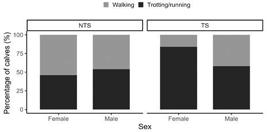
Percentages of Brahman’s calves (n = 109) that left the squeeze chute walking or trotting/running according to treatments (TS = received tactile stimulation and NTS = did not receive tactile stimulation) and sex (male and female calves).
A series of studies have found no effects of tactile stimulation on the performance of animals from birth to weaning, as described for dairy calves (Lensink et al., 2000), lambs (Pascual-Alonso et al., 2015) and piglets (Muns et al., 2015), which is corroborated by the present results. On the other hand, other studies have shown divergent results with dairy calves, showing that tactile-stimulated calves had a higher average daily gain up to and after weaning. (Lürzel et al., 2015). Likewise, tactile-stimulated piglets showed better performance at weaning than those not stimulated (Oliveira et al., 2015).
Although our results did not show any effect of tactile stimulation on the calves' performance, it was observed that the tactile-stimulated female calves (TS) were less reactive than those not stimulated (NTS). Such behavioral changes may have positive effects when carrying out handling routines, resulting in better reproductive performance, as described by Cooke et al. (2012, 2017), for example, or in lower animal stress and reactivity at the time of slaughter, with positive implications for meat quality (Probst et al., 2012). It is worth noting that the assessment of the calves' reactivity occurred approximately seven months after the application of tactile stimulation, making our results more interesting, as its implementation resulted in a beneficial effect on positive long-term memory formation, potentially improving human-animal interactions during handling routines. Previous studies have shown that female cattle are more reactive than male (Voisinet et al., 1997), and probably by being more temperamental, they can respond better when getting used to handling conditions (Parham et al., 2019), as was the case with the reduction in reactivity in our female calves.
There are reports on commercial farms that have adopted this concept, indicating that in addition to promoting positive changes in animal behavior, there are also changes in the attitudes of cowboys towards animals (Paranhos da Costa, 2022).
On the other hand, the results of a study carried out on commercial beef cattle farms focusing on human-animal interactions during the handling of newborn calves showed that when handling is aversive, calves and cows become more reactive, which directly affects their well-being and increases the risk of accidents for both animals and people responsible for handling livestock (Costa et al., 2021).
Conclusion
In conclusion, tactile stimulation 12 hours after birth in Brahman's calves resulted in a reduction of their reactivity at weaning, with a marked effect in female calves, without changes in their performance.
Acknowledgements
This research was conducted during the term of a doctoral scholarship offered by the Secretaría Nacional de Ciencia, Tecnología e Innovación - Panamá (SENACYT), with code BEPA-D-2019-007. This study was part of the doctoral thesis of the first author, prepared for the Graduate Program in Animal Science of the Faculty of Agricultural and Veterinary Sciences at São Paulo State University, Jaboticabal, SP, Brazil. We thank Fazenda Los Angeles, Live Biotec, and Ernesto Arcia for providing resources, attention, and collaboration to carry out the study
References
-
Acharya, R. Y., Hemsworth, P. H., Coleman, G. J., & Kinder, J. E. (2022). The animal-human interface in farm animal production: animal fear, stress, reproduction and welfare. Animals 12(4), 487. https://doi.org/10.3390/ani12040487
» https://doi.org/https://doi.org/10.3390/ani12040487 -
Bateson, P. (1979). How do sensitive periods arise and what are they for? Animal Behaviour, 27, 470-486. https://doi.org/10.1016/0003-3472(79)90184-2
» https://doi.org/https://doi.org/10.1016/0003-3472(79)90184-2 -
Boivin, X., & Braastad, B. O. (1996). Effects of handling during temporary isolation after early weaning on goat kids’ later response to humans. Applied Animal Behaviour Science , 48(1-2), 61-71. https://doi.org/10.1016/0168-1591(95)01019-X
» https://doi.org/https://doi.org/10.1016/0168-1591(95)01019-X -
Boivin, X., le Neindre, P., Chupin, J. M., Garel, J. P., & Trillat, G. (1992). Influence of breed and early management on ease of handling and open-field behaviour of cattle. Applied Animal Behaviour Science , 32, (4), 313-323. https://doi.org/10.1016/S0168-1591(05)80024-3
» https://doi.org/https://doi.org/10.1016/S0168-1591(05)80024-3 -
Boivin, X., Tournadre, H., & Le Neindre, P. (2000). Hand-feeding and gentling influence early-weaned lambs’ attachment responses to their stockperson. Journal of Animal Science, 78(4), 879-884. https://doi.org/10.2527/2000.784879x
» https://doi.org/https://doi.org/10.2527/2000.784879x -
Caroprese, M., Napolitano, F., Albenzio, M., Annicchiarico, G., Musto, M., & Sevi, A. (2006). Influence of gentling on lamb immune response and human-lamb interactions. Applied Animal Behaviour Science , 99(1-2), 118-131. https://doi.org/10.1016/j.applanim.2005.08.023
» https://doi.org/https://doi.org/10.1016/j.applanim.2005.08.023 -
Cooke, R.F., Bohnert, D.W., Cappellozza, B.I., Mueller, C.J., & Delcurto, T. (2012). Effects of temperament and acclimation to handling on reproductive performance of Bos taurus beef females. Journal of Animal Science , 90(10), 3547-3555. https://doi.org/10.2527/jas.2011-4768
» https://doi.org/https://doi.org/10.2527/jas.2011-4768 -
Cooke, R. F., Bohnert, D. W., Meneghetti, M., Losi, T. C., & Vasconcelos, J. L. M. (2011). Effects of temperament on pregnancy rates to fixed-timed AI in Bos indicus beef cows. Livestock Science, 142(1-3), 108-113. https://doi.org/10.1016/j.livsci.2011.06.024
» https://doi.org/https://doi.org/10.1016/j.livsci.2011.06.024 -
Cooke, R., Schubach, K., Marques, R., Peres, R., Silva, L., Carvalho, R., Cipriano, R., Bohnert, D., Pires, A., & Vasconcelos, J.L.M. (2017). Effects of temperament on physiological, productive, and reproductive responses in Bos indicus beef cows. Journal of Animal Science , 95, (1), 1-8. https://doi.org/10.2527/jas.2016.1098
» https://doi.org/https://doi.org/10.2527/jas.2016.1098 -
Costa, F. de O., Valente, T. S., de Toledo, L. M., Ambrósio, L. A., Campo, M. del, & Paranhos da Costa, M. J. R. (2021). A conceptual model of the human-animal relationships dynamics during newborn handling on cow-calf operation farms. Livestock Science , 246, 104462. https://doi.org/10.1016/J.LIVSCI.2021.104462
» https://doi.org/https://doi.org/10.1016/J.LIVSCI.2021.104462 -
Hemsworth, P., & Coleman, G. (2011). Human-animal interactions and animal productivity and welfare. In Human-Livestock Interactions: The stockperson and the productivity and welfare of intensively farmed animals (2ª ed., pp. 47-83). CABI. https://doi.org/10.1016/J.LIVSCI.2021.104462
» https://doi.org/https://doi.org/10.1016/J.LIVSCI.2021.104462 -
Instituto de Meteorología e Hidrología de Panamá [IMHPA]. (2020). Datos climáticos históricos https://www.imhpa.gob.pa/es/estaciones-satelitales Accessed on 25 December 2022.
» https://www.imhpa.gob.pa/es/estaciones-satelitales -
Instituto Nacional de Estadística y Censo [INEC]. (2021). Situación pecuaria Contraloría General de la República de Panamá. https://www.inec.gob.pa/archivos/P030194820220506094101CUADRO%204.pdf Accessed on 25 October 2023.
» https://www.inec.gob.pa/archivos/P030194820220506094101CUADRO%204.pdf -
Johnsen, J. F., de Passille, A. M., Mejdell, C. M., Bøe, K. E., Grøndahl, A. M., Beaver, A., Rushen, J., & Weary, D. M. (2015). The effect of nursing on the cow-calf bond. Applied Animal Behaviour Science , 163, 50-57. https://doi.org/10.1016/j.applanim.2014.12.003
» https://doi.org/https://doi.org/10.1016/j.applanim.2014.12.003 -
Lange, A., Waiblinger, S., van Hasselt, R., Mundry, R., Futschik, A., Lürzel, S. (2021). Effects of restraint on heifers during gentle human-animal interactions. Applied Animal Behaviour Science , 243, 105445. https://doi.org/10.1016/J.APPLANIM.2021.105445
» https://doi.org/https://doi.org/10.1016/J.APPLANIM.2021.105445 -
Lange, A., Waiblinger, S., Heinke, A., Barth, K., Futschik, A., & Lürzel, S. (2020). Gentle interactions with restrained and free-moving cows: Effects on the improvement of the animal-human relationship. Plos One, 15(11), e0242873. https://doi.org/10.1371/JOURNAL.PONE.0242873
» https://doi.org/https://doi.org/10.1371/JOURNAL.PONE.0242873 -
Lensink, B. J., Boivin, X., Pradel, P., Le Neindre, P., & Veissier, I. (2000). Reducing veal calves’ reactivity to people by providing additional human contact. Journal of Animal Science , 78(5), 1213-1218. https://doi.org/10.2527/2000.7851213x
» https://doi.org/https://doi.org/10.2527/2000.7851213x -
Ligout, S., Bouissou, M. F., & Boivin, X. (2008). Comparison of the effects of two different handling methods on the subsequent behaviour of Anglo-Arabian foals toward humans and handling. Applied Animal Behaviour Science , 113(1-3), 175-188. https://doi.org/10.1016/J.APPLANIM.2007.12.004
» https://doi.org/https://doi.org/10.1016/J.APPLANIM.2007.12.004 -
Lürzel, S., Münsch, C., Windschnurer, I., Futschik, A., Palme, R., & Waiblinger, S. (2015). The influence of gentle interactions on avoidance distance towards humans, weight gain and physiological parameters in group-housed dairy calves. Applied Animal Behaviour Science , 172, 9-16. https://doi.org/10.1016/j.applanim.2015.09.004
» https://doi.org/https://doi.org/10.1016/j.applanim.2015.09.004 -
Muns, R., Jean-Loup, R., & Hemsworth, P. (2015). Positive human contact on the first day of life alters the piglet's behavioral response to humans and breeding. Physiology & Behavior, 151, 162-167. https://doi.org/10.1016/j.physbeh.2015.06.030
» https://doi.org/https://doi.org/10.1016/j.physbeh.2015.06.030 -
Oliveira, D., Paranhos da Costa, M. J. R., Zupan, M., Rehn, T., & Keeling, L. J. (2015). Early human handling in non-weaned piglets: Effects on behaviour and body weight. Applied Animal Behaviour Science , 164, 56-63. https://doi.org/10.1016/J.APPLANIM.2015.01.002
» https://doi.org/https://doi.org/10.1016/J.APPLANIM.2015.01.002 - Paranhos da Costa, M. J. R. (2022). Bem-estar animal: Avanço na adoção de boas práticas. In. Bovinos. Inovação Sustentabilidade e Mercado do Brasil (pp. 153-168). Editora Metalivros.
-
Paranhos da Costa, M.J., Schmidek, A., & Macedo de Toledo, L. (2014). Boas Práticas de Manejo, Bezerros ao Nascimento Editora Funep; UNESP. https://repositorio-dspace.agricultura.gov.br/bitstream/1/251/1/Bezerros-ao-Nascimento.pdf
» https://repositorio-dspace.agricultura.gov.br/bitstream/1/251/1/Bezerros-ao-Nascimento.pdf -
Parham, J. T., Tanner, A. E., Barkley, K., Pullen, L., Wahlberg, M. L., Swecker, W. S., Lewis, R. M. (2019). Temperamental cattle acclimate more substantially to repeated handling. Applied Animal Behaviour Science , 212, 36-43. https://doi.org/10.1016/j.applanim.2019.01.001
» https://doi.org/https://doi.org/10.1016/j.applanim.2019.01.001 -
Pascual-Alonso, M., Miranda-de la Lama, G. C., Aguayo-Ulloa, L., Ezquerro, L., Villarroel, M., Marín, R. H., & Maria, G. A. (2015). Effect of postweaning handling strategies on welfare and productive traits in lambs. Journal of Applied Animal Welfare Science, 18(1), 42-56. https://doi.org/10.1080/10888705.2014.941107
» https://doi.org/https://doi.org/10.1080/10888705.2014.941107 -
Probst, J. K., Spengler Neff, A., Leiber, F., Kreuzer, M., & Hillmann, E. (2012). Gentle touching in early life reduces avoidance distance and slaughter stress in beef cattle. Applied Animal Behaviour Science , 139(1-2), 42-49. https://doi.org/10.1016/j.applanim.2012.03.002
» https://doi.org/https://doi.org/10.1016/j.applanim.2012.03.002 -
Verwer, C. M., van Amerongen, G., van den Bos, R., & Hendriksen, C. F. M. (2009). Handling effects on body weight and behaviour of group-housed male rabbits in a laboratory setting. Applied Animal Behaviour Science , 117(1-2), 93-102. https://doi.org/10.1016/J.APPLANIM.2008.12.004
» https://doi.org/https://doi.org/10.1016/J.APPLANIM.2008.12.004 -
Vetters, M. D. D., Engle, T. E., Ahola, J. K., & Grandin, T. (2013). Comparison of flight speed and exit score as measurements of temperament in beef cattle. Journal of Animal Science , 91(1), 374-381. https://doi.org/10.2527/jas.2012-5122
» https://doi.org/https://doi.org/10.2527/jas.2012-5122 -
Vigors, B., & Lawrence, A., (2019). What are the positives? Exploring positive welfare indicators in a qualitative interview study with livestock farmers. Animals, 9(9), 694. https://doi.org/10.3390/ani9090694
» https://doi.org/https://doi.org/10.3390/ani9090694 -
Voisinet, B. D., Grandin, T., Tatum, J. D., & Struthers, J. J. (1997). Feedlot cattle with calm temperaments have higher average daily gains than cattle with excitable temperaments. Journal of Animal Science , 75(4), 892-896. https://doi.org/10.2527/1997.754892x
» https://doi.org/https://doi.org/10.2527/1997.754892x


