
 The Amazon Burning Crisis: South America’s Ecological Catastrophe and Call to Action
The Amazon, often referred to as the “lungs of the Earth,” is one of the most vital ecosystems on the planet, housing approximately 10% of the world’s biodiversity and serving as a critical carbon sink. However, in recent decades, the region has faced escalating deforestation, wildfires, and environmental degradation. Alarmingly, extreme drought events have become more frequent and intense. In 2024, the situation reached critical levels, leading to water shortages and threatening the food security of Amazonian communities. This crisis affects not only the ecosystems, but also endangers the lives of populations that rely on the rivers for transportation, water supply, and subsistence.
Economic pressures, political decisions, infrastructure development, the expansion of mining and oil exploration, and growing global demand for timber and agricultural commodities such as soy and beef, have accelerated deforestation and uncontrolled fires, particularly in Brazil and other South American countries. These factors place the Amazon at the epicenter of a severe ecological crisis that threatens not only the future of the forest, but also the global climate balance.
The destruction of the Amazon is not solely an environmental crisis; it is deeply intertwined with socio-political issues. Indigenous communities, historically the stewards of the forest, are facing displacement, human rights violations, and the loss of their traditional lands. This crisis reflects a broader tension between extractivism and conservation in Latin America, where governments and corporations often prioritize short-term economic growth over long-term environmental sustainability, this model of unsustainable development exacerbates the ecological crisis (Gudynas, 2018).
Leading scientists like Carlos Nobre and Thomas Lovejoy have sounded the alarm on the Amazon approaching a critical tipping point, where continued deforestation and environmental degradation could push the ecosystem into an irreversible state of ecological collapse. Nobre, a prominent Brazilian climatologist, has been a key figure in identifying the Amazon’s fragility in the face of deforestation, emphasizing that the region could transition from a lush rainforest into a dry savanna-like environment if deforestation reaches between 20-25% of the forest’s original area. According to their research, the Amazon is alarmingly close to this threshold, with approximately 17% of the forest already lost (Lovejoy & Nobre, 2019, Nobre, 2014).
This tipping point would result in a significant reduction of the Amazon’s capacity to generate rain through its natural water cycle, severely disrupting not only local but also global climate patterns. The Amazon is essential for stabilizing the global climate, as it absorbs vast amounts of carbon dioxide and helps regulate weather systems across South America and beyond. If the Amazon reaches this critical point of degradation, it will release stored carbon back into the atmosphere, accelerating global climate change and undermining efforts to limit global warming.
The Amazon, which spans across eight countries that are part of the Amazon Cooperation Treaty Organization (ACTO)-Brazil, Bolivia, Colombia, Ecuador, Guyana, Peru, Suriname, and Venezuela-as well as French Guiana, requires transnational cooperation to effectively address the ongoing environmental crisis. However, national priorities, economic pressures, and differing environmental policies have hindered a unified approach. This lack of cohesion has allowed deforestation, illegal logging, and land clearing to persist at alarming rates across the region, exacerbating the environmental destruction of one of the world’s most critical ecosystems.
The Amazon burning crisis has reached unprecedented levels, with the scale of destruction worsening each year. As illustrated in the Figure 1, based on data from the Brazilian National Institute for Space Research (INPE), the frequency and intensity of forest fires across the Amazon region, particularly in Brazil, Bolivia and Venezuela have sharply increased from 1998 to 2024. Peaks in fire occurrences have been particularly severe in Brazil, reflecting the nation’s substantial contribution to deforestation. Other Amazonian countries, including Peru, Colombia, and Ecuador, have also seen significant fire activity, though at lower levels.
Since the early 2000s, data show several years of fire activity exceeding 300,000 outbreaks in the Amazon region, with particularly severe spikes in 2004, 2007, 2010, and most recently in 2024. These peaks in fire activity can closely linked to land clearing for agriculture, cattle ranching and logging, exacerbated by weak enforcement of environmental regulations.
Political decisions within Amazonian countries, particularly in Brazil have been central to the worsening of the crisis. Many governments have adopted policies that weaken environmental regulations in a bid to attract foreign investments and boost domestic agricultural and mining sectors. In Brazil, under certain administrations, environmental protections have been systematically dismantled, notably through defunding key institutions like IBAMA (the Brazilian Institute of Environment and Renewable Natural Resources), which is tasked with enforcing environmental laws and curbing illegal activities. This has led to a surge in deforestation, illegal logging, and land clearings, often exacerbated by weak enforcement.
In Bolivia, government policies have similarly prioritized agricultural expansion over environmental protection, contributing to increased deforestation and wildfires, particularly in areas targeted for cattle ranching and soy production. The absence of strong state presence in other Amazonian countries has further compounded the problem. In regions where the state is absent or lacks sufficient capacity to enforce environmental laws, illegal activities such as logging, and land grabbing flourish unchecked.
Paulo Artaxo, a renowned Brazilian researcher, points out that fires have been a constant problem in Brazil for at least the last 30 years, mainly due to deforestation to open up new areas for agriculture and cattle ranching in the Cerrado and the Amazon. However, 2024 stands out as a year in which this problem crossed unprecedented thresholds. The situation can be described as a “pandemic” of forest fires (Artaxo, 2024). This emphasizes that the problem of fires and deforestation is not limited to the year 2024; it is a long-standing problem. However, none of the Amazonian countries are adequately prepared to address the crisis, nor do they have strong enough institutions to respond effectively.
Governments must enact and enforce tougher laws with stiffer penalties that target not only minor violations but also major environmental crimes such as land grabbing, large-scale illegal logging and deliberate fires. Governments must also stop treating environmental crimes as minor offenses and instead impose severe penalties that reflect the true extent of environmental degradation. These penalties must be substantial enough to outweigh the financial gains from exploiting the Amazon. As Artaxo points out, there were no lightning strikes in the region in August and September 2024, which means that all these fires were man-made, without legal authorization, since the government had suspended all pre-authorized burning. In other words, these are criminal fires. Hence the importance of a total ban on the use of fire in agriculture (Artaxo, 2024).
In addition, cooperation among Amazonian countries is essential to harmonize environmental policies, strengthen enforcement capacity, and address transnational criminal networks that contribute to environmental degradation. The challenges are transnational and require a unified response, as no country can address them in isolation. In 2024, the crisis of forest fires and drought has forced amazonian governments to take certain measures, such as declaring states of emergency. However, it is imperative that these measures are complemented by more structural and long-term strategies to avoid being limited to palliative solutions. Only through a coordinated and sustainable approach will it be possible to address the root causes of the environmental crisis and preserve the future of the Amazon.
The Amazon’s vital role in regulating global climate, maintaining biodiversity, and supporting indigenous communities makes the need for immediate action urgent. If the Amazon reaches its ecological tipping point, the consequences for both the region and the world will be catastrophic. As Aldo Leopold’s land ethic teaches, humanity has a moral obligation to protect the natural world. Indigenous voices have long called for the protection of their lands and the ecosystems that sustain them. These communities, who depend on the Amazon for their survival, not only warn of environmental degradation, but also advocate for sustainable management of the land. The crisis in the Amazon is a call to action to adopt more sustainable and ethical approaches to land management, recognizing the interconnectedness of life on Earth.
The article “Análisis y sistematización del co-manejo de manglares desde el enfoque sistémico de gestión ambiental”, by Felipe Carrera Villacrés, Lucía Vernaza Quiñónez and Edson Vicente da Silva, analyses and systematizes the experience of implementing and executing the Agreements for the Sustainable Use and Custody of the Mangrove Ecosystem (AUSCEM), using a critical interpretation. To answer these questions, the following phases are adopted: comparing and analysing the Management Plans (MPs); examining the half-yearly reports drawn up by each community; and systematizing the experience, considering the perception of the community and the relevant actors. The communities studied are located in the south of the province of Esmeraldas in Ecuador.
Authored by Laura Gonçalves Osorio and Marcelo Fernandes Pacheco Dias, the article “Comparative Analysis of Brazilian Methods for Evaluating Sustainable Development on Farms” aims to analyze the differences and similarities between Brazilian methods for evaluating sustainable development on farms: Ambitec-Agro, APOIA-NovoRural and ISA. Methodologically, the meta-study method was used. The main results indicate that the three methods Ambitec-Agro, APOIA-NovoRural and ISA each have their similarities and differences. In conclusion, when choosing a method, special emphasis should be placed on deciding the boundaries of the farm to be analyzed (a technology, an agricultural activity or the farm as a whole). Furthermore, all three methods are based on indicators and have been established a priori, which makes it impossible to choose between them.
The text entitled “Environmental Awareness and Public Perception of Carbon Capture and Storage in Brazilian Universities”, written by Lucas Alexandre Franklin Toé, Ana Paula Meneguelo and Gisele de Lorena Diniz Chaves, analyzes how carbon capture and storage (CCS) can be seen as a possible alternative in the effort to reduce GHG emissions on the planet. The aim of this research was to analyze the public’s perception of CCS technology, relating it to their environmental awareness in the context of climate change. To obtain the data, a questionnaire was administered at federal universities in the southeast of Brazil and answered by 671 individuals, including students and professors working at the universities studied. The results point to a low level of awareness of the technology, but with a majority in favor of its acceptance.
The article “Forests in neoliberal climate governance: an analysis of the Floresta+ Amazônia pilot project”, by Veridiana Dalla Vecchia and Veronica Korber Gonçalves, shows that, in a context of neoliberal rationality, the economic and techno-managerial solution for forest protection policies is central to tackling climate change. The paper describes characteristics of this rationality in the project and, to this end, uses critical literature on the REDD+ mechanism and on neoliberal rationality, and details Floresta+ Amazônia based on primary documentation, with a focus on analyzing its structure and processes, as well as the discourses related to its form of implementation. The authors conclude that the pilot project, although it does not directly provide for financial transactions, places the participating actors - and the Amazon rainforest itself - in a technical-managerialist logic that helps to depoliticize the process of defining possible projects for the territory.
The article, entitled “Novelties and Ambiguities in the Specification of an Amazonian Sociobiodiversity Resource: the case of açaí”, written by Renato dos Prazeres, Monique Medeiros, Ademir Antonio Cazella and Marja Zattoni Milano, deals with initiatives for valuing and specifying territorial assets, taking as its empirical reference one of the main food products of the Brazilian Amazon from forest extraction: açaí. The authors address the main innovations constructed by different categories of territorial actors in the processes of valuing açaí in the northeast of Pará, with an emphasis on the ambiguities present in these processes. The methodological strategy used was a case study based on 21 interviews with territorial actors between August and December 2020. The main results are that the processes of consolidating organic certification and marketing certified açaí represent socio-technical novelties, but are permeated by ambiguities and contradictions, which restrict the number of farmers benefiting.
The text entitled “Conservation Units, Environmental Education and the Power to Act: Towards Sustainable Societies?”, written by Gabriela Albuquerque Lucio da Silva, Catarina da Rocha Marcolin and Alessandra Buonavoglia Costa-Pinto, seeks to contribute to the construction of knowledge on transition processes towards sustainable societies by carrying out a case study of the Pau Brasil National Park Conservation Unit (PNPB), investigating the possible links between the constitution of a socio-environmental collegiate body - the Environmental Education Thematic Chamber (CTEA) - of the PNPB Advisory Council, and the variation in the power to act of this collective and of those involved in the process of its constitution and operation. Data was collected through document analysis and narrative interviews and analyzed using Spinoza’s philosophy, triangulation and discursive textual analysis. It was found that the establishment of the CTEA has increased the group’s power to act. However, there were and still are many challenges to overcome.
In “(Re)building socio-ecological resilience through school education: a proposal for a system of indicators”, authors Maria Paula Pires de Oliveira, Diógenes Valdanha Neto and Rodolfo Antônio de Figueiredo present a proposal for a system of indicators to verify the perception of the school community of rural education institutions regarding the role of school practices in developing knowledge and skills that help strengthen the socio-ecological resilience of rural communities. The indicators were defined based on bibliographical and field research, working together with the school through workshops and the application of a questionnaire. Four dimensions and fourteen indicators were defined, validated using the 3S method and applied to the school community. The results were analyzed and the usefulness of the indicators assessed with students and teaching staff. The results of the article indicate that the system of indicators was considered appropriate for evaluating and improving school practices and can be applied in other schools, taking into account the need for possible adaptations to local specificities.
The article “Between Fiagro and Individual Investors: New Logics of Agribusiness Reproduction”, by Bruna Bronoski and Rodolfo Bezerra de Menezes Lobato da Costa, deals with the Agroindustrial Production Chains Investment Fund (Fiagro). The aim of the text is to map the interpretations of individual retail investors in order to understand the devices that contribute to the purchase of Fiagro shares. Methodologically, the study’s sources are interviews conducted between January and August 2023, the period in which the fund completed two years of operation, as well as descriptive and statistical documents. A speculative snowball sampling approach gathered investor reports, which were then treated using the Actor-Network Theory. Among the main results was the mobilization of individuals to Fiagro due to the simultaneous reduction in social security rights, the consolidation of the prosperous image of the agro-industrial sector and the popularization of digital and financial networks.
The study “Study of the Separation of LEDs from Post-Consumer Lamp Modules”, whose authors are Emanuele Caroline Araujo Eschtiler, Aline Deitos, Débora Machado de Souza, Josimar Souza Rosa, Daiane Calheiro Evaldt, Feliciane Andrade Brehm and Carlos Alberto Mendes Moraes, deals with LED lamps, with the aim of studying a method for separating LEDs, with a view to better metal recovery. To this end, the methodology involved obtaining LED modules, removing them on a hot plate at different temperatures, grinding them and characterizing them chemically. After the tests, different solder compositions were identified in the LED-board connections, in which some modules (removed at 150°C) have the presence of lead, and in others not (removed at 200°C), the latter case meeting international standards that restrict its use.
As we consider the texts in question, we wish you all a great read, in which you can look into issues that are at the heart of contemporary socio-environmental issues.
References
-
Artaxo, P. O Brasil está sendo queimado. https://www.abc.org.br/2024/09/16/o-brasil-esta-sendo-queimado/
» https://www.abc.org.br/2024/09/16/o-brasil-esta-sendo-queimado - Gudynas, Eduardo. (2018). Extractivisms: Tendencies and Consequences in Contemporary South American Economies. In The Routledge Handbook of Latin American Development (pp. 84-97). Routledge.
-
INPE. Queimadas. https://terrabrasilis.dpi.inpe.br/queimadas/situacao-atual/situacao_atual/
» https://terrabrasilis.dpi.inpe.br/queimadas/situacao-atual/situacao_atual - Leopold, A. (2003). From a sand county Almanac. In This sacred earth (pp. 36-38). Routledge.
- Lovejoy, T. E., & Nobre, C. (2019). Amazon tipping point: Last chance for action. Science Advances, 5(12), eaba2949.
- Nobre, Carlos A. (2014). The Future Climate of Amazonia: Scientific Assessment Report. São José dos Campos, Brazil: CCST-INPE.

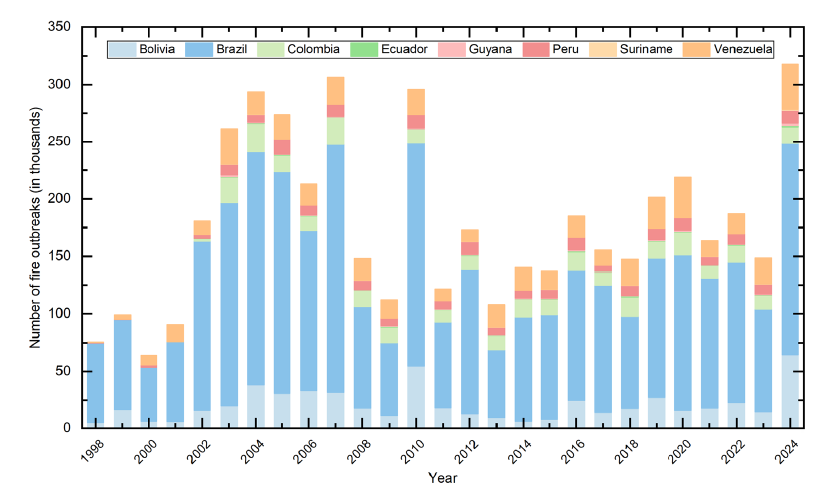 Source: Elaborated from INPE burning data (2024). Note Data represent the number of outbreaks detected by the satellite.