| “They lay eggs” |
Females of Coleodactylus natalensis are oviparous, like other geckos (Gekkota group) (SALES et al., 2020). |
|
“They lay several eggs in a clutch”
|
This does not match the scientific literature, as the clutch size is fixed, consisting of a single egg (LISBOA; SOUSA; RIBEIRO, 2008). |
|
“They lay just 1 egg”
|
This species has a fixed clutch size of a single egg (LISBOA; SOUSA; RIBEIRO, 2008). |
|
“It is common to find more than one egg in the same location”
|
It is very likely that different C. natalensis females use the same sites to oviposit, detecting the presence of conspecific eggs during the choice of oviposition site (SALES et al., 2020). |
|
“It is not common to find more than one egg in the same location”
|
Coleodactylus females have a fixed posture of one egg, and can lay eggs in an isolated place or close to eggs from other females (SALES et al., 2020). |
|
Diet
|
|
“...they feed on small insects.”
“They feed on ants.”
|
The diet of C. natalensis is mainly composed of arthropods, most categorically represented by Isopoda and Araneae (LISBOA; SALES; FREIRE, 2012). |
|
“...feed on fungi and tree resin”
|
This does not match the scientific literature available until the publication of this work (LISBOA; SALES; FREIRE, 2012). |
|
Behavior/habitat
|
|
“they like humidity”
|
Coleodactylus natalensis preferably occupies forested habitats, in humid areas with milder temperatures, without direct sunlight and with thick leaf litter (LISBOA; FREIRE, 2012).
|
|
“They are more seen in winter (rainy season).”
“they are more seen when it rains”
|
A significantly higher occurrence of C. natalensis lizards was found in the rainy season (LISBOA; FREIRE, 2012). |
|
“are more active during the day”
|
Species of geckos in the Coleodactylus genus are only found active during the day (VITT et al., 2005). |
|
“they stay more in the shade where there are lots of leaves and around trees”
|
Coleodactylus natalensis preferentially occupies forest habitats, which have mesic characteristics, such as a shaded environment and thick leaf litter (CAPISTRANO; FREIRE, 2009). |
|
“they like to stay around trees where there is a lot of leaf litter”
|
The greater the thickness of the leaf litter, the greater the density of C. natalensis found. The same goes for the high forest region, where the highest density is found (LISBOA; FREIRE, 2012). |

 Local ecological knowledge about reptiles and cryptic lizard in urban park in the Atlantic Forest
 Thumbnail
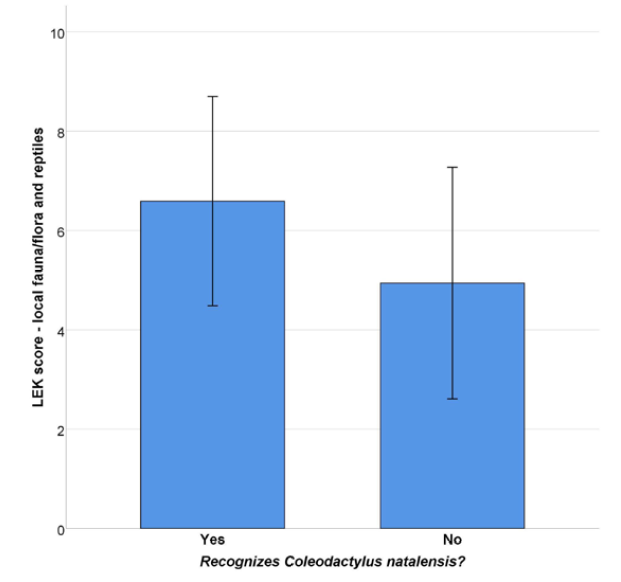 Source: Ramos-Silva, Sales and Freire, 2024.