Control of ALS- and PPO-inhibiting herbicide-resistant redroot pigweed (Amaranthus retroflexus) populations with common postemergence herbicides
Abstract
Background Various herbicide-resistant redroot pigweed (Amaranthus retroflexus) have been confirmed recently in North Carolina, USA.
Objective Determine which postemergence herbicides would effectively control ALS- and PPO-inhibiting herbicide-resistant redroot pigweed populations.
Methods Two ALS- and PPO-inhibiting herbicide-resistant (Camden and Pasquotank County) and two putative herbicide-susceptible (Yadkin and Wake County) populations were treated with a discriminating rate of 2,4-D, atrazine, dicamba, glyphosate, glufosinate and mesotrione. Populations that survived the discriminating rate were further subjected to dose-response assays.
Results All populations except for Pasquotank County survived to 2,4-D and/or dicamba 21 days after treatment. Twelve and 37% of the Pasquotank County plants survived after treatment with atrazine and mesotrione, respectively. Only 12% of the Yadkin County population survived after treatment with glyphosate. No plants survived glufosinate. The Pasquotank County population did have reduced susceptibility to atrazine compared to other populations. The Pasquotank County population (LD50: 918 g ai ha-1) was less susceptible to mesotrione compared to other populations (LD50: 10 to 28 g ai ha-1). The Yadkin County population (LD50: 151 g ae ha-1) had reduced susceptibility to glyphosate compared to other populations (LD50: 52 to 72 g ae ha-1).
Conclusion These studies provide evidence that there are effective postemergence herbicides to control the multiple herbicide-resistant redroot pigweed populations. The studies also provided evidence of resistance to mesotrione in a previously identified herbicide-resistant population and low-level glyphosate resistance in a previously deemed susceptible redroot pigweed population.
Amaranthus Retroflexus; Herbicide Resistance; Multiple Herbicide Resistance; Weed Management
1.Introduction
Redroot pigweed (Amaranthus retroflexus L.) is a globally pervasive row crop weed (Holm et al., 1997). Redroot pigweed exhibits rapid apical growth and can produce more than 250,000 seeds plant-1; these biological traits are reduced in the presence of a crop but the plants still exhibit relatively rapid growth and high fecundity (Khan et al., 2021). If not controlled, redroot pigweed can reduce corn and soybean yield up to 40% (Knezevic et al., 2004). Traditionally, herbicides have been effective for controlling redroot pigweed (Ducar et al., 2004). However, overreliance on herbicides has selected for herbicide-resistant weed populations (Beckie, 2006). Redroot pigweed was one of the first weeds to evolve herbicide resistance; the species has evolved resistance to three herbicide groups (acetolactate synthase [ALS; Group 2]-, photosystem II [PSII; Group 5]- and protoprophyriogen oxidase [PPO; Group 14]-inhibting herbicides) and multiple herbicide-resistant populations exist (Heap, 2024; Radosevich, 1977). Recently, two distinct ALS- and PPO-inhibiting herbicide-resistant populations were confirmed in North Carolina (Jones et al., 2023).
Some herbicide-resistant weeds exhibit multiple resistance to non-related herbicides (Beckie, Tardif, 2012). Multiple herbicide resistance increases control complexity as weeds can be resistant to herbicides that have never been applied (Takano et al., 2023). Many weeds that exhibit resistance to non-related herbicides possess non-target site mutations (Letouzé, Gasquez, 2003). This is a concern as one of the herbicide-resistant redroot pigweed populations from North Carolina exhibited non-target site resistance to fomesafen (Jones et al., 2023). Previous research has demonstrated that atrazine-resistant redroot pigweed can exhibit cross resistance with other PSII-inhibiting herbicides (Eleftherohorinos et al., 2000). Knowledge of these multiple herbicide-resistant redroot pigweed populations exhibit resistance to non-related herbicides is crucial for effective weed control. Farmers also need to know what postemergence herbicides will effectively control these populations to ensure sustainable weed management (Jussaume et al., 2021). The hypothesis of the study was there may be limited effective herbicides to control multiple herbicide-resistant redroot pigweed populations. The objective of the research was to determine effective postemergence herbicides from Groups 4 (synthetic auxins), 5 (PSII), 9 (5-enolypyruvateshikimate-3-phosphate synthase [EPSPS]-inhibiting herbicides), 10 (glutamine synthetase [GS]-inhibiting herbicides), and 27 (4-hydroxyphenylpyruvate dioxygenase [HPPD]-inhibiting herbicides) to control the North Carolina herbicide-resistant redroot pigweed populations.
2.Materials and Methods
2.1 Discrimination assay
Four redroot pigweed populations were evaluated to determine which postemergence herbicides would provide effective control: Camden County (resistant, ALS: Trp-574-Leu; PPX2: Arg-98-Gly), Pasquotank County (resistant, ALS: Pro-197-His; PPX2: Non-target site), Wake County, and Yadkin County; the Wake and Yadkin were putatively susceptible in previous research (Jones et al., 2023). Seeds from the Camden and Pasquotank County population were collected from plants that survived recurrent applications of ALS- and PPO-inhibiting herbicides from soybean fields during the 2019 and 2020 growing seasons, respectively. Seeds from Wake and Yadkin County were collected from soybean fields in 2019. The harvested seedheads were stored at ambient air temperature (10 to 25 C) for approximately 1 month to reduce plant moisture content while maintaining seed viability. After the storage period, the harvested plants were threshed by hand to remove seeds from the florets, and seeds were separated from plant residues using sieves and a forced-air column separator (South Dakota Seed Blower, Seedburo Equipment, Chicago, IL, USA). Seeds from approximately 10 individual plants were pooled for the locations where they were collected. The collected seeds were placed in a petri dish with approximately 5 mL of water and stored at 5 C for 2 wk to break dormancy. The petri dishes, without lids, were then placed into a dryer at 65 C for 48 h to reduce seed moisture content before storage (Leon et al., 2006). Seeds were stored at 5 C until needed.
Seeds from each population were sown into separate 21 cm by 28 cm flats containing a 4:1 ratio of Sunshine® Mix #2 (Sun Gro Horticulture, Agawam, MA, USA) potting soil and sand with approximately 5 g of Osmocote® Flower Food Granules (14-14-14) (Scotts Company, Marysville, OH, USA). Plants were maintained in a glasshouse at 30/24 C diurnal fluctuation and topically watered to maintain field capacity water content. Sunlight was supplemented with 600 to 1,000 μmol m2 s 1 PPFD of artificial light set to a 14-h photoperiod. Two plants were then transplanted at approximately 2 cm in height to 5-cm (125 cm3) pots containing the same potting media with 1 g of pellet fertilizer.
The herbicides used in the assay are provided in Table 1. Each herbicide was applied at 1/2x of the labeled field use rate. This rate was selected for all herbicides as susceptible plants should be controlled while putative resistant plants should exhibit differential survival (Beckie et al., 2000). Plants were treated at an approximate height of 7.6 cm (approximately 4-leaf) and the herbicides were applied with a CO2-pressurized cabinet-mounted track sprayer (DeVeries Manufacturing, Hollandale, MN) calibrated to deliver 140 L ha-1 at 241 kPa with a Teejet 8002EVS nozzle (TeeJet Technologies, Wheaton, IL, USA) 46 cm above the target weed height. The experimental design was completely randomized with each treatment replicated four times. The experimental unit was a 5-cm pot containing two plants. The experiment was conducted twice, where each experimental run was conducted in a different glasshouse. Twenty-one days after treatment, plant survival was recorded on a binomial scale: where 0 equaled plant death (no green vegetative tissue) and 1 equaled plant survival (green vegetative tissue present). Injury was evaluated 21 days after treatment as well on a rating scale ranging from 0 to 100; where 0 equals no control and 100 equals complete control.
2.2 Dose-response assay
Redroot pigweed populations that exhibited higher survival deviations from the other populations to select herbicides were subjected to whole-plant dose-response assays to further characterize the susceptibility of each population. Seeds from the original seed lot were re-sown and curated as described above. The herbicides (atrazine, glyphosate, and mesotrione) and rates used in each dose-response assay are provided in Table 2. Herbicides were applied to plants as described above. The experimental design and survival evaluation were the same as described above.
2.3 Statistical analysis
Discrimination assay. Plant survival data were subjected to analysis of variance (α = 0.05) using the GLIMMIX procedure in SAS 9.4 (Statistical Analysis Software, Cary, NC) and means were separated using Fisher’s HSD (P ≤ 0.05). Population and herbicide were considered main effects while run and replication were considered random effects. Injury and survival data were subjected to Pearson’s correlation coefficients using the Corr procedure in SAS 9.4 between the evaluations. The nontreated control and treatments that exhibited no variance (i.e., complete survival or control) were excluded from the statistical analyses due to the violation of analysis of variance assumptions.
Dose-response. Plant survival data were subjected to analysis variance (α = 0.05) using the GLIMMIX procedure in SAS 9.4 (Statistical Analysis Software, Cary, NC) for each herbicide. Population and rates were considered main effects while the experimental run and repetition were considered random effects.
Dose-response curves for plant survival were fit with a three-parameter log-logistic equation in SigmaPlot 14.0 (Systat Software, Palo Alto, CA) [1]
where a is the upper asymptote, x is the herbicide rate, x0 equals the LD50 (lethal dose to control 50% of the population [survival]) rate, and b is the slope at x0. The LD50 for each population was derived from the regression equations. The three-parameter log logistic model was selected based on previous dose-response literature and relatively lower root mean square error values (Seefeldt et al., 1995). Differential LD50 values and susceptibility across herbicide rates between putative herbicide-resistant and susceptible can elucidate if a population is resistant (Burgos et al., 2013).
3.Results and Discussion
3.1 Discrimination assay
The Pearson’s correlation coefficient between the injury and survival data for all herbicides was negatively correlated (R > -0.9; P < 0.001). Therefore, only the survival data will be discussed. Due to high mortality incurred by plants from each population after treatment with the various herbicides, the constant variance assumption of ANOVA was violated. Therefore, descriptive statistics of plant survival are described for each population. Plants from Camden (13%), and Yadkin County (28%) survived dicamba 21 DAT (Table 3). Only plants from Wake County (31%) survived 2,4-D 21 DAT (Table 3). No plants survived glufosinate (Table 3). The Camden County population exhibited 14% survival when treated with mesotrione (Table 3). The Pasquotank County population exhibited 12 and 37% survival when treated with atrazine and mesotrione, respectively (Table 3). The Yadkin County population exhibited 13% survival when treated with glyphosate and mesotrione, respectively (Table 3).
3.2 Dose-response assay
Atrazine. The Camden, Yadkin, and Wake County populations were similarly controlled with atrazine; where the LD50 values for all populations were approximately 70 g ai ha-1 (Table 4). The LD50 value for the Pasquotank County population was 30 g ai ha-1, less than the LD50 values of the other populations (Table 4). While there was a differential susceptibility between the populations, the LD50 values across populations were similar to susceptible populations from previous research (Fuerst et al., 1980).
Glyphosate. The LD50 value for the Yadkin County population was 151 g ae ha-1 which was greater than the LD50 values of the Camden (52 g ae ha-1) and Wake (72 g ae ha-1) County populations (Figure 1; Table 4). The Camden and Wake County populations were controlled with the 100 g ae ha-1 rate, demonstrating a difference in susceptibility between these two populations and the Yadkin County population (Figure 1). The Yadkin County population survived rates deemed lethal in previous research (Vieira et al., 2018). The differential LD50 values and survival responses across rates suggest the Yadkin County population is likely low-level glyphosate-resistant (Burgos et al., 2013).

Survival of North Carolina redroot pigweed populations (Camden [Resistant]: circle; Wake [Susceptible]: open triangle; Yadkin [Susceptible]: square) to various rates of glyphosate 21 days after treatment
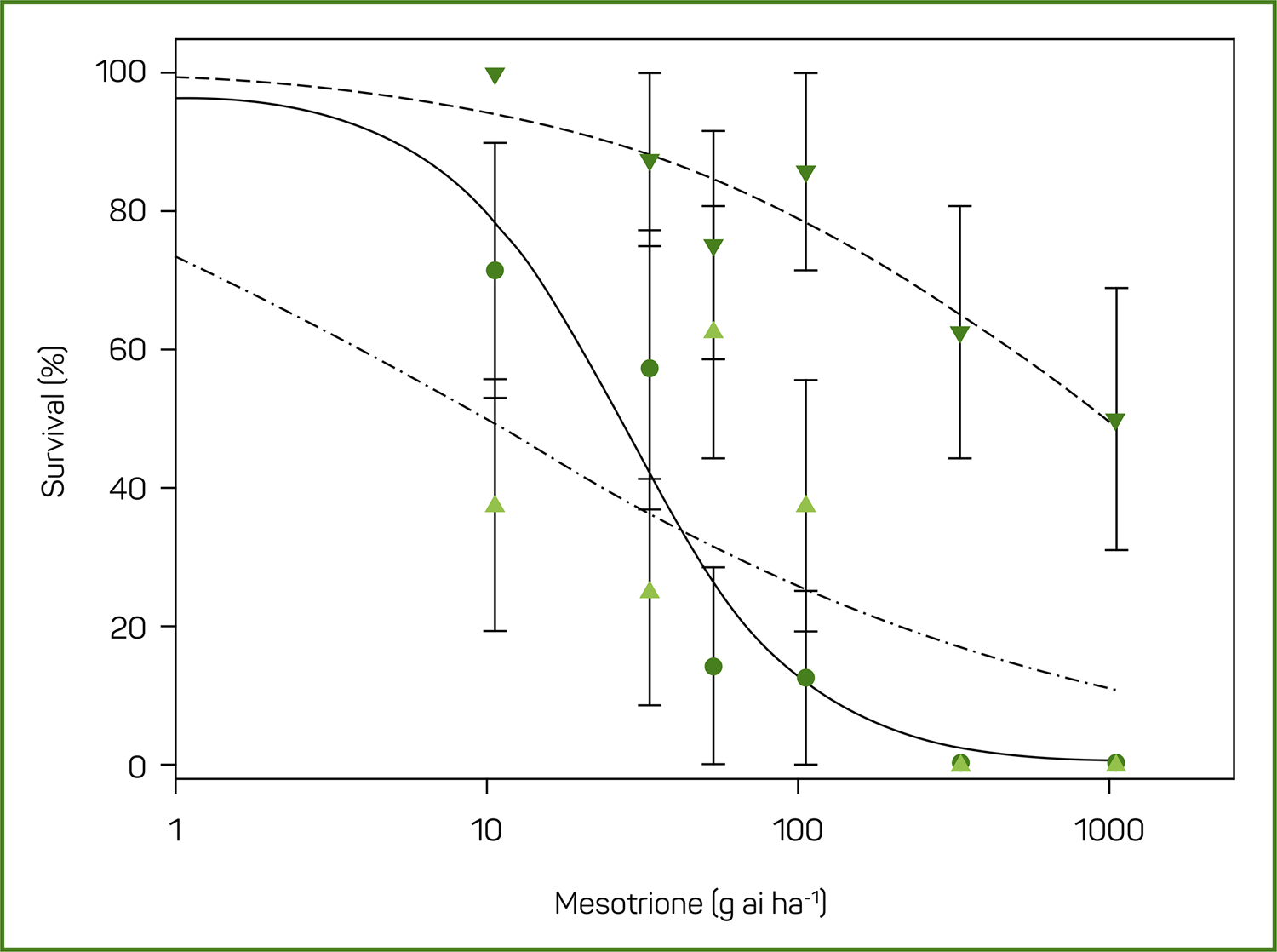
Mesotrione. The LD50 value for the Pasquotank County population was 918 g ai ha-1 (Figure 2; Table 4). The LD50 values for the Camden (28 g ai ha-1) and Wake (10 g ai ha-1) were lesss than the Pasquotank County population (Figure 2; Table 4). The rates used in this experiment were not great enough to control the Pasquotank County population, while the Camden and Wake County populations were controlled with rates ranging from 105 to 330 g ai ha-1 (Figure 2). The mesotrione rates that the Pasquotank County survived were lethal to susceptible Amaranthus spp. in previous research (Singh et al., 2018). The differential LD50 values and survival responses across rates suggest the Pasquotank County population is mesotrione-resistant (Burgos et al., 2013).

Survival of North Carolina redroot pigweed populations (Camden [Resistant]: circle; Pasquotank [Resistant]: upside down triangle; Wake [Susceptible]: open triangle) to various rates of mesotrione 21 days after treatment
Dose-response assays were not conducted for 2,4-D or dicamba despite relatively high realized survival (Table 3). While most of the plants that survived herbicide application were successfully propagated for seed increases, the plants that survived 2,4-D and dicamba all plants died 28 DAT (data not shown). The selected 2,4-D and dicamba rates may not have been discriminating within the evaluation period and more research is needed to determine if any of these population exhibit resistance to either herbicide.
However, it is impossible to discern whether the plants died from transplant shock or from the slow activity of the herbicides. This anecdotal result further bolsters that the fact that more research is needed to determine the susceptibility of these herbicides in the tested Biomass reductions may have been another insightful response variable that could determine the susceptibility to the selected herbicides across the redroot pigweed populations. However, biomass was not collected as surviving plants were propagated for seed increases to be used in future research.
These results provide confirmation of the first case of a mesotrione-resistant redroot pigweed globally (Heap, 2024); additionally, this population was resistant to ALS- and PPO-inhibiting herbicides as characterized in previous research (Jones et al., 2023). Currently, only three other species (Palmer amaranth [Amaranthus palmeri S. Wats.], waterhemp [Amaranthus tuberculatus Moq. J.D. Sauer], and wild radish [Raphanus raphanistrum L.]) have evolved resistance to HPPD-inhibiting herbicides (i.e., mesotrione) (Jhala et al., 2014; Lu et al., 2020; McMullan, Green, 2011). All these species also exhibit resistance to atrazine (Jhala et al., 2014; Lu et al., 2020). Additionally, the Yadkin County population represents the first case of glyphosate-resistant redroot pigweed (Heap, 2024). While the level of glyphosate resistance is low in this population, other confirmed glyphosate-resistant weeds exhibited similar levels of susceptibility differences (Zhang et al., 2021). Future research should focus on determining the mechanism(s) of resistance to glyphosate and mesotrione in the respective populations. Future research should also determine the effectiveness of preemergence herbicides on these herbicide-resistant populations. Previous research has demonstrated that weeds resistant to similar herbicides can exhibit reduced susceptibility to soil applied herbicides (Strom et al., 2019; Wuerffel et al., 2015). Additional research should include evaluating the effectiveness of various postemergence herbicide mixtures on the herbicide-resistant redroot pigweed populations (Barbieri et al., 2022; Hugie et al., 2008).
4.Conclusions
Inevitably, these herbicide-resistant redroot pigweed populations will further complicate weed control in North Carolina. While there are effective postemergence herbicides to control these populations, these herbicides need to be correctly stewarded (Owen, 2016). Closely related weedy Amaranthus spp. have evolved resistance to 2,4-D, dicamba, and glufosinate that effectively controlled the populations, demonstrating that resistance can evolve to these herbicides (Bernards et al., 2012; Priess et al., 2022; Shergill et al., 2018). Herbicide mixtures, multiple application timings, and implementation of nonherbicide management tactics will be crucial to control and reduce selection pressure (Norsworthy et al., 2012; Renton et al., 2023).
Acknowledgements
Project funding was provided by the North Carolina Soybean Producers Association.
References
-
Barbieri GF, Young BG, Dayan FE, Streibig JC, Takano H, Merotto Junior A et al. Herbicide mixtures: interactions and modeling. Adv Weed Sci. 2022;40(spe1):1-25. Available from: https://doi.org/10.51694/AdvWeedSci/2022;40:seventy-five011
» https://doi.org/10.51694/AdvWeedSci/2022;40:seventy-five011 -
Beckie HJ, Heap IM, Smeda RJ, Hall LM. Screening for herbicide resistance in weeds. Weed Technol. 2000;14(2):428-45. Available from: https://doi.org/10.1614/0890-037X (2000)014[0428:SFHRIW]2.0.CO;2
» https://doi.org/10.1614/0890-037X -
Beckie HJ, Tardif FJ. Herbicide cross-resistance in weeds. Crop Prot. 2012;35:15-28. Available from: https://doi.org/10.1016/j.cropro.2011.12.018
» https://doi.org/10.1016/j.cropro.2011.12.018 -
Beckie HJ. Herbicide-resistant weeds: management tactics and practices. Weed Technol. 2006;20(3):793-814. Available from: https://doi.org/10.1614/WT-05-084R1.1
» https://doi.org/10.1614/WT-05-084R1.1 -
Bernards ML, Crespo RJ, Kruger GR, Gaussoin R, Tranel PJ. A waterhemp ( Amaranthus tuberculatus ) population resistant to 2,4-D. Weed Sci. 2012;60(3):379-84. Available from: https://doi.org/10.1614/WS-D-11-00170.1
» https://doi.org/10.1614/WS-D-11-00170.1 -
Burgos NR, Tranel PJ, Streibig JC, Davis VM, Shaner D, Norsworthy JK. Review: confirmation of resistance to herbicides and evaluation of resistance levels. Weed Sci. 2013;61(1):4-20. Available from: https://doi.org/10.1614/WS-D-12-00032.1
» https://doi.org/10.1614/WS-D-12-00032.1 -
Ducar JT, Wilcut JW, Richburg JS. Weed management in imidazolinone-resistant corn with imazapic. Weed Technol. 2004;18(4):1018-22. Available from: https://doi.org/10.1614/WT-03-204R
» https://doi.org/10.1614/WT-03-204R -
Eleftherohorinos IG, Vasilakoglou IB, Dhima KV. Metribuzin resistance in Amaranthus retroflexus and Chenopodium album in Greece. Weed Sci. 2000;48:69-74. Available from: https://doi.org/10.1614/0043-1745 (2000)048[0069:MRIARA]2.0.CO;2
» https://doi.org/10.1614/0043-1745 -
Fuerst EP, Arntzen CJ, Pfister K, Penner D. Herbicide cross-resistance in triazine-resistant biotypes of four species. Weed Sci. 1986;34(3):344-53. Available from: https://doi.org/10.1017/S0043174500066960
» https://doi.org/10.1017/S0043174500066960 -
Heap I. International survey of herbicide resistant weeds. Weedscience. 2024[access Sept 11, 2024]. Available from: http://www.weedscience.org
» http://www.weedscience.org - Holm LR, Doll J, Holm E, Pancho JV, Herberger JP. World weeds: natural histories and distribution. New York: John Wiley and Sons; 1997.
-
Hugie JA, Bollero GA, Tranel PJ, Riecher DE. Defining the rate requirements for synergism between mesotrione and atrazine in redroot pigweed ( Amaranthus retroflexus ). Weed Sci. 2008;56(2):265-70. Available from: https://doi.org/10.1614/WS-07-128.1
» https://doi.org/10.1614/WS-07-128.1 -
Jhala AJ, Sandell LD, Rana N, Kruger GR, Knezevic SZ. Confirmation and control of triazine and 4-hydroxyphenylpyruvate dioxygenase-inhibiting herbicide-resistant palmer amaranth ( Amaranthus palmeri ) in Nebraska. Weed Technol. 2014;28(1):28-38. Available from: https://doi.org/10.1614/WT-D-13-00090.1
» https://doi.org/10.1614/WT-D-13-00090.1 -
Jones EAL, Andres RJ, Dunne JC, Leon RG, Everman WJ. Confirmation and detection of novel acetolactate synthase- and protoporphyrinogen oxidase-inhibiting herbicide-resistant redroot pigweed ( Amaranthus retroflexus ) populations in North Carolina. Weed Sci. 2023;71(2):84-94. Available from: https://doi.org/10.1017/wsc.2023.4
» https://doi.org/10.1017/wsc.2023.4 -
Jussaume RA, Dentzman K, Frisvold G, Ervin D, Owen MDK. Factors that influence on-farm decision-making: evidence from weed management. Soc Nat Resour. 2021;35(5):527-46. Available from: https://doi.org/10.1080/08941920.2021.2001123
» https://doi.org/10.1080/08941920.2021.2001123 -
Khan AM, Mobli A, Werth JA, Chauhan BS. Effect of emergence time on growth and fecundity of redroot pigweed ( Amaranthus retroflexus ) and slender amaranth ( Amaranthus viridis ): emerging problem weeds in Australian summer crops. Weed Sci. 2021;69(3):333-40. Available from: https://doi.org/10.1017/wsc.2021.9
» https://doi.org/10.1017/wsc.2021.9 -
Knezevic SZ, Weise SE, Swanton CJ. Interference of redroot pigweed ( Amaranthus retroflexus L.) in corn ( Zea mays ). Weed Sci. 1994;42(4):568-73. Available from: https://doi.org/10.1017/S0043174500076967
» https://doi.org/10.1017/S0043174500076967 -
Leon RG, Bassham DC, Owen MDK. Germination and proteome analyses reveal intraspecific variation in seed dormancy regulation in common waterhemp ( Amaranthus tuberculatus ). Weed Sci. 2006;54(2):305-15. Available from: https://doi.org/10.1614/WS-05-115R1.1
» https://doi.org/10.1614/WS-05-115R1.1 -
Letouzé A, Gasquez J. Enhanced activities of several herbicide degrading enzymes: a suggested mechanism responsible for multiple resistance in blackgrass ( Alopecurus myosuroides Huds.). Agronomie. 2003;23(7):601-8. Available from: https://doi.org/10.1051/agro:2003036
» https://doi.org/10.1051/agro:2003036 -
Lu H, Yu Q, Han H, Owen M, Powles S. Evolution of resistance to HPPD-inhibiting herbicides in a wild radish population via enhanced herbicide metabolism. Pest Manag Sci. 2020;76(6):1929-37. Available from: https://doi.org/10.1002/ps.5725
» https://doi.org/10.1002/ps.5725 -
McMullan PM, Green JM. Identification of a tall waterhemp ( Amaranthus tuberculatus ) biotype resistant to HPPD-inhibiting herbicides, atrazine, and thifensulfuron in Iowa. Weed Technol. 2011;25(3):514-18. Available from: https://doi.org/10.1614/WT-D-10-00150.1
» https://doi.org/10.1614/WT-D-10-00150.1 -
Norsworthy JK, Ward SM, Shaw DR, Llewellyn RS, Nichols RL, Webster TM et al. Reducing the risks of herbicide resistance: best management practices and recommendation. Weed Sci. 2012;60(SP1):31-62. Available from: https://doi.org/10.1614/WS-D-11-00155.1
» https://doi.org/10.1614/WS-D-11-00155.1 -
Owen MDK. Diverse approaches to herbicide-resistant weed management. Weed Sci. 2016;64(S1):570-84. Available from: https://doi.org/10.1614/WS-D-15-00117.1
» https://doi.org/10.1614/WS-D-15-00117.1 -
Priess GL, Norsworthy JK, Godara N, Mauromoustakos A, Butts TL, Roberts TL et al. Confirmation of glufosinate-resistant Palmer amaranth and response to other herbicides. Weed Technol. 2022;36(3):368-72. Available from: https://doi.org/10.1017/wet.2022.21
» https://doi.org/10.1017/wet.2022.21 -
Radosevich SR. Mechanism of atrazine resistance in lambsquarters and pigweed. Weed Sci. 1977;25(4):316-18. Available from: https://doi.org/10.1017/S0043174500033543
» https://doi.org/10.1017/S0043174500033543 -
Renton M, Willse A, Aradhya C, Tyre A, Head G. Simulated herbicide mixtures delay both specialist monogenic and generalist polygenic resistance evolution in weeds. Pest Manag Sci. 2023;80(11):5983-94. Available from: https://doi.org/10.1002/ps.8331
» https://doi.org/10.1002/ps.8331 -
Seefeldt SS, Jensen JE, Fuerst EP. Log-logistic analysis of herbicide dose response relationships. Weed Technol. 1995;9(2):218-27. Available from: https://doi.org/10.1017/S0890037X00023253
» https://doi.org/10.1017/S0890037X00023253 -
Shergill LS, Barlow BR, Bish MD, Bradley KW. Investigations of 2,4-D and multiple herbicide resistance in a Missouri waterhemp ( Amaranthus tuberculatus ) population. Weed Sci. 2018;66(3):386-94. Available from: https://doi.org/10.1017/wsc.2017.82
» https://doi.org/10.1017/wsc.2017.82 -
Singh S, Roma-Burgos N, Singh V, Alcober EAL, Salas-Perez R, Shivrain V. Differential response of Arkansas palmer amaranth ( Amaranthus palmeri ) to glyphosate and mesotrione. Weed Technol. 2018;32(5):579-85. Available from: https://doi.org/10.1017/wet.2018.34
» https://doi.org/10.1017/wet.2018.34 -
Strom SA, Gonzini LC, Mitsdarfer C, Davis AS, Riechers DE, Hager AG. Characterization of multiple herbicide-resistant waterhemp ( Amaranthus tuberculatus ) populations from Illinois to VLCFA-inhibiting herbicides. Weed Sci. 2019;67(4):369-79. Available from: https://doi.org/10.1017/wsc.2019.13
» https://doi.org/10.1017/wsc.2019.13 -
Takano H, Greenwalt S, Ouse D, Zielinski M, Schmitzer P. Metabolic cross-resistance to florpyrauxifen-benzyl in barnyardgrass ( Echinochloa crus-galli ) evolved prior to its commercialization.Weed Sci. 2023;71(2):77-83. Available from: https://doi.org/10.1017/wsc.2023.11
» https://doi.org/10.1017/wsc.2023.11 -
Vieira BC, Samuelson SL, Alves GS, Gaines TA, Werle R, Kruger GR. Distribution of glyphosate-resistant Amaranthus spp. in Nebraska. Pest Manag Sci. 2018;74(10):2316-24. Available from: https://doi.org/10.1002/ps.4781
» https://doi.org/10.1002/ps.4781 -
Wuerffel RJ, Young JM, Matthews JL, Young BG. Characterization of PPO-inhibitor-resistant waterhemp ( Amaranthus tuberculatus ) response to soil-applied PPO-inhibiting herbicides. Weed Sci. 2015;63(2):511-21. Available from: https://doi.org/10.1614/WS-D-14-00108.1
» https://doi.org/10.1614/WS-D-14-00108.1 -
Zhang C, Yu CJ, Yu Q, Guo WL, Zhang TJ, Tian XS. Evolution of multiple target-site resistance mechanisms in individual plants of glyphosate-resistant Eleusine indica from China. Pest Manage Sci. 2021;77(10):4810-7. Available from: https://doi.org/10.1002/ps.6527
» https://doi.org/10.1002/ps.6527
Edited by
-
Editor in Chief:
Carol Ann Mallory-Smith
-
Associate Editor:
José Barbosa dos Santos