 Valorization of Agroindustrial Residues between Annatto (Bixa orellana L.) and Oyster Mushroom (Pleurotus ostreatus var. Florida) Cultivation: a Cascade Approach
HIGHLIGHTS
-
Mushroom residue boosts annatto seedling germination and growth up to 60% inclusion.
-
Annatto residue supports Pleurotus yields with substitutions up to 80%.
-
Pleurotus strain 16/01 shows superior mushroom productivity and efficiency.
-
Mushroom and annatto residue use cuts costs and supports regional small producers.
Abstract
Annatto production generates agroindustrial residues (AAR) with no defined use. Meanwhile, mushroom cultivation repurposes another by–product, spent mushroom substrate (SMS). Integrating both into a cascade approach offers a sustainable solution that adds value and supports local small–scale farmers. This study aimed to assess the use of SMS for growing annatto seedlings and AAR as a substrate for Pleurotus ostreatus var. Florida. In the first experiment, the standard annatto substrate was replaced by SMS at 20– 80%. Germination and biometric characteristics were evaluated of seedlings. Adding up to 60% SMS improved germination without significantly affecting seedling quality, making it a viable option for nurseries. The second experiment replaced rice straw with AAR (0%, 20%, 40%, 60%, 80%, 100%) for two strains of P. ostreatus (16/01 and 20/01). Although AAR reduced mushroom yield by up to 16%, it did not affect the productive aspects or earliness of fruiting. Using up to 60% AAR could reduce costs related to rice straw acquisition and transportation. Strain 16/06 showed higher productivity than 20/01. In conclusion, integrating annatto and P. ostreatus production in a cascade approach is sustainable and adds value to AAR and SMS waste.
INTRODUCTION
Native to the Brazilian Amazon rainforest, annatto (Bixa orellana L.) is cultivated mainly by small and medium–scale producers and has gained prominence in Brazil [1]. As a natural dye rich in carotenoids, mainly norbixin and bixin, annatto serves as an alternative to many synthetic dyes [2]. The dye is used in various industries such as food, cosmetics, pharmaceuticals, and textiles, and is recognized as one of the most sustainable dyes in the world [3]. The World Health Organization (WHO) promotes annatto as a non–toxic dye that does not alter the nutritional value of food [4].
Brazil, specifically the western region of São Paulo state, is globally recognized as one of the main annatto–producing regions [5], with seeds rich in carotenoids (especially bixin), tocotrienols, and minerals, highlighting their nutritional and functional value [6]. Recent data show that this region produces more than 1,000 tonnes per year [6]. However, local production is threatened by climate change, and climatic zoning does not seem promising [5]. Recent efforts have been made to prevent climate change from further affecting the productivity and quality of annatto, both in Brazil and globally. These include the efficient use of mineral fertilizers [7], integrated agroforestry management [8], and the use of mycorrhizae to improve root capacity and water uptake [1]. However, there are no scientific reports on the use of sustainable seedling production techniques using alternative organic residues.
Among organic residues, spent mushroom substrate (SMS) stands out. Consisting of mycelium and decomposed substrate, this waste has the potential to improve seedling development, leading to more resilient production environments [9]. Studies have shown that SMS can help various plants stimulate growth and develop mechanisms to better cope with future stress [10, 11, 12, 13].
On the other hand, after annatto harvesting, consisting mainly of pericarp shells and small seeds that cannot be processed for dye extraction. It is estimated that for every 2.5 kg of harvested dry annatto, 1 kg is used for dye production, while the remaining 1.5 kg is pericarp waste with no specific use [14]. While this waste is considered in the literature as an emerging sustainable energy source, its use as a substitute for commercial substrates in mushroom production could add greater value to this by–product.
This scenario creates an opportunity to adopt a cascade approach, defined as a strategy that prioritizes the sequential use of natural resources or by–products to maximize their economic and environmental value before final disposal or energy recovery [15]. In this context, annatto pericarp waste and spent mushroom substrate can be valorized as agricultural inputs, while still retaining potential for subsequent energy use, thereby enhancing resource–use efficiency and promoting circularity within production systems.
Therefore, we propose the development of an integrated cascade model linking annatto and mushroom production within a circular bioeconomy framework. Cascade–based interactions between plant residues and edible mushroom cultivation have been increasingly reported in the literature, particularly in systems involving tomato–Pleurotus spp. and lettuce–buna shimeji integrations [16, 17], demonstrating the potential of such strategies to enhance resource efficiency and value recovery. However, to the best of our knowledge, no study has yet explored a cascade approach integrating annatto residues with the cultivation of Pleurotus ostreatus var. florida.
This unexplored linkage represents a novel opportunity to valorize annatto processing by–products while simultaneously reintegrating spent mushroom substrate (SMS) into annatto seedling production. Accordingly, our objectives are to (i) reuse SMS as a substrate component for annatto seedling production and (ii) evaluate the potential of annatto pericarp husk waste as a partial or total substitute for conventional substrates in the cultivation of P. ostreatus var. florida.
MATERIAL AND METHODS
Site of experimentation
The experiment was carried out in the facilities of the Centre for Mushroom Studies (CECOG), located in the Faculty of Agricultural and Technological Sciences, São Paulo State University – Dracena Campus (21°29’S; 51°52’W; 420 m.a.s.l.), between March and December 2021.
Use of SMS as Substrate for Annatto Seedling Production
The experiment was conducted in a greenhouse using a completely randomized design. Annatto seeds of the variety “Piave Anão” were kindly provided by a local producer. The seedlings were grown in polypropylene tubes (140 mm long and 40 mm in diameter, with a capacity of 100 cm3). Prior to use, the tubes were disinfected by immersion in a 2% (v/v) sodium hypochlorite solution for 24 h.
The SMS of Pleurotus ostreatus was obtained from a cultivation study carried out at the Centre for Mushroom Studies (CECOG). The initial substrate used for mushroom cultivation consisted of rice straw containing 2% CaCO3 before the mushrooms were harvested.
Sugarcane filter cake (FC) was used as the control treatment, as it is a by–product of the sugarcane industry and is widely used by producers as a standard substrate for seedling production. Spent mushroom substrate (SMS) was evaluated as an alternative component for annatto seedling growth.
Prior to substrate preparation, both materials were air–dried, sieved through a 4–mm mesh, and stored under dry conditions. The experimental design consisted of six treatments: (i) FC, composed exclusively of sugarcane filter cake (control); (ii) SMS20, containing 20% spent mushroom substrate and 80% filter cake; (iii) SMS40, containing 40% spent mushroom substrate and 60% filter cake; (iv) SMS60, containing 60% spent mushroom substrate and 40% filter cake; (v) SMS80, containing 80% spent mushroom substrate and 20% filter cake; and (vi) SMS100, composed exclusively of spent mushroom substrate. Each treatment had eight replicates, totaling 48 experimental units (n = 48), arranged in a completely randomized design. All substrates were weighed, thoroughly homogenized, and adjusted to approximately 70% moisture using a 1:1 (v/v) water addition prior to sowing. The physicochemical characterization of both materials is presented in Table 1.
Five annatto seeds were sown per tube, and thinning was carried out after 17 days, leaving only one plant per tube. The seedlings were cultivated in a transparent anti–UV plastic greenhouse made of low–density polyethylene (LDPE) with 150 μm thickness, under an average temperature of 25 ± 3°C and relative humidity of 70 ± 10%. Foliar application of organomineral fertilizer was made weekly, according to the manufacturer's recommendations (AMINON 25®, Technes Agrícola, São Paulo, Brazil). Irrigation was performed daily. The final evaluation was carried out after 35 days by measuring the height, fresh and dry weight of the aerial parts and roots. Seedling quality was assessed using Dickson’s Quality Index (DQI), an integrated and widely accepted parameter that combines morphological variables to provide a reliable estimate of seedling vigor and structural balance, following the equation [18]:
Where: DQI: Dickson Quality Index; TDM: total dry matter, in g; H: plant height, in cm; D: stem diameter, in mm; SDM: shoot dry matter, in g; RDM: root dry matter, in g.
Production of Pleurotus ostreatus var. florida from Annatto Agro–industrial Waste
The experiment evaluated the partial and total replacement of rice straw with annatto agro–industrial residue (AAR) as a substrate for the cultivation of Pleurotus ostreatus var. florida. Crushed rice straw was used as the control substrate (RS). The experimental design consisted of six substrate treatments arranged in a completely randomized design, with eight replicates per treatment. The treatments were defined according to increasing proportions of AAR replacing rice straw, as follows: (i) RS, 100% rice straw (control); (ii) AAR 20, 80% rice straw + 20% AAR; (iii) AAR40, 60% rice straw + 40% AAR; (iv) AAR60, 40% rice straw + 60% AAR; (v) AAR80, 20% rice straw + 80% AAR; and (vi) AAR 100, 100% AAR. Two P. ostreatus var. florida strains (16/01 and 20/02), obtained from the CECOG mycelium bank, were used in the experiment. The composition of the substrates formulations is presented in Table 2.
Chemical composition1 of mixed substrates for cultivation of Pleurotus ostreatus var. florida.
The substrate moisture was adjusted to 70%, and 1.8 kg of each tested mixture was prepared. The bags were then autoclaved at 121 °C for four hours and, after cooling, inoculated under aseptic conditions in a laminar airflow chamber with colonized sorghum grains (2% spawn rate).
The inoculated bags were transferred to a high–technology mushroom cultivation greenhouse equipped with automated environmental control systems for temperature, relative humidity, ventilation, and gas exchange. During the mycelial running phase, the bags were maintained at 25 ± 2 °C, with relative humidity between 60–75%, under dark conditions. Limited ventilation was applied, allowing elevated CO2 concentrations (approximately 5,000–20,000 ppm), which are favorable for rapid substrate colonization.
After 25 days of incubation, when full colonization was achieved, the bags were opened to induce fruiting. During the fruiting phase, environmental conditions were adjusted to 20–22 °C, with relative humidity maintained at 85–90%. Continuous air exchange was provided to maintain CO2 concentrations below 1,000 ppm, ensuring adequate oxygen availability and proper basidioma development. Diffuse white light was supplied at an intensity of approximately 500–1,000 lux for 8–12 h per day to stimulate primordia formation and normal fruiting body development. Harvesting was performed twice daily, and three production flushes were completed.
The following variables were evaluated : total yield (∑ total mass harvested / initial substrate mass * 100), yield per harvest flush (1st, 2nd, and 3rd flush), number of mushrooms harvested, average mushroom mass (∑ total mass harvested / ∑ number of mushrooms), biological efficiency (∑ total mass harvested / initial dry mass of substrate * 100), precocity (∑ production during the first half of the harvesting period * 100 / ∑ total production) and earliness (day on which basidiocarp harvesting started) [15].
Statistical analysis
All collected data were subjected to analysis of variance (ANOVA), after verifying the assumptions of normality of residuals (Shapiro–Wilk test) and homogeneity of variances (Bartlett test).
The first trial (annatto seedlings) was analyzed as a completely randomized design. In the second trial, a factorial arrangement was adopted, considering AAR residue addition levels and fungal strains as fixed factors. A two–way ANOVA was performed to evaluate the main effects of AAR addition and strain, as well as their interaction (AAR × strain). When a significant interaction was detected (p ≤ 0.05), treatment means were compared within each factor combination. In the absence of significant interaction, the main effects were interpreted independently.
For the annatto seedling trial (1st trial) and for the isolated factor of AAR addition (2nd trial), means were compared using Tukey’s test. For the strain factor (2nd trial), means were compared using the t–based least significant difference test (T–LSD), both at a 5% significance level (p ≤ 0.05). Statistical analyses were performed using SisVAR software (Version 5.7), and figures were generated using GraphPad Prism v. 8.
RESULTS AND DISCUSSION
Use of SMS as Substrate for Annatto Seedling Production
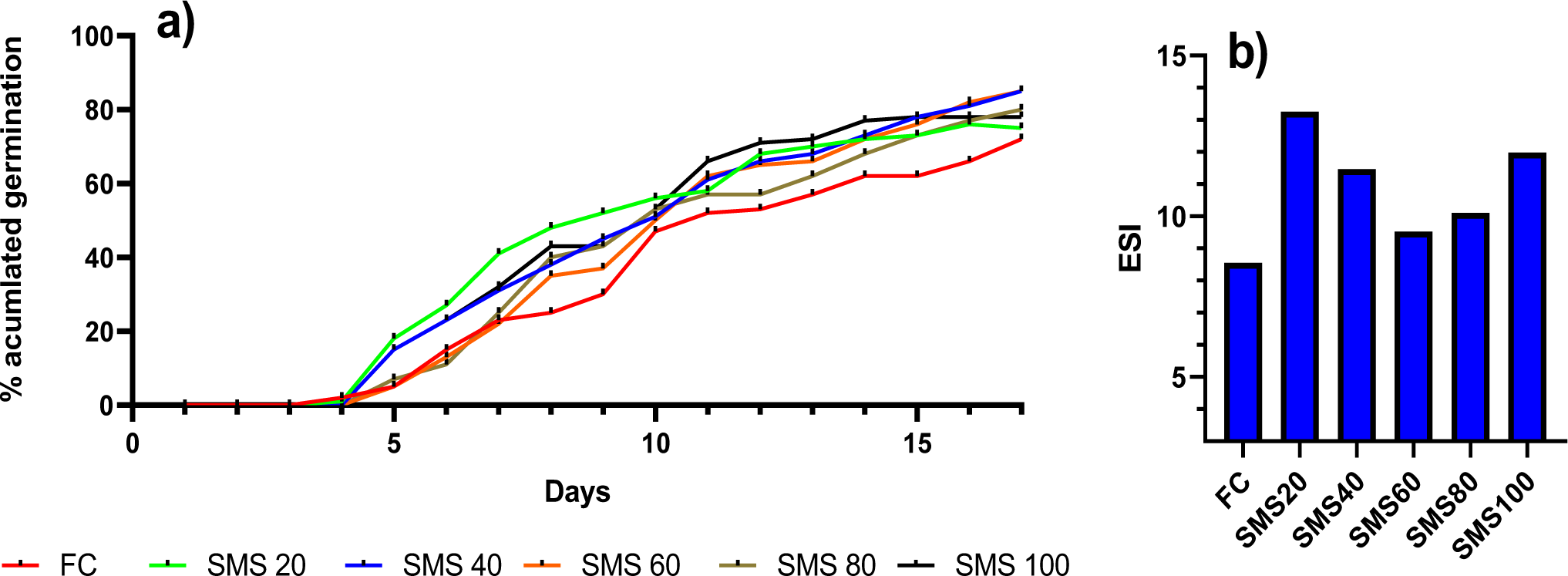
Figure 1 illustrates the effect of the uses of SMS on the germination and Germination Speed Index (GSI) of annatto plants. It is evident that the addition of 20% and 40% SMS to the control substrate results in a higher cumulative germination rate of annatto seedlings up to the 5th day after sowing compared to other treatments.
Accumulated germination (%) over time (a) and emergence speed index (ESI) (b) of annatto seedlings grown under different proportions of spent mushroom substrate (SMS) (0, 20, 40, 60, 80, and 100%) mixed with sugarcane filter cake (FC). Germination was evaluated up to 17 days after sowing.
From the 8th day onward, all SMS–containing treatments promoted higher cumulative germination compared to the filter cake–based substrate, with 40% and 60% SMS exceeding 80% germination by 17 days after sowing (DAS). The concurrent increase in cumulative germination and emergence speed index (ESI) indicates that moderate SMS incorporation improved the physicochemical environment of the substrate, enhancing aeration, water retention balance, and early nutrient availability. The highest ESI observed at 20% SMS (≈13.6), compared to 8.3 in the control, reinforces the existence of an optimal substitution range capable of promoting faster and more uniform seedling establishment.
However, the response appears to be dose dependent. While moderate SMS inclusion improves porosity and provides residual nutrients, excessive substitution may increase electrical conductivity, alter salt balance, or modify the C:N ratio beyond optimal thresholds for early plant development. Similar threshold effects have been reported by Vieira and coauthors [16], who observed reduced germination speed in tomato under 100% substitution with Pleurotus ostreatus SMS, and by Ré and coauthors [17], who described decreased lettuce seedling quality index (SQI) with increasing SMS proportions.
In the case of annatto, this effect may be particularly relevant due to the species’ inherent dormancy traits and variable germination performance [19]. Under such physiological constraints, substrate conditions play a decisive role in regulating water uptake, oxygen diffusion, and metabolic activation. SMS, as a biologically active organic amendment, may further contribute through pH adjustment, gradual nutrient release, and beneficial microbial interactions that stimulate early germination processes. Supporting this interpretation, Hernández and coauthors [11] demonstrated that composted residues from Agaricus bisporus and Pleurotus ostreatus increased lettuce germination under suppressive conditions, suggesting that SMS–associated microbial communities and substrate improvements can positively influence seedling establishment in the adequate dose use.
Taken together, these findings suggest that the positive response observed in annatto is not merely nutritional but results from an integrated physicochemical and biological modulation of the germination environment, operating within an optimal substitution threshold.
Beyond its agronomic effect on germination and seedling vigor (Figure 1), the use of spent mushroom substrate represents a biotechnological strategy for residue valorization and substrate engineering. SMS contains biologically active microbial consortia, residual enzymes, and partially degraded lignocellulosic compounds that can modulate substrate physicochemical properties and promote plant establishment [13].
Due to the thermal and biological conditions inherent to the mushroom cultivation process, SMS is generally free of plant pathogens and weed seeds when compared with other organic residues, representing an important agronomic and sanitary advantage. From a compositional standpoint, SMS presents similarities to agro–industrial residues such as filter cake, although with a higher C/N ratio and lower electrical conductivity (Table 1). This reduced salinity may have contributed to the enhanced germination observed, minimizing osmotic stress during early seedling development.
These characteristics position SMS as a promising platform for the development of bio–based inputs, including bio–stimulants, microbially enriched substrates, and functional organic amendments. Similar microbial–mediated effects on germination enhancement were reported by Hernández and coauthors [11], reinforcing the potential of SMS as a biotechnological tool rather than merely an organic residue.
The average height of the annatto seedlings was 9.87 cm (Table 3). According to Ferreira Filho and coauthors [20], annatto is suitable for transplanting at a height of 15 to 30 cm. The cultivar Piave Anão cultivar used in this study is a small–sized variety, which allows for better mechanization and higher planting density [21]. In addition to height, the number of leaves is also important. In this study, the treatments resulted in an average of just over 8 leaves per seedling. The ideal number of leaves for transplanting is 6 to 8 [20], indicating that these seedlings are ready for transplanting despite being shorter than the standard height.
Biometrics of annatto seedlings grown under different proportions of spent mushroom substrate (SMS).
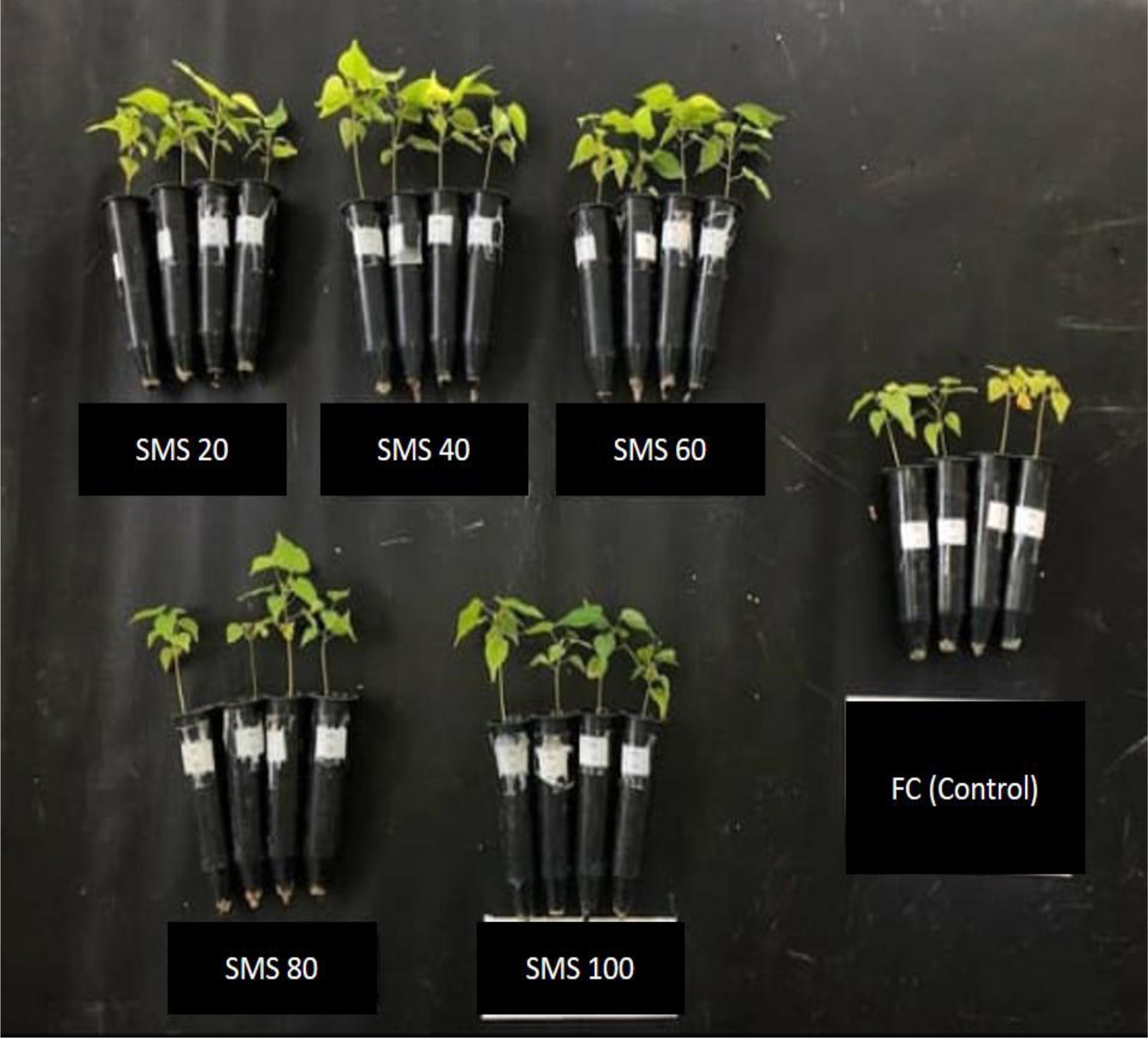
The use of 20% or 100% SMS did not result in statistically significant differences in plant height compared to the control (Figure 2). In contrast, substitution levels between 40 and 80% promoted increases greater than 30%, with the 60% SMS treatment showing the most consistent response. This intermediate level proved more advantageous than total substitution (100% SMS) and did not differ statistically from the commercial substrate commonly used by local producers for RFM and ADM.
Representative images of annatto seedlings grown under different proportions of spent mushroom substrate (SMS) (20, 40, 60, 80, and 100%) compared to the sugarcane filter cake substrate control (FC). Images were taken at 35 days after sowing under greenhouse conditions.
The reduced performance observed at 100% SMS may be associated with elevated electrical conductivity, which can increase osmotic potential in the root environment, limiting water uptake and inducing mild physiological stress. Under such conditions, seedlings may allocate energy to osmotic adjustment rather than growth, resulting in lower height and biomass accumulation [22].
A practical strategy to mitigate this limitation is the pre–composting of SMS, which can promote further mineral stabilization and salt redistribution, thereby reducing the risk of substrate salinization [13]. Postinguel and coauthors [23] demonstrated in Eucalyptus urograndis seedlings that combining SMS with mineral fertilizers improved seedling quality, indicating that balanced nutrient supplementation may enhance the agronomic performance of SMS–based substrates.
From an economic perspective specific to annatto market, the partial replacement of sugarcane filter cake by SMS—particularly up to 60% substitution—offers a cost–effective alternative for annatto seedling producers. Filter cake has experienced increased market demand due to its multifunctional use as an organic fertilizer, leading to higher prices and limited access for smallholders [24,25]. In contrast, SMS can be locally produced as a by–product of mushroom cultivation, reducing dependence on external inputs, transportation costs, and market price fluctuations. This integrated system promotes circular bioeconomy principles by converting agro–industrial residues into value–added inputs, improving economic resilience and sustainability for small– and medium–scale producers.
Production of Pleurotus ostreatus var. florida from Annatto Agro–industrial Waste
Table 4 shows the data for two isolated and interactive factors. No significant interaction was observed between AAR addition and the different strains. For the AAR addition factor, there was a significant decrease in yield, dropping from 27.93% (control) to 11.27% (AAR 100). Although yield, the most important variable in mushroom cultivation [26], decreased, the number of mushrooms, average mass, and biological efficiency did not show a statistical decrease until AAR 80% substitution. Earliness was not affected by substitutions up to 60% AAR.
Productive parameters of Pleurotus ostreatus var. florida harvested under different levels of annatto agro–industrial residue (AAR).
Variation in the number and average weight of mushrooms reflects efficient nutrient uptake from the substrate and high commercial quality of the harvested mushrooms [27]. Mushrooms with consistent weight have higher market value, and a good balance between number and weight indicates efficient use of substrate nutrients. Furthermore, optimizing these factors helps reduce production costs and maximize economic returns by avoiding excessive work with very small mushrooms [28, 29]. Earliness also allows growers to have more cycles per year, reducing the time between inoculation and harvest, and reducing the risk of disease affecting the crop [30].
The results of this study are consistent with the criteria established for alternative lignocellulosic substrates for Pleurotus cultivation described by Masevhe and coauthors [31]. Substrate performance depends fundamentally on structural composition, C/N balance, and physical characteristics that influence aeration and moisture distribution. Biological efficiency increases when the substrate provides degradable structural carbohydrates in combination with sufficient nitrogen to sustain biomass formation and reproductive development [31].
In this context, intermediate proportions of annatto agro–industrial residue (AAR) likely improved substrate functionality by adjusting structural composition and nutrient balance. The incorporation of AAR may have enhanced carbon availability while maintaining adequate nitrogen supply, resulting in more efficient substrate utilization and higher biological efficiency. In contrast, total substitution with AAR may have altered substrate stoichiometry or physical properties, potentially leading to nutrient imbalance or suboptimal structural conditions. Such changes can reduce conversion efficiency and limit productive output.
Regarding the strain factor, we observed that strain 16/01 is more productive and suitable when compared to strain 20/01, with higher yield, number of mushrooms, and better biological efficiency (Table 4). The study of different mushroom strains is crucial, as it helps determine which is best suited to the cultivation conditions, which can lead to the success of a commercial production [32, 33]. Furthermore, variations in techniques can lead to different results in the cultivation of Pleurotus species cultivation [34, 35].
The higher productivity of strain 16/01 is directly related to its higher yield in the first mushroom flush, as shown in Figure 3. When comparing the strains across different substrate proportions, although 16/01 and 20/01 showed no significant difference from the control (RS), strain 16/01 showed higher productivity in the first flush for AAR20, AAR40, AAR60, and AAR80, indicating better adaptation to the addition of annatto residue.
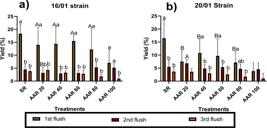
Yield (%) of Pleurotus ostreatus var. florida strains 16/01 (a) and 20/01 (b) cultivated on substrates containing different levels of annatto agro–industrial residue (AAR). Production was evaluated across three flushes (1st, 2nd, and 3rd). Uppercase letters indicate significant differences between strains within the same substrate level and flush, while lowercase letters indicate differences among flushes within the same substrate level and strain. Means were compared using the Tukey’s LSD (T–LSD) test at p ≤ 0.05.
The superior performance of strain 16/01 highlights not only its agronomic suitability but also its relevance from a biotechnological and economic standpoint. Similar strain–dependent differences have been reported by Mleczek and coauthors [36], who observed that strain selection is a key determinant of commercial cultivation success. As highlighted by these authors, genetic variability significantly influences productive performance even under comparable cultivation conditions. Therefore, our findings reinforce that the interaction between strain background and AAR substrate formulation must be strategically considered to optimize Pleurotus spp. production. Strains with higher productivity in the first flush optimize substrate conversion efficiency, reduce cultivation time, and lower production costs per cycle. When combined with annatto agro–industrial residue, strain 16/01 demonstrates enhanced adaptability to alternative substrates, reinforcing its potential for scalable and economically viable mushroom production systems based on regional residues.
The mushroom strains, regardless of species, that are more productive in the first flush tend to exhibit higher cumulative productivity across cultivation cycles [37,38]. Therefore, the early productive response observed for strain 16/01 may be indicative of a more efficient initial metabolic activation and substrate colonization capacity, which ultimately translates into superior biological efficiency and economic return.
This study highlights the importance of diversifying substrates for Pleurotus ostreatus var. florida cultivation beyond conventionally used materials such as rice residues, which are geographically concentrated and may create logistical and supply–chain dependencies. Although rice–based substrates are recognized as efficient [39], sustainable expansion of mushroom production requires the integration of alternative lignocellulosic residues that are widely available and locally adaptable. Expanding the range of viable substrates enhances production resilience, reduces transportation demands, and supports circular bioeconomy strategies, positioning alternative agro–industrial residues not as regional substitutes but as relevant components of sustainable mushroom cultivation systems.
Sourcing substrates from distant locations often increases logistical costs for small–scale mushroom producers, including transportation, handling, and storage, while also increasing the risk of substrate degradation during transport [40]. Moreover, conventional inputs used in Pleurotus cultivation—such as rice straw, rice bran, wheat straw and wheat bran—are widely traded agricultural commodities and are therefore subject to significant price fluctuations driven by international market
Vieira Junior and coauthors [41] demonstrated that there were even partial reductions in the use of these conventional inputs, can lead to substantial economic gains by lowering substrate formulation costs and increasing production profitability, highlighting the strategic importance of developing sustainable and locally available alternatives to reduce dependency on volatile external markets.
In this context, AAR represents a strategic regional alternative capable of reducing reliance on externally sourced inputs. Its reuse supports a cascading value chain in which annatto residues are transformed into mushroom substrates, generating edible biomass and spent mushroom substrate (SMS) that can subsequently be reused in seedling production. This integrated approach enhances resource efficiency and strengthens local economic resilience [16].
However, the findings are based on regional conditions in western São Paulo and may vary under different climatic or management contexts. In addition, the study was limited to short–term cultivation cycles and did not include techno–economic or life cycle assessments. Future research should therefore incorporate economic and environmental evaluations, as well as detailed the support large–scale implementation within circular bioeconomy systems.
CONCLUSIONS
The integration of annatto seedling production and Pleurotus ostreatus var. florida cultivation in a cascading system is a viable strategy. Replacing up to 60% of the conventional substrate with spent mushroom substrate (SMS) did not compromise annatto seedling growth and offers a practical route to reduce production costs.
In mushroom cultivation, the use of annatto agro–industrial residue (AAR) reduced yield, but mushroom quality parameters remained stable at substitution levels of 60–80%. Strain 16/01 outperformed strain 20/01, mainly due to higher productivity in the first flush.
Overall, the results demonstrate that sequential use of residues is agronomically feasible within the specific experimental conditions evaluated. The cascading configuration was validated in terms of biological performance across the two production stages; however, the findings are restricted to controlled conditions and short–term assessment. Economic feasibility, environmental implications, and performance under commercial–scale operations were not investigated and remain to be determined in future studies.
-
Funding:
This research was funded by Programa Institucional de Bolsas de Iniciação Cientifica (PIBIC/CNPq) and Fundação de Amparo à Pesquisa do Estado de São Paulo (FAPESP) grant number #2024/01185-9.
-
Institutional Review Board Statement:
Not applicable.
-
Informed Consent Statement:
Not applicable.
Data availability statement:
Research data are only available upon request for corresponding author.
Acknowledgments:
The authors would like to thank Comércio de Urucum Brasil Ltda. (Monte Castelo, São Paulo, Brazil) for providing the annatto seeds, control substrate, and annatto residues used in this study.
-
Use of Generative Artificial Intelligence
The authors declare that generative artificial intelligence (AI) or AI-assisted tools were used under full human supervision. The tool used was ChatGPT by OpenAI, which assisted in improving the writing quality of the manuscript and the organization of the data. No confidential or sensitive data were uploaded to the tool, and all AI-assisted content was reviewed, corrected, and approved by the authors, who take full responsibility for the integrity and originality of the manuscript.
REFERENCES
-
1 Pontes MMCM, Oliveira JP, Barreto MDCS, Carvalho EX, Mergulhão ACES, Silva MLRB, et al. Inoculation of arbuscular mycorrhizal fungi as a strategy to improve annatto (Bixa orellana L.) growth. Acta Sci Biol Sci. 2021;43: e54742. doi: 10.4025/actascibiolsci. v43i1.54742.
» https://doi.org/10.4025/actascibiolsci.v43i1.54742 - 2 Kala S, Kumaran K. Improved clonal propagation technique for mass multiplication of Bixa orellana L. Indian For. 2015;141(3):279-84.
- 3 Bindyalaxmi K, Mohammed H. Annatto: a dye for sustainability. J Agric Technol. 2023;10(2):128-34.
- 4 Hirko B, Getu A. Bixa orellana (Annatto Bixa): a review on use, structure, extraction methods and analysis. J Agron Technol Eng Manag. 2022;5(1):687-96.
- 5 Lorençone JA, Oliveira LEA, Lorençone PA, Torsoni GB, Lima RF, Chiquitto AG, et al. Climate change and its alterations on annatto (Bixa orellana L.) climate zoning in Brazil. Theor Appl Climatol. 2024;155(3):2473-97.
-
6 Instituto Brasileiro de Geografia e Estatística (IBGE). [IBGE automatic recovery system - SIDRA: municipal agricultural production] [Internet]. 2021 [cited 2026 May 8]. Available from: https://sidra.ibge.gov.br/pesquisa/ppm/quadros/brasil/2020
» https://sidra.ibge.gov.br/pesquisa/ppm/quadros/brasil/2020 - 7 Kumar S, Venugopalan R, Rao VK, Nair AK, Caithiratchelvan R. NPK requirement for annatto (Bixa orellana L.) seed yield and bixin content. Indian J Agrofor. 2020;12(2).
- 8 Poveda-Giraldo JA, Salgado-Aristizabal N, Piedrahita-Rodriguez S, Ortiz-Sanchez M, Ledezma Renteria ED, Orrego Alzate CE, et al. Improving small-scale value chains in tropical forests: the Colombian case of annatto and acai. Waste Biomass Valor. 2023;14(10):3297-313.
-
9 Mwangi RW, Mustafa M, Kappel N, Csambalik L, Szabó A. Practical applications of spent mushroom compost in cultivation and disease control of selected vegetables species. J Mater Cycles Waste Manag. 2024;26:1918-33. doi: 10.1007/s10163-024-01969-9.
» https://doi.org/10.1007/s10163-024-01969-9 - 10 Zhang RH, Duan ZQ, Li ZG. Use of spent mushroom substrate as growing media for tomato and cucumber seedlings. Pedosphere. 2012;22(3):333-42.
-
11 Hernández D, Ros M, Carmona F, Saez-Tovar JA, Pascual JA. Composting spent mushroom substrate from Agaricus bisporus and Pleurotus ostreatus production as a growing media component for baby leaf lettuce cultivation under Pythium irregulare biotic stress. Horticulturae. 2021;7(2):13. doi: 10.3390/horticulturae7020013.
» https://doi.org/10.3390/horticulturae7020013 - 12 Xu SY, Wei JK, Xue FY, Li WC, Guan TK, Hu BY, et al. Microbial inoculation influences microbial communities and physicochemical properties during lettuce seedling using composted spent mushroom substrate. Appl Soil Ecol. 2022;174:104418.
-
13 Alves LS, Tolardo G, Caitano CEC, Vieira Junior WG, Gomes Freitas PN, Cunha Zied D. Use of spent mushroom substrate for cherry tomato seedlings: a potential alternative to peat in horticulture. Biol Agric Hortic. 2024;40(2):127-40. doi: 10.1080/01448765.2024.2308301.
» https://doi.org/10.1080/01448765.2024.2308301 - 14 Parimalan R, Giridhar P, Rajasekaran T, Ravishankar GA. Annatto fruit pericarp: newer source as a potential fuel. Energy Fuels. 2007;21(2):1181-2.
-
15 Francavilla M, Manara P, Kamaterou P, Monteleone M, Zabaniotou A. Cascade approach of red macroalgae Gracilaria gracilis sustainable valorization by extraction of phycobiliproteins and pyrolysis of residue. Bioresour Technol. 2015;184:305-13. doi: 10.1016/j.biortech.2014.10.147.
» https://doi.org/10.1016/j.biortech.2014.10.147 -
16 Vieira VO, Conceição AA, Cunha JRB, Machado AEV, Almeida EG, Dias ES, et al. A new circular economy approach for integrated production of tomatoes and mushrooms. Saudi J Biol Sci. 2022;29(4):2756-65. doi: 10.1016/j.sjbs.2021.12.058.
» https://doi.org/10.1016/j.sjbs.2021.12.058 -
17 Ré BB, Vieira Junior WG, Postiguel RB, Alves LS, Caitano CEC, Freitas MADS, et al. A cascade approach to sustainable agriculture: from mushroom mycelium to lettuce harvest. Sci Total Environ. 2024;944:173976. doi: 10.1016/j.scitotenv.2024.173976.
» https://doi.org/10.1016/j.scitotenv.2024.173976 - 18 Dickson A, Leaf AL, Hosner JF. Quality appraisal of white spruce and white pine seedling stock in nurseries. For Chron. 1960;36:10-3.
- 19 Fernandes AC, Faria JCT, Faria JMR, Pires RMO, Carvalho ER, Santos HOD. Use of different conditioning agents and quality evaluation of two lots of annatto (Bixa orellana) seeds. Cienc Florest. 2021;31:808-29.
- 20 Ferreira Filho GS. [Annatto cultivation: production system]. Rondônia (BR): Emater; 2018.
-
21 Santos EJ, Lourenzani WL, Lourenzani AEBS. [Coordination of the annatto agroindustrial system in the Dracena microregion, São Paulo State]. Rev Bras Gest Desenvolv Reg. 2019;15(1). Available from: https://www.rbgdr.net/revista/index.php/rbgdr/article/view/4323
» https://www.rbgdr.net/revista/index.php/rbgdr/article/view/4323 - 22 Rahman NA, Adam S, Kassim NQB. Effects of peat in reducing the salinity of spent mushroom waste as growing medium. Malays J Soil Sci. 2024;28:147-52.
-
23 Postinguel RB, Alves LS, Ré BB, Caitano CEC, Barretto VCM, Zied DC. Spent mushroom substrate for eucalyptus seedling growth under varying water deficiency conditions. New Forests. 2025;56(1):9. doi: 10.1007/s11056-024-10082-6.
» https://doi.org/10.1007/s11056-024-10082-6 -
24 Silva JHB, Almeida LJM, Silva AV, Araújo JRES, Santos JPO, Silva AJ, et al. Filter cake increases sugarcane yield. Braz J Biol. 2023;83:e273414. doi: 10.1590/1519-6984.273414.
» https://doi.org/10.1590/1519-6984.273414 -
25 Soares ADAVL, Prado RDM, Bertani RMDA, Silva APR, Deus ACF, Kano C, et al. Contribution of using filter cake and vinasse as a source of nutrients for sustainable agriculture: a review. Sustainability. 2024;16(13):5411. doi: 10.3390/su16135411.
» https://doi.org/10.3390/su16135411 - 26 Dhar BL. Mushrooms and human civilization. In: Zied DC, Pardo-Giménez A, editors. Edible and medicinal mushrooms: technology and applications. Chichester (UK): John Wiley & Sons; 2017. p. 1-4.
-
27 Muswati C, Simango K, Tapfumaneyi L, Mutetwa M, Ngezimana W. The effects of different substrate combinations on growth and yield of oyster mushroom (Pleurotus ostreatus). Int J Agron. 2021:9962285. doi: 10.1155/2021/9962285.
» https://doi.org/10.1155/2021/9962285 -
28 Caitano CEC, Vieira Junior WG, Soares DM, Alves LS, Nóbrega BDB, Pardo-Giménez A, et al. Management of water supply in the cultivation of different Agaricus bisporus strains. Agronomy. 2023;13(10):2626. doi: 10.3390/agronomy13102626.
» https://doi.org/10.3390/agronomy13102626 -
29 Agba MO, Markson AA, Oni JO, Bassey GA. Growth and yield impact of oyster mushroom Pleurotus ostreatus (Jacq P. Kumm) cultivated on different agricultural wastes. J Biosci Agric Res. 2021;27(1):2225-33. doi: 10.18801/jbar.270121.272.
» https://doi.org/10.18801/jbar.270121.272 - 30 Fayssal SA, Yordanova MH, Sassine YN. Effect of substrate temperature and stages duration on recycling of agro-industrial residues through Pleurotus ostreatus production. Int J Recycl Org Waste Agric. 2023;12(4):559-71.
-
31 Masevhe MR, Taylor NJ, Soundy P. Alternative substrates for cultivating oyster mushrooms (Pleurotus ostreatus). S Afr J Plant Soil. 2016;33(2):97-103. doi: 10.1080/02571862.2015.1079932.
» https://doi.org/10.1080/02571862.2015.1079932 - 32 Menolli Junior N, Asai T, Capelari M, Paccola-Meirelles LD. Morphological and molecular identification of four Brazilian commercial isolates of Pleurotus spp. and cultivation on corncob. Braz Arch Biol Technol. 2010;53:397-408.
- 33 Alkan S, Uysal A, Kasik G, Vlaisavljevic S, Berežni S, Zengin G. Chemical characterization, antioxidant, enzyme inhibition and antimutagenic properties of eight mushroom species: a comparative study. J Fungi (Basel). 2020;6(3):166.
-
34 Albertia MM, Cunha MLO, Mendes DW, Vieira WG, Zied DC. Tecnologic development on Pleurotus cultivation: specific practices used in Brazil. Braz Arch Biol Technol. 2021;64:e21200198. doi: 10.1590/1678-4324-2021200198.
» https://doi.org/10.1590/1678-4324-2021200198 -
35 Vieira WG, Alberti MM, Pardo-Giménez A, Iossi MR, Dias ES, Zied DC. The application of the scratching technique has the same effect on Pleurotus spp.? Braz Arch Biol Technol. 2023;66:e23220736. doi: 10.1590/1678-4324-2023220736.
» https://doi.org/10.1590/1678-4324-2023220736 -
36 Mleczek M, Gąsecka M, Budka A, Niedzielski P, Siwulski M, Kalač P, et al. Changes in mineral composition of six strains of Pleurotus after substrate modifications with different share of nitrogen forms. Eur Food Res Technol. 2021;247(1):245-57. doi: 10.1007/s00217-020-03622-9.
» https://doi.org/10.1007/s00217-020-03622-9 -
37 Patel C, Shroff S, Soni C, Behar N. Comparative evaluation studies of different species of Pleurotus for radial growth, biomass and yield parameters. J Agric Ecol Res Int. 2024;25(2):7-14. doi: 10.9734/jaeri/2024/v25i21451.
» https://doi.org/10.9734/jaeri/2024/v25i21451 -
38 Atila F, Cetin M. Recycling biotoxic green walnut husks through mushroom cultivation and impact of these wastes on yield and nutritional composition of Pleurotus spp. Biocatal Agric Biotechnol. 2024;60:103322. doi: 10.1016/j.bcab.2024.103322.
» https://doi.org/10.1016/j.bcab.2024.103322 -
39 Iossi MR, Vieira Junior WG, Caitano CEC, Alves LS, Palú IA, Heirinchs R, et al. Macromineral consumption by Pleurotus ostreatus var. Florida in different straws. Arch Biol Sci. 2023;75(1):19-25. doi: 10.2298/ABS221230002I.
» https://doi.org/10.2298/ABS221230002I -
40 Balan V, Zhu W, Krishnamoorthy H, Benhaddou D, Mowrer J, Husain H, et al. Challenges and opportunities in producing high-quality edible mushrooms from lignocellulosic biomass in a small scale. Appl Microbiol Biotechnol. 2022;106(4):1355-74. doi: 10.1007/s00253-022-11835-1.
» https://doi.org/10.1007/s00253-022-11835-1 -
41 Vieira Junior WGV, Caitano CEC, Alves LS, Teixeira PAG, Noble R, Pardo JE, et al. From waste to resource: sustainable reuse of spent shiitake mushroom substrate in subsequent production cycles. Int Biodeterior Biodegradation. 2025;200:106034. doi: 10.1016/j.ibiod.2025.106034.
» https://doi.org/10.1016/j.ibiod.2025.106034
Edited by
-
Editor–in–Chief:
Bill Jorge Costa
-
Associate Editor:
Ana Cláudia Barana