
 Evaluation of Phytolith Production and Preservation in an Oxisol in Western Paraná, Brazil
Abstract
Phytoliths are plant micro-remains found in soils and sediments. Their durability, abundance and diagnostic morphologies make them reliable environmental proxies, especially when associated with other biological, chemical, or physical indicators. However, in some cases, phytoliths are the only biological proxy available on the soil for paleoenvironmental studies, therefore, it requires extra attention to taphonomic processes affecting these silica bodies’ assemblage. The preservation and conservation of this markers in the soil is directly linked to the edaphic conditions to which it is subjected over time. Hence, the application of this proxy requires care in order to avoid misinterpretations, since phytoliths are subject to degradation and movement within the soil due to soil-plant-water interactions, soil hydrological processes a/nd bioturbation. In this article we examine the diversity and taphonomic evidence found in an Oxisol’s phytolith assemblage in search to better our understanding of this silica bodies preservation in tropical soils. The result shows that the assembly found is very resistant to tropical edaphic conditions, displaying taphonomic signs such as breakage and corrosion across the profile, with significant increase with depth, pointing to the phytolith’s early deposition. Also, results suggest that Grass Silica Short Cell Phytolith tend to present more breakage than corrosion due to its smaller size when compared to bigger morphotypes, which have corrosion features more often.
Keywords:
Phytoliths; Taphonomy; Tropical Soils
HIGHLIGHTS
The rate of phytolith taphonomization within the soil profile tends to increase with depth.
Greater rates of non-identified taphonomized phytoliths might be associated with soil compaction.
Taphonomy effects are different on Grass Silica Short Cell Phytoliths and on larger morphotypes.
INTRODUCTION
Paleoclimatic records can be found on the current environments in many forms. Environmental markers such as phytoliths, pollen grains, sponge spicules and diatoms provide information about past climate and vegetation. Among these, phytoliths stand out for being a reliable and very resistant proxy found in many soils. In the past decades phytoliths have been used more frequently in tropical domains, which are characterized by intense biogeochemical cycling and rich biodiversity that could potentially harm this marker’s stability in the soil and therefore disturb our understanding of the phytolith assembly and its environmental significance. Thus, comprehending this proxy’s preservation in soil is a difficult but essential task for the better use of this tool in paleoenvironmental studies.
Phytoliths are amorphous biomineralizations of hydrated silica (SiO2.nH2O), produced by certain types of plants through silica absorption, accumulation and deposition within and among plant tissue cells, particularly the epidermis, during the vegetative cycle [1,2]. Upon the plant's death and decomposition, phytoliths can integrate soils and sediments and might remain preserved if the environment's pH conditions are between 3 and 9, not causing its dissolution [2-4].
The phytolith record is an important tool in developing paleoenvironmental research. These proxies present distinct morphologies with taxonomic value, allowing the identification of its plant of origin. Phytoliths were first identified in the 19th century, but only started being used as bioindicators on the 1970s, mostly in the field of archaeobotany then on paleoenvironmental studies of climate and vegetation [1, 2, 5, 6].
Phytolith analysis has proven to be trustworthy due to phytolith’s resistance, diagnostic morphologies, and environmental abundance [7]. Although relatively resistant to weathering, phytoliths can be transported by water, wind, and animals [3, 6]. However, it is important to emphasize that the analysis of the phytolith assemblage cannot accurately replicate the diversity of plants from past vegetation cover, as some plants do not produce phytoliths or do not produce those with diagnostic morphology, or even because these microremains may not be sufficiently silicified to remain well preserved in the soil [6]. Thus, it is crucial to know that the scope of this analysis is local and that it should be performed amongst a multiproxy approach, allowing the comparison and complementarity of data.
Phytoliths are subject to many chemical and physical attacks just like other soil mineral particles, causing taphonomic processes and translocation [3,7,8]. The theory that phytoliths remain s in sediments and soil profiles was debunked after many studies proved the vertical movement of the assemblage in different soil orders [3, 9-11].
Taphonomic investigation’s intent is to have more accurate interpretations of past environments, life and decay of organisms and the conditions under which they were preserved [11]. Studies on phytolith taphonomy have been executed in different sites with the intended of comprehending biogenic silica’s movement and permanence in soil [3, 4, 9-15] still these aspects remain little analyzed when it comes to tropical landscapes.
Phytolith taphonomization can occur pre- or post-deposition in the soil [8, 11]. Pre-depositional processes include via wind and water movement or though faunal activity e.g., grazing herbivores. Post deposition, silica dissolution may occur especially in tropical areas, as well as soil erosion and bioturbation [16, 17].
Significant research on phytolith taphonomy has been conducted to comprehend how laboratory procedures might induce taphonomization in silica cells, alongside with studies focused on determining the source area of plant microremains and transport induced taphonomization, as well as investigations aiming to understand the impact of post-depositional and pedogenetic processes on these remains [3, 8, 9, 11 -21]. Recognizing these mechanisms is essential to elucidate the environmental processes affecting phytolith distribution and preservation.
Soils bear multiple elements and characteristics that provide information about processes it underwent through several years. The biotic and abiotic records found in soil reveal many ecological phases and events in a broad timescale. Oxisols are known as pedogenetically well developed, polygenetic and polycyclic soils [22, 23]. These soils form through processes of laterization and bioturbation which involve intense leaching of bases and silica as well as particle mixing and burrowing. Faunal activities, as noted by several authors [13-16, 24-27], can move and rearrange phytoliths, often resulting in broken or corroded assemblages. These natural processes potentially disturb the original sedimentation of the phytolith assemblage and change morphological aspects.
Despite recognized as an important factor, research on phytolith preservation and taphonomic processes in tropical soils, particularly those with clay texture, remains limited. Thus, this article investigates the vertical distribution and preservation of phytoliths in an Oxisol profile from Western Paraná, Brazil, focusing on distinguishing silica bodies with broken, corroded and with no taphonomical aspects in its morphology in order to better our understanding of processes that lead to the distribution and preservation of phytoliths intra soils of this particular environment.
STUDY AREA
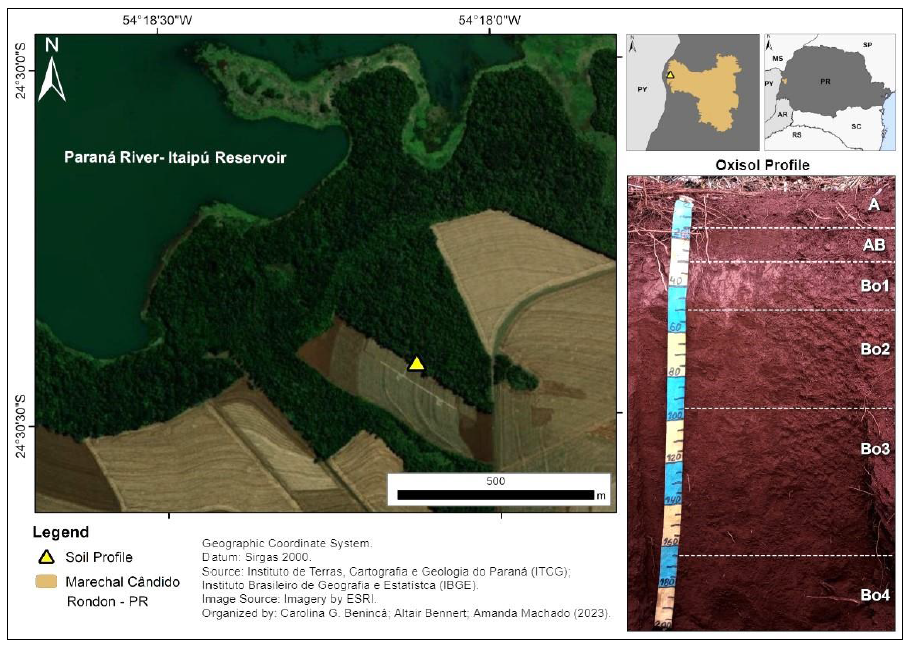
The study area is located in Porto Mendes, district of Marechal Cândido Rondon city, Westen Paraná, Brazil, at geographical coordinates of 24°30'25.3"S and 54°18'07.5"W (Figure 1). The site is located on the Terceiro Planalto Paranaense, a geomorphological unit composed of magmatic rocks from the Cretaceous period, and in the geological formation known as the Serra Geral Group [28].
This landscape evolved though many tectonic events and climatic variations in the past million years leading to its current characteristics of tropical and subtropical climates and deep Oxisols formation [28, 29]. According to Köppen’s classification, the current climate at the study area is Cfa - humid subtropical climate with hot summers and no dry season. The temperatures are higher than 22ºC during summer and under 18ºC during the winter, with mean annual precipitation of 1250 to 1500mm [30].
Recently, due to the implementation of Itaipú’s Hydroelectric Power Plant in the Paraná River, the study site became part of a protected riparian area of this water reservoir that was reforested with native Atlantic Forest (specifically Floresta Estacional Semidecidual phytophysionomy) species around twenty years ago.

A Oxisol profile with clay texture was chosen for being very representative of Western region soils. It is located at the transition between the area of permanent vegetation preservation of the Paraná River and a crop planting area. The soil’s horizon sequence is A (0-20cm); AB (20-30cm); Bo1 (30-50cm); Bo2 (50-95cm); Bo3 (95-165cm) e Bo4 (165-200cm).
MATERIAL AND METHODS
Field Procedures
Disturbed soil samples were collected systematically at each 10cm, from the bottom to the top of the profile, summing up to 20 samples in means of phytolith extraction and analysis of these silica bodies morphotypes and its taphonomical features. Disturbed samples of the soil’s horizons were collected and described according to procedures stablished in Manual de Descrição e Coleta de Solos [31] in means of characterization and classification.
Phytolith Extraction from Soil Samples
The phytolith extraction and identification was conducted at the Laboratório Multiusuário de Estudos da Dinâmica Ambiental - LEDA (from Unioeste campus Marechal Cândido Rondon), starting with 4g of fine air-dried soil and following the methods described in [32] and [33] as method two for elimination of soil organic matter (SOM), carbonates, iron and aluminum oxides and clay from the soil sample for they may cover the sample’s phytoliths. The removal of soil organic matter is made using 40ml of hydrogen peroxide, the next steps consist of the removal of oxides in a hot water-bath by adding dithionite and a solution of citrate and sodium bicarbonate to the samples. After that, the clay was eliminated through centrifugation. The following step consisted on phytolith separation trough fluctuation using a high-density solution of sodium polytungstate (2,35 g.cm-3) [32].
After the extraction, the phytolith material was placed in microscope slides for identification and counting of silica amorphous cell in a Zeiss AxioScope 5 petrographic microscope with magnification of 40x. In each slide at least 200 morphotypes bigger than > 5μm and with taxonomic significance were counted and named according to the International Code for Phytolith Nomenclature - ICPN 2.0 [34] [35].
The description of phytoliths focused on corrosion and breakage taphonomical aspects. The morphotypes were grouped according to the taxonomic significance of each group following authors such as [16, 37-39], and the main Brazilian phytophysiognomy’s reference collections available at LEDA [39-45].
Phytolith Taphonomization Index (I/T)
Following the counting and identification of morphotypes the phytolith taphonomization index, established by Marcolin, 2022 [36], was calculated. This indicator traces the proportion of taphonomized phytoliths within the soil profile.
RESULTS
The soil’s phytolith assembly accounts with 25 distinct morphotypes and shows variations in its composition and distribution along the Oxisol profile (detailed data available on supplementary material). The phytoliths identified are: Acute Bulbous, Ameboid, Bilobate, Blocky, Blocky Cavate, Blocky Dentate, Blocky Sinuate, Brachiate, Bulliform Flabellate, Crenate, Elongate Entire, Elongate Sinuate, Polygonal, Polylobate, Rondel, Saddle, Saddle Collapsed, Spheroid Echinate, Spheroid Ornate, Spheroid Psilate, Tabular Retangular, Tabular Elongate, Tabular Polygonal, Tracheid, and Trapeziform.
Phytoliths produced by the Eudicotiledonea group predominate throughout the profile, representing an average of 44% in each soil layer, with a slight concentration at depth (Figure 2). A greater predominance of Eudicotiledonea morphotypes (>50%) occurs from 170 to 200cm.

A predominance of Bambusoideae subfamily morphotypes (Saddle colapsed) was observed in the upper layers (from 10 to 50cm) but it gradually reduces with depth (making on average, only 4% of the assemblage between 130 to 200cm). A similar scenario occurs with the phytoliths of grass subfamilies, Panicoideae (Bilobate and Crenate) and Chloridoideae (Saddle), to a lesser extent. The opposite trend is seen in the assemblage of phytoliths produced by Poaceae in general (Blocky, Bulliform Flabellate and Elongate Entire), which increases in depth.
Pooid (Rondel and Trapeziform morphotypes) and Arecaceae (Spheroid Echinate) phytoliths were identified in smaller quantities in the profile, representing 4.1% and 1.6% of the assemblage, respectively. As for morphotypes with unknown origin (Acute, Ameboid and Tracheid) they account for 39% of the litter layer, but only 3% of the soil profile layers.
The distribution verified in this profile is related to variations in the evolution of the landscape’s vegetation structure during the Quaternary. The most superficial layers mirror the recent occupation of this site marked by the substitution of the original land cover, the Atlantic Forest vegetation, for agriculture fields in the past seventy years of colonization. Recently, due to the implementation of the Itaipú Hydroelectric Power Plant Reservoir, the area became part of a protected riparian vegetation area and about twenty years ago was reforested with native species, from which phytoliths morphotypes are manifested, especially in the litter layer.
The taphonomized identified phytoliths represent 31.7% of the profile’s assemblage (Figure 3). The Taphonomization Index shows a tendency of linear increase in tafonomized phytoliths with depth. The Index varied between 0.1 in the litter layer, 0.25 in the surface layer and 0.38 in the profile base. There are noticeable peaks in the tafonomization trend, which cause the mean value of the index to be at 0.73. These peaks at 130 and 170cm might signal greater soil disturbance and in the Bo3 horizon.

The increase on the proportion of corroded and broken phytoliths (taphonomized cells) not identified, especially in the Bo2 and Bo3 horizons, indicates a longer residence time of phytoliths in the soil profile. The exposure to pedogenetic processes for longer likely led to the increase in these taphonomic characteristics. The Bo1 horizon showed a higher rate of non-identified taphonomized phytoliths which might be related to mixing and compactation of this soil layer because by previous occupation and use of mechanized agriculture before the displacement of this activities with the emergence of Itaipú’s lake.
Amongst the phytolith cells, the grass silica short cell group (GSSCP) such as Bilobate and Saddle presented itself more broken than corroded but overall, less taphonomized than other morphotypes (Figure 4). Larger surface morphotypes like Blocky, Bulliform Flabelate and Tabular show signs of corrosion more frequently (Figure 5).

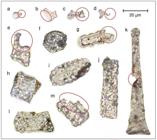
Broken and corroded phytolith examples (red circles indicate breakage points): a - Bilobate; b - Polygonal; c- Saddle Collapsed; d -Bilobate e - Tabular; f - Tabular Polygonal; g - Crenate; h - Blocky; i - Acute; j - Tabular Elongate; k - Acute Bulbous; l - Tabular Retangular; m - Blocky Sinuate.
DISCUSSION
Taphonomized morphotypes can be accessed to provide a bigger picture of environmental dynamics, revealing paleoenvironmental aspects regarding pedogenic process and the soil’s evolution. Researchers assess the mean residence time of phytoliths in soils qualitativelly by observing corroded, broken and burned phytoliths. This approach often reveals a higher rate of taphonomized phytoliths in the subsurface, suggesting that these phytoliths have been in the soil for longer [4; 46]
There once was an hypothesis of phytolith immobility after its deposition in soil, but the vertical movement of this cells has long been verified in different soil orders [10,14]. In soil, phytoliths behave as particles of silt and fine sand due to their size range, being vulnerable to translocations [47]. In tropical environments, the reworking of soil particles by faunal activity is intense enough to disrupt the chronological order of phytolith particles deposition, possibly causing inconsistences in data and interpretations [4,48].
The larger frequency of taphonomized morphotypes identified at depth in the Porto Mendes Oxysol profile corroborates the logic of an increase in the average age of phytoliths in the profiles [48, 49]. Similar scenario was observed by [36], also in Paraná state soil. According to the author, this distribution is related to soil’s texture, macroporosity and water circulation in the profile.
It is known that pH conditions that favor phytolith dissolution are under 3 and over 9 [2], [50] compared the phytolith assemblages of different modern soils, showing that acid soils maintain these proxies better than pyroclastic and saline-alkaline soils. The taphonomization rate and index verified in the Oxisol profile under study seem to reflect the stage of weathering, and the moderate acidity and the typical presence of Fe and Al oxides and hydroxides found in these soils and that often cover the mineral particles, making it difficult for them to dissolve, and possibly having the same effect on phytoliths [47, 51, 52].
Many other factors may interfere in this process, such as the shape, size and the degree of silicification of the phytolith cell as noted by [49]. A study conducted by [53], showed that the mineral’s solubility of which the microremains are made of, their robustness, the water regime, and the locus of soil formation have an impact in its preservation in soil.
[54] verified that the translocation of phytolith in the soil profile is related to the morphotype size, smaller cells such as GSSCP are moved preferentially, tabular, blocky and bulliform cells are less translocated than those. Therefore, it is expected to have a bigger number of this morphotypes in depth and a decrease in larger phytoliths, which is not verified in this case but the opposite scenario. This could be simply related to the sedimentation of these micro remains, and the tendency suggested by the authors could be occurring in a smaller scale.
According to [12,13, 54], the phytolith’s distribution pattern is conditioned by soil texture, which in turn affects bioturbation. The occurrence of taphonomized phytoliths throughout the soil profile suggest the activity of the edaphic fauna could be moving older and more taphonomized phytoliths from depth to surface layers [19, 43].
Corrosion being a predominant feature in of larger phytoliths is associated with its robustness when compared to other shapes of phytoliths. Same was noted by [55] in Oxisol profiles of Paraná. Abundance and over-representation of larger morphotypes has also been indicated in studies [53] and [56].
CONCLUSION
The distribution of taphonomized phytolith cells provides insights into not only the soil formation processes over time but also the broader environmental implications of these processes. In the study area, diagnostic morphotypes of Eudicot phytoliths are predominant, especially at the bottom of the soil profile, indicating their presence and abundance in the vegetative cover of past periods.
The persistence of taphonomized phytoliths at various depths suggests that these silica bodies can remain in the soil for extended periods, even under intense tropical weathering conditions. This enduring presence influences nutrient cycling and soil formation, since the silica percentage in soil is increased by these micro-remains.
Corrosion is the predominant form of taphonomization in larger morphotypes, more frequent than breakage, likely due to their larger surface areas and possibly lower degrees of silicification. In contrast, smaller phytoliths more commonly exhibit cell breakage. Bigger rates of non-identified taphonomized (corroded and broken cells) phytoliths occurred associated with a compacted soil layer.
The chronology and environmental implications of these phytolith assemblies are subjects of ongoing research. Future studies will focus on the potential movement of phytoliths within the soil profile due to faunal activity, such as bioturbation.
Acknowledgments
We thank PhD. Vanda Pietrowski, professor of Agronomy Department of State University of Western Paraná (Universidade Estadual do Oeste do Paraná - Unioeste) and the Technical Association of Cassava Industries of Paraná (Associação Técnica das Indústrias de Mandioca do Paraná - ATIMOP) for providing access to the study site and cooperation on field activities.
REFERENCES
- 1 Rovner I. Potential of opal phytoliths for use in paleoecological reconstruction. Univ Washingt. 1971;1(3):323-59.
- 2 Piperno DR. Phytoliths: a comprehensive guide for archaeologists and paleoecologists. Oxford: AltaMira Press; 2006.
- 3 Osterrieth M, Madella M, Zurro D, Fernanda Alvarez M. Taphonomical aspects of silica phytoliths in the loess sediments of the Argentinean Pampas. Quat Int. 2009;(1-2):70-9.
- 4 Pearsall DM. Phytolith Analysis. In: Pearsall DM, (ed.). Paleoethnobotany: A Handbook of Procedures. 3rd ed. Routledge; 2016. p. 572-754.
- 5 Twiss C, Suess E, Smith, RM. Morphological classification of grass phytoliths. Soil Sci Soc Am Proc. 1969; 33:109-15.
- 6 Mulholland SC, Rapp G. Phytolith Systematics: An Introduction. In: Phytolith Systematics. Boston, MA: Springer US; 1992. p. 1-13.
- 7 Piperno DR. Phytolith Analysis: An Archaeological and Geological Perspective. San Diego: Academic Press, Inc.; 1988.
- 8 Dodd JR, Stanton RJ. Paleoecology. Concepts and Applications. New York: Wiley; 1990.
- 9 Piperno DR. The Interpretation of Phytolith Assemblages: Method and Theory. In: Phytolith Analysis. Elsevier; 1988. p. 131-67.
- 10 Calegari MR, Souza E de, Mozer JH, Marcolin L, Fonseca CF. [Phytoliths - A tool for palaeoenvironmental reconstitution studies]. Derbyana. 2022 Dec 29;43:778. Portuguese.
- 11 Madella M, Lancelotti C. Taphonomy and phytoliths: A user manual. Quat. Int. 2012;275:76-83.
- 12 Grave P, Kealhofer L. Assessing Bioturbation in Archaeological Sediments using Soil Morphology and Phytolith Analysis. J Archaeol Sci. 1999;Oct;26(10):1239-48.
- 13 Hart DM. The influence of soil fauna on phytolith distribution in an Australian soil. In: Hart DM, Wallis LA, editors. Phytolith an starch research in the Australian-Pacific-Asian regions: the state of the art. Terra Aust. Camberra: Pandanus Books; 2003, 83-92.
- 14 Humphreys GS, Hart DM, Simons N, Field RJ. Phytoliths as indicators of process in soils. In: Hart DM, Wallis LA, editors. Phytolith and starch research in the Australian-Pacific-Asian regions: the state of the art. Camberra: Pandanus Books; 2003, 93;104 p.
- 15 Hart DM, Humphreys GS. [The Mobility of Phytolith in Soils: Pedological considerations]. In: Pinilla A, Juan-Tresserras J, Machado MJ. editors. [First European Meeting on Phytolith Research]. Barcelona: Centro de Ciencias Medioambientales (Spain) Madrid. Consejeri´a de Educacio´n y Cultura. Spain. Direccio´n General de Investigacio´n Cienti´fica y Te´cnica. 1997, 292 p.
- 16 Runge F. The opal phytolith inventory of soils in central Africa - Quantities, shapes, classification, and spectra. Rev Paleobot Palynol. 1999;107(1-2):23-53.
- 17 Cordova CE, Scott L. The potential of Poaceae, Cyperaceae, and Restionaceae phytoliths to reflect past environmental conditions in South Africa. In: Runge j (ed.). African palaeoenviornments and geomorphic landscape evolution (pp. 107-133). Boca Raton, FL: CRC Press. 2010.
- 18 Garnier A, Neumann K, Eichhorn B, Lespez L. Phytolith taphonomy in the middle-to late-Holocene fluvial sediments of Ounjougou (Mali, West Africa). The Holocene. 2013;23(3),416-31.
- 19 Bartoli F, Wilding LP. Dissolution of biogenic opal as a function of its physical and chemical properties. Soil Sci Soc Am J. 1980;44:873-8.
- 20 Wilding LP, Drees LR. Contributions of forest opal and associated crystalline phases to fine silt and clay fractions of soils. Clay Clay Miner. 1974;22:295-306.
- 21 Piperno, DR. Phytolith taphonomy and distributions in archaeological sediments from Panama. J Archaeol Sci. 1985;12:247-67.
- 22 Ker JC. [Oxisols from Brazil: a review]. Geonomos. 1998;5(1):17-40. Portuguese.
- 23 Muggler CC. Polygenetic Oxisols on Tertiary Surfaces, Minas Gerais, Brazil: Soil genesis and landscape development. Wageningen Agricultural University, Netherlands; 1998.
- 24 Calegari MR, Madella M, Vidal-Torrado P, Pessenda LCR, Marques FA. Combining phytoliths and d13C matter in Holocene palaeoenvironmental studies of tropical soils: An example of an Oxisol in Brazil. Quat Int.; 2013;287.
- 25 Hallsworth EG, Waring HD. Studies In Pedogenesis In New South Wales. J Soil Sci. 1964;Sep;15(2):158-77.
- 26 Fishkis O, Ingwersen J, Lamers M, Denysenko D, Streck T. Phytolith transport in soil: A laboratory study on intact soil cores. Eur J Soil Sci. 2010;61(4):445-55.
- 27 Rodrigues BM. [Bioturbation and phytolith distribution in Oxisols of Paulista Peripheral Depression]. [Piracicaba]: Universidade de São Paulo; 2019. Portuguese.
- 28 Maack R. [Physical geography of Paraná State]. 2nd ed. J Olympio; 1981. 450 p. Portuguese.
- 29 Bigarella JJ. [Structure and Origin of Tropical and Subtropical Landscapes]. Florianópolis: Ed. da UFSC; 2003. 877-1436 p. Portuguese.
- 30 NIitsche PR, Caramori PH, Ricce WS, Pinto LFD. [Climate atlas of Paraná state]. Londrina: IAPAR; 2019. 210 p. Portuguese.
- 31 Santos RD, Santos HG, Ker JC, Anjos LHC, Shimizu SH. [Field Soil Description and Collection Manual]. 7th ed. Viçosa: Sociedade Brasileira de Ciência do Solo; 2015; 102 p. Portuguese.
- 32 Madella M, Powers-Jones AH, Jones MK. A Simple Method of Extraction of Opal Phytoliths from Sediments Using a Non-Toxic Heavy Liquid. J Archaeol Sci. 1998; Aug 25(8):801-3.
- 33 Calegari MR, Madella M, Vidal-Torrado P, Otero XL, Macias F, Osterrieth M. Opal phytolith extraction in oxisols. Quat Int. 2013;287:56-62.
- 34 ICPT IC for IPT, Neumann K, Strömberg CAE, Ball T, Albert RM, Vrydaghs L, et al. International Code for Phytolith Nomenclature (ICPN) 2.0. Ann Bot. 2019 Sep 24;124(2):189-99.
- 35 Stromberg, CAE. Methodological concerns for analysis of phytolith assemblages: Does count size matter? Quat Int. 2009;193:124-40.
- 36 Marcolin, L. [Paleoenvironmental Reconstruction in an Anomalous Relief Feature in Northwest Paraná]. Doctorate Thesis. Curitiba: Universidade Federal do Paraná; 2022. Portuguese.
- 37 Twiss PC. Predicted world distribution of C3 and C4 grass phytoliths. In: Rapp G, Mulholland SC (Ed.). Phytolith Systematics: Emerging Issues. Soc Archaeol Sci. (U.S.). 1992;113-28.
- 38 Alexandre A, Meunier J-D, Colin F, Koud J-M. Plant impact on the biogeochemical cycle of silicon and related weathering processes. Geochim Cosmochim Acta. 1997;61(3):671-82.
- 39 Calegari MR, Raitz E, Menegazzi CP, Cecchet FA, Felipe Ewald PLL, Brustolin LT. Phytolith signature from grassland and araucaria forest in Southern Brazil. In: Heloisa Helena Gomes Coe, Osterrieth ML (Ed.). Synthesis of Some Phytolith Studies in South America (Brazil and Argentina). 2014. 91-210.
- 40 Calegari MR, Madella M, Tagliari LB, Ruiz Pessenda LC, Buso AA, Francisquini MI, et al. Potential of soil phytoliths, organic matter and carbon isotopes for small-scale differentiation of tropical rainforest vegetation: A pilot study from the campos nativos of the Atlantic Forest in Espírito Santo State (Brazil). Quat Int. 2017; May 437:156-64.
- 41 Cecchet FA. [Phytolith Assemblage of the Lower Strata of the Ombrophilous Dense Forest: Subsidies for Paleoenvironmental Reconstruction]. Marechal Cândido Rondon: Universidade Estadual do Oeste do Paraná; 2012. Portuguese.
- 42 Felipe PLL. [Reference Collection of Eudicotiledoneae Phytoliths from the Dense Ombrophilous Forest: Subsidies for Paleoenvironmental Studies in Tropical Regions]. Marechal Cândido Rondon: Universidade Estadual do Oeste do Paraná; 2012. Portuguese.
- 43 Raitz E. [Reference collection of silicophytolites from the flora of southwestern Paraná: subsidies for paleoenvironmental studies]. Marechal Cândido Rondon: Universidade Estadual do Oeste do Paraná; 2012. Portuguese.
- 44 Souza E. [Paleoenvironmental reconstruction based on the phytolithic signal at ESEC Caetetus - Gália (SP)]. Marechal Cândido Rondon: Universidade Estadual do Oeste do Paraná; 2019. Portuguese.
- 45 Mozer JH. [Reference Collection of Phytoliths and Paleoenvironmental Reconstruction of the Altomontane Ombrophilous Dense Forest in Carlos Botelho State Park - SP]. Marechal Cândido Rondon: Universidade Estadual do Oeste do Paraná; 2021. Portuguese.
- 46 Alexandre A, Meunier JD, Mariotti A, Soubies F. Late Holocene Phytolith and Carbon-Isotope Record from a Latosol at Salitre, South-Central Brazil. Quat Res. 1999; Mar 20;51(2):187-94.
- 47 Wilding LP, Smeck NE, Larry RD. Si cycling in a forest biogeosystem - the importance of transient state biogenic Si pools; in Dixon, JB., Weed, SB (eds.) Minerals in Soil Environments, Soil Sci Soc Am Inc. 1977;1-10.
- 48 Liu L, Li D, Jie D, Liu H, Gao G, Li N. Translocation of Phytoliths Within Natural Soil Profiles in Northeast China. Front Plant Sci. 2019 Oct;10:1-15.
- 49 Strömberg CAE, Dunn RE, Crifò C, Harris EB. Phytoliths in Paleoecology: Analytical Considerations, Current Use, and Future Directions. In: D. A. Croft et al., editor. Methods in Paleoecology: Reconstructing Cenozoic Terrestrial Environments and Ecological Communities. Springer Int Publ AG. 2018,235-87.
- 50 Albert RM, Bamford MK, Cabanes D. Taphonomy of phytoliths and macroplants in different soils from Olduvai Gorge (Tanzania) and the application to Plio-Pleistocene palaeoanthropological samples. Quat Int. 2006 May;148(1):78-94.
- 51 Bartoli F, Wilding LP. Dissolution of biogenic opal as a function of its physical and chemical properties. Soil Sci Soc Am J. 1980;44:873-8.
- 52 Strömberg CAE, Dunn RE, Crifò C, Harris EB. Phytoliths in paleoecology: analytical considerations, current use, and future directions. In: Methods in paleoecology: Reconstructing Cenozoic terrestrial environments and ecological communities. Strömberg CAE et al. (Ed.). Springer Cham, Switzerland. 2018:235-87.
- 53 Cabanes D, Weiner S, Shahack-Gross R. Stability of phytoliths in the archaeological record: a dissolution study of modern and fossil phytoliths. J Archaeol Sci. 2011 Sep;38(9):2480-90.
- 54 Hart DM, Humphreys GS. Distribution and mobility of spherical opaline phytoliths in a podzol. In: Super Soil: 3rd Australian New Zealand Soils Conference, 2004.
- 55 Santos TG. [Effect of Bioturbation on the Assembly of Phytoliths in Latosols of the Basaltic Province of Paraná]. Master's Dissertation. [Piracicaba] Escola Superior em Agricultura "Luiz de Queiróz" - Universidade de São Paulo; 2023. Portuguese.
- 56 Zhou L, Li R, Vachula RS, Dong H, Tan S, Chen X, et al. Phytolith morphology and assemblage variations in a bamboo forest plant-soil system. Rev Palaeobot Palynol 2022;300:1-9.

 Source: Authors.
 Source: Authors
 Source: Authors.
 Source: Authors.