 Dielectric Properties of Gelatin Films Determined Using a Simple Set-Up
Abstract
Knowledge and understanding of the dielectric properties of food and biological materials are of great relevance for the research and development of new methods of characterization, quality assessment and process monitoring of these materials using non-destructive techniques. This study developed an easily available instrumentation set-up which was used for dielectric characterization of gelatin films. The effect of frequency, moisture content and plasticizer type (glycerol or sorbitol) on their dielectric characteristic (ɛ´) was evaluated. The films were produced by casting. The circuit used consisted of a very simple astable oscillator with operation based on the operational amplifier (741) switched by the load of a parallel plate capacitor whose dielectric was the film under study. From the values of oscillation frequency and capacitor geometry, it was possible to calculate the capacitance and obtain the dielectric characteristics using basic relations. Such an instrumentation proposal was able to accurately measure the dielectric constant of gelatin films in the frequency range 5-50 kHz. The results demonstrated a decrease of ɛ´ with increasing frequency. Such influence on dielectric characteristic of the films (∆ɛ´/∆f ≈ 22%) is stronger at low frequencies. The analysis of influence of plasticizers on the films dielectric characteristics showed that the sorbitol results in higher values for the permittivity when compared with the use of glycerol as a thickener. In this frequency range, effect of moisture on ɛr´ was observed on films with sorbitol only, below 20 kHz.
Keywords:
relative permittivity; parallel plate capacitor; biodegradable films; gelatin; plasticizer type
HIGHLIGHTS
A not expensive device for dielectric characterization of films was developed.
The relative permittivity (ɛr’) of the films decreases as a function of frequency.
The effect of plasticizers was more important for films conditioned under NaBr.
Films containing glycerol were more sensitive to frequency effect.
INTRODUCTION
Dielectric properties represent important physical parameters that are useful to understand the physical electrical behavior of materials. These characteristics are required to develop procedures for food processing, particularly for radio frequency (RF) and microwave cooking, but also for cooling and freezing processes [1, 2, 3, 4, 5, 6]. These characteristics are also crucial when employing edible and/or biodegradable films, often used for food packaging. Refrigeration and cooking processes are determined primarily by conduction and convection phenomena that depend mainly on the conductivity, but also the emission and absorption of radiation, described by the Stefan law, are obviously active in these cases. Thus, the dielectric properties are also important parameters to be considered. In fact, dielectric properties are important when processing foods but also for on-line quality control in food processing [7]. Dielectric properties of materials are described in terms of the permittivity (ɛr) according to equation 1.
This equation shows a complex electrical function, composed of a real (ɛr’) and an imaginary (ɛr”) components, where j is the imaginary unit. This equation describes the ability of the dielectric material to absorb, transmit or reflect the electromagnetic energy [8, 9, 10]. ɛr” is known as loss factor and is an indicator of the energy dissipated inside the material whereas ɛr’ is traditionally called as "dielectric constant", even though it varies depending on the frequency, and humidity and composition of the material or when the medium is not a vacuum.
In fact, the magnetic permeability (µ0) and electrical permittivity (ɛ0) of the vacuum are related to the speed of light (equation 2). However, as we know, the speed of light is actually constant in the vacuum but varies in a material media. Indeed, the purpose of this paper was exactly to measure the gelatin films’ dielectric permittivity variations.
The magnitude of ɛr’ gives an indication of the polarizability of the molecules and a measure of the ability of the material to store energy in response to application of an electric field [11]. Nevertheless, this property is also essential for provide important information on structural changes in the materials when subjected to environmental changes, particularly temperature and relative humidity [12,13].
The dielectric properties of materials, including biopolymers, can be influenced by several factors. Some of these factors are related to the nature of the material (chemical composition, chemical structure, etc.). The conditions of the external environment, such as the temperature, moisture content, frequency of the applied electromagnetic field, and the time of application can also influence dielectric properties by altering the response of the induced or permanent dipoles [9].
The choice of the most appropriate method to determine the dielectric properties depends on the material under test, frequency range of interest, dielectric properties to be measured, the need for a non-destructive method, degree of accuracy required, equipment and resources available [14, 15]. For thin solid materials, such as sheets and films, the method of parallel plates is the most suitable for the study of the dielectric properties [16].
Currently, there is a growing interest in research focused on the development and characterization of biodegradable materials, particularly edible films. This is due to the need of replacing synthetic polymers, commonly used in packaging, which cause great environmental impact [17]. Among the biodegradable natural edible biopolymers, gelatin stands out for being an abundant raw material, produced with relatively low cost, with excellent functional and film-forming properties and has wide application in various fields, especially for food processing and packaging, plastics manufacture, agricultural and pharmaceutical products [16, 18]. Gelatin has the ability to form physical gels at room temperature due to the ionic interactions between the amino and carboxyl groups of their amino acids along with hydrogen bonds [19].
Generally, the dehydration of a gelatin solution produces brittle or less flexible films; therefore, the use of plasticizers is required [20]. The plasticizer should be compatible with the biopolymer, as is among the polymer atoms, reducing the intermolecular forces and increasing mobility of the polymer chains, affecting the dielectric properties among others.
Edible films based on gelatin have been produced and studied for long time, and thus, their main and functional properties have been characterized. For example, Sobral and coauthors [20] developed films based on gelatin and studied the effect of the sorbitol concentration on mechanical properties, water vapor permeability and glass transition of these films. Thomazine and coauthors [21] studied the effect of blends with different ratios of sorbitol and glycerol, at two plasticizer concentrations, on mechanical, viscoelastic, and water vapor barrier properties of films based on gelatin. And, more recently, Bertan and coauthors [22] studied the impact of hydroethanolic extracts from Guaco leaves (Mikania glomerata Sprengel) on rheological and viscoelastic properties of gelatin film-forming solutions and on the microstructure, chemical interactions, crystallinity, glass transition, color, solubility in water, water vapor permeability and mechanical properties of these films, among others. However, the dielectric properties have not been studied like other physical properties of these films.
Moreover, considering that equipment for dielectric properties determinations are relatively expensive, the objectives of this study were to develop and build a relatively simple instrumentation set-up, which is accurate and low cost for dielectric characterization of materials, as an alternative to more expensive and sophisticated equipment and to employ this for the dielectric characterization of biodegradable films based on gelatin in order to study the effects of frequency variation, moisture content and plasticizer type in permittivity of these films. The main interest of this study is food packaging. But the readers can find studies on dielectric properties of gelatin systems applied as phantoms of muscle for biomedical application [23], of gelatin-based nanocomposites reinforced with multi wall carbon nanotube interesting for applications as biocompatible electrostatic capacitors and energy storage devices [24], and of gelatin in order to determine its feasibility as a temperature sensor [25], among others.
MATERIAL AND METHODS
Materials
For the development of instrumentation set-up, the following equipment already available in the lab were used: oscilloscope (Minipa, MO-1231, 30MHz, Brazil); source ±10 V (Minipa, MPL-3303M, Brazil); signal generator (Minipa, MGF4220, Brazil); digital frequency meter; circuit board; commercial resistors and capacitors; 741 operational amplifier and other auxiliary equipment.
The films studied in this work were prepared using a commercial bovine gelatin (type A, Bloom = 260, MESH = 40), provided by Gelita do Brasil Ltda (São Paulo, Brazil). Glycerol (Synth, Brazil) and sorbitol (Vetec, Brazil) were used as plasticizers.
Instrumentation
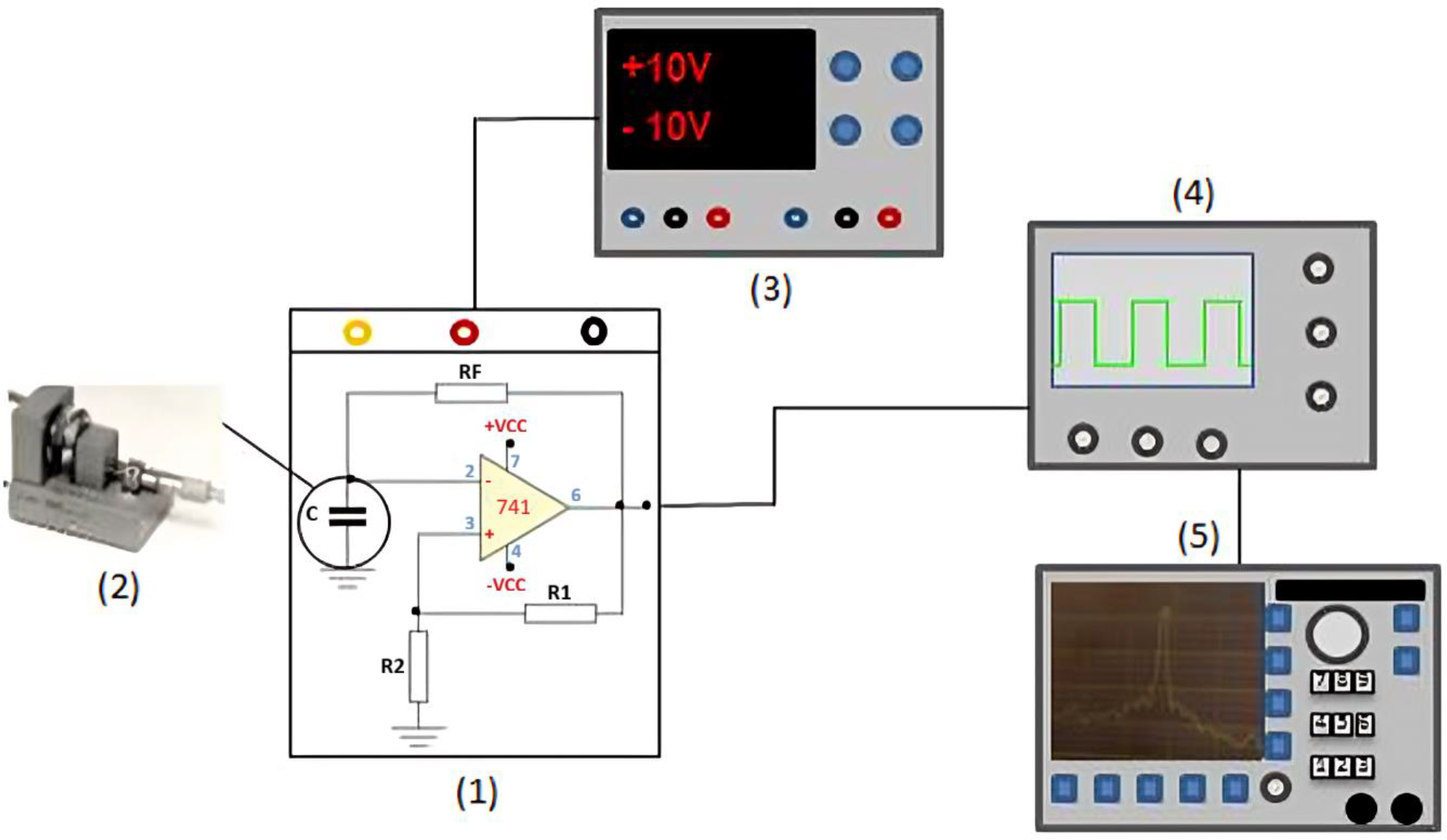
The instrumentation setup proposed and built for dielectric properties characterization of gelatin films is shown in Figure 1.
Instrumentation scheme of (1) electrical circuit board; (2) capacitive test module (capacitor); (3) DC voltage source; (4) oscilloscope; (5) dynamic signal analyser.
The mechanical module (2) (Figure 1) allowed placing a film sample between two metal plates forming a capacitor included in the circuit. This home-made module was based on Agilent`s model 16451B and basically consisted of a circular parallel plate capacitor with 36.1 mm diameter (circular area = 1.02x10⁻³ m2) with a variable clearance between the two plates to adapt to films of different thickness. It was placed in the astable oscillator circuit (1) (Figure 1). The astable oscillator was based on the switching between two semi stable states of a digital circuit. These two semi stable states can be changed from one to another, on command from an external device. In this study, the switching signal was the charging of the capacitor.
The period of the astable oscillator is determined primarily by the duration of charging and discharging of a parallel plate capacitor. The corresponding frequency was measured using a digital frequency meter.
Knowing the frequency and the values of resistors, the capacitance of the capacitive module containing the samples was calculated using the equation 3 [26].
where C is the capacitance of the sample (Farad); T is the circuit oscillation period (= 1/f; f, frequency), and R1 = R2 = 1 kΩ; Rf = 5, 10, 50 or 100 kΩ are resistors. Then, it was possible to determine real part of relative the permittivity (ɛ’) of the gelatin film with the equation 4, allowing to calculate ɛ'r (dielectric constant) (equation 5).
where δ is film thickness, S is the surface area of the capacitive module, and ɛ0 is the electrical permittivity of the vacuum (8.854 x 10⁻¹² F/m).
Method Validation
To validate the method, after the construction of the capacitive test module and the circuit, the instrumentation set-up was tested replacing the capacitive test module for commercial capacitors in order to check the value of their capacitances already known.
Film production
The films were obtained by wet process, known as casting technique, with the following compositions: 4 g of gelatin/100 g of film forming solution (FFS) and 25 g plasticizer/100 g gelatin, according to Reyes and coauthors [27]. This technique consists in the solubilization of the gelatin in distilled water followed by addition of the plasticizer (glycerol or sorbitol). This film forming solution (FFS) was spread on a plate and dried in a forced-air circulation oven (AM-037, Marconi, Brazil) at 30 °C for 24 h [28]. Before dielectric properties characterization, the films were conditioned in desiccators containing NaBr saturated solution or silica gel at 25 ºC, for 5 days. Films without plasticizer were produced for comparison purpose.
The thickness of films was measured at twelve different positions, with a digital micrometer (Mitutoyo, Japan) (± 0.001 mm). The average of the twelve readings was taken as film thickness (δ). And, the moisture content (wb) of the films was determined gravimetrically by drying in an oven at 105 °C for 24 h.
Dielectric properties characterization of films
The films, cut in 5 x 5 cm2 squares, were used as the dielectric in the capacitor probe. Only the real part of the complex permittivity, was calculated. The measurements were performed in a controlled environment, within an insulated box located in a conditioned room (T = 24±3 ºC and relative humidity= 55±5%).
To study the influence of frequency on the dielectric properties, variations were introduced in the circuit by changing the resistors. It was thus possible to vary the frequency from 5 to 50 kHz replacing the resistors in the circuit by different values (5, 10, 50 and 100 kΩ).
To investigate whether the plasticizer type influences the dielectric properties of the film, measurements were made for the gelatin films without plasticizers, with glycerol and with sorbitol. Moreover, to assess the effect of moisture content on the dielectric property of the films, samples equilibrated over silica gel and NaBr saturated solution were used.
The signal frequency meter was programmed to perform 50 measures of astable oscillator. For these fifty measures the mean value was calculated. This procedure was repeated in triplicate every 10 minutes.
RESULTS
Calibration
The experimental set-up was initially tested using an open circuit measurement, using only air as dielectric, whose permittivity is well known (ɛr’air =1.00) [29]; however, the result obtained from this measurement was relatively inaccurate (ɛr’air = 1.24). This result, apparently only tolerable, can however be justified because the geometry of the experimental set-up in open circuit was particularly prone to edge effects. Our capacitive module was built for circular films whose radial dimension did not exceed the area of the metal plates in order to minimize edge effects [30,31], yet when the dielectric material was air (open circuit), this condition was clearly not met, as the air significantly leaked from the edges of the metallic plates.
This result, therefore, although not very accurate, showed that the experimental set-up was able to measure with relative accuracy the order of magnitude of the relative permittivity of air. Nonetheless, as the objective was to guarantee as good precision as possible, it was necessary to carry out more calibration measurements using commercial capacitive devices for which the capacitance was previously well known.
Precision commercial electrolytic and ceramic capacitors (5% and 1%, respectively) were used for this calibration. A series of 10 measurements for 10 different devices of each capacitor type were performed, and this procedure was repeated in triplicate. The developed instrumentation was able to perform capacitance measurements with results quite consistent with the nominal values for these devices, resulting in a very adequate accuracy. The results of this calibration are shown in Table 1. The instrumentation set-up was calibrated using commercial capacitors electrolytic and ceramic with 5% and 1% precision, respectively. A series of 10 measurements to each type of capacitor were performed in triplicate (C1, C2, C3). The instrumentation developed was able to perform capacitance measurements with results very consistent with the nominal values of the commercial devices (Table 1).
Calibration of instrument set-up comparing nominal values with measurements in triplicate of commercial capacitors used as standard sources.
Dielectric properties characterization of films
The films thickness remained around of 0.183 mm. After conditioning over NaBr saturated solution, gelatin films without plasticizer, plasticized with glycerol or with sorbitol presented moisture content of 16.1 ± 0.2; 16.5 ± 0.2 and 14.4 ± 0.1%, respectively. After conditioning in silica gel, gelatin films without plasticizer, plasticized with glycerol or with sorbitol presented moisture content of 9.4 ± 0.6; 7.5 ± 0.6 and 6.7 ± 0.1%, respectively.
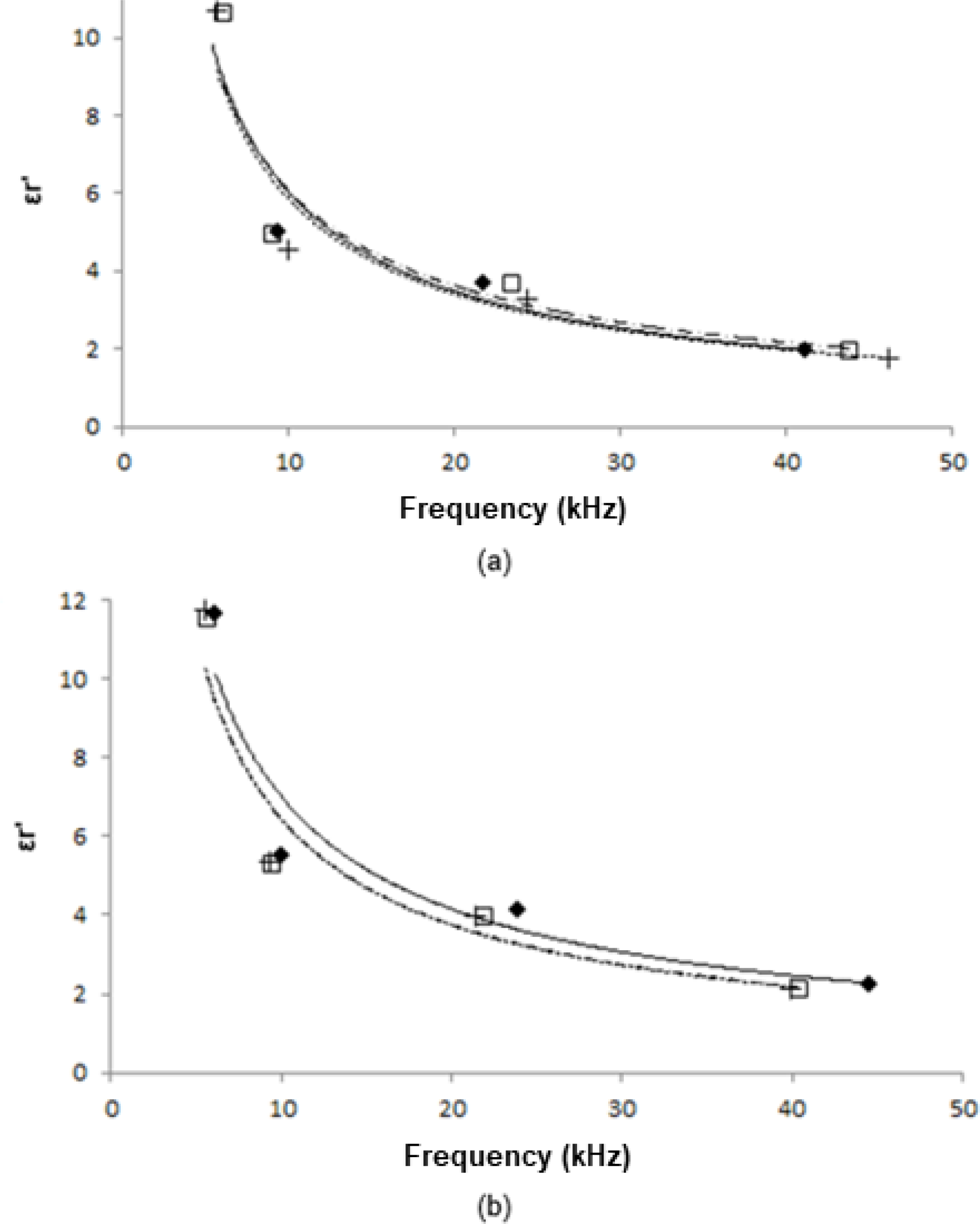
Once the proposed instrumentation did not perform a continuous frequency scan, the relative permittivity of the films was calculated from the circuit oscillation frequency response measured. The dielectric constant (ɛr’) was plotted versus resonant frequency (Figure 2).
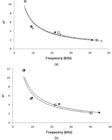
Dielectric constant (ɛr’) as a function of circuit oscillation frequency for gelatin films without plasticizer (·-·□·-·), with glycerol (···+···) or sorbitol (-♦-) conditioned under (a) NaBr saturated solution and (b) silica gel. Lines represents values calculated with equations presented in the Table 2.
Results of non-linear regression of the Power Low Model (equation 6) to experimental data of dielectric constant versus frequency.
The experimental data were fitted to a Power Law model (equation 6) allowing to study the influence of the frequency, moisture content and plasticizer type in the dielectric constant of the gelatin films.
Where f is frequency (Hz) and k and n are empirical constants whose values, calculated by no-linear regression are shown Table 2.
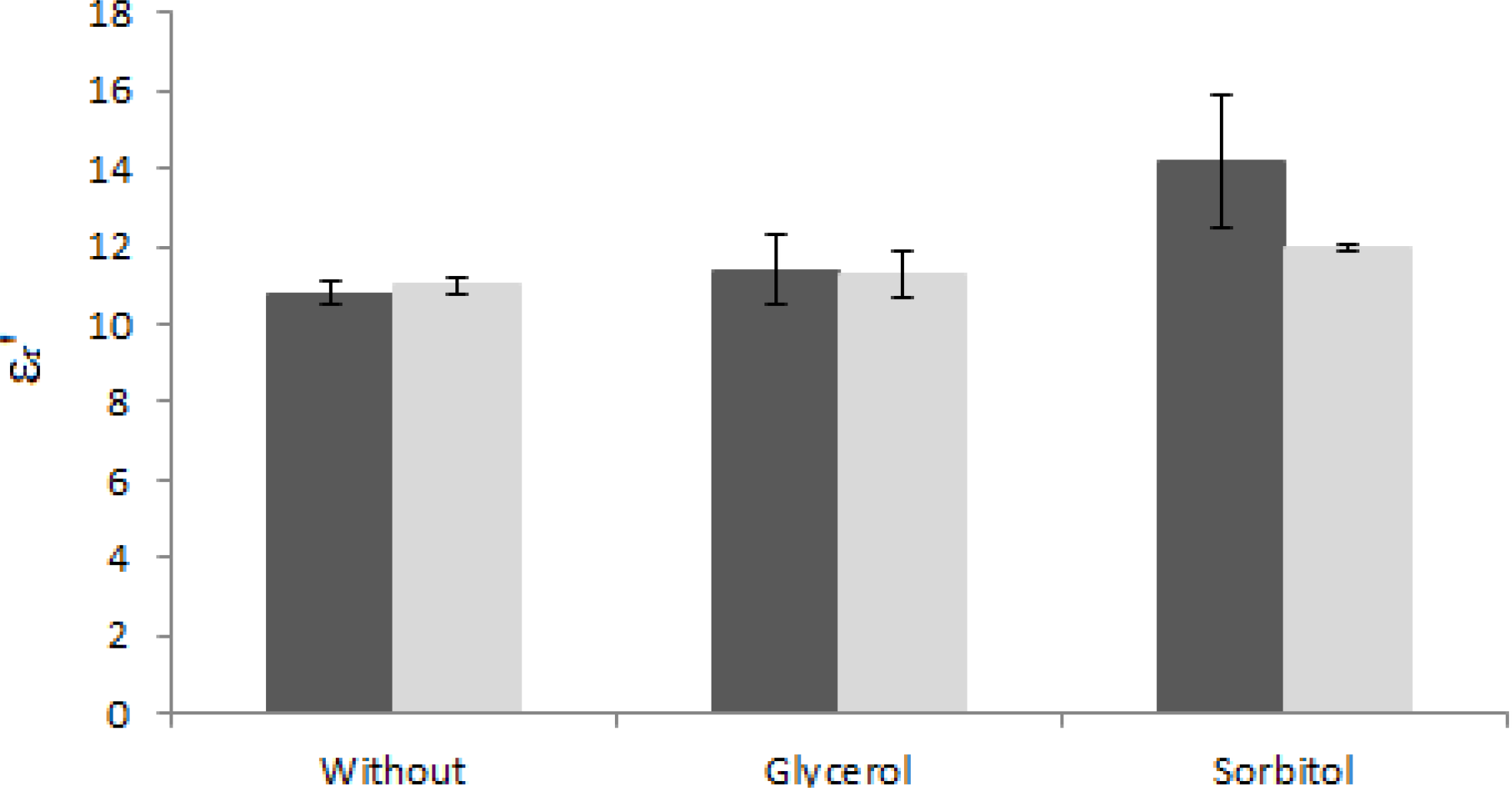
According to results presented in the Table 2, the effect of plasticizers was more important when films were conditioned under NaBr saturated solutions. To complement this evaluation, films ɛr’ was calculated at 5 kHz for both plasticizers (glycerol and sorbitol) and in two conditions of relative humidity or moisture content (Figure 3).
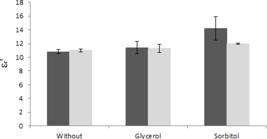
Dielectric constant (ɛr’) at 5 kHz of gelatin films with different plasticizers conditioned at two conditions of relative humidity (■) NaBr saturated solution and (■) silica gel.
DISCUSSION
All the films had a good overall appearance. Subjectively, films plasticized with glycerol were more flexible than those produced using sorbitol, which in turn were more flexible than those without plasticizer. ɛr’ decreased with increasing frequency for all the films (Figure 2). This well-known behavior was due to the dielectric relaxation [32], and has been observed by others authors [13]. The ɛr’ varied more significantly at lower frequencies probably due to the fact that in this domain the biopolymer molecules line up more easily with the applied external electric field [33]. These results are unexpected because the dielectric properties are dependent on the material composition, including the type of plasticizer, the way it is linked to the biopolymer and to the water molecules present in film matrix, which is a function of conditioning [34].
In analyzing these results presented in Figure 3 for films with the same plasticizer, it was possible to observe that no effect of conditioning on dielectric constant of gelatin films without plasticizer and with glycerol was observed, but for films plasticized with sorbitol, the dielectric constant was higher when films were conditioned over NaBr saturated solutions (Figure 3) due to higher moisture content of this film as compared with that for films conditioned over silica gel. The effect of moisture content on dielectric constant of biopolymer-based films was also observed for films based on cassava starch [35] and on blends of cassava starch and quitosan [13]. At this point in analyzing films conditioned over the same conditions, it was possible to observe that the glycerol did not significantly change the dielectric constant of gelatin film at a concentration of 25 g/100 g of biopolymer; however, there was significant variation in the dielectric constant of the films with addition of sorbitol at this same concentration. These results demonstrated that the films containing sorbitol presented greater dielectric constant in comparison to films containing glycerol for the studied frequency (5 kHz), which can be explained by the difference in the molecules of the plasticizer; sorbitol has a higher molecular weight, larger molecular structure, larger amount of hydroxyl groups (-OH) interacting less strongly with gelatin molecule and thus, having more mobility freedom under electrical excitation.
CONCLUSION
The proposed instrumentation allowed the determination of the effect of frequency, moisture content and the use of two plasticizers on the dielectric constant of gelatin films. The proposed and tested method may be a less expensive alternative to experimentally determine these dielectric properties at lower frequencies, when more expensive and sophisticated equipment, such as network analyzers and impedance, are not available.
The results confirmed the expected decrease in ɛr’ with increasing frequency and demonstrated that films plasticized with sorbitol exhibited higher ɛr’ values than those with glycerol, particularly under higher moisture conditions. The experimental setup showed satisfactory performance within the low-frequency range (5-50 kHz) and was able to detect relative variations in permittivity among samples, validating its use for comparative dielectric assessments.
It can also be considered, due to its low cost, as an interesting educational tool to demonstrate these dielectric properties of materials in general, and particularly of edible films that are currently gaining applications in the food industry. This is relevant to the development of films based on biopolymers for food packaging, which must have physical and functional properties that can be assessed through dielectric measurements, considering that these properties are linked to the macromolecular mobility of the biopolymer matrix.
-
Funding:
The authors gratefully acknowledge the Brazilian National Council for Scientific and Technological Development (CNPq) for the Research fellowship of P.J.A.S. (30.3746/2021-3) and of I.C.F.M (31.4109/2018-8).
Acknowledgments:
The authors gratefully acknowledge the Prof. Dr. Alberto Sereno from Porto University, in memoriam, for research support and contributions.
Data Availability Statement:
Research data are only available upon request for corresponding author.
REFERENCES
- 1 Alfaifi B, Wang S, Tang J, Rasco B, Sablani S, Jiao Y. Radio frequency disinfestation treatments for dried fruit: Dielectric properties. LWT Food Sci Technol. 2013 Mar;50(2):746-54.
- 2 Peng J, Tang J, Jiao Y, Bohnet SG, Barrett DM. Dielectric properties of tomatoes assisting in the development of microwave pasteurization and sterilization processes. LWT Food Sci Technol. 2013 Dec;54(2):367-76.
- 3 Jiao Y, Tang J, Wang S, Koral T. Influence of dielectric properties on the heating rate in free-running oscillator radio frequency systems. J Food Eng. 2014 Jan;120:197-203.
- 4 Ozturk S, Kong F, Trabelsi S, Singh RK. Dielectric properties of dried vegetable powders and their temperature profile during radio frequency heating. J Food Eng. 2016 Jan;169:91-100.
- 5 Ahmed J, Thomas L, Khashawi R. Influence of hot-air drying and freeze-drying on functional, rheological, structural and dielectric properties of green banana flour and dispersions. Food Hydrocoll. 2020 Feb;99:105331.
- 6 Tao Y, Yan B, Fan D, Zhang N, Ma S, Wang L, et al. Structural changes of starch subjected to microwave heating: A review from the perspective of dielectric properties. Trends Food Sci Technol. 2020 May;99:593-607.
- 7 Zhang H. Electrical properties of foods. Oxford (UK): Eolss Publ.; 2007 Dec. p.115-25.
- 8 Ryynänen S. [The electromagnetic properties of food materials: A review of the basics principles]. J Food Eng. 1995;26(4):409-29.
- 9 Sosa-Morales ME, Valerio-Junco L, López-Malo A, García HS. Dielectric properties of foods: Reported data in the 21st Century and their potential applications. LWT Food Sci Technol. 2010 Oct;43(8):1169-79.
- 10 Franco AP, Yamamoto LY, Tadini CC, Gut JAW. Dielectric properties of green coconut water relevant to microwave processing: Effect of temperature and field frequency. J Food Eng. 2015 Jun;155:69-78.
- 11 Wang Y, Wig TD, Tang J, Halberg LM. Dielectric properties of foods relevant to RF and microwave pasteurization and sterilization. J Food Eng. 2003 May;57(3):257-68.
- 12 Engelder DS, Buffler CR. Measuring dielectric properties of food products at microwave frequencies. Microwave World. 1991;12(2):6-15.
- 13 Iaccheri E, Siracusa V, Ragni L, Pinheiro ACAS, Romani S, Rocculi P, et al. Studying physical state of films based on casava starch and/or chitosan by dielectric and thermal properties and effects of pitanga leaf hydroethanolic extract. J Food Eng. 2023 Feb;339:111280.
- 14 Nelson SO. Agricultural Applications of Dielectric Measurements. IEEE Trans Dielect Electr Insul. 2006 Aug;13(4):688-702.
- 15 Içier F, Baysal T. Dielectrical properties of food materials - 2: Measurement techniques. Crit Rev Food Sci Nutr. 2004;44(6):473-8.
-
16 Keysight Technologies. Measuring dielectric properties using Keysight’s materials measurement solutions [Internet]. Brochure. Literature number 5991-2171EN. 2023 Fev 22 [cited 2025 Oct 29]. Available from: https://www.keysight.com/us/en/assets/7018-03896/brochures/5991-2171.pdf
» https://www.keysight.com/us/en/assets/7018-03896/brochures/5991-2171.pdf - 17 Taboada OM, Carvalho RA, Sobral PJA. [Dynamic mechanical analysis: applications in edible films]. Quim Nova. 2008;31(2):384-93.
- 18 Badii F, Macnaughtan W, Mitchell JR, Farhat IA. The effect of drying temperature on physical properties of thin gelatin films. Dry Technol. 2014 Jan;32(1):30-8.
- 19 Fakhoury FM, Martelli SM, Bertan LC, Yamashita F, Mei LHI, Queiroz FPC. Edible films made from blends of manioc starch and gelatin - Influence of different types of plasticizer and different levels of macromolecules on their properties. LWT Food Sci Technol. 2012 Nov;49(1):149-54.
- 20 Sobral PJA, Menegalli FC, Hubinger MD, Roques MA. Mechanical, water vapor barrier and thermal properties of gelatin based edible films. Food Hydrocoll. 2001 Jul;15(4-6):423-32.
- 21 Thomazine M, Carvalho RA, Sobral PJA. Physical properties of gelatin films plasticized by blends of glycerol and sorbitol. J. Food Sci. 2005 May;70(3): E172-6.
- 22 Bertan DW, Silva LD, Ribeiro L, Benoso P, Lourenço RV, Bittante AMQB, et al. Impact of hydroethanolic extracts from guaco leaves (Mikania glomerata Sprengel) on mechanical properties and bioactivities of gelatin-based bioactive films. Food Bioprod Process. 2025 May;151:355-71.
- 23 Hess A, Liu J, Pott PP. Analysis of dielectric properties of gelatin-based tissue phantoms. Curr. Dir. Biomed. Eng. 2022 Sep; 8(2):340-3.
- 24 Alam RB, Ahmada HM, Islam MR. Effect of MWCNT nanofiller on the dielectric performance of bio-inspired gelatin based nanocomposites. RSC Adv. 2022 May;12(23):14686-97.
- 25 Silva FT, Sorli B, Calado V, Guillaume C, Gontard N. Feasibility of a gelatin temperature sensor based on electrical capacitance. Sensors. 2016 Dec;16(12):2197.
- 26 Tooley M. Electronic Circuits: Fundamentals and applications. 4th ed. Oxford (UK): Routledge Elsevier; 2007.
- 27 Reyes LM, Landgraf M, Sobral PJA. Gelatin-based films activated with red propolis ethanolic extract and essential oils. Food Packag Shelf Life. 2021 Mar;27:100607.
- 28 Moraes ICF, Silva GGD, Carvalho RA, Habitante AMQB, Bergo PVA, Sobral PJA. [Influence of the degree of hydrolysis of poly(vinyl alcohol) on the physical properties of films based on blends of gelatin and poly(vinyl alcohol) plasticized with glycerol]. Cienc Tecnol Aliment. 2008 Sep;28(3):738-45.
- 29 Callister WD. Materials Science and Engineering: An Introduction. 7th ed. New York (US): John Wiley & Sons Inc.; 2007.
- 30 Xavier Júnior AL. [Computational modeling in electrostatics: fringe field effect in finite cylindrical capacitors]. Rev Bras Ensino Fis. 2007 Sep; 29(2).
- 31 Yariv E. Edge corrections for parallel-plate capacitors. Eur J Appl Math. 2021 Apr;32(2):226-41.
- 32 Maxwell JCA. Treatise on Electricity and Magnetism. London(UK): Clarendon Press; 1873.
- 33 Beh CY, Cheng EM, Nasir NFM, Majid MSA, Khor SF. Jamir MRM, et al. Dielectric properties of hydrothermally modified potato, corn, and rice starch. Agriculture. 2022 May;12(6):783.
- 34 Yakimets I, Wellner N, Smith AC, Wilson RH, Farhat I, Mitchell J. Mechanical properties with respect to water content of gelatin films in glassy state. Polymer. 2005 Dec;46(26):12577-85.
- 35 Bergo P, Moraes ICF, Sobral PJA. Effects of moisture content on structural and dielectric properties of cassava starch films. Starch Starke. 2012 May;64(10):835-9.
-
Editor-in-Chief:
Alexandre Rasi Aoki
-
Associate Editor:
Alexandre Rasi Aoki