 Azadirachtin A and B: A New Biological Tool to a Sustainable Management of Diatraea saccharalis (Lepidoptera: Crambidae)
Abstract
Biopesticides have shown high potential in controlling insect pests, including Diatraea saccharalis Fabr. (Lepidoptera: Crambidae). From that perspective, this study evaluated lethal concentrations of the product Fitoneem®, which has Azadirachtin A and B, and its impact on the mortality pattern of D. saccharalis. Fitoneem® was diluted in distilled water at concentrations of 5000 ppm, 10000 ppm, 20000 ppm, 30000 ppm, and 50000 ppm. The larvae were exposed to the product through the following exposure routes: (1) topical spray, applying the product directly to the larvae's prothorax; (2) ingestion, exposing the larvae through inoculation of the product in the artificial diet; and (3) spraying the entire body of the insect, using a manual spray bottle. After exposure, mortality was assessed at 24 intervals for six consecutive days. According to the concentrations studied of Fitoneem®, larvae exposed via spraying all over the body showed LC50 of 18500 ppm and LC90 of 55100 ppm; via topical application, the LC50 was 15700 ppm and LC90 of 17400 ppm, and via ingestion, LC50 of 22500 ppm and LC90 of 70400 ppm. The median lethal time ranged from 96 to 144 hours. Therefore, Fitoneem® in low concentrations promotes high mortality levels in D. saccharalis. Hence, our results show the potential of using Azadirachtin A and B to manage this crucial pest in sugarcane and information that can contribute to understanding its action mode in the insect.
Keywords:
Bioinsecticide; Toxicity; Sugarcane borer.
HIGHLIGHTS
Diatraea saccharalis is considered the main pest of sugarcane in Brazil.
Biopesticides based on Azadirachtin A and B has potential to a sustainable pest management.
Fitoneem® promotes high levels of mortality in D. saccharalis.
INTRODUCTION
The sugarcane borer, Diatraea saccharalis (Fabricius) (Lepidoptera: Crambidae), is considered the primary pest of sugarcane in Brazil [1]. The crop suffers from attacks by this pest throughout its cycle, which results in high productivity losses [2]. After the attack, the injuries caused by D. saccharalis are irreversible since the pest opens galleries in the sugarcane stalk, causing various losses such as weight loss, death of the buds, failure to germinate, drying out of tips on new plants, and in some cases the entire plant is damaged [3]. Indirect damage can also be seen, such as the entry of the fungi Colletotrichum falcatum and Fusarium moniliformes, which cause red stem rot [4].
With the growing demand for more sustainable control measures, biological tools equivalent to market demand have been sought. The search for insecticides of botanical origin is constantly growing, as these, in addition to their low production value, have no residual effects and have economic and ecological importance for the sustainable management of various pests, having repellent, toxic, or modifying insect behavior [5]. Botanical insecticides have rapid action and degradation, have low toxicity to humans, and are beneficial to insects [6]. These bioproducts can be administered "in natura" or be components of industrialized products, which opens a range of possibilities for the farmer [6].
In Brazil, some plant species are commonly used to produce botanical insecticides, such as Neem (Azadirachta indica), of Asian origin; Aloe vera, native to North Africa and the Middle East; and tobacco, originating from the Bolivian Andes. Although these species are exotic, they have developed well in Brazilian territory, especially in tropical regions [7]. Plants of A. indica is a tree that can reach 12 meters in height. Its use in agriculture is quite recurrent, given its insecticidal and repellent properties. It is estimated that more than 400 species of insects can be affected by Neem. In addition to its insect-repellent power, it is also effective in controlling tiny snails and nematodes [8]. Since the 1970s, the phytochemical potential of A. indica has been studied as it presents a vast diversity of compounds that directly interfere with critical biological variables of insects (wing growth, regulatory hormones, reproduction, and metamorphosis) and can affect different species of orders different species, including Lepidoptera [9].
Azadirachtin is a tetranotriterpenoid (limonoid), the main toxic substance in plants with expressive and sustainable potential [10]. The product Fitoneem® has been shown to cause high mortality levels in several insect species, and its active ingredient can promote high inhibition of larval development and growth of pupae, low body formation, changes in development and reproduction in adulthood in insects of the Order Lepidoptera [11, 12]. Therefore, it mainly affects larvae and has shown low toxicity to natural enemies [13]. According to high insecticide potential and selectivity activity on non-target species, this study aimed to evaluate lethal concentrations of the Fitoneem® product, which has Azadirachtin A and B, and its insecticidal potential for controlling D. saccharalis using different exposure methods in laboratory conditions. Additionally, the mortality pattern of the larvae was verified by exposing lethal concentrations as a function of time. The present study tested the alternative hypothesis that low volumes of Fitoneem® promote high levels of D. saccharalis mortality.
MATERIAL AND METHODS
The study was conducted at the Entomology Laboratory of the Department of Plant Science and Environmental Sciences from the Center for Agricultural Sciences at the Federal University of Paraíba -CCA/UFPB, Areia-PB. Third-instar larvae of D. saccharalis provided by the Paraíba Sugarcane Growers Association (ASPLAN) were used. We characterized the third-instar larvae by their head capsule widths. Concerning the rearing of D. saccharalis, individuals were kept individually in glass tubes (8.5 cm x 2.5 cm) containing an artificial diet.
Larvae were fed an artificial diet based on casein and wheat germ and subsequently sealed with wads of hydrophilic cotton. After inoculation, the containers were maintained in a room with controlled conditions at 26 ± 1°C, 65 ± 10% RH, and a 12-hour photophase. To conduct the bioassays, the treatments consisted of the application of Fitoneem®, which contains Azadirachtin A (2%) and Azadirachtin B (1%); it was diluted in distilled water at concentrations of 5000 ppm, 10000 ppm, 20000 ppm, 30000 ppm, and 50000 ppm, as a control, distilled water was used.
The routes of exposure of D. saccharalis larvae to treatments occurred in three ways, as follows: (1) Topical Spray (TS), for which five caterpillars were distributed in Petri dishes containing an artificial diet and with the assistance of an Automated Pipette, applied 0,5μL in each treatment directly on the prothorax of the larvae; (2) Ingestion (I), with two caterpillars being distributed in falcon tubes (50 mL capacity), which received 10g of an artificial diet with the inoculated product for 10 seconds; and (3) Spray in the Entire Body (SEB), with the entire body of the caterpillars sprayed through very fine droplets with approximately 136 μm with the treatments and subsequently distributed in Falcon tubes (50mL capacity) containing four units of the insect in each tube along with the artificial diet. After exposure of the larvae, mortality was assessed at 24, 48, 72, 96, 128, and 152 hours.
A Completely Randomized Experimental Design in a factorial arrangement 6 × 3 (6 doses and 3 routes of exposure) was adopted with six treatments and four replications, each consisting of 40 insects. We used a dose-response model from binomial generalized linear model (GLM) to estimate LC50 and LC90. In addition, functions were programmed using the “survmniner” [14] and “survival” [15] packages in R [16] to compare survival curves and estimate the acute toxicity of lethal doses (LC50 and LC90) at concentrations when applied in the different exposure routes evaluated in this work and their respective Confidence Intervals with 95% probability (95% CI). We consider two LC values significantly different when only their 95% fiducial limits do not overlap.
RESULTS
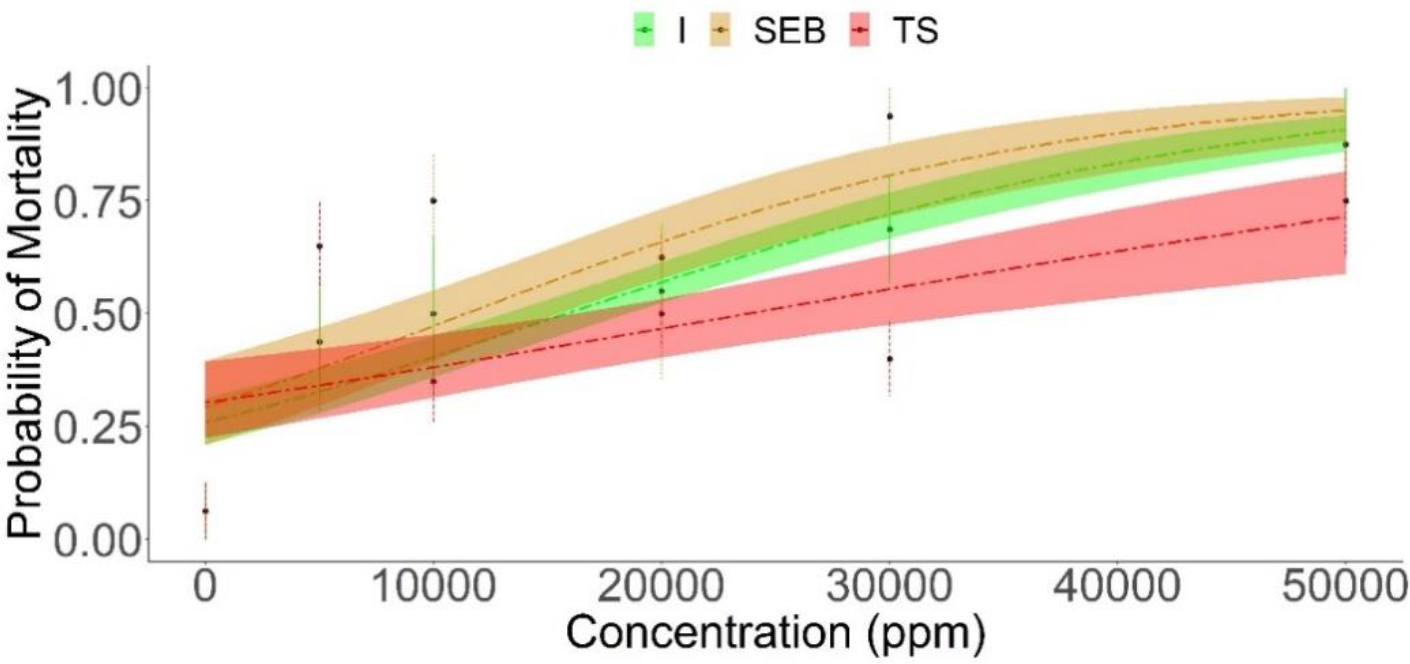
The results obtained in the present study reveal a quadratic mortality pattern of D. sacharalis larvae as a function of the adopted concentrations of the Fitoneem® product (Figure 1).
Dose response of Fitoneem action on Diatraea saccharalis larvae from a dose-response model in a binomial generalized linear model. I= Ingestion. SEB= Spray in the Entire Body. TS= Topic Spray.
According to the concentrations of Fitoneem® studied, acute toxicity for 3rd instar larvae of D. saccharalis was proven for all exposure routes studied. When the larvae were exposed via spray in the entire body, LC50 of 18500 ppm (IC95%= 13500 - 23500 ppm) and LC90 of 55100 ppm (IC95%= 38700 - 126000 ppm) were observed; via Topic Spray the LC50 was 15700 ppm (IC95%= 12600 - 32900 ppm), and LC90 was 17400 ppm (IC95%= 55400 - 192400 ppm), and via ingestion LC50 was 22500 ppm (95%CI= 17000 - 29100 ppm) and LC90 of 70400 ppm (95%CI= 47,500 - 182000 ppm) (Table 1).
Lethal Concentration (LC) (50% and 90%) in Diatraea saccharalis larvae according to the application of Fitoneem® in different ways of exposure.
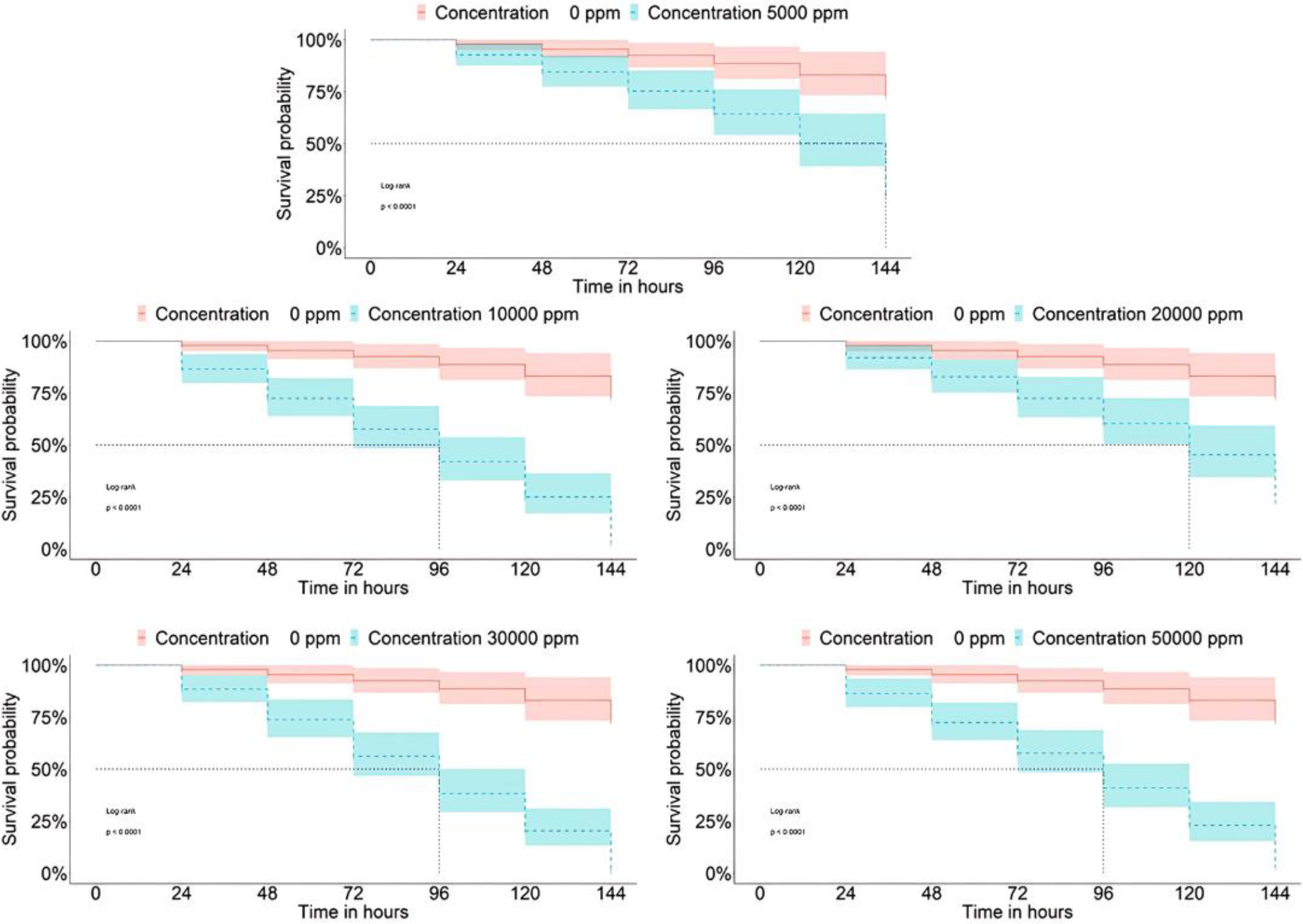
The mortality pattern of larvae was investigated only by spraying the entire body, given the effectiveness of this exposure way. Therefore, the time required for 50% of the individuals in the D. saccharalis population to die, that is, the median lethal time, varied in spray application from 96 to 144 hours, being 96 hours for concentrations of 10000 ppm (95%CI= 72 - 120 hours); 20000 ppm (95%CI= 72 - 144 hours); 30000 ppm (95%CI= 72 - 120 hours) and 50000 ppm (95%CI= 72 - 120 hours), while at the 5000 ppm concentration, the median lethal time was estimated at 144 hours (95%CI= 120 - 144 hours). Given these results, it is possible to observe that the concentration did not interfere with the median lethal time (Table 2; Figure 2).
Median lethal time (hours) of Diatraea saccharalis as a function of Fitoneem® spray concentration
Survival pattern as a function of spraying concentrations of Fitoneem® in the entire body of Diatraea saccharalis.
DISCUSSION
The results obtained in the present study show evidence that Azadirachtin A and Azadirachtin B present in Fitoneem® have exceptional insecticidal activity on 3rd instar larvae of D. saccharalis. The effectiveness of Azadirachtin on arthropods is mainly due to the cytotoxicity of this compound [17]. This action was proven when Azadirachtin was used in low concentrations and promoted abnormalities and inhibition of cell multiplication of Spodoptera frugiperda (Smith, 1797) (Lepidoptera: Noctuidae) after 48 hours of treatment [18]. The growth regulatory effects caused by Azadirachtin in Lepidoptera, affect the functioning of the endocrine glands that control metamorphosis in insects, inhibiting the development of the main hormones involved in regulating insect growth, the hormones of ecdysis and juvenile hormone. As a result, imperfect ecdysis can occur, causing deformities of various natures and impairing the insect's feeding and locomotion. It should be noted that insects that survive the action of neem tend to present anomalies, interfering with population growth [19].
Given the observed values of median lethal time, it is possible to note that the mode of action of Fitoneem® on D. sacharalis was not predominantly due to a shock effect (knockdown) but instead reaffirming other effects, as at least four days are needed to promote lethality of this product to 50% of the population. Therefore, the hypothesis is that Azadirachtin is an insecticide that acts as a food deterrent and disrupts insect growth [20]. Results found for other species, such as S. frugiperda, also revealed that the seed oil mixture in the diet caused interruption and reduced feeding, delayed ecdysis, and death of larvae. However, the mode of action of Neem-based extracts may vary from species to target species. It may affect the development period, delaying their growth and causing a decrease in the fertility and fecundity of insects in the adult phase. The effects can promote behavioral changes and result in various cellular and physiological anomalies in insects [21].
Considering that toxicity depends on the form of exposure time, in addition to the concentration applied and acts mainly on the larvae's mesenterus, causing degeneration of the epithelium and reduction of regenerative cells, it is essential to know how products based on Neem oil, in our case Fitoneem®, should be recommended when the larvae are in the initial phase of development and do not yet cause economic damage and which decreases markedly when the products are applied to control larvae with more advanced instars [22].
Given the current context and the difficulties encountered in managing D. sacharalis in corn and sugarcane in Brazil, due to the evolution of resistance to both insecticides and Bt plants, the use of new bioactive, such as Fitoneem®, can contribute as another tool in IPM and also be favorable to agro-environmental sustainability, as it can reduce the use of insecticides in the total area, decrease the number of active principles applied and reduce the number of applications per crop cycle [23]. Additionally, it is estimated that it would be difficult for insect populations to develop critical frequency levels of resistance alleles to all active ingredients in neem oil because they are diverse in terms of action mode.
The application time and the method of using biological products are essential when aiming for efficiency. An example is aerial spraying using agricultural planes or drones, which is cheaper and widely disseminated worldwide. Agriculture is one of the fastest-growing areas using technologies aimed at the efficiency of applications [24]. Spraying has gained greater emphasis with Agriculture 4.0/5.0, bringing several advances, such as spraying using Unmanned Aerial Vehicles (UAV) that provide low volumes of spray for the application of agricultural products [25]. In this study, we reaffirm the possibility of using Fitoneem® to control D. saccharalis, since low volumes of spray and bioinsecticide concentrations of 18500 and 55100 ppm are needed to cause mortality in 50 and 90% of insects, respectively, with these concentrations in line with new agricultural technologies, such as the use of remotely pilotable aircraft (RPA) due to the low volume of spray required for this spraying [26] and the need of agricultural alternatives to control this insect pest.
Despite the proof that Azadirachtin is an insecticide with a low residual effect and physiological selectivity towards natural enemies and pollinators [10], further studies should be conducted with D. sacharalis as the leading natural enemy. In addition to evaluating physiological selectivity, testing the compatibility hypothesis with other management techniques, such as entomopathogenic fungi, is pertinent. In addition, the artificial (laboratory) setting in which the current study was conducted may not reflect the exact field results. Thus, it is necessary to validate this bioproduct’s spray using different application technology.
CONCLUSION
Fitoneem® in low concentrations is effective in controlling D. saccharalis, making Azadirachtin oil a potential bioinsecticide for the management of this critical pest in sugarcane. All exposure routes of this biopesticide effectively promote mortality in D. saccharalis. At least four days are needed for this product to be lethal to 50% of the population.
-
Funding:
JBM is supported by a grant from the Brazilian National Council for Scientific and Technological Development (CNPq) (Process number: 420064/2023-0).
Acknowledgments:
To the Federal University of Paraíba (UFPB/CCA) and the Postgraduate Program in Agronomy (PPGAgro) for access to bibliographic and technological resources fundamental to the advancement of this research and to the Coordination for the Improvement of Higher Education Personnel of the Ministry of Education (CAPES) for granting scholarships to the authors.
REFERENCES
- 1 Silva MRD, Cortes AM, Svensson GP, Löfstedt C, Lima ER, Zarbin PH. Identification of two additional behaviorally active gland constituents of female Diatraea saccharalis (Fabricius) (Lepidoptera: Crambidae). J Braz Chem Soc. 2021;32:225-30.
- 2 Jiang-jiang X, Jun-Xian Y, Qing-Wen L, Chun-Giang Y, Qiao-Fei P. Survey of Sugarcane Pests in Xianggui Sugarcane Area and Countermeasures of Pest Control. Plant Dis Pests. 2020;11:1-13.
- 3 Puentes-Cala E, Atehortúa-Bueno M, Tapia-Perdomo V, Navarro-Escalanta L, Hernández-Torres J, Castillo-Villamizar G. First insights into the gut microbiome of Diatraea saccharalis: From a sugarcane pest to a reservoir of new bacteria with biotechnological potential. Front Ecol Evol. 2023;11:1027527.
- 4 Santos EF, Santos M, Henkes JA. {Case Study: Trichogramma galloi in the Management of Diatraea saccharalis in the Cultivation of Saccharum Officinarum in Ulianópolis-PA}. R Gest Sust Ambiental. 2020;9:617-34.
- 5 Usharani KV, Dhananjay N, Manjunatha RL. Neem as an organic plant protectant in agriculture. J Pharmacogn Phytochem. 2019;8:4176-84.
- 6 Lengai GM, Muthomi JW, Mbega ER. Phytochemical activity and role of botanical pesticides in pest management for sustainable agricultural crop production. Sci Afr. 2020;7:e00239.
- 7 Bakheit EH, Taha AK, Mahmoud ME. Bio-rationale management of tomato leaf miner, Tuta absoluta (Meyrick, 1917)(Lepidoptera: Gelechiidae) using extracts of Neem (Azadirachta indica A. Juss) Jimsonweed (Datura stramonium L) and Periwinkle (Vinca rosea L.). Athens J Sci. 2022;9(3):193-204.
- 8 Fontenele MJS, Lima A, Paiva MG, Santos KP. {Neem tree (Azadirachta indica A. Juss): Positive Aspects, A Brazilian Panorama}. Anais do XI Congresso Brasileiro de Agroecologia, São Cristóvão, Sergipe, Brasil, (04 November 2020).
- 9 Lima RR, Silva FP. {Nim (Azadirachta indica): An Approach on Its Use as a Natural Insecticide}. Rev Cient Acert. 2022;2:e21099.
- 10 Kilani-Morakchi S, Morakchi-Goudjil H, Sifi K. Azadirachtin-based insecticide: Overview, risk assessments, and future directions. Front Agron. 2021; 3; 676208.
- 11 Carvalho Neto MF, Lima ACS, Gervásio RDCRG, Melo Filho AA, Cruz Araújo EC, Rocha ACR, et al. Bioactivity of aqueous extracts of annonaceous from the amazon savannah of Roraima on the cowpea aphid. Contrib Cienc Soc. 2023;16(12):32146-60.
- 12 Martins LN, Geisler FCDS, Amandio DTT, Rakes M, Pasini RA, Ribeiro LDP, et al. Association of growth-regulating insecticides and limonoid-based formulations: physicochemical compatibility and toxicity against Spodoptera frugiperda (Lepidoptera: Noctuidae). J Econ Entomol. 2023;116(3):927-34.
- 13 Cardoso TDN, Stupp P, Rakes M, Martins MB, da Silva Filho JG, Grützmacher AD, et al. Lethal and sublethal toxicity of pesticides used in fruit growing on the parasitoid Diachasmimorpha longicaudata (Hymenoptera: Braconidae): implications for integrated fruit fly management. J Econ Entomol, 2021;114(6):2412-20.
-
14 Package `survminer´: Drawing survival curves using 'ggplot2'. R package version 0.4.9. 2022. Available online: https://cran.r-project.org/web/packages/survminer/survminer.pdf (Accessed on 23 January 2024).
» https://cran.r-project.org/web/packages/survminer/survminer.pdf -
15 A package for survival analysis in R package version 3.2-13. 2023. Available online: https://CRAN.R-project.org/package=survival (Accessed on 23 January 2024).
» https://CRAN.R-project.org/package=survival -
16 R Core Team. R: A language and environment for statistical computing. R Foundation for Statistical Computing, Vienna, Austria. 2021. Available online: URL: https://www.R-project.org/ (Accessed on 23 January 2024).
» https://www.R-project.org/ - 17 Oulhaci CM, Denis B, Kilani-Morakchi S, Sandoz JC, Kaiser L, Joly D, Aribi N. Azadirachtin effects on mating success, gametic abnormalities and progeny survival in Drosophila melanogaster (Diptera). Pest Manag. Sci. 2018;74:174-80.
- 18 Reed E, Majumdar SK. Differential cytotoxic effects of azadirachtin on Spodoptera frugiperda and mouse cultured cells. Entomol exp Appl. 1998;89:215-21.
- 19 Marcílio T, Daquila BV, Conte H. {Plant Extracts in the Alternative Management of Diatraea saccharalis (Lepidoptera: Crambidae)}. Em Meio ambiente e seus desafios: Estudos Contemporâneos, 1ª ed.; Rendin, E.; Poisson, Brasil, 2020; 2: 46-57.
- 20 Spazzin MP, Cemin MFR, Bellon PP. Insecticidal potential of agroecological sprays in the control of cabbage curuquerê, Ascia monuste orseis (Lepidoptera: Pieridae). Res. Soc. Dev. 2023;12(4): e1812440815.
- 21 Corassa JN, Machiner M, Valladao DM, Andrighetti CR, Weberling JB. Effect of ethanolic extracts of plants on Spodoptera frugiperda (Lepdoptera: Noctuidae). Res Soc Dev. 2022; 11: e30511223395.
- 22 Vidal MC, Amaral DFS, Nogueira JD, Mazzaro MAT, Lira VMC. {Bioinputs: the construction of a national program for the sustainability of brazilian agriculture}. Econ Anal Law Rev. 2021; 12:557-74.
- 23 Xiao J, Chen L, Pan F, Deng Y, Ding C, Liao M, et al. Application method affects pesticide efficiency and effectiveness in wheat fields. Pest Manag. Sci. 2020;76:1256-64.
- 24 Carvalho FK, Chechetto RG, Mota AA, Antuniassi UR. Challenges of aircraft and drone spray applications. Outlooks Pest Manag. 2020;31:83-8.
- 25 He X. Rapid development of unmanned aerial vehicles (UAV) for plant protection and application technology in China. Outlooks Pest Manag. 2018;29:162-7.
- 26 Wang G, Lan Y, Yuan H, Qi H, Chen P, Ouyang F, et al. Comparison of spray deposition, control efficacy on wheat aphids and working efficiency in the wheat field of the unmanned aerial vehicle with boom sprayer and two conventional knapsack sprayers. Appl Sci. 2019;9:218.
-
Editor-in-Chief: Bill Jorge Costa
-
Associate Editor: Adriel Ferreira da Fonseca