Holten et al. (2004) [16]
Denmark |
Analyze whether strength training increases insulin-mediated glucose uptake, GLUT4 content, and insulin signaling in skeletal muscle in patients with type 2 diabetes. |
Diabetes
MEDLINE/PubMed
IF = 7.7 |
Clinical Trial |
n = 17 adults
GC = 7 with normal glucose tolerance
GI = 10 with type 2 diabetes |
Supervised RT 3x/week, sessions of up to 30 min, over 6 weeks. Weeks 1-2: 3x10 repetitions (50% 1-RM). Weeks 3-6: 4x8-12 repetitions (70-80% 1-RM). Last 2 weeks: exhaustive sets (8-12 repetitions). Rest: >90 s between sets, >2 min between stations |
The biopsies were performed 16 hours after the participants completed their last RT session. |
Chris-Roberts et al. (2004) [17]
USA |
Valuate the relative contributions of improvements in insulin receptor signaling, GLUT4 protein expression, and GS activity to training-induced increases in insulin sensitivity. |
Metabolism
MEDLINE/PubMed
IF = 9.8 |
Parallel Clinical Trial |
n = 22 people
GC = 16 nondiabetic
GI = 6 with type 2 diabetes |
Supervised AE 3x/week, starting at 60% VO2peak for 20 min per session, over 8 weeks of intervention. Progressive increase over 8 weeks to 70% VO2peak, 45 min, 4x/week. Heart rate used as an intensity indicator. |
Muscle biopsies were performed before and after 8 weeks of AE. |
Wojtaszewski et al. (2005) [18]
Denmark |
Investigate the effect of strength training and type 2 diabetes on the expression of isoforms and the heterotrimeric composition of AMPK in human skeletal muscle. |
The Journal of Physiology
MEDLINE/PubMed
IF = 5.5 |
Parallel Clinical Trial |
n = 17 adults
GC = 7 with normal glucose tolerance (sex unspecified)
GI = 10 with type 2 diabetes |
Supervised RT, 3x/week, sessions up to 30 min, for 6 weeks. Weeks 1-2: 3x10 repetitions (50% 1 RM). Weeks 3-6: 4x8-12 repetitions (70-80% 1 RM). Last 2 weeks: exhaustive sets. Rest: ~90 s between sets, ~2 min between exercises. 3 RM test at the beginning and end of the training. |
The biopsy time points were: 16 to 18 hours after the last training session, with 30 minutes of supine rest before performing biopsies of the vastus lateralis muscle of the trained (T) and untrained (UT) legs. |
O’Gorman et al. (2006) [19]
Ireland |
Assess the impact of acute short-term exercise training on whole-body insulin-mediated glucose disposal and signaling transduction along the canonical insulin signaling cascade. |
Diabetologia
MEDLINE/PubMed
IF = 8.2 |
Parallel Clinical Trial |
n = 15
GC = 7 obese nondiabetic
GI = 8 obese with type 2 diabetes (sex unspecified) |
Supervised AE for 1 week at ∼75% VO2peak for 1 hour on a stationary cycle ergometer. The intensity was determined based on heart rate (±5 beats per minute) corresponding to 75% VO2peak, measured by indirect calorimetry. Blood pressure and heart rate were monitored before, during, and after exercise. |
The vastus lateralis muscle biopsies were performed at baseline and 16 hours after an acute exercise session and short-term physical training (7 days). |
Wang, Simar e Whang (2009) [20]
Australia |
Review the morphological and metabolic adaptations of skeletal muscle to exercise training in adults with type 2 diabetes or impaired glucose tolerance. |
Diabetes/MetabolismResearch and Reviews
MEDLINE/PubMed
IF= 8.0 |
Systematic Review |
n = 18 RCTs and non-randomized |
RT a 50-80% 1RM, 2-3 sets of 8-10 repetitions. AE of Low intensity (1 study), moderate (6), high (6); 30-60 min/session (mean 48 ± 9 min). Combined exercise: AE (80-90% VO₂max) + RT (50%). Variation in the total duration of interventions: 4-52 weeks. Majority with supervision. |
The sample timing was: interval between the last exercise session and biopsy: 16-96 h (median: 60 h; interquartile range: 80 h). |
Sriwijitkamol et al. (2007) [21]
UK |
Determine whether individuals with type 2 diabetes and moderate to severe obesity (BMI > 30 kg/m2) exhibit impaired AMPK signaling. |
Diabetes
PubMed
IF = 7.7 |
Clinical Trial |
n = 28 people
GC = 8 obese nondiabetic and 8 lean nondiabetic
GI = 12 obese with type 2 diabetes |
Two acute protocols (50% and 70% VO₂max), 40 minutes of AE (cycling. A 4-6 week interval between sessions. |
The vastus lateralis muscle biopsies were performed at four time points: before exercise (fasted and at basal rest), after 10 minutes, after 40 minutes of exercise, and 150 minutes post-exercise (during recovery). |
Vind et al.
(2011) [22]
Denmark |
Investigate whether type 2 diabetes is associated with abnormalities in insulin-induced site-specific phosphorylation of TBC1D4 in skeletal muscle; examine the effect of resistance exercise training on TBC1D4 and other key insulin signaling events in well-controlled obese individuals with and without type 2 diabetes. |
Diabetologia
MEDLINE/PubMed
IF = 8.2 |
Clinical Trial |
n = 26 obese men
with type 2 diabetes
GC = 13 obese men with normal glucose tolerance
GI = 13 obese men with type 2 diabetes |
AE on a stationary bike at ~65% VO₂max, with 4-5 sessions/week (20-35 min), for 10 weeks. |
Skeletal muscle biopsies were obtained from the vastus lateralis muscle before and after insulin, 1-2 weeks prior to the training protocol, and 48 hours after the last exercise session. |
Hussey et al. (2012) [23]
Australia |
Determine the effect of a single bout of exercise on GLUT4 gene expression in muscles of patients with type 2 diabetes and control subjects, accounting for age and body mass index. |
Diabetes, Obesity and Metabolism
MEDLINE/PubMed
IF = 5.8 |
Clinical Trial |
n = 18 adults
GI = 9 people with type 2 diabetes
GC = 9 people with normal glucose tolerance |
A 60-minute session of AE (cycle ergometer) at ∼55% peak power output (WMax). |
Skeletal muscle biopsies were obtained at the beginning of the study, immediately after exercise, and 3 hours post-exercise. |
García-Hermoso et al. (2023) [24]
Spain |
Investigate the effects of exercise training on exerkines in patients with type 2 diabetes to determine the ideal exercise prescription. |
Journal of Sport and Health Science
MEDLINE/PubMed
IF = 11.7 |
Systematic Review of RCTs
|
n = 40 RCTs with 2,160 people in total
1,281 people with diabetes in GI
879 people with diabetes in GC |
RT, CE, and AE protocols: Weekly frequency ranged from 2 to 5 sessions; session volume varied between 15 and 75 minutes across trials. Total intervention duration ranged from 8 to 96 weeks. Intensity for AE varied between 40-95% of HRmax, 40-85% of VO2peak, and 50-80% of maximal oxygen consumption. RT intensity ranged from 40-80% of 1RM and 3.6 to 6 METs. |
The timing of the sample collection was not specified. |

 25 Molecules Expressed in the AMPK Pathway After Exercise in Type 2 Diabetes: Evidence Map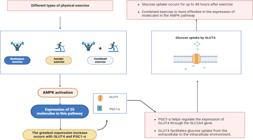
 Thumbnail