 Evaluation of a Pilot-Scale Vertical Flat-Panel Photobioreactor for Indoor Mass Cultivation of Microalgae
Abstract
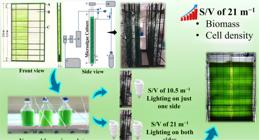
The study assessed flat-panel photobioreactors (FP-PBRs) for superintensive microalgae cultivation. FP-PBRs were constructed with a metallic skeletal structure and galvanized metal grids for support. FP-PBRs were made with plastic bags with dimensions of 2.30 m × 0.75 m × 0.1 m and a useful volume of 150 L. The operation included a filtered aeration system, CO2 injection, and automated pH and temperature control. To start the FP-PBR operation, an aeration rate of 0.067 vvm and an overall mass transfer coefficient KLa(O2) of 54.29 h-1 were used. An irradiance of 400 µmol photons m-2 s-1 suitable for Nannochloropsis oculata cultivation was applied. Two surface-to-volume ratios (S/V) were used: 10.5 m-1 with one-sided illumination and 21 m-1 with illumination on both sides. At the end of 264 h (11 days), the FP-PBR system made with alternative materials proved to be efficient. The highest biomass of N. oculata biomass was achieved with a S/V ratio of 21.0 m-1 (1.91 ± 0.15 g L-1 day-1), compared to 1.13 ± 0.08 g L-1 day-1 in the S/V 10.5 m-1 treatment. By using a FP-PBR that cost around US$ 544.00, it was feasible to attain high productivity in cultures where the algal cells received increased light exposure, while still ensuring control and safety.
Keywords:
Aquaculture; Mass transfer; Optical path; Nannochloropsis oculata; Biomass production.
HIGHLIGHTS
To FP-PBR operation, an aeration rate of 0.067 vvm (10 L min-1) was efficient.
Higher Nannochloropsis oculata biomass (1.91 ± 0.15 g L-1) was obtained using S/V 21.0 m-1.
The FP-PBR system made with alternative materials proved to be efficient.
INTRODUCTION
Microalgae are photosynthetic organisms responsible for primary production in aquatic environments; therefore, they are the basis of several trophic chains, providing diverse phyconutrients, including polyunsaturated fatty acids (PUFAs), to the next trophic levels [1,2]. In the natural environment or in laboratory cultures, the growth of microalgae is dependent on light, pH, salinity, temperature, quantity and quality of nutrients [3].
In aquaculture, microalgae are used to feed many cultivated species (marine shrimp, molluscs, some fish species, etc.), especially in the larviculture (hatchery) phase [1,4]. To satisfy this demand, thousands of litres of microalgae cultures, such as Chaetoceros spp., Isochrysis galbana, Chlorella ssp., Phaeodactylum tricornutum, Tetraselmis spp. and Nannochloropsis oculata, need to be developed from commercial hatcheries [2]. N. oculata is one of the most important cultivated species for the aquaculture trophic chain because it is rich in polyunsaturated fatty acids (n-3 PUFAs) and vitamin B12 [5,6] and has high concentrations of eicosapentaenoic acid and carotenoids [6,7]. The problem is that most laboratories use traditional microalgae cultivation systems, which generally have very low productivity, high vulnerability to contamination, and frequent problems associated with fluctuations in the volume produced daily [8].
Recent research has focused on cultivation methods that enhance light and nutrient delivery, as well as photobioreactor design, which may improve production if applied on an industrial scale [9-12]. Typically, commercial bioreactors utilized for microalgae cultivation exhibit considerable variation, encompassing fiberglass tanks, open-air cement tanks, raceway ponds, tubular and flat-panel bioreactors [2] or thin-layer cascade systems [13].
Furthermore, the cultivation of microalgae for increased biomass production is sought after not only for their use as live feed in aquaculture but also due to their significant biotechnological potential [13]. This potential includes reducing greenhouse gases (GHGs) by biofixing CO2 from industrial combustion [14], treating NH4+, NO3-, and PO-rich domestic and industrial effluents [15], producing biofuels [16] and organic fertilizers [17], as well as extracting valuable bioactive compounds such as polyunsaturated fatty acids, natural pigments, and carbohydrates [18,19].
However, to increase biomass production by taking advantage of the maximum growth potential of microalgae, it is necessary to use efficient photobioreactors (PBR) [8,20], which follow design criteria (surface-to-volume ratio - S/V, orientation and inclination, mixing and high mass transfer - KLa, temperature control, etc.) compatible with the PBR category (tubular and flat, horizontal, inclined, vertical and spiral) [8]. For instance, Ahangar and coauthors [9] developed a mirror photobioreactor with internal illumination to enhance microalgae production by ensuring uniform light distribution, resulting in a significant 60% increase in the growth rate of Chlorella sorokiniana. Similarly, Yaqoubnejad and coauthors [10] demonstrated that an air-lifted hexagonal flat plate photobioreactor not only enhanced C. sorokiniana growth but also improved CO2 biofixation.
PBR are designed to overcome some limitations (evaporation, self-shading, contamination, environmental instability, low S/V ratio, etc.) observed in open systems and enhance productivity, as they are usually constructed with a high S/V ratio, which maximizes the exposure of cells to light, allowing greater control of cultivation conditions and reducing the risk of contamination, even by other microalgae, and ensuring the cultivation of specific strains [21,22]. Over the years, the evolution of PBRs has occurred mainly on a laboratory scale, and to make these systems commercially viable, i.e., to produce microalgae on a large scale, it is necessary to overcome some obstacles, such as the high cost of implementation, as well as the scalability of the systems [8].
Although the limitations of microalgae growth are well-understood [23], numerous studies have investigated and evaluated optical paths in flat-panel photobioreactors (FP-PBRs) [24-27]. However, large-scale cultivation is challenging because the physiology of algae requires thorough knowledge [22, 28].
FP-PBRs with high illuminated surface areas and reduced optical paths have been developed and can be used to obtain the best exposure of microalgal cells to light radiation (reducing the self-shadowing effect) [29]; i.e., a short optical path allows microalgae react to light exposure more frequently, which provides the most efficient use of light and, consequently, an increase in the cell density or biomass of cultures [30]. In FP-PBRs, culture mixing can be promoted by pumping the culture medium or agitation by aeration [31]. This system is characterized by easier maintenance, suitability for cultivation in external areas, and greater control of microalgae cultures [19,31]. However, some limitations, such as difficult temperature control, biofouling and hydrodynamic stress due to agitation in the cultivation of some species, have been reported for FP-PBR [19].
The study aimed to assess the effect of different lighting schedules on the performance of low-cost Flat-Plate Photobioreactors (FP-PBRs) in the super-intensive cultivation of N. oculata microalgae on a pilot scale. This research is crucial for enhancing microalgae production systems to achieve high biomass productivity and reduce contamination risks.
MATERIAL AND METHODS
Study location and design of the flat-panel photobioreactor - FP-PBR
The study was conducted at the Laboratory of Algae Cultivation - LCA, Aquaculture Department, Federal University of Santa Catarina - UFSC.
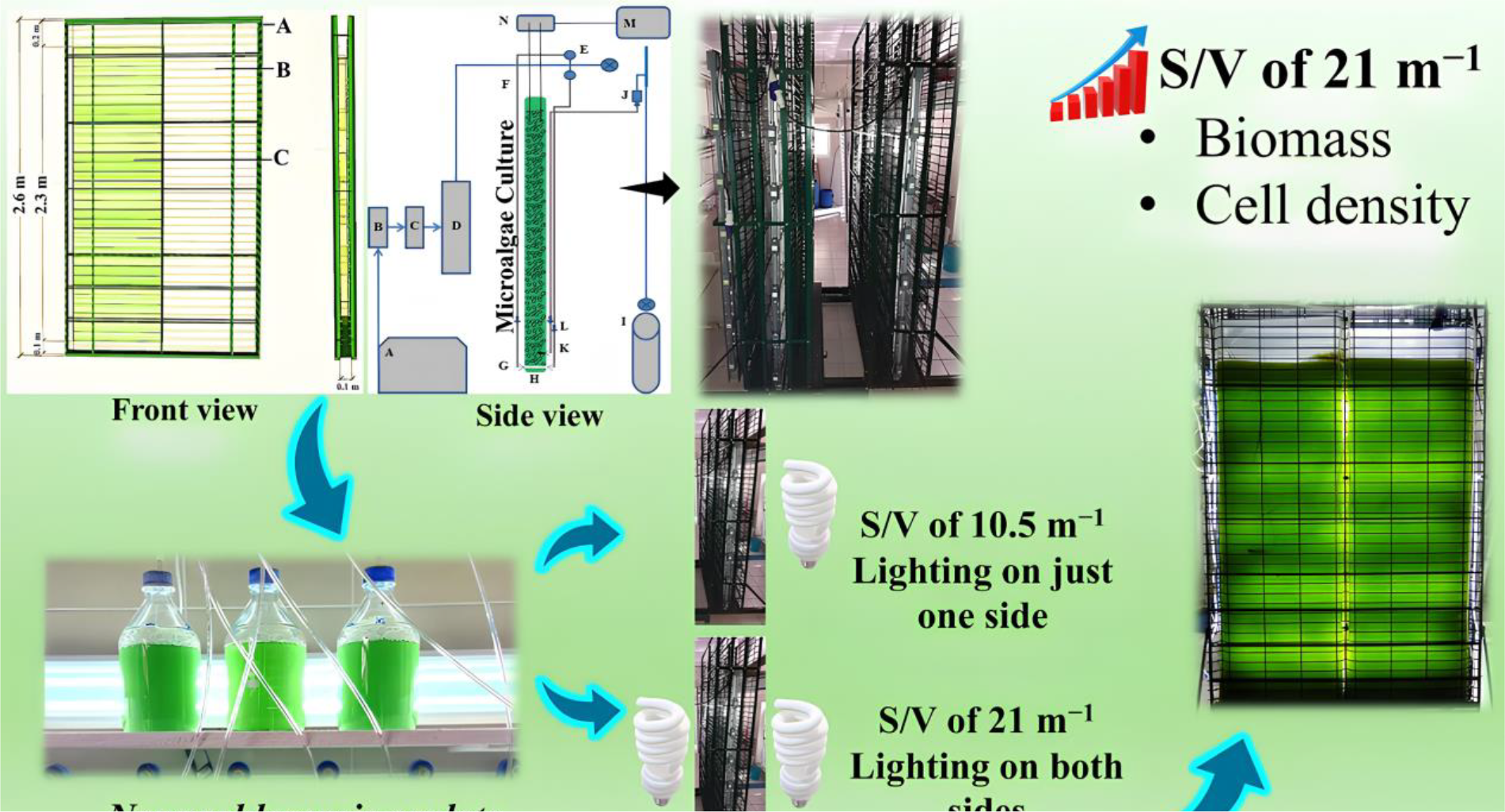
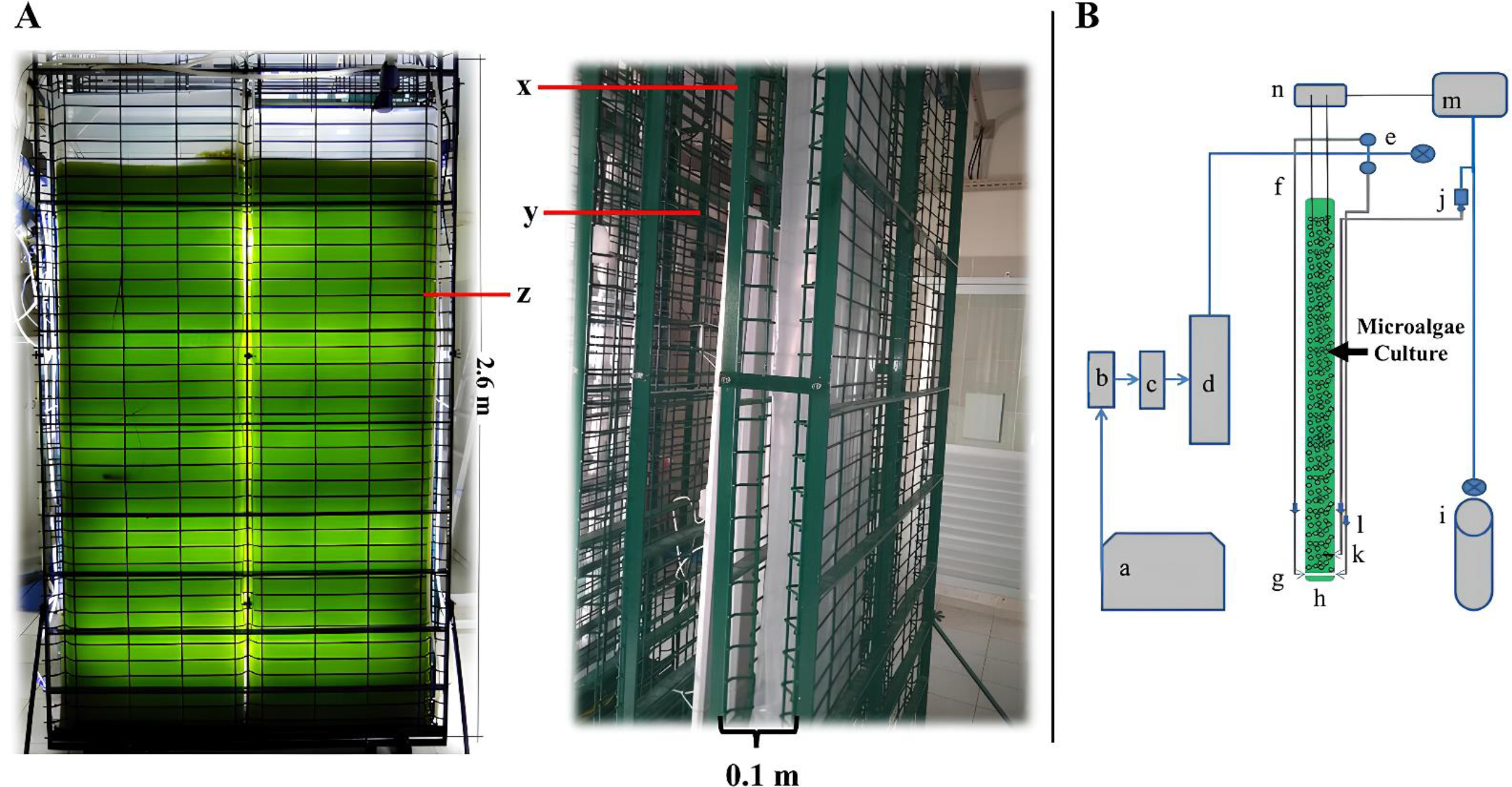
For the design of the FP-FBR set, a metallic structure consisting of four galvanized iron frames was built. Then, galvanized metal grid panels (Belgo Durafor®) to support the plastic bags (Crudo Plast® São Paulo, Brazil) for microalgae cultivation were attached. Each structure measured 2.60 m high × 1.50 m wide, with a thickness of 0.10 m. In this space (0.10 m between the metal grid panels), translucent plastic bags (sterile and factory sealed at both ends) with dimensions of 2.30 m × 0.75 m × 0.40 mm and a useful volume of 150 L were inserted. Four plastic bags were installed in each structure, thus totaling eight FP-FBRs with a total production volume of 1,200 L of microalgae cultures. The estimated total cost of the FP-PBR was around US$544.00 (Figure 1).
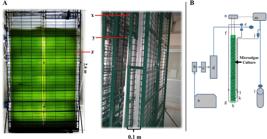
In (A) Structural design of the experimental flat-panel photobioreactor (FP-PBR) used for Nannochloropsis oculata cultivation, where (x) is the metallic skeletal structure, (y) is the galvanized metal grid, and (z) is the plastic bag containing the cultured microalgae. (B) Side view of the FP-PBR, where a = air compressor; b and c = air filters; d = humidity remover; e = pressure regulator; f = 6 mm compressed air hose; g = quick coupling; h = perforated Teflon tube; i = CO2 cylinder; j = solenoid valve; k = porous hose for CO2 injection; l = fluid retention valve (nonreturn); m = APEX command center; and n = Apex temperature monitoring and pH control module.
FP-PBR monitoring and cultivation conditions
pH, temperature, and aeration
To control the pH and monitor the temperature, an automated system-APEX AQUACONTROLLER-from Neptune System® was used. This system allowed real-time monitoring of temperature and pH, ensuring greater precision, control and safety in the FP-PBR. The collected data were stored in a cloud-based system (APEX Fusion by Neptune System®) (cloud computing at www.apexfusion.com). The monitoring system contained an APEX central connected by a USB cable to modules in series (one for each FP-PBR), where the pH and temperature sensors were connected.
For the development of N. oculata cultures, the APEX command system was programmed to maintain the pH between 8.2 and 8.6 by injecting CO2 (which is an acidic gas). Once the minimum (8.2) and maximum (8.6) pH variation limits were programmed, the probe inside the cultures transmitted the information in real time to the central unit, which in turn indicated the need, or not, to inject CO2 into the cultures. The solenoid valve released CO2 until the pH reached the programmed minimum limit.
The system for distributing compressed air was independent of the on-demand supply of CO2, which in turn was monitored and controlled by the automated system. In this way, each FP-FBR became independent, resulting in greater biosecurity for the system.
To aerate the set of eight FP-PBRs, an oil-free air compressor (model BPIS 10/100 with a maximum operating pressure of 100 lbf/in2 6.9 bar - PEG Compressors®) with the capacity to produce up to 150 L min-1 was installed, aiming to promote efficient mixing of the culture medium with a low risk of contamination. The equipment was provided with a buffer tank with a capacity of 100 L to avoid work overload. The compressed air passed through a sequence of coalescing filters (pre-filter 1.0 µm and post-filter 0.01 µm) and then through a humidity separator, which guaranteed the purity of the air injected into the cultures through a microperforated Teflon tube. This aeration system featured 25 mm high-pressure air tubes and pressure regulators and was maintained at approximately 0.2 bar at the air inlet in each FP-PBR.
Culture illumination
According to Pereira [32], the microalga N. oculata had a greater photosynthetic rate when the cultures were illuminated with 400 µmol m-2 s-1; thus, this irradiance was applied to the experimental cultures in the present study. FP-PBRs were illuminated with compact fluorescent lamps (Daylight Taschibra® color temperature (K) 6400K) installed in aluminium panels 2.00 m high × 1.40 m wide and covered by 3.0 mm colourless polycarbonate plates to prevent contact with water (splashes). Each panel was structured with 60 lamps (25 and 59 W, interspersed) distributed horizontally in six lines (10 lamps per line), which were activated by specific switches, enabling 50% or 100% of the lamps from each power in each set. Each side (face) of the FP-PBR had an area corresponding to 1.57 m2 (2.1 m × 0.75 m); thus, when the FP-PBR was illuminated from both sides, the area of the illuminated surface was 3.15 m2. The light extinction coefficient was verified in cultures that were illuminated only from one side, i.e., at an S/V ratio of 10.5 m-1. A culture of N. oculata in FP-PBR was randomly diluted, and three biomass concentrations were used (0.51, 0.34 and 0.21 g L-1). An underwater irradiance measurement sensor (PAR Neptune System®) was installed inside the cultures at five positions (distances) relative to the initial light source (0, 1.5, 4.0, 5.0, 7.5, and 9.0 cm).
Overall Mass Transfer Coefficient KLa
To determine KLa(O2), one of the FP-PBRs was filled with 150 L of seawater (salinity 30 ‰). The initial concentration of dissolved oxygen (DO) in the water was measured with the aid of a multiparameter probe (YSI® Pro Plus), and then through a microperforated Teflon tube, nitrogen gas was injected into the water until the oxygen concentration dropped below 5% (v/v) saturation. At this saturation point, aeration was started (with atmospheric air under pressure), considering three different aeration rates of 8, 10 and 15 L min-1 (0.053, 0.067 and 0.1 vvm, respectively), until the oxygen concentration was restored to initial saturation. To estimate KLa values, the following equation was applied:
where:
dC/dt = transfer velocity of O2 (mg O2 L-1 h).
C* = saturation concentration of O2 in the liquid, in equilibrium with Pg, according to Henry's law (mg O2 L-1).
C = O2 concentration in the liquid (mg O2 L-1).
Pg = partial pressure of O2 in the gas bubble (atm).
Operation of the FP-PBR during N. oculata cultivation
The water used in the cultures was pumped from Barra da Lagoa beach Florianopolis, Brazil (27°34′02′′S, 48°25′44′′W) to a central reservoir in the LCA, and initially had a salinity of 34 ‰, pH 8.7 ± 0.4 and alkalinity above 150 mg CaCO3 L-1. Then, the water was treated in two systems. First, the water was filtered through 5.0 µm disc filters (Helix systems AZUD®) in recirculation for 2 h and then through 1.0 µm bag filters (PALL®). Subsequently, the water underwent treatment with ultraviolet radiation (UV-C 75 W) and new filtration (1.0 and 0.5 µm cartridge filters) in a recirculating system, which promoted successive exposures to ultraviolet radiation and filtration.
For the development of initial cultures, a strain of the marine microalga N. oculata obtained from the strain bank of the Laboratory of Algae Cultivation - LCA at the Federal University of Santa Catarina - UFSC/Brazil was used.
To evaluate the effect of the ratio of illuminated surface area per culture volume (S/V), two treatments were applied in triplicate: lighting provided only on one side of the FP-PFB, which generated an S/V ratio of 10.5 m-1, and lighting on both sides of the FP-PBR, which generated an S/V ratio of 21.0 m-1.
A culture of N. oculata (mother culture or bulk starter) was developed and used to inoculate the experimental units. Based on the cell density observed in the mother culture, an inoculum of equal volume was added to each of the FP-PBR, which were filled with treated seawater, making a total volume of 150 L in each unit, with an initial biomass concentration of 0.22 g L-1 and salinity of 30 ‰. An irradiance of 400 µmol photons m-2 s-1 was applied under full photoperiod (24:0) and aeration rate of 0.067 vvm (10 L min-1, according to KLa calculated in section 2.3).
Daily (9 am), a 50 mL sample of each experimental culture was carefully obtained in the centre of the FP-PBR, where agitation allowed homogenization of the culture, ensuring a significant sample to monitor turbidity (NTU), cell density (cells mL-1). Nitrate concentration (µM) was determined from 10 mL samples of the filtered medium, following the colorimetric method (HACH®) with the PERMCHEM NitraVer Reagent through absorbance readings at 410 nm using a UV-Vis spectrophotometer (Thermo) and biomass concentration (dry weight, g L-1) via gravimetry [33] using glass fibre microfilters-GF-1 (0.45 µm porosity). As these were fed-batch cultures, nutrients from LCA-SW culture medium [34] made with natural seawater (Table 1), were added daily in proportion to nitrate consumption. The amount of re-addition of culture medium (%) to supply nitrate was based on the reference value (100% = 0.510 g L-1) of sodium nitrate from the LCA-SW medium and its respective observed daily consumption.
Composition of LCA-SW medium (based on Conway medium) used in initial cultures of Nannochloropsis oculata microalgae.
Statistical analysis
The data were subjected to one-way ANOVA, and when a significant difference was detected, the Tukey test was applied to compare the means. The analyses were performed at a significance level of 5% (p < 0.05) using the GraphPad Prism 7 program.
RESULTS
Temperature monitoring and pH control system
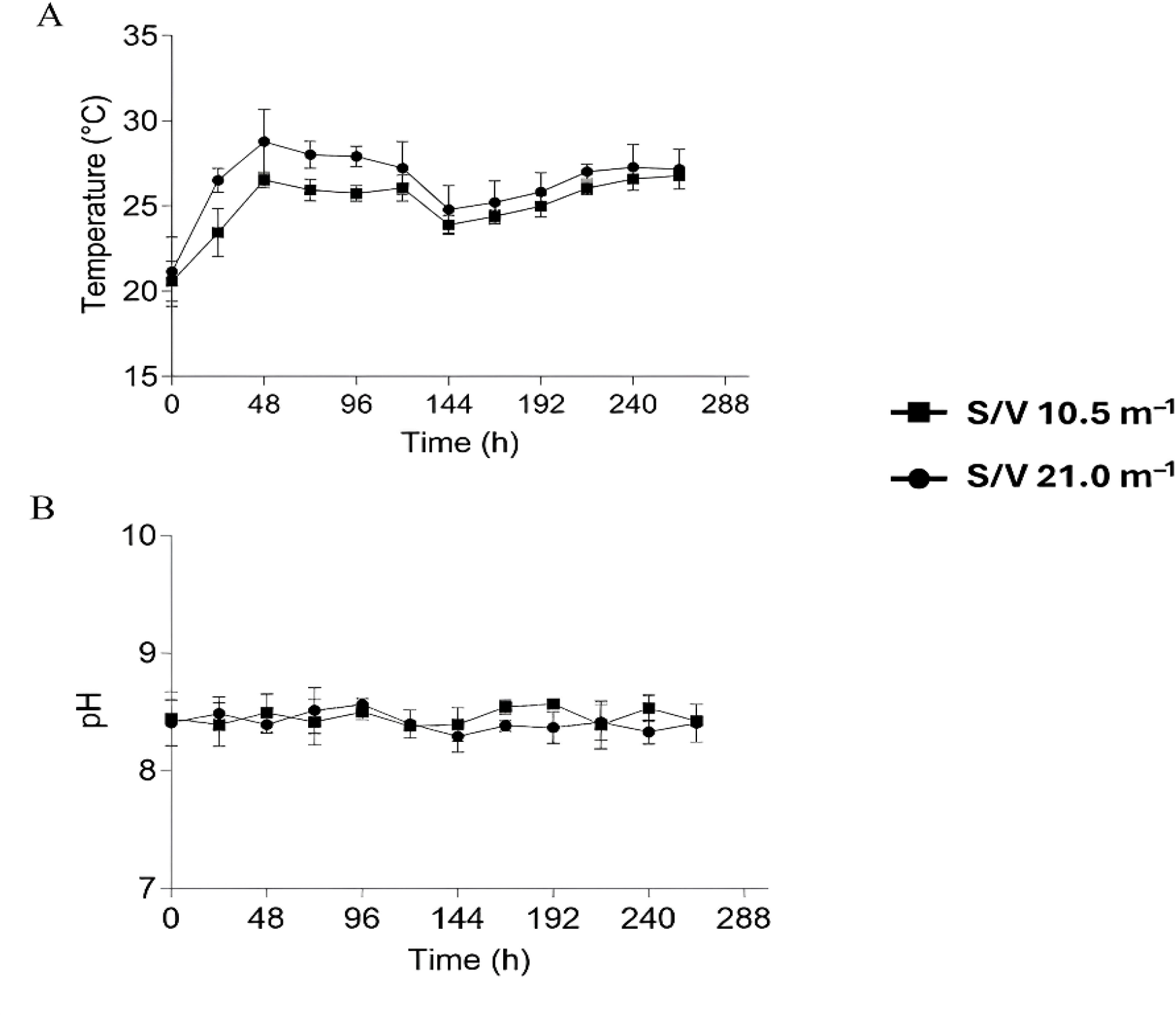
The temperature data obtained with automated monitoring demonstrated that there was an increase in the first 48 h, probably due to heat radiation from light panels. Although compact fluorescent lamps (CFLs) were used, these lamps still generated heat that caused the temperature to increase. When the temperature of the experimental room was stabilized, with the help of an air conditioner, the temperature of the cultures did not show large thermal amplitudes, with minimums between 20.6 and 21.1°C and maximums between 26.8 and 28.8°C. for treatments with S/V ratios of 10.5 and 21.0 m-1, respectively (Figure 2A). No significant differences (p > 0.05) in pH were detected between treatments. The values remained within the preestablished range and maintained minimum values of 8.3 and 8.4 and maximum values of 8.6 and 8.5 for treatments S/V 10.5 and 21.0 m-1, respectively (Figure 2B).
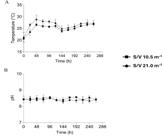
Temperature (A) and pH (B) variation using different illuminated surface/volume ratios (S/V 10.5 m-1 and 21.0 m-1) in the experimental flat-panel photobioreactor (FP-PBR) used for N. oculata cultivation.
Overall Mass Transfer Coefficient (KLa)
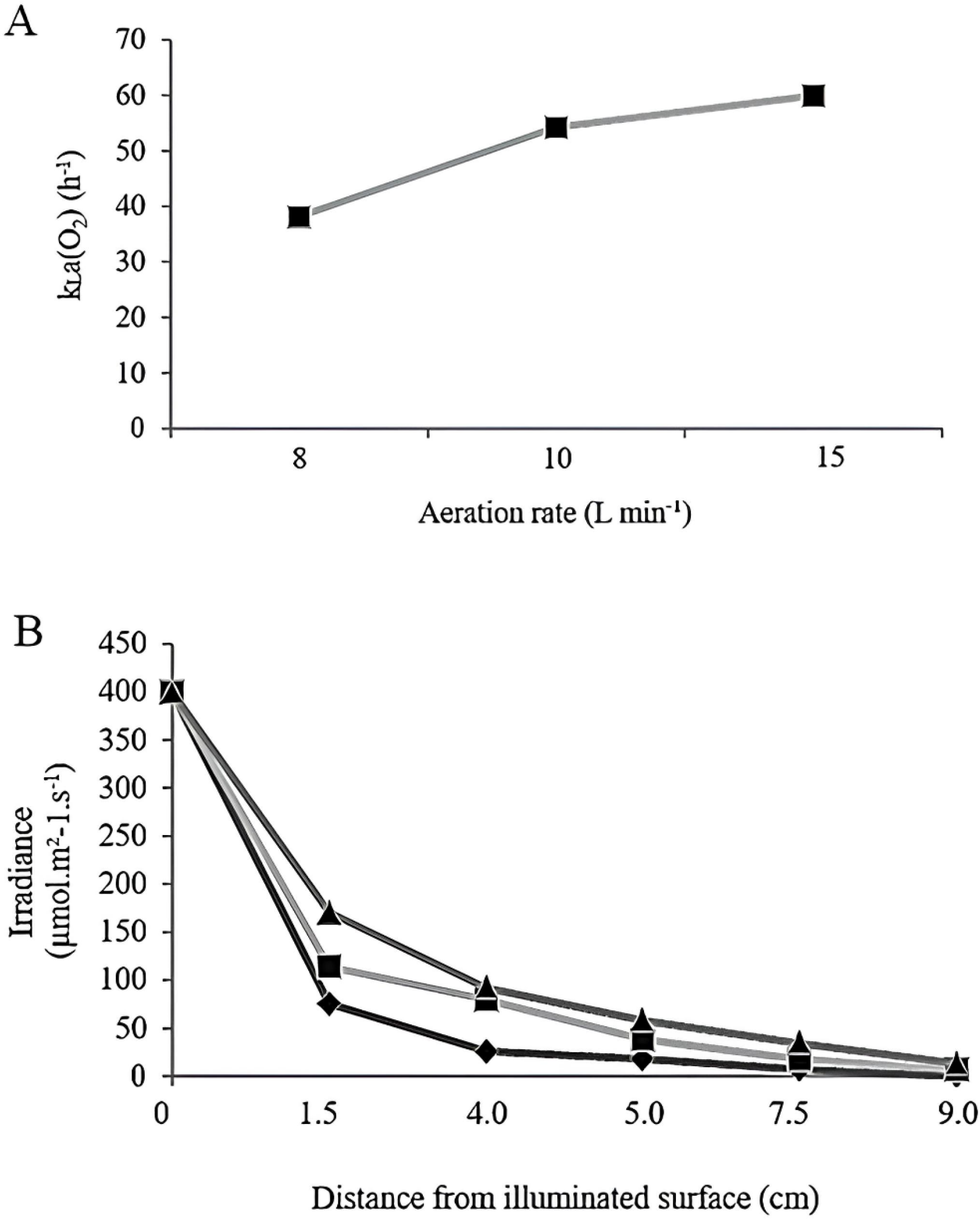
In the present study, KLa(O2) by applying different aeration rates of 8, 10 and 15 L min-1 (0.053, 0.067 and 0.100 vvm, respectively) was determined. The KLa(O2) values increased as the aeration rate increased (Figure 3A). Using an aeration rate of 8 L min-1 generated a KLa(O2) corresponding to 38.19 h-1, while using aeration rates of 10 and 15 L min-1, values of 54.29 h-1 and 60.01 h-1, respectively, were obtained. However, a proportional increase in KLa(O2) was not verified considering the highest aeration rate.
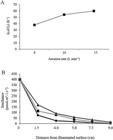
In (A) Overall mass transfer coefficien KLa(O2) as a function of aeration rate. (B) Light extinction coefficient inside the flat-panel photobioreactor (FP-PBR) as a function of Nannochloropsis oculata biomass concentration: (▲) 0.21 g L-1, (■) 0.34 g L-1, and (♦) 0.51 g L-1.
Illumination
The light extinction coefficients of the FP-PBRs used in N. oculata cultures at biomass concentrations of 0.21, 0.34, and 0.51 g L-1 are shown in Figure 3B. In the present study, an irradiance of 400 µmol m-2 s-1 homogeneously illuminated the 150 L culture in the FP-PBR, which was just 1.5 cm from the illuminated surface, and it was possible to illuminate culture volumes of approximately 63, 42 and 28 L for biomass concentrations of 0.21, 0.34 and 0.51 g L-1, respectively (Figure 3B). This means that when 0.51 g L-1 culture was used, the light extinction coefficient reached approximately 80%, and when 0.21 g L-1 culture was used, 57% was obtained. As the biomass concentration increased, the attenuation increased, and consequently, the illumination volume decreased, reaching almost 100% in 9.0 cm of culture, limiting photosynthesis and growth.
FP-PBR with different S/V ratios
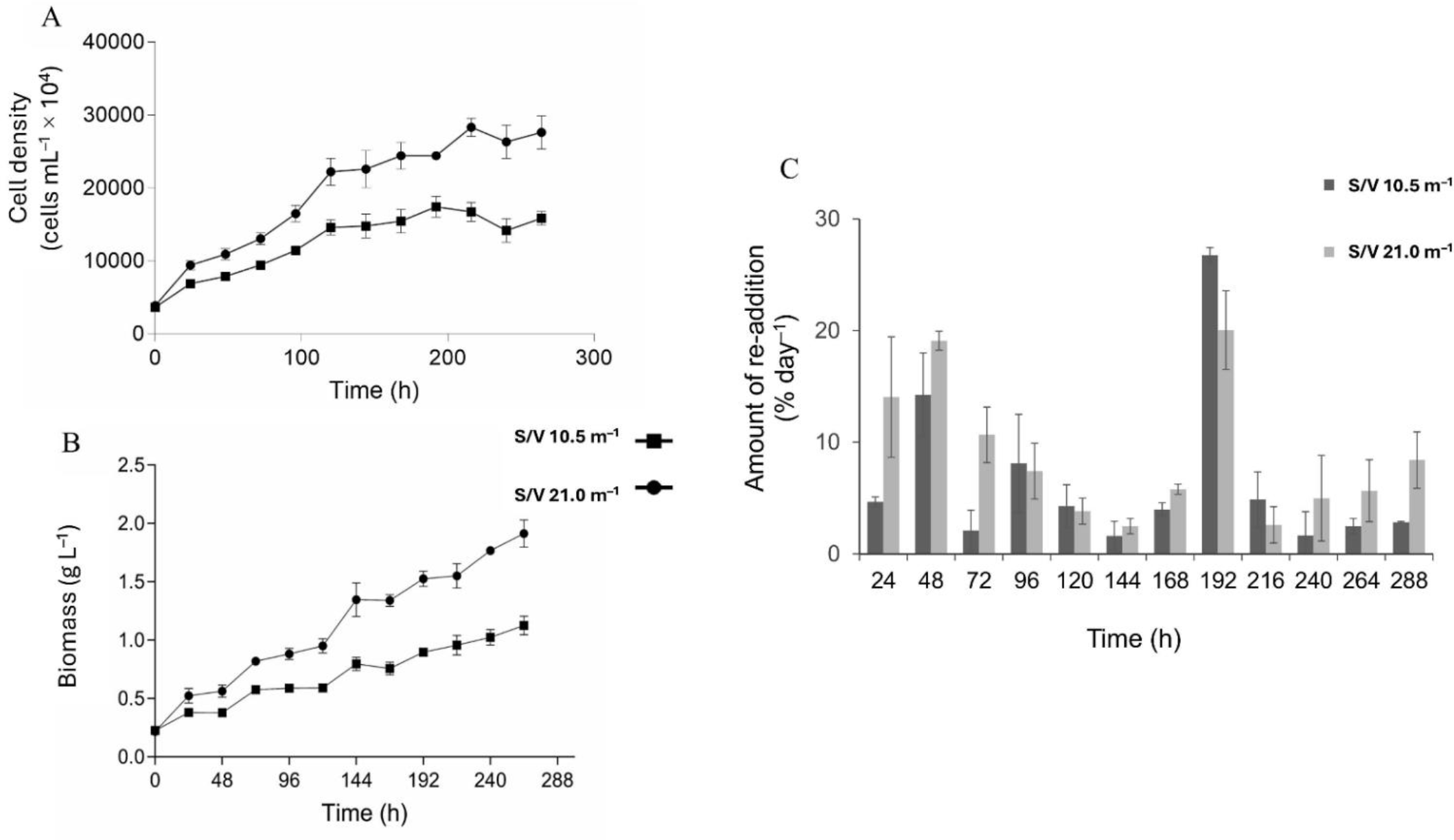
Significant differences (p < 0.05) were observed between treatments. Illumination on both sides of the FBR-FP allowed greater cell density to be achieved, possibly due to greater light availability for the cultures. At the end of 264 h (11-day trial), growth curves were constructed, where a lag phase (adaptation) was not observed in the cultures in either treatment. This is an indication that the microalgae were acclimatized to the experimental cultivation conditions. Cultures subjected to treatment with an S/V ratio of 21.0 m-1 reached a cell density of 27,600 × 104 cells mL-1 and average turbidity of 1364.36 ± 92.69 NTU, while cultures treated with an S/V ratio of 10.5 m-1 reached 15,800 × 104 cells mL-1 and average turbidity of 825.87 ± 60.15 NTU, which resulted in a greater amount of re-addition of culture medium to supply nitrate nutrient in S/V 21.0 m-1 treatment (Figure 4A, 4C). When checking the stability of the cell density between 216 h and 264 h of cultivation, it was determined that the cultures reached the stationary phase when the experiment was completed.
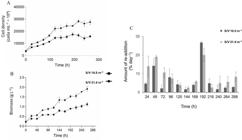
Performance of N. oculata cultures after 264 h of cultivation in the experimental flat-panel photobioreactor (FP-PBR) under different illuminated surface/volume ratios (S/V 10.5 m-1 and 21.0 m-1). In (A) cell density, (B) biomass concentration, (C) daily nitrate supply.
The highest microalgal growth occurred between 96 h and 120 h, possibly representing the cut-off point (dilution) for semicontinuous cultures. However, when checking the biomass concentration graph (Figure 4B), it was noted that there was a greater daily accumulation of biomass at 144 h, with 0.4 g L-1 for the S/V treatments of 21.0 m-1 and 0. 21 g L-1 for an S/V of 10.5 m-1. For this reason, it is very important to analyse these factors when planning an FP-PBR.
Regarding the maximum biomass achieved, there was a significant difference (p < 0.05) between treatments, where the S/V ratio of 21.00 m-1 achieved greater biomass concentration, with 1.91 ± 0.15 g L-1 and a total productivity of 0.174 g L-1 day-1, while the treatment with the S/V ratio of 10.50 m-1 obtained a biomass concentration of 1.13 ± 0.08 g L-1 and a total productivity of 0.102 g L-1 day-1.
DISCUSSION
Specific light availability can influence biocompounds productivity and microalgae biomass yield [22,27]. In the present study, the use of lighting on both sides of the culture probably generated twice as much heat; however, even at higher temperatures, the difference between treatments did not exceed 2°C during the experimental period. For future studies, it is recommended that the experimental room be acclimatized after the cultures are inoculated, thus avoiding the variation observed in the first 48 h. Furthermore, pH stability throughout the experimental period indicated that the automated system, through on-demand CO2 injection, worked effectively.
Carbon is considered the most important nutrient in terms of mass [35,36] since the amount of this element in algal cells is approximately 50% of the dry biomass [37]. It is crucial to understand that the presence of carbon dioxide (CO₂) in water can change depending on the pH level, which impacts water chemistry and the accessibility of CO₂ for biological functions like photosynthesis. This underscores the significance of pH regulation, as keeping pH levels within an optimal range helps to manage the different forms of carbon (CO₂, HCO₃⁻, CO₃2⁻) present in the crop [35-37].
Nannochloropsis sp. showed a greater growth rate when aerated with CO2 [38]. This implies the need to make carbon available for greater biomass production and at the same time maintain adequate pH for culture development. Furthermore, it is very important that CO2 is continuously available into cultures, and that monitoring by pH sensors, such as those implemented in the present study, could avoid lack or excess of carbon, which would cause stress and growth limitations of microalgae, or even waste, increasing production costs [39]. Although the present FP-PBR model has not been economically evaluated, the use of automation could provide an ideal cultivation cycle without human intervention [40], allowing a reduction in operational costs related to the use of CO2.
The KLa(O2) values observed in the present study corroborate those found in photobioreactors, since KLa in these cultivation systems could vary between 5 and 100 h-1 [41]. The microperforated Teflon tube used in the present research promoted the formation of bubbles with diameters between 2 and 4 mm. This size of bubbles allows for excellent efficiency in regard to mixing the culture, as it causes great turbulence, and the smaller the size of the bubbles is, the greater the gas‒liquid interfacial area, which provides higher KLa values [42]. Indeed, the mass transfer capacity of a system is related to the size of the bubbles, stirring speed, temperature and aeration rate applied in the reactor [43]. However, its measurement is commonly applied to PBRs through the measurement of KLa(O2), which can be converted to KLa(CO2) [44], where “KL” represents the density, viscosity, diffusivity, temperature, etc., and the interfacial area “a” depends on the holdup gas and the size of the bubbles [45]. Additionally, the design and operating conditions of FP-PBRs are fundamental for increasing the interfacial area (gas‒liquid) to the maximum, thus facilitating the incorporation of CO2 (gaseous) into the liquid medium [46]. Nevertheless, high aeration rates can accelerate the passage of gas bubbles through the vertical column of the FP-PBR, reducing the incorporation of CO2 and causing cellular damage in microalgae [47,48]. Therefore, an aeration rate of 10 L min-1 (0.067 vvm) with a KLa(O2) of 54.29 h-1 was considered ideal for the FP-PBR models described in the present study.
In terms of lighting, it was observed that even with a low biomass concentration, only about 50% of the culture in a 1.5 cm depth was effectively illuminated. This underscores the significance of the optical path and mixing rate in the system, emphasizing the necessity of having lighting sources on both sides of the panel. According to Sierra and coauthors [21] and Bahadar and Khan [22], increasing the S/V ratio maximizes the exposure of algal cells to light. Therefore, finding the balance, referring to biomass accumulation as the optical path decreases with volumetric production, is fundamental for the system, which always focuses on the final biomass. Additionally, maximum productivity in cultures of phototrophic microorganisms such as microalgae will always be limited by light, even when nutritional needs are satisfied, and environmental conditions are close to ideal [30]. Thus, studies to design photobioreactors and efficient protocols for the mass production of phototrophic algae, such as those presented in the present study, are desirable.
The efficiency of the FP-PBR and its cost-benefit ratio are determined by the total illuminated surface required to produce a given biomass and the volume of culture required to produce such biomass, based on the premise that the lower these values, the more efficient and economical the reactor will be [25]. According to Ammar and coauthors [49], the maximum biomass achieved for the microalga N. oculata in 400 mL glass flasks with a temperature of 25.0 ± 1.0°C, irradiance of 2,000 lux (equivalent to less than 30 µmol m-2 s-1), constant aeration of 3.5 L min-1 and photoperiod of 18:6 was 0.85 g L-1 day-1 in 20 days of cultivation, while Converti and coauthors [50] reported a productivity of 0.130 g L-1 day-1 in 14 days in cultures developed in 2 L glass flasks with a temperature of 25°C and lighting of 70 µmol m-2 s-1. These results corroborate those found in the present study; however, productivity in smaller-scale cultures is easier to control, which allows us to infer that FP-PBR provided satisfactory productivity since it was carried out in larger volumes than in Erlenmeyer flasks.
N. oculata yields were reported on a large scale in the flat-panel. When Nannochloropsis sp. was grown in a modular flat-panel photobioreactor with a culture volume of 20.5 L and an illuminated surface area of 3.4 m2, continuous illumination of one side of the panels with 115 μmol photon m-2 s-1 achieved an average volumetric productivity (dry weight) of 0.61 g L-1 day-1, increasing to 0.97 g L-1 day-1 when the same irradiance was provided on both sides of the panels [51]. This demonstrates that increasing the amount of light supplied to the culture, either by irradiance or the illuminated surface area, could directly affect productivity.
By testing different optical paths in photobioreactors, Richmond and Zou [52] obtained higher productivity when the S/V ratio increased, where the highest biomasses (12.1, 9.3, 7.3 and 5.5 g m-2 day-1) were observed as the optical path decreased (1.3, 2.6, 5.2, and 10.4 cm, respectively), indicating that the smaller the optical path was, the greater the productivity. These findings indicate that higher productivity is associated with smaller optical paths. In comparison to the referenced study, the productivity levels achieved with S/V ratios of 10.50 and 21.00 m-1 (10.90 and 18.60 g m-2 day-1, respectively) exceed the reported values by Richmond and Zou [52]. Microalgae are crucial in aquaculture as they provide essential larval food for various species for a limited time. Enhancing the quality and growth of microalgae can boost sustainability in the industry [6,40]. The model created in this research provides cost-effective and space-efficient solutions for microalgae production in aquaculture, ultimately improving sustainability and efficiency in microalgal culture for aquaculture purposes.
The present study attempted to meet the requirements imposed on the development of microalgal cultures in flat-panel photobioreactors. The increase in the surface-to-volume ratio in the FP-PBR enabled the achievement of competitive biomass and productivity levels compared to those attained in photobioreactors for large-scale cultivation [8,20]. However, it is very important to constantly monitor other factors that influence microalgal growth, such as pH, temperature, nutrients, irradiance, KLa and water treatment. Tests such as the validation of this system in an outdoor environment, with different lighting wavelengths, different ways of inserting CO2, and the quantification of its consumption, must be conducted for complete validation of this system, in addition to its use with other microalgae species.
CONCLUSION
The pilot-scale FP-PBR proved to be successful for N. oculata cultures. By maintaining an aeration rate of 0.067 vvm (10 L min-1) and utilizing illumination on both sides with an S/V ratio of 21.0 m-1, it was feasible to attain a greater microalgae biomass of 1.91 ± 0.15 g L-1.
-
Funding: This work was conducted with financial support from the Coordination for the Improvement of Higher Education Personnel (CAPES) financing code 001 and with the support of the Ministry of Science, Technology and, Innovation - MCTI/CGTS/SETEC, the National Council for Scientific and Technological Development - CNPq and the Financial Agency for Studies and Projects - FINEP.
Acknowledgments:
The authors would like to thank the Ministry of Science, Technology and Innovation (MCTI) for financial support provided by the Financial Agency for Studies and Projects (FINEP - Agreement No. 01.10.0457.00) and the Coordination of Superior Level Staff Improvement (CAPES) (Finance Code 001).
Data Availability Statement:
Research data are only available upon request for corresponding author.
REFERENCES
-
1 Nishida Y, Hoshina R, Higuchi S, Suzaki T. The unicellular green alga Chlorogonium capillatum as a live food promotes the growth and survival of Artemia larvae. Aquaculture 2023 Mar;566:739227. https://doi.org/10.1016/j.aquaculture.2022.739227
» https://doi.org/10.1016/j.aquaculture.2022.739227 -
2 Ma M, Hu Q. Microalgae as feed sources and feed additives for sustainable aquaculture: Prospects and challenges. Rev Aquac. 2024 Nov;16(2):818-35. https://doi.org/10.1111/raq.12869
» https://doi.org/10.1111/raq.12869 -
3 Derner RB, Ohse S, Villela M, Carvalho SMD, Fett R. Microalgae, products and applications. Cienc Rural 2006 Dec;36:1959-67. https://doi.org/10.1590/S0103-84782006000600050
» https://doi.org/10.1590/S0103-84782006000600050 -
4 Conceição LE, Yúfera M, Makridis P, Morais S, Dinis MT. Live feeds for early stages of fish rearing. Aquac Res. 2010 Apr;41(5):613-40. https://doi.org/10.1111/j.1365-2109.2009.02242.x
» https://doi.org/10.1111/j.1365-2109.2009.02242.x -
5 Radhakrishnan DK, AkbarAli I, Schmidt BV, John EM, Sivanpillai S, Thazhakot Vasunambesan S. Improvement of nutritional quality of live feed for aquaculture: An overview. Aquac Res. 2020 Oct;51(1):1-17. https://doi.org/10.1111/are.14357
» https://doi.org/10.1111/are.14357 -
6 Kumar NA, Sridhar S, Jayappriyan KR, Raja R. Applications of microalgae in aquaculture feed. In Handbook of Food and Feed from Microalgae. Academic Press 2023. p.421-33. https://doi.org/10.1016/B978-0-323-99196-4.00011-5
» https://doi.org/10.1016/B978-0-323-99196-4.00011-5 -
7 Torky A, Saad S, Eltanahy E. Microalgae as dietary supplements in tablets, capsules, and powder. In Handbook of Food and Feed from Microalgae. Academic Press 2023. p.357-69. https://doi.org/10.1016/B978-0-323-99196-4.00002-4
» https://doi.org/10.1016/B978-0-323-99196-4.00002-4 -
8 Tredici MR, Chini Zittelli G, Rodolfi L. Photobioreactors. In: Encyclopedia of Industrial Biotechnology: Bioprocess, Bioseparation, and Cell Technology 2009. p.1-15. https://doi.org/10.1002/9780470054581.eib479
» https://doi.org/10.1002/9780470054581.eib479 -
9 Ahangar AK, Yaqoubnejad P, Divsalar K, Mousavi S, Taghavijeloudar M. Design a novel internally illuminated mirror photobioreactor to improve microalgae production through homogeneous light distribution. Bioresour Technol. 2023 Nov;387:129577. https://doi.org/10.1016/j.biortech.2023.129577
» https://doi.org/10.1016/j.biortech.2023.129577 -
10 Yaqoubnejad P, Rad HA, Taghavijeloudar M. Development a novel hexagonal airlift flat plate photobioreactor for the improvement of microalgae growth that simultaneously enhance CO2 bio-fixation and wastewater treatment. J Environ Manag. 2021 Nov;298:113482. https://doi.org/10.1016/j.jenvman.2021.113482
» https://doi.org/10.1016/j.jenvman.2021.113482 -
11 Rozenberg JM, Sorokin BA, Mukhambetova AN, Emelianova AA, Kuzmin VV, Belogurova-Ovchinnikova OY, et al. Recent advances and fundamentals of microalgae cultivation technology. Biotechnol J. 2024 Mar;19(3):2300725. https://doi.org/10.1002/biot.202300725
» https://doi.org/10.1002/biot.202300725 -
12 Mishra N, Prasad SM, Mishra N. Influence of high light intensity and nitrate deprivation on growth and biochemical composition of the marine microalgae Isochrysis galbana Braz Arch Biol Technol. 2019 Jul;62:e19180398. https://doi.org/10.1590/1678-4324-2019180398
» https://doi.org/10.1590/1678-4324-2019180398 -
13 Venancio HC, Cella H, Lopes RG, Derner RB. Surface-to-volume ratio influence on the growth of Scenedesmus obliquus in a thin-layer cascade system. J Appl Phycol. 2020 Jan;32:821-29. https://doi.org/10.1007/s10811-020-02036-0
» https://doi.org/10.1007/s10811-020-02036-0 -
14 Wang B, Li Y, Wu N, Lan CQ. CO2 bio-mitigation using microalgae. Appl Microbiol Biotechnol. 2008 Jul;79:707-18. https://doi.org/10.1007/s00253-008-1518-y
» https://doi.org/10.1007/s00253-008-1518-y -
15 Abdelfattah A, Ali SS, Ramadan H, El-Aswar EI, Eltawab R, Ho SH, Elsamahy T, et al. Microalgae-based wastewater treatment: Mechanisms, challenges, recent advances, and future prospects. Environ Sci Ecotech 2023 Jan; 13:100205. https://doi.org/10.1016/j.ese.2022.100205
» https://doi.org/10.1016/j.ese.2022.100205 -
16 Sathya AB, Thirunavukkarasu A, Nithya R, Nandan A, Sakthishobana K, Kola AK, et al. Microalgal biofuel production: Potential challenges and prospective research. Fuel 2023 Jan;332:126199. https://doi.org/10.1016/j.fuel.2022.126199
» https://doi.org/10.1016/j.fuel.2022.126199 -
17 Braun JC, Colla LM. Use of Microalgae for the Development of Biofertilizers and Biostimulants. BioEnerg Res. 2023 Apr;16(1):289-310. https://doi.org/10.1007/s12155-022-10456-8
» https://doi.org/10.1007/s12155-022-10456-8 -
18 Raja R, Hemaiswarya S, Kumar NA, Sridhar S, Rengasamy R. A perspective on the biotechnological potential of microalgae. Crit Rev Microbiol. 2008 Oct;34(2):77-88. https://doi.org/10.1080/10408410802086783
» https://doi.org/10.1080/10408410802086783 -
19 Rizwan M, Mujtaba G, Memon SA, Lee K, Rashid N. Exploring the potential of microalgae for new biotechnology applications and beyond: A review. Renew Sustain Energy Rev. 2018 Sep;92:394-404. https://doi.org/10.1016/j.rser.2018.04.034
» https://doi.org/10.1016/j.rser.2018.04.034 -
20 Ugwu CU, Aoyagi H, Uchiyama H. Photobioreactors for mass cultivation of algae. Bioresour Technol. 2008 Jul;99(10):4021-28. https://doi.org/10.1016/j.biortech.2007.01.046
» https://doi.org/10.1016/j.biortech.2007.01.046 -
21 Sierra E, Acién FG, Fernández JM, García JL, González C, Molina E. Characterization of a flat plate photobioreactor for the production of microalgae. Chem Eng J. 2008 May;138(1-3):136-47. https://doi.org/10.1016/j.cej.2007.06.004
» https://doi.org/10.1016/j.cej.2007.06.004 -
22 Bahadar A, Khan MB. Progress in energy from microalgae: A review. Renew Sustain Energy Rev. 2013 Nov; 27:128-48. https://doi.org/10.1016/j.rser.2013.06.029
» https://doi.org/10.1016/j.rser.2013.06.029 -
23 Borowitzka MA. Algal Physiology and Large-Scale Outdoor Cultures of Microalgae. In: Borowitzka, M., Beardall, J., Raven, J. (eds) The Physiology of Microalgae. Developments in Applied Phycology. Springer, Cham. 2016. p.611-52 https://doi.org/10.1007/978-3-319-24945-2_23
» https://doi.org/10.1007/978-3-319-24945-2_23 -
24 Zou N, Richmond A. Effect of light-path length in outdoor flat plate reactors on output rate of cell mass and of EPA in Nannochloropsis sp. J Biotechnol. 1999 Apr;70(1-3):351-56. https://doi.org/10.1016/S0168-1656(99)00087-5
» https://doi.org/10.1016/S0168-1656(99)00087-5 -
25 Richmond A, Cheng-Wu Z. Optimisation of a flat plate glass reactor for mass production of Nannochloropsis sp. outdoors. J Biotechnol. 2001 Feb;85:259-69. https://doi.org/10.1016/S0168-1656(00)00353-9
» https://doi.org/10.1016/S0168-1656(00)00353-9 -
26 Zhang J, Miyachi S, Kurano N. Evaluation of a vertical flat-plate photobioreactor for outdoor biomass production and carbon dioxide bio-fixation: effects of reactor dimensions, irradiation and cell concentration on the biomass productivity. Appl Microbiol Biotechnol. 2001 May;55:428-33. https://doi.org/10.1007/s002530000550
» https://doi.org/10.1007/s002530000550 -
27 Münkel R, Schmid-Staiger U, Werner A, Hirth T. Optimization of outdoor cultivation in flat panel airlift reactors for lipid production by Chlorella vulgaris Biotechnol Bioeng. 2013 Apr;110(11):2882-93. https://doi.org/10.1002/bit.24948
» https://doi.org/10.1002/bit.24948 -
28 Matos ÂP. Advances in microalgal research in Brazil. Braz Arch Biol Technol. 2021 May;64:e21200531. https://doi.org/10.1590/1678-4324-2021200531
» https://doi.org/10.1590/1678-4324-2021200531 -
29 Wang B, Lan CQ, Horsman M. Closed photobioreactors for production of microalgal biomasses. Biotechnol Adv 2012 Jul;30(4):904-12. https://doi.org/10.1016/j.biotechadv.2012.01.019
» https://doi.org/10.1016/j.biotechadv.2012.01.019 -
30 Richmond A. Principles for attaining maximal microalgal productivity in photobioreactors: an overview. Hydrobiologia 2004 Jan;512:33-37. https://doi.org/10.1007/978-94-007-0944-7_5
» https://doi.org/10.1007/978-94-007-0944-7_5 -
31 Mata TM, Martins AA, Caetano NS. Microalgae for biodiesel production and other applications: a review. Renew Sustain Energy Rev. 2010 Jan;14(1):217-32. https://doi.org/10.1016/j.rser.2009.07.020
» https://doi.org/10.1016/j.rser.2009.07.020 - 32 Pereira GHM. Cultivo da microalga Nannochloropsis oculata em batelada alimentada. [dissertation]. Florianópolis: Federal University of Santa Catarina, School of Agricultural Sciences; 2017. 47 p.
- 33 APHA - American Public Health Association. Standard Methods of Water and Wastewater, 21st Ed. American Public Health Association, Washington, DC 2005; p 2-61.
-
34 Sales R, Derner RB, Tsuzuki MY. Effects of different harvesting and processing methods on Nannochloropsis oculata concentrates and their application on rotifer Brachionus sp. cultures. J Appl Phycol. 2019 Aug;31(6):3607-15. https://doi.org/10.1007/s10811-019-01877-8
» https://doi.org/10.1007/s10811-019-01877-8 -
35 Sun H, Li X, Ren Y, Zhang H, Mao X, Lao Y, et al. Boost carbon availability and value in algal cell for economic deployment of biomass. Bioresour Technol. 2020 Mar;300:122640. https://doi.org/10.1016/j.biortech.2019.122640
» https://doi.org/10.1016/j.biortech.2019.122640 -
36 Sarwer A, Hamed SM, Osman AI, Jamil F, Al-Muhtaseb AAH, Alhajeri NS, et al. Algal biomass valorization for biofuel production and carbon sequestration: a review. Environ Chem Lett. 2022 Jun;20(5):2797-851. https://doi.org/10.1007/s10311-022-01458-1
» https://doi.org/10.1007/s10311-022-01458-1 -
37 Sánchez Mirón A, García Camacho F, Contreras Gómez A, Grima EM, Chisti Y. Bubble-column and airlift photobioreactors for algal culture. AIChE J. 2000 Apr;46(9):1872-87. https://doi.org/10.1002/aic.690460915
» https://doi.org/10.1002/aic.690460915 -
38 Hu H, Gao K. Optimization of growth and fatty acid composition of a unicellular marine picoplankton, Nannochloropsis sp., with enriched carbon sources. Biotechnol Lett. 2003 Mar;25:421-25. https://doi.org/10.1023/A:1022489108980
» https://doi.org/10.1023/A:1022489108980 -
39 Sawayama S, Inoue S, Dote Y, Yokoyama SY. CO2 fixation and oil production through microalga. Energy Convers Manag. 1995 Sep;36(6-9):729-31. https://doi.org/10.1016/0196-8904(95)00108-P
» https://doi.org/10.1016/0196-8904(95)00108-P -
40 Kassem T, Shahrour I, El Khattabi J, Raslan A. Smart and sustainable aquaculture farms. Sustainability 2021 Sep;13(19):10685. https://doi.org/10.3390/su131910685
» https://doi.org/10.3390/su131910685 -
41 Langley NM, Harrison STL, Van Hille RP. A critical evaluation of CO2 supplementation to algal systems by direct injection. Biochem Eng J. 2012 Oct;68:70-5. https://doi.org/10.1016/j.bej.2012.07.013
» https://doi.org/10.1016/j.bej.2012.07.013 -
42 Ferreira A, Pereira G, Teixeira JA, Rocha F. Statistical tool combined with image analysis to characterize hydrodynamics and mass transfer in a bubble column. Chem Eng J. 2012 Jan;180:216-28. https://doi.org/10.1016/j.cej.2011.09.117
» https://doi.org/10.1016/j.cej.2011.09.117 -
43 Talbot P, Lencki RW, De la Noüe J. Carbon dioxide absorption characterization of a bioreactor for biomass production of Phormidium bohneri: comparative study of three types of diffuser. J Appl Phycol. 1990 Dec;2:341-50. https://doi.org/10.1007/BF02180924
» https://doi.org/10.1007/BF02180924 -
44 Talbot P, Gortares MP, Lencki RW, De la Noüe J. Absorption of CO2 in algal mass culture systems: a different characterization approach. Biotechnol Bioeng. 1991 Apr;37(9):834-42. https://doi.org/10.1002/bit.260370907
» https://doi.org/10.1002/bit.260370907 - 45 Chisti Y. Airlift bioreactors, First edition. London: Elsevier applied science 1989. 345 p.
-
46 Fan LH, Zhang YT, Zhang L, Chen HL. Evaluation of a membrane-sparged helical tubular photobioreactor for carbon dioxide biofixation by Chlorella vulgaris J Membr Sci. 2008 Nov;325(1):336-45. https://doi.org/10.1016/j.memsci.2008.07.044
» https://doi.org/10.1016/j.memsci.2008.07.044 -
47 Contreras A, García F, Molina E, Merchuk JC. Interaction between CO2-mass transfer, light availability, and hydrodynamic stress in the growth of Phaeodactylum tricornutum in a concentric tube airlift photobioreactor. Biotechnol Bioeng. 1998 Mar;60(3):317-25. https://doi.org/10.1002/(SICI)1097-0290(19981105)60:3%3C317::AID-BIT7%3E3.0.CO;2-K
» https://doi.org/10.1002/(SICI)1097-0290(19981105)60:3%3C317::AID-BIT7%3E3.0.CO;2-K -
48 Sobczuk TM, Camacho FG, Grima EM, Chisti Y. Effects of agitation on the microalgae Phaeodactylum tricornutum and Porphyridium cruentum Bioprocess Biosyst Eng. 2006 Oct;28:243-50. https://doi.org/10.1007/s00449-005-0030-3
» https://doi.org/10.1007/s00449-005-0030-3 -
49 Ammar SH, Khadim HJ, Mohamed AI. Cultivation of Nannochloropsis oculata and Isochrysis galbana microalgae in produced water for bioremediation and biomass production. Environ Technol Inno. 2018 May;10:132-42. https://doi.org/10.1016/j.eti.2018.02.002
» https://doi.org/10.1016/j.eti.2018.02.002 -
50 Converti A, Casazza AA, Ortiz EY, Perego P, Del Borghi M. Effect of temperature and nitrogen concentration on the growth and lipid content of Nannochloropsis oculata and Chlorella vulgaris for biodiesel production. Chem Eng Process: Process Intensif. 2009 Jun;48(6):1146-51. https://doi.org/10.1016/j.cep.2009.03.006
» https://doi.org/10.1016/j.cep.2009.03.006 -
51 Chini Zittelli G, Pastorelli R, Tredici M. A Modular Flat Panel Photobioreactor (MFPP) for indoor mass cultivation of Nannochloropsis sp. under artificial illumination. J Appl Phycol. 2000 Oct;12(3-5):521-6. https://doi.org/10.1023/A:1008165606234
» https://doi.org/10.1023/A:1008165606234 -
52 Richmond A, Zou N. Efficient utilisation of high photon irradiance for mass production of photoautotrophic micro-organisms. J Appl Phycol. 1999 Feb;11:123-7. https://doi.org/10.1023/A:1008033906840
» https://doi.org/10.1023/A:1008033906840
-
Editor-in-Chief:
Paulo Vitor Farago
-
Associate Editor:
Luiz Gustavo Lacerda