 Enhancing the Accuracy of the Low-Cost Capacitive Soil Moisture Sensor SEN0193 for Internet of Things Applications
Abstract
Monitoring soil moisture is an essential aspect of comprehending the functioning of terrestrial ecosystems. However, the cost of commercial sensors often challenges their acquisition. In response to this issue, manufacturers have developed several low-cost soil moisture sensors in recent decades, but there is still a need to improve the evaluation of their precision and accuracy. This article assesses the precision and accuracy of a low-cost soil moisture sensor SEN0193. The assessment results highlight the consistent precision of SEN0193 and emphasize the homogeneity of responses among sensors of the same model. The study also underscores the significant impact of soil granulometry on sensor precision, emphasizing the importance of realizing site-specific calibrations. In terms of accuracy, the study reveals that the calibration recommended by the manufacturer tends to overestimate moisture, particularly in soils with smaller granulometry. The study suggests that soil-specific calibration methods utilizing linear equations are more reliable and effective than polynomial and exponential approaches, especially when employing three to five calibration points. This study offers an essential contribution to the advancement of accessible methods for soil moisture monitoring. These methods are crucial for efficiently monitoring soil moisture in agriculture and natural ecosystems.
Keywords:
calibration; precision; smart agriculture; soil water content.
HIGHLIGHTS
Our study has validated the precision of the SEN0193 sensor.
Manufacturer calibration of the SEN0193 exhibited low accuracy.
We recommend a two-point linear calibration considering soil-specific characteristics.
INTRODUCTION
Soil moisture is essential for terrestrial ecosystems functioning [1, 2, 3]. It is determinant of plant growth, reproduction and development [4, 5, 6, 7]. It also influences the activity of microorganisms, shaping soil functionality through nutrient cycling [8, 9]. Insects and other soil organisms also rely on humidity for their survival and reproductive activities [10, 11]. In addition to its ecological importance, it is crucial in agriculture since controlling soil water content is determinant for food production and crop protection [12, 13].
However, commercially available soil moisture sensors are often expensive and may not be widely available to farmers and researchers worldwide [12]. These financial limitations can prevent access to essential technologies for adequate soil moisture monitoring. Furthermore, the scarcity of affordable sensors directly affects the capacity to make informed decisions concerning water resource management in agriculture and preservation of natural ecosystems [14, 15, 16]. Therefore, the current demand for low-cost soil moisture sensors is evident [13].
Nevertheless, errors in measuring soil moisture can result in mistaken decisions that negatively affect ecosystem conservation and agricultural production [17]. Therefore, precision and accuracy are essential requirements for low-cost sensors. Precision refers to the sensor's ability to provide consistent readings, indicating a low degree of variability among other sensors of the same model. Accuracy, on the other hand, represents the proximity between the sensor readings and the actual soil moisture values, reflecting how faithfully the device mirrors reality [18]. The low-cost sensor SEN0193 (DFRobot, Shanghai, China) [19] has been widely utilized in recent years, mainly in irrigation projects [20, 21, 22, 23, 24]. However, a few studies explore aspects such as the precision and accuracy of this instrument. The scant literature documenting precision outcomes of SEN0193 reveals divergent findings, wherein Schwamback and coauthors [24] attains satisfactory results while Kulmány and coauthors [25] does not. Studies evaluating the calibration methods of this sensor note that polynomial equations prove to be the most effective [25, 26]. While most studies achieve high accuracy through extensive calibrations, this approach poses challenges for real-world soil monitoring due to the impracticality of using numerous calibration points by farmers. Furthermore, some studies highlight the limitations of the manufacturer's recommended calibration methods [27, 28], underscoring the importance of researches that evaluate alternative calibration methods.
Therefore, our study initially focused on assessing the precision of the SEN0193 sensor. By validating the precision of the sensor, a properly executed calibration can be universally applied to any sensor unit of this model. We then compared the effectiveness of the manufacturer's suggested calibration versus a simple calibration approach, considering a linear equation with only two calibration points. Additionally, we explored more robust calibration methods, employing a limited number of calibration points, aiming to propose accurate methods that can be more easily employed. Finally, as the SEN0193 sensor estimates soil moisture based on dielectric permittivity and how soil structure affects it, we assessed whether and how the distinct granulometry of the soil affects the precision and accuracy of the SEN0193 sensor.
MATERIAL AND METHODS
SEN0193 and the reference sensor
SEN0193 is a low-cost capacitive soil moisture sensor consisting of a dielectric material surrounded by two terminals, capable of measuring the water concentration in the soil by detecting variations in the capacitance of its dielectric zone [19]. The readings provided by the device are expressed through voltage oscillations in millivolts (mV) resulting from changes in capacitance caused by the presence of water. In this unit of measurement, lower voltage values indicate a high soil moisture content, while higher voltage values correspond to a reduced water content in the soil. However, it is essential to convert these millivolt values to technical soil moisture units through a calibration process. Therefore, it is essential to assess the precision of the low-cost sensor to determine if the conversion from millivolts to a technical unit of moisture, developed by one SEN0193 sensor, can be applied to other sensors of the same model.
We used the field capacity method for millivolt conversion, according to the manufacturer's guidelines for converting the Mv values obtained by the SEN0193 sensor to the humidity unit (%) [19]. However, the method proposed by the manufacturer does not consider soil characteristics, suggesting a standardized calibration approach for different soils - which will be further detailed below. Field capacity estimates soil maximum water storage capacity until saturation occurs [29]. The degree of soil saturation is calculated based on the obtained field capacity for each soil type, where 0% represents completely dry soil and 100% indicates that the soil is fully saturated.
As a reference for soil moisture, we used the high-accuracy and higher-cost EC-5 sensor, from Decagon Devices (Washington, USA). This capacitive sensor has been extensively studied regarding the influence of soil temperature, composition and granulometry to obtain the humidity value [30, 31, 32] and continues to be widely employed worldwide [33, 34, 35, 36]. The reference sensor was also calibrated using the field capacity method for each soil sample, as previously described to the SEN0193 sensor.
The millivolt measurements of the low-cost sensor were obtained using nine individual SEN0193 sensors connected to an Arduino Uno R3 microcontroller board based on the ATmega328P, and visualized through the Arduino Integrated Development Environment (IDE). The sensors operated under a 5V operating voltage, chosen due to the increased variability in moisture measurements reported when operating at lower voltages [26]. The mV values obtained were recorded to assess the consistency among the nine SEN0193 sensors and for subsequent calibration (conversion mV to %) to evaluate accuracy against the reference sensor. The reference sensor was integrated into the H21-002 data logging microstation (Hobo, USA) and configured using HOBOware software.
Laboratory procedure
Commercially washed sand was used as the soil matrix to obtain soil samples for moisture tests. The sample preparation process began with drying the sand at a constant temperature of 105 ºC over 24 hours. Subsequently, the dried sand was sieved to obtain different soil grain sizes: coarse grains (greater than 0.5 mm), medium grains (between 0.5 and 0.25 mm), and fine grains (between 0.25 and 0.1 mm). Then, place 100 grams of sand from each grain size in a cylindrical glass container with a diameter of 45mm and a height of 12cm.
In each cylinder, we added 5 ml aliquots of purified water seven times, taking measures after each addition. The soil was manually stirred after each addition to ensure uniform water distribution. We recorded millivolt values (from the nine SEN0193 sensors) and soil moisture values (from the reference sensor). After adding 35 ml of water, all grain sizes reached saturation, and each sensor recorded 24 readings (8 moisture levels x 3 grain size categories).
Calibration equations
The SEN0193 sensor features a manufacturer-suggested standard calibration involving a linear equation with two calibration points. The point corresponding to dry soil (0%) is determined by the millivolt value obtained when the sensor is in contact with no object, while the point for saturated soil (100%) is determined by the millivolt value obtained when the sensor is immersed in water [19]. In other words, the manufacturer's suggested calibration does not take into account the specific characteristics of distinct soil types. Many studies emphasize the importance of considering the specific properties of each soil when calibrating moisture sensors [37, 38, 39]. Therefore, we also conducted a calibration based on a linear equation with two calibration points, considering the soil's specificities. In this approach, the point for dry soil (0%) corresponds to the millivolt value obtained by the sensors when inserted into each dry soil, while the point for saturated soil (100%) corresponds to the millivolt value obtained by the sensor in saturated soils. Both calibration methods described above are based on extreme values and do not require intermediate moisture values, eliminating the need for a reference sensor. Hence, they are referred to as unreferenced calibrations.
In addition to the two unreferenced calibration methods, we conducted nine additional calibration methods, including linear, second-degree polynomial, and exponential calibrations, each considering three, four, and five calibration points. To obtain intermediate millivolt values, we used the values obtained from the reference sensor to determine the millivolt value corresponding to the target moisture level. For equations with three, four and five calibration points, the millivolt values obtained for dry soil (0%), saturated soil (100% moisture) and intermediate reference values (50% for three-point equations; 33% and 66% for four-point equations; and 25%, 50% and 75% for five-point equations) were considered as the points for the corresponding levels of soil moisture. The reference sensor was used to obtain intermediate millivolt values during the calibrations described above. Therefore, we will refer to them as referenced calibrations.
Statistical analysis
To assess the precision of SEN0193, a one-way analysis of variance (ANOVA) was conducted among the nine sensors at each soil moisture level, using millivolt values as response variables and the sensors as categorical variables. Additionally, to investigate the potential influence of grain size on sensors accuracy, a one-way ANOVA was performed at each moisture concentration, using millivolt values as response variables and the three grain sizes as categorical variables. Moreover, in the presence of statistically significant results from the ANOVA, Tukey's post-hoc test was employed to discern pairwise differences. Conducting these analyses across the moisture gradient allowed us to evaluate whether, at certain moisture levels, the sensors exhibit variations in the influence of grain size and the accuracy of SEN0193 in the obtained millivolt values.
An evaluation of the calibration models in relation to reference moisture was conducted using Mean Bias Error (MBE; Equation 1) and the Coefficient of Determination (R2; Equation 2). MBE represents the mean difference between the obtained moisture value and the actual moisture value. Therefore, values equal to zero indicate no difference between the obtained and actual values, while negative values suggest that the calibration method is underestimating the actual moisture, and positive values indicate overestimation. On the other hand, R2 quantifies the degree of fit of the obtained moisture value in relation to the actual moisture value, with 1 indicating a perfect fit between obtained and actual values.
where: n represents the number of observations, Actuali is the actual moisture value for observation i, Obtainedi is the obtained moisture value for observation i, and Actual is the mean of the actual moisture values.
The comparative statistical analysis between unreferenced calibration models involved the application of the Student's t-test to investigate potential disparities in MBE and R2 values between the manufacturer-recommended calibration and a linear calibration with two points, adapted to account for soil-specific characteristics. Additionally, an analysis of variance (ANOVA) was employed to understand the potential influence of grain size in each calibration model, assessing both MBE and R2 across different grain sizes.
For the comparative analysis between referenced models, we conducted ANOVAs for both MBE and R2 among the referenced calibration models (Linear, Polynomial, and Exponential), individually for each grain size and number of calibration points. In order to examine the potential influence of grain size on each calibration model, we performed separate ANOVAs for MBE and R2 among grain sizes (Coarse, Medium, and Fine) within each calibration model and number of calibration points. Finally, to determine if there are significant differences between calibration points, we carried out ANOVAs for both MBE and R2 among calibration points (Three, Four, and Five points) within each calibration model and grain size. Tukey's post-hoc test was employed to discern differences within grain sizes, calibration techniques, and calibration points.
In cases where the assumptions of normality and homoscedasticity were not met, the decision was made to perform the Mann-Whitney test as a substitute for the Student's t-test, and the Kruskal-Wallis test as a substitute for ANOVA. All statistical analyses were carried out using R software v. 4.3.2 [40]. Normality and homogeneity of variances were checked using the shapiro.test and levene.test functions, respectively, from the "car" library.
RESULTS AND DISCUSSION
SEN0198 precision validation
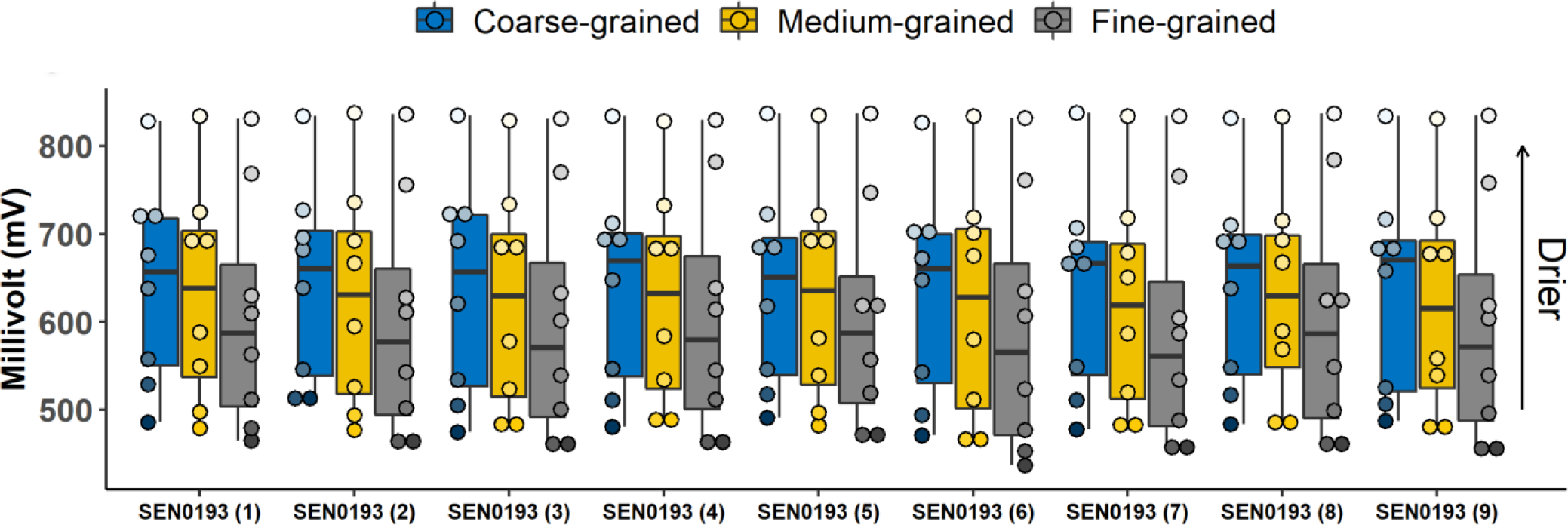
There is a noticeable uniformity in the millivolt values obtained among SEN0193 sensors, regardless of the soil granulometry (Figure 1). This consistency is statistically validated (Table 1), revealing the absence of significant differences between the sensors across the entire investigated moisture gradient. This result emphasizes that, despite the low cost of the SEN0193 sensor, reliability in the homogeneity of the obtained responses is confirmed, indicating the sensor model is precise.
Results of the analysis of variance (or Kruskal-Wallis) among the nine SEN0193 sensors along the moisture gradient.
Millivolt values obtained by the low-cost sensor in coarse, medium, and fine grains sizes. The color of the points of each grain size indicates the degree of moisture, where lighter points correspond to drier soil and darker points to more humid soil.
The absence of soil moisture in the first measurement affected sensor precision and could be responsible for the marginal significant values in the dry soil (p<0,0759; Table 1). The sensor may exhibit inconsistent readings with insufficient water to conduct electrical current. Such inaccuracies can introduce measurement errors and lead to erroneous results, such as Type 1 statistical errors (false positives).
Sensors showed a clear gradation in soil moisture among all grain sizes caused by the addition of purified water, with only a few instances of overlap at specific points (Figure 1). This overlap occurs in coarse-grained soil in the range between 650 and 750 mV, in medium-grained soil between the ranges of 650 and 700 mV and 400 and 500 mV, and for fine-grained soil only in the range between 400 and 500 mV. For fine-grained soil, the addition of water seems to cause more substantial changes in the voltage recorded by the devices, as evidenced by the lower number of intermediate points and a higher concentration of readings with lower millivolt values. This disparity in readings among grain sizes is significant (Table 2), except in dry soil.
Results of the analysis of variance among the three grain sizes studied along the moisture gradient.
Significant differences were found between fine-grained and mediumor coarse-grained particles at all soil moisture levels; and at some intermediate levels of addition of purified water (20 to 30 ml), researchers observed significant differences among all grain sizes.
The significant distinction on millivolt values obtained by the SEN0193 sensor between the different grains (Figure 1; Table 2) emphasize that the sensor readings are considerably impacted by variations in soil structure, reinforcing the importance of calibrating the SEN0193 sensor based on site-specific conditions. This phenomenon arises from the interplay between grain size and dielectric constant. Fine-grained soils exhibit lower dielectric constants under similar moisture conditions than coarse-grained soils [41]. Consequently, soils with a higher concentration of fine grains have a reduced capacity to conduct electric fields, potentially overestimating soil moisture when using calibrations designed for coarser-grained soils.
The uncertainty surrounding the precision of SEN0193 would make it impractical to rely on the obtained moisture values. However, there were no significant differences in moisture values among sensors of the SEN0193 model, which confirms that the measurements are precise, as previously reported [24]. Thus, the lack of precision noted by [25] may have been due to the limited number of replicates used in their study (only 3). None of the previous studies conducted statistical tests to assess the accuracy of the sensors. Our study is the first to evaluate this sensor model's precision statistically.
Accuracy of unreferenced calibration methods
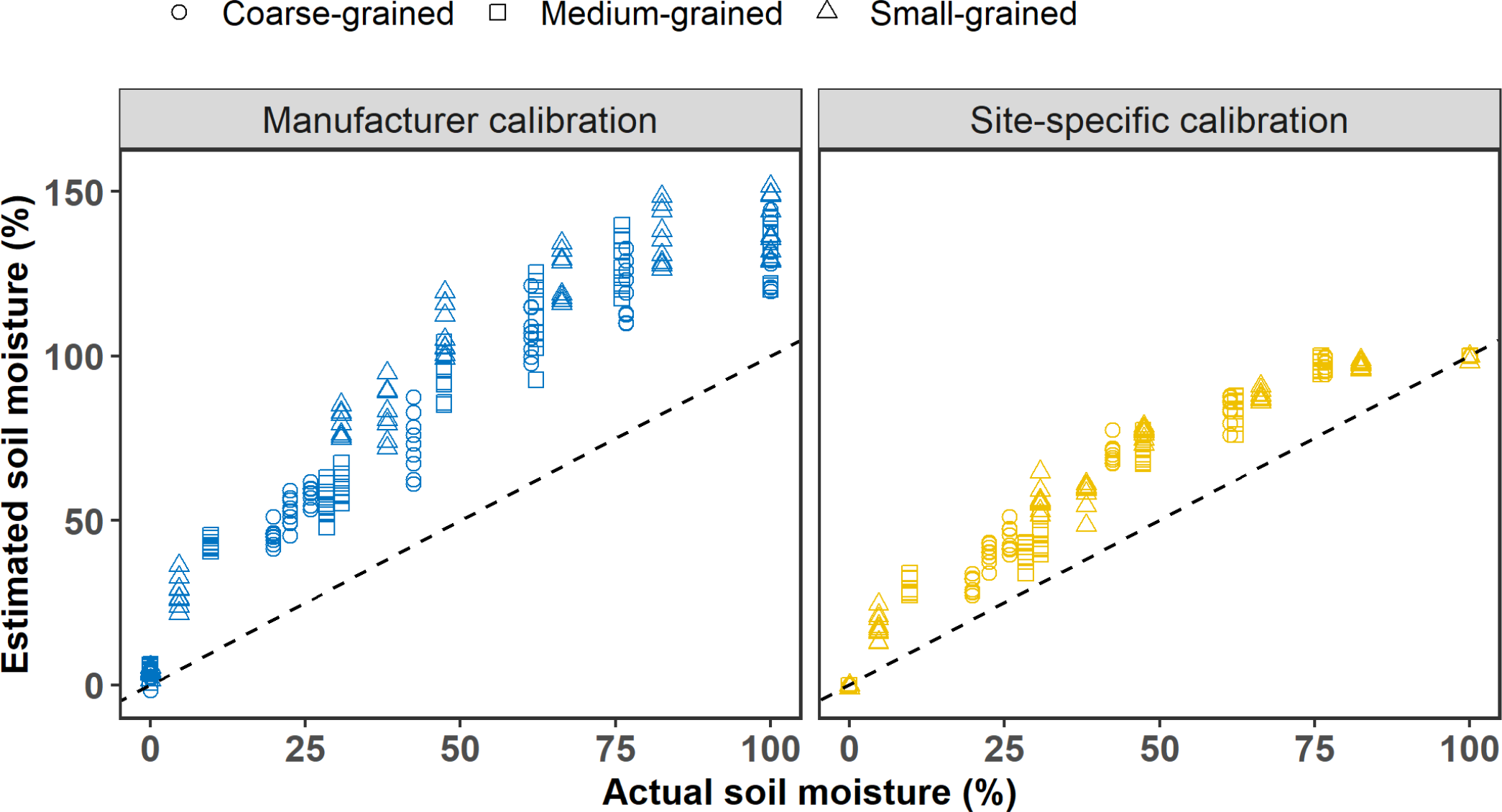
Both unreferenced calibration equations demonstrated a tendency to overestimate soil moisture, as illustrated in Figure 2. However, there is a noticeable greater deviation between obtained and actual values when using the equation suggested by the manufacturer. The equation that considers the specific soil properties presents values closer to reality (based on reference sensor), especially for more extreme moisture levels. It is observed that, the smaller the soil grain size, the greater the deviation from the actual moisture values, which corresponds to an overestimation of 41.6 ± 5.14% (average ± standard deviation) for fine-grained soils in the manufacturer-suggested calibration (Table 3).
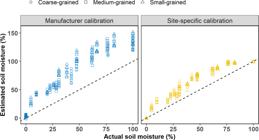
Actual and estimated soil moisture values through unreferenced calibration methods in different soil grain sizes. The dashed line represents the expected soil moisture value.
For the soil-specific equation, there is no significant difference between grain sizes for MBE, and the highest overestimation found was up to 15.5 ± 1.29% - also registered for fine-grained soil (Table 3). Besides to the lower MBE values observed in the soil-specific calibration, this technique also resulted in a better fit between obtained and actual moisture values, evidenced by determination coefficients exceeding 70% for all grain sizes, while the factory calibration presented R2 values of 0.51 ± 0.05%, 0.47 ± 0.04%, and 0.43 ± 0.04%, respectively, for coarse, medium, and fine grains (Table 3).
These results highlight that both unreferenced calibration equations tend to overestimate soil moisture. The manufacturer calibration is more susceptible to overestimate the actual soil moisture value, especially in finer-grained sediments. The soil-specific calibration presented moderate MBE values and a better fit to actual moisture values (Table 3). These findings emphasize the importance of considering the specific soil characteristics during the calibration of the SEN0193 sensor, aiming for greater accuracy and reliability in soil moisture measurements.
Previous studies have examined the calibration of soil moisture sensors, such as 10HS and CS646, revealing the inefficiency of relying on the manufacturer's suggested calibration [42]. Such an approach can led to highly overestimated readings, which can be particularly problematic for low-cost sensor users. For example, in irrigation projects, inaccurate readings can result in insufficient water being supplied to plants, leading to water stress, poor seed germination, reduced plant growth, and lower crop yield [43, 44]. Similarly, in environmental monitoring and research projects, misinterpretations can lead to inappropriate decision-making regarding natural resources and a misunderstanding of ecosystem functioning.
Soil-specific calibration is a more reliable method to measure soil moisture and it uses a simple methodology. Instead of using the calibration suggested by the manufacturer, it is recommended to create an equation using the mV values of SEN0193 in dry and flooded soil. This method does not require additional equipment and can provide accurate results. Creating a site-specific calibration is important as it tailors the equation to the specific conditions of the site, ensuring even more accurate results.
Accuracy of referenced calibration methods
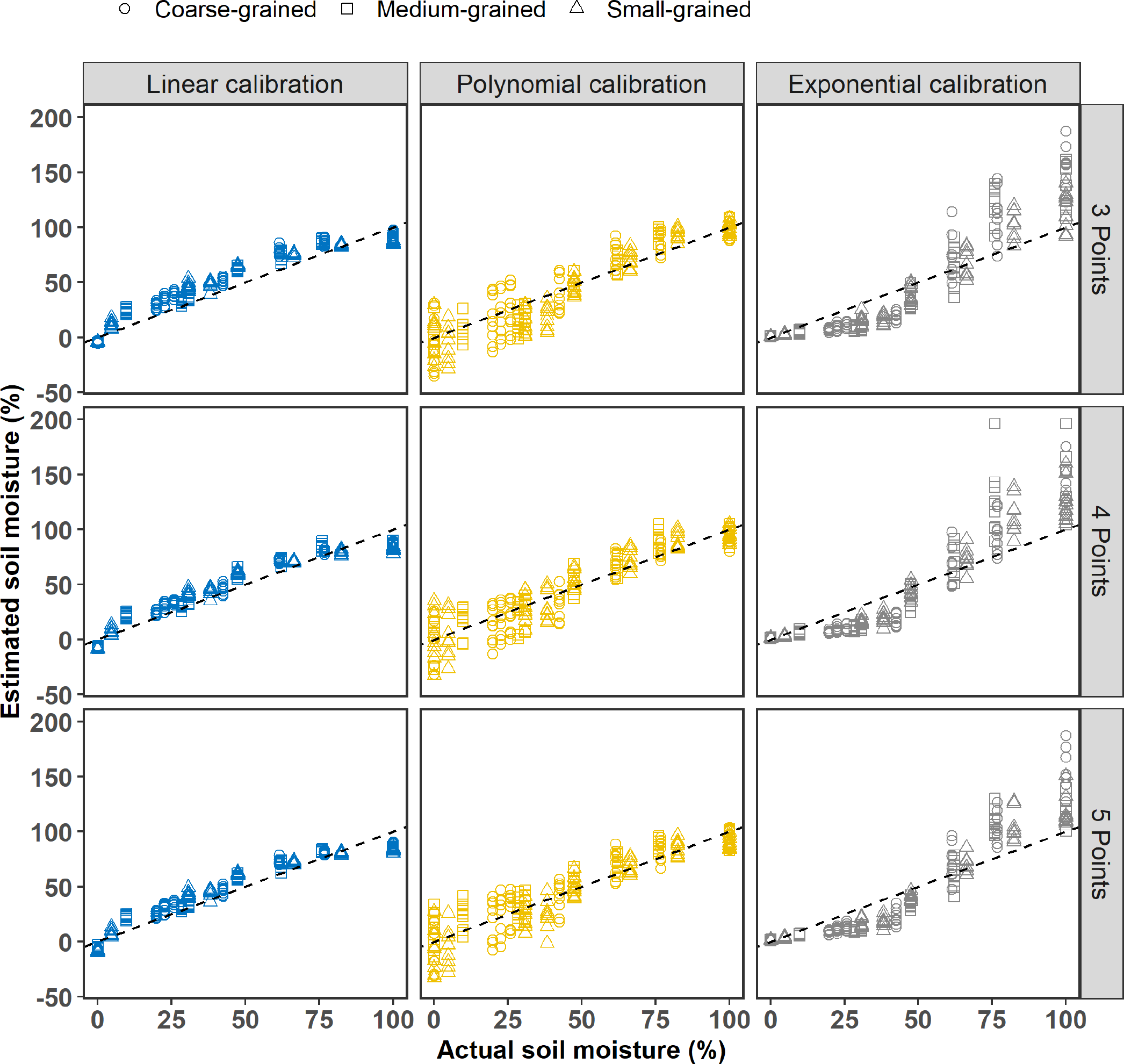
The soil moisture values obtained using different calibration techniques show distinct distribution patterns around the actual moisture value (as shown in Figure 3). Linear calibration tends to underestimate moisture at extreme values (both lower and higher) and overestimate it at intermediate values. Polynomial and exponential calibrations present cone-shaped distributions. The precision of polynomial calibration reduces when dealing with dry soils. It becomes more accurate with increasing moisture, while exponential calibration is more accurate in dry soils but becomes less accurate with increasing moisture.
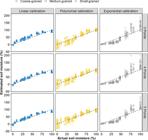
Actual and obtained soil moisture values through referenced calibration methods in different soil grain sizes. The dashed line represents the expected soil moisture value.
The distribution of moisture values obtained by polynomial and exponential calibration techniques is quite heterogeneous, which results in high standard deviations for MBE (as listed in Table 4). While some of these equations give highly confident estimates (MBE values close to zero), applying these equations for calibration would result in low accuracy for estimates of some specific moisture intervals. As a result, polynomial and exponential equations lower R2 than linear calibration (also shown in Table 4).
Despite the similarities between calibration techniques shown in Figure 3, errors along the moisture gradient are distinct among the methods. The linear calibration consistently displays an error along the gradient, reaching up to 9.75% moisture for coarse grain with three calibration points; while the Polynomial and Exponential calibrations present moisture intervals with small errors, but other intervals can reach up to 17.64% and 16.97%, respectively, for coarse and medium grain with three and four calibration points. Therefore, the linear calibration method is the preferred option for equations using three to five calibration points as it not only has the lowest MBE standard deviation but also ensures excellent reliability due to the absence of extreme errors at certain moisture levels. The impact of these extreme errors, more evident in the exponential method, is reflected in the R2 results.
Our study has found different results from previous studies conducted [26, 25], both of which concluded that the polynomial calibration method was the most effective for SEN0192. However, we only evaluated calibration methods using between three and five calibration points. Therefore, polynomial calibration is more suitable for equations that use more than ten calibration points, as used by the aforementioned authors. However, when selecting a calibration method, it is not only the number of calibration points that should be taken into account but also the sensor to be used. For instance, previous studies have reported that exponential equations demonstrate better performance in calibration for 10HS [45] and ML2X sensors [46]. Therefore, in addition to the number of calibration points, the chosen calibration method should also consider the type of sensor being employed.
The structure of soil significantly affects MBE (Mean Bias Error) and R2 (the coefficient of determination), which is highly dependent on the type of calibration method used (as shown in Table 4). When using linear calibrations, significant differences in MBE were observed between coarse and fine grains (3 points), medium and fine grains (4 points), and all three-grain sizes (5 points). In all of these cases, fine grains exhibited MBE values closer to zero. Concerning R2, linear calibrations also showed significant differences between coarse and fine grains at four and five calibration points and between coarse and medium grains at five calibration points for polynomial calibration. The observed trend suggested that coarse grains generally had higher R2 in linear calibrations, while finer grains performed better in polynomial and exponential calibrations.
Interestingly, the number of calibration points affected MBE and R2 only in linear calibrations (as seen in Table 4). Regardless of grain size, using only three calibration points resulted in higher MBE and poorer fit compared to four and five calibration points. On the other hand, using a higher number of calibration points resulted in MBE values closer to zero and a better fit of the obtained moisture values with the actual moisture values for all grain sizes.
The high standard deviations of MBE observed in polynomial and exponential models resulted in the absence of a significant difference between grain sizes and the number of calibration points. For these methods, studies employing a more significant number of calibration points could more effectively assess the effects of grain size and the number of calibration points in polynomial and exponential equations. In contrast, for the linear equation, where the standard deviations of MBE were lower, using the sensor in fine soils demonstrated more remarkable similarity to actual moisture values, and employing 4 or 5 calibration points exhibited better efficiency than relying on just 3.
Although there are significant differences in grain size and the number of calibration points in linear calibrations, the largest difference observed in MBE was only 6.75%. Similarly, the greatest disparity found in the R2 was only 0.06. Minimal variations among different grain types were expected in all calibration methods, as site-specific calibration takes into account the peculiarities related to grain size in the equation. Moreover, due to the minor differences observed in MBE and R2, the probability of this disparity compromising accuracy regarding soil moisture is very low.
In addition to soil texture, various other soil properties influence soil dielectric constant [47]. Previous studies with capacitive soil moisture sensors have reported the effects of soil organic matter [48], salinity [49], and temperature [30, 50] on these sensors' readings. This study considers all these properties in the equation during site-specific calibrations.
This study represents another significant step toward understanding and improving the functioning of low-cost soil sensors, particularly the SEN0193 model. Further research is required to individually assess the effects of additional soil properties, such as soil organic matter content, salinity, and temperature, on SEN0193's performance. Investigating these factors in greater details will contribute to a comprehensive understanding of the sensor's behavior and enhance its applicability across diverse soil proprieties.
CONCLUSIONS
Our study has validated the precision of the SEN0193 sensor, ensuring trustworthy comparisons among sensors of the same model with identical applied calibration. Manufacturer calibration exhibited low accuracy. Therefore, we recommend a simple two-point linear calibration, accounting for soil-specific characteristics. If higher accuracy is required, we recommend a linear calibration with four or five points for enhanced accuracy.
-
Funding:
This research was funded by National Council for Scientific and Technological Development (CNPq), throught ILTER project (PELD - Site RLaC,) grant CNPq 441610/2016-1 and CNPq 441927/2020-3) and to Fundação de Amparo à Pesquisa do Estado do Rio de Janeiro (FAPERJ, grant E- 26/010.001232/2015 Ref. 210.882/2015 and E26 - 210 127/2022). JGFG is grateful to a scholarship supporting provided by CNPq (CNPq 441927/2020-3) and ACLPD is grateful to a scholarship supporting provided by FAPERJ (E26/204.320/2022 - 277001).
Acknowledgments:
None
REFERENCES
-
1 Brunbjerg AK, Bruun HH, Dalby L, Classen AT, Fløjgaard C, Frøslev TG, et al. Multi-taxon inventory reveals highly consistent biodiversity responses to ecospace variation. Oikos. 2020 May;129(9):1381-92. doi: https://doi.org/10.1111/oik.07145
» https://doi.org/10.1111/oik.07145 -
2 Moeslund JE, Arge L, Bøcher PK, Dalgaard T, Svenning J. Topography as a driver of local terrestrial vascular plant diversity patterns. Nord. J. Bot. 2013 May;31(2):129-44. doi: https://doi.org/10.1111/j.1756-1051.2013.00082.x
» https://doi.org/10.1111/j.1756-1051.2013.00082.x -
3 Riggs CE, Hobbie SE, Cavender-Bares J, Savage JA, Wei X. Contrasting effects of plant species traits and moisture on the decomposition of multiple litter fractions. Oecologia. 2015 May;179(2):573-84. doi: https://doi.org/10.1007/s00442-015-3352-0
» https://doi.org/10.1007/s00442-015-3352-0 -
4 Briggs LJ, Shantz HL. The wilting coefficient and its indirect determination. Bot. Gaz. 1912 Jan;53(1):20-37. doi: https://doi.org/10.1086/330708
» https://doi.org/10.1086/330708 -
5 Dai W, Yang Y, Patch HM, Grozinger CM, Mu J. Soil moisture affects plant-pollinator interactions in an annual flowering plant. Philos. Trans. R. Soc. Lond., B. 2022 Jun;377(1853):20210423. doi: https://doi.org/10.1098/rstb.2021.0423
» https://doi.org/10.1098/rstb.2021.0423 -
6 Li S, Liu J, Li J, Deng Y, Chen J, Wang J, et al. Reproductive strategies involving biomass allocation, reproductive phenology and seed production in two Asteraceae herbs growing in karst soil varying in depth and water availability. Plant Ecol. 2021 Apr;222(6):737-47. doi: https://link.springer.com/article/10.1007/s11258-021-01141-5
» https://link.springer.com/article/10.1007/s11258-021-01141-5 -
7 Taylor CA, Blaney HF, McLaughlin WW. The wilting-range in certain soils and the ultimate wilting-point. EOS., Trans. AGU. 1934 Jun;15(2):436-44. doi: https://doi.org/10.1029/TR015i002p00436
» https://doi.org/10.1029/TR015i002p00436 -
8 Chen H, Mothapo NV, Shi W. Soil moisture and pH control relative contributions of fungi and bacteria to N2O production. Microb. Ecol. 2015 Sep;69:180-91. doi: http://dx.doi.org/10.1007/s00248-014-0488-0
» http://dx.doi.org/10.1007/s00248-014-0488-0 -
9 Ullah MR, Carrillo Y, Dijkstra FA. Relative contributions of fungi and bacteria to litter decomposition under low and high soil moisture in an Australian grassland. Appl. Soil Ecol. 2023 Feb;182:104737. doi: https://doi.org/10.1016/j.apsoil.2022.104737
» https://doi.org/10.1016/j.apsoil.2022.104737 -
10 Pflug A, Wolters V. Influence of drought and litter age on Collembola communities. Eur. J. Soil Biol. 2021 Nov;37:305-8. doi: https://doi.org/10.1016/S1164-5563(01)01101-3
» https://doi.org/10.1016/S1164-5563(01)01101-3 -
11 Tsiafouli MA, Kallimanis AS, Katana E, Stamou GP, Sgardelis SP. Responses of soil microarthropods to experimental short-term manipulations of soil moisture. Appl. Soil Ecol. 2005 May;29:17-26. doi: https://doi.org/10.1016/j.apsoil.2004.10.002
» https://doi.org/10.1016/j.apsoil.2004.10.002 -
12 McBratney A, Whelan B, Ancev T, Bouma J. Future directions of precision agriculture. Precis. Agric. 2005 Feb;6:7-23. doi: https://doi.org/10.1007/s11119-005-0681-8
» https://doi.org/10.1007/s11119-005-0681-8 -
13 Yin H, Cao Y, Marelli B, Zeng X, Mason AJ, Cao C. Soil sensors and plant wearables for smart and precision agriculture. Adv. Mater. 2021 Apr;33:2007764. doi: https://doi.org/10.1002/adma.202007764
» https://doi.org/10.1002/adma.202007764 -
14 Robinson DA, Campbell CS, Hopmans JW, Hornbuckle BK, Jones SB, Knight R, et al. Soil moisture measurement for ecological and hydrological watershed-scale observatories: a review. Vadose Zone J. 2008 Feb;7(1):358-89. doi: https://doi.org/10.2136/vzj2007.0143
» https://doi.org/10.2136/vzj2007.0143 -
15 Rosel RAV, Bouma J. Soil sensing: a new paradigm for agriculture. Agric. Syst. 2016 Oct;148:71-4. doi: https://doi.org/10.1016/j.agsy.2016.07.001
» https://doi.org/10.1016/j.agsy.2016.07.001 -
16 Zhang N, Wang M, Wang N. Precision agriculture - a worldwide overview. Comput. Electron. Agric. 2002 Nov;36(2-3):113-32. doi: https://doi.org/10.1016/S0168-1699(02)00096-0
» https://doi.org/10.1016/S0168-1699(02)00096-0 -
17 Kelly TD, Foster T, Schultz DM, Mieno T. The effect of soil-moisture uncertainty on irrigation water use and farm profits. Adv. Water Resour. 2021 Aug;154:103982. doi: https://doi.org/10.1016/j.advwatres.2021.103982
» https://doi.org/10.1016/j.advwatres.2021.103982 - 18 Murphy RB. On the meaning of precision and accuracy. In: Ku HH, editor. Precision measurement and calibration: Selected NBS papers on statistical concepts and procedures. 1st ed. Washington: NBS Special Publication; 1969. p.357-60.
-
19 DFRobot. SKU:SEN0193 [Internet]. Shanghai: DFRobot; 2015 [cited 2024 Mar 03]. Available from: https://wiki.dfrobot.com/Capacitive_Soil_Moisture_Sensor_SKU_SEN0193
» https://wiki.dfrobot.com/Capacitive_Soil_Moisture_Sensor_SKU_SEN0193 -
20 Ahmad U, Alvino A, Marino S. Solar fertigation: a sustainable and smart IoT-based irrigation and fertilization system for efficient water and nutrient management. Agronomy. 2022 Apr;12:1012. doi: https://doi.org/10.3390/agronomy12051012
» https://doi.org/10.3390/agronomy12051012 -
21 Kim JY, Abdel-Haleem H, Luo Z, Szczepanek A. Open-source electronics for plant phenotyping and irrigation in controlled environment. Smart Agric. Technol. 2023 Feb;3:100093. doi: https://doi.org/10.1016/j.atech.2022.100093
» https://doi.org/10.1016/j.atech.2022.100093 -
22 Khoa TA, Man MM, Nguyen T, Nam NH. Smart Agriculture Using IoT Multi-Sensors: A Novel Watering Management System. J. Sens. Actuator Netw. 2019 Aug;8(3):45. doi: https://doi.org/10.3390/jsan8030045
» https://doi.org/10.3390/jsan8030045 -
23 Visconti P, Fazio R, Primiceri P, Cafagna D, Strazzella S, Giannoccaro NI. A solar-powered fertigation system based on low-cost wireless sensor network remotely controlled by farmer for irrigation cycles and crops growth optimization. Int. J. Electron. Telecommun. 2020 Jan;66(1):59-68. doi: http://dx.doi.org/10.24425/ijet.2019.130266
» http://dx.doi.org/10.24425/ijet.2019.130266 -
24 Schwamback D, Persson M, Berndtsson R, Bertotto LE, Kobayashi ANA, Wendland EC. Automated low-cost soil moisture sensors: trade-off between cost and accuracy. Sensors. 2023 Feb;23(5):2451. doi: https://doi.org/10.3390/s23052451
» https://doi.org/10.3390/s23052451 -
25 Kulmány IM, Bede-Fazekas Á, Beslin A, Giczi Z, Milics G, Kovács B, et al. Calibration of an arduino-based low-cost capacitive soil moisture sensor for smart agriculture. J Hydrol. Hydromech. 2022 Sep;70(3):330-40. doi: http://dx.doi.org/10.2478/johh-2022-0014
» http://dx.doi.org/10.2478/johh-2022-0014 -
26 Pereira RM, Sandri D, Júnior JJS. Evaluation of low-cost capacitive moisture sensors in three types of soils in the cerrado, Brazil. Eng. Agric. 2022 Aug;30:262-72. doi: https://doi.org/10.13083/reveng.v30i1.14017
» https://doi.org/10.13083/reveng.v30i1.14017 -
27 Akhter T, Mohammod A, Jaeyoon C, Seong-Jin P, Gyeang J, Kyu-Won Y, et al. Development of a data acquisition system for the long-term monitoring of plum (Japanese apricot) farm environment and soil. J. Biosyst. Eng. 2018 Dec;43(4):426-439. doi: https://doi.org/10.5307/JBE.2018.43.4.426
» https://doi.org/10.5307/JBE.2018.43.4.426 -
28 Pinheiro ALA, Figueiredo AES, Feitosa FCC, Esmeraldo GARM, Santos FGB, Sousa, FRR, et al. [Analyzing reliability with emphasis on sensor performance of an IoT system for remote irrigation management]. Rev. Sist. Comput. 2022 Ago;12(2):40-50. doi: https://dx.doi.org/10.36558/rsc.v12i2.7704
» https://dx.doi.org/10.36558/rsc.v12i2.7704 - 29 Zonta JH, Bezerra JRC, Pereira, JR, Sofiatti. [Cotton Irrigation Management]. Campina Grande (PB): Empresa Brasileira de Pesquisa Agropecuária, EMBRAPA Algodão; 2016. Circular Técnica: 139.
-
30 Fares A, Safeeq M, Awal R, Fares S, Dogan A. Temperature and probe-to-probe variability effects on the performance of capacitance soil moisture sensors in an oxisol. Vadose Zone J. 2016 Mar;15(3):1-13. doi: https://doi.org/10.2136/vzj2015.07.0098
» https://doi.org/10.2136/vzj2015.07.0098 -
31 Kodešová R, Kodeš V, Mráz A. Comparison of two sensors ECH2O EC-5 and SM200 for measuring soil water content. Soil Water Res. 2011 Jun;6(2):102-110. doi: http://dx.doi.org/10.17221/6/2011-SWR
» http://dx.doi.org/10.17221/6/2011-SWR -
32 Payero JO, Qiao X, Khalilian A, Mirzakhani-Nafchi A, Davis R. Evaluating the effect of soil texture on the response of three types of sensors used to monitor soil water status. J. Water Resour. Prot. 2017 May;9(6):566-77. doi: https://doi.org/10.4236/jwarp.2017.96037
» https://doi.org/10.4236/jwarp.2017.96037 -
33 Bauweraerts I, Ameye M, Wertin TM, McGuire MA, Teskey, RO, Steppe K. Water availability is the decisive factor for the growth of two tree species in the occurrence of consecutive heat waves. Agric. For. Meteorol. 2014 Jun;189-190:19-29. doi: https://doi.org/10.1016/j.agrformet.2014.01.001
» https://doi.org/10.1016/j.agrformet.2014.01.001 -
34 Gripp AR, Genovez JGF, Santos QS, Nogueira LEGD, Barboza CAM, Esteves FA, et al. Daily variation on soil moisture and temperature on three restinga plant formations. Air Soil Water Res. 2023 Feb;16. doi: https://doi.org/10.1177/11786221231154105
» https://doi.org/10.1177/11786221231154105 -
35 Sánches-Molina JA, Rodríguez F, Guzmán JL, Ramírez-Arias JA. Water content virtual sensor for tomatoes in coconut coir substrate for irrigation control design. Agric. Water Manag. 2015 Mar;151:114-25. doi: https://doi.org/10.1016/j.agwat.2014.09.013
» https://doi.org/10.1016/j.agwat.2014.09.013 -
36 Tarlera S, Capurro MC, Irisarri P, Scavino AF, Cantou G, Roei A. Yield-scaled global warming potential of two irrigation management systems in a highly productive rice system. Sci. Agric. 2016 Jan;73(1):43-50. doi: https://doi.org/10.1590/0103-9016-2015-0050
» https://doi.org/10.1590/0103-9016-2015-0050 -
37 Kargas G, Ntoulas N, Nektarios PA. Soil texture and salinity effects on calibration of TDR300 dielectric moisture sensor. Soil Res. 2013 Aug;51:330-340. doi: https://doi.org/10.1071/SR13009
» https://doi.org/10.1071/SR13009 -
38 Mortl A, Muñoz-Carpena R, Kaplan D, Li Y. Calibration of a combined dielectric probe for soil moisture and porewater salinity measurement in organic and mineral coastal wetland soils. Geoderma. 2011 Feb;161:50-62. doi: https://doi.org/10.1016/j.geoderma.2010.12.007
» https://doi.org/10.1016/j.geoderma.2010.12.007 -
39 Rowlandson TL, Berg AA, Bullock PR, Ojo ER, McNairn H, Wiseman G, et al. Evaluation of several calibration procedures for a portable soil moisture sensor. J. Hydrol. 2013 Aug;498: 335-44. doi: https://doi.org/10.1016/j.jhydrol.2013.05.021
» https://doi.org/10.1016/j.jhydrol.2013.05.021 - 40 R Core Team. R Development Core TeamR: A Language and Environment for Statistical Computing. 2023. R Foundation for Statistical Computing, Vienna, Austria.
-
41 Jacobsen OH, Schjønning PA. A laboratory calibration of time domain reflectometry for soil water measurement including effects of bulk density and texture. J. Hydrol.. 1993 Nov;151(2-4):147-57. doi: https://doi.org/10.1016/0022-1694(93)90233-Y
» https://doi.org/10.1016/0022-1694(93)90233-Y -
42 Mittelbach H, Lehner I, Seneviratne SI. Comparison of four soil moisture sensor types under field conditions in Switzerland. J. Hydrol. 2012 Apr;430-431:39-49. doi: https://doi.org/10.1016/j.jhydrol.2012.01.041
» https://doi.org/10.1016/j.jhydrol.2012.01.041 -
43 Lipiec J, Doussan C, Nosalewicz A, Kondracka K. Effect of drought and heat stresses on plant growth and yield: a review. Int. Agrophys. 2013 Oct;27(4):463-77. doi: https://doi.org/10.2478/intag-2013-0017
» https://doi.org/10.2478/intag-2013-0017 -
44 Loffroy O, Hubac C, Silva JBV. Effect of temperature on drought resistance and growth of cotton plants. Physiol. Plant. 1983 Oct;59(2):297-301. doi: https://doi.org/10.1111/j.1399-3054.1983.tb00774.x
» https://doi.org/10.1111/j.1399-3054.1983.tb00774.x -
45 Mittelbach H, Casini F, Lehner I, Teuling AJ, Seneviratne SI. Soil moisture monitoring for climate research: Evaluation of a low-cost sensor in the framework of the Swiss Soil Moisture Experiment (SwissSMEX) campaign. J. Geophys. Res. Atmos. 2011 Mar;116:D05111. doi: https://doi.org/10.1029/2010JD014907
» https://doi.org/10.1029/2010JD014907 -
46 Silva BPC, Tassinari D, Silva MLN, Silva BM, Curi N, Rocha HR. Nonlinear models for soil moisture sensor calibration in tropical mountainous soils. Scientia Agricola. 2022;79(4):e20200253. doi: http://dx.doi.org/10.1590/1678-992X-2020-0253
» http://dx.doi.org/10.1590/1678-992X-2020-0253 -
47 Topp GC, Davis JL, Annan AP. Electromagnetic determination of soil water content: Measurements in coaxial transmission lines. Water Resour. Res. 1980 Jun; 16(3):574-82. doi: https://doi.org/10.1029/WR016i003p00574
» https://doi.org/10.1029/WR016i003p00574 -
48 Szypłowska A, Lewandowski A, Yagihara S, Saito H, Furuhata K, Szerement J, et al. Dielectric models for moisture determination of soils with variable organic matter content. Geoderma. 2021 Nov;401:115288. doi: https://doi.org/10.1016/j.geoderma.2021.115288
» https://doi.org/10.1016/j.geoderma.2021.115288 -
49 Fares A, Safeeq M, Jenkins DM. Adjusting temperature and salinity effects on single capacitance sensors. Pedosphere. 2009 Oct;19(5):588-96. doi: https://doi.org/10.1016/S1002-0160(09)60153-3
» https://doi.org/10.1016/S1002-0160(09)60153-3 -
50 Rosenbaum U, Huisman JA, Vrba J, Vereecken H, Bogena HR. Correction of temperature and electrical conductivity effects on dielectric permittivity measurements with ECH2O sensors. Vadose Zone J. 2011 May;10(2):582-93. doi: https://doi.org/10.2136/vzj2010.0083
» https://doi.org/10.2136/vzj2010.0083
-
Editor-in-Chief:
Alexandre Rasi Aoki
-
Associate Editor:
Alexandre Rasi Aoki