 Optimization of Electric Truck Routes for Performing Maintenance Services on the Electric Power Distribution Network
Abstract
Maintenance activities on electric power distribution networks are an essential tool in achieving a robust electricity supply system that meets society's needs. Regulation indicators require distribution companies to invest in maintenance and frequently maintain their networks. However, current maintenance activities are executed using fossil fuel-powered trucks equipped with aerial baskets and without route planning, resulting in high travel costs. The advent of new technologies, such as electric trucks, raises questions about their feasibility in replacing fossil fuel-powered trucks. In this study, we propose a routing methodology for an electric truck equipped with an aerial basket that performs maintenance activities in electric power distribution networks, aiming to reduce operational costs. The methodology utilized is an extension of the electric travelling salesman problem with time windows, considering partial charging and work schedules. Tests were conducted in the cities of Mairiporã and Atibaia, in the state of São Paulo, analyzing the electric truck travel limits based on battery autonomy and the need for intermediate recharges. The analysis compares electric trucks and regular trucks using an implemented methodology. The results show that the shortest possible route was achieved, all planned activities were completed, and the need for intermediate recharges was identified
Keywords:
Electric truck; Routing problem; Maintenance in distribution networks; Electric traveling salesman problem; Electric vehicle logistics.
HIGHLIGHTS
The National Electric Energy Agency launches Call No. 22 for Electric Mobility Projects.
Development of an electric truck to perform maintenance in electricity distribution networks.
Development of a route planning model for electric trucks.
Results of the methodology application in two scenarios.
INTRODUCTION
Unquestionably, society is increasingly concerned about sustainability, where discussions about air pollution in large urban centers, greenhouse gas emissions, global warming, and energy security become relevant in public policies [1, 2]. More than half of the population lives in large urban centers, in which air pollution levels are 2.5 times higher than recommended by the World Health Organization (WHO) [3]. According to [4], one of the ways to minimize impacts and reduce pollution to acceptable levels is the adoption of technological innovations with a sustainable bias. In this sense, electrification emerges as an option to reduce the emission levels of greenhouse gases with benefits such as the reduction of maintenance and refueling costs [5].
Among the advantages of electric vehicles (EVs), one can mention the better acoustic performance and greater torque compared to conventional vehicles, especially in sprints and restarts. Additionally, EVs present other benefits such as the reduction or exemption of property taxes, and exemption from alternate-day travel restrictions. Electric trucks are a reality and are increasingly present in Europe and the United States. Major global manufacturers already have at least one model in their portfolio. Even with a high acquisition price of up to four times more than a similar conventional model, the operating cost of electric trucks is up to 65% lower, according to [6].
In this sense, the development of solutions in electric mobility is highly sought after. In Brazil, among other initiatives, the National Electric Energy Agency (ANEEL) launched a strategic call entitled R&D nº 22: “Development of Solutions in Efficient Electric Mobility” to encourage electromobility. In this context, this work is related to PD-00385-0069 - “Development of an electric truck for maintenance of distribution networks” with an intelligent set for managing recharges and a safe and efficient system for recharging the vehicle on Neoenergia Elektro’s network.
Among the development opportunities, the objective of this work is the routing optimization traveled by electric trucks to reach the maximum vehicle autonomy, considering the possibility of opportunity recharges in the distribution network during the daily maintenance activities, as well as recharges at fixed charging stations when the electric truck is out of service. The present work is based on the electricity distributor Neoenergia Elektro, which maintains the distribution networks using combustion trucks and does not apply a routing methodology.
Routing problem
A vehicle routing problem consists initially of a definition of an optimal set of routes to be followed from a set of predefined locations. The most common formulation of this problem is similar to the “Travelling Salesman Problem” (TSP) [7] that is, given a set of cities and a travel metric between each possible pair, the TSP aims to find the best possible route to visit all the locations only once and return to the starting point to minimize trip costs, avoiding disjoint subroutes in this process.
In the case of an electric vehicle routing problem (EVRP), the model to be defined must contain details regarding the type of vehicle, such as the charging stations, electric energy consumption by the EV, recharging policies, and charger technology. The classic combinatorial optimization problem known as the Vehicle Routing Problem (VRP) is well-explored in the literature, but with the rise of the electric vehicle market, a newer approach has become necessary, so the Electric Vehicle Routing Problem (EVRP) involves determining the optimal routes for a fleet of electric vehicles, as discussed in [8, 9, 10] with a comprehensive literature review on the EVRP.
An overview of VRP problems focuses on problems where each vehicle can visit multiple locations and be recharged during its trip, is presented [8]. There are nine categorizations presented such as Electric Traveling Salesman Problem, Green VRP, Electric VRP, Mixed Electric VRP, Electric Location Routing Problem, Hybrid Electric VRP. Some key findings from the analysis revealed that most of the methods reviewed also address the allocation of charging stations, scheduling of electric vehicle usage, and energy constraints related to both the vehicle's battery and the local distribution network. In [9], additional features of the methods are highlighted, including the consideration of greenhouse gas emissions and insights into future trends that may lead to more advanced charging systems.
In the article presented in [10] the parameters observed include charging locations, energy cost, battery capacity, time windows, travel distance, waiting time, and fixed costs. Although many of the articles utilize heuristic algorithms, their applications typically focus on regular EV usage and for drop-off scenarios. However, by properly allocating these parameters, it is possible to develop solutions tailored to power grid utility vehicles.
In [11], there is also a literature review and it is presented the EVRP problem focuses on minimizing distance or time while accounting for challenges such as the limited range of electric vehicles and the need for recharging. The article introduces a novel approach using Ant Colony Optimization (ACO). The ACO algorithm, which mimics the foraging behavior of ants, is particularly well-suited to combinatorial optimization problems like the EVRP because it can efficiently explore a large search space to find near-optimal solutions. The article presents experimental results demonstrating the effectiveness of this method in comparison with variable neighborhood search methods. In [10], it is also stated that while the ACO algorithm produces well-suited results, there are many other methods, such as genetic algorithms, each with its own advantages, disadvantages and limitations.
Among the main observed works, the modeling presented by [12] was considered in this present work. This method is selected as the basis for development through an analysis of the literature review. In this case, we encounter a similar problem that can benefit from the advantages of the selected method, such as the ability to work with time windows and additional constraints like partial charging. The method presented in [12] is based on the models in [13,14] .These works describe route optimization models for a single electric vehicle, with the possibility of complete or partial recharges, in private or public charging stations considering linear charging functions. The mathematical model presented in [12] considers the possibility of different recharge technologies between the locations considered for routing, which implies varying recharge times between locations.
In [4] the customer time window is considered, in which it is possible to charge the batteries at the customer locations, acknowledging that customers have varying types, rates, and functions for battery recharging. The authors propose an integer-mixed linear programming formulation, which they solve using a hybrid approach combining two heuristics. Their results demonstrate that, for EVRP with a time window, the proposed formulation leads to a significant cost reduction in most instances when the loading takes place at the client’s locations. Moreover, the algorithm is capable of identifying an efficient and more realistic solution for the EV charging problem.
Routing problem modelling
The mathematical model presented in [12] has been adopted as the main reference for the daily operation planning of an electric truck equipped with an aerial basket for maintenance activities on distribution networks due to its distinctive features. Two important points about the model [12] should be highlighted: first, the exact model follows a full charging policy. Second, it incorporates a specific time window constraint for service, as the model is designed to meet the needs of delivery drivers who operate electric vehicles (EVs). In the implemented model, based on the Electric Traveling Salesman Problem (ETSP), a partial charging policy was updated, modifying from [12] the following: the objective function, battery level constraints at each node, and the time window restriction was also disregarded, keeping in mind that the locations to be visited will not be separated in advance by a responsible person, in theory respecting the common service hours.
The following section describes the implemented mathematical model for the EV routing problem with time discretization in minutes. In the implemented model, we adopted a partial charging policy by removing fictitious nodes and disregarding the time window constraint, assuming that the locations to be visited during the day would be pre-determined and adherent to common service hours.
To facilitate comprehension, we will first describe the nomenclature of sets and parameters required for the problem modeling.
Sets
Parameter
To determine the recharge rate gi of an EV, the maximum charger capacity at each node i must be considered in kWh, therefore the rate must be:
where the 60 factor indicates the conversion from hours to minutes.
With the sets and parameters defined in the problem, the decision variables of the optimization model are described below.
Decision Variables
The decision variables that determine the route planning for the EV include x as the path chosen to be defined, and r defines if the EV battery will be recharged on-site. When the EV arrives at the service location, the battery charge level is represented by y and decides if the vehicle will perform any recharge according to the variable r Variables w and w' are related to the battery charge status.
The routing model is described below:
The objective function (1) is that aims to minimize the covered distance and avoid unnecessary loads. The Pen1 and Pen2 values are penalties for the charge state variables, where Pen1 > Pen2.
Equations (2) - (6) are constraint sets responsible for building an Eulerian circuit, which is a condition for TSP route determination. Constraint (2) ensures that each customer will be visited exactly once and ensures that the circuit starts at the warehouse node. Constraint (3) ensures that each private charging station visit does not repeat. Constraint (4) maintains the continuity of routing flow. Constraints (5), (6) are based on the Miller-Tucker-Zemlin methodology [15], which are meant to prevent subroutes, and here also track the service start times at customer, charging station and depot nodes by considering the charging times. Thus, these set of constraints ensure that the EV routing is carried out without the creation of sub-routes or more than one visit per node.
Constraints (7)-(13) determine the EV battery levels at each node. Constraint (7) ensures that the EV starts the circuit with a full battery, while constraint (8) guarantees that the battery level upon arrival at any node is at least 10% of its total capacity, regarding the battery’s depth of discharge limits. Constraint (9) determines the battery level upon arrival and the possible charging operation at the predecessor circuit node.
Meanwhile, constraints (10)-(13) determine the amount of EV charging at customer nodes or warehouse nodes according to a partial charging policy. For these stations, it is assumed that the vector s is equal one, which all customers have available charging stations.
Implementation and model validation
The routing model was implemented using the software Gurobi version 9.1.1. Therefore, the adopted parameters are listed in Table 1
For optimizing the operation planning considering an electric truck, the necessary information includes work teams, and the operational base locality, which will be the starting and ending point, scheduled days (the information about the clients that need to be visit per day), latitude and longitude of each point to be serviced. Initially, data related to combustion trucks that currently perform maintenance for a predetermined period were obtained, covering the chosen locations and their respective teams.
The numerical tests performed aim to validate the implemented model. For this purpose, data provided by Neoenergia Elektro was used, which is introduced into the routing model to obtain the shortest possible displacement to serve all points of interest (customers) to be serviced in a workday, with the vehicle returning to the base at the end of the activity.
It is also intended to verify the total distance traveled between the points of interest, the time to serve the points of interest, whether there is a need for intermediate recharges for the electric truck or not, the solver response time, and the battery state of charge after completing the activities and returning to the origin point.
The data provided are related to the work performed by three teams in Mairiporã and three teams in Atibaia, both cities located in the state of São Paulo, Brazil, for four days between November 3rd and November 6th, 2020. These data include the distance traveled to serve each point of interest (customer), the day the maintenance was performed, the travel time, and the geographic position through the address of the location served.
RESULTS
This section presents the primary outcomes concerning Mairiporã and Atibaia cities. The tables show the planning results, containing details about the route, distance traveled in kilometers, total travel time associated with the route in minutes, recharge needs, and the solver execution time response. Additionally, the graphs exhibit the electric truck battery state of charge at each point visited during the analyzed period, allowing for the daily consumption analysis. The findings demonstrate that using the routing methodology on the electric truck considerably reduces travel distance compared to non-routed combustion trucks. Furthermore, the electric vehicle is a suitable option for executing the planned activities within the analyzed perimeter as its battery autonomy satisfies the requirements, and, if needed, onboard opportunity charging can be utilized.
Mairiporã Results
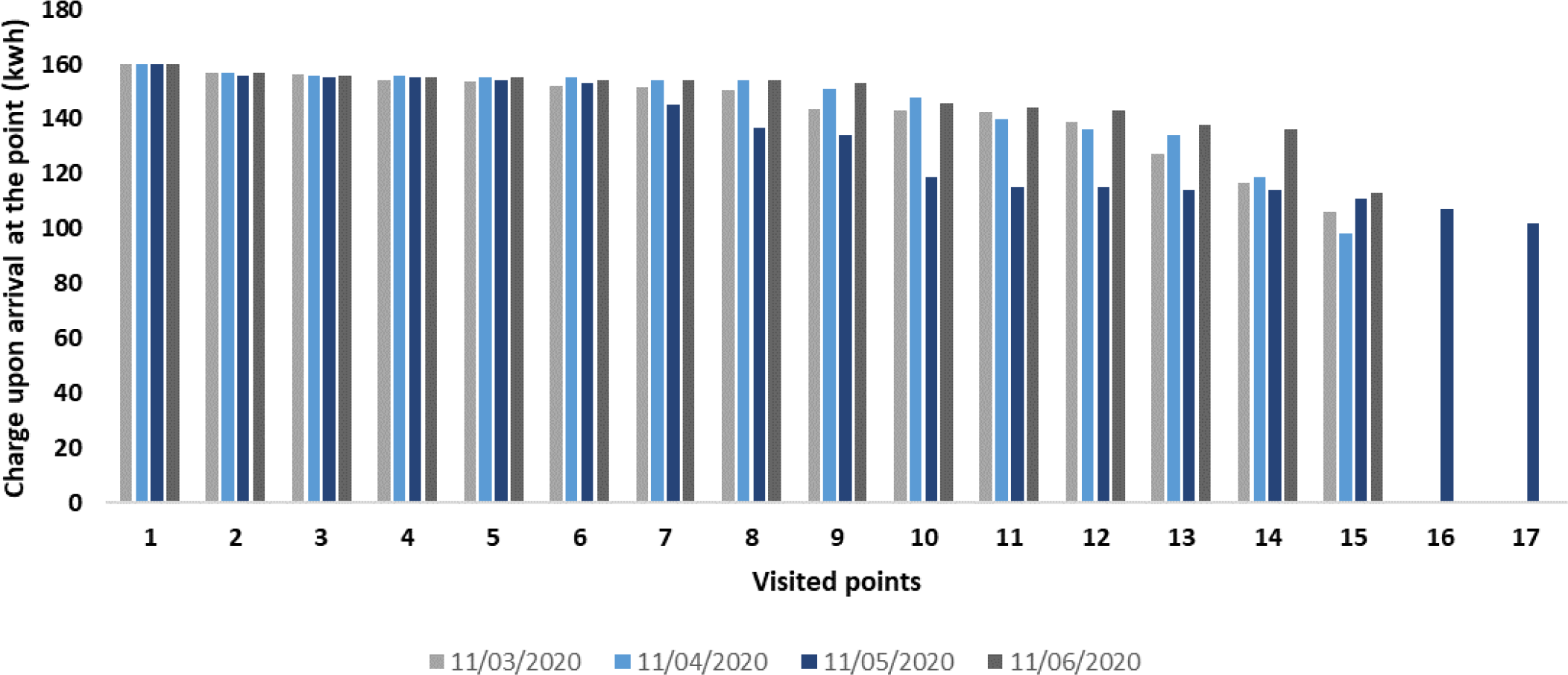
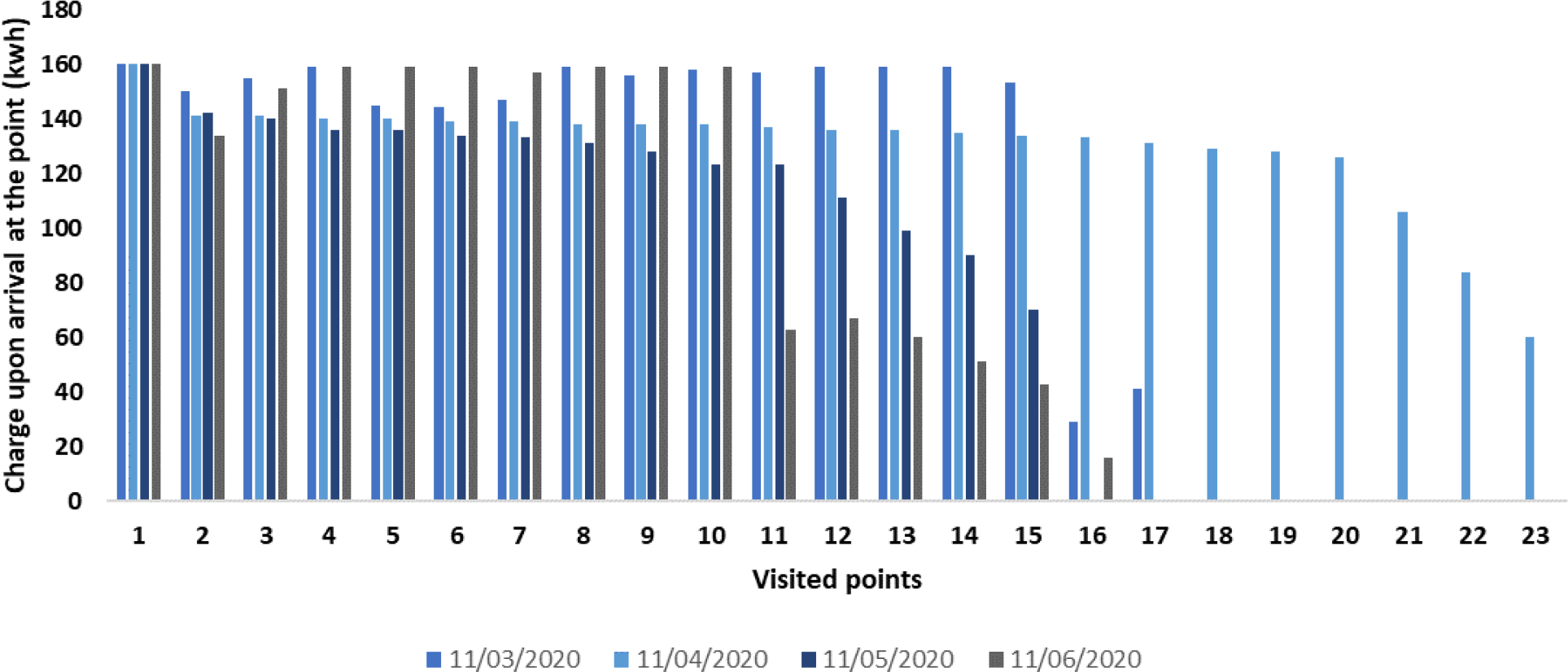
In Mairiporã, the teams MAI-01, MAI-02, and MAI-03 are responsible for providing service for different points each day. Table 2 presents the daily optimization results for team MAI-01. The farthest distance that the electric truck will have to travel in this test to attend all occurrences represents approximately 38% of the total battery charge, therefore, there are no restrictions for the use of this vehicle for these activities since the autonomy is enough to perform all tasks looking to the final battery state of charge (SoC).
Figure 1 represents the battery charge status of the electric truck used by the MAI-01 team during their displacement between November 3rd and November 6th, 2020.
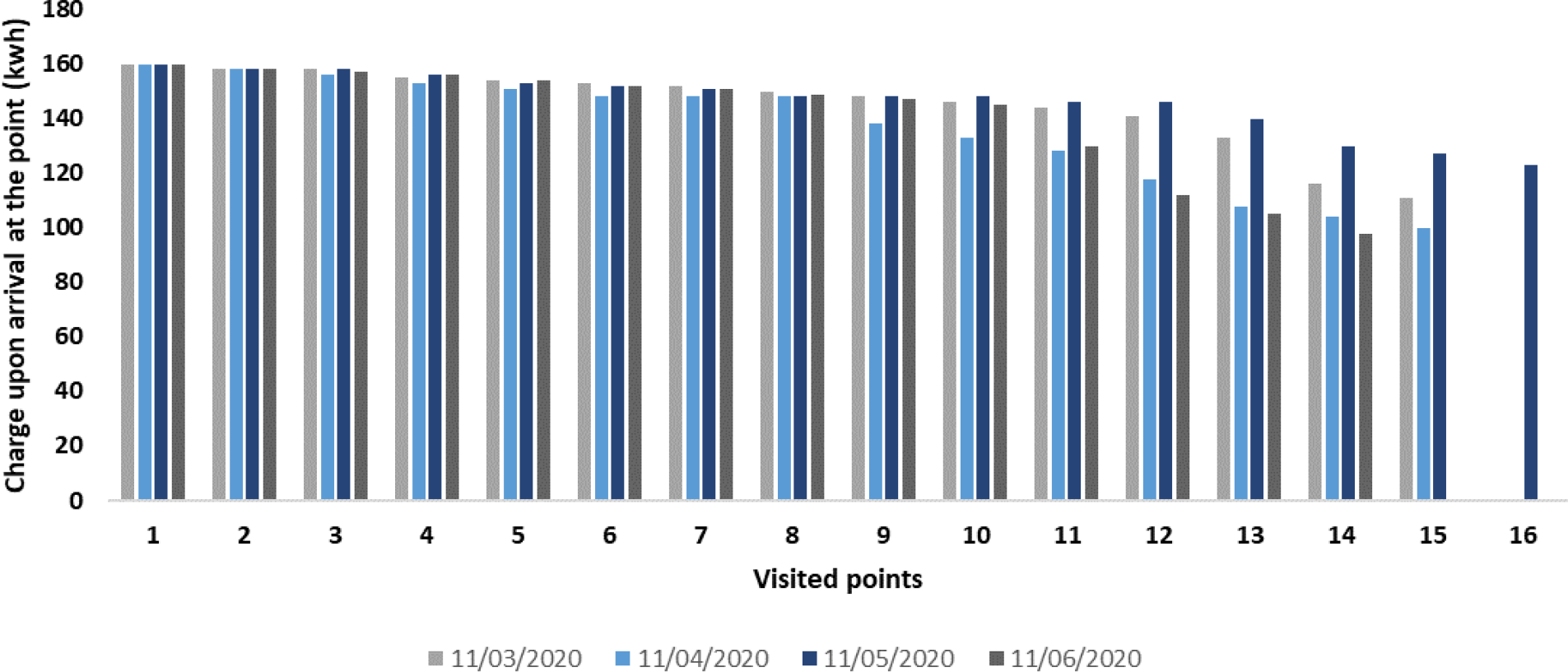
The summary of optimization results for team MAI-02 is presented in Table 3. In this case, the autonomy of the electric truck was also met, as the longest distance traveled represents approximately 38% of the total battery capacity, with no restrictions for using this vehicle for these activities.
Figure 2 illustrates the battery charge status of the electric truck used by the MAI-02 team during their displacement between November 3rd and November 6th, 2020.
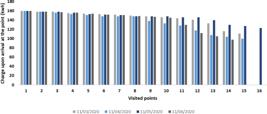
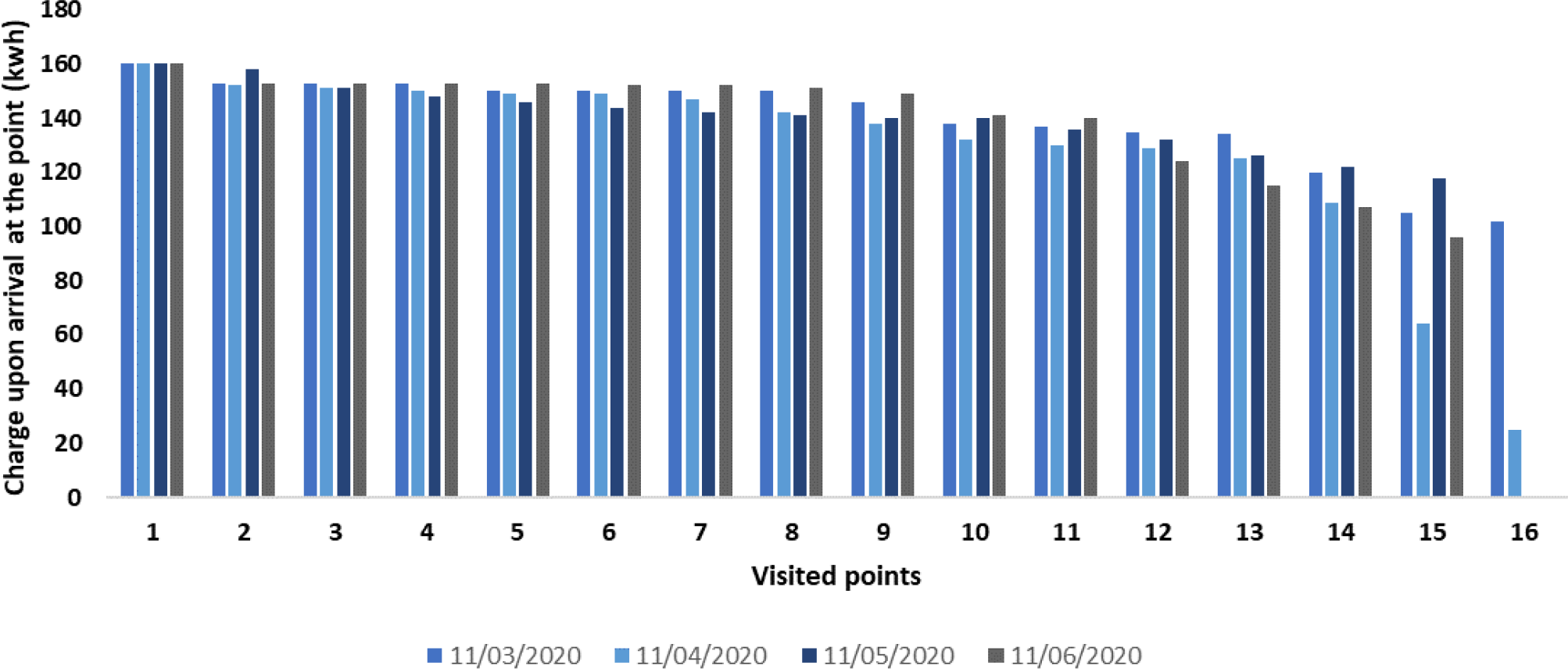
Table 4 presents a summary of the simulation results for the MAI-03 team in Mairiporã, where it can be seen that the distance traveled by the electric truck represents 84% of the total battery charge for the maximum distance traveled. Therefore, there are no restrictions for the use of this vehicle for these activities, as autonomy is sufficient.
It is worth noting that when the solver reaches the maximum set time of 500 seconds, it does not guarantee that the optimal solution has been achieved. Therefore, the result obtained on 11/04/2020 is an approximate solution. In these tests, the maximum set time was not changed. Figure 3 illustrates the battery charge status of the electric truck used by the MAI-03 team during their displacement between November 3rd and November 6th, 2020.
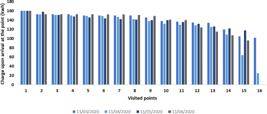
Table 5 presents a summary of the movements of the three teams during the considered period, using the electric truck and the combustion truck. It is noteworthy that the teams currently do not have a previously defined routing. Therefore, comparing the distances traveled in the optimized routes and the routes taken using the combustion truck, it is noted that the lack of planning results in a displacement of approximately 63% greater when compared to the electric truck. In this case, when the recharged is not used, the optimization route are the same for combustion or electric truck.
Comparison between distances traveled in Mairiporã by the optimized and non-optimized truck route.
Atibaia Results
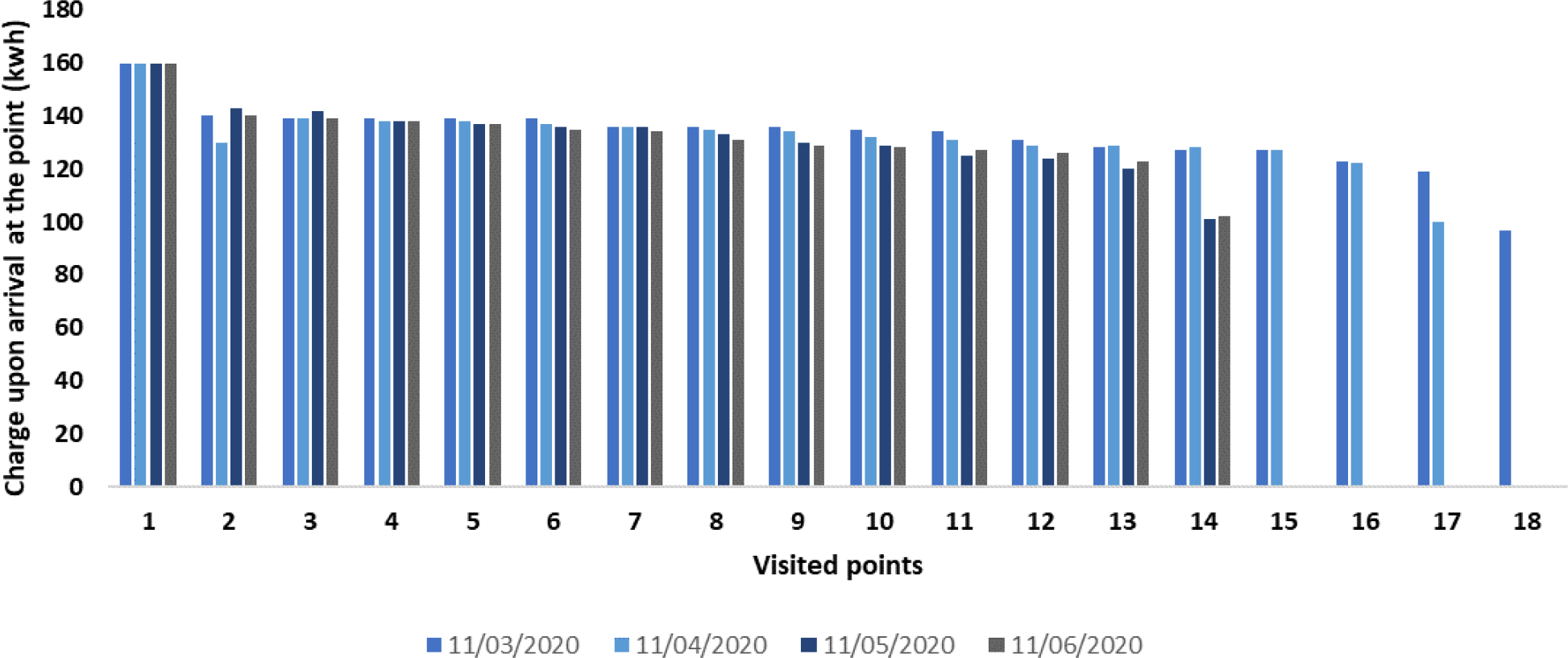
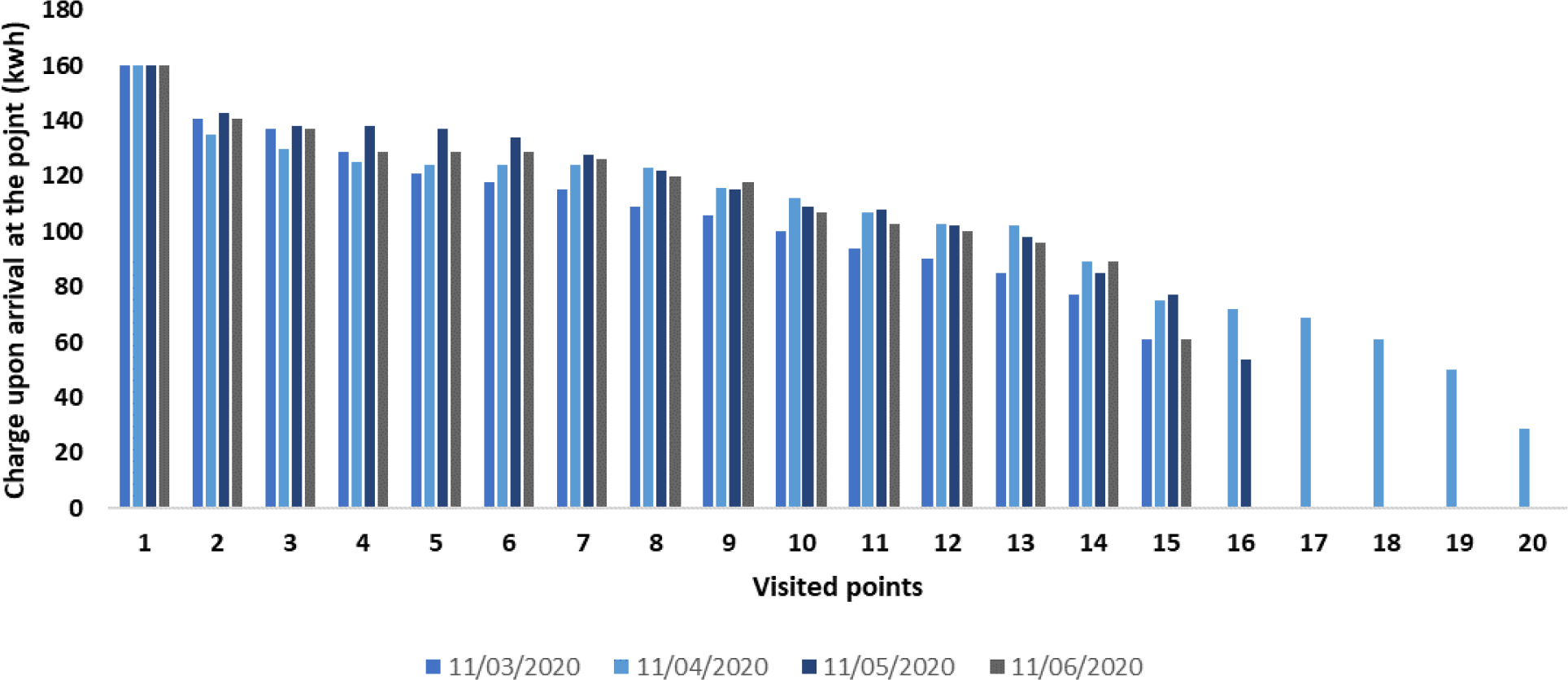
The city of Atibaia is served by the teams ATI-01, ATI-02, and ATI-03. Table 6 presents a summary of the results obtained for the ATI-01 team, where it can be noted that the distance covered by the electric truck represents 39% of the total battery charge for the maximum distance traveled, therefore, there are no restrictions for the application of this vehicle for these activities since the autonomy is sufficient.
Figure 4 presents the battery electric truck charge status for the team ATI-01 displacement between November 3rd and November 6th, 2020.
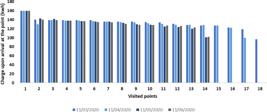
The results of the simulation for team ATI-02 are summarized in Table 7. It can be observed that the electric truck covered a distance in Atibaia for two days that exceeded the battery autonomy, indicating the need for an intermediate recharge. This requirement for recharging confirms that the algorithm considers the battery capacity adequately.
The battery charge status of the electric truck used by team ATI-02 during their displacement between November 3rd and November 6th, 2020 is presented in Figure 5.
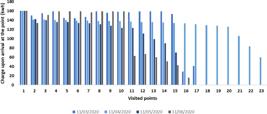
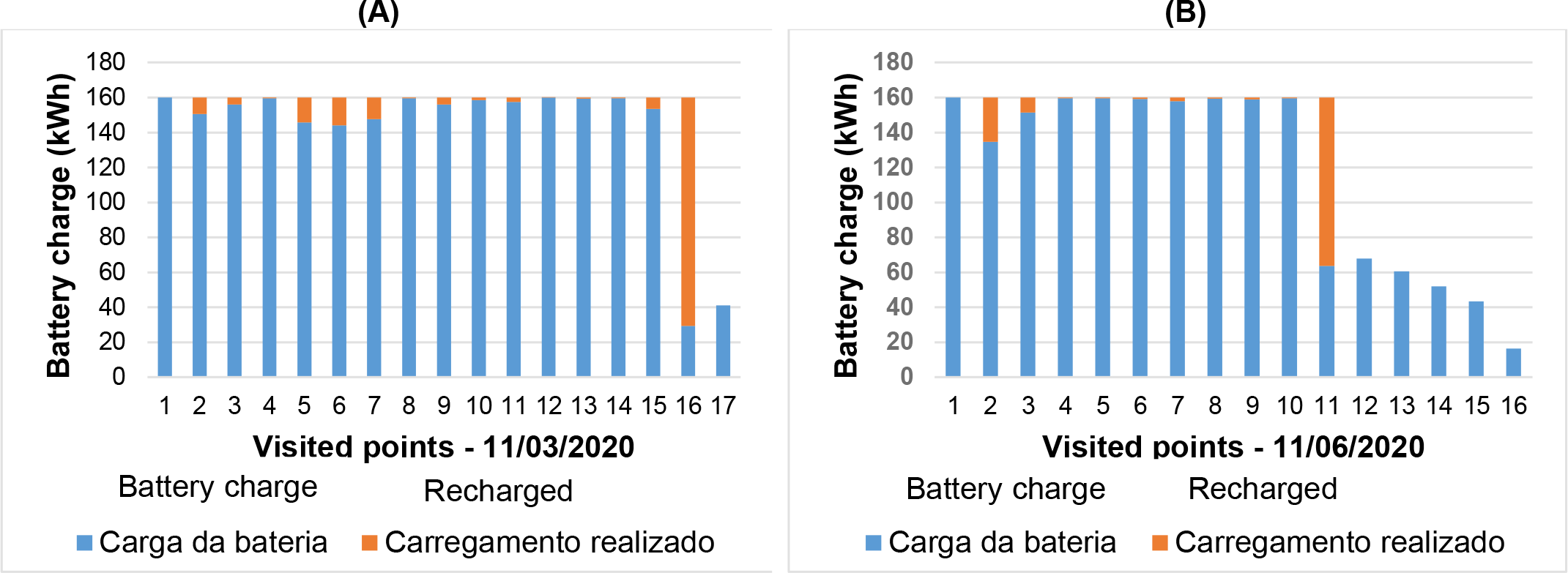
The results of the intermediate recharge for the two days that the team ATI-02 needed recharge during the rout is presented in Figure 6. During those days, the team carried out activities outside its usual region, such as equipment maintenance on November 3rd, 2020, and attending activities in a neighboring city on November 6th.
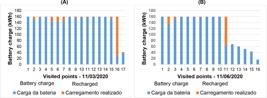
Table 8 summarizes the results obtained for the ATI-03 team in Atibaia, showing that the distance covered by the electric truck represents 81% of the total battery capacity for the maximum distance traveled, indicating that there are no restrictions for the use of this vehicle in these activities as the autonomy is sufficient.
In Figure 7 is presented the battery electric truck charge status for the team ATI-03 displacement between November 3rd and November 6th, 2020.
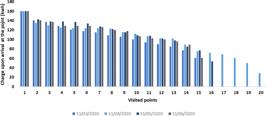
Table 9 provides a summary of the displacements of the three teams during the analyzed period, using both the electric and combustion trucks. It is important to note that the teams currently do not have a predefined routing system. Therefore, when comparing the optimized routes and the routes taken using the combustion truck, it becomes evident that the lack of planning results in a displacement that is around 42% longer than the one achieved by the electric truck.
Comparison between the distances traveled in Atibaia by the electric truck and the combustion truck.
CONCLUSION
In conclusion, the results of this work are coherent and consistent with the objectives of the mathematical model, as they fall within the proposed conditions. The proposed model, based on the ETSP with customized constraints, allows for recharging at various points along the route, as well as partial or complete recharging. The proposal also guarantees that the objective function will recharge the battery, when necessary, as well as ensuring that the evolution of battery consumption is consistent with the consumption function adopted in the model. In addition, the requirement for battery energy consumption of up to a maximum of 10% of the battery SoC is also guaranteed in the model, these charge levels are important for maintaining the vehicle battery’s lifespan regarding the maximum depth of discharge indicated by the truck manufacturer.
As for the numerical experiments carried out, based on the battery information of the electric vehicle to be implemented, in most cases there was no need for recharging during the execution of the planning. The importance of routing methodology for electric trucks is highlighted in this work, due to their lower range compared to combustion trucks, longer recharge times, and limited availability of charging stations.
Moreover, this work also emphasizes the significance of applying routing to fossil fuel combustion trucks, as routing can lead to a 63% reduction in displacement in Mairiporã and a 42% reduction in Atibaia, as well as significant fuel savings and reductions in preventive maintenance costs, increasing the overall lifespan of the vehicles.
In future work, a heuristic approach can be developed to solve larger problems, as the maximum computational time was reached in most of the tested scenarios. This method ensures that vehicles are always available for work shifts, demonstrating the feasibility of adopting electric vehicles for this type of activity. However, improvements in charging infrastructure are still necessary to achieve even better results in the future. Additionally, financial analyses can be conducted to further enhance the outcomes. There is also the potential to compare the results obtained by the improved method in this study with other established methods to identify the optimal solution for each case.
-
Funding:
This research is being funding by the R&D project PD-00385-0069/2019 sponsored by Neoenergia Elektro, under the auspices of the R&D Program of the Brazilian Electricity Regulatory Agency - ANEEL.
Acknowledgments:
None
REFERENCES
-
1 Boon WPC, Bakker S. Learning to shield - Policy learning in socio-technical transitions. Environ Innov Soc Transit 2016;18:181-200. Available in: https://doi.org/10.1016/j.eist.2015.06.003 .
» https://doi.org/10.1016/j.eist.2015.06.003 -
2 Nykvist B, Nilsson M. The EV paradox - A multilevel study of why Stockholm is not a leader in electric vehicles. Environ Innov Soc Transit 2015;14:26-44. Available in: https://doi.org/10.1016/j.eist.2014.06.003 .
» https://doi.org/10.1016/j.eist.2014.06.003 - 3 World Health Organization. World health statistics 2018: monitoring health for the SDGs, sustainable development goals. 2018.
-
4 Struben J, Sterman JD. Transition Challenges for Alternative Fuel Vehicle and Transportation Systems. Environ Plann B Plann Des 2008;35:1070-97. Available in: https://doi.org/10.1068/b33022t .
» https://doi.org/10.1068/b33022t -
5 World Wildlife. Fund 2017: [The role of electric vehicles in the clean economy, Climate and Energy - Climate and Energy Change Program] WWF Brasil. Available in: https://www.wwf.org.br/?61662/O-Papel-dos-Veculos-Eltricos-na-Economia-Limpa .
» https://www.wwf.org.br/?61662/O-Papel-dos-Veculos-Eltricos-na-Economia-Limpa -
6 Myers MWC. [Feasibility analysis for replacing diesel-powered VUC trucks with electric-powered trucks]. Natal - RN. Undergraduate Thesis [Bachelor's Degree in Mechanical Engineering] - Universidade Federal do Rio Grande do Norte (UFRN), 2021. Available in: https://repositorio.ufrn.br/handle/123456789/42924
» https://repositorio.ufrn.br/handle/123456789/42924 - 7 Arenales M, Morabito R, Armentano V, Yanasse H. [Operational Research: For engineering courses]. 1st ed. Elsevier Brasi; 2015.
-
8 Qin H, Su X, Ren T, Luo Z. A review on the electric vehicle routing problems: Variants and algorithms. Front. Eng. Manag. 2021;8:370-89. Available in: https://doi.org/10.1007/s42524-021-0157-1 .
» https://doi.org/10.1007/s42524-021-0157-1 - 9 Zhou Y, Chen L, Yang Y, Li Y, Cheng G, Fu Y, et al. Electric Vehicle Routing Problem: Model and Algorithm. 12th International Conference on Measuring Technology and Mechatronics Automation (ICMTMA) 2020:1049-54.
-
10 Abid M, Tabaa M, Chakir A, Hachimi H. Routing and charging of electric vehicles: Literature review. Energy Rep 2022;8:556-78. Available in: https://doi.org/10.1016/j.egyr.2022.07.089 .
» https://doi.org/10.1016/j.egyr.2022.07.089 -
11 Thymianis M, Tzanetos A, Osaba E, Dounias G, Del Ser J. Electric Vehicle Routing Problem: Literature Review, Instances and Results with a Novel Ant Colony Optimization Method. 2022 IEEE Congress on Evolutionary Computation (CEC), IEEE; 2022, p. 1-8. Available in: https://doi.org/10.1109/CEC55065.2022.9870373 .
» https://doi.org/10.1109/CEC55065.2022.9870373 -
12 Küçükoğlu İ, Dewil R, Cattrysse D. Hybrid simulated annealing and tabu search method for the electric travelling salesman problem with time windows and mixed charging rates. Expert Syst Appl 2019;134:279-303. Available in: https://doi.org/10.1016/j.eswa.2019.05.037 .
» https://doi.org/10.1016/j.eswa.2019.05.037 - 13 Schneider M, Stenger A, Goeke D. The Electric Vehicle-Routing Problem with Time Windows and Recharging Stations. Transp. Sci. 2014;48:500-20.
-
14 Roberti R, Wen M. The Electric Traveling Salesman Problem with Time Windows. Transp Res E Logist Transp Rev 2016;89:32-52. Available in: https://doi.org/10.1016/j.tre.2016.01.010 .
» https://doi.org/10.1016/j.tre.2016.01.010 -
15 Miller CE, Tucker AW, Zemlin RA. Integer Programming Formulation of Traveling Salesman Problems. J. ACM 1960;7:326-9. Available in: https://doi.org/10.1145/321043.321046
» https://doi.org/10.1145/321043.321046
-
Editor-in-Chief:
Alexandre Rasi Aoki
-
Associate Editor:
Clodomiro Unsihuay Vila