 Assessing runs of homozygosity reveals production traits of Kazakh sheep breeds
Abstract
Sheep breeding in Kazakhstan is one of the main local roles in animal husbandry. This article presents the results of a study of the genetic indicators of sheep breeds in Kazakhstan, in relation to their meat and wool productivity. Genetic analysis was carried out using the ROH (runs of homozygosity) method and candidate genes for various kinds of productivity traits were identified. The lowest mean genomic inbreeding coefficient values were observed in the Kazakh fine-wool breed and the Edilbay breed (FROH = 0.039 and FROH = 0.037). The highest values of inbreeding coefficient were in the Saryarka breed (FROH = 0.043), the Akzhaiyk breed (FROH = 0.044), and the Kazakh semi-coarse breed (FROH = 0.040). Since all these breeds possess the phenotypic traits for good meat constitution, the MSTN gene on the registered ROH islands has been identified and was found in all five breeds. In addition, genes affecting meat yield, adaptive traits, reproductive systems, immune systems, average daily weight gain, percentage of carcass fat, and third lumbar fat were observed within the recorded ROH islands using the Sheep QTL database. The results from the study of five breeds of sheep presented in the article are relevant (depending on the desired productivity traits) and have practical significance since only constitutionally strong animals, without exterior flaws and with high resistance to existing environmental factors, are able to produce higher yields and provide profitability to the sheep industry.
Keywords:
kazakh sheep breeds; DNA; ovine 50K SNP; run of homozygosity; inbreeding coefficient; candidate genes; productive traits
Resumo
A criação de ovelhas no Cazaquistão é uma das principais funções locais na criação de animais. Este artigo apresenta os resultados de um estudo dos indicadores genéticos de raças de ovelhas no Cazaquistão em relação à sua produtividade de carne e lã. A análise genética foi realizada usando o método ROH (runs of homozygosity), e genes candidatos para vários tipos de características de produtividade foram identificados. Os menores valores médios de coeficiente de endogamia genômica foram observados na raça de lã fina do Cazaquistão e na raça Edilbay (FROH = 0,039 e FROH = 0,037). Os maiores valores de coeficiente de endogamia foram na raça Saryarka (FROH = 0,043), na raça Akzhaiyk (FROH = 0,044) e na raça semi-grossa do Cazaquistão (FROH = 0,040). Como todas essas raças possuem características fenotípicas para uma boa constituição de carne, o gene MSTN nas ilhas ROH registradas foi identificado e encontrado em todas as cinco raças. Além disso, genes que afetam rendimento de carne, características adaptativas, sistemas reprodutivos, sistemas imunológicos, ganho de peso médio diário, porcentagem de gordura da carcaça e gordura da terceira lombar foram observados nas ilhas ROH registradas usando o banco de dados Sheep QTL. Os resultados do estudo de cinco raças de ovelhas apresentadas no artigo são relevantes (dependendo das características de produtividade desejadas) e têm significado prático, pois apenas animais constitucionalmente fortes, sem falhas externas e com alta resistência aos fatores ambientais existentes são capazes de produzir maiores rendimentos e fornecer lucratividade à indústria ovina.
Palavras-chave:
raças de ovelhas cazaques; DNA; SNP 50K ovino; corrida de homozigosidade; coeficiente de endogamia; genes candidatos; características produtivas
1. Introduction
Approximately 9,000 years B.P., sheep (Ovis aries) were domesticated in the Near East, and they are now one of the most culturally and economically important farm animals in the region (Tapio et al., 2010). It is likely that this occurred in the southern part of Central Asia, southwestern Asia, and Iran. It is possible that a separate domestic action event occurred in regions of North Africa and the Sahara Desert. Sheep breeding eventually spread to Egypt and the Mediterranean (Mukhametzharova et al., 2018). Kazakhstan occupies a huge territory with an area of approximately 276 million hectares, covering four latitudinal geographical zones—steppe, semi-desert, desert, and forest-steppe—as well as high-altitude zones, belts of the whole system and the mountain ranges of Altai, Tarbagatai, Dzungarian Alatau and Tien-Shan (Land Resources, 2017). The main feature of the available land areas of the republic is that they have a lot of pastures, represented mainly by those of natural origin. The presence of vast natural pastures makes it possible to intensively develop sheep breeding and produce very valuable, low-cost products (meat, wool, fur, and raw hide) (Land Resources, 2017). Sheep breeding in Kazakhstan is a strategic branch of agriculture, primarily because of the harsh natural and climatic conditions in almost its entire vast territory, which facilitates the provision of meat products to the population (Traisov et al., 2016).
The Edilbay breed was created at the end of the 19th century in the Ural region as a result of natural and artificial selection. No documented data are available on the appropriation of this sheep breed (Ermekov and Golodnov, 1976). On September 28, 1945, the board of the USSR approved the Kazakh fine-wool breed of sheep as a new independent breed. Work on the breeding of fine-fleece sheep for the regions of southeastern Kazakhstan (Rakhimzhanov et al., 1997). The Akzhaiyk meat–wool breed of sheep was cross bred with wool breeds in East Kazakhstan in 1996 by complex reproductive crossbreeding of fine-fleece and semi-fine-coarse-haired ewes with rams of the Lincoln and Romney Marsh type, subsequently interbreeding desired specimens (Karabayev, 2015). The Saryarka fat-tailed breed was approved in 1999. This breed of sheep was created (1970–1998), mainly through in-breeding selection and selection according to the breeding traits of the improved Kazakh fat-tail sheep crossed with the Edilbay sheep and partially crossed with the Kargaly semi-coarse sheep with the subsequent interbreeding of desired specimens (Manurov, 2005). They are mainly distributed across Central Kazakhstan (Kineev and Erdenov, 2009; Karabayev, 2015). The Kazakh fat-tail semi-coarse breed was created by means of complex reproductive breeding of local Kazakh coarse-haired sheep with Edilbay, Saraja, Degeress, and Tadzhik breeds of sheep (Kineev and Erdenov, 2009). Nowadays, there has been an increase in the breeding of Kazakh sheep breeds by researchers using microsatellite (Dossybayev et al., 2018; Mukhametzharova et al., 2018) and SNP analysis (Pozharskiy et al., 2020; Zhumadillayev et al., 2022).
In recent years, the popularity of sheep production has increased, which has led to an interest in the genomic evaluation of sheep breeds (Zhang et al., 2013). The development of high throughput single nucleotide polymorphism (SNP) genotyping technologies for the performance of genetic analysis in livestock species has increased in recent years, which in turn has improved animal breeding, genomic prediction, and animal selection (Gholizadeh et al., 2015; Kijas et al., 2014; Vignal et al., 2002). Genotyping using SNPs is a powerful tool for genetic selection (Seidel, 2010; Haynes and Latch, 2012). With the increased demand from the sheep industry (meat and wool production), breeders started to increase the number of heads and the quality of sheep; meanwhile, geneticists have been concerned with beneficially economic traits, the genetic evaluation of sheep, and genetic prediction. Each animal breed, being a product of the interaction of the genotype and the environment, has its biological characteristics and distinctive properties (Zhang et al., 2013). Recent application of genome-wide SNP analysis, as well as determination of population structure based on the OvineSNP50 BeadChip, has shown good suitability in Russian, Ethiopian and German sheep breeds. A series of homozygosity distribution patterns (ROH) has been used to quantify genetic diversity (Addo et al., 2021).
SNP markers are used to identify regions of the genome in which a decrease in heterozygosity has occurred, as well as changes in homozygosity, since these markers are distributed throughout the genome. ROHs are not only an indicator of inbreeding but can also be used to identify economically useful and important genes present in these regions, which may be used to minimize the inbreeding coefficient and improve the breeding process (Mastrangelo et al., 2018). Sheep researchers are conducting various studies to increase population numbers with excellent genetic potential using artificial insemination and quantitative loci (QTL). QTL are loci associated with the phenotypic variability of the organism (Miles and Wayne, 2008). The use of QTL has for many years been the preferred tool to identify economically important phenotypic traits (Zhang et al., 2012).
In this work, we investigated the identified candidate genes for productive traits in five local Kazakh sheep breeds using the OvineSNP50K BeadChip. This research will influence the future of Kazakh sheep breeding. On Kazakhstan’s territory, many species of domestic animal such as horses, cattle, goats, and others, have yet to be studied at the genetic level. Based on this research, further selection will be carried out to improve the Kazakh sheep breeds. The use of the most adapted, highly productive, and economically profitable sheep genotypes in breeding strategies to improve their meat and wool qualities in relation to specific economic conditions is of both scientific and practical interest.
2. Materials and Methods
Institutional Review Board Statement: The study was approved by the Ethics Commission of the NJSC “Kazakh National Agrarian Research University”, Kazakhstan (11/08/2022).
2.1. Location and collection of samples
We utilized publicly available datasets of five Kazakh sheep breeds (n=6161), genotyped with the OvineSNP50 BeadChip. These datasets were obtained from Mendeley Data (https://data.mendeley.com/datasets/57ct3z6bvv/1, accessed on 22 September 2020) for our analysis. Ear tissue samples were collected around Kazakhstan and were categorized into groups. For this study, samples were collected from 4 wool types: coarse wool (CW), semi-coarse wool (SMW), fine wool (FW) and semi-fine wool (SFW) (Table 1, Figure S1). Samples from the Edilbay (ED) breed (n=1264) were collected in the Western Kazakhstan and the Almaty regions. Samples from the Akzhaiyk (AK) breed (n=2020) were collected in the Western Kazakhstan region. Samples from the Kazakh fine wool (KFW) breed were collected in the Almaty region (n=500). In the case of the Kazakh fat-tailed semi-coarse-wool (KSCW) breed (n=1755), samples were taken from the Karaganda and the Eastern Kazakhstan regions. Samples from the Saryarka (SA) breed (n=600) were collected in the Karaganda region.
2.2. Quality Control and Data Analysis
For quality control (QC), the PLINK v1.9 software was used (Purcell et al. 2007) based on the following parameters: the missing rate per SNP, missing rate per individual and minor allele frequency (MAF) set to 0.1, 0.1, and 0.05, respectively, and Hardy–Weinberg equilibrium (HWE) (p < 10 -5); SNPs with more than 10% Mendel error were also filtered out. Nevertheless, to examine the genotyped data, all extra SNPs were excluded, other than the SNPs located on autosomes. Sex chromosomes were also excluded.
The population structure was observed through PCA (principal components analysis) using the option –pca in PLINK v1.9, also visualized with R studio.
For the Edilbay breed 45023 SNPs from 916 sheep passed filters and QC. As a result of the QC for the Kazakh fine-wool breed there were 46511 variants in 290 individuals; for the Saryarka breed there were 44819 variants in 419 individuals. In the case of the Akzhaiyk breed 49899 SNPs in 1588 individuals passed QC. In addition, as a result of the quality control there were 45953 variants in 887 individuals retained in the Kazakh semi-coarse-wool breed.
Runs of homozygosity (ROH) analysis was conducted with the R package detectRUNS v. 0.9.5 (Biscarini et al., 2018). ROH islands were calculated using the following parameters: per ROH was set for 1 SNP marker per 50 kb, 30 consecutive homozygous SNPs was a minimum number for ROH islands, 500 kb was a higher gap between homozygous SNPs, the minimum ROH length was set to 1 Mb for avoiding short consecutive homozygosity segments derived from higher linkage disequilibrium. ROH length, according to Kirin and coauthors (Kirin et al., 2010) and Ferenčaković and colleagues (Ferenčaković et al., 2013a; Ferenčaković et al., 2013b) was classified into five classes 1–2, 2–4, 4–8, 8–16, and >16 Mb. The average number of ROH islands per animal, the average length of the ROH segment per individual, the number of homozygosity islands, and the average length of the runs on the chromosome were estimated.
The individual inbreeding coefficients, based on ROH segments for individuals, were calculated as the proportion of the autosomal genome above a specified length threshold F_ROH= ∑ L_ROH/L_auto where ∑ L_ROH is the sum of all the ROH length discovered per animal, while L_auto is the total length of the autosomal genome covered by SNPs, centromeres excluded (McQuillan et al., 2008). For each breed, individual consanguinity coefficients according to the five different categories, FROH1–2 Mb, FROH2–4 Mb, FROH4–8 Mb, FROH8–16 Mb, and FROH >16 Mb, were estimated.
For detected genomic regions with high frequency of ROH, the occurrence percentage of SNPs in an ROH was estimated by counting the number of times the SNP was detected inside the ROH in the sampled animals, then the proportion of times each SNP fell inside an ROH was plotted against SNP positions along the chromosome The significance in ROH analysis with p-value of < 0.05 of the SNPs were included.
The genomic region associated with each of the ROH islands was annotated using the Sheep Quantitative Trait Loci (QTL) database (http://www.animalgenome.org/cgi-bin/QTLdb/OA/summary). The genomic coordinates for these ROH segments for gene annotation were detected using Ensembl BioMart by OAR_v3.1-based assembly per each breed (http://www.ensembl.org/biomart/martview/7a48879424ee4599ae80a4be9139ead4); these coordinates were then submitted to the DAVID (Database for Annotation, Visualization, and Integrated Discovery) database (http://david.abcc.ncifcrf.gov/) for gene ontology. Significant enrichment for the candidate genes with a p-value of < 0.05 was indicated.
3. Results and Discussion
3.1. Population structure
For the fisrt of all, we performed PCA (Figure 1) for detailed examine the genetic relationships among studied populations the basis on genotyping data. The PC analysis revealed that all breeds formed separetely clusters, except Saryarka breed. Since it was formed from the Edilbay, Kazakh fat-tailed breed and Kargaly semi-coarse sheep (Karynbaev et al., 2014; Smagulov et al., 2020), but for the latests two breeds we have no genetic data. According to this analysis, that genetic structure of the Saryarka breed has slight similarities with the Edilbay breed. The individuals within each breed clustered closely together, and all five breeds have their own genetic structure. The Akzhaiyk and Kazakh Fine wool breeds has a great diversity of genetic structure, unlike other breeds, which have a denser genetic structures such as Edilbay, Kazakh Semi Coarse wool and Saryarka sheep breeds.

Principal components analysis (PC1) of the 5 Kazakh sheep breeds: For a description of the sheep breeds, see Table 1.
3.2. ROH islands
ROH islands were detected in all studied breeds on all autosomes. Mean ROH lengths varied significantly in different sheep breeds (Table 2).
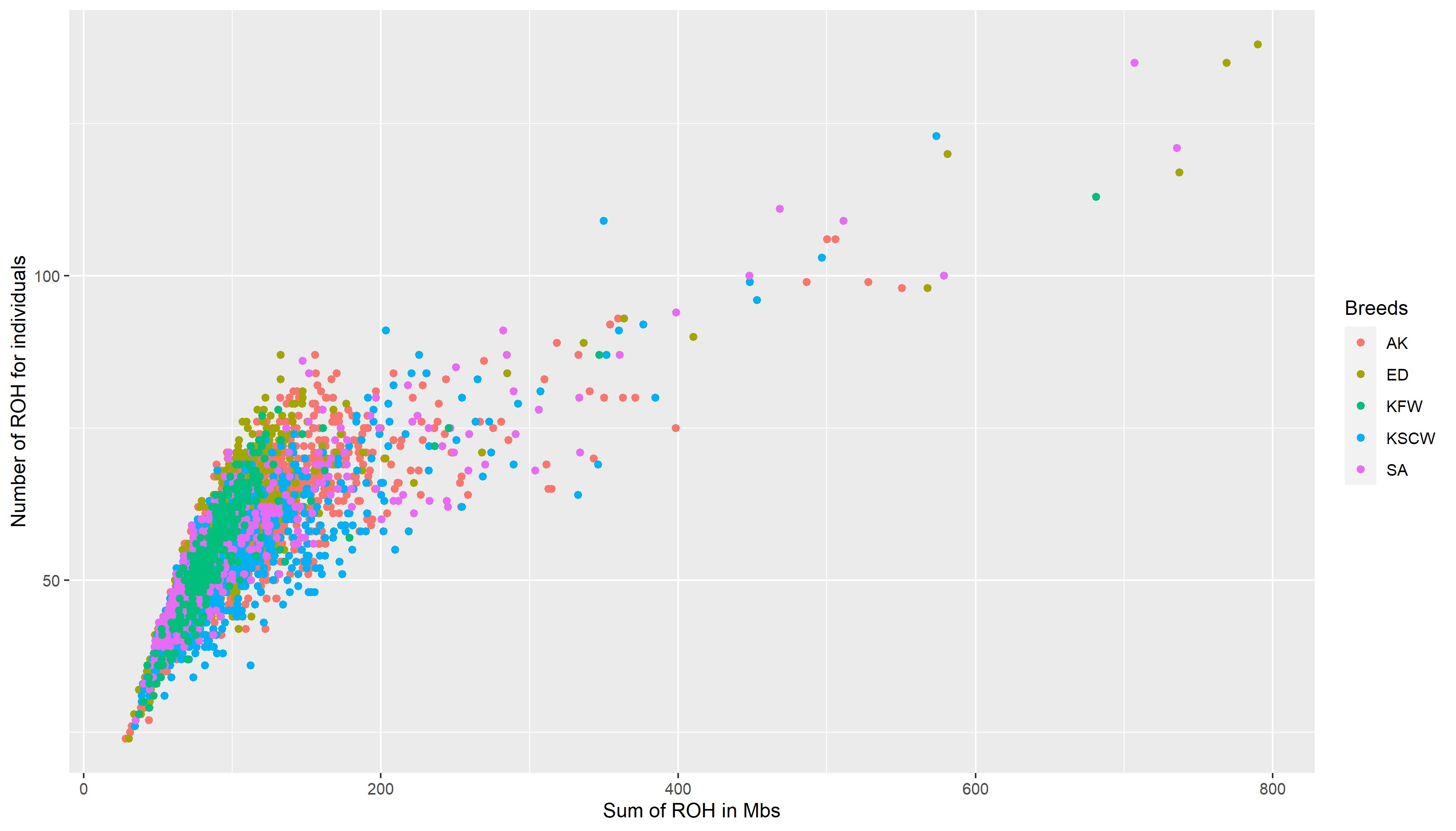
Mean ROH lengths ranged from 91.9 Mb in the Kazakh fine-wool breed to 109.6 Mb in the Saryarka breed. Among all the studied breeds, the maximum individual ROH length was found in the Edilbay breed (789.9 Mb), and the minimum was identified in the Akzhaiyk breed (28.4 Mb). Considering the individual ROH numbers, the greatest number was displayed in the Edilbay breed (138) and the lowest numbers were detected in the Akzhaiyk and Edilbay breeds (24) (Table 2, Figure 2).

Genomic coverage in ROH (X-axis) and ROH number per individual (Y-axis) in 5 Kazakh sheep breeds.
3.3. Inbreeding coefficient
The mean genomic inbreeding coefficient values were the highest in the Akzhaiyk (FROH = 0.044), Kazakh semi-coarse (FROH = 0.040), and Saryarka breeds (FROH = 0.043); the lowest values were in Kazakh fine-wool breed (FROH = 0.037) and the Edilbay (FROH = 0.039).
Among all the studied animals, the maximum individual FROH value was calculated in the Edilbay breed (FROH = 0.31) and the minimum FROH value in the Akzhaiyk breed (FROH = 0.225) (Figure 3).

Based on previous studies in cattle (McQuillan et al., 2008; Kirin et al., 2010; Kim et al., 2013; Zhang et al., 2015) and sheep (Purfield et al., 2012), the inbreeding coefficient in populations can be detected. There are several methods for detecting the inbreeding coefficient—one of them is the FROH method—and a moderate correlation between FROH and FPED can be found in the study by Purfield and colleagues (Purfield et al., 2012). Both methods of detecting inbreeding can be used for research; one method does not exclude the other. For accurate prediction, in our study, we used the ROH method to find the inbreeding coefficient. ROH has been well studied in humans and pets and is a method for determining population history. ROH provides useful information about genetic events in a population, and animal genetic relationships to control the rate of inbreeding in a herd and is a predictor of levels of inbreeding in populations (Dzomba et al., 2021).
In this study, the minimum inbreeding coefficient was revealed in the Edilbay breed (FROH = 0.039) and the Kazakh fine-wool breed (FROH = 0.037), from which it can be concluded that in these two populations there is a genetic diversity of breeding rams and ewes; since the Edilbay breed is native, as described in the article by Pozharskiy and coauthors (Pozharskiy et al., 2020), selection for this breed is carried out quite carefully in Kazakhstan. One of the breeds that has a high inbreeding coefficient compared to other Kazakh breeds, is Akzhaiyk (FROH = 0.044); this is because the number of animals of the Akzhaiyk breed is the smallest of the sheep breeds in Kazakhstan.
3.4. ROH segments
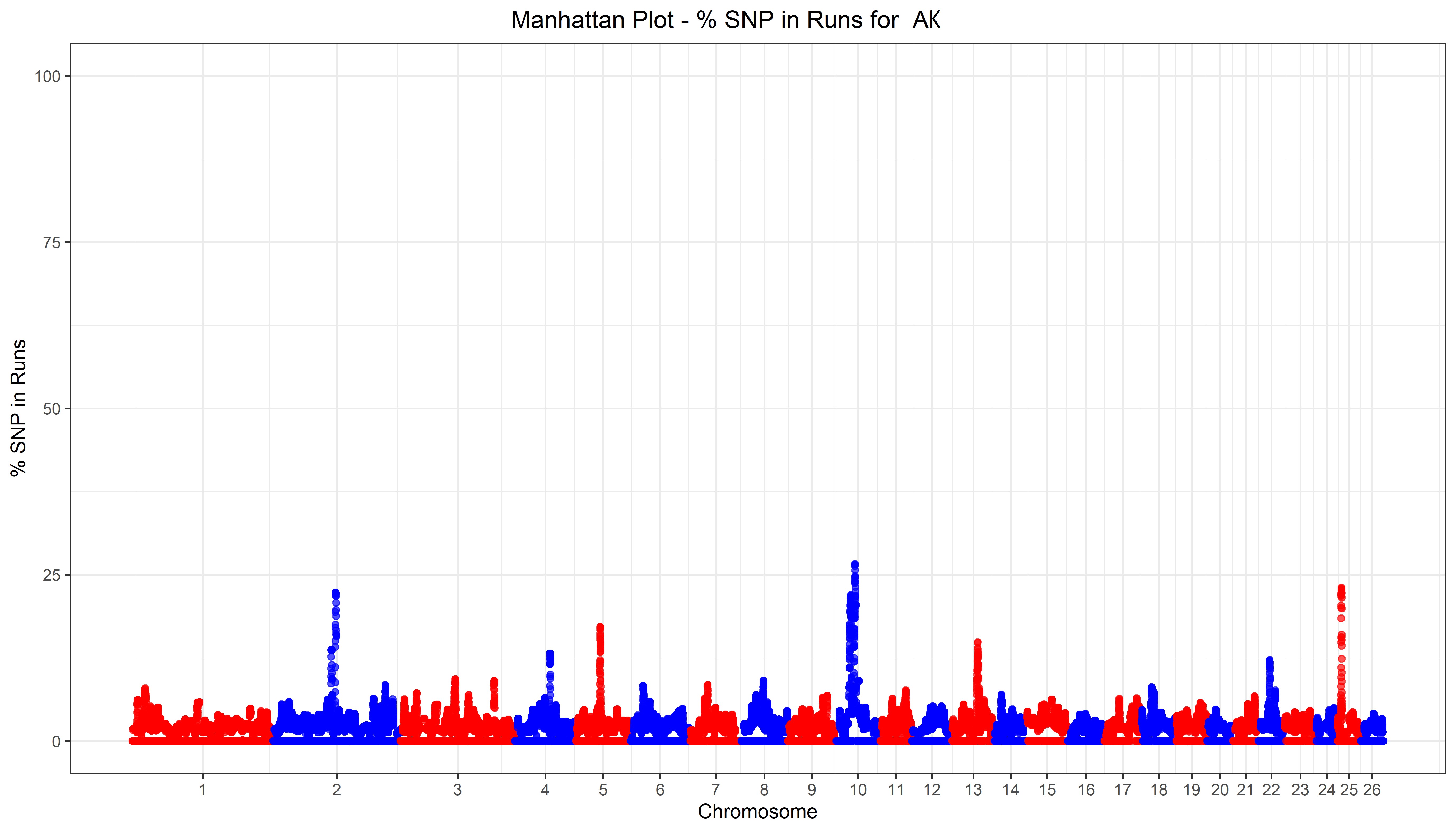
According to Table 3, and Figure 4 -8, it was revealed that ROH segments in all five breeds are found in the second and tenth chromosomes.

Manhattan plot of the distribution of ROH in the Edilbay breed. The x-axis is the SNP position, and the y-axis shows the frequency (%) at which each SNP occurred.

Manhattan plot of the distribution of ROH in the Kazakh ûne-wool breed. The x-axis is the SNP position, and the y-axis shows the frequency (%) at which each SNP occurred.

Manhattan plot of the distribution of ROH in the Saryarka breed. The x-axis is the SNP position, and the y-axis shows the frequency (%) at which each SNP occurred.

Manhattan plot of the distribution of ROH in the Akzhaiyk breed. The x-axis is the SNP position, and the y-axis shows the frequency (%) at which each SNP occurred.

Manhattan plot of the distribution of ROH in the Kazakh semi-coarse breed. The x-axis is the SNP position, and the y-axis shows the frequency (%) at which each SNP occurred.
The Saryarka and Edilbay breeds have ROH islands on chromosome 21. In the Kazakh semi-coarse-wool and Kazakh semi-fine-wool breeds, they were identified on chromosome 16. The Akzhaiyk breed is the only breed that has an ROH segment on chromosomes 4, 5, and 22. The largest number of SNPs (89) was detected in the Akzhaiyk breed on chromosome 10. The minimum number of SNPs (1) was determined in the Kazakh semi-fine-wool breed on chromosomes 1 and 10, the Kazakh semi-coarse-wool breed also has a minimum number of SNPs (1) on chromosomes 6 and 10, and in the Saryarka breed, 1 SNP was also detected on the second chromosome.
3.5. SNPs and gene annotation
In the Akzhaiyk breed, homeobox family genes, shown in Table 4, are expressed during early embryological development and during the critical stages of embryogenesis and early body plan specification (Jacobson, 2010).
In addition, HOXD9 and HOXD3 genes (homeobox cluster) were identified in the Akzhaiyk breed (Table 4) and found to affect the polyceraty phenotype in Jacob, Navajo-Churro, Damara and Sishui Fur sheep breeds; these genes are also responsible for identifying horn number and horn existence in sheep (Johnston et al., 2011; Gebreselassie et al., 2019). This fact is described in the phenotypic data of the Akzhaiyk breed; at the moment, some representatives of this breed have the beginnings of horns that have been atrophied as a result of selective breeding. The Villin gene (Kazakh fine-wool breeds) represents an actin-severing and bundling, nucleating and capping protein that accumulates predominantly in the microvilli of absorptive intestinal epithelial cells of mammals; together with the actin-bundling protein fimbriated to gelsolin, it is responsible for forming a rigid structure in the nucleus of microvilli and mediating stress responses (Klahre et al., 2000). An et al. identified that the CCNY gene might play a different role in the various peripheral tissues of mice and might be involved for regulating glucose and lipid metabolism in the body (An et al., 2015). Dzomba et al. observed sphingolipid metabolism, purine metabolism and metabolic systems pathways in South African sheep breeds (Dzomba et al., 2021) and, as in this study, observed lipid metabolic processes and galactose metabolic process in Edilbay and Saryarka breeds.
3.6. Candidate genes and QTL
ROH is also used to identify candidate genes and the function of these genes. Based on the Sheep QTL database, both performance traits—the average daily weight gain and percentage of carcass fat—adaptive traits, immune and reproductive systems, meat yield, and third lumbar fat, were observed within the recorded ROH islands. According to a previous population analysis of five Kazakh sheep breeds (Pozharskiy et al., 2020), it was shown that the population of Kazakh sheep breeds is the result of a mixture of indigenous, commercial, and mixed breeds that were raised in the extreme climatic conditions of Kazakhstan in a sharply continental climate where temperatures range from −40 to +40 degrees Celsius.
The MSTN gene, which is associated with meat production and weight gain, is also observed in the recorded ROH islands (Table 5) of all five breeds, which makes sense given that all these breeds have a good meat constitution. Additionally, the SLC15A1 gene, which is associated with reproductive function, was identified in the Akzhaiyk breed and the Kazakh fine-wool breed; this may be associated with the fact that more than one lamb is born in these breeds (Rakhimzhanov et al., 1997; Karabayev, 2015), which is not observed in the remaining three breeds. Edilbay, Kazakh semi-coarse wool and Saryarka have a high birth weight, and this gene was not found in the QTL sheep database. Moreover, related to the variety of breeds used to create the Kazakh fine-wool breed (Kineev and Erdenov, 2009), several candidate genes (IL2RA, KIF16B) were observed to be associated with resistance to parasites and variations in coat fineness. For the fine-wool breed, the FST gene was included in the genes associated with sheep wool; it was especially characterized for wool crimp traits and fiber diameter in merino sheep of the Chinese (Xinjiang) type (Gebreselassie et al., 2019). Sheep FST is a comparatively short gene and consists of six exons located on chromosome 16 (Gebreselassie et al., 2019). This may explain the good yield of merino wool in the Kazakh fine-wool breed.
4. Conclusions
Domestication of sheep has been a complex process in human history that has involved not only natural selection but also artificial selection and has resulted in the emergence of a diverse number of variations in animal phenotypes. Based on this study, in Kazakhstan there is a high number of high-performance sheep breeds, with a good constitution and genetic potential; within these breeds meat and wool productivity candidate genes, such as MSTN, CCNY, Villin and FST, have been identified using ROH fragments. This study has been carried out for the first time in Kazakhstan and is of great practical interest to farmers, scientists, and researchers in the field of sheep breeding.
Supplementary Material
Supplementary material accompanies this paper.
Figure S1
This material is available as part of the online article from https://doi.org/10.1590/1519-6984.292980
Acknowledgements
Funding: Ministry of Science and Higher Education of the Republic of Kazakhstan 2024 - 2026, BR24992940 - “Creation highly productive sheep population in north-eastern region Kazakhstan based on development effective selection techniques and introduction resource-saving technologies”
References
-
ADDO, S., KLINGEL, S., THALLER, G. and HINRICHS, D., 2021. Genetic diversity and the application of runs of homozygosity-based methods for inbreeding estimation in German White-headed Mutton sheep. PLoS One, vol. 16, no. 5, pp. e0250608. http://doi.org/10.1371/journal.pone.0250608 PMid:33956807.
» http://doi.org/10.1371/journal.pone.0250608 -
AN, W., ZHANG, Z., ZENG, L., YANG, Y., ZHU, X. and WU, J., 2015. Cyclin Y is involved in the regulation of adipogenesis and lipid production. PLoS One, vol. 10, no. 7, pp. e0132721. http://doi.org/10.1371/journal.pone.0132721 PMid:26161966.
» http://doi.org/10.1371/journal.pone.0132721 -
BISCARINI, F., COZZI, P., GASPA, G. and MARRAS, G., 2018 [viewed 26 December 2024]. detectRUNS: detect runs of homozygosity and runs of heterozygosity in diploid genomes [online]. Available from: https://cran.r-project.org/web/packages/detectRUNS/vignettes/detectRUNS.vignette.html
» https://cran.r-project.org/web/packages/detectRUNS/vignettes/detectRUNS.vignette.html - DOSSYBAYEV, K., MUSSAYEVA, A., BEKMANOV, B. and KULATAEV, B., 2018. Analysis of genetic diversity in three kazakh sheep using 12 microsatellites. International Journal of Engineering & Technology, vol. 7, no. 4.38, pp. 122-124.
-
DZOMBA, E.F., CHIMONYO, M., PIERNEEF, R. and MUCHADEYI, F.C., 2021. Runs of homozygosity analysis of South African sheep breeds from various production systems investigated using OvineSNP50k data. BMC Genomics, vol. 22, no. 1, pp. 7. http://doi.org/10.1186/s12864-020-07314-2 PMid:33407115.
» http://doi.org/10.1186/s12864-020-07314-2 - ERMEKOV, M. and GOLODNOV, A., 1976. Tailored sheep of Kazakhstan, Kaynar Almaty: Alma-Ata, pp. 15–81.
-
FERENČAKOVIĆ, M., HAMZIĆ, E., GREDLER, B., SOLBERG, T.R., KLEMETSDAL, G., CURIK, I. and SÖLKNER, J., 2013a. Estimates of autozygosity derived from runs of homozygosity: empirical evidence from selected cattle populations. Journal of Animal Breeding and Genetics, vol. 130, no. 4, pp. 286-293. http://doi.org/10.1111/jbg.12012 PMid:23855630.
» http://doi.org/10.1111/jbg.12012 -
FERENČAKOVIĆ, M., SÖLKNER, J. and CURIK, I., 2013b. Estimating autozygosity from high-throughput information: effects of SNP density and genotyping errors. Genetics, Selection, Evolution, vol. 45, no. 1, pp. 42. http://doi.org/10.1186/1297-9686-45-42 PMid:24168655.
» http://doi.org/10.1186/1297-9686-45-42 -
GEBRESELASSIE, G., BERIHULAY, H., JIANG, L. and MA, Y., 2019. Review on genomic regions and candidate genes associated with economically important production and reproduction traits in sheep (Ovies aries). Animals, vol. 10, no. 1, pp. 33. http://doi.org/10.3390/ani10010033 PMid:31877963.
» http://doi.org/10.3390/ani10010033 -
GHOLIZADEH, M., RAHIMI-MIANJI, G. and NEJATI-JAVAREMI, A., 2015. Genomewide association study of body weight traits in Baluchi sheep. Journal of Genetics, vol. 94, no. 1, pp. 143-146. http://doi.org/10.1007/s12041-015-0469-1 PMid:25846889.
» http://doi.org/10.1007/s12041-015-0469-1 -
HAYNES, G.D. and LATCH, E.K., 2012. Identification of Novel Single Nucleotide Polymorphisms (SNPs) in deer (Odocoileus spp.) using the BovineSNP50 beadchip. PLoS One, vol. 7, no. 5, pp. e36536. http://doi.org/10.1371/journal.pone.0036536 PMid:22590559.
» http://doi.org/10.1371/journal.pone.0036536 -
JACOBSON, B., 2010 [viewed 26 December 2024]. Homeobox genes and the homeobox [online]. Arizona State University: Embryo Project Encyclopedia. Available from: https://embryo.asu.edu/pages/homeobox-genes-and-homeobox
» https://embryo.asu.edu/pages/homeobox-genes-and-homeobox -
JOHNSTON, S.E., MCEWAN, J.C., PICKERING, N.K., KIJAS, J.W., BERALDI, D., PILKINGTON, J.G., PEMBERTON, J.M. and SLATE, J., 2011. Genome‐wide association mapping identifies the genetic basis of discrete and quantitative variation in sexual weaponry in a wild sheep population. Molecular Ecology, vol. 20, no. 12, pp. 2555-2566. http://doi.org/10.1111/j.1365-294X.2011.05076.x PMid:21651634.
» http://doi.org/10.1111/j.1365-294X.2011.05076.x - KARABAYEV, Z.H., 2015. Creation of new highly productive breeds of sheep of Kazakhstan Beijing: NCSTI, pp. 1–12.
- KARYNBAEV, A., EGEMBERDIEVA, B. and YULDASHBAEV, Y.U., 2014. Exterior-constitutional features of sheep with different types of higher nervous activity. Academy of Natural Sciences, vol. 9, no. 3, pp. 96-98.
-
KIJAS, J.W., PORTO‐NETO, L., DOMINIK, S., REVERTER, A., BUNCH, R., MCCULLOCH, R., HAYES, B.J., BRAUNING, R. and MCEWAN, J., and INTERNATIONAL SHEEP GENOMICS CONSORTIUM, 2014. Linkage disequilibrium over short physical distances measured in sheep using a high‐density SNP chip. Animal Genetics, vol. 45, no. 5, pp. 754-757. http://doi.org/10.1111/age.12197 PMid:25040320.
» http://doi.org/10.1111/age.12197 -
KIM, E.-S., COLE, J.B., HUSON, H., WIGGANS, G.R., VAN TASSELL, C.P., CROOKER, B.A., LIU, G., DA, Y. and SONSTEGARD, T.S., 2013. Effect of artificial selection on runs of homozygosity in U.S. Holstein Cattle. PLoS One, vol. 8, no. 11, pp. e80813. http://doi.org/10.1371/journal.pone.0080813 PMid:24348915.
» http://doi.org/10.1371/journal.pone.0080813 - KINEEV, M. and ERDENOV, B., 2009. Breeds of Kazakhstan sheep, RSE “SPC ZhiV” Almaty: Ministry of Agriculture of the Republic of Kazakhstan, pp. 1–15.
-
KIRIN, M., MCQUILLAN, R., FRANKLIN, C.S., CAMPBELL, H., MCKEIGUE, P.M. and WILSON, J.F., 2010. Genomic Runs of Homozygosity Record Population History and Consanguinity. PLoS One, vol. 5, no. 11, pp. e13996. http://doi.org/10.1371/journal.pone.0013996 PMid:21085596.
» http://doi.org/10.1371/journal.pone.0013996 -
KLAHRE, U., FRIEDERICH, E., KOST, B., LOUVARD, D. and CHUA, N.-H., 2000. Villin-like actin-binding proteins are expressed ubiquitously in arabidopsis. Plant Physiology, vol. 122, no. 1, pp. 35-48. http://doi.org/10.1104/pp.122.1.35 PMid:10631247.
» http://doi.org/10.1104/pp.122.1.35 - LAND RESOURCES, 2017. National report on the state of the environment of the Republic of Kazakhstan Astana: Ministry of National Economy of the Republic of Kazakhstan.
- MANUROV, I., 2005. Features of the exterior and physique of young sheep of different genotypes, Izhevsk State Agricultural Academy conference Izhevsk: Izhevsk State Agricultural Academy, pp. 94–96.
-
MASTRANGELO, S., CIANI, E., SARDINA, M.T., SOTTILE, G., PILLA, F. and PORTOLANO, B., and Bi.Ov. ITA CONSORTIUM, 2018. Runs of homozygosity reveal genome‐wide autozygosity in Italian sheep breeds. Animal Genetics, vol. 49, no. 1, pp. 71-81. http://doi.org/10.1111/age.12634 PMid:29333609.
» http://doi.org/10.1111/age.12634 -
MCQUILLAN, R., LEUTENEGGER, A.-L., ABDEL-RAHMAN, R., FRANKLIN, C.S., PERICIC, M., BARAC-LAUC, L., SMOLEJ-NARANCIC, N., JANICIJEVIC, B., POLASEK, O., TENESA, A., MACLEOD, A.K., FARRINGTON, S.M., RUDAN, P., HAYWARD, C., VITART, V., RUDAN, I., WILD, S.H., DUNLOP, M.G., WRIGHT, A.F., CAMPBELL, H. and WILSON, J.F., 2008. Runs of homozygosity in european populations. American Journal of Human Genetics, vol. 83, no. 3, pp. 359-372. http://doi.org/10.1016/j.ajhg.2008.08.007 PMid:18760389.
» http://doi.org/10.1016/j.ajhg.2008.08.007 - MILES, C. and WAYNE, M., 2008. Quantitative Trait Locus (QTL) analysis Cambridge: Nature Education.
-
MUKHAMETZHAROVA, I., ISLAMOV, Y., SHAUYENOV, S., IBRAYEV, D., ATAVLIYEVA, S. and TARLYKOV, P., 2018. Genetic characterization of kazakh native sheep breeds using mitochondrial DNA. Online Journal of Biological Sciences, vol. 18, no. 3, pp. 341-348. http://doi.org/10.3844/ojbsci.2018.341.348
» http://doi.org/10.3844/ojbsci.2018.341.348 -
POZHARSKIY, A., KHAMZINA, A., GRITSENKO, D., KHAMZINA, Z., KASSYMBEKOVA, S., KARIMOV, N., KARYMSAKOV, T. and TLEVLESOV, N., 2020. SNP genotyping and population analysis of five indigenous Kazakh sheep breeds. BioRxiv https://doi.org/10.1101/2020.04.28.065797 Preprint.
» https://doi.org/10.1101/2020.04.28.065797 -
PURCELL, S., NEALE, B., TODD-BROWN, K., THOMAS, L., FERREIRA, M.A.R., BENDER, D., MALLER, J., SKLAR, P., DE BAKKER, P.I.W., DALY, M.J. and SHAM, P.C., 2007. PLINK: a tool set for whole-genome association and population-based linkage analyses. American Journal of Human Genetics, vol. 81, no. 3, pp. 559-575. http://doi.org/10.1086/519795 PMid:17701901.
» http://doi.org/10.1086/519795 -
PURFIELD, D.C., BERRY, D.P., MCPARLAND, S. and BRADLEY, D.G., 2012. Runs of homozygosity and population history in cattle. BMC Genetics, vol. 13, no. 1, pp. 70. http://doi.org/10.1186/1471-2156-13-70 PMid:22888858.
» http://doi.org/10.1186/1471-2156-13-70 - RAKHIMZHANOV, Z.H., SABDENOV, K. and KUSAINOV, A., 1997. New breeds and types of sheep and goats of Kazakhstan Kazakhstan: Ministry of Education of the Republic of Kazakhstan, Kazakh State Agrarian University, Handbook, vol. 1, pp. 26-42.
-
SEIDEL, G.E., 2010. Brief introduction to whole-genome selection in cattle using single nucleotide polymorphisms. Reproduction, Fertility, and Development, vol. 22, no. 1, pp. 138-144. http://doi.org/10.1071/RD09220 PMid:20003856.
» http://doi.org/10.1071/RD09220 - SMAGULOV, D., DAVLETOVA, A. and SHAMIRBEK, D., 2020. Exterior measurements and physique indices of fat-tailed sheep Penza: MNIC.
-
TAPIO, M., OZEROV, M., TAPIO, I., TORO, M.A., MARZANOV, N., ĆINKULOV, M., GONCHARENKO, G., KISELYOVA, T., MURAWSKI, M. and KANTANEN, J., 2010. Microsatellite-based genetic diversity and population structure of domestic sheep in northern Eurasia. BMC Genetics, vol. 11, no. 1, pp. 76. http://doi.org/10.1186/1471-2156-11-76 PMid:20698974.
» http://doi.org/10.1186/1471-2156-11-76 - TRAISOV, B., UKBAEV, H. and SMAGULOV, D., 2016. The current state and prospects for the development of sheep breeding in the West Kazakhstan region. News of the National Academy of Sciences of the Republic of Kazakhstan, vol. 4, pp. 149-153.
-
VIGNAL, A., MILAN, D., SANCRISTOBAL, M. and EGGEN, A., 2002. A review on SNP and other types of molecular markers and their use in animal genetics. Genetics, Selection, Evolution, vol. 34, no. 3, pp. 275-305. http://doi.org/10.1186/1297-9686-34-3-275 PMid:12081799.
» http://doi.org/10.1186/1297-9686-34-3-275 -
ZHANG, H., WANG, Z., WANG, S. and LI, H., 2012. Progress of genome wide association study in domestic animals. Journal of Animal Science and Biotechnology, vol. 3, no. 1, pp. 26. http://doi.org/10.1186/2049-1891-3-26 PMid:22958308.
» http://doi.org/10.1186/2049-1891-3-26 -
ZHANG, L., LIU, J., ZHAO, F., REN, H., XU, L., LU, J., ZHANG, S., ZHANG, X., WEI, C., LU, G., ZHENG, Y. and DU, L., 2013. Genome-wide association studies for growth and meat production traits in sheep. PLoS One, vol. 8, no. 6, pp. e66569. http://doi.org/10.1371/journal.pone.0066569 PMid:23825544.
» http://doi.org/10.1371/journal.pone.0066569 -
ZHANG, Q., CALUS, M.P., GULDBRANDTSEN, B., LUND, M.S. and SAHANA, G., 2015. Estimation of inbreeding using pedigree, 50k SNP chip genotypes and full sequence data in three cattle breeds. BMC Genetics, vol. 16, no. 1, pp. 88. http://doi.org/10.1186/s12863-015-0227-7 PMid:26195126.
» http://doi.org/10.1186/s12863-015-0227-7 -
ZHUMADILLAYEV, N., DOSSYBAYEV, K., KHAMZINA, A., KAPASULY, T., KHAMZINA, Z. and TLEVLESOV, N., 2022. SNP Genotyping Characterizes the Genome Composition of the New Baisary Fat-Tailed Sheep Breed. Animals (Basel), vol. 12, no. 11, pp. 1468. http://doi.org/10.3390/ani12111468 PMid:35681932.
» http://doi.org/10.3390/ani12111468