
 Chia crop yield in Northwestern Paraná, Brazil: a synthesis of field experiments conducted between 2015 and 2019
Abstract
The objective of this study was to establish regional grain yield benchmarks for chia (Salvia hispanica L.) cultivated in sandy soils of northwestern Paraná State, Brazil, through the integration of results obtained from field experiments conducted between 2015 and 2019 under different management strategies. Data were compiled from four independent studies evaluating nitrogen fertilization, phosphorus fertilization, sowing dates and the residual effect of fertilization applied to the preceding bean crop. Grain yield data were organized and analyzed to characterize the productive potential of chia under the edaphoclimatic conditions of the region. Chia grain yield ranged from 113 to 1,546 kg ha−1, with an average yield of 842 kg ha−1. The highest yields were obtained in experiments involving phosphorus fertilization and residual nutrient availability, exceeding 1,400 kg ha−1. In contrast, delayed sowing markedly reduced crop performance, resulting in yields as low as 113 kg ha−1. The results indicate that soil fertility and sowing date are the main factors affecting chia grain yield in northwestern Paraná. Under favorable management conditions, the crop showed a yield potential greater than 1,500 kg ha−1. These findings provide important regional grain yield references and contribute to the development of management strategies aimed at expanding chia cultivation in southern Brazil.
Keywords:
Salvia hispanica; sowing times; grain yield
Resumo
O objetivo deste trabalho foi estabelecer referências regionais de produtividade para a cultura da chia (Salvia hispanica L.) cultivada em solo arenoso do noroeste do Paraná, Brasil, por meio da integração de resultados obtidos em experimentos de campo conduzidos entre 2015 e 2019 sob diferentes estratégias de manejo. Foram compilados dados provenientes de quatro estudos independentes que avaliaram a adubação nitrogenada, a adubação fosfatada, épocas de semeadura e o efeito residual da adubação da cultura do feijoeiro em sucessão. Os dados de produtividade de grãos foram organizados e comparados com o objetivo de identificar o potencial produtivo da cultura nas condições edafoclimáticas da região. A produtividade da chia variou de 113 a 1.546 kg ha−1, com rendimento médio de aproximadamente 842 kg ha−1. As maiores produtividades foram observadas nos experimentos envolvendo adubação fosfatada e aproveitamento do efeito residual de nutrientes, atingindo valores superiores a 1.400 kg ha−1. Em contrapartida, o atraso da semeadura reduziu significativamente o desempenho da cultura, com produtividades de apenas 113 kg ha−1. Os resultados demonstram que a fertilidade do solo e a época de semeadura constituem os principais fatores determinantes da produtividade da chia na região. Em condições adequadas de manejo, a cultura apresentou potencial produtivo superior a 1.500 kg ha−1. As informações obtidas fornecem importantes referências regionais de produtividade e contribuem para o desenvolvimento de estratégias de manejo voltadas à expansão do cultivo da chia no sul do Brasil.
Palavras-chave:
Salvia hispanica; época de semeadura; produtividade de grãos
1. Introduction
Chia (Salvia hispanica L.) is an annual species belonging to the family Lamiaceae, native to the region extending from southern Mexico to northern Guatemala. Over the last few decades, the crop has attracted increasing interest due to the high nutritional value of its seeds, which are rich in proteins, dietary fiber, antioxidant compounds, and polyunsaturated fatty acids, particularly α-linolenic acid (Ayerza and Coates, 2009).
The expansion of chia cultivation into different regions has stimulated studies on the adaptation of the species and its agronomic management. Crop yield is strongly influenced by environmental conditions, as chia is a short-day plant with high sensitivity to variations in photoperiod, temperature, and water availability. These factors directly affect plant growth, flowering, grain filling, and consequently, grain yield (Jamboonsri et al., 2012).
Recent studies conducted in Brazil have contributed to improving the understanding of chia establishment and development. Costa et al. (2022) demonstrated that seed germination and early seedling development are influenced by water stress conditions, whereas Schuelter et al. (2024) reported that inoculation with Trichoderma harzianum promotes positive changes in vegetative growth and rhizosphere microbial communities, highlighting the importance of environmental and biological factors for chia development.
The importance of phosphorus management has also been demonstrated in studies involving other crops grown under tropical conditions. Adequate phosphorus availability, combined with proper soil acidity correction, increases nutrient use efficiency and promotes greater plant growth and grain yield. These findings highlight that efficient soil fertility management is essential to maximize crop performance and should be considered a key strategy in production systems established on highly weathered soils (Silva et al., 2025).
Among the agronomic factors affecting crop yield, soil nutrient availability plays a key role. Nitrogen is directly associated with vegetative growth and biomass production, whereas phosphorus is essential for energy transfer, root development, and the formation of reproductive structures (Vance et al., 2003). Furthermore, Grimes et al. (2019) reported positive responses of chia to nitrogen fertilization, reinforcing the importance of proper soil fertility management for achieving high grain yields.
Despite the growing interest in chia cultivation, consolidated information on its yield potential under different Brazilian growing conditions remains scarce. In northwestern Paraná State, where sandy soils predominate and edaphoclimatic conditions are unique, most available studies have focused on individual management practices, making it difficult to obtain an integrated assessment of the crop's productive performance.
Therefore, the objective of this study was to establish regional grain yield benchmarks for chia cultivated in sandy soils of northwestern Paraná State, Brazil, by integrating the results of field experiments conducted between 2015 and 2019 under management strategies.
2. Material and Methods
All studies included in this synthesis were conducted under field conditions at the Experimental Farm of the State University of Maringá, Umuarama Regional Campus, Paraná State, Brazil (23°47′22.37″ S, 53°15′29.98″ W; 401 m above sea level). According to the Köppen climate classification, the regional climate is classified as Cfa (humid subtropical), characterized by a mean temperature above 22 °C in the warmest month and below 18 °C in the coldest month, no defined dry season, infrequent frosts, hot summers with concentrated rainfall, and an average annual precipitation of approximately 1,600 mm (IAPAR, 2014). The soil is classified as a Typic Dystrophic Red Latosol with a sandy texture (Embrapa, 2025).
Data were compiled from four independent field studies that evaluated agronomic management factors affecting chia (Salvia hispanica L.) grain yield, including nitrogen fertilization, phosphorus fertilization, sowing dates, and the residual effect of fertilization applied to the preceding common bean crop. All experiments were carried out in the same experimental area at different growing seasons. Between consecutive experiments, the area was managed under crop rotation, avoiding continuous cultivation of chia. Before the establishment of each experiment, soil chemical analyses were performed and soil fertility was corrected whenever necessary according to the recommendations for chia cultivation. Detailed descriptions of the experimental designs, soil chemical characteristics, crop management practices, and statistical analyses are available in the respective original publications.
Grain yield data were compiled and organized into comparative tables to provide an integrated assessment of the agronomic factors evaluated. Detailed descriptions of the experimental procedures, crop management practices, and statistical analyses are available in the original publications from which the data were obtained.
3. Results and Discussion
Gouveia et al. (2019) evaluated five nitrogen topdressing rates (0, 40, 80, 120, and 160 kg ha−1) using a randomized complete block design. Grain yield values obtained in the study are presented in Table 1.
Grain yield of chia as affected by topdressed nitrogen rates. Umuarama, Paraná State, Brazil, 2015/2016 growing season.
The authors observed a positive linear relationship between nitrogen rate and grain yield (y = 2.7975x + 276), with the highest yield (733 kg ha−1) obtained at 120 kg ha−1 of nitrogen. These results highlight the importance of nitrogen for chia growth and grain production, as this nutrient is directly involved in protein synthesis, chlorophyll formation, and the production of structural compounds essential for plant development. Similar findings were reported by Grimes et al. (2019), who emphasized the importance of nitrogen fertilization for achieving high grain yield and seed quality in chia.
Domingues et al. (2020) conducted a randomized complete block experiment using five phosphorus rates applied as P2O5 (0, 30, 60, 90, and 120 kg ha−1). Agronomic and yield-related traits were evaluated to determine the response of chia to phosphorus fertilization under field conditions. Grain yield results are presented in Table 2.
Chia grain yield as affected by phosphorus (P2O5) rates applied at sowing. Umuarama, Paraná State, Brazil, 2016/2017 growing season.
The authors observed a significant linear regression (y = 6.2167x + 799.8; R2 = 0.91). The highest grain yield (1,546 kg ha−1) was obtained with the application of 120 kg ha−1 of P2O5, sown on December 19, 2016, demonstrating the importance of phosphorus for the growth, development, and productivity of oilseed crops. Phosphorus plays a central role in energy transfer, photosynthesis, and the formation of reproductive structures (Vance et al., 2003).
Silva et al. (2020) conducted field experiments over two growing seasons using a randomized complete block design in a factorial arrangement combining five phosphorus rates (0, 30, 60, 90, and 120 kg ha−1 of P2O5) and four sowing dates distributed between March and May. The experiments were carried out during the 2017 and 2018 growing seasons to evaluate the effects of phosphorus fertilization and sowing date on the agronomic performance and grain yield of chia (Table 3).
Mean chia grain yield as affected by sowing date. Umuarama, Paraná State, Brazil, 2017/2018 growing season.
Sowing date significantly affected chia grain yield in both growing seasons. In both years, the highest yields were obtained from sowing performed at the end of March, reaching 1,115 and 987 kg ha−1 in 2017 and 2018, respectively. In contrast, delaying sowing resulted in substantial yield reductions, with the lowest grain yield (113 kg ha−1) recorded for the May 2, 2017 sowing date. These findings demonstrate the high sensitivity of chia to environmental conditions associated with sowing time and reinforce the importance of sowing as close as possible to March to maximize grain yield under the conditions of northwestern Paraná.
Bordin-Rodrigues et al. (2021) conducted the experiment in two stages. In the first stage, common bean was cultivated under five basal fertilization levels: T1 (recommended fertilization), T2 (recommended fertilization + 20%), T3 (+40%), T4 (+60%), and T5 (+80%). After bean harvest, chia was grown in succession under the residual effect of these fertilization treatments (T1 to T5). An additional treatment (T6), consisting of the residual fertilization from the bean crop plus the recommended fertilization for chia, was also included (Table 4).
Chia grain yield as affected by the residual effect of fertilization management applied to the preceding common bean crop. Umuarama, Paraná State, Brazil, 2019.
Chia grain yield increased as the fertilization level applied to the preceding bean crop increased, demonstrating the crop's ability to benefit from residual soil nutrients under a crop succession system. The increase of 508 kg ha−1 between the lowest and highest yields obtained solely from residual fertilization highlights the importance of fertilization planning in integrated production systems. Furthermore, the highest grain yield observed in the treatment receiving additional fertilization for chia indicates that, although the crop efficiently utilizes residual soil nutrients, supplemental fertilization further enhances grain yield, emphasizing the importance of proper fertility management in crop succession systems, where efficient nutrient use contributes to increased productivity and agricultural sustainability (van Raij, 2011).
Considering the potential inclusion of chia in crop succession systems, particularly as a second-season crop, sowing generally takes place after the harvest of the main crop, making sowing during December and January impractical. Under these conditions, sowing date becomes one of the main factors determining grain yield. The results showed marked yield reductions as sowing was delayed until late April and May, indicating the high sensitivity of the crop to the prevailing environmental conditions during this period. A similar response was reported by Andrade et al. (2025) for second-season maize, in which delayed sowing significantly reduced yield potential. According to these authors, the highest grain yields were obtained with sowing performed on March 11, whereas later sowing dates impaired plant development and grain production. These findings reinforce that appropriate sowing time is one of the most important management strategies for maximizing crop yield in second-season production systems.
Chia grain yield showed considerable variation among the experiments conducted in the region, ranging from 113 to 1,546 kg ha−1 (Table 5). This wide variation demonstrates the strong influence of agronomic management practices and environmental conditions on crop performance under the edaphoclimatic conditions of northwestern Paraná.
The highest grain yields were obtained in studies involving phosphorus fertilization and the residual effect of fertilization, where yields exceeded 1,400 kg ha−1. These findings indicate that nutrient availability, particularly phosphorus, is one of the main limiting factors affecting chia grain yield in sandy soils. Phosphorus is recognized as one of the most limiting nutrients for agricultural production worldwide because of its essential role in plant growth, energy metabolism, and development (Vance et al., 2003).
Grain yield declined sharply when sowing was performed after March. In some cases, delayed sowing reduced grain yield to only 113 kg ha−1, demonstrating the strong dependence of the crop on photoperiod, temperature, and rainfall. Chia is a short-day species, and unfavorable environmental conditions, particularly under late sowing, alter plant growth and reproductive development (Jamboonsri et al., 2012). Consequently, delayed sowing shortens the period available for vegetative growth and may impair grain formation and filling, directly reducing final grain yield.
To summarize the results obtained from the different studies, Figure 1 presents the minimum, average, and maximum grain yields observed for chia under the edaphoclimatic conditions of northwestern Paraná. The average grain yield was approximately 842 kg ha−1, indicating that although the crop has the potential to produce more than 1.5 t ha−1, achieving such yields depends on the adoption of appropriate agronomic management practices.
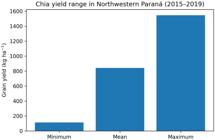
Minimum, mean and maximum grain yield of chia observed in field experiments conducted in Northwestern Paraná, Brazil, between 2015 and 2019.
The lowest grain yields were associated with late sowing and low nutrient availability, whereas the highest yields were achieved under phosphorus fertilization and optimal sowing dates. These findings demonstrate that chia grain yield can be severely limited when soil fertility, photoperiod, and climatic conditions are unfavorable. The maximum grain yield recorded in the experiments conducted in northwestern Paraná was 1,546 kg ha−1, which is lower than the 2,300 kg ha−1 reported by Ayerza and Coates (2009) for the Iztac 1 genotype grown under favorable environmental conditions in Ecuador. Nevertheless, the present results demonstrate the high yield potential of chia under the conditions of northwestern Paraná, particularly when adequate soil fertility management and appropriate sowing dates are adopted.
4. Conclusion
Chia grain yield in northwestern Paraná is strongly influenced by agronomic management practices and sowing date, ranging from 113 to 1,546 kg ha−1. Under appropriate soil fertility management and favorable crop establishment conditions, chia exhibits a grain yield potential exceeding 1,500 kg ha−1, representing a promising alternative for diversifying cropping systems in the region. The results of this study establish regional grain yield benchmarks that can support future research and contribute to the development of technical recommendations for chia cultivation.
Acknowledgements
This study was financed in part by the Coordenação de Aperfeiçoamento de Pessoal de Nível Superior (CAPES, Finance Code 001) and the Conselho Nacional de Desenvolvimento Científico e Tecnológico (CNPq) - Process Nºs 302923/2022-5 and 318048/2025-6 - Bolsa de produtividade em pesquisa - Chamadas CNPq Nºs 09/2022 and 23/2025.
Data Availability Statement
The research data is available upon prior request via email to the corresponding author.
References
-
ANDRADE, M.F., PESSOA, L.G.M., FRANÇA, J.G.E., SIQUEIRA, T.S., SIMPLÍCIO, J.B., MOURA, M.F., SILVA, L.M., AMORIM, A.T., SANTOS, J.G.B., SILVA, E.G. and TABOSA, J.N., 2025. Genotype x sowing time interaction on agronomic parameters of corn sown in no-tillage in the Brazilian semiarid region. Brazilian Journal of Biology, vol. 85, pp. e298537. https://doi.org/10.1590/1519-6984.298537 PMid:41538580.
» https://doi.org/10.1590/1519-6984.298537 -
AYERZA, R. and COATES, W., 2009. Influence of environment on growing period and yield, protein, oil and α-linolenic content of three chia (Salvia hispanica L.) selections. Industrial Crops and Products, vol. 30, no. 2, pp. 321-324. https://doi.org/10.1016/j.indcrop.2009.03.009
» https://doi.org/10.1016/j.indcrop.2009.03.009 -
BORDIN-RODRIGUES, J.C., SILVA, T.R.B., SOARES, D.F.D.M., STRACIERI, J., DUCHESKI, R.L.P. and SILVA, G.D., 2021. Bean and chia development in accordance with fertilization management. Heliyon, vol. 7, no. 6, pp. e07316. https://doi.org/10.1016/j.heliyon.2021.e07316 PMid:34195423.
» https://doi.org/10.1016/j.heliyon.2021.e07316 -
COSTA, A.A., PAIVA, E.P., TORRES, S.B., SOUZA NETA, M.L., PEREIRA, K.T.O., LEITE, M.S., SÁ, F.V.S. and BENEDITO, C.P., 2022. Osmoprotection in Salvia hispanica L. seeds under water stress attenuators. Brazilian Journal of Biology, vol. 82, pp. e233547. https://doi.org/10.1590/1519-6984.233547 PMid:34105656.
» https://doi.org/10.1590/1519-6984.233547 -
DOMINGUES, L.Z., SILVA, T.R.B. and BRONDANI, S.T., 2020. Phosphorus application effects on seeding chia. Acta Iguazu, vol. 9, no. 1, pp. 99-107. https://doi.org/10.48075/actaiguaz.v9i1.22210
» https://doi.org/10.48075/actaiguaz.v9i1.22210 -
EMPRESA BRASILEIRA DE PESQUISA AGROPECUÁRIA – EMBRAPA, 2025 [viewed 19 June 2026]. Sistema Brasileiro de Classificação de Solos [online]. 6. ed. Brasília: Embrapa. Available from: https://www.infoteca.cnptia.embrapa.br/infoteca/bitstream/doc/1176834/1/Sistema-Brasileiro-de-Classificacao-de-Solos-2025.pdf
» https://www.infoteca.cnptia.embrapa.br/infoteca/bitstream/doc/1176834/1/Sistema-Brasileiro-de-Classificacao-de-Solos-2025.pdf -
GOUVEIA, P.T., TIBURCIO, M.G.G., SILVA, T.R.B., AMBROSANO, L., BELTRAME, K.K. and DIAS, M.G., 2019 [viewed 19 June 2026]. Doses de nitrogênio na produtividade da cultura da chia [online]. In: VII Congresso da Rede Brasileira de Tecnologia e Inovação de Biodiesel, 2019, Florianópolis. Brasília: Embrapa, pp. 1-2. Available from: http://www.infoteca.cnptia.embrapa.br/infoteca/handle/doc/1117564
» http://www.infoteca.cnptia.embrapa.br/infoteca/handle/doc/1117564 -
GRIMES, S.J., PHILLIPS, T.D., CAPEZZONE, F. and GRAEFF-HÖNNINGER, S., 2019. Impact of row spacing, sowing density and nitrogen fertilization on yield and quality traits of chia (Salvia hispanica L.) cultivated in Southwestern Germany. Agronomy, vol. 9, no. 3, pp. 136. https://doi.org/10.3390/agronomy9030136
» https://doi.org/10.3390/agronomy9030136 -
INSTITUTO AGRONÔMICO DO PARANÁ – IAPAR, 2014 [viewed 10 May 2025]. Cartas climáticas do Paraná [online]. Available from: https://www.iapar.br
» https://www.iapar.br -
JAMBOONSRI, W., PHILLIPS, T.D., GENEVE, R.L., CAHILL, J.P. and HILDEBRAND, D.F., 2012. Extending the range of an ancient crop, Salvia hispanica L. – a new ω3 source. Genetic Resources and Crop Evolution, vol. 59, no. 2, pp. 171-178. https://doi.org/10.1007/s10722-011-9673-x
» https://doi.org/10.1007/s10722-011-9673-x - VAN RAIJ, B., 2011. Fertilidade do solo e manejo de nutrientes Piracicaba: International Plant Nutrition Institute, 420 p.
-
SILVA, T.G., NOLLA, A., CASTALDO, J.H., SILVA, T.R.B., ALOVISI, A.M.T. and BORDIN, A.V., 2025. Agronomic efficiency of phosphorus sources associated to acidity correctives for bean cultivation. Brazilian Journal of Biology, vol. 85, pp. e296036. https://doi.org/10.1590/1519-6984.296036 PMid:41191663.
» https://doi.org/10.1590/1519-6984.296036 -
SILVA, T.R.B., MELO, S.C., NASCIMENTO, A.B., AMBROSANO, L., BORDIN, J.C., ALVES, C.Z., SECCO, D., SANTOS, R.F., GONÇALVES JUNIOR, A.C. and SILVA, G.D., 2020. Response of chia (Salvia hispanica) to sowing times and phosphorus rates over two crop cycles. Heliyon, vol. 6, no. 9, pp. e05051. https://doi.org/10.1016/j.heliyon.2020.e05022 PMid:33005814.
» https://doi.org/10.1016/j.heliyon.2020.e05022 -
SCHUELTER, A.R., PEDRON, L.E.C., SILVA, G.J., BONETT, L.P., SOUZA, I.R.P., GRIGNET, R.S., STATHACOS, J.V.G., ALVES NETTO, A.F. and COELHO, S.R.M., 2024. Metagenomics and vegetative growth of Salvia hispanica inoculated with Trichoderma harzianum. Brazilian Journal of Biology, vol. 84, pp. e284877. https://doi.org/10.1590/1519-6984.284877 PMid:39319930.
» https://doi.org/10.1590/1519-6984.284877 -
VANCE, C.P., UHDE-STONE, C. and ALLAN, D.L., 2003. Phosphorus acquisition and use: critical adaptations by plants for securing a nonrenewable resource. The New Phytologist, vol. 157, no. 3, pp. 423-447. https://doi.org/10.1046/j.1469-8137.2003.00695.x PMid:33873400.
» https://doi.org/10.1046/j.1469-8137.2003.00695.x
Edited by
-
Editor:
Takako Matsumura Tundisi

