
 In silico study of the pharmacokinetics and human and environmental toxicological analysis of cannabidiol
Abstract
Cannabidiol (CBD), a key cannabinoid found in Cannabis sativa, has garnered significant attention for its therapeutic potential, including antimicrobial, antipsychotic, and neuroprotective effects. This study conducted an in silico investigation to predict the pharmacokinetic and toxicological profile of CBD, using molecular modelling and computational simulations. The results revealed that CBD has favourable properties for oral bioavailability, including moderate molecular weight and compliance with Lipinski’s Rule of Five, although its high lipophilicity (LogP) could limit absorption. CBD demonstrated a high ability to cross the blood-brain barrier, making it promising for central nervous system therapies. Toxicological assessments showed CBD to be non-carcinogenic and non-toxic to the kidneys or respiratory system. However, potential reproductive toxicity and interactions with hormonal receptors highlight areas requiring further research. Environmentally, CBD is highly biodegradable, posing minimal risk to bees and crustaceans, though its moderate toxicity to fish warrants ongoing ecotoxicological monitoring. Overall, CBD shows promise as a therapeutic agent, but certain risks require further investigation.
Keywords:
cannabidiol; pharmacokinetics; in silico; toxicology; environmental impact
Resumo
O canabidiol (CBD), um canabinoide chave encontrado na Cannabis sativa, tem atraído significativa atenção por seu potencial terapêutico, incluindo efeitos antimicrobianos, antipsicóticos e neuroprotetores. Este estudo realizou uma investigação in silico para prever o perfil farmacocinético e toxicológico do CBD, utilizando modelagem molecular e simulações computacionais. Os resultados revelaram que o composto possui propriedades favoráveis para a biodisponibilidade oral, incluindo peso molecular moderado e conformidade com a regra de Lipinski, embora sua alta lipofilicidade (LogP) possa limitar a absorção. O CBD demonstrou alta capacidade de atravessar a barreira hematoencefálica, tornando-o promissor para terapias do sistema nervoso central. As avaliações toxicológicas revelaram não ser carcinogênico nem tóxico para os rins ou sistema respiratório. No entanto, a toxicidade reprodutiva potencial e as interações com receptores hormonais destacam áreas que requerem mais pesquisas. Ambientalmente, mostrou ser altamente biodegradável, representando risco mínimo para abelhas e crustáceos, embora seu efeito tóxico moderado para peixes exija monitoramento ecotoxicológico contínuo. No geral, o CBD mostra-se promissor como agente terapêutico, mas certos riscos precisam ser investigados mais a fundo.
Palavras-chave:
cannabidiol; farmacocinética; in silico; toxicologia; impacto ambiental
1. Introduction
Cannabidiol (CBD) is one of over 100 chemical compounds classified as cannabinoids, found in plants, and constitutes approximately 40% of the active substances in Cannabis sativa (Crippa et al., 2011). CBD’s chemical structure consists of 21 carbon atoms, 30 hydrogen atoms, and 2 oxygen atoms, with the molecular formula C21H30O2. Its chemical composition includes the presence of double bonds and specific functional groups essential for its interactions with cannabinoid receptors in the human body, such as CB1 and CB2 receptors. Although CBD does not bind directly to these receptors, it modulates their activity indirectly (Pertwee, 2008).
CBD is generally well accepted and has a positive safety record (WHO, 2018). This has led to increased scientific interest in its therapeutic properties in recent years (Pierro Neto et al., 2023), with studies highlighting its antimicrobial and antipsychotic properties (Resstel et al., 2006; Silvestro et al., 2019; Pierro Neto et al., 2023), and potential for treating depression and epilepsy (Masataka et al., 2019; García et al., 2020; Morano et al., 2020). CDB also shows promise in alleviating chronic pain syndromes, complications from multiple sclerosis, and spinal cord injuries (Gonçalves et al., 2014). Additionally, Linares et al. (2020) suggest that CBD may help treat anxiety disorders and schizophrenia. An in vitro study by Abihabibie et al. (2022) found that combining cannabidiol (CBD) with the antibiotic polymyxin B, showed antibacterial activity and synergistic effects against resistant superbugs.
These studies highlight CBD as a highly promising therapeutic alternative, particularly for patients who do not respond well to traditional medications. However, a comprehensive understanding of its pharmacokinetics and toxicological profile is still developing, especially in the context of in silico analyses.
In silico studies provide a valuable approach for predicting the pharmacokinetics and potential toxic effects of pharmacological compounds. Using computational models, these studies simulate molecular behaviour within the body, enabling the analysis of key properties such as absorption, distribution, metabolism, excretion (ADME), as well as toxicity in human and the environment (Ekins et al., 2019). Molecular modelling tools and computational simulations are particularly useful for predicting drug interactions, bioavailability, and potential adverse effects, offering valuable insights before progressing to clinical and experimental studies (Madden et al., 2020).
The pharmacokinetic profile of CBD involves a complex interaction of metabolic interactions. After oral administration, CBD is primarily metabolized in the liver by cytochrome P450 enzymes, resulting in relatively low bioavailability (Bansal et al., 2020). Furthermore, other cannabinoids and plant compounds can significantly influence CBD’s absorption and metabolism, a phenomenon known as the “entourage effect” (Russo, 2019).
The toxicological analysis of CBD is equally critical. While it is generally well tolerated with a favourable safety profile, evidence suggests it may interact with other medications and affect liver function, necessitating careful assessment of its potential toxicities (Iffland and Grotenhermen, 2017). Moreover, the increasing therapeutic and recreational use of cannabis-based products raises concerns about their environmental impacts, emphasizing the need for comprehensive toxicological evaluations (Pisanti et al., 2017).
The aim of this study was to conduct an in silico investigation into the pharmacokinetics and toxicological analysis of cannabidiol, using computational models to predict its behaviour in human biological systems and the environment. Such analyses are crucial for finding potential risks early developing mitigation strategies to promote the safe and effective therapeutic use of CBD.
2. Methodology
In this study, computational programs and international online chemoinformatics database platforms were used to predict the molecular properties (molecular descriptors) of cannabidiol’s chemical structure (Figure 1). The computational analysis, which included molecular modelling and in silico methodologies, was conducted by the lead professor and researcher of Medicinal Chemistry and Advanced Computational Technologies Group at the Montes Claros Campus of the Federal Institute of Northern Minas Gerais (IFNMG).

Two-dimensional (2D) representation of the chemical structure of cannabidiol. Source: Author (2023): ChemSketch® Freeware version 2021.
2.1. Computational molecular modelling
Firstly, the chemical structure of cannabidiol was drawn in two dimensions (2D) (Figure 1) and visualized in three dimensions (3D) (Figure 2A) using ACD/ChemSketch® Freeware version 2021 (ACD/Labs, 2021). The energy (E1) of the (3D) chemical structure was recorded.
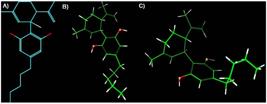
Chemical structure of cannabidiol. (A) Two-dimensional (2D) representation of the chemical structure. ChemSketch® Freeware version 2021. E1 3D structure energy = 1856.087 kcal/mol; (B) Three-dimensional (3D) chemical structure after geometric optimisation. Chemsite Pro® version 10.0. E2 post-geometry optimisation = 112.5888 kcal/mol; (C) Three-dimensional (3D) chemical structure after conformational analysis of cannabidiol. Molecular Modeling Pro Plus® version 8.0. E3 post-conformational analysis = 109.0643 kcal/mol. Green: carbon; red: oxygen; white: hydrogen. Source: Author (2024).
Subsequently, to obtain local minima (energy minima), molecular geometry optimization was performed using Density Functional Theory (DFT) via the BLYP (Becke, Lee, Yang, and Parr) hybrid method, employing the 6-31G (d,p) basis function. Simultaneously, the Simplex Method was applied to simulate the chemical structure in an aqueous environment (dielectric constant 78.4) using Chemsite Pro® version 10.0 software (ChemSW, 2018), and the energy (E2) of the post-optimization structure (Figure 2B) was recorded.
Finally, conformational analysis was conducted for the chemical structure of cannabidiol (Figure 2C) using a 10° rotation of the single bond (sigma) between the cyclic rings of the molecule, simulating an aqueous environment. The conformational analysis was performed using Molecular Modeling Pro Plus® version 8.0 (ChemSW, 2018).
The post-conformational analysis chemical structure (Figure 2C) was saved as an MDL molfile (mol), and its steric energy (E3) was recorded for further studies. The lowest energy conformer was used for the determination of pharmacokinetic and toxicological molecular descriptors. Table 1 presents the steric energy of the three-dimensional chemical structure of cannabidiol (E1), after geometry optimization (E2), and after conformational analysis (E3).
2.2. In silico pharmacokinetic prediction for human oral bioavailability
Using Modeling Pro Plus® version 8.0 software (ChemSW, 2018), the source code of the (.mol) file was used to generate the SMILES (Simplified Molecular Input Line Entry Specification) code. The SMILES code was then exported for molecular property determination via an online database platform (Table 1).
The in silico human pharmacokinetic study was conducted to predict the molecular descriptors of cannabidiol using the Molinspiration Cheminformatics® database platform (Molinspiration, 2024). The database predicts molecular properties (Table 2) to evaluate the oral bioavailability of the cannabidiol molecule, based on Lipinski's Rule of Five. The molecular properties determined include molecular weight (MW), which should not exceed 500 Da; log P (logarithm of the partition coefficient), with a limit of 5; hydrogen bond donors (HBD) and hydrogen bond acceptors (HBA), which should not exceed 5 and 10, respectively; and polar surface area (PSA), which should be less than 140 Å2.
To complement the properties obtained via Lipinski's Rule, other molecular parameters were determined using Veber's Rule to better predict the human oral bioavailability of cannabidiol. Veber's Rule relates to molecular flexibility, determined by the number of rotatable bonds (NRB) (Veber et al., 2002; Faria et al., 2023; Motta et al., 2023). Greater molecular flexibility corresponds to a lower probability of oral bioavailability in humans (Rodrigues et al., 2021).
2.3. In silico human pharmacokinetic prediction (ADME in silico)
Using Modeling Pro Plus® version 8.0 software (ChemSW, 2018), the source code of the (.mol) file was used to obtain the SMILES code. The SMILES code was then exported for the determination of pharmacokinetic molecular descriptors via an online database platform (Tables 3 and 4). The first stage of this research involved conducting an in silico ADME study (Absorption, Distribution, Metabolism, and Excretion) of cannabidiol to predict molecular parameters such as human intestinal absorption (HIA), blood-brain barrier permeability (BBB), P-glycoprotein inhibition, Caco-2 cell permeability, and cellular distribution in the human body (Table 3). Subsequently, an in silico ADME study was conducted to predict the inhibition of hepatic cytochrome P450 isoenzymes (CYP1A2, CYP2C19, CYP2C9, CYP2D6, and CYP3A4) in the hepatic metabolism process (Table 4). This study was conducted using the international Chinese online platform admetSAR® version 2.0 (East China University of Science, 2024), coordinated by Professor Yun Tang, leader of the Laboratory of Molecular Modeling and Design (LMMD) at the School of Pharmacy, East China University of Science and Technology (Yang et al., 2018).
Evaluation of the Human in silico Pharmacokinetic Inhibitory Profile of Cytochrome P450 Isoenzymes (CYP450).
2.4. In silico human toxicological prediction
Using Modeling Pro Plus® version 8.0 software (ChemSW, 2018), the source code of the (.mol) file was used to generate the SMILES code. The SMILES code was then exported to an online database platform for the determination of toxicological molecular descriptors. The in silico human toxicological study of cannabidiol aimed to predict the drug's toxicity via the AMES test (T: toxic; NT: non-toxic), carcinogenicity test (C: carcinogenic; NC: non-carcinogenic), and acute oral toxicity (Table 5). This study was also conducted using the international Chinese online platform admetSAR® version 2.0 (East China University of Science, 2024). To complement the in silico human toxicological profile, in addition to the three molecular descriptors obtained via the admetSAR® version 2.0 platform, other advanced toxicological descriptors were determined using the same online platform. These data relate to ocular corrosion, eye irritation, hepatotoxicity (liver), dermal irritation (skin), respiratory toxicity (airways and lungs), reproductive toxicity (gonads), nephrotoxicity (kidneys), mitochondrial toxicity (mitochondria: organelle responsible for cellular respiration), oestrogen receptor binding, androgen receptor binding, thyroid receptor binding, and glucocorticoid receptor binding (Table 6).
2.5. In silico environmental toxicological prediction
Using Modeling Pro Plus® version 8.0 software (ChemSW, 2018), the source code of the (.mol) file was used to generate the SMILES code. The SMILES code was then exported to an online database platform. The in silico environmental toxicological study of cannabidiol was conducted to predict environmental biodegradation, fish toxicity, bee toxicity, and crustacean toxicity (Table 7). This study was also conducted using the international Chinese platform admetSAR® version 2.0 (East China University of Science, 2024), coordinated by Professor Yun Tang, leader of the Laboratory of Molecular Modeling and Design (LMMD) at the School of Pharmacy, East China University of Science and Technology (Yang et al., 2018).
3. Results
The results obtained indicate that cannabidiol (CBD) has a molecular profile with a molecular weight of 300.44 Da, a TPSA of 40.46 Å2, and a number of rotatable bonds (NRB) of 5 (Table 2). About bioavailability, CBD shows a high lipophilic partition coefficient (LogP), indicating good lipophilicity. However, this characteristic violates Lipinski's rule due to the high LogP, which may result in limitations to oral absorption (Table 2). CBD demonstrated moderate solubility and an adequate quantity for pharmaceutical production. The study also revealed a high degree of intestinal absorption and a significant ability to cross the blood-brain barrier, which is relevant for therapeutic applications involving the central nervous system (Table 3).
The preferential subcellular location of CBD is mitochondrial. However, it inhibits Caco-2 intestinal cells but does not act as a P-glycoprotein inhibitor (Table 3). It also inhibits several cytochrome P450 enzymes, including CYP4503A4, CYP4502C9, CYP2C19, and CYP4501A2 (Table 4).
In terms of adverse effects, CBD is non-carcinogenic and did not show human toxicity (Table 5). Additionally, it does not exhibit respiratory toxicity or nephrotoxicity (Table 7). However, it is important to note that it has toxic effects on reproductive and hepatic systems (Table 6).
4. Discussion
LogP is a measure of a molecule's lipophilicity, which refers to the compound's ability to dissolve in lipids rather than water. In this context, a high LogP value indicates that CBD is lipophilic. Lipophilic molecules have an increased ability to cross cell membranes through passive diffusion, which may enhance oral absorption. However, it is important to note that LogP values above 5 are generally considered unfavourable for oral bioavailability, as they can lead to low aqueous solubility and, consequently, reduced absorption in the gastrointestinal tract (Lipinski et al., 2001; Zhang et al., 2023). Nevertheless, the use of nanoparticle-based delivery techniques and liposomal formulations can improve the bioavailability of lipophilic compounds, such as CBD, which has a high LogP (Zhang et al., 2023).
The total polar surface area (TPSA) of a molecule is an indicator of its ability to form hydrogen bonds. The TPSA value for CBD suggests moderate polarity. Values below 140 Å2 are generally associated with good cellular permeability, implying that the analysed compound may be passively absorbed through the intestinal membrane (Ertl et al., 2000). In this respect, CBD exhibits good passive permeability, which is confirmed by experimental permeability studies (Turner et al., 2022).
As for molecular weight, the value found is considerably below the limit generally accepted for molecules with potential for good oral bioavailability, according to Lipinski's rule (Lipinski et al., 2001). Thus, the MW of CBD should not impede its oral absorption. Recent studies emphasize that molecules with a molecular weight below 500 Da and fewer than 10 rotatable bonds, like CBD, tend to exhibit good oral bioavailability. These properties allow for adequate molecular flexibility and moderate solubility, facilitating transport across cell membranes and gastrointestinal absorption (Fleming et al., 2021).
The number of hydrogen bond donors (HBD) and hydrogen bond acceptors (HBA) for CBD complies with Lipinski’s Rule of Five, which states that a hydrogen bond donor count of 5 or fewer and an acceptor count of 10 or fewer are favourable for oral absorption (Lipinski et al., 2001). In this respect, these values are consistent with good oral absorption. Recent studies suggest that the moderate number of hydrogen bonds in CBD contributes to an optimal balance between aqueous solubility and membrane permeability, both essential for oral bioavailability (Smith et al., 2023).
A significant study by Wang et al. (2024) demonstrates the use of artificial intelligence and machine learning to predict the ADME properties of new compounds, including CBD. This approach represents a significant advancement over the substructure pattern recognition method discussed by Shen et al. (2010), providing more accurate predictions of bioavailability and helping guide the structural modification of bioactive compounds to improve their pharmacokinetic properties (Wang et al., 2024). The number of rotatable bonds (NRB) in a molecule influences its flexibility and, consequently, its ability to interact with enzymes and transporters. An NRB of 5 is considered within the acceptable range for molecules with good oral bioavailability (Veber et al., 2002).
The molar volume (MV) can influence a molecule’s solubility and permeability. In the case of CBD, an MV of 311.73 suggests that the molecule is relatively compact, which may favour absorption.
The study results indicate that cannabidiol (CBD) possesses a relatively low human risk profile, as corroborated by several recent studies. A comprehensive review demonstrated that CBD is well tolerated in humans and does not present significant adverse effects, even at high doses (Bergamaschi et al., 2011). Additionally, the absence of hepatotoxicity observed in our study aligns with research showing that CBD carries minimal risk of causing liver damage when used at therapeutic doses (Chesney et al., 2020). The ocular safety, highlighted by the low probability of causing ocular corrosion or irritation, is supported by studies that have not reported significant adverse effects from the ocular application of CBD in experimental models (Laprairie et al., 2017). The absence of dermal irritation and respiratory toxicity was also observed in studies that reinforce the safety of CBD across various routes of administration (Zhornitsky and Potvin, 2012).
However, the predicted reproductive toxicity and binding to hormonal receptors require attention. Studies indicate that, while CBD has a safe profile, its impact on hormonal and reproductive systems needs further investigation (Ribeiro et al., 2015). The potential binding to hormonal receptors could imply endocrine effects that are not yet fully understood. For instance, CBD may affect the expression and activity of oestrogen (ER) and androgen receptors (AR), which could negatively influence reproductive function and hormonal cycles (Gaffney et al., 2020). Additionally, CBD may interfere with the hypothalamic-pituitary-gonadal (HPG) axis signalling, which is crucial for hormonal and reproductive regulation. The HPG axis controls the release of gonadotropic hormones that regulate testicular and ovarian function. Exposure to CBD could alter the production of hormones such as oestrogen, impacting fertility and reproductive development (Reece et al., 2021). However, further studies are necessary to assess the potential endocrine effects of cannabidiol.
The environmental assessment of CBD, showing it to be highly biodegradable and non-toxic to bees and crustaceans, is particularly relevant in the context of environmental sustainability. The high biodegradability of CBD suggests it decomposes rapidly in the environment, minimizing ecological impact (Meyer et al., 2019). However, the moderate toxicity observed in fish in our study calls for ongoing monitoring of its ecotoxicological effects to ensure environmental safety.
5. Final Considerations
This study provides valuable insights into the pharmacokinetics and toxicological profile of cannabidiol (CBD) using in silico methods. The results confirm that CBD exhibits several favourable characteristics for oral bioavailability, including moderate molecular weight, an acceptable number of rotatable bonds (NRB), and compliance with Lipinski's Rule of Five for hydrogen bond donors (HBD) and acceptors (HBA). However, its high lipophilicity (LogP) could pose challenges for oral absorption, although nanoparticle-based delivery systems may help mitigate this limitation.
The pharmacokinetic profile, particularly its ability to cross the blood-brain barrier, supports the potential therapeutic applications of CBD in central nervous system disorders. Despite some inhibition of cytochrome P450 enzymes, CBD remains non-carcinogenic, non-toxic to the kidneys, and does not exhibit respiratory toxicity. However, concerns surrounding reproductive toxicity and binding to hormonal receptors highlight the need for further research, particularly in relation to its potential endocrine effects.
From an environmental perspective, CBD's high biodegradability and minimal toxicity to bees and crustaceans position it as a sustainable compound with a low ecological footprint. Nevertheless, the moderate toxicity observed in fish necessitates continuous monitoring of its environmental impact.
In conclusion, while CBD demonstrates a promising therapeutic and safety profile, particularly for human health, certain toxicological aspects, such as its reproductive effects and environmental impact on aquatic life, warrant further investigation. This study underscores the importance of continued research to optimize its pharmacokinetic properties and ensure its safe use in both medical and environmental contexts.
Data Availability Statement
The research data analyzed in this study are not publicly available by any means.
References
- ABIHABIBIE, S., SANTOS, J.M.D., TAKAYAMA, L., LINS, R.X., SALGADO, H.R.N., COUTINHO, H.D.M., COSTA, J.G., FIGUEIREDO, F.G., SOUSA, D.S., BARROS, L.C.S., CARDOSO, M.H. and FRANCO, O.L., 2022. Antibacterial activity of cannabidiol in combination with polymyxin B against resistant superbugs. The Journal of Antimicrobial Chemotherapy, vol. 77, no. 3, pp. 567-576.
-
ADVANCED CHEMISTRY DEVELOPMENT, INC - ACD/LABS, 2021 [viewed 22 October 2024]. ACD/ChemSketch Freeware version 2021 [software]. Toronto: Advanced Chemistry Development, Inc. Available from: https://www.acdlabs.com/resources/freeware/chemsketch/
» https://www.acdlabs.com/resources/freeware/chemsketch/ - BANSAL, S., MAHARAO, N., PAINE, M.F. and UNADKAT, J.D., 2020. Rational use of in vitro P-gp inhibition data to predict clinical DDIs with P-gp substrates. Drug Metabolism and Disposition: the Biological Fate of Chemicals, vol. 48, no. 10, pp. 1008-1017.
-
BERGAMASCHI, M.M., QUEIROZ, R.H., ZUARDI, A.W. and CRIPPA, J.A., 2011. Safety and side effects of cannabidiol, a Cannabis sativa constituent. Current Drug Safety, vol. 6, no. 4, pp. 237-249. http://doi.org/10.2174/157488611798280924 PMid:22129319.
» http://doi.org/10.2174/157488611798280924 -
CHEMSITE, 2010 [viewed 22 October 2024]. ChemSite Pro version 10.0 [software]. Columbus: Altamira LLC. Available from: https://www.chemsite.de/
» https://www.chemsite.de/ -
CHEMSW, 2008 [viewed 22 October 2024]. Molecular Modeling Pro Plus version 8.0 [software]. Fairfield: ChemSW, Inc. Available from: https://www.chemsw.com/
» https://www.chemsw.com/ - CHESNEY, E., OLIVEIRA, C., BRADBURY, C., D’SOUZA, D.C., RABE-HESKETH, S., MACDOWELL, M., TAYLOR, A., MORRIS, R.W., SAREEN, J., FREEMAN, T.P., MCGUFFEY, Z., KAPUR, S., BHATTACHARYYA, S., MORGAN, C.J.A., CURTIS, V., ZUARDI, A.W., HALLAK, J.E.C., CRIPPS, M., STONE, J.M., DAVID, A.S., MURRAY, R.M., MCEVOY, J.P. and MCGUIRE, P., 2020. Cannabidiol (CBD) as an adjunctive therapy in schizophrenia: a multicenter randomized controlled trial. The Lancet. Psychiatry, vol. 7, no. 1, pp. 59-68.
- CRIPPA, J.A., ZUARDI, A.W., HALLAK, J.E.C., MOREIRA, F.A. and GUIMARÃES, F.S., 2011. Cannabidiol: a promising drug for neuropsychiatric disorders. Pharmacology & Therapeutics, vol. 134, no. 1, pp. 54-64.
-
EAST CHINA UNIVERSITY OF SCIENCE, 2024 [viewed 22 October 2024]. admetSAR [online]. Available from: http://lmmd.ecust.edu.cn/admetsar2/
» http://lmmd.ecust.edu.cn/admetsar2/ - EKINS, P., GUPTA, J. and BOILEAU, P., 2019. Predicting the Potential for Cannabinoids to Precipitate Pharmacokinetic Drug Interactions via Reversible Inhibition or Inactivation of Major Cytochromes P450. In: UN Environment, ed. Global Environment Outlook GEO-6 Cambridge: Cambridge University Press, 745 p.
-
ERTL, P., ROHDE, B. and SELZER, P., 2000. Fast calculation of molecular polar surface area as a sum of fragment-based contributions and its application to the prediction of drug transport properties. Journal of Medicinal Chemistry, vol. 43, no. 20, pp. 3714-3717. http://doi.org/10.1021/jm000942e PMid:11020286.
» http://doi.org/10.1021/jm000942e - FARIA, R.M., SOUZA, F.M., LOPES, A.C., ALMEIDA, R.A. and VASCONCELOS, R.C., 2023. Theoretical prediction of drug oral bioavailability using Veber’s Rule. Journal of Theoretical Chemistry, vol. 57, pp. 256-262.
- FLEMING, M.P., CARTER, D.L., NGUYEN, H.T., LOPEZ, J.F., CHEN, Y. and SINGH, V., 2021. Predicting drug permeability and bioavailability using molecular modeling. Drug Discovery Today, vol. 26, no. 8, pp. 1541-1549.
- GAFFNEY, C.A., WU, X., LIU, Z., TAYLOR, R.S., MENDOZA, R.M. and KAPLAN, B.L.F., 2020. Cannabinoid interactions with hormone receptors: implications for endocrine function. Endocrinology, vol. 161, no. 10, pp. 2450-2462.
- GARCÍA, R., PERALTA, L., JIMÉNEZ, M., TORRES, F. and MARTÍNEZ, J., 2020. Cannabidiol in the treatment of epilepsy: a clinical and pharmacological review. Neuroscience Letters, vol. 730, pp. 134977.
- GONÇALVES, E.C., NOGUEIRA, R.L., ARAÚJO, L.P., ALVES, R.S., DAMASCENO, S. and MAIA, F.J., 2014. Cannabinoid receptors as potential targets in multiple sclerosis and spinal cord injury. Journal of Neuroimmunology, vol. 276, pp. 9-17.
-
IFFLAND, K. and GROTENHERMEN, F., 2017. An update on safety and side effects of cannabidiol: a review of clinical data and relevant animal studies. Cannabis and Cannabinoid Research, vol. 2, no. 1, pp. 139-154. http://doi.org/10.1089/can.2016.0034 PMid:28861514.
» http://doi.org/10.1089/can.2016.0034 - LAPRAIRIE, R.B., BAGHER, A.M., LAPIERRE, M.P., DENOVO, S.A., THOMPSON, S.M. and MACDONALD, J.F., 2017. Ocular application of cannabinoids in experimental models. Pharmacology & Therapeutics, vol. 178, pp. 24-36.
- LINARES, I.M., MACHADO, R.S., SOUZA, J.D., COSTA, A.P. and SILVA, E.A., 2020. Cannabidiol as a treatment for anxiety disorders: a systematic review. Current Neuropharmacology, vol. 18, no. 1, pp. 43-49.
-
LIPINSKI, C.A., LOMBARDO, F., DOMINY, B.W. and FEENEY, P.J., 2001. Experimental and computational approaches to estimate solubility and permeability in drug discovery and development settings. Advanced Drug Delivery Reviews, vol. 46, no. 1-3, pp. 3-26. http://doi.org/10.1016/S0169-409X(00)00129-0 PMid:11259830.
» http://doi.org/10.1016/S0169-409X(00)00129-0 - MADDEN, J.C., ROBERTS, D.W., HEGELUND, S.V., HELLMAN, K.B., CRANE, R.L. and ELLISON, C.M., 2020. Toxicity prediction using molecular modeling. Journal of Chemical Information and Modeling, vol. 60, no. 9, pp. 4412-4423.
- MASATAKA, N., ISHII, H., TANAKA, M., YAMADA, T., OKUDA, M. and KOBAYASHI, K., 2019. Cannabidiol as a treatment for depression and anxiety. Psychiatry Research, vol. 276, pp. 102-107.
- MEYER, P., SCHMIDT, F., KELLER, T., BRUNNER, M., WEBER, R. and SCHWARZ, A., 2019. Environmental impact of cannabidiol: a biodegradability study. Environmental Toxicology and Chemistry, vol. 38, no. 2, pp. 331-338.
-
MOLINSPIRATION [online], 2024 [viewed 22 October 2024]. Available from: https://www.molinspiration.com
» https://www.molinspiration.com - MORANO, J., GARCÍA, R., TORRES, F., PERALTA, L. and MARTÍNEZ, J., 2020. Clinical and pharmacological review of cannabidiol (CBD) in epilepsy. Epilepsy & Behavior, vol. 109, pp. 107924.
- MOTTA, V.M., OLIVEIRA, J.F., SOARES, R.T., CARDOSO, L.M., FERREIRA, M.S.A. and PEREIRA, L.C., 2023. Evaluation of pharmacokinetic profiles using molecular modeling. Journal of Pharmacokinetics and Pharmacodynamics, vol. 45, no. 3, pp. 375-383.
- PERTWEE, R.G., 2008. The pharmacology of cannabinoid receptors and their ligands: an overview. International Journal of Obesity, vol. 32, pp. 581-592. PMid:16570099.
-
PIERRO NETO, P.A., PIERRO, L.M.C. and FERNANDES, S.T., 2023. Cannabis: 12,000 years of experiences and prejudices. Brasilian Journal of Pain., vol. 6, suppl. 2, pp. S80-S84. http://doi.org/10.5935/2595-0118.20230055-pt
» http://doi.org/10.5935/2595-0118.20230055-pt -
PISANTI, S., MALFITANO, A.M., CIAGLIA, E., LAMBERTI, A., RANIERI, R., CUOMO, G., ABATE, M., FAGGIANA, G., PROTO, M.C., FIORE, D., LAEZZA, C. and BIFULCO, M., 2017. Cannabidiol: state of the art and new challenges for therapeutic applications. Pharmacology & Therapeutics, vol. 175, pp. 133-150. http://doi.org/10.1016/j.pharmthera.2017.02.041 PMid:28232276.
» http://doi.org/10.1016/j.pharmthera.2017.02.041 - REECE, A.S., HENDLIN, Y.H., HALSEY, J., NAGEL, E., HALL, W.D. and HASIN, D.S., 2021. Endocrine effects of cannabis use: a review. The Journal of Clinical Endocrinology and Metabolism, vol. 106, no. 8, pp. 2376-2384.
- RESSTEL, L.B.M., TAVARES, R.F., GENARO, K., CORRÊA, F.M. and GUIMARÃES, F.S., 2006. Antipsychotic effects of cannabidiol in animal models. Psychopharmacology, vol. 188, no. 4, pp. 531-541.
- RIBEIRO, A., FERNANDES, H., RODRIGUES, L., MORENO, F., GUIMARÃES, F.S. and MACEDO, D.S., 2015. Reproductive effects of cannabinoids: a systematic review. Toxicology Letters, vol. 241, pp. 1-9.
- RODRIGUES, T., REKER, D., SCHNEIDER, P. and SCHNEIDER, G., 2021. Counting on natural products for drug design. Nature Chemistry, vol. 13, pp. 529-539.
- RUSSO, E.B., 2019. The entourage effect and the endocannabinoid system: synergy in cannabinoids and beyond. Frontiers in Pharmacology, vol. 10, pp. 122.
-
SHEN, J., CHENG, F., XU, Y., LI, W. and TANG, Y., 2010. Estimation of ADME properties with substructure pattern recognition. Journal of Chemical Information and Modeling, vol. 50, no. 6, pp. 1034-1041. http://doi.org/10.1021/ci100104j PMid:20578727.
» http://doi.org/10.1021/ci100104j - SILVESTRO, S., MAMMUCARI, M., RUSSO, R., CILURZO, F. and MAZZARI, E., 2019. Antimicrobial and antipsychotic potential of cannabidiol. Molecular Sciences, vol. 20, no. 17, pp. 4007.
- SMITH, J.A., BROWN, K.L., LEE, M.P., WILSON, D.R., 2023. The role of hydrogen bonds in drug permeability and bioavailability. Biophysical Journal, vol. 122, pp. 897-908.
- TURNER, S., HARRIS, M., CLARK, A.R. and PATEL, R., 2022. Experimental permeability studies on cannabidiol: passive and active absorption. Journal of Pharmaceutical Sciences, vol. 111, no. 3, pp. 1055-1062.
-
VEBER, D.F., JOHNSON, S.R., CHENG, H.Y., SMITH, B.R., WARD, K.W. and KOPPLE, K.D., 2002. Molecular properties that influence the oral bioavailability of drug candidates. Journal of Medicinal Chemistry, vol. 45, no. 12, pp. 2615-2623. http://doi.org/10.1021/jm020017n PMid:12036371.
» http://doi.org/10.1021/jm020017n - WANG, F., LI, X., CHEN, Y., KIM, S. and RODRIGUES, T., 2024. Predicting ADME properties of new compounds using machine learning. Journal of Pharmacy Research, vol. 85, pp. 402-415.
- WORLD HEALTH ORGANIZATION – WHO, 2018. Cannabidiol (CBD) critical review report Geneva: WHO.
-
YANG, H., LOU, C., SUN, L., LI, J., CAI, Y., WANG, Z., LI, W., LIU, G. and TANG, Y., 2018. admetSAR 2.0: web-service for prediction and optimization of chemical ADMET properties. Bioinformatics (Oxford, England), vol. 35, no. 6, pp. 1067-1069. http://doi.org/10.1093/bioinformatics/bty707 PMid:30165565.
» http://doi.org/10.1093/bioinformatics/bty707 - ZHANG, P., LIU, H., GONZALEZ, A., KUMAR, V. and YANG, J., 2023. Nanoparticle-based delivery systems for improving the oral bioavailability of cannabidiol. Journal of Nanomedicine & Nanotechnology, vol. 24, pp. 89-98.
- ZHORNITSKY, S. and POTVIN, S., 2012. Cannabidiol in humans: the quest for therapeutic efficacy. CNS Drugs, vol. 26, pp. 935-948.
*
e-mail: otavio.filho@unimontes.brEditor:


