| Synthesis of Ottonia anisum Extract Mediated ZnO NPs and Their Local Anesthetic, Analgesic and HCl-induced Acute Lung Injury Activities |
Fan et al. (2024)
|
Synthesize zinc oxide nanoparticles (ZnO NPs) via green synthesis and evaluate their biological activities. |
Green synthesis with O. anisum extract; characterization via UV-vis, XRD, HR-TEM. • In vivo (mice): Oral analgesic hot-plate and writhing tests at 2.5, 5, 10, and 20 mg/kg; formalin pain test at 1.0, 2.5, 5, and 10 mg/kg; and HCl-induced acute lung injury model at oral doses of 50, 100, and 200 mg/kg. |
China |
| Characterization of an arylbutanoid derivative in leaves and roots of Ottonia anisum Sprengel |
Marques et al. (2008)
|
Isolate and characterize chemical constituents present in leaf and root extracts. |
Pure analytical phytochemistry. No biological doses or concentrations applied. |
Brazil |
| Effects of Ottonia anisumplant extract on local anesthetic, analgesic, anti-inflammatory and HCl-induced acute lung injury activities |
Liu et al. (2023)
|
Evaluate the pharmacological potential of the methanolic root extract of O. anisum. |
• In vivo/In vitro local anesthesia: Frog foot withdrawal reflex and guinea pig intradermal wheal method using extract solutions at 10, 20, 40, and 80 mg/mL (0.2 mL injection volume). • In vivo (mice/rats): HCl-induced acute lung injury model at oral doses of 50, 100, and 200 mg/kg; hot-plate analgesic latency test and carrageenan paw edema model at 50, 100, and 200 mg/kg (i.p. / p.o.). |
China |
| 1-Butyl-3,4-Methylenedioxybenzene as the Major Constituent of Essential Oil from Ottonia anisum
|
Moreira et al. (1997)
|
Analyze the chemical composition of the species' essential oil. |
Hydrodistillation and volatile profile analysis by GC-MS. Pure analytical phytochemistry. |
Brazil |
| Larvicidal activity of Ottonia anisum metabolites against Aedes aegypti
|
Marques et al. (2017)
|
Investigate the insecticidal potential against the Dengue, Zika, and Chikungunya vector. |
• In vitro bioassays: Larval mortality laboratory assays against third-instar (L3) larvae. • Concentrations: Crude extracts screened at 10, 100, and 200 µg/mL; pure compound 1-butyl-3,4-methylenedioxybenzene tested at fixed screenings of 1, 10, and 30 µg/mL. |
Brazil |
| Local Anesthetic Activity from Extracts, Fractions and Pure Compounds from the Roots of Ottonia anisum
|
López et al. (2016)
|
Validate the popular use of the plant as an anesthetic through scientific trials. |
• In vivo (guinea pigs): Electrophysiological assays and intradermal wheal tactile stimulation reflex block tests. • Concentrations: Direct regional intradermal infiltration of crude methanolic extract, n-hexane fraction, pure amides (pipercallosidine), and amide-rich fraction at concentrations of 60, 120, 240, 470, and 940 µg/mL. |
Brazil |
|
Piper anisum as a promising new source of bioactive metabolites |
Batista et al. (2019)
|
Perform metabolic profiling and evaluate global bioactivities of the species. |
Metabolomics (UHPLC-MS) and laboratory microplate screening assays. • In vitro concentrations: DPPH free-radical scavenging screening at 10–1000 µg/mL; antimicrobial minimum inhibitory concentration (MIC) screening up to 500 µg/mL; and tumour cell lines cytotoxicity fixed at 50 µg/mL. |
Brazil |
| (2E,4E)-N-Isobutyl-9-piperonyl-nona-2,4-dienoic Amide from Ottonia anisum
|
Giesbrecht et al. (1981)
|
Isolate and describe new amides present in the plant. |
Chemical fractionation and structural analysis by NMR and Mass Spectrometry. Pure structural phytochemistry. |
Brazil |
| Aristolactams from roots of Ottonia anisum(Piperaceae) |
Marques et al. (2011)
|
Identify aristolactams present in the plant roots. |
Column chromatography purification from the hexanic root extract. Pure analytical phytochemistry. |
Brazil |
| Molluscicidal Activity of Piper anisum Volatile Oil and of its Major Chemical Marker |
Castilho et al. (2024)
|
Evaluate molluscicidal activity against the snail host of schistosomiasis. |
• In vitro bioassays: Snail mortality exposure assays against Biomphalaria glabrata. • Concentrations: Volatile essential oils from distinct seasons tested at a fixed concentration of 100 µg/mL; isolated pure marker 1-butyl-3,4-methylenedioxybenzene evaluated at 25, 36, 50, and 75 µg/mL. |
Brazil |

 Piper anisum (Spreng.) Angely: constituintes fitoquímicos e atividades biológicas
 Thumbnail
 Thumbnail
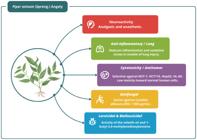 Thumbnail