 Maximizing profits while reducing environmental impacts in silvopastoral systems for Nellore: an idealized, simplified farm-level mathematical model
Abstract
This study focuses on maximizing profits and reducing environmental impacts in silvopastoral systems for Nellore cattle through an idealized farm-level mathematical model. The research team from various Brazilian universities and institutions aimed to develop a framework using linear programming to optimize resource allocation, integrate different plant and animal species, and minimize costs. The model considers parameters such as plant density, animal nutrition, and greenhouse gas emissions. Results indicate that a well-managed silvopastoral system can significantly improve profitability (R$ 867,712.72) and sequester substantial amounts of CO2 (1,341.39 tons CO2-equivalent). The study highlights the potential of integrated farming systems to enhance economic sustainability while mitigating environmental impacts.
Keywords:
ecological sustainability; economic feasibility; GAMS CPLEX®; linear programming; operations research
Resumo
Este estudo foca em maximizar lucros e reduzir impactos ambientais em sistemas silvipastoris para gado Nelore através de um modelo matemático idealizado ao nível da fazenda. A equipe de pesquisa de várias universidades e instituições brasileiras visou desenvolver um quadro usando programação linear para otimizar a alocação de recursos, integrar diferentes espécies de plantas e animais e minimizar custos. O modelo considera parâmetros como densidade de plantas, nutrição animal e emissões de gases de efeito estufa. Os resultados indicam que um sistema silvipastoril bem gerido pode melhorar significativamente a rentabilidade (R$ 867.712,72) e sequestrar quantidades substanciais de CO2 (1.341,39 toneladas de CO2-equivalente). O estudo destaca o potencial dos sistemas agrícolas integrados para melhorar a sustentabilidade econômica enquanto mitiga os impactos ambientais.
Palavras-chave:
sustentabilidade ecológica; viabilidade econômica; GAMS CPLEX®; programação linear; pesquisa operacional
1. Introduction
Agriculture has evolved from traditional, with hand tools, to modern, with machines and chemical inputs, progressing to precision agriculture with GPS (Global Positioning System) and sensors, and smart agriculture with IoT (internet of things) and AI (artificial intelligence). Finally, it has reached sustainable and regenerative agriculture, which prioritizes ecological practices, restores soil health, reduces the use of industrial fertilizers, promotes biodiversity and increases climate resilience (Ruttan, 2002; Mazoyer and Roudart, 2006; Borlaug, 2000; Pingali, 2012; Pierce and Nowak, 1999; Zhang et al., 2002; Wolfert et al., 2017; Bronson, 2019; Rhodes, 2017; Lal, 2020).
This makes it necessary to use sustainable alternatives for animal production that transform current production paradigms, since sustainable intensification of animal production systems can be achieved through silvopastoral systems (Pérez Márquez et al., 2021). More than 40% of the Earth's surface is occupied by ecologically managed pastures, characterized by native plants and their main use for grazing. They provide around 75% of forage for domestic animals and can contribute significantly to GDP (SRM, 2002; Brown and Thorpe, 2008). In addition, grasslands provide ecosystem services such as food, fiber, water, recreation, minerals and medicinal plants for rural and urban populations (Havstad et al., 2007).
However, Brazil's thriving livestock sector faces challenges due to the deterioration of strategic assets such as land, labor and technology. In order to guarantee the competitiveness and sustainability of the production chain, it is necessary to develop new solutions that reconcile efficiency, environmental preservation and the reduction of inequalities (ABRAFRIGO, 2024; EMBRAPA, 2024; Hötzel and Vandresen, 2022). Agroecological management strategies and the redesign of pasture-based livestock production systems are promising tools for achieving these goals, boosting the resilience, self-sufficiency, productivity and efficiency of national livestock farming (Pereira et al., 2024; Bonaudo et al., 2014). Thus, through mathematical modeling it is possible to create a framework to guide the redesign of productive landscapes (Gomes Lobo et al., 2023) in integrated systems which allow the insertion of different species of trees and shrubs (Lobo et al., 2024).
Mathematical linear programming is a powerful tool for modeling, analyzing and solving problems related to the allocation of scarce resources, with the aim of minimizing costs or maximizing profits. This tool is widely used in this context, making it possible to make efficient decisions in independent activities, based on available sources, and it is also possible to obtain an optimal solution using the simplex method in a linear model.
This structure is a deterministic, robust model that combines plant and animal species in a more suitable arrangement and at a lower cost (Marques, 2021), in which a benchmark is established to assess the effectiveness of management practices and proposed mitigation strategies. In addition, optimization is the mathematical process of finding the best solution within a set of options, especially necessary in complex situations where intuition is not enough.
As a way of taking advantage of the resources for nutrient cycling in the soil-plant-animal system, benefiting the farmer's profit margin and the sustainability of the environment in which he produces, the aim of this paper is to create a modelling framework, based on experimental parameters from the related literature, which can guide the redesign of productive landscapes for ruminants in tropical conditions, moving from the conventional to the sustainable scenario that estimate the potential economic and environmental gains to be obtained from integrating livestock farming with crop production.
2. Material and Methods
This empirical (in silico) study focuses on the application of a mathematical model to represent the reality of a beef cattle farm in the growing and finishing phases, characterized by the integration of cattle farming and plant production, mainly aimed at producing food for the animals, in a silvopastoral system. The formal description of the mathematical model includes the indices of the sets, the parameters, the variables and the equations that make it up. Next, the parameters to be used in the model are surveyed and defined, presenting the basis on which the information was obtained, both from databases and from existing literature. Finally, the proposed methods for estimating the gains obtained from adopting integrated production activities are described, which are applied to the results obtained from processing the proposed optimization model.
2.1. Study description
Linear Programming (LP) stands out as a fundamental technique in the field of Operations Research (OR) (Hillier and Lieberman, 2006). Its popularity stems from its ability to offer relatively simple mathematical modelling to solve complex problems, along with the availability of a variety of algorithms and the promise of finding optimal and unique solutions, when feasible.
The core of the approach is solving deterministic models composed of linear equations. These models have a linear objective function to be optimized (either maximized or minimized), subject to a set of linear constraints, as the name suggests. In general, when applying the Linear Programming model to farm planning, it can be represented as:
In this context, Z represents the farm's profit, c is a vector that expresses the net profits of each activity, x is a vector that describes the quantities of the respective activities, A is a matrix of technical coefficients and b is a vector of resources (inputs) available on the farm. The technique makes it possible to determine the values of the variables x that maximize Z, while complying with all the established restrictions.
2.2. Location and tools
The work was conducted in silico, in the Department of Biotechnology and Plant and Animal Production, of the Federal University of São Carlos, Araras city, whose geographical coordinates are 22° 21’ 28” South, 47° 23’ 6” West, state of São Paulo, located in Brazil. This experience does not need to go through an ethics committee, as its indirect work involves people and animals in the system.
The tools objects used were a laptop, meetings interview with experts on the subject to define the model and parameters, data from the literature with searches on database access sites such as Web of Science®, Google Scholar® and the use of software such as CiteSpace® to analyze emerging trends and critical changes in scientific literature and VOSviewer® for constructing and visualizing bibliometric networks. In addition, to obtain the model's answer, it was used the software GAMS/CPLEX® Version 46.4.0, which will be described in the methodology.
All in all, the software GAMS/CPLEX® looks for values for the variables that maximize the margin or profit, respecting all the “sine qua non” constraints, finding an optimal value for the variable (s) “X”.
GAMS (General Algebraic Modelling System) is a high-level modelling system designed to solve complex mathematical programming problems, including linear, nonlinear and integer programming. It is widely used in areas such as economics, engineering, operations research and social sciences, providing a flexible platform for formulating and solving mathematical models. CPLEX, on the other hand, is an optimization solver developed by IBM that is recognized for its efficiency in solving large linear programming (LP), mixed integer programming (MIP), and quadratic programming (QP) problems. CPLEX is often used in conjunction with modelling systems such as GAMS to provide a robust and efficient solution to complex optimization problems. When integrated, GAMS and CPLEX offer a powerful combination for modelling and solving optimization problems. GAMS allows users to model problems in a declarative and intuitive way, while CPLEX provides the advanced algorithms needed to solve these problems efficiently (IBM, 2024a).
2.3. Study design
The text describes several key elements essential for building a decision-making model, focusing particularly on deterministic modelling in the context of reshaping productive landscapes for ruminants in tropical conditions. The core is to work within a silvopastoral system, at farm level, with tree (Gliricidia sepium) and shrub (Tithonia diversifolia) species, grazing Urochloa brizantha cv. Marandu, containing Nellore animals in the growing and finishing (fattening) phases.
A synthetic population of beef cattle was study in silico, which is a predictive tool applied to data analysis for fundamental understanding of the underlying theory (Madden et al., 2020), to be applied in practice and speed up the decision-making process (Shaker et al., 2021).
We are considering the rainy (animals in the growing phase) and dry (animals in the finishing phase) seasons of the year, as well as the nutritional requirements of the animals, where we want to obtain answers to the following questions like, what is the margin, in reais (R$)? What is the number of animals, in head or number of animals? What is the plant area, in hectare? How much supplement, in tons? How much mineral supplement in the rainy season, in tons? How much protein-energy supplement in the dry season, in tons? How much greenhouse gases (GHG) are emitted or sequestered, in t of CO2-equivalent? How much fertilizer, in tons? How much manure is produced, in tons? How much manure is used as fertilizer, in tons?
2.4. Model approach
Developed at UFSCAR-ARARAS, this is a farm-level model capable of creating a modeling framework to guide the redesign of productive landscapes for ruminants in tropical conditions. It allows us to know how the plant and animal characteristics of ruminants fed diets with the addition of alternative forages, mineral supplementation during the wet season and minimal supplementation during the dry season behave; and this allows the use of alternative forages in the diet to contribute to the development of sustainable management strategies. This model combines factors capable of predicting what the redesign of a rural property would look like, having proposed productive, ecosystem and environmental impact mitigation characteristics and positive margins in this multifunctional landscape with the insertion of these new species.
2.4.1. Model features
In operations research (OR), simulations are often developed to solve practical problems of complex systems (Sinuany-Stern, 2023). Linear programming modelling is a technique within operations research used to find the optimal answer to a given problem, from which decisions can be made beyond all the coefficients of the objective function and the constraints being deterministic, as follows, a decision with certainty. And that, the simplistic model is subject to trade-offs, i.e. as simplification increases, the model's representation decreases and vice versa, which is why the model needs to contain some variables from reality. That said, when new approaches are inserted into the model, the solutions found are often conflicting, generating trade-offs in decisions (Péra, 2022).
Therefore, a toy-model is a deliberately simplistic model with many details removed so that it can be used to explain a mechanism concisely and is useful in a more complete description of the model (Blanchard, 2018). With this premise in mind, philosophically, the applicability of the toy-model in mathematical modelling is done by restricting the number of variables, being a deliberately simplistic model so that it can be used to explain a mechanism concisely, whose formal setting may be irrelevant (Frigg and Nguyen, 2020; Reutlinger et al., 2018; Koutsoyiannis, 2006).
2.4.2. Sustainable production system traits
For the operational research study, it was first necessary to define the spatial and temporal limits (Gameiro et al., 2010). The spatial limit was defined at farm level as being from growth to fattening or finishing, with Nellore bulls from 8 to 30 months of age (Trocóniz et al., 1991) and the temporal limit, considering a lifetime of a whole year, considering seasons such as wet and drought, taking into account a silvopastoral system with an intensive stocking rate (Lobo, 2023).
It is possible to characterize the forage plants, since this is a grazing system:
2.4.2.1. Urochloa brizantha cv. Marandu
It is a cespitose, robust plant that can reach 1.5-2.5 m (Nunes et al., 1984). The forage qualities of the Urochloa brizanta cv. Marandu ecotype make it an excellent alternative for the silvopastoral system (Oliveira et al., 2021), since it has been shown to be resistant to the pasture leafhopper (Jesus et al., 2023), with good nutritional value within the silvopastoral system (Gomes et al., 2022), high biomass production (Oliveira et al., 2022) and no cases of photosensitization.
2.4.2.2. Gliricidia sepium
A member of the Fabaceae family, commonly known as gliricidia, coyote, and mother of cocoa, reaches heights of 12 to 15 meters (Drumond and Carvalho Filho, 1999). Used in silvopastoral systems, it is pruned initially one year after planting and then every six months (Fontes et al., 2016). The species is notable for its deep roots and high drought tolerance, enduring up to eight months of drought with a minimum annual rainfall of 500 mm (Lima Filho et al., 2023; Fontes et al., 2016; Andrade et al., 2015). Gliricidia excels in nitrogen fixation, nutrient cycling, and biomass production, with 56 to 74% of its aerial nitrogen from biological fixation (Silva, 2022). It effectively reduces soil density and compaction and thrives in low-fertility soils (Andrade et al., 2015; Conceição, 2017).
2.4.2.3. Titonia diversifolia
Belonging to the Asteraceae family and commonly known in Brazil as titonia, Mexican sunflower, or margaridão, is a drought-tolerant shrub that grows between 1.5 and 4.0 meters tall (Reis et al., 2015; Radomski and Oliveira, 2018). It is used in silvopastoral systems, attracting pollinators and exhibiting nematicidal and allelopathic effects on weeds. This plant serves as green manure, aids in recovering degraded soils, and enhances nutrient cycling due to its deep root system and nutrient-rich aerial biomass (Radomski and Oliveira, 2018). Applying 7.5 t.ha-1 of titonia biomass can significantly increase soil humidity by reducing soil temperature and water evaporation (Opala, 2020). Though it does not fix atmospheric nitrogen, titonia effectively cycles nitrogen from deeper soil layers, accumulating large amounts in its biomass (Jama et al., 2000). It efficiently utilizes nutrients in low-fertility soils, producing biomass high in N, P, K, Ca, and Mg, and is effective for erosion control due to its dense, deep roots and mulching capability (Reis et al., 2015; Radomski and Oliveira, 2018; Jama et al., 2000; Opala, 2020).
2.4.3. Mathematical connotation
The simulation model was used to generate in silico experiments to evaluate the following aspects: sets, parameters, response variables and equations like constraints and objective function, which will be described:
Sets - 𝑣 represents the set of plant types, including tithonia (Tithonia diversifolia), gliricidia (Gliricidia sepium) and pasture (Urochloa brizantha, Marandu); 𝑙 represents the set of cattle types, including growing and fattening; 𝑓 represents the set of fertilizer types, including nitrogen, phosphorus, potassium, calcium and magnesium; 𝑠 represents the set of feed types, including mineral supplement and protein supplement; Parameters - 𝑑𝑒𝑛𝑠𝑖ty𝑣(𝑣) is the density of plants per hectare for each type of plant; 𝑝𝑟𝑖𝑐𝑒𝑙(𝑙) is the price per head of cattle for each type of cattle; 𝑐𝑜𝑠𝑡𝑣(𝑣) is the implementation cost per hectare for each type of plant; 𝑐𝑜𝑠𝑡𝑙(𝑙) is the cost per head of cattle for each type of cattle; 𝑐𝑜𝑠𝑡𝑓(𝑓) is the cost per ton of fertilizer for each type of fertilizer; 𝑐𝑜𝑠𝑡𝑠(𝑠) is the cost per ton of food for each type of food; 𝑙𝑖𝑣𝑒𝑠𝑡𝑜𝑐𝑘𝑤𝑒𝑖𝑔ℎ𝑡(𝑙) is the weight per head of cattle for each type of cattle; productivRainy(v) is the biomass productivity in tons of dry matter per hectare for each type of plant during the rainy season; 𝑝𝑟𝑜𝑑𝑢𝑡𝑖𝑣𝐷𝑟𝑦(𝑣) is the biomass productivity in tons of dry matter per hectare for each type of plant during the dry season; 𝑑𝑟𝑦𝑚𝑎𝑡𝑡𝑒𝑟𝑟𝑒𝑞𝑢𝑖𝑟𝑒𝑚𝑒𝑛𝑡(𝑙) is the daily dry matter requirement in kg for each type of livestock; 𝑝𝑒𝑟𝑖𝑜𝑑(𝑙) is the period in days for each type of livestock; drymattercompositionrainy(v) is the dry matter composition in percent for each type of plant during the rainy season; 𝑑𝑟𝑦𝑚𝑎𝑡𝑡𝑒𝑟𝑐𝑜𝑚𝑝𝑜𝑠𝑖𝑡𝑖𝑜𝑛𝑑𝑟𝑦(𝑣) is the dry matter composition in percent for each type of vegetable during the dry season; 𝑑𝑟𝑦𝑚𝑎𝑡𝑡𝑒𝑟𝑐𝑜𝑚𝑝𝑜𝑠𝑖𝑡𝑖𝑜𝑛𝑓𝑒𝑒𝑑(𝑠) is the dry matter composition in percent for each type of food; 𝑝𝑟𝑜𝑡𝑒𝑖𝑛𝑟𝑒𝑞𝑢𝑖𝑟𝑒𝑚𝑒𝑛𝑡(𝑙) is the daily protein requirement in kg for each type of livestock; 𝑝𝑟𝑜𝑡𝑒𝑖𝑛𝑐𝑜𝑛𝑡𝑒𝑛𝑡𝑟𝑎𝑖𝑛𝑦(𝑣) is the protein content in percentage of dry matter for each type of vegetable during the rainy season; 𝑝𝑟𝑜𝑡𝑒𝑖𝑛𝑐𝑜𝑛𝑡𝑒𝑛𝑡𝑑𝑟𝑦(𝑣) is the protein content as a percentage of dry matter for each type of vegetable during the dry season; 𝑝𝑟𝑜𝑡𝑒𝑖𝑛𝑐𝑜𝑛𝑡𝑒𝑛𝑡𝑓𝑒𝑒𝑑(𝑠) is the protein content as a percentage of dry matter for each type of food; energyrequirement(l) is the daily energy requirement in Mcal for each type of livestock; 𝑒𝑛𝑒𝑟𝑔𝑦𝑐𝑜𝑛𝑡𝑒𝑛𝑡𝑟𝑎𝑖𝑛𝑦(𝑣) is the energy content in Mcal per ton of dry matter for each type of plant during the rainy season; 𝑒𝑛𝑒𝑟𝑔𝑦𝑐𝑜𝑛𝑡𝑒𝑛𝑡𝑑𝑟𝑦(𝑣) is the energy content in Mcal per ton of dry matter for each type of vegetable during the dry season; 𝑒𝑛𝑒𝑟𝑔𝑦𝑐𝑜𝑛𝑡𝑒𝑛𝑡𝑓𝑒𝑒𝑑(𝑠) is the energy content in Mcal per ton of dry matter for each type of food; totaldigestiblenutrientsrequirement(l) is the daily requirement of total digestible nutrients in kg for each type of livestock; 𝑡𝑜𝑡𝑎𝑙𝑑𝑖𝑔𝑒𝑠𝑡𝑖𝑏𝑙𝑒𝑛𝑢𝑡𝑟𝑖𝑒𝑛𝑡𝑠𝑐𝑜𝑛𝑡𝑒𝑛𝑡𝑟𝑎𝑖𝑛𝑦(𝑣) is the content of total digestible nutrients as a percentage of dry matter for each type of plant during the rainy season; 𝑡𝑜𝑡𝑎𝑙𝑑𝑖𝑔𝑒𝑠𝑡𝑖𝑏𝑙𝑒𝑛𝑢𝑡𝑟𝑖𝑒𝑛𝑡𝑠𝑐𝑜𝑛𝑡𝑒𝑛𝑡𝑑𝑟𝑦(𝑣) is the content of total digestible nutrients as a percentage of dry matter for each type of vegetable during the dry season; 𝑡𝑜𝑡𝑎𝑙𝑑𝑖𝑔𝑒𝑠𝑡𝑖𝑏𝑙𝑒𝑛𝑢𝑡𝑟𝑖𝑒𝑛𝑡𝑠𝑐𝑜𝑛𝑡𝑒𝑛𝑡𝑓𝑒𝑒𝑑(𝑠) is the content of total digestible nutrients as a percentage of dry matter for each type of feed; manureproduction(l) is the daily manure production in tons per head of cattle for each type of cattle; 𝑐𝑜𝑠𝑡𝑔𝑒𝑒 is the cost per ton of greenhouse gas emissions; 𝑡𝑜𝑡𝑎𝑙𝑎𝑟𝑒𝑎 is the total area in hectares; 𝑚𝑜𝑟𝑡𝑎𝑙𝑖𝑡𝑦𝑟𝑎𝑡𝑒 is the mortality rate in percent; 𝑠𝑡𝑜𝑐𝑘𝑖𝑛𝑔𝑟𝑎𝑡𝑒 is the stocking rate in hectares per head of cattle; 𝑠𝑙𝑎𝑢𝑔ℎ𝑡𝑒𝑟𝑤𝑒𝑖𝑔ℎ𝑡 is the slaughter weight in kg; 𝑚𝑖𝑛𝑖𝑚𝑢𝑚𝑡𝑖𝑡ℎ𝑜𝑛𝑖𝑎, 𝑚𝑖𝑛𝑖𝑚𝑢𝑚𝑔𝑙𝑖𝑟𝑖𝑐𝑖𝑑𝑖𝑎, and 𝑚𝑖𝑛𝑖𝑚𝑢𝑚𝑝𝑎𝑠𝑡𝑢𝑟𝑒 are the minimum area coverage requirements for tithonia, gliricidia and pasture, respectively, in percentage of the total area; 𝐷𝑀𝐼𝐺 and 𝐷𝑀𝐼𝐹 are the dry matter intake values in kg for growth and fattening, respectively; 𝑐𝑜2𝑒𝑞𝑣𝑒𝑔𝑒𝑡𝑎𝑙(𝑣) is the amount of carbon dioxide equivalent in tons per hectare of each type of plant; 𝑐𝑜2𝑒𝑞𝑓𝑒𝑟𝑡𝑖𝑙𝑖𝑧𝑒𝑟(𝑓) is the amount of carbon dioxide equivalent in tons per ton of each type of fertilizer; 𝑐𝑜2𝑒𝑞𝑙𝑖𝑣𝑒𝑠𝑡𝑜𝑐𝑘(𝑙) is the amount of carbon dioxide equivalent in tons per head of cattle of each type of cattle; 𝑚𝑎𝑛𝑢𝑟𝑒𝑛𝑢𝑡𝑟𝑖𝑒𝑛𝑡𝑠(𝑓) is the percentage of manure weight that consists of nutrients for each type of nutrient in the manure; 𝐹𝑒𝑟𝑡𝑖𝑙𝑖𝑧𝑒𝑟𝑅𝑒𝑞𝑢𝑖𝑟𝑒𝑚𝑒𝑛𝑡(𝑣,𝑓) is the amount of fertilizer needed in tons per hectare for each type of plant and fertilizer; Variables - 𝑀 is the margin; 𝑥𝑙𝑖𝑣𝑒𝑠𝑡𝑜𝑐𝑘(𝑙) is the number of head of cattle for each type of cattle; 𝑥𝑣𝑒𝑔𝑒𝑡𝑎𝑙(𝑣) is the area of plants in hectares for each type of plant; 𝑥𝑓𝑒𝑒𝑑(𝑠), 𝑥𝑓𝑒𝑒𝑑𝑟𝑎𝑖𝑛𝑦(𝑠) and 𝑥𝑓𝑒𝑒𝑑𝑑𝑟𝑦(𝑠) are the amounts of supplement in tons for each type of food and climate condition; 𝑥𝑔𝑒𝑒 is the amount of greenhouse gases in tons; 𝑥𝑓𝑒𝑟𝑡𝑖𝑙𝑖𝑧𝑒𝑟(𝑓) is the amount of fertilizer in tons for each type of fertilizer; 𝑥𝑑𝑟𝑦𝑚𝑎𝑡𝑡𝑒𝑟𝑖𝑛𝑡𝑎𝑘𝑒, 𝑥𝑡𝑜𝑡𝑎𝑙𝑑𝑖𝑔𝑒𝑠𝑡𝑖𝑏𝑙𝑒𝑛𝑢𝑡𝑟𝑖𝑒𝑛𝑡𝑠, 𝑥𝑒𝑛𝑒𝑟𝑔𝑦 and 𝑥𝑝𝑟𝑜𝑡𝑒𝑖𝑛 are the intakes of dry matter, total digestible nutrients, energy and protein, respectively, in kg; 𝑥𝑚𝑎𝑛𝑢𝑟𝑒 and 𝑥𝑚𝑎𝑛𝑢𝑟𝑒𝑓𝑒𝑟𝑡𝑖𝑙𝑖𝑧𝑒𝑟 (𝑓) are the amounts of manure in tons and the amount of manure used as fertilizer for each type of nutrient in the manure; Equations – Objective Function: Maximizes the margin (Profit = Income – Cost); Restrictions: Imposes restrictions on area, livestock, nutrient intake, greenhouse gas emissions, manure production, fertilizer consumption, and minimum area coverage requirements for each type of plant.
2.4.4. Equations details
A solution is considered optimal in the Pareto sense, or not dominated, if there is no other solution in the viable space that improves any of the objectives without harming at least one other criterion (Zavala et al., 2014). Take note that the objective function serves as a response variable that optimizes the profit margin when seeking to maximize gains, considering all imposed restrictions (IBM, 2024b), since the degree of precision in evaluating the objective function is controlled by constraints (Larreal Herrera, 2023). Therefore, we have the objective function:
where,
: price per unit of fattening cattle, in reais.
: quantity of fattening cattle, in head.
: weight of cattle at slaughter, considering a carcass yield of 50%, in kg.
: cost associated with each cattle , in reais.
: quantity of cattle , in head.
: cost associated with each vegetable , in reais.
: area of plant , in hectare.
: cost associated with supplement , in reais.
: quantity of supplement , in kg.
: cost associated with each fertilizer , in reais.
: quantity of fertilizer , in tons.
: cost per unit of greenhouse gas emissions, in reais per ton.
: quantity of greenhouse gas emissions, in tons.
The formula expresses profit 𝑀 as the difference between the revenue generated by the sale of fattened cattle and the various operating costs involved in the process.
Informations used to construct the constraint equations for the model's response variables or outputs.
where:
2. Area Restriction: ensures that the area of planted vegetables does not exceed the total available area.
3. Livestock Restriction: controls the proportion of fattening cattle in relation to growing ones, considering the survival rate.
4. Capacity Restriction: limits the area for fattening cattle based on stocking rate and available area.
5. Restriction of Dry Matter Intake in the Rainy Season: ensures that dry matter intake by growing animals in the rainy season meets daily needs, considering plant productivity and dry matter composition.
6. Restriction of Dry Matter Intake in the Dry Season: similar to the previous restriction, but for fattening animals during the dry season.
7. Mineral Restriction in the Rainy Season: restricts the amount of mineral supplement for growing animals in the rainy season.
8. Protein Supplement Restriction in the Dry Season: restricts the amount of protein supplement for fattening animals in the dry season.
9. Forage and Concentrate Restriction in the Dry Season: balances forage and concentrate in the animals' diet in the dry season, ensuring that at least 90% of the diet is made up of forage.
10. Forage Presence Restriction: limits the area occupied by forage to a maximum of 10% of the total available area.
11. Restriction of Protein Intake in the Rainy Season: certifies adequate protein for growing animals in the rainy season, considering plant biomass, dry matter and protein concentration.
12. Restriction of Protein Intake in the Dry Season: confirms sufficient protein for fattening animals in the dry season according to nutritional requirements.
13. Energy Intake Restriction in the Rainy Season: ensures that energy intake by growing animals in the rainy season meets daily needs.
14. Restriction of Energy Intake in the Dry Season: protects that the energy consumed by fattening animals in the dry season corresponds to the daily requirement.
15. Restriction of Total Digestible Nutrients (TDN) Intake in the Rainy Season: endorses that the intake of TDN by growing animals in the rainy season meets their daily needs.
16. Restriction of Total Digestible Nutrients (TDN) Intake in the Dry Season: confirms that animals fattening in the dry season consume sufficient TDN.
17. Emissions Restriction: controls greenhouse gas emissions in production.
18. Manure Quantification Restriction: calculates the total amount of manure produced by animals.
19. Fertilizer Consumption Restriction: controls the use of fertilizers, limiting the amount consumed for each type of vegetable, including manure.
20. Restriction of Maximum Use of Manure-Derived Fertilizers: limits the amount of fertilizer coming from manure so that it does not exceed the total proportion.
21. Minimum Area Restriction for vegetal sets: sustains minimum proportion for tithonia, gliricidia and pasture in the total area.
22 to 26. Minimum Value Restriction for vegetal sets to growing and fattening animals: ensures minimum areas for tithonia, gliricidia and pasture regardless of daily needs.
3. Results
To analyze the results of the model and its sensitivity, we will consider the optimal solution found for the decision variables and how it relates to the constraints and parameters of the model.
3.1. Optimal decision variables
Decision variables provide information on how resources are allocated in the optimal solution, including the objective function response. For example, the amount of area dedicated to each type of plant, the number of animals at each stage, the amount of food supplements consumed, as described:
-
𝑥vegetal(𝑣): Area dedicated to the cultivation of each type of vegetable (tithonia, gliricidia, pasture).
-
𝑥livestock(𝑙): Number of animals at each stage (growth, fattening).
-
𝑥feed(𝑠): Amount of feed supplement consumed (mineral, protein).
-
𝑥feedrainy(𝑠): Amount of feed supplement consumed during the rainy season.
-
𝑥feeddry(𝑠): Amount of feed supplement consumed during the dry season.
-
𝑥fertilizer(𝑓): Amount of fertilizer used for each type of nutrient (nitrogen, phosphorus, potassium, calcium, magnesium).
-
𝑥gee: Greenhouse gas emissions.
-
𝑥manure: Total amount of manure produced by animals.
-
𝑥manurefertilizer(𝑓): Amount of manure used as fertilizer for each type of nutrient.
The numerical responses of the model for the response variables are shown below:
-
What is the profit, in R$?
-
R.: R$ 867,712.72
-
-
What is the number of animals (head)?
-
A.: Growing: 139.82 and Fattening: 124.44
-
-
What is the plant area (ha)?
-
A.: Tithonia = 3.30
-
Gliricidia = 46.10
-
Pasture = 6.60
-
-
How much supplement, in t?
-
A.: mineralsuple = 0
-
protsuple = 0
-
Note: the nutritional requirement is only being met by the vegetables.
-
-
What is the amount of mineral supplement in the rainy season, in t?
-
A.: mineralsuple = 8,474.25
-
Note: the nutritional requirement is only being met by vegetables, and supplementation with macro and microminerals and salt (sodium chloride) is necessary.
-
-
What is the amount of protein-energy supplement in the dry season, in t?
-
A.: protsuple = 0
-
Note: the nutritional requirement is only being met by vegetables.
-
-
How much greenhouse gas (GHG) is emitted or sequestered, in t of CO2-equivalent?
-
R.: -1,341.39
-
Note: the silvopastoral system sequesters the equivalent of the above amount.
-
-
How much fertilizer, in t?
-
A.: nitrogen = 2.61
-
phosphorus = 20.18
-
potassium = 9.56
-
calcium = 4.16
-
magnesium = 1.30
-
-
How much manure is produced, in t?
-
R.: 871.95
-
-
How much manure is used as fertilizer, in t?
-
A.: nitrogen = 5.23
-
phosphorus = 45.34
-
potassium = 21.80
-
calcium = 8.72
-
magnesium = 2.62
-
The mathematical analysis provided by the report generated by GAMS/CPLEX® makes it possible to understand not only the model's optimal solution, but also how this solution can change in response to alterations in the system's parameters and constraints.
3.2. Results analysis
The decision variables indicate how resources (land, animals, supplements, fertilizers) are allocated to optimize the model's margin, taking into account prices, costs and associated constraints. Thus, the solution may indicate that a certain amount of area is dedicated to growing tithonia, a certain number of animals are in the fattening stage, and a specific amount of feed supplement is being consumed during the rainy and dry seasons. The amounts of fertilizer and manure used will also be determined by the optimal solution, considering the nutritional requirements of the plants and the availability of nutrients in the manure. Greenhouse gas emissions will be minimized according to the optimal solution, considering the emissions associated with growing different types of vegetables and using fertilizers.
3.3. Parameters table and simulated scenarios
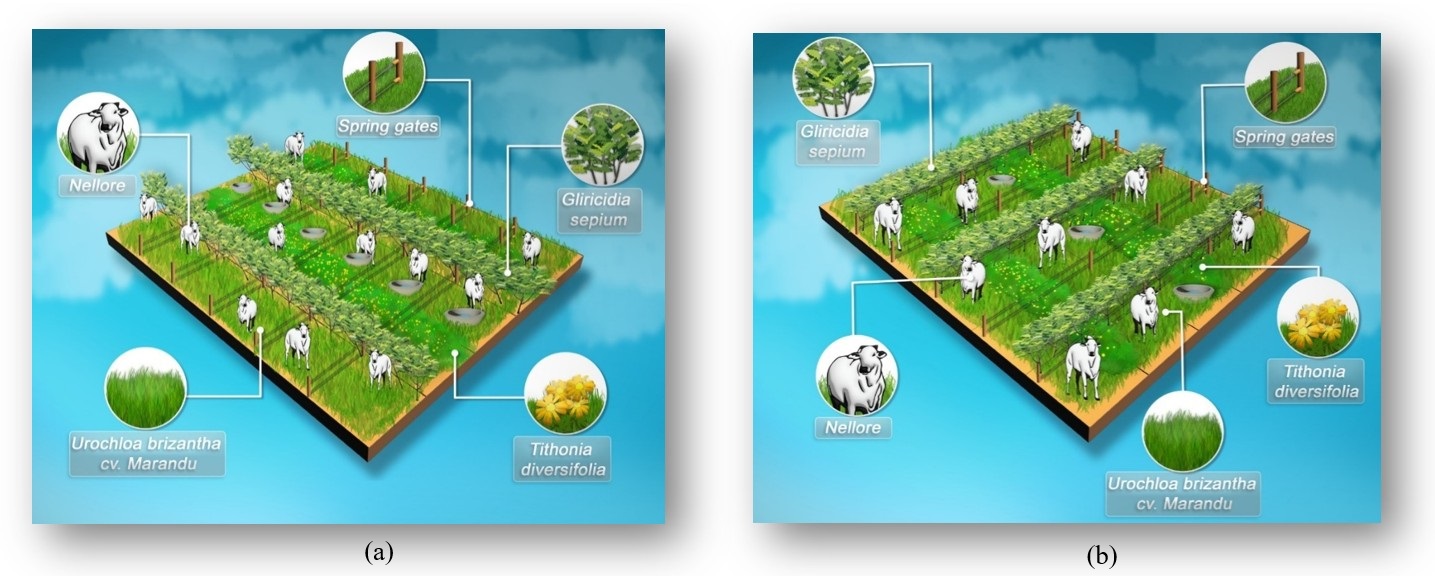
Below is a self-explanatory table (Table 1) with the parameters and scalar values used to construct the constraint equations for the model's response variables or outputs, as well as examples of production scenarios in agriculture that combine different elements in the system and can be an integrated sustainable agricultural production system, referring to this present model (Figure 1a, b).
Parameters and scalar values used to construct the constraint equations for the model's response variables or outputs.

Simulated scenarios transposed from the information generated by the GAMS® software. Software used: Adobe Illustrator® 2024 (Adobe Inc., 2024) to vectorize the images and Adobe Photoshop® CC 2019 (Adobe Inc., 2019) to join the vectors.
Means of parameters taken from the literature under meticulous scanning.
*If the growing sales is included in the revenue. For this model, only the revenue from fattening animals was taken into account.
4. Discussion
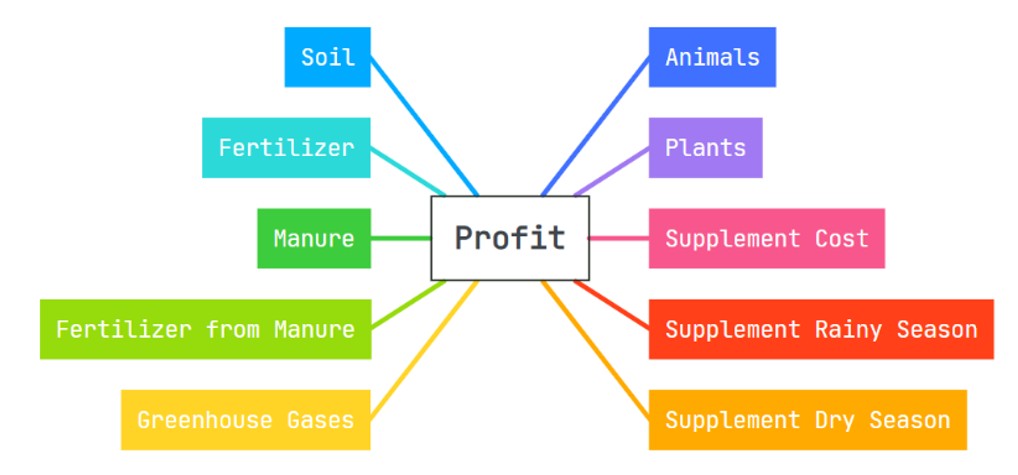
The discussion revolves around the hypotheses, which in this case are the issues that plague the commitment of the work. These questions are fundamental to assessing the validity of initial assumptions and identifying areas that require further investigation. By analysing these hypotheses, we can recognize the strengths and weaknesses of the commitment made, allowing adjustments and improvements to ensure the effectiveness of the project. Therefore, these questions are essential to guide the research and ensure that the work achieves its objectives in a solid and well-founded way, as shown in the mind map below (Figure 2).
Organization of information in relation to model response variables to encourage critical thinking and problem solving.
4.1. Maximizing profit
Implementing this mathematical model for beef cattle in tropical conditions will make it possible to maximize profits by optimizing available resources and boosting herd productivity.
Implementing the 'GETAP_model' for beef cattle in tropical conditions effectively maximizes profits by optimizing the use of resources and increasing herd productivity, as evidenced by the impressive profit maximization of R$ 867,712.72. This result is corroborated by several studies in the literature. For example, Oliveira et al. (2018a) demonstrated a 15% reduction in operating costs through the inclusion of alternative forages, while Santos et al. (2021) reported a 20% increase in farm profitability with the application of optimization models. In addition, the development of selection indices and management strategies, as highlighted by Portes et al. (2020) and Bomfim (2023), further reinforces the economic benefits, with net profitability figures of R$ 213,637.55 and R$ 184,550.15, respectively. In addition, Ogawa et al. (2021) and Pahmeyer and Britz (2020) showed substantial profits (R$ 598,403.80 and R$ 568,000.00, respectively) from improved carcass production and optimized dairy farming practices, emphasizing the broad applicability and financial advantages of these optimization models in agriculture. These findings collectively highlight the significant potential to increase economic sustainability and profitability through advanced modelling and management techniques in agricultural systems, including payment for carbon credits.
4.2. Minimizing environmental impacts
The adoption of sustainable practices in beef cattle management is imperative for minimizing environmental impacts, ensuring the conservation of natural resources and long-term sustainability, as shown in model. This discussion evaluates the nutritional management of animals within such a system, the need for supplementation and the environmental impact of the system, with a particular focus on greenhouse gas (GHG) emissions.
In the system studied, the animal population includes 139.82 head in the growing phase and 124.44 head in the fattening phase. The plant area is divided into Tithonia (3.30 ha), Gliricidia (46.10 ha) and pasture (6.60 ha). These figures are comparable to those found in the literature, which highlights the importance of efficient management of the planted area to maintain animal productivity (Nair and Garrity, 2012). The cattle's nutritional needs are mainly met by the vegetation present in the system. Supplement intake is minimal, with no need for mineral or energy-protein supplements during the dry season due to the adequate availability of forage. However, during the rainy season, 8,474.25 tons of mineral supplements are needed to meet the animals' requirements, highlighting the need for supplementation with macro and microminerals and salt (sodium chloride) during this period. This supplementation pattern is consistent with studies that indicate seasonal variability in nutrient availability and the need for additional supplementation during periods of higher nutritional demand (Murgueitio et al., 2011).
A significant environmental benefit of the silvopastoral system is its ability to sequester carbon dioxide. The system sequesters 1,341.39 tons of CO2-equivalent, demonstrating its potential to mitigate climate change by absorbing more GHGs than it emits. This sequestration capacity is corroborated by the literature, which highlights silvopastoral systems as effective strategies for mitigating climate change (Smith et al., 2014). Fertilizer use includes 2.61 tons of nitrogen, 20.18 tons of phosphorus, 9.56 tons of potassium, 4.16 tons of calcium and 1.30 tons of magnesium. The manure produced, totaling 871.95 tons, plays a crucial role in recycling nutrients within the system. Specifically, the manure used as fertilizer contributes 5.23 tons of nitrogen, 45.34 tons of phosphorus, 21.80 tons of potassium, 8.72 tons of calcium and 2.62 tons of magnesium, thus reducing the need for synthetic fertilizers and improving soil fertility. These values for reusing manure as fertilizer are higher than those often found in the literature, which suggests that efficient management can significantly reduce dependence on synthetic fertilizers and promote agricultural sustainability (Nair and Garrity, 2012).
Thus, the silvopastoral system effectively meets the nutritional needs of cattle through its diverse vegetation, minimizing dependence on external supplements. It also offers substantial environmental benefits by sequestering significant amounts of COand promoting sustainable nutrient management practices. The integration of trees, forage and livestock not only supports animal health and productivity, but also contributes to mitigating climate change and improving soil health. So, as a complement, due to the scarcity of current works in this context, this work serves as a literary reference, supported by evidence in relation to rigor and quality of writing, as well as meeting the interest to a general audience due to the overall quality of the content.
5. Conclusion
Optimization models derived from linear programming have emerged as valuable tools in the planning and management of agricultural farms, offering a strategic approach to dealing with operational complexity. Furthermore, these models are useful for evaluating the possible benefits arising from the implementation of integrated production systems, which combine animal husbandry and cultivation activities on a single property.
The technical synergies between the proposed activities, especially those related to livestock and agriculture, represent clear opportunities for economies of scale. The prospect of complete recycling of nitrogen, phosphorus and potassium contained in animal waste could increase when moving from scenarios with less diversification to those with greater diversification.
In addition to economic gains, running integrated systems brings benefits to the environment, especially through the reuse of resources that, once discarded, would cause negative externalities to the environment. Furthermore, the estimated volume of CO2-equivalent sequestered could increase from the lowest to the highest diversification scenario.
Acknowledgements
We acknowledge and thank the editor and reviewers, as well as the funding body FAPESP (#2022/14349-4) and the host institution, Federal University of Sao Carlos.
Data Availability Statement
The entire data set that supports the results of this study was published in the article itself.
References
-
ADOBE INC., 2019 [viewed 21 June 2024]. Adobe Photoshop (Version 2019) [software]. Available from: https://www.adobe.com/products/photoshop.html
» https://www.adobe.com/products/photoshop.html -
ADOBE INC., 2024 [viewed 21 June 2024]. Adobe Illustrator (Version 2024) [software]. Available from: https://www.adobe.com/products/illustrator.html
» https://www.adobe.com/products/illustrator.html - ANDRADE, B.M.S., SOUZA, S.F., SANTOS, C.M.C., MEDEIROS, S.S., MOTA, P.S.S. and CURADO, F.F., 2015. Uso da gliricídia (Gliricidia sepium) para alimentação animal em sistemas agropecuários sustentáveis. Scientia Plena, vol. 11, no. 4, pp. 046109.
-
ASSOCIAÇÃO BRASILEIRA DE FRIGORÍFICOS – ABRAFRIGO, 2024 [viewed 17 June 2024]. O desafio de manter o protagonismo brasileiro no mercado mundial de carne bovina [online]. Available from: https://www.abrafrigo.com.br/artigo/o-desafio-de-manter-o-protagonismo-brasileiro-no-mercado-mundial-de-carne-bovina
» https://www.abrafrigo.com.br/artigo/o-desafio-de-manter-o-protagonismo-brasileiro-no-mercado-mundial-de-carne-bovina -
BARBERO, R.P., RIBEIRO, A.C.C., MOURA, A.M., LONGHINI, V.Z., MATTOS, T.F.A. and BARBERO, M.M.D., 2021. Production potential of beef cattle in tropical pastures: a review. Ciência Animal Brasileira, vol. 22, e69609. http://doi.org/10.1590/1809-6891v22e-69609
» http://doi.org/10.1590/1809-6891v22e-69609 - BARBOSA, J.S., 2020. Uso de cama de frango no cultivo de Brachiaria brizantha cv. Marandú Anápolis: Centro Universitário de Anápolis, 25 p. Trabalho de Conclusão de Curso em Agronomia.
-
BLANCHARD, O., 2018. On the future of macroeconomic models. Oxford Review of Economic Policy, vol. 34, no. 1-2, pp. 52-53. http://doi.org/10.1093/oxrep/grx045
» http://doi.org/10.1093/oxrep/grx045 - BOMFIM, L.N., 2023. Avaliação econômica do programa Zebu PO: produção de carne de qualidade com eficiência e sustentabilidade sob o enfoque de gestão de custos e análises dos ponderadores técnicos-econômicos Campo Grande: Universidade Federal de Mato Grosso do Sul, 47 p. Dissertação de Mestrado em Ciência Animal.
-
BONAUDO, T., BENDAHAN, A.B., SABATIER, R., RYSCHAWY, J., BELLON, S., LEGER, F., MAGDA, D. and TICHIT, M., 2014. Agroecological principles for the redesign of integrated crop-livestock systems. European Journal of Agronomy, vol. 57, pp. 43-51. http://doi.org/10.1016/j.eja.2013.09.010
» http://doi.org/10.1016/j.eja.2013.09.010 - BORLAUG, N.E., 2000. The green revolution revisited and the road ahead Oslo: The Norwegian Nobel Institute. Special 30th Anniversary Lecture.
- BRONSON, K.F., 2019. Smart farming: integrating agribusiness and the Internet of Things (IoT). IEEE Technology and Society Magazine, vol. 38, no. 1, pp. 2-10.
-
BROWN, J.R. and THORPE, J., 2008. Climate change and rangelands: responding rationally to uncertainty. Rangelands, vol. 30, no. 3, pp. 3-6. http://doi.org/10.2111/1551-501X(2008)30[3:CCARRR]2.0.CO;2
» http://doi.org/10.2111/1551-501X(2008)30[3:CCARRR]2.0.CO;2 - CALSAVARA, L.H.F., RIBEIRO, R.S., SILVEIRA, S.R., DELAROTA, G., FREITAS, D.S., SACRAMENTO, J.P., PACIULLO, D.S.C. and MAURÍCIO, R.M., 2016. Potencial forrageiro da Tithonia diversifolia para alimentação de ruminantes. Livestock Research for Rural Development, vol. 28, no. 2, pp. 1-9.
-
CHARÁ, J., RIVERA, J., BARAHONA, L., MURGUEITIO, E., DEBLITZ, C., REYES, E., MAURICIO, R.M., MOLINA, J.J., FLORES, M. and ZULUAGA, A., 2017. Intensive Silvopastoral systems: Economics and contribution to climate change mitigation and public policies. In: F. MONTAGNINI, ed. Integrating landscapes: agroforestry for biodiversity conservation and food sovereignty. Advances in agroforestry Cham: Springer, vol. 12, pp. 395-416. http://doi.org/10.1007/978-3-319-69371-2_16
» http://doi.org/10.1007/978-3-319-69371-2_16 - CONCEIÇÃO, J.M., 2017. Gliricidia sepium: produtividade, composição químico-bromatológica e características de fermentação da silagem São Cristóvão: Universidade Federal de Sergipe, 52 p. Dissertação de Mestrado em Zootecnia.
-
COSTA, B.M., CAPINAN, G.C.S., SANTOS, H.H.M. and SILVA, M.A., 2004. Métodos de plantio de gliricídia (Gliricidia sepium (Jacq.) Walp.) em estacas para produção de forragem. Revista Brasileira de Zootecnia, vol. 33, no. 6, pp. 1969-1974. http://doi.org/10.1590/S1516-35982004000800007
» http://doi.org/10.1590/S1516-35982004000800007 -
COSTA, S.B.M., MELLO, A.C.L., DUBEUX, J.C.B., SANTOS, M.V.F., CUNHA, M.V. and COELHO, J.J., 2021. Proportion and digestibility of tree legumes in diets of grazing cattle in a tropical silvopastoral system. Livestock Science, vol. 252, pp. 104689. http://doi.org/10.1016/j.livsci.2021.104689
» http://doi.org/10.1016/j.livsci.2021.104689 -
DATAGRO, 2024 [viewed 30 April 2024]. Consultoria agrícola independente [online]. Available from: https://cbio.datagro.com/cbio/
» https://cbio.datagro.com/cbio/ - DRUMOND, M.A. and CARVALHO FILHO, O.M., 1999. Introdução e avaliação da Gliricidia sepium na região semiárida do Nordeste brasileiro. In: M.A. QUEIRÓZ, C.O. GOEDERT and S.R.R. RAMOS, eds. Recursos genéticos e melhoramento de plantas para o Nordeste brasileiro Petrolina: Embrapa Semi-Árido, Embrapa Recursos Genéticos e Biotecnologia, pp. 974-981.
-
EIFEDIYI, E.K., AHAMEFULE, H.E., OGEDEGBE, F.O., AGBEDE, T.M., KAREEM, I. and AJAYI, A.D., 2023. Influence of Tithonia diversifolia and cattle manures on the growth and yield of sesame (Sesamum indicum L.). International Journal of Recycling of Organic Waste in Agriculture, vol. 12, no. 3, pp. 291-202. http://doi.org/10.30486/ijrowa.2022.1945769.1377
» http://doi.org/10.30486/ijrowa.2022.1945769.1377 -
EMPRESA BRASILEIRA DE PESQUISA AGROPECUÁRIA – EMBRAPA, 2024 [viewed 17 June 2024]. O futuro da cadeia produtiva da carne bovina brasileira: uma visão para 2040 [online]. Available from: https://www.infoteca.cnptia.embrapa.br/infoteca/handle/doc/1125194
» https://www.infoteca.cnptia.embrapa.br/infoteca/handle/doc/1125194 -
ERI, M., SILVA-JUNIOR, C.A., LIMA, M., SCALA-JÚNIOR, N., OLIVEIRA-JÚNIOR, J.F., TEODORO, P.E., CAPRISTO-SILVA, G.F., CAIONE, G. and PERES, C.A., 2020. Capitalizing on opportunities provided by pasture sudden death to enhance livestock sustainable management in Brazilian Amazonia. Environmental Development, vol. 33, pp. 100499. http://doi.org/10.1016/j.envdev.2020.100499
» http://doi.org/10.1016/j.envdev.2020.100499 -
FACULDADE CNA, 2017 [viewed 12 March 2024]. Agro em Questão: Revista de Iniciação Científica da Faculdade CNA. Brasília, ano I, no. 1, 172 p. Available from: https://www.cnabrasil.org.br/assets/arquivos/RevistaCNA.1.arquivo3.pdf
» https://www.cnabrasil.org.br/assets/arquivos/RevistaCNA.1.arquivo3.pdf - FONTES, H.R., BARRETO, A.C. and SOBRAL, L.F., 2016. Adubação verde com Gliricidia sepium como fonte permanente de nitrogênio na cultura do coqueiro Aracaju: Embrapa Tabuleiros Costeiros, Comunicado Técnico, no. 192.
-
FRIGG, R. and NGUYEN, J., 2020. Modelling nature: an opinionated introduction to scientific representation Cham: Springer, 241 p. Synthese Library, no. 4. http://doi.org/10.1007/978-3-030-45153-0
» http://doi.org/10.1007/978-3-030-45153-0 - GAMEIRO, A.H., CAIXETA-FILHO, J.V. and BARROS, C.S.D., 2010. Modelagem matemática para o planejamento, otimização e avaliação da produção agropecuária. In: M.V. SANTOS, L.F.P. SILVA, F.P. RENNÓ and R. ALBUQUERQUE, orgs. Novos desafios da pesquisa em nutrição e produção animal Pirassununga: Editora 5D, pp. 165-191.
- GISSI, L., 2017. Mitigação das emissões de óxido nitroso pelo uso de fertilizantes nitrogenados revestidos São Paulo: Escola de Economia de São Paulo, Fundação Getúlio Vargas, 50 p. Dissertação de Mestrado em Agronegócio.
-
GOMES LOBO, A.A., CAMPANA, M., GAMEIRO, A.H., MOURÃO, G.B. and MORAIS, J.P.G., 2023. Indicators for modeling redesign from conventional to sustainable silvopastoral systems –an expert’s opinion. Frontiers in Environmental Science, vol. 11, pp. 1295590. http://doi.org/10.3389/fenvs.2023.1295590
» http://doi.org/10.3389/fenvs.2023.1295590 -
GOMES, F.J., CAVALLI, J., PEDREIRA, B.C., PEDREIRA, C.G.S., HOLSCHUCH, S.G. and PEREIRA, D.H., 2022. Forage nutritive value of Marandu palisade grass under clipping in a silvopastoral system. Agroforestry Systems, vol. 96, no. 1, pp. 79-88. http://doi.org/10.1007/s10457-021-00696-6
» http://doi.org/10.1007/s10457-021-00696-6 -
HAVSTAD, K.M., PETERS, D.P.C., SKAGGS, R., BROWN, J., BESTELMEYER, B., FREDRICKSON, E., HERRICK, J. and WRIGHT, J., 2007. Ecological services to and from rangelands of the United States. Ecological Economics, vol. 64, no. 2, pp. 261-268. http://doi.org/10.1016/j.ecolecon.2007.08.005
» http://doi.org/10.1016/j.ecolecon.2007.08.005 -
HERRERA, A.M., MELLO, A.C.L., OLIVEIRA-APOLINÁRIO, V.X., DUBEUX-JUNIOR, C.B., CUNHA, M.V. and SANTOS, M.V.F., 2021. Potential of Gliricidia sepium (jacq.) Kunth ex Walp. and Mimosa caesalpiniifolia Benth. in silvopastoral systems intercropped with signalgrass [Urochloa decumbens (Stapf) R.D. Webster]. Agroforestry Systems, vol. 95, no. 6, pp. 1061-1072. http://doi.org/10.1007/s10457-021-00625-7
» http://doi.org/10.1007/s10457-021-00625-7 - HILLIER, F.S. and LIEBERMAN, G.J., 2006. Introdução à pesquisa operacional 8. ed. São Paulo: McGraw-Hill, 828 p.
-
HÖTZEL, M.J. and VANDRESEN, B., 2022. Brazilians’ attitudes to meat consumption and production: present and future challenges to the sustainability of the meat industry. Meat Science, vol. 192, pp. 108893. http://doi.org/10.1016/j.meatsci.2022.108893 PMid:35760024.
» http://doi.org/10.1016/j.meatsci.2022.108893 -
INTERNATIONAL BUSINESS MACHINES – IBM, 2024a [viewed 28 June 2024]. User's manual for CPLEX [online]. Available from: https://www.ibm.com/docs/en/icos/20.1.0?topic=cplex-users-manual
» https://www.ibm.com/docs/en/icos/20.1.0?topic=cplex-users-manual -
INTERNATIONAL BUSINESS MACHINES – IBM, 2024b [viewed 28 June 2024]. Optimization software [online]. Available from: https://www.ibm.com/optimization-solver
» https://www.ibm.com/optimization-solver -
JAMA, B., PALM, C.A., BURESH, R.J., NIANG, C., GACHENGO, C., NZIGUHEBA, G. and AMADALO, B., 2000. Tithonia diversifolia as a green manure for soil fertility improvement in western Kenya: a review. Agroforestry Systems, vol. 49, pp. 201-221. http://doi.org/10.1023/A:1006339025728
» http://doi.org/10.1023/A:1006339025728 -
JESUS, M.S., PASSOS, A.R. and DINIZ, R.P., 2023. Genetic diversity for agronomic and bromatological traits in forage cactus. Acta Scientiarum. Agronomy, vol. 46, no. 1, e62752. http://doi.org/10.4025/actasciagron.v46i1.62752
» http://doi.org/10.4025/actasciagron.v46i1.62752 -
KOUTSOYIANNIS, D., 2006. A toy model of climatic variability with scaling behaviour. Journal of Hydrology, vol. 322, no. 1-4, pp. 25-48. http://doi.org/10.1016/j.jhydrol.2005.02.030
» http://doi.org/10.1016/j.jhydrol.2005.02.030 -
KUL, E., ŞAHIN, A., AKSOY, Y. and UĞURLUTEPE, E., 2020. The effects of slaughter weight on chemical composition, physical properties, and fatty acid profile of musculus longissimus dorsi in Holstein bulls. Tropical Animal Health and Production, vol. 52, no. 1, pp. 159-165. http://doi.org/10.1007/s11250-019-01996-x PMid:31280420.
» http://doi.org/10.1007/s11250-019-01996-x -
KUMAR, S., SINGH, J., NANOTI, S.M. and GARG, M.O., 2012. A comprehensive life cycle assessment (LCA) of Jatropha biodiesel production in India. Bioresource Technology, vol. 110, pp. 723-729. http://doi.org/10.1016/j.biortech.2012.01.142 PMid:22361070.
» http://doi.org/10.1016/j.biortech.2012.01.142 -
LAL, R., 2020. Regenerative agriculture for food and climate. Journal of Soil and Water Conservation, vol. 75, no. 5, pp. 123-124. http://doi.org/10.2489/jswc.2020.0620A
» http://doi.org/10.2489/jswc.2020.0620A -
LARREAL-HERRERA, F.L., 2023. Restauração inexata com avaliação imprecisa da função objetivo e das restrições Campinas: Universidade Estadual de Campinas, 190 p. Tese de Doutorado em Matemática Aplicada. http://doi.org/10.47749/T/UNICAMP.2023.1376022
» http://doi.org/10.47749/T/UNICAMP.2023.1376022 - LIMA-FILHO, O.F., AMBROSANO, E.J., WUTKE, E.B., ROSSI, F. and CARLOS, J.A.D., eds., 2023. Adubação verde e plantas de cobertura no Brasil: fundamentos e prática 2. ed. Brasília: Embrapa, 586 p.
-
LOBO, A.A.G., 2023. Intensidade de emissão de metano, fermentação e dinâmica ruminal de bovinos Nelore em sistemas de pastejo intensificado e integrado nas diferentes estações do ano Pirassununga: Universidade de São Paulo, 145 p. Tese de Doutorado em Qualidade e Produtividade Animal. http://doi.org/10.11606/T.74.2023.tde-26042023-094836
» http://doi.org/10.11606/T.74.2023.tde-26042023-094836 -
LOBO, A.A.G., CAMPANA, M., GAMEIRO, A.H. and MORAIS, J.P.G., 2024. Modeling approaches to redesign ruminant production toward sustainability: the state of the art from a literature perspective. Frontiers in Environmental Science, vol. 12, pp. 1345313. http://doi.org/10.3389/fenvs.2024.1345313
» http://doi.org/10.3389/fenvs.2024.1345313 -
MADDEN, J.C., ENOCH, S.J., PAINI, A. and CRONIN, M.T.D., 2020. A review of in silico tools as alternatives to animal testing: principles, resources and applications. Alternatives to Laboratory Animals, vol. 48, no. 4, pp. 146-172. http://doi.org/10.1177/0261192920965977 PMid:33119417.
» http://doi.org/10.1177/0261192920965977 -
MARÍN-GARZÓN, N.A., MAGALHÃES, A.F.B., SCHMIDT, P.I., SERNA, M., FONSECA, L.F.S., SALATTA, B.M., FREZARIM, G.B., FERNANDES-JUNIOR, G.A., BRESOLIN, T., CARVALHEIRO, R. and ALBUQUERQUE, L.G., 2021. Genome-wide scan reveals genomic regions and candidate genes underlying direct and maternal effects of preweaning calf mortality in Nellore cattle. Genomics, vol. 113, no. 3, pp. 1386-1395. http://doi.org/10.1016/j.ygeno.2021.02.021 PMid:33716185.
» http://doi.org/10.1016/j.ygeno.2021.02.021 - MARQUES, M.A., 2021. Modelagem matemática aplicada a recomendação de uso de sistemas agroflorestais multiestratos sucessionais pelo pequeno agricultor no bioma cerrado Seropédica: Universidade Federal Rural do Rio de Janeiro, 153 p. Tese de Doutorado em Ciência, Tecnologia e Inovação em Agropecuária.
-
MARSETYO, SULENDRE, I.W., TAKDIR, M., HARPER, K.J. and POPPI, D.P., 2021. Formulating diets based on whole cassava tuber (Manihot esculenta) and gliricidia (Gliricidia sepium) increased feed intake, liveweight gain and income over feed cost of Ongole and Bali bulls fed low quality forage in Central Sulawesi, Indonesia. Animal Production Science, vol. 61, pp. 761-769. http://doi.org/10.1071/AN20297
» http://doi.org/10.1071/AN20297 -
MATO GROSSO DO SUL. Secretaria do Estado de Meio Ambiente, Desenvolvimento, Ciência, Tecnologia e Inovação – SEMADESC, 2022 [viewed 13 March 2024]. Calcário rendeu 78% a mais de arrecadação de taxas ao Estado no ano passado [online]. Available from: https://www.semadesc.ms.gov.br/calcario-rendeu-78-a-mais-de-receita-ao-estado-no-ano-passado/#:~:text=No%20ano%20passado%20o%20custo,seja%2C%20majora%C3%A7%C3%A3o%20de%2060%25
» https://www.semadesc.ms.gov.br/calcario-rendeu-78-a-mais-de-receita-ao-estado-no-ano-passado/#:~:text=No%20ano%20passado%20o%20custo,seja%2C%20majora%C3%A7%C3%A3o%20de%2060%25 -
MATSUDA, 2024 [viewed 13 March 2024]. Grupo Matsuda de nutrição animal [online]. Available from: https://www.matsuda.com.br/nutricao-animal
» https://www.matsuda.com.br/nutricao-animal -
MAURICIO, R.M., RIBEIRO, R.R., PACIULLO, D.S.C., CANGUSSÚ, M.A., MURGUEITIO, E., CHARÁ, J. and ESTRADA, M.X.F., 2019. Silvopastoral systems in Latin America for biodiversity, environmental, and socioeconomic improvements. In: G. LEMAIRE, P.C.F. CARVALHO, S. KRONBERG and S. RECOUS, eds. Agroecosystem diversity: reconciling contemporary agriculture and environmental quality London: Academic Press, pp. 287-297. http://doi.org/10.1016/B978-0-12-811050-8.00018-2
» http://doi.org/10.1016/B978-0-12-811050-8.00018-2 - MAZOYER, M. and ROUDART, L., 2006. A history of world agriculture: from the neolithic age to the current crisis London: Earthscan. 512 p.
-
MÉO-FILHO, P., 2020. Efeitos do manejo, intensificação e integração em sistemas de produção de bovinos de corte a pasto, em face da emissão de metano ruminal e do aquecimento global Pirassununga: Universidade de São Paulo, 148 p. Tese de Doutorado em Zootecnia. http://doi.org/10.11606/T.74.2020.tde-29042021-162448
» http://doi.org/10.11606/T.74.2020.tde-29042021-162448 -
MONTAGNINI, F., IBRAHIM, M. and MURGUEITIO, E., 2013. Silvopastoral systems and climate change mitigation in Latin America. Bois et Forêts des Tropiques, vol. 316, no. 2, pp. 3-16. http://doi.org/10.19182/bft2013.316.a20528
» http://doi.org/10.19182/bft2013.316.a20528 -
MURGUEITIO, E., CALLE, Z., URIBE, F., CALLE, A. and SOLORIO, B., 2011. Native trees and shrubs for the productive rehabilitation of tropical cattle ranching lands. Forest Ecology and Management, vol. 261, no. 10, pp. 1654-1663. http://doi.org/10.1016/j.foreco.2010.09.027
» http://doi.org/10.1016/j.foreco.2010.09.027 - NAIR, P.K.R. and GARRITY, D., 2012. Agroforestry: the future of global land use Dordrecht: Springer, 852 p. Advances in Agroforestry, no. 9.
-
NATIONAL ACADEMIES OF SCIENCES, ENGINEERING AND MEDICINE – NASEM, 2016. Nutrient requirements of beef cattle 8th ed. Washington: Academy Press, 494 p. http://doi.org/10.17226/19014
» http://doi.org/10.17226/19014 -
NATIVA AGRONEGÓCIOS, 2024 [viewed 13 March 2024]. Fertilizantes convencionais [online]. Available from: https://nativagro.com.br/produtos/fertilizantes-convencionais/
» https://nativagro.com.br/produtos/fertilizantes-convencionais/ - NEVES, F.O., 2020. Qualidade da carcaça e carne de novilhas angus-nelore em sistemas integrados de produção agropecuária Dracena: Universidade Estadual Paulista, 49 p. Dissertação de Mestrado em Ciência e Tecnologia Animal.
- NUNES, S.G., BOOCK, A., PENTEADO, M.I.O. and GOMES, D.T., 1984. Brachiaria brizantha cv. Marandu Campo Grande: EMBRAPA-CNPGC, 31 p. Documentos, no. 21.
-
ODEDIRE, J.A. and OLOIDI, F.F., 2014. Feeding wild sunflower (Tithonia diversifolia Hemsl. A. Gray) to West African dwarf goats as a dry season forage supplement. World Journal of Agricultural Research, vol. 2, no. 6, pp. 280-284. http://doi.org/10.12691/wjar-2-6-6
» http://doi.org/10.12691/wjar-2-6-6 -
OGAWA, S., KITAJIMA, S., SAITO, H. and SATOH, M., 2021. Deriving economic values for female reproductive traits in lifetime carcass production of japanese black cows using deterministic profit function. Agriculture, vol. 11, no. 11, pp. 1055. http://doi.org/10.3390/agriculture11111055
» http://doi.org/10.3390/agriculture11111055 -
OLIVEIRA, A.F., MENEZES, G.L., GONÇALVES, L.C., ARAÚJO, V.E., RAMIREZ, M.A., GUIMARÃES-JUNIOR, R., JAYME, D.G. and LANA, A.M.Q., 2022. Pasture traits and cattle performance in silvopastoral systems with Eucalyptus and Urochloa: systematic review and meta-analysis. Livestock Science, vol. 262, pp. 104973. http://doi.org/10.1016/j.livsci.2022.104973
» http://doi.org/10.1016/j.livsci.2022.104973 -
OLIVEIRA, D.E., AMARAL, C.M., GIAROLA, I.B.S. and FERREIRA, C.C.M., 2023. Variabilidade climática e as chuvas de janeiro de 2007: uma análise episódica na bacia hidrográfica do Rio Preto, Sudeste do Brasil. Revista Da ANPEGE, vol. 18, no. 37, pp. 106-135. http://doi.org/10.5418/ra2022.v18i37.10117
» http://doi.org/10.5418/ra2022.v18i37.10117 - OLIVEIRA, J.C., SILVA, M.S. and SOUZA, P.B., 2018a. Estratégias de manejo com dietas de forragens alternativas: impactos econômicos e ambientais. Revista Brasileira de Agricultura Sustentável, vol. 8, no. 2, pp. 67-82.
-
OLIVEIRA, J.T.C., LIRA, M.A., SANTOS, M.V.F., FREIRE, F.J., DUBEUX JÚNIOR, J.C.B., FREITAS, E.V. and COSTA, S.B.M., 2018b. Methodologies in the evaluation of forage mass in tree legumes. Agrária, vol. 13, no. 1, e5500. http://doi.org/10.5039/agraria.v13i1a5500
» http://doi.org/10.5039/agraria.v13i1a5500 -
OLIVEIRA, V.A.V., BRAZ, T.G.S., SILVA, R.B., VELOSO, A.C.R., RUFINO, L.D.A., MARTUSCELLO, J.A., MOURTHÉ, M.H.F. and BARROS, L.V., 2021. Defoliation heights for palisade grass cv. Marandu in silvopastoral system. Arquivo Brasileiro de Medicina Veterinária e Zootecnia, vol. 73, no. 3, pp. 665-674. http://doi.org/10.1590/1678-4162-12253
» http://doi.org/10.1590/1678-4162-12253 -
OPALA, P.A., 2020. Recent advances in the use of Tithonia diversifolia green manure for soil fertility management in Africa: a review. Agricultural Reviews (Karnal), vol. 41, no. 3, pp. 256-263. http://doi.org/10.18805/ag.R-141
» http://doi.org/10.18805/ag.R-141 -
PAGLIARI, P., WILSON, M. and HE, Z., 2020. Animal manure production and utilization: impact of modern concentrated animal feeding operations. In: H.M. WALDRIP, P.H. PAGLIARI and Z. HE, eds. Animal manure: production, characteristics, environmental concerns, and management Hoboken: Wiley, pp. 1-14. http://doi.org/10.2134/asaspecpub67.c1
» http://doi.org/10.2134/asaspecpub67.c1 -
PAHMEYER, C. and BRITZ, W., 2020. Economic opportunities of using crossbreeding and sexing in Holstein dairy herds. Journal of Dairy Science, vol. 103, no. 9, pp. 8218-8230. http://doi.org/10.3168/jds.2019-17354 PMid:32684478.
» http://doi.org/10.3168/jds.2019-17354 - PALMA, P., 2009. Estructura y composición de la selva mediana subcaducifolia de Kabah y San Juan Bautista Tabí y anexa Sanicté, Yucatán Mérida: Universidad Autónoma de Yucatán, 64 p. Tese de Licenciatura en Veterinaria y Zootecnia.
-
PAZLA, R., ADRIZAL and SRIAGTULA, R., 2021. Intake, nutrient digestibility and production performance of pesisir cattle fed Tithonia diversifolia and Calliandra calothyrsus-based rations with different protein and energy ratios. Advances in Animal and Veterinary Sciences, vol. 9, no. 10, pp. 1608-1615. http://doi.org/10.17582/journal.aavs/2021/9.10.1608.1615
» http://doi.org/10.17582/journal.aavs/2021/9.10.1608.1615 -
PERA, T.G., 2022. Efeitos das mudanças tecnológicas e infraestruturais do transporte para o fomento da logística verde da soja brasileira: abordagens multiobjetivos. Piracicaba: Universidade de São Paulo, 171 p. Tese de Doutorado em Economia Aplicada. http://doi.org/10.11606/T.11.2022.tde-08042022-162357
» http://doi.org/10.11606/T.11.2022.tde-08042022-162357 - PEREIRA, F.C., OLIVEIRA, R., CAMPANA, M., GREGORINI, P., DEL-VALLE, T.A., POGLIANI, C.F. and MORAIS, J.P.G., 2024 Introducing multifunctional forages to redesign pastoral livestock production systems. SSRN In press. http://doi.org/10.2139/ssrn.4854210.
- PÉREZ MÁRQUEZ, S., OVANI, V.S., ABDALLA, A.L. and MAURÍCIO, R.M., 2021. Why haven’t silvopastoral system expanded in Brazil? Livestock Research for Rural Development, vol. 33, no. 5, pp. 66.
-
PIERCE, F.J. and NOWAK, P., 1999. Aspects of precision agriculture. Advances in Agronomy, vol. 67, pp. 1-85. http://doi.org/10.1016/S0065-2113(08)60513-1
» http://doi.org/10.1016/S0065-2113(08)60513-1 -
PINGALI, P.L., 2012. Green revolution: Impacts, limits, and the path ahead. Proceedings of the National Academy of Sciences of the United States of America, vol. 109, no. 31, pp. 12302-12308. http://doi.org/10.1073/pnas.0912953109 PMid:22826253.
» http://doi.org/10.1073/pnas.0912953109 -
PORTES, J.V., MENEZES, G.R.O., MACNEIL, M.D., SILVA, L.O.C., GONDO, A. and BRACCINI-NETO, J., 2020. Selection indices for Nellore production systems in the Brazilian Cerrado. Livestock Science, vol. 242, pp. 104309. http://doi.org/10.1016/j.livsci.2020.104309
» http://doi.org/10.1016/j.livsci.2020.104309 - RADOMSKI, M.I. and OLIVEIRA, B.T., 2018. Produção de biomassa aérea e teor de nutrientes de Erythrina speciosa e Tithonia diversifolia cultivadas em Morretes, PR – resultados iniciais Colombo: Embrapa, 15 p. Comunicado Técnico, no. 422.
- REIS, M.M., CRUZ, L.R., COSTA, G.A., BARROS, R.E. and SANTOS, L.D.T., 2015. Potencial forrageiro de Tithonia diversifolia na alimentação animal. Caderno de Ciências Agrárias, vol. 7, pp. 233-245.
-
RESENDE, L.O., MÜLLER, M.D., KOHMANN, M.M., PINTO, L.F.G., CULLEN-JUNIOR, L. and REGO, L.F.G., 2020. Silvopastoral management of beef cattle production for neutralizing the environmental impact of enteric methane emission. Agroforestry Systems, vol. 94, no. 3, pp. 893-903. http://doi.org/10.1007/s10457-019-00460-x
» http://doi.org/10.1007/s10457-019-00460-x -
REUTLINGER, A., HANGLEITER, D. and HARTMANN, S., 2018. Understanding (with) toy models. The British Journal for the Philosophy of Science, vol. 69, no. 4, pp. 1069-1099. http://doi.org/10.1093/bjps/axx005
» http://doi.org/10.1093/bjps/axx005 -
RHODES, C.J., 2017. The Imperative for regenerative agriculture. Science Progress, vol. 100, no. 1, pp. 80-129. http://doi.org/10.3184/003685017X14876775256165 PMid:28693674.
» http://doi.org/10.3184/003685017X14876775256165 - RIVERA, J.E., CUARTAS, C.A., NARANJO, J.F., TAFUR, O., HURTADO, E.A., ARENAS, F.A., CHARÁ, J. and MURGUEITIO, E., 2015. Efecto de la oferta y el consumo de Tithonia diversifolia en un sistema silvopastoril intensivo (SSPi), en la calidad y productividad de leche bovina en el piedemonte Amazónico colombiano. Livestock Research for Rural Development, vol. 27, no. 10, pp. 189.
-
RIVERA-ACOSTA, J. and XIUCHUAN, X., 2023. The impact of credit on agricultural productivity of Musaceae: evidence from Valle Del Cauca, Colombia. Revista Facultad Nacional de Agronomía, vol. 76, no. 1, pp. 10135-10148. http://doi.org/10.15446/rfnam.v76n1.101474
» http://doi.org/10.15446/rfnam.v76n1.101474 -
RODRIGUES, D.C., 2004. Produção de forragem de cultivares de Brachiaria brizantha (Hochst. ex A. Rich.) Stapf e modelagem de respostas produtivas em função de variáveis climáticas Piracicaba: Universidade de São Paulo, 94 p. Dissertação de Mestrado em Ciência Animal e Pastagens. http://doi.org/10.11606/D.11.2004.tde-11112004-161221
» http://doi.org/10.11606/D.11.2004.tde-11112004-161221 - RUTTAN, V.W., 2002. Technology, growth, and development: an induced innovation perspective Oxford: Oxford University Press, 672 p.
-
SANDOVAL PAIXÃO, M.V., GROBÉRIO, R.B.C., FERNANDES, A.R., FARIA-JUNIOR, H.P.D., CELESTINO-MEIRELES, R. and SOUSA, G.B., 2020. Esterco bovino e fertilizante na emergência e desenvolvimento inicial de plântulas de mamoeiro. Brazilian Journal of Development, vol. 6, no. 8, pp. 59048-59057. http://doi.org/10.34117/bjdv6n8-354
» http://doi.org/10.34117/bjdv6n8-354 - SANTOS, F.R., LIMA, A.L. and MENDES, C.G., 2021. Modelos de otimização na agricultura: ajuste de práticas agrícolas para maximização de lucro e sustentabilidade. Agrária, vol. 16, no. 3, pp. 311-326.
-
SANTOS, P.P., 2022. Controle cultural de plantas daninhas em pastagens. Archivos de Zootecnia, vol. 71, no. 273, pp. 46-57. http://doi.org/10.21071/az.v71i273.5610
» http://doi.org/10.21071/az.v71i273.5610 - SANTOS, S.S. and GRZEBIELUCKAS C., 2014. Sistema silvipastoril com eucalipto e pecuária de corte: uma análise de viabilidade econômica em uma propriedade rural em Mato Grosso/Brasil. Custos e @gronegócio on line, vol. 10, no. 3, pp. 317-333.
-
SCOT CONSULTORIA, 2015 [viewed 24 March 2024]. Carta insumos: custo para formação de um hectare de pasto [online]. Available from: www.scotconsultoria.com.br
» www.scotconsultoria.com.br -
SHAKER, B., SAJJAD-AHMAD, S., LEE, J., JUNG, C. and NA, D., 2021. In silico methods and tools for drug discovery. Computers in Biology and Medicine, vol. 137, pp. 104851. http://doi.org/10.1016/j.compbiomed.2021.104851 PMid:34520990.
» http://doi.org/10.1016/j.compbiomed.2021.104851 - SILVA, A.M.S., SILVA, L.D., CRUZ, P.J.R., SANTOS, M.V., SOUZA, C.M.P., FARNESI, M.M.M. and GANDINI, E.M.M., 2018. Produção e valor nutritivo da Tithonia diversifolia em período de estabelecimento. Livestock Research for Rural Development, vol. 30, no. 9, pp. 158.
-
SILVA, E.F., MOITINHO, M.R., TEIXEIRA, D.B., PEREIRA, G.T. and SCALA-JUNIOR, N., 2014. Emissão de CO2 do solo associada à calagem em área de conversão de laranja para cana-de-açúcar. Engenharia Agrícola, vol. 34, no. 5, pp. 885-898. http://doi.org/10.1590/S0100-69162014000500008
» http://doi.org/10.1590/S0100-69162014000500008 - SILVA, H.W., 2022. Produtividade e valor nutritivo em diferentes intervalos entre cortes da gliricídia Dracena: Universidade Estadual Paulista, 36 p. Dissertação de Mestrado em Ciência e Tecnologia Animal.
- SILVA, H.W., JAHNO, V.D., FAVARIN, S. and GODINHO, A.M.M., 2020. Substâncias antinutricionais nas folhas e raízes de Gliricídia. Revista Alomorfia, vol. 4, no. 3, pp. 123-130.
-
SILVA, R.F., COSTA, I.P.A., SANTOS, M., FÁVERO, L.P.L., SANTOS, L.J.T., MOREIRA, M.A.L. and KOJIMA, E.H., 2022. Tariff optimization under incentive regulation of public services using simplex method. Procedia Computer Science, vol. 214, pp. 1325-1333. http://doi.org/10.1016/j.procs.2022.11.312
» http://doi.org/10.1016/j.procs.2022.11.312 -
SIMIONI, G.F., SCHIMITT-FILHO, A.L., JONER, F., FARLEY, J., FANTINI, A.C. and MOREIRA, A.P.T., 2022a. Response of birds to high biodiversity silvopastoral systems: integrating food production and biodiversity conservation through applied nucleation in southern Brazil. Agriculture, Ecosystems & Environment, vol. 324, pp. 107709. http://doi.org/10.1016/j.agee.2021.107709
» http://doi.org/10.1016/j.agee.2021.107709 -
SIMIONI, T.A., MESSANA, J.D., SILVA, L.G., BRITO, L.F., TORRECIHAS, J.A., GRANJA-SALCEDO, Y.T., VITTO, E.S., LAGE, J.F., REIS, R.A. and BERCHIELLI, T.T., 2022b. Performance and enteric methane emission of growing beef bulls from different genetic groups subjected to two supplementation strategies grazing tropical grass in the rainy season. Animal Feed Science and Technology, vol. 293, pp. 115470. http://doi.org/10.1016/j.anifeedsci.2022.115470
» http://doi.org/10.1016/j.anifeedsci.2022.115470 -
SINUANY-STERN, Z., 2023. Foundations of operations research: from linear programming to data envelopment analysis. European Journal of Operational Research, vol. 306, no. 3, pp. 1069-1080. http://doi.org/10.1016/j.ejor.2022.10.046
» http://doi.org/10.1016/j.ejor.2022.10.046 - SMITH, P., BUSTAMANTE, M., AHAMMAD, H., CLARK, H., DONG, H., ELSIDDIG, E.A. and TUBIELLO, F.N., 2014. Agriculture, Forestry and other land use (AFOLU). In: R.K. PACHAURI and L.A. MEYER, eds. Climate change 2014: synthesis report. Contribution of Working Groups I, II and III to the Fifth Assessment Report of the Intergovernmental Panel on Climate Change Cambridge: Cambridge University Press, pp. 812-922.
- SOARES, N.O., 2021. Seleção de acessos de Tithonia diversifolia para fins forrageiros Montes Claros: Universidade Federal de Minas Gerais, 63 p. Dissertação de Mestrado em Produção Animal.
-
SOCIETY FOR RANGE MANAGEMENT – SRM, 2002 [viewed 28 June 2024]. Policy statement, position statements, and resolutions [online]. Available from: https://s3.wp.wsu.edu/uploads/sites/2080/2014/02/SRM-position-and-policy-statement11.pdf
» https://s3.wp.wsu.edu/uploads/sites/2080/2014/02/SRM-position-and-policy-statement11.pdf -
TAHUK, P.K., NAHAK, O.R.T.B., BIRA, G.F., MANEK, A., MANEK, D., PURNAMA, T.Y., BUBUN, E. and SUBAY, S., 2022. The effect of using Gliricidia sepium leaves as a source of protein in the complete feed on the performance of fattened male bali cattle in West Timor, Indonesia. Advances in Animal and Veterinary Sciences, vol. 10, no. 6, pp. 1339-1349. http://doi.org/10.17582/journal.aavs/2022/10.6.1339.1349
» http://doi.org/10.17582/journal.aavs/2022/10.6.1339.1349 -
TROCÓNIZ, J.F., BELTRÁN, J., BASTIDAS, H., LARREAL, H. and BASTIDAS, P., 1991. Testicular development, body weight changes, puberty and semen traits of growing guzerat and Nellore bulls. Theriogenology, vol. 35, no. 4, pp. 815-826. http://doi.org/10.1016/0093-691X(91)90422-A PMid:16726950.
» http://doi.org/10.1016/0093-691X(91)90422-A -
UNIVERSIDADE DE SÃO PAULO – USP. Centro de Estudos Avançados em Economia Aplicada – CEPEA, 2024 [viewed 28 June 2024]. PIB do agronegócio brasileiro de 1996 a 2018 [online]. Available from: https://www.cepea.esalq.usp.br/br/pib-do-agronegocio-brasileiro.aspx
» https://www.cepea.esalq.usp.br/br/pib-do-agronegocio-brasileiro.aspx - VAL, G.A., 2019. Produtividade e composição química da Tithonia diversifolia sob diferentes alturas de resíduo Seropédica: Universidade Federal Rural do Rio de Janeiro, 45 p. Dissertação de Mestrado em Zootecnia.
-
VALADARES-FILHO, S.C., COSTA E SILVA, L.F., GIONBELLI, M.P., ROTTA, P.P., MARCONDES, M.I., CHIZZOTTI, M.L. and PRADOS, L.F., 2016. Exigências nutricionais de zebuínos puros e cruzados BR-Corte 3. ed. Viçosa: UFV, 347 p. http://doi.org/10.5935/978-85-8179-111-1.2016B001
» http://doi.org/10.5935/978-85-8179-111-1.2016B001 -
VALADARES-FILHO, S.C., LOPES, S.A., SILVA, B.C., CHIZZOTTI, M.L. and BISSARO, L.Z., 2018 [viewed 24 March 2024]. Tabelas Brasileiras de Composição de Alimentos para Ruminantes [online]. Viçosa: UFV. Available from: www.cqbal.com.br
» www.cqbal.com.br -
VÁZQUEZ, T.E.R., 2023. Silvopastoral Systems with Leucaena leucocephala and Tithonia diversifolia in Cuba. In: J. CHARÁ and S. JOSE, eds. Silvopastoral systems of Meso America and Northern South America Cham: Springer, pp. 325-345. http://doi.org/10.1007/978-3-031-43063-3_16
» http://doi.org/10.1007/978-3-031-43063-3_16 -
WOLFERT, S., GE, L., VERDOUW, C. and BOGAARDT, M.J., 2017. Big data in smart farming: a review. Agricultural Systems, vol. 153, pp. 69-80. http://doi.org/10.1016/j.agsy.2017.01.023
» http://doi.org/10.1016/j.agsy.2017.01.023 -
ZAVALA, G.R., NEBRO, A.J., LUNA, F. and COELLO COELLO, C.A., 2014. A survey of multi-objective metaheuristics applied to structural optimization. Structural and Multidisciplinary Optimization, vol. 49, no. 4, pp. 537-558. http://doi.org/10.1007/s00158-013-0996-4
» http://doi.org/10.1007/s00158-013-0996-4 -
ZHANG, N., WANG, M. and WANG, N., 2002. Precision agriculture: a worldwide overview. Computers and Electronics in Agriculture, vol. 36, no. 2-3, pp. 113-132. http://doi.org/10.1016/S0168-1699(02)00096-0
» http://doi.org/10.1016/S0168-1699(02)00096-0
Edited by
-
Editor:
Takako Matsumura Tundisi