 First record of Polygrammodes eleuata (Lepidoptera: Crambidae) associated with sweet potato (Ipomoea batatas) in the Brazilian Cerrado
Sweet potato (Ipomoea batatas (L.) Lam.) is widely cultivated across tropical and subtropical regions (Santos et al., 2018) and plays a significant role in food security, animal feed, and bioenergy production (França and Ritschel, 2002; Cabral et al., 2025). In Brazil, it is among the most important vegetable crops due to its adaptability, low production costs, and high energy yield over short cultivation cycles (Amaro et al., 2017; Melo et al., 2009). In addition to its nutritional value, the crop supports smallholder farming systems and diversified agricultural production (Ziska et al., 2009; Santos et al., 2018).
A diverse assemblage of insect pests is associated with sweet potato, including species that attack leaves, stems, and storage roots (França and Ritschel 2002). Among these, stem borers and root feeders are particularly relevant due to their capacity to reduce plant vigor and compromise yield. The sweet potato weevil, Euscepes postfasciatus (Fairmaire, 1849) (Coleoptera: Curculionidae), is widely recognized as a key pest; however, other lepidopteran species may also contribute to crop damage, especially under specific environmental conditions (Nuss et al., 2025).
Recent studies published in Brazil have highlighted the importance of monitoring insect species associated with sweet potato production systems, including new occurrence records and trophic interactions involving economically important pests (Cabral et al., 2024; Cabral et al., 2025).
Field observations were conducted in an experimental sweet potato germplasm collection located at the Centro de Pesquisa e Capacitação (CEPAER/AGRAER; 20°25'12.35"S, 54°40'03.93"W), Campo Grande, Mato Grosso do Sul, Brazil. The germplasm bank was established in December 2017 and maintained until May 2018 under an organic production system. Approximately 20 sweet potato genotypes with contrasting morphological characteristics were cultivated, each genotype occupying a 1 × 10 m plot containing 64 plants. During routine inspections, symptoms of infestation were observed in apical stems and tuberous roots, including internal galleries, tissue necrosis, and frass accumulation near the base of plants.
Approximately 30 infested stems (about 30 cm long) and 30 damaged tuberous roots were collected from the affected genotypes and individually maintained in insect-rearing cages under ambient laboratory conditions until adult emergence. Insect-rearing cages measuring 30 × 40 × 50 cm were built using Ipê wood frames. The side panels and upper surface were covered with fine-mesh screens fixed to the wooden structure to provide ventilation while preventing insect escape. The front panel consisted of a removable glass sheet fitted into the frame, allowing observation and handling of the insects during rearing. Adults emerging from the samples were preserved and sent to taxonomic specialists for identification. Species determination was based on external morphology and genitalia characters. The species identification was carried out by Dr. Paulo Ricardo Barbosa de Souza, one of the co-authors of this work. Voucher specimens have already been deposited in the institutional collection and are under the custody of the Museu da Biodiversidade (MUBIO/UFGD, Brazil).
Because the collections were originally performed for diagnostic purposes rather than for quantitative estimation of infestation or emergence, the number of infested samples and the number of adults emerging from each individual stem or root were not precisely recorded. Overall, approximately 30–40 adults were obtained during rearing. Consequently, these observations are interpreted qualitatively and do not permit estimates of infestation prevalence or mean emergence per sample.
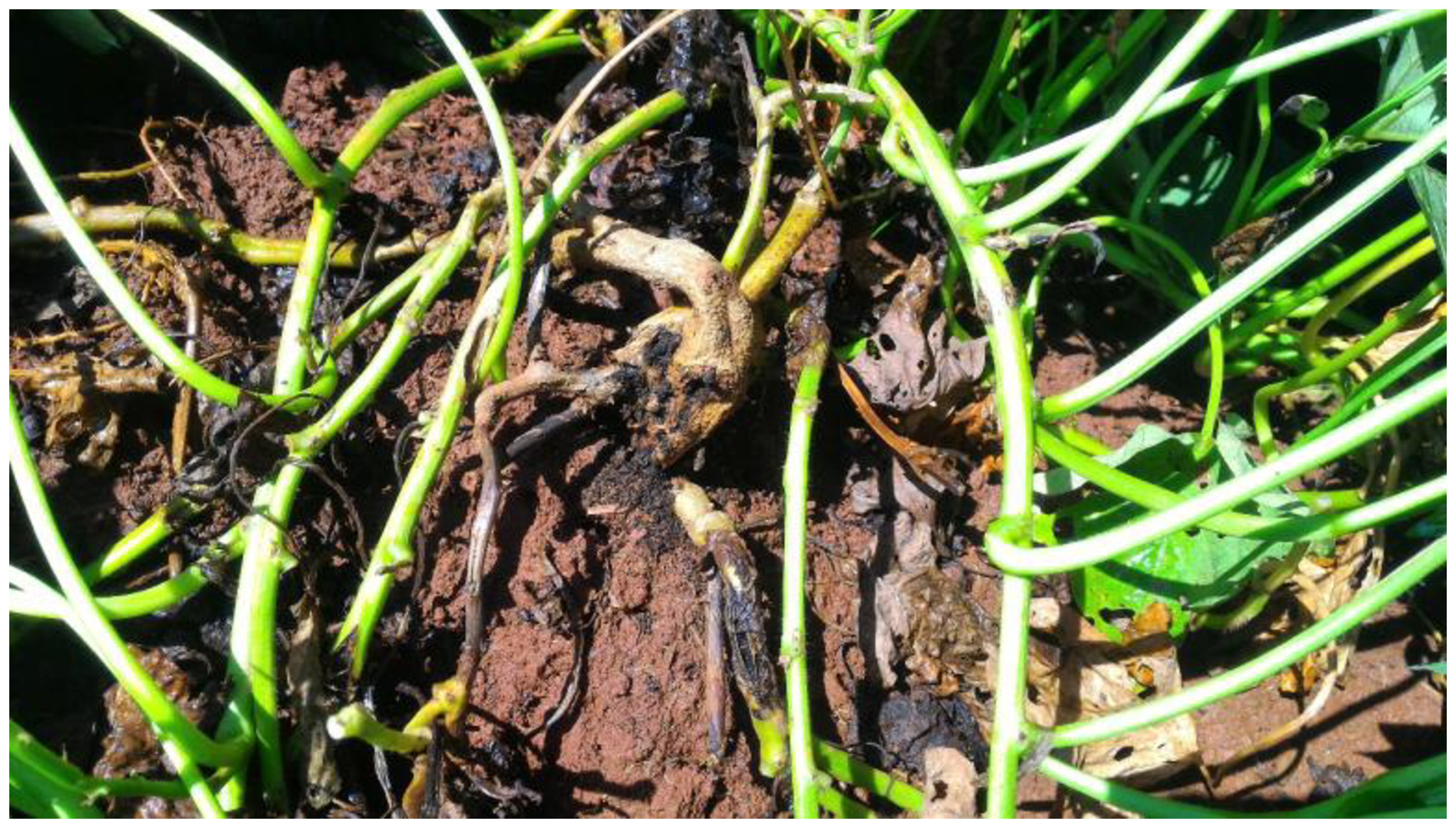
Polygrammodes eleuata (Figure 1) is distributed throughout Central and South America, the Caribbean, and portions of the southern United States (Cock, 2017). In Brazil, published records of P. eleuata associated with sweet potato are available for the states of Minas Gerais and São Paulo (Cabral et al., 2024). To the best of our knowledge, no published record has previously documented this species in Mato Grosso do Sul or elsewhere within the Brazilian Cerrado biome. However, no previous occurrence had been documented for Mato Grosso do Sul or for the Brazilian Cerrado biome. The species is known to oviposit near the soil surface, and its larvae bore into stems and other plant tissues, producing galleries/damage that may reduce plant vigor (King and Saunders, 1984). Similar stem damage was observed in the present study (Figure 2) that may facilitate pathogen invasion and reduce plant vigor.

Dorsal (a) and ventral (b) view of adult Polygrammodes eleuata (Fabricius, 1777) (Lepidoptera: Crambidae: Spilomelinae). Source: Oliveira, I. T.
Damage caused by larvae of Polygrammodes eleuata (Fabricius, 1777) (Lepidoptera: Crambidae: Spilomelinae). Source: Zatarim, M. CEPAER/AGRAER.
Larvae of P. eleuata were found associated with the damaged tissues (Figure 3). Larval feeding was characterized by internal tunneling in stems near the soil line, resulting in tissue swelling, necrosis, and, in severe cases, plant death. Root damage consisted of galleries and perforations that compromise commercial quality and storage potential (Figure 4). However, because both P. eleuata and E. postfasciatus emerged from the tuber samples, the observed root injuries cannot be unequivocally attributed to a single species. Therefore, the present record confirms the association of P. eleuata with stem damage, whereas its contribution to root damage should be interpreted with caution. .

Larva of Polygrammodes eleuata (Fabricius, 1777) (Lepidoptera: Crambidae: Spilomelinae). Source: Oliveira, I. T.

Root damage observed in sweet potato tubers from which adults of both Polygrammodes eleuata (Fabricius, 1777) (Lepidoptera: Crambidae) and E. postfasciatus (Fairmaire, 1849) (Coleoptera: Curculionidae) emerged. Therefore, the injuries cannot be unequivocally attributed to a single species. Source: Oliveira, I.T.
This study constitutes the first record of P. eleuata associated with sweet potato in Mato Grosso do Sul state and, based on an extensive review of the currently available scientific literature, including taxonomic databases, regional pest surveys, and published records of sweet potato-associated insects in Brazil, revealed no previous report of P. eleuata occurring in Mato Grosso do Sul or within the Cerrado biome. This finding represents a significant expansion of the known geographic distribution of the species and indicates its presence in an important agricultural region of Brazil. The Cerrado biome is characterized by marked seasonality, high temperatures, and highly heterogeneous landscapes (Braga and Laurini, 2024; Alencar et al., 2020), factors that can influence insect population dynamics and host–plant interactions. The occurrence of P. eleuata in Mato Grosso do Sul extends its documented geographic distribution to an agriculturally important region of Central-Western Brazil. However, a single occurrence record does not allow conclusions regarding its local population dynamics, establishment, or potential economic importance. Additional surveys are therefore required to determine its distribution, frequency of occurrence, host use, and damage potential in sweet potato production systems within the Cerrado. Furthermore, the presence of this species in experimental fields raises concerns about its potential spread to commercial production areas, particularly given the extensive cultivation of sweet potato in smallholder and diversified farming systems in Central-Western Brazil. Therefore, systematic monitoring and further studies on its distribution, biology, and host range in this biome are strongly recommended.
Given the economic importance of sweet potato and the increasing diversification of agricultural production systems, the occurrence of P. eleuata in a new production region deserves attention. Stem-boring insects can reduce plant vigor and facilitate pathogen entry, potentially affecting crop performance. The simultaneous occurrence of P. eleuata and E. postfasciatus in damaged tuberous roots also indicates the need for studies capable of distinguishing their respective contributions to root injury and evaluating their relative importance under field conditions. In this context, early detection, precise taxonomic identification, continuous monitoring and characterization of damage patterns are critical steps in developing effective integrated pest management (IPM) programs. These actions will support decision-making processes, including the implementation of cultural practices, monitoring thresholds, and, when necessary, targeted control measures, ultimately contributing to the sustainability of sweet potato production systems.
Acknowledgements
Conselho Nacional de Desenvolvimento Científico e Tecnológico (CNPq) - Processo: 433049/2018-9; Coordenação de Aperfeiçoamento de Pessoal de Nível Superior (CAPES); and Fundação de Apoio ao Desenvolvimento do Ensino, Ciência e Tecnologia do Estado de Mato Grosso do Sul (FUNDECT) - processos 71/020.991/2022 e 83/029.333/2024.
Data Availability Statement
Data supporting the findings of this study are available from the corresponding author upon reasonable request.
References
-
ALENCAR, A., SHIMBO, Z., LENTI, J., BALZANI, F., MARQUES, C., ZIMBRES, B., ROSA, M., ARRUDA, V., CASTRO, I., FERNANDES MÁRCICO RIBEIRO, J., VARELA, V., ALENCAR, I., PIONTEKOWSKI, V., RIBEIRO, V., BUSTAMANTE, M., EYJI SANO, E. and BARROSO, M., 2020. Mapping three decades of changes in the brazilian savanna native vegetation using landsat data processed in the google earth engine platform. Remote Sensing, vol. 12, no. 6, pp. 924. https://doi.org/10.3390/rs12060924
» https://doi.org/10.3390/rs12060924 -
AMARO, G.B., FERNANDES, F.R., SILVA, G.O., MELLO, A.F.S. and CASTRO, L.A.S., 2017. Desempenho de cultivares de batata doce na região do Alto Paranaíba/MG. Horticultura Brasileira, vol. 35, no. 2, pp. 286-291. https://doi.org/10.1590/s0102-053620170221
» https://doi.org/10.1590/s0102-053620170221 -
BRAGA, A. and LAURINI, M., 2024. Spatial heterogeneity in climate change effects across Brazilian biomes. Scientific Reports, vol. 14, no. 1, pp. 16414. https://doi.org/10.1038/s41598-024-67244-x PMid:39014072.
» https://doi.org/10.1038/s41598-024-67244-x -
CABRAL, M.J.S., HASEEB, M. and SOARES, M.A., 2024. Major Insect Pests of Sweet Potatoes in Brazil and the United States, with Information on Crop Production and Regulatory Pest Management. Insects, vol. 15, no. 10, pp. 823. https://doi.org/10.3390/insects15100823 PMid:39452399.
» https://doi.org/10.3390/insects15100823 -
CABRAL, M.J.S., NASCIMENTO, S.A., SOUZA, R.F.A., SOARES, M.A., EVARISTO, A.B. and SILVA, E.B., 2025. Perspectives for using sweet potatoes as raw material for bioethanol production in Brazil. Brazilian Journal of Biology, vol. 85, pp. e293624. https://doi.org/10.1590/1519-6984.293624
» https://doi.org/10.1590/1519-6984.293624 - COCK, M.J.W., 2017. A preliminary catalogue of the moths (Lepidoptera except Papilionoidea) of Tobago, West Indies. Insecta Mundi, vol. 585, pp. 1-58.
-
FRANÇA, F.H. and RITSCHEL, P.S., 2002. Avaliação de acessos de batata-doce para resistência à broca-da-raiz, crisomelídeos e elaterídeos. Horticultura Brasileira, vol. 20, no. 1, pp. 79-85. https://doi.org/10.1590/S0102-05362002000100015
» https://doi.org/10.1590/S0102-05362002000100015 - KING, A.B.S. and SAUNDERS, J.L., 1984. The invertebrate pests of annual food crops in Central America: a guide to their recognition and control Turrialba: CATIE, 166 p.
- MELO, A.S., COSTA, B.C., BRITO, M.E.B., AGUIAR NETTO, A.O. and VIÉGAS, P.R.A., 2009. Custo e rentabilidade na produção de batata-doce nos perímetros irrigados de Itabaiana, Sergipe. Pesquisa Agropecuária Tropical, vol. 39, no. 2, pp. 119-123.
-
NUSS, M., LANDRY, B., MALLY, R., VEGLIANTE, F., TRÄNKNER, A., BAUER, F., HAYDEN, J., SEGERER, A., SCHOUTEN, R., LI, H., TROFIMOVA, T., SOLIS, M.A., PRINS, J. and SPEIDEL, W., 2025 [viewed 22 November 2025]. Global Information System on Pyraloidea [online]. Available from: http://www.pyraloidea.org
» http://www.pyraloidea.org -
SANTOS, M.M., SOARES, M.A., SILVA, I.M., FONTES, P.C.R. and ZANUNCIO, J.C., 2018. First record of the sweet potato pest Bedellia somnulentella (Lepidoptera: Bedelliidae) in Brazil. The Florida Entomologist, vol. 101, no. 2, pp. 315-316. https://doi.org/10.1653/024.101.0224
» https://doi.org/10.1653/024.101.0224 -
ZISKA, L.H., RUNION, G.B., TOMECEK, M., PRIOR, S.A., TORBET, H.A. and SICHER, R., 2009. An evaluation of cassava, sweet potato and field corn as potential carbohydrate sources for bioethanol production in Alabama and Maryland. Biomass and Bioenergy, vol. 33, no. 11, pp. 1503-1508. https://doi.org/10.1016/j.biombioe.2009.07.014
» https://doi.org/10.1016/j.biombioe.2009.07.014
Edited by
-
Editor:
Takako Matsumura Tundisi