 Anastrepha species (Diptera, Tephritidae, Trypetinae) from a Neotropical Conservation Unity: diversity, population parameters and seasonality
Abstract
Due to the economic impact of some fruit fly species on fruit and vegetable crops, understanding their biology, ecology and evolution in areas with native vegetation are essential to enable the application of sustainable management methods to suppress their populations. Thus, the aims of this research were evaluate the species diversity of fruit flies in the Conservation Unity Cerro Corá National Park (CCNP) and quantify those with pest status elsewhere; to establish the population parameters for Anastrepha fruit fly species captured inside the CCNP; check if there is a relationship between climate components (temperature, relative humidity and rainfall) with species abundances, and provide some orientations to authorities, farmers, and the general public about environment conservation and sustainable agriculture in Paraguay. Collections occurred monthly during two years, using McPhail traps with food bait in transects inside the park. A total of 17,309 adults of eighteen Anastrepha species were collected, being six reported with pest status and 12 not pests. Anastrepha fraterculus (Wiedemann 1830), A. sororcula Zucchi 1979 and A. punctata Hendel 1914 were the most abundant and frequent species. The highest abundances were recorded in May and July, corresponding to the autumn and winter, respectively. The correlation analysis between weather components and the abundance of these fruit fly species was not significant. This is the first study on populations parameters of fruit fly species along the year seasons in a conservation unit in Paraguay. The results here have generated information on components of regional biodiversity, with suggestions to guide authorities, farmers, and the general public about nature conservation, sustainable fruit and vegetable production in Paraguay.
Keywords:
biodiversity; fruit fly populations; protected areas; pest-species; species seasonality
Resumo
Devido ao impacto econômico de algumas espécies de moscas-das-frutas em cultivos de frutíferas e hortaliças, a compreensão de sua biologia, ecologia e evolução em áreas com vegetação nativa é essencial para permitir a aplicação de métodos de manejo sustentável visando a supressão de populações. Os objetivos desta pesquisa foram avaliar a diversidade de espécies de moscas-das-frutas na Unidade de Conservação Parque Nacional Cerro Corá (PNCC) e quantificar aquelas com status de praga em outros lugares; estabelecer os parâmetros populacionais para as espécies de Anastrepha Schiner 1868 capturadas dentro do PNCC; verificar se há relação entre os componentes climáticos (temperatura, umidade relativa e precipitação) com a abundância das espécies e, prover algumas orientações às autoridades, agricultores e ao público em geral sobre conservação ambiental e agricultura sustentável no Paraguai. As coletas ocorreram mensalmente durante dois anos, utilizando-se armadilhas McPhail com atrativo alimentar, em transectos dentro do parque. Um total de 17.309 adultos de 18 espécies de Anastrepha foram coletados, sendo seis delas reportadas com status de praga e 12 não-praga. Anastrepha fraterculus (Wiedemann 1830), A. sororcula Zucchi 1979 e A. punctata Hendel 1914 foram as espécies mais abundantes e frequentes. As maiores abundâncias foram registradas em maio e julho, correspondendo ao outono e inverno, respectivamente. A análise de correlação entre os componentes climáticos e a abundância das espécies não foi significativa. Este é o primeiro estudo sobre parâmetros populacionais de espécies de moscas-das-frutas ao longo das estações do ano em uma unidade de conservação no Paraguai. Os resultados geraram informações sobre componentes da biodiversidade regional com orientações às autoridades, agricultores e público em geral para a conservação da natureza e a produção sustentável de frutas e hortaliças no Paraguai.
Palavras-chave:
biodiversidade; populações de moscas-das-frutas; áreas protegidas; espécies-praga; sazonalidade das espécies
1. Introduction
The conservation of the physical environment and the biological diversity are extremely necessary to maintain species, trophic interactions, and all the provided services at local, regional and global levels (Perović et al., 2018). The insect communities, as well as all other living beings, help in the stability of ecosystems and provide several important biological services (Dudley, 2008). Thus, to reduce the impacts caused by man to the natural environment, laws were drafted to establish the creation of protected areas (conservation units), which must be delimited and maintained in order to protect and conserve biological diversity, the processes that maintain this diversity and the natural and cultural resources. In these areas, only non-destructive activities are allowed, such as, for example, scientific research on the diagnosis of flora and fauna (Brasil, 2000).
Integral Conservation Units (ICUs) comprise special types of Protected Areas: These ecosystems have environmental resources with relevant natural characteristics, so they are legally instituted by the country's public power, with the purpose of conservation and defining limits, under a special administration regime, to which adequate guarantees of protection apply (Brasil, 2000). According to Avila and Vogt (2025), seven ecoregions are recognized in Paraguay: Dry Chaco, Humid Chaco, Cerrado, Pantanal, Atlantic Forest of Upper Paraná, Cordillera de los Altos and Mesopotamian Savanna. Lucking for pattens of plant endemism they found endemic species in two of them: Dry Chaco and Atlantic Forest.
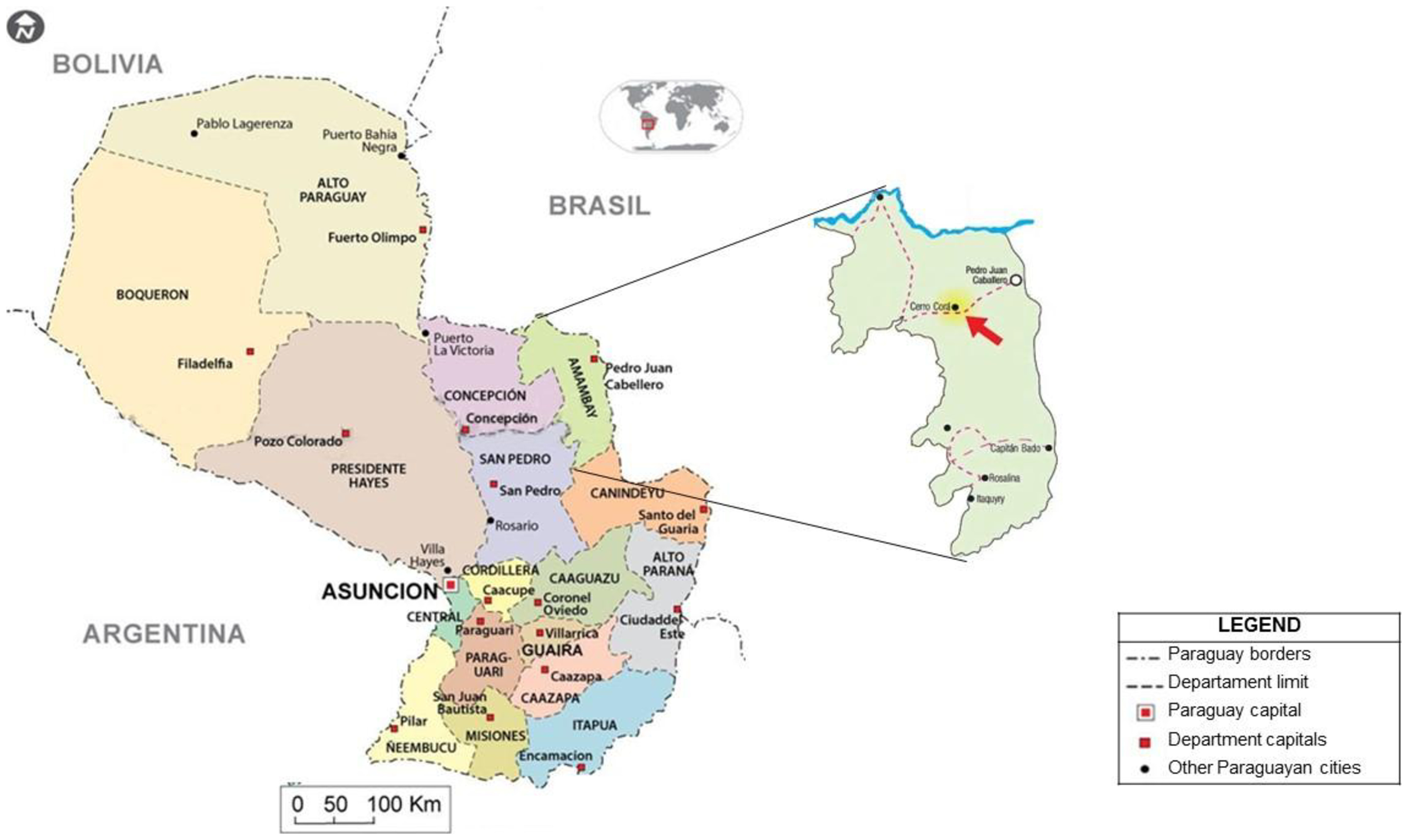
The Cerro Corá National Park (CCNP), is located in the Amambay Ecoregion, which has natural vegetation communities composed by the Cerrado, Wooded Cerrado, Dense Subtropical Semideciduous Forest, Medium Subtropical Semideciduous Forest, Dams, Gallery Forests, Pastures, Cliffs, Streams and Rivers (Avila and Vogt, 2025). It has watercourses and waterfalls that flow into the Aquidabán River, as well as the Aceiteí, Aquidabán Nigui and Panambi'y streams, which play an important role in water conservation in that region of Paraguay. The vegetation in the pasture area (low fields) serves as a collector of surface and groundwater for the Guarani Aquifer. This environment has an average annual temperature of 23 °C in the coldest zone, in the Northeast, and 25 °C in the hottest zone, towards the Southeast (Paraguay, 2012). CCNP is within the boundaries of the Amambay Mountain Range, where there are a large number of hills that offer rocky cliffs and a unique landscape in Paraguay (Figure 1). Among the best-known hills, are: Cerro Akua, Cerro Guasú, Cerro Memby, Cerro Corá, Cerro Sarambi, and Cerro Lorito. This wider area is extremely rich in biological diversity, especially plant and Arthropods. Scientific research in the CCNP began in the 1980s, mainly aiming to describe the flora. Many national and international researchers have contributed to collections in different vegetation communities of the CCNP, especially representing the Cerrado Biome. However, few scientific studies on its fauna have been developed (Paraguay, 2012) and almost nothing is known about the entomofauna, although the conservation of biodiversity is recognized as a need by the scientific community worldwide and from Paraguay (Paraguay, 2012).
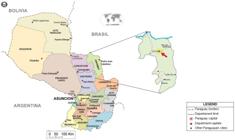
Border of Paraguayan limits, Department of Amambay, other departments with their capitals, highlighting to the Cerro Corá National Park (CCNP).
Among the currently protected areas in Paraguay, there are 16 national parks, including Cerro Corá National Park [CCNP] (CGR, 2010), which comprises an area extremely rich in biological diversity, inserted in the ecoregion Atlantic Forest of Upper Paraná (Avila and Vogt, 2025). However, few scientific studies have been developed at the CCNP (Paraguay, 2012), as well as in any other conservation unit from Paraguay, lacking information mainly on fauna, especially on insects (Arthropoda).
Most of the researches on fruit flies focus on pest species, both in the American continent and worldwide. Those studies are generally carried out in agricultural environments, most commonly in commercial orchards (Aluja and Mangan, 2008; Papadopoulos et al., 2024), however the pest concept is anthropocentric and insects living in natural forest, generally do not reach pest status (Jankielsohn, 2018). Hill (1997) conceptualize pest as an insect (or other organism) that causes damage to humans, their livestock, crops or possessions, which can be measured or quantified. They point out that some time, harm at its lowest level of interpretation includes nuisance and disturbance. Authors highlight that pest designation applies only to that particular species of insect population on that action and at that time.
Some frugivorous dipterans (Lonchaeidae and Tephritidae, Tephritoidea) are taxons of highest economic importance as pest species to horticulture and fruticulture. The losses caused by tephritoid species in the horticulture worldwide were not evaluated, but is enormous. The presence of Tephritoidea species in orchards could reduce yields, enhance production costs and generate quarantine restrictions between international markets. These fly species attack more than 400 species of fruit and vegetables. Only in Brazil these losses are estimated at around US$ 240 million per year (Uchoa, 2012; Qin et al., 2015). Species of the genus Anastrepha Schiner 1868 (Trypetinae, Toxotrypanini), have been intensively studied in the Neotropical Region, due to their economic importance (Aluja and Mangan, 2008) of some species as fruit pests. They are among the most harmful pests of fruits and some vegetables worldwide and their economic impacts, damaging fruit and other horticultural crops, is a concern to several countries that import such products (Aluja and Mangan, 2008). Those nations impose severe quarantine restrictions on exporting countries to avoid the entrance of pest species in their territories. In the Neotropical Region (except in Chile), 12 fruit fly species: [Ceratitis capitata (Wiedemann, 1824), Bactrocera carambolae Drew and Hancock 1994 (both exotic), and eight native species of Anastrepha (A. fraterculus (Wiedemann), A. grandis (Macquart), A. obliqua (Macquart), A. pseudoparallela (Loew), A. serpentine (Wiedemann), A. sororcula Zucchi, A. striata Schiner, and A. zenildae Zucchi] reach pest status in Brazil (Uchoa et al., 2023; Zucchi et al., 2022), beyond A. ludens (Loew 1873) and A. suspensa (Loew 1862). These two last species are key pests in part of Nearctic Region, especially South of Mexico and South of USA, and do not occur in South America (Aluja and Mangan, 2008). On the other hand, most of described species of Anastrepha, are not pests. Several species of Anastrepha are monophagous or stenophagous upon no commercial fruits at natural forests, having an important role keeping several natural enemies, which could be multiplied and used in integrated pest management (IPM) programs against fruit fly pest species in commercial crops (Aluja and Mangan, 2008; Uchoa, 2012).
The main biological aspects studied in economically important species include analysis of their demographics, which includes, aspects of populations and the processes that shape them, such as size (number of organisms within the population) and their population distribution in time and space. Demographic studies of fruit flies allow us to understand the life cycle strategies of different species, to compare the distribution dynamics of species in different host plants, contributing to the implementation of IPM strategies for pest species suppression (Aluja et al., 2003; Oliveira et al., 2019). Species demography continues to be an important metric to evaluate the patterns of biodiversity for insects and plants in the terrestrial ecosystems (Burgess et al., 2024).
Anastrepha species population presents aggregate distribution in the field, following the patterns of distribution and abundance of their host fruits (Uchoa, 2012; Nicácio et al., 2019), with higher number of species being found on the edges of confronting environments (Uchoa et al., 2023). Aluja et al. (2003) pointed out that much of the information needed to understand the biology, ecology and evolution of fruit fly species is found in areas with native vegetation. So, in this research, due to the great diversity of fruit fly species of the genus Anastrepha (about 350 named species) in the Neotropical Region and the richness of plant species in Neotropical conservation units, our hypothesis is to find high indexes of diversity and of equitability for fruit fly species inside Cero Corá National Park. In this context, the aims of this paper were evaluate the species diversity of fruit flies in the Conservation Unity Cerro Corá National Park (CCNP) and quantify those already reported with pest status elsewhere; establish the population parameters for fruit fly species of the genus Anastrepha captured inside the Cerro Corá National Park (CCNP); check if there is a relationship between climate components (temperature, relative humidity and rainfall) with species population size, and provide some orientation to government authorities, farmers, and the general public about environment conservation and sustainable agriculture in Paraguay.
2. Material and Methods
This research was carried out at the integral biodiversity conservation unit, Cerro Corá National Park (CCNP), which covers an area of 5,538 hectares and is located in the municipality Cerro Corá, Department of Amambay, Paraguay. Located between the geographical coordinates 22° 65’ 03” S and 56° 01’ 39” W, around 267 m of mean altitude. CCNP is situated about 450 km from Asunción, the capital of Paraguay, and 40 km from Pedro Juan Caballero, capital of the Amambay Department. Pedro Juan Caballero is a dry border with the municipality of Ponta Porã, state of Mato Grosso do Sul, Midwest of Brazil. According to SEAM (Paraguay, 2012), the CCNP region comprises one of the Paraguayan areas richest in biological diversity.
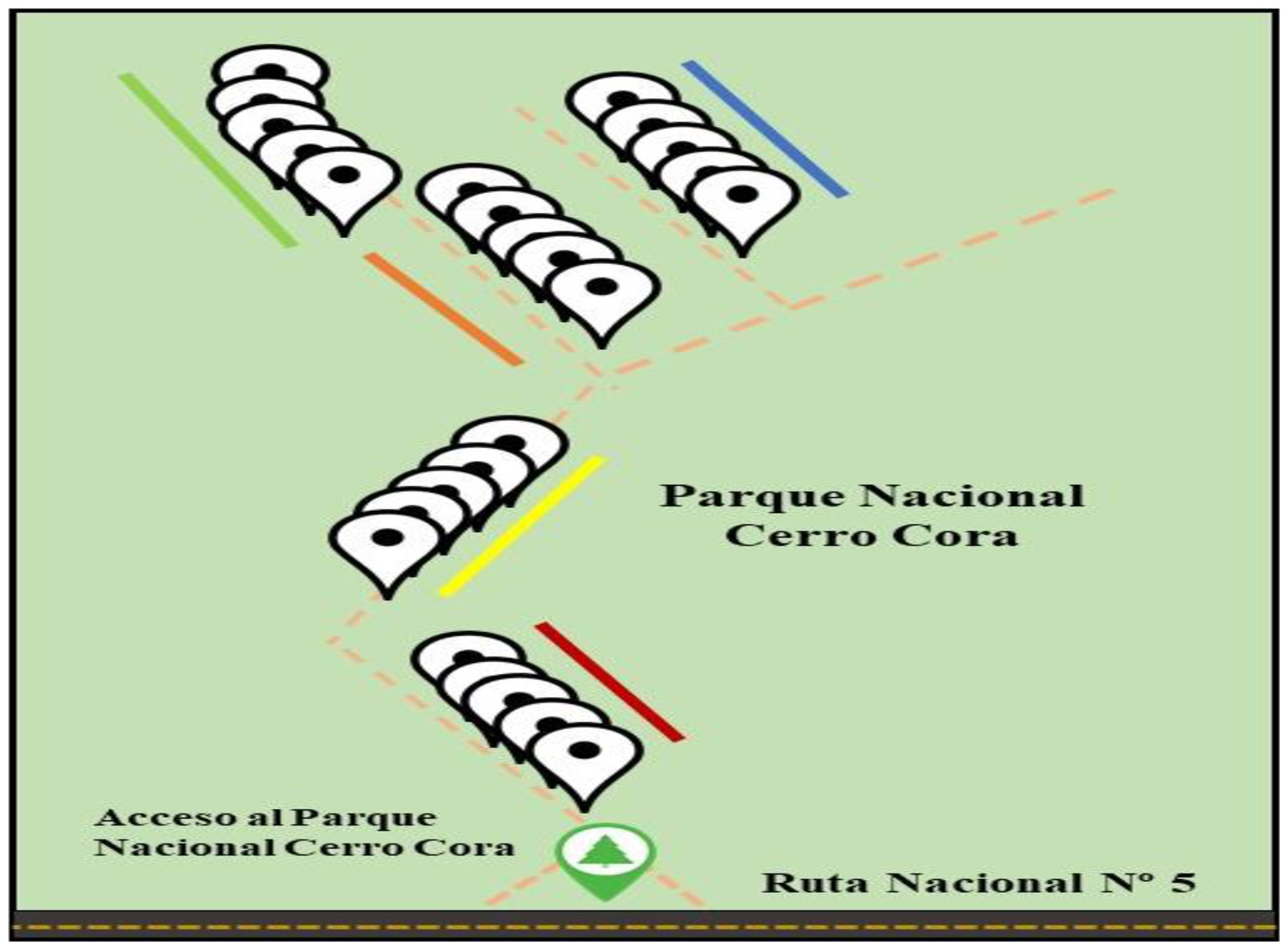
Inside the CCNP, five transects were established, employing the hiking trails already used by people visitors of the park. Along of each one of the five walking trails, were designed five sampling points: 1 to 5. Each point received one McPhail trap, being installed around 100 m apart of each other, totaling 25 traps (Figure 2). The traps were baited with a solution with BioAnastrepha® (10% vol./vol.) food attractant and attached to tree branches at approximately 1.8m above ground level. Each transect had a total length of 500 m and the traps were placed 10 m inside the area with vegetation, in order to avoid interference by park visitors in the capture of fruit fly species.
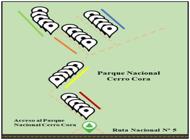
Scheme illustrating the five sample points for the fruit flies (Diptera: Tephritidae) in the Cerro Corá National Park, Cerro Corá, Department of Amambay, Paraguay. The colored bars indicate the location: Green, point 1; Orange, point 2; Blue, point 3; Yellow, point 4; Red, point 5. The sampling period was between November 5, 2016 and October 13, 2018.
The expeditions were carried out monthly in the first two weeks of each month. The traps were supplied with the food bait in the first week, and the specimens collected in the second one, for 24 consecutive assessments, covering the four seasons of the years. This made possible to sample different species of frugivorous Tephritidae for two years of samplings.
The captured fruit flies were transferred from the traps to vials containing 92% ethanol, labeled with the collecting place (geographic coordinates), collector, and date of sampling. The species were identified in the Laboratório de Taxonomia de Tephritoidea (LabTaxon), Faculdade de Ciências Biológicas e Ambientais (FCBA), Universidade Federal da Grande Dourados (UFGD), Dourados-MS, Brazil, using taxonomic keys and original descriptions (Stone, 1942; Steyskal, 1977; Norrbom et al., 2012). Anastrepha species identification is based mainly on the chromatic patterns of the body, wings and measurements and shape of the female oviscape and aculeus. Males of the Anastrepha species were identified in their respective infrageneric groups according to Norrbom et al. (2012). The specific identification of ♂♂ of several species has not been performed, as there are no identification keys for the ♂♂ of the vast majority of Anastrepha species. For this reason, data analysis included only females of each species. The voucher specimens of Anastrepha species are deposited into the Entomological Collection in the Museu da Biodiversidade (MuBio), Faculdade de Ciências Biológicas e Ambientais (FCBA), Universidade Federal da Grande Dourados (UFGD), Dourados-MS, Brazil.
To characterize the population parameters of Anastrepha species in the CCNP, Paraguay, the species composition was analyzed and the rates of abundance, frequency, constancy and dominance were measured, according to Uramoto et al. (2005), Oliveira et al. (2019) and Uchoa et al. (2023). Abundance: according to the values obtained, classes were established for each species, using measures and dispersion, by calculating the standard deviation and confidence interval (CI) of the arithmetic mean, considering 1% and 5% of CI (Uramoto et al., 2005). The species were classified as: rare (R), which comprises species whose number of individuals is less than the lower limit of the average CI at 1% of CI; dispersed (D), which comprises species whose number of individuals is situated between the lower limits of the average CI at 1% and 5%, and common (C), which comprises species whose number of individuals is within the IC of the average at 5% of CI. The species whose number of individuals is situated between the upper limits (UL) of the CI of the average at 1 and 5% of CI are very abundant (VA), and super abundant (SA) those whose number of individuals is greater than the upper limits of the average CI at 1% (Uramoto et al., 2005; Oliveira et al., 2019; Uchoa et al., 2023).
Frequency: corresponds to the percentage of participation of the number of individuals of each species, in relation to the total of collected specimens from all the sampled species. This index is calculated by the Equation 1:
where: n = number of individuals of the considered species, N = total number of individuals of all the species collected.
According to the values obtained, frequency classes were established for each species, using the confidence intervals (CI) at 5%. Thus, the species were classified as: few frequent (FF), which comprises species whose frequency was less than the lower limit (LL) of the 5% CI; Frequent (F), comprised the species whose frequency is within the 5% of the CI; Very common (VC), which comprises species whose frequency is greater than the upper limit of the 5% of the CI, and super frequent (SF) which comprises species whose frequency is greater than the upper limit of the 1% CI (Uramoto et al., 2005; Oliveira et al., 2019).
Constancy: the percentage of collections in which a given species was present. This index is calculated by the Equation 2:
where p corresponds to the number of collections containing a given species, and N refer to the total number of collections performed.
According to the values obtained, the species can be classified as Constant: those present in more than 50% of the collections, represented by the letter W; Accessory: those present between 25% and 50% of collections (Y), and accidental (Z): species present in less than 25% of collections (Uramoto et al., 2005; Oliveira et al., 2019; Uchoa et al., 2023). Dominance refers to the frequency with which a particular species appears in relation to the total number of species sampled. Dominance consists of the ability of a species to modify or not, for its benefit, the impact received from the environment, thus being able to cause the appearance or disappearance of other organisms in that place at the time of the evaluation (Uramoto et al., 2005; Uchoa et al., 2023).
The dominance index is calculated by the Equation 3:
where: LD corresponds to the dominance limit, and S refers to the total number of species.
According to the values obtained, the species can be classified as: Non-dominant (ND), when the frequency is less than 1 / S; dominant (D), when the frequency is higher than 1 / S (Uramoto et al., 2005; Uchoa et al., 2023). Shannon-Wiener Diversity (H’) and Equitability (EH) indices were calculated using the software DivEs (2019), v4.7 free version. The Shannon-Wiener diversity index (H’) refers to the degree of uncertainty in predicting which species an individual will be randomly collected from a random sample from a population with S species and N individuals. This index is calculated by the Equation 4:
where pi = frequency of each species, for i ranging from 1 to S (richness), ln = logarithm of Neperian basis, and S = total number of species sampled.
According to Shannon-Wiener Diversity Index (H’), as the higher is H’ value, as higher is diversity, because in places with high diversity, becomes difficult to predict the identity of the species of a specimen captured at random and, thus, the value of the index tends to increase. On the contrary, as lower is the index value, as lower is the degree of uncertainty and, consequently, the diversity is smaller (Uramoto et al., 2005; Uchoa et al., 2023). Equitability refers to the uniform distribution of the number of individuals between species. This index is calculated by the Equation 5:
where H’ corresponds to the Shannon-Wiener diversity index, and H’ max corresponds to the maximum diversity. The values obtained range from 0 to 1, with 1 occurring at the same frequency for all species.
The species richness analysis was performed using the Chao 2. The efficiency of the species richness estimator test was assessed using the Equation 6 (Figure 3):
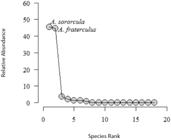
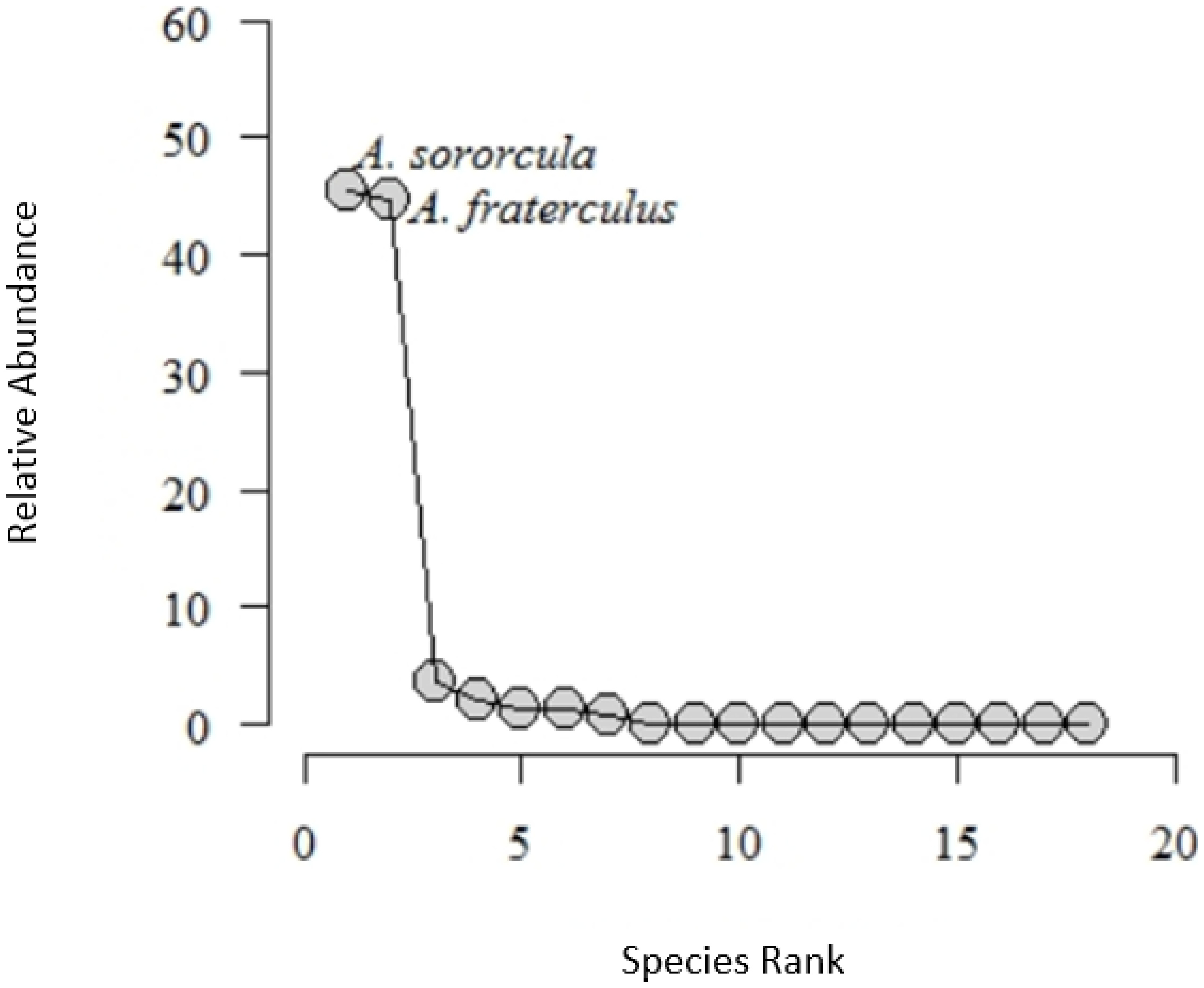
Rank-abundance of the dominant Anastrepha species (Diptera: Tephritidae) caught in McPhail traps in the Cerro Corá National Park, Cerro Corá, Department of Amambay, Paraguay, between November 5, 2016 and October 13, 2018.
The population fluctuation was estimated considering the total number of females of the predominant species of Anastrepha: those with the highest fauna index. The value referring to the total number of females was obtained by adding the absolute values of the females captured in all traps, in each month, during the 24 months of sampling. These population patterns were analyzed in relation to the weather components: temperature, relative humidity and accumulated rainfall.
Data on climatic factors for the period of the survey were obtained from the website of INMET / SEPAF / AGRAER / CEMTEC-MS, from the Mato Grosso do Sul State Development and Extension Agency (AGRAER), Ponta Porã-MS, Brazil, located at about 40 km from the CCNP, Pedro Juan Caballero, Amambay, Paraguay. These data were analyzed and correlated to the abundance of fruit fly species by Pearson's Correlation test. Values are expressed within categories: 0 to 0.19 = very weak or nonexistent correlation; 0.2 to 0.39 = weak correlation; 0.4 to 0.69 = moderate correlation; 0.7 to 0.89 = strong correlation; 0.9 to 1 = very strong correlation. When the coefficient is negative, the correlation is negative or inverse, indicating that when the value of one variable increases, that of the other decreases. When the coefficient is positive, the correlation is positive linear: when the value of one variable increases, that of the other will also increase.
The significances of the correlations were analyzed using the T-Student Test for r (Correlation coefficient) at 5% probability. Through the obtained data, figures demonstrating the population fluctuation of fruit flies were elaborated. The seasonal variation of the catch was also analyzed in relation to the seasons. The rank-abundance curve for seasonality of occurrence of the two most abundant, frequent and dominant species (A. sororcula and A. fraterculus) was plotted, comparing their catch patterns in the spring, summer, autumn and winter seasons, using Estimator Chao 2, free version (Figure 3). Additionally, the curve of species accumulation, also by the Chao 2, is presented to investigate the pattern of stabilization or the tendency of obtaining new records of Anastrepha species during the sampling time in the PNCC, Paraguay (Figure 4). During the 2-year of sampling activities, notes were made on the practices adopted by CCNP administration, so that at the end of the research, it would be possible to contribute with suggestions for measures aimed at conserving biodiversity in that integral conservation unit.
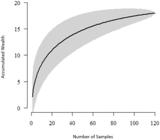
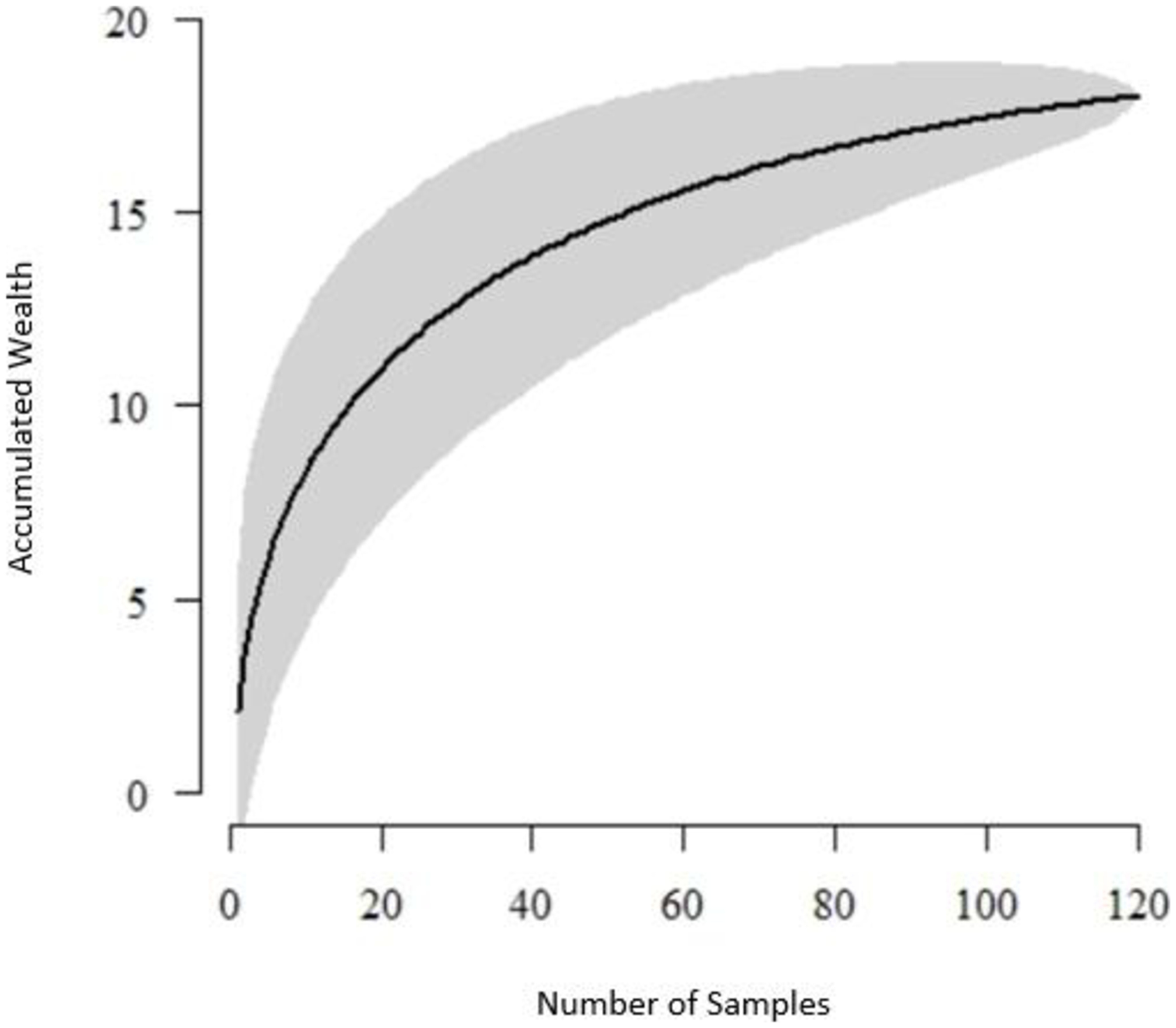
Accumulation curve of Anastrepha (Diptera: Tephritidae) species richness sampled (wealth) in different seasons in the Cerro Corá National Park, Cerro Corá, Department of Amambay, Paraguay, between November 5, 2016 and October 13, 2018.
3. Results
In the Cerro Corá National Park (CCNP), a total of 17,309 adults of fruit flies were captured, being 8,765 males and 8,544 females of the genus Anastrepha. Eighteen Anastrepha species were caught, being six reported with pest status elsewhere (A. sororcula, A. fraterculus, A. obliqua, A. zenildae, A. serpentina, A. striata), and 12 not pests. Species belong to 10 infrageneric groups, as proposed by Norrbom et al. (2012) (Table 1). Despite our initial hypothesis of high diversity and equitability indices for Anastrepha species, the diversity indicative values were low: diversity index (H’ = 1.61) and equitability index (EH = 0.17), suggesting possible problems in that integral biodiversity conservation unit (CCNP), as show in Table 1.
Population parameters of Anastrepha species (Diptera: Tephritidae) caught in McPhail traps baited with food attractant inside the Cerro Corá National Park, Department of Amambay, Paraguay. The sampling was carried out between November 5, 2016 and October 13, 2018.
The groups daciformis, mucronota, pseudoparallela, punctata, robusta, serpentina and striata are each represented by a single species; the groups leptozona and spatulata by two species each, while fraterculus was the most specious group, with six species. Additionally, four females of Anastrepha matogrossensis Norrbom and Uchoa (2011), not yet assigned to any of the infrageneric groups, were also collected (Table 1).
The analysis of population parameters of the species indicated that A. distincta, A. barnesi and A. striata, were characterized as rare, being represented by a single specimen of each species, in a single sample, throughout the two-year period. A. elegans, A. chiclayae, A. concava, A. montei, A. pickeli and A. matogrossensis, were characterized as accidental species and, A. zenildae, although super abundant, was also characterized as non-dominant and accidental, because its occurrence was recorded in only three of 24 collections. Anastrepha leptozona and A. serpentina, were very abundant, very frequent, but not dominant. Anastrepha daciformis, A. obliqua and A. turpiniae are super abundant, and super frequent, but not dominant species, being characterized as accessory (Table 2).
Seasons of occurrence (months and years) to the Anastrepha species (Diptera: Tephritidae, Trypetinae) captured in MacPhail traps inside the Cerro Corá National Park, Cerro Corá, Department of Amambay, Paraguay, between November 5, 2016 and October 13, 2018.
The results of the population analysis indicated that Anastrepha fraterculus and A. sororcula were the predominant species, being super abundant, super frequent and dominant. Anastrepha punctata was super abundant, super frequent, but no dominant. Only A. fraterculus, A. sororcula and A. punctata were constant species, occurring in more than 50% of the samples. Females of the seven most abundant species, in decreasing order: A. sororcula (n = 3,883), A. fraterculus (3,819), A. punctata (317), A. obliqua (186), A. zenildae (115), A. daciformis (108), and A. turpiniae (78), represent 99,56% of all ♀♀ (n = 8,544) of the 18 species caught during the 24 evaluated months. The remaining 11 species of Anastrepha occurred in very low abundances, representing only 0,44% of total sample. The diversity sampled over the two-year period at the CCNP, Paraguay, changed over the months of collection, revealing a change in the composition of Anastrepha species community (Table 2).
Although Anastrepha sororcula and A. fraterculus were the most abundant species (Figure 3), A. punctata was the most frequent, being captured in 23 of 24 months, while A. fraterculus and A. sororcula were obtained in 19 and 21 months, respectively (see Table 2).
The species of the genus Anastrepha, presented Shannon-Wiener diversity indexes, H’ = 1.61 and equitability index, EH = 0.17. The species richness indicated the stabilization of the rarefaction curve (asymptote) (Figure 4).
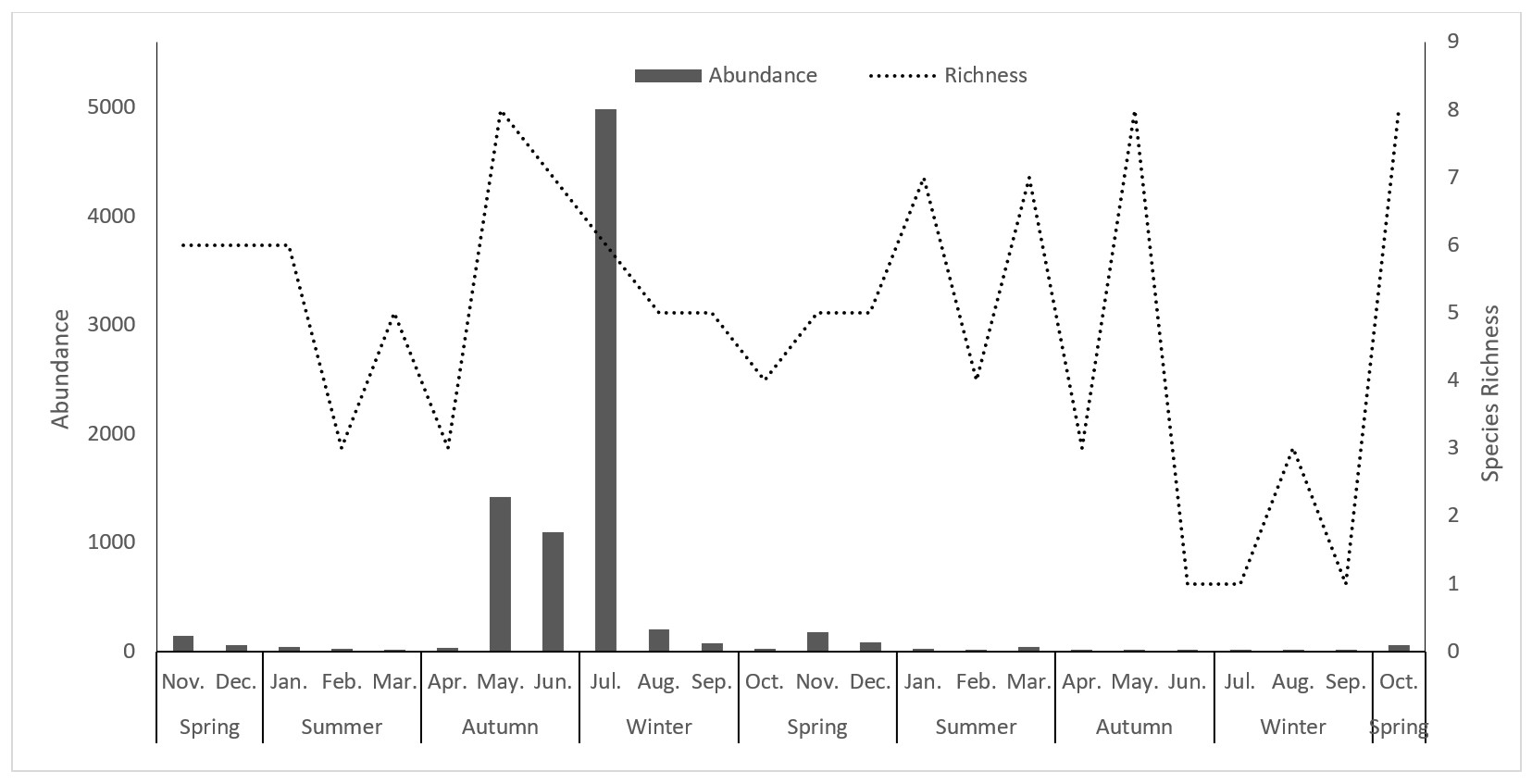
The variation in the population of Anastrepha species in relation to the year seasons, revealed a population peak in May (autumn), and another highest (population acme) in July, corresponding to the winter. The summer was the season with the lowest abundance of Anastrepha species, increasing in the autumn, with a population peak by July (winter). However, regarding the diversity the findings were opposite, having a peak in the summer (March), with highest species richness (S), decreasing in the autumn and winter (Figure 5).
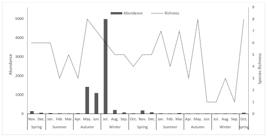
Abundance and species richness of Anastrepha species (Diptera: Tephritidae) sampled with McPhail traps in the Cerro Corá National Park, Cerro Corá, Department of Amambay, Paraguay, between November 5, 2016 and October 13, 2018.
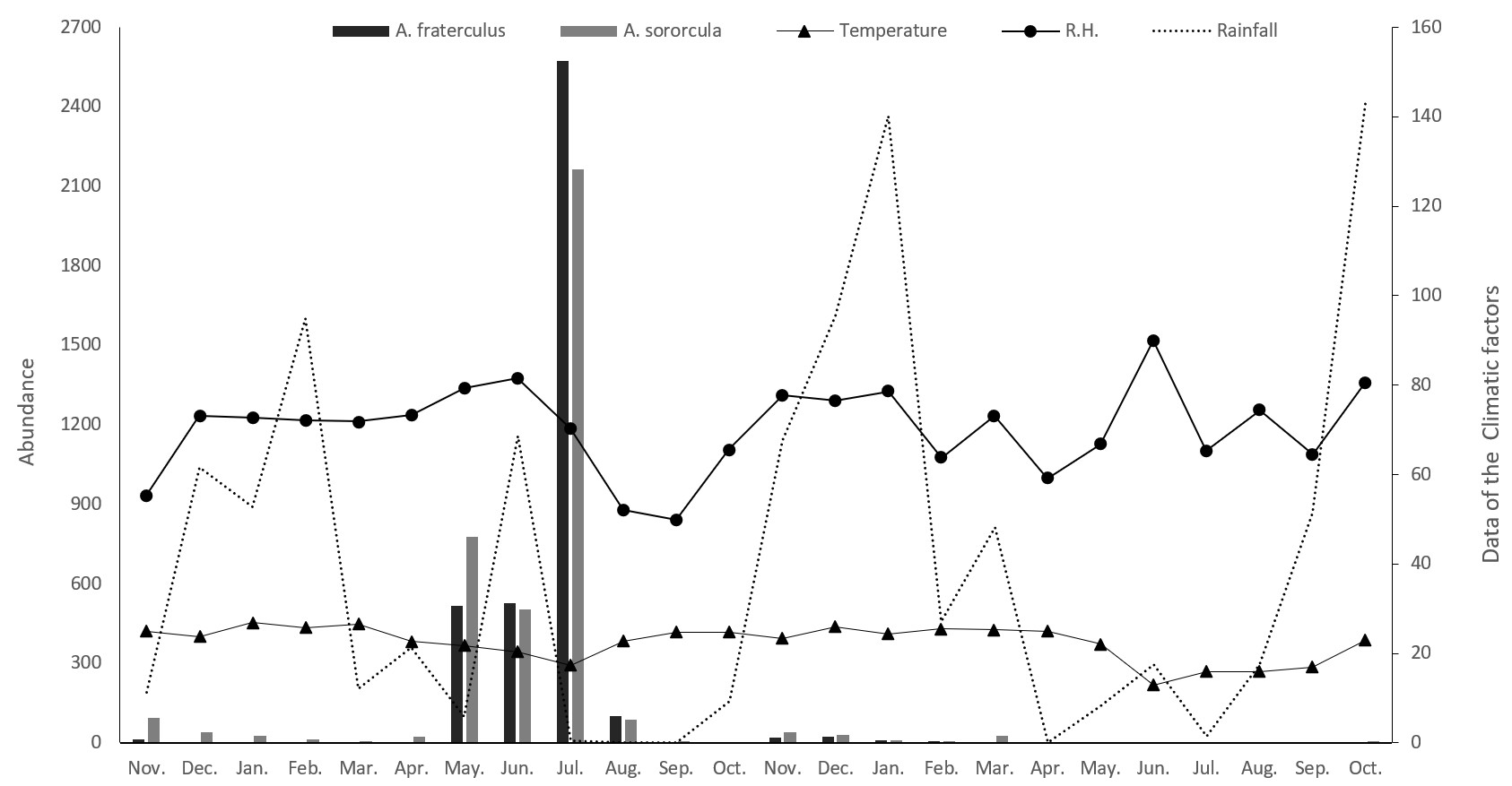
The analysis of the population parameters of the Anastrepha species prevalent in this research showed peaks in the occurrence of A. sororcula and A. fraterculus by May and July 2017 (Figure 6). For A. punctata, these peaks, although is much smaller in abundance, occurred during May, September and November 2017. The abundance of Anastrepha species was analyzed in comparison with the weather, but no significant correlation was found with any of the tested climatic variables (Table 3).
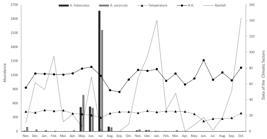
Adult population fluctuation (♀♀) of the two dominant species: Anastrepha sororcula and A. fraterculus (Diptera: Tephritidae), sampled with McPhail traps and relationship with the weather (average temperature, relative humidity (R.H.), and accumulated rainfall) in the Cerro Corá National Park, Cerro Corá, Department of Amambay, Paraguay, between November 5, 2016 and October 13, 2018.
Correlation analysis of climatic factors and the abundance of Anastrepha species (Diptera: Tephritidae) collected in the Cerro Corá National Park, Departament of Amambay, Paraguay, between November 5, 2016 and October 13, 2018.
4. Discussion
The metrics applied to evaluate biodiversity in terrestrial biomes were recently reviewed by Burgess et al. (2024). They reported that the key components to access biodiversity, are: genes (within and between species diversity); species (taking in account their extinction risk, population abundance and their changes in patterns of distribution), and ecosystems (with respect to extent, condition of conservation and risk of collapse of natural resources). In this research were evaluated as component of the ecosystem, the fruit fly species of the genus Anastrepha, and their diversity patterns, based mainly on species occurrence, seasonality, abundancy, frequency, indexes (diversity and equitability), investigating whether there are some relationships between species populations and weather.
Despite our initial hypothesis of high diversity and equitability indices for Anastrepha species, results shown that species richness of Anastrepha in the CCNP, is low for an integral conservation unity. Only 18 species from 10 different infrageneric groups were caught, reflecting a low index of diversity (H’ = 1.61) and low index of equitability (EH = 0.17). This suggests possible problems in the management of Cerro Corá National Park. These results do not differ so much of a few other researches carried out in natural environments, at forest fragments from the Neotropical Region, that are not conservation units. Thirteen species in a forest reserve at Vera Cruz, Mexico (Hernández-Ortiz et al., 1993), 14 species in the south of Mato Grosso do Sul state, Brazil (Canesin and Uchoa, 2007), 11 species in the state of Espírito Santo, Brazil (Uramoto et al., 2008), 14 species in Dourados regions, state of Mato Grosso do Sul (Oliveira et al., 2019), and 19 species in the state of Tocantins, Brazil (Uchoa and Bomfim, 2017). Only this last one is an Integral Conservation Units (ICUs), but which has suffered a generalized episode of burning that time in the forest. Unfortunately, data on fruit fly diversity in ICUs are rare, which don’t allow more appropriate comparisons.
This is the first record of species of fruit flies in a natural environment in Paraguay. However, previously, other researches have been conducted in orchards to inventory Anastrepha species in other Departments in Paraguay. Arias et al. (2014), based part of that inventory of fruit flies on material sampled by the “Servicio Nacional de Cualidad y Sanidad Vegetal y de Semillas (SENAVE)” in areas with fruit cultivation. They reported 17 species of Anastrepha. Later, Clavijo Rodriguez et al. (2020), based on compilation of publications and field research have updated to 26 the species of Anastrepha in Paraguay. Studies of the population parameters of fruit flies in natural environments around the world, including integral conservation units, are rare.
In this research, females of A. sororcula and A. fraterculus showed greater relative abundance and were the dominant species in the CCNP, corresponding to 90.1% of all fruit flies (♀♀), followed in abundance by A. puntata, A. obliqua, A. zenildae and A. turpiniae (Table 1 and Figure 3). This population pattern of the fruit flies (or any other taxa of insect which includes pestiferous species and high taxonomic species richness), where a few species stand out as dominant and several of the same genus occurs as rare along the year seasons, is characteristic of endangered or anthropized environments (Aluja et al., 2012; Uchoa, 2012). Previously, in Paraguay, Arias et al. (2014) report three predominant species in fruit tree orchards: A. fraterculus, A. sororcula and A. punctata, corroborating the results obtained herein. In Arias et al. (2014), A. fraterculus was the most abundant species, accounting for 70.76% of the captured individuals.
In this research, the change in the diversity and abundance of Anastrepha species over the months and during the two surveyed years (Table 2) is probably due to climatic variations that interfere with the production of fruits by their host plants (Angiospermae), but not directly on the fruit fly species (see Table 3). In Mexico, Aluja et al. (2012) used 11 years of population data sampling to demonstrate some correlations between pest species of the genus Anastrepha and climate, presenting very relevant aspects of Tephritidae populations in orchards. However, Aluja et al. (2012) needed to transform data and standardize periodic collections, grouping the dataset of captured fruit fly species (e.g. number of fruit flies per trap per day) to make adjustments and test correlations with climatic variables (rainfall, air temperature, El Niño Southern Oscillation [ENSO], and North Atlantic Oscillation [NAO]). At the local level, it is not simple to demonstrate in a short period of time, the direct effect of climate on the populations of fruit fly species, because other intervening variables may be acting simultaneously (see Aluja et al., 2012). This may explain why climate data (air temperature, relative humidity and rainfall) measured in the CCNP do not directly correlate with population data of frugivorous Tephritidae species.
Here, the high relative frequency of A. sororcula and A. fraterculus in the fruit fly community recorded, is attributed to the high level of polyphagia of both species, as well as the great availability of host plants in the CCNP, which can serve as preferred hosts for these multivoltine species (Uchoa, 2012; Zucchi and Moraes, 2025). The South American fruit fly A. fraterculus is the most polyphagous and economically important species of the genus Anastrepha, occurring throughout Central and South America, being the second most widespread in Brazil, behind A. obliqua (see Zucchi et al., 2022, vol. II, p. 20). Due to its high polyphagia and great dispersion ability, in addition to the damage caused to horticultural products, A. fraterculus is the species most commonly obtained attacking commercial fruits and vegetables, receiving the status of key pest in South America (Uchoa, 2012; Zucchi and Moraes, 2025). Despite this species having the largest geographical distribution between Anastrepha species at South America, its occurrence varies significantly throughout its distribution range from North to South. In Argentina, Uruguay and in the South and Southeast of Brazil, A. fraterculus is considered the most abundant and frequent pest species. However, in the South America its pest status and abundance changes as it moves to North, where A. sororcula predominates (EPPO, 2025). At higher latitude, as in the Amazon, Peru, Ecuador, Colombia and Venezuela, A. fraterculus is once again the dominant species. In American continent, A. fraterculus is already reported in: Argentina, Belize, Bolivia, Colombia, Costa Rica, El Salvador, Ecuador, French Guiana, Guyana, Guatemala, Honduras, Mexico, Nicaragua, Panama, Paraguay, Peru, Suriname, Trinidad and Tobago, Uruguay and Venezuela (EPPO, 2025). This is the most polyphagous species of the genus Anastrepha already associated with 167 species of host plants, while A. sororcula also polyphagous, has been reported in 59 host fruit trees (Zucchi and Moraes, 2025).
In this research, A. sororcula, A. fraterculus, and A. punctata, contributed to the great abundance of fruit fly’s community caught in the traps. The highest abundance of these three species in the CCNP suggests that they are able to exploit most of the resources available in the area, remaining in the habitat in the coldest seasons [fall and winter (April to August)] where they can find food, shelter and breeding sites, explaining their predominance in that conservation unit. According to Hernández-Ortiz and Aluja (1993), due to the obligatory frugivory of Anastrepha species, host plants are one of the fundamental elements in the evolution and diversification of fruit fly species, interfering in the modification of its patterns of both spatial and seasonal distribution.
Anastrepha obliqua (Macquart, 1835), also reported as key pest of several crops and native fruits in natural and agroecosystems in the Neotropics, here was the fourth species in abundance. This species is widespread, reported already to several countries in the American continent, such as, Antigua-Barbuda, Bahamas, Barbados, Belize, Colombia, Costa Rica, Cuba, Dominican Republic, Ecuador, El Salvador, French Guiana, Grenada, Guadelupe, Guatemala, Guyana, Haiti, Honduras, Jamaica, Martinique, Mexico, Montserrat, Northerlands-Antilles, Nicaragua, Panama, Paraguay, Peru, Puerto Rico, Saint Kittis and Nevis, Saint Lucia, Saint Vicent and Grenadines, Suriname, Trinidad and Tobago, USA (Virgin Islands) and Venezuela (EPPO, 2025). In Brazil, A. obliqua is recorded infesting 73 different species of host fruits related to various plant families (Zucchi and Moraes, 2025), considered a species of quarantine concern, very destructive to many crop fruits, especially to Anacardiaceae and Myrtaceae (Uchoa, 2012).
Eight species of Anastrepha [A. fraterculus (Wiedemann), A. grandis (Macquart), A. obliqua (Macquart), A. pseudoparallela (Loew), A. sororcula Zucchi, A. serpentina (Wiedemann), A. striata Schiner and A. zenildae Zucchi], reach pest status in South America (Uchoa et al., 2023). Here, from the 18 species found in CCNP, only six of them assume the status of horticultural pests (A. fraterculus, A. obliqua, A. sororcula, A. serpentina, A. striata and A. zenildae), but the other 12 species listed (see Table 1), do not reach pest-status. Pest species can be conceptualized as individuals or populations that consume cultivated plants, animals, their products, by-products or anything of economic value to humans; have high biotic potential (high offspring per parent); high abundance on the living being or thing attacked; high constancy on the living being or thing attacked; wide geographic distribution in its area of occurrence; rapid dispersion in the environment where it occurs; have strategies for surviving to variations in weather conditions, and the ability to escape of population suppression techniques (see Hill, 1997; Jankielsohn, 2018).
Anastrepha non-pest species, as well as other non-pestiferous insects in natural environments are of great importance as providers of relevant environmental services, such as the decomposition of noncommercial fruit, serving as resource for wild fauna, and specially, for keeping natural enemies of pestiferous fruit flies (Perović et al., 2018; Almeida et al., 2019). Native plants play a crucial role in the occurrence of fruit fly species, as well as in the multiplication of their natural enemies (Monteiro et al., 2019). The occurrence of different species of fruit flies is affected by the landscape and depends on its preference for their host fruits, as pointed out by Monteiro et al. (2019). Among the biotic event determining the occurrence of fruit fly species, the availability of host fruits in ecosystems is one of the most important factors. The native forest of the CCNP offers a wide range of autochthonous hosts, such as the following taxa of fruiting trees: Annona (Annonaceae); Butia (Arecaceae); Byrsonima (Malpighiaceae); Campomanesia spp., Eugenia spp. and Plinia spp. (Myrtaceae); Chrysophyllum spp. and Pouteria spp. (Sapotaceae); Diospyros spp. (Ebenaceae); Solanum spp. (Solanaceae), and Sorocea spp. (Moraceae), as recorded by SEAM (Paraguay, 2012). Two from the three most abundant and frequent Anastrepha species in this research (A. sororcula and A. fraterculus) are already reported infesting fruits of the plant taxa above cited inside CCNP. A. fraterculus in all of them and A. sororcula (except Annonaceae, Arecaceae, and Sapotaceae), see Zucchi and Moraes (2025). Anastrepha punctata, the third most abundant and frequent species in this survey [Table 1] have no known host fruit in the world, as well as A. concava, and A. matogrossensis (Zucchi and Moraes, 2025). Herein these findings are exiting, because A. punctata, A. concava, and A. matogrossensis, probably have their host fruits in that conservation unity (CCNP) or on the nearby.
In the CCNP was recorded a low Shannon-Wiener diversity index (H’ = 1.61) and equitability index (EH = 0.17) for the fruit fly species. These indexes reflect the high abundance, frequency and dominance of two species: A. sororcula and A. fraterculus. The equitability index (EH) indicates the way in which individuals are distributed among different species. In this research, the distribution of specimens was not homogeneous, with considerable divergence in the abundance of different species (Table 1). Similar results were found by Uchoa and Bomfim (2017). They pointed out that in orchards, most of the occurring fruit fly species are characterized as infrequent or rare, while one or two species will stand out as dominant, implying in low equitability. On the other hand, in natural forests, comparatively higher species richness occurs, but the species are represented by a few conspecific individuals, ensuring greater equitability in their patterns of abundance.
The pattern of the fruit fly community obtained inside the CCNP, with few dominant species and low equitability, can be justified by the fact that the sampled area receives anthropogenic impact, because, although it is a preserved area, it functions as a historical park, constantly open for public visitation. The species richness of the fruit flies at the CCNP during the two years of sampling, there was a tendency of stabilization (asymptote) in the cumulative curve of more species records, indicating that the collection effort was near the enough to sample all the local diversity (Figure 4). The variation in populations of Anastrepha species in relation to the seasons of the year in the CCNP, shows a population peak in May (Autumn), and the acme (highest peak) in July of 2017 (Winter) (Figures 5 and 6). Probably this pattern could be due to the fact that, in the winter, the offer of fruits is scarce, enhancing the attractiveness of fruit flies to the McPhail traps with corn protein (bait), that becomes an alternative source of food to Anastrepha species. As pointed out by Joachim-Bravo et al. (2023, p. 186), the adults of Tephritidae in nature could feed on bird faeces, nectar, decomposing organic matter, fruit liquids, pollen and insect’s honeydew, being that the availability of resources influence on the search of the fruit flies by alternative sources of food.
The predominant species in this research (A. sororcula and A. fraterculus) showed population peaks in May and July 2017 (Figure 6). The fact is that historic of the fruit production by native fruit trees in Midwest Brazil (especially in the state of Mato Grosso do Sul), as well as in the Northwest of Paraguay, is concentrated from December to April. Considering that Anastrepha species spend around two months to become adults (egg-adult), and that sampling was based on the capture of adults, so this can explain a population acme of A. sororcula and A. fraterculus in the winter (July).
Herein, tacking in account the abundance of fruit fly species, no correlation was found with climatic factors (Table 3). But, in some environments of the Neotropical Region, which the differences between winter and summer are relatively small, the seasonal pattern of tephritid abundance was not directly influenced by the weather, being difficult to find correlations between air temperature and humidity (see Martínez-Flores et al., 2023). Anastrepha fraterculus and A. sororcula have great morphological similarity and belong to the fraterculus species group (Norrbom et al., 2012). However, the detailed morphometric examination at the apex of the aculeus allows the species-specific identification of both, as well as of the other cryptic species of the fraterculus group, such as, A. obliqua, A. turpiniae and A. zenildae. These five species are generalists and multivoltine, with A. fraterculus and A. sororcula preferentially infesting Myrtaceae species (Uchoa, 2012). Anastrepha chiclayae Greene 1934, captured in CCNP, has been recorded recently in Brazil by Araújo et al. (2023). They pointed out that using integrative taxonomy, discovered that the species previously listed in several inventories in the Brazilian states as A. dissimilis Stone 1942, is A. chiclayae.
Population studies applying metrics to quantify and qualify species patterns of distribution and abundance increase the levels of knowledge about local, regional and global biodiversity (Burgess et al., 2024). The calculations of frequency, abundance, constancy, dominance and regional species diversity indexes, help to understand the general patterns of biology, ecology and behavior of communities of Tephritidae (Uramoto et al., 2005; Uchoa et al., 2023), providing subsidies for apply rational method and techniques to population suppression of fruit fly pest species on agroecosystems of food production (fruit and vegetable crops). The correlation analysis of abundance of individuals of Anastrepha species with climatic factors was not significant, corroborating that the abundance of fruit flies in Neotropics is mainly associated with the presence of host plants and their respective fruiting seasons.
The International Union for Conservation of Nature (IUCN) established 12 principles and practices to guide national parks administration around world in achieving of the best local and international biodiversity conservation goals. Are them: Perpetual integrity; system planning (e.g. buffer zones); management by conservation objectives; integral conservation unity’s management plans; precautionary approach; management of invasive alien species; management of climate change; taking an international perspective; good governance; public participation; access to information and social equity and justice (Holland et al., 2024).
Herein, based on two years of research, on-site experience and IUCN guidelines, the following recommendations could be driven to authorities about conservation policies for Cerro Cora National Park in Paraguay: accompanying the visiting public inside the forest by professional guides; avoiding the removal of native fruits for consumption or trade, and making efforts together the owners of the farms bordering the CCPN to leave their reserve areas attached to the park boundaries, and do not giving access to cattle or other rearing animals in those ones. In this way, the forest reserves of the landowners will serve as buffers zones, and corridors for the dispersal of fauna and seeds of flora transportation between farms, that national park and beyond.
5. Conclusions
This is the first survey of fruit fly species in an integral conservation unity from Paraguay. Anastrepha sororcula and A. fraterculus were the dominant species, being A. punctata the most constant one, but no dominant. Anastrepha chiclayae Greene 1934 and A. matogrossensis Norrbom and Uchoa 2011 are for the first time reported to Paraguay.
The species richness of Anastrepha inside the CCNP is relatively low for an integral conservation unity, as expressed by the diversity indexes: Shannon-Wiener (H’= 1.61), and equitability (EH = 0.17), where only 18 Anastrepha species is recorded, being only six of them already reported as pest species in other Paraguayan places.
Higher populations of fruit flies inside Cerro Corá National Park occurs from May (autumn) and June to July (winter), but the highest species diversity is found in March (summer). The abundance of Anastrepha species when compared with each one of the three weather variables tested (air temperature, relative humidity and rainfall) do not presented significant correlations.
Conservation policies to the CCNP deserves some care, such as: accompanying the visiting public by professional guides; prohibition of removal fruits, timber or any other resources from the CCNP and of their buffer zones.
5.1. Research needs
Future research is in need to evaluate whether the host plants of Tephritidae inside the CCNP bear fruits in autumn and winter, or whether the higher population of Anastrepha species in winter is due to the accumulation of the last-instar larvae, concentered at the end of the native fruit production (late April). Such adults would emerge in late June, thus explaining the highest population peak of these fruit flies in July. It’s also important to check if fruit fly community undergo in migratory movements to adjacent areas to the CCNP or to Areawide (sensu Aluja et al., 2012). Fruit collections inside CCNP and on the nearby is a need to discovery the host fruit species for A. punctata, A. concava, and A. matogrossensis here captured in McPhail traps.
Acknowledgements
We are grateful to the direction of the Cerro Corá National Park and to Secretaria Nacional do Meio Ambiente de Paraguay; Faculty of Agricultural Sciences, Universidad Nacional de Asunción, Pedro Juan Caballero, Amanbay, Paraguay; Coordenação de Aperfeiçoamento de Pessoal de Nível Superior (CAPES), Brasília-DF, Brazil; Fundação de Apoio ao Desenvolvimento do Ensino, Ciência e Tecnologia do Estado de Mato Grosso do Sul (FUNDECT), Campo Grande-MS, Brazil, especially to Editais Chamadas CAPES-PAPOS-MS 44/2014, FUNDECT-CAPES 12/2015-BIOTA-MS-Ciência e Biodiversidade and Programa de Desenvolvimento da Pós-Graduação (PDPG-Consolidação 3-4): Emergencial de Consolidação dos Programas de Pós-Graduação stricto sensu acadêmicos, Process 88881.710568/2022-01; Universidade Federal da Grande Dourados (UFGD), Dourados-MS, Brazil, for the logistic and financial support that allowed the execution of this research. Finally, we appreciate the constructive criticism of two anonymous referees who contributed to making the article more comprehensive and detailed.
Data Availability Statement
The entire data set that supports the results of this study was published in the article itself.
References
-
ALMEIDA, L.B.M., COELHO, J.B., UCHOA, M.A. and GISLOTI, L.J., 2019. Diversity of fruit flies (Diptera: Tephritoidea) and their host plants in a conservation unit from midwestern Brazil. The Florida Entomologist, vol. 102, no. 3, pp. 562-570. https://doi.org/10.1653/024.102.0333
» https://doi.org/10.1653/024.102.0333 -
ALUJA, M., RULL, J., SIVINSKI, J., NORRBOM, A.L., WHARTON, R.A., MACÍAS-ORDOÑEZ, R., DÍAZ-FLEISCHER, F. and LÓPEZ, M., 2003. Fruit flies of the genus Anastrepha (Diptera: Tephritidae) and associated native parasitoids (Hymenoptera) in the tropical rain forest biosphere reserve of Montes Azules, Chiapas, Mexico. Environmental Entomology, vol. 32, no. 6, pp. 1377-1385. https://doi.org/10.1603/0046-225X-32.6.1377
» https://doi.org/10.1603/0046-225X-32.6.1377 -
ALUJA, M. and MANGAN, R.L., 2008. Fruit fly (Diptera: Tephritidae) host status determination: critical conceptual, methodological, and regulatory considerations. Annual Review of Entomology, vol. 53, no. 1, pp. 473-502. https://doi.org/10.1146/annurev.ento.53.103106.093350 PMid:17877455.
» https://doi.org/10.1146/annurev.ento.53.103106.093350 -
ALUJA, M., ORDANO, M., GUILLÉN, L. and RULL, J., 2012. Understanding long-term fruit fly (Diptera: Tephritidae) population dynamics: implications for areawide management. Journal of Economic Entomology, vol. 105, no. 3, pp. 823-836. https://doi.org/10.1603/EC11353 PMid:22812118.
» https://doi.org/10.1603/EC11353 -
ARAÚJO, A.S., ZUCCHI, R.A., NORRBOM, A.L., NANINI, F., CORREA, A.S., ALVARENGA, C.D., SOUZA-FILHO, M.F., NAVA, D.E. and SAVARIS, M., 2023. Integrative approach reveals the identity of Brazilian specimens previously recognized as Anastrepha dissimilis Stone, 1942 (Diptera: tephritidae). Zootaxa, vol. 5228, no. 3, pp. 317-336. https://doi.org/10.11646/zootaxa.5228.3.5 PMid:37044649.
» https://doi.org/10.11646/zootaxa.5228.3.5 -
ARIAS, O.R., FARIÑA, N.L., LOPES, G.N., URAMOTO, K. and ZUCCHI, R.A., 2014. Fruit flies of the genus Anastrepha (Diptera: Tephritidae) from some localities of Paraguay: new records, checklist, and illustrated key. Journal of Insect Science, vol. 14, no. 1, pp. 1-9. https://doi.org/10.1093/jisesa/ieu086 PMid:25525098.
» https://doi.org/10.1093/jisesa/ieu086 - AVILA, R.I. and VOGT, C., 2025. Conservation of Paraguay’s floristic biodiversity: a biogeographical analysis with a multi-scale spatial approach for the identification of priority areas. Biogeographia - The Journal of Integrative Biogeography, vol. 40, no. 1, pp. a043.
-
BRASIL. Sistema Nacional de Unidades de Conservação – SNUC, 2000 [viewed 15 March 2024]. Lei nº 9.985, 18 de julho de 2000. Regulamenta o art. 225, § 1o, incisos I, II, III e VII da Constituição Federal, institui o Sistema Nacional de Unidades de Conservação da Natureza e dá outras providências [online]. Diário Oficial da República Federativa do Brasil, Brasilia, 19 jul. Available from: http://www.planalto.gov.br/ccivil_03/leis/l9985.htm
» http://www.planalto.gov.br/ccivil_03/leis/l9985.htm -
BURGESS, N.D., ALI, N., BEDFORD, J., BHOLA, N., BROOKS, S., CIERNA, A., CORREA, R., HARRIS, M., HARGEY, A., HUGHES, J., MCDERMOTT-LONG, O., MILES, L., RAVILIOUS, C., RODRIGUES, A.R., VAN SOESBERGEN, A., SIHVONEN, H., SEAGER, A., SWINDELL, L., VUKELIC, M., DURÁN, A.P., GREEN, J.M.H., WEST, C., WEATHERDON, L.V., HAWKINS, F., BROOKS, T.M., KINGSTON, N. and BUTCHART, S.H.M., 2024. Global metrics for terrestrial biodiversity. Annual Review of Environment and Resources, vol. 49, no. 1, pp. 673-709. https://doi.org/10.1146/annurev-environ-121522-045106
» https://doi.org/10.1146/annurev-environ-121522-045106 -
CANESIN, A. and UCHOA, M.A., 2007. Análise faunística e flutuação populacional de moscas-das-frutas (Diptera, Tephritidae) em um fragmento de floresta semidecídua em Dourados, Mato Grosso do Sul, Brasil. Revista Brasileira de Zoologia, vol. 24, no. 1, pp. 185-190. https://doi.org/10.1590/S0101-81752007000100023
» https://doi.org/10.1590/S0101-81752007000100023 - CLAVIJO RODRIGUEZ, P.A., MIRET, L.M., NORRBOM, A.L., GARAY, L.C., CORONEL, L. and ARÉVALO, P., 2020. New records of Anastrepha (Diptera: Tephritidae) from Paraguay. Zootaxa, vol. 4809, no. 1, pp. 141-155. PMid:33055953.
- CONTRALORÍA GENERAL DE LA REPÚBLICA – CGR, 2010. Informe final: resolución CGR Nº 1238/09. Dirección general de control de la gestión ambiental. Asunción.
-
DIVES, 2019 [viewed 15 November 2019]. DIVES v4.7 [online]. Available from: http://dives.ebras.bio.br/
» http://dives.ebras.bio.br/ -
DUDLEY, N., ed., 2008. Guidelines for applying protected area management categories. Gland: IUCN, 220 p. https://doi.org/10.2305/IUCN.CH.2008.PAPS.2.en
» https://doi.org/10.2305/IUCN.CH.2008.PAPS.2.en -
EUROPEAN AND MEDITERRANEAN PLANT PROTECTION ORGANIZATION – EPPO, 2025 [viewed 23 April 2025]. Anastrepha fraterculus(ANSTFR) [online]. Available from: https://gd.eppo.int/taxon/ANSTFR/distribution
» https://gd.eppo.int/taxon/ANSTFR/distribution -
HILL, D.S., 1997. Pest definitions. In: D.S. HILL, ed. The economic importance of insects London: Chapman & Hall, pp. 51-63. https://doi.org/10.1007/978-94-011-5348-5_3
» https://doi.org/10.1007/978-94-011-5348-5_3 - HERNÁNDEZ-ORTIZ, V. and ALUJA, M., 1993. Listado del especies del gênero neotropical Anastrepha (Diptera: Tephritidae) com notas sobre su distribucion y plantas hospedeiras. Folia Entomologica Mexicana, vol. 88, pp. 89-105.
-
HERNÁNDEZ-ORTIZ, V., PÉREZ-ALONSO, R., HERNANDEZ-ORTIZ, V. and PEREZ-ALONSO, R., 1993. The natural host plants of Anastrepha (Diptera: Tephritidae) in a tropical rain forest of Mexico. The Florida Entomologist, vol. 73, no. 3, pp. 447-460. https://doi.org/10.2307/3495645
» https://doi.org/10.2307/3495645 -
HOLLAND, J., FARRELLY, T. and MWAPE, A., 2024. Using IUCN best practice principles to evaluate national park management: A Zambia case study. Journal of Park and Recreation Administration, vol. 42, no. 2, pp. 1-23. https://doi.org/10.18666/JPRA-2024-11631
» https://doi.org/10.18666/JPRA-2024-11631 - JOACHIM-BRAVO, I.S., DIAS, V.S. and RORIZ, A.K.P., 2023. Alimentação, nutrição e dietas artificiais. In: R.A. ZUCCHI, A. MALAVASI, R. ADAIME and D. NAVA, eds. Moscas-das-frutas no Brasil: conhecimento básico e aplicado. 2. ed. Piracicaba: FEALQ, pp. 183-206.
-
JANKIELSOHN, A., 2018. The importance of Insects in agricultural ecosystems. Advances in Entomology, vol. 6, no. 1, pp. 62-73. https://doi.org/10.4236/ae.2018.62006
» https://doi.org/10.4236/ae.2018.62006 -
MARTÍNEZ-FLORES, A.M., RODRÍGUEZ, W.D., HERNÁNDEZ-SALCIDO, P.G., GUAPO-MORA, L.A., VALDERRAMA-HERRERA, M. and NAVARRETE-MAYA, R., 2023. The influence of temperature and precipitation on the abundance of Anastrepha ludens and A. obliqua (Diptera: Tephritidae), in “Barranqueño” mango (Mangifera indica) in Jalisco, Mexico. Phytoparasitica, vol. 51, no. 1, pp. 29-40. https://doi.org/10.1007/s12600-022-01034-x
» https://doi.org/10.1007/s12600-022-01034-x - MONTEIRO, L.B., TOMBA, J.A.S., NISHIMURA, G., MONTEIRO, R.S., FOELKEL, E. and LAVIGNE, C., 2019. Faunistic analyses of fruit fly species (Diptera: Tephritidae) in orchards surrounded by Atlantic Forest fragments in the metropolitan region of Curitiba, Paraná state, Brazil. Brazilian Journal of Biology = Revista Brasileira de Biologia, vol. 79, no. 3, pp. 395. PMid:30231137.
-
NICÁCIO, J., OLIVEIRA, I., UCHOA, M.A., FACCENDA, O., ABOT, A.R., FERNANDES, M.G. and GARCIA, F.R.M., 2019. Spatial distribution and control levels of Anastrepha spp. (Diptera: Tephritidae) in guava orchards. Anais da Academia Brasileira de Ciências, vol. 91, no. 3, e20180428. https://doi.org/10.1590/0001-3765201920180428 PMid:31411256.
» https://doi.org/10.1590/0001-3765201920180428 -
NORRBOM, A.L., KORYTKOWSKI, C.A., ZUCCHI, R.A., URAMOTO, K., VENABLE, G.L., MCCORMICK, J. and DALLWITZ, M.J., 2012 [viewed 25 January 2019]. Anastrepha and Toxotrypana: descriptions, illustrations, and interactive keys [online]. Available from: http://www.delta-intkey.com/anatox/indext.htm
» http://www.delta-intkey.com/anatox/indext.htm -
OLIVEIRA, I., UCHOA, M.A., PEREIRA, V.L., NICÁCIO, J. and FACCENDA, O., 2019. Anastrepha species (Diptera: Tephritidae): patterns of spatial distribution, abundance, and relationship with weather in three environments of midwestern Brazil. The Florida Entomologist, vol. 102, no. 1, pp. 113-120. https://doi.org/10.1653/024.102.0118
» https://doi.org/10.1653/024.102.0118 -
PAPADOPOULOS, N.T., DE MEYER, M., TERBLANCHE, J.S. and KRITICOS, D.J., 2024. Fruit flies: challenges and opportunities to stem the tide of global invasions. Annual Review of Entomology, vol. 69, no. 1, pp. 355-373. https://doi.org/10.1146/annurev-ento-022723-103200 PMid:37758223.
» https://doi.org/10.1146/annurev-ento-022723-103200 -
PARAGUAY. Secretaria del Ambiente – SEAM, 2012 [viewed 31 January 2019]. Evaluación ecológica rápida en parque nacional cerro cora [online]. Available from: http://archivo.seam.gov.py/sites/default/files/4-EVALUACION_ECOLOGICA_RAPIDA-ARQUE_NACIONAL_CERRO_CORA-DOCUMENTO%20FINAL.pdf
» http://archivo.seam.gov.py/sites/default/files/4-EVALUACION_ECOLOGICA_RAPIDA-ARQUE_NACIONAL_CERRO_CORA-DOCUMENTO%20FINAL.pdf -
PEROVIĆ, D.J., GÁMEZ‐VIRUÉS, S., LANDIS, D.A., WÄCKERS, F., GURR, G.M., WRATTEN, S.D., YOU, M.S. and DESNEUX, N., 2018. Managing biological control services through multi‐trophic trait interactions: review and guidelines for implementation at local and landscape scales. Biological Reviews of the Cambridge Philosophical Society, vol. 93, no. 1, pp. 306-321. https://doi.org/10.1111/brv.12346 PMid:28598568.
» https://doi.org/10.1111/brv.12346 -
QIN, Y., PAINI, D.R., WANG, C., FANG, Y. and LI, Z., 2015. Global establishment risk of economically important fruit fly species (Tephritidae). PLoS One, vol. 10, no. 1, e0116424. https://doi.org/10.1371/journal.pone.0116424 PMid:25588025.
» https://doi.org/10.1371/journal.pone.0116424 - STEYSKAL, G., 1977. Pictorial key to species of the geuns Anastrepha (Dip., Tephritidae). Washington, D.C.: Entomological Society of Washington, 35 p.
- STONE, A., 1942. The fruit flies of the genus Anastrepha. Washington, D.C.: United States Department of Agriculture, 112 p. Miscellaneous Publication, no. 439.
- UCHOA, M.A., 2012. Fruit flies (Diptera: Tephritoidea): biology, host plants, natural enemies, and the implications to their natural control. In: M.L. LARRAMENDY and S. SOLONESKI, eds. Integrated pest management and pest control: current and future tactics Croatia: Intech, pp. 271-300.
-
UCHOA, M.A. and BOMFIM, D.A., 2017. Effect of an accidental fire on Anastrepha fruit fly (Diptera: Tephritidae) community in a conservation area of the Cerrado Biome. EntomoBrasilis, vol. 10, no. 3, pp. 148-154. https://doi.org/10.12741/ebrasilis.v10i3.661
» https://doi.org/10.12741/ebrasilis.v10i3.661 -
UCHOA, M.A., PEREIRA-BALBINO, V.L. and FACCENDA, O., 2023. Ecotone effect on the fruit fly assemblages (Diptera: Tephritidae) in natural and anthropized environments. Brazilian Journal of Biology = Revista Brasileira de Biologia, vol. 83, e273399. https://doi.org/10.1590/1519-6984.273399 PMid:38055575.
» https://doi.org/10.1590/1519-6984.273399 -
URAMOTO, K., WALDER, J.M.M. and ZUCCHI, R.A., 2005. Análise quantitativa e distribuição de populações de espécies de Anastrepha (Diptera: Tephritidae) no Campus Luiz de Queiroz, Piracicaba, SP. Neotropical Entomology, vol. 34, no. 1, pp. 33-39. https://doi.org/10.1590/S1519-566X2005000100005
» https://doi.org/10.1590/S1519-566X2005000100005 -
URAMOTO, K., MARTINS, D.S. and ZUCCHI, R.A., 2008. Fruit flies (Diptera, Tephritidae) and their associations with native host plants in a remnant area of the highly endangered Atlantic Rain Forest in the State of Espírito Santo, Brazil. Bulletin of Entomological Research, vol. 98, no. 5, pp. 457-466. https://doi.org/10.1017/S0007485308005774 PMid:18439337.
» https://doi.org/10.1017/S0007485308005774 - ZUCCHI, R.A., MORAES, R.C.B., MALAVASI, A., ADAIME, R. and NAVA, D.E., 2022. Moscas-das-frutas, suas plantas hospedeiras e parasitoides no Brasil: dados consolidados. In: R.A. ZUCCHI, A. MALAVASI, R. ADAIME and D.E. NAVA, eds. Moscas-das-frutas no Brasil: conhecimento básico e aplicado. Piracicaba: FEALQ, vol. II, pp. 20.
-
ZUCCHI, R.A. and MORAES, R.C.B., 2025 [viewed 7 September 2025]. Fruit flies in Brazil: Anastrepha species their host plants and parasitoids [online]. Piracicaba: USP. Available from: http:// www.lea.esalq.usp.br/anastrepha/
» http:// www.lea.esalq.usp.br/anastrepha/
Edited by
-
Editor:
Takako Matsumura Tundisi