 Perceptions regarding the safety of plastic materials used for food packaging
Abstract
This study investigates consumer perceptions and behaviors concerning plastic packaging, focusing on demographic factors, shopping habits, Purchasing Considerations and Influences, Reasons for Choosing Plastic Packaging, Importance of Plastic Packaging Features and health and environmental impacts. A survey was conducted with 400 participants, distributed from December 2023 to October 2024 using Google Forms via online links and social medians and email. The results reveal a significant awareness of the negative effects of plastic, yet many consumers still prioritize convenience, cost, and brand loyalty when purchasing plastic-packaged products. Participants indicated that quality and brand were the most significant factors influencing their choices regarding plastic food packaging, followed by appearance, preservation Single-use and recycling. The most frequently cited advantage was ease of transport or opening, followed by cost-effectiveness, visibility of the product, and protection and hygiene. Many respondents assigned very low importance ratings to several plastic packaging features. Concerns about health and environmental impacts were widespread, with many participants agreeing that chemicals from plastic can transfer to food and that plastic waste poses significant ecological risks. These findings underscore the need for educational campaigns to raise awareness about the dangers of plastic, aligning with initiatives like Saudi Arabia's Vision 2030, which aims to promote sustainability and reduce plastic waste. By addressing these concerns and promoting sustainable alternatives, the study contributes to discussions on responsible consumer behavior in the context of environmental stewardship.
Keywords:
consumer; packaging; sustainability; awareness; behavior
Resumo
Este estudo investiga as percepções e comportamentos dos consumidores em relação às embalagens plásticas, com foco em fatores demográficos, hábitos de compra, considerações e influências na compra, razões para a escolha de embalagens plásticas, importância das características das embalagens plásticas e impactos na saúde e no meio ambiente. Uma pesquisa foi realizada com 400 participantes, distribuída de dezembro de 2023 a outubro de 2024, utilizando o Google Forms por meio de links online, mídias sociais e e-mail. Os resultados revelam uma conscientização significativa sobre os efeitos negativos do plástico, porém muitos consumidores ainda priorizam conveniência, custo e fidelidade à marca ao comprar produtos embalados em plástico. Os participantes indicaram que a qualidade e a marca foram os fatores mais significativos que influenciaram suas escolhas em relação às embalagens plásticas de alimentos, seguidos por aparência, conservação, uso único e reciclagem. A vantagem mais frequentemente citada foi a facilidade de transporte ou abertura, seguida por custo-benefício, visibilidade do produto e proteção e higiene. Muitos respondentes atribuíram baixíssima importância a diversas características das embalagens plásticas. As preocupações sobre os impactos na saúde e no ambiente foram generalizadas, com muitos participantes a concordar que os produtos químicos do plástico podem ser transferidos para os alimentos e que os resíduos de plástico representam riscos ecológicos significativos. Estas conclusões sublinham a necessidade de campanhas educativas para aumentar a sensibilização sobre os perigos do plástico, alinhando-se com iniciativas como a Visão 2030 da Arábia Saudita, que visa promover a sustentabilidade e reduzir os resíduos plásticos. Ao abordar estas preocupações e promover alternativas sustentáveis, o estudo contribui para as discussões sobre o comportamento responsável do consumidor no contexto da gestão ambiental.
Palavras-chave:
consumidor; embalagem; sustentabilidade; conscientização; comportamento
1. Introduction
Plastic food packaging has become an integral part of modern life, providing essential benefits in the preservation and transportation of food products (Ncube et al., 2021). Its widespread use is attributed to its lightweight nature, durability, and effective barrier properties that protect food from moisture, contaminants, and spoilage (Fasake et al., 2021). However, the increasing reliance on plastic packaging has raised significant concerns regarding its safety and environmental impact, particularly in the context of public health and ecological sustainability.
Plastics are primarily derived from fossil fuels, and their production contributes significantly to greenhouse gas emissions, which exacerbate climate change (Abdullayeva and Yaqubov, 2024). Every year, more than 380 million tons of plastic are produced, with some studies indicating that up to half of it is for single-use purposes - used for a few minutes yet remaining on the earth for at least several hundred years. It is estimated that more than 10 million tons of plastic are poured into our oceans each year (Plastic-Oceans, 2022a, b). The greenhouse gas emissions related to the manufacturing, use, and disposal of traditional fossil fuel-based plastics are expected to increase to 19% of the global carbon budget by 2040 and the estimated annual loss in the value of plastic packaging waste during sorting and processing alone is US$ 80–120 billion.
The persistence of plastic in the environment poses a serious threat to wildlife and ecosystems. Marine animals, in particular, are at risk of ingesting plastic debris, which can lead to bioaccumulation of toxic substances in the food chain (Paul et al., 2024). The United Nations Environment Programme has highlighted the urgent need for worldwide action to combat plastic pollution, highlighting the need to decrease plastic waste and encouraging sustainable alternatives (Fletcher et al., 2023).
In addition to environmental considerations, there is rising concern about the health risks posed by plastic food packaging (Almahasheer, 2025). Many plastics contain chemicals, such as phthalates and bisphenol A (BPA), which can seep into food products and pose possible health hazards for consumers (Obuzor and Onyedikachi, 2023). Research has indicated that these chemicals can alter endocrine functioning and have been related to a variety of health difficulties, including reproductive problems, developmental disorders, and even certain types of cancer (Obuzor and Onyedikachi, 2023). Despite these efforts, the challenge remains daunting. The proliferation of microplastics—small plastic particles less than 5 mm in size—poses additional risks to human health and the environment (Martin et al., 2020). Microplastics have been found in various ecosystems, from the deepest ocean trenches to Arctic ice, and their effects on marine life and human health are still being studied (Cunningham et al., 2020).
Plastic pollution is not only an environmental crisis but also a socio-economic challenge. The burden of cleanup and remediation disproportionately affects low-income communities, often lacking the resources to address the issue effectively. This underscores the need for equitable solutions that involve all stakeholders, including local communities, businesses, and governments. The circular economy offers a viable pathway to mitigate plastic waste. By promoting recycling and reusing materials. Initiatives like the BlueCommunities project empower local communities to adopt sustainable practices, fostering environmental stewardship (Plastic-Oceans, 2022a, b).
In Saudi Arabia, the widespread use of plastic packaging highlights the need for enhanced public awareness about its safety and environmental implications. This need for awareness is echoed in broader studies assessing environmental perceptions; for instance, a recent survey of 1,524 Saudi citizens revealed that littering and pollution are major concerns, with participants advocating for immediate action against pollution sources (Almahasheer and Duarte, 2020). Effective educational initiatives are essential to inform the public about safe plastic use, recycling practices, and the benefits of reducing plastic consumption. The Saudi Vision 2030 initiative emphasizes environmental sustainability and public health, aiming to promote sustainable practices across various sectors, including the food industry. Aligning efforts with this vision can contribute to a healthier population and a cleaner environment. This study aims to investigate the perceptions of Saudi citizens regarding plastic food packaging and its impacts on health and the environment.
2. Method
2.1. Survey design
A structured questionnaire was developed to gather data on participants’ demographic characteristics and their attitudes towards plastic food packaging and its impact on health and the environment. The assessment was conducted using a structured questionnaire adapted from the framework developed by reference (Macena et al., 2022). The questionnaire included the following sections:
-
Demographic Information: Participants were asked to provide their age, gender, occupation, and education level.
-
Consumer Shopping Habits: When buying, do you consider the quality or safety of the food product?
-
Purchasing Considerations and Influences: This section combined questions regarding the quality or safety of food products and factors influencing the choice of plastic food packaging. Participants indicated whether they consider the quality or safety of the food product when making purchases and identified factors that affect their decision to choose plastic packaging over alternative materials, such as price or discounts, brand preference, overall appearance or product information on the label, quality and ease of handling, environmental considerations, single-use product preference, and long-term preservation.
-
Reasons for Choosing Plastic Packaging: Participants were asked to select three advantages of plastic packaging from a predefined list. The options included easy transport or opening, reusability and recyclability, cost-effectiveness, protection and hygiene, and the ability to see the product. This section aimed to understand the perceived benefits that influence consumer choices regarding plastic packaging.
-
Importance of Plastic Packaging Features: Participants rated the importance of various features of plastic packaging on a scale from 1 to 5, assessing aspects such as whether it effectively contains the product, protects it, or provides useful marketing information.
-
Health and Environmental Impact of Plastic: A series of statements regarding the impact of plastic on health and the environment were included, with participants rating their agreement on a 5-point Likert scale from " Strongly disagree" (1) to " Strongly agree" (5). Statements addressed concerns about chemical transfer from packaging to food, the breakdown of plastic into toxic substances, environmental pollution during production, and the ingestion of plastic by marine animals.
2.2. Data collection and analysis
Data collection was conducted from December 2023 to October 2024 using Google Forms, distributed via email and social media to ensure a diverse representation. Participation was voluntary, and informed consent was obtained. The collected quantitative data were analyzed using SPSS Version 29. Descriptive statistics summarized participant demographics and responses, while chi-square tests assessed relationships between categorical variables. One-Way ANOVA and Duncan's post-hoc analysis was used to explore differences between group means. This methodology aims to provide a comprehensive understanding of public attitudes and behaviors regarding plastic food packaging and its perceived impacts on health and the environment.
3. Results
3.1. Demographic information
The sociodemographic characteristics of the sample included various factors such as age, gender, education, and occupation. The largest group consisted of young adults aged 18 to 30 years, totaling 245 individuals. Adults aged 31 to 50 years numbered 128, while senior adults aged 51 years and older were represented by 27 individuals. Regarding gender, there were 299 females and 101 males in the sample. In terms of educational background, 351 participants had achieved a Bachelor's degree, 38 had completed high school, and 11 had attended elementary or middle school. The data on occupation indicated that 190 respondents were students, 146 were employed, and 64 were either retired or not working. This overview provides important insights into the sociodemographic features of the sample, which are essential for interpreting the study’s findings (Figure 1).

3.2. Consumer shopping habits
The results indicate that 288 participants think about the negative impact of plastic packaging on the environment and health but still choose to purchase it. In contrast, 112 participants do not consider this impact when making their purchases (Table 1). Chi-Square tests assessed the relationship between consideration of plastic's impact and sociodemographic factors: gender, age, education, and occupation. Significant differences were observed for age and occupation, while no statistically significant differences were found for gender and education. For gender, 77.2% of those checking food quality were female, while 22.8% were male. Among those who do not check, females accounted for 68.2% and males for 31.8%. χ2 = 3.468 (p = 0.063). Regarding occupation, 65.8% of students, 80.1% of employees, and 75.0% of retirees checked food quality. χ2 = 8.763 (p = 0.013). Age differences showed that 67.2% of young respondents checked food quality compared to 35.5% of middle-aged and 6.6% of seniors. χ2 = 9.720 (p = 0.008) (Supplementary Material S1).
Participants’ Consideration of the Environmental and Health Impacts of Plastic Packaging During Purchasing Decisions.
3.3. Purchasing considerations and influences
The analysis explored factors influencing respondents' choices regarding plastic food packaging, including quality, brand, appearance, preservation, discounts, single-use, and recycling. Quality (83%) and brand (78%) were identified as the most significant influences, followed by appearance (77%) and preservation (73%). Single-use considerations affected 59% of respondents, while recycling was noted by 58% (Figure 2). Chi-Square tests assessed the impact of overall appearance or product information on decision-making based on age and occupation, but not gender or education. Among different occupations, 81.1% of students indicated that appearance affects their decisions, compared to 78.1% of employees and 64.1% of retirees. χ2 = 7.954 (p = 0.019). In terms of age, 79.2% of young respondents reported that appearance affects their choices, while this was 78.1% for middle-aged respondents and only 50.0% for seniors. χ2 = 9.892 (p = 0.007) (Supplementary Material S1).

Packaging characteristics influencing consumers’ decisions to purchase food products packaged in plastic.
3.4. Reasons for choosing plastic packaging
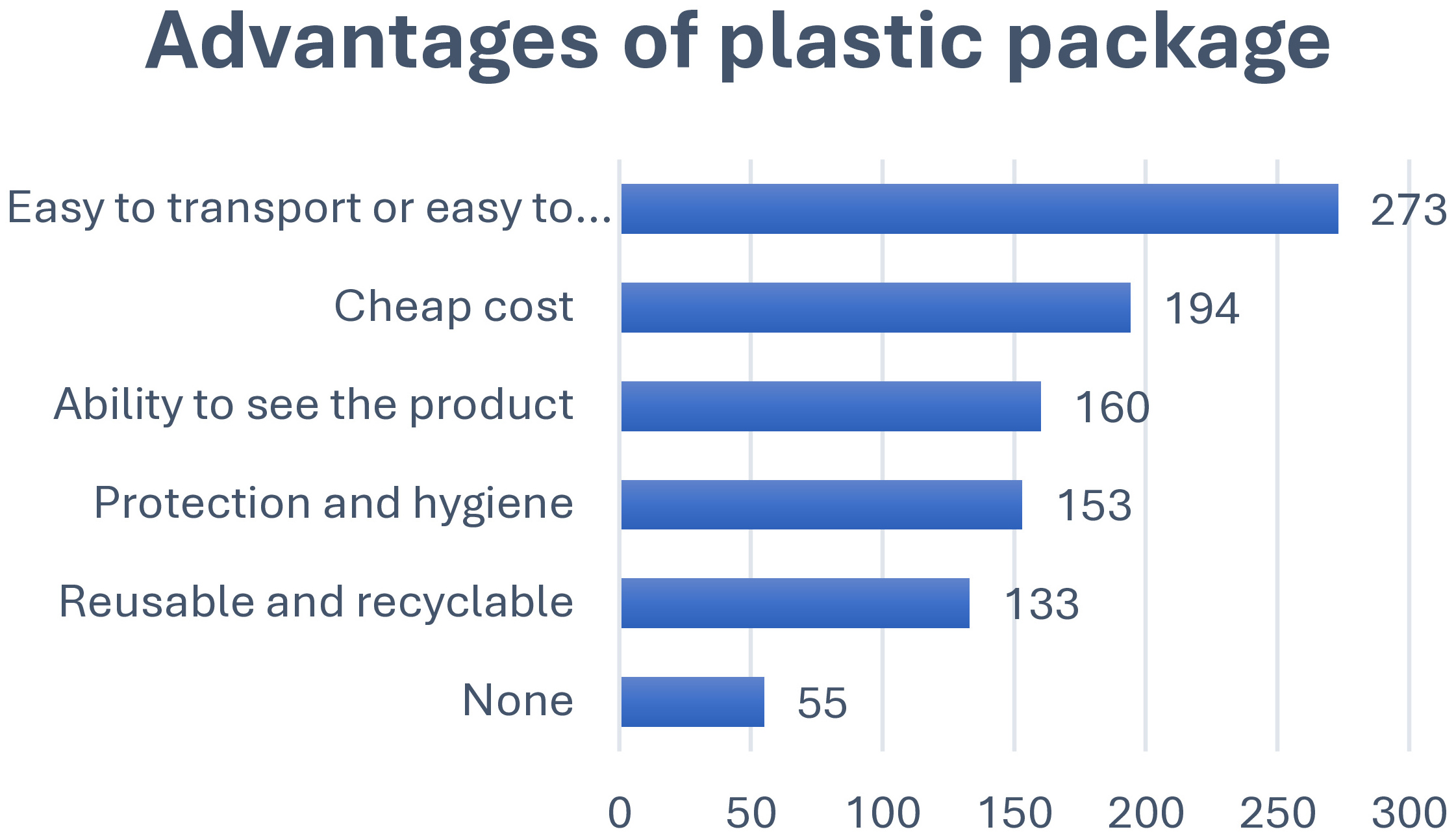
The analysis identified several advantages of plastic packaging as reported by respondents. The most frequently cited advantage was that plastic packaging is "easy to transport or easy to open," with 273 mentions. Following this, "cheap cost" was noted by 194 respondents, highlighting affordability as a key benefit. Other advantages included the "ability to see the product," which received 160 mentions, and "protection and hygiene," cited by 153 respondents. Additionally, 133 individuals noted that plastic packaging is "reusable and recyclable." Conversely, 55 respondents indicated that there are "none" of these advantages associated with plastic packaging (Figure 3). Chi-Square test revealed that perceptions of protection and hygiene significantly differed by gender, with 79.6% of females indicating these were not advantages, compared to 20.4% of males. Conversely, 69.6% of females acknowledged protection and hygiene as advantages, while 30.4% of males agreed. χ2 = 5.319 (p = 0.021), indicating a statistically significant difference in perceptions between genders (Supplementary Material S1).

3.5. importance of plastic packaging features
The most important finding is that a significant number of respondents rated the importance of plastic food packaging as 0, indicating they do not see any value in it. Specifically, 163 respondents rated "Contains the Product" as 0, and 148 rated "Protects the Product" as 0 (Table 2). A one-way ANOVA was conducted to analyze the importance ratings for plastic food packaging in relation to demographic factors such as age, education, and occupation. For the importance ratings of plastic packaging features, ANOVA analyses showed no significant effects of age, education, or occupation. However, independent-samples t-tests revealed significant gender differences for selected packaging attributes. The T-Test results indicated differences in perceptions between females and males regarding specific aspects of product packaging and marketing. For the statement "Product Information (Marketing)," the two-sided p-value was 0.051, indicating a marginal but not statistically significant difference between females and males. Overall, these findings highlight that there is a trend toward gender differences in how genders view the importance of product information in marketing, with females generally rating it higher than males (Supplementary Material S2).
Assessment of Importance Levels for Plastic Food Packaging, 0 indicates "Do not choose if you do not see any importance.
3.6. Health and environmental impact of plastic
The survey results regarding perceptions of plastic impacts, based on a total of 400 participants, reveal significant concerns. For the statement "Chemicals in plastic packaging transfer to our food," 41 participants (10.25%) Strongly disagreed, while 258 (64.50%) agreed or Strongly agreed. Regarding "Plastic breaks down when washed into toxic products," 26 (6.50%) Strongly disagreed, and 225 (56.25%) agreed or Strongly agreed. For the statement "Plastic breaks down when exposed to heat into toxic products," 24 (6.00%) Strongly disagreed, while 292 (73.00%) agreed or Strongly agreed. Concerning the release of toxic materials during plastic production, 36 participants (9.00%) Strongly disagreed, while 248 (62.00%) agreed or Strongly agreed. Finally, regarding "Animals in the oceans ingest plastic and then it reaches our food," 36 (9.00%) Strongly disagreed, while 257 (64.25%) agreed or Strongly agreed. Overall, these results indicate a strong concern about the negative impacts of plastic on health and the environment among respondents (Table 3).
The ANOVA results indicated significant differences with education in perceptions regarding the statement"Chemicals in plastic packaging transfer to our food,"with an F-value of 3.168 and a significance level of 0.043. Duncan's post hoc test revealed three groups:High School,Elementary or Middle School, andBachelor’s, but the significance level suggests that there are no significant differences among these groups (Supplementary Material S2). In terms of occupation, the analysis for"Plastic breaks down when exposed to heat into toxic products"showed a significant effect, with an F-value of 4.739 and a significance level of 0.009. Additionally, for the statement"Animals in the oceans ingest plastic and then it reaches our food,"the ANOVA showed a significant effect (F-value of 6.664, p = 0.001), with Duncan's test revealing means forEmployee,Retired or Not Working, andStudent, indicating no significant differences (Supplementary Material S2).
Regarding age, the ANOVA results for"Plastic breaks down when washed repeatedly into toxic products"indicated a significant effect, with an F-value of 4.132 and a significance level of 0.017. For the statement"Plastic breaks down when exposed to heat into toxic products,"the analysis showed an F-value of 3.524 and a significance level of 0.030, with The statement"During the production of plastic, toxic materials are released into the planet"showed an F-value of 3.284 and a significance level of 0.038. Finally, for the statement"Animals in the oceans ingest plastic and then it reaches our food,"the ANOVA indicated a significant effect (F-value of 8.813, p = 0.000). Overall, while significant effects were noted, Duncan's post hoc test indicated that there were no significant differences among the age groups across these statements (Supplementary Material S2). For gender, the T-Test results indicated significant differences in perceptions between females and males regarding several aspects of plastic and its impact. For the statement"Chemicals in plastic packaging transfer to our food,"the analysis revealed a two-sided p-value of 0.000, indicating a significant difference, with a mean difference of 0.701. For the statement"Plastic breaks down when washed repeatedly into toxic products,"the results showed a two-sided p-value of 0.002, indicating a significant difference, with a mean difference of 0.382. Similarly, for"Plastic breaks down when exposed to heat into toxic products,"the two-sided p-value was 0.000, reflecting a significant difference, with a mean difference of 0.559. Additionally, for the statement"During the production of plastic, toxic materials are released into the planet,"the analysis indicated a two-sided p-value of 0.001, demonstrating a significant difference, with a mean difference of 0.476. Finally, for"Animals in the oceans ingest plastic and then it reaches our food,"the results yielded a two-sided p-value of 0.026, indicating a significant difference, with a mean difference of 0.288. Overall, these findings underscore that gender significantly influences perceptions regarding the negative impacts of plastic, with females generally rating these concerns higher than males (Supplementary Material S2).
4. Discussion
The results of this study provide a comprehensive overview of consumer perceptions and behaviors surrounding plastic packaging. Notably, the demographic profile of the sample was predominantly young, educated, and female. The high proportion of young participants reflects the demographic structure of Saudi Arabia, where approximately 67% of the population is under 35 years of age
(Misk, 2020), suggests that this age group is increasingly aware of environmental issues, potentially shaping their attitudes towards plastic packaging (Figure 1). This awareness is particularly important because younger populations are increasingly involved in sustainability initiatives and environmental discussions, reflecting a broader global trend where youth advocate for environmental responsibility (Sloam et al., 2022). This trend is consistent with previous findings indicating growing environmental awareness among Saudi citizens (Almahasheer and Duarte, 2020).
Despite significant awareness of the negative impacts of plastic packaging on health and the environment—evidenced by the fact that 288 participants express concerns—many consumers still opt to purchase products with plastic packaging. This paradox highlights a gap between awareness and action, suggesting that factors such as convenience, cost, and brand loyalty often outweigh environmental considerations. While most respondents acknowledged the negative impacts, significant differences were found in gender, age, and occupation regarding food product quality and safety (Table 1). Education did not show significant differences, indicating that awareness of plastic's impact may influence purchasing behavior across demographic groups but does not uniformly alter consumer choices. This aligns with previous research indicating that environmental concerns do not always translate into changes in consumer behavior (Mason et al., 2022).
The analysis of purchasing considerations reveals that quality and brand significantly influence consumer choices, particularly emphasizing appearance. Young respondents prioritize appearance, suggesting that marketing strategies focusing on visual presentation may effectively influence this demographic. Research indicates that consumers often associate attractive packaging with higher quality, reinforcing the notion that visual appeal plays a crucial role in decision-making (Srivastava et al., 2022). While appearance was a significant factor in decision-making, its influence varied by age and occupation, highlighting the importance of visual presentation in consumer choices regarding plastic food packaging. Notably, gender and education did not show significant differences, indicating that these factors might not play a critical role in shaping perceptions about product packaging (Figure 2).
The identified advantages of plastic packaging, particularly ease of transport and low cost, reinforce the notion that practical benefits often overshadow environmental concerns. Interestingly, perceptions of protection and hygiene differed significantly by gender, suggesting that males and females evaluate packaging attributes differently. These differences may reflect broader variations in environmental awareness and consumer attitudes toward sustainability (Figure 3) (Konadu et al., 2022).
A concerning finding is the substantial number of respondents who rated the importance of plastic packaging features as negligible, especially regarding product containment and protection. This perspective implies a growing skepticism regarding the utility of plastic packaging, which could be attributed to increased environmental awareness. The lack of significant differences across age, education, and occupation—except for gender—highlights that concerns about the value of plastic packaging are widespread, although differences in perception may vary. Overall, the findings reveal widespread skepticism toward plastic packaging, with notable gender differences in perception. Although females tended to rate product information in marketing more highly than males, this difference did not reach statistical significance (p = 0.051), which was indicated by (Kol and Levy 2023), as that female customers are more likely to search for product information compared to male customers (Table 2).
Moreover, participants were deeply concerned about plastic's detrimental effects on health and the environment, specifically chemical transfer from packaging to food and the breakdown of plastic into poisonous chemicals. The ANOVA results revealed variances in perceptions based on education, occupation, and age, but no significant differences between groups. Notably, females expressed more concern than males. These findings underscore the importance of focused educational initiatives that address the individual concerns of various demographic groups in order to effectively increase awareness about the dangers of plastic use and pollution (Table 3).
5. Conclusion
The findings of this study provide important insights into consumer attitudes and behaviors about plastic packaging. While there is widespread knowledge of the health and ecological risks connected with plastic, many customers continue to prioritize convenience, cost, and brand loyalty in their shopping decisions. This paradox demonstrates that raising awareness alone may not be sufficient to promote major behavioral change. There were notable differences between genders in attitudes, with women generally expressing greater concerns about the effects of plastic consumption. This implies that in order to ensure that all customers are aware of the possible hazards connected to plastic packaging, methods of education that appeal to various demographic groups are required. Overall, the findings support a balanced approach that combines increasing awareness with promoting sustainable alternatives, appealing to the values of all consumers. Future research should focus on effective strategies for encouraging sustainable consumer behavior.
Supplementary Material
Supplementary material accompanies this paper.
Supplementary Material S1
Supplementary Material S2
This material is available as part of the online article from https://doi.org/10.1590/1519-6984.308288
Acknowledgements
The author would like to express sincere gratitude to Dr. Amier Hussain Msmar, Statistical Analysis Service, Imam Abdulrahman Bin Faisal University, for his valuable support and guidance in the statistical analysis.
Data Availability
The data supporting the findings of this study are available from the corresponding author upon reasonable request.
-
Ethics and consent
This study was approved by the Institutional Review Board (IRB) of Imam Abdulrahman Bin Faisal University (Approval No. IRB-2023-10-392). All participants provided informed consent prior to participation in the survey.
References
-
ABDULLAYEVA, M. and YAQUBOV, R., 2024. Microplastics and climate change: analyzing the environmental impact and mitigation strategies. IOP Conference Series. Earth and Environmental Science, vol. 1405, no. 1, pp. 012034. https://doi.org/10.1088/1755-1315/1405/1/012034
» https://doi.org/10.1088/1755-1315/1405/1/012034 -
ALMAHASHEER, H. and DUARTE, C.M., 2020. Perceptions of Marine Environmental Issues by Saudi Citizens. Frontiers in Marine Science, vol. 7, pp. 600. https://doi.org/10.3389/fmars.2020.00600
» https://doi.org/10.3389/fmars.2020.00600 -
ALMAHASHEER, H., 2025. Attitudes of Saudi consumers concerning recycling the plastic food packaging. Journal of the Saudi Society of Agricultural Sciences, vol. 24, no. 7, pp. 52. https://doi.org/10.1007/s44447-025-00059-y
» https://doi.org/10.1007/s44447-025-00059-y -
CUNNINGHAM, E.M., EHLERS, S.M., DICK, J.T., SIGWART, J.D., LINSE, K., DICK, J.J. and KIRIAKOULAKIS, K., 2020. High abundances of microplastic pollution in deep-sea sediments: evidence from Antarctica and the Southern Ocean. Environmental Science & Technology, vol. 54, no. 21, pp. 13661-13671. https://doi.org/10.1021/acs.est.0c03441 PMid:33086791.
» https://doi.org/10.1021/acs.est.0c03441 -
FASAKE, V., SHELAKE, P.S., SRIVASTAVA, A. and DASHORA, K., 2021. Characteristics of different plastic materials, properties and their role in food packaging. Current Nutrition and Food Science, vol. 17, no. 9, pp. 944-954. https://doi.org/10.2174/1573401317666210505100139
» https://doi.org/10.2174/1573401317666210505100139 - FLETCHER, S., MARCH, A.L.A., ROBERTS, K., SHIRIAN, Y., MILÀ I CANALS, L., CAIRNS, A., LEFORT, P., MESO, A., RAINE, A.D., SMAGADI, A., STONE, S., TONDA, E., DE LA FUENTE, J., KOSKELLA, J., BOVE, A.T., BOON, E. and BASS, A., 2023. Turning off the Tap: how the world can end plastic pollution and create a circular economy Portsmouth: University of Portsmouth, United Nations Environment Programme.
-
KOL, O. and LEVY, S., 2023. Men on a mission, women on a journey-Gender differences in consumer information search behavior via SNS: the perceived value perspective. Journal of Retailing and Consumer Services, vol. 75, pp. 103476. https://doi.org/10.1016/j.jretconser.2023.103476
» https://doi.org/10.1016/j.jretconser.2023.103476 -
KONADU, R., AHINFUL, G.S., BOAKYE, D.J. and ELBARDAN, H., 2022. Board gender diversity, environmental innovation and corporate carbon emissions. Technological Forecasting and Social Change, vol. 174, pp. 121279. https://doi.org/10.1016/j.techfore.2021.121279
» https://doi.org/10.1016/j.techfore.2021.121279 -
MACENA, M.W., CARVALHO, R., CRUZ-LOPES, L.P. and GUINÉ, R.P., 2022. Perceptions and knowledge regarding quality and safety of plastic materials used for food packaging. Open Agriculture, vol. 7, no. 1, pp. 132-146. https://doi.org/10.1515/opag-2022-0066
» https://doi.org/10.1515/opag-2022-0066 -
MARTIN, C., BAALKHUYUR, F., VALLUZZI, L., SADERNE, V., CUSACK, M., ALMAHASHEER, H., KRISHNAKUMAR, P., RABAOUI, L., QURBAN, M., ARIAS-ORTIZ, A., MASQUÉ, P. and DUARTE, C.M., 2020. Exponential increase of plastic burial in mangrove sediments as a major plastic sink. Science Advances, vol. 6, no. 44, pp. eaaz5593. https://doi.org/10.1126/sciadv.aaz5593 PMid:33115749.
» https://doi.org/10.1126/sciadv.aaz5593 -
MASON, M.C., PAULUZZO, R. and UMAR, R.M., 2022. Recycling habits and environmental responses to fast-fashion consumption: enhancing the theory of planned behavior to predict Generation Y consumers’ purchase decisions. Waste Management, vol. 139, pp. 146-157. https://doi.org/10.1016/j.wasman.2021.12.012 PMid:34971902.
» https://doi.org/10.1016/j.wasman.2021.12.012 -
MISK, 2020 [viewed 2 May 2026]. Saudi Youth Values 2020 [online]. Available from: https://hub.misk.org.sa/insights/givingback-leadership-skills/2020/saudi-youth-values-2020/?allowview=true - :~:text=In%20the%20Kingdom%20of%20Saudi,67%25%20of%20the%20entire%20population.
» https://hub.misk.org.sa/insights/givingback-leadership-skills/2020/saudi-youth-values-2020/?allowview=true -
NCUBE, L.K., UDE, A.U., OGUNMUYIWA, E.N., ZULKIFLI, R. and BEAS, I.N., 2021. An overview of plastic waste generation and management in food packaging industries. Recycling, vol. 6, no. 1, pp. 12. https://doi.org/10.3390/recycling6010012
» https://doi.org/10.3390/recycling6010012 -
OBUZOR, G.U. and ONYEDIKACHI, U.B., 2023. Chemical leaching into food and the environment poses health hazards. In: E.O. Nwaichi, ed.Modernity in health and disease diagnosis: The account from STEM women Cham: Springer Nature Switzerland, pp. 129-148.. https://doi.org/10.1007/978-3-031-34963-8_14
» https://doi.org/10.1007/978-3-031-34963-8_14 -
PAUL, S., NATH, S., BHATTACHARJEE, S. and MUKHERJEE, S., 2024. Unveiling the effects of microplastics pollution on marine fauna. Blue Biotechnology, vol. 1, no. 1, pp. 6. https://doi.org/10.1186/s44315-024-00006-6
» https://doi.org/10.1186/s44315-024-00006-6 -
PLASTIC-OCEANS, 2022a [viewed 2 May 2026]. Join BlueCommunities [online]. Available from: https://www.plasticoceans.org/bluecommunities
» https://www.plasticoceans.org/bluecommunities -
PLASTIC-OCEANS, 2022b [viewed 2 May 2026]. Plastic pollution facts [online]. Available from: https://plasticoceans.org/the-facts/
» https://plasticoceans.org/the-facts/ -
SLOAM, J., PICKARD, S. and HENN, M., 2022. Young people and environmental activism: the transformation of democratic politics. Journal of Youth Studies, vol. 25, no. 6, pp. 683-691. https://doi.org/10.1080/13676261.2022.2056678
» https://doi.org/10.1080/13676261.2022.2056678 -
SRIVASTAVA, P., RAMAKANTH, D., AKHILA, K. and GAIKWAD, K.K., 2022. Package design as a branding tool in the cosmetic industry: consumers’ perception vs. reality. SN Business & Economics, vol. 2, no. 6, pp. 58. https://doi.org/10.1007/s43546-022-00222-5 PMid:35615336.
» https://doi.org/10.1007/s43546-022-00222-5
Edited by
-
Editor:
Takako Matsumura Tundisi