
 Exploring natural compounds as potential inhibitors of Derlin-1: a computational approach
Abstract
Derlin-1 is an essential component of the endoplasmic reticulum-associated degradation (ERAD) pathway, responsible for the retrotranslocation of misfolded proteins. Its overexpression has been linked to metabolic, neurodegenerative, and cancer-related diseases, as Derlin-1 controls ER stress. In this study, we employed an integrated computational approach to identify natural compounds as potential inhibitors of Derlin-1. Pharmacophore modeling, molecular docking, predictive pharmacokinetic and toxicological analyses, and molecular dynamics simulations were applied. Among the candidates evaluated, compound 628 stood out by exhibiting higher conformational stability and favorable interactions within the protein’s active site. These findings highlight the potential of natural products as promising sources for the development of Derlin-1 modulators and open new perspectives for experimental studies to validate their efficacy in biological models.
Keywords:
Derlin-1; natural compounds; NuBBE; molecular docking; pharmacophore modeling
Resumo
A Derlin-1 é um componente essencial da via de degradação associada ao retículo endoplasmático (ERAD), sendo responsável pela retrotranslocação de proteínas mal conformadas. A superexpressão dessa proteína tem sido associada a doenças metabólicas, neurodegenerativas e ao câncer, uma vez que a Derlin-1 desempenha papel central na regulação do estresse do retículo endoplasmático. Neste estudo, foi empregada uma abordagem computacional integrada para identificar compostos naturais como potenciais inibidores da Derlin-1. Foram aplicadas técnicas de modelagem farmacofórica, docking molecular, análises preditivas farmacocinéticas e toxicológicas, bem como simulações de dinâmica molecular. Entre os candidatos avaliados, o composto 628 destacou-se por apresentar maior estabilidade conformacional e interações favoráveis no sítio ativo da proteína. Esses achados evidenciam o potencial de produtos naturais como fontes promissoras para o desenvolvimento de moduladores da Derlin-1 e fornecem subsídios para futuros estudos experimentais visando à validação de sua eficácia em modelos biológicos.
Palavras-chave:
Derlin-1; compostos naturais; NuBBE; docking molecular; modelagem farmacofórica
1. Introduction
The endoplasmic reticulum (ER) is responsible for the synthesis, modification, and transport of proteins and lipids, so that, in this organelle, the synthesized proteins are folded and modified post-translationally, in a finely monitored process (Vembar and Brodsky, 2008). Proteins that pass cellular quality control criteria are transported to their destinations through the secretory route, while non-native and poorly conformed proteins are degraded through the endoplasmic reticulum-associated degradation (DARE) pathway (Wiseman et al., 2022).
Derlin-1 is essentially involved in DARE and, therefore, in the regulation of protein homeostasis, organized in a homotetrameric structure and classified as a rhomboid protein (Rao et al., 2021). Despite sharing homology with this vast family, Derlin-1 does not have the key residues necessary for the typical proteolytic activity of these proteases, being involved in the formation of a retrotranslocation channel in the ER for the passage of peptides across the organelle membrane (Greenblatt et al., 2011).
Derlin-1 has a distinct molecular architecture with six predicted transmembrane domains and amino (N) and carboxyl (C) termini facing the cytosol. The transmembrane domains anchor Derlin-1 and form the retrotranslocation channel, while the cytoplasmic domains signal the degradation of specific substrates (Nejatfard et al., 2021). Indeed, the dynamic interaction of Derlin-1 with other molecular components is a central aspect of this intricate process, ensuring efficiency and specificity in the identification and removal of misfolded proteins (St-Pierre et al., 2012; Lim et al., 2016; Schuberth and Buchberger, 2005). Therefore, Derlin-1 is a key molecule in maintaining the integrity and functional efficiency of cells (Lilley and Ploegh, 2004). For this reason, Derlin-1 has a significant implication in different diseases such as Parkinson's, Alzheimer's, and Huntington's, in which the aggregation of misfolded proteins is involved (Vembar and Brodsky, 2008; Cai et al., 2022).
Besides, Derlin-1 participates in modulating the ER stress response, a critical phenomenon for cell survival and proliferation of malignant cells (Xu et al., 2014). In tumors, Derlin-1 displays an exacerbated expression, inhibiting apoptosis induced by ER stress (Fan et al., 2020). In this context, oxidative stress, resulting from an imbalance between reactive oxygen species (ROS) production and antioxidant defense mechanisms, is closely intertwined with ER stress, and both pathways contribute to the development and progression of neurodegenerative disorders, cardiovascular diseases, cancer, and metabolic syndromes. Genetic variants modulating antioxidant pathways may therefore influence individual susceptibility to diseases in which Derlin-1 is implicated, reinforcing the relevance of exploring molecular targets within these interconnected stress response networks (Rehman et al., 2025).
In this context, the search for Derlin-1 inhibitors is interesting, and computational techniques, such as molecular docking, have been fundamental in predicting interactions between proteins and ligands (Zhang et al., 2024). Natural compounds are even more promising, as they stand out for their chemical diversity, biological evolution, efficacy, lower toxicity, specific interactions with biological targets, and lower side effects (Xing et al., 2017). Therefore, in this study, we aimed to identify new molecules derived from Brazilian natural products with high binding affinity to the Derlin-1 protein, to explore their therapeutic potential. We performed molecular docking and dynamics simulations of Derlin-1 with natural compounds from the Núcleo de Bioensaios, Biossíntese e Ecofisiologia de Produtos Naturais (NuBBE) database, identifying promising candidates for future studies in biological models.
2. Materials and Methods
2.1. Derlin-1 and structure-based pharmacophore model
The three-dimensional structure of Derlin- was obtained from the Protein Data Bank (PDB ID 7CZB) (NSF, 2026) and then optimized by Molecular Operating Environment 2022.02 (MOE). The protein preparation included the addition of hydrogen atoms, assignment of partial charges, and energy minimization to resolve steric clashes and optimize bond geometries. The binding site was identified using the MOE SiteFinder tool, which detects energetically favorable interaction regions on the protein surface based on the receptor interface, including hydrogen bond donor, hydrogen bond acceptor, and hydrophobic regions.
The pharmacophore model was constructed based on the structural and chemical characteristics of the identified binding site, considering fundamental aspects for the biological activity of Derlin-1. The model was designed with six pharmacophoric features, comprising two hydrogen bond acceptor sites and four hydrogen bond donor sites. Compounds were required to match at least three of the six pharmacophoric features to be considered viable candidates. The MOE Pharmacophore Search tool was used to identify compounds with robust complementarity to the Derlin-1 binding site.
2.2. Database preparation
The library of natural product compounds from NuBBE (UNESP, 2026) was chosen and previously filtered for molecules with druglike characteristics using the FILTER program of OMEGA 4.1.2.0 (OpenEye Scientific Software). QUACPAC 1.6.3.1 program, from OpenEye Scientific Software (OpenEye, 2026) was then employed for accurate protonation at pH 7.4 and to enumerate the possible tautomers of each molecule.
The NuBBE database was selected for this study due to its comprehensive and curated collection of natural products derived exclusively from Brazilian biodiversity, encompassing compounds isolated from plants, fungi, and microorganism’s native to Brazilian biomes such as the Amazon, Cerrado, and Atlantic Forest (Pilon et al., 2017; Valli et al., 2013). This database represents a strategically relevant source for drug discovery, given that Brazilian biodiversity is among the richest in the world and remains largely underexplored in terms of pharmacological potential. Furthermore, NuBBE compounds are structurally diverse and have been previously characterized in terms of their chemical properties, facilitating the integration with computational screening pipelines. The choice of a natural product-focused database is also consistent with the growing evidence that natural compounds exhibit favorable interactions with biological targets due to their evolutionary optimization for binding to proteins (Atanasov et al., 2015).
2.3. Molecular docking
Virtual screening was carried out with the previously prepared NuBBE database and docking was conducted using MOE's Pharmacophore Modeling tool, which predicts the optimal interaction geometry and binding energy between potentially tautomeric forms relative to Derlin-1. The binding site was defined based on the pharmacophoric regions previously identified by the SiteFinder tool, centered on the hydrogen bond donor, acceptor, and hydrophobic regions of the Derlin-1 receptor interface.
The induced fit docking algorithm was applied to allow receptor flexibility during the screening process, better accounting for conformational adaptations upon ligand binding. For each compound, a maximum of 10 poses were generated and initially scored using the London dG scoring function, which estimates the binding free energy based on geometric and chemical complementarity between the ligand and the receptor. The top-ranked poses were subsequently refined using the GBVI/WSA dG scoring function, which provides a more accurate estimation of binding free energy by accounting for solvation effects and van der Waals interactions. Different conformations were evaluated, and the final scores reflected the free binding energy of the ligand from the most favorable pose, enabling the ranking and classification of the screened molecules. The five compounds presenting the most favorable binding scores, that is, the lowest free energy value, were selected for subsequent analyses, including molecular dynamics simulations. No co-crystallized ligand is currently available for Derlin-1 (PDB ID 7CZB), therefore, a classical re-docking validation using a reference compound was not applicable in this study. As an alternative internal validation strategy, the consistency of the docking protocol was assessed by verifying the reproducibility of key protein–ligand interactions across the top-ranked compounds.
2.4. Pharmacokinetic properties
Pharmacokinetic properties of the five best molecules were determined using the pkCSM tool (University of Melbourne, 2026). pkCSM is an innovative approach that considers interconnected structure-based signatures to predict the pharmacokinetic and toxicity properties for drug development (Pires et al., 2015). For each ligand candidate, absorption, distribution, metabolism, excretion and toxicity (ADMET) were analyzed, as well as solubility and permeability properties.
2.5. Simulation using CHARMM-GUI and GROMACS
The simulation of the Derlin-1 was performed using the CHARMM-GUI Membrane Builder tool, which a web-based graphical interface that prepares proteins, lipids and other components for molecular dynamics (MD) simulations (Feng et al., 2023).
The force and topology parameters generated by CHARMM-GUI were converted to a GROMACS-compatible format, ensuring consistency between simulation models. GROMACS software is a widely used package for MD of biomolecular systems (Abraham et al., 2015). The interaction parameters between atoms were defined by the CHARMM force field, while the TIP3P water model was used for the solvation of the system. The cell was adjusted to the dimensions of the protein and ligands, with the addition of water and ions to neutralize it. The protein was inserted into a bilipid membrane using dioleoylphosphatidylcholine (DOPC). The simulation was balanced in the NVT (Number of Particles, Volume, Temperature) and NPT (Number of Particles, Pressure, Temperature) phases to control the system temperature and pressure, respectively. The temperature was kept constant at 303.15 K using an appropriate thermostat; and van der Waals interactions were treated with a short-range cutoff according to the CHARMM force field. The production phase consisted of 100 ns of simulation.
After the simulation, the structural stability of the protein-ligand complex over time was analyzed using the Root Mean Square Deviation (RMSD). The flexibility of specific residues in the protein was investigated using Root Mean Square Fluctuation (RMSF), while the number of hydrogen bonds was determined to evaluate specific interactions. Finally, principal component analysis (PCA) was performed to investigate the main modes of variation in the dynamics of the protein-ligand complex. Analysis of Derlin-1 without the ligand (Apo) was also included.
3. Results
3.1. Potential Derlin-1 natural inhibitors
The 3D structure of the Derlin-1 protein was obtained from the Protein Data Bank (PDB ID 7CZB) and optimized using MOE software (Figure 1A). The resulting pharmacophore model presented the molecular interaction points considered crucial for the identification and selection of potential inhibitors. Six distinct domains in Derlin-1 stood out, two of which are acceptors (Figure 1B, blue spheres) and four are hydrogen bond donors (Figure 1B, pink spheres). These domains are important for establishing specific interactions with the active site, influencing affinity and selectivity. Thus, the pharmacophore model was used in virtual screening, allowing the identification of candidate compounds to interact with specific targets. For this purpose, MOE's SiteFinder tool accurately outlined the ideal interaction parameters between the protein and possible ligands.
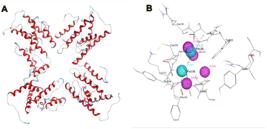
Pharmacophoric model of Derlin-1. (A) Tetrameric structure of Derlin-1 (PDB ID7CZB) optimized by Molecular Operating Environment (MOE); (B) Molecular interaction points crucial for the identification and selection of potential Derlin-1 inhibitors. Pink spheres: hydrogen bond acceptor domains. Blue spheres: hydrogen bond donor domains.
Natural compounds with structural characteristics that suggest affinity for binding to Derlin-1 were identified from the NuBBE database. The results were meticulously ranked, prioritizing the most favorable interactions with lowest scoring. The ranking analysis was based on MOE's GBVI/WSA dG model, and five promising compounds (Table 1). The first four main compounds are semi-synthetic derivatives of the plant Alchornea glandulosa and the fifth is isolated from the fungus Humicola grisea, which highlights the promising diversity of natural sources in the identification of potential ligands.
Compounds with the best scores obtained in the virtual screening based on the pharmacophore model. 2D structure and free binding energy (kcal/mol) are presented.
3.2. Molecular docking of the top five ligands
The interactions between the top five ligands selected from the NuBBE database and the Derlin-1 protein were then investigated by MD (Figure 2). The interaction induced between compound 628 and Derlin-1 was stabilized by hydrogen bonds, in which the compound associated with the amino acid residues tyrosine 154 (Tyr154), leucine 155 (Leu155) and methionine 140 (Met140). The first two residues acted as hydrogen bond acceptors, while the last one functioned as a hydrogen bond donor, providing stability. The interaction of compound 630, in turn, was stabilized by just two hydrogen bonds between the compound and the amino acid residues Leu155 and Tyr154, hydrogen acceptors. The stability of the 627 bonds was also achieved due to the interaction of the compound with the amino acid residues Leu155 and Tyr154, hydrogen acceptors. Furthermore, there was an interaction between the compound's side chain and serine 143 (Ser143), ensuring better binding specificity. Finally, compound 1527 demonstrated two bonds, one being a hydrogen bond between the compound and lysine 151 (Lys151) and a nitrogen bond with Tyr154.

2D interaction of the five selected compounds aligned with the Derlin-1 pharmacophore model. (A) 628; (B) 630; (C) 627; (D) 626; (E) 1527.
3.3. Pharmacokinetics properties
The five selected compounds were subjected to a comprehensive analysis using the pkCSM model (Table 2). This analysis allowed the prediction of pharmacokinetic properties, providing insights into their potential as drug candidates.
Analysis of the pharmacokinetic properties of the top five molecules selected in the virtual screening.
Molecules 628 and 630 demonstrated high intestinal and skin permeability. However, in terms of distribution, they exhibited a significant unbound fraction, increasing their availability for interactions with other biological targets. They presented favorable metabolic profile and adequate total release rate. Moreover, they did not demonstrate mutagenic, hepatotoxic, or cardiac ion channel inhibitory activity. However, skin sensitization was observed, which requires further evaluation.
Molecule 627 demonstrated moderate solubility in water and significant intestinal permeability. It also exhibited a considerable unbound fraction and adequate cerebral permeability, suggesting tissue distribution and potential penetration into the central nervous system. In terms of metabolism, 627 maintained a relatively stable metabolic profile with efficient elimination (excretion profile). However, acute oral toxicity was observed in rats, with a significant LD50. Although 627 has not demonstrated skin sensitization, moderate toxicity has been identified in tests with aquatic organisms.
Molecule 626 showed moderate solubility in water and notable intestinal permeability, suggesting effective absorption by the gastrointestinal tract. In distribution, a considerable unbound fraction was observed, although its cerebral permeability was modest. Regarding metabolism, no significant interactions with enzymes of the cytochrome P450 system were identified. Upon excretion, the molecule showed an adequate total release rate, suggesting efficient elimination. However, acute oral toxicity was also observed in rats, with a significant LD50.
Finally, molecule 1527 presented moderate solubility in water and relatively low intestinal permeability, suggesting a less effective absorption by the gastrointestinal tract. Its skin permeability has been significantly reduced. A considerable unbound fraction was described, and its cerebral permeability was modest. No interactions with enzymes of the cytochrome P450 system were observed, suggesting a relatively stable metabolic profile. Upon excretion, it presented an adequate total release rate, suggesting efficient elimination from the organism. Toxicity in murine and aquatic organisms was also observed.
Comparing ADMET results, 628 and 630 stood out as the most promising compounds. Detailed analysis of molecules 627, 626, and 1527 using the pkCSM model revealed important pharmacokinetic properties, but with worrying toxicity.
3.4. Molecular dynamics
Molecular dynamics simulations were conducted with the three compounds that showed the best docking scores (628, 630, and 627) and with the δ-lactam derivative from the fungus Humicola grisea (1527), included because it represents a distinct structural class compared to the other candidates. The dynamics of hydrogen bonding over time during the simulation of the interaction of the Derlin-1 protein with the four compounds is shown in Figure 3.

Hydrogen bond dynamics over time between Derlin-1 and potential ligands. (A) 628; (B) 630; (C) 627; (D) 1527.
Table 3 presents the structural stability patterns of molecular dynamics. The Apo system showed intermediate RMSD and RMSF values, consistent with the intrinsic flexibility of membrane proteins in the absence of ligands. Among the complexes evaluated, 628 stood out for presenting the lowest average RMSD and RMSF values compared to the others, suggesting greater conformational stability throughout the simulation. 1527 also exhibited favorable performance, with lower RMSD than Apo and a significant number of hydrogen bonds, indicating consistent anchoring potential. On the other hand, 630 presented the highest RMSD among all systems, coupled with a low number of hydrogen bonds, reflecting lower overall stability. 627, in turn, showed intermediate behavior, with RMSD and RMSF close to those observed in Apo, but with a lower frequency of hydrogen bonds. These results reinforce the relevance of compounds 628 and 1527 as more stable candidates for interaction with Derlin-1.
Mean and standard deviation of the number of hydrogen bonds (H-BOND) formed after molecular dynamics analysis.
Analysis of the stability, movement and flexibility of the protein associated with the ligands are also presented in Figure 4. For RMSD (Figure 4A), consistent stability was observed (mean 0.36 ± 0.03), with minimal fluctuations in atomic positions for 628 (green trace). In the protein associated with 627 (red trace), there was stability (0.39 ± 0.04), but with a slight difference in relation to compound 628. For 1527 (yellow trace), an intermediate behavior was observed, with RMSD values lower than Apo and comparable to 628, indicating overall stability of the complex. However, its RMSF revealed slightly higher fluctuations in some regions, suggesting increased local mobility. Nevertheless, the average number of hydrogen bonds was consistent, reinforcing its capacity for stable interaction with Derlin-1. These findings point to 1527 as a relevant candidate, whose structural stability is sustained by specific interactions, even in the face of small local variations in flexibility The complex with compound 630 (blue trace) exhibited a higher RMSD value (0.55 ± 0.09) compared to the apo system and the other ligand-bound complexes. Furthermore, the three ligands formed a plateau after 50 ns of simulation, which indicates that they all reached stability.

Comparative molecular dynamics analysis of Derlin-1 associated with compounds 628 (black trace), 630 (red trace), and 627 (green trace). (A) Root mean square deviation (RMSD); (B) Root mean square fluctuation (RMSF); (C) Principal component analysis (PCA).
PCA analysis (Figure 4B) represents protein trajectories in a two-dimensional space, allowing the evaluation of protein compaction. The association of compound 628 with Derlin-1 showed a more compact trajectory in relation to the other ligands. Finally, RMSF represents fluctuations in residuals over time (Figure 4C). Both compounds 628 and 627 showed similar fluctuation patterns (means 0.12 ± 0.1 and 0.11 ± 0.06 respectively) for the residues of the binding site (residues 82 to 156). This result indicates a lower fluctuation and, therefore, greater stability of the interactions between ligand and protein. Complex with 630, in turn, showed greater instability, with a higher mean and high standard deviation (0.14 ± 0.16). Therefore, compound 628 is the most promising in terms of stability and compaction with the Derlin-1 binding site.
4. Discussion
Molecular docking is among the most commonly used methods to predict the binding of ligands to target proteins in a virtual environment (Ononamadu and Ibrahim, 2021). The present study outlined a comprehensive and strategic approach for identifying potential inhibitors of Derlin-1, a fundamental protein in the regulation of protein degradation in the ER, especially in contexts related to metabolic dysfunctions. Derlin-1 eliminates misfolded proteins, contributing to the maintenance of cellular integrity and functional efficiency (Rao et al., 2021). Its overexpression in tumor cells, for example, is associated with resistance to ER stress-induced apoptosis, which suggests Derlin-1 is a potentially significant therapeutic target for targeted interventions (Wang et al., 2008; Taghizadeh et al., 2022).
The strategy adopted in the present study was based on advanced computational techniques, including pharmacophoric modeling, MD, analysis of pharmacokinetic and toxicological properties, and molecular dynamics, with the aim of identifying promising natural compounds as candidates for Derlin-1 inhibitors. Pharmacophoric modeling allowed the precise delineation of potential binding sites on Derlin-1, providing a structural guide for the virtual screening of natural compounds available in the NuBBE database. Previous studies have attested to the importance of pharmacophoric modeling as a structural and essential tool in the identification and development of potential therapeutic agents, allowing the precise selection of bioactive compounds for specific interactions with molecular targets of interest (Luo et al., 2021; Gouda et al., 2020).
Five promising candidates with the potential for inhibiting Derlin-1 were selected, as evidenced by the low free energy remaining after binding. Among the five, four are synthetic derivatives of the same species, Alchornea glandulosa, a plant native to the tropical region of South America, from the Euphorbiaceae family, with secondary metabolites relevant to pharmacology (Morais et al., 2010). Phytochemical studies have identified a variety of bioactive compounds, including flavonoids, tannins, alkaloids, and terpenoids (Morais et al., 2010). Phenolic compounds are among the main metabolites, such as gallic acid, incluiding n-butyl gallate, n-pentyl gallate, isopropyl gallate, and n-propyl gallate. These are semi-synthetic esters (Morais et al., 2010) identified in NuBBE as 628, 630, 627, and 626, respectively. Phenolic compounds are recognized as interesting therapeutic sources due to their antioxidant properties (Xing et al., 2017). The antitumor action of Alchornea glandulosa, for example, is largely associated with the inhibition of nitric oxide, with an anti-inflammatory effect compared to traditional drugs such as celecoxib and doxorubicin (Malara et al., 2021). The structural consistency between the four compounds therefore suggests the presence of metabolites shared in the same species and, possibly, convergent mechanisms of action that, in the present study, are related to the inhibition of Derlin-1. The fifth compound selected in the screening is derived from the fungus Humicola grisea, a thermophilic soil organism belonging to the genus Humicola. This fungus is known for its ability to degrade complex natural substrates and to produce thermostable enzymes with biotechnological applications. It is the source of the δ-lactam derivative, a bioactive compound with anti-inflammatory properties (Andrioli et al., 2012).
In fact, natural products play a crucial role in the search for new therapies, due to their structural diversity and molecular complexity, with significant and innovative advantages (Melo et al., 2011). The growing trend in medicines is directed towards compounds with reduced molecular mass, which have desirable pharmacological properties, such as greater efficacy and a better bioavailability profile (Atanasov et al., 2021; Luo et al., 2021). In this context, the analysis of pharmacokinetic and toxicological properties revealed molecules 628 and 630 as the most promising, with favorable absorption, distribution, metabolism, and excretion properties, together with acceptable toxicity profiles. However, with skin sensitization. On the other hand, molecules 627, 626, and 1527 showed predicted pharmacokinetic and toxicological properties that may limit their potential as therapeutic agents.
The conformational stability of Derlin-1, whose structural role in the ERAD pathway involves the formation of a homotetrameric channel, is essential for the retrotranslocation of misfolded proteins (Rao et al., 2023). This architecture provides a plausible structural basis for ligand-induced stabilizing or destabilizing effects. Within the analyzed set, the complexes with compounds 628 and 1527 exhibited lower mean RMSD values compared to the other systems, which is consistent with greater overall conformational stability. In contrast, the complex with compound 630 displayed the highest RMSD, reflecting increased mobility and reduced structural retention. From a methodological standpoint, the use of RMSD and RMSF as primary descriptors of protein–ligand complex stability and flexibility is well established in contemporary molecular dynamics studies: lower RMSD values generally indicate more stable complexes, whereas RMSF describes residue-wise flexibility, assisting in the identification of regions stabilized or sensitized by ligand binding (Abdalla et al., 2024). These criteria are consistently reported in recent computational screening and complex stability assessment studies, reinforcing the interpretation presented here (Jin et al., 2025).
The number and occupancy of hydrogen bonds emerge as additional determinants of ligand anchoring. (Sangande et al., 2020). The complex with compound 628 exhibited the highest mean number of hydrogen bonds, in agreement with reports indicating that hydrogen bonds with high occupancy (≥50%) tend to sustain persistent interactions and, consequently, greater complex stability throughout the simulation trajectory (Liu and Kokubo, 2017; Sangande et al., 2020). This correlation between hydrogen bonds and stability has been highlighted in recent molecular dynamics studies focused on inhibitor discovery. (Ferreira et al., 2015; AlRawashdeh and Barakat, 2024).
A biological perspective, prioritizing candidates that stabilize Derlin-1 (or modulate its dynamics in a predictable manner) is consistent with the protein’s increasing clinical relevance across different diseases, including cancer. In breast cancer, for example, Derlin-1 is frequently overexpressed and associated with aggressive phenotypes and endoplasmic reticulum stress. (Bai et al., 2024). The growing interest in natural compounds as anti-cancer candidates has been increasingly supported by computational approaches. Recent studies have demonstrated the potential of in silico screening strategies, including molecular docking and dynamics simulations, for identifying natural product-derived compounds with high binding affinity to key cancer targets. The convergence of such strategies with the present study highlights the relevance of virtual screening of natural products as a viable route for discovering novel therapeutic candidates (Rohmatika et al., 2025). Thus, a compound exhibiting a more favorable balance between conformational stability (RMSD/RMSF) and interaction network (hydrogen bonds), such as compound 628, emerges as a preferred candidate for future experimental validation.
5. Conclusions
The integration of pharmacophore modeling, molecular docking, predictive ADMET analyses, and molecular dynamics simulations enabled the rigorous selection of compounds with high interaction potential with the target protein, particularly compound 628. This candidate exhibited significant conformational stability and interaction patterns consistent with effective Derlin-1 inhibition.
The innovative aspect of this work lies in the exploration of metabolites derived from Brazilian biodiversity as sources of bioactive molecules targeting the ERAD pathway, a strategy that remains relatively underexplored in the literature. The prioritization of the identified compounds opens perspectives for future experimental validation in cellular and animal models, thereby contributing to the expansion of the therapeutic arsenal against different pathologies associated with endoplasmic reticulum stress. Taken together, this study establishes a solid foundation for the translational investigation of natural Derlin-1 inhibitors and highlights the importance of integrated computational approaches in the screening of new chemical entities of pharmacological interest.
Acknowledgements
The authors would like to thank OpenEye Scientific Software for kindly providing free academic licenses for the software used in this work. The authors would like to thank the financial support by Fundação de Amparo à Pesquisa de Minas Gerais (FAPEMIG REMITRIBIC RED-00031-21, APQ-00741-24 and RED-00053-21), Conselho Nacional de Desenvolvimento Científico e Tecnológico (CNPq – grant 305328/2022-0 - T.G.A. and 405751/2023-0), and Coordenação de Aperfeiçoamento de Pessoal de Nível Superior (CAPES).
Data Availability Statement
The datasets used and/or analyzed during the current study are available from the corresponding author upon reasonable request.
References
-
ABDALLA, M., ABDELKHALIG, S.M., EDET, U.O., ZOTHANTLUANGA, J.H., UMOH, E.A., MOGLAD, E., NKANG, N.A., HADER, M.M., ALANAZI, T.M.R., ALSHOULI, S. and AL-SHOULI, S., 2024. Molecular dynamics-based computational investigations on the influence of tumor suppressor p53 binding protein against other proteins/peptides. Scientific Reports, vol. 14, no. 1, pp. 29871. https://doi.org/10.1038/s41598-024-81499-4 PMid:39622863.
» https://doi.org/10.1038/s41598-024-81499-4 -
ABRAHAM, M.J., MURTOLA, T., SCHULZ, R., PÁLL, S., SMITH, J.C., HESS, B. and LINDAHL, E., 2015. Gromacs: high performance molecular simulations through multi-level parallelism from laptops to supercomputers. SoftwareX, vol. 1-2, pp. 19-25. https://doi.org/10.1016/j.softx.2015.06.001
» https://doi.org/10.1016/j.softx.2015.06.001 -
ALRAWASHDEH, S. and BARAKAT, K.H., 2024. Applications of molecular dynamics simulations in drug discovery. In: M. GORE and U.B. JAGTAP, eds. Computational drug discovery and design New York: Humana, vol. 2714, pp. 127-141. https://doi.org/10.1007/978-1-0716-3441-7_7
» https://doi.org/10.1007/978-1-0716-3441-7_7 -
ANDRIOLI, W.J., SANTOS, M.S., SILVA, V.B., OLIVEIRA, R.B., CHAGAS-PAULA, D.A., JORGE, J.A., FURTADO, N.A., PUPO, M.T., SILVA, C.H., NAAL, R.M. and BASTOS, J.K., 2012. δ-Lactam derivative from thermophilic soil fungus exhibits invitro anti-allergic activity. Natural Product Research, vol. 26, no. 23, pp. 2168-2175. https://doi.org/10.1080/14786419.2011.647020 PMid:22239222.
» https://doi.org/10.1080/14786419.2011.647020 -
ATANASOV, A.G., WALTENBERGER, B., PFERSCHY-WENZIG, E.-M., LINDER, T., WAWROSCH, C., UHRIN, P., TEMML, V., WANG, L., SCHWAIGER, S., HEISS, E.H., ROLLINGER, J.M., SCHUSTER, D., BREUSS, J.M., BOCHKOV, V., MIHOVILOVIC, M.D., KOPP, B., BAUER, R., DIRSCH, V.M. and STUPPNER, H., 2015. Discovery and resupply of pharmacologically active plant-derived natural products: a review. Biotechnology Advances, vol. 33, no. 8, pp. 1582-1614. https://doi.org/10.1016/j.biotechadv.2015.08.001
» https://doi.org/10.1016/j.biotechadv.2015.08.001 -
ATANASOV, A.G., ZOTCHEV, S.B., DIRSCH, V.M. and SUPURAN, C.T., 2021. Natural products in drug discovery: advances and opportunities. Nature Reviews. Drug Discovery, vol. 20, no. 3, pp. 200-216. https://doi.org/10.1038/s41573-020-00114-z PMid:33510482.
» https://doi.org/10.1038/s41573-020-00114-z -
BAI, Y., ZHANG, Z., BI, J., TANG, Q., JIANG, K., YAO, C. and WANG, W., 2024. miR-181c-5p/DERL1 pathway controls breast cancer progression mediated by TRAF6-linked K63 ubiquitination of AKT. Cancer Cell International, vol. 24, no. 1, pp. 204. https://doi.org/10.1186/s12935-024-03395-1 PMid:38858669.
» https://doi.org/10.1186/s12935-024-03395-1 -
CAI, Y., XU, K., AIHAITI, Y., LI, Z., YUAN, Q., XU, J., ZHENG, H., YANG, M., WANG, B., YANG, Y., YANG, Y. and XU, P., 2022. Derlin-1, as a potential early predictive biomarker for nonresponse to infliximab treatment in rheumatoid arthritis, is related to autophagy. Frontiers in Immunology, vol. 12, pp. 795912. https://doi.org/10.3389/fimmu.2021.795912 PMid:35046954.
» https://doi.org/10.3389/fimmu.2021.795912 -
FAN, J., TIAN, L., HUANG, S., ZHANG, J. and ZHAO, B., 2020. Derlin-1 promotes the progression of human hepatocellular carcinoma via the activation of AKT pathway. OncoTargets and Therapy, vol. 13, pp. 5407-5417. https://doi.org/10.2147/OTT.S222895 PMid:32606758.
» https://doi.org/10.2147/OTT.S222895 -
FENG, S., PARK, S., CHOI, Y.K. and IM, W., 2023. CHARMM-GUI membrane builder: past, current, and future developments and applications. Journal of Chemical Theory and Computation, vol. 19, no. 8, pp. 2161-2185. https://doi.org/10.1021/acs.jctc.2c01246 PMid:37014931.
» https://doi.org/10.1021/acs.jctc.2c01246 -
FERREIRA, L.G., SANTOS, R.N., OLIVA, G. and ANDRICOPULO, A.D., 2015. Molecular docking and structure-based drug design strategies. Molecules, vol. 20, no. 7, pp. 13384-13421. https://doi.org/10.3390/molecules200713384 PMid:26205061.
» https://doi.org/10.3390/molecules200713384 -
GOUDA, M.A.S., SALEM, M.A.I. and MAHMOUD, N.F.H., 2020. 3D-pharmacophore study molecular docking and synthesis of pyrido[2,3-d]pyrimidine-4(1H) dione derivatives with in vitro potential anticancer and antioxidant activities. Journal of Heterocyclic Chemistry, vol. 57, no. 11, pp. 3988-4006. https://doi.org/10.1002/jhet.4109
» https://doi.org/10.1002/jhet.4109 -
GREENBLATT, E.J., OLZMANN, J.A. and KOPITO, R.R., 2011. Derlin-1 is a rhomboid pseudoprotease required for the dislocation of mutant α-1 antitrypsin from the endoplasmic reticulum. Nature Structural & Molecular Biology, vol. 18, no. 10, pp. 1147-1152. https://doi.org/10.1038/nsmb.2111 PMid:21909096.
» https://doi.org/10.1038/nsmb.2111 -
JIN, M.-Y., YU, H., DENG, Q., WANG, Z., WANG, J.-Y., LI, H.-L. and LIANG, H., 2025. Virtual screening and molecular dynamics simulation study of ATP-competitive inhibitors targeting mTOR protein. PLoS One, vol. 20, no. 5, e0319608. https://doi.org/10.1371/journal.pone.0319608 PMid:40324009.
» https://doi.org/10.1371/journal.pone.0319608 -
LILLEY, B.N. and PLOEGH, H.L., 2004 [viewed 12 December 2023]. A membrane protein required for dislocation of misfolded proteins from the ER [online]. Available from: www.nature.com/nature
» www.nature.com/nature -
LIM, J.J., LEE, Y., YOON, S.Y., LY, T.T., KANG, J.Y., YOUN, H.-S., AN, J.Y., LEE, J.-G., PARK, K.R., KIM, T.G., YANG, J.K., JUN, Y. and EOM, S.H., 2016. Structural insights into the interaction of human p97 N-terminal domain and SHP motif in Derlin-1 rhomboid pseudoprotease. FEBS Letters, vol. 590, no. 23, pp. 4402-4413. https://doi.org/10.1002/1873-3468.12447 PMid:27714797.
» https://doi.org/10.1002/1873-3468.12447 -
LIU, K. and KOKUBO, H., 2017. Exploring the stability of ligand binding modes to proteins by molecular dynamics simulations: a cross-docking study. Journal of Chemical Information and Modeling, vol. 57, no. 10, pp. 2514-2522. https://doi.org/10.1021/acs.jcim.7b00412 PMid:28902511.
» https://doi.org/10.1021/acs.jcim.7b00412 -
LUO, L., ZHONG, A., WANG, Q. and ZHENG, T., 2021. Structure-based pharmacophore modeling, virtual screening, molecular docking, ADMET, and molecular dynamics (MD) simulation of potential inhibitors of PD-L1 from the library of marine natural products. Marine Drugs, vol. 20, no. 1, pp. 29. https://doi.org/10.3390/md20010029 PMid:35049884.
» https://doi.org/10.3390/md20010029 -
MALARA, F.A., MATOS, D.C., RIBEIRO, L.C.A., FALCOSKI, T.O.R., ANDRADE, T.J.A.S., SANTOS, V.N.C., LIMA, N.M. and CARLOS, I.Z., 2021. Medicinal plants from Brazilian cerrado biome: potential sources of new anti-inflam,matory compounds and antitumor agents on ehrlich carcinoma. Anais da Academia Brasileira de Ciências, vol. 93, suppl. 3, e20191101. https://doi.org/10.1590/0001-3765202120191101 PMid:34730736.
» https://doi.org/10.1590/0001-3765202120191101 -
MELO, J.G., SANTOS, A.G., AMORIM, E.L., NASCIMENTO, S.C. and ALBUQUERQUE, U.P., 2011. Medicinal plants used as antitumor agents in Brazil: an ethnobotanical approach. Evidence-Based Complementary and Alternative Medicine : eCAM, vol. 2011, no. 1, pp. 365359. https://doi.org/10.1155/2011/365359 PMid:21528006.
» https://doi.org/10.1155/2011/365359 -
MORAIS, M.C.C., LUQMAN, S., KONDRATYUK, T.P., PETRONIO, M.S., REGASINI, L.O., SILVA, D.H., BOLZANI, V.S., SOARES, C.P. and PEZZUTO, J.M., 2010. Suppression of TNF-α induced NFκB activity by gallic acid and its semi-synthetic esters: possible role in cancer chemoprevention. Natural Product Research, vol. 24, no. 18, pp. 1758-1765. https://doi.org/10.1080/14786410903335232 PMid:20408045.
» https://doi.org/10.1080/14786410903335232 -
NEJATFARD, A., WAUER, N., BHADURI, S., CONN, A., GOURKANTI, S., SINGH, N., KUO, T., KANDEL, R., AMARO, R.E. and NEAL, S.E., 2021. Derlin rhomboid pseudoproteases employ substrate engagement and lipid distortion to enable the retrotranslocation of ERAD membrane substrates. Cell Reports, vol. 37, no. 3, pp. 109840. https://doi.org/10.1016/j.celrep.2021.109840 PMid:34686332.
» https://doi.org/10.1016/j.celrep.2021.109840 -
ONONAMADU, C.J. and IBRAHIM, A., 2021. Molecular docking and prediction of ADME/drug-likeness properties of potentially active antidiabetic compounds isolated from aqueous-methanol extracts of Gymnema sylvestre and Combretum micranthum. Biotechnologia, vol. 102, no. 1, pp. 85-99. https://doi.org/10.5114/bta.2021.103765 PMid:36605715.
» https://doi.org/10.5114/bta.2021.103765 -
OPENEYE, 2026 [viewed 23 February 2026]. Molecular modeling software [online]. Available from: www.eyesopen.com
» www.eyesopen.com -
PILON, A.C., VALLI, M., DAMETTO, A.C., PINTO, M.E.F., FREIRE, R.T., CASTRO-GAMBOA, I., ANDRICOPULO, A.D. and BOLZANI, V.S., 2017. NuBBEDB: an updated database to uncover chemical and biological information from Brazilian biodiversity. Scientific Reports, vol. 7, no. 1, pp. 7215. https://doi.org/10.1038/s41598-017-07451-x PMid:28775335.
» https://doi.org/10.1038/s41598-017-07451-x -
PIRES, D.E.V., BLUNDELL, T.L. and ASCHER, D.B., 2015. pkCSM predicting small-molecule pharmacokinetic and toxicity properties using graph-based signatures. Journal of Medicinal Chemistry, vol. 58, no. 9, pp. 4066-4072. https://doi.org/10.1021/acs.jmedchem.5b00104 PMid:25860834.
» https://doi.org/10.1021/acs.jmedchem.5b00104 -
RAO, B., LI, S., YAO, D., WANG, Q., XIA, Y., JIA, Y., SHEN, Y. and CAO, Y., 2021. The cryo-EM structure of an ERAD protein channel formed by tetrameric human Derlin-1. Science Advances, vol. 7, no. 10, eabe8591. https://doi.org/10.1126/sciadv.abe8591 PMid:33658201.
» https://doi.org/10.1126/sciadv.abe8591 -
RAO, B., WANG, Q., YAO, D., XIA, Y., LI, W., XIE, Y., LI, S., CAO, M., SHEN, Y., QIN, A., ZHAO, J. and CAO, Y., 2023. The cryo-EM structure of the human ERAD retrotranslocation complex. Science Advances, vol. 9, no. 41, eadi5656. https://doi.org/10.1126/sciadv.adi5656 PMid:37831771.
» https://doi.org/10.1126/sciadv.adi5656 -
REHMAN, S.U., ASHRAF, J.M., BEG, M.M.A., AHMAD, H., MOHAMED, Y.S., APSAMATOV, N., MAKAMBAEV, A. and OSMONALIEV, K., 2025. Exploring the role of genetic variants in oxidative stress susceptibility and disease risk. Brazilian Journal of Biology = Revista Brasileira de Biologia, vol. 85, e292857. https://doi.org/10.1590/1519-6984.292857 PMid:40990790.
» https://doi.org/10.1590/1519-6984.292857 -
ROHMATIKA, A.U., DEMIRCAN, T., JAMIL, A.K.M. and DEWI, F.R.P., 2025. Exploring 5,7-dimethoxyflavone from Piper ornatum as a novel anti-breast cancer candidate: insights from in silico analysis. Brazilian Journal of Biology = Revista Brasileira de Biologia, vol. 85, e288642. https://doi.org/10.1590/1519-6984.288642 PMid:40465971.
» https://doi.org/10.1590/1519-6984.288642 -
SANGANDE, F., JULIANTI, E. and TJAHJONO, D.H., 2020. Ligand-based pharmacophore modeling, molecular docking, and molecular dynamic studies of dual tyrosine kinase inhibitor of EGFR and VEGFR2. International Journal of Molecular Sciences, vol. 21, no. 20, pp. 7779. https://doi.org/10.3390/ijms21207779 PMid:33096664.
» https://doi.org/10.3390/ijms21207779 -
SCHUBERTH, C. and BUCHBERGER, A., 2005. Membrane-bound Ubx2 recruits Cdc48 to ubiquitin ligases and their substrates to ensure efficient ER-associated protein degradation. Nature Cell Biology, vol. 7, no. 10, pp. 999-1006. https://doi.org/10.1038/ncb1299 PMid:16179952.
» https://doi.org/10.1038/ncb1299 -
ST-PIERRE, P., DANG, T., JOSHI, B. and NABI, I.R., 2012. Peripheral endoplasmic reticulum localization of the Gp78 ubiquitin ligase activity. Journal of Cell Science, vol. 125, no. 7, pp. 1727-1737. https://doi.org/10.1242/jcs.096396 PMid:22328510.
» https://doi.org/10.1242/jcs.096396 -
TAGHIZADEH, M.S., NIAZI, A., MOGHADAM, A. and AFSHARIFAR, A., 2022. Experimental, molecular docking and molecular dynamic studies of natural products targeting overexpressed receptors in breast cancer. PLoS One, vol. 17, no. 5, e0267961. https://doi.org/10.1371/journal.pone.0267961 PMid:35536789.
» https://doi.org/10.1371/journal.pone.0267961 -
U.S. NATIONAL SCIENCE FOUNDATION – NSF, 2026 [viewed 23 February 2026]. RCSB Protein Data Bank [online]. Available from: www.rcsb.org
» www.rcsb.org -
UNIVERSIDADE ESTADUAL PAULISTA – UNESP, 2026 [viewed 23 February 2026]. NuBBE [online]. Available from: https://nubbe.iq.unesp.br/portal/nubbe-search.html
» https://nubbe.iq.unesp.br/portal/nubbe-search.html -
UNIVERSITY OF MELBOURNE, 2026 [viewed 23 February 2026]. pkCSM - pharmacokinetics [online]. Available from: https://biosig.lab.uq.edu.au/pkcsm/
» https://biosig.lab.uq.edu.au/pkcsm/ -
VALLI, M., SANTOS, R.N., FIGUEIRA, L.D., NAKAJIMA, C.H., CASTRO-GAMBOA, I., ANDRICOPULO, A.D. and BOLZANI, V.S., 2013. Development of a natural products database from the biodiversity of Brazil. Journal of Natural Products, vol. 76, no. 3, pp. 439-444. https://doi.org/10.1021/np3006875 PMid:23330984.
» https://doi.org/10.1021/np3006875 -
VEMBAR, S. and BRODSKY, J., 2008. One step at a time: endoplasmic reticulum-associated degradation. Nature Reviews. Molecular Cell Biology, vol. 9, no. 12, pp. 944-957. https://doi.org/10.1038/nrm2546 PMid:19002207.
» https://doi.org/10.1038/nrm2546 -
WANG, J., HUA, H., RAN, Y., ZHANG, H., LIU, W., YANG, Z. and JIANG, Y., 2008. Derlin-1 is overexpressed in human breast carcinoma and protects cancer cells from endoplasmic reticulum stress-induced apoptosis. Breast Cancer Research : BCR, vol. 10, no. 1, pp. R7. https://doi.org/10.1186/bcr1849 PMid:18205950.
» https://doi.org/10.1186/bcr1849 -
WISEMAN, R.L., MESGARZADEH, J.S. and HENDERSHOT, L.M., 2022. Reshaping endoplasmic reticulum quality control through the unfolded protein response. Molecular Cell, vol. 82, no. 8, pp. 1477-1491. https://doi.org/10.1016/j.molcel.2022.03.025 PMid:35452616.
» https://doi.org/10.1016/j.molcel.2022.03.025 -
XING, M., AKOWUAH, G.A., GAUTAM, V. and GAURAV, A., 2017. Structure-based design of selective phosphodiesterase 4B inhibitors based on ginger phenolic compounds. Journal of Biomolecular Structure & Dynamics, vol. 35, no. 13, pp. 2910-2924. https://doi.org/10.1080/07391102.2016.1234417 PMid:27608741.
» https://doi.org/10.1080/07391102.2016.1234417 -
XU, L., WANG, Z.H., XU, D., LIN, G., LI, D.R., WAN, T. and GUO, S.L., 2014. Expression of Derlin-1 and its effect on expression of autophagy marker genes under endoplasmic reticulum stress in lung cancer cells. Cancer Cell International, vol. 14, no. 1, pp. 50. https://doi.org/10.1186/1475-2867-14-50 PMid:24944523.
» https://doi.org/10.1186/1475-2867-14-50 -
ZHANG, C., LIU, Y.C., WANG, D. and WANG, Y., 2024. Discovery of a novel ROCK2 ATP competitive inhibitor by DNA-encoded library selection. Biochemical and Biophysical Research Communications, vol. 699, pp. 149537. https://doi.org/10.1016/j.bbrc.2024.149537 PMid:38280309.
» https://doi.org/10.1016/j.bbrc.2024.149537
Edited by
-
Editor:
Takako Matsumura Tundisi


