 First report of Elasmopalpus lignosellus (Lepidoptera: Pyralidae) in Eucalyptus plantations in Brazil
Eucalyptus spp. are the most cultivated genus in forest plantations in Brazil, occupying approximately 8.1 million hectares for pulp paper, charcoal, sawn wood, and energy production (IBÁ, 2025). Recent investments on forestry sector in Brazil have driven the conversion of degraded pastures into large-scale forest plantations over the last decade (IBÁ, 2025). The expansion of these plantations, often located near agricultural frontiers, creates favorable conditions for the spread of insect pests by forming “green bridges”, continuous belt of vegetative habitat that enables the movement of agricultural polyphagous pests into newly established Eucalyptus saplings (Rand et al., 2006; Guo et al., 2020; Skendžić et al., 2021). The combination of climate change and homogeneous plantations reduces ecological resilience, facilitating pest establishment and outbreaks (Guo et al., 2019; Jactel et al., 2021).
Elasmopalpus lignosellus (Zeller, 1848) (Lepidoptera: Pyralidae) is a native species from the Americas, commonly known as the lesser cornstalk borer, this pest is considered a highly polyphagous species, recorded on more than 70 plant hosts, including maize, soybean, sugarcane, and peanut (Bragard et al., 2021; Funderburk et al., 1985; Mack and Backman, 1987; Lemes et al., 2017).
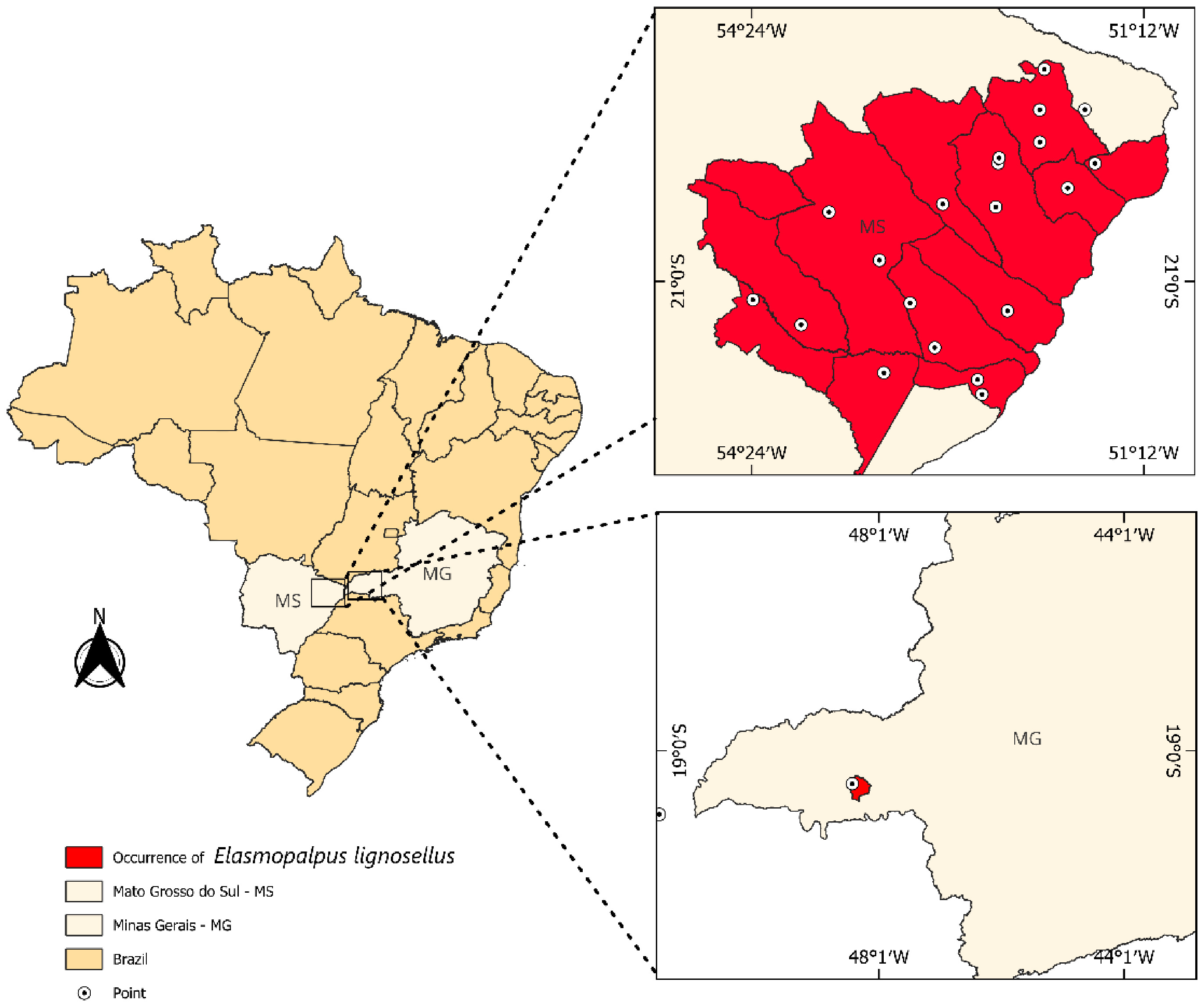
This study reports an occurrence of E. lignosellus damaging Eucalyptus saplings in Brazil. In December 2023, phytossanitary teams from silviculture companies operating in the region detected significant mortality in Eucalyptus hybrids (E. urophylla x E. grandis) establishment areas in 15 localities across 14 municipalities in Mato Grosso do Sul (MS) and Minas Gerais (MG) states (Figure 1; Table 1).

Occurrence areas of Elasmopalpus lignosellus (Zeller, 1848) in planted Eucalyptus forests observed between December 2023 and February 2025 in Mato Grosso do Sul (MS) and Minas Gerais (MG) states, Brazil.
Geographic coordinates (latitude and longitude) of municipalities with occurrence records of Elasmopalpus lignosellus in Eucalyptus spp. (E. grandis × E. urophylla) plantations in Brazil between December 2023 and February 2025.
Field inspections revealed symptoms in early seedlings of the Eucalyptus urophylla × E. grandis hybrid, predominantly within the first 50 days after planting, consistent with stem boring. A total of 50 insects (larvae and adults) were collected and brought to the Laboratory of Biological Control of Forest Pests at School of Agricultural Sciences (FCA)/ São Paulo State University (Unesp) for identification.
The adults were identified as Elasmopalpus lignosellus based on morphological attributes compared with specimens in the entomological collection of the Plant Protection Department at UNESP/FCA, Botucatu, São Paulo State University. Voucher specimens were deposited under registration number LEP-22-612.
Additionally, ten larvae with adequate preservation were subjected to DNA extraction using 80 μL of 10% Chelex 100® solution and 8 μL of proteinase K. PCR amplifications used universal Lepidoptera primers (LEPF1/LEPR1 or LEPF1/LEPR2), following Hebert et al. (2004). These primers amplify a fragment of the mitochondrial cytochrome c oxidase subunit I (COI) gene, the standard DNA barcode region for Lepidoptera. PCR products were purified with magnetic beads, quantified with a NanoDrop spectrophotometer, and sequenced via the Sanger method (ABI 3500, Applied Biosystems) at the Biotechnology Institute (IBTEC/UNESP). The resulting sequences were analyzed using BLASTn and subsequently deposited in GenBank under accession number PX530030. The specimens displayed 99.26% similarity to Elasmopalpus lignosellus sequences available in GenBank, confirming their identity. The sequenced fragment corresponded to approximately 658 bp of the standard COI barcode region (e-value = 0.0; query coverage = 99%; no gaps detected). All ten sequences were aligned using MUSCLE (Edgar, 2004) and showed no intraspecific variation (100% identical across specimens).
This finding represents, to our knowledge, the first record of the species damaging Eucalyptus seedlings in Brazil. Although traditionally associated with agricultural crops, the detection of E. lignosellus in forest environments is here treated as an association and occurrence of damage. Confirmation of E. lignosellus as a true host of Eucalyptus would require evidence of complete biological cycle completion (pupation and adult emergence) on this host, which warrants future investigation. Nevertheless, the finding highlights the ecological plasticity of this species.
The outbreak reached roughly 20,000 hectares in 14 municipalities of both states an estimate based on mapped plantation areas where mortality symptoms associated with E. lignosellus infestation were confirmed by field technicians during the monitoring period, from December 2023 to February 2025 (Figure 1). Environmental conditions typical of newly established Eucalyptus plantations as exposed soil, susceptible plant phenology, low surface moisture, and elevated temperature may resemble those observed in susceptible agricultural crops, facilitating larval establishment (Sandhu et al., 2013; Guo et al., 2020; Skendžić et al., 2021; Santos et al., 2023). Most affected areas corresponded to plantations established over degraded pastures or adjacent to agricultural crops, where residents E. lignosellus populations were likely already present in the soil prior to planting. This land-use transition is consistent with the "green bridge" hypothesis.
The damage observed in Eucalyptus plantations (Figure 2) consisted of larvae boring into the root collar slightly below the soil surface, producing transverse galleries that injured the stem and caused wilting, tipping, and seedling death. In some plants, stems were completely severed, and larvae were also observed feeding on leaves touching the soil surface. In the most severely affected plantation sites, mortality reached up to 40%, frequently with several damaged plants occurring in sequence along planting rows.

(a) Typical symptoms of Elasmopalpus lignosellus (Lepidoptera: Pyralidae) attack on Eucalyptus sp. sapling, showing damage and silk-soil tube at the root collar. Photographs taken in Mato Grosso do Sul, Brazil, in 2023; (b) General view of a Eucalyptus sp. plantation area displaying sapling failures caused by E. lignosellus; (c) Close-up of larva and silk-soil tube at the root collar of a Eucalyptus sapling; (d) Dead sapling with complete wilting caused by E. lignosellus larval feeding at the root collar; (e) Internal cross-section of the stem showing larval galleries and frass; (f) External perforations and resinous exudate on the stem surface characteristic of E. lignosellus infestation.
Similar injury patterns have been reported for E. lignosellus in agricultural crops such as maize and sugarcane, where larvae initially feed on leaves and subsequently bore into stems, damaging meristematic tissues and disrupting sap flow (Viana et al., 2000; Viana, 2004, 2007, 2011). Injuries in Eucalyptus plantations were also observed predominantly during the first 50 days after planting, before stem lignification, which is consistent with reports from agricultural systems.
This new host record raises concerns for the forestry sector. The finding demonstrates the pest’s expanding host range and emphasizes the need for targeted monitoring in forest systems. Integrated pest management strategies and enhanced phytosanitary surveillance are essential to mitigate potential impacts on Brazilian silviculture.
Acknowledgements
To the Coordenação de Aperfeiçoamento de Pessoal de Nível Superior (CAPES – Finance Code 001), and Programa Cooperativo sobre Proteção Florestal (PROTEF) do Instituto de Pesquisas e Estudos Florestais (IPEF) for their financial support.
Data Availability Statement
The datasets generated and analyzed during the current study are available from the corresponding author upon reasonable request.
References
-
BRAGARD, C., DEHNEN-SCHMUTZ, K., DI SERIO, F., GONTHIER, P., JACQUES, M., MIRET, J., JUSTESEN, A., MAGNUSSON, C., MILONAS, P., NAVAS-CORTÉS, J., PARNELL, S., POTTING, R., REIGNAULT, P., THULKE, H., VAN DER WERF, W., CIVERA, A., YUEN, J., ZAPPALÀ, L., MALUMPHY, C., CZWIENCZEK, E., KERTÉSZ, V., MAIORANO, A. and MACLEOD, A., 2021. Pest categorisation of Elasmopalpus lignosellus. EFSA Journal, vol. 19, no. 6, pp. e06663. https://doi.org/10.2903/j.efsa.2021.6663 PMid:34194573.
» https://doi.org/10.2903/j.efsa.2021.6663 -
EDGAR, R.C., 2004. MUSCLE: multiple sequence alignment with high accuracy and high throughput. Nucleic Acids Research, vol. 32, no. 5, pp. 1792-1797. https://doi.org/10.1093/nar/gkh340 PMid:15034147.
» https://doi.org/10.1093/nar/gkh340 -
FUNDERBURK, J.E., HERZOG, D.C., MACK, T.P. and LYNCH, R.E., 1985. Sampling Lesser Cornstalk Borer (Lepidoptera: Pyralidae) adults in several crops with reference to adult dispersion patterns. Environmental Entomology, vol. 14, no. 4, pp. 452-458. https://doi.org/10.1093/ee/14.4.452
» https://doi.org/10.1093/ee/14.4.452 -
GUO, J., FU, X., ZHAO, S., SHEN, X., WYCKHUYS, K. and WU, K., 2020. Long-term shifts in abundance of migratory crop-feeding and beneficial insect species in northeastern Asia. Journal of Pest Science, vol. 93, no. 2, pp. 583-594. https://doi.org/10.1007/s10340-019-01191-9
» https://doi.org/10.1007/s10340-019-01191-9 -
GUO, Q., FEI, S., POTTER, K.M., LIEBHOLD, A.M. and WEN, J., 2019. Tree diversity regulates forest pest invasion. Proceedings of the National Academy of Sciences of the United States of America, vol. 116, no. 15, pp. 7382-7386. https://doi.org/10.1073/pnas.1821039116 PMid:30910953.
» https://doi.org/10.1073/pnas.1821039116 -
HEBERT, P.D.N., BURNS, J.M., JANZEN, D.H. and HALLWACHS, W., 2004. Ten species in one: DNA barcoding reveals cryptic species in the neotropical skipper butterfly Astraptes fulgerator. Proceedings of the National Academy of Sciences of the United States of America, vol. 101, no. 41, pp. 14812-14817. https://doi.org/10.1073/pnas.0406166101 PMid:15465915.
» https://doi.org/10.1073/pnas.0406166101 -
INDÚSTRIA BRASILEIRA DE ÁRVORES – IBÁ, 2025 [viewed 12 February 2025]. Relatório anual 2025 [online]. Available from: https://iba.org/?publications=relatorio-anual-2025
» https://iba.org/?publications=relatorio-anual-2025 -
JACTEL, H., MOREIRA, X. and CASTAGNEYROL, B., 2021. Tree diversity and forest resistance to insect pests: patterns, mechanisms, and prospects. Annual Review of Entomology, vol. 66, no. 1, pp. 277-296. https://doi.org/10.1146/annurev-ento-041720-075234 PMid:32903046.
» https://doi.org/10.1146/annurev-ento-041720-075234 -
LEMES, A., FIGUEIREDO, C., SEBASTIÃO, I., DA SILVA, L., DA COSTA ALVES, R., DE SIQUEIRA, H., LEMOS, M., FERNANDES, O. and DESIDÉRIO, J., 2017. Cry1Ac and Vip3Aa proteins from Bacillus thuringiensis targeting Cry toxin resistance in Diatraea flavipennella and Elasmopalpus lignosellus from sugarcane. PeerJ, vol. 5, pp. e2866. https://doi.org/10.7717/peerj.2866 PMid:28123906.
» https://doi.org/10.7717/peerj.2866 -
MACK, T. and BACKMAN, C., 1987. Density of the Lesser Cornstalk Borer, Elasmopalpus lignosellus (Zeller) in peanut fields: endemic and outbreak population configurations. Peanut Science, vol. 14, no. 2, pp. 61-66. https://doi.org/10.3146/i0095-3679-14-2-3
» https://doi.org/10.3146/i0095-3679-14-2-3 -
RAND, T., TYLIANAKIS, J. and TSCHARNTKE, T., 2006. Spillover edge effects: the dispersal of agriculturally subsidized insect natural enemies into adjacent natural habitats. Ecology Letters, vol. 9, no. 5, pp. 603-614. https://doi.org/10.1111/j.1461-0248.2006.00911.x PMid:16643305.
» https://doi.org/10.1111/j.1461-0248.2006.00911.x -
SANDHU, H., NUESSLY, G., WEBB, S., CHERRY, R. and GILBERT, R., 2013. Temperature-dependent reproductive and life table parameters of Elasmopalpus lignosellus (Lepidoptera: Pyralidae) on sugarcane. The Florida Entomologist, vol. 96, no. 2, pp. 380-390. https://doi.org/10.1653/024.096.0258
» https://doi.org/10.1653/024.096.0258 -
SANTOS, A., SANTOS, I. and PAULA-MORAES, S., 2023. Flight phenology of Elasmopalpus lignosellus (Lepidoptera: Pyralidae) in the Northwest Florida Panhandle. Insects, vol. 14, no. 4, pp. 354. https://doi.org/10.3390/insects14040354 PMid:37103169.
» https://doi.org/10.3390/insects14040354 -
SKENDŽIĆ, S., ZOVKO, M., ŽIVKOVIĆ, I., LEŠIĆ, V. and LEMIĆ, D., 2021. The impact of climate change on agricultural insect pests. Insects, vol. 12, no. 5, pp. 440. https://doi.org/10.3390/insects12050440 PMid:34066138.
» https://doi.org/10.3390/insects12050440 - VIANA, P.A., 2004. Lagarta-elasmo. In: J.R. SALVADORI, C.J. ÁVILA and M.T.B. SILVA, eds. Pragas de solo no Brasil Passo Fundo: Embrapa Trigo; Dourados: Embrapa Agropecuária Oeste; Cruz Alta: Fundacep Fecotrigo, pp. 379-408.
- VIANA, P.A., 2007. Manejo da lagarta elasmo em grandes culturas: gargalos da pesquisa. In: Anais da 10ª Reunião Sul-brasileira sobre Pragas de Solo, 2007, Dourados. Dourados: Embrapa Agropecuária Oeste, pp. 67-72.
- VIANA, P.A., 2011. Principais pragas subterrâneas do milho no Brasil Sete Lagoas: Embrapa Milho e Sorgo, 63 p. Série Documentos, no. 129.
- VIANA, P.A., CRUZ, I. and WAQUIL, J.M., 2000. Danos da lagarta-elasmo à cultura do milho e medidas para o seu controle Sete Lagoas: Embrapa Milho e Sorgo, 3 p. Comunicado Técnico, no. 20.
Edited by
-
Editor:
Takako Matsumura Tundisi