 First characterisation of benthic macroinvertebrate communities in the upper and middle reaches of the Loa River, northern Chile
Abstract
The Loa River is the longest river in Chile and flows through the Atacama Desert, one of the driest environments on Earth. Despite its ecological importance, knowledge of its benthic macroinvertebrate fauna remains limited. This study provides the first characterisation of benthic macroinvertebrate communities inhabiting the upper and middle reaches of the Loa River and its principal tributaries. Seven sampling sites, including four along the main river channel and three tributaries, were surveyed between April and June 2005. Community structure was evaluated using total abundance, taxonomic richness and the Margalef, Pielou, Brillouin, Fisher, Shannon and Simpson diversity indices. Spatial patterns were assessed using univariate statistical analyses, Bray–Curtis similarity and ANOSIM. A total of 50 taxa belonging to four phyla were recorded. Arthropods dominated the assemblages, particularly Trichoptera, Coleoptera and Diptera, which together accounted for more than 90% of the total abundance. Diptera exhibited the highest taxonomic richness, with 22 taxa, including 11 taxa of Chironomidae. The highest diversity was recorded at the Yanquilcha site, whereas San Pedro River and Loa before Chiu-Chiu supported the greatest macroinvertebrate abundances. Multivariate analyses revealed a clear spatial pattern associated with changes in community composition along the river system. These findings provide the first comprehensive baseline description of benthic macroinvertebrate communities in the upper and middle Loa River and highlight the influence of environmental gradients on community structure in one of the world's most arid river systems.
Keywords:
Atacama Desert; benthic macroinvertebrates; community structure; Loa river; river ecology
Resumo
O rio Loa é o mais extenso do Chile e percorre o deserto do Atacama, um dos ambientes mais áridos do planeta. Apesar de sua importância ecológica, o conhecimento sobre sua fauna de macroinvertebrados bentônicos ainda é limitado. Este estudo apresenta a primeira caracterização das comunidades de macroinvertebrados bentônicos que habitam os trechos superior e médio do rio Loa e seus principais afluentes. Sete locais de amostragem, incluindo quatro ao longo do canal principal do rio e três afluentes, foram investigados entre abril e junho de 2005. A estrutura da comunidade foi avaliada utilizando-se abundância total, riqueza taxonômica e os índices de diversidade de Margalef, Pielou, Brillouin, Fisher, Shannon e Simpson. Os padrões espaciais foram avaliados por meio de análises estatísticas univariadas, similaridade de Bray–Curtis e ANOSIM. Foram registrados 50 táxons pertencentes a quatro filos. Os artrópodes dominaram as comunidades, especialmente Trichoptera, Coleoptera e Diptera, que juntos responderam por mais de 90% da abundância total. Diptera exibiu a maior riqueza taxonômica, com 22 táxons, incluindo 11 táxons de Chironomidae. A maior diversidade foi registrada em Yanquilcha, enquanto o rio San Pedro e o trecho do rio Loa antes de Chiu-Chiu apresentaram as maiores abundâncias de macroinvertebrados. As análises multivariadas revelaram um padrão espacial claro, associado a mudanças na composição da comunidade ao longo do sistema fluvial. Os resultados fornecem a primeira descrição de linha de base abrangente das comunidades de macroinvertebrados bentônicos nos trechos superior e médio do rio Loa e constituem uma importante linha de base para futuras pesquisas ecológicas em um dos sistemas fluviais mais áridos do mundo.
Palavras-chave:
Deserto do Atacama; macroinvertebrados bentônicos; estrutura da comunidade; rio Loa; ecologia de rios
1. Introduction
The Loa River is the longest river in Chile, extending for approximately 440 km across the Antofagasta Region in the Atacama Desert, one of the most arid environments on Earth (De los Ríos-Escalante and Woelfl, 2023; De los Ríos-Escalante et al., 2023; Ruffino et al., 2022). Its hydrological and chemical characteristics vary markedly along the river course. The upper reach receives water from the San Pedro River, whereas the middle reach is influenced by the Salado River and, further downstream, by the San Salvador River. Among these tributaries, the Salado River is particularly important because its brackish waters contribute to increasing salinity in the main channel. Salinity values may reach approximately 5 g L−1 in the middle reaches and increase further downstream as a consequence of high evaporation and very low precipitation (De los Ríos et al., 2010; De los Ríos-Escalante et al., 2023; Ruffino et al., 2022).
Benthic macroinvertebrates are key components of river ecosystems because they contribute to organic-matter processing, nutrient cycling and aquatic food webs (Figueroa and De los Rios-Escalante, 2022, 2023). Their relatively limited mobility and differential sensitivity to environmental conditions also make them useful indicators of ecological variation among sites (Figueroa and De los Rios-Escalante, 2022). In arid river systems, macroinvertebrate communities may be strongly influenced by hydrological instability, elevated conductivity, salinity, nutrient availability and the intermittent contribution of tributaries (De los Ríos et al., 2010; De los Ríos-Escalante et al., 2023). These environmental filters can affect taxonomic composition, abundance and diversity, particularly where water availability is highly variable and evaporation is intense.
Knowledge of the aquatic fauna of the Loa River remains limited, partly because of the geographical isolation and environmental harshness of the basin (Silva et al., 1985; De los Ríos-Escalante et al., 2023). Early studies documented introduced rainbow trout in the upper reaches (Silva et al., 1985), whereas native silversides and the northern Chilean river prawn have been reported from lower sections of the river (De los Ríos-Escalante & Mardones, 2013). Previous investigations of benthic invertebrates have focused mainly on crustaceans and have reported amphipods, littoral ostracods and cladocerans along different sections of the basin (De los Ríos et al., 2010; De los Ríos-Escalante et al., 2023). These studies suggest that crustacean richness decreases towards the lower reaches, where salinity is higher (De los Ríos et al., 2010). However, a broader quantitative characterisation of the benthic macroinvertebrate community in the upper and middle reaches of the Loa River is still lacking.
This study aimed to provide the first quantitative characterisation of benthic macroinvertebrate communities in the upper and middle reaches of the Loa River basin. Specifically, we assessed spatial variation in taxonomic composition, abundance and diversity across sites located in the main river channel and selected tributaries. Given the marked environmental heterogeneity of the basin, particularly the variation in conductivity and tributary influence, we expected benthic macroinvertebrate assemblages to differ among sampling sites.
2. Materials and Methods
Study site: The Loa River is located in northern Chile (Antofagasta Region) and extends for approximately 440 km from its headwaters in the Andean Altiplano to its mouth in the Pacific Ocean. The river drains one of the driest regions in the world and exhibits pronounced longitudinal variation in hydrology and water chemistry, largely influenced by tributary inputs and intense evaporation. The present study focused on the upper and middle reaches of the basin. Seven sampling sites were selected, including four located along the main channel of the Loa River and three situated in its principal tributaries (Figure 1; Table 1). These sites were chosen to represent the main environmental gradient within the study area, encompassing differences in altitude, water chemistry and tributary influence (De los Rios et al., 2010). Field sampling was conducted between April and June 2005. Three replicate Surber samples were collected at each site, samples were collected from shallow riffle habitats with coarse gravel and cobble substrates. Sites were selected to represent the environmental gradient of the upper and middle Loa River.
Environmental variables: At each sampling site, water temperature (°C), pH, electrical conductivity (µS cm−1), dissolved oxygen (mg L−1), water hardness, alkalinity, nitrate, nitrite, ammonium and orthophosphate concentrations were measured following standard limnological procedures (APHA, 2005; Baird et al., 2017). In addition, channel width, water depth and current velocity were recorded to characterise local habitat conditions.
Macroinvertebrate sampling: Benthic macroinvertebrates were collected using a Surber sampler covering an area of 0.09 m2 with a mesh size of 250 µm (Hauer and Lamberti, 2017). Samples were preserved in 70% ethanol and transported to the laboratory for sorting and taxonomic identification. Organisms were identified to the lowest possible taxonomic level using specialised taxonomic keys (Fernandez and Dominguez, 2001; González, 2003; Dominguez and Fernandez 2009).
Community analysis: Community structure was characterised using: total abundance, taxonomic richness, Margalef richness index, Pielou's evenness, Brillouin diversity, Fisher's alpha, Shannon diversity, Simpson diversity. Relative abundances were calculated for the dominant taxonomic groups (Magurran and McGill, 2011).
Statistical analysis: Prior to statistical analyses, data were examined for normality and homogeneity of variances. As these assumptions were not satisfied, differences among sampling sites were evaluated using the non-parametric Kruskal–Wallis test, followed by Tukey-type non-parametric multiple comparisons to identify significant pairwise differences (Zar, 2014). These analyses were performed using Statgraphics Plus 5.1. Spatial variation in community composition was assessed using Bray–Curtis similarity, followed by an Analysis of Similarities (ANOSIM) to evaluate differences among sampling sites. Both analyses were conducted using PRIMER version 5.2 (Clarke, 1993; Clarke and Gorley, 2006). Community diversity was characterised using taxonomic richness together with the Margalef (d), Pielou's evenness (J′), Brillouin (HB), Fisher's alpha, Shannon (H′) and Simpson (1 − λ) diversity indices (Magurran and McGill, 2011). These indices were calculated in PRIMER version 5.2 following the procedures described by Clarke (1993) and Clarke and Gorley (2006). Statistical significance was accepted at P < 0.05.

3. Results
Environmental characteristics: Environmental conditions varied markedly among sampling sites (Table 2). Water temperature ranged from 8.8 to 17.8 °C, whereas pH remained circumneutral to slightly alkaline across the basin. Electrical conductivity showed the greatest spatial variation, increasing from 343 μS cm−1 at LE-1 to 8442 μS cm−1 at LD-5, reflecting the pronounced chemical gradient along the river system. Dissolved oxygen concentrations remained relatively high at all sites, while nutrient concentrations were generally low. Water hardness and alkalinity also increased downstream, particularly at sites influenced by tributary inflows. Significant differences among sampling sites were detected for most environmental variables (P < 0.05), indicating substantial spatial heterogeneity within the upper and middle reaches of the Loa River.
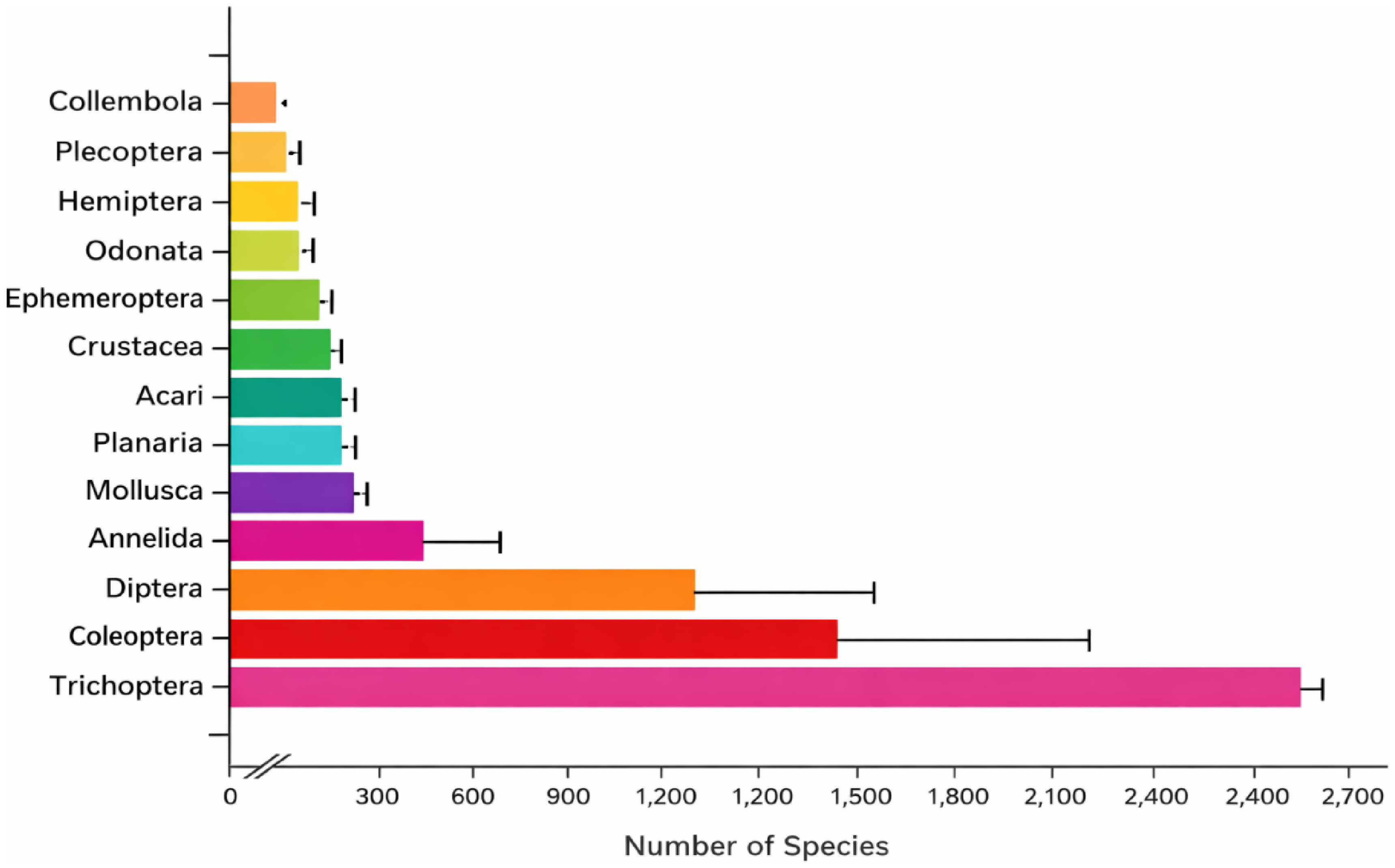
Taxonomic composition: A total of 50 taxa belonging to four phyla were recorded during the study (Table 3; Figure 2). Arthropoda was the dominant phylum, comprising 39 taxa (78%), followed by Mollusca (4 taxa), Annelida (4 taxa) and Platyhelminthes (3 taxa). Within Arthropoda, Diptera was the most diverse order, represented by 22 taxa, including eleven chironomid taxa. Trichoptera, Coleoptera and Ephemeroptera were also well represented throughout the study area. Taxonomic composition varied among sampling sites, with several taxa being restricted to particular tributaries or sections of the main river channel.

Macroinvertebrate abundance differed considerably among sampling sites (Table 4; Figures 3 and 4). The highest abundances were recorded at San Pedro River (SP-2) and Loa River before Chiu-Chiu (LA-3), whereas substantially lower abundances were observed at the remaining sites. Three insect orders dominated the assemblages throughout the basin. Trichoptera, Coleoptera and Diptera together accounted for more than 90% of the total abundance. Particularly high densities of Mastigoptila sp. were recorded at San Pedro River, whereas Austrelmis sp. predominated at Loa River before Chiu-Chiu. Chironomidae represented the most diverse dipteran group. Overall, macroinvertebrate assemblages were characterised by a small number of numerically dominant taxa together with a relatively large number of low-abundance taxa.
Diversity: Community diversity varied substantially among sampling sites (Table 5). The highest taxonomic richness was recorded at Yanquilcha (YA-6), where 34 taxa were identified. This site also presented the highest values of the Margalef and Shannon diversity indices, indicating a relatively diverse and well-balanced assemblage. Conversely, San Pedro River exhibited comparatively low diversity despite supporting one of the highest macroinvertebrate abundances, reflecting the marked numerical dominance of a few taxa. Evenness showed a similar pattern, with the lowest values occurring at sites dominated by single taxa. Overall, diversity indices consistently indicated pronounced spatial variation in community structure throughout the basin.
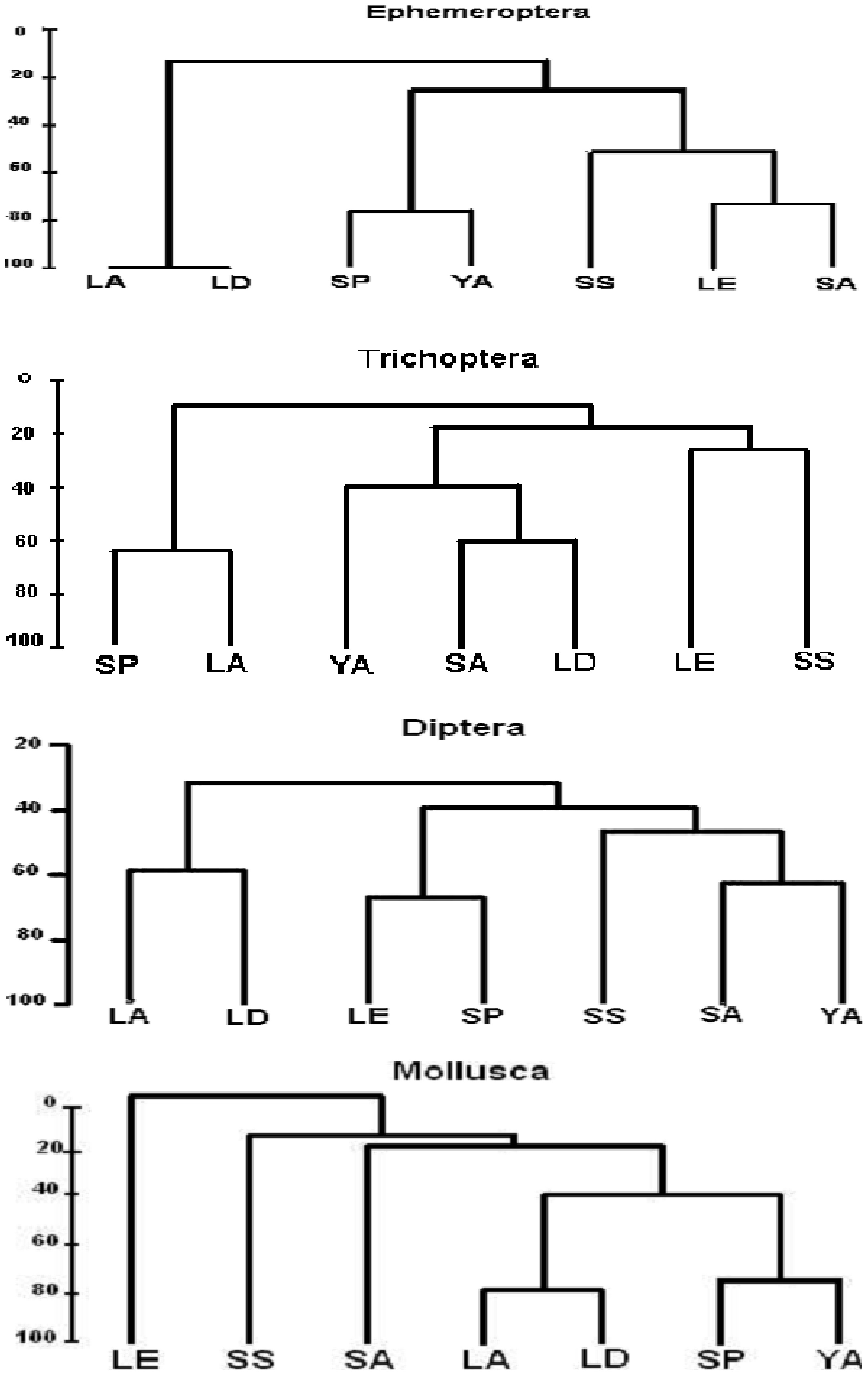
Community similarities: Cluster analysis based on Bray–Curtis similarity revealed clear spatial differences in community composition among sampling sites (Figure 5). Sites sharing similar environmental characteristics tended to group together, whereas sites influenced by distinct tributaries formed separate clusters. Analysis of Similarities (ANOSIM) confirmed that macroinvertebrate assemblages differed significantly among sampling sites (P < 0.01), demonstrating that community composition changed markedly along the upper and middle reaches of the Loa River. The clustering of dominant taxa further reflected differences in habitat conditions and species dominance among sites.
Abundances of taxa (average + standard deviation in ind/m2) reported for studied sites on Loa river.

In (A) mean values and confidence intervals of the evaluated metric across sampling sites; (B) mean abundance (ind m−2) of benthic macroinvertebrates across sampling sites. Error bars represent standard deviation. In A) Site SS-7 was not included in the analysis because it has one observation.

Abundance of the main orders (mean and standard deviation) for studie sites, results of Kruskall-Wallis analysis (P values lower than 0.05 denotes significant differences). , the horizonal lines indicate that these sites have not significant differences (P > 0.05). Site SS-7 was not included in the analysis because it has one observation.

Bray-Curtis cluster analysis for species composition and population abundances of the main abundant groups for studied sites.
4. Discussion
The present study provides the first quantitative characterisation of benthic macroinvertebrate communities inhabiting the upper and middle reaches of the Loa River basin, one of the least studied river systems in northern Chile. A total of 50 taxa were recorded, with aquatic insects dominating the assemblages, particularly Trichoptera, Coleoptera and Diptera. The marked spatial variation in taxonomic composition, abundance and diversity indicates substantial environmental heterogeneity throughout the study area. These findings expand current knowledge of freshwater biodiversity in the Atacama Desert and provide an important ecological baseline for future monitoring of the Loa River.
Although the survey did not encompass the middle–lower and lower reaches of the river, the results suggest a longitudinal change in benthic community structure across the section examined. Comparable spatial gradients have been reported in Mediterranean and northern Patagonian rivers of Chile (Figueroa and De los Ríos-Escalante, 2022, 2023; Solís-Lufí et al., 2022), as well as in Patagonian river systems of Argentina (Miserendino et al., 2018; Epele et al., 2019; Molineri et al., 2020; Pessacq et al., 2020). However, information on benthic macroinvertebrate assemblages from arid rivers in northern Chile remains extremely limited. Previous investigations in the Loa River have mainly described crustacean taxa, including the amphipods Hyalella fossamancinii and H. kochi in the upper basin (De los Ríos et al., 2010; De los Ríos-Escalante et al., 2023). The present results therefore extend previous taxonomic records by providing a broader community-level assessment of benthic fauna.
The pronounced aridity of the basin, together with intense evaporation and very low precipitation, is likely to contribute to the downstream increase in dissolved salts and to the environmental differences observed among sites. Previous studies have suggested that salinity is an important regulatory factor for crustacean communities in the Loa River (De los Ríos et al., 2010; De los Ríos-Escalante et al., 2023). In particular, the Salado River introduces brackish water into the main channel and may therefore alter the physicochemical conditions experienced by aquatic organisms. Although the present analyses did not directly quantify the individual contribution of each environmental variable to community composition, the observed differences among sites are consistent with the potential influence of salinity, conductivity and tributary inputs.
The longitudinal variation detected in the Loa River is also comparable with patterns reported from arid and semi-arid rivers in Algeria, particularly in transitional regions between desert environments and Mediterranean landscapes. Studies conducted in these systems have highlighted the importance of salinity, nutrients and hydrological variability in structuring benthic macroinvertebrate assemblages (Baaloudj et al., 2021, 2024; Khelifa et al., 2021; Rouibi et al., 2021; Chaib et al., 2023; Gharbi et al., 2024). These comparisons suggest that benthic communities in geographically distant arid rivers may respond to similar environmental filters. In the Loa River, however, the interaction between extreme evaporation, low precipitation and the input of brackish tributaries creates a particularly complex environmental setting.
The predominance of Trichoptera, Coleoptera and Diptera indicates that aquatic insects form the principal component of the benthic assemblages in the upper and middle Loa River. Differences among sites were strongly influenced by the numerical dominance of particular taxa. For example, the high abundance of Mastigoptila sp. at the San Pedro River was associated with low evenness and diversity despite relatively high taxonomic richness. In contrast, Yanquilcha exhibited the highest taxonomic richness and comparatively high diversity, suggesting a more even distribution of individuals among taxa. These results demonstrate that abundance and diversity may follow contrasting patterns when communities are dominated by a small number of highly abundant taxa.
Fish predation may represent an additional factor affecting benthic community composition. Studies conducted in Patagonian rivers have shown that macroinvertebrates constitute an important food resource for native and introduced fishes (Encina et al., 2017; Vega et al., 2020; Barile et al., 2021). Previous observations from the Loa River have documented native and introduced fish species along different sections of the basin (De los Ríos et al., 2010; De los Ríos-Escalante and Mardones, 2013; De los Ríos-Escalante et al., 2023). Introduced rainbow and brown trout occur in the upper reaches, native silversides inhabit middle and lower sections and introduced mosquitofish have been reported from downstream areas. These fishes may exert different predation pressures on benthic invertebrates. Nevertheless, fish abundance, diet and trophic interactions were not assessed in the present study, and their influence should therefore be regarded as a hypothesis requiring further investigation.
The composition of the benthic fauna may also be interpreted from a biogeographical perspective. The assemblages include both endemic and more widely distributed taxa. Aquatic insects may have greater dispersal capacity because their winged adult stages can move between water bodies and colonise geographically separated habitats, whereas freshwater crustaceans generally have more restricted active dispersal abilities (Oyanedel et al., 2008; Moya et al., 2009). Such differences in dispersal capacity may contribute to the contrasting spatial distributions observed among taxonomic groups, although the present study did not directly evaluate dispersal processes.
Future changes in precipitation and hydrological conditions may also modify the structure of aquatic communities in the Loa River. Variability between dry and wet periods, together with climate-related changes in water availability and groundwater recharge, may affect river discharge, salinity and habitat connectivity in northern Chile (Blin et al., 2022; Valdivieso et al., 2022). Consequently, benthic macroinvertebrate assemblages may exhibit substantial temporal as well as spatial variation. Repeated seasonal and long-term sampling would therefore be necessary to determine whether the patterns documented here remain stable under changing hydrological conditions.
Several limitations should be acknowledged. Sampling was conducted between April and June 2005 and did not include the lower reaches of the Loa River. The study consequently provides a spatial characterisation of the upper and middle basin rather than a complete assessment of the entire river or its temporal variability. In addition, the available analyses do not allow causal relationships to be established between individual environmental variables and community structure. Despite these limitations, the dataset represents a valuable historical baseline and the first broad quantitative description of benthic macroinvertebrates from this section of the basin.
In conclusion, the upper and middle reaches of the Loa River support a taxonomically diverse but spatially heterogeneous benthic macroinvertebrate fauna. Community composition appears to vary along the river in association with marked differences in water chemistry, tributary influence and local dominance patterns. The brackish contribution of the Salado River, together with intense evaporation and limited precipitation, may be particularly relevant to the longitudinal environmental gradient. Further studies incorporating seasonal sampling, the lower river reaches, fish communities and direct modelling of environmental variables will be necessary to clarify the mechanisms structuring these assemblages. Nevertheless, the present study provides an essential foundation for future research and biomonitoring of Andean desert rivers in northern Chile.
Acknowledgements
This research was funded by Projects MECESUP UCT 0804, MECESUP ANT 003, Anillos ATE220060, Agricultural and Poultry Service (SAG-Chile), National Forestry Corporation (CONAF-Chile), Environmental Studies Centre (CREA-Universidad de Antofagasta). Also, the authors express their gratitude to Maritza Mercado (RIP) who collaborate in confirm the taxonomic identification of studied material, and to M.I., and S.M.A., for their valuable comments for improve the manuscript.
Data Availability Statement
Research data is available in the body of the article.
References
- AMERICAN PUBLIC HEALTH ASSOCIATION – APHA, 2005. Standard Methods for the Examination of Water and Wastewater 23rd ed. Washington: APHA.
-
BAALOUDJ, A., DE LOS RIOS-ESCALANTE, P. and ESSE, C., 2024. Benthic community ecology for Algerian river Seybouse. Brazilian Journal of Biology, vol. 84, pp. e251566. https://doi.org/10.1590/1519-6984.251566 PMid:35019090.
» https://doi.org/10.1590/1519-6984.251566 -
BAALOUDJ, A., SAMIA, O., KERFOUF, A., BOURIACH, M., ALIHUSSEIN, A., HAMMANA, C. and N’DIAYE, D., 2021. Use of macro invertebrates to assess the quality of Seybouse River (North-East of Algeria). Ukrainian Journal of Ecology, vol. 10, no. 4, pp. 60-66. https://doi.org/10.15421/2020_168
» https://doi.org/10.15421/2020_168 - BAIRD, R.B., EATON, A.D. and RICE, E.W., 2017. Standard methods for the examination of water and wastewater 23rd ed. Washington: American Public Health Association.
-
BARILE, J., VEGA, R. and DE LOS RÍOS-ESCALANTE, P., 2021. First reports of the role of benthic macroinvertebrates as preys for native fish in Tolten river (38º S, Araucania region, Chile. Brazilian Journal of Biology, vol. 81, no. 3, pp. 845-853. https://doi.org/10.1590/1519-6984.232661 PMid:32965340.
» https://doi.org/10.1590/1519-6984.232661 -
BLIN, N., LERAY, S., LOWRY, C. and SUAREZ, F., 2022. Potential impacts of climate change on an aquifer in the arid Altiplano, northern Chile: the case of the protected wetlands of the Salar del Huasco basin. Journal of Hydrology. Regional Studies, vol. 39, pp. 100996. https://doi.org/10.1016/j.ejrh.2022.100996
» https://doi.org/10.1016/j.ejrh.2022.100996 -
CLARKE, K.R., 1993. Non-parametric multivariate analyses of changes in community structure. Australian Journal of Ecology, vol. 18, no. 1, pp. 117-143. https://doi.org/10.1111/j.1442-9993.1993.tb00438.x
» https://doi.org/10.1111/j.1442-9993.1993.tb00438.x - CLARKE, K.R. and GORLEY, R.N., 2006. PRIMER v6: User Manual/Tutorial Plymouth: PRIMER-E.
-
CHAIB, S., BAALOUDJ, A., DE LOS RIOS-ESCALANTE, P.R., ESSE, C., GHARBI, M. and HUHAMDI, M., 2023. Ecological structure of aquatic macroinvertebrate communities in the Hauts Plateaux of Northeast Algeria. Brazilian Journal of Biology, vol. 83, pp. e273010. https://doi.org/10.1590/1519-6984.273010 PMid:37585930.
» https://doi.org/10.1590/1519-6984.273010 -
DE LOS RÍOS, P., ADAMOWICZ, S. and WITT, J., 2010. Aquatic fauna in the driest desert on earth: first report on the crustacean fauna of the Loa River (Atacama Desert, Antofagasta Region, Chile). Crustaceana, vol. 83, no. 3, pp. 257-266. https://doi.org/10.1163/001121609X12596543952333
» https://doi.org/10.1163/001121609X12596543952333 -
DE LOS RÍOS-ESCALANTE, P. and MARDONES, A., 2013. Ecology of the malacostracans of northern Chilean inland waters. Crustaceana, vol. 86, no. 12, pp. 1511-1519. https://doi.org/10.1163/15685403-00003261
» https://doi.org/10.1163/15685403-00003261 -
DE LOS RIOS-ESCALANTE, P.R. and WOELFL, S., 2023. A review of zooplankton research in Chile. Limnologica, vol. 100, pp. 1206079. https://doi.org/10.1016/j.limno.2023.126079
» https://doi.org/10.1016/j.limno.2023.126079 -
DE LOS RIOS-ESCALANTE, P.R., WILSON, R., NORAMBUENA, J. and ESSE, C., 2023. First description of invertebrate benthic fauna in middle zone of the Loa river (Chile). Zoodiversity, vol. 57, no. 2, pp. 143-150. https://doi.org/10.15407/zoo2023.02.143
» https://doi.org/10.15407/zoo2023.02.143 - DOMÍNGUEZ, E. and FERNANDEZ, H.R., 2009. Macroinvertebrados bentónicos sudamericanos: sistemática y biología Tucumán, Argentina: Fundación Miguel Lillo.
-
ENCINA, F., VEGA, R., LARA, G. and DE LOS RÍOS-ESCALANTE, P., 2017. Ecological role of benthic crustaceans in Chilean North Patagonian lakes and rivers (Araucania region, 39° S). Crustaceana, vol. 90, no. 4, pp. 437-447. https://doi.org/10.1163/15685403-00003643
» https://doi.org/10.1163/15685403-00003643 -
EPELE, L.B., BRAND, C. and MISERENDINO, M.L., 2019. Ecological drivers of alpha and beta diversity of freshwater invertebrates in arid and semiarid Patagonia (Argentina). The Science of the Total Environment, vol. 678, pp. 62-73. https://doi.org/10.1016/j.scitotenv.2019.04.392 PMid:31075604.
» https://doi.org/10.1016/j.scitotenv.2019.04.392 - FERNÁNDEZ, H.R. and DOMÍNGUEZ, E., 2001. Guía para la determinación de los artrópodos bentónicos sudamericanos San Miguel de Tucumán, Argentina: Editorial Universitaria de Tucumán, Fundación Miguel Lillo.
-
FIGUEROA, D. and DE LOS RÍOS-ESCALANTE, P., 2022. Macrozoobenthos in an altitudinal gradient in North Patagonian Cautín River (Araucanía Region, Chile). Brazilian Journal of Biology, vol. 82, pp. e240484. https://doi.org/10.1590/1519-6984.240484 PMid:34105648.
» https://doi.org/10.1590/1519-6984.240484 - FIGUEROA, D. and DE LOS RÍOS-ESCALANTE, P., 2023. Null models for explaining macroinvertebrates communities in Northern Patagonian Cautin river (39° S, Araucania region, Chile). Spixiana, vol. 45, no. 2, pp. 169-176.
-
GHARBI, M., ZIANE, N., BAALOUDJ, A., DE LOS RÍOS-ESCALANTE, P., ESSE, C., CHAIB, S. and HOUHAMDI, M., 2024. Distribution of benthic macroinvertebrate communities in different kind of inland water bodies in northeastern Algeria. Brazilian Journal of Biology, vol. 84, pp. e273662. https://doi.org/10.1590/1519-6984.273662 PMid:38536974.
» https://doi.org/10.1590/1519-6984.273662 -
GONZÁLEZ, E., 2003. Los anfípodos de agua dulce del género Hyalella Smith, 1874 en Chile (Crustacea: amphipoda). Revista Chilena de Historia Natural, vol. 76, no. 4, pp. 623-637. https://doi.org/10.4067/S0716-078X2003000400007
» https://doi.org/10.4067/S0716-078X2003000400007 - HAUER, F.R. and LAMBERTI, G.A., 2017. Methods in stream ecology Amsterdam: Elsevier.
-
KHELIFA, R., MAHDJOUB, H., BAALOUDJ, A., CANNINGS, R. and SAMWAYS, M., 2021. Remarkable population resilience in a North African endemic damselfly in the face of rapid agricultural transformation. Insects, vol. 12, no. 4, pp. 353. https://doi.org/10.3390/insects12040353 PMid:33920977.
» https://doi.org/10.3390/insects12040353 - MAGURRAN, A.E. and MCGILL, B.J., 2011. Biological diversity, frontiers in measurement and assessment Oxford: Oxford University Press.
-
MISERENDINO, M.L., BRAND, C., EPELE, L.B., DI PRINZIO, C.Y., OMAD, G.H., ARCHANGELSKY, M., MARTÍNEZ, O. and KUTSCHKER, A.M., 2018. Biotic diversity of benthic macroinvertebrates at contrasting glacier-fed systems in Patagonia Mountains: the role of environmental heterogeneity facing global warming. The Science of the Total Environment, vol. 622-623, pp. 152-163. https://doi.org/10.1016/j.scitotenv.2017.11.320 PMid:29212052.
» https://doi.org/10.1016/j.scitotenv.2017.11.320 -
MOLINERI, C., NIETO, C., DOS SANTOS, D.A., EMMERICH, D., ZUÑIGA, M.C., FIERRO, P., PESSACQ, P., GOMEZ, D., MARQUEZ, J.A., PRINCIPE, R.E., VALDOVINOS, C. and DOMINGUEZ, E., 2020. Do mayflies (Ephemeroptera) support a biogeographic transition zone in South America? Journal of Biogeography, vol. 47, no. 9, pp. 1980-1993. https://doi.org/10.1111/jbi.13868
» https://doi.org/10.1111/jbi.13868 -
MOYA, C., VALDOVINOS, C., MORAGA, A., ROMERO, F., DEBELS, P. and OYANEDEL, A., 2009. Patrones de distribución espacial de ensambles de macroinvertebrados bentónicos de un sistema fluvial Andino Patagónico. Revista Chilena de Historia Natural, vol. 82, no. 3, pp. 425-442. https://doi.org/10.4067/S0716-078X2009000300009
» https://doi.org/10.4067/S0716-078X2009000300009 -
OYANEDEL, A., VALDOVINOS, C., AZOCAR, M., MOYA, C., MANCILLA, G., PEDREROS, P. and FIGUEROA, R., 2008. Patrones de distribución espacial de los macroinvertebrados bentónicos de la cuenca del río Aysén (Patagonia Chilena). Gayana, vol. 72, no. 2, pp. 241-257. https://doi.org/10.4067/S0717-65382008000200011
» https://doi.org/10.4067/S0717-65382008000200011 -
PESSACQ, P., DUARTE, T. and EPELE, L.B., 2020. A first cladistic analysis of Antarctoperlinae (Plecoptera: Gripopterygidae) and a new micropterous species from Patagonia. Zoological Journal of the Linnean Society, vol. 190, no. 3, pp. 771-787. https://doi.org/10.1093/zoolinnean/zlaa077
» https://doi.org/10.1093/zoolinnean/zlaa077 - ROUIBI, A., BAALOUDJ, A., FAYÇAL, C., KERFOUF, A., RAFIK, B. and CHAIB, S., 2021. Characterization and diversity of macroinvertebrates of the Bouhamdane stream (northeast of Algeria). Acta Zoologica Lituanica, vol. 31, no. 1, pp. 45-52. http://doi.org/10.35513/2165.
-
RUFFINO, B., CAMPO, G., CRUTCHIK, D., REYES, A. and ZANETTI, M., 2022. Drinking water supply in the Region of Antofagasta (Chile): A challenge between past, present and future. International Journal of Environmental Research and Public Health, vol. 19, no. 21, pp. 14406. https://doi.org/10.3390/ijerph192114406 PMid:36361296.
» https://doi.org/10.3390/ijerph192114406 - SILVA, A., FRANCO, L. and ITURRA, N., 1985. Antecedentes sobre la reproducción y alimentación de la trucha arco iris Salmo gairdneri del Embalse Conchi, Antofagasta, Chile. Biologia Pesquera, vol. 14, pp. 32-39.
-
SOLIS-LUFI, K., SUAZO, M.J., AVILA-SALEM, M.E., MALDONADO-MURÚA, C., APONTE, H., FARIAS, J. and DE LOS RÍOS-ESCALANTE, P., 2022. Community structure of benthic invertebrates in the Allipén river basin, North Patagonia, Araucania region (39° S, Chile). Brazilian Journal of Biology, vol. 82, pp. e232825. https://doi.org/10.1590/1519-6984.232805 PMid:33787712.
» https://doi.org/10.1590/1519-6984.232805 -
VALDIVIESO, S., VÁZQUEZ-SUÑÉ, E., HERRERA, C. and CUSTODIO, E., 2022. Characterization of precipitation and recharge in the peripheral aquifer of the Salar de Atacama. The Science of the Total Environment, vol. 806, no. Pt 1, pp. 150271. https://doi.org/10.1016/j.scitotenv.2021.150271 PMid:34560455.
» https://doi.org/10.1016/j.scitotenv.2021.150271 -
VEGA, R., DE LOS RIOS-ESCALANTE, P., ENCINA, F., NORAMBUENA, J.A., BARILE, J. and MARDONES, A., 2020. First report of inventory and role of macroinvertebrate and fish in Cautin river (38º S, Araucania region, Chile). Brazilian Journal of Biology, vol. 80, no. 1, pp. 215-228. https://doi.org/10.1590/1519-6984.203511 PMid:31066767.
» https://doi.org/10.1590/1519-6984.203511 - ZAR, J.H., 2014. Biostatiscal analysis New York: Pearson.
Edited by
-
Editor:
Takako Matsumura Tundisi