 Effect of two co-microencapsulation methods on the viability of the Lactobacillus plantarum ATCC 14917 and the release and bioaccessibility of iron
Abstract
Co-microencapsulation is an innovative approach for delivering two or more bioactive components to their site of action. This study aimed to evaluate the effect of two co-microencapsulation methods on the viability of the Lactobacillus plantarum ATCC 14917 during storage (24 °C and 4 °C) and under simulated gastrointestinal conditions, focusing on the release and the bioaccessibility of iron in vitro. Co-microencapsulation of L. plantarum and iron was performed using extrusion and spray-drying, using alginate (2%), chitosan (1%), and maltodextrin (0% and 5%) as wall materials. The microcapsules were characterized in terms of probiotic encapsulation yield, iron encapsulation efficiency, morphology (by scanning electron microscopy), and functional groups (by Fourier transform infrared spectroscopy). Both encapsulation methods exhibited high encapsulation yield values (87.43% – 98.90%). However, the spray-drying method with 5% maltodextrin leads to a higher survival rate at 4 °C, with a viability loss rate of -0.010 day-1. This negative value indicates an increase in the probiotic viability due to the use of maltodextrin as an energy source. Similarly, this treatment resulted in bacterial growth of 0.12 log CFU/g under intestinal conditions and the lowest viability reduction of 0.32 log CFU/g under gastric conditions. Maltodextrin enhanced probiotic viability both during storage and under simulated gastrointestinal conditions. Furthermore, the spray-drying method also promoted greater and faster iron release under gastric (85% – 98%) and intestinal (51.67%) conditions, as well as higher iron bioaccessibility (74.13%). These findings suggest that co-microencapsulation of L. plantarum and iron via spray-drying with maltodextrin has significant potential for the development of functional foods containing viable probiotic bacteria while ensuring the timely release of iron with superior bioaccessibility, thereby offering health benefits.
Keywords:
Microencapsulation; Maltodextrin; Probiotic viability; Extrusion; Spray-drying; Gastrointestinal simulation
HIGHLIGHTS
Spray-drying with maltodextrin improved probiotic viability during storage and digestion
Iron release and bioaccessibility were higher with spray-drying, enhancing nutrient availability
Spray-drying is an appropriate method for the co-microencapsulation of L. plantarum and iron
1 Introduction
Iron deficiency is the leading cause of anemia, affecting approximately 33% of the world's population, with children and women being the most vulnerable (World Health Organization, 2020). In foods, iron is found either as heme, with 15 to 20% of it being absorbed by the organism, and non-heme, with a less than 5% absorption (Barragán-Ibañez et al., 2016). Historically, foods fortified with iron salts have been used to counteract the poor bioavailability of iron. Although soluble iron salts are its most used form, they are highly reactive, rapidly oxidize, and cause organoleptic changes in foods (Baldelli et al., 2023; Blanco-Rojo & Vaquero, 2019). Furthermore, other food components, such as phytates, tannins, phosphates, phenolic compounds, soy proteins, and calcium tend to reduce this micronutrient absorption (Barragán-Ibañez et al., 2016; Dasa & Abera, 2018). Conversely, ascorbic acid, meat, and some organic acids improve iron absorption (Blanco-Rojo & Vaquero, 2019; Dasa & Abera, 2018).
Unabsorbed iron can cause an imbalance in the intestinal microbiota (dysbiosis) because pathogenic bacteria can use it in their metabolism, which can cause diarrhea (Ippolito et al., 2022). Therefore, it is important to administer iron with probiotics to prevent dysbiosis. Moreover, there is scientific evidence that consuming probiotics combined with iron increases the absorption of this micronutrient. For example, the Lactobacillus casei improved iron bioaccessibility by 11% under in vitro conditions (Genevois et al., 2017). Similarly, the consumption of Lactobacillus plantarum 299v mixed with iron in a juice improved this micronutrient absorption by 50% (Hoppe et al., 2015). It has also been reported that the Lactobacillus fermentum synthesizes the p-hydroxyphenyllactic acid (HPLA) and that the L. plantarum 299v stimulates the synthesis of duodenal cytochrome b (DCYTB) in the gut; both processes are found to reduce the Fe3+ to Fe2+, making it more absorbable (González et al., 2017; Sandberg et al., 2018). Nevertheless, iron can produce undesired organoleptic changes in the food that people often dislike. Furthermore, probiotic viability decreases under food processing, storage, and gastrointestinal conditions. Hence the importance of co-microencapsulating iron and probiotics together, to maintain its high bioaccessibility and viability.
Microencapsulation is an effective technique for preventing iron from interacting with other components of the food matrix, making it more bioaccessible (Bryszewska, 2019; Bryszewska et al., 2019). In other words, this technology preserves the viability of probiotics during the processing and storage processes, as well as under gastrointestinal conditions (Razavi et al., 2021; Vivek et al., 2023). The microencapsulation of two or more active components is called co-microencapsulation and can have different release times, acting synergistically at the site of action (Liu et al., 2022; Niño-Vásquez et al., 2022).
The individual microencapsulation of iron and probiotics has been widely researched; however, there are very few studies on the microencapsulation of probiotics combined with iron. Different methods are used for the microencapsulation of iron and probiotics, including extrusion (ion gelation), spray-drying, emulsion, lyophilization, coacervation, liposome formation, and solvent evaporation (Dehnad et al., 2024; Liu et al., 2022; Vivek et al., 2023). The extrusion-based method involves dripping a mixture of the wall material along with the active component into a gelling solution, such as CaCl2 (Niño-Vásquez et al., 2022). This method has been used to microencapsulate iron (Churio et al., 2018; Valenzuela et al., 2014; Wardhani et al., 2021a; Wardhani et al., 2019) and different probiotic strains, such as the Lactobacillus acidophilus, Lactobacillus plantarum and Lactobacillus casei (Afzaal et al., 2020; Lee et al., 2019; Mahmoud et al., 2020; Praepanitchai et al., 2019; Rather et al., 2017; Ta et al., 2021; Wu & Zhang, 2018).
The spray-drying method consists of removing the moisture content at temperatures above 100 °C, obtaining a dry powder with a controlled shape and size (Niño-Vásquez et al., 2022). This approach is ideal for iron microencapsulation, using the appropriate inlet temperature of 130 °C (Dehnad et al., 2024). By applying this method, Fe and Zn can be co-microencapsulated as well as the isolated Fe (Churio & Valenzuela, 2018; Kaul et al., 2022; Pratap Singh et al., 2018; Pratap-Singh & Leiva, 2021; Wardhani et al., 2020; Wardhani et al., 2021b). Similarly, this technique has been used to microencapsulate specific probiotics, namely Lactobacillus plantarum, Lactobacillus casei, Lactobacillus paracasei and Lactobacillus acidophilus, resulting in probiotics with a higher viability during storage and under simulated gastrointestinal conditions, when compared to free cells (Costa et al., 2023; Gul, 2017; Gul et al., 2019; Guo et al., 2022; Mohapatra & Sahu, 2021; Rajam & Anandharamakrishnan, 2014; Tang et al., 2020; Tao et al., 2019).
Co-microencapsulation has the potential to protect probiotics from adverse conditions while facilitating a controlled iron release with a high bioaccessibility, thereby delivering two active components concurrently at the sites of action. Whereas other techniques only deliver one active component or two components without any synergetic effect. With this in mind, the present study aimed to evaluate the effect of two co-microencapsulation methods on the viability of the L. plantarum ATCC 14917 under storage and simulated gastrointestinal conditions, as well as on the release and bioaccessibility of the iron in vitro.
2 Material and methods
2.1 Probiotic culture
The probiotic strain, L. plantarum ATCC 14917 (Microbiologics, USA), was grown in Man, Rogosa, and Sharpe broth (MRS, HiMedia, India) at 37 °C for 24 h with constant stirring at 150 rpm to a DO600 nm of 2.6. The probiotics were collected by centrifugation at 3,500 g for 10 min and washed twice with sterile distilled water. Finally, the biomass was resuspended in 1 g/L peptone water (HiMedia, India) for processing samples M1 and M3, or in 50 g/L maltodextrin for samples M2 and M4, up to a concentration of 1010 CFU/mL.
2.2 Preparation of the polymers
Sodium alginate (2% w/v; Nutragreenlife Biotechnology Co. Ltd., China) and maltodextrin (MD) were dissolved in distilled water with constant stirring until a homogeneous solution was obtained. Chitosan (1% w/v; Qingdao Nineteen Forty Nine Industry and Trade Co. Ltd., China) was dissolved in a 4% (w/v) citric acid solution (HiMedia, India). Subsequently, these solutions were separately sterilized in tubes at 121 °C for 15 min. The alginate has gelling properties and electrostatic interaction with the chitosan that improves the structure of the microcapsules, while the maltodextrin is a good source of energy and acts as a cryoprotectant for active agents.
2.3 Co-microencapsulation by extrusion and spray-drying methods
The different encapsulation materials (alginate, chitosan, maltodextrin) were co-formed by either extrusion or spray-drying. Extrusion-based microencapsulation was performed according to the procedure described by Pupa et al. (2021) and Padhmavathi et al. (2021), with some modifications. A solution of alginate, chitosan and ferrous sulfate (5% v/v, 100 mg/L) was mixed under constant agitation at a high revolution rate. The probiotic was then added to the polymer mixture at a 1:2 ratio. The Vibro Viscometer SV-10 was applied to measure the viscosity (mPa.s) of the homogeneous mixtures at room temperature. The homogeneous mixtures were manually added dropwise through a 10 mL syringe into 50 mL of CaCl2 (0.1 M) (Spectrum Chemical, USA). After 30 min, the microcapsules were harvested and washed twice with sterile distilled water, being stored in polypropylene tubes with screw caps. Spray-drying microencapsulation was performed with a laboratory spray-dryer (Toption Tp-s15, China) at an inlet temperature of 130 °C and an outlet temperature of 45 ± 2 °C. The feed flow was measured at 5%, and the drying airflow was 100%, with a 0.25 mm atomizing nozzle. Dry-powder samples were collected from the cyclone chamber and stored in polypropylene tubes with screw caps.
The effects of these co-microencapsulation methods were calculated according to the encapsulation yield of the probiotic bacteria and the encapsulation efficiency of iron, as shown in Table 1.
Effects of the L. plantarum and iron co-microencapsulation methods on the encapsulation yield (EY) of probiotic bacteria as well as on the encapsulation efficiency (EE) of iron.
2.4 Encapsulation yield of the probiotics
The microcapsules extracted (1 g) were then dissolved in 9 mL of sterile 1% (w/v) trisodium citrate dihydrate (Loba Chemie, India) and vortexed into a homogeneous solution (Mahmoud et al., 2020). The final amount of 0.1 g of the powder obtained via spray-drying was dissolved in 9.9 mL of peptone water. The seeding was done by spreading on MRS agar, being subsequently incubated at 37 °C for 48 h. Petri dishes with 20 to 350 colonies were considered in the viable cell count, being expressed as CFU/g (Gul, 2017; Rajam & Anandharamakrishnan, 2014). Seeding of the feed solution was performed to quantify the probiotic concentration before microencapsulation. The probiotic EY was calculated using the following Equation 1:
where N0 is the number of bacteria before microencapsulation (CFU/mL), and N is the number of bacteria after microencapsulation (CFU/g).
2.5 Iron encapsulation efficiency
2.5.1 Extrusion-based encapsulation efficiency of iron
The EE of iron was determined according to the method described by Wardhani et al. (2021a), with a few modifications. Ten milliliters of the aqueous CaCl2 solution described in section 2.3 was used to determine the amount of unencapsulated Fe2+. The feed solution (1 mL) was dissolved in 25 mL of trisodium citrate dihydrate (1% w/v) and centrifuged at 3,500 g for 15 min, after which 10 mL of the supernatant was collected to quantify the iron in the mixture. These aqueous solutions were mixed with 0.5 mL of hydroxylamine hydrochloride (0.3 M), 2.5 mL of sodium acetate (1.0 M), and 2.5 mL of 1,10-phenanthroline (0.25% w/v), being completed to 25 mL with deionized water. After 10 min, the absorbance was measured at 510 nm using a UV-Vis spectrophotometer (Persee T7S). The iron EE was calculated using the Equation 2:
Where Fe2+mixture is the initial concentration (mg/kg) and Fe2+CaCl2 is the amount of non-microencapsulated Fe2+ (mg/kg).
2.5.2 Spray-drying encapsulation efficiency of iron
The EE of iron in the dry powder was determined according to the method used by Pratap Singh et al. (2018) as well as Pratap-Singh & Leiva (2021), with some modifications. The dry powder (50 mg) was dissolved in 20 mL of deionized water and, after 30 min, it was filtered through a Whatman No. 4 paper (Whatman International Ltd., England), representing the fraction of non-encapsulated iron. Another 50 mg of the sample was dissolved in 20 mL of deionized water to assess the total iron concentration. Both solutions were then centrifuged at 3,500 g for 15 min, and 10 mL of the supernatant was collected to quantify the released and total iron amount using a UV-Vis spectrometer, as described in Section 2.5.1. The iron EE was calculated using the Equation 3:
Where Fe2+total is the total concentration of iron in microcapsules (mg/kg) and Fe2+Released pH 7.0 is the concentration of iron released from the microcapsules (mg/kg).
2.6 Morphology and FTIR analysis
The morphology of the L. plantarum ATCC 14917 and the iron microcapsules were observed through the scanning electron microscope (SEM, FEI INSPECT S50) of the Specialized Equipment Laboratory (Faculty of Biological Sciences, UNMSM, Peru). The microcapsules were fixed in carbon fibers on metal stubs and metalized with gold. The metalized samples were examined at an electrical energy intensity of 5 – 12.5 kV and with a 100 to 10,000 × magnification. The functional groups were determined using Fourier transform infrared spectroscopy (FTIR, Thermo Scientific Nicolet iS10).
2.7 Survival of the L. plantarum ATCC 14917 in storage conditions
The survival rate of both free and microencapsulated L. plantarum ATCC 14917 was evaluated under room temperature (24 ± 2 °C) and refrigeration (4 ± 2 °C) for 4 weeks. The viability of the bacteria was determined according to the plate count on MRS agar every seven days. The log-plot of the relative cell viability (Log Nt/N0) versus the storage time was fitted to a first-order reaction kinetics model according to Equation 4 (Rajam & Anandharamakrishnan, 2014).
where Nt is the number of viable cells in each storage period (CFU/g), N0 is the number of viable cells at the start of storage (CFU/g), t is the storage time (days), and KT is the specific rate of viability loss at 24 °C and 4 °C per day (day-1).
2.8 Survival of the L. plantarum ATCC 14917 in simulated gastric and intestinal conditions
The tolerance of both free and microencapsulated L. plantarum ATCC 14917 to gastric conditions was evaluated as described by Afzaal et al. (2020) and Gul (2017). Gastric juice was prepared by adding pepsin (3 g/L, Sigma-Aldrich, USA) to a NaCl solution (2 g/L), and the pH was adjusted to 2.0 with HCl 0.1 N. Subsequently, 1 mL of free cells, 1 g of beads and 0.1 g dry powder were added to a 9 mL, a 9 mL and a 9.9 mL of gastric fluid, respectively, being incubated at 37 °C for 2 h in constant agitation at 110 rpm. CFU/g was determined at the different time intervals of 0, 30, 60, 90, and 120 min. Using the obtained data, the reduction in the probiotic viability was calculated as the difference between the initial and final concentrations.
The tolerance of free and microencapsulated L. plantarum ATCC 14917 to intestinal conditions was evaluated following the method described by Afzaal et al. (2020). The intestinal fluid was prepared with bile salts (3 g/L, HiMedia, India) and pancreatin (10 g/L, Sigma-Aldrich, USA), which were dissolved in a phosphate buffer (pH 8.0), and the pH was adjusted to 7.5 using NaOH (0.1 N). A volume of 1 mL of free cells, 1 g of beads, and 0.1 g of dry powder were added to 9 mL, 9 mL, and 9.9 mL of intestinal fluid, respectively, being incubated at 37 °C in constant agitation at 110 rpm. CFU/g was determined at the time intervals of 0, 30, 60, 90, and 120 min. Using the obtained data, the reduction in the probiotic viability was calculated using the difference between the initial and final concentrations.
2.9 Iron release profile in simulated gastric and intestinal conditions
The iron release profile was evaluated in two stages, simulating the pH and enzymatic activity of the stomach as well as of the small intestine (duodenum and jejunum). This assessment was conducted by the method used by Pratap-Singh & Leiva (2021), with some modifications. The gastric fluid was prepared by mixing NaCl (2 g/L) and pepsin (1 g/L) in deionized water; the pH was adjusted to 2.0 using HCl 1.0 N; after which the fluid was set aside for 2 h at 37 °C before the evaluation was performed. The intestinal fluid was prepared by combining CaCl2 (0.2 g/L) and pancreatin (3 g/L) with deionized water. The solution was then adjusted to a pH of 6.6 with the addition of NaOH 0.1 N, being set aside for 2 h at 37 °C before being used.
The tests regarding both gastric and intestinal conditions were conducted separately, with 2 g of the beads and 100 mg of the dry powder added to a plastic tea micromesh, then immersed in 100 mL of each prepared fluid for 2 h at 37 °C in constant agitation at 80 rpm. Sampling was performed at the following time points: 15, 30, 60, 90 and 120 min. The obtained samples were then centrifuged at 3,500 g for 15 min, and the supernatant was recovered to quantify the iron content released by atomic absorption spectroscopy (AAS, AA7000, SHIMADZU).
2.10 Bioaccessibility of iron
The determination of iron in its assimilable form after going through the gastrointestinal tract was performed based on the method described by Bryszewska (2019), with a few modifications. Microcapsules were incorporated to 30 mL of a HCl pH 2.0 solution, with the gastric digestion beginning after the addition of 3 mL of pepsin solution (4 g/L), being incubated in a water bath at 37 °C and stirred for 2 h. To simulate the intestinal conditions, the solution acidity was adjusted to a pH of 6.8 – 7.0 with a NaHCO3 solution. Three milliliters of a mixture of pancreatin (0.5 g/L) and bile salt (3 g/L) solution was then added. The samples were subsequently incubated at 37 °C for a further 2 h. Finally, the samples were centrifuged at 3,500 g for 15 min, and the supernatant was collected to determine the soluble iron content by AAS. Bioaccessibility was calculated using the Equation 5 (Pynaert et al., 2006).
2.11 Statistical analysis
All experimental results were indicated as the mean ± standard deviation. Significant differences between the data were evaluated using the analysis of variance (ANOVA) and multiple comparisons with the Tukey test at a 95% confidence level (p < 0.05), using the Minitab 20 software.
3 Results and discussion
3.1 Encapsulation yield of the L. plantarum ATCC 14917
The EY values of the L. plantarum ATCC 14917 are listed in Table 1, showing the significant differences (p < 0.05) among treatments. The highest probiotic EY value was obtained in samples M2 (98.90%) and M1 (97.73%). Upon the addition of MD, the EY of the probiotics increased. This may be explained by the fact that MD increases the medium's viscosity (386 mPa.s without MD, 718 mPa.s with MD) and acts as a filler (Pandey et al., 2023). Similar results (98.1% – 99.7%) were reported by Mahmoud et al. (2020) and Lee et al. (2019). After spray-drying, the EY values were assessed as 87.43% (M3) and 89.59% (M4), because the spray-drying method generates cell damage due to the high temperatures of the process, which causes the loss of bound water on the cell surface and, consequently, an increase in the cell membrane porosity; the resulting cytoplasmic leakage of the cells leads to the death of the microorganism (Huang et al., 2017; Šipailienė & Petraityte, 2017). This is consistent with the results reported by Arepally & Goswami (2019), who obtained a low EY for the L. acidophilus NCDC 016 (65.00% – 89.15%), further observing that by increasing the inlet temperature (130 °C – 150 °C) the EY tended to decrease.
Both the spray-drying and the extrusion-based methods have advantages and disadvantages. The highest probiotic EY (p < 0.05) was obtained using the extrusion method, likely because the process is carried out at low temperatures (Pupa et al., 2021), avoiding cell damage. However, one disadvantage of extrusion is that this technique results in microcapsules that present a higher moisture content, which reduces their shelf life, whereas spray-drying creates a more stable and scalable product (Niño-Vásquez et al., 2022). These advantages and disadvantages need to be considered when choosing the preferred method for microencapsulation.
3.2 Iron encapsulation efficiency
The highest EE of iron was obtained in samples M2 (82.34%) and M1 (74.07%), which were extrusion-based (Table 1), where the addition of MD increased the EE. Similar results were reported by Churio et al. (2018) and Valenzuela et al. (2014), with values ranging between 57.6% and 78.5%, respectively. This high EE occurs because Ca2+ displaces Na+, forming alginate beads and trapping iron (Wardhani et al., 2021a). In addition, the negative charge of the sodium alginate leads to the formation of a ferrous complex, in which Fe2+ is chelated with carboxylate and hydroxyl groups (Katuwavila et al., 2016). Moreover, the higher the proportion of guluronic acid in alginate, the greater the Fe+2 entrapment due to its affinity (Perez-Moral et al., 2013).
Notably, the M3 and M4 samples that were obtained by spray-drying account for only 47.33% and 32.13% of EE, respectively, which may be explained by the low drying temperature used in the process (130 °C). This result differs from what has been reported by previous studies that found higher EE values, such as in the works of Pratap Singh et al. (2018), Pratap-Singh & Leiva (2021) as well as Wardhani et al. (2021b). The higher the drying temperature, the higher the EE of iron, given the rapid evaporation of water (Kaul et al., 2022; Wardhani et al., 2020). Nevertheless, the level of probiotic EY is reduced as a consequence of cell damage (Arepally & Goswami, 2019). Therefore, the drying temperature must be optimized to obtain a high EY as well as a high EE of probiotics and iron, respectively. The large difference in the EE of iron between the two microencapsulation methods can be explained by the fact that the calculations were performed differently for the two methods, thus limiting the comparison of the results.
3.3 Morphology and FTIR analysis
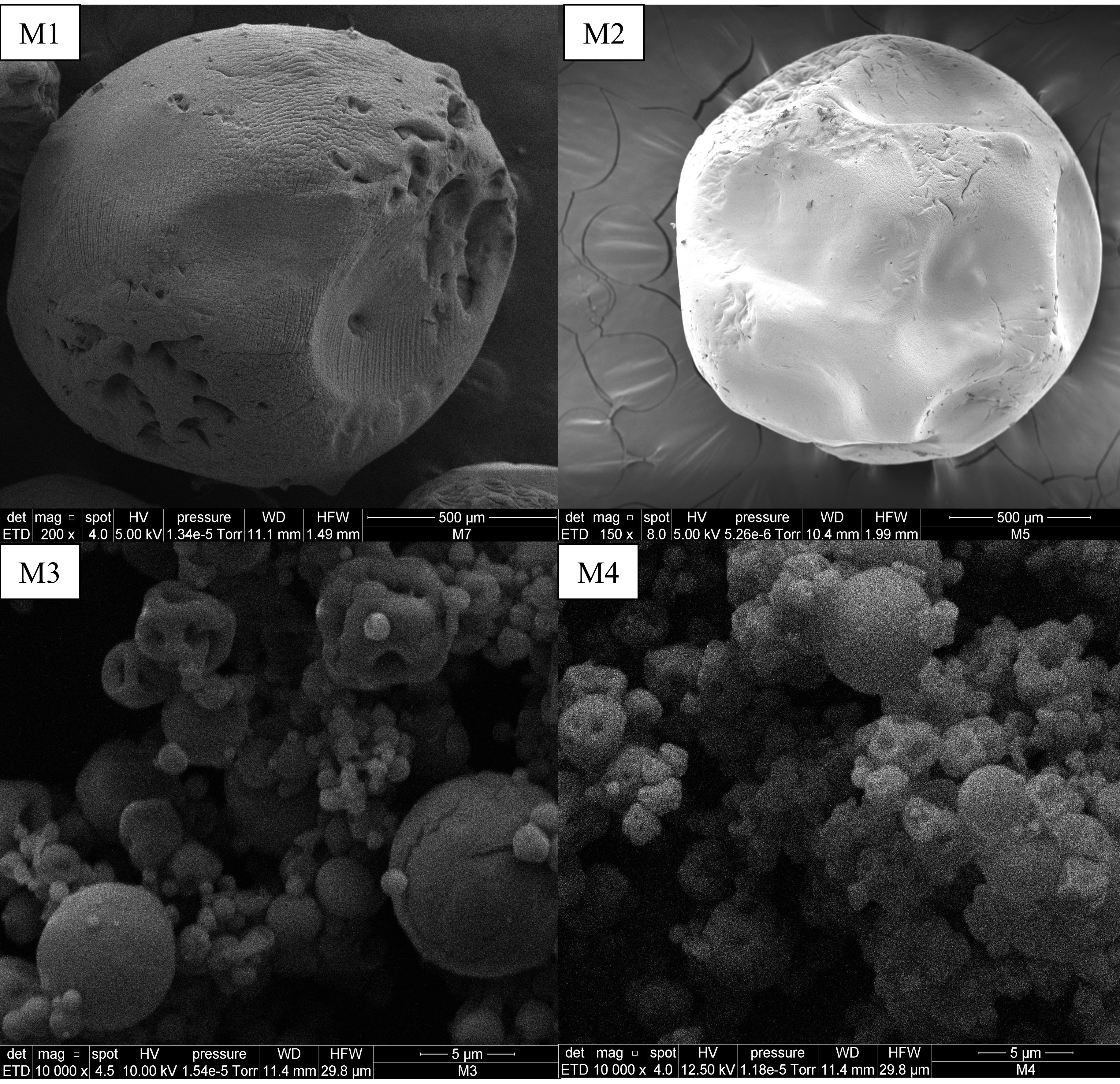
The SEM micrographs of the microcapsules obtained by the extrusion and spray-drying methods containing the L. plantarum ATCC 14917 and iron are shown in Figure 1. The extrusion-based microcapsules (M1 and M2) had a spherical shape with a partially smooth and compact surface, with the presence of concavities due to the evaporation of water in the drying process by critical point before being observed in the SEM. This concavity was most noticeable in the M2 sample, which contained the MD. It was found that compact, nonporous microcapsules provide good protection for probiotics as they pass through the gastrointestinal tract under processing conditions (Rather et al., 2017).
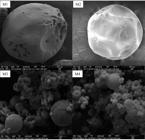
SEM images of the L. plantarum ATCC 14917 and iron microcapsules obtained by extrusion (M1 and M2, mag 200× and 150×, respectively) and spray-drying (M3 and M4, mag 10,000×). M1 and M3: alginate, chitosan, L. plantarum and iron; M2 and M4: alginate, chitosan, MD, L. plantarum and iron.
The M3 and M4 samples obtained by spray-drying presented spherical shapes, variable sizes, smooth surfaces, and some concavities; however, the M3 material showed fissures or cracks in the larger particles. The presence of concavities is a result of the rapid drying process, during which moisture is lost (Guo et al., 2022). On the other hand, at low temperatures, deformed and contracted particles are obtained due to the slow diffusion of water (Barajas-Álvarez et al., 2022). Seamless microcapsules have a strong structure that reduces gas permeability and increases probiotic protection (Rajam & Anandharamakrishnan, 2014), and the absence of free bacteria on the surface indicates a good microencapsulation of probiotics (Tao et al., 2019).
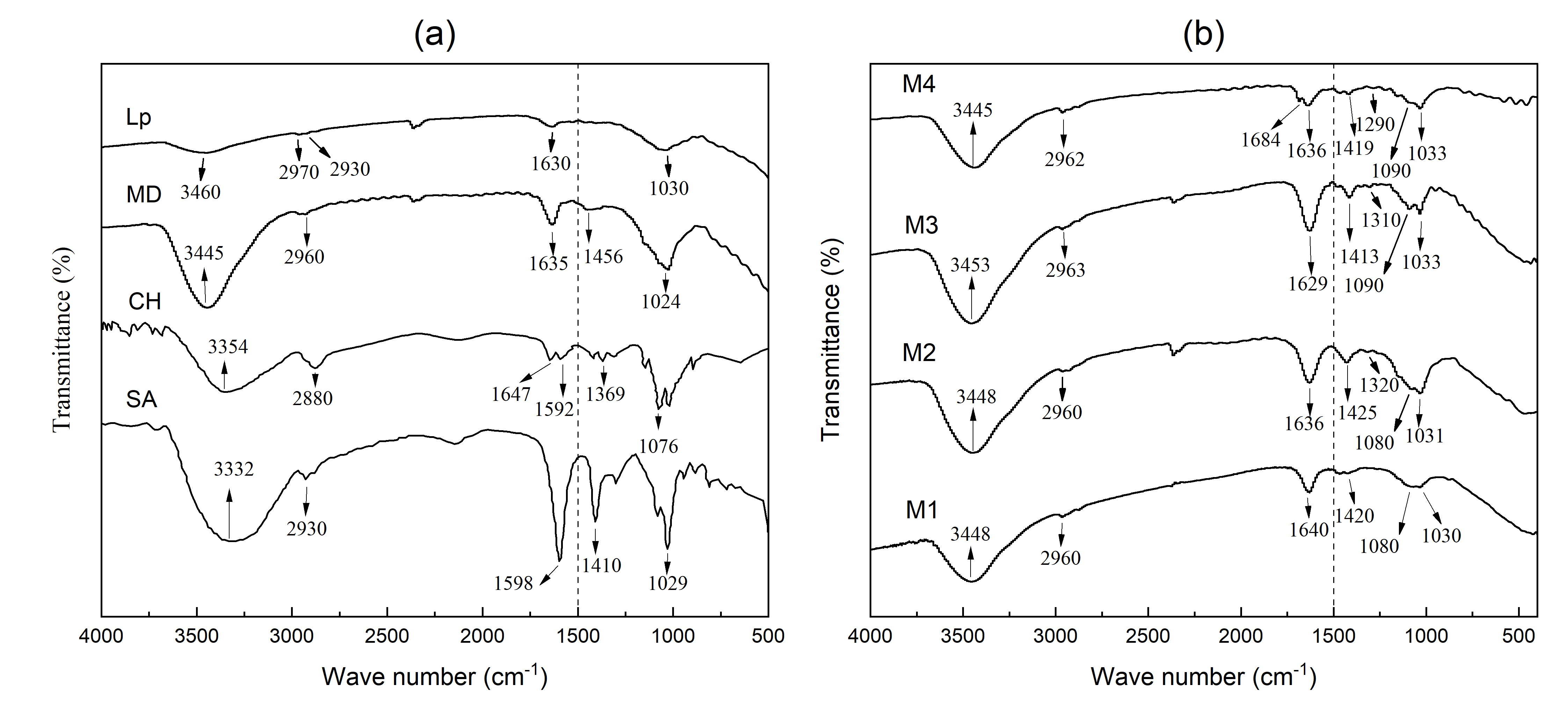
The FTIR spectra of the biomaterials (a) and microcapsules (b) produced by extrusion (M1 and M2) and spray-drying (M3 and M4) are displayed in Figure 2. The O-H bond stretching is responsible for the bands between 3332 and 3460 cm-1, while C-H bond stretching is responsible for the peaks around ~2960 cm-1. The asymmetric and symmetric vibrational stretching of the C-O bonds is responsible for the peaks that emerge around 1598 and 1410 cm-1, respectively (Valenzuela et al., 2014). The symmetric stretching of the phosphoric acid in nucleic acid along with the vibration of C-O-C bonds of polysaccharides connected to the glycopeptides and lipopolysaccharides of the cell wall is responsible for the peaks in the fingerprint region of about 1030 cm-1 (Smilkov et al., 2014). Moreover, the presence of maltodextrin is indicated by the broader bands in M2 and M4 (Kaul et al., 2022). The presence of the sulfate group corresponding to the ferrous sulfate heptahydrate is indicated by a tiny band that may be detected near the ~1080 cm-1 mark, as reported by Churio & Valenzuela (2018), Bryszewska (2019) and Kaul et al. (2022). The reduced concentration of the micronutrient used herein may be the cause of the band's low intensity. The successful microencapsulation using both the extrusion and the spray-drying process is demonstrated by the presence of functional groups in the wall materials, iron, and L. plantarum ATCC 14917.
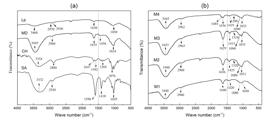
FTIR spectrum of a) individual components and b) microcapsules. SA: sodium alginate, CH: chitosan, MD: maltodextrin, Lp: L. plantarum ATCC 14917. M1 and M2 microencapsulated by extrusion, M3 and M4 by spray-drying.
3.4 Survival of the L. plantarum ATCC 14917 under storage conditions
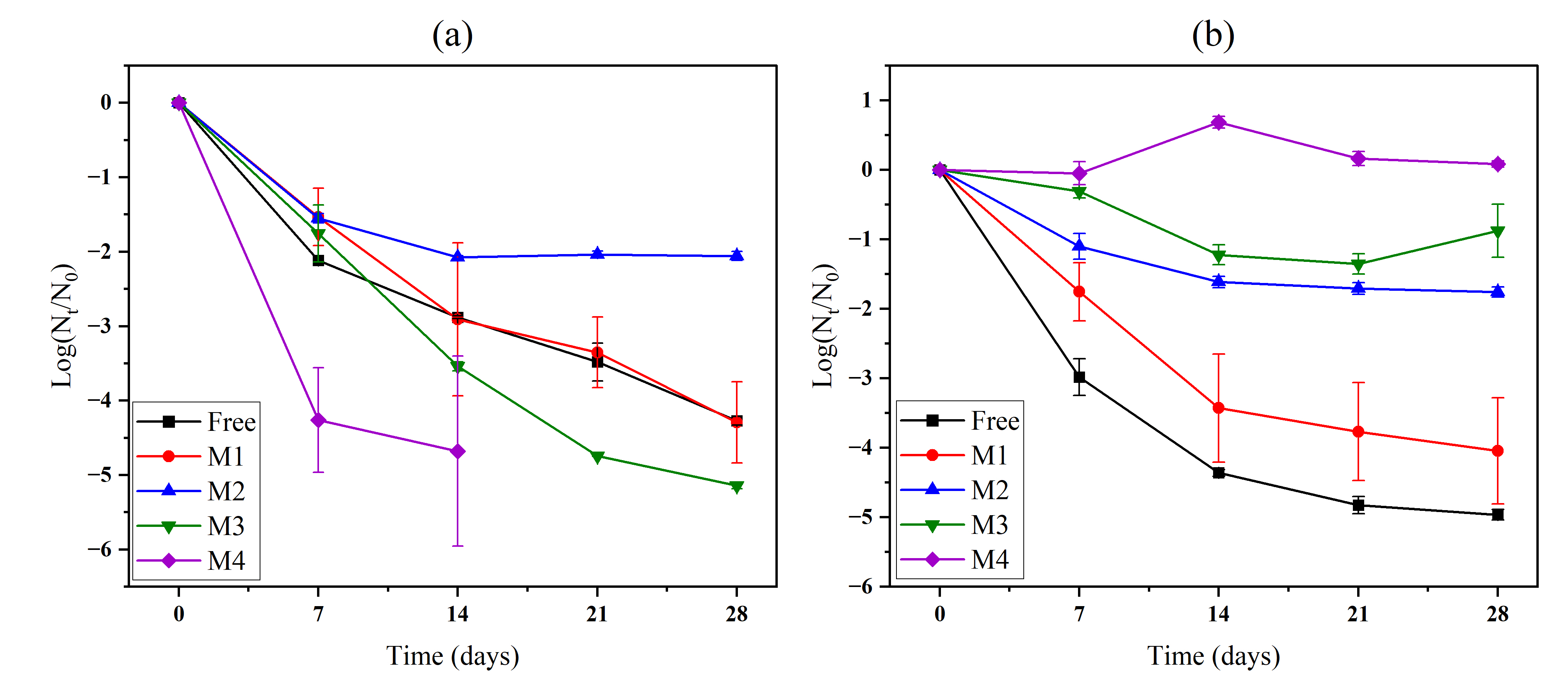
The survival of both free and microencapsulated L. plantarum ATCC 14917 was evaluated at room temperature (24 °C) and refrigeration temperature (4 °C) for 4 weeks, as depicted in Figure 3. At room temperature, the microencapsulated probiotic in M2 had the highest survival rate (p < 0.05), with a 79.25% viability after 4 weeks of storage. Probiotics can be protected by the MD, which serves as an energy source during storage. In contrast, the M4 sample obtained by spray-drying exhibited a loss of total viability after 21 days. Similar results were reported by Costa et al. (2023), who observed that there were no viable cells at 25 °C storage after 27 days. The loss of cell viability is mainly due to the oxidation of the lipid membrane, where temperature and moisture content have the greatest impacts during the storage period (Santivarangkna et al., 2008). Furthermore, increasing the water activity to above 0.33 reduces the viability of the probiotic below the recommended dose (Barajas-Álvarez et al., 2022).
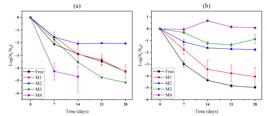
Survival of the L. plantarum ATCC 14917 during storage at (a) room temperature (24 ± 2 °C) and (b) under refrigeration (4 ± 2 °C). M1 and M2 were microencapsulated by extrusion, and M3 and M4 by spray-drying. The error bars indicate the standard deviation (n = 3).
At a temperature of 4 °C, the L. plantarum ATCC 14917 microencapsulated in the M4 sample showed a greater survival rate (p < 0.05) during the 4 weeks of storage with viability of approximately 100%, followed by M3 and M2 with a 91.03% and 82.24% viability, respectively. However, there was no significant difference between the M1 and the free probiotics (p > 0.05). These results are consistent with those obtained by Tang et al. (2020) and Oluwatosin et al. (2022), who reported a high viability of the L. acidophilus (9.20 and 9.98 log CFU/g) as well as the L. plantarum (8.11 log CFU/g) spray-dried and lyophilized with MD, being stored at 4 °C. Notwithstanding, Gul (2017) observed a greater viability loss when the MD was used as an encapsulating agent. Similarly, Kalita et al. (2018) reported a greater viability loss when using the MD alone than when using a mixture of MD and FOS. In addition, increasing the amount of solids in the mixture to be atomized improves the viability of the probiotics during storage (Vanden Braber et al., 2020). In other words, the MD acts as a cryoprotectant (Pandey et al., 2023). These are likely the reasons why the viability of the L. plantarum ATCC 14917 in the M4 sample was better than in the M3.
Li et al. (2023) reported that using only the extrusion-based sodium alginate provided no protective effect on the L. casei at 6 °C, while the addition of the Choerospondias axillaris fruit peel improved viability (7.42 log CFU/g). This is similar to the present study’s findings, where incorporating MD improved the L. plantarum ATCC 14917 viability (8.98 log CFU/g) at 4 °C. Likewise, Luca & Oroian (2021) reported that the addition of prebiotics (inulin, oligofructose and resistant starch) maintained the probiotic viability above 8.0 log CFU/g after 30 days at 4 °C. Whereas Mahmoud et al. (2020) observed an increase in the viability (0.19-1.40 log CFU/g) of the L. plantarum during one month of storage at 6 °C.
The best survival rate during the storage of the L. plantarum ATCC 14917 was obtained at refrigeration temperature (p < 0.05); that is, the lowest rate of viability loss (KT) occurred in the M4 and M3 samples at 4 °C, with a value of -0.010 and 0.049 day-1 (Table 2), respectively, where the negative value indicates that there was no loss, but a slight increase in the probiotic viability. Similarly, Tao et al. (2019) reported that the viability of encapsulated L. paracasei was superior at 4 °C than at 25 °C, with a KT value between 0.037-0.050 day-1.
3.5 Survival of the L. plantarum ATCC 14917 in simulated gastric conditions
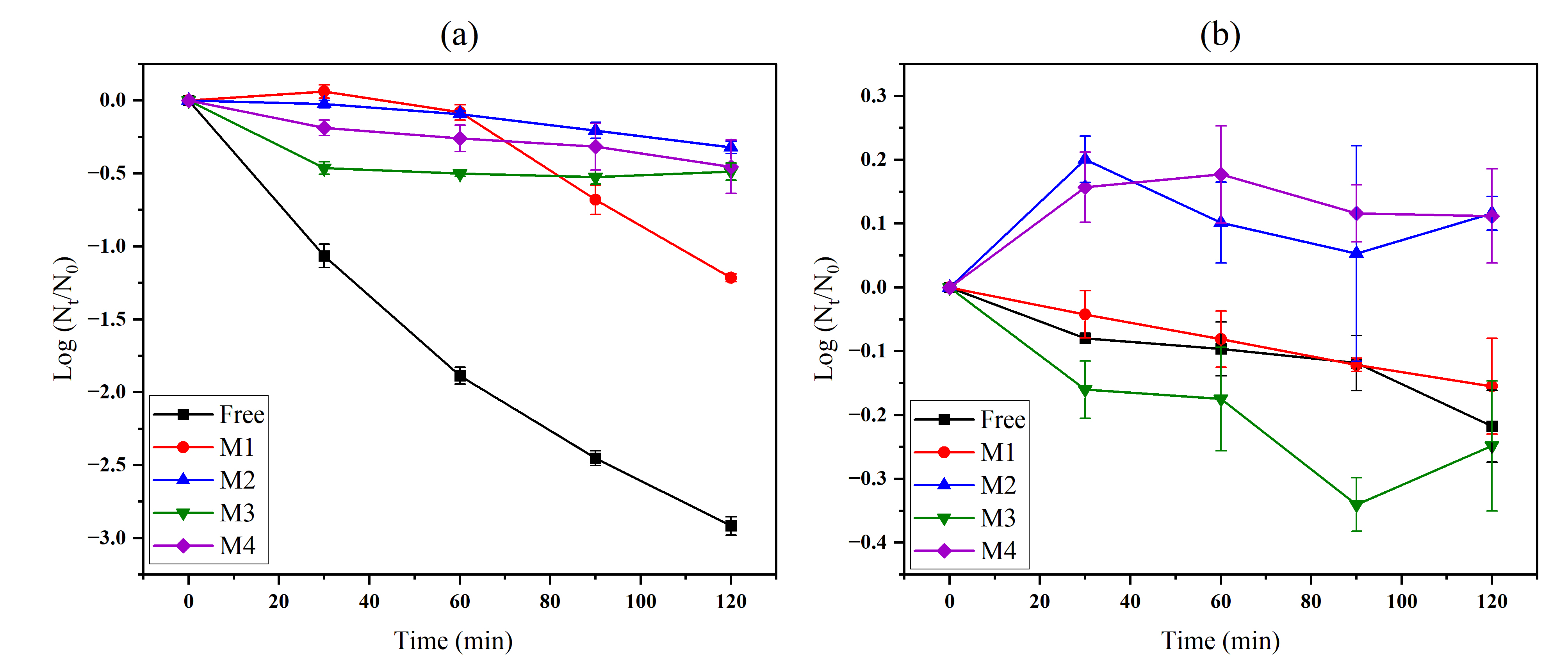
The survival rates of the free and microencapsulated L. plantarum ATCC 14917 cells are illustrated in Figure 4a. The survival rate of the microencapsulated probiotics was found to be higher than that of the free probiotics (p < 0.05). Samples M2, M4, and M3 showed the lowest reductions in viability (0.32, 0.45, and 0.49 log CFU/g, respectively) after 2 h under gastric conditions. In contrast, the viability of the free cells decreased by 2.92 log CFU/mL. This result is similar to what was reported by Guo et al. (2022), who observed a reduction in the viability of free and microencapsulated L. plantarum of 1.73 and 0.51 log CFU/g, respectively. Likewise, Afzaal et al. (2020) reported that the L. acidophilus microencapsulated in alginate presented a better survival rate than the free form.
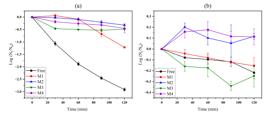
Survival of the L. plantarum ATCC 14917 in (a) pH 2.0 gastric conditions and (b) pH 7.5 intestinal conditions. M1 and M2 were microencapsulated by extrusion, M3 and M4 by spray-drying. M1 and M3: alginate, chitosan, L. plantarum ATCC 14917 and iron; M2 and M4: alginate, chitosan, MD, L. plantarum and iron. The error bars indicate the standard deviation (n = 3).
High survival rates of the L. plantarum ATCC 14917 were observed under gastric conditions in the samples containing MD, results that are consistent with previous studies' findings. Accordingly, the alginate coated with chitosan (Lee et al., 2019; Mahmoud et al., 2020), the mixture of alginate + xanthan gum coated with chitosan (Fareez et al., 2015), the alginate + soy protein isolate (Praepanitchai et al., 2019), the alginate + starch (Ta et al., 2021), the alginate + arabinoxylane (Wu & Zhang, 2018), the FOS + whey protein isolate along with the FOS + denatured whey protein isolate (Rajam & Anandharamakrishnan, 2014), and the Inulin + MD (Sakoui et al., 2022) provided better protection to the probiotic in acidic conditions. The use of alginate (Lee et al., 2019; Praepanitchai et al., 2019; Wu & Zhang, 2018), FOS (Rajam & Anandharamakrishnan, 2014), and MD (Gul et al., 2019) as wall materials provided low protection against gastric conditions. Therefore, the use of individual wall materials is not as effective in protecting cells under gastric conditions.
L. plantarum strains use different mechanisms for stress tolerance under acidic conditions. Unlike other lactic acid bacteria, the L. plantarum does not use H+-ATPases to maintain internal pH homeostasis (Hamon et al., 2014). Conversely, the ability of these bacteria to use different carbon sources for energy (ATP) boosts their ability to survive under acidic conditions (Heunis et al., 2014). F1Fo-ATPase uses this energy to export H+ protons and maintain a stable internal pH (Sun, 2016). It has also been observed that under these conditions, there is an increase in maltose O-acetyltransferase (Maa2) expression (Heunis et al., 2014), which may explain why the MD is such a good source of energy that contributes to the viability increase of the L. plantarum ATCC 14917 in gastric conditions.
Similarly, Wang et al. (2018) reported an increase in the energy metabolism of the L. plantarum ATCC 14917 as well as in the amount of unsaturated fatty acids in the cell membrane, which allowed it to withstand acidic conditions. The higher the proportion of unsaturated fatty acids, the higher the resistance of the bacteria to acidic pH (Guan & Liu, 2020).
Additionally, certain proteins, such as heat shock protein (GrpE), methionine synthase (MetE), and 30S ribosomal protein S2 (RpsB), tend to improve the resistance to acidic pH (Hamon et al., 2014). Under these conditions, ammonia assimilation decreases, which leads to ammonia being accumulated in the cytoplasm, or being generated by arginine deiminase, reacting with the H+ to maintain internal pH homeostasis (Heunis et al., 2014; Wang et al., 2018). There is also an increase in arginine, glutamate, alanine, and lysine levels, which contributes to stress tolerance (Guo et al., 2017; Heunis et al., 2014).
3.6 Survival of the L. plantarum ATCC 14917 in simulated intestinal conditions
When the probiotics reach the gut, they must be able to resist the bile salts, which are antimicrobial compounds that damage cell membranes and DNA (Ruiz et al., 2013). The survival of the L. plantarum ATCC 14917 under intestinal conditions is depicted in Figure 4b. The M2 and M4 samples containing MD that were microencapsulated by the extrusion and spray-drying methods, respectively, presented no significant differences (p > 0.05) in the highest survival of this probiotic, where a viability increases of 0.12 and 0.11 log CFU/g was observed after 2 h of evaluation, respectively. In contrast, the M3 sample and the free probiotic showed a slight viability reduction of 0.25 and 0.22 log CFU/g, respectively. However, both the free and microencapsulated forms had a survival rate of more than 9.0 log CFU/g, which is higher than the minimum concentration required (6.0 log CFU/g) to have a beneficial effect on the body upon reaching the intestine (Rajam & Subramanian, 2022). Therefore, the L. plantarum ATCC 14917 demonstrated a high tolerance to bile salts in the intestine and is an ideal probiotic that can be used in foods to provide functional value.
Alginate and chitosan as wall materials were found to confer low protection to the L. plantarum ATCC 14917, hence presenting a poor survival rate under intestinal conditions when compared to the free form, which is consistent with the results reported by Ta et al. (2021). That being said, there was no reduction in viability (9.9 log CFU/g) with the addition of the MD. Similarly, Praepanitchai et al. (2019) observed that the alginate combined with soy protein isolate protects the L. plantarum better (9.0 log CFU/g) than the alginate alone (8.51-8.62 log CFU/g) at 0.5 and 1.0% bile salts. In addition, Mahmoud et al. (2020) reported an increased viability for the L. plantarum microencapsulated in alginate and skim milk (> 7.0 log CFU/g). A mixture of different wall materials tends to provide more protection to probiotics under intestinal conditions than individual materials. As such, the alginate, chitosan, and MD mixture better protected the L. plantarum ATCC 14917 in intestinal conditions.
Moreover, the MD has been shown to improve the L. plantarum Lp-115 tolerance to bile salts by inducing the bile salt hydrolase (pva3) gene expression and changing the composition of membrane fatty acids (Zhou et al., 2019). Five additional proteins are involved in the stress resistance of these L. plantarum strains, including two glutathione reductases (GshR1 and GshR4) related to the protection against oxidative damage caused by the bile salts, a cyclopropane-fatty-acyl-phospholipid synthase (Cfa2) involved with the integral maintenance of the cell membrane, an ABC transporter and an F0F1-ATP synthase (Hamon et al., 2011).
3.7 Iron release in simulated gastric and intestinal conditions
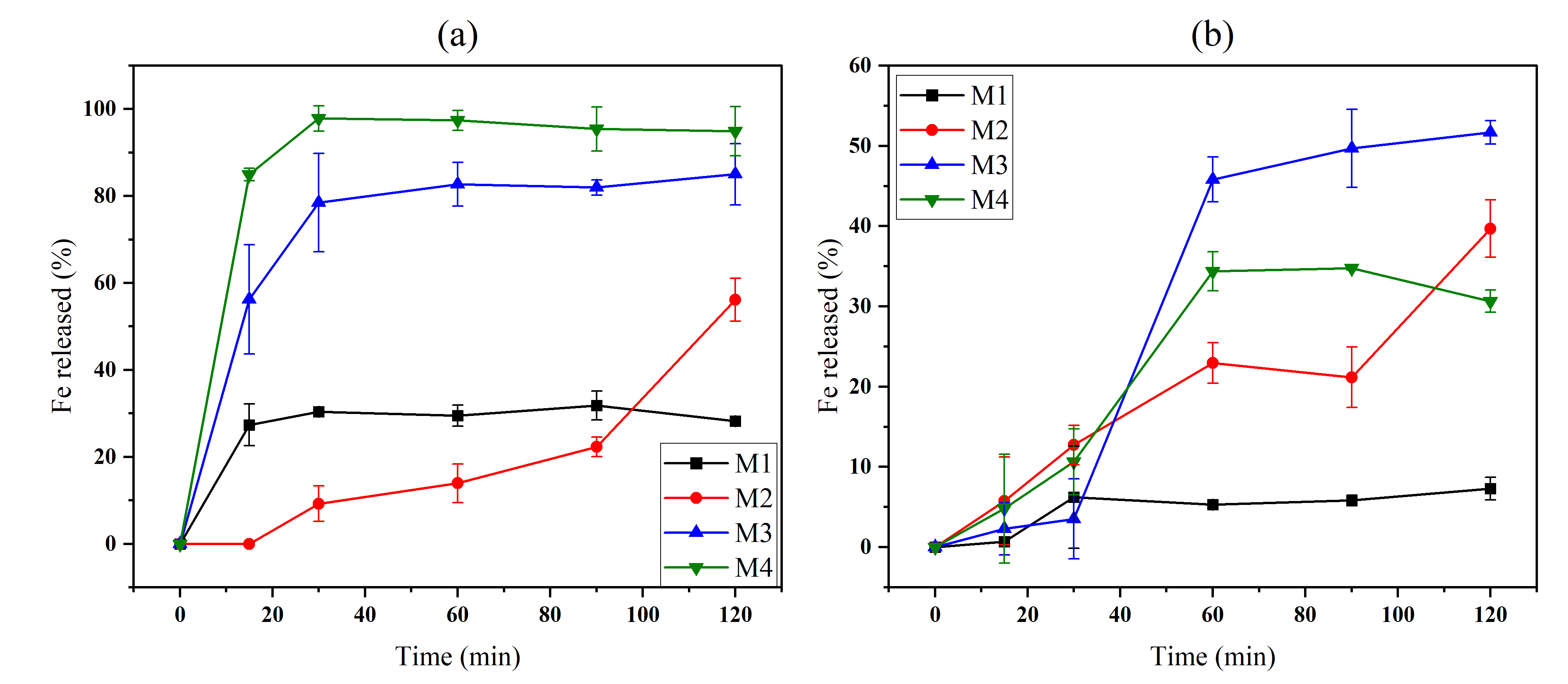
The iron release profiles under simulated gastric and intestinal conditions are detailed in Figure 5. Samples M4 (97.85%) and M3 (85.02%) exhibited a greater Fe release under gastric conditions. The microcapsules obtained by spray-drying presented a higher release of iron (p < 0.05) than the extrusion-based products. The largest and fastest release occurred during the first 30 min since the dry powder was more soluble than the beads. In addition, given the small particle size, there was a larger area of contact with the surrounding fluid. This finding is consistent with the results reported by Pratap Singh et al. (2018) as well as by Pratap-Singh & Leiva (2021), who obtained release rates ranging between 85% and 100%. The iron should be absorbed upon reaching the duodenum and upper part of the jejunum, where the greatest absorption of this micronutrient occurs (Dueik & Diosady, 2016; Pratap Singh et al., 2018; Pratap-Singh & Leiva, 2021).
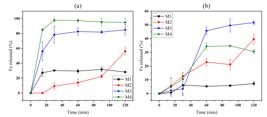
Iron release profile in simulated (a) gastric (pH 2.0) and (b) intestinal (pH 6.6) conditions. M1 and M2 were microencapsulated by extrusion, M3 and M4 by spray-drying. M1 and M3: alginate, chitosan, L. plantarum and iron; M2 and M4: alginate, chitosan, MD, L. plantarum and iron. The error bar represents the standard deviation (n = 2).
Samples M3 (51.67%), M2 (39.69%), and M4 (34.78%) showed the highest release of iron under intestinal conditions, whereas sample M1 released only 7.3% of the iron. The higher release in M3 could be explained by the presence of fissures or cracks in the particles, which allows for a rapid release of iron, this way, the release was slower than under gastric conditions. These results are similar to those reported by Dueik & Diosady (2016), Pratap Singh et al. (2018), and Wardhani et al. (2020), who observed a release of approximately 10%, 15%, and 4% under intestinal conditions, respectively.
The release of iron under both gastric and intestinal conditions depends on the properties of the wall materials, particle size, and microencapsulation methods applied.
3.8 Bioaccessibility of the microencapsulated iron
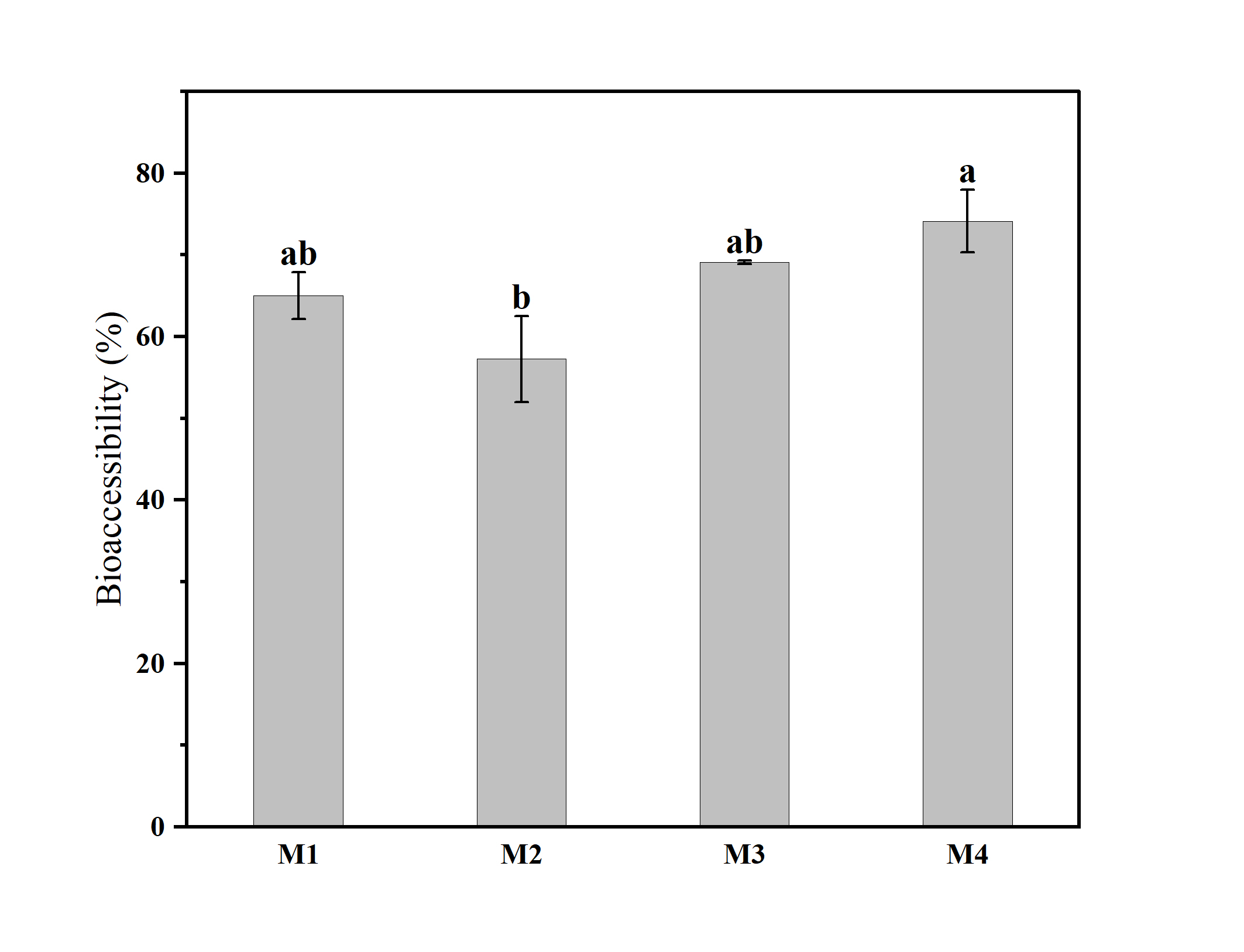
In the present study, the bioaccessibility of the iron co-microencapsulated with the L. plantarum ATCC 14917 was evaluated by extrusion and spray-drying. The percentage bioaccessibility of the microencapsulated iron is depicted in Figure 6. The highest bioaccessibility was obtained in the M4 and M3 samples at 74.13% and 69.08%, respectively. Similarly, the highest bioaccessibility was found in the microcapsules prepared by spray-drying (p < 0.05).
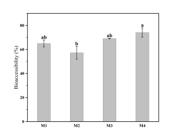
Bioaccessibility of the microencapsulated iron. M1 and M2 were microencapsulated by extrusion, M3 and M4 by spray-drying. M1 and M3: alginate, chitosan, L. plantarum and iron; M2 and M4: alginate, chitosan, MD, L. plantarum and iron. The error bar represents the standard deviation (n = 2).
Further studies have reported a lower bioaccessibility of microencapsulated iron. For instance, Bryszewska (2019) obtained a 24.6% bioaccessibility whereas, when microencapsulated along with ascorbic acid, bioaccessibility was assessed at 92.9%, this is because vitamin C prevents iron oxidation. On the other hand, Bryszewska et al. (2019) combined microencapsulated iron with bread and obtained a bioaccessibility range of 35.99–66.29%, while with free iron it only reached 9.81%, attesting to the protective effect of microcapsules. However, it has been reported that iron bioaccessibility varies according to the age of the consumer, which may be explained by the differences in pH and enzyme activity in digestion (Barbosa & Garcia-Rojas, 2022).
In this study, the effects of the L. plantarum ATCC 14917 on iron bioaccessibility were not evaluated. Nevertheless, previous studies have indicated that different probiotic strains can improve the absorption of this micronutrient. For example, L. casei improves iron bioaccessibility by 11% in fortified pumpkins (Genevois et al., 2017). Lactobacillus fermentun has also been shown to reduce ferric iron to ferrous iron by synthesizing p-hydroxyphenylacetic acid, an antioxidant (González et al., 2017). This metabolite was found much earlier in L. plantarum strains (Suzuki et al., 2013) and may be one of the mechanisms by which the L. plantarum ATCC 14917 improves iron bioaccessibility.
4 Conclusion
The co-microencapsulation of L. plantarum ATCC 14917 and iron, using alginate, chitosan, and maltodextrin as wall materials, demonstrated remarkable benefits. Maltodextrin enhanced probiotic viability both during storage and under simulated gastrointestinal conditions, surpassing the performance of free probiotics. Additionally, spray-drying proved to be an efficient encapsulation method, enabling rapid iron release, while maintaining a high bioaccessibility exceeding 65%. These findings highlight the strong potential of spray-dried co-microencapsulation of L. plantarum and iron with maltodextrin for food fortification, paving the way for the development of functional foods that deliver viable probiotics and iron with high bioaccessibility., thus promoting enhanced health benefits.
Acknowledgements
The authors would like to thank the CONCYTEC-PROCIENCIA within the framework of the contest E074-2022-01 “Tesis y Pasantías en Ciencia, Tecnología e Innovación” (No. PE501081625-2022) and the Universidad Nacional Mayor de San Marcos (No. C19072181) for the financial support.
-
Cite as:
Jimenez Ramirez, A., Guerrero Aquino, M., & Memenza Zegarra, M. (2025). Effect of two co-microencapsulation methods on the viability of the Lactobacillus plantarum ATCC 14917 and the release and bioaccessibility of iron. Brazilian Journal of Food Technology, 28, e2024084. https://doi.org/10.1590/1981-6723.08424
-
Funding: CONCYTEC (PE501081625-2022); Universidad Nacional Mayor de San Marcos (contract N° C19072181)
References
-
Afzaal, M., Saeed, F., Saeed, M., Azam, M., Hussain, S., Mohamed, A. A., Alamri, M. S., & Anjum, F. M. (2020). Survival and stability of free and encapsulated probiotic bacteria under simulated gastrointestinal and thermal conditions. International Journal of Food Properties, 23(1), 1899-1912. http://doi.org/10.1080/10942912.2020.1826513
» http://doi.org/10.1080/10942912.2020.1826513 -
Arepally, D., & Goswami, T. K. (2019). Effect of inlet air temperature and gum Arabic concentration on encapsulation of probiotics by spray drying. LWT, 99, 583-593. http://doi.org/10.1016/j.lwt.2018.10.022
» http://doi.org/10.1016/j.lwt.2018.10.022 -
Baldelli, A., Ren, M., Liang, D. Y., Lai, S., Hartono, B., Sum, K., & Pratap-Singh, A. (2023). Sprayed microcapsules of minerals for fortified food. Journal of Functional Foods, 101, 105401. http://doi.org/10.1016/j.jff.2023.105401
» http://doi.org/10.1016/j.jff.2023.105401 -
Barajas-Álvarez, P., González-Ávila, M., & Espinosa-Andrews, H. (2022). Microencapsulation of Lactobacillus rhamnosus HN001 by spray drying and its evaluation under gastrointestinal and storage conditions. LWT, 153, 112485. http://doi.org/10.1016/j.lwt.2021.112485
» http://doi.org/10.1016/j.lwt.2021.112485 -
Barbosa, B. S. T., & Garcia-Rojas, E. E. (2022). Double emulsions as delivery systems for iron: Stability kinetics and improved bioaccessibility in infants and adults. Current Research in Food Science, 5, 718-725. PMid:35497774. http://doi.org/10.1016/j.crfs.2022.04.003
» http://doi.org/10.1016/j.crfs.2022.04.003 -
Barragán-Ibañez, G., Santoyo-Sánchez, A., & Ramos-Peñafiel, C. O. (2016). Iron deficiency anemia. Revista Medica del Hospital General, 79(2), 88-97. http://doi.org/10.1016/j.hgmx.2015.06.008
» http://doi.org/10.1016/j.hgmx.2015.06.008 -
Blanco-Rojo, R., & Vaquero, M. P. (2019). Iron bioavailability from food fortification to precision nutrition. A review. Innovative Food Science & Emerging Technologies, 51, 126-138. http://doi.org/10.1016/j.ifset.2018.04.015
» http://doi.org/10.1016/j.ifset.2018.04.015 -
Bryszewska, M. A. (2019). Comparison study of iron bioaccessibility from dietary supplements and microencapsulated preparations. Nutrients, 11(2), 273. PMid:30691123. http://doi.org/10.3390/nu11020273
» http://doi.org/10.3390/nu11020273 -
Bryszewska, M. A., Tomás-Cobos, L., Gallego, E., Villalba, M., Rivera, D., Taneyo Saa, D. L., & Gianotti, A. (2019). In vitro bioaccessibility and bioavailability of iron from breads fortified with microencapsulated iron. LWT, 99, 431-437. http://doi.org/10.1016/j.lwt.2018.09.071
» http://doi.org/10.1016/j.lwt.2018.09.071 -
Churio, O., & Valenzuela, C. (2018). Development and characterization of maltodextrin microparticles to encapsulate heme and non-heme iron. LWT, 96, 568-575. http://doi.org/10.1016/j.lwt.2018.05.072
» http://doi.org/10.1016/j.lwt.2018.05.072 -
Churio, O., Pizarro, F., & Valenzuela, C. (2018). Preparation and characterization of iron-alginate beads with some types of iron used in supplementation and fortification strategies. Food Hydrocolloids, 74, 1-10. http://doi.org/10.1016/j.foodhyd.2017.07.020
» http://doi.org/10.1016/j.foodhyd.2017.07.020 -
Costa, N. A., Silveira, L. R., Amaral, E. P., Pereira, G. C., Paula, D. A., Vieira, E. N. R., Martins, E. M. F., Stringheta, P. C., Leite Junior, B. R. C., & Ramos, A. M. (2023). Use of maltodextrin, sweet potato flour, pectin and gelatin as wall material for microencapsulating Lactiplantibacillus plantarum by spray drying: Thermal resistance, in vitro release behavior, storage stability and physicochemical properties. Food Research International, 164, 112367. PMid:36737954. http://doi.org/10.1016/j.foodres.2022.112367
» http://doi.org/10.1016/j.foodres.2022.112367 -
Dasa, F., & Abera, T. (2018). Factors affecting iron absorption and mitigation mechanisms: A review. International Journal of Agricultural Science and Food Technology, 4(1), 24-30. http://dx.doi.org/10.17352/2455-815x.000033
» http://dx.doi.org/10.17352/2455-815x.000033 -
Dehnad, D., Ghorani, B., Emadzadeh, B., Emadzadeh, M., Assadpour, E., Rajabzadeh, G., & Jafari, S. M. (2024). Recent advances in iron encapsulation and its application in food fortification. Critical Reviews in Food Science and Nutrition, 64(33),12685-12701. PMid:37703437. http://dx.doi.org/10.1080/10408398.2023.2256004
» http://dx.doi.org/10.1080/10408398.2023.2256004 -
Dueik, V., & Diosady, L. L. (2016). Microencapsulation of iron in a reversed enteric coating using spray drying technology for double fortification of salt with iodine and iron. Journal of Food Process Engineering, 40(2), 1-9. http://dx.doi.org/10.1111/jfpe.12376
» http://dx.doi.org/10.1111/jfpe.12376 -
Fareez, I. M., Lim, S. M., Mishra, R. K., & Ramasamy, K. (2015). Chitosan coated alginate-xanthan gum bead enhanced pH and thermotolerance of Lactobacillus plantarum LAB12. International Journal of Biological Macromolecules, 72, 1419-1428. PMid:25450046. http://doi.org/10.1016/j.ijbiomac.2014.10.054
» http://doi.org/10.1016/j.ijbiomac.2014.10.054 -
Genevois, C., de Escalada Pla, M., & Flores, S. (2017). Novel strategies for fortifying vegetable matrices with iron and Lactobacillus casei simultaneously. LWT, 79, 34-41. http://doi.org/10.1016/j.lwt.2017.01.019
» http://doi.org/10.1016/j.lwt.2017.01.019 -
González, A., Gálvez, N., Martín, J., Reyes, F., Pérez-Victoria, I., & Dominguez-Vera, J. M. (2017). Identification of the key excreted molecule by Lactobacillus fermentum related to host iron absorption. Food Chemistry, 228, 374-380. PMid:28317737. http://doi.org/10.1016/j.foodchem.2017.02.008
» http://doi.org/10.1016/j.foodchem.2017.02.008 -
Guan, N., & Liu, L. (2020). Microbial response to acid stress: Mechanisms and applications. Applied Microbiology and Biotechnology, 104(1), 51-65. PMid:31773206. http://doi.org/10.1007/s00253-019-10226-1
» http://doi.org/10.1007/s00253-019-10226-1 -
Gul, O. (2017). Microencapsulation of Lactobacillus casei Shirota by spray drying using different combinations of wall materials and application for probiotic dairy dessert. Journal of Food Processing and Preservation, 41(5), 1-9. http://doi.org/10.1111/jfpp.13198
» http://doi.org/10.1111/jfpp.13198 -
Gul, O., Atalar, I., & Gul, L. B. (2019). Effect of different encapsulating agent combinations on viability of Lactobacillus casei Shirota during storage, in simulated gastrointestinal conditions and dairy dessert. Food Science & Technology International, 25(7), 608-617. PMid:31146586. http://doi.org/10.1177/1082013219853462
» http://doi.org/10.1177/1082013219853462 -
Guo, Q., Li, S., Tang, J., Chang, S., Qiang, L., Du, G., Yue, T., & Yuan, Y. (2022). Microencapsulation of Lactobacillus plantarum by spray drying: Protective effects during simulated food processing, gastrointestinal conditions, and in kefir. International Journal of Biological Macromolecules, 194, 539-545. PMid:34808148. http://doi.org/10.1016/j.ijbiomac.2021.11.096
» http://doi.org/10.1016/j.ijbiomac.2021.11.096 -
Guo, Y., Tian, X., Huang, R., Tao, X., Shah, N. P., Wei, H., & Wan, C. (2017). A physiological comparative study of acid tolerance of Lactobacillus plantarum ZDY 2013 and L. plantarum ATCC 8014 at membrane and cytoplasm levels. Annals of Microbiology, 67(10), 669-677. http://doi.org/10.1007/s13213-017-1295-x
» http://doi.org/10.1007/s13213-017-1295-x -
Hamon, E., Horvatovich, P., Izquierdo, E., Bringel, F., Marchioni, E., Aoudé-Werner, D., & Ennahar, S. (2011). Comparative proteomic analysis of Lactobacillus plantarum for the identification of key proteins in bile tolerance. BMC Microbiology, 11, 63. Retrieved in 2023, November 20, from http://www.biomedcentral.com/1471-2180/11/63
» http://www.biomedcentral.com/1471-2180/11/63 -
Hamon, E., Horvatovich, P., Marchioni, E., Aoude-Werner, D., & Ennahar, S. (2014). Investigation of potential markers of acid resistance in Lactobacillus plantarum by comparative proteomics. Journal of Applied Microbiology, 116(1), 134-144. PMid:24016102. http://doi.org/10.1111/jam.12339
» http://doi.org/10.1111/jam.12339 -
Heunis, T., Deane, S., Smit, S., & Dicks, L. M. (2014). Proteomic profiling of the acid stress response in Lactobacillus plantarum 423. Journal of Proteome Research, 13(9), 4028-4039. PMid:25068841. http://doi.org/10.1021/pr500353x
» http://doi.org/10.1021/pr500353x -
Hoppe, M., Önning, G., Berggren, A., & Hulthén, L. (2015). Probiotic strain Lactobacillus plantarum 299v increases iron absorption from an iron-supplemented fruit drink: A double-isotope cross-over single-blind study in women of reproductive age. British Journal of Nutrition, 114(8), 1195-1202. PMid:26428277. http://doi.org/10.1017/S000711451500241X
» http://doi.org/10.1017/S000711451500241X -
Huang, S., Vignolles, M.-L., Chen, X. D., Le Loir, Y., Jan, G., Schuck, P., & Jeantet, R. (2017). Spray drying of probiotics and other food-grade bacteria: A review. Trends in Food Science & Technology, 63, 1-17. http://doi.org/10.1016/j.tifs.2017.02.007
» http://doi.org/10.1016/j.tifs.2017.02.007 -
Ippolito, J. R., Piccolo, B. D., Robeson, M. S., Barney Junior, D. E., Ali, J., Singh, P., & Hennigar, S. R. (2022). Iron deficient diets modify the gut microbiome and reduce the severity of enteric infection in a mouse model of S. Typhimurium-induced enterocolitis. The Journal of Nutritional Biochemistry, 107, 109065. PMid:35609848. http://doi.org/10.1016/j.jnutbio.2022.109065
» http://doi.org/10.1016/j.jnutbio.2022.109065 -
Kalita, D., Saikia, S., Gautam, G., Mukhopadhyay, R., & Mahanta, C. L. (2018). Characteristics of synbiotic spray dried powder of litchi juice with Lactobacillus plantarum and different carrier materials. LWT, 87, 351-360. http://doi.org/10.1016/j.lwt.2017.08.092
» http://doi.org/10.1016/j.lwt.2017.08.092 -
Katuwavila, N. P., Perera, A. D. L. C., Dahanayake, D., Karunaratne, V., Amaratunga, G. A. J., & Karunaratne, D. N. (2016). Alginate nanoparticles protect ferrous from oxidation: Potential iron delivery system. International Journal of Pharmaceutics, 513(1-2), 404-409. PMid:27659860. http://doi.org/10.1016/j.ijpharm.2016.09.053
» http://doi.org/10.1016/j.ijpharm.2016.09.053 -
Kaul, S., Kaur, K., Mehta, N., Dhaliwal, S. S., & Kennedy, J. F. (2022). Characterization and optimization of spray dried iron and zinc nanoencapsules based on potato starch and maltodextrin. Carbohydrate Polymers, 282, 119107. PMid:35123743. http://doi.org/10.1016/j.carbpol.2022.119107
» http://doi.org/10.1016/j.carbpol.2022.119107 -
Lee, Y., Ji, Y. R., Lee, S., Choi, M. J., & Cho, Y. (2019). Microencapsulation of probiotic Lactobacillus acidophilus KBL409 by extrusion technology to enhance survival under simulated intestinal and freeze-drying conditions. Journal of Microbiology and Biotechnology, 29(5), 721-730. PMid:31030452. http://doi.org/10.4014/jmb.1903.03018
» http://doi.org/10.4014/jmb.1903.03018 -
Li, Q., Lin, H., Li, J., Liu, L., Huang, J., Cao, Y., Zhao, T., McClements, D. J., Chen, J., Liu, C., Liu, J., Shen, P., & Zhou, M. (2023). Improving probiotic (Lactobacillus casei) viability by encapsulation in alginate-based microgels: Impact of polymeric and colloidal fillers. Food Hydrocolloids, 134, 108028. http://doi.org/10.1016/j.foodhyd.2022.108028
» http://doi.org/10.1016/j.foodhyd.2022.108028 -
Liu, K., Chen, Y. Y., Pan, L. H., Li, Q. M., Luo, J. P., & Zha, X. Q. (2022). Co-encapsulation systems for delivery of bioactive ingredients. Food Research International, 155, 111073. PMid:35400451. http://doi.org/10.1016/j.foodres.2022.111073
» http://doi.org/10.1016/j.foodres.2022.111073 -
Luca, L., & Oroian, M. (2021). Influence of different prebiotics on viability of Lactobacillus casei, Lactobacillus plantarum and Lactobacillus rhamnosus encapsulated in alginate microcapsules. Foods, 10(4), 1-19. PMid:33810507. http://doi.org/10.3390/foods10040710
» http://doi.org/10.3390/foods10040710 -
Mahmoud, M., Abdallah, N. A., El-Shafei, K., Tawfik, N. F., & El-Sayed, H. S. (2020). Survivability of alginate-microencapsulated Lactobacillus plantarum during storage, simulated food processing and gastrointestinal conditions. Heliyon, 6(3), e03541. PMid:32190759. http://doi.org/10.1016/j.heliyon.2020.e03541
» http://doi.org/10.1016/j.heliyon.2020.e03541 -
Mohapatra, A., & Sahu, J. K. (2021). Spray‐process optimization for the encapsulation of probiotic Lactobacillus acidophilus ATCC 11975 in a ternary wall matrix. Journal of Food Processing and Preservation, 45(10), 1-12. http://doi.org/10.1111/jfpp.15860
» http://doi.org/10.1111/jfpp.15860 -
Niño-Vásquez, I. A., Muñiz-Márquez, D., Ascacio-Valdés, J. A., Contreras-Esquivel, J. C., Aguilar, C. N., Rodríguez-Herrera, R., & Flores-Gallegos, A. C. (2022). Co-microencapsulation: A promising multi-approach technique for enhancement of functional properties. Bioengineered, 13(3), 5168-5189. PMid:35172666. http://doi.org/10.1080/21655979.2022.2037363
» http://doi.org/10.1080/21655979.2022.2037363 -
Oluwatosin, S. O., Tai, S. L., & Fagan-Endres, M. A. (2022). Sucrose, maltodextrin and inulin efficacy as cryoprotectant, preservative and prebiotic - towards a freeze dried Lactobacillus plantarum topical probiotic. Biotechnology Reports (Amsterdam, Netherlands), 33, e00696. PMid:35024350. http://doi.org/10.1016/j.btre.2021.e00696
» http://doi.org/10.1016/j.btre.2021.e00696 -
Padhmavathi, V., Shruthy, R., & Preetha, R. (2021). Chitosan coated skim milk-alginate microspheres for better survival of probiotics during gastrointestinal transit. Journal of Food Science and Technology, 60(3), 889-895. PMid:36908352. http://doi.org/10.1007/s13197-021-05179-1
» http://doi.org/10.1007/s13197-021-05179-1 -
Pandey, S., Premjit, Y., Khuntia, A., Kadival, A., & Mitra, J. (2023). Development of probiotic-loaded calcium alginate-maltodextrin microparticles based on electrohydrodynamic technique. Powder Technology, 428, 118808. http://doi.org/10.1016/j.powtec.2023.118808
» http://doi.org/10.1016/j.powtec.2023.118808 -
Perez-Moral, N., Gonzalez, M. C., & Parker, R. (2013). Preparation of iron-loaded alginate gel beads and their release characteristics under simulated gastrointestinal conditions. Food Hydrocolloids, 31(1), 114-120. http://doi.org/10.1016/j.foodhyd.2012.09.015
» http://doi.org/10.1016/j.foodhyd.2012.09.015 -
Praepanitchai, O. A., Noomhorm, A., & Anal, A. K. (2019). Survival and behavior of encapsulated probiotics (Lactobacillus plantarum) in calcium-alginate-soy protein isolate-based hydrogel beads in different processing conditions (pH and temperature) and in pasteurized Mango Juice. BioMed Research International, 2019, 1-9. PMid:30895197. http://doi.org/10.1155/2019/9768152
» http://doi.org/10.1155/2019/9768152 -
Pratap Singh, A., Siddiqui, J., & Diosady, L. L. (2018). Characterizing the pH-dependent release kinetics of food-grade spray drying encapsulated iron microcapsules for food fortification. Food and Bioprocess Technology, 11(2), 435-446. PMid:31258831. http://doi.org/10.1007/s11947-017-2022-0
» http://doi.org/10.1007/s11947-017-2022-0 -
Pratap-Singh, A., & Leiva, A. (2021). Double fortified (iron and zinc) spray-dried microencapsulated premix for food fortification. LWT, 151, 112189. http://doi.org/10.1016/j.lwt.2021.112189
» http://doi.org/10.1016/j.lwt.2021.112189 -
Pupa, P., Apiwatsiri, P., Sirichokchatchawan, W., Pirarat, N., Muangsin, N., Shah, A. A., & Prapasarakul, N. (2021). The efficacy of three double-microencapsulation methods for preservation of probiotic bacteria. Scientific Reports, 11(1), 13753. PMid:34215824. http://doi.org/10.1038/s41598-021-93263-z
» http://doi.org/10.1038/s41598-021-93263-z -
Pynaert, I., Armah, C., Fairweather-Tait, S., Kolsteren, P., Van Camp, J., & Henauw, S. D. (2006). Iron solubility compared with in vitro digestion–Caco-2 cell culture method for the assessment of iron bioavailability in a processed and unprocessed complementary food for Tanzanian infants (6–12 months). British Journal of Nutrition, 95(4), 721-726. PMid:16571151. http://doi.org/10.1079/BJN20051722
» http://doi.org/10.1079/BJN20051722 -
Rajam, R., & Anandharamakrishnan, C. (2014). Microencapsulation of Lactobacillus plantarum (MTCC 5422) with fructooligosaccharide as wall material by spray drying. LWT, 60(2), 773-780. http://doi.org/10.1016/j.lwt.2014.09.062
» http://doi.org/10.1016/j.lwt.2014.09.062 -
Rajam, R., & Subramanian, P. (2022). Encapsulation of probiotics: Past, present and future. Beni-Suef University Journal of Basic and Applied Sciences, 11(46), 1-18. http://doi.org/10.1186/s43088-022-00228-w
» http://doi.org/10.1186/s43088-022-00228-w -
Rather, S. A., Akhter, R., Masoodi, F. A., Gani, A., & Wani, S. M. (2017). Effect of double alginate microencapsulation on in vitro digestibility and thermal tolerance of Lactobacillus plantarum NCDC201 and L. casei NCDC297. LWT, 83, 50-58. http://doi.org/10.1016/j.lwt.2017.04.036
» http://doi.org/10.1016/j.lwt.2017.04.036 -
Razavi, S., Janfaza, S., Tasnim, N., Gibson, D. L., & Hoorfar, M. (2021). Microencapsulating polymers for probiotics delivery systems: Preparation, characterization, and applications. Food Hydrocolloids, 120, 106882. http://doi.org/10.1016/j.foodhyd.2021.106882
» http://doi.org/10.1016/j.foodhyd.2021.106882 -
Ruiz, L., Margolles, A., & Sanchez, B. (2013). Bile resistance mechanisms in Lactobacillus and Bifidobacterium. Frontiers in Microbiology, 4(396), 1-8. PMid:24399996. http://doi.org/10.3389/fmicb.2013.00396
» http://doi.org/10.3389/fmicb.2013.00396 -
Sakoui, S., Derdak, R., Pop, O. L., Vodnar, D. C., Addoum, B., Teleky, B. E., Elemer, S., Elmakssoudi, A., Suharoschi, R., Soukri, A., & El Khalfi, B. (2022). Effect of encapsulated probiotic in Inulin-Maltodextrin-Sodium alginate matrix on the viability of Enterococcus mundtii SRBG1 and the rheological parameters of fermented milk. Current Research in Food Science, 5, 1713-1719. PMid:36212080. http://doi.org/10.1016/j.crfs.2022.09.027
» http://doi.org/10.1016/j.crfs.2022.09.027 -
Sandberg, A.-S., Önning, G., Engström, N., & Scheers, N. (2018). Iron supplements containing lactobacillus plantarum 299v increase ferric iron and up-regulate the ferric reductase DCYTB in human Caco-2/HT29 MTX co-cultures. Nutrients, 10(12), 1949. PMid:30544799. http://doi.org/10.3390/nu10121949
» http://doi.org/10.3390/nu10121949 -
Santivarangkna, C., Kulozik, U., & Foerst, P. (2008). Inactivation mechanisms of lactic acid starter cultures preserved by drying processes. Journal of Applied Microbiology, 105(1), 1-13. PMid:18266696. http://doi.org/10.1111/j.1365-2672.2008.03744.x
» http://doi.org/10.1111/j.1365-2672.2008.03744.x -
Šipailienė, A., & Petraityte, S. (2017). Encapsulation of probiotics: Proper selection of the probiotic strain and the influence of encapsulation technology and materials on the viability of encapsulated microorganisms. Probiotics and Antimicrobial Proteins, 10(1), 1-10. PMid:29124564. http://doi.org/10.1007/s12602-017-9347-x
» http://doi.org/10.1007/s12602-017-9347-x -
Smilkov, K., Petreska Ivanovska, T., Petrushevska Tozi, L., Petkovska, R., Hadjieva, J., Popovski, E., Stafilov, T., Grozdanov, A., & Mladenovska, K. (2014). Optimization of the formulation for preparing Lactobacillus casei loaded whey protein-Ca-alginate microparticles using full-factorial design. Journal of Microencapsulation, 31(2), 166-175. PMid:23919399. http://doi.org/10.3109/02652048.2013.824511
» http://doi.org/10.3109/02652048.2013.824511 -
Sun, Y. (2016). F1F0-ATPase functions under markedly acidic conditions in bacteria. In S. Chakraborti, & N. S. Dhalla (Eds.), Regulation of Ca2+-ATPases,V-ATPases and F-ATPases (pp. 459-468). Cham: Springer. http://doi.org/10.1007/978-3-319-24780-9_22
» http://doi.org/10.1007/978-3-319-24780-9_22 -
Suzuki, Y., Kosaka, M., Shindo, K., Kawasumi, T., Kimoto-Nira, H., & Suzuki, C. (2013). Identification of antioxidants produced by Lactobacillus plantarum. Bioscience, Biotechnology, and Biochemistry, 77(6), 1299-1302. PMid:23748762. http://doi.org/10.1271/bbb.121006
» http://doi.org/10.1271/bbb.121006 -
Ta, L. P., Bujna, E., Antal, O., Ladanyi, M., Juhasz, R., Szecsi, A., Kun, S., Sudheer, S., Gupta, V. K., & Nguyen, Q. D. (2021). Effects of various polysaccharides (alginate, carrageenan, gums, chitosan) and their combination with prebiotic saccharides (resistant starch, lactosucrose, lactulose) on the encapsulation of probiotic bacteria Lactobacillus casei 01 strain. International Journal of Biological Macromolecules, 183, 1136-1144. PMid:33932423. http://doi.org/10.1016/j.ijbiomac.2021.04.170
» http://doi.org/10.1016/j.ijbiomac.2021.04.170 -
Tang, H. W., Abbasiliasi, S., Murugan, P., Tam, Y. J., Ng, H. S., & Tan, J. S. (2020). Influence of freeze-drying and spray-drying preservation methods on survivability rate of different types of protectants encapsulated Lactobacillus acidophilus FTDC 3081. Bioscience, Biotechnology, and Biochemistry, 84(9), 1913-1920. PMid:32448058. http://doi.org/10.1080/09168451.2020.1770572
» http://doi.org/10.1080/09168451.2020.1770572 -
Tao, T., Ding, Z., Hou, D., Prakash, S., Zhao, Y., Fan, Z., Zhang, D., Wang, Z., Liu, M., & Han, J. (2019). Influence of polysaccharide as co-encapsulant on powder characteristics, survival and viability of microencapsulated Lactobacillus paracasei Lpc-37 by spray drying. Journal of Food Engineering, 252, 10-17. http://doi.org/10.1016/j.jfoodeng.2019.02.009
» http://doi.org/10.1016/j.jfoodeng.2019.02.009 -
Valenzuela, C., Hernández, V., Morales, M. S., Neira-Carrillo, A., & Pizarro, F. (2014). Preparation and characterization of heme iron-alginate beads. LWT, 59(2), 1283-1289. http://doi.org/10.1016/j.lwt.2014.04.030
» http://doi.org/10.1016/j.lwt.2014.04.030 -
Vanden Braber, N. L., Díaz Vergara, L. I., Rossi, Y. E., Aminahuel, C. A., Mauri, A. N., Cavaglieri, L. R., & Montenegro, M. A. (2020). Effect of microencapsulation in whey protein and water-soluble chitosan derivative on the viability of the probiotic Kluyveromyces marxianus VM004 during storage and in simulated gastrointestinal conditions. LWT, 118, 108844. http://doi.org/10.1016/j.lwt.2019.108844
» http://doi.org/10.1016/j.lwt.2019.108844 -
Vivek, K., Mishra, S., Pradhan, R. C., Nagarajan, M., Kumar, P. K., Singh, S. S., Manvi, D., & Gowda, N. A. N. (2023). A comprehensive review on microencapsulation of probiotics: Technology, carriers and current trends. Applied Food Research, 3(1), 100248. http://doi.org/10.1016/j.afres.2022.100248
» http://doi.org/10.1016/j.afres.2022.100248 -
Wang, W., He, J., Pan, D., Wu, Z., Guo, Y., Zeng, X., & Lian, L. (2018). Metabolomics analysis of Lactobacillus plantarum ATCC 14917 adhesion activity under initial acid and alkali stress. PLoS One, 13(5), e0196231. PMid:29795550. http://doi.org/10.1371/journal.pone.0196231
» http://doi.org/10.1371/journal.pone.0196231 -
Wardhani, D. H., Aryanti, N., Etnanta, F. N., & Ulya, H. N. (2019). Modification of glucomannan of Amorphophallus oncophyllus as an excipient for iron encapsulation performed using the gelation method. Acta Scientiarum Polonorum. Technologia Alimentaria, 18(2), 173-184. PMid:31256545. http://dx.doi.org/10.17306/j.afs.0651
» http://dx.doi.org/10.17306/j.afs.0651 -
Wardhani, D. H., Wardana, I. N., Ulya, H. N., Cahyono, H., Kumoro, A. C., & Aryanti, N. (2020). The effect of spray-drying inlet conditions on iron encapsulation using hydrolysed glucomannan as a matrix. Food and Bioproducts Processing, 123, 72-79. http://doi.org/10.1016/j.fbp.2020.05.013
» http://doi.org/10.1016/j.fbp.2020.05.013 -
Wardhani, D. H., Aryanti, N., Aziz, A., Firdhaus, R. A., & Ulya, H. N. (2021a). Ultrasonic degradation of alginate: A matrix for iron encapsulation using gelation. Food Bioscience, 41, 100803. http://doi.org/10.1016/j.fbio.2020.100803
» http://doi.org/10.1016/j.fbio.2020.100803 -
Wardhani, D. H., Ulya, H. N., Rahmawati, A., Sugiarto, T. V. K., Kumoro, A. C., & Aryanti, N. (2021b). Preparation of degraded alginate as a pH-dependent release matrix for spray-dried iron and its encapsulation performances. Food Bioscience, 41, 101002. http://doi.org/10.1016/j.fbio.2021.101002
» http://doi.org/10.1016/j.fbio.2021.101002 -
World Health Organization – WHO. (2020). WHO guideline on use of ferritin concentrations to assess iron status in individuals and populations Geneva: WHO. Retrieved in 2023, November 20, from https://www.who.Int/Publications/i/Item/9789240000124
» https://www.who.Int/Publications/i/Item/9789240000124 -
Wu, Y., & Zhang, G. (2018). Synbiotic encapsulation of probiotic Latobacillus plantarum by alginate-arabinoxylan composite microspheres. LWT, 93, 135-141. http://doi.org/10.1016/j.lwt.2018.03.034
» http://doi.org/10.1016/j.lwt.2018.03.034 -
Zhou, Y., Wang, J. Q., Hu, C. H., Ren, L. Q., Wang, D. C., & Ye, B. C. (2019). Enhancement of bile resistance by maltodextrin supplementation in Lactobacillus plantarum Lp‐115. Journal of Applied Microbiology, 126(5), 1551-1557. PMid:30790408. http://doi.org/10.1111/jam.14229
» http://doi.org/10.1111/jam.14229
Edited by
-
Section Editor: Mateus Petrarca.