 Optimization of hemp seed oil extraction and functional testing of its by-product in gluten-free baked goods
Abstract
Hemp is a non-psychoactive variety of cannabis. Its seed is rich in high quality protein, dietary fiber, and polyunsaturated fatty acids (PUFA). Oil extraction can be performed by cold pressing, and the by-product, known as press cake, is an interesting matrix to formulate functional foods.
Response surface methodology was used for the optimization of hemp seed oil extraction by means of cold pressing. Experiments were carried out according to a face-centered central composite design with two independent variables (press and roasting temperature) at three different levels (60 °C, 65 °C, 70 °C; 120 °C, 140 °C, 160 °C). Optimized conditions were determined by a press temperature (PT) of 68.6 °C and a roasting temperature (RT) of 159.5 °C, with a predicted oil yield of 40.77% and an experimental one of 45.59%.
With a circular economy approach, the by-product of the extraction process was used in the development of functional gluten free cookies, a source of protein and fiber, as well as antioxidant compounds. The cookie with higher press cake substitution showed the best results with a total phenolic content (TPC) after in vitro digestion of 3.97 ± 0.13 mg GAE/g and an antioxidant capacity measured by 2,2′-azino-bis(3-ethylbenzothiazoline-6-sulfonic acid) (ABTS) and Ferric Reducing Antioxidant Power (FRAP) methods of 103 ± 4 µmol TEQ/g and 29 ± 1 µmol TEQ/g.
Keywords:
Hemp oil extraction; Circular economy; Hemp seed press cake; Functional cookies; Bioaccessible antioxidants; Functional foods
Highlights
Optimization of hemp seed oil extraction achieved a 45.59% yield under optimal pressing (68.6 °C) and roasting (159.5 °C) conditions
Hemp seed press cake was effectively reused in the formulation of gluten-free cookies, enriching them with protein, fiber, and antioxidant compounds
Cookies with higher press cake substitution showed increased polyphenol content and antioxidant capacity compared to the control
1 Introduction
Hemp (Cannabis sativa L.) is the industrial, non-psychoactive variant of Cannabis, with levels of tetrahydrocannabinol (THC), which are below 1% (Lachenmeier et al., 2004). According to the FAO’s FAOSTAT database, the most recent available data (2021) reported a global hemp seed production of 34.074 tons, with Canada, Australia, Chile, Russia and the United States of America (USA) being the main producers (Food and Agriculture Organization of the United Nations, 2023).
Hemp seeds are composed, on a dry weight basis, of 25%–35% oil, 20%–25% protein, 20%–30% carbohydrates, 10%–15% insoluble dietary fiber, 5%.4% soluble dietary fiber, and a smaller amount of minerals and vitamins (Callaway, 2004; Irakli et al., 2019). In addition, it contains all the essential amino acids, a wide range of polyunsaturated fatty acids (PUFA), including essential fatty acids (linoleic and linolenic acids), as well as antioxidant compounds (Vodolazska & Lauridsen, 2020).
Linolenic (ω-3) and linoleic acid (ω-6) are critical for human health as they serve as precursors for longer chain PUFA. There are significant global disparities in ω-3 levels and ω-6:ω-3 ratios. Besides, suboptimal ω-3 levels and imbalanced ω-6:ω-3 ratios are prevalent worldwide (Torrissen et al., 2025). In this sense, hemp seed oil represents an interesting alternative, as it has the most complete and balanced fatty acid profile in the plant kingdom (Callaway, 2004). Particularly, it exhibits an ω-3/ω-6 ratio close to 1:3, with approximately 17.4% ω-3 and 56% ω-6, which differentiates it from most available vegetable oils (Vodolazska & Lauridsen, 2020; Simopoulos, 2002).
Considering these characteristics, cold pressing is regarded as the most suitable extraction method (Crimaldi et al., 2017; Da Porto et al., 2011). This technique consists of a mechanical process without direct heat application and without refining steps (Çakaloğlu et al., 2018). It is a healthier and less polluting technique than solvent extraction, as it does not require the use of organic solvents such as hexane (Yusuf et al., 2014). Some authors (Callaway, 2004; Rabadán et al., 2018) indicate that, in certain cases, it may be necessary to apply low-temperature heat conditions to the pressing equipment; however, this should not lead to a significant increase in oil temperature due to the short residence time in the press barrel. Additionally, the roasting of seeds before pressing constitutes a key factor to improve oil release and should be considered in the optimization of the extraction process (Babiker et al., 2020).
This extraction method is aligned with the concept of green extraction proposed by Chemat et al. (2012). Moreover, the fact that hemp seed oil preserves its antioxidant properties is not only beneficial to human health but also improves oil preservation, since, due to its high PUFA content, it is otherwise prone to rapid lipid oxidation (Faugno et al., 2019).
During the oil extraction process, hemp seed cake is generated. This by-product is rich in protein and dietary fiber and is also gluten-free, which is particularly relevant for the production of foods suitable for people with celiac disease or gluten sensitivity. Despite being defatted, the cake still contains 13.6% fat, of which 14.55% corresponds to ω-3 fatty acids (Siano et al., 2019). It also contains approximately 30.7% protein and 41% carbohydrates, as well as antioxidant compounds such as tocopherols, phenolic compounds, and phytosterols (Irakli et al., 2019). Hemp seed press cake represents a versatile ingredient with growing applications in the food industry. It has been used in the production of gluten-free breads and cookies, improving protein, dietary fiber, and bioactive compound content, while also contributing to the sensory acceptance of products (Korus et al., 2017; Mikulec et al., 2019). It has also shown potential in the formulation of extruded snacks enriched with plant proteins, where its incorporation enhances the mineral and nutritional profile (Ruszkowska et al., 2025). Furthermore, recent studies highlight its use in ice cream fortification as a partial substitute for dairy solids, providing functional and sustainable benefits (Lučan Čolić et al., 2024).
It should also be noted that hemp seeds may present allergenic potential. Recent findings identified storage proteins such as vicilins and edestins as possible allergens, with indications of cross-reactivity with hazelnuts (Beriziky et al., 2023). Although not the main focus of the present work, this aspect deserves consideration for future applications as hemp continues to gain popularity in human nutrition.
The valorization of this oil extraction by-product, by recovering and adding value to it, together with the fact that polluting organic solvents are not employed, allows the development of an integral process that takes advantage of the entire matrix without generating waste. This is in line with the concept of circular economy defined by the Ellen MacArthur Foundation (2017), understood as an economic activity that enables the elimination of waste generated by the system from its design.
In this context, the present study aims to optimize the cold pressing extraction of hemp seed oil and to explore the potential use of the resulting by-product (hemp seed press cake) as a functional ingredient in preliminary gluten-free cookie formulations.
2 Materials and methods
2.1 Hemp seed origin and pretreatment
Hemp seed “Futura 75” variety cultivated in France was provided by the hemp consulting company “Puerto Rural” (Montevideo, Uruguay).
The seeds were dried in a convection oven at 70 °C for 4 hours to avoid lipid oxidation and then stored at -18 °C until further use. These conditions were determined in preliminary assays.
2.2 Oil extraction and experimental design
An oil press (Mianyang Guangxin Import and Export Co., Ltd., Model YZYX40) was used to obtain hemp seed oil and hemp seed cake, operating at a screw speed of 35 rpm. Roasting of the seeds was carried out in a convection oven for 14 minutes at different temperatures, following the approach described by Babiker et al. (2021). A fixed roasting time of 14 minutes was adopted based on previous evidence showing that short-time convective roasting enhances oil release while minimizing thermal degradation of lipids and phenolic compounds. This strategy also ensured a controlled thermal load during cold pressing, in line with prior studies on hemp seed roasting for oil extraction (Babiker et al., 2021).
Within this constant time, a response surface methodology was established to maximize oil yield (Oy). A faced centred design, shown in Table 1, was established. Roasting temperature (120 °C to 160 °C) and press temperature (60 °C to 70 °C) were the independent variables.
A second-order polynomial model was set to predict the Oy (Equation 1):
Where is the Oy, and are the independent variables PT and RT, respectively, the intercept coefficient, and the linear coefficients, and the quadratic coefficients and the cross-product coefficient. Additionally, the coefficient of determination (R2) and lack of fit were determined to estimate the adequacy of the fit model obtained.
In order to calculate the Oy in each experiment, the remaining fat in press cake was determined following the ISO-6492-1999 procedure (International Organization for Standardization, 1999). Oil yield was determined using the fat percentages of whole seed and press cake as follows (Equation 2):
2.3 Proximate analyses
Proximate analyses were performed on the seed and press cake. Protein and Total Dietary Fiber were determined using the Association of Official Analytical Chemists (AOAC) methods 984.13 and 985.29, respectively (Association of Official Analytical Chemists, 2012). Fat was estimated following the ISO-6492-1999 (International Organization for Standardization, 1999) procedure. Moisture content was determined by gravimetric analysis in a convection oven at 105 °C until constant weight. Ash was determined in a muffle furnace following ISO 5984-2002 (International Organization for Standardization, 2002). Total carbohydrate content was obtained by difference.
2.4 Cookie formulation
Hemp seed press cake cookies were prepared with the cake resulting from the optimized pressing conditions. Two cookies were formulated (as shown in Table 2) which comply with the “source of protein” and “high protein” claims from the C1 Regulation (EC) No 1924/2006 of the European Parliament and of the Council (European Union, 2006). Also, both cookies comply with the “high in fiber” claim according to the same regulation. Control cookies were formulated substituting the press cake with the gluten free flour mix. Basic ingredients were obtained from the local market, and the gluten free flour mix used was Exent’s “Gluten free cook mix” made in Uruguay. It consists of a mix of rice flour, corn starch, and cassava starch and contains 3,4% of protein and 0% of dietary fiber.
All ingredients were mixed and kneaded for the preparation of the dough, which was then rolled out to a height of 0.3 mm and cut into 4.7 cm diameter discs. The cookies were then baked in a convection oven at 180 °C for 15 minutes. Cookie A complied with the “source of protein” and “high in fiber” claims, whereas cookie B complied with the “high in protein” and “high in fiber” claims. Control cookie is represented by the letter C.
Note: The formulated cookies were evaluated in a non-structured preliminary test (n=6) by members of the research team. While this allowed for basic assessment of feasibility and acceptability, it does not substitute a statistically robust sensory evaluation. Further studies are required to evaluate consumer acceptance through formal sensory analysis.
2.5 Phenolic compounds extraction
Phenolic compounds were extracted from hemp seeds, press cake, and all three cookie formulations following the methodology of Pérez-Jiménez et al. (2008). Extractable polyphenols (EPC) were obtained through sequential aqueous-organic extraction using methanol/water and acetone/water solutions, and quantified directly in the resulting supernatants. The non-extractable polyphenols (NEPC), corresponding to bound phenolics, were determined from the solid residue after EPC extraction. In this study, NEPC were released by acid hydrolysis of the residue, omitting the HCl/butanol/FeCl3 step described in the original protocol. Both EPC and NEPC were analyzed separately, and total polyphenol content (TPC) was expressed as the sum of EPC and NEPC.
2.6 Total polyphenol content (TPC)
Total phenolic content (TPC) of the extracts was determined by the Folin-Ciocalteu method, first proposed by Singleton & Rossi Junior (1965), modified by Georgé et al. (2005). Results were expressed in mg of Gallic acid equivalents per gram of wet sample.
The TPC was determined as the sum of EPC and NEPC.
2.7 Antioxidant capacity
The antioxidant capacity of hemp seed, press cake, and gluten-free cookies was determined using two assays: the ABTS radical cation discoloration assay (Re et al., 1999, with modifications) and the FRAP assay (Benzie & Strain, 1996, with modifications).
For the ABTS assay, the stock solution was prepared by diluting the reagent in distilled water to a concentration of 2.5 mM. Then, 2.5 mL of this solution were mixed with 44 μL of potassium persulfate and kept in the dark for 16 h to allow complete formation of the ABTS radical. A Trolox standard curve was prepared using ethanol:water (50:50, v/v) dilutions in concentrations ranging from 0 to 2.0 mM. After activation, the radical solution was diluted with ethanol:water to reach an absorbance of 0.70 ± 0.02 at 734 nm. Subsequently, 3 mL of this solution were mixed with 30 μL of either Trolox standard or sample extract and incubated for 30 min in the dark. Absorbance was measured at 734 nm using a Shimadzu 1800 Ultraviolet–Visible (UV-Vis) spectrophotometer. Results were expressed as μmol Trolox equivalents per gram of wet sample.
For the FRAP assay, the working reagent was prepared by mixing equal volumes of FeCl3·6H2O (20 mM), TPTZ (10 mM in 40 mM HCl), and sodium acetate buffer (0.3 M, pH 3.6, adjusted with glacial acetic acid). A Trolox standard curve was prepared with aqueous dilutions ranging from 25 μM to 750 μM. Samples or standards were mixed with distilled water and FRAP reagent in a ratio of 1:1:30 (v/v/v), then incubated for 30 min at 37 °C in a water bath. Absorbance was recorded at 595 nm using a Shimadzu 1800 UV–Visible spectrophotometer. Results were expressed as μmol Trolox equivalents per gram of wet sample.
2.8 In vitro digestion
To determine the bioaccessibility of phenolic compounds in the formulated cookie, an in vitro digestion was performed according to the methodology described by Hollebeeck et al. (2013).
The polyphenol content and antioxidant capacity of the supernatants were determined as described in 2.6 and 2.7, respectively. In each case, the bioaccessibility percentage of TPC was calculated (Equation 3), as described by Tomé-Sánchez et al. (2021).
2.9 Statistical analysis
Analyses were carried out in triplicate, and all data were reported as mean ± SD. Design Expert Software (version 11.0) was used for response surface methodology analysis. One-way analysis of variance (ANOVA) was performed on each assay using InfoStat (Di Rienzo et al., 2020), and differences between samples were determined by Tukey’s test (α ≤ 0.05).
3 Results and discussion
3.1 Oil extraction optimization
Results obtained after conducting the response surface analysis are shown in Table 3. The lack of fit was non-significant (p > 0.05), which means that the mathematical model correctly fits the oil yield (Oy) data. In addition, the R2 of 0.959 shows that almost 96% of the variations could be explained by the current model.
Estimated regression coefficients (β) in terms of coded factors, determination coefficient (R2), and lack-of-fit of the predicted second-order polynomial model for the oil yield in terms of coded factors. corresponds to the intercept coefficient, and the linear coefficients for PT and RT, respectively, and the quadratic coefficients for PT and RT, respectively and the cross product coefficient.
Looking at the coefficients of the linear regression, the linear term of press temperature (PT) was not significant (p > 0.05), while all the other coefficients were significant. Taking this into consideration, the second order equation for the model is presented below in terms of actual factors (Equation 4).
Regarding the rest of the coefficients and considering their corresponding p-values (Table 3) the most significant terms were the linear term for preheating temperature (), the quadratic term for press temperature () and the interaction () (p < 0.0001) followed by the quadratic term for preheating temperature () (p = 0.0008).
The effects of press and roasting temperature on oil yield can be seen in Figure 1. Oil yield is higher when both roasting and press temperature increase. Roasting affects the seed’s structural stability, particularly its shell, which can be taken apart easily after it, and due to this, it is a proven and commonly used method to enhance oil yield (Babiker et al., 2021). Therefore, it makes sense that a higher roasting temperature implies a higher oil yield. In this line of thought, the higher press temperature may have had a positive effect on the Oy because of its repercussions on the seed’s structure. Moreover, higher temperatures imply a decrease in the oil viscosity, which is favorable to its flow and contributes to the increase in oil yield (Savoire et al., 2012).
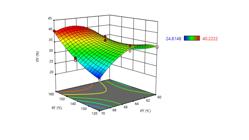
Response surface for oil yield. OY means oil yield. PT means press temperature. RT means roasting temperature.
As seen in Table 1, Oy varied from 20.53% to 43.52%, the highest oil yield from the design points was 43.52% and was obtained at the most extreme pressing conditions. This result is concordant with the one obtained by Crimaldi et al. (2017), who obtained the highest Oy of their design at the most extreme temperature conditions.
The optimal point selected from the model to use as working conditions to obtain the maximum oil extraction yield (Oy) was the one determined by a press temperature of 68.6 °C and a roasting temperature of 159.5 °C. As can be seen in Figure 1, there are several points that maximize extraction, but this was the chosen one because it was easily replicable in the conditions of the press. For these conditions, the model predicts an oil yield of 40.77%, and the experimental result was 45.59%. Further studies should be conducted regarding the oxidation of free fatty acids to determine the oil quality in the selected conditions.
3.2 Proximate composition of hemp seed and press cake
Results for the proximate composition of hemp seed and press cake are presented in Table 4. The values obtained for all the parameters analyzed for hemp seed and its press cake are consistent with the expected ranges (Siano et al., 2019). When the hemp seeds went through the pressing process, an ingredient significantly higher in fiber and protein was obtained, that is, the press cake. For this reason, the pressing process is not only of value because of the hemp seed oil extraction but because it results in a good option for the manufacturing of products, a source of fiber and protein.
3.3 Functional characterization of hemp seed and press cake
The EPC and NEPC of hemp seed and press cake, as well as antioxidant capacity, are shown in Table 5.
Extractable and non-extractable polyphenol content and antioxidant capacity of hemp seed and press cake.
According to Siano et al. (2019), the TPC (TPC=EPC+NEPC) as determined by Folin-Ciocalteu method after following the extraction process established by Vonapartis et al. (2015) of the seed was 0.767 mg GAE/g and 0.744 mg GAE/g for the press cake. They also semi-quantified polyphenols by Reversed Phase-High Performance Liquid Chromatography (RP-HPLC) and determined a total of 1.540 mg GAE/g for the seed and 1.078 mg GAE/g for the press cake. In the case of this study, TPC for the seed was 14.14 mg GAE/g and 19.2 mg GAE/g for the press cake. This difference could be explained by the difference in the extraction method. As stated by Pérez-Jiménez et al. (2008), differences in sample preparation, extraction of antioxidants and expression of results may vary between methods, leading to different results. Irakli et al. (2019) obtained for the Futura 75 hemp seed flour variety a TPC of 7.798 mg GAE/g; this value more closely resembles the one obtained in the present study for the same variety, and its difference could also be explained by the polyphenol extraction method.
Even though the TPC quantified is not comparable to the available studies, EPC can be compared, and the results obtained were in the same range. Current research does not usually take into consideration the NEPC, which is not significantly released during the salivary, gastric, or duodenal steps of digestion, nor does it get released during conventional extraction methods that are carried out with the use of organic solvents like methanol, ethanol, and acetone in aqueous solutions. To extract these polyphenols, protocols consisting of acid hydrolysis have to be applied. Whereas, in the case of human consumption, they do not get released and absorbed in the small intestine because of their bond with dietary fiber, and instead are carried out to the colon where they can be metabolized by the microbiota and some enzymes present there. This has been reported to result in positive health outcomes (Pérez-Jiménez et al., 2013).
Apart from that, EPC in the press cake was higher (p < 0.05) than in the hemp seed; this could be explained by the effect that the pressing process has on the structure of the food matrix, making the polyphenols initially present easier to extract when it comes to the press cake.
Furthermore, antioxidant capacity was significantly higher for the press cake in every case except for the non-extractable fraction as measured by the ABTS assay. The first result stated is concordant with the higher TPC. The exception could be explained firstly by the difference that exists between the two assays used to determine antioxidant capacity. They are both single electron transfer (SET) reactions and are usually used to determine hydrophilic compounds' antioxidant capacity, but ABTS can also detect some lipophilic antioxidants. Since the seed has a higher lipid content, this could explain why the ABTS assay detects a higher antioxidant capacity for the seed, but the FRAP assay does not (Pérez-Jiménez et al., 2008). Secondly, the fact that this was only observed for the non-extractable fraction could be explained because usually lipophilic antioxidants remain mostly bound to the fiber that remains in this fraction.
3.4 Characterization of hemp seed cookies
3.4.1 Nutritional value of functional cookies
As seen in Table 2, cookie formulations were developed to reach different nutritional claims according to EU guidelines (Regulation (EU) No 1047/2012). This approach has already been used in previous research (Presa-Lombardi et al., 2023). Its particularly important to reach nutritional claims in ready-to-eat products such as cookies, since these claims have been shown to influence the purchase intent for all types of consumers (Pinto et al., 2017)
Similar strategies have been reported with other cereal by-products. For instance, whole grain rice flours from traditional landraces (Kalanamak and Chak-hao) have been successfully incorporated into gluten-free cookies, improving their content of bioactive compounds and antioxidant capacity while maintaining desirable sensory attributes (Itagi et al., 2023). Likewise, the use of fermented rice bran enriched the nutritional profile of gluten-free cookies with higher protein, fiber, and phenolic content, besides extending shelf life and consumer acceptance (Christ-Ribeiro et al., 2021). These findings support the present study, showing that hemp press cake, like other agro-industrial by-products, can be effectively valorized as a functional ingredient in gluten-free baked goods.
Other studies have evaluated the use of hemp seeds in pasta (Teterycz et al., 2021 bread (Mikulec et al., 2019), and its influence on nutritional value. According to Mikulec et al. (2019) and Presa-Lombardi et al. (2023), the incorporation of hemp flour into ready-to-eat products shows clear limitations in terms of formulation. Both studies identified a threshold of approximately 30% in bread and 50% in snack bars, beyond which product quality begins to be negatively affected. When these levels are exceeded, undesirable changes occur in key parameters such as color, rheological behavior, and sensory attributes. These alterations not only compromise the technological performance of the dough or mixture but also reduce consumer acceptance significantly, highlighting the importance of balancing nutritional enrichment with the maintenance of desirable organoleptic properties (Mikulec et al., 2019; Presa-Lombardi et al., 2023). As one of the main limitations of this study is the lack of a sensory analysis, this threshold may be of particular importance.
3.4.2 Functional characterization of hemp seed cookies
EPC and NEPC of hemp fortified cookies, as well as antioxidant capacity, are shown in Table 6.
Extractable content (EPC) and non-extractable polyphenol content (NEPC), and antioxidant capacity of hemp seed and control cookies.
Results in the case of control cookies were the lowest (p < 0.05), which suggests that the addition of hemp seed press cake to the cookies may have a positive effect in the polyphenol content and antioxidant capacity.
Results obtained for antioxidant capacity of the extractable and non-extractable polyphenols were significantly different (p < 0.05) for all cookies except in the case of the FRAP assay for the extractable fraction of cookie A and cookie B. This result could be explained by the difference, which was previously mentioned, between the ABTS and the FRAP assay: the former is able to detect some lipophilic antioxidants that the latter is not. This could explain the reason why only this method resulted in a significant difference in TEAC (Total equivalent antioxidant capacity) of the B cookie in comparison to the A cookie, as cookie B has the highest lipid content of the three cookies studied (Pérez-Jiménez et al., 2008).
For the polyphenol content, the B cookie presented the highest content of EPC and NEPC, and it has a TPC of 14.3 mgGAE/g. The results indicate that the addition of a higher amount of press cake leads to an increase in the amount of TPC in the cookie. The B cookie also has the highest antioxidant capacity for the ABTS assay and the NEPC of the FRAP assay. These results are consistent with the ones reported by Ertaş & Aslan (2020).
3.5 Bioaccessibility of bioactive compounds of cookies
The content of antioxidant compounds in the cookies does not guarantee that they will be able to be absorbed and possibly result in health benefits. The in vitro digestion method used in this study allows for simulating a gastrointestinal human digestion and estimating the bioaccessibility of bioactive compounds, that is to say the amount of antioxidants that could be potentially absorbed by the intestine. Results for TPC and polyphenol bioaccessibility are shown in Table 7.
The B cookie was the one with higher TPC after the digestion, it has twice the TPC content of the C cookie. Therefore, cookie B is the one with the highest amount of bioaccessible polyphenols (Table 7).
However, cookie B was the one with the lowest bioaccessibility percentage. This could be explained by its high content of NEPC compared to cookies A and C (Table 6). Cookie B was formulated with the highest substitution of hemp seed press cake and therefore has the highest fiber content. Previous studies have proven that dietary fiber forms structures with polyphenols that are difficult to break during digestion, causing most of the polyphenols to remain in the pellet. This means that most of the polyphenols initially present in the cookie will not be available for absorption after digestion (Gutiérrez Barrutia et al., 2019; Quirós-Sauceda et al., 2014).
The polyphenol content that is not bioaccessible after going through the duodenum corresponds to the non-extractable fraction. It is bound to dietary fiber, and it is carried through the small intestine into the colon, where it can be metabolized by the gut microbiota, forming short chain free fatty acids (Pérez-Jiménez et al., 2013). Several studies have shown that these non-extractable compounds result in several health benefits, such as anti-inflammatory activity and a reduction of oxidative stress because of the effect of polyphenol-derived metabolites (Pérez-Jiménez et al., 2013).
In concordance with the TPC results, antioxidant capacity was significantly higher for the B cookie, making it the best option when it comes to the potential health benefits. Further investigation is needed regarding the bioavailability of the polyphenols, as well as sensory analysis to evaluate the acceptance of the cookie.
3 Limitations of the study
This study has certain limitations that should be acknowledged. First, although the functional properties of hemp press cake were evaluated in gluten-free cookies, no formal sensory analysis was conducted. This restricts the possibility of assessing consumer acceptance, which is essential for determining the potential of these formulations in real markets. Second, oil recovery under the chosen cold-pressing conditions was lower than yields typically obtained with solvent-based methods. Nevertheless, the decision to apply a solvent-free extraction was deliberate, aiming to minimize the use of hexane and other organic solvents that present environmental and toxicological concerns. In this regard, Cravotto et al. (2024) highlighted the importance of developing alternative green extraction strategies that move away from hexane in the food industry. Future research should therefore complement these findings with comprehensive sensory evaluation and further exploration of environmentally friendly extraction techniques to improve oil yield while maintaining safety and sustainability (Cravotto et al., 2024).
4 Conclusion
This study demonstrated that hemp seed oil can be obtained under optimized cold-pressing conditions using a solvent-free methodology, reaching acceptable yields while preserving the nutritional and functional qualities of the by-product. The resulting press cake proved to be a valuable ingredient for the formulation of gluten-free cookies, enhancing their protein, fiber, and bioactive compound content, as well as their antioxidant capacity after digestion. These results provide evidence that hemp by-products can be effectively valorized within a circular economy framework, contributing to the development of sustainable functional foods.
At the same time, the work highlights trade-offs between environmental considerations and technological performance, since solvent-free extractions achieve lower oil recovery than conventional solvent-based methods. Nevertheless, adopting greener approaches aligns with current demands to reduce the use of hexane in food processing and to minimize toxicological and ecological impacts.
Future studies should address sensory analysis to evaluate consumer acceptance and investigate alternative eco-friendly extraction strategies that could further improve oil yield without compromising safety or sustainability.
-
Cite as:
Coronel, S., González Costa, F., Sallé, L., Presa, J., Gutiérrez Barrutia, M. B., & Cozzano, S. (2026). Optimization of hemp seed oil extraction and functional testing of its by-product in gluten-free baked goods. Brazilian Journal of Food Technology, 29, e2025046. https://doi.org/10.1590/1981-6723.462025
-
Funding:
Agencia Nacional de Investigación e Innovación.
Data Availability Statement
All data generated or analyzed in this study are included in this published article.
References
- Association of Official Analytical Chemists – AOAC. (2012). Official methods of analysis of AOAC International (19th ed.). Gaithersburg: AOAC International.
-
Babiker, E. E., Uslu, N., Al Juhaimi, F., Mohamed Ahmed, I. A., Ghafoor, K., Özcan, M. M., & Almusallam, I. A. (2020). Effect of roasting on antioxidative properties, polyphenol profile and fatty acids composition of hemp (Cannabis sativa L.) seeds. Lebensmittel-Wissenschaft + Technologie, 133, 110537. https://doi.org/10.1016/j.lwt.2020.110537
» https://doi.org/10.1016/j.lwt.2020.110537 -
Babiker, E., Uslu, N., Al Juhaimi, F., Mohamed Ahmed, I., Ghafoor, K., Özcan, M., & Almusallam, I. (2021). Effect of roasting on antioxidative properties, polyphenol profile and fatty acids composition of hemp (Cannabis sativa L.) seeds. Lebensmittel-Wissenschaft + Technologie, 139, 110537. https://doi.org/10.1016/j.lwt.2020.110537
» https://doi.org/10.1016/j.lwt.2020.110537 -
Benzie, I., & Strain, J. (1996). The ferric reducing ability of plasma (FRAP) as a measure of “antioxidant power”: The FRAP assay. Analytical Biochemistry, 239(1), 70-76. PMid:8660627. https://doi.org/10.1006/abio.1996.0292
» https://doi.org/10.1006/abio.1996.0292 -
Beriziky, P., Cherkaoui, M., Linxe, L., Perrin, É., Rogniaux, H., Denery-Papini, S., Morisset, M., Larré, C., & Dijk, W. (2023). Hemp seed: A source of allergens with potential cross-reactivity with hazelnut. Food Research International, 169, 112932. PMid:37254358. https://doi.org/10.1016/j.foodres.2023.112932
» https://doi.org/10.1016/j.foodres.2023.112932 -
Çakaloğlu, B., Özyurt, V., & Ötleş, S. (2018). Cold press in oil extraction: A review. Ukrainian Food Journal, 7(4), 640-654. https://doi.org/10.24263/2304-974X-2018-7-4-9
» https://doi.org/10.24263/2304-974X-2018-7-4-9 -
Callaway, J. C. (2004). Hempseed as a nutritional resource: An overview. Euphytica, 140(1–2), 65-72. https://doi.org/10.1007/s10681-004-4811-6
» https://doi.org/10.1007/s10681-004-4811-6 -
Chemat, F., Vian, M. A., & Cravotto, G. (2012). Green extraction of natural products: Concept and principles. International Journal of Molecular Sciences, 13(7), 8615-8627. PMid:22942724. https://doi.org/10.3390/ijms13078615
» https://doi.org/10.3390/ijms13078615 -
Christ-Ribeiro, A., Mendes, N. S., Silva, L. B., Alencar, E. R., Steel, C. J., & Schmiele, M. (2021). Development of gluten-free cookies enriched with fermented rice bran: Physicochemical, technological, sensory, and shelf life evaluation. Food Bioscience, 44, 101432. https://doi.org/10.1016/j.fbio.2021.101432
» https://doi.org/10.1016/j.fbio.2021.101432 -
Cravotto, C., Fabiano-Tixier, A.-S., Bartier, M., Claux, O., & Tabasso, S. (2024). Green extraction of hemp seeds cake (Cannabis sativa L.) with 2-methyloxolane: A response surface optimisation study. Sustainable Chemistry and Pharmacy, 39, 101509. https://doi.org/10.1016/j.scp.2024.101509
» https://doi.org/10.1016/j.scp.2024.101509 -
Crimaldi, M., Faugno, S., Sannino, M., & Ardito, L. (2017). Canapa sativa L. mechanical oil extraction optimizations. Chemical Engineering Transactions, 58, 373-378. https://doi.org/10.3303/CET1758063
» https://doi.org/10.3303/CET1758063 - Da Porto, C., Decorti, D., & Tubaro, F. (2011). Fatty acids composition and oxidation stability of hemp (Cannabis sativa L.) seed oil extracted by supercritical carbon dioxide. Industrial Crops and Products, 33(2), 401-404. https://doi.org/10.1016/j.indcrop.2011.09.015
- Di Rienzo, J. A., Casanoves, F., Balzarini, M. G., González, L., Tablada, M., & Robledo, C. W. (2020). InfoStat versión 2020 Córdoba: Grupo InfoStat.
-
Ellen MacArthur Foundation. (2017). Ellen MacArthur Foundation: Economía circular – Concepto Retrieved in 2025, May14, from https://archive.ellenmacarthurfoundation.org/es/economia-circular/concepto
» https://archive.ellenmacarthurfoundation.org/es/economia-circular/concepto - Ertaş, N., & Aslan, M. (2020). Antioxidant and physicochemical properties of cookies containing raw and roasted hemp flour. Acta Scientiarum Polonorum. Technologia Alimentaria, 19(2), 177-184. PMid:32600014.
-
Faugno, S., Piccolella, S., Sannino, M., Principio, L., Crescente, G., Baldi, G., Fiorentino, N., & Pacifico, S. (2019). Can agronomic practices and cold-pressing extraction parameters affect phenols and polyphenols content in hempseed oil? Industrial Crops and Products, 130, 511-519. https://doi.org/10.1016/j.indcrop.2018.12.084
» https://doi.org/10.1016/j.indcrop.2018.12.084 -
Food and Agriculture Organization of the United Nations – FAO. (2023). FAOSTAT: Crops and livestock products (QCL), item: Hempseed (code 336) Rome. Retrieved in 2025, May14, from https://www.fao.org/faostat/en/#rankings/countries_by_commodity
» https://www.fao.org/faostat/en/#rankings/countries_by_commodity -
Georgé, S., Brat, P., Alter, P., & Amiot, M. J. (2005). Rapid determination of polyphenols and vitamin C in plant-derived products. Journal of Agricultural and Food Chemistry, 53(5), 1370-1373. PMid:15740008. https://doi.org/10.1021/jf048396b
» https://doi.org/10.1021/jf048396b -
Gutiérrez Barrutia, M., Curutchet, A., Arcia, P., & Cozzano, S. (2019). New functional ingredient from orange juice byproduct through a green extraction method. Journal of Food Processing and Preservation, 43(12), e13934. https://doi.org/10.1111/jfpp.13934
» https://doi.org/10.1111/jfpp.13934 -
Hollebeeck, S., Borlon, F., Schneider, Y. J., Larondelle, Y., & Rogez, H. (2013). Development of a standardized human in vitro digestion protocol based on macronutrient digestion using response surface methodology. Food Chemistry, 138(2-3), 1936-1944. PMid:23411328. https://doi.org/10.1016/j.foodchem.2012.11.041
» https://doi.org/10.1016/j.foodchem.2012.11.041 -
Irakli, M., Tsaliki, E., Kalivas, A., Kleisiaris, F., Sarrou, E., & Cook, C. (2019). Effect of genotype and growing year on the nutritional, phytochemical and antioxidant properties of industrial hemp (Cannabis sativa L.) seeds. Antioxidants, 8(10), 491. PMid:31627349. https://doi.org/10.3390/antiox8100491
» https://doi.org/10.3390/antiox8100491 - International Organization for Standardization – ISO. (1999). ISO 6492: Animal feeding stuffs: Determination of fat content. Geneva: ISO.
- International Organization for Standardization – ISO. (2002). ISO 5984: Animal feeding stuffs: Determination of crude ash. Geneva: ISO.
-
Itagi, H., Saxena, A., Singh, A., & Patel, A. R. (2023). Nutritional, bioactive, antioxidant and sensory properties of gluten-free cookies developed from pigmented traditional rice landraces (Kalanamak and Chak-hao). Lebensmittel-Wissenschaft + Technologie, 180, 114753. https://doi.org/10.1016/j.lwt.2023.114753
» https://doi.org/10.1016/j.lwt.2023.114753 -
Korus, J., Witczak, T., Ziobro, R., & Juszczak, L. (2017). Hemp (Cannabis sativa subsp. sativa) flour and protein preparation as natural nutrients and structure forming agents in starch-based gluten-free bread. Lebensmittel-Wissenschaft + Technologie, 84, 143-150. https://doi.org/10.1016/j.lwt.2017.05.046
» https://doi.org/10.1016/j.lwt.2017.05.046 -
Lachenmeier, D., Kroener, L., Musshoff, F., & Madea, B. (2004). Determination of cannabinoids in hemp products by use of headspace solid-phase microextraction and gas chromatography-mass spectrometry. Analytical and Bioanalytical Chemistry, 378(1), 183-189. PMid:14598006. https://doi.org/10.1007/s00216-003-2268-4
» https://doi.org/10.1007/s00216-003-2268-4 -
Lučan Čolić, M., Jukić, M., Nakov, G., Lukinac, J., & Antunović, M. (2024). Sustainable utilization of hemp press cake flour in ice cream production: Physicochemical, rheological, textural, and sensorial properties. Sustainability, 16(19), 8354. https://doi.org/10.3390/su16198354
» https://doi.org/10.3390/su16198354 -
Mikulec, A., Kowalski, S., Sabat, R., Skoczylas, Ł., Tabaszewska, M., & Wywrocka-Gurgul, A. (2019). Hemp flour as a valuable component for enriching physicochemical and antioxidant properties of wheat bread. Lebensmittel-Wissenschaft + Technologie, 102, 164-172. https://doi.org/10.1016/j.lwt.2018.12.028
» https://doi.org/10.1016/j.lwt.2018.12.028 -
Pérez-Jiménez, J., Arranz, S., Tabernero, M., Díaz-Rubio, M. E., Serrano, J., Goñi, I., & Saura-Calixto, F. (2008). Updated methodology to determine antioxidant capacity in plant foods, oils and beverages: Extraction, measurement and expression of results. Food Research International, 41(3), 274-285. https://doi.org/10.1016/j.foodres.2007.12.004
» https://doi.org/10.1016/j.foodres.2007.12.004 -
Pérez-Jiménez, J., Díaz-Rubio, M. E., & Saura-Calixto, F. (2013). Non-extractable polyphenols, a major dietary antioxidant: Occurrence, metabolic fate and health effects. Nutrition Research Reviews, 26(2), 118-129. PMid:23930641. https://doi.org/10.1017/S0954422413000097
» https://doi.org/10.1017/S0954422413000097 -
Pinto, V. R. A., Freitas, T. B. O., Dantas, M. I. S., Della Lucia, S. M., Melo, L. F., Minim, V. P. R., & Bressan, J. (2017). Influence of package and health-related claims on perception and sensory acceptability of snack bars. Food Research International, 101, 103-113. PMid:28941673. https://doi.org/10.1016/j.foodres.2017.08.062
» https://doi.org/10.1016/j.foodres.2017.08.062 -
Presa-Lombardi, J., García, F., Gutierrez-Barrutia, M. B., & Cozzano, S. (2023). Hemp seed’s (Cannabis sativa L.) nutritional potential for the development of snack functional foods. Oilseeds and Fats, Crops and Lipids, 30, 24. https://doi.org/10.1051/ocl/2023025
» https://doi.org/10.1051/ocl/2023025 -
Quirós-Sauceda, A. E., Palafox-Carlos, H., Sáyago-Ayerdi, S. G., Ayala-Zavala, J. F., Bello-Pérez, L. A., Álvarez-Parrilla, E., & González-Aguilar, G. A. (2014). Dietary fiber and phenolic compounds as functional ingredients: Interaction and possible effect after ingestion. Food & Function, 5(6), 1063-1072. PMid:24740575. https://doi.org/10.1039/C4FO00073K
» https://doi.org/10.1039/C4FO00073K -
Rabadán, A., Pardo, J., Gómez, R., & Álvarez-Ortí, M. (2018). Influence of temperature in the extraction of nut oils by means of screw pressing. Lebensmittel-Wissenschaft + Technologie, 93, 354-361. https://doi.org/10.1016/j.lwt.2018.03.061
» https://doi.org/10.1016/j.lwt.2018.03.061 -
Re, R., Pellegrini, N., Proteggente, A., Pannala, A., Yang, M., & Rice-Evans, C. (1999). Antioxidant activity applying an improved ABTS radical cation decolorization assay. Free Radical Biology & Medicine, 26(9-10), 1231-1237. PMid:10381194. https://doi.org/10.1016/S0891-5849(98)00315-3
» https://doi.org/10.1016/S0891-5849(98)00315-3 - European Union. (2006). Regulation (EC) No 1924/2006 of the European Parliament and of the Council of 20 December 2006 on nutrition and health claims made on foods. Official Journal of the European Union, Luxembourg.
-
Ruszkowska, M., Świtalski, M., Tańska, M., Rybicka, I., Miedzianka, J., Baranowska, H. M., & Kowalczewski, P. Ł. (2025). Sustainable protein fortification: Impact of hemp and cricket powder on extruded snack quality. Sustainability, 17(7), 3097. https://doi.org/10.3390/su17073097
» https://doi.org/10.3390/su17073097 -
Savoire, R., Lanoisellé, J., & Vorobiev, E. (2012). Mechanical continuous oil expression from oilseeds: A review. Food and Bioprocess Technology, 6(1), 1-16. https://doi.org/10.1007/s11947-012-0947-x
» https://doi.org/10.1007/s11947-012-0947-x -
Simopoulos, A. P. (2002). The importance of the ratio of omega-6/omega-3 essential fatty acids. Biomedicine & Pharmacotherapy = Biomédecine & Pharmacothérapie, 56(8), 365-379. https://doi.org/10.1016/S0753-3322(02)00253-6
» https://doi.org/10.1016/S0753-3322(02)00253-6 -
Siano, F., Moccia, S., Picariello, G., Russo, G. L., Sorrentino, G., Di Stasio, M., La Cara, F., & Volpe, M. G. (2019). Comparative study of chemical, biochemical characteristic and ATR-FTIR analysis of seeds, oil and flour of the edible fedora cultivar hemp (Cannabis sativaL.). Molecules, 24(1), 83. PMid:30591638. https://doi.org/10.3390/molecules24010083
» https://doi.org/10.3390/molecules24010083 -
Singleton, V. L., & Rossi Junior, J. A. (1965). Colorimetry of total phenolics with phosphomolybdic-phosphotungstic acid reagents. American Journal of Enology and Viticulture, 16(3), 144-158. https://doi.org/10.5344/ajev.1965.16.3.144
» https://doi.org/10.5344/ajev.1965.16.3.144 -
Teterycz, D., Sobota, A., Przygodzka, D., & Łysakowska, P. (2021). Hemp seed (Cannabis sativa L.) enriched pasta: physicochemical properties and quality evaluation. PLoS One, 16(3), e0248790. https://doi.org/10.1371/journal.pone.0248790
» https://doi.org/10.1371/journal.pone.0248790 -
Tomé-Sánchez, I., Martín-Diana, A., Peñas, E., Frias, J., Rico, D., Jiménez-Pulido, I., & Martínez-Villaluenga, C. (2021). Bioprocessed wheat ingredients: Characterization, bioaccessibility of phenolic compounds and bioactivity during in vitro digestion. Frontiers in Plant Science, 12, 790898. PMid:35003179. https://doi.org/10.3389/fpls.2021.790898
» https://doi.org/10.3389/fpls.2021.790898 -
Torrissen, M., Gisslevik, E., Gundersen, T. E., Bolstad, T., Eide, O., Rizzo, A. M., Clayton, P., & Robertson, C. (2025). Global variations in omega-3 fatty acid status and omega-6:omega-3 ratios: Insights from > 500,000 whole-blood dried blood spot samples. Lipids in Health and Disease, 24(1), 260. PMid:40783537. https://doi.org/10.1186/s12944-025-02676-6
» https://doi.org/10.1186/s12944-025-02676-6 -
Vodolazska, D., & Lauridsen, C. (2020). Hemp seed oil: Nutritional quality and health benefits. Journal of Food Composition and Analysis, 92, 103570. https://doi.org/10.1016/j.jfca.2020.103570
» https://doi.org/10.1016/j.jfca.2020.103570 -
Vonapartis, E., Aubin, M., Seguin, P., Mustafa, A., & Charron, J. (2015). Seed composition of ten industrial hemp cultivars approved for production in Canada. Journal of Food Composition and Analysis, 39, 8-12. https://doi.org/10.1016/j.jfca.2014.11.004
» https://doi.org/10.1016/j.jfca.2014.11.004 - Yusuf, K., Olaniyan, A., Atanda, E., & Sulieman, I. (2014). Effect of heating temperature and seed condition on the yield and quality of mechanically expressed groundnut oil. International Journal of Technology Enhancements and Emerging Engineering Research, 2(1), 73-78.
Edited by
-
Associate Editor:
Elizabeth H. Nabeshima.