 Psychometric properties of the Pittsburgh Fatigability Scale for assessing physical and mental fatigability in Brazilian older adults (PFS-Brasil)
Abstract
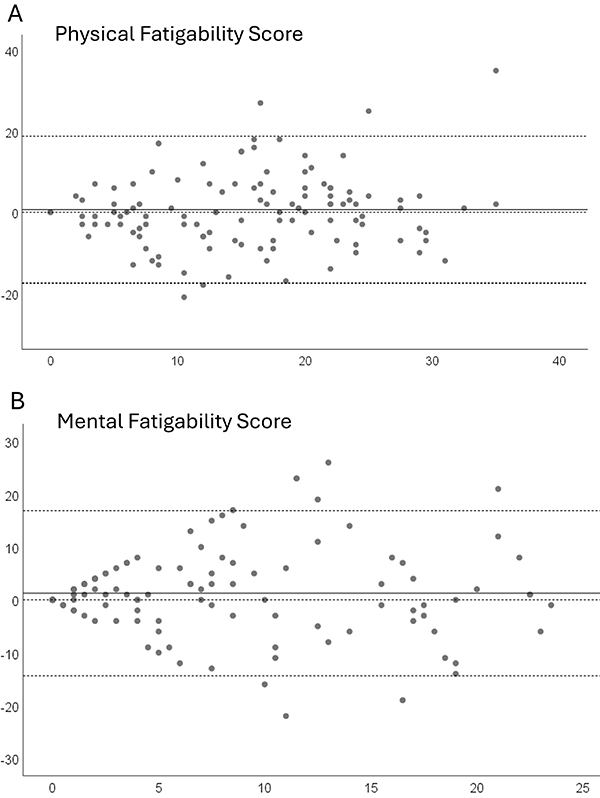
Fatigability is critical for understanding older adults' physical and mental health. The Pittsburgh Fatigability Scale (PFS) is widely employed to measure perceived fatigability, reflecting how fatigue impacts performance and its association with adverse health outcomes. This study aimed to evaluate the psychometric properties of the PFS adapted for Brazilian older adults (PFS-Brasil), focusing on perceived physical and mental fatigability. Confirmatory factor analysis (CFA) validated the bifactorial model. Internal consistency was assessed using Cronbach's alpha, while test-retest reliability was evaluated through the intraclass correlation coefficient (ICC) and Bland-Altman Plot. Convergent validity was determined by correlating PFS-Brasil score with physical and cognitive performance measures, and ceiling and floor effects were analyzed. CFA confirmed the two-factor structure of the PFS-Brasil. The Physical and Mental subscales showed high internal consistency (α=0.89 and 0.86, respectively). Test-retest reliability demonstrated good agreement (ICC for Physical=0.84; Mental=0.83). Higher fatigability score correlated with poorer physical performance on the Short Physical Performance Battery (SPPB) and the 6-Minute Walk Test (6MWT), with physical score showing weak to moderate correlations (P=-0.22 to -0.37) and mental score showing weak correlations (P=-0.20 to -0.25). Mental fatigability was weakly correlated with inhibitory control. The PFS-Brasil demonstrated robust psychometric properties, supporting its reliability and validity for assessing perceived physical and mental fatigue in older adults. Its use is recommended in clinical and research settings to identify individuals at risk of physical and psychological decline, promoting better health outcomes and quality of life in aging.
Fatigue; Older adults; Psychometric properties; Perceived fatigability; Quality of life; Assessment
 Thumbnail