 Entecavir: stability and drug-excipient compatibility
Abstract
Entecavir is an inhibitor of hepatitis B virus (HBV) DNA synthesis that has been widely prescribed in the treatment of chronic infections caused by the virus. Production of generic ETV drugs is an ongoing global endeavor, with particular significance for developing countries that rely on importing the expensive reference drug. ETV-excipient compatibility studies were conducted with the declared inputs in solid pharmaceutical formulations on the market through thermal analysis and HPLC techniques. Thermal analyses by TGA and DTA indicated compatibility of entecavir with the excipients microcrystalline cellulose, crospovidone, titanium dioxide, magnesium stearate, hypromellose, polyethylene glycol and povidone; this was confirmed via HPLC. Lactose monohydrate proved to be incompatible with ETV in thermal and chromatographic assays. The thermal analysis of marketed solid dosage forms revealed a predominance of the lactose monohydrate profile at the expense of ETV and other inputs in the TGA and DTA curves, due to its high content in the formulations; this makes the evidence of ETV-lactose chemical interaction even more important. Compatibility tests by HPLC showed no chemical interaction of ETV with the excipient mannitol, a soluble diluent proposed as a replacement for lactose monohydrate, with the same function in the formulation.
Keywords:
Entecavir; Stability; Drug-excipient compatibility; Thermal analysis; HPLC
INTRODUCTION
Entecavir (ETV) is an active pharmaceutical ingredient (API) used to combat hepatitis B virus (HBV), a hepadnavirus that causes acute and chronic liver infection. Hepatitis B is a major global health problem (WHO, 2018) with difficult diagnosis and treatment, as well as potentially fatal outcomes. ETV has been recommended and used in the treatment of the chronic form of the disease and its co-infections (Keating, 2011; EASL, 2009).
The first medicine containing ETV for the treatment of hepatitis B was approved in 2005, and since then the drug has shown great global relevance in treating the chronic form of the disease. Despite this, there are still gaps in the publication of drug stability studies, especially regarding API-excipient compatibility and kinetic calculations of degradation (Ramesh, Rao, Rao, 2014; Keating, 2011; EASL, 2009; FDA, 2005).
The API stability and API-excipient compatibility studies are particularly relevant because they allow us to understand the factors that interfere with the stability of a formulation as well as to elucidate possible ETV degradation routes and potential conditions that may promote product instability (Oliveira, Silva, Campos, 2016).
Through the application of compatibility studies to ETV and to formulations containing the API, this work proposes to contribute to the database that will assist in the development of potentially more stable solid formulations of the drug. The stability of ETV formulations must be given utmost importance, considering the therapeutic importance of this API, its added value and the onset of global production of generic drugs.
ETV: general and Brazilian overview
ETV was originally developed for the treatment of Herpes simplex viral infections, against which it had only moderate activity. Later, the drug was found to be a potent HBV polymerase inhibitor, with toxicity considered low. Clinical studies have shown that its efficacy is much greater than that of other nucleoside analogues such as lamivudine, zidovudine and adefovir, with low development of resistance in long-term patients (Keating, 2011; EASL, 2009; Christopher, William, Kirkpatrick, 2005).
In 2010, ETV became a recommendation of the Food and Drug Administration (FDA) for the treatment of chronic hepatitis B in patients with evidence of decompensated liver disease in the United States (FDA, 2010). In 2015, the drug was incorporated into the List of Essential Medicines of the World Health Organization (WHO), which lists safe and effective drugs and is an international influence in public health policies (WHO, 2017).
In Brazil, the Ministry of Health (MoH) included entecavir in the Clinical Protocols and Therapeutic Guidelines for the treatment of chronic viral hepatitis B and coinfections in 2011. ETV is available in Brazil in the form of pharmaceutical tablets, in 0.5 mg and 1 mg doses (Brazil, 2019a; Brazil, 2013; Brazil, 2011). According to the MoH’s Ambulatory Information System, there was a 430% yearly increase in the estimated number of daily doses of 0.5 mg entecavir (tablet) made available by the Brazilian Unified Health System, from 2011 to 2018. Brazil imports the high-cost reference drug Baraclude® (Brazil, 2019b), but a partnership was established with a national foundation for the production of a generic drug of 0.5 mg entecavir monohydrate (Brazil, 2012). The production of the Active Pharmaceutical Ingredient (API) was also assigned to a Brazilian pharmochemical facility, reducing costs and improving logistics for the free distribution of the drug. The generic drug was registered in Brazil in 2018 and is already produced on a large scale to meet government programs. It is dispensed to the population since 2020 (Sandes, 2020; FUNED, 2020; FUNED, 2018; Brazil, 2018; Brazil, 2013).
Drug characteristics
The chemical name of entecavir monohydrate is 2-amino-1,9-dihydro-9-[(1S,3R,4S)-4-hydroxy-3-(hydroxymethyl)-2-methylene-cyclopentyl]-6H-purine-6-one monohydrate. Its molecular formula is C12H15N5O3. H O and its relative molecular mass is 295.29 g.mol-1. The melting range is 249°C to 252°C. The drug is a white or off-white crystalline powder (Ph. Eur., 2016). Figure 1 shows its molecular structure.

Molecular structure of entecavir monohydrate, with chiral centers identified by the configuration of the isomer used as API (1S, 3R, 4S).
Entecavir monohydrate belongs to class III of the Biopharmaceutics Classification System (BCS). It presents high solubility and low permeability, the latter being the limiting step for the absorption of the drug in the body (Christopher, William, Kirkpatrick, 2005; Amidon et al., 2004).
ETV exhibits crystalline polymorphism, with several crystalline forms and one amorphous form having been identified. Thermogravimetric Analysis (TGA) showed that the active substance contains a water molecule of crystallization (EMA, 2018). Partial conversion into anhydrous ETV (considered an impurity) may occur during the production, distribution and storage processes of formulations containing ETV monohydrate (Liu et al., 2021).
The molecular structure of ETV has functional groups that, in theory, increase the drug’s vulnerability to chemical degradation. Primary alcohol (on chiral 4S carbon), in contact with an oxidizing agent, can be converted to aldehyde and carboxylic acid, while secondary alcohol (on chiral 3R carbon) can be converted to a ketone. The cyclic amide (lactam), in turn, can be catalyzed and undergo hydrolysis, generating carboxylic acid and amine (Solomons, Fryhle, Snyder, 2017). In addition to these reactions, the amino group present in ETV may have direct interactions with excipients. The reaction of the amino group with saccharides has already been reported in the literature (Barathe, Barathe, Bajaj, 2010).
Marketed ETV formulations
Medicines containing only ETV as API for the treatment of hepatitis B are presented in solid and liquid dosage forms: as coated tablets of 0.5 mg and 1.0 mg; and as an oral solution 0.05 mg.mL-1, respectively. Entecavir is also present in compound antiviral formulations, in association with other active ingredients (BMS, 2018; FUNED, 2019; EMA, 2015; FDA, 2010).
According to the manufacturer’s information, coated tablets of the reference drug Baraclude® have the following formulation: entecavir, lactose monohydrate, microcrystalline cellulose, crospovidone, povidone and magnesium stearate, in the core; titanium dioxide, hypromellose (HPMC), polyethylene glycol (macrogol) and polysorbate 80, in the coating (BMS, 2018). The generic drug produced in Brazil has the same formula, with the exception of the excipient polysorbate 80, which is not stated in the package insert (FUNED, 2019).
Drug-excipient compatibility study
The composition of a pharmaceutical formulation has direct effects on the stability and pharmacokinetic properties of the product, affecting the API’s bioavailability and, ultimately, its therapeutic action. Pharmaceutical inputs may also react with each other or make the environment favorable to certain chemical reactions including hydrolysis and oxidation, since they alter factors such as pH and the oxidizing power of the environment. It is essential to predict and control these interferences to prevent drug degradation and the formation of potentially harmful degradation products in the product (Rowe, Sheskey, Quinn, 2020; Silveira et al., 2018).
Compatibility studies between the components of a formulation are a decisive step to assess possible physicochemical incompatibilities and to propose more stable and safer formulations. Thermal analyses have many applications in this pharmaceutical field. Any incompatibilities observed in the TGA/DTA analysis must be confirmed by other analytical techniques; as such, the stress of samples in liquid medium with subsequent determination by High Performance Liquid Chromatography (HPLC) can be a valuable confirmation resource (Oliveira, Yoshida, Lima Gomes, 2011; Gabbott, 2008).
Thermogravimetric Analysis (TGA) and Differential Thermal Analysis (DTA) are particularly useful techniques in stability and API-excipient compatibility tests, presenting advantages over conventional study methods, such as faster analytical process, low sample consumption (a few milligrams are enough for analysis) and low cost (Gabbott, 2008).
The DTA curve shows the temperature difference between the sample and a reference material while both are exposed to a controlled temperature program; as such, it evidences the occurrence of events involving heat exchange (endothermic and exothermic processes). In DTA analysis, an API-excipient interaction can be identified through changes in the melting point and in the shape or area of peaks of the API, or through the appearance or disappearance of events in the curve after mixing the components (Silveira et al., 2018; Oliveira, Silva, Campos, 2016).
TGA measures the sample’s mass during a controlled atmosphere heating program and indicates mass variations as a function of temperature or time. Through the TGA technique, incompatibilities are perceived by changes in the speed and aspect of the API degradation process, which are clearer in the derivative curve, DrTGA. The derivative indicates the amount of mass varied by time interval and enables the observation of different stages of degradation (Silveira et al., 2018; Oliveira, Silva, Campos, 2016).
In API-excipient compatibility tests, HPLC is an adequate and reliable technique to determine the content of the active pharmaceutical ingredient after its contact with the evaluated excipients. This contact must be carried out under extreme conditions that favor the occurrence of these chemical reactions in a relatively brief period of time; to do so, the application of high temperatures and the use of a liquid medium can work as efficient catalysts for possible chemical interactions between the inputs. Eventual reductions in the API content after exposure indicate possible incompatibility with the evaluated excipient, and it is also possible to observe the formation of degradation products in the chromatogram.
MATERIAL AND METHODS
The reference chemical substance was purchased from the United States Pharmacopeial Convention (USP reference standard), lot R05700, with a purity of 99.89% in relation to entecavir monohydrate. The feedstock entecavir from MICROBIOLOGICA QUÍMICA FARMACÊUTICA LTDA was used in the tests as a secondary standard; the content declared by the manufacturer is 99.05% in relation to entecavir monohydrate (Brazil, 2017).
Compatibility study by thermal analysis
The tests were performed using the techniques of thermogravimetric analysis (TGA) and differential thermal analysis (DTA). The TGA and DTA curves were obtained in DTG-60 Shimadzu thermal analyzer, under controlled nitrogen atmosphere at a flow rate of 50 mL.min-1, with a heating rate of 10ºC.min-1, until the final temperature of 500°C. The equipment was previously calibrated with indium (melting point of 156.6ºC; ΔH of 28.54 J.g-1) and lead (melting point of 327.5ºC).
The selection of excipients for the compatibility tests considered the formulation declared by the manufacturers for coated tablets of entecavir (0.5 mg): the reference drug Baraclude® and the generic formulation developed in Brazil. With the exception of polysorbate 80, a liquid excipient at room temperature which is used in the coating of Baraclude® tablets, all excipients declared for solid formulations were evaluated, namely: microcrystalline cellulose, crospovidone, titanium dioxide, magnesium stearate, hypromellose, lactose monohydrate, polyethylene glycol and povidone. It is noteworthy that most of the excipients described are widely used in generic and similar ETV drugs marketed globally (FUNED, 2019; BMS, 2018).
The samples evaluated in the API-excipient compatibility tests by thermal analysis were: a) ETV; b) excipients of solid formulation; and c) binary mixtures in a 1: 1 ratio (m/m) of ETV and each excipient.
The amount used of each sample in performing the thermal tests was approximately five milligrams. The components of the binary mixtures, after individual weighing, were homogenized in a glass mortar, aiming to increase the probability of API-excipient interaction and obtain uniform mixtures.
The TGA/DTA curves were evaluated individually and by comparing isolated substances, binary mixtures, and multicomponent mixtures. The results were compared with the thermal profile of API and excipients described in the literature.
For the TGA curves, we measured variation in mass loss, the onset of degradation and the extent of API’s degradation along the heating program. The derivative curve, DrTGA, was used to elucidate the degradation process steps. In the DTA curves, events related to the melting range, the heat of fusion and the degradation range of ETV were estimated. The API-excipient interactions were evaluated from the variation of the thermal behavior of the API in each sample.
Compatibility study by HPLC
The HPLC tests were carried out in a Waters® brand equipment, provided with automation and diode array detector (UV-DAD) with peak purity feature, to facilitate the identification of degradation products and evidence possible coelutions.
Optimization and validation of HPLC analytical method
Based on selected methods in the literature and official compendia (USP, 2017; Yousaf et al., 2014; Satyanaryana et al., 2011), we made variations in the composition and proportion of the mobile phase, in the flow, in the sample injection volume, in the column used and in the column temperature. The preparation of standard ETV solutions was also studied, varying the API diluents between methanol, hydrochloric acid 0.01 M and water. All solutions showed the entecavir concentration of 20 µg.mL-1.
The criteria for defining the best chromatographic conditions were the analytical quality, measured by the chromatographic performance parameters, and the suitability of the method to the available analytical instrumentation.
The validation of the analytical method was performed with ETV (USP reference standard) and with samples of tablets containing ETV, through the parameters described in ICH Q2 (R1) and in ANVISA RDC N° 166/2017 (BRAZIL, 2017; ICH Q2 (R1), 2005).
To determine the linearity of the method, an analytical curve was prepared from five ETV solutions, in the concentration range of 14 µg.mL-1 to 26 µg.mL-1. These values refer to a range of 70% to 130% of the work concentration (20 µg.mL-1). Precision and accuracy were evaluated at concentrations of 14 µg.mL-1, 20 µg.mL-1 and 26 µg.mL-1 (low, medium and high, respectively). Limit of quantification, limit of detection, robustness and selectivity were also evaluated according to the parameters of the ICH Q2 (R1).
HPLC analysis of excipients and binary mixtures
All excipients evaluated by thermal analysis techniques were also submitted to HPLC analysis to confirm the observed results. We also evaluated in this step polysorbate 80 (PS80) and the excipient mannitol. Thus, the samples analyzed by HPLC were: a) ETV; b) excipients of solid formulation and mannitol; and c) binary mixtures in a 1: 1 ratio (m/m) of ETV and each excipient.
Dispersions of ETV, excipients and binary mixtures were prepared in a 1: 1 ratio, with a concentration of 20 µg.mL-1 (for each component). The samples were subjected to a temperature of 80°C in a water bath for four hours. ETV-excipient dispersions were prepared with two different diluents: HCl 0.01 M (API standard solution diluent) and distilled water, to assess the effect of pH on any chemical reactions observed.
The content of entecavir in the samples of binary mixtures after stress was compared with that of the API standard solution, through the area of the chromatographic bands. Thus, an eventual occurrence of API degradation due to chemical interaction between the inputs was investigated.
Thermal analysis of multicomponent mixtures
Marketed solid drugs containing ETV were submitted to the TGA and DTA techniques for the outline of the thermal profile and eventual comparison with the formulation inputs. Six batches of entecavir 0.5 mg in the form of coated tablets were obtained: three produced in 2015 (samples 1, 2 and 3) and three produced in 2020 (samples 4, 5 and 6), all from the same manufacturer. The samples were analyzed for general thermal profile, homogeneity between batches, and the thermal behavior of the formulation compared to ETV and the excipients present.
We conducted the tests using the same equipment and the analytical techniques and conditions described for the thermal analysis compatibility tests.
The pharmaceutical formulation tablets (multicomponent mixtures) were ground in a glass mortar before weighing.
RESULTS AND DISCUSSION
Compatibility study by thermal analysis
Thermal characterization of entecavir
Figure 2 shows the ETV TGA, DrTGA and DTA curves, analyzed separately. The first event of the TGA curve is observed in the range of 61.97°C to 107.84°C, where there is initial mass loss of 5.05%. At the same time, a long endothermic event with enthalpy variation (ΔH) of -133.25 J.g-1 can be seen in the DTA curve, in the same thermal range. Such events indicate the occurrence of dehydration, with potential loss of hydration water present in the API crystal, as reported by EMA (2018) and Kang et al. (2018). Therefore, there is a transition from the monohydrate form of entecavir (active molecule, present in the raw material) to its anhydrous form. It is also observed that, in the total mass of monohydrated ETV, the mass of the water molecule corresponds to 6.10%, a percentage close to the initial mass lost in the experiment.

Following the DTA curve, after dehydration, two events are observed: an isolated endothermic peak at 139°C; and an exothermic peak at 228°C, followed immediately by another endothermic event at 232°C. Previous literature (Liu et al., 2021) mentions the possibility of transition of the crystalline form of ETV at 137º C referring to changing of crystal structure for anhydrous ETV. Endothermic phase transition peaks are also reported at 136ºC and 243ºC (Kang et al., 2018; Liu et al., 2021), which may indicate that the endothermic peaks identified in the present work at 139ºC and 232ºC refer to phase transition events of the ETV.
Still in the DTA curve, it is possible to perceive an endothermic event between 296.99°C and 309.99°C, with ΔH of -147.33 J.g-1. This event was not accompanied by mass loss in the TGA curve and corresponds to ETV fusion, which is supported by earlier research which documented ETV fusion occurring at 296ºC (Liu et al., 2021). The experimental heat of fusion of the API was therefore -147.33 J.g-1.
Another exothermic event is observed in the DTA curve between 316.93°C and 362.96°C, with a heat of 224.13 J.g-1. In the same temperature range, the TGA curve records ETV mass loss (from 310.11°C), indicating that there was exothermic degradation of the API. Thus, we observed the end of the thermostability of the ETV and the beginning of its thermal decomposition, which continued until the end of the experiment (500°C).
Through DrTGA, it is possible to visualize a first typical mass loss started almost concomitantly with the end of the ETV fusion process, and whose end coincides with the end of the exothermic peak in the DTA curve (310.11°C to 363.30°C). Thus, it is inferred that the first stage of ETV degradation is exothermic and easy to identify, corresponding to a 15.75% reduction in API mass. Next, a new, longer mass loss step is seen in the curve derived up to the final temperature of the experiment (500°C). This second stage is endothermic, as seen through the DTA curve. The total mass loss of ETV by thermal degradation during the experiment was 42.13%.
To compare the degradation profile of ETV in binary and multicomponent mixtures, we analyzed the two stages of thermal decomposition recorded from 310.11°C to 500°C. However, our primary focus was on the exothermic stage (the first one), which has been completely finalized and can be used to identify the presence of ETV in samples combined with excipients.
Thermal analysis of excipients and binary mixtures
Table I presents the values found for the main thermal events of the isolated API sample and the API-excipient binary mixtures. The melting range and heat of fusion results refer to the ETV, in order to compare the thermal behavior of the API in each sample. The table also describes the initial temperature of mass loss by degradation observed during the TGA analyses.
The discussion on thermal events and possible API-excipient interactions is presented below, based on the thermal curves of ETV, the excipient and the respective binary mixture.
Binary mixtures with indication of API-excipient compatibility
The TGA/DTA curves of microcrystalline cellulose (Figure 3) showed the typical endothermic event of degradation reported in the literature for the excipient (Lima et al., 2014), from 304.97°C to 394.23°C. In the thermal curves of the binary mixture of microcrystalline cellulose and ETV (Figure 3), the main thermal events of ETV are maintained. There is an endothermic event between 63.18°C and 106.71°C in the DTA curve of the association (Figure 3), with a ΔH of 71.74 J.g-1. This value corresponds to about half of that observed for the isolated API (ΔH=-133.25 J.g-1), which is in line with the proportion of ETV in the 1: 1 mixture and corresponds to its dehydration. The proportional heat of fusion of the API is also observed in the DTA curve of the mixture, with a value of 64.23 J.g-1; the melting range did not change significantly (296.45°C to 307.59°C). Soon after, the beginning of the thermal degradation of the ETV is noticed through the TGA curve of the mixture from 308.07°C. The sample mass loss in the API typical degradation range (310.11°C to 500°C) was 47.89% and refers to the relative degradation of either ETV and cellulose, both occurring in this interval. Visually, the TGA/DTA curves of the binary mixture behave as a sum of the isolated curves of ETV and microcrystalline cellulose. As such, there was no evidence of chemical interaction between the API and the excipient and that both are probably compatible in the formulation.

TGA/DTA curves of entecavir (ETV), microcrystalline cellulose (CEL) and the respective 1: 1 binary mixture.
The thermal analysis of the binary mixtures of ETV with crospovidone, titanium dioxide and magnesium stearate also showed no evidence of API-excipient interaction. The API melting range, heat of fusion and the onset of degradation did not undergo any relevant variation when in a binary mixture with these excipients, as shown in Table I.
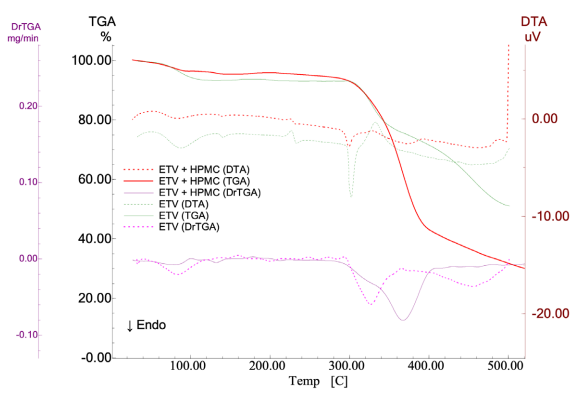
In the DTA curve of the binary mixture of entecavir and hypromellose (Figure 4), we noted that the initial events of isolated ETV curve were maintained for the mixture, with initial dehydration and peaks of possible crystal transitions. The API’s melting was observed, with a slight displacement in the melting range (295.04°C to 305.67°C). After that, it was not possible to identify the exothermic event typical of the thermal degradation of ETV, since the excipient also suffered decomposition in this temperature range. The DrTGA derivative feature was then applied to check if typical ETV degradation events are recorded in the binary association curve (Figure 5).

TGA/DTA curves of entecavir (ETV), hypromellose (HPMC) and the respective 1: 1 binary mixture.

TGA, DrTGA and DTA curves of entecavir (ETV) and the binary mixture of ETV and hypromellose (HPMC) in a 1: 1 ratio.
The DrTGA curve of ETV+hypromellose (Figure 5) allowed the visualization of the mass variation typical of the first stage of ETV degradation (from 310.11°C to 363.30°C), confirming the presence of ETV in the mixture up to this thermal range and demonstrating a probable absence of interaction chemistry with the excipient. This first mass change by degradation is followed by another almost continuous event in the derivative curve. This second event probably refers to the proportional degradations of both ETV (second stage) and hypromellose. There is an indication of ETV-hypromellose compatibility since the API degradation events were observed in the binary association and confirmed with the resource of the TGA derivative.
The binary mixtures of ETV with the excipients polyethylene glycol and povidone presented a behavior similar to that of hypromellose: the TGA/DTA curves allowed to partially distinguish the typical thermal profile of ETV, with small changes that made it necessary to apply the DrTGA curve for a better visualization of common events of the API. From the derivative curve, we could observe the exothermic degradation typical of ETV (first stage of thermal decomposition) and its general thermal profile, indicating compatibility between ETV and these excipients.
Hence, these were the excipients with indication of compatibility with ETV, according to TGA and DTA tests: microcrystalline cellulose, crospovidone, titanium dioxide, magnesium stearate, hypromellose, polyethylene glycol and povidone.
Binary mixture with indication of API-excipient incompatibility
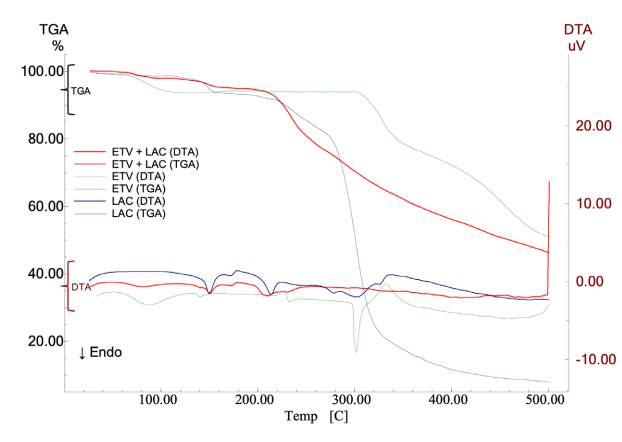
The TGA/DTA curves for lactose monohydrate (Figure 6) show several noteworthy thermal events. The thermogravimetric curve presents an initial mass loss of 2.82% between 143.41°C and 156.72°C, referring to the loss of hydration water of the excipient crystal. This loss can be evidenced by the endothermic event observed in the lactose DTA curve, from 143.36°C to 159.78°C, with ΔH of -88.43 J.g-1; both events were also reported by Listiohadi et al. (2009). Next, a discrete exothermic event is seen in the DTA curve between 175.23°C and 184.68°C, with a heat variation of 11.77 J.g-1. This event is potentially related to a crystal transition from α-lactose to βlactose, as reported by Pires (2016). In the range of 204.46°C to 222.34°C, another endothermic event can be noticed, with a heat of -90.23 J.g-1. This event refers to the fusion of the excipient and matches the literature reports (Silveira et al., 2018; Pires, 2016; Bertol et al., 2010). Finally, soon after melting, the excipient’s thermal degradation begins, with a loss of mass in the TGA curve from 223.05°C onwards. Two endothermic events related to lactose degradation are seen in the DTA curve, in the ranges from 272.28°C to 284.99°C and from 289.52°C to 315.22°C, as described by Silveira et al. (2018), Pereira et al. (2014), and Bertol et al. (2010).

As for the binary mixture (Figure 6), it is possible to notice in the DTA curve the initial endothermic event related to ETV dehydration, from 65.61°C to 106.67°C, with a proportional ΔH of -54.68 J.g-1. After that, it is not possible to identify the typical behavior of the API, such as the endothermic melting event or the exothermic degradation. For this reason, the DrTGA curve of the binary mixture was obtained and is represented in Figure 7.

TGA, DrTGA and DTA curves of entecavir (ETV) and the binary mixture of ETV and lactose monohydrate (LAC) in a 1: 1 ratio.
The DrTGA curve shows important signs of API-excipient interaction. Additionally, it did not reveal any mass variation associated with typical ETV degradation steps. Comparison with the entecavir derivative curve evidences the difference observed in the thermal behavior of the samples: a marked mass variation is only perceived in the typical degradation range of lactose and not in the temperature range of 310.11°C to 500°C, typical of API degradation. To confirm the possible chemical incompatibility observed for the ETV-lactose association, the results of the evaluation of the binary mixture by HPLC in liquid medium were also considered.
Compatibility study by HPLC
Optimization and validation of HPLC analytical method
The optimized method for determining entecavir by HPLC was developed from those described by Yousaf et al. (2014) and by the monograph of the product in the American Pharmacopoeia (USP, 2017), presenting the following chromatographic conditions: mobile phase of water and acetonitrile in the proportion 92: 8, flow of 1.0 mL.min-1, reverse phase column of octadecylsilane (C18), 30°C column temperature, 254 nm wavelength at the detector, and 50 µL sample injection volume. The diluent for the ETV samples was HCl 0.01 M.
The method is simple and the validation process presented good analytical quality and suitability for determining ETV in solid pharmaceutical formulation. The optimization presented the following results: retention factor (k’) of 1.76; asymmetry or tail factor (T) of 0.78; and number of theoretical plates (N) of 12800 plates/column. For validation, the following results were obtained: linear correlation coefficient (r) for linearity equal to 0.99995; repeatability and intermediate precision with relative standard deviation (RSD) less than 1%; accuracy with recovery close to 100% and with RSD less than 1%; detection limit of 0.075 µg.mL-1; quantification limit of 0.228 µg.mL-1; adequate robustness after changing the flow, the temperature and the composition of the mobile phase, with a RSD of 0.19% between analyses of the same sample; and adequate selectivity, without interference of matrix components in the analysis.
HPLC analysis of excipients and binary mixtures
Table II shows the results of compatibility tests by HPLC, after submitting the dispersions to a temperature of 80°C in a water bath for 4 hours.
In general, the results corroborate those obtained with thermal analysis. Binary mixtures with the excipients microcrystalline cellulose, crospovidone, titanium dioxide, magnesium stearate, hypromellose, polyethylene glycol and povidone showed no reduction in the ETV content after stress with any of the diluents (HCl 0.01 M and distilled water). Therefore, such excipients are compatible with ETV and can be safely used in solid pharmaceutical formulations containing the API.
In the association of ETV with polysorbate 80, there was also an important reduction in the API content after stress, for both samples (neutral and acidic). This should be factored in, as it indicates a possible API-excipient incompatibility. However, it is noteworthy that polysorbate 80 is only used in coating of tablets of the ETV reference drug, in an undeclared amount (in general, the percentage for use in this function would be reduced, less than 0.2%) (Gautier et al., 2000). In the HPLC study, the excipient was compared in a maximized way at a ratio of 1: 1, in direct contact with the ETV in a liquid medium, both solubilized, and with an accelerated degradation process at a temperature of 80°C for 4 hours. Thus, the degradation observed in the present experiment would have a reduced aspect in the medicine, since in the tablet the excipient is used only in the coating step (which reduces direct contact with the drug), in addition to being used in low proportion in relation to ETV and having a solid pharmaceutical form at the end of the process. Thus, it is only considered that ETV may have problems with the excipient depending on the contact, proportion, and type of dosage form.
In the binary mixture ETV+lactose monohydrate, there was API degradation in both solutions diluted in distilled water and in those diluted in HCl 0.01 M, confirming the incompatibility indicated by the TGA and DTA techniques. There was a greater loss of ETV content in the solution prepared with acid, which indicates the influence of pH on the chemical interaction between the inputs.
The chemical interaction observed between lactose and ETV can be associated with the Maillard reaction, reported in the literature (Barathe, Barathe, Bajaj, 2010). In this reaction, molecules with amino groups, such as ETV, react with reducing saccharides in a series of steps that lead to the formation of chemically different products from the reacting substances; in the case of drugs, there may be significant degradation of the active principle, which configures the occurrence of chemical incompatibility (Barathe, Barathe, Bajaj, 2010). Although other techniques would be necessary to confirm the API-excipient incompatibility, as the events occur at high temperatures and stressing conditions, the results obtained suggest replacing lactose monohydrate by other soluble diluents in solid formulations containing entecavir.
Proposed excipient for solid pharmaceutical formulation: mannitol
In view of the incompatibility verified between ETV and lactose monohydrate, mannitol was proposed and submitted to compatibility analysis by HPLC, considering it has the same function in the formulation (soluble diluent).
After stress in a liquid medium at 80°C for 4 hours, the final content of entecavir in the binary mixture sample was 100.39% when dissolved in HCl 0.01 M and 99.25% when dispersed in distilled H2O. Therefore, there was no API degradation and the association between ETV and mannitol was proved compatible.
Diluents have a direct influence on the release of API in the human body and make up the majority of a solid formulation. Its compatibility with the active ingredient is essential to ensure the quality and safety of the product (Oliveira, Yoshida, Lima Gomes, 2011). Mannitol is a diluent widely used in industry as a soluble diluent (Sena et al., 2014); as such, the results demonstrate its use as an alternative excipient to lactose in solid entecavir medicines.
When changing a pharmaceutical formulation by replacing lactose with mannitol, there should be special care to the physical form of mannitol used (powder or granulated) and its particle size. This is necessary due to the different flow and compressibility typical of mannitol compared to lactose, which impact the manufacturing process.
Thermal analysis of multicomponent mixtures
General profile and uniformity of samples of the marketed formulation
The TGA/DTA curves obtained for the multicomponent mixtures (old and new pharmaceutical formulations) are shown in Figure 8.

TGA/DTA curves of marketed pharmaceutical formulations, produced in 2015 (1, 2 and 3) and in 2020 (4, 5 and 6).
All formulations are very similar to each other in terms of temperature range and characteristic of each observed thermal event, differing only in the intensity with which they occurred. Samples 4 and 5 (produced in 2020) show events quantitatively less intense in the DTA curve than the 2015 samples (1, 2 and 3) and more intense than those seen in the curve of sample 6 (also from 2020). In general, it is possible to observe a degree of homogeneity in the TGA/DTA curves of the different samples; it is noteworthy that all refer to the formulation of the same laboratory and this, added to the high uniformity observed, explains the proximity between the curves.
Thermal characterization of entecavir’s pharmaceutical formulation
The TGA/DTA curves of samples 2 and 4, representative of the different years of production, were compared with those of the ETV in Figure 9. The comparison is intended to compare the thermal events of the formulation with those typical of the API.

At first observation, the behavior of the formulation samples does not reflect the thermal profile shown by the isolated ETV curve. The events related to the fusion and degradation of entecavir are not visualized in the DTA curve of any of the evaluated formulations, as well as the loss of mass by degradation presents distinct patterns in the TGA curves of the API and of the multicomponent mixtures.
It is conducive to evaluate the thermal behavior of samples 2 and 4 also in light of the events observed for the non-active inputs of the formulation. In the DTA curve of the samples, an accentuated endothermic event is noted between 128.33°C and 156.04°C. A slight reduction in the mass of formulation samples (above 2%) is also perceived in this temperature range, through the TGA curve. Among the events perceived for the formulation excipients at close temperature ranges, the dehydration of lactose monohydrate stands out. There is a hypothesis that the initial events of the multicomponent mixtures curves are related to the loss of hydration water present in the lactose crystal.
Between the range of 164.60°C and 174.23°C, a discrete endothermic event occurs in the DTA curve of the formulations, followed immediately by an exothermic peak between 173.51°C and 185.57°C. A similar event also occurred in the lactose DTA curve (Figure 6), showing the eventual exothermic transition from α-lactose crystals to βlactose crystals (Pires, 2016). There is a strong probability that these events are interconnected, which shows the typical thermal behavior of lactose in the samples curve.
There is another accentuated endothermic event in the DTA curve of samples 2 and 4, from 201.73°C to 222.60°C, with an enthalpy variation of -89.91 J.g-1 (referenced by sample 2). Once again, there is a possible correlation with the thermal profile of lactose, since in this temperature range the excipient melts, with a similar ΔH value (90.23 J.g-1). Finally, the onset temperature of thermal degradation in the TGA curve is also similar for the formulations and the lactose (around 220°C), with a respective discrete endothermic peak at 304.07°C in the DTA curves of sample 2 and of the excipient.
Figure 10 shows the TGA/DTA curves for pharmaceutical formulations 2 and 4 compared to the isolated curve of lactose monohydrate, for better visualization of the events covered in the discussion.

Lactose monohydrate is used as a diluent and is present in a high percentage in the studied pharmaceutical formulation (about 80% of the tablet mass). It is a likely explanation for the similarity of curves to the individual thermal behavior of lactose.
There are some considerations to be made regarding the absence of the typical thermal profile of ETV in the TGA/DTA curves of the pharmaceutical formulation. The relative amount of API in the tablets is very small, about 0.17% (calculated from the average weight of 0.5 mg ETV tablets); this makes events related to higher proportions components more visible to the detriment of events corresponding to ETV. In addition, certain excipients melt before the drug’s melting range, such as lactose and polyethylene glycol, which can cause the solubilization of ETV in the liquefied mass and prevent visualization of the API melting peak in the mixture. Finally, possible APIexcipient incompatibilities can lead to the non-appearance of thermal events typical of ETV in the thermal curves of the formulation, which is also a factor to be considered when interpreting the results. In this context, the interactions detected between ETV and lactose in the compatibility tests are even more relevant, especially in light of the HPLC studies, which corroborate the existence of incompatibility between the substances (Silveira et al., 2018).
CONCLUSIONS
Thermal analysis by TGA and DTA indicated no chemical interactions of ETV with microcrystalline cellulose, crospovidone, titanium dioxide, magnesium stearate, hypromellose, polyethylene glycol and povidone. HPLC tests confirmed the compatibility of ETV with these excipients, confirming they are suitable for use in solid formulations of entecavir.
The TGA/DTA curves showed evidence of chemical incompatibility between ETV and lactose monohydrate, with an important change in the thermal profile of the API when in association with the excipient. In the HPLC confirmation assay, ETV content was reduced after stress of the binary mixture. Thus, the chemical interaction between the inputs was attested, with consequent degradation of ETV.
Even if a drug has a content that is within that specified by the manufacturer at the end of two years (which is the established expiration date), there should be special care to the importance of lactose replacement. The presence of lactose may, at some point, accelerate the degradation of ETV, whether through exposure to light, heat, inadequate packaging, inadequate manufacturing process or inadequate storage. Therefore, it is recommended to replace lactose as a form of prevention and care for product stability.
We suggest replacing lactose monohydrate with mannitol in solid formulations of entecavir. Mannitol is a soluble diluent widely used in industry and has shown compatibility with ETV in the HPLC compatibility test. This substitution of lactose for mannitol in pharmaceutical formulations containing ETV also meets current requirements for lactose intolerant individuals. Mannitol has often been the excipient of choice in this exchange with lactose, and it has also shown to be more suitable for the stability of formulations with ETV.
Thermal analyses with marketed medicines containing ETV revealed uniformity between the evaluated formulations. There were no relevant changes in the thermal profile over time when comparing the batches produced in 2015 and 2020. There was a predominance of the thermal profile of lactose monohydrate in the TGA/DTA curves of the multicomponent mixtures, due to its use as a soluble diluent in the formulations (presence in high percentage). This reinforces the importance of replacing lactose with a compatible soluble diluent.
ACKNOWLEDGEMENTS
The authors thank the Espirito Santo Research Foundation (Fundação de Amparo à Pesquisa e Inovação do Espírito Santo - FAPES) and the National Council for Scientific and Technological Development (Conselho Nacional de Desenvolvimento Científico e Tecnológico - CNPq) for their financial support.
REFERENCES
- Amidon GL, Kasim NA, Whitehouse M, Ramachandran C, Bermejo M, Lennernas H, et al. Molecular Properties of WHO Essential Drugs and Provisional Biopharmaceutical Classification. Mol Pharm. 2004; 1(1): 85-96.
- Barathe SS, Barathe SB, Bajaj AN. Interactions and incompatibilities of pharmaceutical excipients with active pharmaceutical ingredients: a comprehensive review. J Excip Food Chem. 2010; 1: 3-26.
- Bertol CD, Cruz AP, Stulzer HK, Murakami FS. Thermal decomposition kinetics and compatibility studies of primaquine under isothermal and non-isothermal conditions. J Therm Anal Calorim. 2010; 102(1): 187-192.
-
BMS - Bristol-Myers Squibb. 2018. Leaflet for the healthcare professional: Baraclude® coated tablets. Available at: <Available at: https://www.bms.com/assets/bms/brazil/documents/hcp/bulas-profissionais-otimizadas/BARACLUDE_COMP_VPS_Rev0918.pdf >. Accessed: 15 dec. 2022.
» https://www.bms.com/assets/bms/brazil/documents/hcp/bulas-profissionais-otimizadas/BARACLUDE_COMP_VPS_Rev0918.pdf - Brazil. Ministry of Health. 2011. Law No. 12,401, of April 28, 2011. Official Gazette, Brasilia.
- Brazil. Ministry of Health. 2012. Ordinance No. 837, of April 18, 2012. Official Gazette, Brasilia.
- Brazil. Ministry of Health. 2013. Ordinance No. 3,089, of December 11, 2013. Official Gazette, Brasilia.
- Brazil. National Health Surveillance Agency. 2017. Resolution RDC No. 166, of July 24, 2017. Official Gazette, Brasilia.
- Brazil. National Health Surveillance Agency. 2018. Resolution RDC No. 1465, of June 7, 2018. Official Gazette, Brasilia.
- Brazil. Ministry of Health. Secretariat of Science, Technology and Strategic Inputs. Department of Pharmaceutical Services and Strategic Inputs. 2019a. National List of Essential Medicines: RENAME 2020. Brasilia: Ministry of Health.
- Brazil. Ministry of Economy. Council for Monitoring and Evaluation of Public Policies. Evaluation Report of the Specialized Component of Pharmaceutical Services (CEAF). Cycle 2019. Brasilia: Ministry of Economy. 2019b.
- Christopher KO, William ML, Kirkpatrick P. Entecavir Nat Rev Drug Discov. 2005; 4(7): 535-539.
- EASL (European Association for the Study of the Liver) Clinical Practice Guidelines: Management of chronic hepatitis B J Hepatol. 2009; 50(2): 227-242.
- EMA - European Medicine Agency. Committee for Medicinal Products for Human Use (CHMP). Entecavir film-coated tablets 0.5 and 1 mg, oral solution 0.05mg/ml product-specific bioequivalence guidance. London: European Medicines Agency. 2015.
- EMA - European Medicine Agency. Committee for Medicinal Products for Human Use (CHMP). Assessment report: Entecavir Accord European Medicines Agency: London. 2018.
-
FDA - Food and Drug Administration. Center for Drug Evaluation and Research. Drug Approval Package: Baraclude (Entecavir) Film Coated Tablets & Oral Solution. 2005. Available at: <Available at: https://www.accessdata.fda.gov/drugsatfda_docs/nda/2005/21797_21798_BaracludeTOC.cfm >. Accessed: 07 may 2022.
» https://www.accessdata.fda.gov/drugsatfda_docs/nda/2005/21797_21798_BaracludeTOC.cfm -
FDA - Food and Drug Administration. Center for Drug Evaluation and Research. Baraclude (entecavir) oral solution label. 2010. Available at: <Available at: https://www.accessdata.fda.gov/drugsatfda_docs/label/2010/021797s011lbl.pdf >. Accessed: 18 mar. 2022.
» https://www.accessdata.fda.gov/drugsatfda_docs/label/2010/021797s011lbl.pdf -
FUNED - Fundação Ezequiel Dias. Entecavir. 2018. Available at: <Available at: http://www.funed.mg.gov.br/2018/10/parque-industrial/entecavir/ >. Accessed: 26 apr. 2021.
» http://www.funed.mg.gov.br/2018/10/parque-industrial/entecavir/ -
FUNED - Fundação Ezequiel Dias. Package leaflet for the health professional: entecavir monohydrate (Generic Drug, Law No. 9,787/1999) 0.5 mg. 2019. Available at: <Available at: http://www.funed.mg.gov.br/wp-content/uploads/2019/10/Bula-entecavir-monoidratado-para-o-profissional-de-sa%C3%BAde.pdf >. Accessed: 15 dec. 2021.
» http://www.funed.mg.gov.br/wp-content/uploads/2019/10/Bula-entecavir-monoidratado-para-o-profissional-de-sa%C3%BAde.pdf -
FUNED - Fundação Ezequiel Dias. Funed makes the first delivery of entecavir to the Ministry of Health. 2020. Available at: <Available at: http://www.funed.mg.gov.br/2020/05/geral/funed-realiza-primeira-entrega-do-entecavir-ao-ministerio-da-Lsaude/#:~:text=Funed%20realiza%20primeira%20entrega%20do%20Entecavir%20ao%20Minist%C3%A9rio%20da%20Sa%C3%BAde,-Funed%20desenvolve%2C%20registra&text=A%20Funda%C3%A7%C3%A3o%20Ezequiel%20Dias%20(Funed,da%20Hepatite%20B%20(VHB) >. Accessed: 14 july 2021.
» http://www.funed.mg.gov.br/2020/05/geral/funed-realiza-primeira-entrega-do-entecavir-ao-ministerio-da-Lsaude/#:~:text=Funed%20realiza%20primeira%20entrega%20do%20Entecavir%20ao%20Minist%C3%A9rio%20da%20Sa%C3%BAde,-Funed%20desenvolve%2C%20registra&text=A%20Funda%C3%A7%C3%A3o%20Ezequiel%20Dias%20(Funed,da%20Hepatite%20B%20(VHB) - Gabbott P. Principles and applications of thermal analysis. Oxford: Blackwell Publishing. 2008. 464 p.
- Gautier JC, Abramovici B, Boulenc X, Vilain P. Pharmaceutical formulation, and process for their preparation. Depositor: Sanofi-Synthelabo. Attorney: Momsen, Leonardos & Cia. FR n. PI 9807406-7A2. Deposit: 17 fev. 1998. Publication: 14 mar. 2000.
-
ICH Q2 (R1) - International Conference on Harmonization of Technical Requirements for the Registration of Drugs for Human Use. 2005. Validation of analytical procedures: text and methodology Q2(R1). Available at: <Available at: http://www.ich.org/LOB/media/MEDIA417.pdf >. Accessed: 05 may 2019.
» http://www.ich.org/LOB/media/MEDIA417.pdf - Kang Y, Shao Z, Wang Q, Hu X, Yu D. Quantitation of polymorphic impurity in entecavir polymorphic mixtures using powder X-ray diffractometry and Raman spectroscopy. J Pharm Biomed Anal. 2018; 158: 28-37.
- Keating GM. Entecavir: A review of its use in the treatment of chronic hepatitis B in patients with decompensated liver disease. Drugs, Springer International Publishing, 2011; 71(18): 2511-29.
- Lima NGPB, Lima IPB, Barros DMC, Oliveira TS, Raffin FN, Moura TFAL et al. Compatibility studies of trioxsalen with excipients by DSC, DTA, and FTIR. J Therm Anal Calorim. 2014; 115(3): 2311-2318.
- Listiohadi Y, Hourigan JA, Sleigh RW, Steele RJ. Thermal analysis of amorphous lactose and α-lactose monohydrate. Dairy SciTechnol. 2009; 89(1): 43-67.
- Liu M, Shi P, Wang G, Wang G, Song P, Liu Y, et al. Quantitative analysis of binary mixtures of entecavir using solid-state analytical techniques with chemometric methods. Arab J Chem. 2021; 14(10): 103360.
- Oliveira MA, Yoshida MI, Lima Gomes EL. Thermal analysis applied to drugs and pharmaceutical formulations in the pharmaceutical industry. Quim Nova. 2011; 34(7): 1224-1230.
- Oliveira MA, Silva GD, Campos MST. Chemical degradation kinetics of fibrates: bezafibrate, ciprofibrate and fenofibrate. Braz J Pharm Sci. 2016; 52(3): 545-553.
- Pereira MAV, Fonsêca GD, Silva Júnior AA, Pedrosa MFF, Moura MFV, Barbosa EG, et al. Compatibility study between chitosan and pharmaceutical excipients used in solid dosage forms. J Therm Anal Calorim. 2014; 116(2): 1091-1100.
- Ph. Eur. (European Pharmacopoeia). 9. ed. Strasbourg: European Department for Quality of Medicines. 2016.
- Pires SA. 2016. Compatibility studies of the drugs fenofibrate, ciprofibrate and citalopram with some excipients. Tese (PhD in Sciences - Chemistry) - Federal University of Minas Gerais.
- Ramesh T, Rao PN, Rao RN. LC-MS/MS method for the characterization of the forced degradation products of Entecavir. J Sep Sci. 2014; 37(4): 368-375.
- Rowe RC, Sheskey PJ, Quinn ME. Handbook of Pharmaceutical Excipients. 2020. 9. ed. Pharmaceutical Press: London.
-
Sandes T. Fiocruz produces the country’s first generic for hepatitis B. Portal Fiocruz. 2020. Available at: <Available at: https://portal.fiocruz.br/noticia/fiocruz-produz-primeiro-generico-do-pais-para-hepatite-b >. Accessed: 15 dec. 2022.
» https://portal.fiocruz.br/noticia/fiocruz-produz-primeiro-generico-do-pais-para-hepatite-b - Satyanaryana L, Naidu SV, Rao MN, Priya LR, Suresh K. The estimation of entecavir in tablet dosage form by RP-HPLC. Res J Pharm Technol. 2011; 4(11): 1699-1701.
- Sena LCS, Santos JLA, Andrade PHS, Brito GC, Lira AAM, Lobo IMF. Pharmaceutical excipients and their health risks: a literature review. Rev Bras Farm Hosp Serv Saúde. 2014; 5(4): 25-34.
- Silveira LM, Fiorot AB, Xavier TP, Yoshida MI, Oliveira MA. Drug-excipient compatibility assessment of solid formulations containing meloxicam. Eur J Pharm Sci. 2018; 112: 146-151.
- Solomons TWG, Fryhle CB, Snyder SA. 2017. Organic Chemistry. 12 ed. 1208 p. Nova Iorque: Softcover Wiley & Sons Ltda.
- USP (United States Pharmacopoeia). 2017. 40. ed. Rockville: United States Pharmacopeial Convention.
-
WHO - Worlds Health Organization. WHO Model Lists of Essential Medicines. 2017. Available at: <Available at: https://www.who.int/medicines/publications/essentialmedicines/en/ >. Accessed: 05 may 2022.
» https://www.who.int/medicines/publications/essentialmedicines/en/ -
WHO - Worlds Health Organization. Hepatitis B. 2018. Available at: <Available at: https://www.who.int/en/news-room/fact-sheets/detail/hepatitis-b >. Accessed: 05 may 2022.
» https://www.who.int/en/news-room/fact-sheets/detail/hepatitis-b - Yousaf AM, Jee JP, Hwang SR, Maeng HJ, Park YJ, Kim JO, et al. Development of direct compression entecavir 0.5 mg-loaded tablet exhibiting enhanced content uniformity. Powder Technol. 2014; 267: 302-308.

 Source: Adapted from