 Clobetasol brazilian pilot study: the vasoconstrictor assay over time
Abstract
The vasoconstrictor assay (VCA) has been internationally recognized as a reliable method to evaluate the bioequivalence of topical corticosteroids. The FDA has recommended its use since 1995 and ANVISA began to require this assay in 2022 (RDC no. 742/22). The objective of this study was to compare results from two VCA pilot studies, using two Konika Minolta® instruments and two different estimation methods. The Emax and ED50 parameters were obtained using a nonlinear mixed effect model and least squares fit using a Gauss-Newton algorithm. Regardless of the equipment or the fitting methods, similar Emax and ED50 were obtained. However, both parameters were different when comparing the assays performed from different batches of the same reference list drug (RLD) and procedures from the different guides. Added to this, the tests were carried out at different times and in different seasons. In the VCA pilot study, estimating the ED50 is essential to determine the D1 and D2 (shorter and longer dose duration reference standard calibrator) to be used in the pivotal bioequivalence study. The diversity of the Brazilian population and the lack of experience to perform the procedure represent major challenges for the implementation of this test.
Keywords:
Vasoconstrictor Assay; Topical corticosteroids; Bioequivalence; Bioavailability; Topical drugs; ANVISA.
INTRODUCTION
The main methods for evaluating topical bioavailability and bioequivalence (BA/BE) can be divided into in vitro and in vivo approaches. The in vitro methods, between the in vitro release test (IVRT) and in vitro permeation test (IVPT) compare drug release from a test and reference dosage form and drug permeation into the skin, respectively, whereas in vivo studies involve clinical trials, pharmacodynamic studies, such as the vasoconstrictor assay (VCA) (FDA, 1995), dermatopharmacokinetics (DPK) (EMA, 2018), dermal microdialysis (Herkenne et al., 2008; Shukla et al., 2014), open flow microperfusion (Bodenlenz et al., 2017), confocal Raman spectroscopy (Iliopoulos et al., 2020), amongst others.
Although clinical trials are considered to be the “gold standard” to assess BE of extravascular dosage form, clinical studies to demonstrate bioequivalence of topical dermatological products, which are NOT intended to be absorbed into the systemic circulation, are considered to be the least accurate, least sensitive and least reproducible of the general approaches for measuring bioavailability to establish bioequivalence for such products. Furthermore, clinical endpoint studies are time-consuming, expensive, and require large numbers of subjects (USA, 2023). In contrast, the VCA is relatively easy to perform and uses a smaller number of participants. This assay is widely accepted by most global regulatory agencies (FDA, 1995; Zvidzayi et al., 2021; Aayushi et al., 2016), despite some negative opinions about this methodology (Humbert, Guichard, 2015). In October 2022, the FDA made the first update to the vasoconstriction study methodology, with other changes made in early 2023, bringing clarity to the pilot and pivotal studies and other recommendations regarding the pharmacodynamic approach to assess bioequivalence of topical corticosteroids (FDA 2022, 2023). This latest review addresses recommendations on method qualification and data analysis; the guidance also discusses considerations and approaches for estimating key study parameters (e.g., dose corresponding to half of the maximal vasoconstrictor response (ED50) and sample size for the pivotal vasoconstrictor bioequivalence study) (FDA 2022, 2023).
In Brazil, all products for topical application and local action were previously considered exempt from bioequivalence tests, according to the Resolution of the Collegiate Board of the National Health Surveillance Agency (ANVISA) RDC no. 37/2011. This meant that, while most regulatory agencies, in principle, required the assessment of therapeutic equivalence for topical generic products, the Brazilian regulatory agency (ANVISA) relied only on in vitro data or, more specifically, physical-chemical and microbiological tests (Leal et al., 2017; Soares et al., 2015).
However, in August and September 2022, ANVISA, through the publication of a Resolution of the Collegiate Board of the National Health Surveillance Agency (RDC) no. 742/2022, 2022 and no. 749/2022, respectively, changed the criteria for accepting a biowaiver for topical generic products. According to RDC no. 749/2022, relating to a biowaiver of pharmaceutical dosage forms for topical application not intended for systemic effects, it is now a requirement not only that the formulations be pharmaceutical equivalents but also that they have the same excipients in the same quantities and the same physicochemical and microstructural behavior.
However, these biowaiver criteria do not apply to semisolid formulations containing corticosteroids since RDC no. 742/2022 made it mandatory to carry out a bioequivalence study using the VCA for the comparative evaluation of topical products containing corticosteroids. This RE no. 742/2022 followed almost the same orientations of the guide published by the FDA in 1995 and represents an advance in the quality and safety of this class of topical medications, widely used by the Brazilian population, to treat a wide variety of skin disorders, including allergic reactions, contact dermatitis, psoriasis, and can be considered the second phase of the implementation of generic medicines in the country.
Subsequently, all semi-solid formulations for topical application, containing already registered corticosteroids, must carry out pharmacodynamic studies within a specific period described in RDC no. 931 of October 9, 2024, which amends RDC no.742/2002. Currently, notwithstanding the mandatory use of this methodology in Brazil, implementation of the VCA seems to be a relatively demanding challenge, considering that most Brazilian bioequivalence centers (CRO) do not yet have the requisite experience and expertise to successfully implement this technique (Leal, Santana, 2024). Given this, the Núcleo de Desenvolvimento Farmacêutico e Cosméticos (NUDFAC/UFPE) and ANVISA, promoted the two first International Brazilian events to discuss this assay together with various CROs and pharmaceutical industries. The VCA Summit I and II workshop included the participation of several international experts (NUDFAC, 2024) who continue to be a part of the VCA Working Group, coordinated by ANVISA (NUDFAC, 2024).
This report compares results from two VCA pilot studies, designed by the US FDA’s 1995 and 2022/2023 recommendations, using two different instruments to generate blanching responses and two different fitting methods to estimate the parameters, Emax and ED50.
MATERIAL AND METHODS
The VCA studies were conductedfollowing the ethical standards established by the Declaration of Helsinki. Theprotocolswereapprovedbythe Research Ethics Committee of the Federal University of Pernambuco/Brazil under numbers 41223414.8.0000.5208 and 49024921.2.0000.5208. All participants signed the Free and Informed Consent Form. The experiments used two different batches (XB0171V & JH6W) of Psorex® (clobetasol propionate cream 0.05%).
The following nonlinear hyperbolic Emax model was fitted to analyze the data:
Where:
Rijl is the response observed at the location l of forearm j, from participant i;
Dijl is the clobetasol dosage duration applied to location l of forearm j, from participant i;
Emaxi is the maximum effect attributable to the clobetasol for participant i;
ɛijl is the dosage duration needed to achieve half of the maximum effect of the clobetasol for participant i; and is the random error related to the location l of forearm j, from participant i.
The relevant and Emax parameters were estimated using the maximum likelihood approach when a nonlinear mixed effects model was used (WinNonlin®), and a Gauss-Newton iterative method when the nonlinear model was fitted by a least squares’ algorithm (JMP®).
VASOCONSTRICTOR ASSAY (VCA)
Two pilot studies were conducted under the FDA guidelines (1995/ ANVISA in 2022 and FDA guideline in 2022. Both studies were conducted using two different batches (XB0171V & JH6W) of the referencelisted drug clobetasol propionate (CP) sold in Brazil as Psorex®.
Pilot study - FDA, 1995/ANVISA, 2022
The study was conducted with 12 healthy participants aged between 21 and 36 years, 7 women and 5 men. Six application-round sites measuring 4cm2 were marked on the ventral part of each forearm, maintaining a distance of 2.5cm center to center between them, and at least 3cm from the wrist and antecubital fossa, as described in the FDA guidance published in 1995 by FDA (1995) and ANVISA (2022).
The inclusion criteria were healthy participants who showed adequate vasoconstrictor to topical corticosteroids and followed the study restrictions. The exclusion criteria involved the following:
-
Presence of any circulatory disease
-
Smoked within one week of study
-
Caffeine intake greater than 500mg per day
-
History of alcoholism or drug abuse
-
Current use of any topical dermatologic drug therapy on ventral forearms
-
Use of any vasoactive medicine (constrictor or dilator) or obvious difference in skin color between arms.
The reference listed drug (RLD) was applied to 8 previously demarcated locations (4 on each forearm), and 4 locations were reserved for the negative control (without formulation application), 2 on each forearm, according to randomization, represented in Figure 1A. To demarcate the application sites on the skin, a template made of translucent PVC laminate was designed and applied. The template was placed on the skin with a micropore paper tape from 3M®.

Schematic diagram with the application sites of the formulations marked on the ventral region of each forearm. A - Application sites recommended by the FDA in 1995 and ANVISA in 2022. BApplication sites recommended by the FDA in 2022.
The staggered application method with synchronized removal was used following the application of the medication on each location at different times and simultaneously removed at the appropriate time, without occlusion. Dose durations were 0.25; 0.50; 0.75; 1.0; 1.5; 2.0; 4.0 and 6.0 h.
Skin blanching was evaluated using a model CR 700-d spectrophotometer (Konica Minolta®), 0.5 hours before applying the formulation (baseline), and at times 0, 2, 4, 6, 19, and 24 hours after removal of the formulation. The untreated sites were evaluated accordingly.
Pilot study - FDA, 2022
This study was also conducted with 12 healthy participants aged between 20 and 30 years old, 8 women and 4 men at a different time from the previous study. In the guidelines published in 2022 by the FDA, the eight dose durations must be equally divided between the two arms, and the four untreated control sites must be randomly distributed among the 20 sites, represented in Figure 1B. Thus, each arm of a subject received all eight dose durations and two untreated sites, so each duration has duplicate measurements.
The staggered application method with synchronized removal was used as previously described. Dose durations were 0.25; 0.50; 0.75; 1.0; 1.5; 2.0; 4.0 and 6.0 h. and the application sites on the skin were demarcated using the templates described previously.
Skin blanching was evaluated with two different instruments, a CR-400 chromameter and a CM-700d spectrophotometer, both from Konica Minolta®, 0.5 hours before applying the formulation (baseline), and at times 0, 2, 4, 6, 19, 24 and 43 hours after formulation removal. The untreated sites were also evaluated accordingly.
Raw data obtained from the chromameter readings were corrected using baseline readings and untreated site data. The trapezoidal rule was used to calculate the area under the response curve (AUEC0-24h) for each application site.
MICROSTRUCTURE EVALUATION
The used products were characterized regarding their microstructure, through droplet size, zeta potential, pH, spreadability, and rheology profile tests.
The determination of the droplet size, as well as the zeta potential, was carried out using the ZetaSizer® Nano- ZS90 equipment (Malvern®Instruments, UK), using the Dynamic Light Scattering technique. All samples were analyzed with dilution in water in the ratio of 1:1000.
Spreadability was determined at 25°C according to the methodology proposed by Knorst (1991). The calculation of sample spreadability (Ei) was performed as described in the equation below:
Where:
Ei = sample spreadability for weight i (mm2) d= average diameter
π= 3,14
The apparent viscosity was evaluated using a Rheology International® rotational viscometer at 30 rpm, while the relative viscosities were determined in an increasing and decreasing shear gradient with the rotational speed of 10 to 100 rpm using an S7 spindle and temperature of 25°C. The rheological behavior was identified from the construction of the viscosity versus shear rate graph.
The viscosity curve (shear stress versus viscosity) was performed using a linear flow from 0.01 to 100 Pa for 30 seconds, through a rheometer model RHEOPLUS/32 V3.40 21004235-33024.
The pH was verified using a digital pH meter, model PG 2000 (Gehaka®) previously calibrated with pH buffer solutions 4.0 and 7.0 at a temperature of 25°C. The analyses were performed sixfold, and the results were presented as mean ± standard deviation (SD).
The methodology used to assay CP was based on the American Pharmacopoeia (USP 40, 2017), since there is no monograph for the respective drugs in the Brazilian Pharmacopoeia 6th edition (FARMACOPEIA BRASILEIRA, 2019).
RESULTS
No adverse reactions or other clinical events were reported when conducting the two studies.
Pilot study (FDA 1995 / ANVISA 2022)
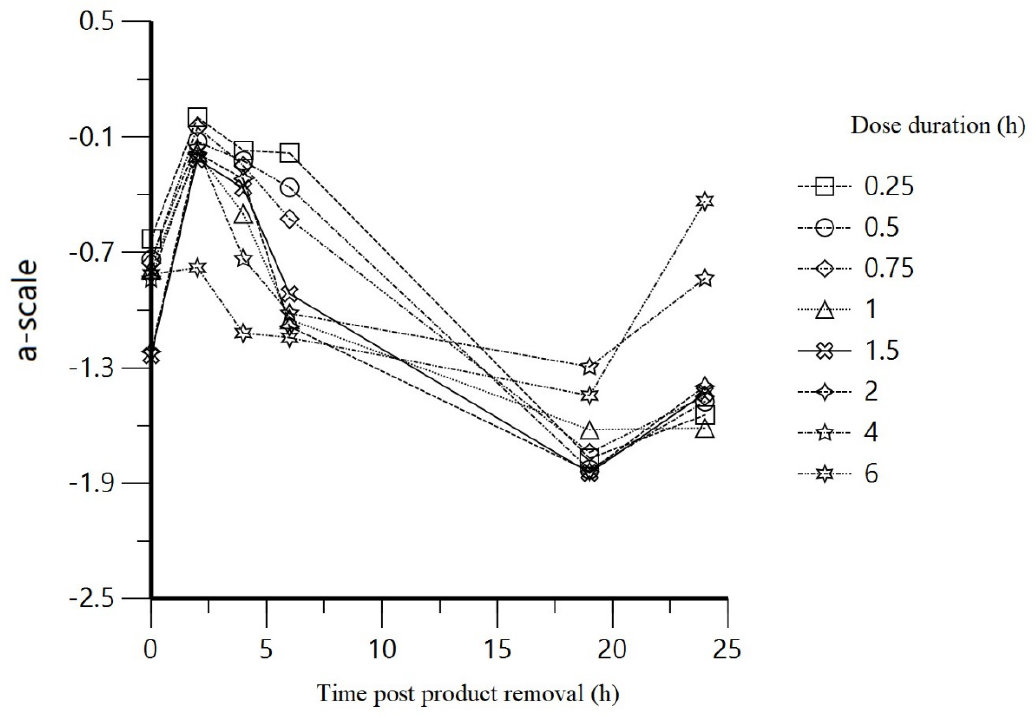
The a* scale values adjusted for baseline and untreated sites were plotted as a function of time after product removal, illustrating the mean responses per dose duration of the 12 participants, as shown in Figure 2. The graphical inspection allows one to identify the maximum blanching effect reached 19 hours after the removal of the product. It also indicates that the average effect tends to return to the baseline skin blanching level after 24 hours.

AUEC values were calculated to produce a dose duration versus AUEC profile for all participants, to illustrate the response at the different dose durations, as shown in Figure 3. This figure shows the fitted data based on a nonlinear mixed model approach. Table I shows the estimated values for ED50 and Emax, for both WinNonlin® and JMP®.

Pilot Study (FDA 2022)
After the various exposure times (0.25, 0.50, 0.75, 1.0, 1.5, 2.0, 4.0, and 6.0 h), the maximum blanching effect of clobetasol in this study was observed 22 hours after removal of the drug, with a subsequent return to baseline, as shown in Figure 4, which occurred 43 hours after removal of the product. Unlike the recommendation of the FDA guide, in this study readings were taken at times 0, 2, 4, 6, 19, 24, and 43 hours after formulation removal. Figure 4 indicates data obtained from the CR-400 chromometer (A) and CM-700d spectrophotometer (B), respectively.

Comparison of Clobetasol propionate blanching profile: (A) CR-400 chromometer, and (B) CM-700d spectrophotometer. A: Blanching profile of CP study participants (CR-400 chromometer). B: Blanching profile of CP study participants (CM-700d spectrophotometer)
Table II shows the values of ED50 and Emax using the different statistical software, and two different instruments and Figure 5 shows fitted data using WinNonlin® for both instruments.
ED50 and Emax values obtained from the different software (and using two types of instruments, CR-400 chromometer and CM-700d spectrophotometer

MICROSTRUCTURE EVALUATION
The critical quality attributes can influence the therapeutic and sensory properties of a semisolid formulation. Among these attributes are droplet size, pH, and rheological properties. (Namjoshi et al., 2020). In this work, the results of pH and the diameter of droplet size are shown in table III and demonstrated that both batches evaluated have uniformity and similarity in terms of droplet size and pH values.
The droplet size is related to the physical stability and release properties of the product. Failure to adequately control droplet size may result in phase separation, which may lead to overor under-dosing. Formulations containing larger droplet sizes showed a greater tendency to sediment, while those with smaller droplets were more prone to creaming. (Namjoshi et al., 2020; Simões, Veiga, Vitorino, 2020).
The pH value of a formulation has a great influence on the drug’s solubility, ionization state, amount of drug in the phase in contact with the skin and on the viscosity and stability of the formulation, determining the quality and performance of the product. Furthermore, the pH value also interferes with the tolerance of semi-solid topical products, since a formulation with a pH different from the skin’s pH can cause irritation. (Ilić et al., 2021). According to the American Pharmacopoeia, CP must have a pH range of 4.5 - 7.0 (USP 40, 2017).
The rheological profile of topical semi-solid formulations can interfere with the therapeutic effect of the product, as it directly affects stability, drug release, homogeneity, dosage accuracy and adhesion at the application site. Additionally, the apparent viscosity provides predictive information about the formulation’s resistance to structural rupture, since more structured networks exhibit greater resistance to shear-induced deformation. (Simões, Veiga, Vitorino, 2020).
Apparent viscosity data and demonstrated similarity between both batches evaluated are shown in Table IV. The rheological profile of both batches can be seen in figure 6 through the viscosity curves.

As observed in Non-Newtonian fluids, the viscosity curves show a decrease as the shear rate increases, demonstrating pseudoplastic behavior (Siska et al., 2019).
The rheological assessment is also important to determine batch-to-batch differences. Regarding this parameter, the viscosity curves of Psorex® revealed a very similar behavior, almost overlapping, as shown in figures 6 and 7B.

Another rheological parameter is spreadability, which can influence, the sensory characteristics of a product, among other factors. As shown in Figure 7A, the spreadability of the two different batches was inversely proportional to the applied weight. This set of data presented above demonstrates the similarity between the two batches of Psorex® evaluated. This demonstrates the pharmaceutical equivalence of the products tested and avoids potential biases in the results of pilot tests, obtained through the in vivo blanching test (VCA), for corticosteroid products.
The PC content in both batches is described in Table IV. The assay values were within the limits of 90 - 115% for CP according to the American Pharmacopoeia (USP 40, 2017).
DISCUSSION
As largely demonstrated in the literature, skin isa very efficient barrier to the penetration of the drugs. Realistically, the physicochemical properties of the drug and delivery systems are important parameters to evaluate and control several pharmaceutical dosages, mainly semisolids products.
According to Brazilian pharmacopeia, topical products are those intended for external use for application on the skin without promoting systemic action (ANVISA, 2021). Creams (such as those used in this study consisting of propylene glycol, glyceryl monostearate, Cetearyl alcohol, white beeswax, self-emulsifying glyceryl monostearate, chlorocresol, sodium citrate dihydrate, citric acid anhydrous, purified water) are considered dosage forms containing a complex vehicle, due to the formation of polyphase microstructures. (FDA, 1997). Hence, merely demonstrating pharmaceutical equivalence would not be acceptable to demonstrate bioequivalence for these products, although itis a necessary step to guarantee the quality of the pharmaceutical product.
The FDA establishes tests to evaluate the critical quality attributes of semi-solid topical formulations, such as rheological behavior, droplet size, pH, among others, with the aim of ensuring the pharmaceutical quality of the formulations produced. In the results of all the tests carried out in this work, no differences were found between the different batches of Psorex®. This reinforces the importance of batch-to-batch reproducibility, one of the needed requirements of Good Manufacturing Practices.
Studies carried out by Mangas-Sanjuán and collaborators in 2019 demonstrated differences in rheological behavior between different batches of the same RLD based on the 10% acceptance range criterion proposed by the EMA, reinforcing the inadequacy of this criterion to compare formulations. Since the rheological profile can reflect microstructure, the 10% acceptance range criterion for equivalence, as required by the EMA, proved to be overly restrictive and does not reflect comprehensive therapeutic equivalence (Miranda, 2022).
Considering that the ED50 and Emax values obtained for CP according to the methodology of FDA 1995/ANVISA 2022 and FDA 2022 showed different results, and the microstructure of the two batches proved to be similar, these differences can be readily justified by the difference in study design, conducting the same studies in different seasons of the year, population variability, ability to perform the VCA and/or due to all such concurrent variables.
According to Costin and Hearing (2007) and Furukawa et al. (2021), study design establishes that all dose durations must be applied in a randomized manner using both arms, taking into account the variability between arms, since the arms of the same individual may present color differences (depending on sun exposure), and differences in the composition of the skin along the forearm
Brazil is a tropical country, and Recife is a city with a predominantly hot climate, an average temperature of 25°C and an average annual relative humidity of 80%; it also does not have well-defined seasons (Da Silva Júnior, Da Fonseca Neto, Cabral, 2020). The incidence of solar radiation throughout the year is high and varies little, except for the penetration of cloudiness during the rainy season, which extends from May to September, the period in which the first pilot study was carried out (June). At the end of October, when the second pilot study was conducted, there is little precipitation, and temperatures usually rise by approximately 3°C when compared to the previous period (Nóbrega, Santos, Moreira, 2016).
The IBGE (Brazilian Institute of Geography and Statistics) has defined a racial classification system in five categories, based on the skin colors most recognized by the population. These categories are white, brown, yellow, black, and indigenous (Brasil, 2017). The most common differences between the defined racial categories are linked to skin color, hair type, facial conformation, and genetics (Santos et al., 2010). The broad process of migration and miscegenation of different peoples in Brazil has made it possible to observe traces of various races. In addition to issues related to racial particularities, it is essential to observe the skin type of each person. The Fitzpatrick classification, a widely used methodology to determine skin phototype, evaluates the skin’s sensitivity to ultraviolet radiation according to its ability to burn or tan (Suzuki et al., 2011; Gupta, Sharma, 2019). In general, the Brazilian population is exposed to high and medium incidence solar radiation for a good part of the year, due to the predominantly sunny climate (Oliveira, 2013). This is reflected in the facultative composition of the skin, which refers to the increase in epidermal melanin content because of environmental factors such as sunlight or hormonal factors (Gupta, Sharma, 2019). In other words, given the above, the inclusion of participants in the VCA study should be considered an aspect of paramount importance but that can be readily controlled using appropriate pre-screening techniques.
The inclusion of a participant should be based on the requisite inclusion criteria, and in addition, an adequate response to vasoconstriction (FDA, 1995; FDA, 2022). However, in the first study, all skin phototypes (according to Fitzpatrick) were selected and in the second study only phototypes I, II, and III were included.
Another factor that needs to be considered is the ability of the drug to be absorbed through the skin, which varies between individuals, as it is affected by factors such as thickness, temperature, skin cleanliness, degree of hydration, blood flow, number of hair follicles, sweat gland function, race, pH, and integrity of the stratum corneum (Wokovich et al., 2006).
In the study carried out according to the FDA 2022 guidelines, it was observed that the ED50 values are very close, comparing the adjustments made using the Phoenix WinNonlin® and the JMP®. These results suggest that both types of software are suitable for this type of evaluation. This is important considering that software is usually very expensive and increases a high research cost.
Amongst the equipment used during the current studies, several Konica Minolta® models have changed over time. These updates were intended to provide relevant information regarding the use of a specific instrument for use during VCA studies and to provide advantages such as a reduction in the weight of portable equipment, precise positioning, remote access via Bluetooth (Konica Minolta®), etc. The models indicated in the FDA 1995 guide were the Chroma Meter 200 or 300 by Minolta®, which have been discontinued, while one of the models used in conducting this study, the CM-700d, is a spectrophotometer which is no longer available for sale. In addition to the CR-400 chromometer (also used in this study), the CM-25d and CM-26d are available, which feature a display and a target allowing the device to be centered at the measurement site. It is worth noting, however, that to our knowledge, there is currently no publication of vasoconstriction studies conducted with this type of equipment, nor comparisons of performances between the equipment.
The requirement for vasoconstriction studies with topical formulations containing corticosteroids in Brazil began in 2022 with the publication of RDC no. 742/22. This explains the lack of references regarding this type of conduct in Brazil to date. However, the scientific literature has plenty of publications of studies conducted in other countries, especially in South Africa and the United States. Interestingly, studies published by Zvidzayi (2021) and Au (2010) showed that CP cream 0.05% reached its maximum blanching effect after 12 and 15 hours, respectively, after the removal of the formulation. These data, when compared with the data obtained in this study, are somewhat different from the time found, which was 19 and 22 hours after removal. Considering the possible differences in product registration specifications and all other differences previously mentioned, such behavior would be expected. Hence, it is likely that the differences observed in the maximum blanching times and the ED50 values described above are related to numerous variables such as racial and genetic issues, skin type, and issues related to the characteristics of the Brazilian climate, which directly affect the constitution of the skin.
The data presented in this study are the results of pilot studies of VCA conducted in northeast Brazil, which are extremely important for the country’s regulatory landscape in the context of topical generic drugs.
CONCLUSION
In Brazil, the implementation of the VCA demonstrates ANVISA’s concern about offering topical corticosteroid products with the requisite quality and efficacy for the population. With a methodology that is a “work-in-progress” to be implemented by Brazilian CROs, this becomes a great challenge. However, pharmaceutical industries have shown a growing interest in discussing/adapting to the new legislation.
In summary, this study represents some of the difficulties encountered in the management of VCA, and at the same time, it also represents an important milestone in this second phase of generic drug product testing for safety and efficacy and subsequent market approval in Brazil.
REFERENCES
- Aayushi BM, Nitin JN, Sharmila PP, Kiran VG, Manjyot G, Shweta A. Topical corticosteroids in dermatology. Indian J Dermatol Venereol Leprol. 2016;82:371.
-
ANVISA. Agência Nacional de Vigilância Sanitária. Farmacopeia Brasileira. Volume II. 6. Ed Brasília; 2019. Disponível em https://www.gov.br/ANVISA/pt-br/assuntos/farmacopeia/farmacopeia-brasileira/6aedicao-volume-2
» https://www.gov.br/ANVISA/pt-br/assuntos/farmacopeia/farmacopeia-brasileira/6aedicao-volume-2 -
ANVISA. Agência Nacional de Vigilância Sanitária. Guia sobre requisitos de qualidade para produtos tópicos e transdérmicos - Guia nº 20/2019 - versão 2. Brasília, 2021. Disponível em: https://antigo.ANVISA.gov.br/documents/10181/5516542/Guia+t%C3%B3picos+e+transd%C3%A9rmicos+14+-+adequado+ao+novo+modelo+12.02.2021.pdf/38d9f16b-57ab-4ff5-a29c-4639c05e51da Acesso de 23 de março de 2024.
» https://antigo.ANVISA.gov.br/documents/10181/5516542/Guia+t%C3%B3picos+e+transd%C3%A9rmicos+14+-+adequado+ao+novo+modelo+12.02.2021.pdf/38d9f16b-57ab-4ff5-a29c-4639c05e51da - Au WL. Investigations of the Bioavailability/ Bioequivalence of Topical Corticosteroid Formulations containing Clobetasol Propionate using the Human Skin Blanching Assay, Tape Stripping and Microdialysis [Doctoral dissertation]. Grahamstown: Rhodes University, 2010.
- Bodenlenz M, Tiffner KI, Raml R, Augustin T, Dragatin C, Birngruber T, et al. Open flow microperfusion as a dermal pharmacokinetic approach to evaluate topical bioequivalence. Clin Pharmacokinet. 2017;56:91-98.
- Brasil. Departamento de Apoio à Gestão Participativa e ao Controle Social, Secretaria de Gestão Estratégica e Participativa, Ministério da Saúde. Política Nacional de Saúde Integral da População Negra: uma política para o SUS. 3ª Ed. Brasília: Editora do Ministério da Saúde; 2017.
- Costin GE, Hearing VJ. Human skin pigmentation: melanocytes modulate skin color in response to stress. FASEB J. 2007;21(4):976-994.
- Da Silva Júnior MAB, Da Fonseca Neto GC, Cabral JJSP. Análise estatística para detecção de tendências em séries temporais de temperatura e precipitação no Recife-PE. Revista de Geografia (Recife). 2020;37(1).
- EMA. European Medicine Agency. Draft guideline on quality and equivalence of topical products. 2018
- Furukawa JY, Martinez RM, Morocho-Jácome AL, Castillo-Gomez TS, Pereda-Contreras VJ, Rosado C. Skin impacts from exposure to ultraviolet, visible, infrared, and artificial lights-a review. J Cosmet Laser The. 2021;23(1-2):1-7.
- Gupta V, Sharma VK. Skin typing: Fitzpatrick grading and others. Clinics in dermatology. 2019;37(5):430-436.
- Herkenne C, Alberti I, Naik A, Kalia YN, Mathy F, Préat V, et al. In vivo methods for the assessment of topical drug bioavailability. Pharm Res. 2008;25:87-103.
- Humbert P, Guichard, A. The topical corticosteroid classification called into question: towards a new approach. Exp Dermatol. 2015;24(5):393-395.
- Ilić T, Pantelić I, Savić S. The implications of regulatory framework for topical semisolid drug products: From critical quality and performance attributes towards establishing bioequivalence. Pharmaceutics. 2021;13(5):710.
- Iliopoulos F, Caspers PJ, Puppels GJ, Lane ME. Franz cell diffusion testing and quantitative confocal raman spectroscopy: In vitro-in vivo correlation. Pharmaceutics. 2020;12(9):887.
- Knorst MT. Desenvolvimento tecnológico de forma farmacêutica plástica contendo extrato concentrado de Achyrocline satureioides (Lam.) DC. [Masters Dissertation]. Porto Alegre: Universidade Federal do Rio Grande do Sul, 1991.
- Leal LB, Araujo TP, Chagas SCC, Andrade ARB, Bedor DCG, Santana DP. Registro de medicamentos genéricos tópicos dermatológicos: cenário brasileiro e estudos para demonstração de bioequivalência. Vigil Sanit Debate, Rio de Janeiro. 2017; 5(2):3-12.
-
Leal LB, Santana DP. Segunda fase da implantação de medicamentos genéricos no Brasil? Contract Pharma Brasil., Fev/2024 Disponível em: <http://www.opera.art.br/clientes/Unite/revista_CPB_2024/news_02_fev/artigo.html>. Acesso em 18/03/2024.
» http://www.opera.art.br/clientes/Unite/revista_CPB_2024/news_02_fev/artigo.html - Mangas-Sanjuán V, Pleguezuelos V, Merino-Sanjuán M, Hernandéz MJ,NácherA,García-ArietaA, et al. Assessment of the inter-batch variability of microstructure parametersintopicalsemisolids and impact on the demonstration of equivalence. Pharmaceutics. 2019;11(10):503.
- Namjoshi, S, Dabbaghi, M, Roberts, MS, Grice JE, Mohammed, Y. Quality by design: Development of the quality target product profile (QTPP) for semisolid topical products. Pharmaceutics. 2020;12(3):287.
- Nóbrega RS, Santos PFC, Moreira EBM. Morfologia urbana e ilhas de calor na cidade do Recife/PE: distribuição espacial e intensidade. Rev Geografia (Recife). 2016;33(4).
-
Núcleo de Desenvolvimento Farmacêutico (NUDFAC). Site institucional. Disponível em <http://www.nudfacufpe.com.br/>. Acessado em 23 de março de 2024.
» http://www.nudfacufpe.com.br/ - Oliveira MMF. Radiação Ultravioleta/Índice Ultravioleta e câncer de pele no Brasil: Condições ambientais e vulnerabilidades sociais. Rev Bras Climatol. 2013;13(9):jul./dez.
- Santos DJS, Palomares NB, Normando D, Quintão CCA. Raça versus etnia: diferenciar para melhor aplicar. Dent Press J Orthod. 2010;15:121-124.
- Siska B, Snejdrova E, Machac I, Dolecek P, Martiska J. Contribution to the rheological testing of pharmaceutical semisolids. Pharm Dev Technol. 2019;24(1):80-88.
- Shukla C, Bashaw ED, Stagni G, Benfeldt E. Applications of dermal microdialysis: a review. J Drug Deliv Sci Technol. 2014;24(3):259-269,
- Simões A, Veiga F, Vitorino C. Progressing towards the sustainable development of cream formulations. Pharmaceutics. 2020;12(7):647.
- Soares KCC, Santos GML, Gelfuso GM, Gratieri T. An update of the Brazilian regulatory bioequivalence recommendations for approval of generic topical dermatological drug products. AAPS J. 2015;17:1517-1518.
- Suzuki HS, Hammerschmidt M, Kakizaki P, Mukai MM. Comparação do fototipo entre caucasianos e orientais. Surg Cosmet Dermatol. 2011;3(3):193-196.
-
United States of America, Federal Register - Code of Federal Regulations. Title 21 Part 320 - Bioavailability and Bioequivalence Requirements, Subpart B - Procedures for Determining the Bioavailability or Bioequivalence of Drug Products. Revised as 07 June 2023. Available from: https://www.accessdata.fda.gov/scripts/cdrh/cfdocs/cfcfr/CFRSearch.cfm?fr=320.24
» https://www.accessdata.fda.gov/scripts/cdrh/cfdocs/cfcfr/CFRSearch.cfm?fr=320.24 - Food and Drug Administration (FDA). Department of Health and Human Services. Center of Drug Evaluation and Research (CDER). Guidance: Topic Dermatologic Corticosteroids: in Vivo Bioequivalence. Division of Bioequivalence, Office of Generic, Food and Drug Administration. 1995.
-
Food and Drug Administration (FDA). Department of Health and Human Services. Center of Drug Evaluation and Research (CDER). Guidance: Nonsterile Semisolid Dosage Forms: Scale-Up and Post Approval Changes: Chemistry, Manufacturing, and Controls; In Vitro Release Testing and In Vivo Bioequivalence Documentation. Division of Bioequivalence, Office of Generic, Food and Drug Administration. 1997. Available from: https://www.fda.gov/media/71141/download
» https://www.fda.gov/media/71141/download - Food and Drug Administration (FDA). Department of Health and Human Services. Center of Drug Evaluation and Research (CDER). Guidance: Topic Dermatologic Corticosteroids: in Vivo Bioequivalence. Division of Bioequivalence, Office of Generic, Food and Drug Administration. 2022.
- Food and Drug Administration (FDA). Department of Health and Human Services. Center of Drug Evaluation and Research (CDER). Guidance: Topic Dermatologic Corticosteroids: in Vivo Bioequivalence. Division of Bioequivalence, Office of Generic, Food and Drug Administration. 2023.
- Wokovich AM, Prodduturi S, Doub WH, Hussain AS, Buhse LF. Transdermal drug delivery system (TDDS) adhesion as a critical safety, efficacy, and quality attribute. Eur J Pharm Biopharm. 2006;64(1):1-8.
- Zvidzayi M, Rath S, Bon C, Abboo S, Kanfer I. A novel approach to assess the potency of topical corticosteroids. Pharmaceutics. 2021;13(9):1456.
Edited by
-
Associated Editor:
Silvya Stuchi Maria Engler