 Medical abortion within the Brazilian context: analyzing potential impacts of adopting a MifeMiso regimen
Abstract
In Brazil, when not criminalized, premature interruption of pregnancy may be performed through surgical abortion procedures (SAP) or medical abortion (MA). In the latter case, misoprostol monotherapy is the only available option, although the MifeMiso combination, which entails misoprostol administration after pretreatment with mifepristone, is the World Health Organization’s (WHO) preferred method. Here, we provide a state-of-the-art literature review, an evaluation of Brazilian clinical protocols, and a data analysis methodology exemplifying the impacts of adopting MifeMiso over misoprostol-only. The combination stands out for its superior efficacy, acceptability, and cost-effectiveness. Our findings show that the Brazilian technical standard could be improved, and that it would be valuable to have mifepristone approved for MA in the country. While legalization of abortion seems distant for Brazil, discussing all aspects of abortion is crucial for proper management of health resources, since the health system already bears the costs of illegal abortion.
Keywords:
Induced abortion; Misoprostol; Mifepristone; Brazil
INTRODUCTION
Medical abortion (MA) can be defined as the premature and pharmacological interruption of pregnancy, performed through the administration of medication containing abortive agents – that is, by techniques that do not require surgical intervention, except in the case of complications. Unlike surgical methods, where the concept of failure is intended for cases in which, despite efforts, the pregnancy continues, in the context of MA, failure is characterized by the need for surgical evacuation to complete the procedure, for any reason (Creinin, 2000; Kapp, Lohr, 2020). Around the world, the choice for medical or surgical abortion methods depends on a series of issues, such as those related to the legality of the procedure, as well as the efficacy and safety of the options in the different trimesters of pregnancy.
In Brazil, abortion is not legal, but it ceases to be criminalized and is provided for by law under three circumstances: when the pregnancy carries risk and there is no other way to save the life of the pregnant patient; when it is found that the pregnancy results from sexual abuse; and in cases of fetal anencephaly (Brasil, 2021; CFM, 2012). The gestational age limit for the practice has been a topic of debate in the country since the first mention of abortion in the 1940 Penal Code (Decree-Law No. 2,848/1940), but it is currently established that in cases of sexual violence the interruption can be performed up until the 20th or 22nd week. At the same time, abortion does not have a time limit in cases of risk to the pregnant patient and/or fetal anencephaly, but it is still recommended that the procedure is performed before the 20th or 22nd week. In situations where it is not criminalized, the law allows abortions to be performed through surgical abortion procedures (SAP), such as uterine curettage or manual vacuum aspiration (MVA), or by administration of medication containing misoprostol (Brasil, 2014).
As a result of the many legal restrictions and moral issues associated with inducing abortion, it is understood that global statistics on the practice are largely underestimated. Besides that, a set of studies published by The Lancet estimates that, from 2015 to 2019, 39 abortions were performed for every 1000 pregnancies carried by women between 15 and 49 years old – which corresponds to an average of 73.3 million abortions performed per year worldwide (Bearak et al., 2020). Regarding safety, abortions are considered unsafe when performed by individuals who lack the necessary knowledge and skills to support the procedure and/or performed in environments that do not meet the minimum medical requirements for safety (Ganatra et al., 2017). On that note, it is estimated that about 45% of all abortions performed in the world (25.1 million) between 2010-2014 were unsafe, and about 97% of unsafe abortions performed in low- and middle-income countries (Sedgh et al., 2016). Most research has also found a significantly higher proportion of unsafe abortions in countries with more restrictive than less restrictive abortion laws (Ganatra et al., 2017).
In parallel, Brazil’s specific situation can be better assessed through the results of the National Abortion Surveys, performed in 2010, 2016 and 2021. According to the 2021 survey, it is estimated that 1 in every 7 women of up to 40 years has had at least one abortion, although abortion rates are declining in comparison to prior editions. 10% of respondents informed having had at least one abortion in their lives for the 2021 survey, compared to 13% and 15% for the 2016 and 2010 editions, respectively. The decline is justified by the authors as a reflection of the worldwide decline in unwanted pregnancies and increase in the use of contraceptive methods throughout Latin America, despite data collected for the 2021 edition showing that around two-thirds (66%) of pregnancies are unplanned. Additionally, in accordance with the 2016 survey, about half a million abortions occurred only in 2015, although evidence shows that only about 2,000 abortions are performed legally in the country per year. When we consider that Brazil adopts a highly restrictive policy in relation to abortion, these data allow us to conclude that most of the procedures are performed illegally and unsafely, as well as to establish abortion as one of the main public health issues in Brazil. Despite the lack of in-depth discussion on the subject, the 2016 and 2021 National Abortion Surveys still show that a significant part of abortions is carried out using medication, especially those containing misoprostol – which is understood by the authors as an indication that there is interest in performing abortions safely, even if illegally. However, it is worth noting that, similarly to abortion rates, the proportion of respondents who used medication to abort also diminished between editions – from 48% in 2010 and 2016, to 39% in 2021 (Diniz, Medeiros, Madeiro, 2017; Acayaba, Figueiredo, 2020; Diniz, Medeiros, Madeiro, 2021).
On top of abortion cases foreseen by law, curettage and MVA procedures are also performed in the country for the completion of incomplete spontaneous abortions, and unsuccessful clandestine abortions (Acayaba, Figueiredo, 2020). In the latter case, considering the criminal implications of inducing abortion without medical or legal justification, what is understood is that unsuccessful cases of clandestine abortion are covered up at the time of notification of care. In practice, SAP are reported normally, but the justification for the procedure is distributed between one of two possible classifications on the Brazilian Unified Health System’s (SUS) database (TABNET DataSUS), which are spontaneous miscarriages and other pregnancies that end in abortion. The database also has a third classification, abortion for medical reasons, which encompasses non-criminalized cases, and requires a series of prior medical and legal evaluations, therefore preventing its use for covering-up illegal cases.
In the context of MA, few molecules find clinical application, and two classes of compounds stand out: uterotonics and antiprogestins. Clinical uterotonics are synthetic structural analogues of prostaglandins, whose mechanism of action is based on binding to specific receptors present in myometrial cells, and the consequent promotion of intense uterine contraction and fetal expulsion. Misoprostol stands out among its counterparts due to its affordability, lack of refrigeration requirements, and additional clinical uses – such as the treatment of peptic ulcers caused by non-steroidal anti-inflammatory drugs (Christin-Maitre, Bouchard, Spitz, 2000; Baird, 2002).
In Brazil, misoprostol was approved for the treatment of gastric ulcers in the mid-1980s and began to be marketed without any purchase restriction in 1986. Until then, the most common abortion methods in the country involved the use of sharp objects, probes and caustic substances – which resulted in high morbidity and mortality related to hemorrhages and infections. The introduction of misoprostol in the Brazilian market, however, completely changed the national scenario of unsafe and illegal abortion. The abortifacient potential of the compound was rapidly disseminated between the population, in such a way that from the 1990s onwards several surveys identified misoprostol as the agent used in about half of abortion attempts (Diniz, Madeiro, 2012; Gomperts et al., 2014).
The morbidity and mortality associated with the procedure was also drastically impacted by the introduction of misoprostol in the Brazilian market. Especially since 1992, the medicine has been associated with a higher number of complete abortions and lower rates of complications, although the incidence of hospitalizations for incomplete abortion remains high. Between 1992 and 2009, the number of serious complications from abortion fell from about 80,000 to 33,000 a year. Even with its relatively beneficial impacts on the health of the population with gestational capacity, in 1998 the use of misoprostol in Brazil was restricted to accredited hospitals, and its sale was prohibited. In another attempt to minimize the population's abortion practices, in 2011 the Brazilian state, by means of its National Health Surveillance Agency (ANVISA), issued a resolution to suspend the dissemination of publicity and information regarding the use of misoprostol, especially on the Internet (Gomperts et al., 2014). Regardless of these public policies, the 2021 National Abortion Survey estimate that at least 39% of abortions in the country are performed with medication shows that misoprostol is widely purchased by the population still (Diniz, Madeiro, 2012; Diniz, Medeiros, Madeiro, 2021).
Antiprogestins, on the other hand, are represented by the prototype of the class, mifepristone, and exhibit pharmacological effect due to their ability of binding to, but not activating, progesterone receptors. Mifepristone binds to progesterone receptors with an affinity about 5 times higher than the hormone itself but leads to the formation of a complex that inhibits gene transcription and culminates in decidual necrosis. Decidual necrosis leads to the detachment of the embryo or fetus, a condition incompatible with the maintenance of pregnancy (Christin-Maitre, Bouchard, Spitz, 2000; Baird, 2002). Clinical studies with mifepristone were started in 1982 and did not immediately yield breakthrough results. On average, it was found that the maximum efficacy for inducing abortion with mifepristone alone is 80%, and that the result is not significantly altered by the variation of the daily dose between 50 and 400 mg, in single or fractionated doses, over 4 days. However, because abortion could be pharmacologically induced with misoprostol, a widely available and cheaper medicine with similar efficacy, the results were not considered satisfactory at the time (Creinin, 2000; Soon, Costescu, Guilbert, 2016).
In light of the initial failure, the development of mifepristone-containing medication did not occur until after 1985, when researchers determined that the combination of mifepristone with uterotonics has the ability to increase the efficacy of MA to values close to 95%. The rationale for the increase in efficacy lies in the fact that antiprogestins increase excitability and stimulate myometrial contraction, acting as a pretreatment that sensitizes and prepares the myometrium for the action of uterotonic compounds and for abortion (Christin-Maitre, Bouchard, Spitz, 2000; Baird, 2002). In addition to the high efficacy, the combination also stands out as it enables the use of lower doses of prostaglandin analogues, and therefore minimizes dose-dependent gastrointestinal side effects. Since then, a number of countries have approved and made mifepristone available for use in inducing abortion when combined with misoprostol, such as France and China in 1988, and the United Kingdom in 1991. Given that mifepristone is primarily indicated for abortion, its approval for use faces legal, political, religious, and moral obstacles in various regions of the world. Consequently, it is currently approved in only about 60 countries (Creinin, 2000; Soon, Costescu, Guilbert, 2016). Brazil is not one of them, and little is discussed about the introduction of mifepristone to the list of medicines available for inducing abortion in the country.
Considering that uterotonics and antiprogestins have mechanisms of action that complement each other in the promotion of safe and effective MA, the MifeMiso regimen (combination regimen in which administration of mifepristone is followed by administration of misoprostol) is the most recommended by the WHO (2012). Both medicines involved are part of the Organization's List of Essential Medicines (Baird, 2002), underlining their critical importance in healthcare systems worldwide. The WHO guidelines aimed at promoting safe abortion also provide for the use of a misoprostol-only regimen (monotherapy regimen in which repeated and spaced administration of misoprostol is performed) in countries where mifepristone is not available, but always with caveats, as misoprostol monotherapy is associated with a lower success rate (WHO, 2012). In Brazil, as well as in other countries that adopt restrictive abortion legislation and/or deal with issues associated with the lack of resources and investment in research and public health, it is common that only misoprostol is available. For a long time, the main justification for the use of misoprostol-only over MifeMiso was the high cost of the antiprogestin. However, studies have shown that the benefits of using the combination surpass the financial matter and may even favor the reduction of health expenditures in the medium to long term, or even represent costs very similar to the use of misoprostol monotherapy (Creinin et al., 2005).
Thus, the present study focuses on the problematic of MA in Brazil, with the main objective of investigating the potential impacts of having mifepristone available for MA in Brazil, in addition to evaluating the current clinical protocol used for MA in the country. Such objectives are justified not only by the magnitude of abortion practices in Brazil, as demonstrated by the latest National Abortion Surveys, but also by the fact that most of the clinical protocols for MA employed in Brazil have not been updated since 2005, when the first version of the technical standard for Humanized Abortion Care was published by the Ministry of Health (Brasil, 2014). Collectively, we expect that our analysis contributes to an update of the clinical protocols used in Brazil, while also providing favorable arguments to stimulate the regularization of mifepristone in the country.
METHODOLOGY
As a means to contribute to the aforementioned objectives, our analysis was built in four main stages.
The first stage involved conducting a state-of-the-art literature review as described by Barry, Merkebu, and Varpio (2022) to present how misoprostol-only and MifeMiso regimens compare in terms of efficacy, safety, acceptability, and cost, and define the most current strategies for optimization (effectiveness maximization) of the respective regimens.
To conduct the review, descriptors aligned to Health Sciences Descriptors (DeCS) were defined and introduced into PubMed (National Library of Medicine) to gather relevant publications on the topic. For this step, the descriptors (induced, abortion) AND ((misoprostol) OR (misoprostol, mifepristone)) AND ((efficacy) OR (safety) OR (acceptability) OR (cost)) were used, and the most cited articles published from the year 2000 onwards were considered. In order to restrict the scope of the review, the publications found were screened in accordance with their abstracts, and articles that addressed the use of the regimens in the following contexts were disregarded: after the second trimester of pregnancy; in association with other technologies for inducing abortion (e.g. osmotic dilators for cervical priming); and/or for management of incomplete miscarriages, intrauterine fetal demise cases (IUFD) or ectopic pregnancies. Once the screening was complete, the remaining publications were read in full and considered in the review. Furthermore, in the process of writing the final study, data published from 2010 onwards were prioritized, and when necessary, the bibliographic references of the articles considered were also consulted and incorporated. Ultimately, the literature review findings were used to construct Table I, which summarizes the state-of-the-art for the most optimized version of the regimens under analysis.
The second stage consisted of evaluating and comparing the WHO’s guideline and the Brazilian technical standard to what was presented as the state-of-the-art for the regimens of interest. For that purpose, two additional tables were constructed, so as to summarize the therapeutic regimens indicated in the most recent abortion protocols published by the WHO (Abortion Care Guideline, 2022) and the Brazilian Ministry of Health (Humanized Abortion Care: Technical Standard, 2014) – Tables II and III, respectively. The current and most recent versions available for the protocols were considered, without date restrictions – since it is understood that these documents are updated sporadically, but not necessarily associated with the progress of scientific knowledge.
Number of cases of abortion for medical reasons, extracted from TABNET DataSUS;
Average cost for post-abortion uterine evacuation procedures by manual vacuum aspiration (MVA) and post-abortion/puerperal curettage, extracted from TAB-NET DataSUS;
Estimates presented by the 2016 and 2021 National Abortion Surveys (Diniz, Medeiros, Madeiro, 2017; Diniz, Medeiros, Madeiro, 2021);
Estimated efficacy values for the regimens of interest, reported in WHO guidelines (WHO, 2012; WHO, 2022).
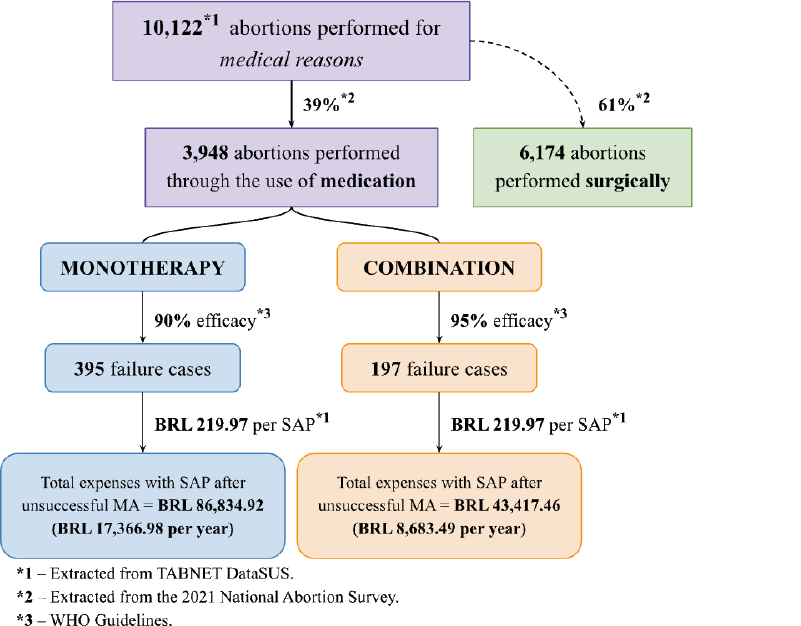
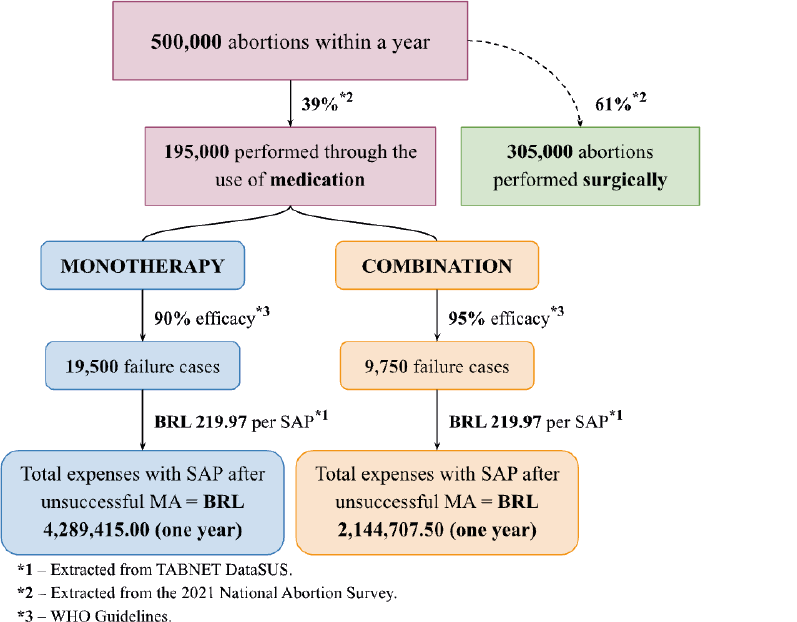
In the case of data extracted from TABNET DataSUS, a period of 5 years (from January 2018 through December 2022) was considered. It was decided not to include data referring to 2023, since these could still be updated in 2024, according to a notice presented by the tool at the time of information extraction. The data extracted from TABNET DataSUS in full can be found in the appendix. The methodology was applied to two different scenarios, as presented by Figures 1 and 2.
Lastly, on the fourth stage, the information gathered as part of the previous stages was analyzed jointly, also considering the Brazilian context, to formulate the discussion and conclusions. To deepen the discussion and provide contextualization on the topic, additional bibliography was incorporated. The search for additional bibliography was carried out on PubMed (National Library of Medicine), Web of Science and SciELO, using the descriptors ((abortion, induced) OR (abortion)) AND (methods) e ((abortion, induced) OR (abortion)) AND (statistics), ((abortion, induced) OR (abortion)) AND (Brazil).
RESULTS
Comparison of misoprostol-only and MifeMiso regimens
Efficacy in the first and second trimesters of pregnancy
As a starting point, it is worth noting that misoprostol-only and MifeMiso regimens are not standardized around the world, which makes it difficult to define their respective average efficacies. Nonetheless, there is a consensus that, when administered in the first trimester of pregnancy (< 12 weeks) and under ideal conditions, the combination regimen demonstrates greater and less variable efficacy (approximately 95 to 98%) than misoprostol-only (approximately 75 to 90%) (WHO, 2012; WHO, 2022). Furthermore, when considering the clinical outcomes of using one regimen over the other, recent evidence suggests that patients receiving MifeMiso are more likely to experience complete expulsion, and less likely to suffer missed abortions or ongoing pregnancies than patients receiving misoprostol-only (Shimels et al., 2023).
Misoprostol monotherapy may vary in terms of the initial dose administered, the interval between doses, and the administration route. In 2019, Raymond, Harrison, Weaver developed one of the largest systematic reviews ever conducted on misoprostol monotherapy for the termination of pregnancies of up to 13 weeks, where data from 12,829 abortions from 38 different studies were used. According to the review, the risk of failure with misoprostol-only is lower the higher the initial dose administered (limit of 800 µg per dose, given the acceptability of the side effects), and when administration is performed through routes alternative to oral (PO), allowing first-pass metabolism escape. Amidst the alternative routes, vaginal (VG), sublingual (SL) and buccal (BC) administration stand out and are considered comparatively equivalent in terms of efficacy during the first trimester of pregnancy (Soon, Costescu, Guilbert, 2016). Additionally, for groups that received 800 μg of misoprostol vaginally, the success rate was higher when at least 4 doses were used, spaced at least 48 hours apart, and when the tablets were moistened before VG insertion. Overall, the meta-analysis found a mean efficacy of 78% for misoprostol monotherapy considering all data, and a mean efficacy of 87% observing only patients who received an initial dose of 800 μg through an alternative route. In 2023, an update of the same study was published by Raymond, Weaver, Shochet including additional trials (16,354 abortions and 66 study groups considered in total). Observations made in the update remained largely the same, although the average efficacy reported for the regimen was increased to 85%, with the potential of reducing the risk of failure to 5% when considering only regimens consisting of at least 4 doses of 800 μg, administered per VG (moistened tablets), BC or SL route.
In parallel, the combination regimen may vary in terms of the dose of mifepristone used and the antiprogestin-prostaglandin administration interval. Mifepristone is administered exclusively PO, in doses ranging from 50 to 600 mg. Initially, the dose approved by most governments was 600 mg. Over time, however, more studies were developed, such as the systematic review by Raymond et al. (2013), and it has been shown that from 200 mg upwards of antiprogestin no significant gains in efficacy are observed for the combined regimen. As a result, the dose of mifepristone recommended by several protocols around the world has been reduced, as well as the costs associated with combination MA, taking into account the high cost of the medicine (Creinin, 2000; WHO, 2022).
Regarding the antiprogestin-prostaglandin administration interval associated to the MifeMiso regimen, several evidence indicate a higher success rate when an interval ≥ 24 and ≤ 48 hours is applied. In general terms, the same considerations presented for misoprostol-only apply to MifeMiso during the first trimester of pregnancy, to such an extent that the efficacy of the combination is also maximized when 800 μg of misoprostol are administered through alternative routes, which are comparatively equivalent. Based on the systematic review by Chen, Creinin (2015), MifeMiso success rate for pregnancies of 70 days or less is approximately 96.6% when 200 mg of mifepristone are administered PO, followed by 800 μg of BC misoprostol, applying an antiprogestin-prostaglandin interval ≥ 24 and ≤ 48 hours. Even though the dose of prostaglandin can be repeated as needed until abortion completion, most procedures achieve success with only one dose, unlike what is observed for misoprostol monotherapy (Raymond et al., 2013; Kapp, Baldwin, Rodriguez, 2018; Hsia et al., 2019; Kapp et al., 2019; Ferguson, Scott, 2020). On the topic of misoprostol dose repetitions, for both regimens, no consensus was identified on the maximum number of repetitions allowed within the same attempt, or on the need for an interval between attempts in case of failure.
Although comparatively effective, the alternative routes mentioned for misoprostol administration still have particularities, both for monotherapy and for combination regimens. In general, SL administration is the one that results in the quickest onset of action, while VG administration results in the highest misoprostol bioavailability and is associated with the most intense uterine effects. Whilst BC administration does not generate the same peak plasma concentration as the others, uterine effects tend to be similar to those promoted by VG administration, with the benefits of less inter-individual variability and greater acceptability, since BC administration is easier and generates less discomfort and concerns than VG administration (Soon, Costescu, Guilbert, 2016; Lerma, Blumenthal, 2020). It is noteworthy, however, that even though the alternative routes are closely comparable in efficacy, recent evidence suggests superiority of VG and BC routes to SL (Shimels et al., 2023).
From the 10th week onwards, and especially from the second trimester of pregnancy, studies show that sensitivity to the uterine and side effects of misoprostol increases significantly, and that the effectiveness of the combined regimen with just one dose of prostaglandin decreases. Consequently, for both monotherapy and combination regimens, available studies demonstrate higher success and satisfaction rates when 400 μg of misoprostol are administered repeatedly until the procedure is complete, with the use of an initial 600 μg loading dose not being recommended by most authors. Furthermore, the duration of the process appears to be shorter when a 3-hour interval between misoprostol repetitions is applied. For the combination, the recommended mifepristone dose and antiprogestin-prostaglandin interval remain as described for the first trimester (Kapp, Lohr, 2020; Lerma, Blumenthal, 2020; Whitehouse et al., 2020). Although the use of antiprogestin-prostaglandin intervals closer to 48 hours increases the total procedure time significantly, it appears to be associated with slightly shorter induction times (time from first dose of misoprostol to expulsion) than when intervals closer to 24 hours are employed (Shaw et al., 2013).
When contemplating the most recommended misoprostol administration route for both regimens during the second trimester of pregnancy, the available data are inconclusive. Some authors recommend VG administration over the others, under the premise that it would lead to higher success rates, in spite of the associated evidence being limited. In fact, what is observed is that VG administration is associated with shorter procedures, which makes it preferable (Kapp, Lohr, 2020; Lerma, Blumenthal, 2020). More recently, a review and meta-analysis by Whitehouse et al. (2020) suggested that at ≥ 12 weeks’ gestation, for the combination regimen, VG and BC routes are similar in efficacy and superior to SL administration, while BC administration seems to be disfavored for misoprostol-only. It is also worth mentioning that from the 12th week onwards, monotherapy suffers more drastic reductions in efficacy than the combination, which corroborates the importance of having mifepristone available for the optimization of MA in the second trimester. According to the randomized double-blind trial by Dabash et al. (2015) for the use of BC misoprostol after ingestion of placebo or 200 mg of mifepristone, MifeMiso achieved a success rate (complete abortion) of 91.7%, versus 71.7% for misoprostol-only, in pregnancies between 14 and 21 weeks. The antiprogestin-prostaglandin interval applied was 24 hours, and misoprostol was administered in 400 μg doses every 3 hours, until complete fetal and placental expulsion, with a maximum of 10 doses in total (5 for each 24-hour interval).
In order to summarize the information presented for MA optimization, Table I was constructed.
Recommendations for MA optimization (monotherapy or combination therapy) during the first and second trimesters of pregnancy
Safety and acceptability
In terms of safety, all abortive procedures, whether medical or surgical, are safer and more effective at lower gestational age. Nevertheless, provided that the regimens are adequately administered, hospitalizations due to MA complications are rare, mainly triggered by prolonged bleeding and/or pelvic infections (Raymond et al., 2013; Hsia et al., 2019; Kapp et al., 2019; Raymond, Harrison, Weaver, 2019; Ferguson, Scott, 2020; Lerma, Blumenthal, 2020). It is estimated that, in the context of MA, the rate of hemorrhage requiring blood transfusions lies between 0.03 and 0.6%, and that severe infections with fatal sepsis occur in a proportion of < 1 for every 100 thousand procedures performed (Kapp, Lohr, 2020). These findings establish MA as an important strategy to reduce the morbidity and mortality associated with abortion, especially in contexts of illegality and insecurity, where hemorrhage and sepsis resulting from inadequate abortive procedures are some of the main causes of pregnancy-associated mortality (Say et al., 2014; Ferguson, Scott, 2020). The reason behind this is that MA requires less infrastructure and support by trained professionals than surgical methods, facilitating its adequate implementation in restrictive settings, despite the difficulties associated with obtaining medication (WHO, 2022; Barghazan et al., 2022).
Statistically, monotherapy and combination regimens have similar complication rates, which favors MifeMiso regimen as it stands out for its added efficacy and acceptability benefits. Given that the combination allows for less exposure to misoprostol and its dose-dependent side effects, it seems to provide a better experience to the patient (Kapp et al., 2019). According to a randomized double-blind placebo-controlled trial by Ngoc et al. (2011), while all participants, no matter the regimen received, characterized the pain felt similarly, gastrointestinal effects are significantly more frequent in patients receiving misoprostol-only. In the same study, patients who received the combination were more likely to report that the procedure was not difficult and to prefer MA over SAP than patients who received the monotherapy (95% vs. 83.9%, and 92 vs. 76.7%, respectively).
In addition to side effects, the combination also enables shorter procedures, so as to positively influence their acceptability and patient satisfaction. Although the median time to completion of abortion varied among the studies found, in general the reported periods were significantly shorter for patients who received MifeMiso, both in the first and second trimesters of pregnancy (Blum et al., 2012; Dabash et al., 2015; Kapp, Lohr, 2020; Lerma, Blumenthal, 2020). Besides, the groups that received the combination were more likely to characterize the procedure as shorter than expected compared to groups subjected to monotherapy (Blum et al., 2012; Dabash et al., 2015; Kapp, Lohr, 2020).
Costs
The high cost of mifepristone is commonly used as a justification for its unavailability around the world. In the United States of America (USA), in states where both components of the combination can be marketed, one 200 mg mifepristone tablet costs approximately 80 USD$, while four tablets containing 200 μg of misoprostol each can be obtained for approximately 12 USD$ (Creinin et al., 2005; Raymond, Harrison, Weaver, 2019). Regardless of the notable price difference, reducing the applicability of the combination to medication costs is a simplistic argument, as it overlooks the impact that the use of MifeMiso has on the overall cost of abortive procedures.
According to a systematic review developed by Barghazan et al. (2022), the economic evaluation of pregnancy termination strategies is best performed when taking into account three types of costs: direct medical costs, direct non-medical costs, and indirect medical costs. Direct medical costs include all expenses related to medication, surgeries, tests, equipment, healthcare staff, complications, and hospitalization in general. Direct non-medical costs, on the other hand, are those related to the training of involved professionals, transportation, and possible impacts on the patient’s family life. Finally, indirect costs are mainly represented by the time spent and the patient's loss of productivity due to the procedure.
When considering all types of costs described, the same review demonstrated that MA shows significantly greater cost efficiency than SAP, thus representing an important alternative for minimizing expenses related to abortive interventions. The analysis also found that, when evaluating the subject of cost observing both monotherapy and combination regimens, pretreatment with mifepristone significantly reduces total expenditure on abortive procedures. The reason behind this is that, despite the higher direct cost associated to medication, MifeMiso promotes higher rates of complete abortion, with less time being spent on the procedures – reducing the need for surgical management in case of pregnancy persistence and medical visits. Taken together, the results of the review highlight the economic benefits of performing MA over SAP, and of using combination therapy instead of misoprostol-only (Barghazan et al., 2022).
A previous study, published in 2005 by Creinin et al., demonstrated, through the construction of different care models, that MifeMiso may be slightly cheaper or more expensive than misoprostol monotherapy, depending on the country's economic scenario. According to the study, in high-income countries (represented by the USA), where medication tends to be more expensive due to logistical reasons and patent issues, the combined regimen is, in general, more expensive. However, in these cases, the difference in cost between the regimens cannot be summarized by mifepristone’s price, since the efficacy gain provided by the combination significantly diminishes (between 62 and 78%) the additional amount spent – final difference of approximately 22 to 33 USD$ between regimens. On the other hand, in low- and middle-income countries (represented by India and a hypothetical country), where the cost of medication tends to be lower, the combined regimen is generally cheaper – final difference between regimens of approximately 1 to 10 USD$.
In spite of the variable cost differences between the scenarios considered, the study argues that the combined regimen is more cost-effective than misoprostol-only. The reason behind this is that pretreatment with mifepristone maximizes the chances of complete abortion with: fewer misoprostol doses; fewer medical visits; fewer attempts; less time away from daily activities; and lower chances of failure. As a result, it is understood that, for countries like Brazil, where the waiting time for public medical appointments tends to be long, access to transportation is unequal, and time away from daily activities has considerable financial implications, implementing the combination can be especially advantageous.
In summary, the studies found allow us to argue that, in countries like Brazil, MifeMiso tends to favor cost reduction in the context of abortive procedures in a more significant way than SAP and MA with misoprostol-only. Moreover, even in scenarios where the costs of the combined regimen are similar to or higher than the costs of monotherapy, MifeMiso stands out in light of its greater cost-effectiveness concerning aspects related to healthcare services and the patient’s experience.
Evaluating and comparing the WHO’s guideline and the Brazilian technical standard
To facilitate the evaluation and comparison of the therapeutic regimens indicated by the Ministry of Health (2014) and the WHO (2022) for MA in light of the information presented for MA optimization (as summarized by Table I), two additional tables were constructed. Tables II and III present the therapeutic regimens indicated in the most recent abortion protocols published by the WHO (Abortion Care Guideline, 2022) and the Brazilian Ministry of Health (Humanized Abortion Care: Technical Standard, 2014), respectively.
Taking into consideration only misoprostol monotherapy, the WHO guideline presents initial doses of misoprostol compatible with the scientific literature and mentions all alternative routes as options for administration. However, the guideline does not provide supplementary recommendations for optimizing treatment with misoprostol-only by VG administration. As regards the MifeMiso regimen alone, the WHO guideline is completely aligned with the available scientific knowledge. Furthermore, when it comes to the second trimester exclusively, it is worth noting that the global guideline recommends VG administration of misoprostol, under the premise of greater efficacy, no matter the regimen. However, the present review did not find any studies that support this claim – only indications that, in the second trimester, VG administration favors the completion of abortion in less time (Lerma, Blumenthal, 2020). Therefore, the WHO (2012, 2022) recommendation remains valid, given the possible benefits to patients. In light of what has been presented, then, it is possible to argue that the global guideline is aligned with scientific knowledge, which enables its use as a reference for the construction of national protocols.
While the global guideline remains up to date, the Brazilian technical standard lags behind. In addition to the lack of a combined regimen, three issues deserve attention in the therapeutic regimens indicated by the Brazilian Ministry of Health. The first is that, from the 13th week onwards, the technical standard describes the use of misoprostol only for uterine emptying in cases of intrauterine fetal demise (IUFD), despite the 22-week gestational age limit for abortion provided for by law. Consequently, it is understood that from the second trimester onwards, the use of misoprostol is not an option for non-criminalized abortion, and patients must resort to SAP mandatorily. However, extensive scientific evidence suggests that misoprostol monotherapy presents satisfactory efficacy during the second trimester of pregnancy, and Prostokos®, the only medication containing misoprostol currently approved by ANVISA for use in Brazil, has an indication for use in terminating pregnancies of up to 30 weeks (Hebron, 2020). Therefore, it is understood that part of the SAP performed in Brazil could be avoided. Considering that SAP tends to generate higher costs for health services than pharmacological procedures, the technical standard itself may encourage over-expenditure on abortive health (Barghazan et al., 2022). Ultimately, considering that both safe and unsafe abortions pose a higher risk of death with SAP than with MA, due to issues intrinsic to invasive procedures, the Brazilian technical standard encourages the excessive medicalization of abortion and exposes patients to unnecessary risks and harms.
The second issue to be addressed is that, among the three therapeutic schemes indicated as options by the Brazilian standard, only the first has an initial dose of misoprostol in line with the scientific literature. Schemes 2 and 3 have initial doses lower than 800 μg, although several studies have shown significantly lower efficacy in these conditions (Raymond, Harrison, Weaver, 2019). This finding allows us to assume that a portion of non-criminalized MA occurs with reduced effectiveness from the moment the scheme is chosen. In the third place, it is important to note that the technical standard is entirely based on VG administration of misoprostol, even though the state of the art indicates equivalence between the previously mentioned alternative routes during the first two trimesters of pregnancy. Given that VG administration requires that misoprostol tablets are inserted until the bottom of the vaginal canal, it is considered less acceptable and more complicated than other routes, causing additional discomfort and concern to the patient (Soon, Costescu, Guilbert, 2016). Thus, it is understood that updating the standard to include other alternative routes can have a positive impact on the acceptability of MA.
Finally, it is worth mentioning that the Brazilian technical standard, unlike the WHO’s guideline and what is identified in the scientific literature, stipulates a limit on misoprostol repetitions per attempt, and determines a time interval for new attempts in cases of failure.
However, based on the studies considered throughout the present review, it was not possible to prove or deny these indications, as the information available on the subject is mostly divergent and inconclusive.
Exemplifying the impact of adopting MifeMiso over misoprostol-only on failure cases and expenses with unsuccessful MA
As previously mentioned, a methodology was developed to exemplify the potential impacts of adopting MifeMiso instead of misoprostol monotherapy on the number of failure cases and, consequently, on expenses with SAP performed after unsuccessful MA in the country. Considering that, in the context of MA, the concept of failure is characterized by the need for surgical completion, it is understood that part of the curettage and MVA procedures performed in the country derive from unsuccessful MA. Therefore, it is possible to exemplify the reduction of expenditure associated to SAP throughout a regimen substitution, due to the efficacy gain.
To construct the methodology, initially the number of abortive procedures performed in the country for medical reasons (abortion provided for by law) from January 2018 to December 2022 was extracted from TABNET DataSUS (10,122 procedures in total). Next, the average cost of MVA and curettage procedures performed by the health system during the same period was extracted from the tool (average of BRL 229.75 per SAP). Finally, the 2021 National Abortion Survey MA estimates (at least 39% of abortions in the country are performed through the use of medication) and the efficacy values reported by the WHO for the regimens of interest were applied to the data extracted. Optimistic (90% efficacy) and pessimistic (95% efficacy) efficacy scenarios were considered for misoprostol-only and MifeMiso, respectively.
Although the total expenditure is relatively low in both scenarios, as a result of the reduced number of abortions performed legally in the country, the exemplification on Figure 1 shows that implementing a regimen only 5% more efficient has the potential to reduce the number of failure cases by up to 50%. Consequently, the expenditure on SAP performed after unsuccessful MA could also be reduced to half the original amount. In parallel, a greater impact cost difference is observed when considering a hypothetical scenario in which abortion was not criminalized, and was widely available in the country, without the need for medical or legal justification. Based on the 2016 National Abortion Survey, it is estimated that half a million abortions were performed in the country in 2015 alone (Diniz, Medeiros, Madeiro, 2017). Considering a hypothetical scenario where this value remained relatively constant, the same methodology can be applied, as shown on Figure 2.

Impact exemplification for abortions performed legally (abortion for medical reasons) from January 2018 to December 2022.

Impact exemplification considering a hypothetical scenario where half a million abortions are performed legally within a year.
It is worth mentioning that the calculations presented have some limitations, and do not hold predictive value. In the first place, the methodology considers the substitution of one regimen for the other, even though in an ideal scenario both options should be maintained, inasmuch as abortion with mifepristone is not effective in exceptional cases, such as ectopic pregnancies (Soon, Costescu, Guilbert, 2016). On the second place, the calculations consider optimistic efficacy conditions for misoprostol-only, and pessimistic efficacy conditions for the combined regimen. In reality, it is understood that misoprostol monotherapy is already implemented with reduced average effectiveness in Brazil, given the limitations of the MA protocol adopted in the country, as previously discussed. This, coupled with the fact that a conservative efficacy value was considered for the combination regimen, indicates that the calculated difference in failure cases may have been underestimated. In the third place, the calculations also consider that all procedures would have been carried out in the first trimester of pregnancy. Albeit statistics indicate that most abortions are performed in the first trimester, it is still important to consider that some procedures are performed in other periods, in which the regimens addressed herein show reduced effectiveness (Zamberlin, Romero, Ramos, 2012). Finally, it is worth mentioning that the methodology developed is restricted to the potential impact on direct medical costs associated with MA and does not cover direct or indirect non-medical costs which, as discussed, must also be taken into account, especially when formulating public policies.
Notwithstanding its limitations, the methodology applied demonstrates the impacts that implementing a regimen with superior effectiveness can have on abortive healthcare in Brazil. On the other hand, it also highlights the government's lack of preparation to manage, efficiently and responsibly, the resources allocated to abortive health, especially in a hypothetical context in which abortion becomes decriminalized.
DISCUSSION
Optimizing the use of misoprostol, through the construction of therapeutic schemes aligned with available scientific knowledge (especially with respect to dosage and administration routes); and
Avoiding over-expenditure and exposure of patients to preventable risks with SAP, by expanding the gestational age range for MA.
On its own, the optimization of misoprostol use has the potential to increase the overall efficacy of the misoprostol-only regimen in Brazil, therefore reducing expenses related to SAP performed after unsuccessful MA in the country and favoring more appropriate resource management within healthcare. Furthermore, it is expected that expanding the gestational age range for performing MA will also reduce the number of unnecessary SAP and its associated costs. Still on this subject, from an economic point of view, along with what was previously discussed, it is important to highlight the greater ease of implementing MA in contexts like Brazil, in which the infrastructure necessary to offer safe SAP can be limiting (WHO, 2022; Barghazan et al., 2022).
On another note, although it is not possible to say that the Brazilian technical standard is outdated for not including mifepristone for MA, since national clinical protocols only include what is approved by ANVISA, our review brings light to how valuable it would be to have mifepristone approved for use in combination with misoprostol in Brazil. In addition to being equally safe, MifeMiso outperforms misoprostol-only in terms of efficacy, acceptability and cost-effectiveness, thus demonstrating that it could positively impact the Brazilian context of MA. According to the Brazilian technical standard, humanized abortion care presupposes compliance with fundamental bioethical principles, such as beneficence and non-maleficence – “Ethical obligation to maximize the benefit and minimize the harm (to do good)” and “Always cause the least amount of harm to the patient, reducing the adverse or undesirable effects of their actions (do not harm)”, respectively (Brasil, 2014, p. 22). Given that MifeMiso favors simpler, shorter, more effective and acceptable procedures than monotherapy, it is understood that having mifepristone approved and available to increment clinical protocols would also corroborate the application of humanized abortion care, in line with what is proposed by the technical standard in the first place.
Although beneficial, both reviewing the Brazilian standard and attempting to regularize mifepristone nationally are likely to be a cause for discontent, considering that, from a cultural point of view, in addition to legal issues, the Brazilian population is largely opposed to abortion practices (Stinson, 2023). As a result, the publication of an updated version of the standard is likely to be a cause for discontent. In this sense, it is important that the commotion is addressed by educating the population on the importance of offering quality abortion services and preventing false information from spreading. Contrary to the content commonly disseminated in anti-abortion discourse, studies show that countries that adopt less restrictive approaches and invest in abortive health tend to, proportionally, perform fewer abortions and spend less on abortive procedures than countries that hinder access and criminalize the practice (Bearak et al., 2020). These findings, accompanied by the impact exemplifications presented, allow us to characterize the legalization of abortion as a necessary step towards adequate management of resources in healthcare systems.
While the legalization of abortion is a distant reality for Brazil, and despite the relative lack of national data and research on unsafe abortion, there are indications that a considerable portion of the SAP performed in the country derive from unsuccessful clandestine abortions (Acayaba, Figueiredo, 2020). With this, it becomes evident that the healthcare system is already impacted by and bears the costs of illegal and unsafe abortion. Therefore, the negative impact that hindering access and criminalizing the procedure has on the country should not be ignored, and even in the impossibility of legalization, we believe it is important that the government invests in harm reduction policies, based mainly on the education and counseling of patients who wish to undergo an abortion.
In the context of harm reduction, an example to be followed is Uruguay. Prior to legalization in 2012, patients who wished to have an abortion in Uruguay, whether provided for by law or not, could undergo a pre-abortion consultation, and a post-abortion consultation. The pre-abortion consultation was based on the principle of non-judgment and was understood as a chance for the patient to be seen as a citizen, confirm the pregnancy, and become informed about abortion methods and rights, with the aim of enabling the patient to make a conscious and autonomous decision. The risks of clandestine abortion were also informed, and MA was mentioned as one of the safest options. In light of the hitherto restrictive laws, patients were not informed about where or how to acquire abortive medication, or to undergo clandestine SAP, but they were invited to participate in a post-abortion consultation if they decided to go through with the procedure. The post-abortion consultation was based on the principle of absolute confidentiality, as well as non-judgment, and allowed the patient to find support from a multidisciplinary team. In the event of an incomplete abortion, uterine aspiration was performed, and in all cases an effective contraceptive method was sought, according to the patient’s informed decision. Under these conditions, serious complications from clandestine abortion become rare, since the approach promotes the reduction of morbidity and mortality associated with unsafe abortion through a set of mechanisms, the main one being the provision of scientifically based information to the patient (Briozzo et al., 2006). More recently, the 2021 National Abortion Survey also highlighted the usefulness of post-abortion counselling and access to contraceptive methods in reducing repeated unsafe abortion (Diniz, Medeiros, Madeiro, 2021).
CONCLUSIONS
In summary, the results from our state-of-the-art review show that, whilst being equally safe, MifeMiso outperforms misoprostol-only in terms of efficacy, acceptability and cost-effectiveness. When accompanied by the review findings, the impact exemplification methodology constructed demonstrates how beneficial it would be to have mifepristone approved for use in combination to misoprostol in Brazil, not only from a financial point of view, but also considering aspects related to the patients’ experience and humanized care. On another note, our study brings light to the fact that the Brazilian technical standard presents suboptimal therapeutic schemes for misoprostol-only and favors over-expenditure and exposure of patients to preventable risks with SAP, therefore showing points for improvement. Collectively, the results and discussion presented herein also help establish the legalization of abortion as a necessary step towards adequate management of national resources allocated in healthcare. All things considered; we believe that our analysis can serve as a stimulus not only for the update of the Brazilian technical standard, but also for the regularization of mifepristone in Brazil.
DATA AVAILABILITY STATEMENT
All data is available within the article or its supplementary materials.
REFERENCES
-
Acayaba C, Figueiredo P. SUS fez 80,9 mil procedimentos após abortos malsucedidos e 1.024 interrupções de gravidez previstas em lei no 1º semestre de 2020. G1 SP [Internet]. 2020 Aug 20 [cited 2024 Mar 28]. Available from: https://g1.globo.com/sp/sao-paulo/noticia/2020/08/20/sus-fez-809-mil-procedimentos-apos-abortos-malsucedidos-e-1024-interrupcoes-de-gravidez-previstas-em-lei-no-1o-semestre-de-2020.ghtml
» https://g1.globo.com/sp/sao-paulo/noticia/2020/08/20/sus-fez-809-mil-procedimentos-apos-abortos-malsucedidos-e-1024-interrupcoes-de-gravidez-previstas-em-lei-no-1o-semestre-de-2020.ghtml - Baird DT. Medical abortion in the first trimester. Best Pract Res Clin Obstet Gynaecol. 2002;16(2):221-26.
- Barghazan SH, Hadian M, Rezapour A, Nassiri S. Economic evaluation of medical versus surgical strategies for first trimester therapeutic abortion: a systematic review. J Educ Health Promot. 2022;11(1):84-91.
- Barry ES, Merkebu J, Varpio L. How to Conduct a State-of-the-Art Literature Review. J Grad Med Educ. 2022;14(6):663-5.
- Bearak J, Popinchalk A, Ganatra B, Moller AB, Tunçalp Ö, Beavin C, et al. Unintended pregnancy and abortion by income, region, and the legal status of abortion: estimates from a comprehensive model for 1990–2019. Lancet Global Health. 2020;8(9):e1152-61.
- Blum J, Raghavan S, Dabash R, Ngoc NTN, Chelli H, Hajri S, et al. Comparison of misoprostol-only and combined mifepristone-misoprostol regimens for home-based early medical abortion in Tunisia and Vietnam. Int J Gynecol Obstet. 2012;118(2):166-71.
-
Brasil. Ministério da Saúde, Secretaria de Atenção à Saúde, Área Técnica de Saúde da Mulher. Humanized attention to abortion: technical rule [Internet]. Brasília (DF): Ministério da Saúde, Secretaria de Atenção à Saúde, Área Técnica de Saúde da Mulher, 2014. [cited 2024 Mar 31]. 60 p. (Série Direitos Sexuais e Direitos Reprodutivos; Caderno nº 4). Available from: https://portaldeboaspraticas.iff.fiocruz.br/biblioteca/atencao-humanizada-ao-abortamento-norma-tecnica/
» https://portaldeboaspraticas.iff.fiocruz.br/biblioteca/atencao-humanizada-ao-abortamento-norma-tecnica/ -
Brasil. Senado Federal, Coordenação de Edições Técnicas. Constituição da República Federativa do Brasil: texto constitucional promulgado em 5 de outubro de 1988, com as alterações determinadas pelas Emendas Constitucionais de Revisão nº 1 a 6/94, pelas Emendas Constitucionais nº 1/92 a 91/2016 e pelo Decreto Legislativo no 186/2008 [Internet]. Brasília (DF): Senado Federal, Coordenação de Edições Técnicas, 2016. [cited 2024 Mar 31]. 496 p. Available from: https://www2.senado.leg.br/bdsf/bitstream/handle/id/518231/CF88_Livro_EC91_2016.pdf
» https://www2.senado.leg.br/bdsf/bitstream/handle/id/518231/CF88_Livro_EC91_2016.pdf -
Brasil. Senado Federal, Coordenação de Edições Técnicas. Decreto-lei nº 2.848/1940 [Internet]. Brasília (DF): Senado Federal, Coordenação de Edições Técnicas, 2021. [cited 2024 Mar 31]. 142 p. (Código Penal; 4ª edição). Available from: https://www2.senado. leg.br/bdsf/bitstream/handle/id/585476/Codigo_ penal_4ed.pdf
» https://www2.senado. leg.br/bdsf/bitstream/handle/id/585476/Codigo_ penal_4ed.pdf - Briozzo L, Vidiella G, Rodríguez F, Gorgoroso M, Faúndes A, Pons JE. A risk reduction strategy to prevent maternal deaths associated with unsafe abortion. Int J Gynecol Obstet. 2006;95(2):221-26.
- Chen MJ, Creinin MD. Mifepristone with buccal misoprostol for medical abortion: a systematic review. Obstet Gynecol. 2015;126(1):12-21.
- Christin-Maitre S, Bouchard P, Spitz IM. Medical termination of pregnancy. N Engl J Med. 2000;342(2):946-56.
-
Conselho Federal de Medicina – CFM (Brazil). Resolução Nº 1.989/2012. Diário Oficial da União, 2012 May 14 [cited 2024 Mar 28]. Available from: https://sistemas.cfm.org.br/normas/visualizar/resolucoes/BR/2012/1989
» https://sistemas.cfm.org.br/normas/visualizar/resolucoes/BR/2012/1989 - Creinin MD, Shore E, Balasubramanian S, Harwood B. The true cost differential between mifepristone and misoprostol and misoprostol-alone regimens for medical abortion. Contraception. 2005;71(1):26-30.
- Creinin MD. Medical abortion regimens: historical context and overview. Am J Obstet Gynecol. 2000;183(2):S3-9.
- Dabash R, Chelli H, Hajri S, Shochet T, Raghavan S, Winikoff B. A double-blind randomized controlled trial of mifepristone or placebo before buccal misoprostol for abortion at 14–21 weeks of pregnancy. Int J Gynecol Obstet. 2015;130(1):40-44.
- Diniz D, Madeiro A. Cytotec and abortion: the police, the vendors and women. Cienc Saúde Coletiva. 2012;7(17):1795-1804.
- Diniz D, Medeiros M, Madeiro A. National abortion survey – Brazil, 2021. Cienc Saúde Coletiva. 2023;28(6):1601-06.
- Diniz D, Medeiros M, Madeiro A. National Abortion Survey 2016. Cienc Saúde Coletiva. 2017; 22(2):653-660.
- Ferguson I, Scott H. Systematic review of the effectiveness, safety, and acceptability of mifepristone and misoprostol for medical abortion in low- and middle-income countries. J Obstet Gynecol Can. 2020;42(12):1532-42.
- Ganatra B, Gerdts C, Rossier C, Johnson Jr BR, Tunçalp Ö, Assifi A, et al. Global, regional, and subregional classification of abortions by safety, 2010–14: estimates from a Bayesian hierarchical model. Lancet. 2017;390(10110):2372-81.
- Gomperts R, Vleuten KV, Jelinska K, Costa CV, Gemzell-Danielsson K, Kleiverda G. Provision of medical abortion using telemedicine in Brazil. Contraception. 2014;89(2):129-33.
-
Hebron (Infan – Indústria Química Farmacêutica Nacional S/A). Prostokos® (Instructions for Use). Consultas ANVISA [Internet]. 2020 Jul 9 [cited 2024 mar 28]. Available from: https://consultas.anvisa.gov.br/#/bulario/q/?nomeProduto=PROSTOKOS
» https://consultas.anvisa.gov.br/#/bulario/q/?nomeProduto=PROSTOKOS - Hsia JK, Lohr PA, Taylor J, Creinin MD. Medical abortion with mifepristone and vaginal misoprostol between 64 and 70 days' gestation. Contraception. 2019;100(3):178-81.
- Kapp N, Baldwin MK, Rodriguez MI. Efficacy of medical abortion prior to 6 gestational weeks: a systematic review. Contraception. 2018;97(2):90-99.
- Kapp N, Eckersberger E, Lavelanet A, Rodriguez MI. Medical abortion in the late first trimester: a systematic review. Contraception. 2019;99(2):77-86.
- Kapp N, Lohr PA. Modern methods to induce abortion: safety, efficacy and choice. Best Pract Res Clin Obstet Gynaecol. 2020;63:37-44.
- Lerma K, Blumenthal PD. Current and potential methods for second trimester abortion. Best Pract Res Clin Obstet Gynaecol. 2020;63:24-36.
- Ngoc TNN, Blum J, Raghavan S, Nga NTB, Dabash R, Diop A, et al. Comparing two early medical abortion regimens: mifepristone + misoprostol vs. misoprostol alone. Contraception. 2011;83(5):410-17.
- Raymond EG, Harrison MS, Weaver MA. Efficacy of misoprostol alone for first-trimester medical abortion: a systematic review. Obstet Gynecol. 2019;133(1):137-47.
- Raymond EG, Shannon C, Weaver MA, Winikoff B. First-trimester medical abortion with mifepristone 200 mg and misoprostol: a systematic review. Contraception. 2013;87(1):26-37.
- Raymond EG, Weaver MA, Shochet T. Effectiveness and safety of misoprostol-only for first-trimester medication abortion: An updated systematic review and meta-analysis. Contraception. 2023;127:110132.
- Say L, Chou D, Gemmill A, Tunçalp Ö, Moller A, Daniels J, et al. Global causes of maternal death: a WHO systematic analysis. Lancet Global Health. 2014;2(6):e323-33.
- Sedgh G, Bearak J, Singh S, Bankole A, Popinchalk A, Ganatra B, et al. Abortion incidence between 1990 and 2014: global, regional, and subregional levels and trends. Lancet. 2016;388(10041):258-67.
- Shaw KA, Topp NJ, Shaw JG, Blumenthal PD. Mifepristone–Misoprostol Dosing Interval and Effect on Induction Abortion Times – A Systematic Review. Obstet Gynecol. 2013;121(6): 1335-47.
- Shimels T, Getnet M, Shafie M, Belay L. Comparison of mifepristone plus misoprostol with misoprostol alone for first trimester medical abortion: A systematic review and meta-analysis. Front Glob Womens Health. 2023;4:1112392.
- Soon JA, Costescu D, Guilbert E. Medications used in evidence-based regimens for medical abortion: an overview. J Obstet Gynaecol Can. 2016;38(7):636-45.
- Stinson J. Global Views on Abortion. IPSOS. Global Version (Open Access). 2023.
-
United Nations (UN). Universal declaration of human rights, 1948 [Internet]. Paris: United Nations, 1948. [cited 2024 Mar 31]. 8 p. Available from: https://www.un.org/sites/un2.un.org/files/2021/03/udhr.pdf
» https://www.un.org/sites/un2.un.org/files/2021/03/udhr.pdf - Whitehouse K, Brant A, Fonhus MS, Lavelanet A, Ganatra B. Medical regimens for abortion at 12 weeks and above: a systematic review and meta-analysis. Contraception. 2020;2:100037.
-
World Health Organization (WHO). Abortion care guideline [Internet]. Geneva: World Health Organization, 2022. [cited 2024 Mar 31]. 210 p. Available from: https://iris.who.int/bitstream/handle/10665/349316/9789240039483-eng.pdf?sequence=1
» https://iris.who.int/bitstream/handle/10665/349316/9789240039483-eng.pdf?sequence=1 -
World Health Organization (WHO). Safe abortion: technical and policy guidance for health systems. Geneva: World Health Organization, 2012. [cited 2024 Mar 31]. 131 p. Available from: https://www.ncbi.nlm.nih.gov/books/NBK138196/?report=reader
» https://www.ncbi.nlm.nih.gov/books/NBK138196/?report=reader - Zamberlin N, Romero M, Ramos S. Latin american women’s experiences with medical abortion in settings where abortion is legally restricted. Reprod Health. 2012;9(34).
Edited by
-
Associated Editor:
Inajara Rota