 BETWEEN INFORMATIONAL PRAGMATISM AND SCIENTIFIC COMPLEXITY: news agency journalism in covid-19 coverage
ABSTRACT
This article examines how news agency journalism mediated scientific knowledge during the covid-19 pandemic, based on an analysis of 6.694 news items published by the EFE news agency on covid-19 vaccination in Mexico between 2020 and 2023. Using topic modeling (LDA) and a specialized public health lexicon, the study identifies five major thematic axes with an initial peak in health-related content followed by a gradual decline. The findings reveal a shift toward prescriptive and operational content at the expense of contextual explanations of scientific and epidemiological processes. I conclude that, under conditions of high informational urgency, the production dynamics of news agency journalism reinforce a prescriptive orientation that tends to displace broader scientific explanations rather than integrate them in a sustained manner.
Keywords
Health communication; Agenda-setting; Media coverage; Vaccination; Public health
RESUMO
Este artigo analisa como o jornalismo de agência mediou o conhecimento científico durante a pandemia de covid-19, a partir da análise de 6.694 notícias publicadas pela agência EFE sobre a vacinação contra a covid-19 no México entre 2020 e 2023. Por meio de modelagem de tópicos (LDA) e de um léxico especializado em saúde pública, o estudo identifica cinco eixos temáticos principais e uma alta concentração inicial de conteúdo sanitário, seguida de uma diminuição progressiva. Os resultados revelam um deslocamento em direção a conteúdos prescritivos e operacionais, em detrimento de explicações contextuais sobre os processos científicos e epidemiológicos, mostrando que, em contextos de alta urgência informativa, as dinâmicas produtivas do jornalismo de agência reforçam uma orientação prescritiva que tende a deslocar explicações científicas mais amplas, em vez de integrá-las de forma sustentada.
Palavras-chave
Comunicação em saúde; Estabelecimento de agenda; Cobertura midiática; Vacinação; Saúde pública
RESUMEN
Este artículo analiza cómo el periodismo de agencia medió el conocimiento científico durante la pandemia de covid-19, a partir de 6.694 noticias de la agencia EFE sobre vacunación en México (2020-2023). Mediante modelado de temas (LDA) y un léxico especializado en salud pública, se identifican cinco ejes temáticos y una alta concentración inicial de contenido sanitario, seguida de un descenso progresivo. Los resultados muestran un desplazamiento hacia contenidos prescriptivos y operativos, en detrimento de explicaciones contextuales sobre los procesos científicos y epidemiológicos, lo que muestra que, en contextos de alta urgencia informativa, las dinámicas productivas del periodismo de agencia refuerzan una orientación prescriptiva que tiende a desplazar explicaciones científicas más amplias, en lugar de integrarlas de forma sostenida.
Palabras clave
Comunicación en salud; Establecimiento de agenda; Cobertura mediática; Vacunación; Salud pública
1 Introduction
Since the initial outbreak of covid-19 in Wuhan in December 2019, vaccine development has been prioritized by the scientific community and international institutions as a central strategy for controlling the pandemic (Alhassan et al., 2021; Lindholt et al., 2021). In Mexico, the vaccination campaign began in December 2020 with the administration of Pfizer-BioNTech doses. In this context, the media played a key role in the circulation of information about vaccines, mediating public perceptions of their legitimacy, effectiveness, and timeliness (Mahato et al., 2023; Zhao et al., 2023), considering that the coverage included a wide variety of topics such as the promotion of public health advances, criticism of governmental decisions, and the reproduction of institutional discourses (Ajana et al., 2023).
Beyond technical and logistical challenges, the covid-19 vaccination process unfolded in a context of uncertainty and informational urgency, marked by an intense production and circulation of news. In this scenario, journalistic routines, assessment of newsworthiness, and the pressure of immediacy decisively shaped the transfer of scientific knowledge into media discourse, granting vaccination relevance not only as a biomedical issue but as a political, social, and communicational problem. Various studies have documented the structural role of international news agencies in shaping the global media agenda (Rantanen & Kelly, 2021; Qi et al., 2022; Xin, 2025). By supplying national and regional media outlets with standardized content, these agencies operate as strategic nodes in the transnational circulation of information (Cruz-Mendoza, 2020), as they select and prioritize events according to their own editorial and operational criteria (Artero & Morales, 2008), thereby influencing both the topics disseminated and their discursive forms.
Within this framework, the EFE news agency – one of the main providers of news in Spanish and a key actor in the Latin American information ecosystem (Peinado & Pérez, 2023) –played a central role during the pandemic by producing and redistributing health-related information in real time. In a context marked by social demand for reliable information, news agencies became fundamental mediating instances between expert knowledge, health authorities, and general-interest media outlets that rely on their subscriptions. The analytical relevance of EFE thus lies not only in its institutional weight, but also in its structural function as a producer of reference content that shapes agenda-setting processes and the circulation of scientific discourse in national contexts.
Accordingly, EFE’s coverage of covid-19 vaccination in Mexico represents a key case for examining how agency journalism manages the tension between informational urgency and scientific complexity. This dynamic is reflected in professional routines, standardized formats, and editorial decisions that structure news production and can be identified through systematic content analysis (Shoemaker & Reese, 2013, 2016). Highlighting the absence of prior studies on news agencies and covid-19 in Mexico, from the sociology of news perspective, this approach makes it possible to reveal how such practices organize information while simultaneously exposing power relations that determine which forms of scientific knowledge gain public visibility.
Following Mabweazara and Happer (2025), the analysis of health media coverage allows for an understanding of how scientific knowledge is mediated and reconfigured by broader institutional logics inherent to the journalistic field. From this perspective, it becomes possible to problematize not only which health-related content is made visible, but also which dimensions of scientific knowledge tend to be simplified, fragmented, or displaced in response to the informational demands of agency journalism (Takeda et al., 2025).
Therefore, this article analyzes EFE’s coverage of covid-19 vaccines in Mexico between 2020 and 2023, approaching it as a journalistic problem associated with informational logics and the structural constraints of agency journalism. The study is organized around two central research questions: how did the thematic prioritization of the informational discourse on covid-19 vaccines in EFE’s coverage evolve throughout the period analyzed, and to what extent was specialized health knowledge present, and how did its intensity vary across different moments of the pandemic. To address these questions, I analyzed a corpus of 6.694 news items in Spanish using a combination of Latent Dirichlet Allocation (LDA) modeling and the analysis of specialized public health and epidemiology bag-of-words lexicons.
The research follows a mixed-methods approach that combines agenda-setting theory and health communication, with a focus on agency journalism. It posits that health-related content was more visible during the initial and most critical phases of the pandemic – characterized by high uncertainty and strong demand for technical information – and decreased as coverage shifted toward logistical, institutional, and political aspects, following the “media–epidemic” cycles described in the literature (Shih et al., 2008). This pattern shows both a thematic shift and editorial decisions conditioned by informational urgency and the standardization of news formats.
2 Literature review
The covid-19 pandemic not only constituted a global health crisis but also a central challenge for information ecosystems, insofar as media representations can influence social understandings of risk, virus transmission, associated political discourses, and perceptions of public health strategies (Mach et al., 2021). Within this framework, Waisbord (2010) explains the existence of media–epidemiological cycles that describe the fluctuating visibility of health issues on the journalistic agenda, ranging from phases of limited attention to periods of high prioritization and subsequent decline – dynamics that were intensified by the acceleration of the digital news cycle and that had significant effects on public debate and collective action.
From a communicative perspective, the literature has emphasized that the pandemic strained traditional forms of mediating scientific knowledge. Holland and Lewis (2021) identify three models of biocommunicability in health news (biomedical authority, patient-consumer, and public sphere) and argue that covid-19 coverage required articulating scientific knowledge, collective responsibility, and sustained public action, giving rise to the emerging frame of the “public health citizen”. This shift reflects a transition in health journalism from models centered on passive audiences toward public-sphere frameworks, in which readers are addressed as citizen-spectators who deliberate over collective decisions and social values, and where discursive legitimacy is based not solely on scientific expertise but also on experiential proximity and common sense (Briggs & Hallin, 2016).
Empirical studies confirm the complexity and heterogeneity of these processes. Hart et al. (2020) show that early covid-19 coverage in the United States was marked by high levels of politicization and polarization, particularly in the print press, where political actors predominated over scientists as sources. From a comparative perspective, Teschendorf (2024), drawing on Hallin and Mancini’s typology of media systems, demonstrates that health news frames vary according to media system, with differences in thematic priorities, journalistic roles, and degrees of emotional evaluation and attribution of responsibility. Along the same lines, Peschke et al. (2024) show that, in both Turkey and the United Kingdom, media combined up-to-date information with critical commentary on pandemic management, conditioned by national political and social structures. Likewise, Wasserman et al. (2021) document that South African coverage was characterized by predominantly alarmist, negative, and episodic narratives, with limited information oriented toward prevention, citizen agency, and combating misinformation, reinforcing the importance of analyzing media frames to understand the communication of health knowledge.
In the Mexican case, research has also identified a marked primacy of political frames in covid-19 coverage. Rodelo (2021) found that on broadcast television and in major national newspapers, frames of attribution of responsibility, human interest, and political controversy predominated, thus relegating scientific and self-efficacy–oriented information – a trend that coincides with the findings of Arévalo et al. (2021) regarding the centrality of political confrontation and the presidential figure. On the other hand, Mellado et al. (2021) showed that frames varied according to global epidemiological milestones, highlighting the government’s leading role as an informational source, while Villarreal et al. (2023) point out that media coverage oscillated between criticism of government management and the reproduction of official messages, generating ambiguities in social risk perception.
Although much of the literature has focused on general-interest media, studies on news agencies during the pandemic highlight their strategic role in the production, circulation, and standardization of content at national and international levels. These agencies not only mediate access to scientific and governmental information but also shape frames that are replicable by other media, as evidenced by Bessonova (2020), who studied the case of AFP, which prioritized international coverage and fact-checking in collaboration with the WHO; meanwhile, Xinhua minimized economic impacts and emphasized governmental effectiveness, and Reuters maintained a more neutral tone (Al-Salman & Haider, 2021). Chen and Xu (2021) add that Xinhua resorted to episodic frames and heroic narratives. To sum up, the former studies illustrate the heterogeneity of editorial strategies and approaches among news agencies during the health crisis.
The interaction between health communication and social media showed that AFP prioritized positive messages about vaccination, while Reuters achieved greater engagement by emphasizing access barriers, and in India, the amplification of political criticism of vaccines generated public distrust (Wang & Lu, 2022; Basu & Sharma, 2023). At the same time, agencies faced structural tensions: Xinhua Net relied on governmental sources despite its data journalism (Liu, 2021); hybrid models such as SNAPI assessed the public suitability of scientific agencies (Batista de Oliveira et al., 2024); and in Armenia, dilemmas arose between proximity to political power and economic sustainability (Vargová, 2025). Taken together, these findings show that news agencies consolidated their role as central nodes in the production, validation, and circulation of health information, although shaped by tensions among objectivity, official narratives, technological pressures, sustainability, and the emergence of fact-checking as a key subgenre, albeit dependent on digital alliances and subject to ethical and editorial challenges.
3 Analytical framework
This study draws on two complementary conceptual frameworks: agenda-setting and health communication theory. Both perspectives aid the definition of the levels of observation and the interpretive criteria to examine media coverage produced by the EFE agency on covid-19 vaccines between 2020 and 2023. In the methodological section, I describe the specific technical procedures that follow the conceptual framework.
Agenda-setting theory has been central to analyzing how the media construct public relevance, from Lippmann (1922) and Cohen (1963) to McCombs and Shaw (1972), showing that the frequency and prominence of issues influence social perceptions of their importance (Stacks et al., 2015). Three levels are distinguished: issue salience, associated attributes, and networks of associations between objects and attributes (Sulistyanto & Jamil, 2023; Sastre & Berrocal, 2020).
This study focuses on the first two levels: salience allows the identification of the issues prioritized by EFE regarding vaccination, while attribute analysis examines their characteristics, especially in relation to scientific content, health risk, and social and political implications. Salience is operationalized through LDA to reconstruct the thematic structure over time, while attributes of the discourse are analyzed using bag-of-words lexicons specialized in public health, thereby emphasizing the centrality of health-related knowledge at different moments of the pandemic.
Weaver (2007) and Reese (2007) stress the distinction between levels, while McCombs (2005) and Scheufele and Tewksbury (2007) highlight their cognitive and social consequences, as well as their structuring power. The concept of agenda building examines the participation of actors in the definition of media priorities (Walgrave et al., 2010) and, while these studies do not address the public agenda or cognitive associations, they do recognize the structuring role of EFE as an international news agency (McCombs, 2001).
The analysis integrates health communication, understood as the circulation of specialized knowledge and its impact on collective perceptions and decisions (García-González, 2023; Glik, 2007), and moves away from the deficit model by prioritizing the adaptation of messages to different levels of health literacy and sociocultural contexts (Rudd et al., 2023). Health literacy has been conceived as the basic skills to access and use health information (Neuhauser & Kreps, 2003), as a process that combines knowledge, skills, and functional, interactive and critical levels (Liu et al., 2020), and further as a competence within complex media and cultural environments that shape decision-making (Aghazadeh & Aldoory, 2023). This study adopts a communicative and mediated approach that considers health-related content relevant not only because of its terminology but also due to its narrative articulation, thematic salience, and continuity, thus arguing that its presence increases in contexts of high uncertainty and decreases as crises are normalized, in consequence, shifting toward political or logistical frames (Guenther et al., 2021; Ruhrmann et al., 2013).
Based on the intersection of agenda setting and health communication theory, this study defines a set of health-related dimensions whose empirical measurement through specialized lexical bags is shown in the methodological section. The analytical framework makes it possible to analyze how the visibility of expert knowledge is prioritized and transformed in EFE’s coverage, hence contributing to the understanding of the role of agency journalism in shaping public knowledge during a health crisis.
4 Methodology
The analysis was carried out in R using the topicmodels library. The first phase of analysis considered between 3 and 10 topics to examine the evolution and stability of topics over time, measured in quarters, as well as their correspondence with the main informational milestones of both the pandemic and the vaccination campaign in Mexico. The strategy allowed the identification of the predominant topics, as well as their relative variation in terms of intensity and centrality within EFE’s news agenda.
In the second phase, the presence and the evolution of health-related content were examined through lexical bags organized into five groups related to epidemiology and public health (Botero-Rodríguez et al., 2020). The proportion of health-related content per news item and per period was calculated. The proportion accounted for, on average, barely 2% of the total quarterly content, thus evidencing a predominance of non-health-related elements in the media coverage.
To quantify the thematic content, the occurrences of terms by group were analyzed over time, normalizing by the average number of occurrences per word and controlling for variation in news volume through the identification of unique news items. This procedure made it possible to estimate the average number of health-related words per news item, quarter, and thematic group. Complementarily, a systematic content analysis was conducted to identify patterns and emerging themes through close reading of the texts (Krippendorff, 2018; Selvi, 2019). Both manifest analysis, focused on explicit elements, and latent analysis, oriented toward implicit meanings, were combined (Kleinheksel et al., 2020), following an inductive approach in which categories emerged from the corpus and were validated using the contextual information in which the news was produced (Kyngäs, 2020). For this purpose, samples corresponding to 15% of each topic were read.
The units of analysis considered were the publication date, the media outlet, and the body of the text, from which subconcepts, categories, and themes were identified according to their internal coherence. In addition, natural language processing (NLP) techniques were incorporated to expand the scale of analysis for large textual corpora, facilitating coding and the temporal tracking of content, albeit with limitations in capturing contextual nuances (Tixier et al., 2016; Lucy et al., 2020). This methodological combination enabled a rigorous interpretation of the thematic evolution and the presence of scientific content in EFE’s coverage of covid-19 vaccines in Mexico.
5 Results
In this section, the results of the Latent Dirichlet Allocation (LDA) model are first presented, which made it possible to identify and characterize five main topics in media coverage of covid-19 vaccines in Mexico. Subsequently, the findings of the health-related content analysis are reported, based on the quantification and temporal evolution of specialized terms in public health and epidemiology, providing a complementary perspective on the presence and transformation of discourse within this coverage.
5.1 LDA model
To analyze the thematic evolution of EFE’s coverage of covid-19 vaccines in Mexico, Latent Dirichlet Allocation (LDA) (Blei et al., 2003) models were estimated by exploring different values of the parameter k (between 3 and 10 topics), in order to assess the stability and coherence of the corpus’s thematic structure. The final selection of k = 5 was based on the convergence of the main model evaluation criteria (thematic coherence and differentiation), as well as on its stronger correspondence with the informational dynamics and contextual milestones of the pandemic. This number of topics also provided an analytical balance between parsimony and interpretability, by identifying differentiated and substantively meaningful semantic clusters without excessively fragmenting the news discourse.
The LDA model generates two indicators: beta (β), which indicates the probability of association between words and each topic and allows for their semantic characterization, and gamma (γ), which reflects the proportion of each topic within the documents. In this study, the gamma matrix was used to calculate quarterly averages of thematic presence. Table 2 presents these average values, making it possible to identify the relative dominance of topics and discursive shifts over the course of the pandemic. In this way, LDA functions as a tool to map the transformation of media discourse on vaccination across its different phases.
Beta values represent the probability that a given word is associated with a specific topic. The higher the β value of a word within a topic, the greater its relative importance in defining the semantic content of that topic. For this analysis, the words with the highest β values within each of the five topics generated by the LDA model were extracted. These lists of terms were used to assign interpretative labels to the topics, combining statistical criteria with a qualitative analysis of the media context. Based on this review, the following thematic labels were proposed (table 3).
The interpretation of beta values made it possible to link the LDA model topics to specific narratives within media discourse on vaccination, thereby identifying which aspects were prioritized by the EFE news agency and how their meanings were articulated over time. Taken together, gamma and beta values provide a complementary reading: while gamma (γ) indicates the relative dominance of each topic by period, beta (β) characterizes their semantic content based on the associated words.
The longitudinal analysis of gamma showed that certain topics predominated at specific moments of the pandemic. In the first quarter of 2020, the topic related to scientific production and global collaboration stood out, hence reflecting the informational emphasis on vaccine development. Further on, in parallel with the progress of vaccination campaigns in Mexico, media coverage shifted toward topics associated with government management, epidemiological control, and vaccination strategies.
The reading of beta values made it possible to associate these shifts with concrete narratives, such as the centrality of political-institutional aspects or, in certain periods, the commercial dynamics of the vaccine market. The intersection of both parameters revealed phases in which scientific discourses coexisted with political and social narratives, underscoring the complexity of the media narrative.
Overall, the combined analysis of beta and gamma enabled the identification and tracking of the evolution of the topics that structured media coverage of covid-19 vaccination, integrating both quantitative and qualitative perspectives on their content and transformations.
5.2 Evaluation of health-related content in news coverage
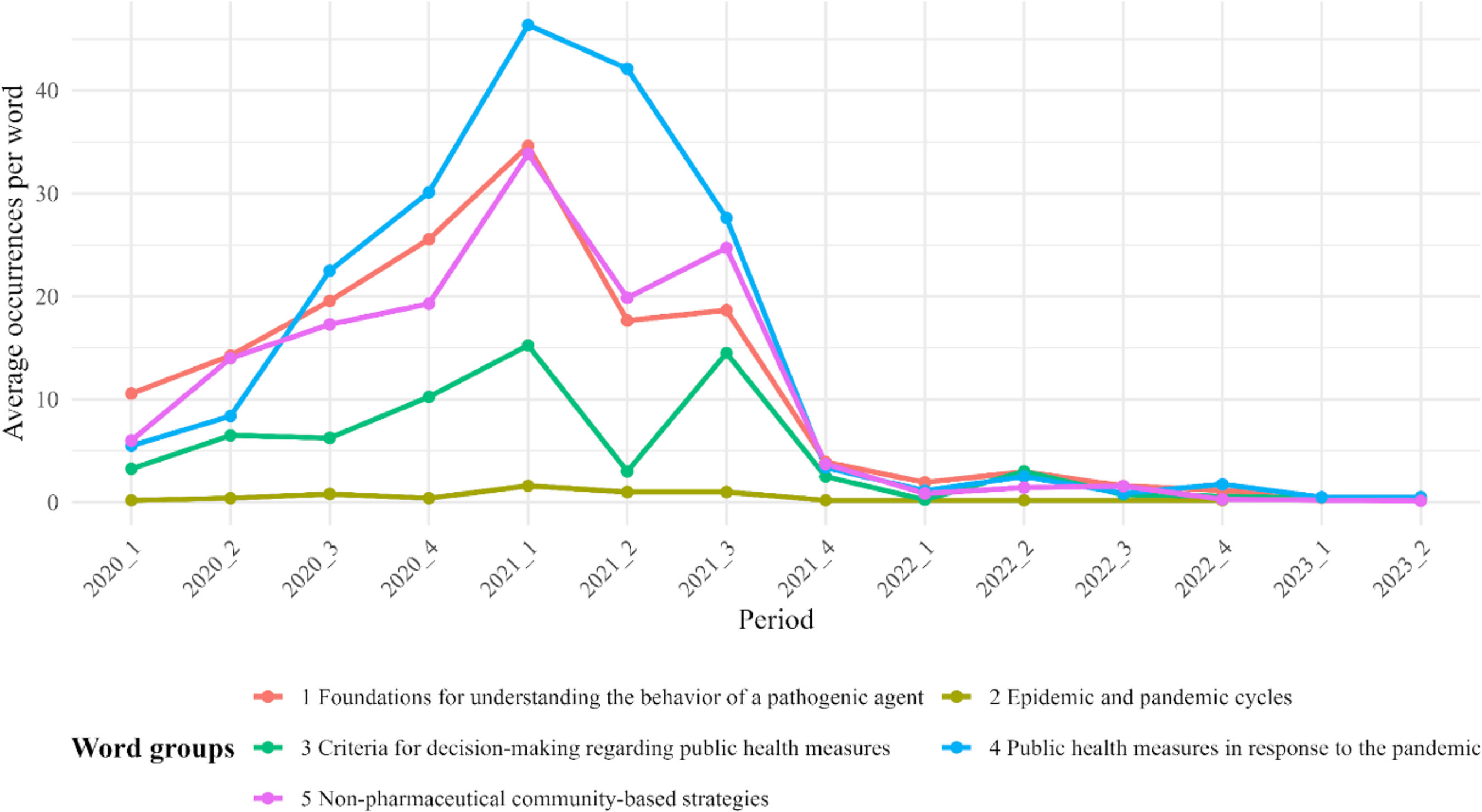
The second step of the study consisted of the assessment of the presence and evolution of scientific content in media coverage of covid-19 vaccines in Mexico. To this end, five thematic groups of keywords were defined: (1) Foundations for understanding the behavior of a pathogenic agent, (2) Epidemic and pandemic cycles, (3) Criteria for decision-making regarding public health measures, (4) Public health measures in response to the pandemic, and (5) Non-pharmaceutical strategies in the community.

Figure 1 presents the temporal evolution of health-related content in EFE news coverage between 2020 and 2023, using a normalized average of term occurrences per word across five thematic groups of public health and epidemiology. This methodological adjustment allows for the comparison of the relative intensity of specialized terminology use, while also highlighting certain limitations in the depth and continuity of scientific discourse within general-interest coverage.
The results reveal a strong concentration of health-related content during the most critical moments of the pandemic, particularly between the third quarter of 2020 and the first quarter of 2021, with peaks in terms associated with “Public health measures in response to the pandemic” and “Non-pharmaceutical strategies”. This initial focus appears to respond to informational urgency and public demand for clarity amid the health crisis, reflecting a legitimate effort by the media to incorporate accessible technical terminology. However, this concentration may also indicate a tendency to emphasize certain practical and tangible aspects – such as quarantines, epidemiological traffic-light systems, mask use, or mobility restrictions – that are more easily translated into journalistic language, while relegating other, more complex or abstract scientific dimensions to the background, including clinical research processes, regulatory criteria for vaccine approval, or debates over long-term efficacy and safety.
6 Discussion
The results of this study allow for a discussion, from the perspectives of health communication and media agenda setting, of how the EFE news agency structured and prioritized scientific knowledge about covid-19 vaccination in Mexico, as well as the limits of such informational mediation. In line with the research questions, the combined analysis of thematic modeling through LDA and health-related content attributes shows that coverage not only evolved over the course of the pandemic but also exhibited an uneven and temporally concentrated presence of scientific discourse.
First, the findings of the LDA model confirm that EFE’s thematic agenda was organized into differentiated phases, consistent with the literature on media – epidemiological cycles (Shih et al., 2008). During the initial stages of the pandemic, a frame associated with scientific production and global collaboration predominated, reflecting a phase in which expert knowledge gained informational centrality. However, as the vaccination process progressed, coverage shifted toward topics related to government management, political strategies, and logistical dynamics.
This shift is relevant in light of the agenda-setting framework. Although science was visible at certain moments, it did not manage to sustain itself as a long-term priority in informational hierarchization. The attribute analysis shows that specialized terminology was concentrated in topics related to public health measures and non-pharmaceutical strategies, particularly between the third quarter of 2020 and the first quarter of 2021. This pattern is aligned with international studies that document a media tendency to privilege practical and prescriptive information over more structural explanations of epidemiological processes (Ishikawa & Kiuchi, 2010).
By contrast, the sustained low visibility of categories such as “Epidemic and pandemic cycles”, which include concepts like herd immunity or long-term transmission dynamics, points to limited engagement with the scientific foundations of vaccination. This result is consistent with research in the Mexican context that has identified a fragmented coverage of scientific knowledge during the pandemic, frequently subordinated to political or governmental management narratives (Rodelo, 2021; Mellado et al., 2021; Villarreal et al., 2023). From a critical perspective, this omission reduces the potential of media coverage to contribute to a more robust and reflexive form of health literacy.
These findings should be interpreted in light of the structural conditions of news agencies. Unlike general-interest outlets oriented toward direct consumption, agencies such as EFE operate under production logics that privilege standardization, speed, and content reuse. In this context, the intermittent presence of scientific knowledge can be interpreted less as a devaluation of science and more as its instrumental integration as a legitimizing resource within informational discourse, in line with models of biocommunicability centered on biomedical authority (Briggs & Hallin, 2016).
From this perspective, scientific knowledge occupies a strategic but subordinate position: it is activated during peaks in infections and deaths or to legitimize technical and political decisions, but it loses centrality when narratives shift toward political conflict, management assessments, or logistical aspects of vaccination. The thematic modeling shows that topics with the highest density of scientific terminology are concentrated in the early phases of the pandemic and during critical moments of the vaccination process, whereas in later stages operational and administrative frames predominate, with less explanatory depth. This pattern resonates with studies highlighting both the strategic role of agencies in the transnational circulation of health information and their limitations in sustaining complex scientific explanations under high informational pressure (Bessonova, 2020; Al-Salman & Haider, 2021; Chen & Xu, 2021), as well as with findings that point to a preference for higher-yield frames such as access barriers, political decisions, or public controversies (Wang & Lu, 2022; Basu & Sharma, 2023). In the Mexican case, this study provides original evidence by analyzing the coverage of an international news agency in a context where no prior systematic research on news agencies and the pandemic exists.
Overall, the results show that EFE’s coverage of covid-19 vaccination in Mexico was shaped by a structural tension between the incorporation of scientific knowledge and the narrative, temporal, and productive demands of agency journalism. This tension affected both the visibility and depth of health-related discourse, as well as its continuity, concentrating it in moments of high epidemiological uncertainty and diluting it as the media agenda shifted toward political, logistical, or managerial frames. From the perspective of health literacy – understood as a communicative process that conditions audiences’ ability to access, interpret, and use health information – these findings indicate that the episodic presence of scientific content does not guarantee the construction of sustained public understanding. In line with Aghazadeh and Aldoory (2023), health literacy depends not only on informational content but also on its narrative articulation, thematic hierarchization, and continuity. Thus, the processes of selection, simplification, and standardization inherent to agency journalism directly shape which forms of scientific knowledge become intelligible and which are relegated, with implications for risk assessment, trust in vaccination policies, and public decision-making in crisis contexts.
7 Conclusions
This study analyzed media coverage of covid-19 vaccines by the EFE news agency in Mexico between 2020 and 2023 through a mixed methodological strategy that combined topic modeling (LDA) and health content analysis based on specialized lexical bags. This approach made it possible to identify the topics that structured the news agenda and to examine the presence, intensity, and evolution of scientific knowledge discourse during a period marked by informational urgency and health-related uncertainty. In line with the research problem, the results show that media coverage was organized around a broad but unbalanced thematic agenda, composed of five major axes (scientific, political-institutional, logistical, social, and economic), whose relative salience varied significantly over time.
Overall, the findings indicate that EFE granted greater centrality to scientific discourse during the initial and most critical phases of the pandemic and during the early development of vaccines. However, this centrality was temporary and faded as vaccination became integrated into daily news coverage, giving way to frames dominated by governmental management, political decision-making, and logistical and institutional dynamics. This shift confirms patterns identified in both the international literature and studies on the Mexican case, which point to a decreasing visibility of scientific knowledge discourse as health crises become normalized and more manageable from a political and operational standpoint.
From a health communication perspective, the analysis of news attributes reveals that the incorporation of health-related content was selective and functional. Coverage privileged terms associated with public health measures and non-pharmaceutical strategies, while more structurally complex concepts – such as epidemic cycles or herd immunity – had a limited and weakly sustained presence. This pattern suggests an informative mediation oriented toward communicative pragmatism and immediate utility, which facilitates a basic understanding of risk but restricts the media’s potential to contribute to critical and long-term health literacy. In this sense, coverage not only informs but also delineates the frames within which scientific knowledge becomes socially intelligible.
The study also provides relevant evidence from the sociology of media by showing how the structural characteristics of news agency journalism condition the place of scientific knowledge within the news agenda. Unlike general-interest media aimed at direct consumption, EFE operates under a production logic marked by standardization, urgency, and the transnational circulation of content. In this context, science functions primarily as a resource for legitimizing news discourse and as a punctual explanatory frame, rather than as a sustained organizing axis of coverage. This subordination of expert knowledge to institutional and political frames reflects power relations intrinsic to the journalistic field and highlights the tensions between pragmatism and complexity that shape news production in crises.
From a theoretical and methodological standpoint, the research demonstrates the usefulness of articulating agenda-setting theory and health communication with computational tools for textual analysis. The combination of LDA and health content analysis made it possible to simultaneously capture the thematic evolution of the media agenda and variations in the density and depth of scientific discourse, offering an integrated reading of processes of hierarchization and informative mediation. This approach is particularly relevant for the study of large journalistic corpora and opens up possibilities for comparative analyses across agencies, countries, and types of media.
Finally, the study raises relevant implications for future research on journalism, crises, and scientific information. It is necessary to deepen comparative analyses between news agencies and general-interest media, to incorporate reception studies that assess how these discourses influence public perception and decision-making, and to examine in greater detail the interaction between scientific, political, and social dimensions in the construction of health-related narratives. Taken together, the findings underscore that media communication of science in contexts of health crisis is neither a neutral nor a linear process, but rather a practice shaped by structural, editorial, and sociopolitical tensions that decisively influence the public circulation of expert knowledge. In this way, the article contributes to understanding the role of news agency journalism as a key – albeit ambivalent – actor in the informational management of health crises, permanently situated between the demands of informational pragmatism and the challenges of communicating scientific complexity.
-
How to cite this article:
Cruz-Mendoza, E. (2026). BETWEEN INFORMATIONAL PRAGMATISM AND SCIENTIFIC COMPLEXITY: news agency journalism in covid-19 coverage. Brazilian Journalism Research, 22(2), e1850. DOI: 10.25200/BJR.v22n2.2026.1850
DATA AVAILABILITY
The data supporting the findings of this study are available within the article
REFERENCES
-
Aghazadeh, S. A., & Aldoory, L. (2023). Health Communication Theory in Public Relations. In C. Botan & E. Sommerfeldt (Eds.), Public Relations Theory III (pp. 395-411). Routledge. DOI: 10.4324/9781003141396-27
» https://doi.org/10.4324/9781003141396-27 -
Ajana, B., Engstler, E., Ismail, A., & Kousta, M. (2023). Risk Consciousness and Public Perceptions of covid-19 Vaccine Passports. Social Science Information, 62(2), 233–258. DOI: 10.1177/05390184231182056
» https://doi.org/10.1177/05390184231182056 -
Alhassan, R., Owusu-Agyei, S., Ansah, E. & Gyapong, M. (2021). Covid-19 Vaccine Uptake Among Health Care Workers in Ghana: A Case for Targeted Vaccine Deployment Campaigns in the Global South. Human Resources for Health, 19(1), 1–12. DOI: 10.1186/s12960-021-00657-1
» https://doi.org/10.1186/s12960-021-00657-1 -
Al-Salman, A., & Haider, A. (2021). The Representation of covid-19 and China in Reuters’ and Xinhua’s Headlines. SEARCH Journal of Media and Communication Research, 13(1), 95–114. Retrieved from https://fslmjournals.taylors.edu.my/the-representation-of-covid-19-reuters-and-xinhua/
» https://fslmjournals.taylors.edu.my/the-representation-of-covid-19-reuters-and-xinhua/ -
Arévalo, R. I., Del Prado, R., & Góngora, G. E. (2021). Nueva teoría estratégica de comunicación y biopolítica en México ante la covid-19: Proyecto de salud solidaria ES POR TI. Razón Y Palabra, 24(110), 113–137. DOI: 10.26807/rp.v25i110.1723
» https://doi.org/10.26807/rp.v25i110.1723 -
Artero, J., & Morales, R. (2008). Opciones estratégicas de las agencias de noticias europeas: Reuters, France Presse y EFE. Comunicación y Sociedad, 21(1), 53–79. DOI: 10.15581/003.21.36289
» https://doi.org/10.15581/003.21.36289 -
Basu, S., & Sharma, H. (2023). Media Reporting Relating to covid-19 Vaccination as a Driver of Vaccine Hesitancy Prior to the Second Wave of the covid-19 Pandemic in India: A Content Analysis of Newspaper and Digital Media Reports. Cureus, 15(3), e36750. DOI: 10.7759/cureus.36750
» https://doi.org/10.7759/cureus.36750 -
Batista de Oliveira, M., Hafiz, M., Fleerackers, A., Bolonha Nunes, L., & Fernandes Barata, G. (2024). Science News Agencies in SciComm: An Exploratory Index for Evaluating and Enhancing Public Interest in Mass-distributed Press Releases [Preprint]. SciELO Preprints DOI: 10.1590/SciELOPreprints.9799
» https://doi.org/10.1590/SciELOPreprints.9799 -
Bessonova, M. (2020). Coverage of the covid-19 pandemic by the news agency L’Agence France-Presse (early 2020). Proceedings of the International Scientific Conference “Ukraine in the Modern World”. Educational and Scientific Institute of History and Philosophy of Sumy State. Retrieved from https://elibrary.kubg.edu.ua/id/eprint/33883
» https://elibrary.kubg.edu.ua/id/eprint/33883 -
Blei, D., Ng, A., & Jordan, M. (2003). Latent Dirichlet Allocation. Journal of Machine Learning Research, 3, 993–1.022. Retrieved from https://jmlr.csail.mit.edu/papers/v3/blei03a.html
» https://jmlr.csail.mit.edu/papers/v3/blei03a.html -
Borowiec, B. G. (2023). Ten Simple Rules for Scientists Engaging in Science Communication. PLoS Computational Biology, 19(7), e1011251. DOI: 10.1371/journal.pcbi.1011251
» https://doi.org/10.1371/journal.pcbi.1011251 -
Botero-Rodríguez, F., Franco, O., & Gómez Restrepo, C. (2020). Glosario para una pandemia: el ABC de los conceptos sobre el coronavirus. Biomédica, 40(2), 16–26. DOI: 10.7705/biomedica.5605
» https://doi.org/10.7705/biomedica.5605 - Briggs, C. L., & Hallin, D. C. (2016). Making Health Public: How News Coverage Is Remaking Media, Medicine, and Contemporary Life (2nd ed.). Routledge.
- Cohen, B. C. (1963). The press and foreign policy Princeton University Press.
-
Cruz-Mendoza, E. (2020). Análisis sociológico de la producción de los mensajes: Estudio de caso de la Agencia Informativa Conacyt (México). JCOMAL, 3(01), A04. https://doi.org/10.22323/3.03010204
» https://doi.org/10.22323/3.03010204 -
Chen, Z., & Xu, X. (2021). Covid-19 News Reporting and Engaging in the Age of Social Media: Comparing Xinhua News Agency and The Paper. Global Media and China, 6(2), 152–170. DOI: 10.1177/20594364211017364
» https://doi.org/10.1177/20594364211017364 - García-González, J. (2023). Estrategias de comunicación en salud: Selección teórico-metodológica para vías de intervención en política pública Teseo.
-
Glik, D. (2007). Risk Communication for Public Health Emergencies. Annual Review of Public Health, 28(1), 33–54. DOI: 10.1146/annurev.publhealth.28.021406.144123
» https://doi.org/10.1146/annurev.publhealth.28.021406.144123 -
Güenther, L., Gaertner, M., & Zeitz, J. (2021). Framing as a Concept for Health Communication: A Systematic Review. Health Communication, 36(7), 891–899. DOI: 10.1080/10410236.2020.1723048
» https://doi.org/10.1080/10410236.2020.1723048 -
Hart, P. S., Chinn, S., & Soroka, S. (2020). Politicization and Polarization in covid-19 News Coverage. Science Communication, 42(5), 679–697. DOI: 10.1177/1075547020950735
» https://doi.org/10.1177/1075547020950735 -
Holland, K., & Lewis, M. (2021). Mapping National News Reports on covid-19 in Australia: Topics, Sources, and Imagined Audiences. In M. Lewis, E. Govender & K. Holland (Eds.), Communicating covid-19 (pp. 57–75). Palgrave Macmillan. DOI: 10.1007/978-3-030-79735-5_4
» https://doi.org/10.1007/978-3-030-79735-5_4 -
Ishikawa, H., & Kiuchi, T. (2010). Health Literacy and Health Communication. BioPsychoSocial Medicine, 4, 1–5. DOI: 10.1186/1751-0759-4-18
» https://doi.org/10.1186/1751-0759-4-18 -
Kleinheksel, A. J., Rockich-Winston, N., Tawfik, H., & Wyatt, T. R. (2020). Demystifying Content Analysis. American Journal of Pharmaceutical Education, 84(1), 127–137. DOI: 10.5688/ajpe7113
» https://doi.org/10.5688/ajpe7113 - Krippendorff, K. (2018). Content Analysis: An Introduction to its Methodology (4th ed.). Sage Publications.
-
Kyngäs, H. (2020). Inductive Content Analysis. In H. Kyngäs, K. Mikkonen & M. Kääriäinen (Eds.), The Application of Content Analysis in Nursing Science Research (pp. 13–21). Springer. DOI: 10.1007/978-3-030-30199-6_2
» https://doi.org/10.1007/978-3-030-30199-6_2 -
Lindholt, M. F., Jørgensen, F., Bor, A., & Petersen, M. B. (2021). Public Acceptance of covid-19 Vaccines: Cross-national Evidence on Levels and Individual-Level Predictors Using Observational Data. BMJ OPEN, 11(6), e048172. DOI: 10.1136/bmjopen-2020-048172
» https://doi.org/10.1136/bmjopen-2020-048172 - Lippmann, W. (1922). Public opinion Harcourt, Brace and Company.
-
Liu, C., Wang, D., Liu, C., Jiang, J., Wang, X., Chen, H., Ju, X., & Zhang, X. (2020). What is the Meaning of Health Literacy? A Systematic Review and Qualitative Synthesis. Family Medicine and Community Health, 8(2), e000351. DOI: 10.1136/fmch-2020-000351
» https://doi.org/10.1136/fmch-2020-000351 -
Liu, J. (2021). Visualization of Data Journalism of China’s Mainstream Media in Public Health Emergences: Taking the Data News Section of Xinhua Net as an Example. Journal of Physics: Conference Series, 1880(1), 012038. DOI: 10.1088/1742-6596/1880/1/012038
» https://doi.org/10.1088/1742-6596/1880/1/012038 -
Lucy, L., Demszky, D., Bromley, P., & Jurafsky, D. (2020). Content Analysis of Textbooks Via Natural Language Processing: Findings on Gender, Race, and Ethnicity in Texas US History Textbooks. AERA Open, 6(3), 1–27. DOI: 10.1177/2332858420940312
» https://doi.org/10.1177/2332858420940312 -
Mabweazara, H. M., & Happer, C. (2025). Rethinking the Sociology of News: Global Empirical and Theoretical Perspectives. Journalism Studies, 26(16), 1.981–1.996. DOI: 10.1080/1461670X.2025.2590209
» https://doi.org/10.1080/1461670X.2025.2590209 -
Mach, K. J., Salas Reyes, R., Pentz, B., Taylor, J., Costa, C. A., Cruz, S. G., Thomas, K. E., Arnott, J. C., Donald, R., Jagannathan, K., Kirchhoff, C. J., Rosella, L. C., & Klenk, N. (2021). News Media Coverage of covid-19 Public Health and Policy Information. Humanities and Social Sciences Communications, 8(220), 1–12. DOI: 10.1057/s41599-021-00900-z
» https://doi.org/10.1057/s41599-021-00900-z -
Mahato, P., Adhikari, B., Marahatta, S., Bhusal, S., Kunwar, K., Yadav, R., Baral, S., Adhikari, A., & van Teijlingen, E. (2023). Perceptions around covid-19 and Vaccine Hesitancy: A Qualitative Study in Kaski District, Western Nepal. PLOS Global Public Health, 3(2), e0000564. DOI: 10.1371/journal.pgph.0000564
» https://doi.org/10.1371/journal.pgph.0000564 -
McCombs, M. (2001). Agenda-setting. In N. J. Smelser & P. B. Baltes (Eds.), International Encyclopedia of the Social & Behavioral Sciences (pp. 285–288). Pergamon. DOI: 10.1016/B0-08-043076-7/04310-2
» https://doi.org/10.1016/B0-08-043076-7/04310-2 -
McCombs, M. (2005). A Look at Agenda-setting: Past, Present and Future. Journalism Studies, 6(4), 543–557. DOI: 10.1080/14616700500250438
» https://doi.org/10.1080/14616700500250438 -
McCombs, M. E., & Shaw, D. L. (1972). The Agenda-setting Function of Mass Media. Public Opinion Quarterly, 36(2), 176– 187. DOI: 10.1086/267990
» https://doi.org/10.1086/267990 -
Mellado, C., Hallin, D., Cárcamo, L., Alfaro, R., Jackson, D., Humanes, M. L., Márquez-Ramírez, M., Mick, J., Mothes, C., Lin, C. I.-H., Lee, M., Alfaro, A., Isbej, J., & Ramos, A. (2021). Sourcing Pandemic News: A Cross-national Computational Analysis of Mainstream Media Coverage of covid-19 on Facebook, Twitter, and Instagram. Digital Journalism, 9(9), 1.261– 1.285. DOI: 10.1080/21670811.2021.1942114
» https://doi.org/10.1080/21670811.2021.1942114 -
Neuhauser, L., & Kreps, G. L. (2003). Rethinking Communication in the E-health Era. Journal of Health Psychology, 8(1), 7–23. DOI: 10.1177/1359105303008001426
» https://doi.org/10.1177/1359105303008001426 -
Peinado, F., & Pérez, C. (2023). El posicionamiento de la agencia EFE en las redes sociales. Estudios sobre el Mensaje Periodístico, 29(1), 209–220. DOI: 10.5209/esmp.83776
» https://doi.org/10.5209/esmp.83776 -
Peschke, L., Seyfafjehi, S., Dündar, I., & Gümüş Ağca, Y. (2024). Analyser le contenu médiatique en Turquie et au Royaume-Uni pendant la pandémie de covid-19 en tenant compte des dimensions des processus de collaboration Quadruple Helix. Social Sciences, 13(9), 458–481. DOI: 10.3390/socsci13090458
» https://doi.org/10.3390/socsci13090458 -
Qi, F., Tian, Y., & Wang, J. (2022). Analysis of Media Coverage of Beijing Winter Olympic Games Under the Time Background with Framework Theory-Take Xinhua News Agency as an Example. Journal of Humanities and Social Sciences Studies, 4(3), 243–253. DOI: 10.32996/jhsss.2022.4.3.27
» https://doi.org/10.32996/jhsss.2022.4.3.27 - Rantanen, T., & Kelly, A. (2021). The Digital Transformation of International and National News Agencies: Challenges Facing AFP, AP, and TASS. In D. H. Weaver, L. Willnat & S. C. D. Waisbord (Eds.), Global Journalism: Understanding World Media Systems (pp. 189–198). Routledge.
-
Reese, S. D. (2007). The Framing Project: A Bridging Model for Media Research Revisited. Journal of Communication, 57(1), 148–154. DOI: 10.1111/j.1460-2466.2006.00334.x
» https://doi.org/10.1111/j.1460-2466.2006.00334.x -
Reese, S. D., & Shoemaker, P. J. (2016). A Media Sociology for the Networked Public Sphere: The Hierarchy of Influences Model. Mass Communication and Society, 19(4), 389–410. DOI: 10.1080/15205436.2016.1174268
» https://doi.org/10.1080/15205436.2016.1174268 -
Rodelo, F. V. (2021). Framing of the covid-19 Pandemic and its Organizational Predictors. Cuadernos.info, (50), 91–112. DOI: 10.7764/cdi.50.37525
» https://doi.org/10.7764/cdi.50.37525 -
Rodríguez, F., Franco, O. H., & Gómez-Restrepo, C. (2020). Glosario para una pandemia: el ABC de los conceptos sobre el coronavirus. Biomédica, 40(2), 116–130. DOI: 10.7705/biomedica.5605
» https://doi.org/10.7705/biomedica.5605 - Rudd, R. E., Anderson, J. E., Oppenheimer, S., & Nath, C. (2023). Health Literacy: An Update of Medical and Public Health Literature. In J. Comings, B. Garner & C. Smith (Eds.), Review of Adult Learning and Literacy, Volume 7 (pp. 175–204). Routledge.
-
Ruhrmann, G., Guenther, L., Kessler, S. H., & Milde, J. (2013). Frames of Scientific Evidence: How Journalists Represent the (Un)certainty of Molecular Medicine in Science Television Programs. Public Understanding of Science, 24(6), 681–696. DOI: 10.1177/0963662513510643
» https://doi.org/10.1177/0963662513510643 -
Sastre, A., & Berrocal, S. (2020). Agenda setting en la era digital: Nuevas tendencias sobre el tercer nivel de agenda setting a través de las aportaciones de McCombs (2010-2017). Mediapolis – Revista de Comunicação, Jornalismo e Espaço Público, (10), 37–46. DOI: 10.14195/2183-6019_10_3
» https://doi.org/10.14195/2183-6019_10_3 -
Scheufele, D. A., & Tewksbury, D. (2007). Framing, Agenda Setting, and Priming: The Evolution of Three Media Effects Models. Journal of Communication, 57(1), 9–20. DOI: 10.1111/j.1460-2466.2006.00326_5.x
» https://doi.org/10.1111/j.1460-2466.2006.00326_5.x - Selvi, A. (2019). Qualitative Content Analysis. In A. Selvi (Ed.), The Routledge Handbook of Research Methods in Applied Linguistics (pp. 440–452). Routledge.
-
Shih, T. J., Wijaya, R., & Brossard, D. (2008). Media Coverage of Public Health Epidemics: Linking Framing and Issue Attention Cycle Toward an Integrated Theory of Print News Coverage of Epidemics. Mass Communication and Society, 11(2), 141–160. DOI: 10.1080/15205430701668121
» https://doi.org/10.1080/15205430701668121 - Shoemaker, P. J., & Reese, S. D. (2013). Mediating the Message in the 21st century: A Media Sociology Perspective Routledge.
-
Stacks, D. W., Li, Z., & Spaulding, C. (2015). Media effects. In J. D. Wright (Ed.), International Encyclopedia of the Social & Behavioral Sciences (pp. 29–34). Elsevier. DOI: 10.1016/B978-0-08-097086-8.95045-1
» https://doi.org/10.1016/B978-0-08-097086-8.95045-1 -
Sulistyanto, A., & Jamil, A. (2023). Trends of Agenda-setting Research: A Bibliometric and a Thematic Meta-analysis. Komunikator, 15(1), 1–18. DOI: 10.18196/jkm.18166
» https://doi.org/10.18196/jkm.18166 -
Takeda, K. F., Komata, M., Takae, K., Tanaka, M., & Shineha, R. (2025). Comparative Analysis of Media Coverage Concerning the Social Implications on Three Life Sciences in Japan During 1991-2020. Frontiers in Sociology, 10, 1–13. DOI: 10.3389/fsoc.2025.1523795
» https://doi.org/10.3389/fsoc.2025.1523795 -
Teschendorf, V. S. (2024). Understanding covid-19 Media Framing: Comparative Insights from Germany, the US, and the UK during Omicron. Journalism Practice, 20(4), 1–22. DOI: 10.1080/17512786.2024.2412832
» https://doi.org/10.1080/17512786.2024.2412832 -
Tixier, A. J., Hallowell, M., Rajagopalan, B., & Bowman, D. (2016). Application of machine learning to construction injury prediction. Automation in Construction, 69, 102–114. DOI: 10.1016/j.autcon.2016.05.016
» https://doi.org/10.1016/j.autcon.2016.05.016 - Vargová, K. (2025). What is the Future of News Agencies (not Only) in Armenia? In M. Jančová & B. Dorková (Eds.), Aktuálne otázky výskumu humanitných vied VII (pp. 271–283). VERBUM.
-
Villarreal, G., Uresti, A. D., & Inzunza, B. E. (2023). Análisis de sentimientos hacia el Dr. Hugo López-Gatell Ramírez en Twitter: El caso del covid-19 en México. Anuario de Investigación de la Comunicación CONEICC, (30), 1–27. Retrieved from https://anuario.coneicc.org.mx/index.php/anuarioconeicc/article/view/619
» https://anuario.coneicc.org.mx/index.php/anuarioconeicc/article/view/619 -
Waisbord, S. (2012). When Health is the Deadline: Dengue Fever, AH1N1 Flu and Media-epidemic Cycles. Folios, Revista de la Facultad de Comunicaciones y Filología, (23), 93–103. Retrieved from https://revistas.udea.edu.co/index.php/folios/article/view/11786
» https://revistas.udea.edu.co/index.php/folios/article/view/11786 -
Walgrave, S., Van Aelst, P., & Bennett, L. (2010). Beyond Agenda-setting: Towards a Broader Theory of Agenda Interactions between Political Actors and the Mass Media. APSA Annual Meeting, 2(5), 1–23. Retrieved from https://medialibrary.uantwerpen.be/oldcontent/container2608/files/Walgrave%20et%20al_%20%282010%29%20-%20Beyond%20agenda-setting.pdf
» https://medialibrary.uantwerpen.be/oldcontent/container2608/files/Walgrave%20et%20al_%20%282010%29%20-%20Beyond%20agenda-setting.pdf -
Wang, D., & Lu, J. (2022). How News Agencies’ Twitter Posts on covid-19 Vaccines Attract Audiences’ Twitter Engagement: A Content Analysis. International Journal of Environmental Research and Public Health, 19(5), 1–20. DOI: 10.3390/ijerph19052716
» https://doi.org/10.3390/ijerph19052716 -
Wasserman, H., Chuma, W., Bosch, T., Uzuegbunam, C. E., & Flynn, R. (2021). South African Newspaper Coverage of covid-19: A Content Analysis. Journal of African Media Studies, 13(2), 333–350. DOI: 10.1386/jams_00052_1
» https://doi.org/10.1386/jams_00052_1 -
Weaver, D. H. (2007). Thoughts on Agenda Setting, Framing, and Priming. Journal of Communication, 57(1), 142–147. DOI: 10.1111/j.1460-2466.2006.00333.x
» https://doi.org/10.1111/j.1460-2466.2006.00333.x -
Xin, X. (2025). How are News Agencies Coping with Digital Disruption in the Age of Artificial Intelligence (AI)? The Case of Xinhua. In B. Mutsvairo & K. S. Orgeret (Eds.), The Palgrave Handbook of Global Digital Journalism (pp. 181–194). Palgrave Macmillan. DOI: 10.1007/978-3-031-59379-6_11
» https://doi.org/10.1007/978-3-031-59379-6_11 -
Zhao, S., Lok, Kris., Sin, Z., Peng, Y., Fan, H. S. L., Nagesh, N., Choi, M.S.L., Kwok, J. Y. Y., Choi, E. P. H., Zhang, X., Wai, H. K., Tsang, L. C. H., Cheng, S. S. M., Wong, M. K. L., Zhu J., Mok, C. K. P., Ng, S. C., Chan, F. K. L., Peiris, M., Poon, L. L. M, & Tun, H. M. (2023). Covid-19 mRNA vaccine-mediated antibodies in human breast milk and their association with breast milk microbiota composition. npj Vaccines, 8(1), 1–11. DOI: 10.1038/s41541-023-00745-4
» https://doi.org/10.1038/s41541-023-00745-4
-
Desk review editor:
Laura Storch