
 Management and challenges of thyroid cancer treatment with radioiodine therapy in a patient with cerebral palsy and autism spectrum disorder: a case report
Abstract
Background: Thyroid cancer is one of the most prevalent endocrine neoplasms in Brazil, and radioiodine therapy (RAI) is a well-established adjuvant treatment. However, managing RAI can be particularly challenging in patients with neurological disorders and significant behavioral disturbances. Case Presentation: We report the case of a 16-year-old adolescent with cerebral palsy and level 3 autism spectrum disorder (ASD) who underwent RAI after total thyroidectomy for metastatic papillary thyroid carcinoma. The case illustrates the tailored technical and clinical strategies implemented by the multidisciplinary team to address the patient’s complex needs, including adaptations in radiation protection, hospitalization logistics, and caregiver support. Conclusion / Lessons Learned: This case underscores the complexity of performing RAI in patients with severe neurological and behavioral impairments. It reinforces the importance of early and expanded multidisciplinary involvement—particularly from neurology and psychiatry—during the preparatory phase. Additionally, enhanced caregiver training and consideration of alternative therapeutic strategies are essential to ensure safety, optimize radiological protection, and improve adherence throughout the treatment process.
Keywords:
Case report; Radioiodine therapy; Papillary thyroid carcinoma; Autism spectrum disorder; Radiation protection
Resumo
Introdução: O câncer de tireoide é uma das neoplasias endócrinas mais prevalentes no Brasil, e a terapia com radioiodo (RAI) é uma abordagem adjuvante bem estabelecida. Entretanto, o manejo desse tratamento pode ser particularmente desafiador em pacientes com distúrbios neurológicos e importantes alterações comportamentais. Apresentação do Caso: Relatamos o caso de um adolescente de 16 anos com paralisia cerebral e transtorno do espectro autista (TEA) nível 3 que foi submetido à RAI após tireoidectomia total devido a carcinoma papilífero metastático de tireoide. O caso ilustra as estratégias técnicas e clínicas individualizadas adotadas pela equipe multidisciplinar para atender às demandas complexas do paciente, incluindo adaptações em radioproteção, logística de hospitalização e suporte à cuidadora. Conclusão / Lições Aprendidas: Este caso evidencia a complexidade da realização de RAI em pacientes com graves comprometimentos neurológicos e comportamentais. Reforça também a importância do envolvimento precoce e ampliado de uma equipe multidisciplinar — especialmente neurologia e psiquiatria — durante a fase preparatória. Além disso, destaca a necessidade de treinamento intensificado para cuidadores e da consideração de estratégias terapêuticas alternativas para garantir maior segurança, otimização da radioproteção e melhor adesão ao tratamento.
Palavras-chave:
Relato de caso; Terapia com radioiodo; Carcinoma papilífero de tireoide; Transtorno do espectro autista; Radioproteção
1. INTRODUCTION
Thyroid cancer is the most common malignant endocrine neoplasm, with a global annual incidence of approximately 586,000 new cases ( 1 ). Papillary thyroid carcinoma (PTC) is the most prevalent histological subtype, accounting for over 80% of all cases ( 2 ). In Brazil, according to the report “Estimativa 2023: Incidência de Câncer no Brasil” (Estimate 2023: Cancer Incidence in Brazil) published by the National Cancer Institute ( 3 ), thyroid cancer, excluding non-melanoma skin tumors, ranks as the seventh most frequent malignant neoplasm and stands out as the predominant endocrine cancer. Gender distribution reveals significant disparities: while thyroid cancer is the third most common among women, it ranks 15th among the most incident cancers in men in the Southeast region of the country.
The gold-standard treatment for PTC is thyroidectomy combined with radioiodine therapy (RAI) using [131I] Sodium Iodide ([131I]NaI). The objectives of RAI include: (i) ablation of presumably benign residual thyroid tissue, (ii) adjuvant therapy for suspected but unproven microscopic residual disease, and (iii) treatment of persistent/recurrent structural disease ( 4 ). Additionally, radioactive iodine is used in the management of residual diseases with an affinity for radioiodine ( 5 ).
Scientific evidence demonstrates that RAI is associated with significant improvements in overall survival and reduced recurrence rates, particularly in high-risk patients ( 6 , 7 ). Despite its widespread consolidation in clinical practice and proven therapeutic benefits, RAI management requires specific health and radioprotection measures, which can pose challenges, especially in pediatric patients with behavioral disorders ( 8 ).
This case report describes the application of radioiodine therapy (RAI) in a patient with underlying neuropathy and neurodevelopmental disorder - an atypical condition that imposed additional challenges for both the healthcare team and the patient's caregivers. Prepared in accordance with the CARE (CAse REport) guidelines ( 9 ), this report aims to provide the academic and clinical community with valuable insights for managing similar complex cases while ensuring comprehensive and transparent documentation of all relevant clinical details. The complete CARE checklist is included as supplementary material.
1.1. Case presentation
In September 2022, a 16-year-old male patient underwent a cervical ultrasound, which revealed the presence of a solid nodular formation in the right thyroid lobe, measuring 3.9 x 3.0 x 2.9 cm. The nodule was heterogeneous, with scattered echogenic foci and enlarged lymph nodes. The left thyroid lobe showed no significant abnormalities, and the finding was classified as TI-RADS 5. In the same month, the patient underwent a chest computed tomography (CT) scan, which identified countless bilateral diffuse nodules of varying sizes and a large solid lesion in the projection of the right thyroid lobe, causing airway deviation and associated with multiple adjacent lymph nodes.
Subsequently, the patient underwent a biopsy, which confirmed the presence of a solid variant tumor in the right lobe and isthmus of the thyroid, measuring 4.2 x 4.0 x 2.5 cm. The tumor exhibited extrathyroidal extension, infiltrating adjacent muscle tissue, with angiolymphatic invasion and pulmonary metastasis. Histology was classified as pT3pN1, and the case was stratified as high-risk for recurrence according to the 2015 American Thyroid Association (ATA) guidelines ( 10 ). Based on these characteristics, the patient was deemed eligible for radioiodine therapy (RAI) in accordance with the European Thyroid Association guidelines for the management of pediatric thyroid nodules and differentiated thyroid carcinoma ( 11 ) and the ATA guidelines for the management of children with thyroid nodules and differentiated thyroid cancer ( 10 ). Initial examinations were conducted at an external hospital, which limited access to detailed information about the precursor symptoms that prompted the investigation.
In September 2022, the patient was referred to the Nuclear Medicine department of the hospital for post-total thyroidectomy RAI. A activity of 7400 MBq (200 mCi) of sodium iodide ([131I]NaI) in liquid form was prescribed, following stimulation with exogenous thyroid-stimulating hormone (TSH). The patient was accompanied by his mother, the primary caregiver, who received thyroid protection with potassium iodide syrup as a protective measure. The hospitalization lasted two days, and six days after the therapeutic activity administration, the patient returned to the department for whole body scan (WBS). The clinical timeline is depicted in Figure 1 , where T0 represents the first day of the initial procedure accessed by the team in relation to the event (time is measured in days).

2. MATERIALS AND METHODS
2.1. Patient’s health and family background
The patient has severe non-progressive encephalopathy, epilepsy, and autism spectrum disorder (ASD) with level 3 support needs. He is non-verbal, uses a wheelchair for mobility, and exhibits a fixed posture with no trunk control and limited social interaction. The patient responds to few verbal commands and interacts primarily with his 38-year-old mother, his main caregiver, through simple actions.
The adolescent presents with intense and frequent sialorrhea (drooling), which is uncontrolled, as well as repetitive hand-to-mouth movements, particularly during periods of agitation. He also displays self-injurious stereotypic behaviors, including, but not limited to, hand biting. Nutrition is provided orally, with a selective and pasty diet, including refusal of water and medications. Due to food selectivity, the patient has a gastrostomy tube (GTT) for the administration of nutritional supplements, medications, and hydration, managed appropriately by the mother under the guidance of the healthcare team.
The patient’s family consists of a father, mother, and one brother. The mother, who is under psychiatric care and has cognitive deficits, is the primary caregiver. The brother also has a neurodevelopmental disorder, the specific nature of which was not detailed by the healthcare team. The family lives in a two-bedroom, one-bathroom house, and the patient shares a bed with his mother and brother.
2.2. Preparation for hospitalization
Prior to hospitalization, a multidisciplinary consultation was conducted involving two nurses, two physicists, the mother (primary caregiver), and the patient. During the meeting, detailed instructions were provided on radiation protection measures, the need to increase fluid intake, and the importance of adhering to a low-iodine diet. Additionally, a visit to the therapeutic room was arranged, where the hospitalization procedures, the requirement for a companion throughout the entire period, and radiation protection protocols—both during and after hospitalization—were explained.
The primary caregiver demonstrated understanding regarding the pre-treatment diet guidelines and the necessary distancing measures post-hospitalization. However, she expressed concerns about the feasibility of the prescribed care due to the patient’s clinical and behavioral limitations. During the visit to the therapeutic room, the mother initially showed resistance to confinement and signs of anxiety, which were addressed empathetically and informatively by the team.
The nurses assessed that the mother adequately managed her son’s needs, including feeding and hygiene. After multidisciplinary analysis, the team concluded that the patient was eligible for treatment, considering that the benefits would outweigh the associated risks.
2.3. Patient’s and caregiver’s medication history
The patient is on a regular regimen of several medications administered via gastrostomy tube (GTT), including fluoxetine hydrochloride 20mg (one tablet daily), levothyroxine 100µg (one tablet daily), calcium carbonate 500mg daily, calcitriol 0.25 mg (one tablet daily), risperidone 1 mg (every 12 hours), levetiracetam 250mg (three tablets every 12 hours), and polyethylene glycol 4000 (one sachet once daily). In addition to these continuous medications, medications were prescribed for complications related to his underlying condition, such as promethazine hydrochloride 25mg (up to two tablets daily), chlorpromazine hydrochloride (up to one tablet daily), and sodium dipyrone (for pain or fever, as needed).
In this case, given the patient’s companion has a relevant mental health condition, their pharmacological history is documented here. She is also on a regular medication regimen, including sodium valproate 2mg (one tablet twice daily), risperidone 3mg (one tablet twice daily), lithium carbonate 300mg (one tablet daily), and chlorpromazine hydrochloride 25mg (as needed, up to one tablet daily).
As part of the preparation for hospitalization, an antiemetic was prescribed for the patient to be administered via gastrostomy. On the day of admission, a pregnancy test was performed on the patient’s mother to ensure safety during the radiation protection period. The patient’s medications were kept under the supervision of the nursing staff, but administration was carried out by the mother. To streamline the process and reduce handling, medications were provided in disposable cups, already crushed, and administered at predetermined times according to the medical prescription and the patient’s routine. Administration was performed using a syringe tip, with medications diluted to facilitate administration via GTT. During hospitalization, two liters of water and nutritional supplements were also provided via bottle and administered through the GTT.
2.4. Radiation protection strategies previously agreed upon with the primary caregiver
The physics team decided to store the patient’s wheelchair outside the therapeutic room to avoid potential contamination risks. It was agreed between the staff and the caregiver that the patient would remain in bed throughout the hospitalization period. To protect the mattress and facilitate cleaning, a waterproof cover was placed over it. At the time of discharge, the wheelchair was wrapped in plastic material to prevent any contamination during the first days after returning home.
During hospitalization, the adolescent remained with an indwelling urinary catheter (IUC), and his mother was instructed to dispose of urine in the therapeutic room toilet, flushing three times after each procedure. For bowel elimination management, he used diapers throughout the hospitalization period. The end of the IUC was sealed with a urostop to prevent splashing.
The caregiver received specific instructions to ensure radiation protection. She was advised to wear gloves whenever handling the patient and to position herself behind a lead shield available in the room when not directly assisting him. During the patient’s hygiene, she used plastic aprons and was instructed to shower after bathing him, which was done using a spray method in the bathroom on a hygiene chair to eliminate potential contamination. Additionally, the floor around the patient’s bed was completely covered with plastic material to facilitate cleaning and prevent contamination.
3. RESULTS AND DISCUSSIONS
3.1. Challenges during hospitalization
Several relevant incidents occurred during the hospitalization period. The administration of sodium iodide was initially planned to be performed using a 50ml syringe tip containing 5ml of the iodine solution, followed by flushing with a 20ml luer-lock syringe with water and an additional flush using another 50ml syringe tip with water. However, leakage occurred from the syringe tip, with part of the material retained in the cap and another part in the transport container. Initially, the planned activity was 7326MBq (198mCi), but after the incident, only 4909.9 MBq (132.7mCi) remained. Fortunately, the facility had a reserve of liquid iodine, allowing the preparation of a new activity, totaling 7067MBq (191mCi), of which 162.8MBq (4.4mCi) remained after administration. This time, the material was transported in a 10ml luer-lock syringe occluded with a needle and transferred to the 50ml syringe at the time of administration via the gastrostomy tube (GTT), and the procedure was complete.
Despite prior alignment with the team, detailed instructions provided to the caregiver, and supportive medications, the caregiver’s emotional state deteriorated over the course of the hospitalization. During the second half of the hospitalization period, she exhibited a drastic change in behavior, becoming uncooperative and significantly reducing interaction with the care team. Additionally, she began neglecting radiation protection measures, handling and cleaning the patient without using gloves. At one point, she even manipulated the feeding syringe and the GTT tube cannula with her mouth, representing an additional contamination risk.
The caregiver and all her personal belongings were also assessed for radiological contamination. She presented superficial contamination on her hands, with values approximately 6–7 times background levels. The medical physics team instructed her to perform decontamination procedures, and she was only cleared once measurements returned to background levels. Her exposure rate at one meter was 1.5µSv/h before decontamination and at background levels afterward. However, this value carries significant uncertainty, as the caregiver was poorly cooperative during the measurement, moving continuously and nearly leaving the room before completion of proper procedures. For this reason, a reliable estimate of the effective dose received by the caregiver could not be performed.
3.2. Radiometric data and contamination levels of individuals and surfaces
Four radiometric measurements were taken at a distance of 2 meters from the patient, who remained in bed ( Table 1 and Figure 2 ):

3.2.1. Additional monitoring findings:
At this institution, a systematic survey of predefined contamination points is routinely performed after the discharge of all patients undergoing radioiodine therapy. In this case, monitoring was carried out at all standard locations and expanded to additional points due to the patient’s clinical and behavioral characteristics. Although contamination was not observed in a wider range of locations than in typical hospitalizations—largely because the patient remained restricted to the bed—the levels detected were higher than usual. For an example, in most hospitalizations, no contamination is detected on the patient’s bed or meal table (and when present, levels are typically 3–4 times background). In this case, however, contamination was found on the patient’s bed (expected), on the companion’s bed, and on the companion’s meal table, reaching approximately 6–7 times background levels.
3.3. Whole body scan and follow-up
At the time of discharge, the patient and his caregiver were instructed to return to the Nuclear Medicine Service (NMS) in 6 days for a whole body scan (WBS). On this occasion, they also received radiation protection guidelines, including maintaining high fluid intake, avoiding contact with children and pregnant women, washing hair before the examination, among other measures.
The study was performed using planar imaging, with whole-body acquisitions complemented by tomographic imaging (SPECT/CT) of the craniocervical region. It is important to note that the computed tomography (CT) component of this study does not have diagnostic quality and was used exclusively for anatomical correlation of scintigraphic findings.
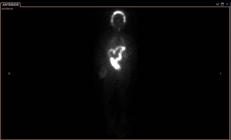
The main findings included radioiodine uptake in the anterior cervical region at level VI, slightly to the left of the midline, with an elongated appearance and mild intensity. Additionally, mild diffuse uptake of the radiotracer was identified in the lung fields. Image interpretation was challenging due to significant contamination of the scalp and hair, mild contamination of the right hip, and intense uptake from fecal matter accumulated in the intestines, as illustrated in Figure 3 .
Following radioiodine therapy (RAI), the patient returned to the institution twice for follow-up visits as of the writing of this article, with clinical progression indicating stable conditions and no evidence of recurrence underlying neuropathies, or chronic psychiatric conditions, assisting professionals (such as neurologists and psychiatrists) should be included in the pre-assessment process. Additionally, a more extended period of training and evaluation is recommended, as well as the consideration of alternative therapeutic options if the training does not achieve the necessary outcomes.
3.4. Limitations
The patient’s total dependence on a caregiver with cognitive and psychiatric limitations presents a major challenge to implementing radiation protection measures. To improve adherence in such cases, strategies like involving secondary caregivers or developing simplified, easy-to-understand protocols should be considered.
The emotional deterioration of the caregiver during hospitalization underscores the need to assess caregivers' coping abilities under stress. Offering psychological or psychiatric support during the hospital stay is recommended to help maintain the caregiver’s emotional stability, which is critical for both patient and staff safety.
External contamination (e.g., hair, feces) and poor adherence to post-discharge instructions may compromise the quality of follow-up imaging. To address this, stricter pre-exam protocols should be adopted, such as clearly repeating instructions in accessible language and verifying the comprehension of both patient and caregiver.
When patient and caregiver collaboration is limited, alternative therapeutic options should be evaluated. A thorough, multidisciplinary assessment is essential to identify candidates for different treatment modalities, ensuring safety and optimizing outcomes.
The CARE guidelines recommend that, when feasible, the perspective of the patient or caregiver regarding the experience of illness and treatment should be presented. In this case, however, it was not possible to obtain sufficient qualitative information. The caregiver initially reported feeling anxious upon entering the therapeutic room, but her mental health condition deteriorated significantly and rapidly during the hospitalization, limiting her communication with the healthcare team. As a result, no additional accounts regarding her experience during treatment, discharge, or return home could be collected.
Finally, comprehensive, personalized training for caregivers is strongly recommended. These programs should include radiation protection guidance, stress management techniques, practical simulations, and continuous monitoring throughout hospitalization to enhance treatment success and minimize associated risks.
4. CONCLUSIONS
Although all teams involved in the hospitalization worked diligently to anticipate problems, find solutions, and train the patient’s caregiver, the hospitalization was marked by several complications. These issues were directly related to the patient’s neurological conditions and the mother’s underlying psychiatric disorders, as the patient relied exclusively on her for activities of daily living.
During the whole body scan (WBS), significant contamination of the scalp, intestinal constipation with fecal accumulation, and small foci of radioiodine uptake in the cervical and pulmonary regions were observed. The mother’s sudden behavioral change, possibly exacerbated by stress and her cognitive deficits, suggests that post-discharge radiation protection guidelines were not adequately followed by the family.
Radioiodine therapy requires active collaboration from patients and caregivers, as well as involves risks associated with radiation exposure. In light of this, the involved teams suggest that, in similar cases where patients and/or caregivers have neurodevelopmental disorders, underlying neuropathies, or chronic psychiatric conditions, assisting professionals (such as neurologists and psychiatrists) should be included in the pre-assessment process. Additionally, a more extended period of training and evaluation is recommended, as well as the consideration of alternative therapeutic options if the training does not achieve the necessary outcomes.
ACKNOWLEDGMENTS
We thank our colleagues from Nuclear Medicine Department from National Cancer Institution who provided insight and expertise that greatly assisted this work.
INFORMED CONSENT STATEMENT
Written informed consent for publication of the clinical information presented in this case report was obtained from the patient’s legal guardian. Although this type of publication does not formally require informed consent at our institution, the signed document was collected and submitted to the journal as part of the submission files.
DATA AVAILABILITY STATEMENT
The authors declare that the data supporting the results of this study are available in the article. Derived data supporting the conclusions of this study are available upon request from the corresponding author.
REFERENCES
-
1 SUNG, H. et al. Global Cancer Statistics 2020: GLOBOCAN Estimates of Incidence and Mortality Worldwide for 36 Cancers in 185 Countries. CA: a cancer journal for clinicians, v. 71, n. 3, p. 209-249, maio 2021. https://doi.org/10.3322/caac.21660
» https://doi.org/10.3322/caac.21660 -
2 BALOCH, Z. W. et al. Overview of the 2022 WHO Classification of Thyroid Neoplasms. Endocrine Pathology, v. 33, n. 1, p. 27-63, mar. 2022. https://doi.org/10.1007/s12022-022-09707-3
» https://doi.org/10.1007/s12022-022-09707-3 -
3 BRASIL. Instituto Nacional de Câncer, Estimativa 2023: incidência de câncer no Brasil. Rio de Janeiro, RJ: Instituto Nacional De Câncer, 31 mar. 2023. Disponível em: <https://www.inca.gov.br/sites/ufu.sti.inca.local/files/media/document/estimativa-2023.pdf>. Acesso em: 30 set. 2024.
» https://www.inca.gov.br/sites/ufu.sti.inca.local/files/media/document/estimativa-2023.pdf -
4 CHANDEKAR, K. R.; SATAPATHY, S.; BAL, C. Impact of radioiodine therapy on recurrence and survival outcomes in intermediate-risk papillary thyroid carcinoma -A systematic review and meta-analysis. Clinical Endocrinology, v. 100, n. 2, p. 181-191, 2023. https://doi.org/10.1111/cen.15001
» https://doi.org/10.1111/cen.15001 -
5 SPARANO, C. et al. Strategies for Radioiodine Treatment: What's New. Cancers, v. 14, n. 15, p. 3800, 4 ago. 2022. https://doi.org/10.3390/cancers14153800
» https://doi.org/10.3390/cancers14153800 -
6 SCUFFHAM, J. W. et al. Radioiodine retention on percutaneous endoscopic gastrostomy tubes. The British Journal of Radiology, v. 85, n. 1012, p. e76-e78, abr. 2012. https://doi.org/10.1259/bjr/20832147
» https://doi.org/10.1259/bjr/20832147 -
7 WANG, X. et al. The benefits of radioactive iodine ablation for patients with intermediate-risk papillary thyroid cancer. PLOS ONE, v. 15, n. 6, p. e0234843, 15 jun. 2020. https://doi.org/10.1371/journal.pone.0234843
» https://doi.org/10.1371/journal.pone.0234843 -
8 BIBBO, G. et al. Radioiodine (131I) therapy in a child with autism spectrum disorder: A complex and demanding task. World Journal of Nuclear Medicine, v. 18, n. 03, p. 293-295, jul. 2019. https://doi.org/10.4103/wjnm.WJNM_40_18
» https://doi.org/10.4103/wjnm.WJNM_40_18 -
9 GAGNIER, J. J. et al. The CARE guidelines: consensus-based clinical case report guideline development. Journal of Clinical Epidemiology, v. 67, n. 1, p. 46-51, jan. 2014. https://doi.org/10.1016/j.jclinepi.2013.08.003
» https://doi.org/10.1016/j.jclinepi.2013.08.003 -
10 AMERICAN THYROID ASSOCIATION. Management Guidelines for Children with Thyroid Nodules and Differentiated Thyroid Cancer: The American Thyroid Association Guidelines Task Force on Pediatric Thyroid Cancer. Thyroid, v. 25, n. 7, p. 716-759, jul. 2015. https://doi.org/10.1089/thy.2014.0460
» https://doi.org/10.1089/thy.2014.0460 -
11 LEBBINK, C. A. et al. 2022 European Thyroid Association Guidelines for the management of pediatric thyroid nodules and differentiated thyroid carcinoma. European Thyroid Journal, v. 11, n. 6, p. e220146, 1 dez. 2022. https://doi.org/10.1530/ETJ-22-0146
» https://doi.org/10.1530/ETJ-22-0146
Edited by
-
SCIENTIFIC EDITOR:
Prof. Dr. Bernardo Maranhão DantasProf. Dr. Alfredo Lopes Ferreira Filho

 Clinical timeline of patient tests and procedures from T0 to T300.
 Graph of dose rate over time during hospitalization.
 Whole body scan image showing radiotracer uptake and contamination.